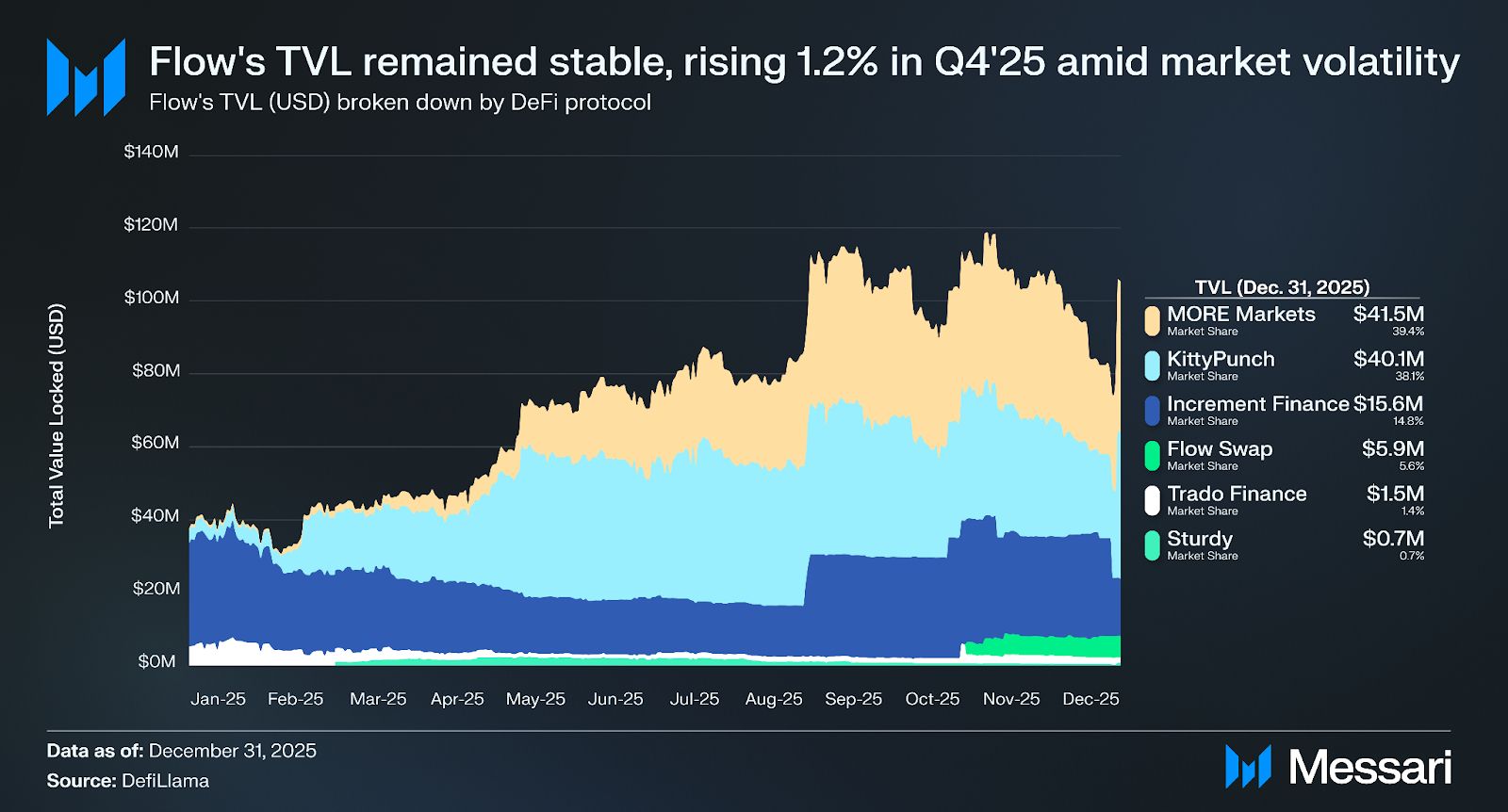
DeFi TVL held at $104.1 million, increasing 1.2% QoQ despite the market decline, as MORE Markets and KittyPunch each grew roughly 10% and together accounted for 77.5% of Flow's DeFi TVL by quarter-end.
The Forte upgrade went live on mainnet on Oct. 22, 2025, introducing workflows, scheduled transactions, and enshrined protocols. Peak Money by Dapper Labs is the first protocol to use these new tools, giving developers onchain automation primitives to build consumer DeFi products without offchain infrastructure.
The December 2025 security exploit forced an unplanned stress test of Flow's governance and incident response. The network was offline for 48 hours before the team executed an Isolated Recovery Plan, restoring full operations with no loss of user assets.
Stablecoin circulating supply contracted 38.3% QoQ to $25.2 million, driven primarily by PayPal consolidating PYUSD liquidity on Solana and Ethereum.
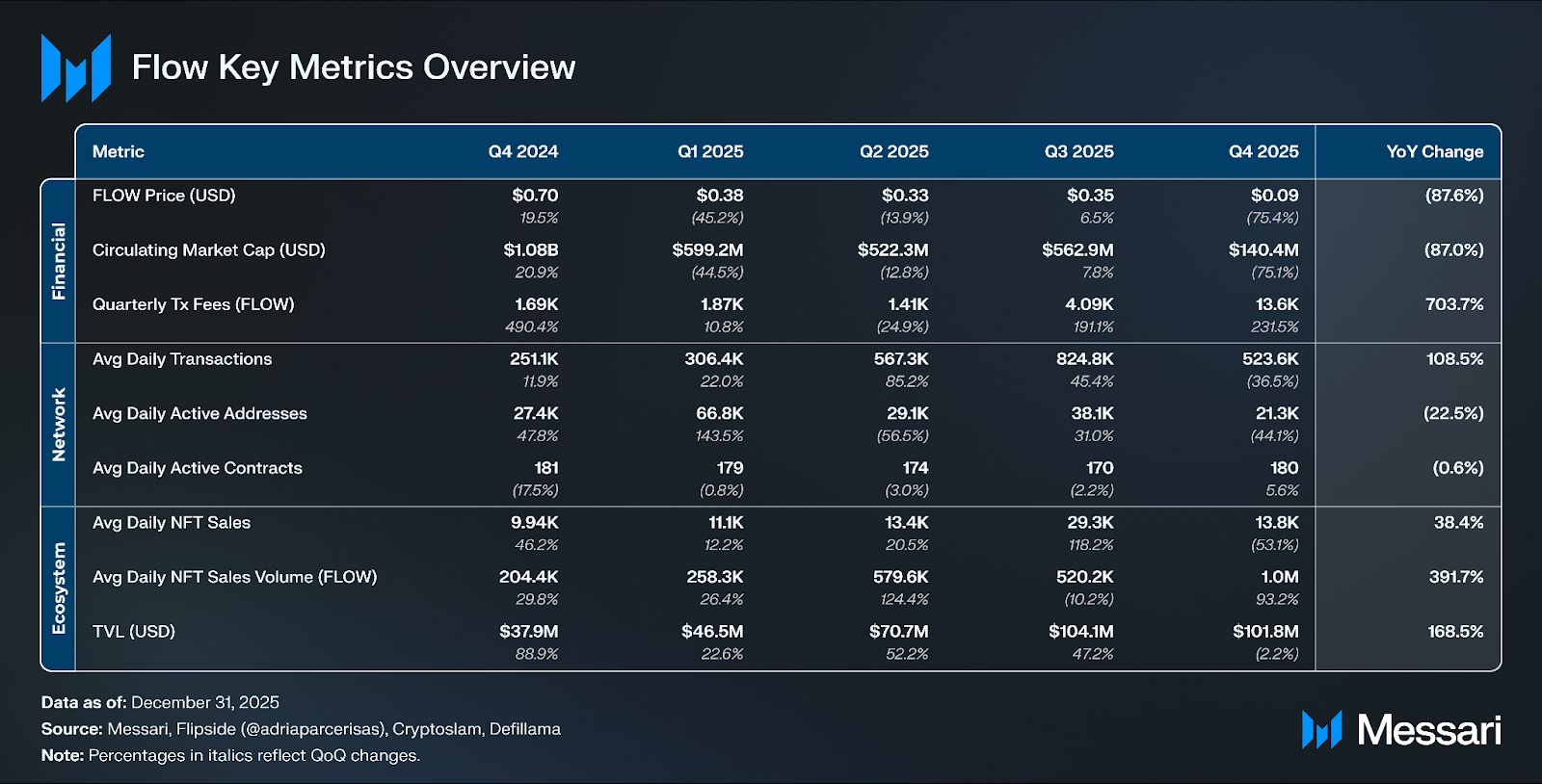
FLOW's price fell 75.4% QoQ to $0.09, bringing the circulating market cap down 75.1% to $140.4 million, as the Dec. 27, 2025, security exploit compounded broader market weakness and triggered exchange withdrawal halts across multiple platforms.
On Flow, developers use “Cadence,” a novel resource-oriented programming language designed for smart contracts. It enforces ownership and type safety at the language level, helping prevent common vulnerabilities in contract logic. In September 2024, Flow introduced the Crescendo upgrade, launching EVM equivalence on Flow via Flow EVM, and bringing Cadence to maturity with the Cadence 1.0 release. Now, developers can use Solidity to build on Flow EVM with block times of 800 milliseconds. Furthermore, developers can tap into existing tools and liquidity across the EVM, while users experience sub-cent transaction fees.
Flow’s most recent development occurred in October 2025 when the Forte upgrade was activated on mainnet. This upgrade introduced Actions, enabling onchain automation without requiring extensive custom code. Actions are composable operations, such as swaps and loans, that can be combined into multi-step workflows. By eliminating the need for offchain infrastructure and relayers, Forte strengthens developer composability and positions Flow for AI-driven applications. The upgrade also reduced hardware requirements for node operators and launched alongside the Forte Hacks hackathon, which offered a $250,000 prize pool, marking Flow's most significant protocol advancement since Crescendo.
Flow has played a significant role in onboarding consumers into crypto by pioneering the ERC-721 (non-fungible) token standard via CryptoKitties in 2017 and putting NFT collectibles into the mainstream via NBA Top Shot in 2021. In 2023, Disney and Dapper Labs launched Disney Pinnacle on Flow, a digital pin marketplace featuring Disney, Pixar, and Star Wars IP, furthering Flow’s consumer reach. Today, Flow is expanding its foundation in consumer applications into programmable consumer finance, building on years of experience operating products with millions of users and real transaction volume. Flow's community validator set includes institutional node operators such as Coinbase, Deutsche Telekom, Samsung, and Ubisoft. For a full primer on Flow, refer to our Initiation of Coverage.
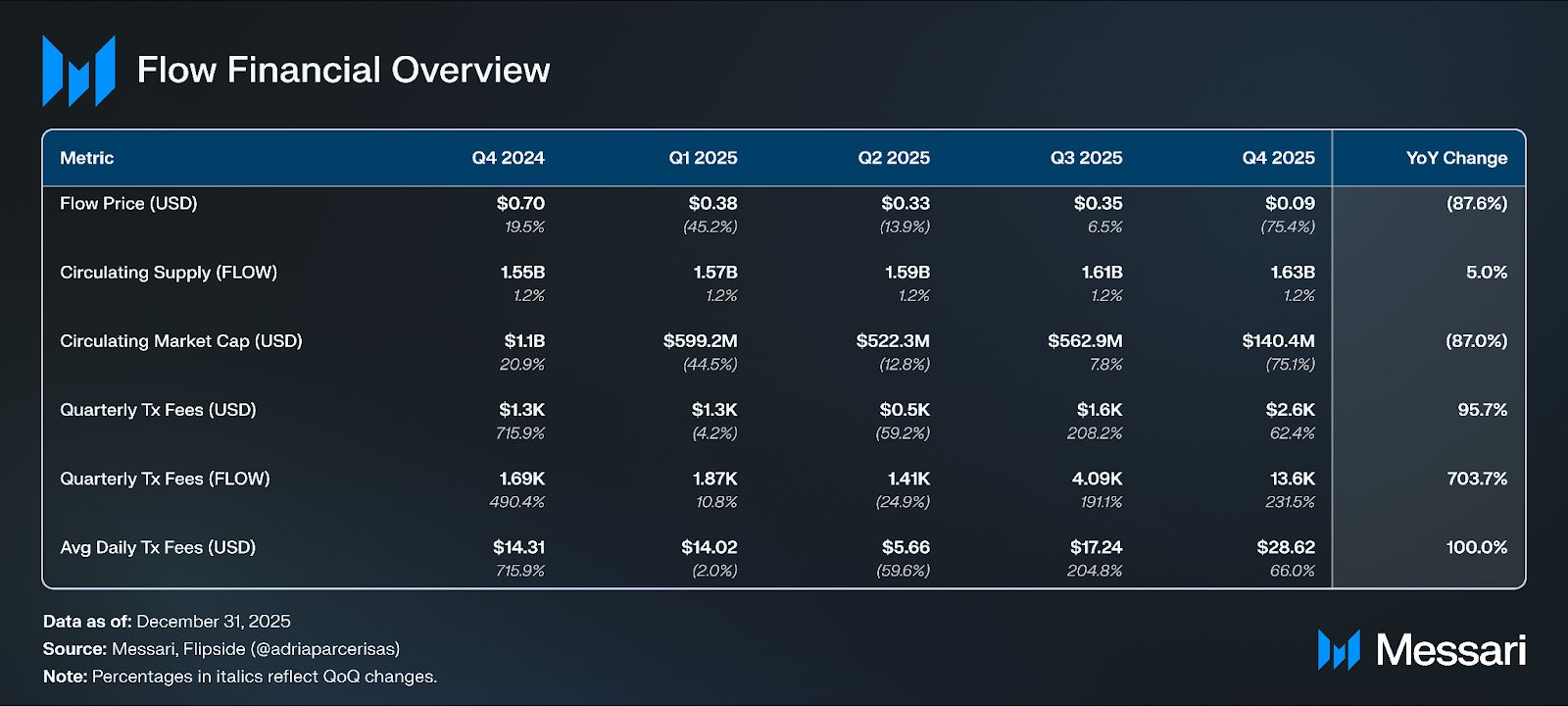
FLOW is the native token of Flow that is used (i) as the primary medium of exchange on Flow and (ii) for staking to facilitate various staking-related functions. In Q4 2025, FLOW's price fell 75.4% QoQ to $0.09. A significant portion of the drop occurred during the December 2025 security exploit and may not reflect Flow’s fundamentals.
The decline caused the circulating market capitalization to drop by 75.1% to $140.4 million, while circulating supply rose 1.2% to 1.63 billion FLOW in line with the protocol's weekly inflation schedule. As Flow’s fee and inflation mechanics mature, the focus is shifting from subsidized activity toward usage that supports sustainable, recurring flows, such as automated payouts or savings strategies. FLOW's circulating market cap ranking fell from 116th to 178th.
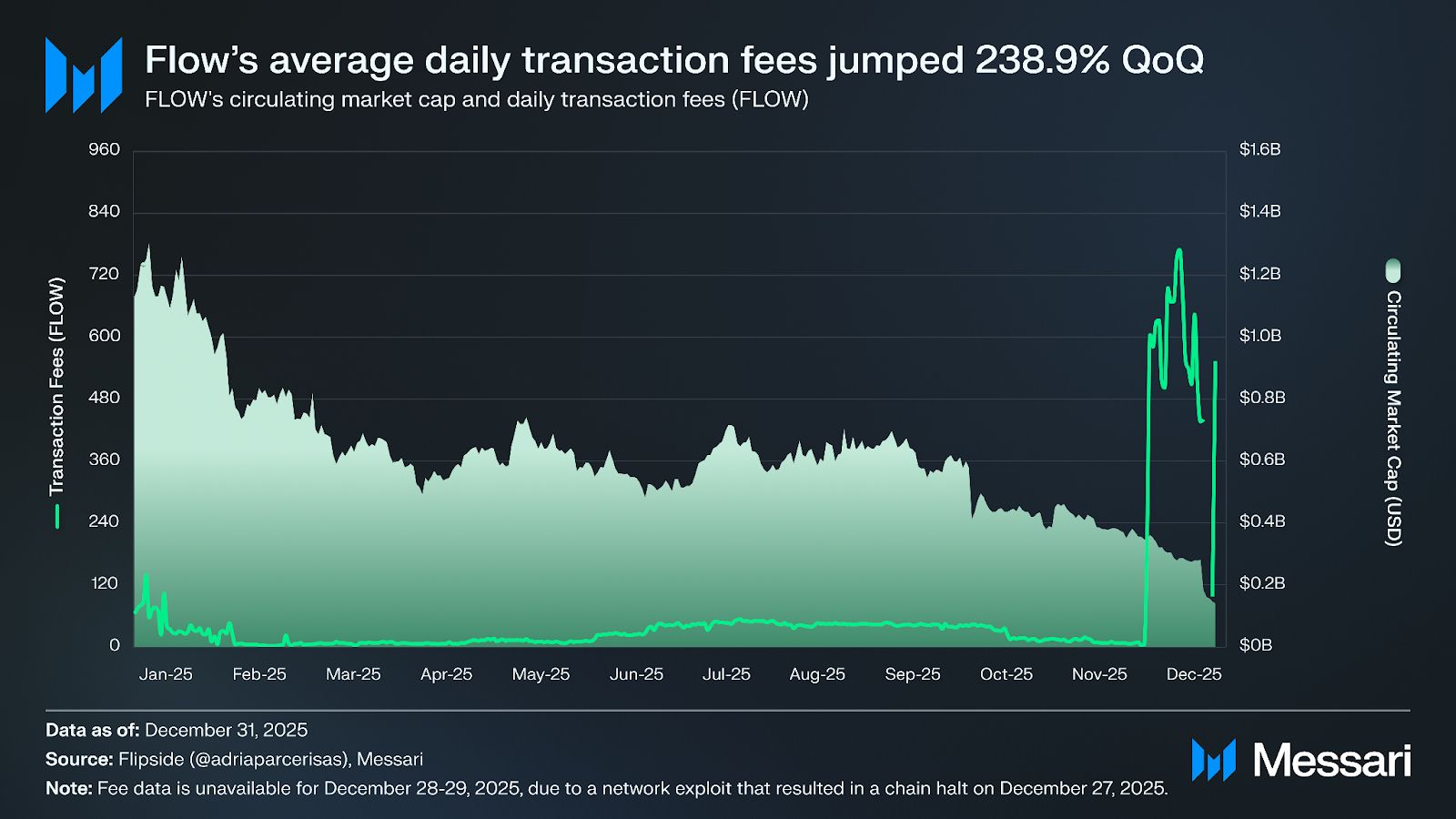
FLOW is used to settle network transaction fees on Flow. The total transaction fee for any transaction on Flow comprises a variable “execution fee” plus a fixed “inclusion fee,” which is then multiplied by a “surge factor”. Total quarterly fees in USD jumped 62.4% QoQ to $2,580, and fees in FLOW increased 231.5% QoQ to 13,570. Additionally, the median daily fee in USD climbed 123.8% to $3.79, and the median daily fee in FLOW increased by 222.8% QoQ to 14.4 FLOW. Two factors drove the fee increase. First, the Forte mainnet launch on Oct. 22, 2025, introduced protocol-native building blocks that enable multi-step workflows and onchain scheduling. These features naturally increase the compute intensity of the average transaction as DeFi protocols began composing more complex workflows into single calls. Second, a network-wide fee update (FLIP 351) went live on Dec. 8, 2025, linking transaction fees to network usage with the goal of making FLOW deflationary at a sustained 250 TPS. The fee model is designed to scale alongside the consumer DeFi throughput that Forte enables, and as products like FCM and Peak Money drive higher transaction volumes, fee burns should accelerate. Fees remained under $20 per day through October and November 2025, but spiked to approximately $146 on Dec. 9, 2025, following the adjustment. Notably, the team delivered 1,247 TPS on mainnet, proving the network is sustainable for consumer apps that want to scale.
FLOW’s initial token supply was 1.25 billion upon Flow’s “Mainnet V1” launch in October 2020. However, the total token supply increases once per epoch (approximately once a week) due to staking rewards distributed to Flow’s validator nodes and delegators. Inflation over an annual period equals 5% of FLOW’s total token supply.
As explained in our Initiation of Coverage, combined weekly staking rewards comprise all network transaction fees, with any remaining amount being minted as inflationary staking rewards.
Stakers, including validator nodes that have self-staked, receive 92% of weekly staking rewards proportional to their stake.
Validator nodes also receive 8% of weekly staking rewards as commission.
As of Dec. 31, 2025, FLOW’s total token supply has increased to 1.63 billion, and weekly inflation equates to approximately 1.47 million FLOW per week.
Ecosystem Analysis
Consumer
Flow’s consumer identity remains anchored in sports, entertainment, and collectibles. Q4 coincided with the heart of the 2025–26 NBA season and the NFL regular season, which provided a steady cadence of content drops across Dapper Labs’ three flagship apps. NBA Top Shot launched its 2025–26 collection in October 2025 with autograph and signature collectibles, alongside reduced mint counts across Common, Rare, and Legendary tiers. NFL All Day entered another big season with autographed collectibles, three new free-to-play game modes, and in-stadium activations with four NFL teams launching in late Q3 and accelerating activity in Q4’25. Disney Pinnacle ran multiple pin releases through the quarter, including Inside Out 2, Star Wars Alphabet, and Lady and the Tramp sets, and collaborated with Hilton Anaheim on a real-world scavenger hunt using digital collectibles. Metaverse Football League continued regular in-game drops and was featured as a challenge track in the Forte Hacks hackathon.
Beyond these flagship apps, TicketMaster has now minted and distributed over 100 million NFTs on Flow, onboarding more than 13 million fans, most of whom do not even know they are using a blockchain. At this scale, Flow's consumer layer operates less as a crypto application platform and more as embedded infrastructure for mainstream digital experiences.
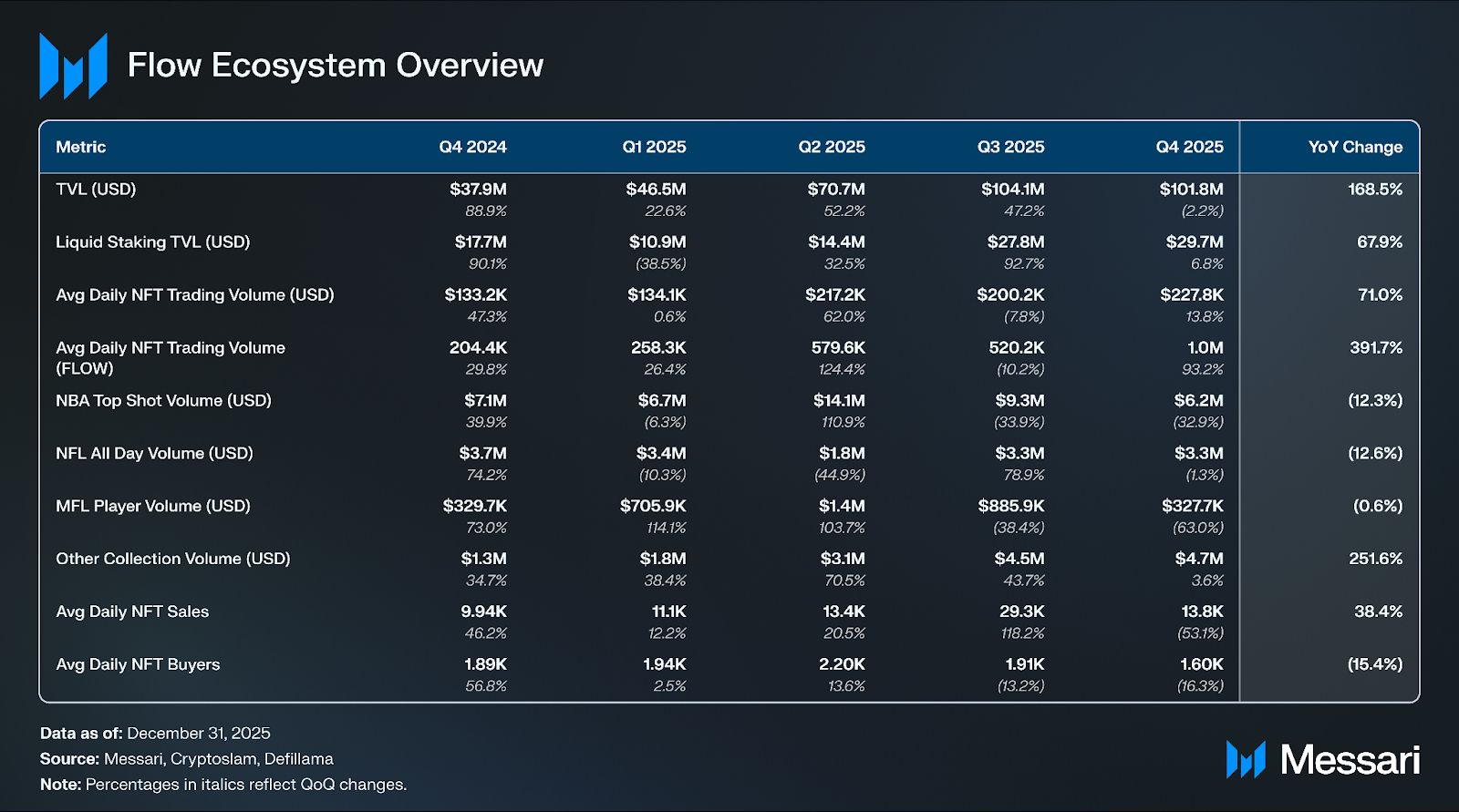
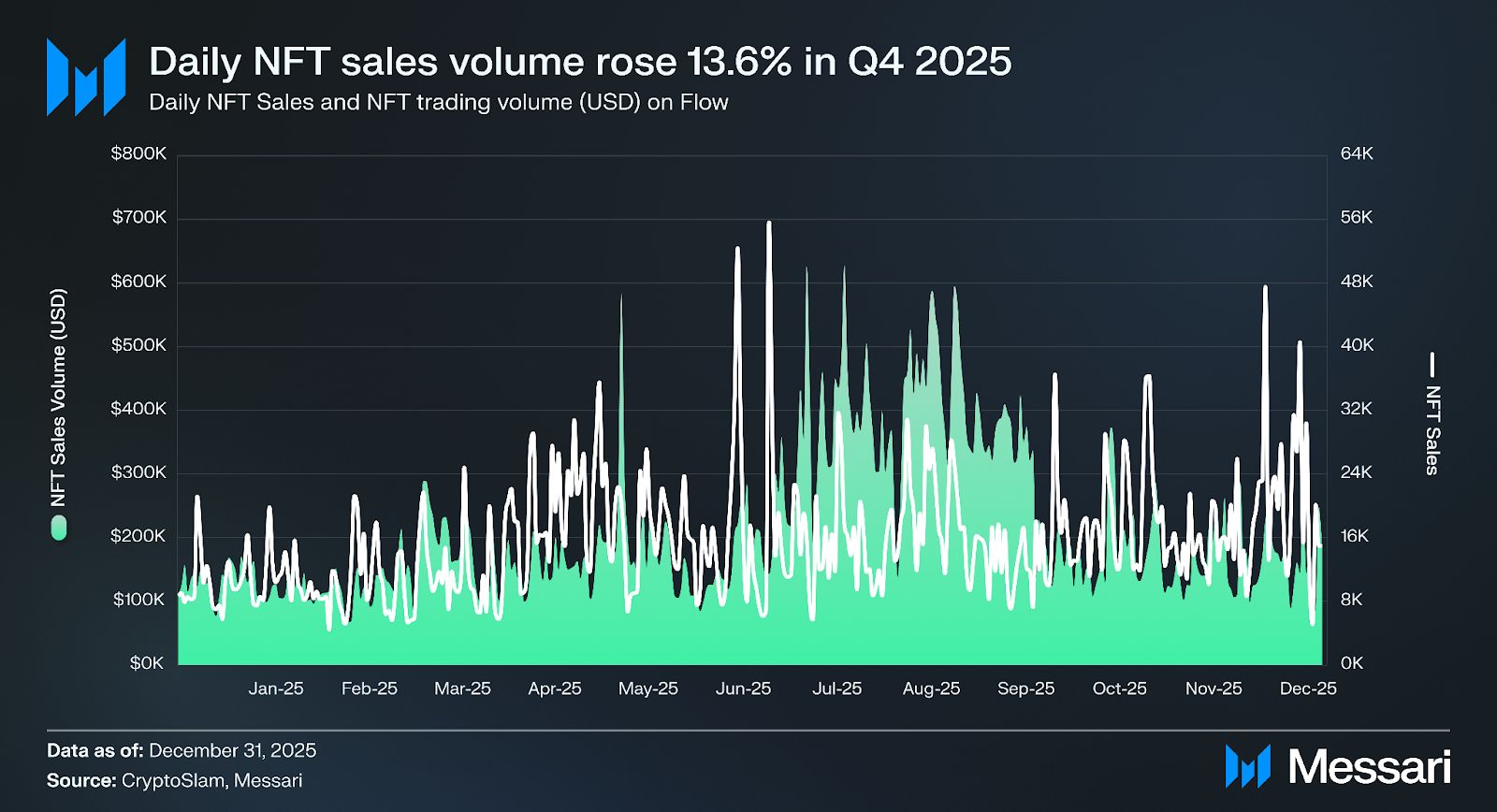
The NFT ecosystem on Flow is the most active sector on the network. An interesting trend worth noting in Q4 was the continued divergence between NFT sales and USD volume metrics. While USD-denominated volume increased only 13.6% to $197,020, NFT sales declined by 53.4% QoQ to 13,720, as targeted events drove a significant increase in onchain activity. The divergence in Q4’25 between rising USD volume and falling sales counts reversed the pattern seen in Q3. NBA Top Shot’s shift toward scarcity-driven collectibles, with lower mint counts and premium autograph and signature tiers, lifted the average price per sale. NFL All Day similarly introduced additional autographed collectibles, featuring verified digital signatures from stars like Cam Ward and Travis Hunter, which command higher price points than standard highlight clips. Meanwhile, Disney Pinnacle’s Q4 releases also shifted toward limited-edition sets rather than the high-frequency marketplace trading events that characterized Q3’25. The net effect was fewer individual sales at higher average values, consistent with a collector base willing to pay more per item as platforms shifted from volume-driven engagement to scarcity-based drops.
This trend mirrors a broader market movement toward unique and ultra-scarce assets, exemplified by Logan Paul's PSA 10 Pikachu Illustrator card selling for $16.5 million at a Goldin auction in February 2026. Flow's NFT platforms are pursuing the same thesis at a different price point: reducing mint counts and attaching real-world authenticity markers like verified autographs to digital collectibles, betting that fewer items at a higher value per unit is a more sustainable model than mass-minted commodity drops.
DeFi
Flow's DeFi TVL remained stable, increasing only 1.2% QoQ to $104.1 million. MORE Markets and KittyPunch each grew roughly 10% QoQ and together accounted for 77.5% of Flow’s DeFi TVL by quarter-end, while Increment Finance lost nearly half its TVL. The quarter also marked a strategic shift in early December 2025. The Flow Foundation introduced enshrined protocols, starting with Flow Credit Market (FCM), a lending protocol that uses Forte’s native onchain scheduler to automate rebalancing and compounding. Dapper Labs simultaneously announced Peak Money, a consumer finance app designed to route mainstream users into FCM’s yield strategies. The combined signal is that Flow is treating DeFi infrastructure as a network-level liquidity source rather than leaving bootstrapping entirely to third-party developers. This is the clearest evidence yet of Flow’s strategic expansion into consumer DeFi, leveraging its existing consumer base as a built-in distribution channel for savings, credit, and payment products. A robust DeFi ecosystem is a prerequisite for consumer finance on Flow, because lending, leverage, and AMMs generate the yield and liquidity needed to support savings, payments, and investment products.
MORE Markets: A borrowing and lending protocol on Flow EVM.
MORE Markets continued to hold the top spot it took from KittyPunch in Q3’25 as the largest DeFi destination on Flow. Its TVL climbed from $37.6 million to $41.5 million, a 10.4% increase that lifted its share of Flow TVL to 39.4%.
MORE continued expanding its vault infrastructure in Q4 with ERC-4626 and EIP-7540 compatible MORE Vaults that support both synchronous and asynchronous deposit flows. The vault architecture went live in production, enabling strategy deployments on top of MORE’s core money markets. With Forte’s onchain scheduling now available, vault strategies can execute automated rebalancing without external keepers, which positions MORE as a natural liquidity destination for the newly announced FCM and Peak Money ecosystem.
KittyPunch: A full-suite DeFi protocol that launched on Flow EVM on Sept. 8, 2024. KittyPunch offers (i) a spot DEX (PunchSwap), (ii) a stableswap DEX (StableKitty), (iii) a spot DEX aggregator (AggroKitty), (iv) a token launchpad (Trenches), (v) an NFT marketplace (Hoard), (vi) a bridge powered by deBridge, and (vii) a volatility protocol (PunchVIX).
KittyPunch ended Q4 with $40.1 million in TVL, a 9.3% increase from the previous quarter. Its market share increased from 35.3% to 38.1% of the network's total market share, accounting for 77.5% of overall DeFi TVL alongside MORE markets.
KittyPunch’s growth in Q4 continued to be driven by PunchVIX volatility farming and PunchSwap’s position as the primary spot DEX on Flow EVM. The project’s growing product surface supports Flow’s consumer DeFi shift as AggroKitty provides the DEX routing layer that consumer-facing products like Peak Money need to execute swaps on behalf of retail users without exposing them to pool selection.
Increment Finance: Increment is a full-suite protocol allowing trading, lending/borrowing, liquid staking, farming, and a points program.
Increment closed Q4 with $15.6 million in TVL, a 43.6% decline from Q3’25. As a result, its market share fell from 26.6% to 14.8%.
The 43.6% decline in TVL likely reflects the winding down of Increment’s in-app points program, which had been a primary incentive for depositors since early 2025. Although there was no official announcement, the points dashboard has not been updated in 4 months. As the program’s rewards tapered, capital rotated toward MORE Markets and KittyPunch, both of which offered many active yield opportunities. Notably, Increment’s stFLOW liquid staking product moved in the opposite direction of its broader TVL, with stFLOW growing to $28.1 million by quarter-end. The divergence suggests that while farming-oriented deposits left, staking demand remained. stFLOW’s composability as a base yield asset across MORE, KittyPunch, and eventually FCM makes it a core building block of the consumer DeFi stack, regardless of Increment’s own TVL trajectory.
FlowSwap: A decentralized exchange on Flow EVM offering token swaps and liquidity pools.
FlowSwap launched in November 2025 and finished Q4 with $5.9 million in TVL, capturing 5.6% of Flow's overall TVL in its first active quarter.
FlowSwap’s initial TVL likely benefited from timing. Launching just after the Forte upgrade gave it access to the wave of developer and user activity that followed, while the Forte Hacks hackathon created a natural funnel for new protocols seeking swap infrastructure. As one of the newer DEX entrants on Flow EVM, FlowSwap may also have attracted users seeking early-mover incentives.
Trado Finance: A spot and perpetual decentralized exchange (DEX) on Flow EVM.
Trado ended Q4 with $1.5 million in TVL, a 14.1% increase from the previous quarter. Its share of Flow liquidity remained unchanged at 1.4%. The modest rebound in Trado’s TVL in Q4’25 coincided with continued spot and perpetual trading activity on the platform. Trado surpassed $15.7 million in cumulative swap volume in 2025, and its liquidity model offers a differentiated trading experience compared to AMM-only DEXs on Flow. The 14.1% increase in TVL broke a multi-quarter downtrend for Trado, suggesting it has built a core user base.
Liquid Staking & Stablecoins
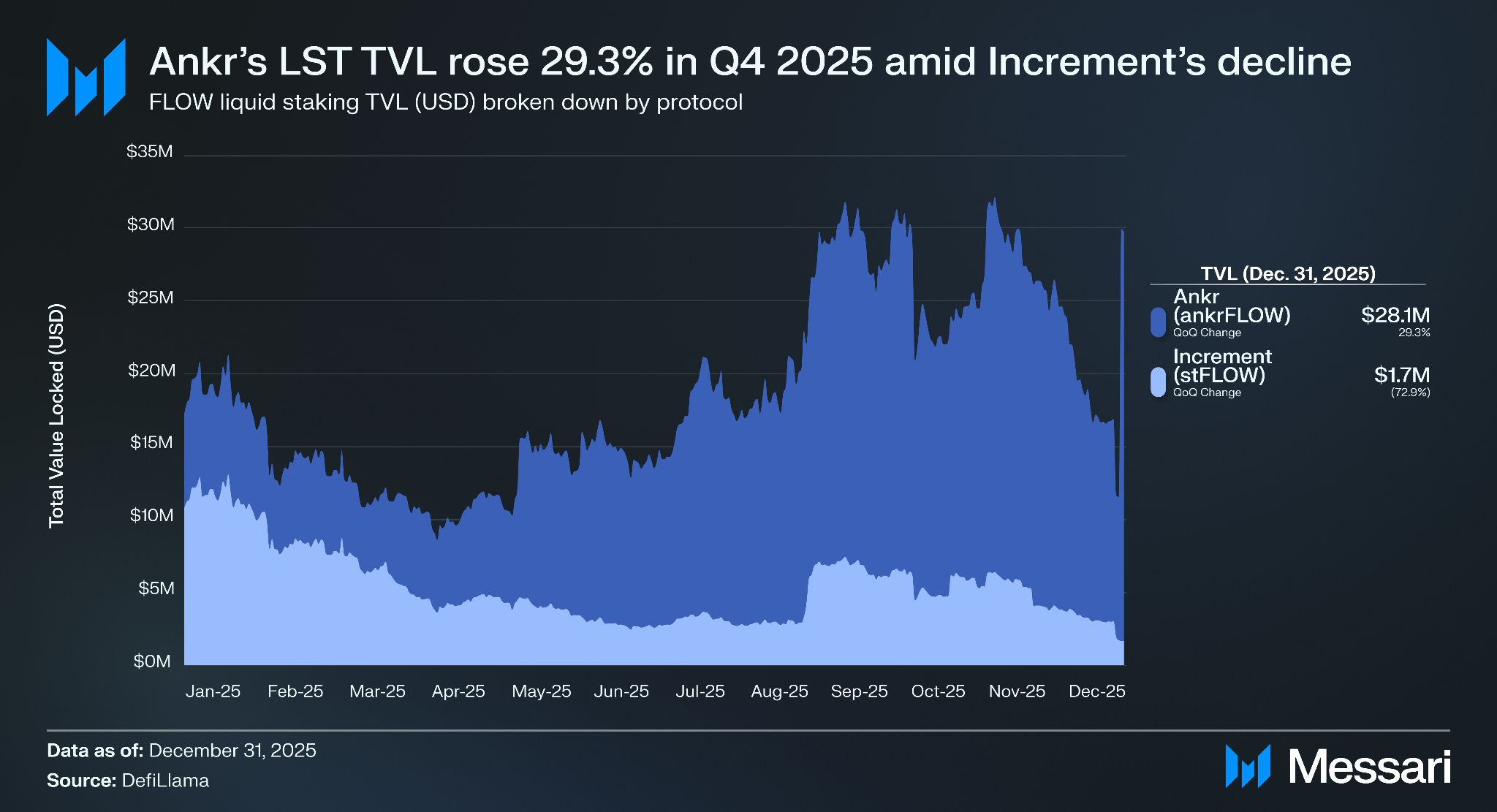
The total value of liquid staking tokens (LSTs) on Flow continued to rebound from the lows seen in Q3’25, increasing 6.8% QoQ from $27.8 million to $29.7 million. LSTs saw a continued consolidation into ankrFLOW, with Ankr’s market share increasing from 78% at Q3-end to 94.4% at Q4-end. With Forte actions and workflows now live on mainnet, LSTs gained direct utility as base collateral for automated DeFi workflows. ankrFLOW is the most likely candidate for yield-bearing balance products that Peak Money would offer retail users. For example, a savings account where the user sees an APY and stFLOW handles delegation and compounding underneath.
As a result, the primary driver of growth was Ankr’s ankrFLOW, which increased its TVL to $28.1 million, maintaining its position as the dominant LST on the network. Increment’s stFLOW fell 72.9% QoQ to $1.7 million, causing its market share to decline to 5.6% from 22.0% by the end of the quarter. While Increment did not discontinue service on Flow, ankrFLOW offered deeper DeFi composability across MORE Markets, KittyPunch, and Increment’s own AMM pools. This consolidation is actually constructive for Flow’s roadmap as a single dominant LST simplifies integration for downstream products. When FCM and Peak Money route user deposits into staking yield, they can rely on a single liquid, well-integrated asset rather than splitting across multiple LST providers with varying liquidity profiles.
Despite a challenging end to the year, the Flow ecosystem reached a significant milestone in 2025 with the successful integration of PayPal’s PYUSD. The addition of a top-tier institutional stablecoin fundamentally strengthened Flow’s consumer DeFi layer, providing users with a highly regulated and trusted on-ramp.
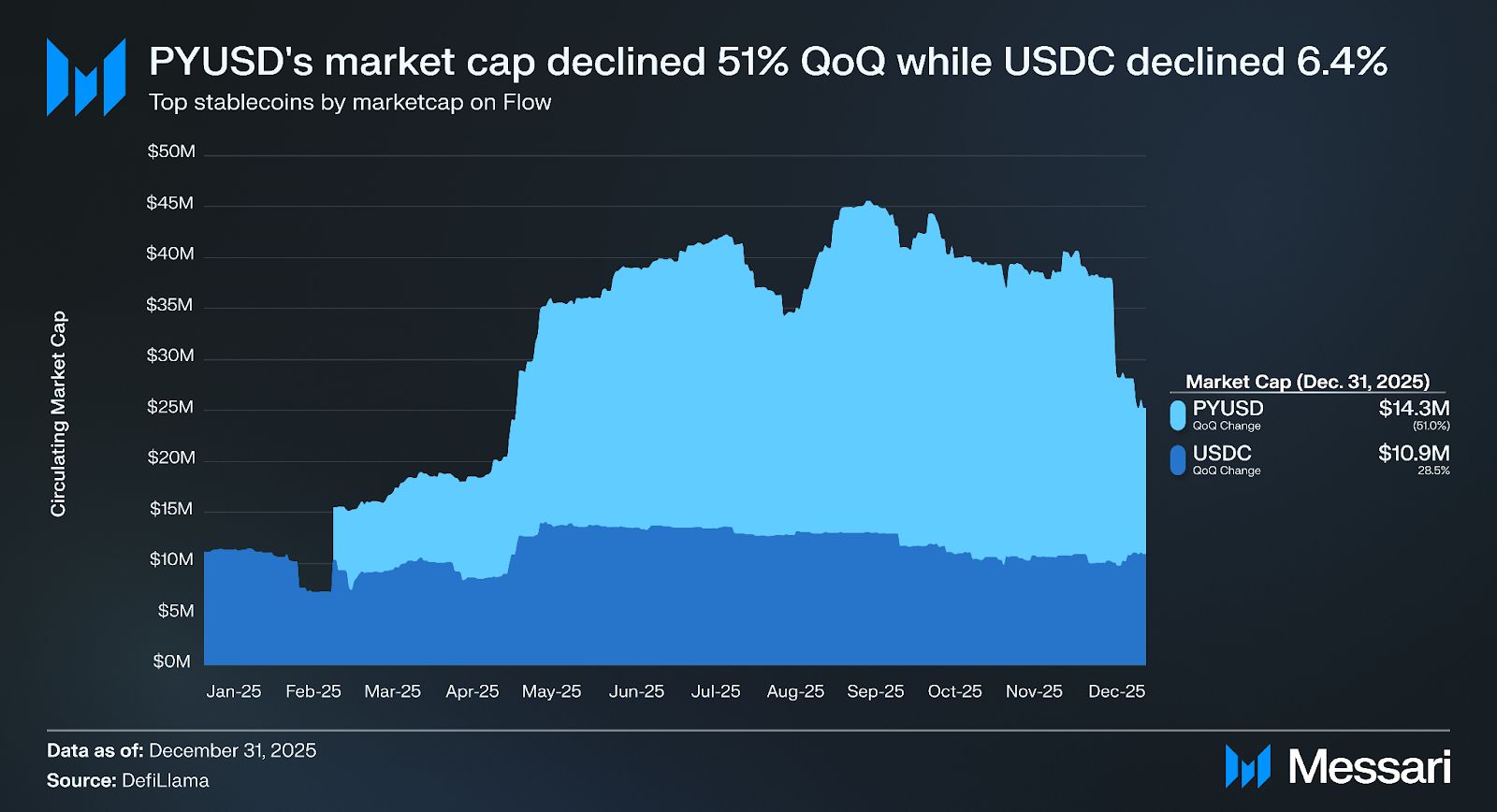
The circulating supply of stablecoins on Flow declined 38.3% QoQ, from $40.9 million at the end of Q3 to $25.2 million at the end of Q4 2025. The decline was led by PayPal’s stablecoin, PYUSD (USDF on Flow), which fell from $29.3 million to $14.3 million. The December 2025 security incident drove much of the decline, as holders bridged stablecoins off the network in the aftermath.
PYUSD’s circulating supply fell from $29.3 million to $14.3 million by the end of Q4, capturing 56.8% of the total stablecoin market share on Flow. Meanwhile, the supply of the long-standing stablecoin, USDC, declined by 6.4% to $10.9 million. As a result of PYUSD’s larger decline, USDC's market share increased from 28.5% to 48.3%. For consumer DeFi, stablecoin reliability matters more than issuer diversity as USDC’s increased share actually simplifies the denominator for savings products, similar to how stFLOW does with LSTs. Products can quote yields in a single, widely trusted unit of account rather than managing multi-stablecoin exposure. However, if Flow’s consumer finance layer becomes primarily USDC-denominated, it will inherit Circle’s policy and redemption dependencies.
Cross-Chain Messaging & Bridges
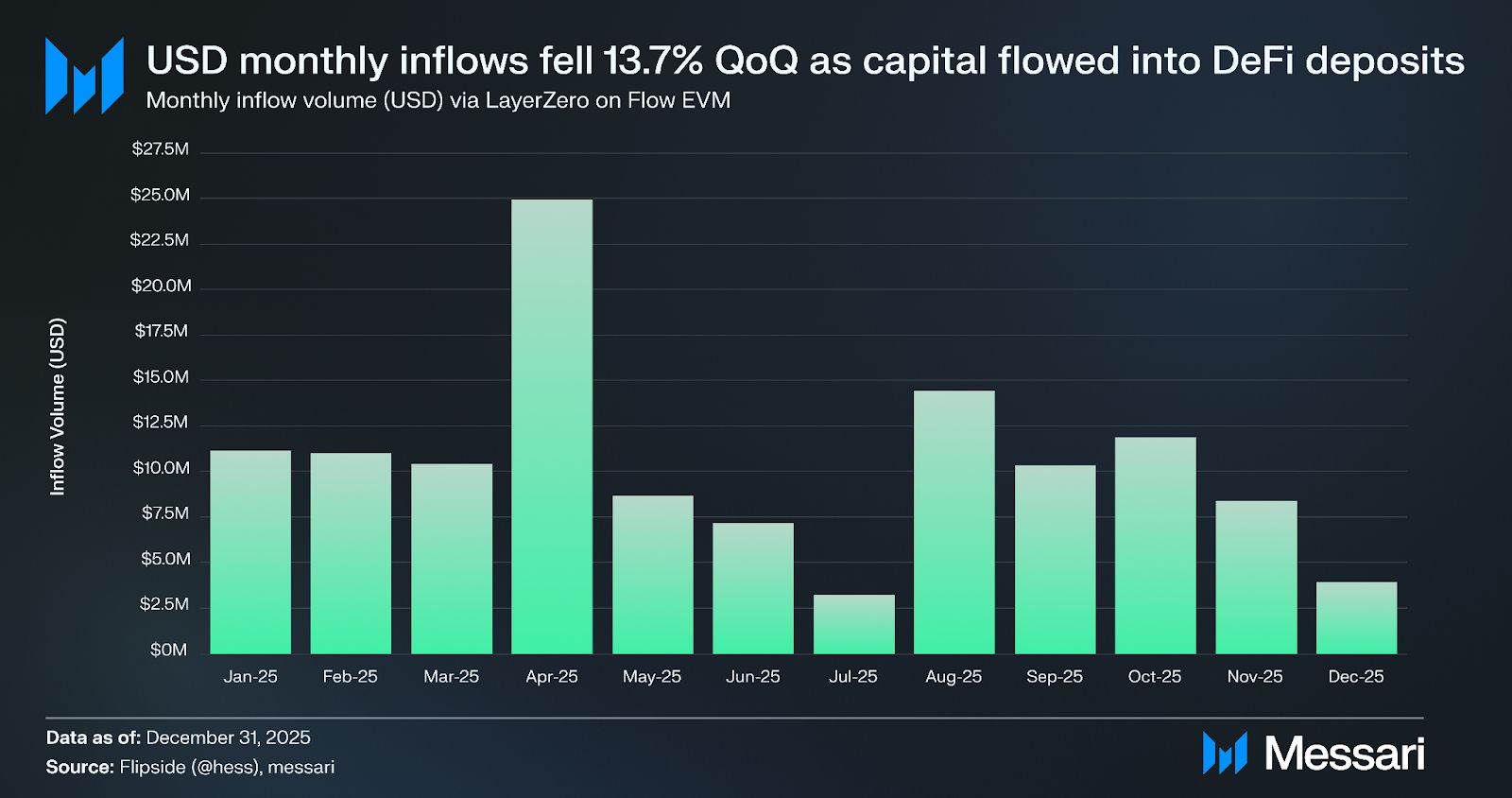
Average daily transactions on Flow EVM decreased 30.1% QoQ to 198,870, building on the levels seen at the end of Q2 following LayerZero’s integration in February 2025. Inflows through LayerZero averaged $383,550 per day, a 52.5% QoQ increase from $251,450. The divergence between declining EVM transactions and rising LayerZero inflows suggests that cross-chain capital was flowing into DeFi deposits rather than into high-frequency trading activity, in line with Flow’s new direction. MORE Markets and KittyPunch, which together held 77.5% of Flow’s DeFi TVL by quarter-end, both accept bridged stablecoins as collateral. Stargate’s USDF routing made it easier to move stablecoin liquidity into Flow EVM from Ethereum and Solana, meaning the inflow uptick likely reflects increased DeFi positioning rather than retail transaction volume. LayerZero’s growing adoption validates that this bridge infrastructure enables products like Peak Money to onboard user deposits from other chains without requiring manual bridging steps.
Development, Growth, and Community
Builder Enablement
After Forte went live on Oct. 22, 2025, developer enablement shifted from pre-launch preparation to production onboarding. Flow published mainnet-ready guides for actions and workflows, replacing the testnet-only tutorials from Q3’25. Flow also expanded its AI tooling surface in Q4’25 with an MCP (Model Context Protocol) integration, letting developers query onchain state and compose transactions through AI-assisted workflows. The Hardhat and Foundry quickstart guides were also updated in November 2025 to reflect post-Forte contract patterns. Lastly, the team upgraded their React SDK, creating a seamless workflow for developers building React apps.
Hackathons
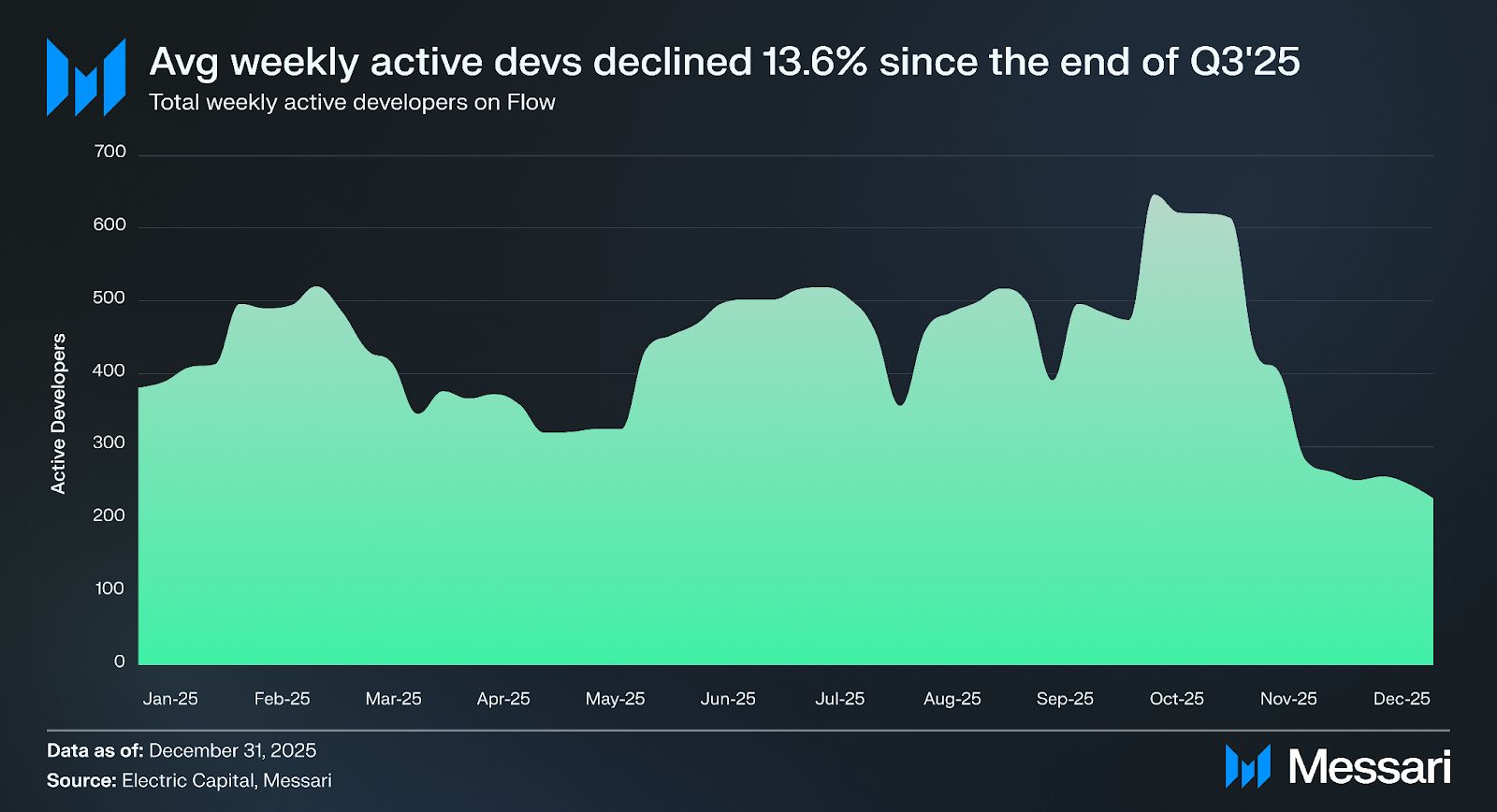
Average weekly active developer count fell 13.6% to 411 since the end of Q3’25. The Q4 decline in weekly active developers followed the conclusion of Q3’s concentrated hackathon cycle, including three ETHGlobal events and a ReWTF sprint. Q4’s primary builder event was Forte Hacks, Flow’s flagship hackathon tied to the Forte mainnet launch. The event drew over 3,300 registered builders and produced more than 400 project submissions across tracks sponsored by Disney, Dune Analytics, Dapper Labs, and others, with a total prize pool of $250,000. The scale of Forte Hacks was significant, but its format concentrated commit activity into a narrower window than previous hackathons that ran alongside multi-day in-person events. Combined with the natural post-hackathon lull at year-end, this timing pattern explains the QoQ decline in the weekly average without indicating an actual loss of developer interest. Overall, 2025 was still the highest year for developer activity in Flow's history (per Electric Capital).
Several Forte Hacks submissions moved into production after the event, with winning projects spanning consumer DeFi, AI agents, and onchain gaming. The combination of Forte Hacks output and post-hackathon project maturation should feed into early 2026 deployment activity.
Network Analysis
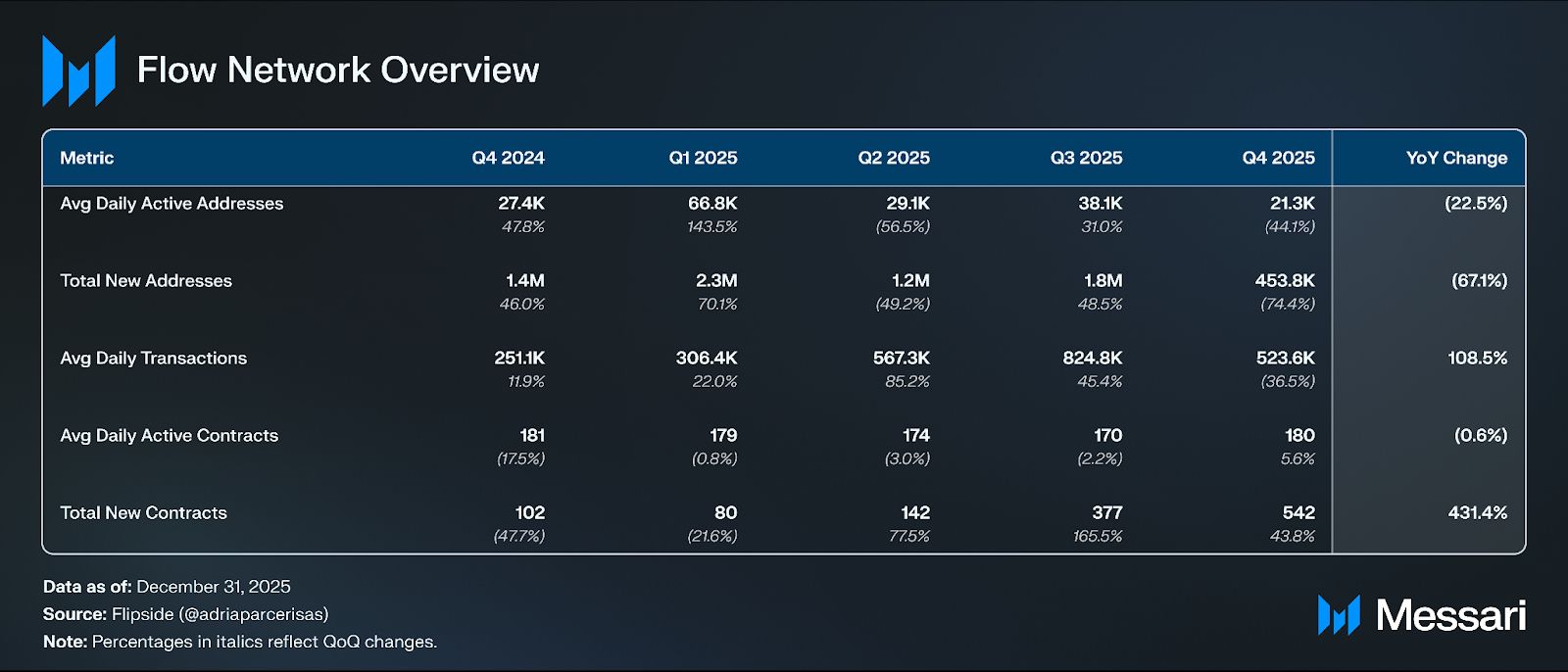
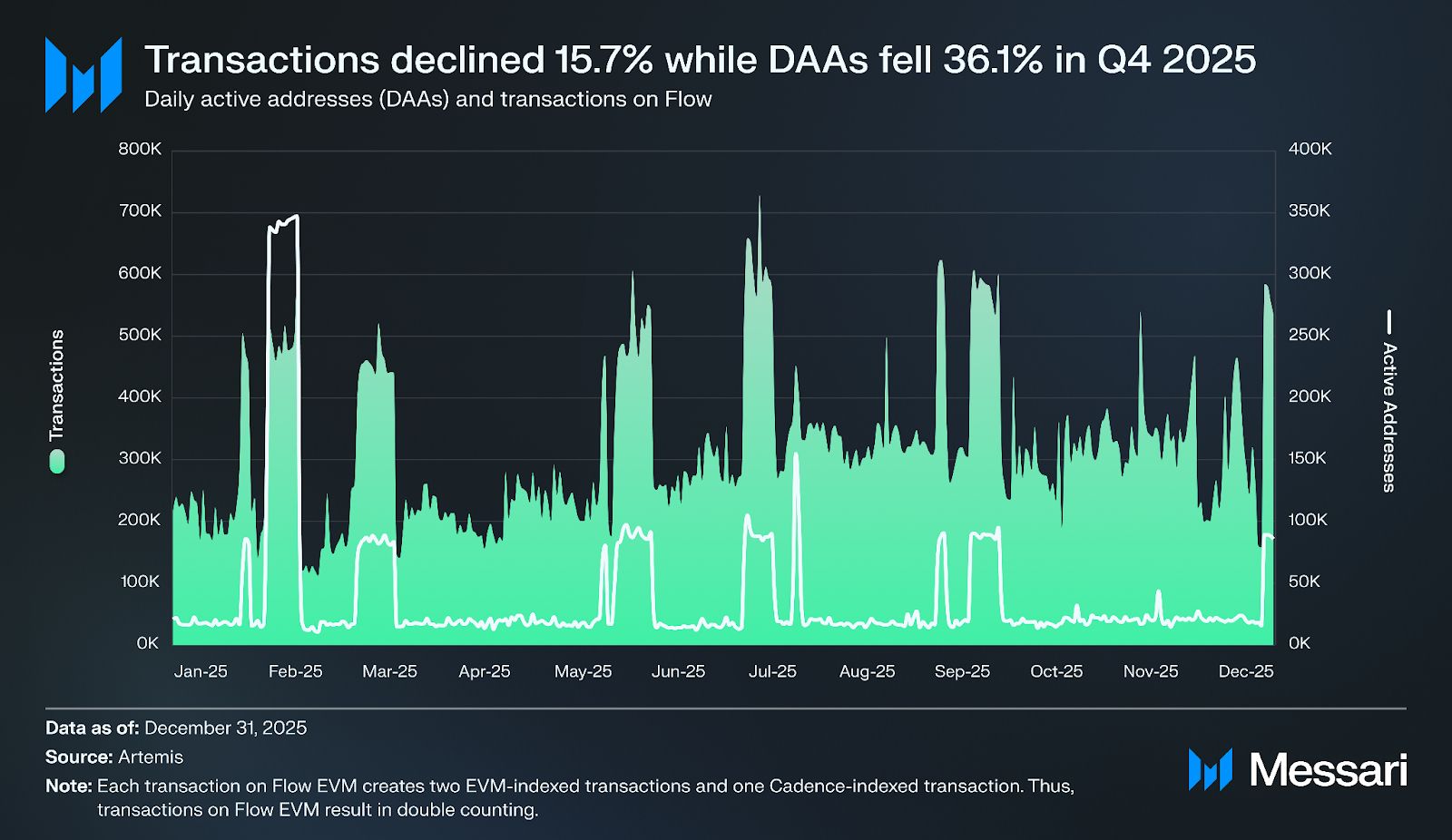
Average daily transactions decreased 15.7% QoQ to 328,540, while average daily active addresses (DAAs) decreased 36.1% to 24,190. Conversely, the ratio of transactions to active addresses (txs/DAAs) increased 2.8% QoQ to 15.3, suggesting a rise in power users; conversely, a decreasing ratio suggests activity is being distributed more evenly across users.
The divergence between rising transactions and falling DAAs reflects a structural shift toward higher per-user throughput. Forte’s scheduled transactions and agent-driven workflows generate recurring onchain calls from a fixed set of accounts, increasing the transaction count without adding new addresses. Simultaneously, the FLIP 351 fee update raised per-transaction costs, which likely pruned low-value bot and spam activity that had inflated DAA counts in prior quarters. The txs/DAAs ratio is consistent with a network in which fewer participants with higher activity drive the bulk of activity.
In Q4 2025, new smart contract deployments increased 22.3% QoQ as activity rebounded from Q3. The rebound was likely driven by Forte requiring new contract deployments for teams migrating from testnet, Forte Hacks competitors deploying contracts to mainnet, and DeFi protocols shipping new production contracts during Q4.
Protocol Upgrades
Forte Mainnet Launch
Forte launched on Flow mainnet on Oct. 22, 2025, introducing actions and workflows that enable onchain financial automation. These primitives let developers build recurring financial workflows entirely onchain without centralized schedulers or pooled custodial funds. The upgrade also reduced hardware requirements for node operators, including the PebbleDB storage migration. PebbleDB replaced BadgerDB across all core node types, delivering 80% lower memory usage and 60% lower CPU load on state reads.
Forte is the technical foundation for Flow’s consumer DeFi thesis. The ~330k existing monthly active wallets represent a built-in distribution channel, but converting those wallets into active financial product users requires protocol-native automation that eliminates manual transaction management. With actions and workflows, products like Peak Money and FCM can offer hands-off savings, lending, and yield compounding to users who have never interacted with a DeFi protocol. For a deeper analysis of Forte's architecture and its role in Flow's consumer DeFi strategy, see Messari's analyst-curated Deep Research report on the upgrade.
FLIP 351 Fee Update
FLIP 351 was accepted on Nov. 19, 2025, overhauling Flow’s transaction fee model. Under the updated schedule, the computation unit cost was set to 4E-05 FLOW and the inclusion fee to 1E-4 FLOW, with a dynamic surge factor that scales fees during congestion spikes. The critical design target is net deflationary tokenomics that sustains throughput above 250 TPS, causes fee burns exceeding new issuance, and aligns validator incentives with higher network utilization. This is a meaningful shift for the consumer DeFi roadmap, as the automated, high-frequency transactions generated by Forte workflows are the kind of sustained throughput that can push a network past the deflationary threshold.
Height-Coordinated Upgrades
Flow executed multiple height-coordinated upgrades (HCUs) during Q4 2025. HCUs allow the protocol to deploy breaking changes at a predetermined block height without requiring a full network spork. Notable HCU updates included Docker tags for the Access, Verification, and Execution nodes, upgrading nodes to v0.44.1-rc.1, and a backwards-compatible patch to remediate the December exploit. The ability to push upgrades without downtime is increasingly important as consumer DeFi products come online, making HCUs a prerequisite for the reliability that consumer finance demands.
Enshrined Protocols and Mainnet 28
On Dec. 2, 2025, Flow announced enshrined protocols, a set of smart contracts embedded at the protocol level and governed through the existing FLIP process. Unlike application-layer DeFi protocols on other L1s, enshrined protocols on Flow receive the same upgrade path and security review as the core protocol itself.
The flagship enshrined protocol is Flow Credit Market (FCM), a lending and borrowing platform, enabling the upcoming launch of Peak Money, a consumer-facing savings and payments product built on top of FCM. The enshrined designation means these contracts receive the same upgrade path and security review as core protocol code, a deliberate design choice for consumer finance that ensures users depositing savings into Peak Money get assurance that the underlying contracts carry protocol-level governance. With Forte providing the execution components and FLIP 351 aligning fee economics, enshrined protocols are the final piece of the consumer DeFi stack.
The quarter closed with Mainnet 28, an emergency spork executed on Dec. 29, 2025, in response to the security exploit. The spork deployed the Isolated Recovery Plan, which destroyed counterfeit assets while preserving all legitimate transaction history.
December Security Incident
The full timeline of the incident, including onchain fund flows and exchange responses, is also available on Messari Intel.
On Dec. 27, 2025, an attacker exploited a vulnerability in Flow’s execution layer to mint counterfeit FLOW tokens. The threat actor then moved approximately $3.9 million off-network via cross-chain bridges before validators coordinated a network halt at 05:23 PST, roughly six hours after the first malicious transaction. The attack involved over 40 malicious smart contracts deployed in a coordinated sequence. Because the attack created new, fraudulent supply, no existing user balances were accessed or compromised.
FLOW dropped by over 40% during the exploit, from $0.17 to a low of $0.08, while multiple exchanges halted FLOW withdrawals during the same period. The Flow Foundation initially proposed restoring the network to a pre-exploit checkpoint, which would have erased all transactions submitted during the six-hour window. However, bridge operators objected, warning that an uncoordinated rollback could create double-balance and lost-fund scenarios worse than the original exploit. Within 48 hours, the Foundation reversed course and adopted an Isolated Recovery Plan that preserved all legitimate transaction history while surgically isolating and destroying the counterfeit assets. Validators ratified the Mainnet 28 protocol fix on Dec. 29, 2025, and the network resumed normal operation.
Of the 1.094 billion counterfeit FLOW deposited across centralized exchanges, 484.4 million was returned by exchange partners and destroyed on Jan. 6, 2026. An additional 98.7% of the remaining counterfeit supply was isolated onchain and burned on Jan. 30, 2026. Comprehensive patches addressing all three stages of the exploit chain have been deployed to mainnet, including overhauled transaction argument validation and extended runtime checks.
Closing Summary
Q4 2025 was a defining quarter for Flow, though not in the way the team planned. The Forte mainnet launch on Oct. 22, 2025, delivered the protocol-level automation primitives that underpin Flow's consumer DeFi thesis, FLIP 351's fee update aligned the network's economic model by making FLOW net-deflationary at sustained throughput above roughly 250 TPS, and the Dec. 5, 2025, announcement of enshrined protocols signaled that the first consumer-facing products built on these primitives are approaching production. However, the Dec. 27, 2025, security exploit overshadowed the technical progress. An attacker minted over a billion counterfeit FLOW tokens and exfiltrated $3.9 million before validators halted the network, triggering a 75.4% price decline across the quarter and weeks of remediation that tested Flow's governance under pressure. This incident tested Flow's governance under extreme pressure, and the Isolated Recovery Plan demonstrated that the network could coordinate a complex remediation without resorting to a rollback, bringing the network back online within days and with no user assets impacted.
On the ecosystem side, DeFi TVL held at $104.1 million despite the price collapse, and MORE Markets and KittyPunch both grew their positions, but Increment Finance lost nearly half its TVL as its points program wound down and stablecoin supply contracted 38.3% as PayPal pulled PYUSD liquidity back to larger chains. Looking ahead, the core question for Flow in 2026 is execution speed. The technical stack for consumer DeFi is largely in place: Forte provides automation, FLIP 351 provides fee alignment, and enshrined protocols provide the product layer. What remains is converting Flow's active wallet base into participants in savings, lending, and payment products while rebuilding market confidence after the exploit.
Looking ahead, several developments in 2026 are positioned to test this thesis. The consumer DeFi pipeline is approaching production with Flow Yield Vaults, Peak Money, and Flow Credit Markets set to launch soon. Whether Flow can convert the technical stack assembled in Q4’25 into measurable adoption in the first half of 2026 will determine if the consumer DeFi thesis gains traction.
This report was commissioned by the Flow Foundation. All content was produced independently by the author(s) and does not necessarily reflect the opinions of Messari, Inc. or the organization that requested the report. The commissioning organization may have input on the content of the report, but Messari maintains editorial control over the final report to retain data accuracy and objectivity. Author(s) may hold cryptocurrencies named in this report. This report is meant for informational purposes only. It is not meant to serve as investment advice. You should conduct your own research and consult an independent financial, tax, or legal advisor before making any investment decisions. Past performance of any asset is not indicative of future results. Please see our Terms of Service for more information.
No part of this report may be (a) copied, photocopied, duplicated in any form by any means or (b) redistributed without the prior written consent of Messari®.