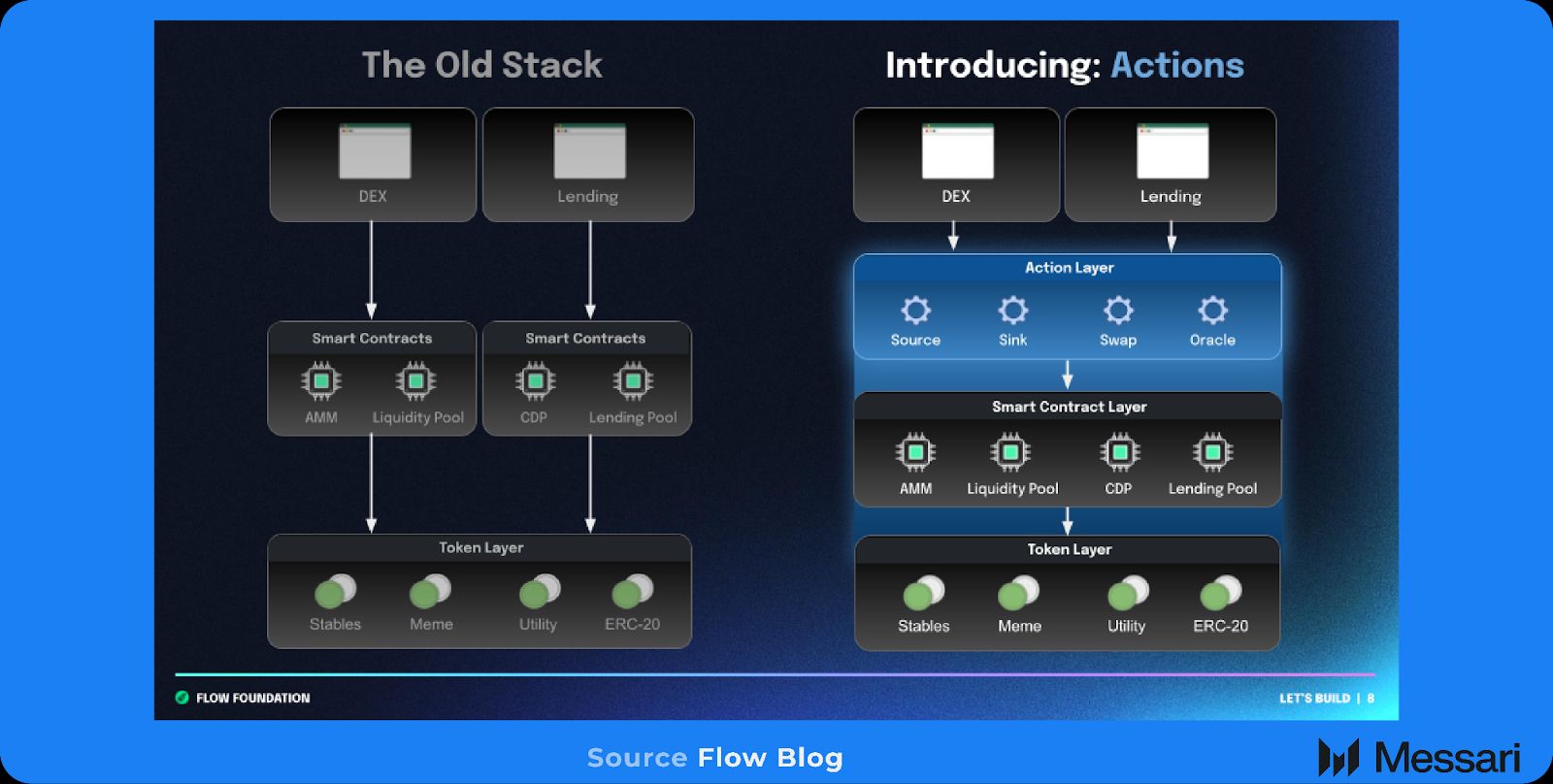
The Forte public testnet went live with Actions, Agents, and Scheduled Transactions, giving developers native tools for scheduled onchain operations.
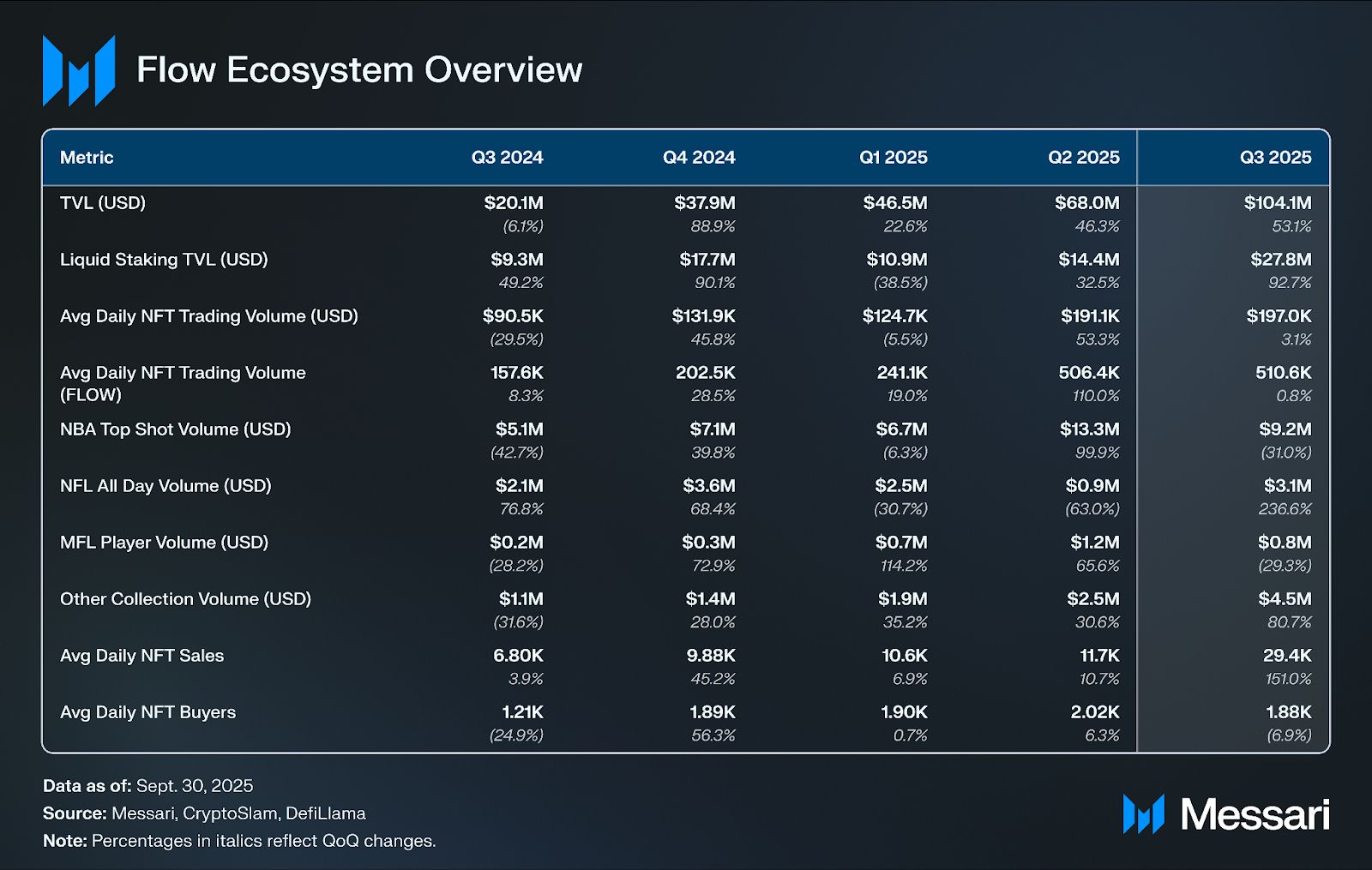
Flow's DeFi total-value locked (TVL) grew 53.1% QoQ to $104.1 million, driven by native DeFi protocols such as Increment Finance, KittyPunch, and MORE Markets.
Liquid staking tokens (LSTs) TVL rose 92.8% QoQ, as expanded stFlow integrations across lending and LPs, ongoing in-application incentives, and rising deposits into Ankr’s Flow LST attracted new deposits.
Flow continues to be a top network for builders, as evidenced by developer/hackathon submissions and results: 13 of 343 submissions at ETHGlobal Cannes (3.8%), 66 of 295 at EthGlobal New York (22.4%), and the top network at EthGlobal New Delhi, with 3 of 10 finalists built on Flow.
Stablecoin circulating supply grew 10.5% QoQ, expanding the base of onchain dollars that consumer apps can use for consumer DeFi products.
On Flow, developers use “Cadence,” Flow’s novel resource-oriented programming language designed for smart contracts. It enforces ownership and type safety at the language level, helping prevent common vulnerabilities in contract logic. In September 2024, Flow introduced the Crescendo upgrade, launching EVM equivalence on Flow via Flow EVM, and bringing Cadence to maturity with the Cadence 1.0 release. Now, developers can use Solidity to build on Flow EVM with block times of 800 milliseconds. Furthermore, developers can tap into existing tools and liquidity across the EVM, while users experience sub-cent transaction fees, which is important for high-frequency activity.
Flow’s most recent development occurred in March when Flow activated a rolling protocol upgrade system on mainnet. This mechanism coordinates behaviour changes at predetermined block heights, so nodes can verify compatibility and upgrade without interrupting block production. By eliminating most downtime, rolling upgrades strengthen network resilience, streamline future releases, and let developers ship improvements faster. The new system builds on earlier Height-Coordinated Upgrades and marks Flow’s first significant step beyond the Crescendo release.
Flow has played a significant role in onboarding consumers into crypto by pioneering the ERC-721 (non-fungible) token standard via CryptoKitties in 2017 and putting NFT collectibles into the mainstream via NBA Top Shot in 2021. In 2023, Disney and Dapper Labs launched Disney Pinnacle on Flow, a digital pin marketplace featuring Disney, Pixar, and Star Wars IP that furthered Flow’s consumer reach. In Q4 2025, Flow also introduced the Forte upgrade, which provides native support for automated transaction flows, and Proof of Possession, which strengthens account security, as part of building a stack oriented toward more routine financial activity onchain. Today, Flow is increasingly focused on combining this consumer footprint with onchain finance primitives, including DeFi, liquid staking, and stablecoins, to support payments, yield, and savings use cases for retail users. The protocol roadmap also aims to more closely align transaction fees and network usage with FLOW value accrual over time. For a full primer on Flow, refer to our Initiation of Coverage.
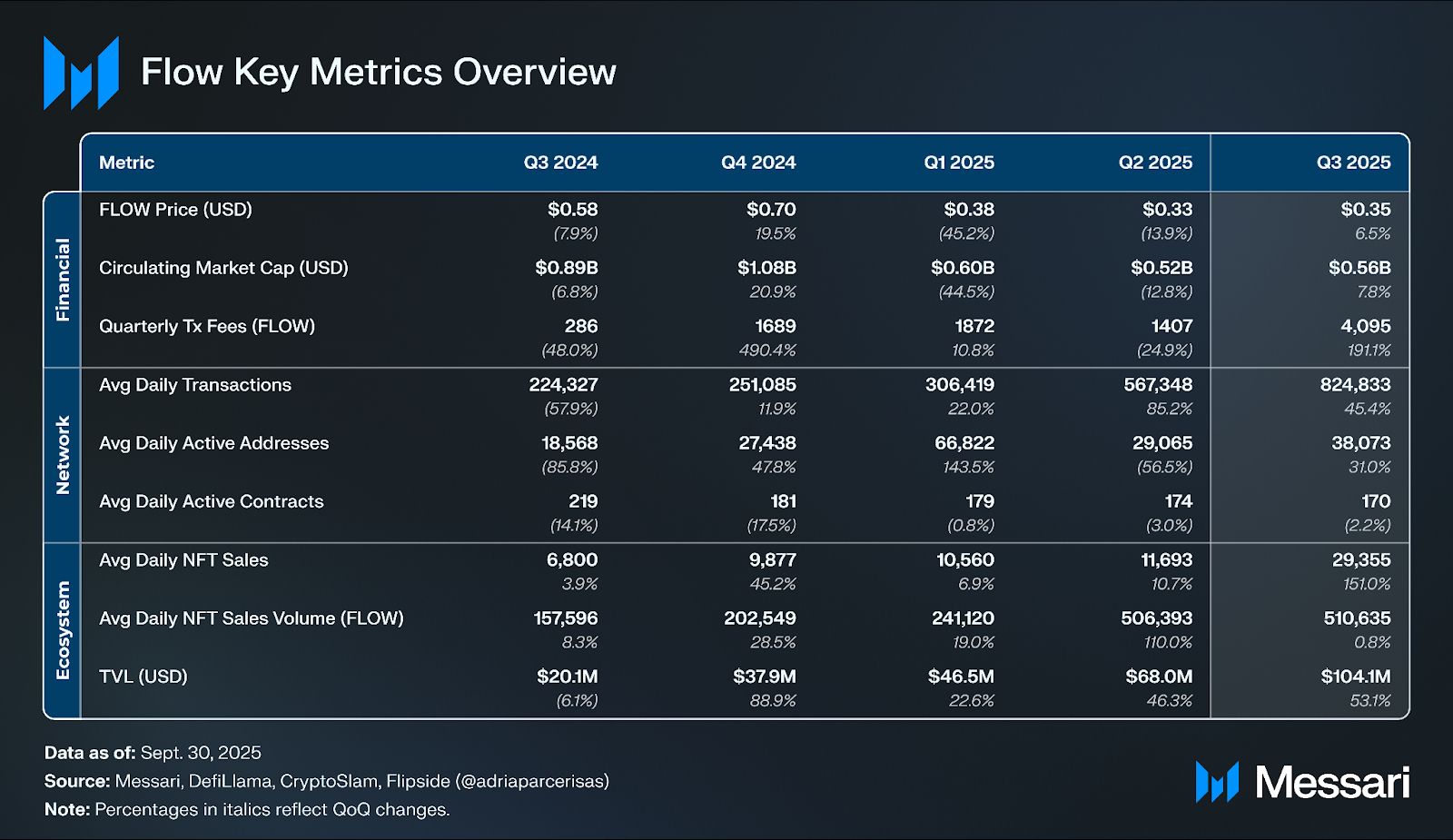
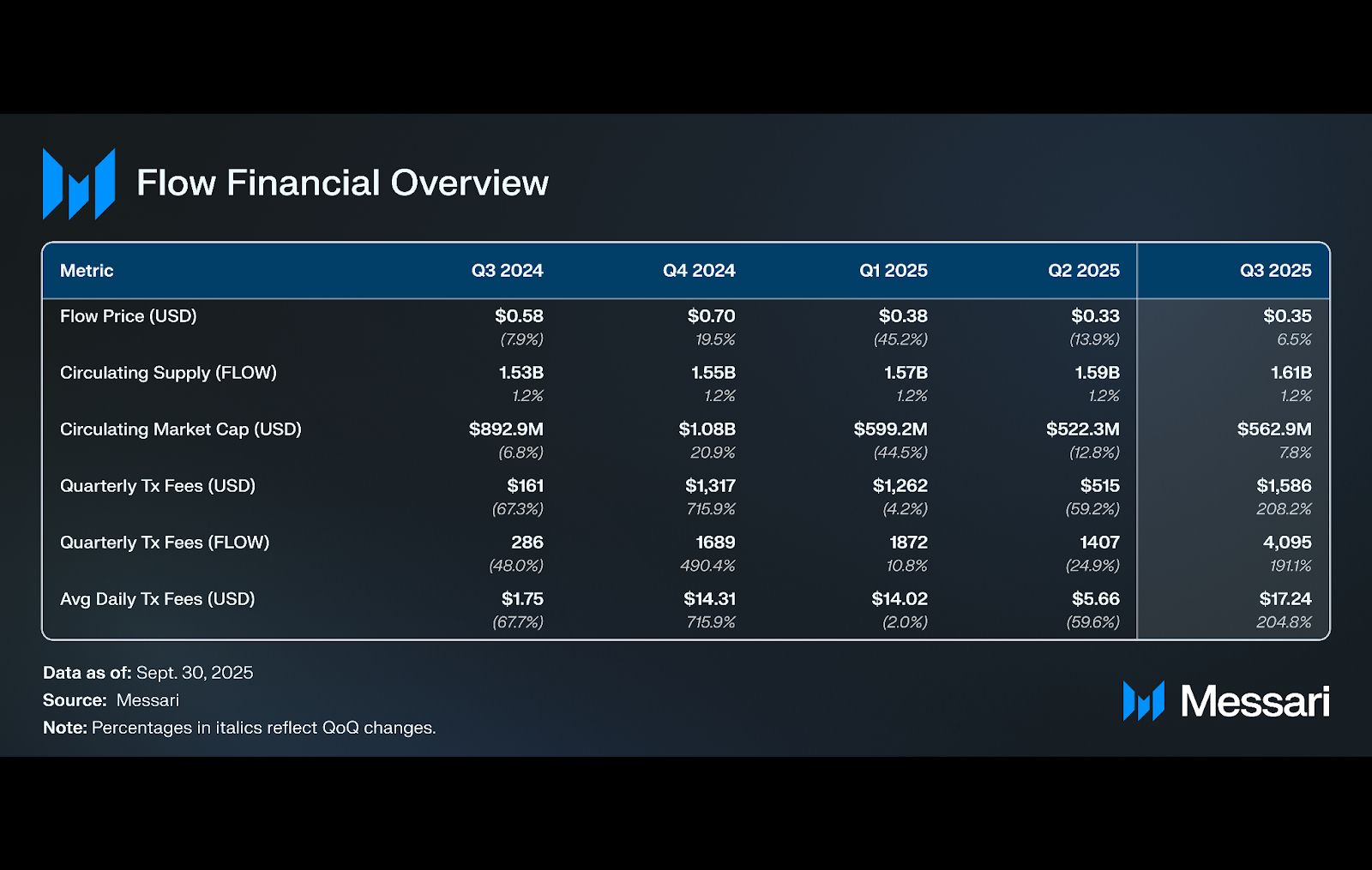
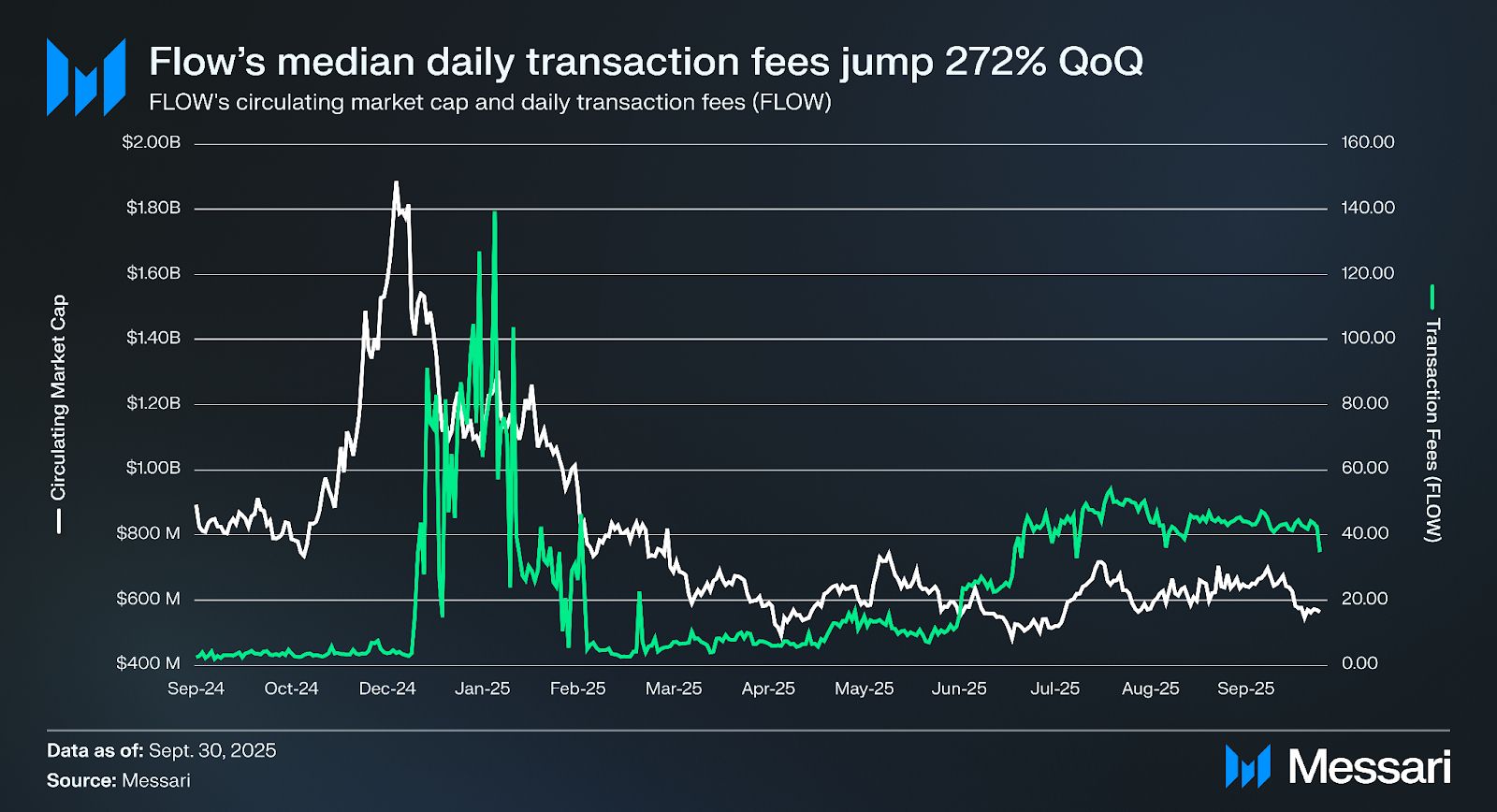
FLOW is the native token of Flow that is used (i) as the primary medium of exchange on Flow and (ii) for staking to facilitate various staking-related functions. In Q3 2025, FLOW's price rose 6.5% QoQ to $0.35. This increase grew the circulating market capitalization by 7.8% to $562.9 million, while circulating supply rose 1.2% to 1.61 billion FLOW in line with the protocol's weekly inflation schedule. As Flow’s fee and inflation mechanics mature, the focus is shifting from subsidized activity toward usage that supports sustainable, recurring flows, such as automated payouts or savings strategies. FLOW's circulating market cap ranking fell from 105th to 116th.
FLOW is used to settle network transaction fees on Flow. The total transaction fee for any transaction on Flow comprises a variable “execution fee” plus a fixed “inclusion fee,” which is then multiplied by a “surge factor”. Total quarterly fees in USD jumped 208.2% QoQ to $1,590, and fees in FLOW increased 191.1% QoQ to 4,095. Additionally, the median daily fee in USD climbed 204.8% to $17.20, and the median daily fee in FLOW increased by 272% QoQ to 44.2 FLOW. This trend could have been driven by a higher EVM transaction mix and more write-heavy actions, such as mints, listings, staking, and bridge updates, which increased per-transaction compute and storage costs.
FLOW’s initial token supply was 1.25 billion upon Flow’s “Mainnet V1” launch in October 2020. However, the total token supply experiences inflation once per epoch (approximately once a week) due to inflationary staking rewards distributed to Flow’s validator nodes and delegators. Inflation over an annual period equals 5% of FLOW’s total token supply.
As explained in our Initiation of Coverage, combined weekly staking rewards comprise all network transaction fees, with any remaining amount being minted as inflationary staking rewards.
Stakers, including validator nodes that have self-staked, receive 92% of weekly staking rewards proportional to their stake.
Validator nodes also receive 8% of weekly staking rewards as commission.
As of Sept. 30, 2025, FLOW’s total token supply has increased to 1.61 billion, and weekly inflation equates to approximately 1.47 million FLOW per week.
Ecosystem Analysis
Consumer
Flow leans heavily into consumer-facing applications, especially in sports, gaming, and collectibles. The chain sustains momentum through partnerships with major entertainment and sports brands. NBA Top Shot, NFL All Day, and onchain football management game Metaverse Football League were dominant collections in Q3. Integrating MFL into the Forte Hacks 2025 Campaign is a smart move to incentivize developers to build on MFL’s ecosystem.
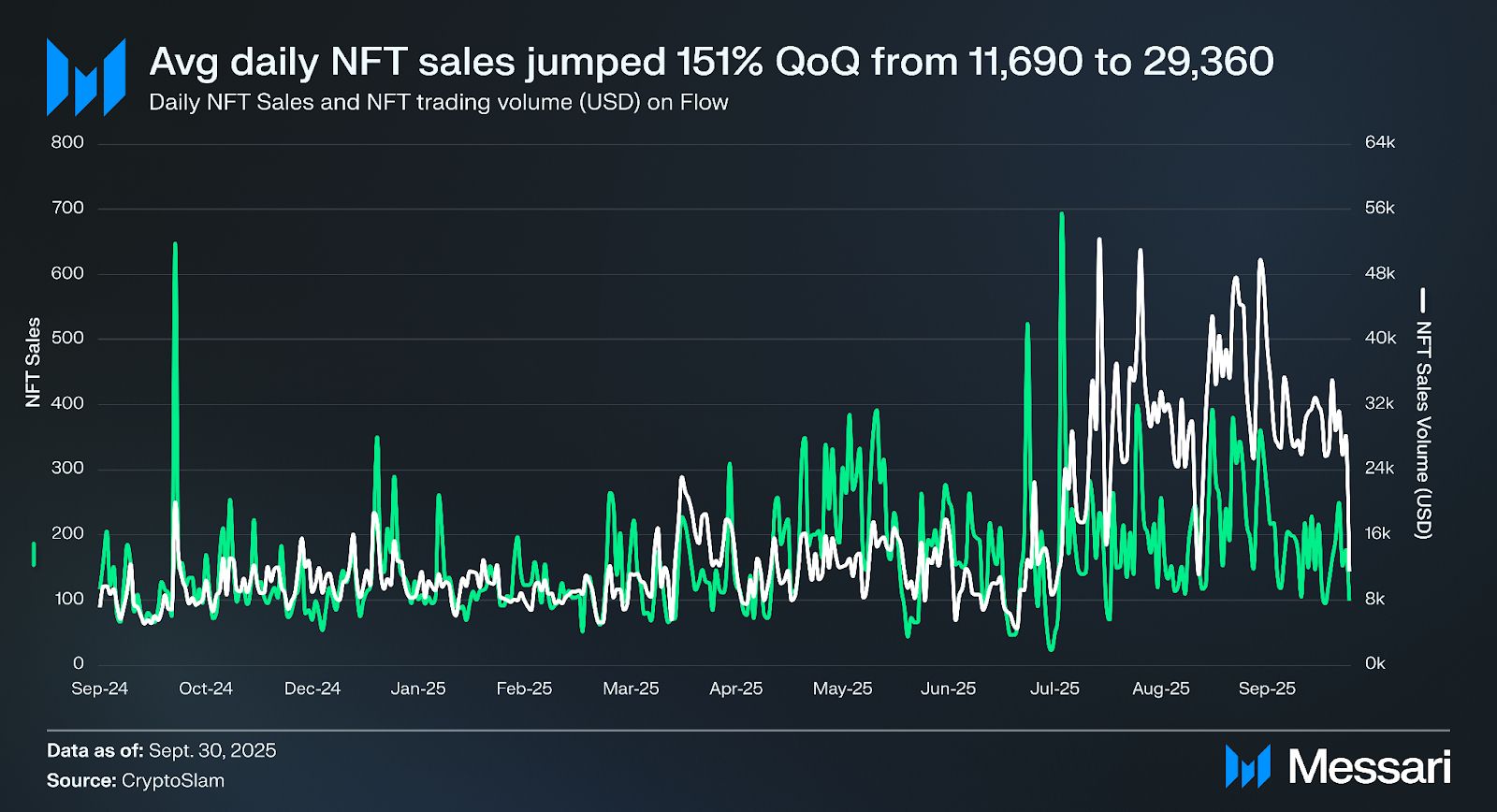
The NFT ecosystem on Flow is the most active sector on the network. An interesting trend worth noting in Q3 was the divergence between NFT sales and USD volume metrics. While USD-denominated volume was nearly flat, increasing only 3% to $197,020, NFT sales surged by 151% QoQ to 29,360, as targeted events drove a significant increase in onchain activity. For example, Disney Pinnacle ran multiple marketplace events in September, while NFL ALL DAY kicked off the new season with rookie drops, challenges, and team-specific rewards that boosted weekly participation. Metaverse Football League added regular in-game drops and quest checkpoints that converted playtime into marketplace activity. Collectively, these developments caused a surge in lower-priced trades, lifting sales counts even as dollar volume stayed flat. This pattern points to a healthier market, with activity anchored in loyal communities around recognized IP and utility-driven gameplay rather than just speculation.
DeFi
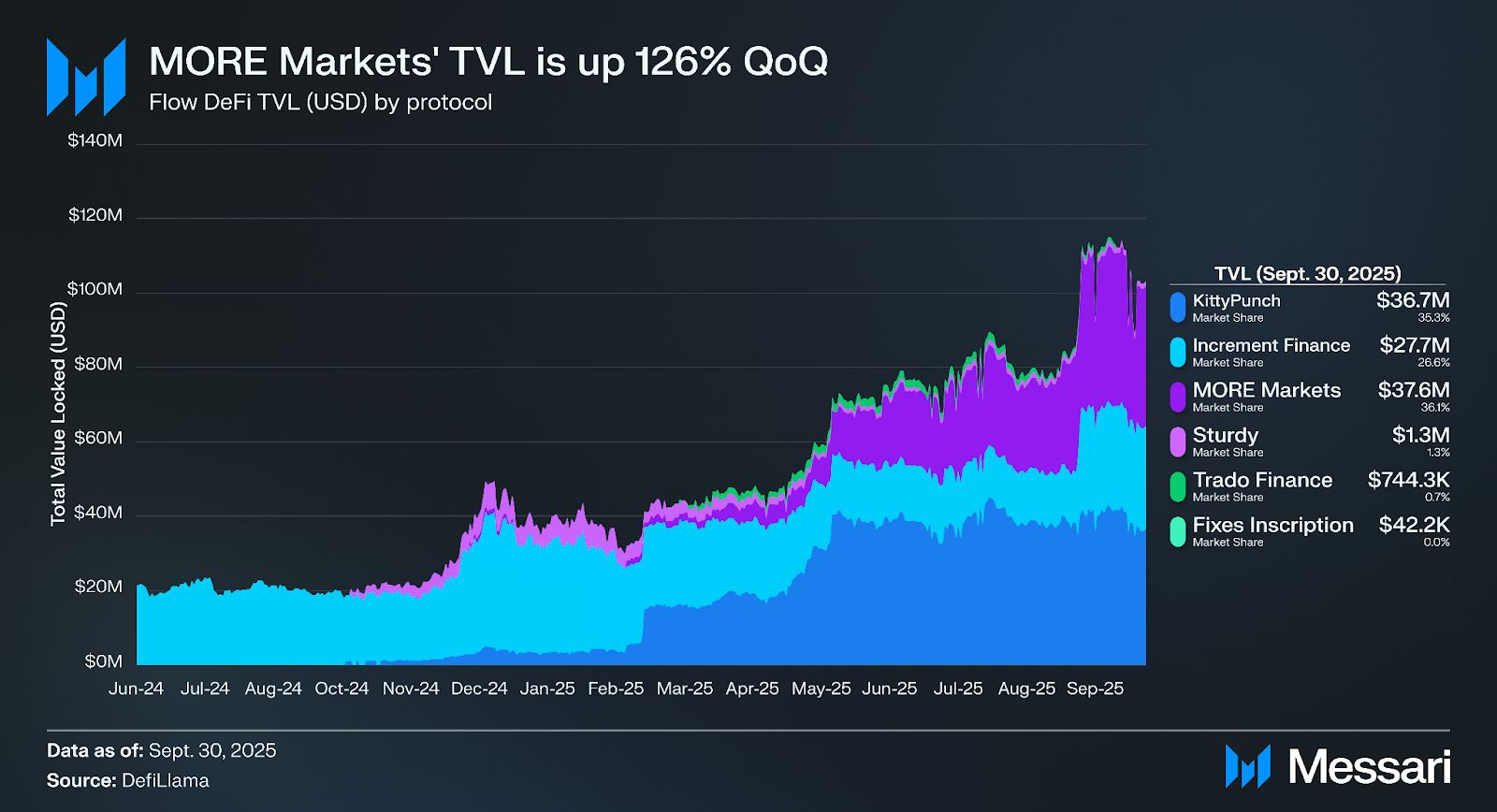
Flow's DeFi TVL grew 53.1% QoQ to $104.1 million. This growth was driven by emerging native protocols such as MORE Markets and Increment Finance. In Q3, more DeFi protocols began launching on Flow, fortifying the trend seen in H1 with token launchpads rolling out. This growth in the DeFi ecosystem is a positive sign for Flow, as it shows that the platform is diversifying beyond its core strengths in NFTs and gaming. A robust DeFi ecosystem is a prerequisite for consumer finance on Flow, because lending, leverage, and AMMs generate the yield and liquidity needed to support savings, payments, and investment products:
MORE Markets: A borrowing and lending protocol on Flow EVM.
MORE Markets had the most explosive growth of the quarter and took the top spot from KittyPunch as the highest DeFi TVL on Flow. Its TVL climbed from $16.6 million to $37.6 million, a 126% jump that lifted its share of Flow TVL to the top contender at 36.1%.
Pre-launch testing for MORE Vaults and new vault workflows went live in Q3, which pulled deposits into the protocol’s core money markets as teams prepared ERC-4626 strategy deployments.
KittyPunch: A full-suite DeFi protocol that launched on Flow EVM on Sept. 8, 2024. KittyPunch offers (i) a spot DEX (PunchSwap), (ii) a stableswap DEX (StableKitty), (iii) a spot DEX aggregator (AggroKitty), (iv) a token launchpad (Trenches), (v) an NFT marketplace (Hoard), (vi) a bridge powered by deBridge, and (vii) a volatility protocol (PunchVIX).
KittyPunch ended Q3 with $36.7 million. This represents an 11.2% USD increase from the previous quarter; however, market share declined 27.4% to 35.3% of the network's market share. The data reflects a continued rotation of capital into newly launched protocols.
The main development in Q3 was volatility farming via PunchVIX, which continued to attract capital. The Forte Hacks partnership kept the suite front and center for Flow EVM users during September.
Increment Finance: Increment is a full-suite protocol allowing trading, lending/borrowing, liquid staking, farming, and a points program.
Increment closed Q3 with $27.7 million in TVL, a 77.2% change from Q2. Its market share has recovered from 23.0% to 26.6%.
Liquidity rotated into stFlow staking in Q3 and related farms while the in-app points program remained active, reinforcing incentives for stFlow holders and LPs.
Trado Finance: A spot and perpetual decentralized exchange (DEX) on Flow EVM.
Trado ended Q3 with $744,270 in TVL, a (54.2%) drop from the previous quarter. Its share of Flow liquidity slipped to just 0.7%. The pullback appears tied to the tapering of its token incentives and the draw of deeper liquidity on other protocols.
Emerging DeFi Protocols on Flow
In Q3, Flow introduced practical DeFi tools that prepare the network for broader payments and finance use cases. This includes building blocks such as attestations for identity and credit workflows, and easier cross-chain stablecoin routing into Flow EVM. These additions enhance onboarding, compliance, and liquidity management for both consumer and enterprise use cases. Notable components include:
Ethereum Attestation Service (EAS) on Flow EVM: EAS enables onchain attestations that can represent KYC outcomes, credit signals, counterparty checks, or policy consents. With mainnet contracts and the EAS explorer scheduled to go live on Flow EVM in Q4, developers will be able to issue and verify attestations natively in their applications, or reference external issuers via schema-controlled records. This creates a standardized way to attach verifiable proofs to wallets, govern access to products, and automate compliance gates for lending, payments, and marketplace flows.
USDF via Stargate + Universal Bridge: Flow Bridged PYUSD (USDF) now has increased availability on Flow EVM through LayerZero’s Stargate. Paired with thirdweb’s Universal Bridge guides, this makes moving stable liquidity into Flow simpler for users and merchants. Teams can route USDC on other chains directly into USDF on Flow, avoiding manual bridging steps and wraps. For builders, this lowers payment friction by enabling recurring payouts, treasury transfers, and settlement with a native Flow EVM stablecoin.
Liquid Staking & Stablecoins
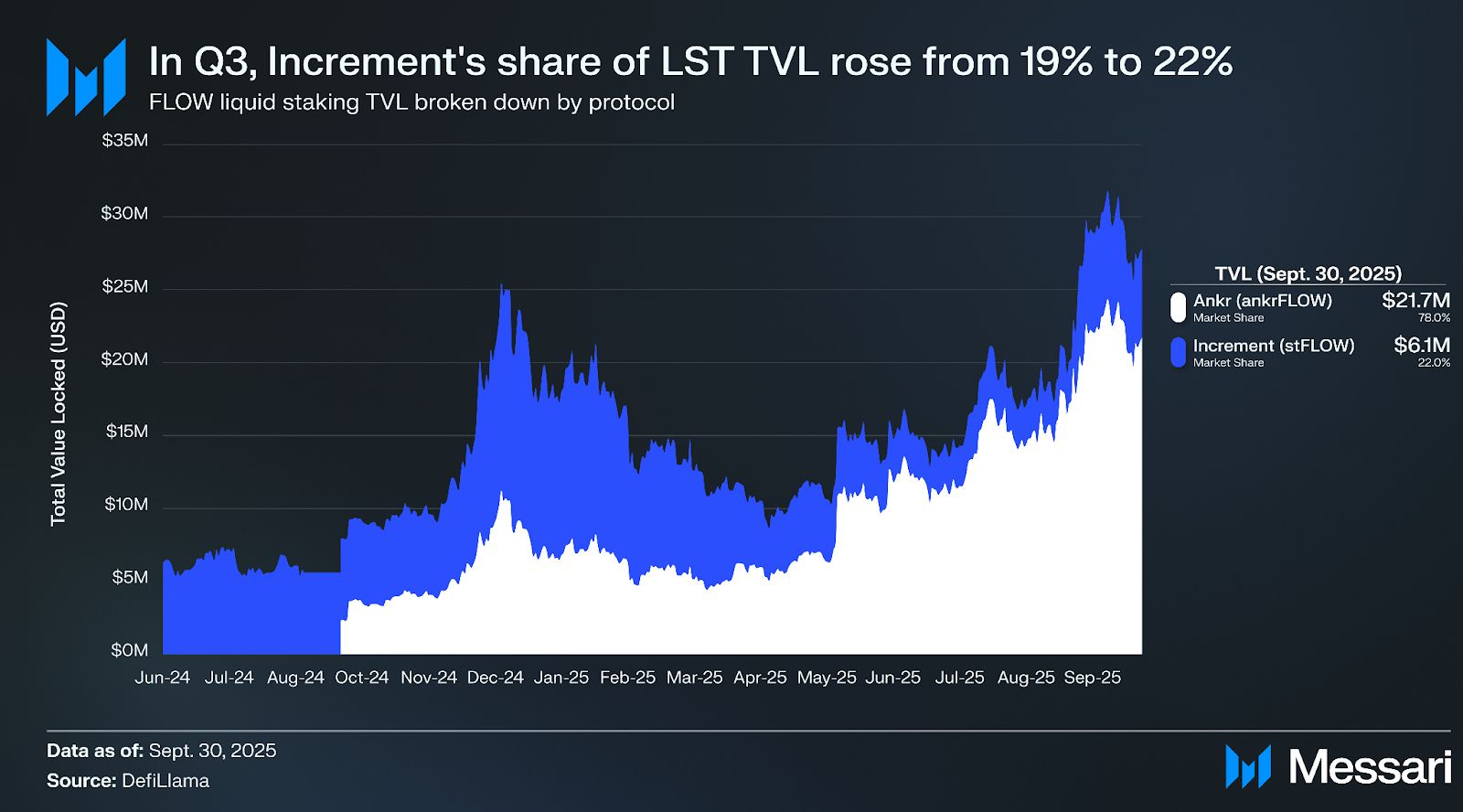
The total value of liquid staking tokens (LSTs) on Flow continued to rebound in Q3, growing 92.8% QoQ from $14.4 million to $27.8 million. The data shows a significant shift in market share dynamics as capital became less concentrated in ankrFLOW, with Ankr’s market share declining from 81% at Q2-end to 78% at Q3-end. LSTs are increasingly serving as Flow’s base yield asset, which future consumer applications can tap for automated savings or yield-bearing balances, without directly exposing users to leverage or complex strategy management.
Despite this, the primary driver of growth was Ankr’s ankrFLOW, which nearly doubled its TVL for the second quarter in a row to $21.7 million, maintaining its position as the dominant LST on the network. Increment’s stFLOW increased 15.7% QoQ to $6.1 million, causing its market share to increase from 19.0% to 22.0% by the end of the quarter. On Ankr's multichain liquid staking platform, Flow is the third-highest TVL asset with 64.1 million FLOW.
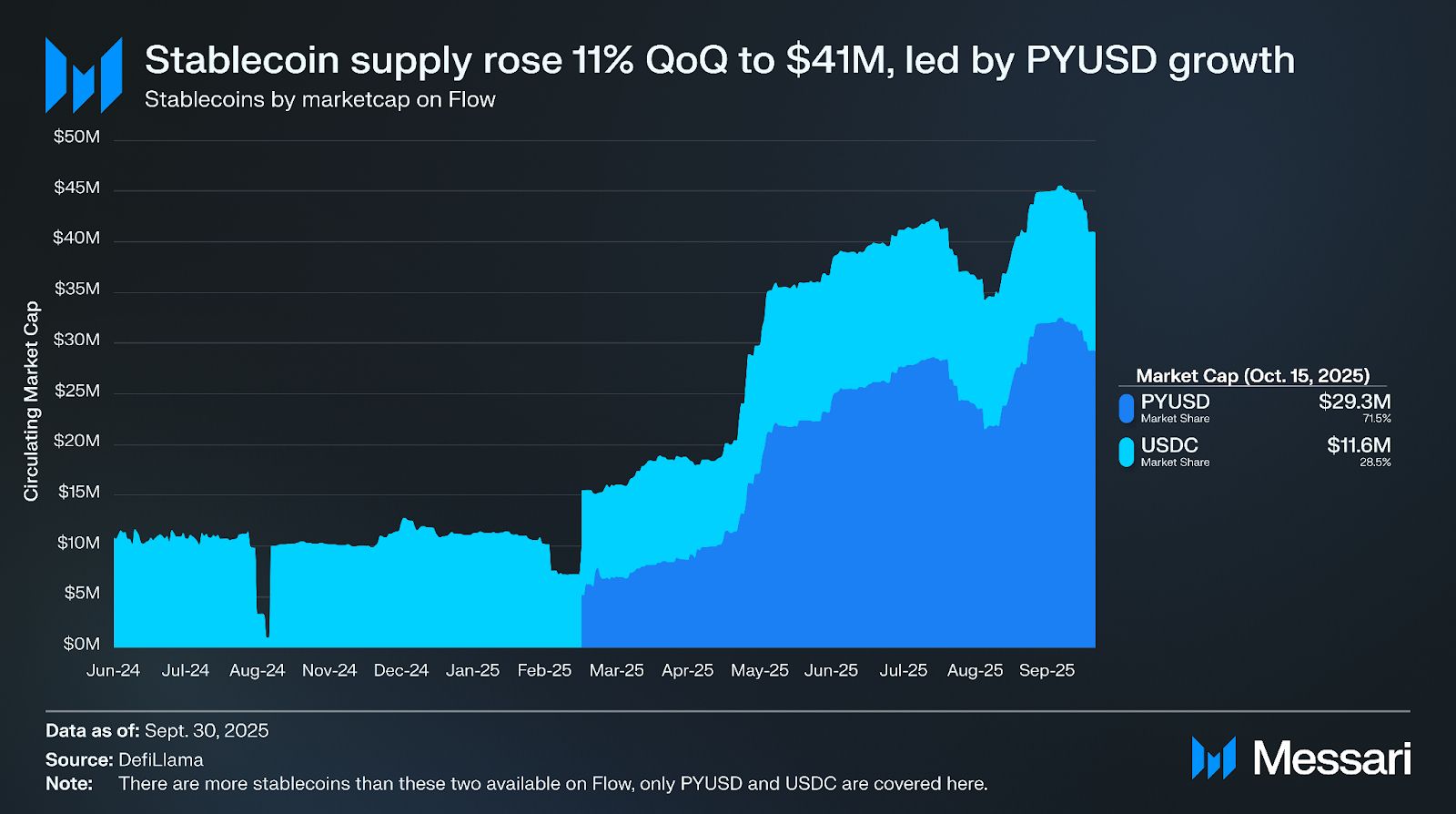
The circulating supply of stablecoins on Flow grew 10.5% QoQ, from $37.0 million at the end of Q2 to $40.9 million at the end of Q3 2025. This growth was driven entirely by the continued aggressive adoption of PayPal's stablecoin, PYUSD, which is represented on Flow as USDF. This version of PYUSD is bridged from other chains using cross-chain bridges.
PYUSD’s circulating supply grew from $24.3 million to $29.3 million by the end of Q3, capturing 71.5% of the total stablecoin market share on Flow in a single quarter. Meanwhile, the supply of the long-standing stablecoin, USDC, fell by 17.1% to $11.6 million. This reduction, combined with PYUSD support, resulted in a decline in USDC's market share from 34.3% to 28.5%. The shift reinforces a new, more competitive environment for stablecoins on the network, with capital continuing to rotate to the newly available asset and creating a deeper base of liquidity that can support a range of consumer DeFi products.
Cross-Chain Messaging & Bridges
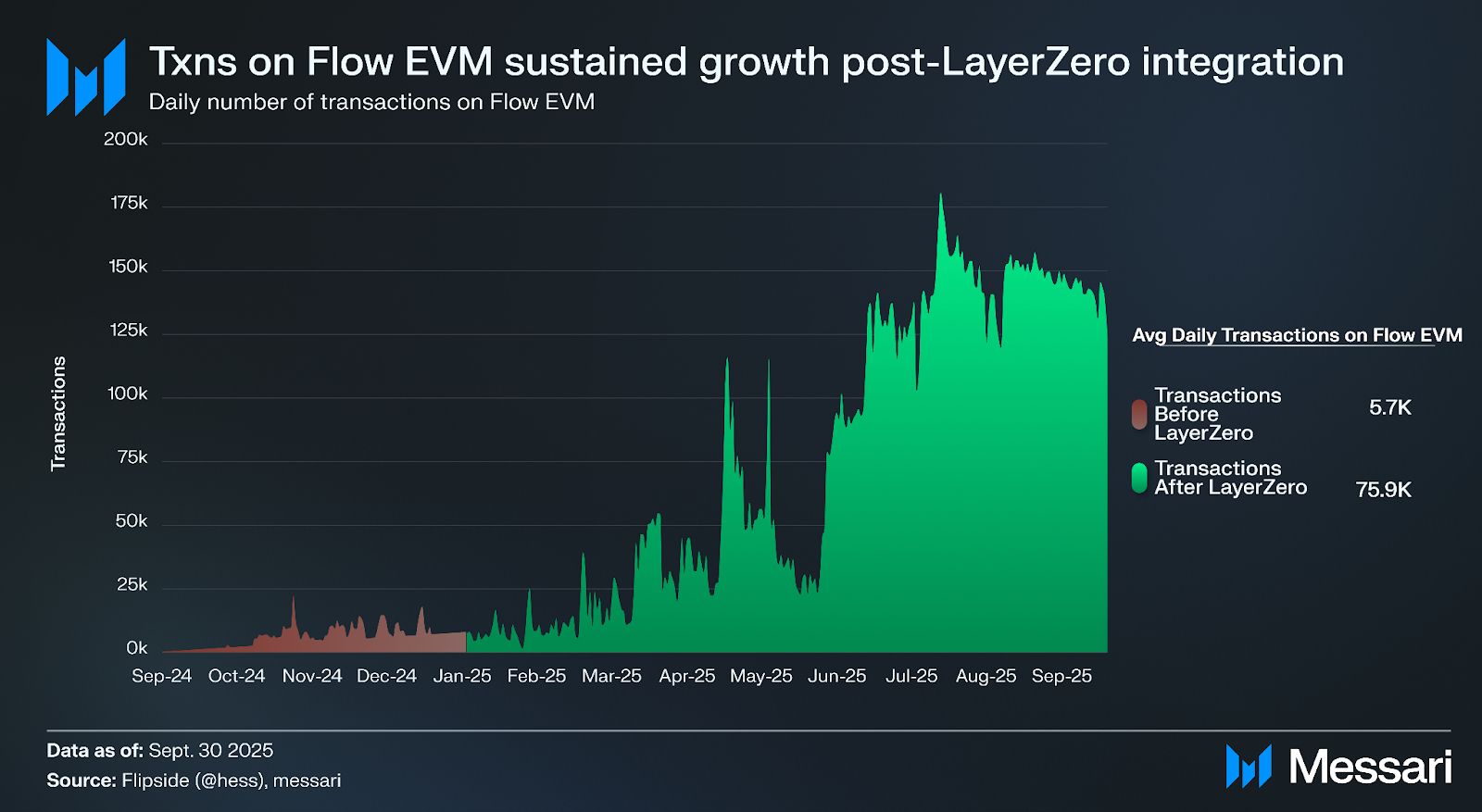
Average daily transactions on Flow EVM increased 138.9% QoQ to 75,900, building on the levels seen at the end of Q2 following LayerZero’s integration in February 2025. Inflows through LayerZero averaged $230,650 per day, a 46.5% QoQ decrease from $431,340.
Development, Growth, and Community
Builder Enablement
Flow rolled out new and updated developer guides for Actions and Scheduled Transactions in late September, aimed at giving teams reference implementations, connector patterns, and step-by-step tutorials on testnet and the emulator ahead of Forte. The updates aligned client and contract expectations before Forte mainnet activation and reduced integration risk for recurring execution. Flow also refreshed EVM builder paths in August. Quickstarts and tool guides for Hardhat and Foundry clarified deployment, verification, and wallet configuration on Flow EVM, which lowers setup friction for Solidity teams coming from Ethereum and L2s. The combined effect is that once EVM applications are live on mainnet, they can plug into the same automation patterns and scheduled flows that Forte enables on the network.
Hackathons
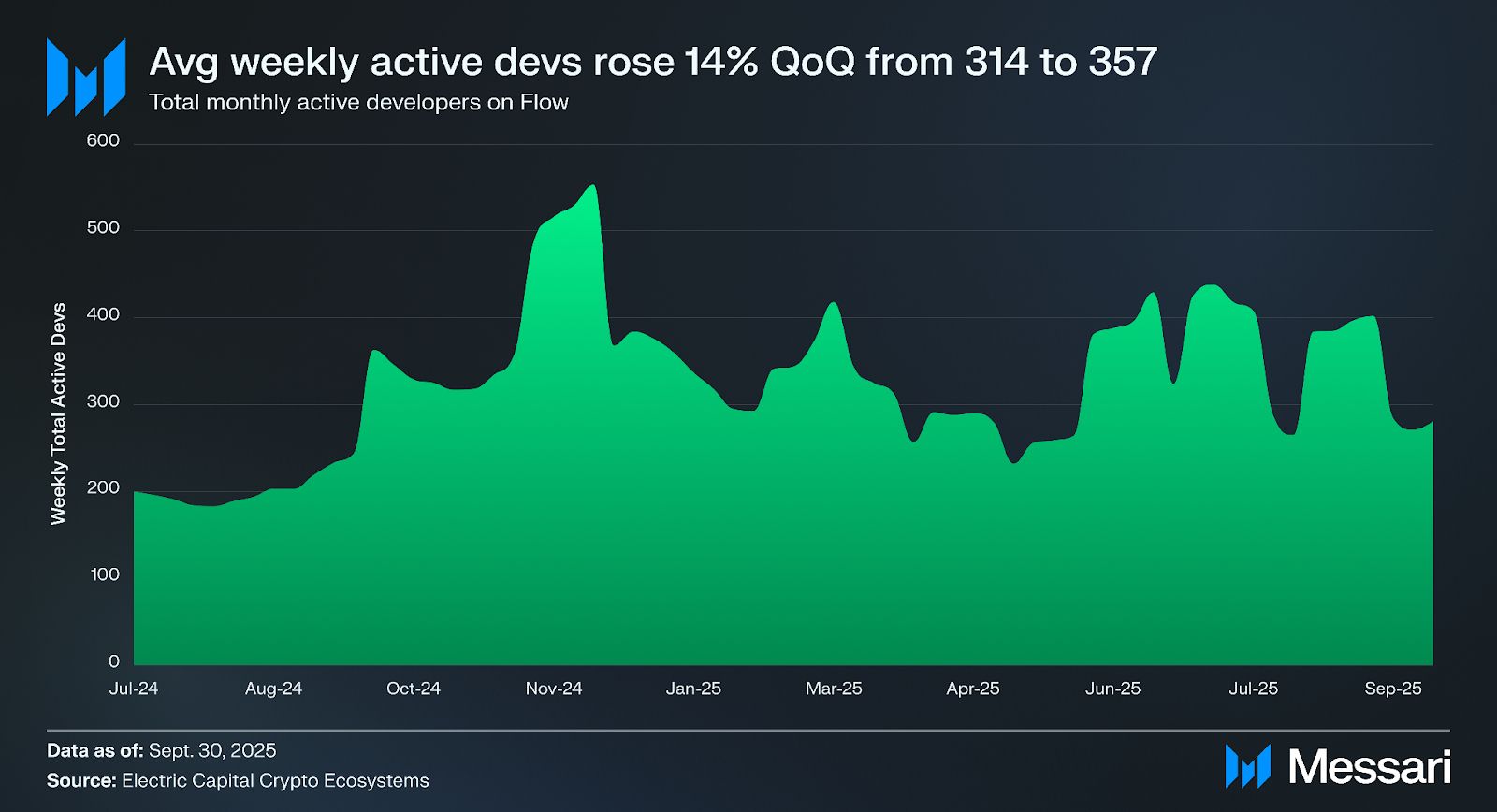
Average weekly active developer count rose 13.9% to 357 since the end of Q2. Weekly active developers are the original code authors who make at least one non-merge commit to canonical repositories in a given week, excluding PR mergers, fork-origin commits, and bots. Troughs and subsequent recoveries in Q3 aligned with two major build cycles. Across three ETHGlobal events in Q3, Flow sponsored prize tracks and drew sustained interest from teams building on Cadence and the Flow EVM. At Cannes (July 4–6), there were 343 total submissions with 13 projects using Flow (3.8%). At New York (Aug. 15–17), there were 295 total submissions with 66 Flow projects (22.4%). Additionally, Flow was chosen as the top network choice at New Delhi (Sept. 26–28), with 3 out of 10 finalist projects being built on Flow.
Beyond ETHGlobal, Forte Hacks opened registration at the end of September 2025 with testnet live and challenge briefs published, extending momentum into October. Additionally, the community-run ReWTFsprint ran through the end of September and rewarded daily building across registered repositories, which helped sustain weekly developer counts between events.
Network Analysis
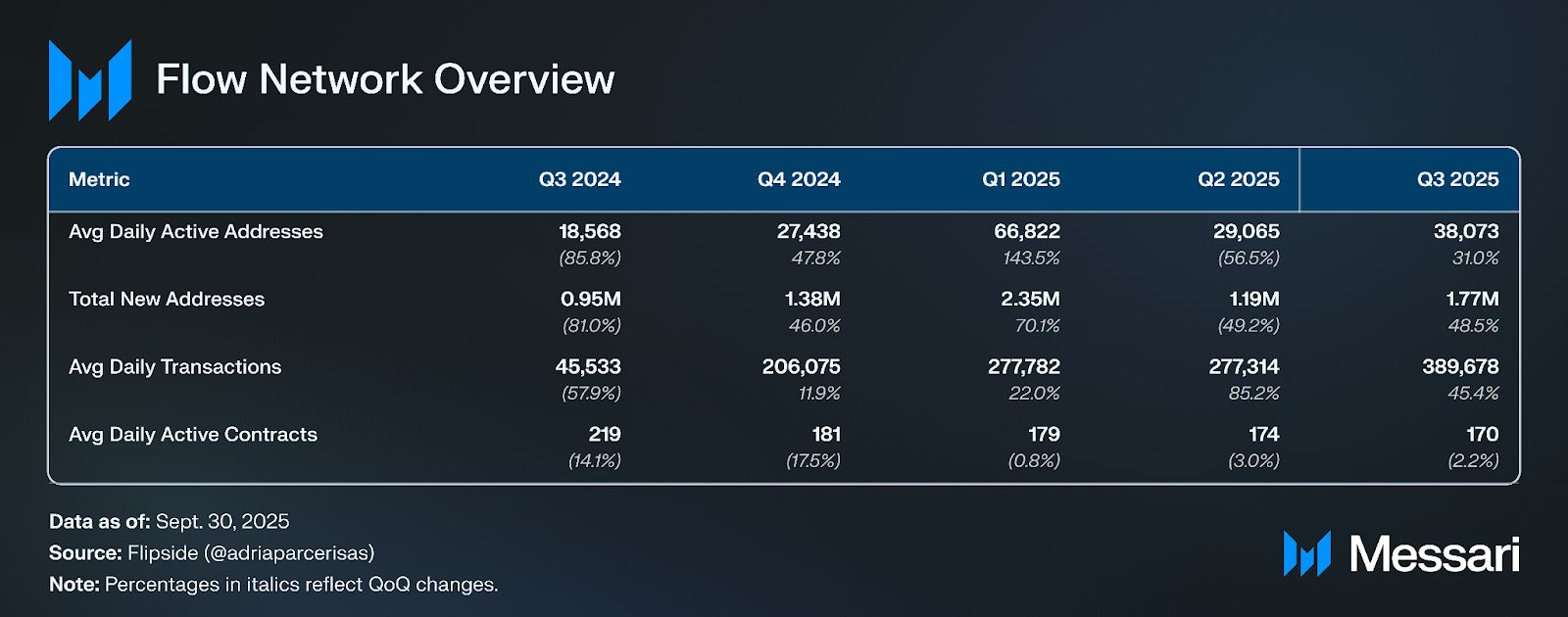
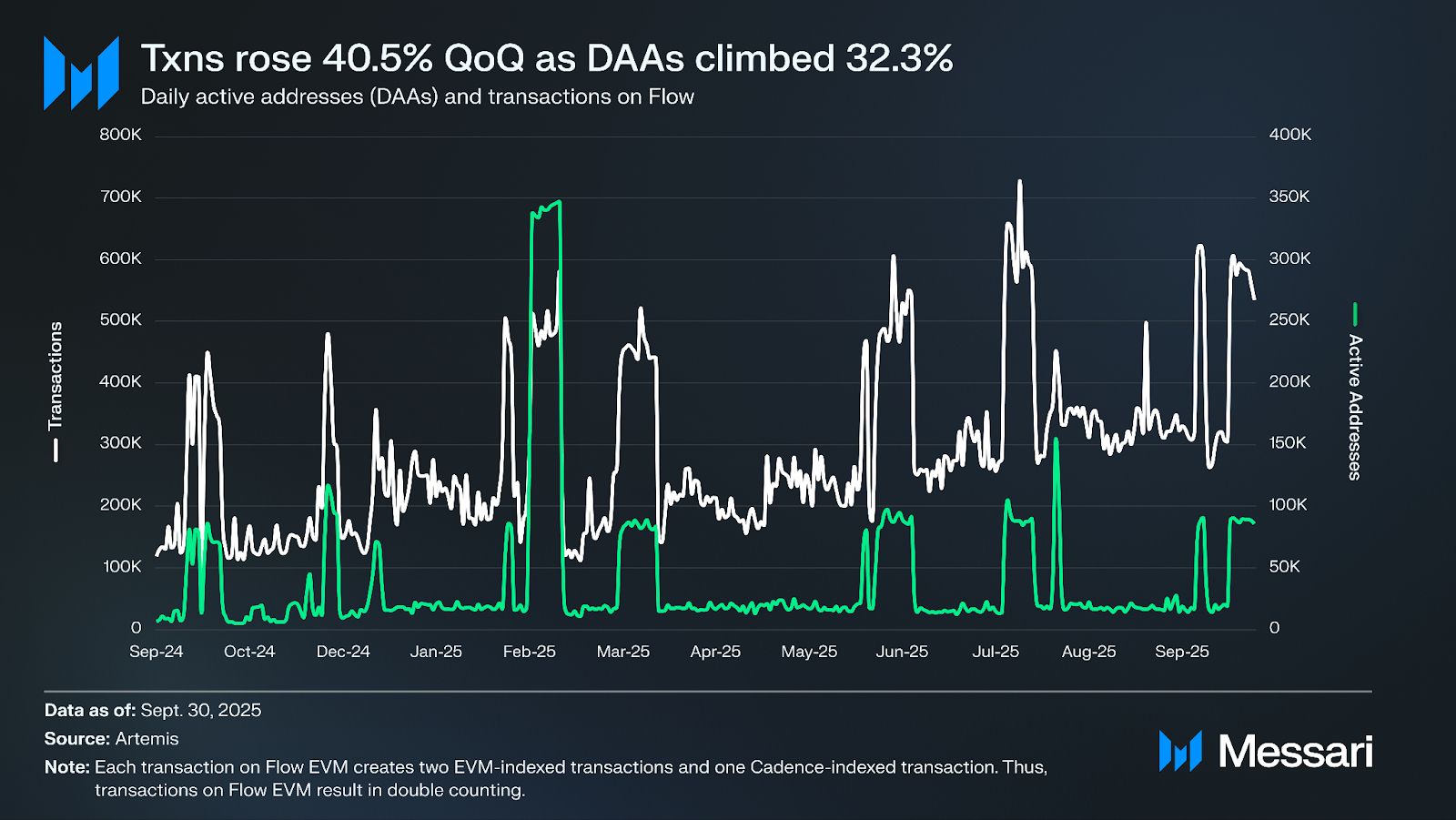
Average daily transactions increased 40.5% QoQ to 389,680, while average daily active addresses (DAAs) increased 32.3% to 38,070. Additionally, the ratio of transactions to active addresses (txs/DAAs) decreased 19.3% QoQ to 14.9, suggesting activity is being distributed more evenly across users; conversely, an increasing ratio suggests a rise in “power users.”
There were multiple spikes in activity in Q3 driven by NFT drops, a controlled fee exercise, and builder activity. The first spike began on July 9, 2025, peaking at 727,660 daily transactions on July 14, 2025, and 104,490 daily active users on July 15, 2025, with increased NBA Top Shot engagement coinciding with the NBA Summer League in Las Vegas, which kicked off on July 10. This was compounded by multiple Disney Pinnacle events, including a The Lion King BOGO capsule offer that ran July 24–31 and a 101 Dalmatians release that ran July 29 to Aug. 19.
Another surge on Sept. 10, 2025, peaked at 609,900 daily transactions and 90,600 DAAs, coinciding with the NFL regular-season kickoff on Sept. 4, and Disney Pinnacle’s ramped marketplace trading events in the official Pinnacle app, where listings, bids, and reward promotions run during a set period. The five-day Collectors Unite global trading event ran Sept. 1–5, 2025, and recurring weekend marketplace windows continue to run Friday 9:00 a.m. PDT to Monday 9:00 a.m. PDT, concentrating listings and trades into predictable blocks. A narrower surge followed during the Sept. 8–12 mainnet dynamic-fee test.
Another uptick to 606,550 daily transactions and 90,407 DAAs on Sept. 23, 2025, could have been driven by Forte’s public testnet opening on Sept. 17 and ETHGlobal New Delhi from Sept. 26–28. Forte introduced onchain automation primitives and tutorials that prompted builders to create wallets, fund test accounts, and run sample flows, which typically creates spillover mainnet activity for account linking, demoing, or testing. At ETHGlobal, Flow offered a dedicated prize track that required teams to build on Flow, which compounded developer traffic during the hackathon window. This combination of developer and consumer-facing events created multiple sustained periods of high engagement throughout the quarter, creating sustained growth in overall network activity.
In Q3 2025, new smart contract deployments fell 87% QoQ as activity normalized from April’s exceptional spike. Instead of launching many new contracts in Q3, teams focused on production work ahead of Forte. Because of this, teams mainly used existing audited modules rather than redeploying new variants, concentrating usage through a smaller set of mature contracts. The shift toward Forte work is constructive for the network’s reliability as Actions (reusable onchain steps like source, swap, and settle), Agents (account-bound executors that submit those steps when triggered), and Scheduled Transactions enable recurring disbursements, payments, and predictable settlement onchain which are prerequisites for bringing payroll like flows, savings plans, and automated debt management to retail users.
Protocol Upgrades
Proof of Possession for Staking Keys
Flow implemented Proof of Possession for staking keys in September 2025 as part of the path to broader validator participation. Under the new requirement, node registration must include a cryptographic proof that the submitter controls the private key corresponding to the advertised BLS staking public key. This closes exposure to rogue-key and substitution attacks, including for schemes that rely on BLS properties. Operator guidance was issued through forum posts and documentation to standardize onboarding across providers.
Forte
Flow introduced the Forte public testnet on Sept. 17, 2025, followed by the mainnet launch on Oct. 22, 2025. Forte adds two protocol-level primitives, Actions and Agents, that let developers compose reusable operations and coordinate them with onchain time-based triggers. Actions expose a standard library of composable steps, including source, swap, sink, flasher, and price oracle. Agents live in a user account and execute precomposed transactions in response to native triggers, including Scheduled Transactions.
Under Forte’s execution model, a pipeline of Actions runs as a single atomic transaction (for example: Source → Swap → Sink). Agents then bind a trigger to that pipeline and submit it when conditions are met. No pooled funds or offchain schedulers are required. The result is reusable workflows that run entirely onchain and keep protocol integrations on a single code path.
For end-users, this type of native automation will enable dApps to provide experiences that resemble familiar banking products more closely than traditional DeFi protocols. For example, users can set up automatic onchain actions such as recurring deposits, scheduled bill payments, and automatic portfolio rebalancing.
PebbleDB Migration
Flow continued the migration from BadgerDB to PebbleDB, databases that store chain state and indexes for core nodes. Execution-node paths validated earlier in the year remained in production, and operator guidance in Q3 focused on keeping testnet and gateway nodes current and ensuring proper Pebble configuration ahead of the October Forte mainnet window. For a full read-up on the problem set addressed by PebbleDB and the two-phase rollout plan, see our Q2 report.
Cross-VM Support for NFTs
Flow maintained and refined the Cross-VM infrastructure so projects can control how NFTs are represented when moving between Cadence and EVM. Q3 updates emphasized documentation and repository guidance for custom associations, contract selection on the destination VM, and metadata views, allowing collections to register mappings and keep schema and policy intact across environments. Teams that bridged before custom associations were available can register new mappings. The bridge also converts older generic representations on subsequent moves. These controls support distribution on EVM venues while preserving collection policy and payout logic across VMs.
Closing Summary
Flow entered Q3 with broader, steadier participation across its core pillars of consumer applications, DeFi, and developers. DeFi TVL rose 53.1% QoQ to $104.1 million, led by MORE Markets and Increment Finance, while liquid staking and stablecoin supply expanded, with USDF on Flow EVM gaining share. Consumer activity stayed resilient as brand events lifted NFT sales volumes even with flat USD turnover, and average daily transactions and active addresses increased. On the protocol side, Proof of Possession streamlined validator onboarding by requiring cryptographic control of staking keys and reducing key-substitution risk, and Forte testnet activation allowed users to become familiar with Agents, Actions, and Scheduled Transactions ahead of mainnet. Additionally, Cross-VM docs were refreshed to simplify moving NFTs between Cadence and EVM. On the developer side, ETH Global prize tracks, updated guides, and a September build sprint kept teams active ahead of Forte. The opportunity in Q4 and beyond is to set up a path to make consumer onchain finance routine and dependable, by adding user verification, easier stablecoin funding, and automated, scheduled payouts and fees.
This report was commissioned by Flow Foundation. All content was produced independently by the author(s) and does not necessarily reflect the opinions of Messari, Inc. or the organization that requested the report. The commissioning organization may have input on the content of the report, but Messari maintains editorial control over the final report to retain data accuracy and objectivity. Author(s) may hold cryptocurrencies named in this report. This report is meant for informational purposes only. It is not meant to serve as investment advice. You should conduct your own research and consult an independent financial, tax, or legal advisor before making any investment decisions. Past performance of any asset is not indicative of future results. Please see our Terms of Service for more information.
No part of this report may be (a) copied, photocopied, duplicated in any form by any means or (b) redistributed without the prior written consent of Messari®.