Flow Forte Upgrade Report
Deep Research ReportGenerated on Feb 24, 2026
Flow Forte Upgrade: What Changed and Why It Matters
Key insights
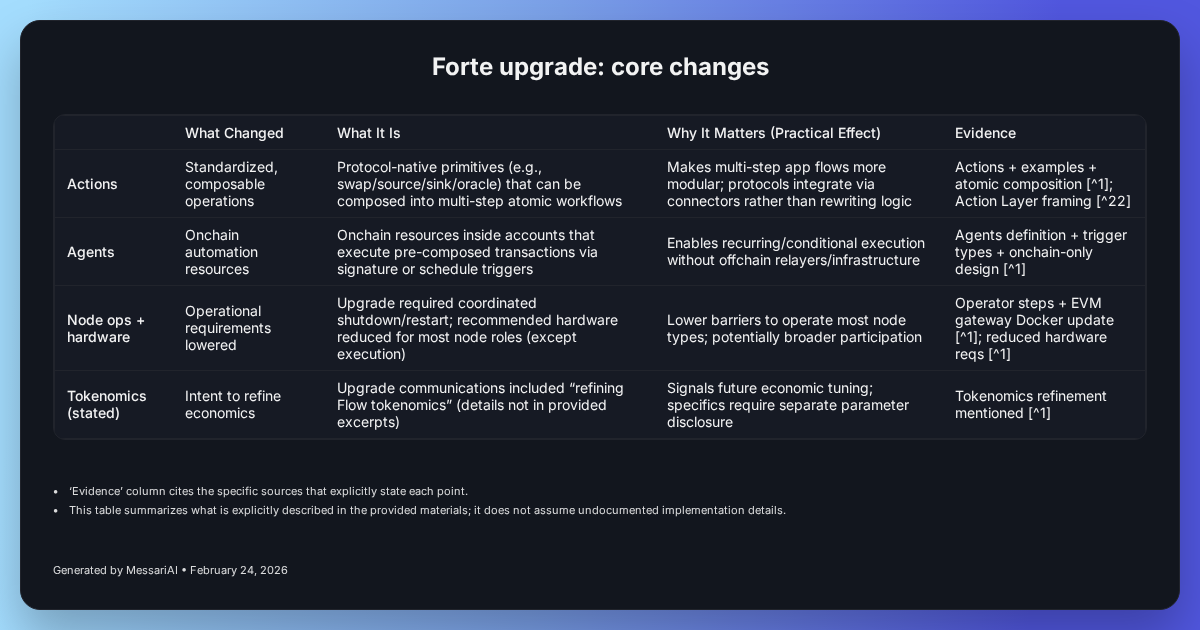
- Forte (mainnet: Oct 22, 2025) is positioned as a major Flow upgrade focused on onchain composability and automation, centered around two protocol-native primitives: Actions and Agents. 12
- Actions aim to standardize common onchain operations (e.g., swaps and oracle reads) so developers can compose multi-step, atomic workflows and integrate via connectors rather than bespoke rewrites. 13
- Agents are designed to make automation more “natively onchain”: they live as resources inside accounts and can execute pre-composed transactions via signature- or schedule-based triggers, without offchain relayers or pooled funds. 1
- Forte also included operator-level changes, including a coordinated shutdown/restart and reduced hardware requirements for most node roles (excluding execution nodes). 1
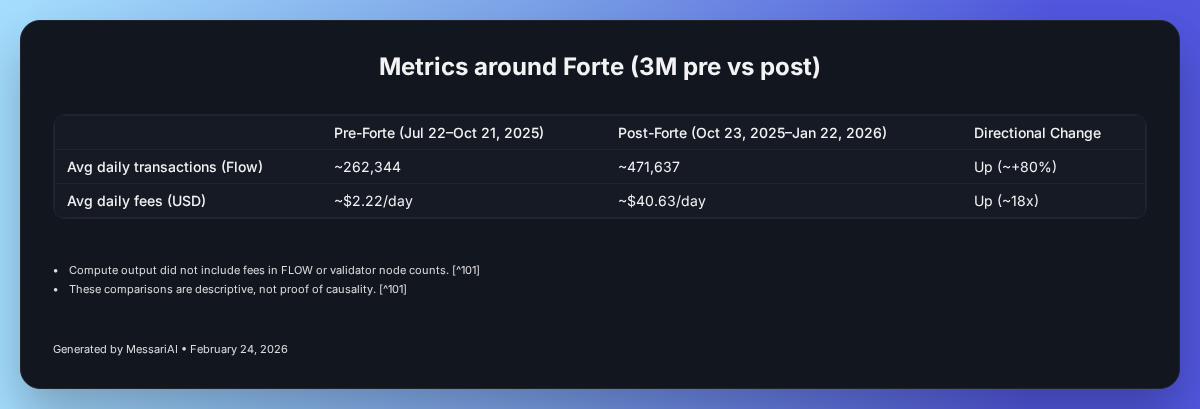
- In the 3 months after Forte vs. the 3 months before, Flow saw higher average daily transactions (~+80%) and much higher average daily fees in USD (~18x). These comparisons are descriptive and do not establish causality. 4
Introduction (SCQA)
Situation: Flow’s prior direction (Cadence + EVM)
Flow has been evolving toward a developer stack that supports both Cadence (Flow’s resource-oriented smart contract language) and a separate Flow EVM environment introduced earlier via the Crescendo upgrade, with cross-environment composability described as nesting EVM-based transactions within Cadence-based transactions in the same block. 56
Complication: composability and automation remain expensive at the app layer
Even with capable execution environments, multi-step workflows (e.g., “swap then deposit collateral”) and recurring/conditional behavior (e.g., scheduled actions) often create friction: teams either build custom integration logic for each counterparty or rely on offchain automation infrastructure.
Question: what is Forte and what concretely changed?
Forte is best understood as Flow’s attempt to make composition (how protocols plug into each other) and automation (how workflows run repeatedly or conditionally) more standardized and “first-class” at the protocol/application boundary.
Answer: Forte adds protocol-native building blocks for composition and automation
Forte introduced Actions and Agents, improved aspects of node operations (including lower hardware requirements for many roles), and explicitly communicated an intent to refine Flow tokenomics (though the provided materials do not enumerate the exact parameter changes). 12
Forte timeline and rollout mechanics
Timeline of key related upgrades and ecosystem milestones
- Sep 4, 2024 — Crescendo upgrade: Introduced Cadence 1.0 and a separate Flow EVM environment; also described cross-environment composability via nesting EVM transactions within Cadence transactions, plus Cadence Owned Accounts (COAs) and cross-chain transfer enablement. 56
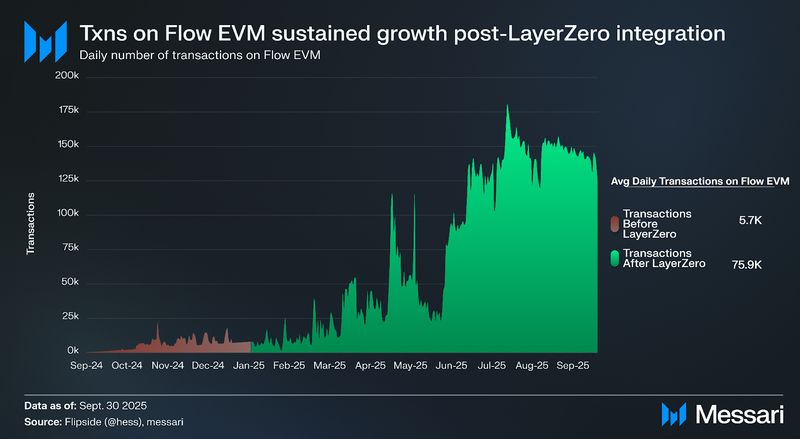
- June 2025 / Sep 2025 — EVM usage indicators: Post-LayerZero integration, average daily Flow EVM transactions are cited as increasing from 5.7K pre-integration to 40.1K by June 2025 and 75.9K by September 2025. 78
- Sep 17, 2025 — Forte testnet deployment. 1
- Oct 22, 2025 — Forte mainnet upgrade: Scheduled maintenance (12:00–15:00 UTC) and coordinated operator steps. 12
- Dec 27, 2025 — Security incident (context): An exploit resulted in counterfeit FLOW; validators contained and patched the issue, and 87.4B counterfeit FLOW were later destroyed (this incident is not described as being caused by Forte, but it is relevant to the post-Forte operational environment). 91011
- Jan 14, 2026 — Flow React SDK: Unified Cadence scripting/queries/transactions with Flow EVM support, including cross-VM capabilities. 12
- Jan 29, 2026 — Flow-Go v0.45.0: Introduced stricter transaction signature verification (signatures must be only from payer/proposer/authorizer). 13
- Feb 2026 — Ongoing height-coordinated upgrades: Operator notices continued post-Forte (specific operator action requirements vary by node type). 14151617
Upgrade process and operator requirements (Forte mainnet)
Forte’s mainnet execution required coordinated operational steps:
- Operators for Access, Consensus, Collection, Verification, and Execution nodes were instructed to shut down by specified times and restart after a go-ahead notice. 1
- EVM Gateway operators were instructed to shut down gateways, update to Docker tag 1.3.3, and update specific access node spork host flags. 1
What Forte introduced at the protocol/application boundary
Actions: a standardized “Action Layer” for atomic, multi-step workflows
Actions are described as protocol-native, composable operations (examples given include
swap, source, sink, flasher, and price oracle). 1Two properties are central to “what changed”:
- Atomic composition: Developers can compose multiple Actions into a single workflow that executes atomically inside one transaction (i.e., it either all succeeds or it all reverts). 1
- Connector-based integration: Protocols can integrate into the Action framework by building connectors, which is positioned as reducing the need to rewrite or duplicate core logic for every integration. 1
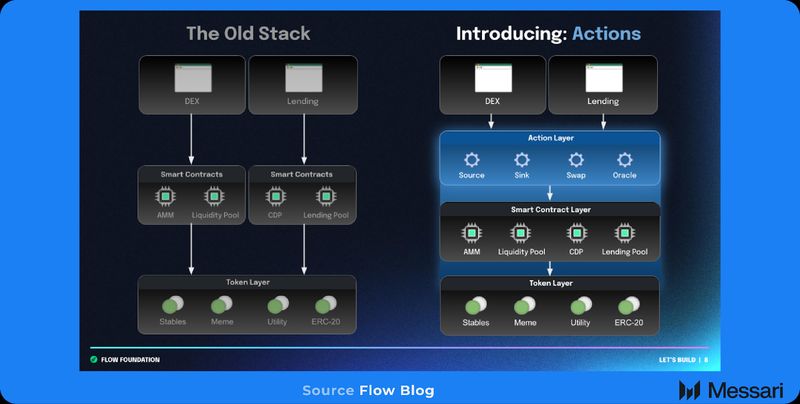
Forte’s “Actions” concept is also framed architecturally as introducing an Action Layer between the application layer (e.g., DEX and lending apps) and the smart contract layer (e.g., AMMs, lending pools). In this framing, the Action Layer contains reusable components such as Source, Sink, Swap, and Oracle. 3
Agents: protocol-native onchain automation without offchain relayers
Agents are described as onchain resources that live within individual Flow accounts and can execute pre-composed transactions when triggered by events (including user signatures or scheduled transactions). 1
The notable design claim in the provided material is that Agents run entirely onchain, without pooled funds, offchain infrastructure, or relayers, and can autonomously schedule and re-trigger execution. 1
What Forte is (and isn’t)
Forte is not described as “the EVM upgrade.” The EVM environment and Cadence 1.0 are tied to the earlier Crescendo upgrade, with Forte instead adding building blocks aimed at composition (Actions) and automation (Agents). 561
How Forte fits with Crescendo and Flow EVM
Crescendo recap: cross-environment composability and account model implications
Crescendo introduced a separate Flow EVM and a composability model described as nesting EVM-based transactions within Cadence-based transactions in the same block. 56
It also introduced Cadence Owned Accounts (COAs), described as smart-contract wallets on Flow EVM that enable Flow resource owners to call and control a Flow EVM address. 56
Why Forte matters in an EVM world
In the provided materials, EVM usage growth (post-LayerZero integration) demonstrates that the EVM environment is an active and growing part of the Flow stack. 78
Against that backdrop, Forte’s design goal can be read as complementary: standardized Actions and onchain Agents aim to reduce friction in composing and automating workflows, including in ecosystems that may span Cadence and EVM-based components. Operationally, the Forte mainnet procedure explicitly included instructions for EVM Gateway operators, reinforcing that Forte was executed with the EVM stack as a first-class part of operations. 1
Practical implications
For application developers
What changes in how apps can be built (based on the provided descriptions):
- DeFi and multi-step flows: Actions are explicitly designed to be composable (e.g., swap + oracle read + other steps) and executed atomically, which can simplify building complex workflows. 13
- Automation and recurring behavior: Agents are explicitly designed to execute pre-composed transactions via signature or schedule triggers and run fully onchain without offchain relayers. 1
Post-Forte behavioral change to watch (transaction verification):
- Flow-Go v0.45.0 (Jan 29, 2026) introduced stricter verification: transactions must include signatures only from accounts that are the payer, proposer, or authorizer; extra signatures are rejected. Teams integrating wallets, custodians, or meta-transaction flows should validate that their signing logic aligns with this rule. 13
For node operators and validators
- Forte reduced recommended hardware requirements for Access, Verification, Collection, and Consensus nodes, while Execution nodes remain the exception with higher requirements. 1
- Post-Forte, Flow continued to issue height-coordinated upgrade notices with operator instructions (e.g., update images and restart, with details varying by node role). 14151617
For token economics and fees
- Forte communications explicitly included an intent to refine Flow tokenomics, but the provided sources do not specify the exact rule/parameter changes introduced at Forte. 1
- After the Dec 27, 2025 incident and remediation, Flow communications emphasized long-term sustainability and “ongoing deflationary tokenomics through transaction fee mechanisms,” but again without detailing a specific Forte-linked parameter update in the provided excerpts. 10
Early impact signals (directional)
Network activity and fee changes around the Forte mainnet date
A compute-based comparison of the three months before Forte (Jul 22–Oct 21, 2025) vs. the three months after Forte (Oct 23, 2025–Jan 22, 2026) reported:
- Average daily transactions: ~262,344 → ~471,637 (≈ +80%). 4
- Average daily fees (USD): ~$2.22/day → ~$40.63/day (≈ 18x). 4
Interpretation constraints:
- These figures are directional, and the dataset provided did not include fees denominated in FLOW or validator node counts for the same comparison window. 4
- The comparison does not isolate Forte’s impact from other drivers (market conditions, app launches, ecosystem incentives, etc.). 4
Ecosystem context
As of Feb 5, 2026, Flow reported 40M+ unique user accounts and 950M+ transactions processed, providing context for Forte’s focus on scaling consumer-grade onchain experiences. 18
Risks, limitations, and open questions
- Specification depth (in provided materials): The provided excerpts describe Actions and Agents at a product/architecture level, but do not include detailed public specifications for lifecycle, constraints, or a formal security model (e.g., explicit guardrails, resource limits, or threat model). 1
- Tokenomics clarity: “Refining tokenomics” is explicitly stated, but without enumerated changes in the provided sources, readers should treat tokenomics implications as a roadmap direction rather than a confirmed parameter update. 1
- Operational/security context: The Dec 27, 2025 exploit and subsequent counterfeit token destruction highlight the importance of incident response and governance processes in the post-Forte era, but the incident is not described in the provided material as being caused by Forte. 91011
Conclusion
Forte’s core change is the introduction of Actions and Agents—protocol-native primitives meant to make Flow applications more composable (standardized action building blocks that can be atomically composed) and more automatable (account-level agents that can execute pre-composed transactions onchain via signatures or schedules). 13
For readers tracking “what to watch next,” the most concrete follow-ups are: (1) whether Actions/Agents become widely adopted primitives across DeFi and consumer finance workflows, (2) whether post-upgrade activity and fee levels persist, and (3) whether future disclosures provide specific, measurable details on the “tokenomics refinement” mentioned in Forte communications. 14
Sources
This report was generated by Artificial Intelligence (AI) using internal and third-party data sources. AI-generated content may contain inaccuracies, omissions, or outdated information. Blockworks makes no representations or warranties, express or implied, regarding the accuracy or completeness of the content, and disclaims all liability for any errors, omissions, or reliance on the content. Use of this report is subject to Blockworks' Terms of Service.