Flow has formalized its expansion deeper into consumer DeFi in a published strategy built around stablecoin-based consumer finance and enshrined protocols, a small set of default apps designed to concentrate liquidity and integrations.
Flow’s expansion into consumer DeFi is anchored to two protocol upgrades: Crescendo makes Flow EVM a practical target for Solidity teams and existing EVM tooling, and Forte adds native, reusable automation for recurring actions.
Flow EVM supports fee sponsorship, letting apps pay transaction fees on a user’s behalf, a prerequisite for consumer payment flows where users can transact without holding FLOW or managing gas.
The Flow Foundation is developing Flow Credit Market (FCM) as the first enshrined protocol, with Peak.Moneypositioned as the flywheel app that brings consumer usage into the shared credit layer.
PYUSD concentration creates a clear default dollar-denominated asset on Flow, which can lower go-to-market friction for apps that want to build around a PayPal-branded stablecoin and a single primary settlement asset.
On Flow, developers use “Cadence,” a novel resource-oriented programming language designed for smart contracts. It enforces ownership and type safety at the language level, helping prevent common vulnerabilities in contract logic. In September 2024, Flow introduced the Crescendo upgrade, launching EVM equivalence on Flow via Flow EVM, and bringing Cadence to maturity with the Cadence 1.0 release. Now, developers can use Solidity to build on Flow EVM with block times of 800 milliseconds. Furthermore, developers can tap into existing tools and liquidity across the EVM, while users experience sub-cent transaction fees.
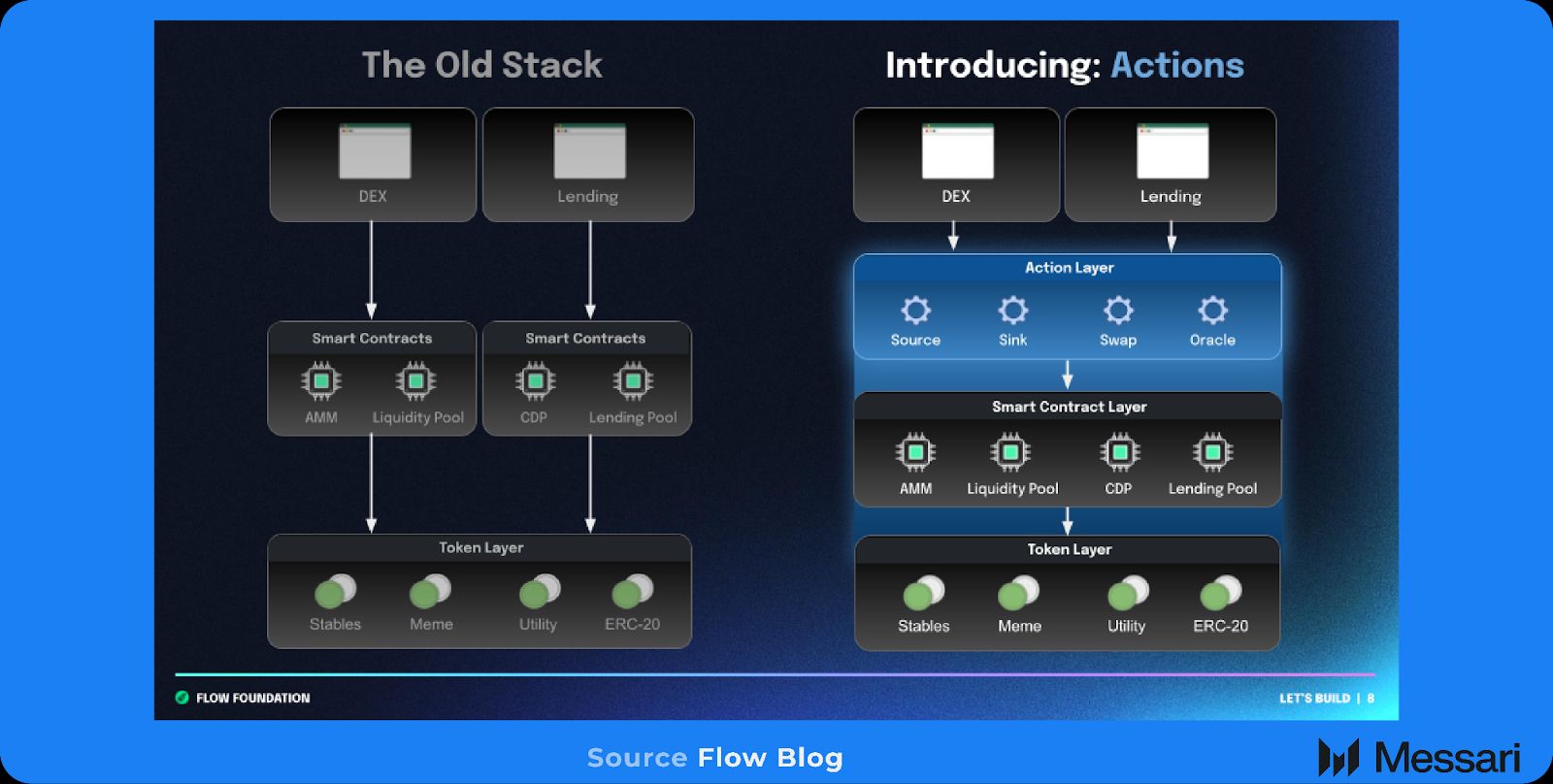
Flow’s most recent development occurred in October 2025 when the Forte upgrade was activated on mainnet. This upgrade introduced Actions, enabling onchain automation without requiring extensive custom code. Actions are composable operations, such as swaps and loans, that can be combined into multi-step workflows. By eliminating the need for offchain infrastructure and relayers, Forte strengthens developer composability and positions Flow for AI-driven applications. The upgrade also reduced hardware requirements for node operators and launched alongside the Forte Hacks hackathon with a $250,000 prize pool, marking Flow's most significant protocol advancement since Crescendo.
Flow has played a significant role in onboarding consumers into crypto by pioneering the ERC-721 (non-fungible) token standard via CryptoKitties in 2017 and putting NFT collectibles into the mainstream via NBA Top Shot in 2021. In 2023, Disney and Dapper Labs launched Disney Pinnacle on Flow, a digital pin marketplace featuring Disney, Pixar, and Star Wars IP, furthering Flow’s consumer reach. Today, Flow is expanding its foundation in consumer applications into programmable consumer finance, building on years of experience operating products with millions of users and real transaction volume. For a full primer on Flow, refer to our Initiation of Coverage.
Flow’s early growth came from consumer applications and partner intellectual property (IP), with NFT-led activity driving billions in transaction volume, tying consumer activity to onchain usage via product launches and secondary-market demand. With the Crescendo and Forte upgrades live, Flow has expanded its focus on consumer DeFi, specifically around stablecoin balances, payments, and transfers.
In early December 2025, Flow published a Consumer DeFi strategy that shifts the roadmap toward stablecoin-based consumer finance and enshrined protocols, meaning shared DeFi infrastructure that the ecosystem can build around. The plan starts with Flow Credit Market (FCM) and a companion consumer yield app, Peak.Money. Roham Gharegozlu has repeated the same positioning in public posts and interviews, as a progression from collectibles into consumer DeFi around stablecoins and recurring onchain routines.
Crescendo-enabled EVM Deployments on Flow
The Crescendo upgrade shipped to mainnet on Sept. 4, 2024, adding EVM equivalence and targeting a block time of 0.8 seconds. EVM equivalence lets Solidity developers deploy on Flow EVM using standard Ethereum tooling. While EVM equivalence reduces porting effort for many Solidity contracts, teams still need to retest and review security assumptions on Flow, since it is still a new deployment environment. This allows teams to save time by porting the core logic for actions such as stablecoin transfers, swaps, lending, and vault wrappers, and instead spend their time on onboarding and safety. Crescendo supports consumer DeFi because it lets apps abstract fees and transaction handling. Flow EVM supports fee sponsorship, where applications pay network fees on behalf of the user. The user still signs the transaction, but they do not need to hold FLOW to cover gas, which makes stablecoin transfers feel closer to payment flows like those on popular apps like Venmo or PayPal.
Forte Automation
The Forte upgrade was completed on Oct. 22, 2025, and introduced Actions and Workflows as building blocks for repeatable, time-based execution. This gives consumer apps a native way to package routine actions into an onchain workflow and execute them on a schedule or other condition. Before Forte, teams would typically run this logic offchain, using their own backend services to trigger and execute scheduled actions. This approach shifts reliability and security responsibilities to each application team, creating more opportunities for execution to fail. Forte brings that recurrence onchain as a shared capability, so apps can build scheduled payments, savings sweeps, and auto-repay flows without custom schedulers.
Consumer Use Cases
Most financial users do not manage their finances on a day-to-day basis. Instead, they rely on routines such as deposits, transfers, and repayments that run on a schedule. Forte enables consumer workflows such as:
A weekly stablecoin deposit that turns into a savings routine. For example, saving $100 every seven days.
Dollar-cost averaging into a target asset on a fixed schedule, with optional caps on price impact or slippage.
Scheduled bill pay for subscriptions, where the workflow checks a balance, tops up if needed, then pays.
Auto-repay for lending, where repayment triggers when balances cross thresholds or when risk metrics deteriorate.
Policy-based rules, such as pausing new exposure when volatility or borrowing rates exceed a limit.
Without a protocol-native approach, apps typically implement these as backend jobs that watch for time and state, then submit transactions. That design works, but each team ends up maintaining its own scheduler, monitoring, and failure handling. Forte standardizes recurring execution natively onchain, reducing the amount of scheduling and monitoring each team needs to manage themselves.
Stablecoins as the Consumer Wedge
Stablecoins are the primary consumer-facing crypto asset because they hold a stable unit of account and support transfers without taking directional price risk. For Flow, stablecoins are also the clearest way to demonstrate that the network is moving beyond NFT-led bursts toward repeat, everyday usage.
Flow’s stablecoin supply (USD) is $26 million as of Dec. 29, 2025, with PayPal USD (PYUSD) at a market share of 57.5%. Most ecosystems are dominated by Tether (USDT) and USD Coin (USDC), with smaller issuers following. The mix on Flow is more concentrated in a single issuer, which simplifies a default dollar balance for consumer apps. While this increases dependency on issuer policy and liquidity conditions, Flow prioritizes consumer UX simplicity over the complexity of a multi-stablecoin ecosystem.
PYUSD’s concentration influences consumer apps because many work best when one stablecoin becomes the standard balance and transfer rail, reducing fragmentation across wallets, liquidity, and support flows. One dominant stablecoin enables apps to maintain balances, pricing, and recurring transfers in a single unit. Because of this, users do not have to choose between multiple “dollars,” and apps do not have to route routine sends through background swaps just to make payments work. If PYUSD supply continues to grow, the PYUSD-heavy mix of FLOW may lower go-to-market friction for apps that want a PayPal-branded stablecoin rail.
For stablecoins to function as a consumer rail on Flow, transfers must be low-cost and predictable, and apps need reliable fee sponsorship for common actions. Additionally, wallet UX should support consumer recovery patterns, such as multi-device keys or social recovery, since key loss is a main failure point. Separately, stablecoin swaps need to clear predictably at everyday sizes, and users require a clear path to deposit and withdraw dollars on and off the Flow network. Consumer payment apps also require transaction handling that mimics payments. Users should be able to clearly distinguish between pending and complete states, understand why an action failed, and retry without risking duplicate sends.
Consumers already have a reference point for how stablecoin payments should work, such as TRON’s well-established USDT transfer activity and consumer-focused distribution on Solana and Base. Flow does not require comparable scale in the near term, but it does need comparable reliability. Stable balances that transfer consistently, fees that users rarely notice, and stable-pair liquidity that holds up during volatility will determine whether Flow can support consumer DeFi at scale.
DeFi Infrastructure for Consumer Products
Swaps
Consumer stablecoin apps often rely heavily on swaps behind the scenes. Even what is presented to the user as a simple payment often requires routing between stables, topping up gas abstractions, or converting balances behind the scenes. On Flow, the first question is whether stablecoin liquidity can support routine usage without noticeable slippage or inconsistent execution. For Flow, what matters is whether stable swaps work in normal use. Small and medium conversions should clear without surprising slippage or failed routing. If stable swaps can remain dependable when volume is low, Flow can convert its existing consumer base into repeat stablecoin behavior, as dependable, routine money movement relies on being able to convert and route stables even when liquidity is thin.
Flow already has stable-focused swap venues that make these conversions realistic. KittyPunch offers StableKitty, a low-slippage stable swap product focused on supporting consumer DeFi flows, and Flow has pointed to it as one of the early liquidity centers in the ecosystem. A second venue is Trado, which Flow has framed as a consumer-oriented DEX, with over 43,000 swaps and more than $15.7 million in swap volume in 2025.
Lending
Lending is the credit layer for consumer DeFi, and also where risk settings and user experience start to matter as much as the product itself. Once users start borrowing against collateral, even small design choices in risk settings and liquidation behavior can have real-world consequences. Because liquidation is automatic, users often interpret it as a product failure rather than a risk they chose to take on. Flow is addressing this by standardizing lending toward shared, default infrastructure, starting with Flow Credit Market (FCM) as the default venue for wallets and apps.
FCM is the first enshrined protocol being developed by the Flow Foundation. Enshrined protocols are Flow’s term for shared DeFi infrastructure that concentrates liquidity in a few central hubs. Flow also plans to bootstrap each enshrined protocol with one or more flywheel applications built by Dapper Labs or another strategic partner, and Forte provides those apps with a clear way to add recurring actions.
The value of a shared venue like FCM is that wallets can build one borrowing and repayment experience and reuse it across apps. However, that only works if the experience is predictable. Users need clear limits, clear triggers, and a simple way to prevent liquidation through scheduled repayments or automatic de-risking. Forte operationalizes safety around FCM by executing repayment routines and guardrails onchain, allowing wallets to run auto-repay and de-risking features without requiring active management from the user. If it works, FCM will become a reusable credit layer across wallets and apps, backed by consistent rules and safety routines that consumers can trust.
Yield
Consumer yield products should be thought of as savings products with tight risk limits. That means the user deposits assets and expects two things to be true at all times:
They can withdraw any amount of their funds at any given time.
The return should come from a small set of easy-to-explain sources, so a consumer can understand why they are earning a yield without needing to understand DeFi.
To meet those expectations, the app and protocol must be designed in tandem. Flow’s approach is to pair shared yield infrastructure with a consumer front end. Peak.Money is positioned as the flywheel app for FCM, giving users a simple “deposit and earn” flow while routing the underlying credit and yield mechanics through the shared market. Apps like this are appealing to consumers because they let consumers earn yield without learning DeFi. These products reduce complexity into one balance with one deposit and one withdrawal flow, while the protocol handles yield generation and risk controls. This simplicity is what consumers and builders want. If the yield path is standardized through a shared market such as Peak.Money and wallets can integrate a single savings feature that works across multiple apps, rather than supporting a different vault and risk model each time.
For Peak.Money and similar consumer yield apps, the main constraint is that the yield path has to behave like savings. Consumer yield works best when the return comes from one of two places: overcollateralized lending or a tightly constrained vault with explicit limits. When the return depends on leverage, multi-step routing, or frequent rebalancing to hit a target rate, the product stops behaving like savings. Users are holding a managed position with moving parts, and most won’t understand why results change from week to week.
Forte mitigates risk in this area by supporting repeat behavior without custom scheduling. For example, a user can set up a weekly deposit, or rules such as “keep a minimum of $1,000 in stablecoins” or “stop deposits if my balance drops to $500,” without the team needing to run a separate backend service to trigger transactions. While this reduces operational complexity, it doesn’t make a vault inherently safe, as they still need to behave predictably. If the same weekly action produces a different result one time to the next, users will stop believing they have a savings balance and start assuming the product is doing something they did not approve.
Tokenization is crucial for Flow’s consumer DeFi push because it enables balances and workflow permissions to be portable across products. Stablecoins are the most familiar tokenized asset for consumers because they conceptualize how a wallet can hold dollar value onchain. However, tokenization matters beyond stablecoins when it turns a deposit or vault balance into a receipt token that a wallet can show and other apps can use. A receipt token is proof of a deposit where a user deposits stablecoins into a savings-style contract, and the receipt token represents the user's claim on that deposit. Similarly, a vault receipt token represents ownership in a pool, but its value changes over time as the pool earns or loses. Rewards points also follow the same concept when they are issued as tokens, as they can be transferred and redeemed across products, rather than being confined to one application.
Tokenization can also represent eligibility, not just token balances. Flow already supports wallet-level proofs through the Flow Client Library (FCL) account proof, which lets an app verify that a user controls a given wallet before it enables sensitive actions. For deeper eligibility checks, Flow’s EVM equivalence enables teams to deploy standard EVM attestation frameworks, such as the Ethereum Attestation Service (EAS), on Flow. This lets wallets present a credential that says “this user qualifies” (e.g., tier, region, compliance status, etc.) so an app can verify the user before allowing actions, which reduces repeated onboarding and KYC-style friction for flows that do not need full re-verification every time. Forte then becomes the execution layer for these flows. A recurring transfer or deposit can verify the credential first and only run while it remains valid, without requiring the team to operate a separate offchain scheduler to enforce the rule. Together, tokenized balances and tokenized eligibility let wallets and payment products move money, represent savings positions, and enforce basic access rules in one flow, with fewer one-off integrations.
Protocol Security: Proof of Possession
Flow has continued tightening protocol-side security around validator participation. Flow describes its implementation of Proof of Possession as a step toward permissionless participation, which requires cryptographic proof of control over staking keys, thereby reducing key-substitution-style risks during node registration. In the context of consumer DeFi, this is not a direct user feature, but it reduces protocol-layer risk for applications built on Flow.
Closing Summary
Flow is leveraging its proven consumer distribution and operational experience to drive consumer DeFi adoption. Forte is the clearest signal of that shift, adding Actions, AI Agents, and scheduled execution to make recurring transfers and multi-step routines something teams can build directly onchain. This supports recurring deposits, scheduled payments, and opt-in rules that run automatically. Crescendo supports the same direction by making Flow EVM compatible for Solidity teams and enabling fee sponsorship. Tokenization then makes balances, positions, and eligibility portable across apps, further supporting savings-like products and automated routines. Flow’s consumer DeFi strategy ties Forte, Crescendo, and tokenization together through enshrined protocols, starting with FCM and Peak.Money to drive early usage through a shared credit layer.
Stablecoins are the core asset for the push toward consumer DeFi, and Flow’s focus on PYUSD creates a default dollar balance for consumers, while concentrating issuer and liquidity exposure into one asset class. Future traction in consumer DeFi will depend on execution quality. Stablecoin transfers need to be predictable, stable swaps need to clear consistently at everyday sizes, and users need a clear path to move dollars on and off Flow. As Flow pairs Forte’s recurring execution with FCM and payment-grade stablecoin reliability, the network can convert consumer distribution into repeat financial behavior.
This report was commissioned by the Flow Foundation. All content was produced independently by the author(s) and does not necessarily reflect the opinions of Messari, Inc. or the organization that requested the report. The commissioning organization may have input on the content of the report, but Messari maintains editorial control over the final report to retain data accuracy and objectivity. Author(s) may hold cryptocurrencies named in this report. This report is meant for informational purposes only. It is not meant to serve as investment advice. You should conduct your own research and consult an independent financial, tax, or legal advisor before making any investment decisions. Past performance of any asset is not indicative of future results. Please see our Terms of Service for more information.
No part of this report may be (a) copied, photocopied, duplicated in any form by any means or (b) redistributed without the prior written consent of Messari®.