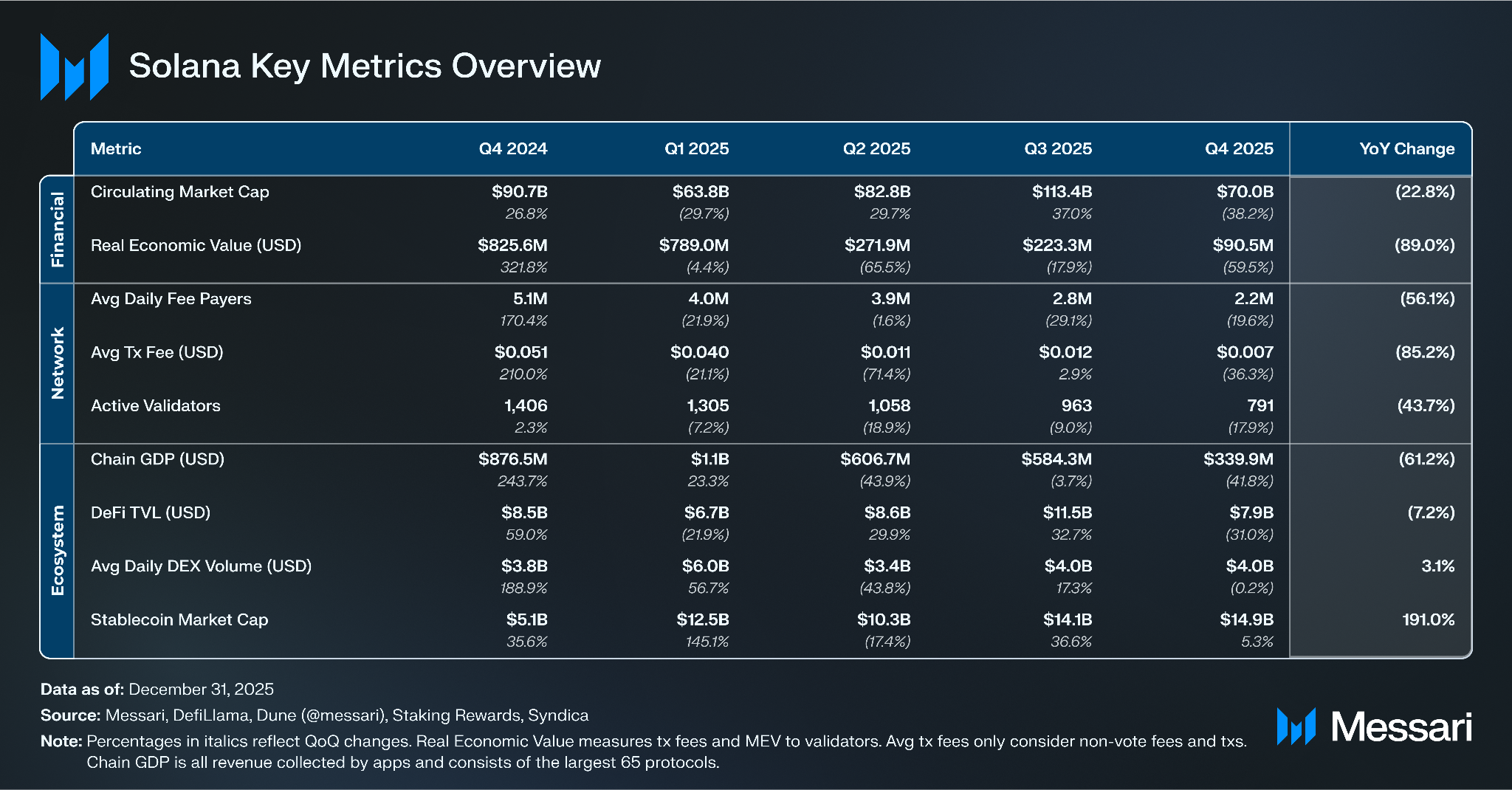
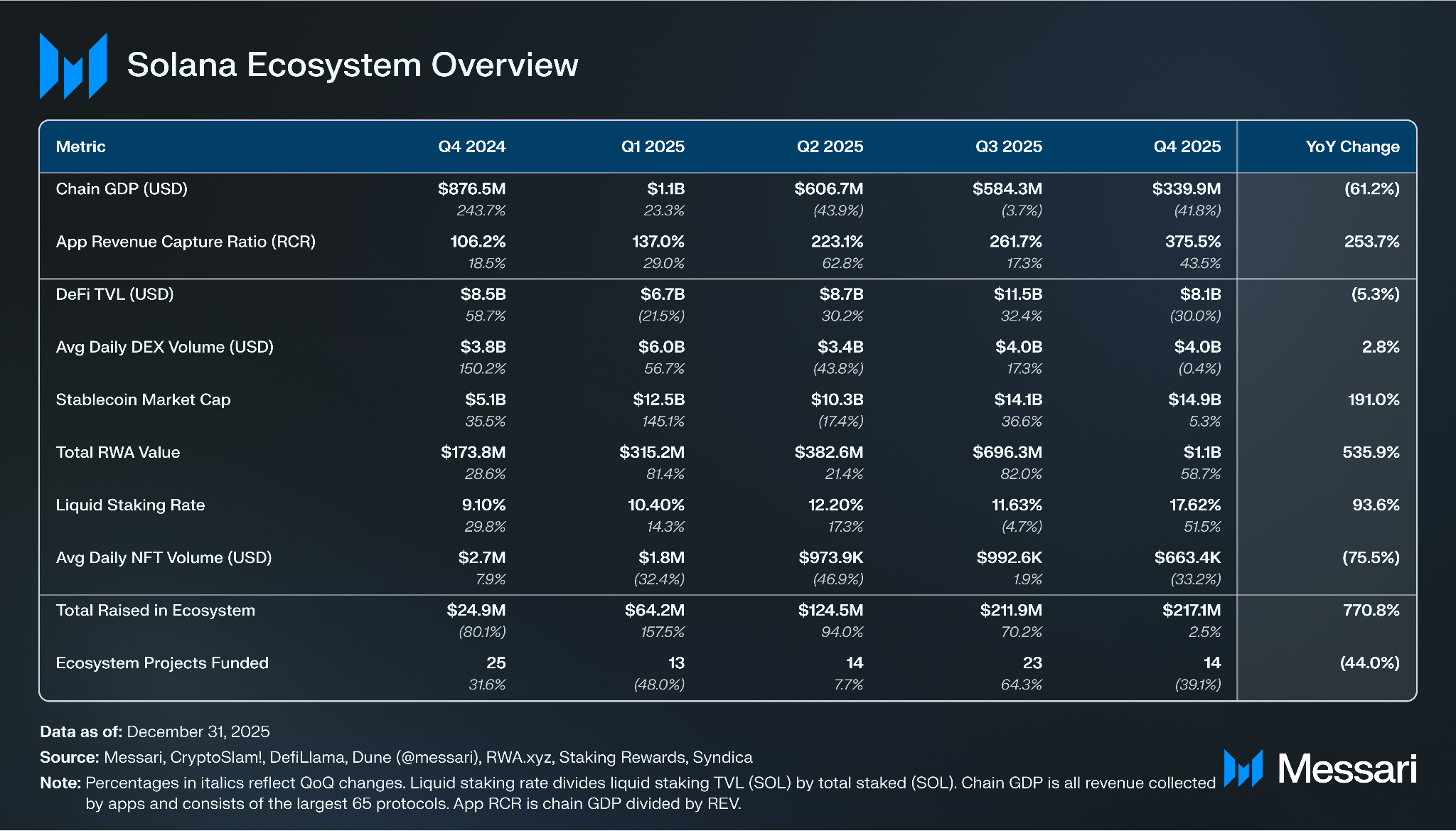
The Application Revenue Capture Ratio (Chain GDP divided by Real Economic Value) grew from 262.8% to 375.5%. An increasing App RCR signals that an ecosystem is increasingly monetizing activity occurring on the network.
Stablecoin market cap on Solana grew 5.3% QoQ to an all-time high of $14.9 billion. USDC stayed flat at $10 billion while PYUSD grew 95.5% QoQ to $871 million.
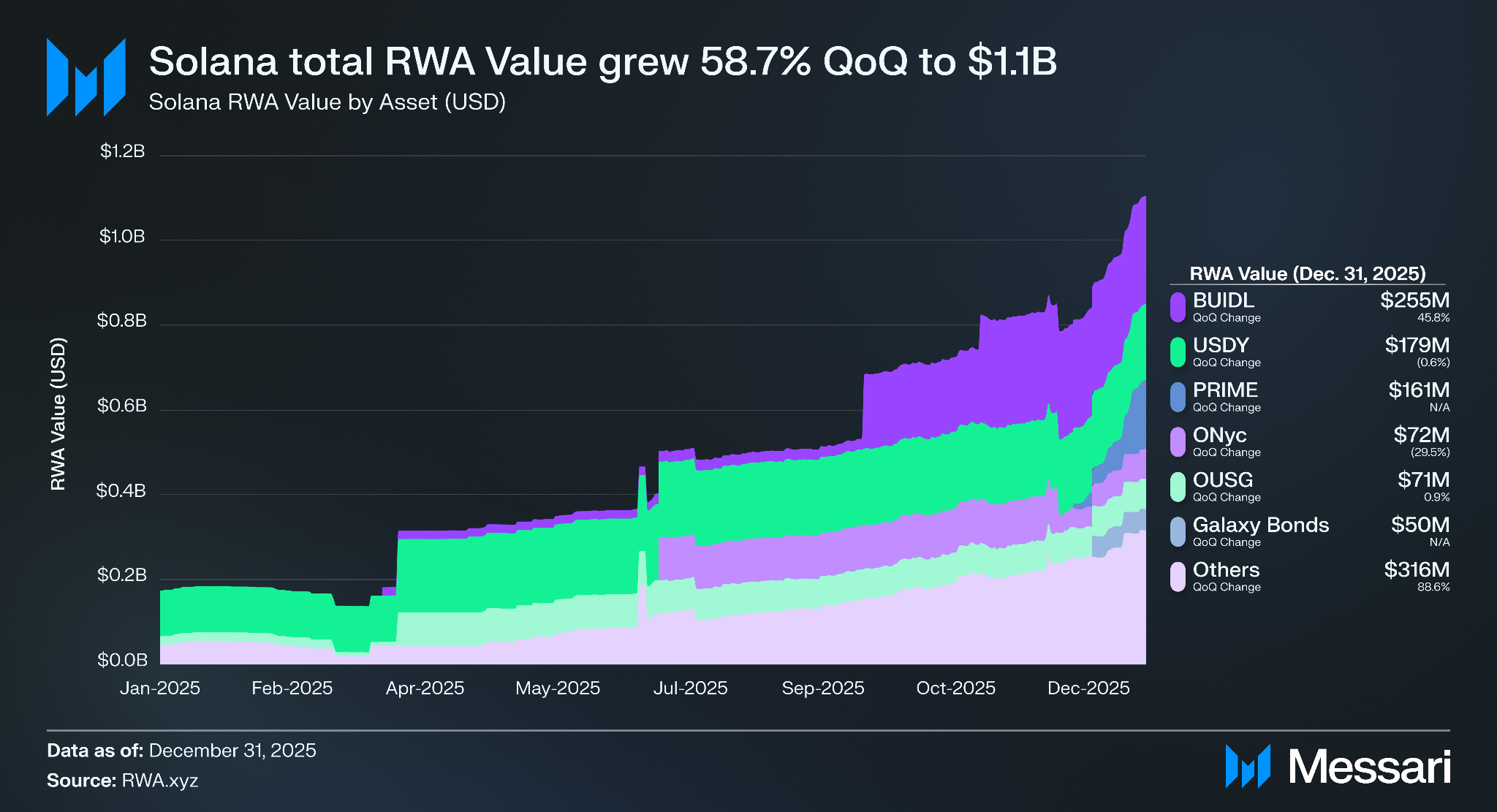
RWA value on Solana grew 58.7% QoQ to $1.1 billion, driven by the growth of products like BlackRock’s BUIDL and Figure’s PRIME.
Validator client diversity advanced as Firedancer surpassed 100 days on mainnet and Frankendancer adoption grew, marking a critical step toward resilience and long-term performance ahead of Alpenglow’s expected launch.
Five new spot SOL ETFs launched and cumulative flows reached $1.0 billion, led by Bitwise’s BSOL and Rex Osprey’s SSK.
Primer
Solana (SOL) is an integrated, open-source Layer-1 network with the goal of synchronizing global information at the speed of light. Solana optimizes for increasing bandwidth and reducing latency. It accomplishes this through features such as its novel timestamp mechanism called Proof-of-History (PoH), a block propagation protocol called Turbine, and parallel transaction processing. Since mainnet launch in March 2020, several network upgrades have brought further network performance and resilience, including QUIC, stake-weighted Quality of Service (QoS), and local fee markets.
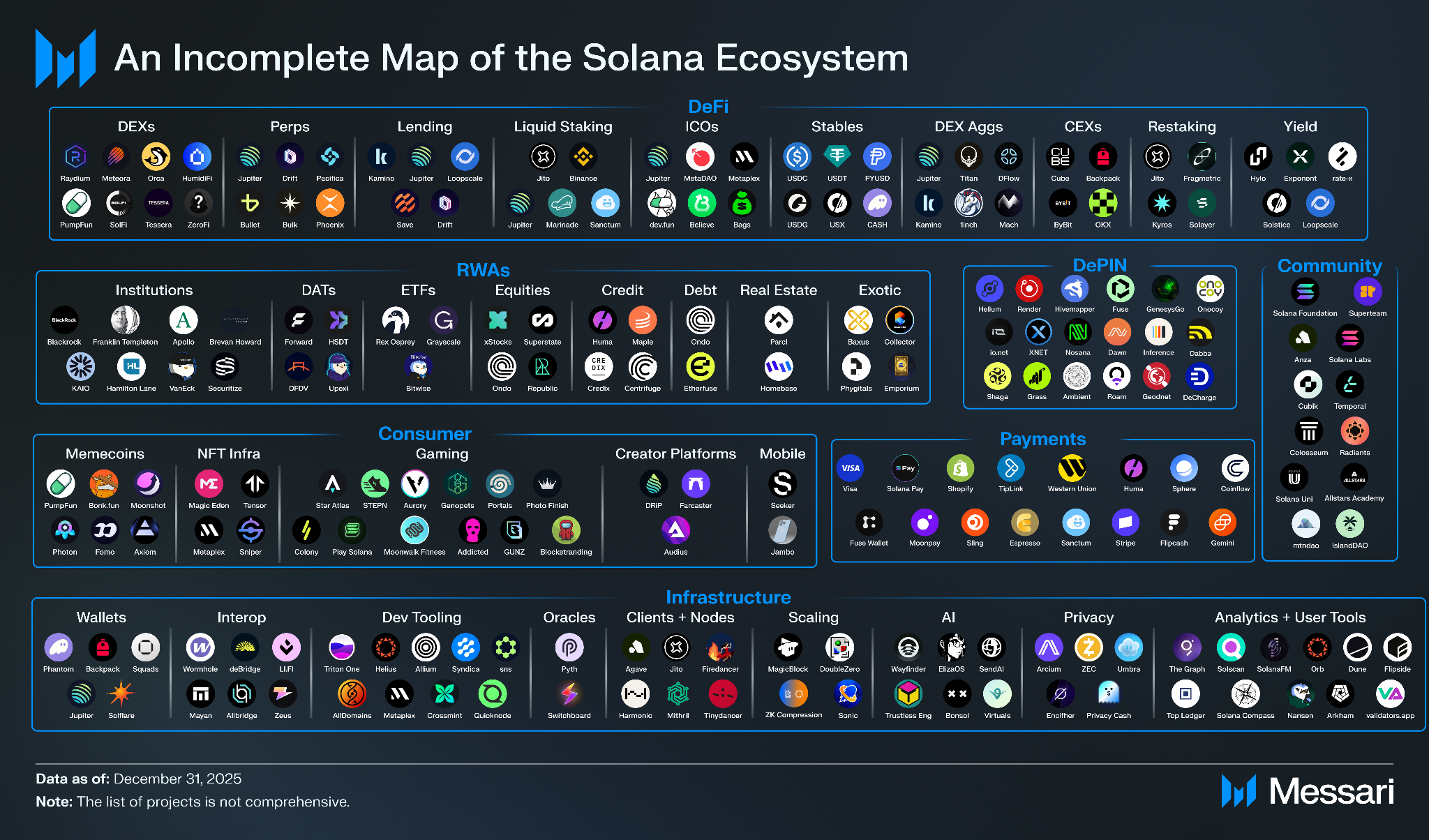
The network’s development and growth, and its ecosystem are supported by the non-profit Solana Foundation, for-profit Solana Labs, and various third-party organizations, including Anza, Colosseum, Helius, Superteam, and many others. Solana Labs has raised over $335 million in private and public token sales. Solana features a growing ecosystem of projects across many sectors, including DeFi, consumer, DePIN, and payments. To stay up-to-date with all things Solana, visit the Solana Portal.
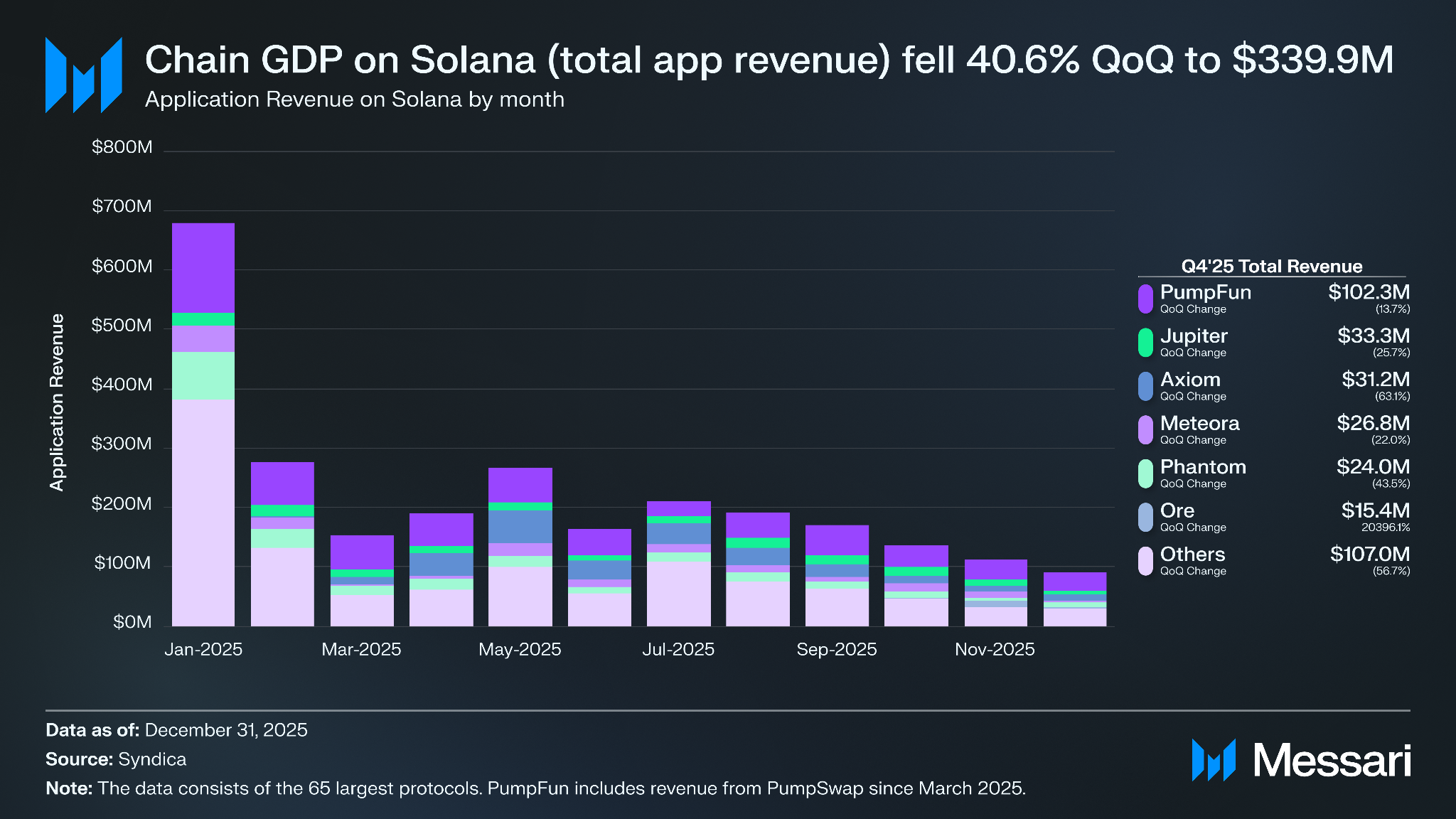
Chain GDP is defined as the total application revenue generated on a network. In Q3 2025, Solana’s Chain GDP fell 41.8% QoQ from $584.3 million to $339.9 million. The leaders by application revenue in Q2’25 were as follows:
These applications facilitate the trading of assets, leading to revenue being directly correlated to speculation activity.
App Revenue Capture Ratio (App RCR)
A network’s App Revenue Capture Ratio (RCR) is the ratio of revenue generated by its apps to its Real Economic Value (REV). REV is defined as the sum of base transaction fees, priority fees, and MEV tips paid to validators. App RCR reflects the efficiency with which applications leverage economic activity on the network. The higher the app RCR, the more effectively apps capture the economic activity being generated on the network, suggesting a mature ecosystem with monetizable applications. A low App RCR may signal untapped potential for app developers or inefficiencies in revenue capture. Alternatively, it may signal a nascent ecosystem not yet ready for monetization.
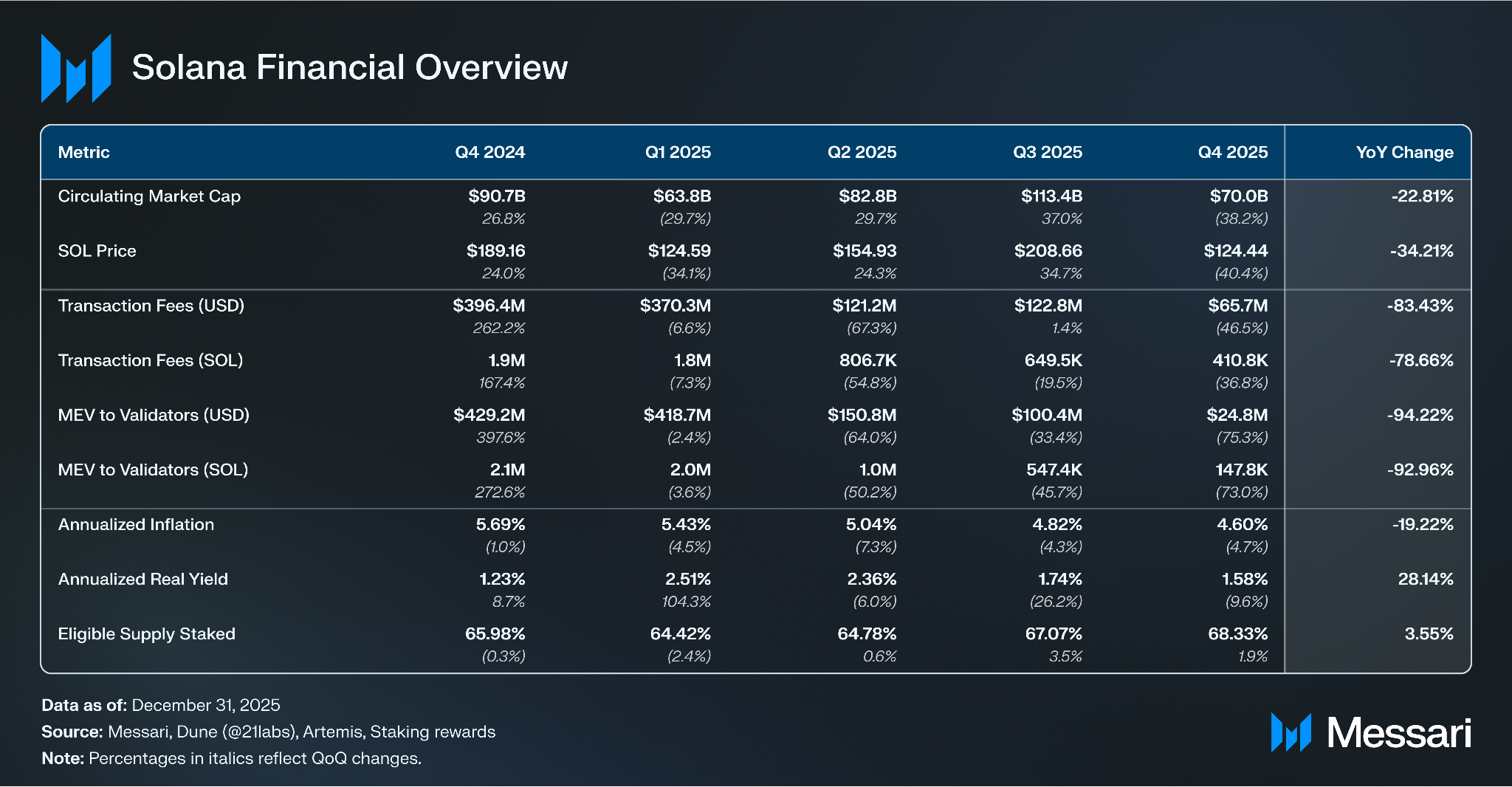
If App RCR equals 20%, this implies that for every $1 of REV generated by the network, $0.20 is captured as revenue by apps. In Q4 2025, App RCR on Solana was 375.5%, up from 261.7% in Q3’25. This can be interpreted as when $100 is spent in transaction fees (and/or Jito tips) to interact with Solana, applications on Solana earn $375.50 in revenue.
A network’s App RCR can exceed 1 when its applications successfully monetize activity, driving revenue streams for project teams and, potentially, tokenholders. Examples include DEXs like Raydium, which charge trading fees on every swap. The trading fee depends on the given pool, 25bps for standard AMM pools, and a range of 1-100bps for CLMM and CPMM pools, a portion of all of which are used to buy back RAY tokens.
DeFi
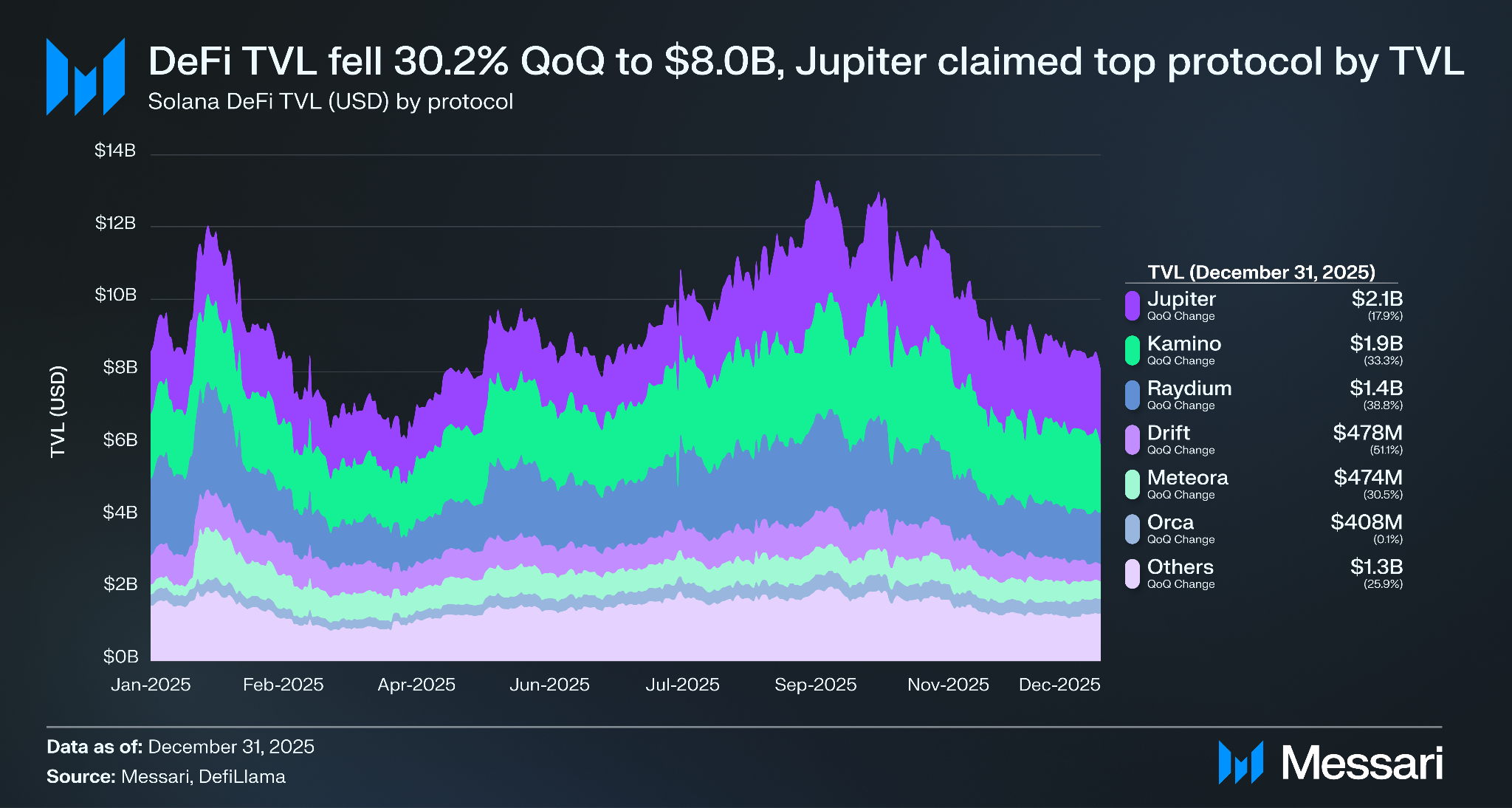
DeFi TVL (USD) on Solana fell 30.2% QoQ to $8.0 billion. Solana maintained its second-place ranking among networks in DeFi TVL after surpassing TRON in November 2024. The leading protocols on Solana, ranked according to DeFi TVL in Q3, were:
Jupiter: Took the top spot as its TVL only decreased 17.9% QoQ, ending with $2.1 billion and a 26.1% market share. At Accelerate 2025 in May, the Jupiter team announced the Jupiter Lend product, powered by Fluid. The product launched in August 2025, and at the end of Q4’25, had $962.7 million in TVL. At Breakpoint 2025, Jupiter announced Offer Book after it acquiredRain.fi. Offer Book allows for peer-to-peer lending and is launching in Q1’26.
Kamino: Fell to the second place in TVL, ending with $1.9 billion and a market share of 23.1% as TVL fell 33.3% QoQ. At Breakpoint 2025, Kamino announced a refreshed brand and six new products: fixed-rate lending, borrow intents, offchain collateral, private credit, an RWA DEX, and Kamino BuildKit.
Raydium: Maintained its third spot, with TVL decreasing 38.8% QoQ to $1.4 billion and 17.6% market share.
Spot DEXs
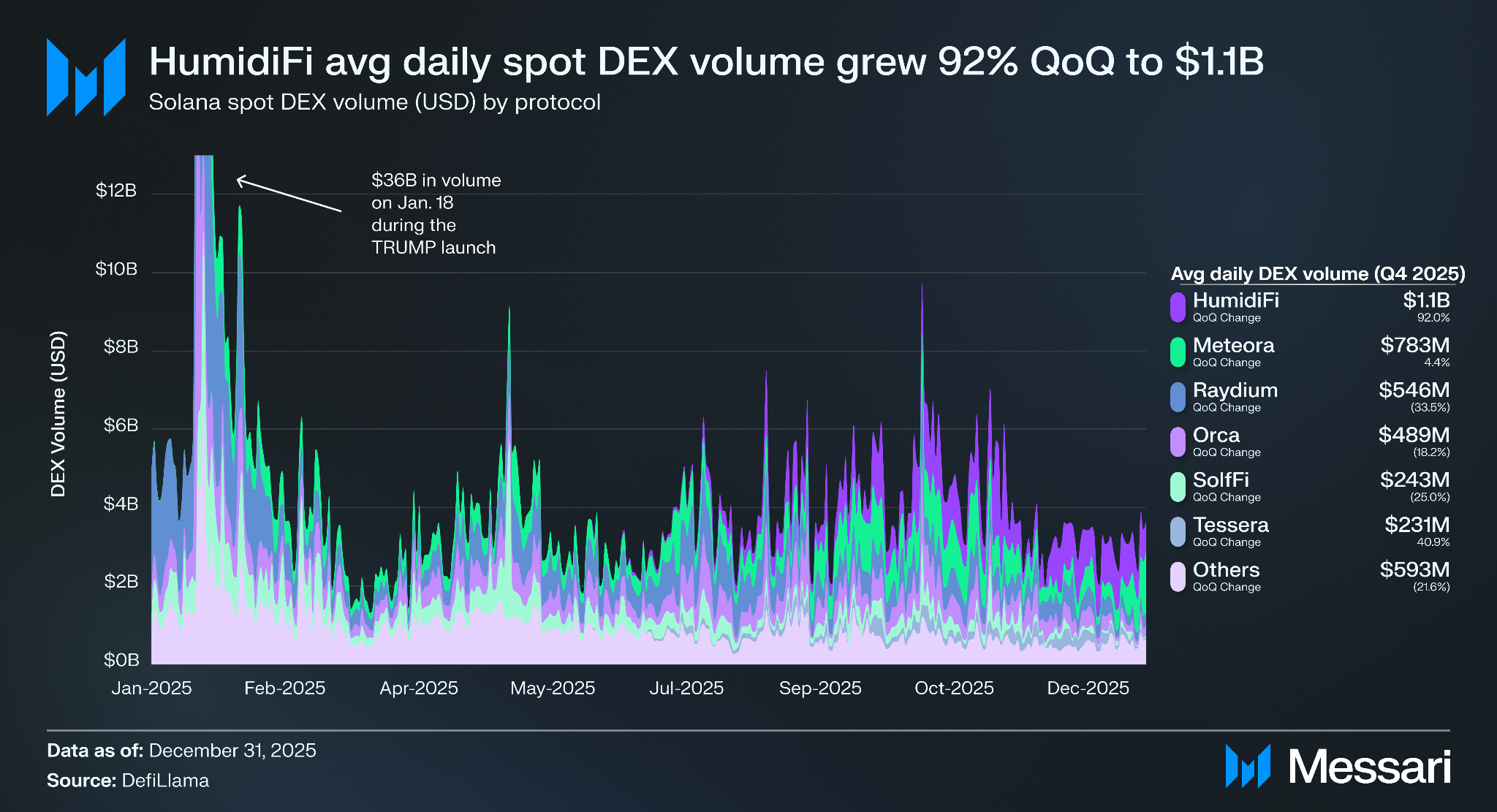
Average daily spot DEX volume (USD) stayed flat QoQ at $4 billion in Q4 2025. The leading protocols on Solana, ranked according to average daily spot DEX volume in Q3, were:
HumidiFi: Claiming the top spot, as its average daily spot volume increased 92.0% QoQ to $1.1 billion with a 27.0% market share. HumidiFi launched its WET token on Dec. 4, 2025, using Jupiter’s DTF ICO platform.
Meteora: Maintained its second spot, as its average daily spot volume increased 4.4% QoQ to $782.9 million, a 19.8% market share. The majority of this rise can be attributed to the anticipation of the MET TGE, which occurred on Oct. 23, 2025.
Raydium: Average daily spot volume decreased 33.5% QoQ to $545.9 million with a 13.8% market share.
In Q4’25, the Solana Ecosystem continued to see multiple Prop AMMs rise to dominate SOL-stablecoin pairs. Prop AMMs are programmable liquidity pools that use offchain price oracles for real-time price discovery, offering tighter spreads and better prices for traders. Prop AMMs like HumidiFi and SolFi do not operate with front-ends and can only be traded on through DEX aggregators like Jupiter or Titan.
At Breakpoint 2025, Coinbase announced that in Q1’26 all Solana tokens will be tradable through their app. On Jan. 23, 2026, the integration went live.
Perp DEXs
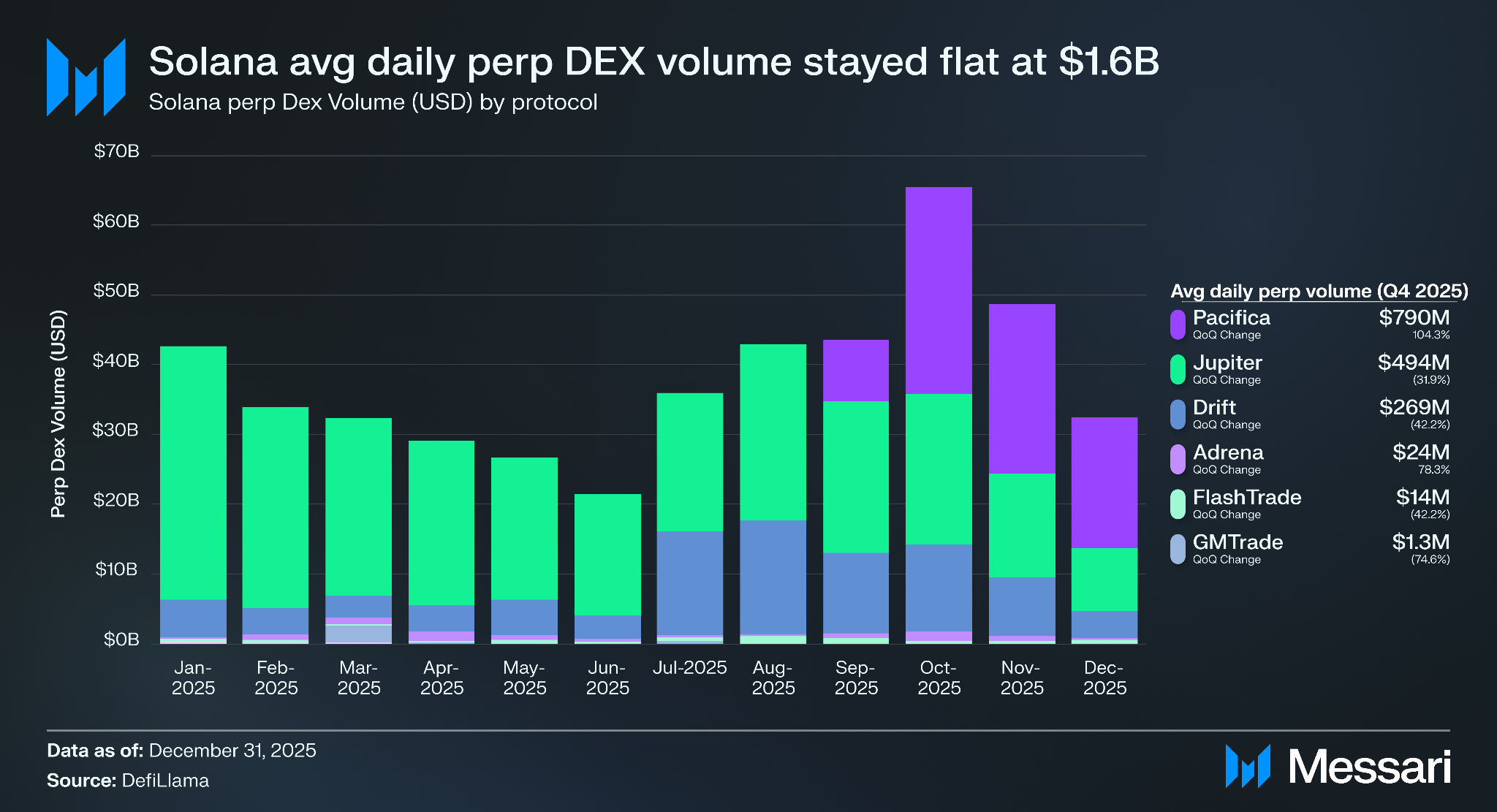
Solana's average daily perp DEX volume (USD) remained flat at $1.6 billion, following a record month in October when $65.4 billion was traded. The leaders for the quarter are listed below:
Pacifica: Launched mainnet in June 2025 and started tracking volume on Sept. 9, 2025. Pacifica averaged $789.6 million in daily perp trading volume, a 104.3% increase QoQ, ending the quarter with a 49.6% market share.
Jupiter: Averaged $494.0 million in daily perp trading volume, a 31.9% decrease QoQ, ending the quarter with a 31.0% market share.
Drift: Average daily perps volume fell 42.2% QoQ to $268.8 million, resulting in a 16.9% market share.
In Q1’26, two highly anticipated Solana perp DEXs are expected to launch:
Phoenix Perps: Ellipsis Labs, the team behind Phoenix Spot and SolFi, is now pursuing Phoenix Perps. This implementation is the most experimental, as it uses prop AMMs as the liquidity source for its perp DEX. Phoenix Perps plans to bring the benefits of prop AMMs, including tighter spreads, deeper books, and more adaptable quoting, to the perp space. Phoenix Perps launched in private beta at Breakpoint 2025.
Bulk: Bulk is introducing a sidecar implementation for Solana perps by forking the Jito-Agave client, enabling validators to run Bulk-Agave. Users’ positions remain on mainnet, but matching occurs through Bulk Tile, which runs on every validator node running Bulk-Agave. This architecture separates order propagation and matching from onchain settlement, enabling low latency and fast propagation. Bulk has also stated that they will share 12.5% of revenue with validators running their client.
Stablecoins
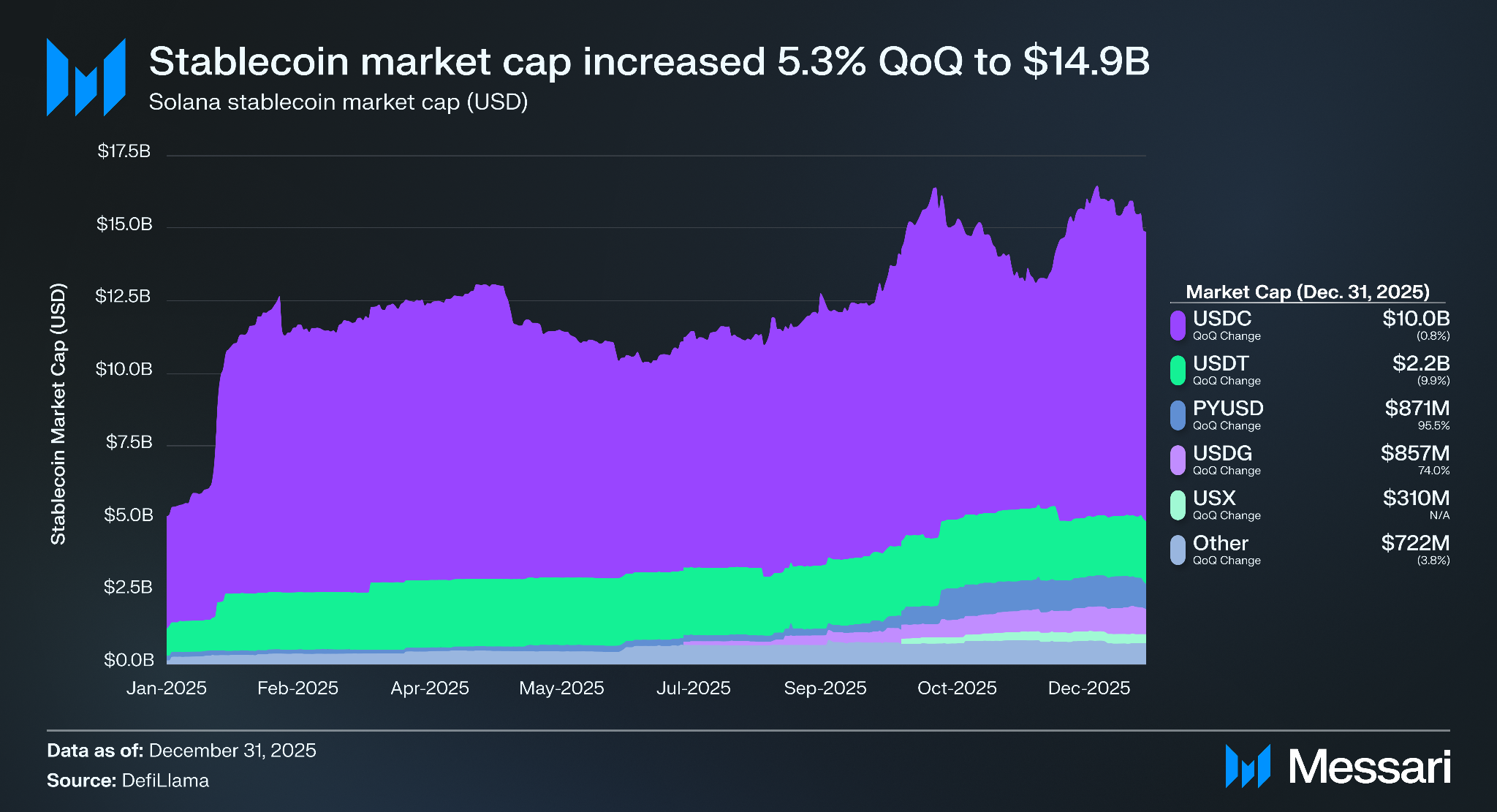
Stablecoin market cap (USD) on Solana grew 5.3% QoQ to $14.9 billion, ranking it third among all networks. Solana outperformed Ethereum’s Q4 growth (4.2% QoQ increase), but underperformed Tron’s Q4 growth (6.9% QoQ increase). Much of this year's growth came after the TRUMP token launched on Jan. 17, 2025, which brought an influx of liquidity to Solana and led to various high-liquidity USDC pairs. The sustained increase in stablecoin market cap indicates that much of the new capital remained on the network. The stablecoin market cap on Solana hit an all-time high of $15 billion shortly after the quarter began on Oct. 4, 2025.
USDC ended the quarter with a market cap of $10 billion with a 67.0% market share. USDT was the second-largest stablecoin on Solana by the end of Q4'25, with $2.2 billion in circulation (a 9.9% QoQ decrease) and a 14.5% market share. PYUSD grew to the third-largest stablecoin by market cap with $870.6 million (a 95.5% QoQ increase) and a 5.9% market share.
RWA
Total real-world assets value (USD) on Solana ended Q4’25 at $1.1 billion, a 58.7% QoQ increase. The leaders in the RWA category were as follows:
BUIDL is a tokenized U.S. money market fund developed by BlackRock, in partnership with Securitize, that holds cash and short-term U.S. Treasuries. As of Dec. 31, 2025, BUIDL was the largest yield-bearing RWA by market cap on Solana, with $255.4 million in market cap, a 45.8% QoQ increase.
Ondo Finance’s USDY, launched in August 2023, is a token backed by U.S. Treasuries and bank deposits, designed to function as a yield-bearing stablecoin with broad accessibility. As of Sept. 30, 2025, USDY was the second-largest yield-bearing RWA by market cap on Solana, with a market cap of $179.4 million, down 0.6% QoQ.
Figure’s PRIME is a tokenized deposit into Democratized Prime, a warehouse lending facility. PRIME launched on Solana in December 2025 and quickly claimed the third-largest RWA by market cap on Solana, with $161.2 million.
Other RWA Related Events
xStocks is a suite of tokenized U.S. equities and ETFs offered by Backed, a regulated Swiss issuer, in partnership with Kraken. Announced in May 2025 and launched on June 30, 2025, with over 74 products ranging from Apple and Tesla to broad index funds. At the end of Q4’25, they had a total market cap of $188.6 million. On Dec. 2, 2025, Kraken acquired Backed.
At Breakpoint 2025, J.P. Morgan announced the first debt issuance on Solana, which was completed on behalf of Galaxy Digital for $50 million.
At Breakpoint 2025, State Street and Galaxy announced their tokenized private liquidity fund SWEEP, which will be seeded by Ondo Finance with $200 million.
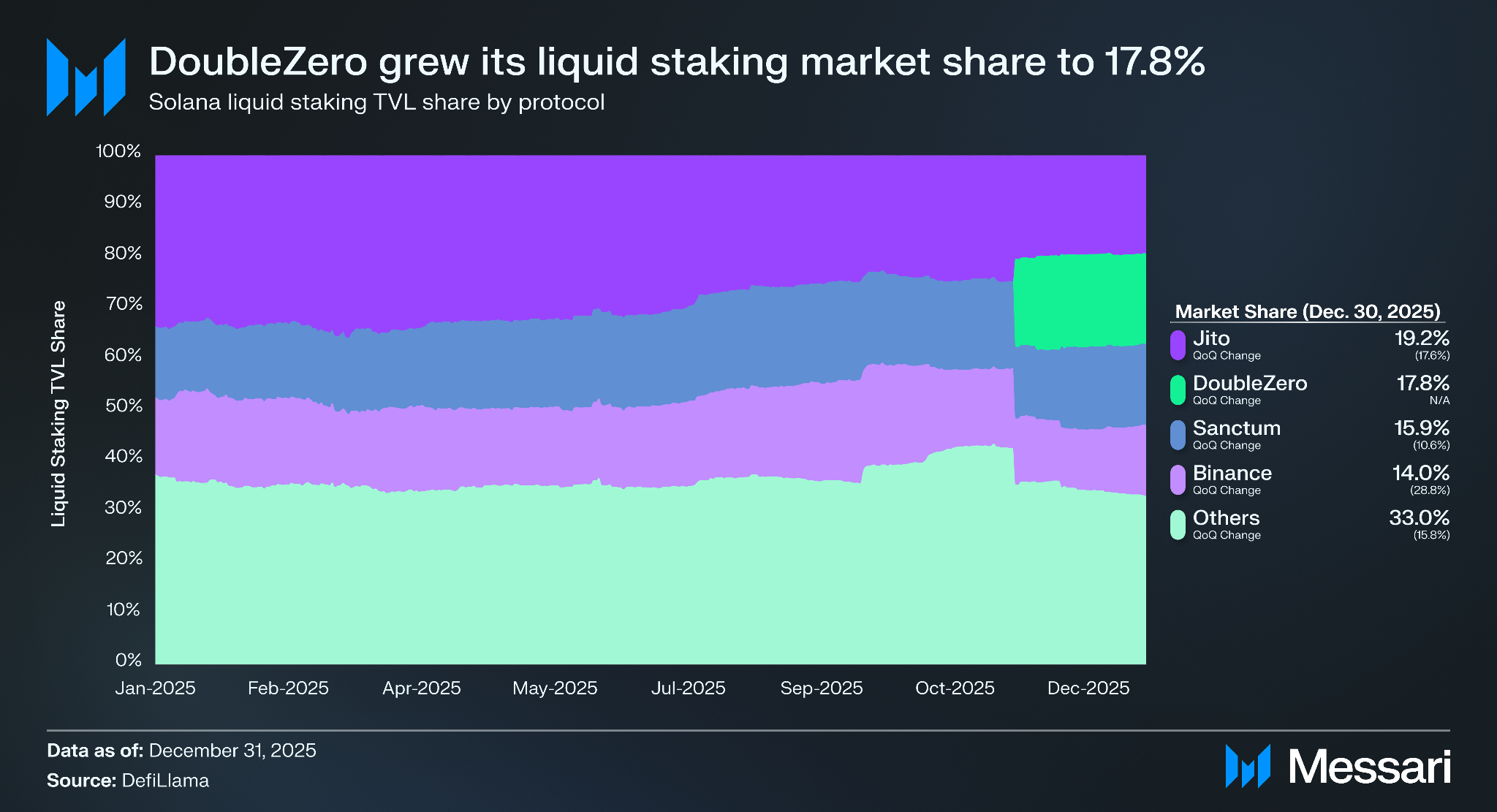
The liquid staking rate on Solana increased from 11.6% to 17.6% QoQ. With 68.3% of SOL’s circulating supply staked, liquid staking is particularly important, as its growth increases the supply of yield‑bearing SOL that can be deployed across DeFi applications.
Jito’s jitoSOL remained the liquid staking token (LST) leader on Solana, though its liquid staking market share fell from 23.4% to 19.3%. jitoSOL had a total market cap of $1.8 billion at year's end.
DoubleZero’s DZSOL claimed the second spot after launching on Nov. 13, 2025. At the end of Q4’25 DZSOL had a market share of 17.8% and total market cap of $1.6 billion.
Sanctum’s LST fell to the third spot after its market share decreased from 17.8% to 15.9% QoQ, LST had a market cap of $1.5 billion at year’s end.
AI
Solana continued to emerge as a leading ecosystem for crypto-native AI applications in Q4’25, particularly across agentic payments, onchain training infrastructure, and decentralized data networks. The network’s low fees, high throughput, and composability have made it a preferred settlement and coordination layer for AI agents interacting onchain.
Notable AI-related developments in Q4’25 include:
Agentic Payments (x402): Solana has become the most active ecosystem for x402, a standard enabling AI agents to autonomously transact and pay for services. The network leads in x402 transaction count and volume, with emerging projects such as Corbits, t54.ai, Unbrowse, and PayAI experimenting with machine-to-machine payments. Tooling such as x402scan has also improved visibility into agent-driven economic activity.
OpenClaw and Onchain Agent Skills: OpenClaw’s rise in popularity has accelerated the development of self-hosted AI agents capable of interacting with onchain protocols. Builders have increasingly developed Solana-specific “skills” that allow agents to trade, stake, manage wallets, and execute DeFi strategies programmatically. Community resources such as the Solana Foundation’s “awesome-solana-ai” repository have helped standardize tooling and integrations.
Onchain RL and Decentralized Training: Solana has seen experimentation with reinforcement learning (RL) training runs directly coordinated onchain, including work associated with Nous and Psyche. These efforts aim to use blockchain-based incentives to coordinate distributed model training and verification.
Decentralized Data Networks: Projects such as Grass, Kled AI, and Perle continued building data infrastructure designed to serve large AI labs as customers. These networks focus on distributed data collection, labeling, and inference coordination, using token incentives to source high-quality datasets for frontier model training.
As AI agents increasingly require programmable payments, composable financial rails, and verifiable coordination, Solana’s performance characteristics position it as a natural base layer for crypto-native AI experimentation.
Consumer
NFTs
Average daily NFT trading volume (USD) on Solana secondary NFT marketplaces fell 33.2% QoQ to $663,400 in Q4 2025. In Q4’25, trading card game (TCG) platforms Phygitals, Collector Crypt, and Emporium did a collective $409.4 million in volume, when combining gacha (users pay the platform to get a random card) and secondary volume.
Gaming
On Oct. 1, 2025, Dupeannounced its beta, which allows users to buy and sell CS2 skins, a popular first-person web2 game.
In October 2025, Addicted, a weed farm simulator, launched on Solana, bringing in over $3.5 million in revenue in 48 hours, flipping PumpFun’s revenue for a 24-hour period.
On Oct. 20, 2025, SolPrize launched a beta with skill-based raffles for crypto and physical/digital prizes, with planned streamer partnerships and hosted giveaways, and a future Solana token focused on utility.
In October 2025, Ore relaunched as a gamified version of its previous mining protocol. In Q4’25, Ore earned $15.4 million in revenue.
Other Consumer-related News
In September 2025, Kalshi introduced a Builders Program, providing funding, technical expertise, and marketing support to advance the prediction markets ecosystem. This follows Kalshi’s decision to enable native deposit support for SOL and USDC in Q2 2025. Jupiter also announced their prediction market product, powered by Kalshi’s liquidity, in October 2025. In December 2025, Kalshi announced that all prediction markets are tokenized on Solana in collaboration with DFlow.
Hivemapper: By the end of Q3’25, Hivemapper had mapped about 13.7 million unique miles, 37% of global coverage, or the surface area of the streets within an urban area.
Geodnet: At the end of Q4’25, Geodnet surpassed 20,700 active Satelite Miners worldwide, reinforcing its position as the world’s largest RTK network. Read more about Geodnet’s recent developments in Messari’s State of Geodnet Q3 2025 report.
Infrastructure
Notable infrastructure-related events from Q4’25 include:
In July 2025, the Jito team announced its Block Assembly Marketplace (BAM). Jito BAM brings verifiability, privacy, and programmability to Solana's transaction pipeline. Developers will be able to develop plugins which all have unique capabilities to the pipeline. Some examples of use cases included just-in-time oracle updates, cancels and maker priority, and feeless transactions. At the end of Q4’25, 11.4% of total stake was running Jito BAM.
On Nov. 11, 2025, Temporal announced Harmonic, an open block building infrastructure for Solana. Harmonic auctions blocks from builders, which the validator selects the best block based on criteria they set. At the end of Q4’25, 2.9% of total stake was running Harmonic.
At the end of Q4’25, about 38% of Solana mainnet stake was running on DoubleZero’s testnet. On Oct. 2, 2025, DoubleZero’s mainnet went live, along with its 2Z token.
Growth
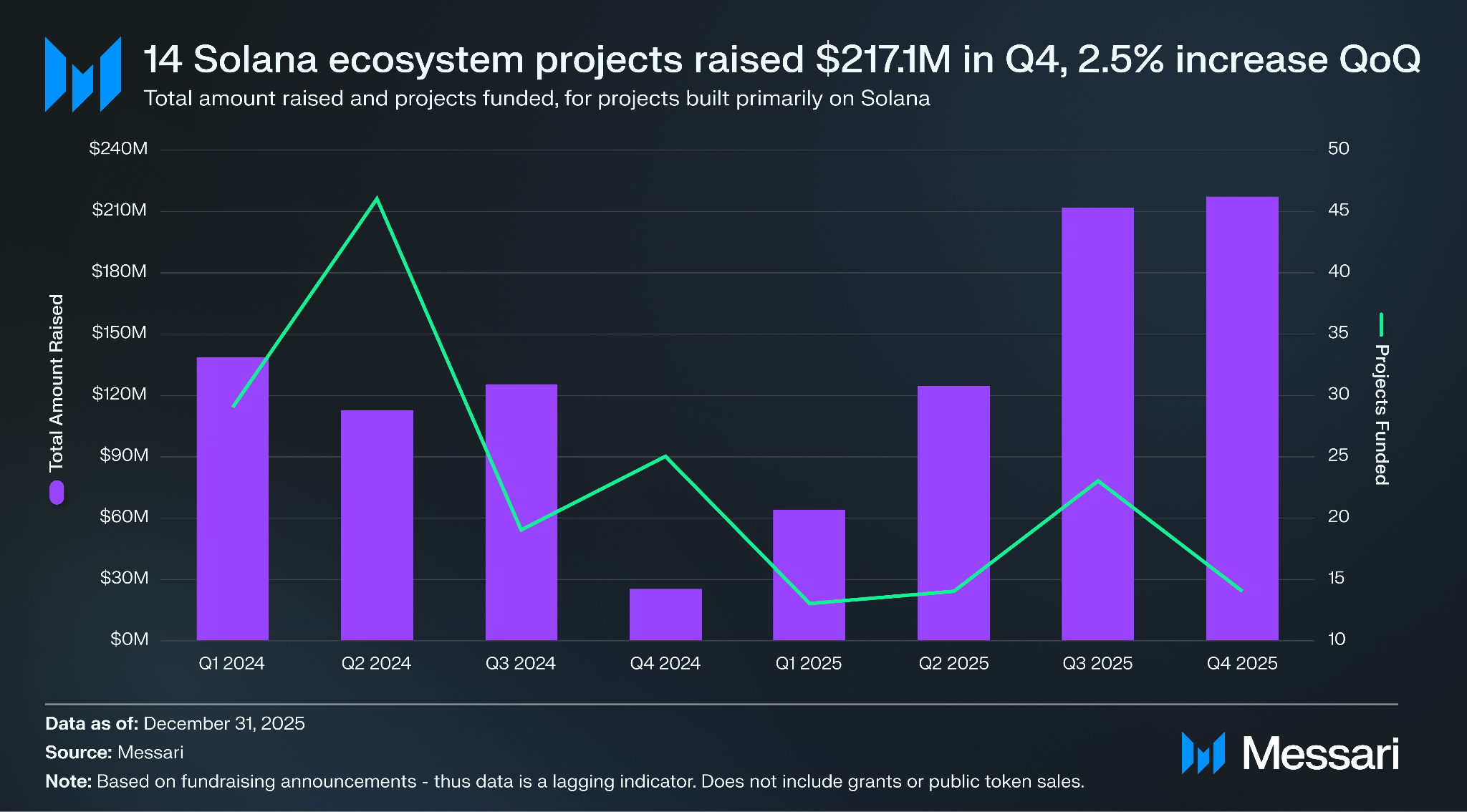
In Q3 2025, 14 projects announced funding rounds, a 39.1% QoQ decrease. These projects raised a combined $217.1 million, a 2.5% QoQ increase. Some of the notable funding rounds include:
Breakpoint 2025 was held in December in Abu Dhabi where over 6,000 members of the community came together. A recap of the event, with all the highlights can be found here.
The full list of community events can be found here.
Network Analysis
Usage
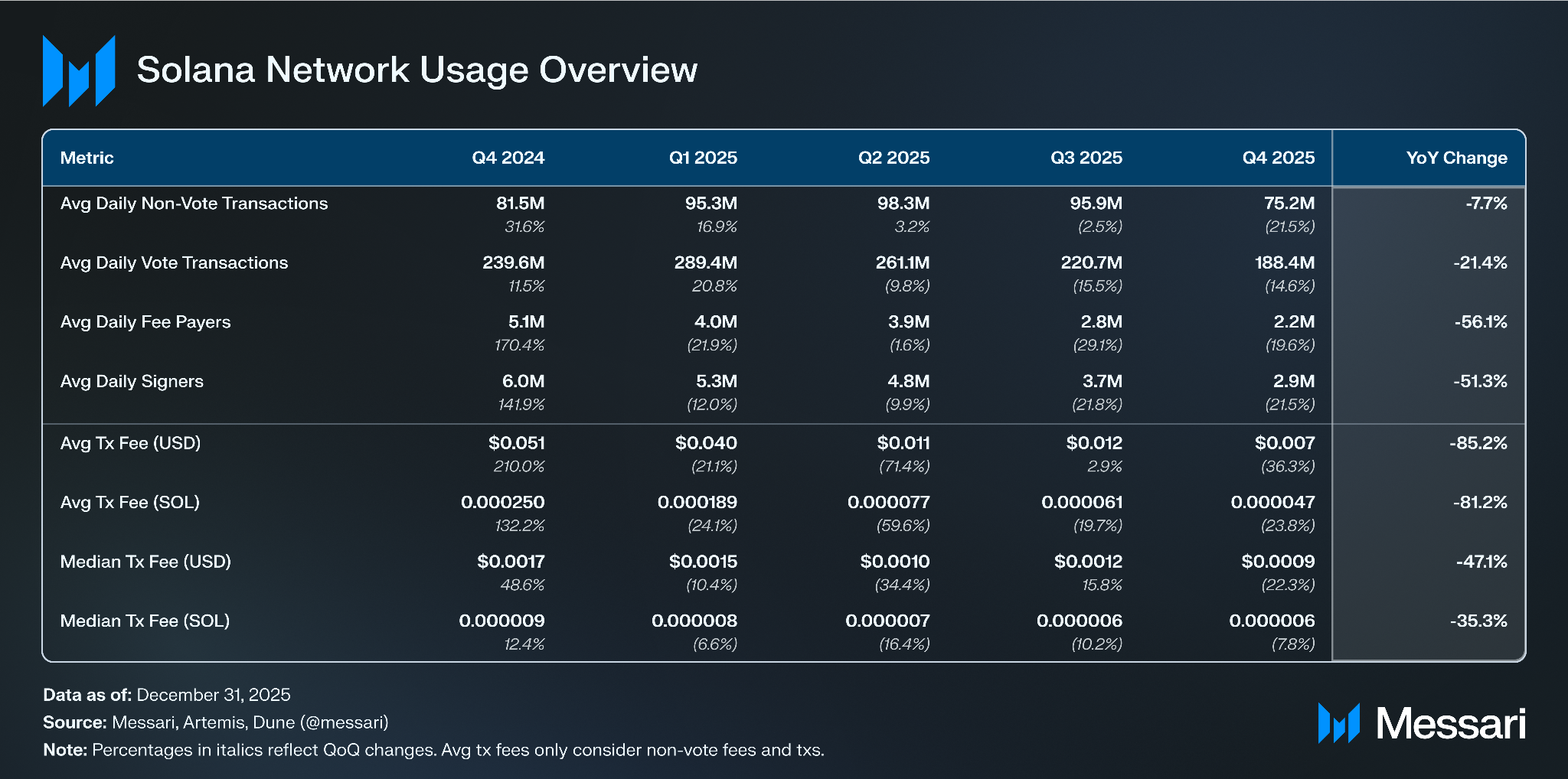
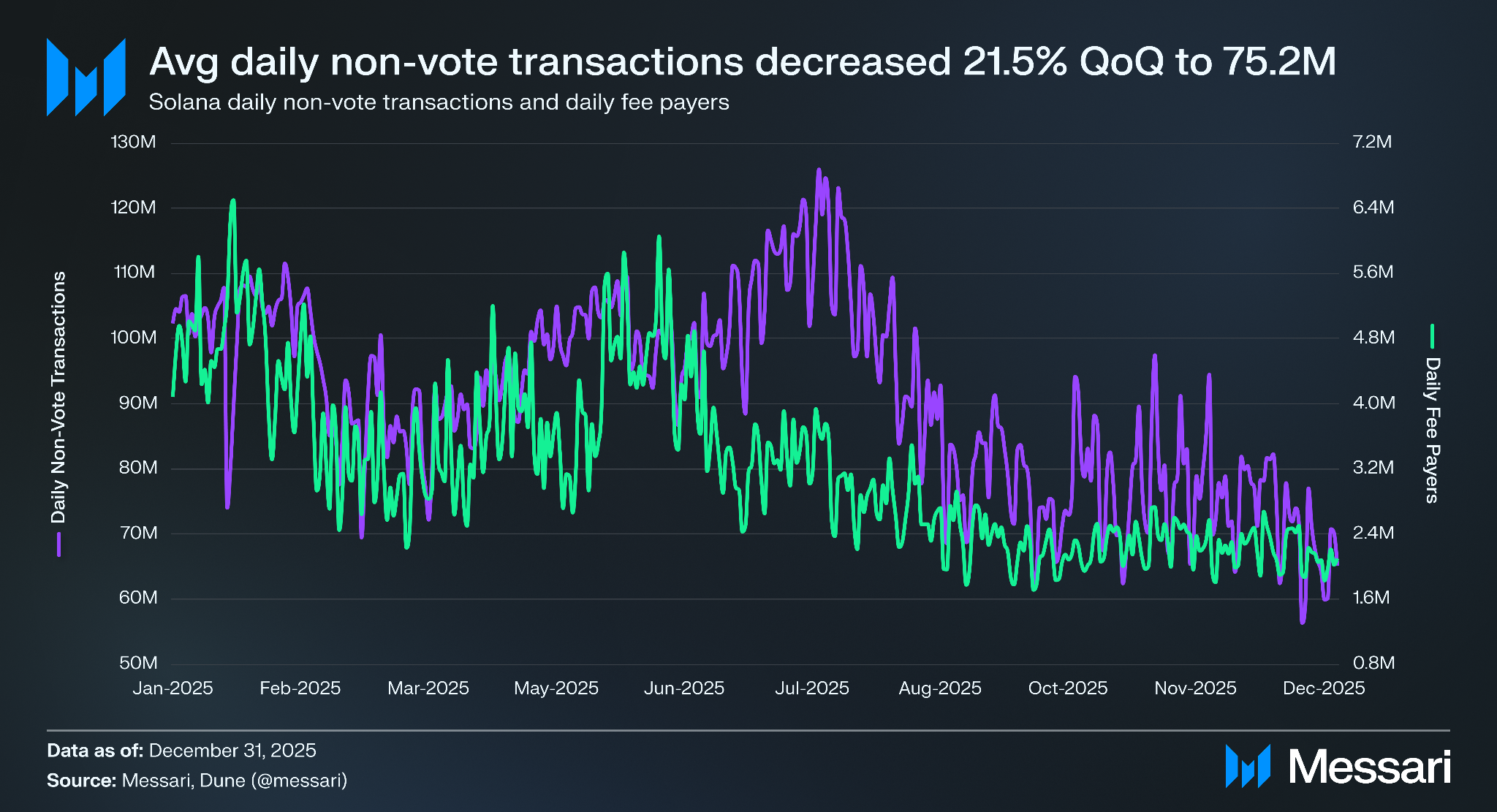
Network activity, measured by non-vote transactions and fee payers, decrease in Q4 2025. Average daily fee payers decreased 19.6% QoQ to 2.2 million, and average daily non-vote transactions decreased 21.5% to 75.2 million.
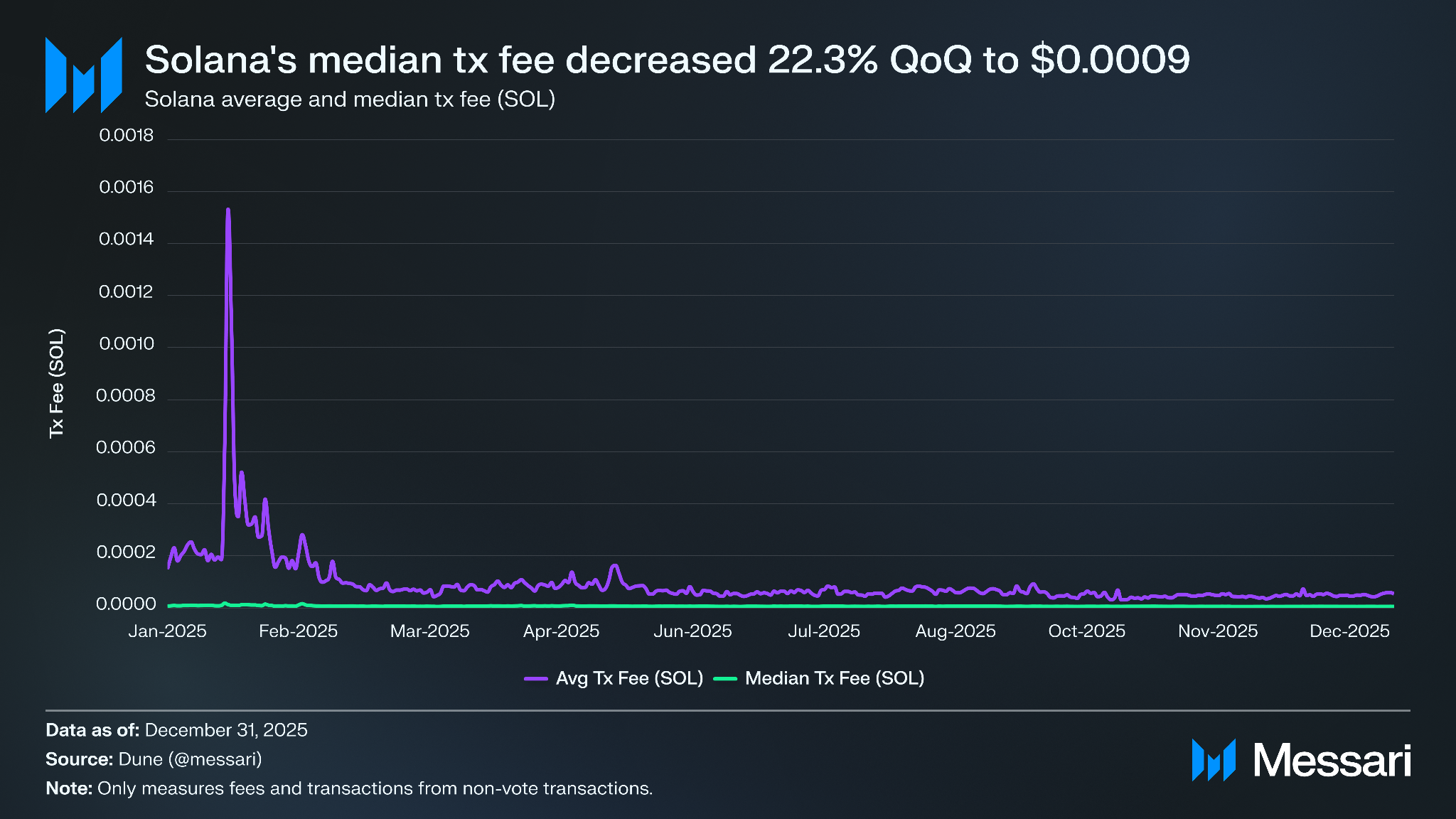
The average transaction fee decreased by 23.8% QoQ to 0.000047 SOL ($0.007), and the median transaction fee decreased by 7.8% QoQ to 0.000006 SOL ($0.0009). The decline in average and median transaction fee can be attributed to overall improvements to the network. One example is the increase in CUs that each block can hold and developers optimizing transactions to consume less CUs. There was a spike in average transaction fees in January when the TRUMP token launched before President Trump took office. On January 19, the average fee paid was $0.41, but the median fee was $0.003, highlighting the power of local fee markets. Helius consistently landed 100% of transactions during this period, with fees as low as $0.001.
Security and Decentralization
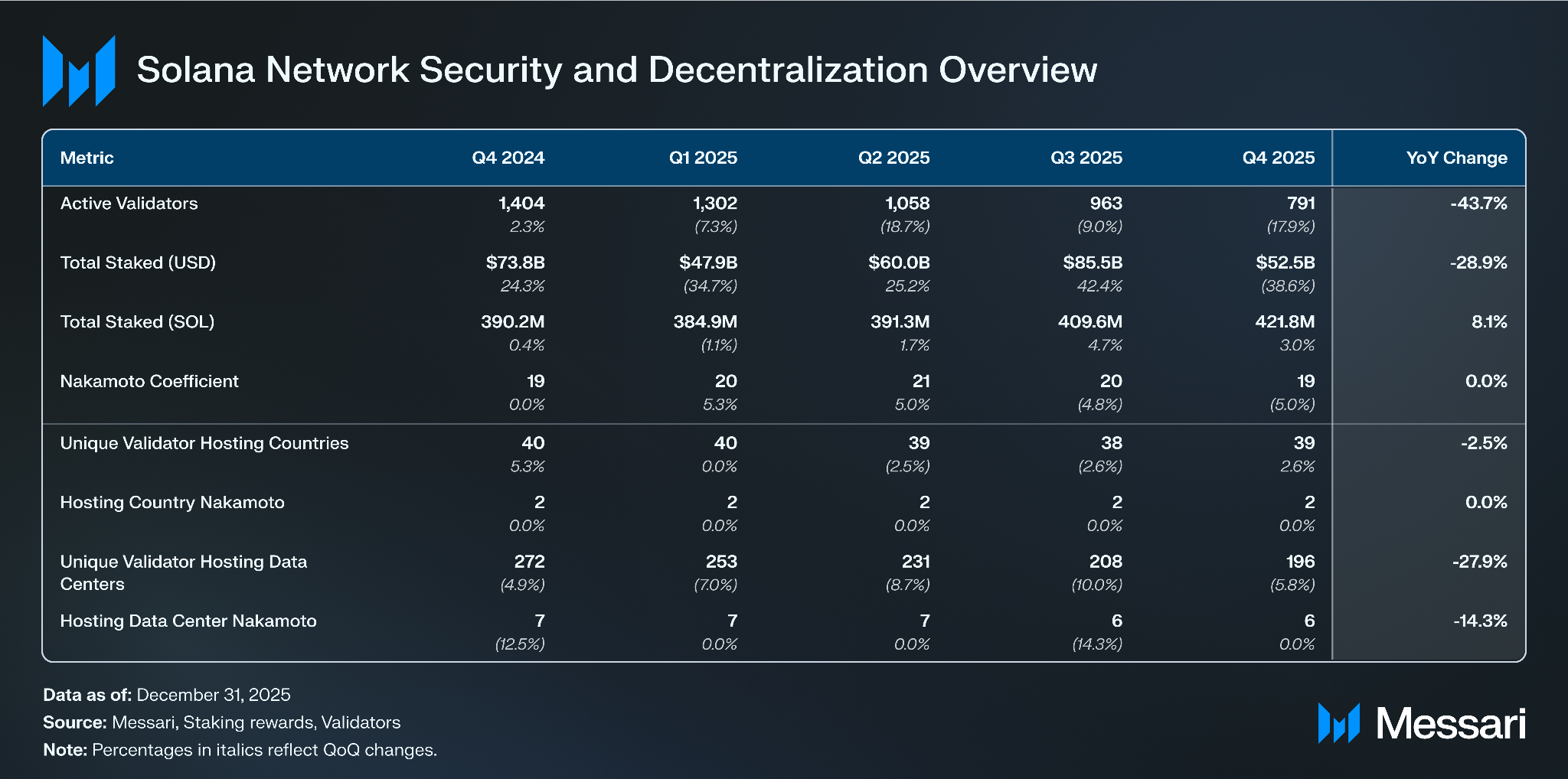
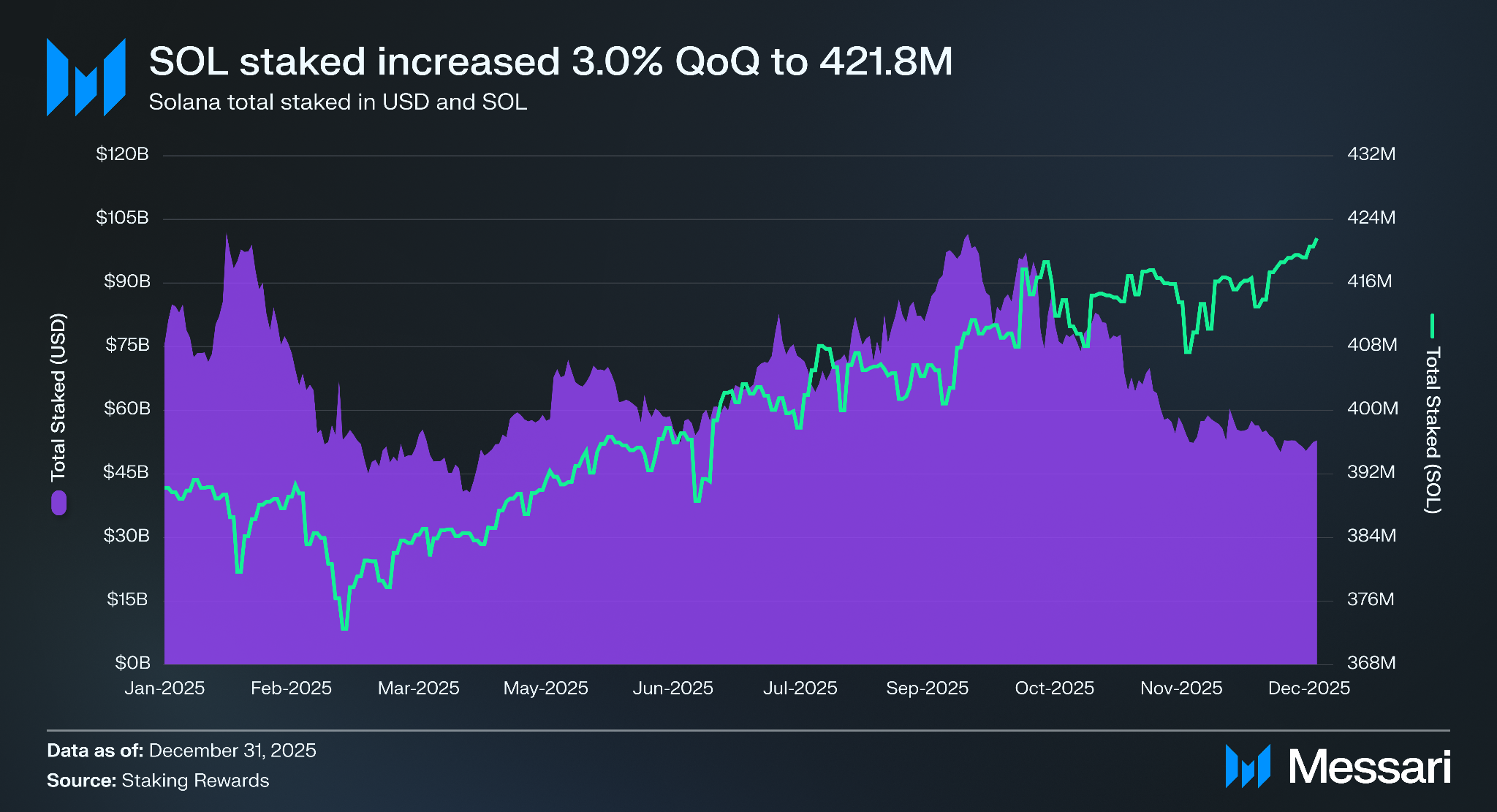
Total stake (USD) reclaimed an all-time high of $102 billion on Sept. 18, 2025, when SOL hit approximately $248. Staked SOL (USD) decreased 38.6% QoQ to $52.5 billion in Q4’25, down from $85.5 billion at the end of Q3’25. The decrease can be attributed to the decline in SOL's price throughout the quarter, as total stake (SOL) grew 3.0% QoQ, from 409.6 million to 421.8 million.
The Nakamoto coefficient is the minimum number of nodes needed to break liveness. The metric can also be measured across other dimensions important to the resilience of a validator network, including distribution of stake by location, hosting provider, and clients.
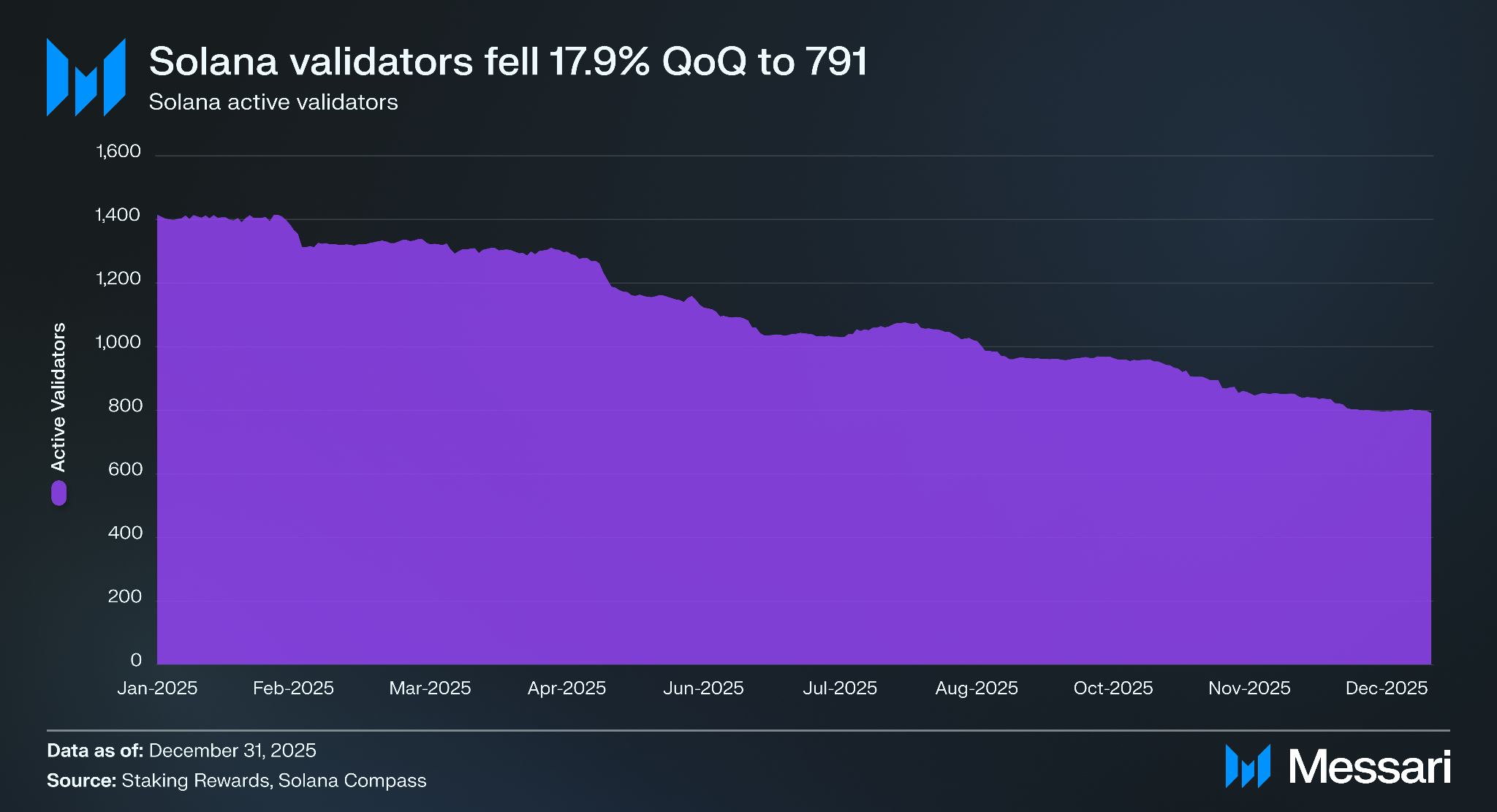
Solana’s Nakamoto coefficient ended Q4’25 at 19, which is above the median of other networks. Solana’s 791 active validators (down 17.9% QoQ) are hosted in 39 countries. Solana validators are hosted across 196 unique data centers, down 5.8% QoQ, and its Nakamoto coefficient for hosting data centers remained at 6.
However, since the change in strategy for the Solana Foundation Delegation Program (SFDP) that began on Apr. 24, 2024, the quality of validators has increased. The amount of stake coming from the SFDP fell from 12.4% at the end of 2024 to only 6.1% of total stake at the end of 2025, a 50.9% YoY decrease. Also, the amount of validators with more than 50,000 SOL staked increased 15.2% YoY, from 515 to 593.
At the Accelerate event in May 2025, the Anza team announced Alpenglow, a new consensus protocol. Alpenglow is aimed squarely at transforming transaction finality by collapsing core legacy systems, including Proof of History, Tower BFT, and gossip‑based vote propagation, into two streamlined mechanisms: Rotor for data propagation and Votor for offchain voting. By standardizing a fixed 400ms block time and eliminating per‑slot vote transactions in favor of lightweight BLS‑aggregated certificates anchored onchain, Alpenglow is projected to reduce finality latency dramatically from roughly 12.8 seconds to 100–150ms, representing a 100× improvement in responsiveness. Simultaneously, the elimination of vote fees and streamlined client logic lowers operational costs, making smaller validators more viable and simplifying ledger growth by shrinking unnecessary onchain data.
Under its new fault‑tolerance model, Alpenglow provides “20 + 20” resilience. Safety is preserved if up to 20 % of stake is adversarial, and liveness is maintained even if an additional, separate 20 % of stake goes offline, offering robust protection in varied network conditions. Because both Rotor and Votor are designed to operate without leader coupling, the protocol naturally supports innovations like multiple concurrent proposers, opening doors to reduced MEV and parallel block proposals. While some protocol details, such as slashing mechanics and relay compensation, remain unresolved, the proposal is scheduled for community review and testnet activation, pending governance and SIMD approval. The update is expected to launch near the end of Q1’26 or the beginning of Q2’26.
Firedancer/Frankendancer Updates
At Breakpoint 2025, the Jump Crypto team announced that Firedancer had been live on mainnet for over 100 days, putting its activation in October 2025. Firedancer is a high-performance validator client that is separate from Agave. This marks the first time Solana has two distinct clients. At the end of Q4’25, 3 validators representing 1% of total stake were running Firedancer, with another 20.6% of stake running Frankendancer, which can be expected to run Firedancer at some point.
Financial Analysis
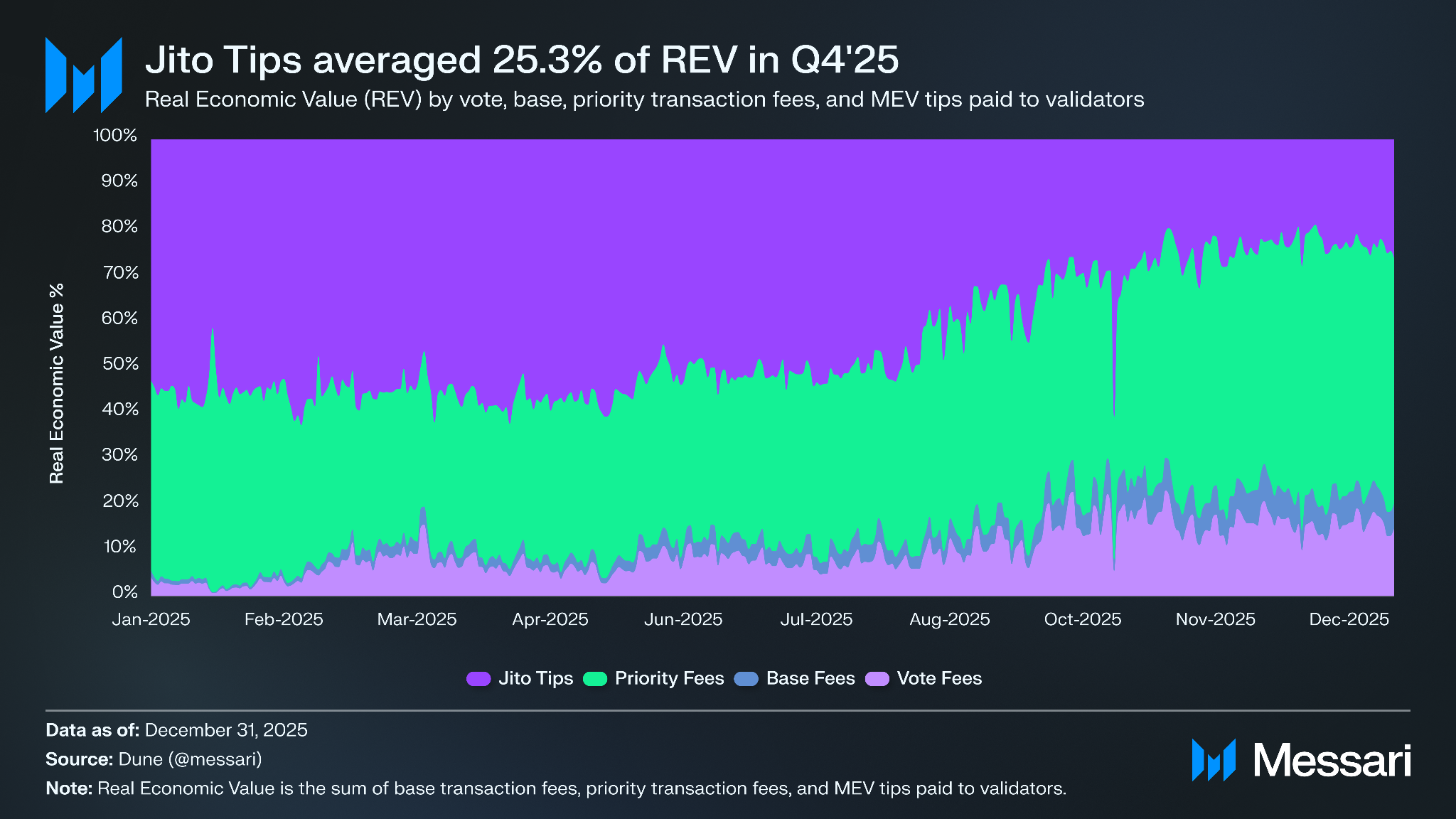
Real Economic Value (REV), which is the sum of vote transaction fees, base transaction fees, priority transaction fees, and MEV tips paid to validators, decreased 53.3% QoQ in SOL terms to 588,632 ($90.5 million). Of this, 25.3% came from MEV tips, with the rest coming from transaction fees.
SOL ETF
In Q4’25, five Solana ETFs launched, joining Rex Osprey’s SSK, which began trading on July 2, 2025. The total flows for all the ETFs by the end of Q4 were $1.0 billion, and the cumulative flows for each ETF are as follows:
To view up-to-date flows, view Farside’s ETF dashboard.
Closing Summary
Solana’s ecosystem in Q4 2025 was defined by improving capital efficiency and expanding institutional relevance, even as broader market activity cooled. Application monetization strengthened, with App RCR climbing to 375.5%, signaling that leading protocols are capturing significantly more value per unit of network spend. Growth in stablecoins to $14.9 billion and RWAs to $1.1 billion highlighted Solana’s increasing use as a high-throughput settlement layer for onchain finance, supported by products like BlackRock’s BUIDL, Ondo’s USDY, and newly launched tokenized equities.
Network usage metrics softened during the quarter, with average daily fee payers and non-vote transactions declining QoQ, largely reflecting reduced speculative intensity following October’s peak trading activity. Despite this, fee dynamics remained favorable, with median transaction fees under one cent even during congestion events. Validator decentralization remained robust, while progress on client diversity accelerated as Firedancer surpassed 100 days on mainnet and Alpenglow advanced toward testnet, positioning Solana for significant improvements in finality and throughput.
Looking ahead, Solana enters 2026 with a stronger structural foundation than prior cycles. The launch of multiple U.S.-listed Solana ETFs, continued expansion of RWAs and liquid staking, and ongoing infrastructure upgrades suggest a network increasingly optimized for sustained, non-cyclical demand. As application revenue, institutional participation, and protocol resilience converge, Solana is evolving from a high-performance trading chain into a mature financial and consumer platform. To stay up-to-date with all things Solana, visit Messari's Solana Portal.
This report was commissioned by the Solana Foundation. All content was produced independently by the author(s) and does not necessarily reflect the opinions of Messari, Inc. or the organization that requested the report. The commissioning organization may have input on the content of the report, but Messari maintains editorial control over the final report to retain data accuracy and objectivity. Author(s) may hold cryptocurrencies named in this report. This report is meant for informational purposes only. It is not meant to serve as investment advice. You should conduct your own research and consult an independent financial, tax, or legal advisor before making any investment decisions. Past performance of any asset is not indicative of future results. Please see our Terms of Service for more information.
No part of this report may be (a) copied, photocopied, duplicated in any form by any means or (b) redistributed without the prior written consent of Messari®.
Matthew is a Research Analyst in Protocol Research. He graduated from MIT with a Master's and Bachelor's in Comp Sci, Economics, and Data Science where he wrote his thesis on DeSoc. Matthew also has previous experience as an Analyst at Goldentree's crypto fund.
Matthew is a Research Analyst in Protocol Research. He graduated from MIT with a Master's and Bachelor's in Comp Sci, Economics, and Data Science where he wrote his thesis on DeSoc. Matthew also has previous experience as an Analyst at Goldentree's crypto fund.