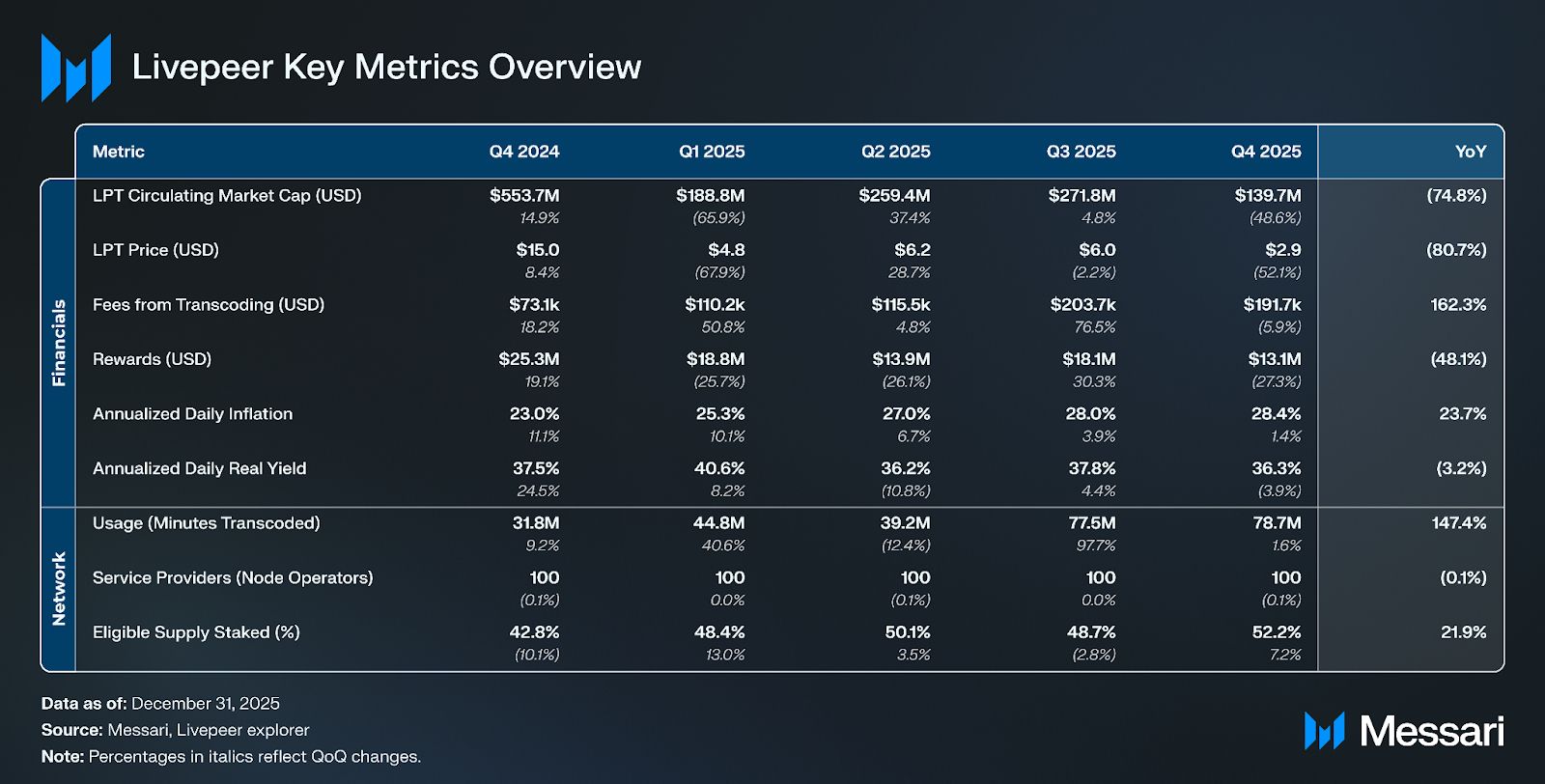
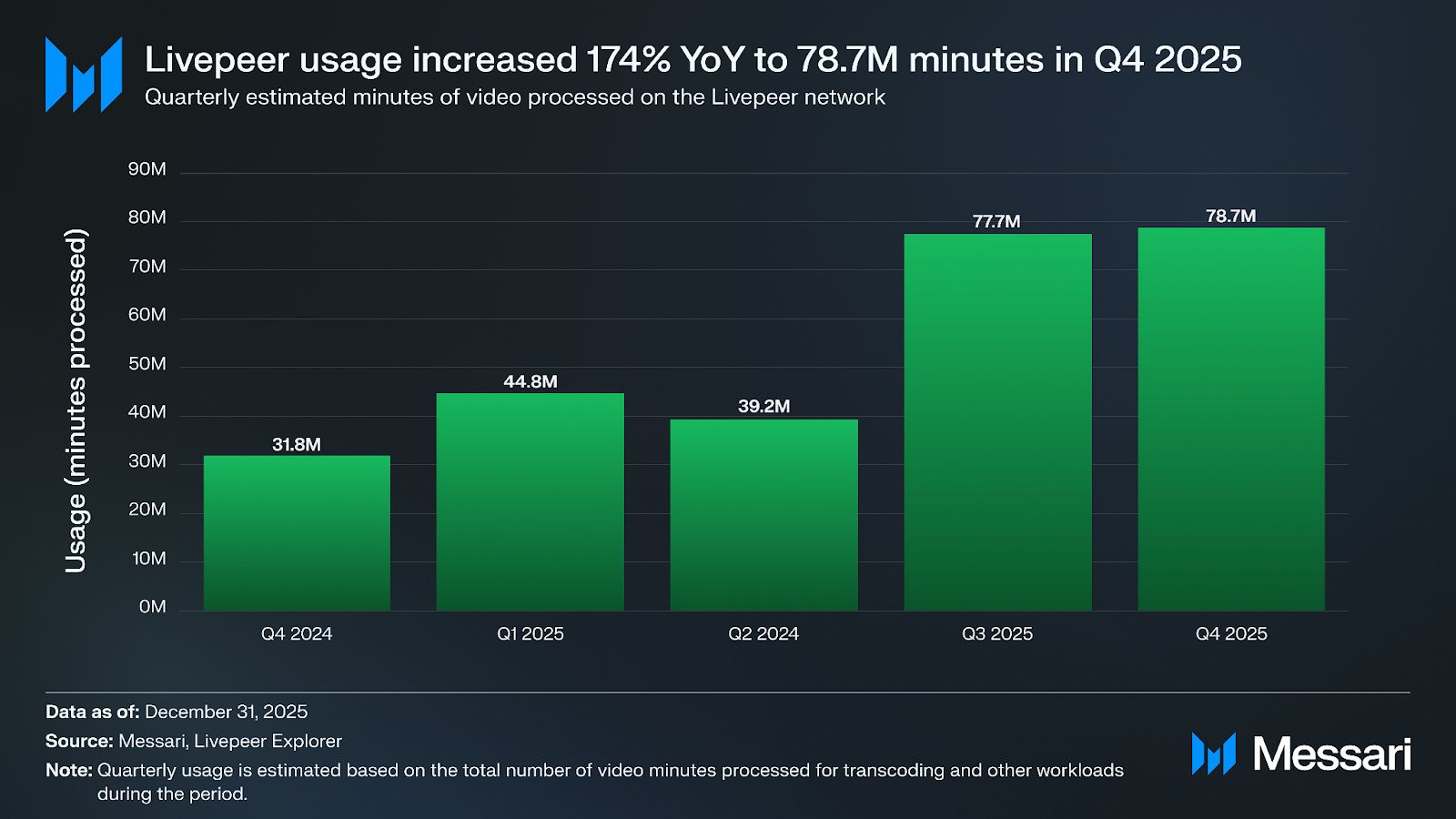
Network usage increased 1.6% QoQ to 78.7 million minutes, bringing total processed volume to +174% YoY, reflecting a higher and more stable baseline of application-driven demand following earlier acceleration in 2025.
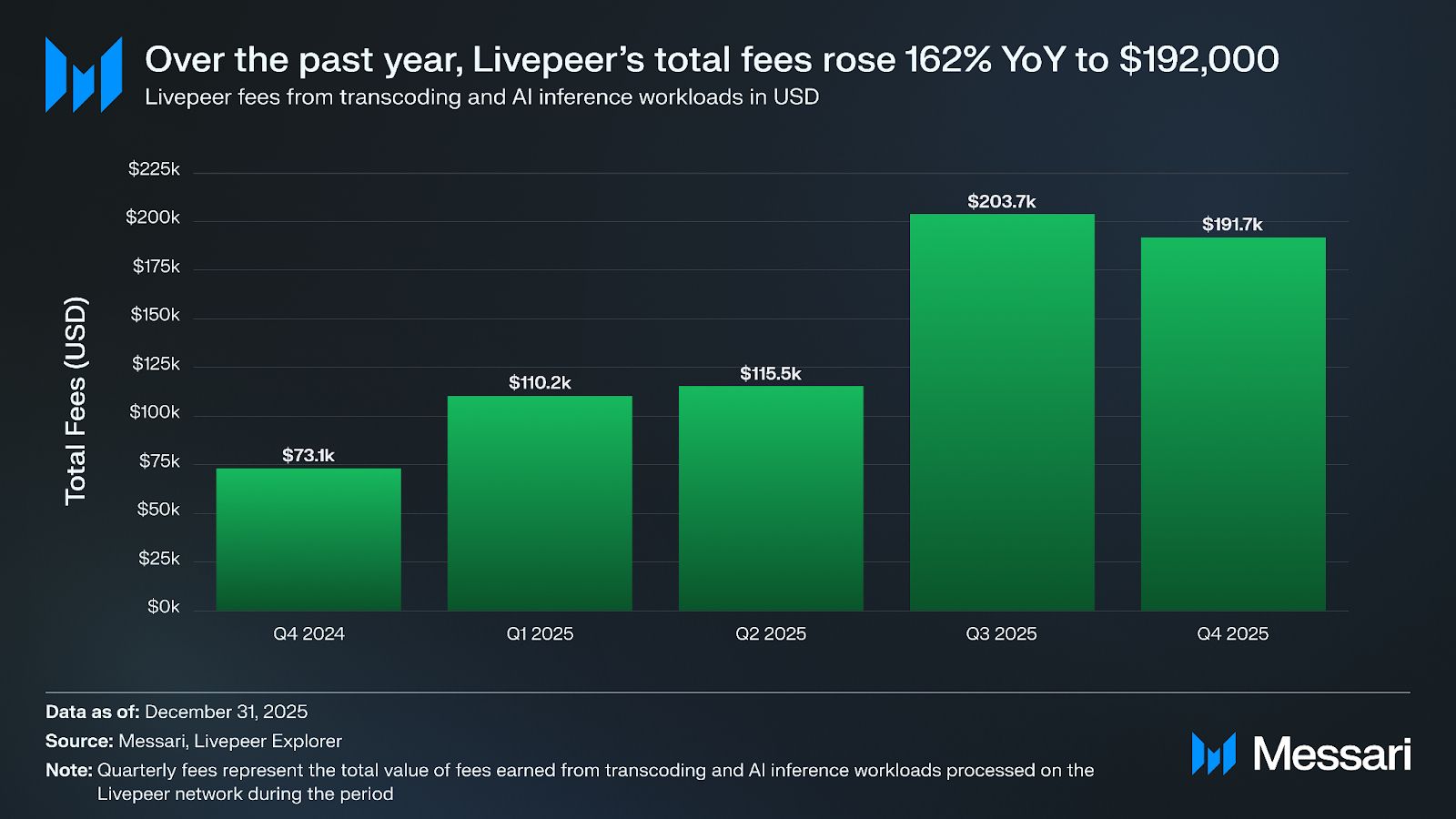
Demand-side fees declined 5.9% QoQ to $191,700, despite higher throughput, while still marking a 162% YoY increase in total fee generation.
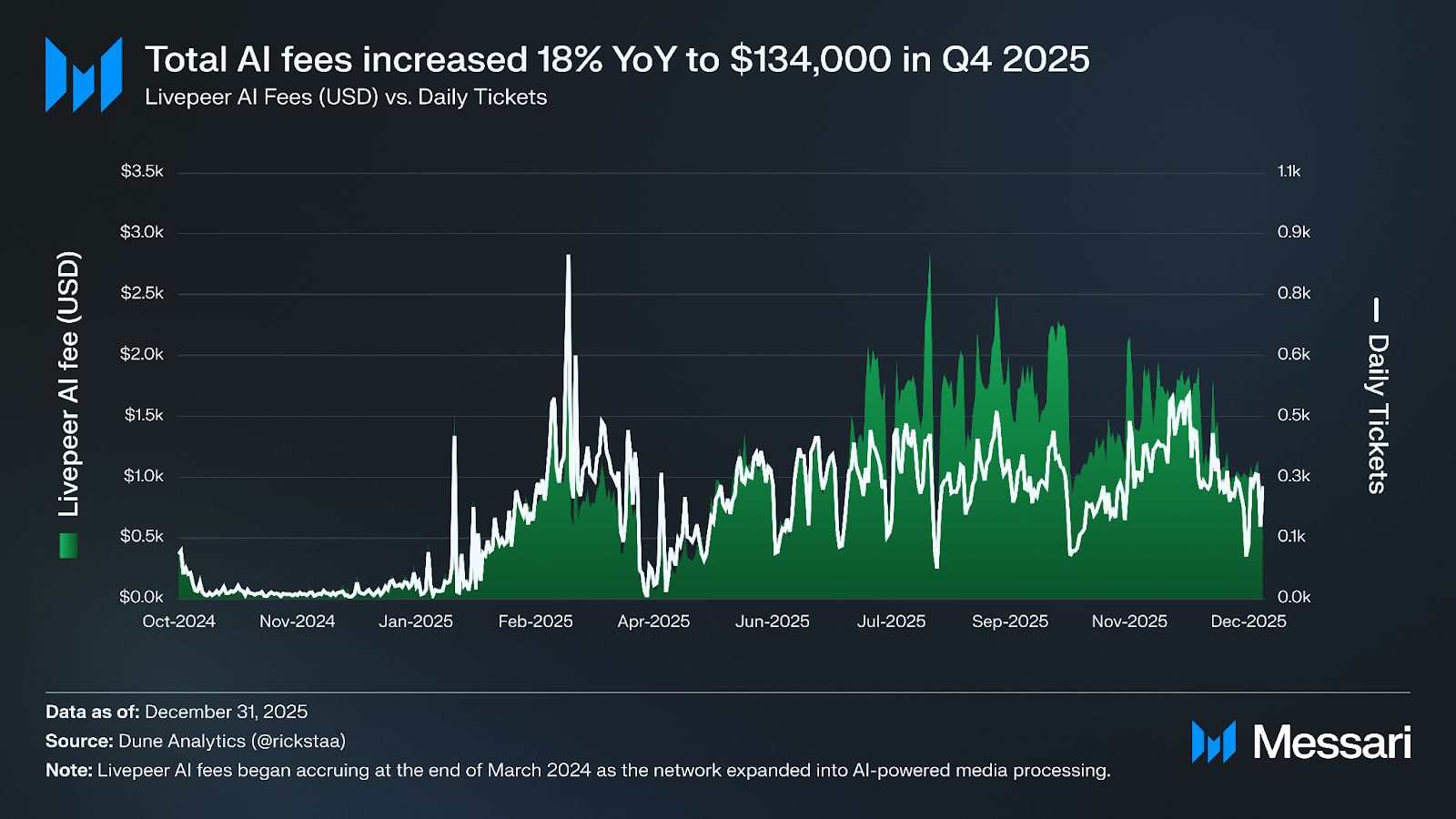
AI-driven fees totaled approximately $134,000 in Q4 (-9% QoQ) and continued to account for over 70% of total protocol revenue, confirming AI inference as the primary driver of network monetization.
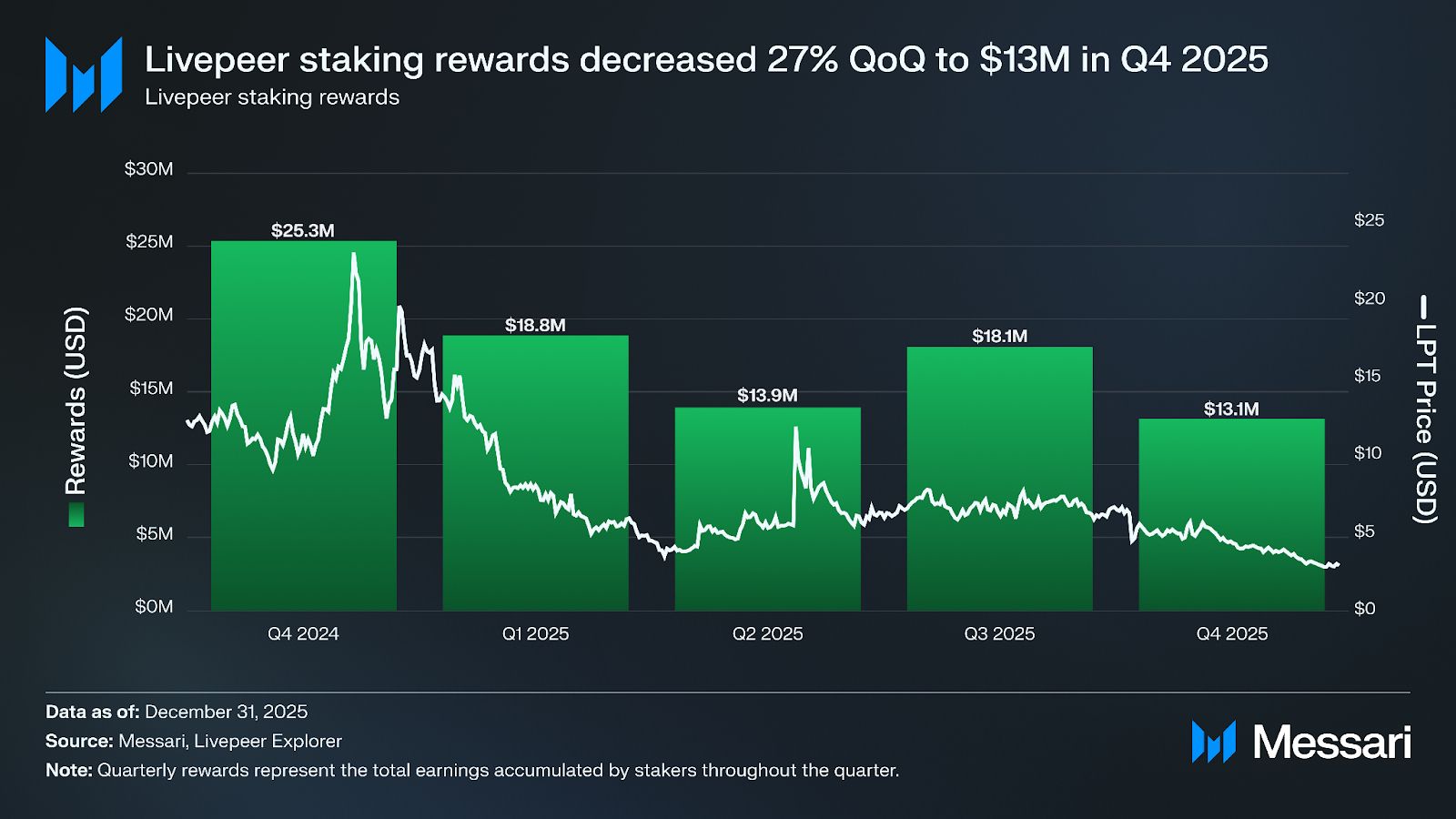
Staking participation rose above the 50% target in Q4, contributing to moderating inflation dynamics; however, total staking rewards declined 27.3% QoQ to $13.1 million, driven mainly by LPT price depreciation.
Livepeer refined its real-time AI video strategy in Q4, publishing a network vision update and a phased 2026 roadmap, outlining infrastructure, go-to-market, and enterprise readiness priorities.
Primer
Building decentralized video apps that resemble Twitch or TikTok requires live and on-demand video streaming infrastructure. Based on a user’s bandwidth and device, video content needs to be processed; i.e., transcoded, into viewable formats. While cloud providers like AWS, Google, or Microsoft are commonplace solutions for video transcoding, they incur high costs.
Livepeer (LPT) is a global compute network for AI video: an open, permissionless marketplace for media compute that powers live and on-demand streaming and real-time AI video inference. By matching application demand with a decentralized GPU supply, the network lowers costs compared to centralized clouds and scales workloads such as transcoding, remixing, and generative overlays.
Its compute marketplace enables participants to contribute GPU resources for various workloads, including video transcoding and AI-powered video processing. As AI-driven video models demand significantly more GPU compute than text and image generation, Livepeer offers a scalable and cost-efficient solution for video-related compute tasks. The network is designed to lower compute costs for video applications by up to 10x. Within Livepeer’s decentralized transcoding network, there are three key participants:
Node operators, called "Orchestrators," route transcoding jobs. The amount of work a node operator can perform is proportional to how many Livepeer native tokens (LPT) it stakes. Node operators earn ETH fees and newly minted LPT rewards.
Service nodes, called "Transcoders," provide compute resources for node operators and deliver video transcoding. In return, they earn ETH fees. Typically, Orchestrators and Transcoders run within the same machine (combined setup).
Delegators stake LPT towards effective node operators to help secure the Livepeer network. Staking is rewarded with a portion of both ETH fees and LPT rewards.
Livepeer has also expanded beyond video transcoding by introducing AI video processing to the network, with a focus on real-time AI inference for live video applications. This expansion is supported by initiatives such as Daydream, a real-time AI video engine that enables the creation and enhancement of video streams through generative overlays and adaptive effects, and Cascade, a framework outlining Livepeer’s approach to scaling decentralized media compute. Collectively, these initiatives signal the network’s progression toward a unified compute layer for live and on-demand video, integrating transcoding, generative AI, and inference workloads within a decentralized GPU marketplace.
Demand for Livepeer stems from apps and developers requiring video transcoding, live streaming, and video generation capabilities. This includes decentralized social media (DeSoc) applications, Web3-native platforms, and traditional Web2 applications requiring scalable video infrastructure. While platforms like TikTok, Twitch, Spotify, and SoundCloud rely on centralized infrastructure for streaming, similar applications in the Web3 space, such as decentralized video platforms, music streaming apps with tokenized incentives, or NFT-based media platforms, can leverage Livepeer’s decentralized video streaming and transcoding services.
Network
Livepeer’s network usage is commonly estimated by the number of minutes of video transcoded or otherwise processed, which serves as a useful proxy for demand on the protocol.
Livepeer’s estimated video processing volume increased 1.6% QoQ, rising from 77.5 million minutes in Q3 to 78.7 million minutes in Q4 2025. Following the sharp acceleration observed in Q3, usage in Q4 largely stabilized, with daily volumes distributed more evenly across the quarter. With core developer tooling and APIs already live, incremental usage during the quarter appears to have been driven primarily by ongoing production activity and retained builders, rather than new product launches or large-scale demonstrations. Improvements to live video pipelines, job scoring, and orchestrator reliability supported the network’s ability to sustain this higher baseline of completed work.
On a YoY basis, usage increased 174%, up from 31.8 million minutes in Q4 2024, reflecting a materially higher level of network activity by the end of the year.
Fees from Transcoding and AI Inference
Services using the Livepeer network pay demand-side fees in ETH to access video transcoding and AI-powered processing tasks. Node operators (orchestrators) earn these fees for processing video and distribute a portion to their delegators based on their fee-sharing structure. The likelihood of receiving transcoding jobs is proportional to the amount of LPT staked; orchestrators with higher self- and delegated LPT are prioritized for more work and thus earn greater fees. This system incentivizes both node operators and delegators, reinforcing network participation and security.
Livepeer’s demand-side total fees increased 162% YoY, rising from $73,100 in Q4 2024 to $191,700 in Q4 2025, reflecting a higher level of network monetization by year's end.
On a QoQ basis, total fees decreased 5.9% to $191,700 in Q4 2025, despite total network usage increasing 1.6% QoQ over the same period. This divergence indicates a continued decline in effective fee capture per unit of activity during the quarter. In parallel, ETH prices declined 23% QoQ from approximately $3,860 in Q3 to $2,970 in Q4, further weighing on USD-denominated fee totals.
Based on total minutes processed, average revenue per 1,000 minutes fell from approximately $2.63 in Q3 to $2.44 in Q4 (-7.2% QoQ), reflecting lower realized fees per minute even as aggregate throughput remained elevated. Daily fee generation in Q4 was more evenly distributed than in Q3, with fewer extreme spikes and a tighter range across the quarter, consistent with usage stabilization rather than event-driven bursts.
The decline in unit revenue aligns with an ongoing shift in workload composition toward real-time AI inference and application-driven usage. Unlike traditional transcoding workloads, which generate fees across multiple bitrate renditions per stream, AI inference workloads, such as video generation, creative transformation, and real-time effects are typically priced on a per-job or per-inference basis rather than per bitrate. As a result, even as overall throughput remains high, these workloads tend to produce lower realized fees per minute relative to high-bitrate, multi-rendition transcoding workloads.
Additional pressure on realized fees appears to be driven primarily by marketplace dynamics rather than demand weakness. Increased competition among node operators for AI inference workloads can compress effective pricing in a decentralized environment, particularly as GPU supply expands and inference jobs become more standardized. In parallel, scaling effects, including higher job concurrency and more consistent throughput can reduce average fees per unit during periods of stable demand, reflecting improved utilization and price discovery rather than declining network activity.
Fees from Livepeer AI
In Q4 2025, Livepeer continued expanding its role beyond video transcoding through the ongoing development of Livepeer AI, which launched in Q3 2024 to support decentralized AI-powered video processing and real-time inference. This progress included the refinement of Cascade, a real-time AI video processing pipeline introduced in late 2024. Cascade enables applications such as automated video agents, live analytics, and interactive overlays by orchestrating GPU resources for continuous media workflows. These developments further established Livepeer’s role as a decentralized media compute network, expanding its infrastructure to support emerging AI-driven video applications.
In Q4 2025, Livepeer’s AI-generated fees totaled approximately $134,000, declining 9% QoQ from $147,100 in Q3 2025. This followed a sharp 131% QoQ increase in Q3, indicating a period of moderation rather than continued acceleration in AI-related fee growth.
A total of 27,514 winning tickets were processed during the quarter, representing a ~1% decrease QoQ from 27,845 tickets in Q3. Ticket volume remained relatively stable quarter over quarter, suggesting that the decline in AI fees was driven primarily by changes in average fees per ticket, rather than a material reduction in AI workload activity.
Based on quarterly aggregates, the average fee per AI ticket declined from approximately $5.28 in Q3 to $4.87 in Q4, reflecting lower realized pricing per unit of AI work. This trend is consistent with broader network-level fee dynamics, where incremental AI workloads continue to expand activity but generate lower average fees than earlier, higher-intensity inference jobs.
The QoQ decline in AI fees likely reflects a combination of post-surge normalization following Q3’s rapid growth, a shift toward more standardized and production-oriented AI workloads, and competitive pricing dynamics among orchestrators as AI inference became a more established workload category.
Despite the QoQ decline, AI workloads remained the primary contributor to protocol revenue, accounting for over 70% of total network fees in Q4 2025.
Staking Rewards
The Livepeer network distributes staking rewards in LPT to node operators and delegators. To provide video services on the Livepeer network, node operators must stake LPT. A node operator’s stake weight comprises their own tokens and tokens they were delegated.
Total staking rewards decreased 27.3% QoQ to approximately $13.1 million in Q4 2025, down from $18.1 million in Q3, alongside a sharp 52.1% QoQ decline in LPT price (from $6.00 to $2.90). LPT price depreciation was the dominant driver of lower rewards in USD terms. Despite relatively steady token emissions, the significant decline in token price mechanically reduced the dollar value of rewards distributed to orchestrators and delegators.
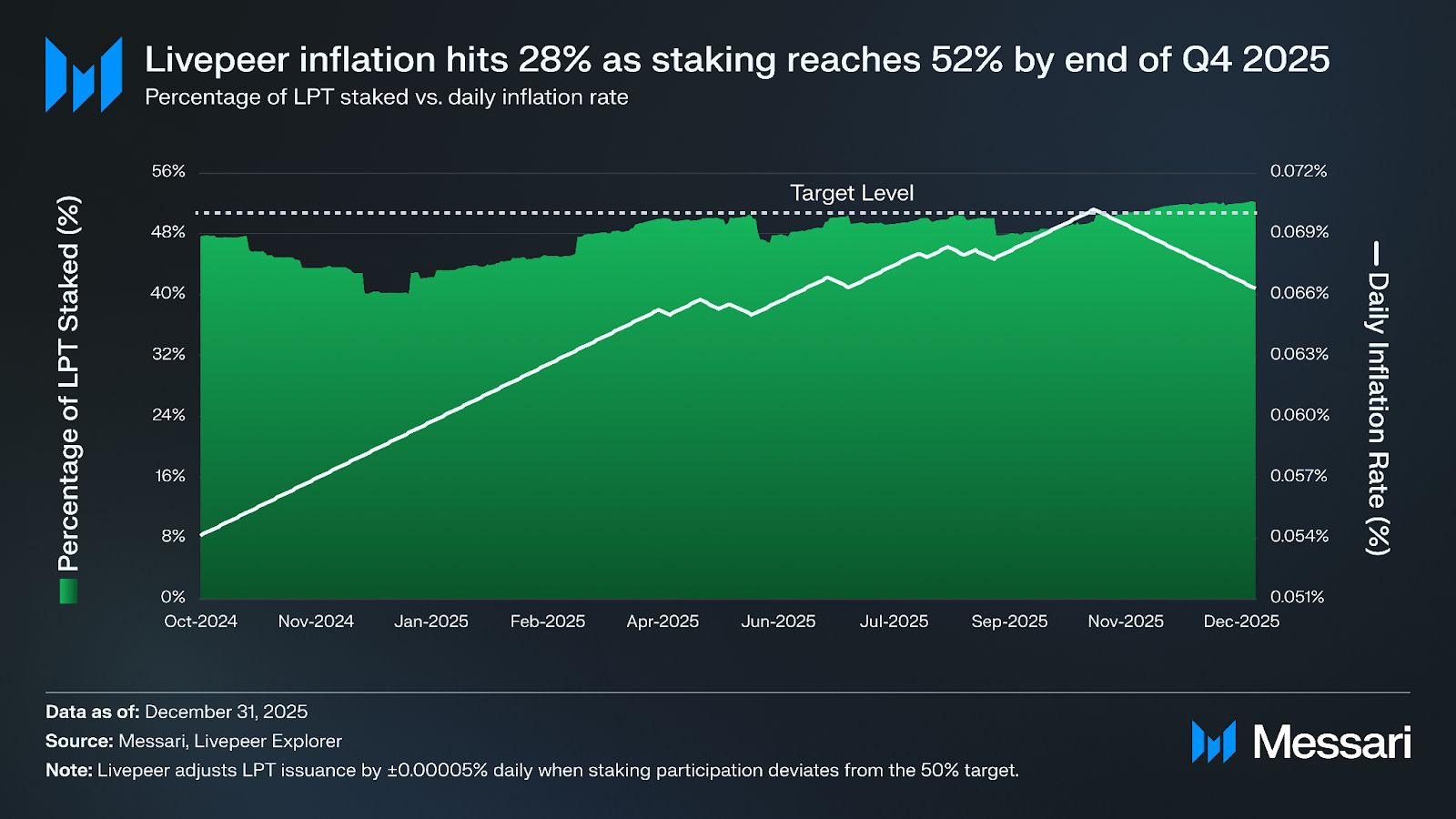
Staking participation increased above the protocol’s 50% target, rising from 48.7% in Q3 to 52.2% in Q4. This shift triggered Livepeer’s dynamic inflation mechanism to moderate issuance pressure, contributing to a slowdown in reward growth on a token-adjusted basis. While annualized daily inflation remained elevated at approximately 28.4%, the rate of inflation growth slowed and has been declining consistently since late October 2025.
Network activity stabilized rather than accelerated during the quarter. Transcoded minutes grew 1.6% QoQ, while demand-side fees declined 5.9% QoQ, limiting the contribution of usage-based fees to total rewards. As a result, fee-derived compensation did not offset the impact of lower token prices as it had in the prior quarter.
In contrast to Q3, when expanding circulating supply, reduced staking participation, and strong fee growth combined to lift USD-denominated rewards, Q4 reflected a price-led contraction. Overall, the quarter highlights the continued sensitivity of USD rewards to LPT price movements, even as staking participation and network usage remained relatively resilient.
Staking Participation
The Livepeer Token (LPT) operates under a Stake-for-Access (SFA) model, requiring node operators to stake LPT to perform work on the network. Over the past seven quarters, staking participation, the percentage of circulating LPT supply that is staked, has remained below the 50% target level. Additionally, the number of delegators has declined, decreasing from 2,683 in Q3 2025 to 2,570 in Q4 2025, reflecting a contraction in the number of active participants helping to secure the network.
Staking participation increased from 48.7% in Q3 to 52.2% of circulating supply in Q4 2025 (+3.5 percentage points), moving above Livepeer’s 50% target threshold. Under the protocol’s dynamic inflation mechanism, issuance increases when participation falls below 50% and tapers as participation rises above the target. While quarter-average annualized daily inflation rose modestly from ~28.0% in Q3 to ~28.4% in Q4, the daily inflation series shows a gradual downward drift toward the end of the quarter as staking participation recovered and remained above target. This reflects the lagged nature of the inflation adjustment; issuance continued responding to below-target participation in late Q3 before stabilizing and beginning to taper as participation improved during Q4.
Livepeer’s July 24 publication, “Why Delegation Still Matters in a Low-Inflation Environment,” remained relevant in Q4, framing the protocol’s longer-term shift toward fee-driven rewards as staking participation approaches a steady-state equilibrium near 50%. In Q4, however, usage-based fee contribution softened, with demand-side fees declining 5.9% QoQ despite a 1.6% increase in usage, limiting the extent to which fee growth could offset macro-driven volatility in USD-denominated returns.
Overall, Q4 reflected higher staking participation with moderating inflation dynamics alongside relatively stable network throughput. This supports network security assumptions but continues to highlight a structural characteristic of Livepeer’s staking economy: stake weight does not perfectly track workload execution, which can lead to differences between capital allocation and fee generation across orchestrators.
Market Capitalization
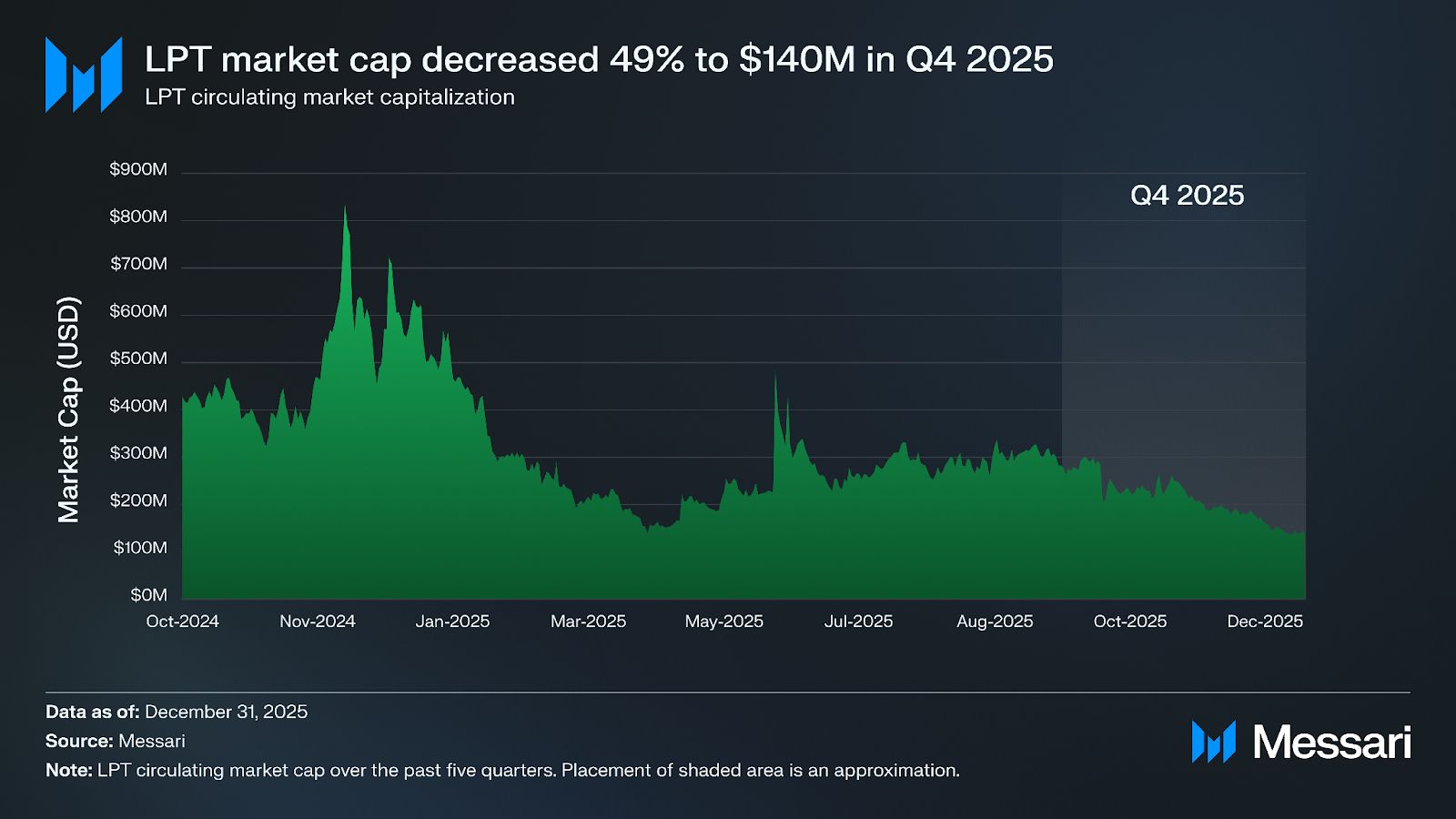
LPT’s circulating market capitalization declined 48.6% QoQ to $139.7 million in Q4 2025 (from $271.8 million in Q3), driven primarily by a 52.1% QoQ decrease in token price to $2.90 (from $6.00). The circulating supply increased modestly from approximately 45.3 million to 48.2 million LPT (an increase of ~2.9 million, or ~6.4% QoQ), consistent with ongoing emissions. However, this supply expansion was insufficient to offset the magnitude of the price decline, resulting in a net contraction in circulating market capitalization for the quarter. On a YoY basis, circulating market cap fell 74.8% YoY (from $553.7 million in Q4 2024) alongside an 80.7% YoY decline in LPT price (from $15.0).
Qualitative Analysis
Product and Infrastructure Updates
Network productization around real-time AI video: On November 13, 2025, Livepeer published a network-vision update framing the protocol’s next phase as AI infrastructure for real-time video, building on the previously articulated Cascade direction. The update cited early indicators of traction and clarified what “productization” implies at the network level, including support for end-to-end workflow deployment beyond base-model inference, latency benchmarking for real-time pipelines, and elastic, usage-based scaling suitable for interactive video and agent-driven workloads.
2026 network roadmap: On December 18, 2025, the Livepeer Foundation published version 1.0 of Livepeer’s roadmap for 2026 and beyond, translating the November vision into a phased execution plan. The roadmap organized priorities across three stages: Now (improving production readiness, reliability, payments, observability, and security), Next (accelerating go-to-market execution and repeatable demand onboarding), and Beyond (supporting enterprise-scale adoption through expanded GPU supply, verifiable compute, and stronger operational guarantees). It was explicitly framed as a living coordination document informed by advisory board input, community feedback, and observed network usage, emphasizing execution ownership and delivery rather than protocol parameter changes.
Live video metrics and testing enhancements: In mid-October 2025, the Livepeer Cloud SPE published updates extending the AI Job Tester to support live video pipelines. Enhancements included RTMP/FFmpeg live inputs, new scoring logic for previously unscored live video job types, and MediaMTX-based multi-URI management. Over the course of the quarter, these changes enabled live video job scores to appear in Livepeer Explorer, improving visibility into live workload performance. The update also documented operational constraints observed in production environments, including registry limitations for live AI jobs, GPU saturation under peak load, and variability introduced by rolling-window scoring.
Community Engagement and Events
Livepeer Summit (Lisbon): From October 6–8, 2025, Livepeer hosted a two-day contributor-focused community gathering in Lisbon, bringing together participants from Livepeer Inc., the Livepeer Foundation, and the broader ecosystem. The summit served as a coordination and alignment forum heading into Q4, with sessions focused on recent product and infrastructure developments, governance initiatives, and longer-term network priorities. Discussions emphasized shared learnings across protocol contributors and helped inform subsequent ecosystem planning and execution into the remainder of the year.
AI × Open Media Forum (Devconnect Buenos Aires): On December 29, 2025, Livepeer published a recap of the AI × Open Media Forum, hosted in partnership with Refraction during Devconnect Buenos Aires. The forum emphasized small-group working sessions rather than panels, with a focus on aligning creators and technologists around priorities for open media infrastructure as real-time AI enters active production use. Key discussion themes included:
Authorship and identity, particularly the distinction between aesthetic remixing and lived experience
Compute access, with GPU cost and availability shaping participation, and Daydream cited as a mechanism for lowering barriers
Discovery, highlighting structural limitations of engagement-optimized algorithms
Provenance, discussed as a layered infrastructure encompassing attestations, watermarking, social proof, and dataset lineage in adversarial environments.
Governance
LiveInfra SPE (Community RPC - Q4 operations funding request): On September 28, 2025, the LiveInfra SPE submitted a treasury pre-proposal requesting Q4 operations funding to sustain its free Community Node / RPC service, supporting Arbitrum L2 and Ethereum L1 endpoints. The proposal targeted 99.9% uptime, maintained an operations-only scope with no new feature development, and outlined a budget of approximately $16.5k for the quarter.
Livepeer Team Commentary
Team Commentary Disclaimer
The Project Team Commentary section of this report was written by the Livepeer team and reflects the views, opinions, and forward-looking statements of Livepeer only. This section is included to provide additional context on the project’s strategy, priorities, and outlook and does not necessarily reflect the views or opinions of Messari, Inc.
“Processing volume grew 174% year over year in Q4, marking a clear shift in how the Livepeer network is being used. This growth provides clear validation of demand for real-time AI video workloads on the network.
This shift is closely tied to the mix of workloads driving network activity over the past 12 months. AI video processing became the dominant source of protocol fees, accounting for more than 70% of total revenue in both Q3 and Q4. Much of this activity came from real-time inference applied to live video streams, including generative effects, avatars and interactive video pipelines. These workloads are integrated directly into running products, which means usage tends to persist and scale alongside application growth rather than appear in short bursts. That behavior helps explain both the year-over-year expansion in volume and the steadier usage profile observed in the second half of the year.
Daydream has played a crucial role in enabling this shift. By offering hosted inference and structured tooling for real-time AI video workflows, it has lowered the barrier for developers to build and test applications under live conditions. More importantly, it has surfaced concrete requirements around latency, throughput and workflow composition that are difficult to capture through short-lived experiments. These signals have informed ongoing improvements across the network as it adapts to sustained, production-level demand.
The usage patterns emerging on the network also help clarify why Livepeer is well positioned to capture the realtime video AI opportunity. The network was designed around live video from the outset, with infrastructure optimized for low-latency ingestion, processing and delivery. Combined with a distributed GPU supply and usage-based execution, this foundation maps closely to the needs of real-time AI video workloads, which require continuous inference, predictable performance and the ability to scale alongside application demand.
The year ahead
Looking ahead, demand remains the clearest measure of progress. Growing usage and fees are what sustain long-term value, and the 174% increase in processing volume over the past year reinforces confidence in the real-time AI video opportunity. With the network now operating at a higher baseline, the focus is shifting from driving performance to accelerating adoption, in line with the next phase of the roadmap.
The priority in 2026 is to build on current demand as more real-time AI video products come to market. That means continuing to improve reliability and developer experience while supporting sustained usage as applications move further into production.”
Closing Summary
In Q4 2025, Livepeer entered a stabilization phase following rapid growth earlier in the year. Total video and AI processing volume increased 1.6% QoQ to 78.7 million minutes, bringing usage to +174% YoY, with activity distributed more evenly across the quarter and less driven by discrete events.
Demand-side fees rose 162% YoY but declined 5.9% QoQ, reflecting lower realized fees per unit of activity amid a shift toward AI inference workloads, increased competition among node operators, scaling effects at higher throughput, and a 23% QoQ decline in ETH prices. AI workloads remained the primary revenue driver, generating $134,000 in fees and accounting for over 70% of total protocol revenue, despite a 9% QoQ moderation following Q3’s surge.
Total staking rewards declined 27.3% QoQ to $13.1 million, primarily due to LPT price depreciation. Staking participation improved above the 50% target by quarter-end, contributing to moderating inflation dynamics, though softer fee growth limited the offset from usage-based rewards.
Overall, Q4 capped a year of significant network expansion, with Livepeer exiting 2025 at a materially higher usage and monetization baseline, clearer positioning around real-time AI video, and a transition toward more incremental, execution-focused growth.
This report was commissioned by Livepeer Inc. All content was produced independently by the author(s) and does not necessarily reflect the opinions of Messari, Inc. or the organization that requested the report. The commissioning organization may have input on the content of the report, but Messari maintains editorial control over the final report to retain data accuracy and objectivity. Author(s) may hold cryptocurrencies named in this report. This report is meant for informational purposes only. It is not meant to serve as investment advice. You should conduct your own research and consult an independent financial, tax, or legal advisor before making any investment decisions. Past performance of any asset is not indicative of future results. Please see our Terms of Service for more information.
No part of this report may be (a) copied, photocopied, duplicated in any form by any means or (b) redistributed without the prior written consent of Messari®.
Armita is a protocol researcher with a robust background in technology and blockchain. Before her role at Messari, she distinguished herself as a tech entrepreneur, executive, and advisor for various blockchain startups. Armita holds two master's degrees, one in Computer Engineering and another in Business Management, as well as a double major undergraduate degree in Physics and Pure Mathematics.
Armita is a protocol researcher with a robust background in technology and blockchain. Before her role at Messari, she distinguished herself as a tech entrepreneur, executive, and advisor for various blockchain startups. Armita holds two master's degrees, one in Computer Engineering and another in Business Management, as well as a double major undergraduate degree in Physics and Pure Mathematics.