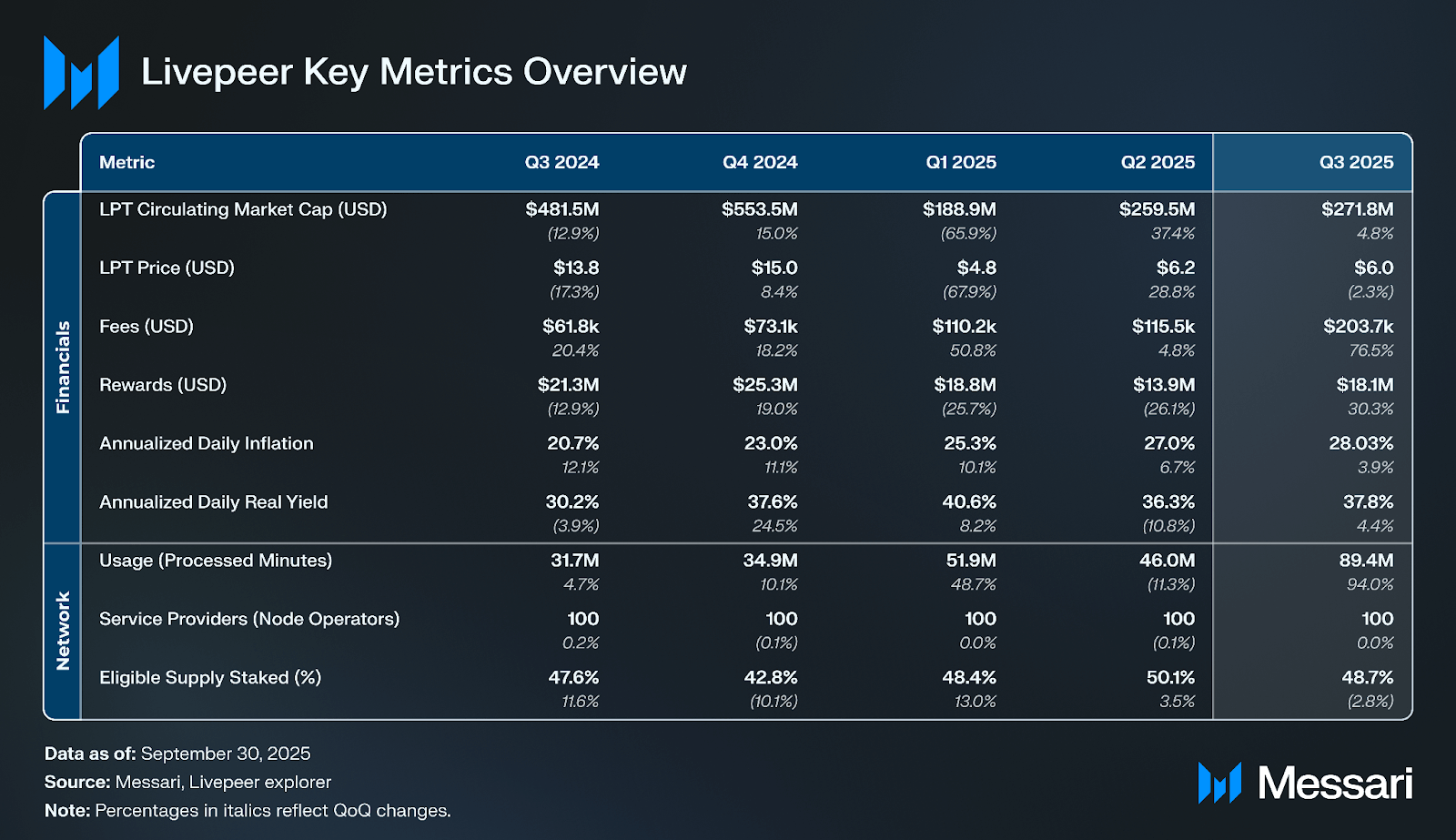
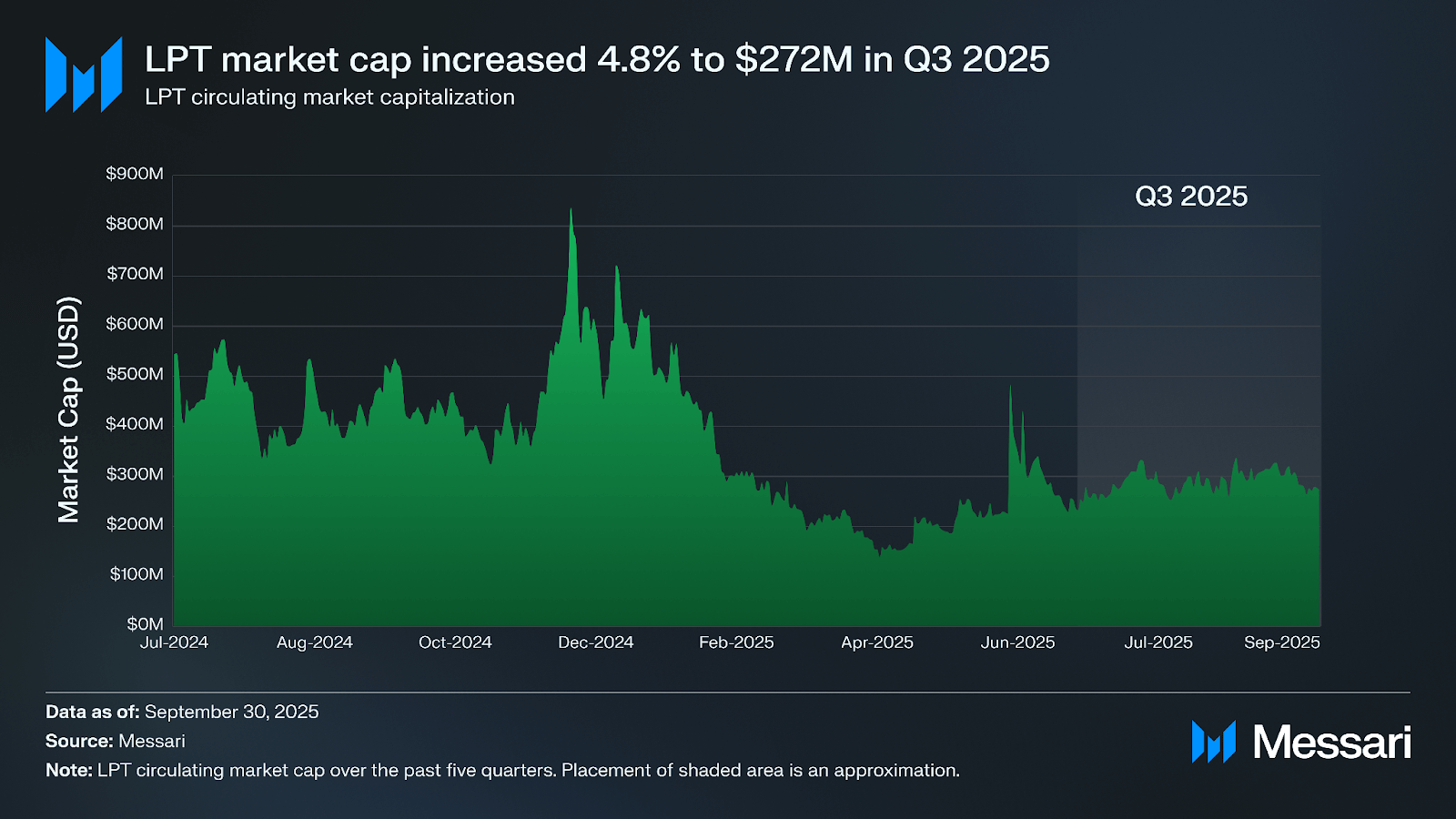
LPT’s circulating market capitalization increased 4.8% QoQ, rising from $259.5 million to $271.8 million, as circulating supply expanded 8.2% to 45.3 million LPT while price declined slightly from $6.20 to $6.00.
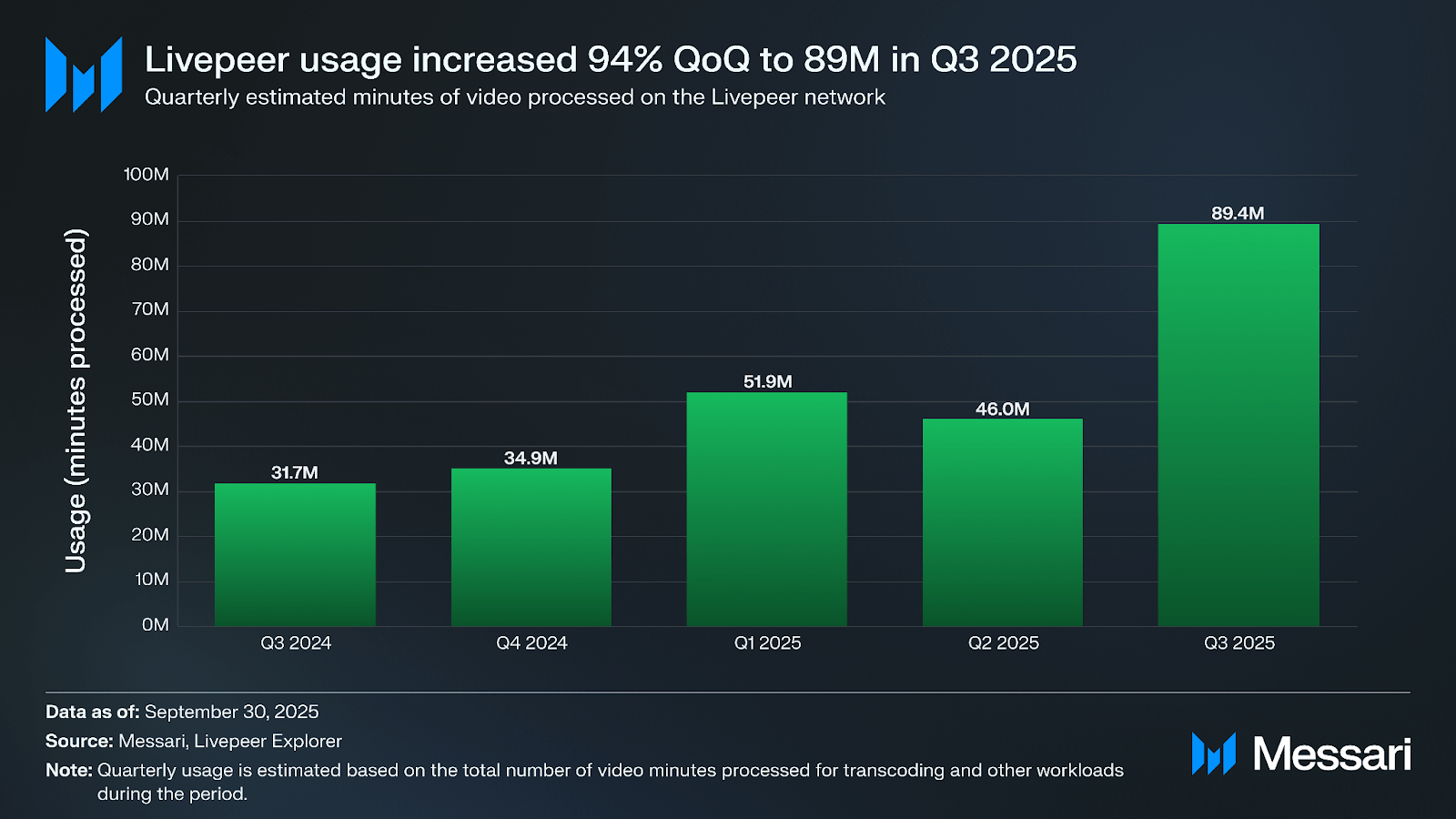
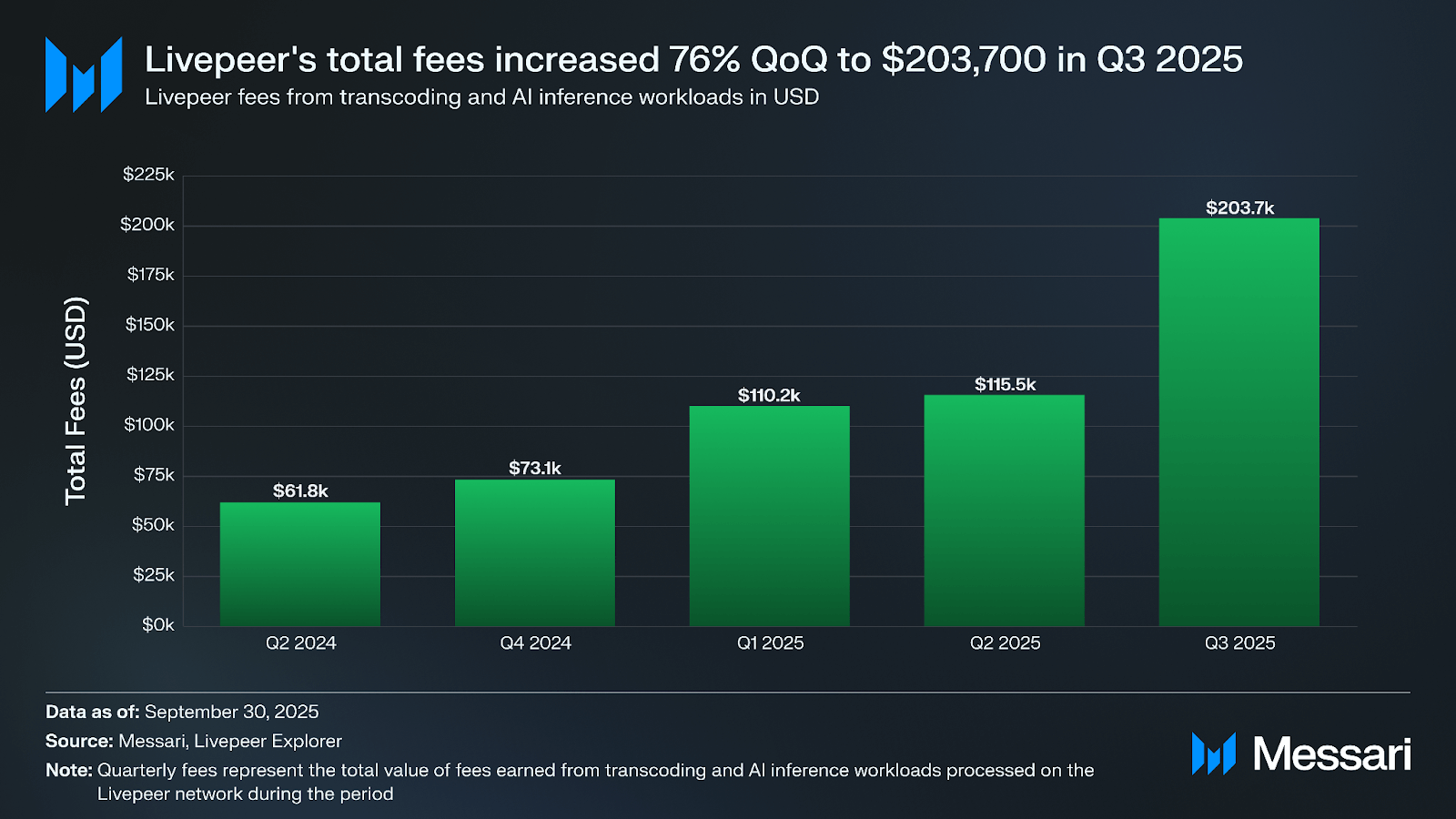
Demand-side fees grew 76% QoQ to $203,700, alongside a 94% increase in total processed minutes to 89.4 million, reflecting stronger application-driven demand and new workloads enabled by the Daydream API.
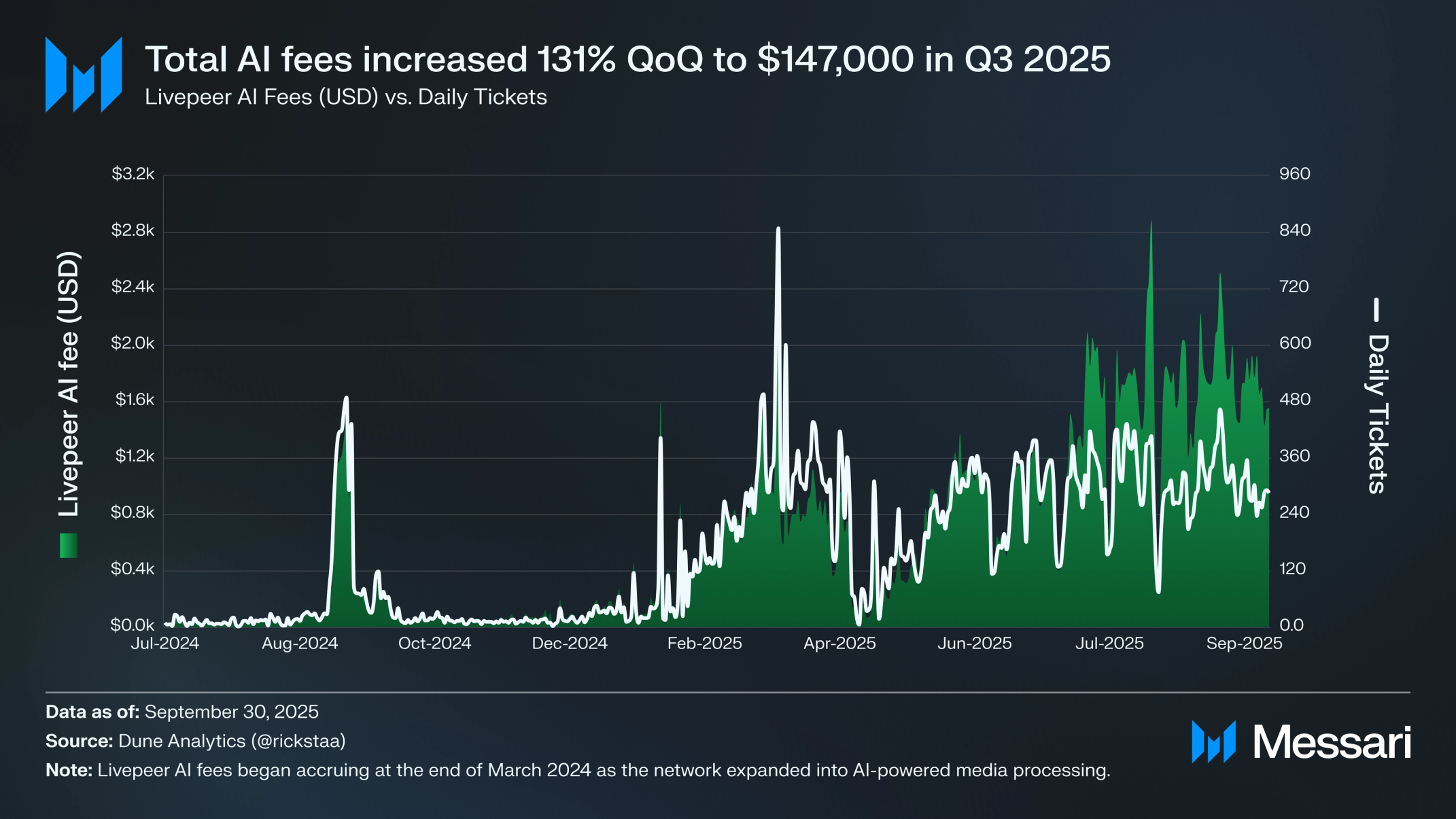
AI driven fees rose 131% QoQ to $147,100, accounting for over 70% of total protocol revenue, supported by real-time AI integrations such as Daydream API, StreamDiffusionTD, and Playa Daydream.
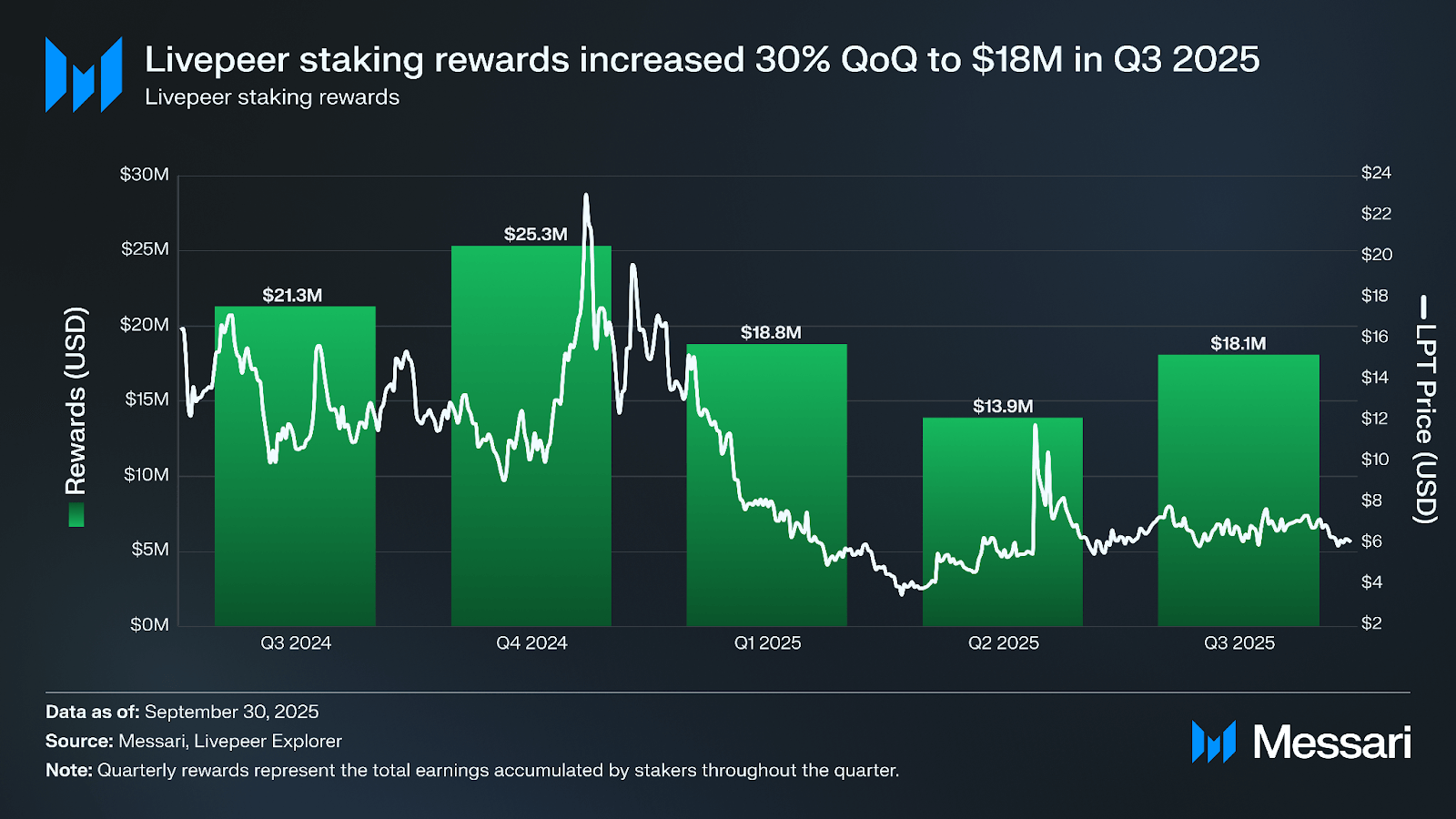
Total staking rewards increased 30% QoQ to $18.1 million, aided by higher usage-based fees, a modest inflation uptick as participation fell below 50%, and a larger circulating token base.
The Livepeer Foundation advanced its Surge strategy through new SPEs: Transformation, LISAR, and LiveInfra, funding infrastructure upgrades, fiat onramps, and governance coordination across the ecosystem.
Primer
Building decentralized video apps that resemble Twitch or TikTok requires live and on-demand video streaming infrastructure. Based on a user’s bandwidth and device, video content needs to be processed; i.e., transcoded, into viewable formats. While cloud providers like AWS, Google, or Microsoft are commonplace solutions for video transcoding, they incur high costs.
Livepeer (LPT) is a global compute network for AI video: an open, permissionless marketplace for media compute that powers live and on-demand streaming and real-time AI video inference. By matching application demand with a decentralized GPU supply, the network lowers costs compared to centralized clouds and scales workloads such as transcoding, remixing, and generative overlays.
Its compute marketplace enables participants to contribute GPU resources for various workloads, including video transcoding and AI-powered video processing. As AI-driven video models demand significantly more GPU compute than text and image generation, Livepeer offers a scalable and cost-efficient solution for video-related compute tasks. The network is designed to lower compute costs for video applications by up to 10x. Within Livepeer’s decentralized transcoding network, there are three key participants:
Node operators, called "Orchestrators," route transcoding jobs. The amount of work a node operator can perform is proportional to how many Livepeer native tokens (LPT) it stakes. Node operators earn ETH fees and newly minted LPT rewards.
Service nodes, called "Transcoders," provide compute resources for node operators and deliver video transcoding. In return, they earn ETH fees. Typically, Orchestrators and Transcoders run within the same machine (combined setup).
Delegators stake LPT towards effective node operators to help secure the Livepeer network. Staking is rewarded with a portion of both ETH fees and LPT rewards.
Livepeer has also expanded beyond video transcoding by introducing AI video processing to the network, with a focus on real-time AI inference for live video applications. This expansion is supported by initiatives such as Daydream, a real-time AI video engine that enables the creation and enhancement of video streams through generative overlays and adaptive effects, and Cascade, a framework outlining Livepeer’s approach to scaling decentralized media compute. Collectively, these initiatives signal the network’s progression toward a unified compute layer for live and on-demand video, integrating transcoding, generative AI, and inference workloads within a decentralized GPU marketplace.
Demand for Livepeer stems from apps and developers requiring video transcoding, live streaming, and video generation capabilities. This includes decentralized social media (DeSoc) applications, Web3-native platforms, and traditional Web2 applications requiring scalable video infrastructure. While platforms like TikTok, Twitch, Spotify, and SoundCloud rely on centralized infrastructure for streaming, similar applications in the Web3 space, such as decentralized video platforms, music streaming apps with tokenized incentives, or NFT-based media platforms, can leverage Livepeer’s decentralized video streaming and transcoding services.
Network
Livepeer’s network usage is commonly estimated by the number of minutes of video transcoded or otherwise processed, which serves as a useful proxy for demand on the protocol.
Livepeer’s estimated video processing volume increased 94% QoQ, rising from 46.0 million minutes in Q2 to 89.4 million in Q3 2025. It was the first quarter to record more than one million minutes processed per day on multiple days, reaching an all-time high of approximately 1.9 million minutes on September 25. The sharp increase reflected lower friction for builders, steadier application-driven demand, and improved reliability in converting requests into completed jobs.
Demand accelerated following the Daydream API launch on August 21, which removed the need for local GPU hardware and enabled real-time AI video through hosted inference. Earlier in the quarter, the StreamDiffusionTD operator for TouchDesigner (August 5) provided creators with a direct pathway to generative video workflows, while the Playa Daydream activation during Burning Man (late August) produced a short-term spike followed by a higher post-event baseline. On the consumer side, Streamplace’s integration with Skylight Social supported recurring web and mobile livestreams, and Harmonic’s late-September activations contributed to the strong end-of-quarter usage cluster that included the September 25 peak.
On the supply side, LiveInfra upgrades, including real-time health checks, automatic failover, and a 99.9% uptime target, helped reduce drop-offs and increase the share of completed minutes.
Fees from Transcoding and AI Inference
Services using the Livepeer network pay demand-side fees in ETH to access video transcoding and AI-powered processing tasks. Node operators (orchestrators) earn these fees for processing video and distribute a portion to their delegators based on their fee-sharing structure. The likelihood of receiving transcoding jobs is proportional to the amount of LPT staked; orchestrators with higher self- and delegated LPT are prioritized for more work and thus earn greater fees. This system incentivizes both node operators and delegators, reinforcing network participation and security.
Livepeer’s demand-side fees increased 76% QoQ, rising from $115,500 in Q2 to $203,700 in Q3 2025, while total usage grew 94%, from 46 million to 89.4 million minutes. Given the larger increase in usage and a 4.65% appreciation in ETH/USD (from $5,588 to $5,848), total fee revenue would have been expected to rise even more sharply if average pricing had remained constant. Instead, unit revenue declined ~9%, from roughly $2.51 to $2.28 per 1,000 minutes, indicating lower effective fees per minute.
The modest reduction in unit revenue aligns with a Q3 workload mix shift toward Daydream-powered real-time AI and consumer social streams such as Streamplace and Skylight Social. These workloads generally operate at lower bitrates, shorter session durations, or with fewer transcoding profiles, resulting in lower fees per minute even as aggregate usage expanded. Additional contributing factors likely included:
Increasing competition among node operators to capture AI video workloads through Daydream may have contributed to lower effective fees, reflecting how decentralized marketplaces can produce price efficiencies on the demand side.
Introductory and promotional pricing for new integrations and event activations (e.g., Playa Daydream), which temporarily reduced average rates.
Operational scaling effects, where higher throughput and job concurrency temporarily compressed per-minute effective fees during early adoption.
Emerging real-time AI agent projects, such as Embody and Sarah’s Game, also contributed to network activity, highlighting diversification across AI-driven use cases
Fees from Livepeer AI
In Q3 2025, Livepeer continued expanding its role beyond video transcoding through the ongoing development of Livepeer AI, which launched in Q3 2024 to support decentralized AI-powered video processing and real-time inference. This progress included the refinement of Cascade, a real-time AI video processing pipeline introduced in late 2024. Cascade enables applications such as automated video agents, live analytics, and interactive overlays by orchestrating GPU resources for continuous media workflows. These developments further established Livepeer’s role as a decentralized media compute network, expanding its infrastructure to support emerging AI-driven video applications.
In Q3 2025, the Livepeer AI generated approximately $147,100 in demand-side fees, up from $63,700 in Q2, representing a 131% QoQ increase. These fees were earned by orchestrators performing AI-powered video inference tasks, including real-time remixing, avatar rendering, and generative overlays. Compensation was distributed through Livepeer’s probabilistic micropayment system, in which node operators receive winning tickets redeemable for ETH-denominated fees.
A total of 27,845 winning tickets were processed during the quarter, a 37% increase from 20,351 in Q2, while the average fee per ticket rose by 69%, from $3.13 to approximately $5.28. AI workloads accounted for over 72% of total protocol fee revenue in Q3, up from 55% in Q2, signaling a continued shift in network activity toward compute-intensive, short-form, and generative video tasks driven by Daydream-powered applications.
Staking Rewards
The Livepeer network distributes staking rewards in LPT to node operators and delegators. To provide video services on the Livepeer network, node operators must stake LPT. A node operator’s stake weight comprises their own tokens and tokens they were delegated.
Total staking rewards increased ~30% QoQ to approximately $18.1 million (up from $13.9 million in Q2 2025), despite a 2.3% decline in LPT price (from $6.20 to $6.00). The rebound was driven by three reinforcing factors.
First, the circulating supply expanded, as market capitalization rose +4.8% QoQ while price declined. The implied circulating LPT supply grew from ~41.9 million in Q2 to ~45.3 million in Q3 (+3.4 million, or ~8.2%), which naturally increased nominal emissions at a given inflation rate.
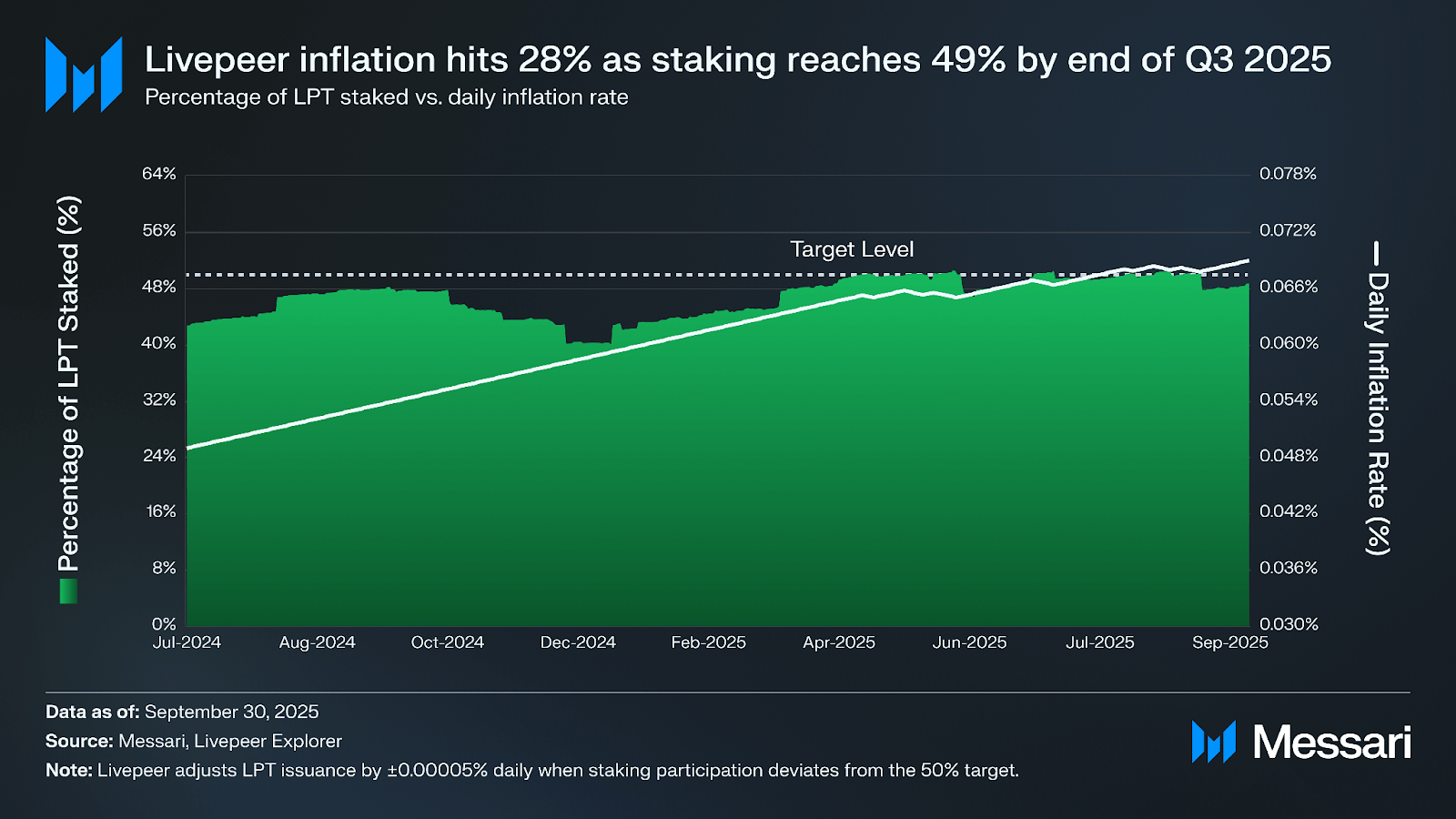
Second, staking participation slipped below the 50% target (from 50.1% to 48.7%), triggering Livepeer’s dynamic inflation mechanism to raise annualized issuance slightly, from ~27.0% to ~28.03%, thereby adding incremental token rewards to stakers and delegators.
Third, network fundamentals improved materially: transcoded minutes grew +94% QoQ, and demand-side transcoding fees rose +76%, expanding the pool of fee-derived rewards distributed to orchestrators and delegators. In Q2, total rewards had fallen from ~$18.8 million to $13.9 million, even as LPT’s price rebounded +29%, because staking participation briefly exceeded the 50% target, tightening emissions, while usage-based fees had yet to inflect. In Q3, this dynamic reversed: a larger circulating base, a modest uptick in inflation from reduced participation, and strong usage-driven fee growth together outweighed the minor price decline, lifting total USD-denominated staking rewards back to approximately $18.1 million.
Staking Participation
The Livepeer Token (LTP) operates under a Stake-for-Access (SFA) model, requiring node operators to stake LPT to perform work on the network. Over the past seven quarters, staking participation, the percentage of circulating LPT supply that is staked, has remained below the 50% target level. Additionally, the number of delegators has declined, decreasing from 2,845 in Q2 2025 to 2,683 in Q3 2025, reflecting a contraction in the number of active participants helping to secure the network.
Staking participation edged down from 50.1% in Q2 to 48.7% in Q3 2025 (–1.4 percentage points), slipping just below Livepeer’s 50% target threshold. In accordance with the protocol’s dynamic inflation mechanism, annualized daily inflation ticked up from ~27.0% to ~28.03%, as the network spent most of the quarter below the participation target. Under this system, issuance increases when participation falls under 50% and tapers when it rises above.
On July 24, Livepeer published “Why Delegation Still Matters in a Low-Inflation Environment,” emphasizing the network’s gradual transition toward usage-based fee rewards as staking levels hover around the 50% equilibrium. This was an interpretive analysis, not a parameter change. In Q3, those dynamics were reflected in practice: despite slightly lower participation and marginally higher inflation, total staking rewards rose ~30% QoQ, driven primarily by stronger network activity. Transcoded minutes increased 94% QoQ, and demand-side fees grew 76%, expanding the pool of rewards tied to real usage rather than inflationary issuance.
Overall, Q3 reward growth and real yield improvements were supported mainly by higher network utilization, with the mild inflation uptick serving as a secondary tailwind. These dynamics reinforce a key structural tension in Livepeer’s staking economy: while inflation helps sustain validator participation, the linkage between stake weight and actual workload execution remains imperfect.
Prior research shows that the top five orchestrators by stake captured 40–50% of total staking rewards but only about 20% of transcoding fees, highlighting inefficiencies in aligning capital allocation with network contribution. As usage continues to grow and inflation gradually stabilizes near the target, optimizing this alignment, through mechanisms that better connect fee distribution to work performed, will be critical to sustaining healthy network economics and equitable yields.
Market Capitalization
LPT’s circulating market capitalization rose 4.8% QoQ to $271.8 million (from $259.5 million), even as the token price declined 2.3% to $6.00 (from $6.20). The increase stemmed from supply expansion, with the circulating supply rising from approximately 41.9 million to 45.3 million LPT (3.4 million, 8.2% increase QoQ). This growth in circulating tokens, consistent with ongoing emissions, while staking participation remained below the 50% target, offset the modest price drop, resulting in a net increase in market capitalization over the quarter.
Qualitative Analysis
Product and Infrastructure Updates
Daydream Platform Expansion and API Launch: Following its public beta in May 2025, Daydream entered Q3 as an increasingly mature platform for real-time AI video creation and experimentation. Initially launched as a creator-facing tool for prompt-based video remixing, overlays, and avatar embodiment, Daydream evolved in Q3 into a broader developer hub with accessible APIs and hosted compute environments.
On August 21, 2025, the Daydream team launched the Daydream API and Interactive Playground, introducing sub-second latency for real-time AI video inference and removing the need for local GPU hardware. The platform now provides a hosted environment for StreamDiffusion and TouchDesigner integrations, enabling artists and developers to build generative video experiences powered by the Livepeer network. By extending beyond its original beta and opening its infrastructure to external builders, Daydream positioned itself as a central hub for open-source AI video experimentation and a key driver of network usage growth.
Creative AI Integrations (Builder Story: TouchDesigner + Daydream): On August 5, Livepeer featured StreamDiffusionTD, a real-time generative video operator for TouchDesigner developed by Lyell Hintz (@dotsimulate). The integration links live inputs such as audio, sensors, and cameras to the Daydream API, enabling remote GPU inference without requiring local RTX-class hardware. Features include multi-ControlNet blending, IPAdapter style guidance, and TensorRT optimization, marking a milestone for Livepeer’s AI compute accessibility and creative-tools ecosystem.
Delegation and Usage-Based Rewards: On July 24, Livepeer published “Why Delegation Still Matters in a Low-Inflation Environment,” explaining how the protocol’s dynamic inflation model now adjusts as staking participation approaches 50%. With roughly 30,000 LPT minted per day, rewards are gradually shifting from inflationary issuance to usage-driven fees earned through video and AI compute work. This transition aligns orchestrator and delegator incentives with real network activity and long-term sustainability.
Livepeer Inc.’s Strategic Focus: On July 31, 2025, CEO Doug Petkanics outlined a narrower mandate for Livepeer Inc. to achieve product-market fit in real-time AI video. The company deprioritized traditional streaming growth efforts to focus on developer APIs, tooling, and community programs that expand demand for AI-native video workflows.
Partnerships and Ecosystem Expansions
Liquidity and Accessibility: On July 1, Binance listed the LPT/USDC trading pair, increasing liquidity and enabling stablecoin-denominated trading for Livepeer users.
Streamplace Expansion: Following its approved April 26, 2025 proposal, Streamplace (formerly Aquareum) received 100,000 LPT in treasury funding to build decentralized livestreaming infrastructure for social applications. In Q3 2025, the team delivered SDKs, multi-platform integrations, and partnered with Skylight Social, a Mark Cuban-backed app that topped the App Store’s entertainment category. The platform now underpins decentralized social protocols such as Farcaster and AT Protocol, strengthening Livepeer’s role in consumer-facing video applications.
Community Engagement and Events
Interactive AI Experiences: In late August 2025, Livepeer showcased its AI infrastructure through Playa Daydream, an interactive activation on the BMWebcast; the live broadcast streamed directly from the Burning Man Playa. Viewers could vote every 60 seconds to remix the Playa environment, with results rendered in real time via Livepeer’s decentralized video inference network, demonstrating emerging use cases for interactive and community-driven media.
Developer Showcases and Hackathons: On September 12, Livepeer hosted live demos of its Realtime AI Builder suite, including Diffusion Lab and Zen Canvas. During the same month, FLIPgo, a Hyperliquid-native streaming platform powered by Livepeer, was recognized at the Hyperliquid Hackathon for its Frontier Track submission, underscoring Livepeer’s expanding role in DeFi-linked streaming.
Harmonic SPE Activations: On September 29, Livepeer recapped Harmonic’s Q3 output (e.g., visuals at FarCon NYC, live streaming at Basecamp VT), with plans around open-sourcing tooling and community bounties.
Ecosystem Coordination and Governance Alignment: The Livepeer Foundation (LF), launched in Q2, continued to drive coordination and decentralization in Q3. It published its first strategic pillars in July and, throughout September, hosted community fireside sessions on orchestrator metrics, infrastructure, and the “Surge” strategy, a tactical plan for open funding and RFP-based execution. These initiatives led to the first Livepeer Community Summit, held in October 2025 in Lisbon, bringing together contributors from Livepeer Inc., the Foundation, and ecosystem teams. During the summit, Petkanics reviewed Livepeer’s technical milestones from its 2017 whitepaper through its 2025 expansion into AI video inference, emphasizing the protocol’s sustained innovation in decentralized compute.
Advisory Boards and Strategic Pillars: The Foundation’s advisory boards advanced from strategic planning to tactical execution in Q3. Phase 1 Strategic Pillars were published July 10, followed by Phase 2 Tactical Recommendations on July 30 and a GTM strategy update on July 24, formalizing objectives across Network, Growth, Markets, and Governance.
Governance
Transformation SPE Governance Proposal: On September 16, 2025, the community approved 44,500 LPT (~$290,000) to fund the Transformation SPE, part of the Foundation’s Surge strategy. The SPE coordinates three workstreams: Capital, Builders, and Development, covering treasury management, liquidity improvements, ecosystem onboarding, and protocol-level enhancements such as explorer upgrades and payment-clearing prototypes. It operates transparently via open RFPs, monthly accounting, and quarterly reports, marking a shift toward structured, operational execution of ecosystem priorities.
Fiat Delegation (LISAR) Governance Proposal: Also approved September 16, the LISAR SPE received 4,450 LPT (~$29,000) to build a fiat-to-delegation gateway that allows users to stake LPT using currencies such as USD, EUR, GBP, and NGN. The four-month roadmap includes a production-ready interface, referral program, educational onboarding in Nigeria, and a public dashboard for conversions and rewards, broadening participation among non-crypto-native users.
LiveInfra SPE Q3 Execution: Approved on July 7, 2025, the LiveInfra SPE received 7,152 LPT (~$31,500) to maintain and upgrade the Community Arbitrum Node, a public good providing free RPC access to Arbitrum and Ethereum L1 for Livepeer developers. The funding covered operational and enhancement costs for Q3 2025. During the quarter, the team deployed higher-performance infrastructure, implemented real-time health checks, and added automatic failover mechanisms to target 99.9% uptime. The RPC Balancer v2 tool was also released, introducing improved redundancy and support for multi-provider configurations. A new service dashboard is under development to display uptime, usage, and performance metrics.
The initiative is led by Joey Kuhnsman (ftkstaking.eth) and operates on a quarterly funding cadence with transparent metrics to ensure sustainability and network reliability.
Closing Summary
In Q3 2025, Livepeer recorded strong network growth and continued progress toward becoming a decentralized media compute platform. Total videos and AI processing volume rose 94% QoQ and demand-side fees increased 76%, supported by the Daydream API launch and integrations with TouchDesigner, Streamplace, and Harmonic. Infrastructure upgrades under the LiveInfra SPE improved uptime and throughput, helping sustain higher utilization.
The AI video processing generated $147,100 in fees (+131% QoQ) and accounted for over 70% of total transcoding revenue, reflecting the network’s growing use in AI and generative workloads. Total staking rewards rose ~30% QoQ to $18.1 million, driven by higher usage, a modest inflation uptick as participation slipped below 50%, and supply expansion.
Governance activity centered on the Livepeer Foundation’s Surge strategy, which funded initiatives including the Transformation, LISAR, and LiveInfra SPEs to improve infrastructure and ecosystem coordination.
Overall, Q3 marked a quarter of higher network utilization, growing AI-driven demand, and steady protocol development, reinforcing Livepeer’s position as a leading decentralized video and compute network.
This report was commissioned by Livepeer Inc. All content was produced independently by the author(s) and does not necessarily reflect the opinions of Messari, Inc. or the organization that requested the report. The commissioning organization may have input on the content of the report, but Messari maintains editorial control over the final report to retain data accuracy and objectivity. Author(s) may hold cryptocurrencies named in this report. This report is meant for informational purposes only. It is not meant to serve as investment advice. You should conduct your own research and consult an independent financial, tax, or legal advisor before making any investment decisions. Past performance of any asset is not indicative of future results. Please see our Terms of Service for more information.
No part of this report may be (a) copied, photocopied, duplicated in any form by any means or (b) redistributed without the prior written consent of Messari®.
Armita is a protocol researcher with a robust background in technology and blockchain. Before her role at Messari, she distinguished herself as a tech entrepreneur, executive, and advisor for various blockchain startups. Armita holds two master's degrees, one in Computer Engineering and another in Business Management, as well as a double major undergraduate degree in Physics and Pure Mathematics.
Armita is a protocol researcher with a robust background in technology and blockchain. Before her role at Messari, she distinguished herself as a tech entrepreneur, executive, and advisor for various blockchain startups. Armita holds two master's degrees, one in Computer Engineering and another in Business Management, as well as a double major undergraduate degree in Physics and Pure Mathematics.