Livepeer is repositioning from decentralized video transcoding toward infrastructure optimized for real-time AI video, guided by the Cascade vision.
The shift builds on Livepeer’s core strengths, low-latency video pipelines, distributed GPU operators, and stake-coordinated execution, while expanding supported workloads to continuous AI inference on live video.
Daydream serves as a flagship product and design partner, translating the real-time AI video thesis into developer-facing workflows and early production demand.
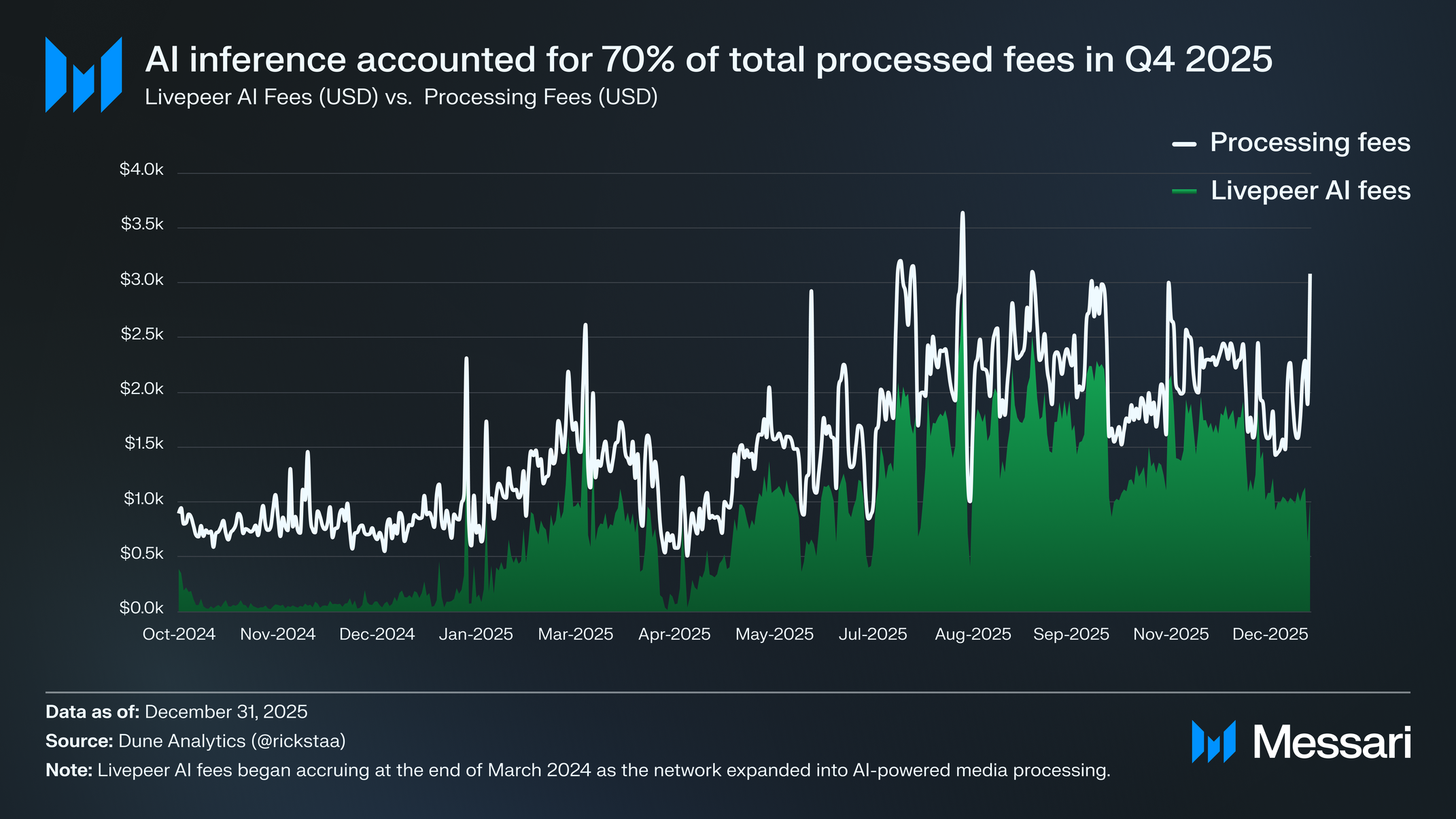
Network economics reflect this transition, with ~3× YoY fee growth and over 70% of fees driven by AI inference rather than traditional transcoding.
The roadmap focuses on productizing real-time AI pipelines, improving tooling and performance benchmarks, and scaling use cases across avatars, agents, and interactive video.
Introduction
As AI-native applications increasingly depend on real-time video generation, analysis, and interaction, infrastructure requirements are shifting away from static media pipelines toward low-latency, compute-intensive workflows. Emerging use cases, including AI-generated game worlds, real-time avatar agents, live video analytics, and interactive creative tools, require tightly coupled video ingestion, inference, and delivery. These constraints are not well served by general-purpose GPU clouds, which are primarily optimized for batch processing and static inputs.
Livepeer was originally built to decentralize video streaming and transcoding, providing cost-effective media processing through a distributed network of GPU operators. As AI inference workloads began running alongside traditional transcoding jobs, the project identified a more focused opportunity: infrastructure purpose-built for real-time AI video.
Over the past year, this transition has been shaped by Livepeer’s Cascade vision, which reorients the ecosystem around building the leading platform and community for real-time AI video. Early indicators point to traction, including sustained network usage across both transcoding and AI media inference and a growing share of network fees driven by AI workloads. With the technical foundation increasingly validated, the current phase emphasizes productizing the network, improving ecosystem coordination, and scaling demand from real-time AI video use cases.
Background
Livepeer launched in 2017 as a decentralized protocol for live video transcoding, designed to reduce the cost and operational complexity of streaming by coordinating independent node operators through cryptoeconomic incentives. Broadcasters paid usage-based fees for video processing, while orchestrators supplied GPU compute and bandwidth and were compensated through fees and staking-backed protocol rewards. This model emphasized cost efficiency, permissionless participation, and reliability, positioning Livepeer as one of the earliest decentralized media infrastructure networks.
From inception, Livepeer’s architecture centered on a single technical primitive: real-time video processing. The protocol introduced an open-source media stack optimized for live workloads and coordinated a globally distributed GPU network capable of handling latency-sensitive video pipelines. Over time, this foundation supported sustained livestream activity across a broad operator base, validating both the technical feasibility and economic viability of decentralized video infrastructure.
As the broader video ecosystem evolved, Livepeer’s opportunity set expanded along two dimensions. First, video workloads increasingly converged with AI, as applications embedded computer vision, generative effects, and agent-driven interaction directly into live streams. Second, demand shifted away from batch or offline processing toward continuous inference under tight latency constraints, exposing limitations in traditional cloud abstractions and generic inference platforms that were not designed for real-time media workflows.
In response, Livepeer expanded its supported job types beyond transcoding to include AI inference, demonstrating that its distributed GPU supply could support real-time AI workloads. While this capability proved technically viable and cost-efficient, it also surfaced a strategic limitation: when framed as generic inference infrastructure, Livepeer competed in crowded markets dominated by centralized providers offering bundled services, enterprise contracts, and sales-driven distribution areas where decentralized networks are structurally disadvantaged.
The introduction of the Cascade vision marked a strategic pivot. Rather than positioning Livepeer as a decentralized alternative to traditional streaming infrastructure platforms or a general-purpose compute marketplace, Cascade reframes the network around a more differentiated category: real-time AI video. This focus emphasizes workloads where Livepeer’s existing strengths, low-latency video processing, a distributed GPU marketplace, and open, stake-coordinated execution, are most defensible and difficult to replicate.
Under Cascade, live streaming is not abandoned but generalized. Video remains a core workload that provides steady demand and operational grounding, while serving as a natural substrate for AI-native extensions. As AI inference matured within the network, it became a primary driver of usage and fees, materially reshaping Livepeer’s economic profile.
Today, Livepeer operates as a network in transition: no longer defined solely by decentralized transcoding, but not yet fully productized as a platform for real-time AI video. Cascade formalizes this trajectory, aligning protocol capabilities, economic incentives, and product direction around a single thesis, enabling scalable, low-latency AI video pipelines that operate on live streams rather than static files.
Livepeer’s Vision
Building on this shift, Livepeer highlights three workload categories driving demand for real-time AI video infrastructure:
AI-generated worlds and games, where environments are produced frame-by-frame in response to user input
Real-time video analysis, enabling continuous data extraction and decision-making from live streams
AI-mediated avatars and agents, where motion capture, style transfer, and inference allow digital identities to operate persistently
Across these use cases, real-time AI video workloads share a common technical profile: continuous, frame-by-frame inference under tight latency constraints. These workloads are GPU-intensive and require close integration between video processing and compute. Livepeer positions this requirement as a structural advantage relative to generic GPU inference platforms, which are typically optimized for batch jobs or static inputs.
Livepeer’s stated opportunity is to serve as infrastructure for real-time AI video across creative media, gaming, robotics, analytics, monitoring, and synthetic data generation use cases where latency, composability, and elastic execution are first-order constraints.
Productizing the Network
With this positioning defined, the focus has shifted from articulation to execution:
Workflow deployment: Developers must be able to deploy complete real-time AI workflows composed of chained models and processing steps, rather than relying solely on base-model inference.
Industry-competitive latency: For interactive video workloads, latency is a binding constraint. Livepeer emphasizes benchmarking and delivering performance competitive with centralized GPU clouds for real-time use cases.
Elastic, usage-based scaling: Livepeer’s open operator marketplace allows workloads to scale on demand and be priced per usage, avoiding long-term GPU reservations and idle capacity, an extension of the cost advantages previously demonstrated in live transcoding.
Together, these attributes form the baseline needed to attract builders beyond Livepeer’s original streaming-focused ecosystem.
Daydream: Design Partner and Demand Driver
Daydream was introduced in May 2025 as a beta product designed to make Livepeer’s real-time AI video thesis tangible to developers. The initial beta, announced on May 12, 2025, positioned Daydream explicitly around real-time AI video workflows, offering a higher-level environment for building, testing, and running low-latency AI video pipelines without requiring developers to interact directly with protocol primitives or infrastructure-level components.
Daydream reflects an evolution in Livepeer’s go-to-market strategy. Rather than relying solely on infrastructure abstractions to attract demand, the ecosystem introduced Daydream as a product-facing surface to demonstrate usability, performance constraints, and real-world developer requirements. In this role, Daydream began generating early network usage while also functioning as a design partner, translating hands-on production feedback into concrete requirements for the underlying network, particularly around latency targets, workflow orchestration, and operational reliability.
By August 2025, Daydream’s positioning had begun to shift from exploratory demos toward reusable developer tooling. Builder-facing content and integrations highlighted the availability of the Daydream API within creative and developer environments, including integrations with tools such as TouchDesigner. This transition signaled a move toward supporting repeatable application development and third-party integrations, reinforcing Daydream’s role as both an onramp for developers and a feedback loop shaping Livepeer’s productization of real-time AI video infrastructure.
How Daydream Works
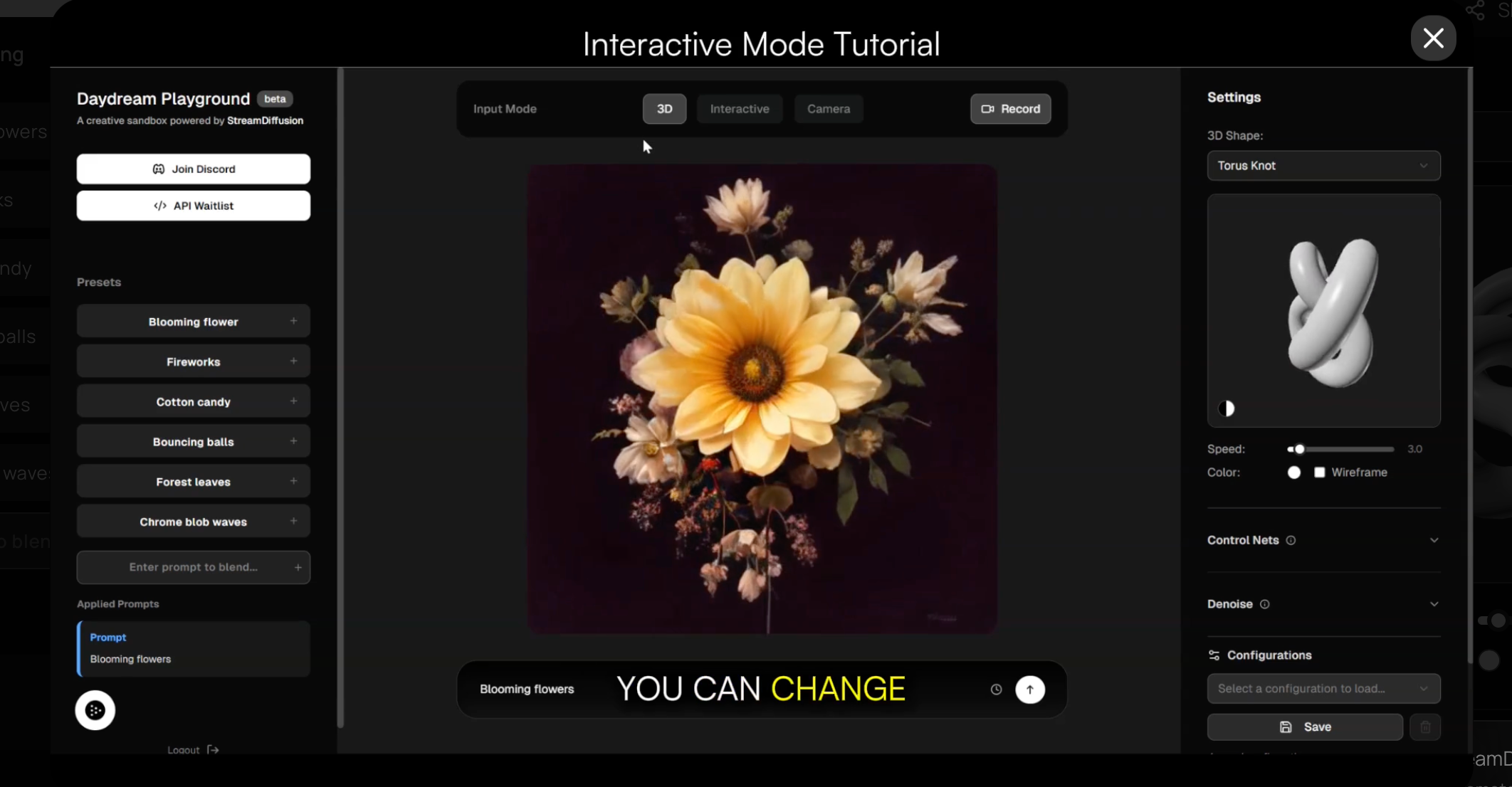
Daydream is an open platform for building, sharing, and deploying real-time AI video workflows. It enables users to transform, edit, and generate live video streams in real time, producing dynamic outputs under low-latency constraints. Use cases under exploration include personalized live entertainment (e.g., gaming and streaming), commerce-oriented applications (such as live shopping and advertising), and early industrial scenarios (for example, robotics training and monitoring).
The Daydream ecosystem currently comprises three primary components:
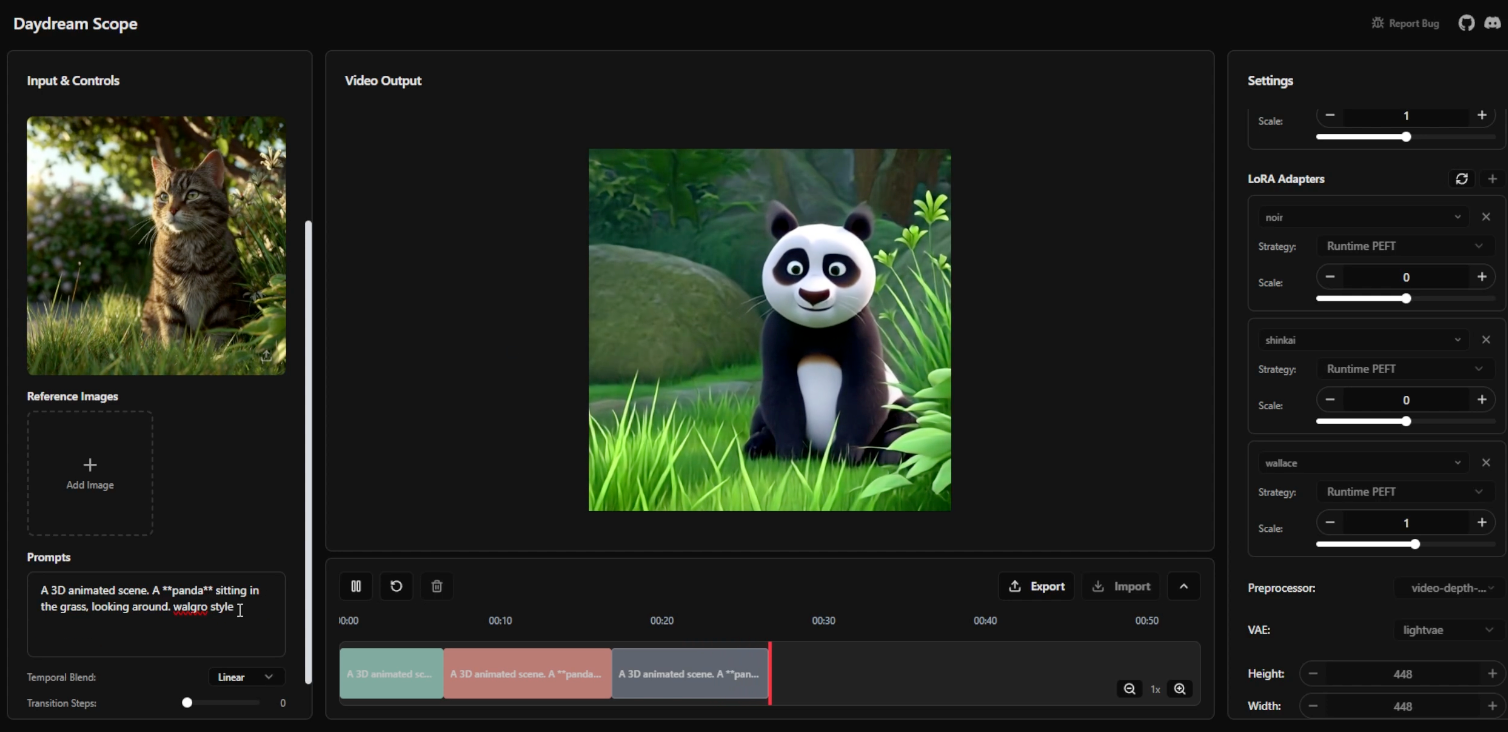
Scope, a local-first, open-source tool that allows creative technologists and applied researchers to design custom real-time AI video workflows and integrate them with complementary tools such as Spout, Unity, Unreal, and TouchDesigner;
a Community Hub, which serves as a discovery and collaboration surface for sharing workflows and highlighting community projects; and
the Daydream API, which provides remote inference for custom workflows executed on GPU backends supported by the Livepeer network.
As real-time AI video remains an active and rapidly evolving research area, Daydream functions as an early bridge between experimental workflows and repeatable, production-oriented deployment.
Daydream uses a combination of open-source tooling and custom real-time streaming pipelines to enable low-latency inference on remote GPU backends. This stack is exposed via the Daydream API, allowing developers to build and deploy real-time AI video workflows on the Livepeer network.
Multi-ControlNet support for spatial and temporal control
IPAdapter-based image style guidance
TensorRT acceleration, targeting ~15–25 FPS for complex configurations
Support for multiple real-time video generation models
Daydream Scope extends this stack as a community-facing, open-source local development environment for building and testing real-time AI video workflows. Scope supports models such as LongLive, StreamDiffusion, and Krea Realtime 14B and remains in community alpha.
Conceptually, the Daydream–Livepeer stack separates concerns cleanly:
Workflow definition: Node-based pipeline construction
Execution: Livepeer AI orchestrators running GPU-backed inference
Routing: AI gateways dispatching requests and returning outputs
In practice, 1. developers author or select a workflow pipeline, 2. requests are submitted via Livepeer’s AI endpoint, 3. orchestrators execute inference on live video streams or frames, and 4. outputs are returned as media artifacts or streams suitable for downstream use.
This division of labor allows Daydream to focus on developer experience, composability, and creative tooling, while Livepeer provides distributed execution, scaling, and operational coordination.
Role in Livepeer’s Broader Strategy
Within the Cascade framework, Daydream functions as a feedback loop between application usage and infrastructure design. Rather than treating applications as downstream consumers, Livepeer frames Daydream as an active input into network evolution, informing performance benchmarks, workflow abstractions, and supply-side readiness.
By anchoring real-time AI video experimentation in a visible product surface, Daydream helps validate Livepeer’s positioning beyond traditional transcoding and provides early signals about which workloads are most likely to scale into sustained network demand.
Supporting Livepeer’s Vision Through Ecosystem Activity
Daydream’s tooling supports Livepeer’s infrastructure thesis by enabling developers to prototype real-time AI video workflows before scaling them into production. Developers can interact through hosted APIs or self-host open-source components, creating multiple pathways from experimentation to deployment.
Livepeer reports that this transition is already reflected in network economics. As of late 2025:
Network fees increased approximately 3× year over year
More than 70% of fees were attributed to AI inference rather than traditional transcoding.
On the product side, Daydream has progressed from beta demonstrations to API-level integrations, with external developers building real-time generative video tools and interactive applications. While early, these signals suggest AI-native video workloads are becoming a primary source of network demand.
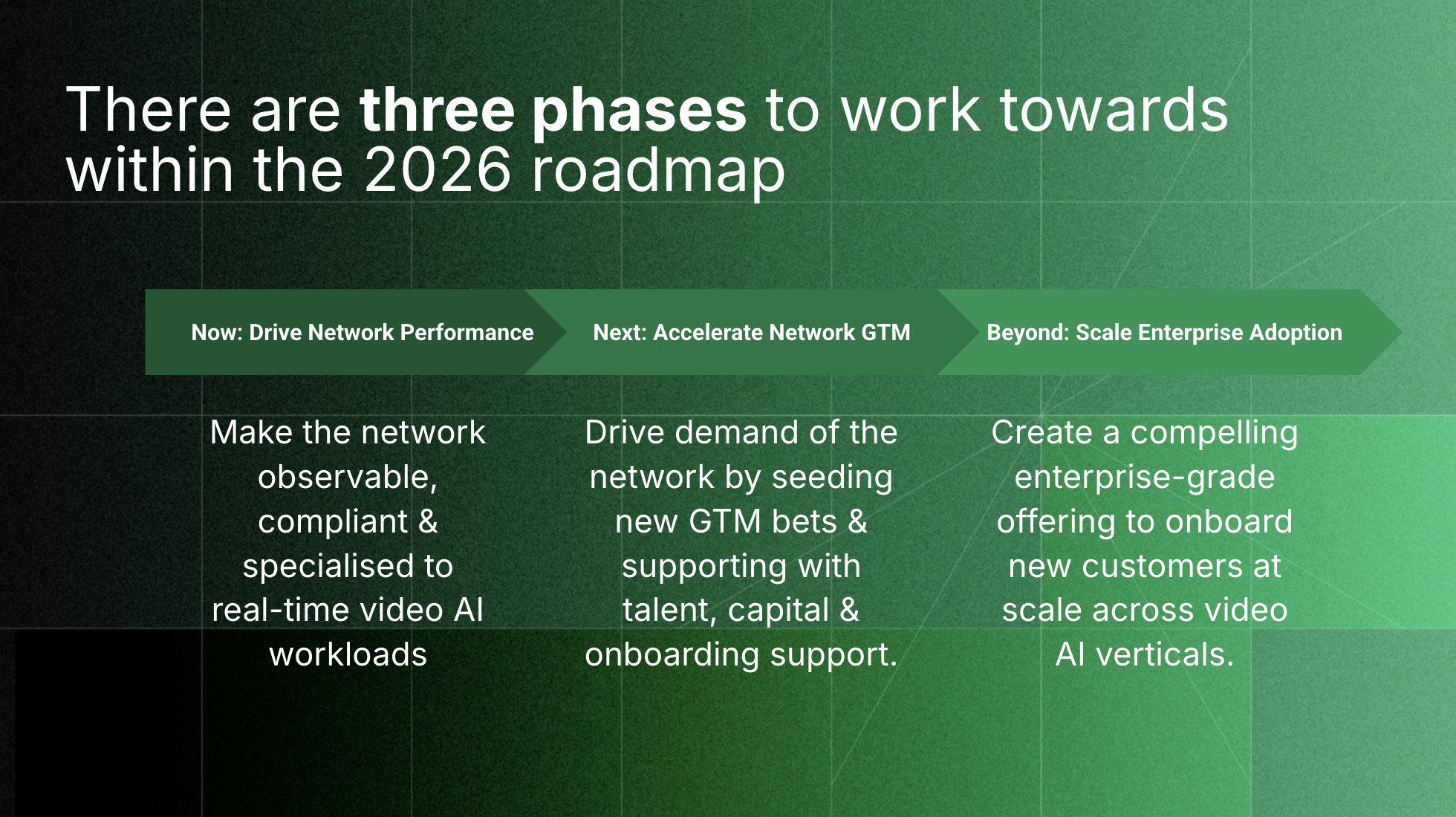
Published in late Q4 2025, the Livepeer roadmap serves as the ecosystem’s primary coordination reference, outlining priority initiatives and areas of contribution across the network. It details how Livepeer intends to execute against the opportunity in real-time video AI and provides a concrete expression of Surge, the network’s execution philosophy centered on speed, focus, and coordination.
Improve network observability, reliability, and security for real-time video AI workloads
Expand developer tooling and reduce integration friction
Remove barriers to sustained production use
Next: Accelerate Network GTM
Convert readiness into consistent demand growth through targeted go-to-market efforts
Support adoption through design partners, onboarding, and ecosystem support
Establish clearer paths from experimentation to production
Beyond: Scale Enterprise Adoption
Prepare the network to support materially higher real-time AI video demand
Expand GPU supply and enterprise-grade operational capabilities
Strengthen trust, verification, and reliability guarantees
The roadmap clarifies how Livepeer intends to move from production readiness to sustained demand growth and, over time, scaled enterprise adoption.
Closing Summary
Livepeer is repositioning itself from a decentralized video transcoding network into infrastructure purpose-built for real-time AI video workloads. The Cascade vision reflects a strategic narrowing of focus toward a category where Livepeer’s low-latency video stack, elastic GPU marketplace, and open coordination model offer meaningful differentiation.
Daydream plays a central role in this transition, serving as both a demand driver and a design partner through open tooling and production-oriented real-time video pipelines. The roadmap emphasizes performance, reliability, and developer-facing infrastructure as prerequisites for scaling real-time AI video beyond early experimentation. If successful, Livepeer could emerge as a specialized infrastructure layer for AI-native video applications, where video is not merely streamed, but continuously generated, transformed, and interpreted in real time.
This report was commissioned by Livepeer Inc. All content was produced independently by the author(s) and does not necessarily reflect the opinions of Messari, Inc. or the organization that requested the report. The commissioning organization may have input on the content of the report, but Messari maintains editorial control over the final report to retain data accuracy and objectivity. Author(s) may hold cryptocurrencies named in this report. This report is meant for informational purposes only. It is not meant to serve as investment advice. You should conduct your own research and consult an independent financial, tax, or legal advisor before making any investment decisions. Past performance of any asset is not indicative of future results. Please see our Terms of Service for more information.
No part of this report may be (a) copied, photocopied, duplicated in any form by any means or (b) redistributed without the prior written consent of Messari®.
Armita is a protocol researcher with a robust background in technology and blockchain. Before her role at Messari, she distinguished herself as a tech entrepreneur, executive, and advisor for various blockchain startups. Armita holds two master's degrees, one in Computer Engineering and another in Business Management, as well as a double major undergraduate degree in Physics and Pure Mathematics.
Armita is a protocol researcher with a robust background in technology and blockchain. Before her role at Messari, she distinguished herself as a tech entrepreneur, executive, and advisor for various blockchain startups. Armita holds two master's degrees, one in Computer Engineering and another in Business Management, as well as a double major undergraduate degree in Physics and Pure Mathematics.