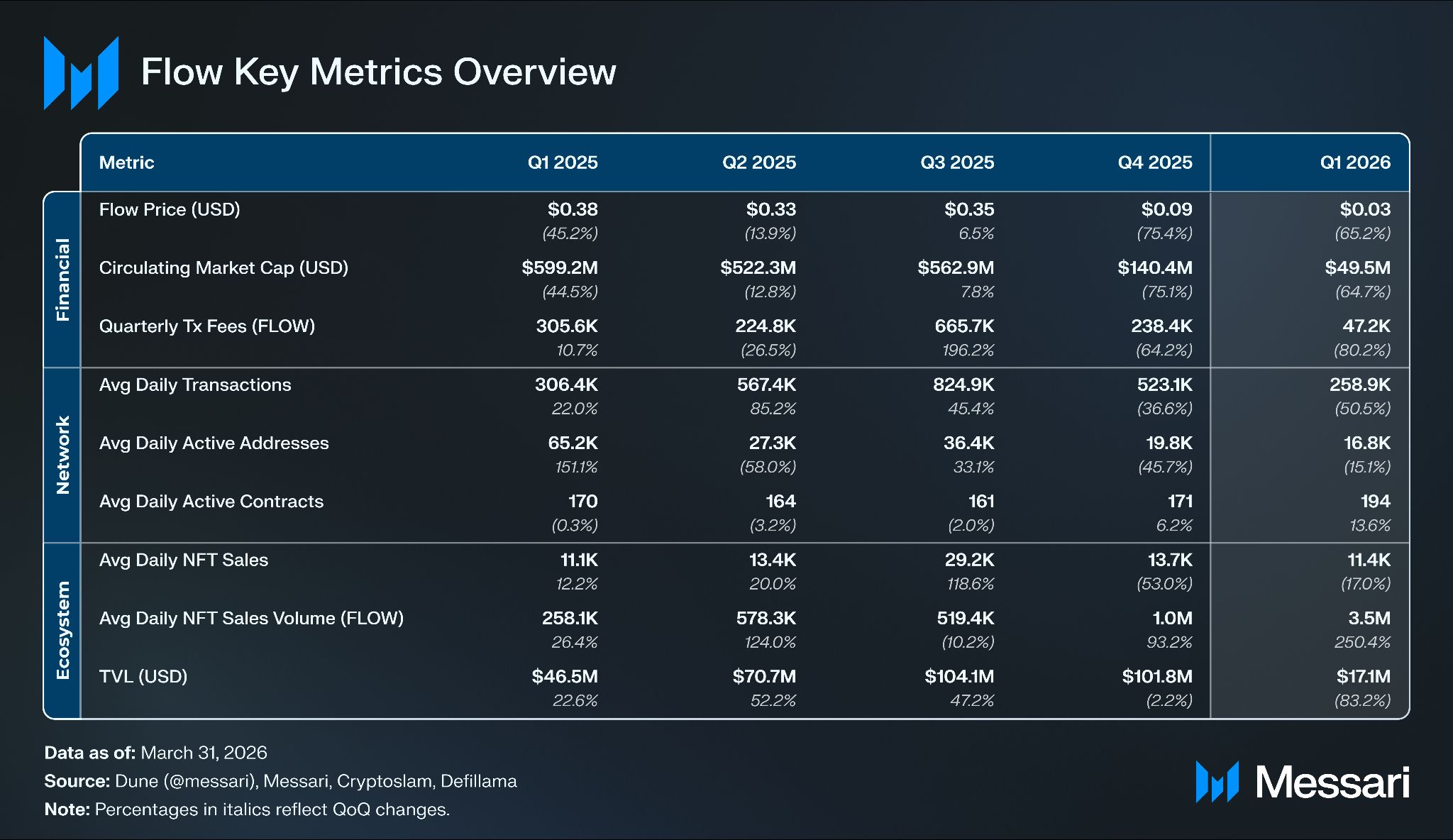
Following the December 2025 security incident, the Flow Foundation completed a multi-phase remediation in Q1 2026, including 87.96 billion counterfeit FLOW tokens destroyed onchain (99.9% of the counterfeit balance), a 50.3 million FLOW buyback and burn (~3% of supply) executed in February 2026, and trading independently restored across more than a dozen global exchanges. Following Binance's restoration of FLOW deposits and withdrawals, FLOW rallied approximately 94% to $0.0742 over the following week, suggesting Flow’s efforts to secure the network and restore normal activity post-incident could carry constructive momentum into Q2’26.
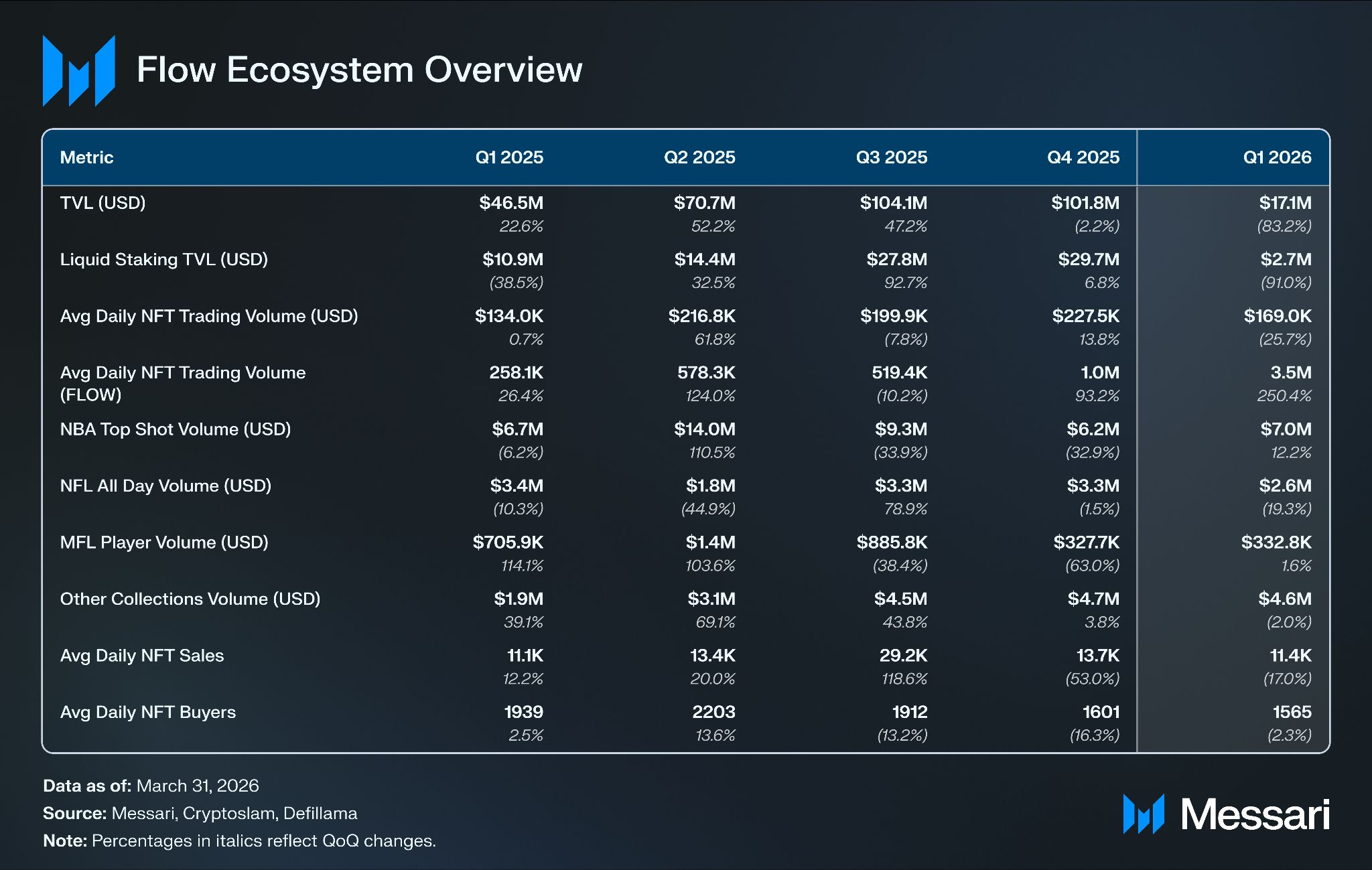
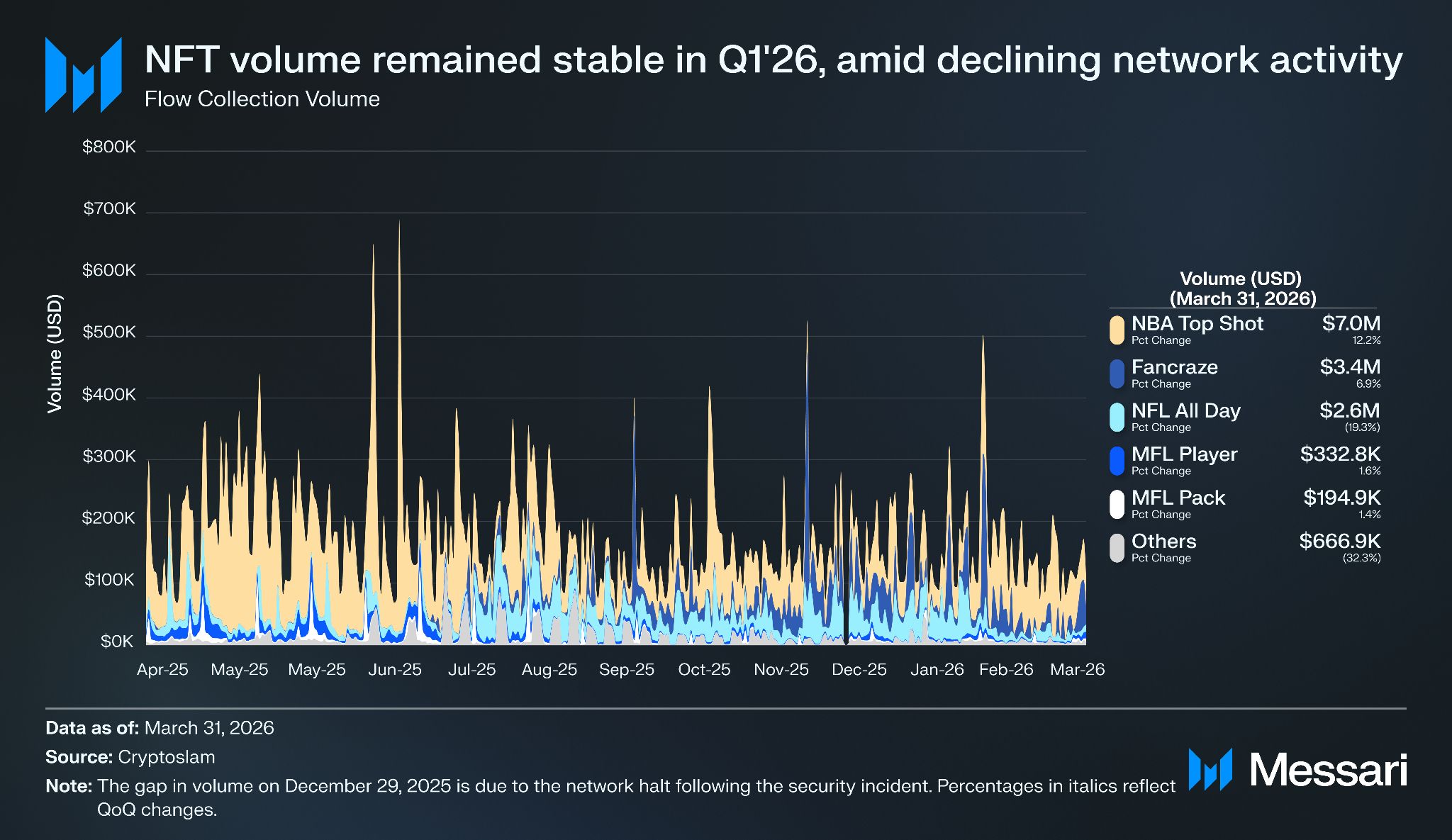
NFT collection volume held steady in Q1 as NBA Top Shot grew 12.2% QoQ to $7.0 million and FanCraze increased 6.9% to $3.4 million. NFL All Day declined 19.3% to $2.6 million as the NFL season wound down, while MFL activity held roughly flat. NBA Top Shot saw multiple notable high ticket sales on the secondary market, including a Series 1 LeBron James #1/59 for $19,500.
FLOW's price fell 65.2% QoQ to $0.03 across two distinct shocks: an early selloff in January 2026 as the attacker liquidated recovered FLOW into onchain pools, and a March 2026 DAXA delisting from Upbit, Bithumb, and Coinone that drove a 55.2% drop in the days following.The drawdown was largely concentrated in Korean order flow.
Flow surpassed 40 million unique accounts and approached 950 million cumulative transactions in Q1'26, putting the network on track to cross 1 billion lifetime transactions in Q2'26, a threshold reached by only a small set of L1s to date.
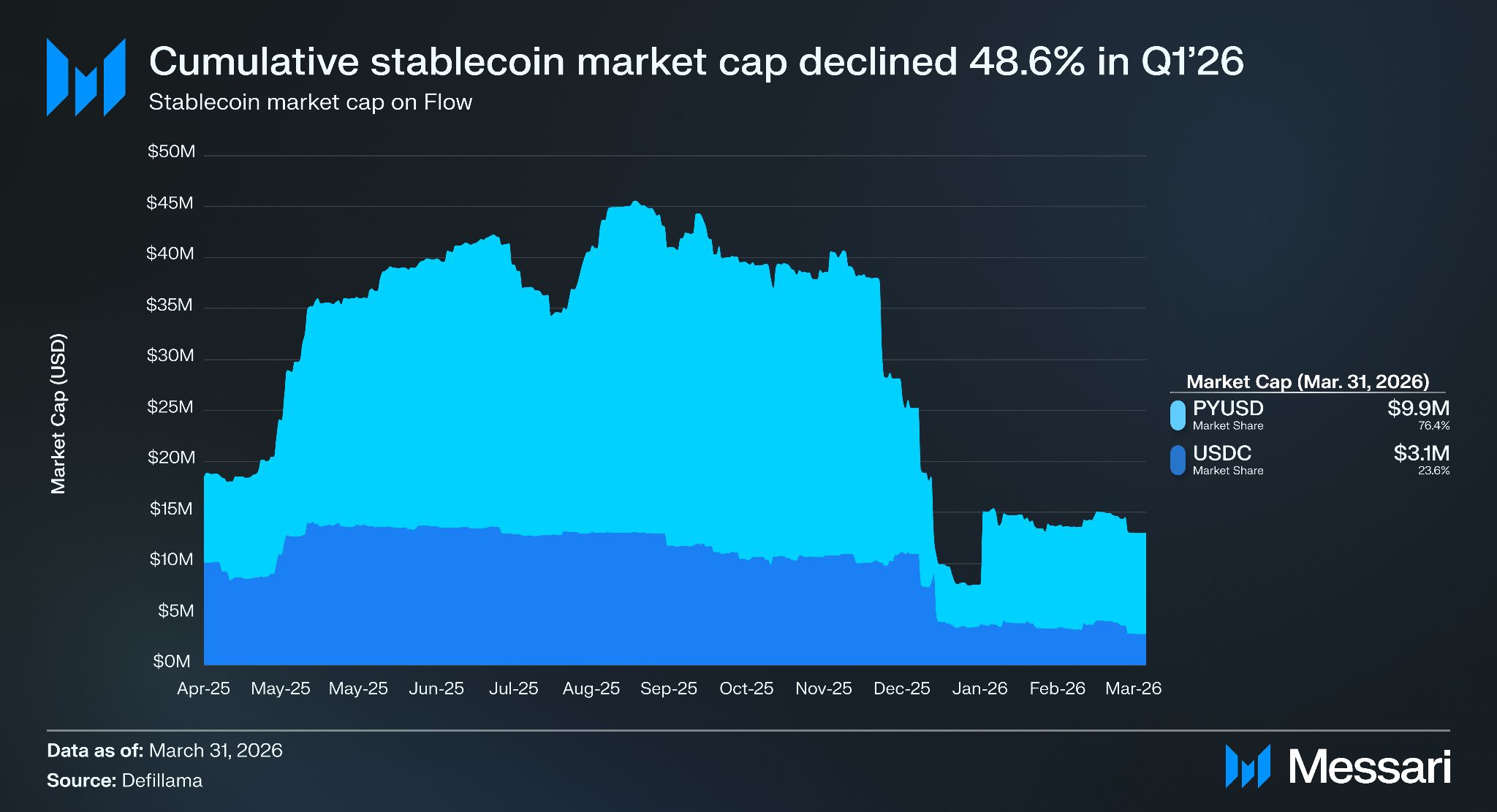
Stablecoin supply fell 48.6% QoQ to $13 million, with outflows concentrated in January 2026 following the security incident. PYUSD partially recovered to $10 million by February 2026.
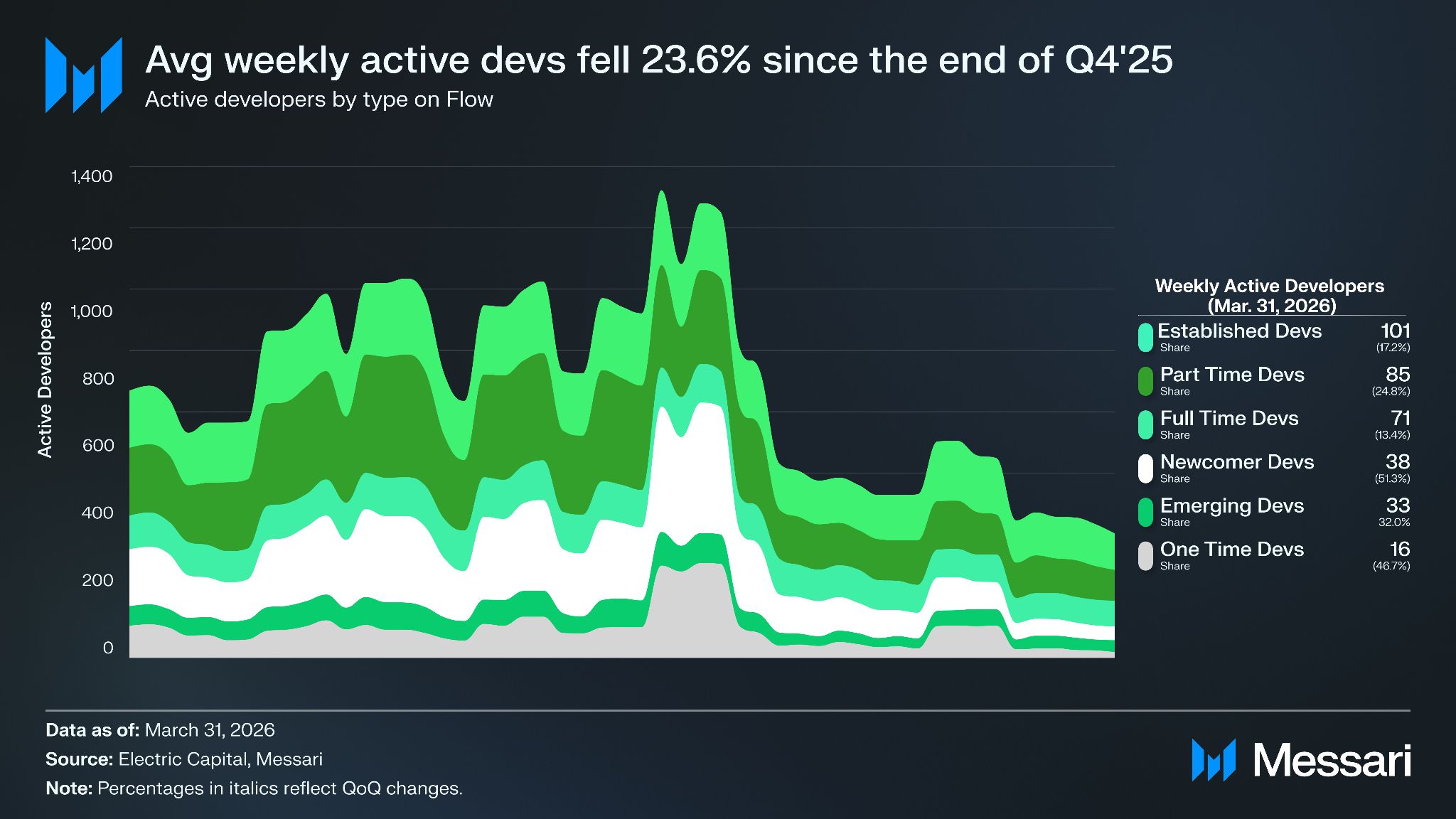
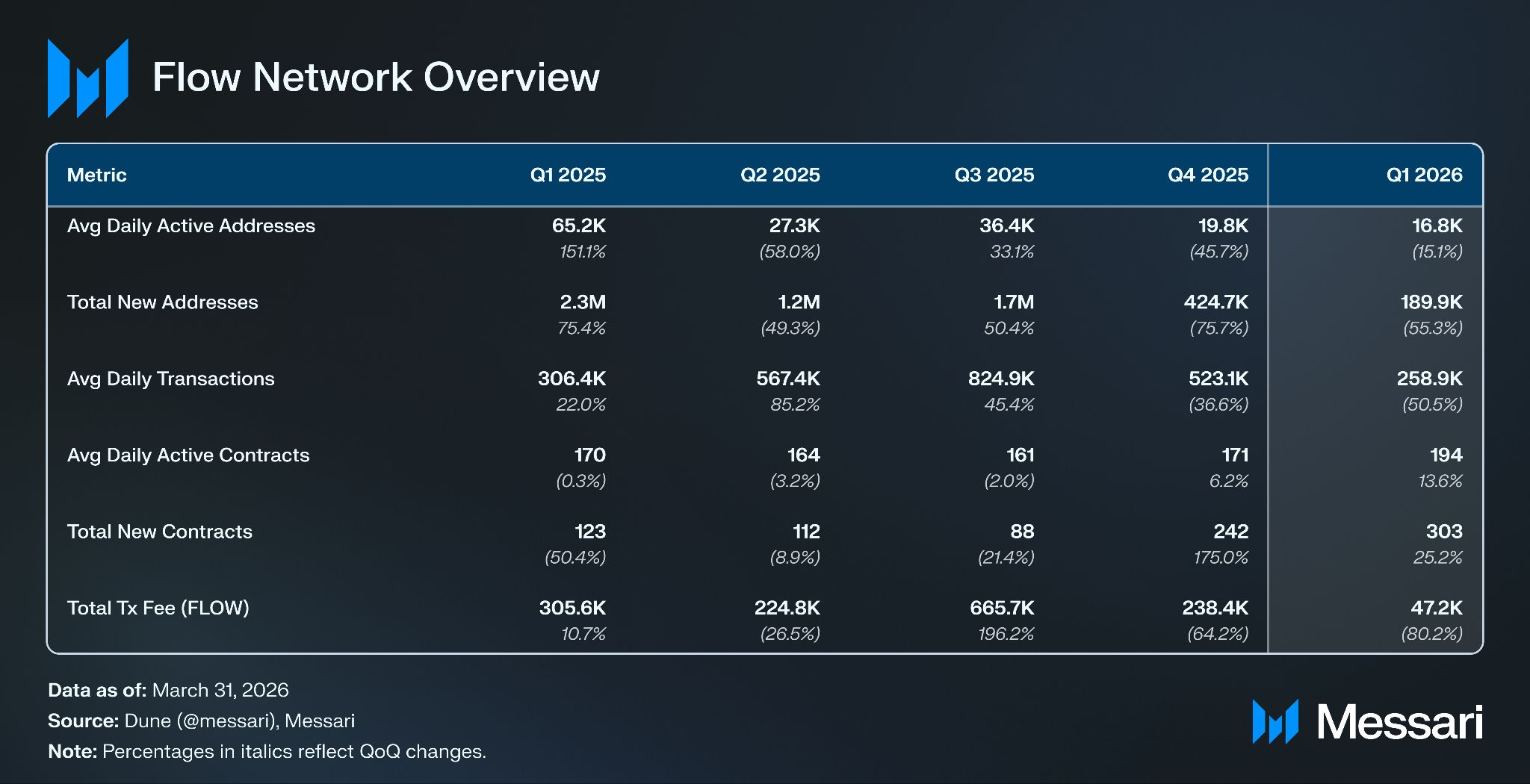
Developer and protocol-level activity held up through the drawdown. New contract deployments rose 25.2% QoQ to 303, full-time developer count held flat at 71, Flow recorded the highest winning-submission count at the Q1 PL Genesis hackathon, and the mainnet HCU delivered an approximately 20% improvement in execution throughput.
On Flow, developers use “Cadence,” a novel resource-oriented programming language designed for smart contracts. It enforces ownership and type safety at the language level, helping prevent common vulnerabilities in contract logic. In September 2024, Flow introduced the Crescendo upgrade, launching EVM equivalence on Flow via Flow EVM, and bringing Cadence to maturity with the Cadence 1.0 release. Now, developers can use Solidity to build on Flow EVM with block times of 800 milliseconds. Furthermore, developers can tap into existing tools and liquidity across the EVM, while users experience sub-cent transaction fees.
Flow’s most recent development occurred in October 2025 when the Forte upgrade was activated on mainnet. This upgrade introduced Actions, enabling onchain automation without requiring extensive custom code. Actions are composable operations, such as swaps and loans, that can be combined into multi-step workflows. By eliminating the need for offchain infrastructure and relayers, Forte strengthens developer composability and positions Flow for AI-driven applications.
Flow has played a significant role in onboarding consumers into crypto by pioneering the ERC-721 (non-fungible) token standard via CryptoKitties in 2017 and putting NFT collectibles into the mainstream via NBA Top Shot in 2021. In 2023, Disney and Dapper Labs launched Disney Pinnacle on Flow, a digital pin marketplace featuring Disney, Pixar, and Star Wars IP, furthering Flow’s consumer reach. Today, Flow is expanding its foundation in consumer applications into programmable consumer finance, building on years of experience operating products with millions of users and real transaction volume. Flow's community validator set includes institutional node operators such as Coinbase, Deutsche Telekom, Samsung, and Ubisoft. For a full primer on Flow, refer to our Initiation of Coverage.
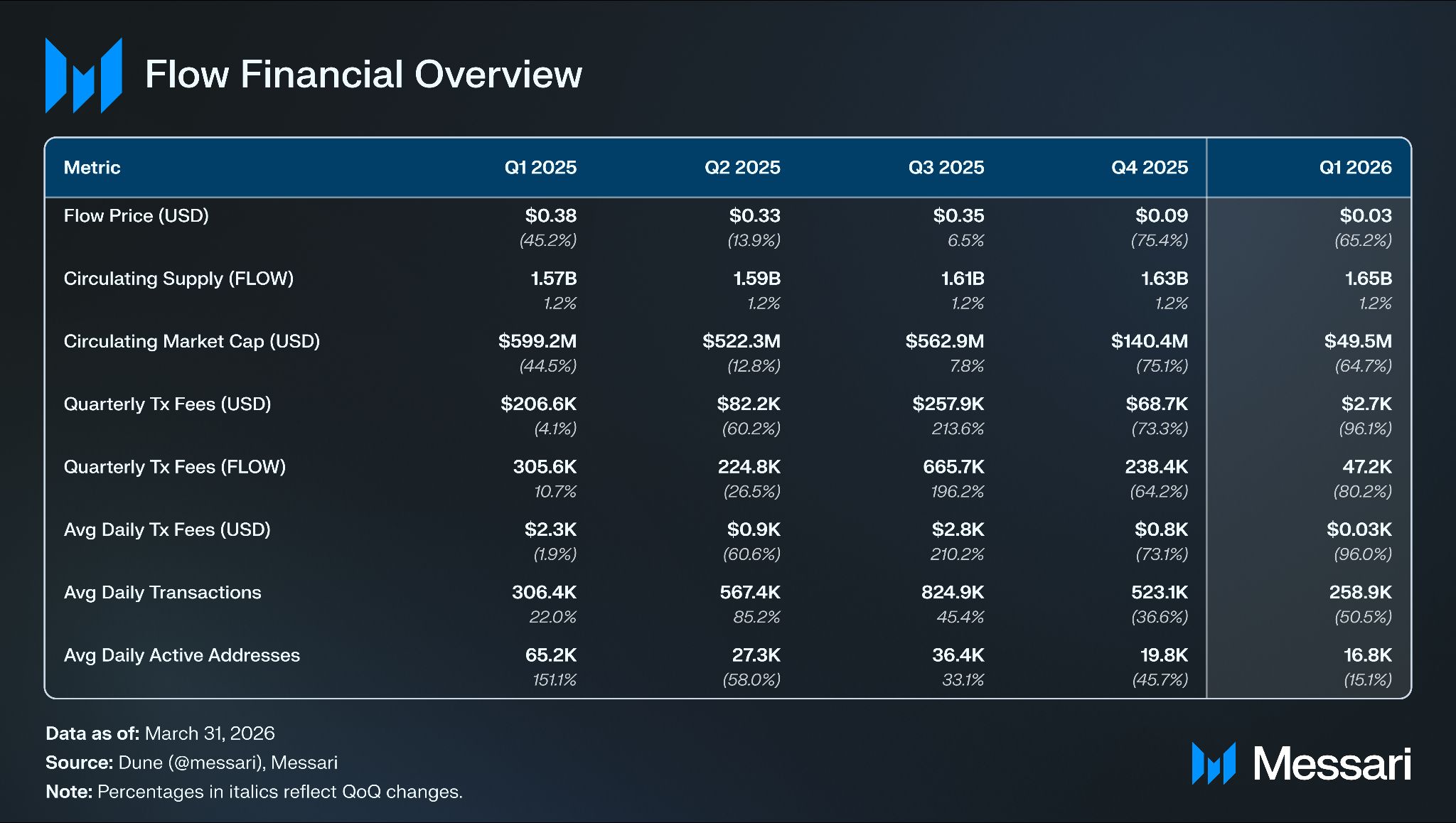
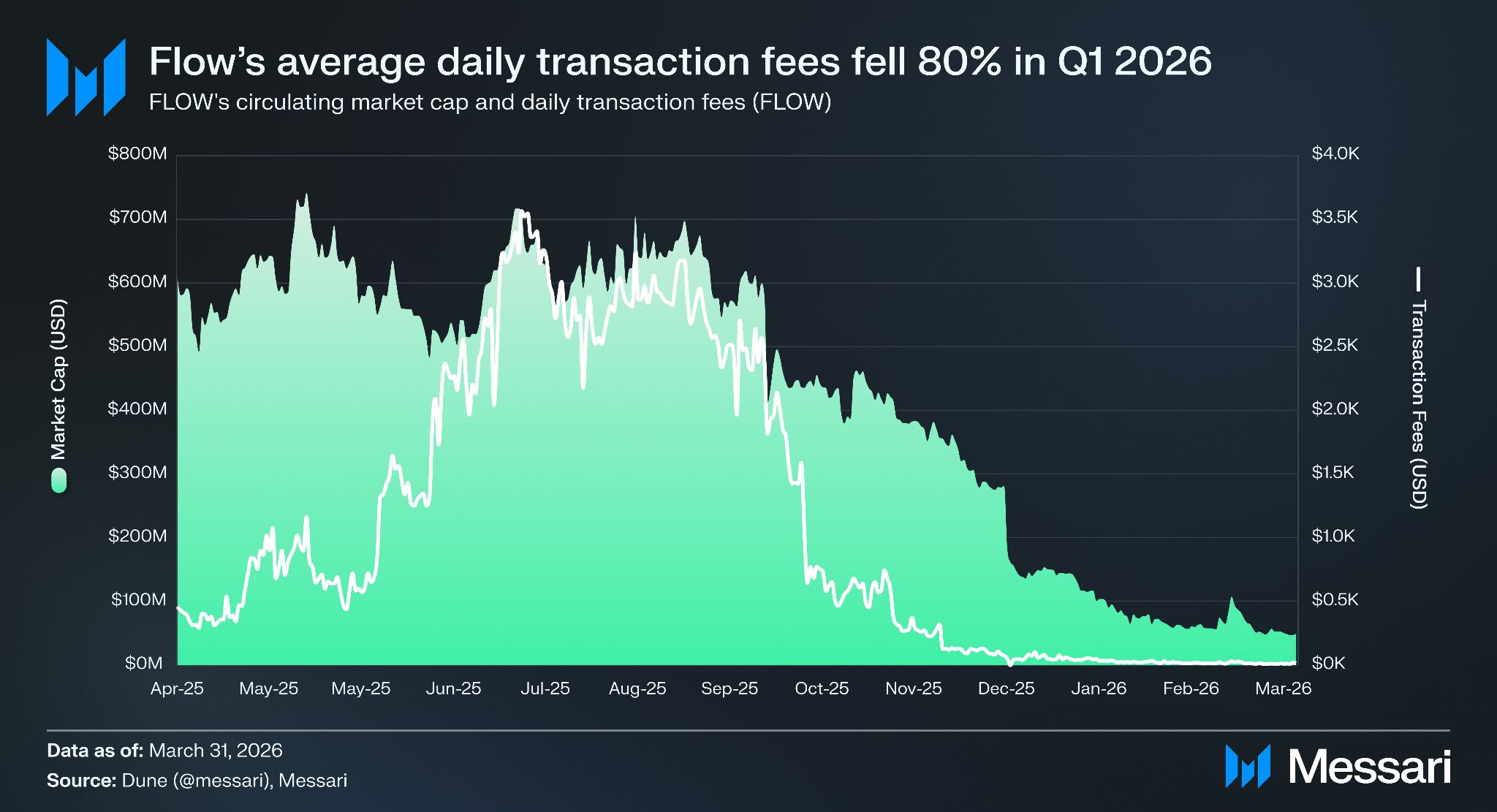
FLOW is the native token of Flow that is used (i) as the primary medium of exchange on Flow and (ii) for staking to facilitate various staking-related functions. In Q1 2026, FLOW’s price fell 65.2% QoQ to $0.03 across two distinct events. The first was a selloff in early January 2026 driven by the December 2025 attacker liquidating recovered FLOW into onchain liquidity pools, with subsequent recovery suppressed by the network halt and the freezing of bridges and exchange deposits. Following Binance's restoration of services on March 6, 2026, FLOW rallied approximately 94% over the following week, suggesting price action could improve heading into Q2. The second leg followed as a result of the delisting of FLOW from Upbit, Bithumb, and Coinone on March 16, 2026, which triggered a 55.2% drop in the days that followed. Korbit, the fourth DAXA member, declined to delist, and every major non-Korean exchange independently reviewed and maintained services through the quarter. Korean exchange flow accounted for the majority of the QoQ decline.
The decline caused the circulating market cap to fall 64.7% to $49.5 million, while circulating supply rose 1.2% to 1.65 billion FLOW in line with the protocol’s weekly inflation schedule. FLOW's circulating market cap ranking fell from 116th to 178th.
FLOW is used to settle network transaction fees on Flow. The total transaction fee for any transaction on Flow comprises a variable “execution fee” plus a fixed “inclusion fee,” which is then multiplied by a “surge factor”. Total quarterly fees in USD terms dropped 96.1% QoQ to $2,690, an 80.2% decline in FLOW terms equating to 47,250 FLOW, as both transaction volume and FLOW’s price declined sharply.
FLOW’s initial token supply was 1.25 billion upon Flow’s “Mainnet V1” launch in October 2020. However, the total token supply increases once per epoch (approximately once a week) due to staking rewards distributed to Flow’s validator nodes and delegators. Inflation over an annual period equals 5% of FLOW’s total token supply.
As explained in our Initiation of Coverage, combined weekly staking rewards comprise all network transaction fees, with any remaining amount being minted as inflationary staking rewards.
Stakers, including validator nodes that have self-staked, receive 92% of weekly staking rewards proportional to their stake.
Validator nodes also receive 8% of weekly staking rewards as commission.
As of March 31, 2026, FLOW’s weekly inflation equates to approximately 1.47 million FLOW per week.
Tokenomics
The Flow Foundation announced a set of supply management actions on February 23, 2026, alongside broader incident remediation efforts. The 50.3 million FLOW buyback and burn (~3% of total supply) was paired with a commitment to acquire at least 50 million additional FLOW from the open market over the coming months, alongside new market-making and liquidity-infrastructure partnerships. The Foundation framed open-market accumulation as a recurring operational program that will go beyond a one-time response to the incident.
Separately, a fee-mechanism update introduced in December 2025 is designed to render FLOW net-deflationary once the network sustains approximately 250 TPS. Q1'26 mainnet throughput remained below that threshold, and while concurrent execution pushed testnet throughput from approximately 15 TPS to 35 TPS during the quarter, mainnet activation and a materially higher utilization base would both be required to cross the deflationary line. Near-term supply discipline, therefore, rests on the executed buyback and the forward open-market commitment. The throughput-linked deflationary mechanism remains contingent on further demand growth.
Ecosystem Analysis
Consumer
Flow’s consumer identity remained anchored in sports, entertainment, and collectibles, with NBA Top Shot and NFL ALL DAY continuing as flagship consumer experiences. NBA Top Shot volume increased 12.2% QoQ to $7.0 million, with $3.13 million in March 2026, and pre-playoffs weekly active users (WAUs) rising to 25,440, suggesting an upward trajectory entering Q2’26. NFL All Day volume declined 19.3% QoQ to $2.6 million as the season wound down, while FanCraze contributed $3.4 million, and MFL held roughly flat. Secondary-market sales accelerated through the quarter, including a Series 1 LeBron James #1/59 at $19,500 on Flowty, a Steph Curry Moment at $17,250, a Luka Dončić at $7,777, and a Caleb Williams NFL Moment collection at $15,000.
Disney Pinnacle's March 2026 MAUs rose to over 15,000, and the protocol's first-ever Legendary Edition drop sold out instantly on January 27, 2026, with a 1-of-1 Apex Donald Duck pin clearing $7,500 on the secondary market within hours. Outside Disney and sports, 24Karat reached 250,000 weekly users in Q1’26 following a VTuber-focused acquisition push, positioning it among the more active Asia-focused consumer apps on Flow.
Beyond these flagship apps, Ticketmaster has now minted and distributed over 100 million NFTs on Flow, onboarding more than 13 million fans, most of whom do not even know they are using a blockchain. At this scale, Flow’s consumer layer operates less like a typical blockchain and more like embedded infrastructure, a pattern that continued to deepen in Q1 2026 as new event drops maintained fan engagement.
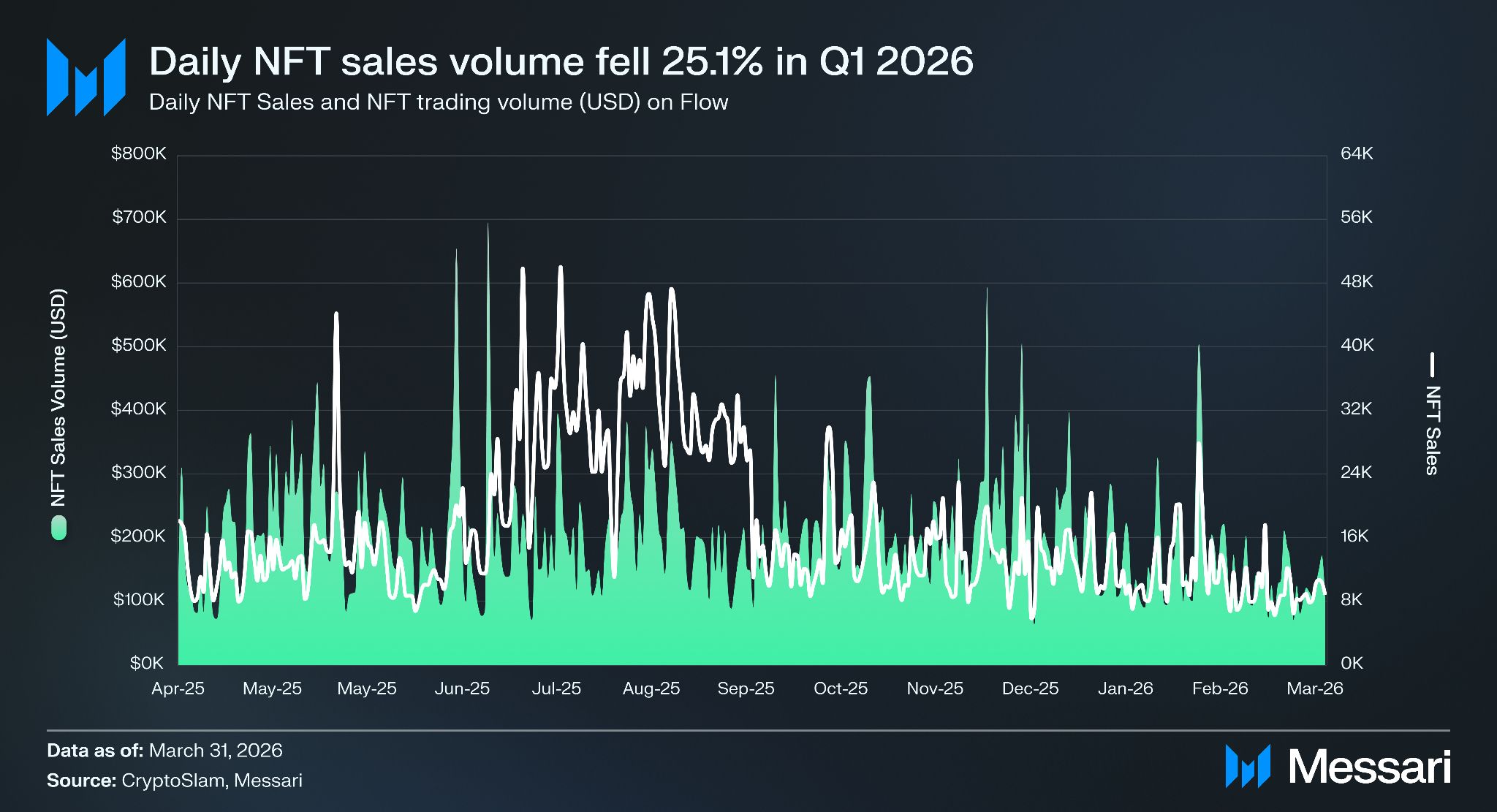
The NFT ecosystem on Flow remained the most active sector on the network in Q1 2026, though activity still declined from Q4’25. Average daily NFT sales declined 17.0% QoQ to 11,394, while average daily NFT sales volume in USD fell 25.7% QoQ to $169,030. As the token's value declined 65.2%, the same USD-denominated transactions translated into substantially higher FLOW volumes.
DeFi
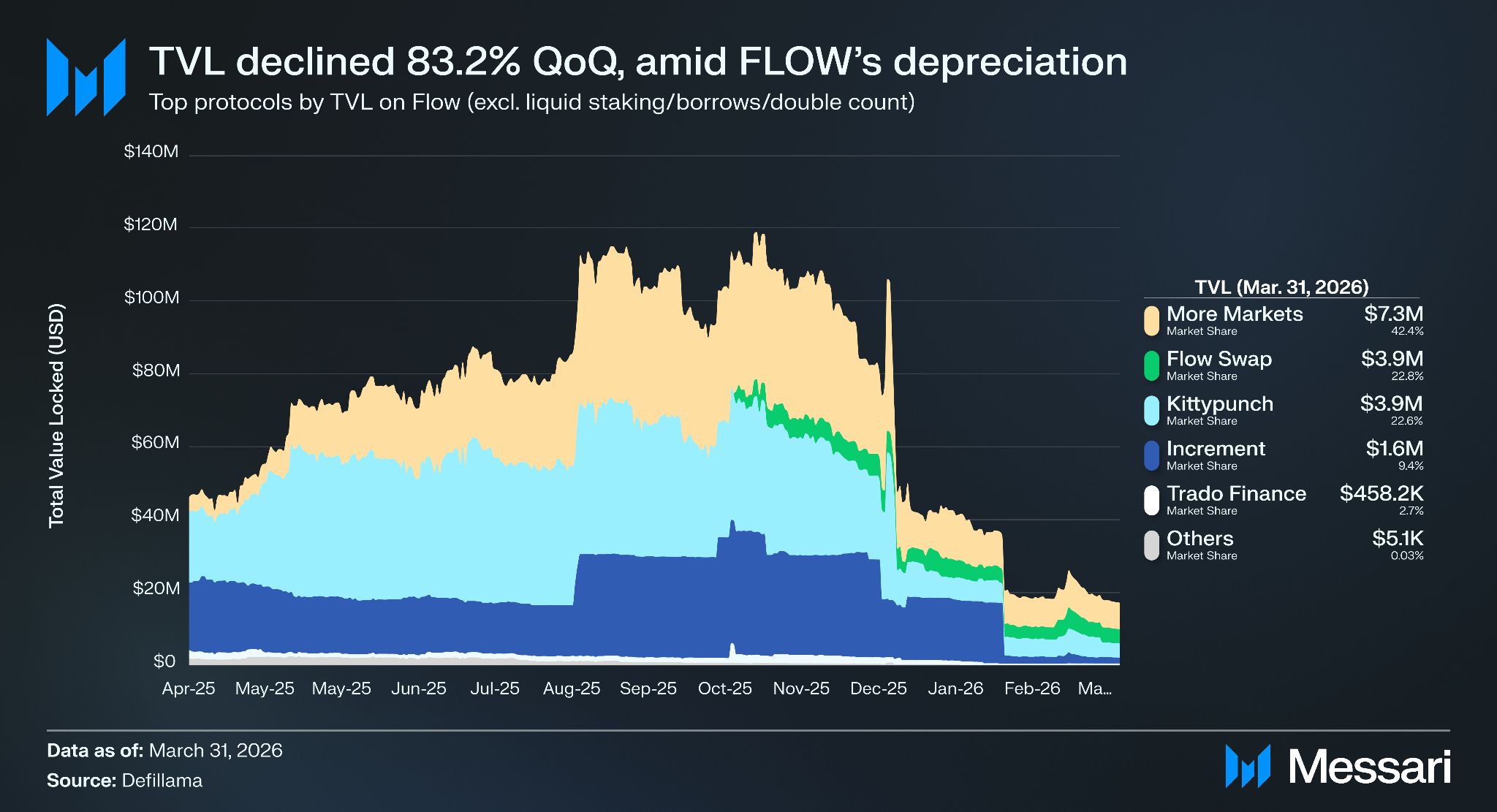
Flow’s DeFi TVL declined 83.2% QoQ to $17.1 million, driven primarily by the 65.2% price drop in FLOW’s price, though the gap indicates capital outflows as well. More Markets held the top spot with $7.3 million in TVL, while FlowSwap’s TVL surged to second with $3.9 million. Protocols with the largest FLOW-denominated pools, particularly KittyPunch and Increment, had the steepest USD declines, while FlowSwap's relatively newer and smaller pool base proved more resilient in percentage terms.
MORE Markets: A borrowing and lending protocol on Flow EVM.
More Markets continued to hold the top spot as the largest DeFi destination on Flow. Its TVL fell from $41.5 million to $7.3 million, an 82.5% decline driven primarily by FLOW’s price depreciation. Its market share increased from 39.4% to 42.5%. Its growing market share suggests relative deposit stickiness compared to other protocols.
FlowSwap: A decentralized exchange on Flow EVM offering token swaps and liquidity pools.
FlowSwap finished Q1 with $3.9 million in TVL, a 33.8% decline from Q4'25. Despite the drop in absolute terms, its market share surged from 5.6% to 22.9%, jumping from fourth to second in the DeFi rankings. The relative outperformance suggests stronger capital retention, potentially driven by its DEX-focused utility and recent launch momentum.
KittyPunch: A full-suite DeFi protocol that launched on Flow EVM on Sept. 8, 2024. KittyPunch offers (i) a spot DEX (PunchSwap), (ii) a stableswap DEX (StableKitty), (iii) a spot DEX aggregator (AggroKitty), (iv) a token launchpad (Trenches), (v) an NFT marketplace (Hoard), (vi) a bridge powered by deBridge, and (vii) a volatility protocol (PunchVIX).
KittyPunch ended Q1 with $3.9 million in TVL, a 90.3% decline from the previous quarter. Its market share fell from 38.1% to 22.6% of the network’s total DeFi TVL, and was the steepest decline among Flow’s top DeFi protocols.
Despite the TVL contraction, KittyPunch shipped a unified DeFi app in Q1 2026 that consolidates spot trading (PunchSwap), stableswap routing (StableKitty), DEX aggregation (AggroKitty), and Amplifi-powered yield vaults under a single interface to reduce friction across the protocol's existing user base.
Increment Finance: Increment is a full-suite protocol allowing trading, lending/borrowing, liquid staking, farming, and a points program.
Increment closed Q1 with $1.6 million in TVL, an 89.7% decline from Q4’25. As a result, its market share fell from 14.8% to 9.4%.
The 89.7% decline in TVL continued a trend from Q4’25, likely reflecting the ongoing winding down of Increment’s in-app points program alongside the broader FLOW price collapse. Without meaningful incentive programs, Increment continued to lose capital.
Trado Finance: A spot and perpetual decentralized exchange (DEX) on Flow EVM.
Trado ended Q1 with $458,180 in TVL, a 69.7% decline from the previous quarter, while its share of Flow liquidity increased from 1.4% to 2.7%. Trado’s 69.7% TVL decline was moderate relative to peers, and its share of Flow liquidity nearly doubled from 1.4% to 2.7%, as larger protocols lost capital at a faster rate.
Liquid Staking & Stablecoins
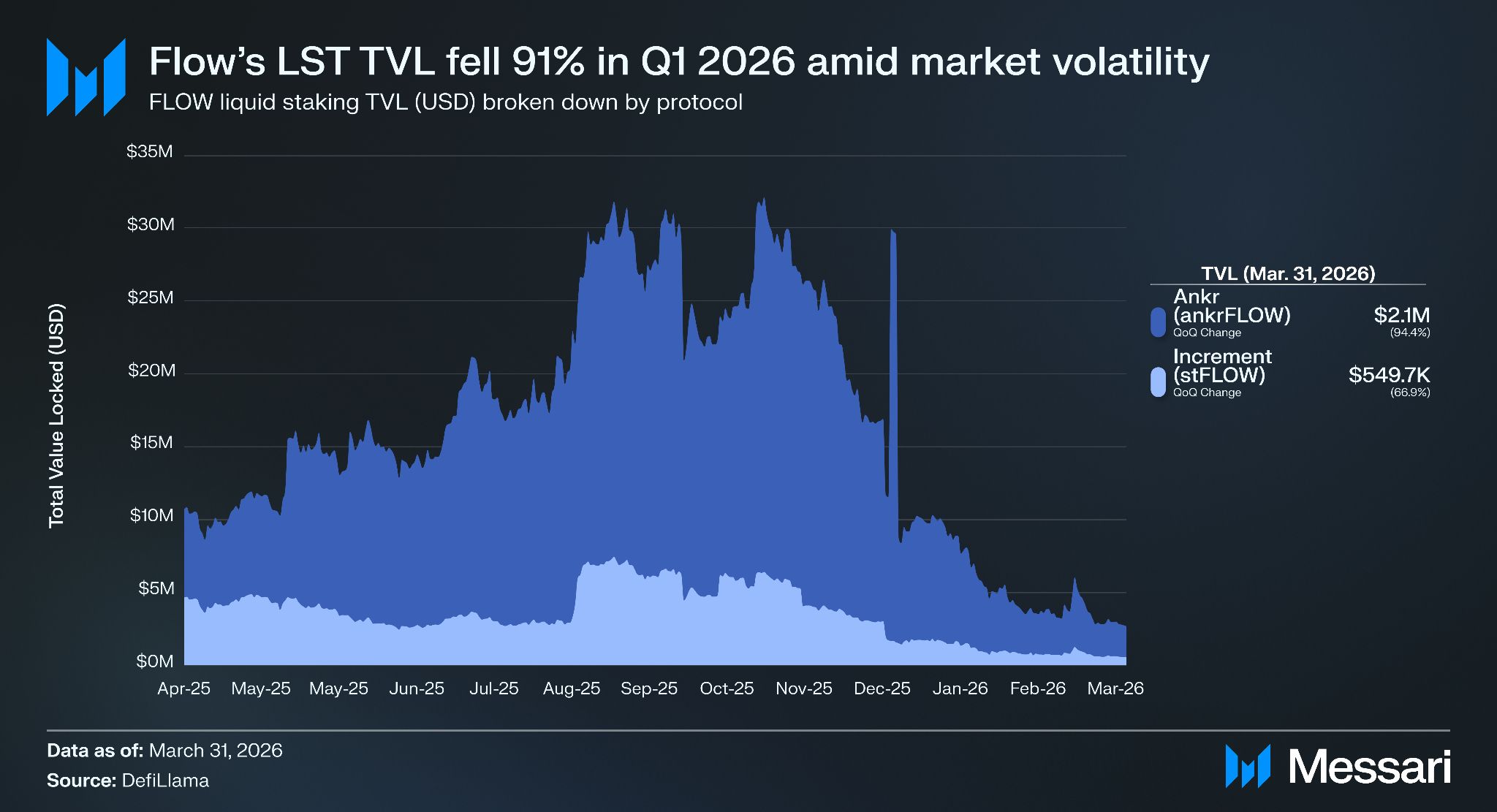
The TVL of liquid staking tokens (LSTs) on Flow declined sharply, falling 91.0% QoQ from $29.7 million to $2.7 million, largely reflecting the FLOW price decline. Ankr's ankrFLOW remained the dominant LST; however, its market share declined from 94.4% to 79.5%, as Increment’s stFLOW held a larger relative share of the smaller pool. The 91.0% decline in total LST TVL exceeded FLOW's 65.2% price decline and significant unstaking: ankrFLOW's FLOW-denominated balance fell from 326.3 million to 70.9 million FLOW over the quarter, with the bulk of outflows concentrated in the first two weeks of January 2026 following the December 2025 security incident. Increment's stFLOW balance, by contrast, held nearly flat at 18.3 million FLOW throughout the quarter.
The stablecoin landscape on Flow continued to evolve in Q1 2026. The integration of PayPal’s PYUSD remains one of Flow’s most significant enterprise partnerships, even as overall stablecoin supply contracted alongside declining DeFi activity.
The circulating supply of stablecoins on Flow declined 48.6% QoQ, from $25.2 million to $13.0 million. The decline was concentrated in January 2026, when both PYUSD and USDC experienced sharp outflows following the December 2025 security incident. PYUSD dropped from $14.3 million to $5.0 million by mid-January before partially recovering to $10.0 million by February 2026, where it stabilized for the remainder of the quarter. USDC fell from $10.9 million to $3.9 million over the same period and did not recover, ending Q1’26 at $3.1 million.
PYUSD's market share increased from 56.8% to 76.4%, with USDC contributing a larger percentage to the decline, falling 71.9% QoQ versus 30.8% for PYUSD. PYUSD's partial recovery in February 2026 accounts for the divergence.
Separately, MORE Markets and AlphaYields announced ayUSD vaults in March 2026, structured as AI-managed modular vault deployments. The product had not produced a meaningful TVL contribution by quarter-end but is an early indicator of agent-driven yield strategies entering Flow's lending stack.
Development, Growth, and Community
Builder Enablement
Developer enablement in Q1 2026 shifted toward security hardening following the December 2025 security incident. The Q1 Height-Coordinated Upgrades (HCUs) delivered Cadence v1.9.9 with runtime security patches addressing the type confusion vulnerability, alongside flow-go v0.46.1.
Hackathons
Average weekly active developer count fell 23.6% QoQ to 344, with the decline concentrated in part-time and newcomer contributors. Full-time developer count held flat at 71, indicating that the core builder base remained intact through the quarter despite the security incident, the price decline, and broader consolidation across crypto developer communities. The weekly active count also reflects normalization following Q4'25's hackathon-driven spike in contributors.
Flow ran the PL Genesis hackathon during Q1’26, a $150,000 prize pool event that drew 142 teams across consumer DeFi, AI agents, and onchain finance categories. Notably, Flow recorded the highest count of winning submissions among participating chains. The event followed a year in which Flow ranked as the most-built-on L1 at ETHGlobal for 12 consecutive months across 2025, and built on the Forte Hacks pipeline in Q4’25, which continued to graduate projects into production. Separately, GrantDAO selected and funded a cohort of consumer DeFi teams during the quarter. Combined post-hackathon activity likely contributed to the 25.2% increase in new contract deployments during Q1'26.
The Forte Hacks hackathon, launched alongside the October 2025 Forte upgrade with a $250,000 prize pool, was Flow's largest developer event since Crescendo. Several submissions continued in production after the event, with projects spanning consumer DeFi, AI agents, and onchain gaming. The post-hackathon pipeline likely contributed to the 25.2% increase in new contract deployments during Q1’26.
Network Analysis
Flow surpassed 40 million unique accounts and approached 950 million cumulative transactions during Q1'26, reflecting the network's accumulated consumer footprint across NBA Top Shot, NFL All Day, Disney Pinnacle, Ticketmaster, and other Dapper-led applications. The network is on track to cross 1 billion lifetime transactions in Q2'26, a threshold reached by only a small set of L1s to date.
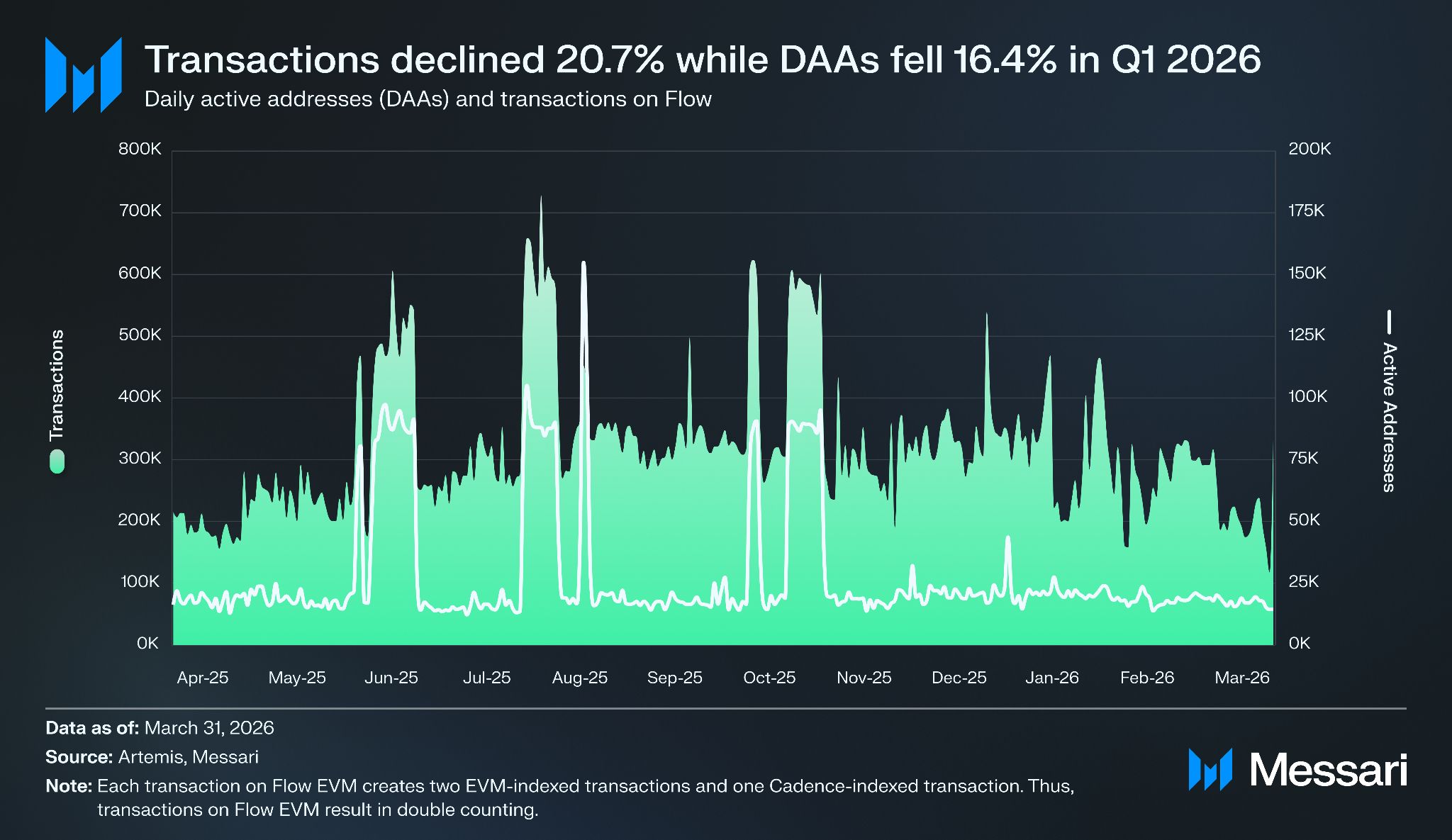
Average daily transactions decreased 50.5% QoQ to 258,850, while average daily active addresses (DAAs) decreased 15.1% to 16,780. The txs/DAAs ratio fell from 26.5 to 15.4, reversing the increase seen in Q4’25 when Forte's scheduled transactions and agent-driven workflows increased per-user throughput.
In Q1 2026, total new contract deployments increased 25.2% QoQ from 242 to 303, and average daily active contracts rose 13.6% from 170.8 to 194.1. Total new EVM accounts, however, fell 93.9% QoQ from 50,080 to 3,070. The divergence between declining user activity and rising contract deployments indicates that builders continued shipping through the downturn, likely driven by the Forte Hacks pipeline and ongoing migrations to Cadence 1.0.
Protocol Upgrades
Security Incident Remediation
The Flow Foundation completed its multi-phase remediation of the December 2025 security incident over the course of Q1 2026. Validators and network operators coordinated a network halt approximately six hours after detection, freezing 87.96 billion counterfeit FLOW (over 99.9% of the counterfeit balance) prior to broader market distribution. Realized attacker proceeds totaled $3.9 million, and no existing user balances were accessed during the incident:
January 6, 2026: 484.4 million counterfeit FLOW tokens returned by centralized exchanges were destroyed onchain.
January 30, 2026: The remaining 87.4 billion counterfeit tokens were permanently destroyed by the Community Governance Council, completing the technical remediation. Coinbase, Kraken, and Gate.io restored full FLOW services the same day.
February 12, 2026: HTX confirmed all user FLOW assets remained intact and restored full trading, deposits, and withdrawals.
February 23, 2026: The Foundation executed a separate buyback and burn of 50.3 million FLOW, approximately 3% of total supply, to offset the ~50 million counterfeit tokens that had been mixed with valid tokens on decentralized exchanges. The Foundation is also committed to acquiring an additional 50 million FLOW from the open market over the coming months.
March 6, 2026: Binance removed its monitoring tag and restored full FLOW services, completing the global exchange resolution. OKX and Bybit also restored services during the quarter.
Despite the remediation being completed, Upbit, Bithumb, and Coinoneannounced a March 16, 2026, deadline to delist FLOW, citing unresolved concerns related to the security incident. The Flow Foundation filed an emergency injunction with the Seoul Central District Court on March 9, 2026, to block the delistings, but the court dismissed the request on March 13. All three exchanges enforced the delisting on March 16, and FLOW's price dropped approximately 50% on the day. Separately, Korbit lifted its trading caution on February 27, 2026, and continues to support FLOW without restriction. Every major global exchange outside Korea, including Coinbase, Kraken, OKX, Binance, and Bybit, independently reviewed and maintained full FLOW trading services throughout the quarter.
AI Agents & Micropayments
On March 20, 2026, x402, an HTTP-native micropayment protocol that lets agents pay for APIs and services using HTTP 402 response headers, went live on Flow EVM. The x402ExactPermit2Proxy contract was deployed alongside a self-hosted facilitator and seven example apps in the project repo. ERC-8004 was also deployed on Flow EVM in the same period. Combined with Forte's scheduled transactions and persistent state, these primitives expand Flow's surface for agent-driven workloads.
Height-Coordinated Upgrades
Flow executed multiple height-coordinated upgrades (HCUs) during Q1 2026, including four in the first week of January as the team stabilized the network following the December security incident. HCUs allow the protocol to deploy breaking changes at a predetermined block height without requiring a full network spork, enabling zero-downtime upgrades. Q1 HCUs delivered Cadence v1.10.2 with runtime security patches addressing the type confusion vulnerability, alongside flow-go v8.0. The January 29, 2026, mainnet HCU also delivered an approximately 20% execution-throughput improvement via Cadence and EVM/Cadence runtime-init optimizations, despite the addition of new defensive checks. Concurrent execution landed on testnet during the quarter, with EN3 pushing throughput from approximately 15 TPS to 35 TPS under load.
FCM, Peak.Money, and Enshrined Protocol Progress
Flow Credit Market (FCM), the flagship enshrined lending protocol announced in December 2025, advanced toward production in Q1 2026. FCM replaces traditional liquidation mechanics with Active Rebalancing, which leverages Flow's native scheduled transactions to micro-adjust positions every 60 seconds without external bots or keepers. Peak.Money, the consumer-facing savings app built on top of FCM, opened its waitlist during Q1’26, advertising up to 10% APY on USD deposits and up to 25% on crypto deposits.
Closing Summary
Q1 2026 was defined by Flow's response to the December 2025 security incident and the Korean exchange delistings that followed. The Foundation destroyed all 87.96 billion counterfeit tokens by January 30 and executed a 50.3 million FLOW buyback and burn to offset tokens that had entered DEX liquidity. By March, every major non-Korean exchange had independently reviewed and restored full services, and Binance removed its post-incident monitoring tag late in the quarter. The Upbit, Bithumb, and Coinone delistings on March 16 drove the quarter's most severe single move (FLOW down 55.2% in the days following), although Korbit declined to delist and continued FLOW trading without restriction. Across the full quarter, FLOW fell 65.2%, DeFi TVL fell 83.2% to $17.1 million, and ankrFLOW balances dropped from 326.3 million to 70.9 million FLOW, with the bulk of unstaking concentrated in the first two weeks of January. In context, Flow's December 2025 incident produced a materially better outcome than the major web3 security events of recent years. The $3.9 million in realized attacker proceeds is two to three orders of magnitude below comparable incidents. Flow achieved containment without a rollback, supplemented by a 50.3 million FLOW buyback and burn and an open-market commitment to acquire an additional 50 million FLOW. The combination of zero direct user-fund loss, a coordinated halt within hours, and a structurally tightened supply suggests Flow exits Q1 with the operational integrity to compound on Q2 catalysts rather than carrying residual incident risk forward.
Despite the financial drawdown, ecosystem activity held up through the back half of the quarter. NBA Top Shot volume grew 12.2% QoQ and exited March on its strongest WAU print in over a year. Disney Pinnacle ran its first Legendary Edition drop, 24Karat reached 250,000 WAUs, and x402 launched on Flow EVM, extending Flow's surface for agent-driven payments. New contract deployments rose 25.2% QoQ, full-time developer count held flat at 71, and Flow recorded the highest winning-submission count at the PL Genesis hackathon, building on a year in which it led ETHGlobal for 12 consecutive months in 2025.
Flow's strategic shift from collectibles infrastructure to consumer DeFi held up on the consumer and builder side this quarter, but not on the financial side: TVL, stablecoin supply, and price all contracted materially, and Korean exchange access remains an open question heading into Q2. The near-term trajectory depends on whether Flow Credit Market and Peak Money convert the network's consumer reach into onchain financial primitives at scale, and whether Q1's ship-through translates into user-facing TVL and active address recovery in subsequent quarters.
This report was commissioned by the Flow Foundation. All content was produced independently by the author(s) and does not necessarily reflect the opinions of Messari, Inc. or the organization that requested the report. The commissioning organization may have input on the content of the report, but Messari maintains editorial control over the final report to retain data accuracy and objectivity. Author(s) may hold cryptocurrencies named in this report. This report is meant for informational purposes only. It is not meant to serve as investment advice. You should conduct your own research and consult an independent financial, tax, or legal advisor before making any investment decisions. Past performance of any asset is not indicative of future results. Please see our Terms of Service for more information.
No part of this report may be (a) copied, photocopied, duplicated in any form by any means or (b) redistributed without the prior written consent of Messari®.