The “Arbitrum Everywhere” framework redefines go-to-market optionality for builders. Arbitrum is positioned as a foundational infrastructure layer for Web3, empowering teams to create opinionated blockspace tailored to their product and demonstrating that infrastructure can adapt to innovation instead of constraining it.
Arbitrum’s app-to-chain model exemplifies builder freedom, enabling teams to launch on Arbitrum One to accelerate growth and iterate on product before migrating to a highly configurable and customizable Arbitrum Chain powered by the Arbitrum Nitro stack.
Institutional deployments from Robinhood, USD.AI, and Etherealvalidate the Arbitrum Everywhere framework by demonstrating Arbitrum’s ability to merge traditional financial products with enterprise-grade crypto infrastructure.
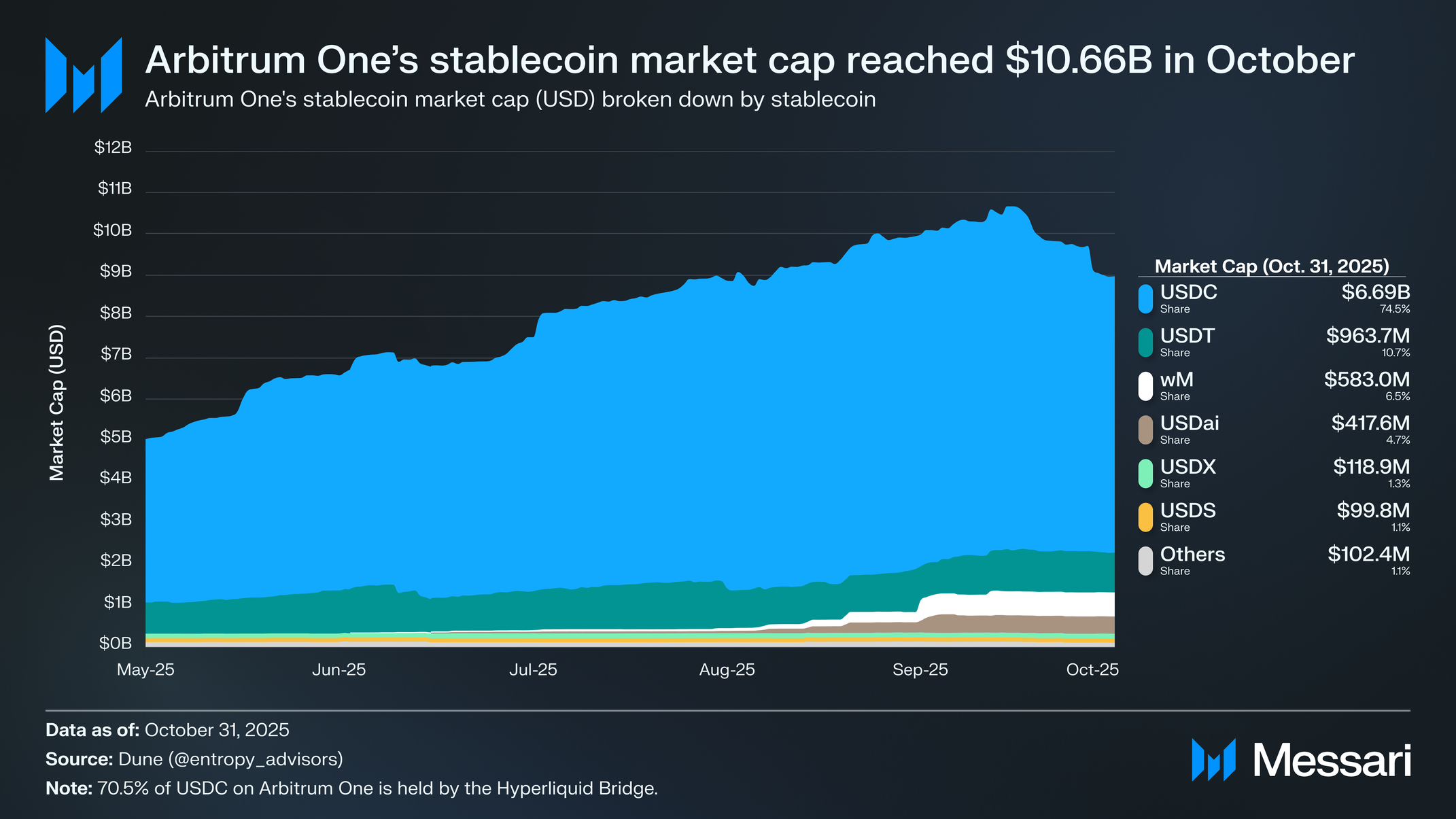
Arbitrum One’s DeFi leadership is evident through its $16.82 billion in TVS and $502.5 million in Chain GDP. Incentive programs like DRIP are catalyzing growth, having pushed Arbitrum One’s stablecoin market cap to $8.97 billion, the most across all Layer-2s.
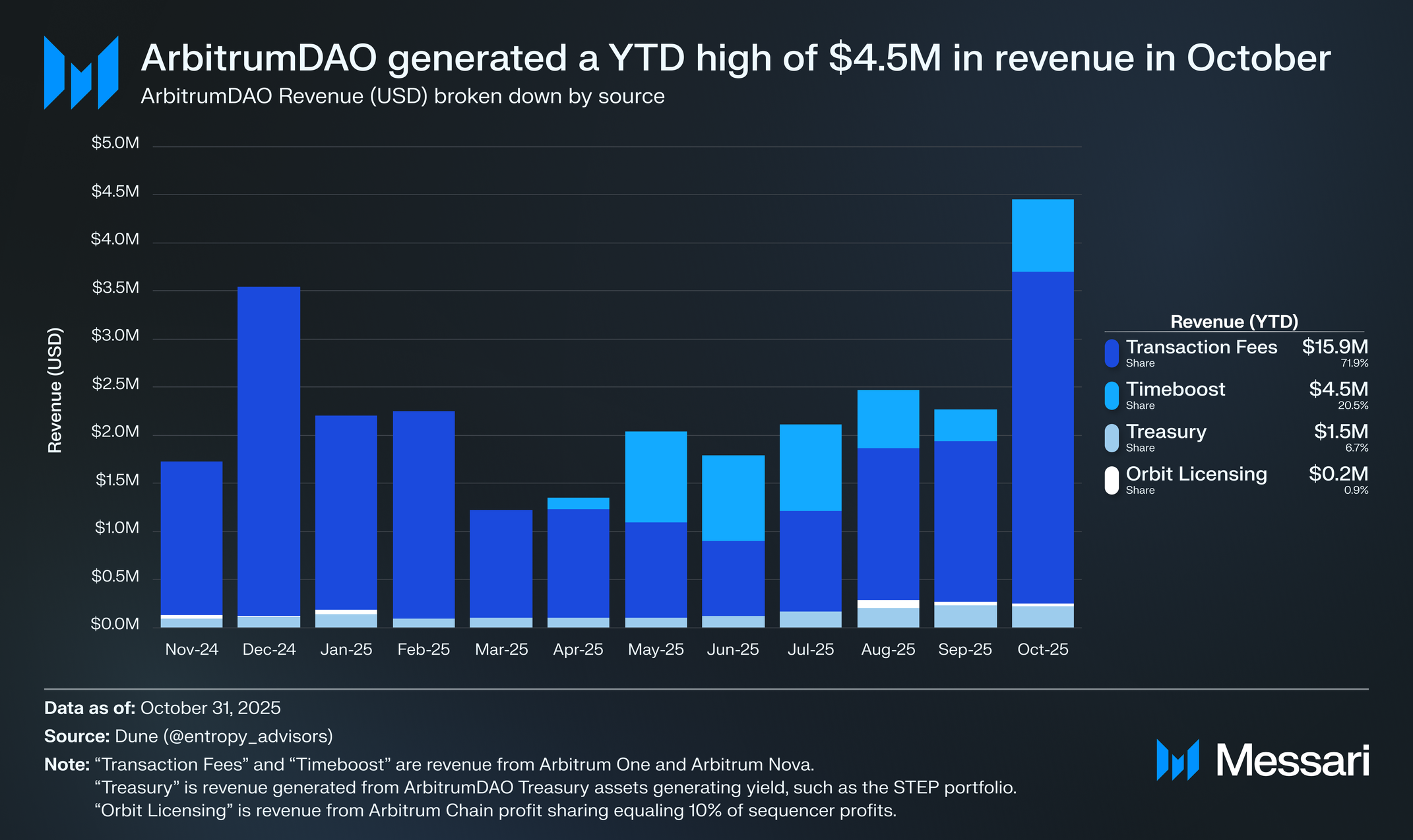
ArbitrumDAO is projected to generate $26.6 million in revenue in 2025, reinforcing the Digital Sovereign Nation model.This capital fuels Arbitrum’s economic engine, transforming protocol revenue into growth through ecosystem investment programs and economic zones of opportunity such as STEP and AGV.
Arbitrum Everywhere
Arbitrum's trajectory has shifted from scaling Ethereum with Layer-2 rollups (L2s) to creating infrastructure that adapts to builder requirements across diverse, enterprise-grade use cases. This evolution has taken shape in the "Arbitrum Everywhere" framework, a strategic approach redefining go-to-market optionality for builders, whereby infrastructure constraints become opinionated design choices rather than technical limitations.
The framework supports the full application lifecycle. Teams can begin by launching on a shared liquidity layer such as Arbitrum One, an L2 that has established itself as one of the most active, liquid, and high-performance blockchains. This allows builders to scale traction and iterate on their product while benefiting from support programs. As applications mature, builders can migrate operations to a configurable, customized Arbitrum Chain built with Arbitrum Nitro technology. Together, Arbitrum One and Arbitrum Orbit underpin Arbitrum Everywhere, positioning Arbitrum as a leading infrastructure layer for tomorrow’s apps.
Arbitrum Everywhere operates through four interconnected pillars that compound together to create ecosystem-wide advantages:
Builder Freedom: Arbitrum technology adapts to builders, enabling complete application lifecycle support without platform lock-in. Arbitrum Chains are configurable and customizable, expanding optionality for early-stage builders who are supported by various Arbitrum grant programs.
Enterprise Ready: Arbitrum’s infrastructure is validated by institutional-grade applications launching atop it. Enterprises like Robinhood can go-to-market today, merging traditional finance with novel onchain use cases, while maintaining flexibility to follow an app-to-chain model.
DeFi Unchained: Arbitrum’s economic activity provides for deep, composable liquidity and an active user base, while ArbitrumDAO investment programs like DRIP strengthen its DeFi leadership.
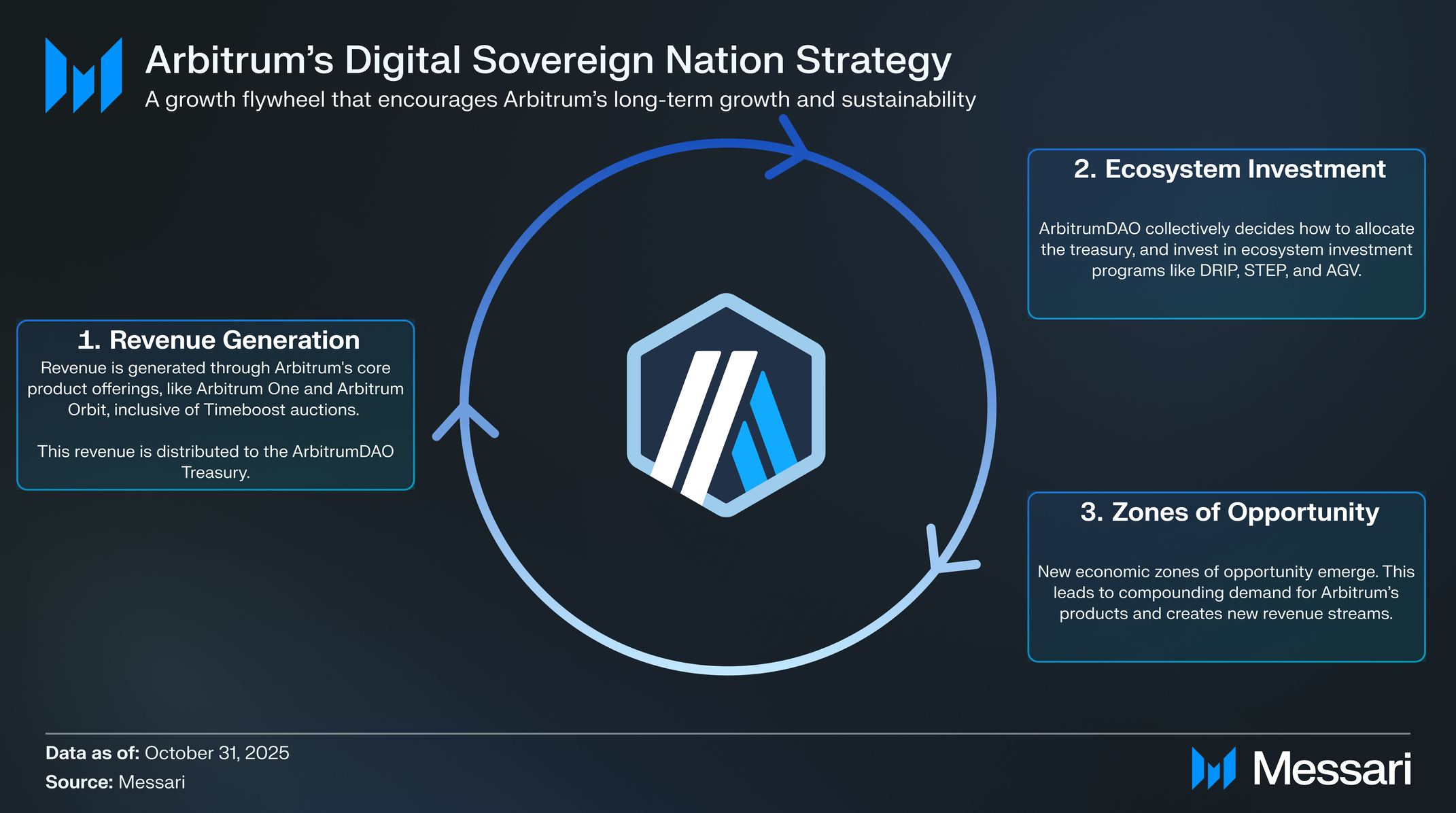
Digital Sovereign Nation: An economic engine steered by ArbitrumDAO drives value to stakeholders via a growth flywheel comprising revenue generation, ecosystem investment programs, and economic zones of opportunity.
The consequence of this framework is a path for builders to launch onchain applications while maintaining long-term flexibility. As Offchain Labs continues its research and development, diversifying what is offered by Arbitrum Nitro, builders have increasingly expressive tools at their disposal. At the same time, deployments from Robinhood, USD.AI, and Ethereal validate Arbitrum’s readiness to support enterprise-grade products, while incentive programs like DRIP catalyze economic activity across DeFi. These core pillars of the Arbitrum Everywhere framework feed into the self-reinforcing economic engine that is the Digital Sovereign Nation, all driven by ArbitrumDAO and ARB tokenholders. For more on Arbitrum’s Digital Sovereign Nation, refer to our report, Arbitrum's Economic Engine: Foundations of a Digital Sovereign Nation.
Builder Freedom
Start Anywhere, Scale Everywhere
Offchain Lab’s approach to developer infrastructure reflects a fundamental principle that technology should adapt to builders' needs rather than forcing them to adapt to technological constraints. Derived from this principle is the “Start Anywhere, Scale Everywhere” philosophy, whereby builders leveraging the Arbitrum Nitro technology framework can scale within the Arbitrum ecosystem regardless of where they launch.
Key to this philosophy is Arbitrum’s multi-product technology platform, which revolves around two distinct but interconnected products that serve different segments of the market:
Arbitrum One: The flagship L2 rollup whose success is demonstrated by a year-to-date Chain GDP (USD) of $502.5 million, $16.82 billion in TVS (USD), and a stablecoin supply (USD) of $8.97 billion.
Arbitrum Orbit: Arbitrum Nitro enables projects to deploy customized L2 or Layer-3 (L3) networks using the same underlying infrastructure that powers Arbitrum One.
“Start Anywhere, Scale Everywhere” examples include Blackbird, Unite, and Onyx launching L3s that settle to alternative networks like Base, while Robinhood launched tokenized securities on Arbitrum One with plans to migrate to its own L2 in the future. Arbitrum builders are spreading Arbitrum technology across the cryptosphere while maintaining the flexibility to make network-level product changes as their needs evolve.
Opinionated Blockspace
A key enabler of the Arbitrum Everywhere framework is the Arbitrum stack’s configurability and customizability, which allow for opinionated blockspace. Builders can make network-level adjustments that align with the needs of their protocols, thereby increasing the total addressable market that Arbitrum can serve. Customizations include alternative data availability (DA) layers like Celestia and EigenDA, while the main configurations include:
Layer-3s: Arbitrum Nitro provides the freedom for Arbitrum Chains to function as L3s that roll up to an L2 like Arbitrum One, rather than an L1 like Ethereum. An example is Flynet, an L3 settling to Base that minimizes transaction costs when paying for dining experiences through its app, Blackbird.
AnyTrust Protocol: Arbitrum’s alternative DA solution used by many Arbitrum Chains that optimizes performance by trusting offchain actions of a Data Availability Committee (DAC). An example is Xai, which utilizes AnyTrust to reduce transaction costs across its gaming ecosystem.
Stylus is an upgraded virtual machine that runs in parallel with the EVM, and is another core part of Arbitrum Nitro’s flexibility. Stylus enables developers to utilize non-EVM programming languages, such as Rust, C/C++, and TypeScript (via Wakeup Labs’ AssemblyScript SDK), to compile them to WebAssembly (WASM). These smart contracts maintain full interoperability with the EVM, and contracts written in different languages can interact with one another (e.g., a smart contract written in Solidity can call a smart contract written in Rust). Stylus dramatically expands Arbitrum’s potential developer pool due to its programming language diversity. Since launching in September 2024, several protocols that were previously building on non-EVM networks like Solana, such as Renegade Finance and Superposition, have pivoted to Arbitrum to leverage Stylus in their deployments.
Renegade Finance: An onchain dark pool offering spot token trading while maintaining privacy and eliminating maximal extractable value (MEV). Renegade leveraged Stylus to implement gas-efficient zero-knowledge (ZK) proof verification and reuse its Rust-based cryptographic code onchain, reducing costs and improving development efficiency.
Superposition: An L3 powered by Conduit that features Super Assets, an automated market maker (AMM) with gamified rewards, the 9lives prediction market, and plans to launch a central limit order book (CLOB) in the future. Superposition leveraged Stylus’s Rust SDK to build complex systems in Rust, leading to features like payment-for-order-flow (PFOF) and accelerated development on products like 9lives.
Fairblock: A confidential execution layer that enables privacy-preserving financial operations like encrypted stablecoin transfers and swaps, and a fixed-rate lending platform, Fairates. Fairblock leverages Stylus to run Rust-based cryptographic computations onchain while maintaining composability with Solidity-based smart contracts that are prevalent across Arbitrum’s DeFi ecosystem.
Aside from offering some of the highest levels of flexibility for builders, Arbitrum continually offers programs that support its ecosystem of builders, including several in 2025:
Arbitrum Open House: An ongoing initiative for onboarding new builders, featuring virtual workshops and online courses for learning, and regional buildathons with hands-on support that culminate in hacker houses.
Arbitrum Audit Subsidy Program: This ongoing program was approved to distribute 30 million ARB (0.3% of the total token supply) to subsidize protocol audits for approved ecosystem builders.
Alchemy-Arbitrum Ecosystem Grant Fund: A $10 million program that offers up to $500,000 worth of credits towards Alchemy’s rollup-as-a-service (RaaS) infrastructure for builders developing Arbitrum Chains. The program is still ongoing, with $1 million in credits remaining for applicants.
Trailblazer 2.0: An ongoing $1 million program focused on supporting applicants building agentic DeFi, such as DeFi agents, agent add-ons or plug-ins , open-source templates, and AI tooling. Grantees have included Allora, Eternal AI, NRN Agents, and ORA.
Arbifuel: An ongoing program spanning May 2025 to January 2026 that sponsors gas fees for early-stage builders to support faster development and reduce friction.
Additional support can come from the following Arbitrum-aligned entities:
Arbitrum Gaming Ventures (AGV): Supports builders within the gaming sector primarily through venture investments. AGV also offers grants and bounties:
Build Grants: 25 million ARB (0.25% of the total token supply) to “empower teams that are aiming to accelerate early stage development on Arbitrum, or to incentivize user onboarding.”
Infrastructure Bounties: 40 million ARB (0.40% of the total token supply) for “creating game-specific tech needed to make Arbitrum the best choice for game builders.”
Onchain Labs: An entity “aimed at accelerating innovative onchain experiences on Arbitrum.” The first publicly announced project incubated by Onchain Labs, Talos, was announced in July 2025.
App-to-Chain Model
The builder freedom offered by Arbitrum, both at the technical and support levels, enables the app-to-chain model. Robinhood is a prime example, having launched tokenized securities on Arbitrum One with plans to introduce its own chain in the future. This go-to-market strategy enables Robinhood to achieve an initial wave of adoption and iterate on its product, while simultaneously developing its own L2 in-house. Other examples include Azuki and Ape, which achieved success in the consumer sector before expanding their ambitions through Arbitrum Chains.
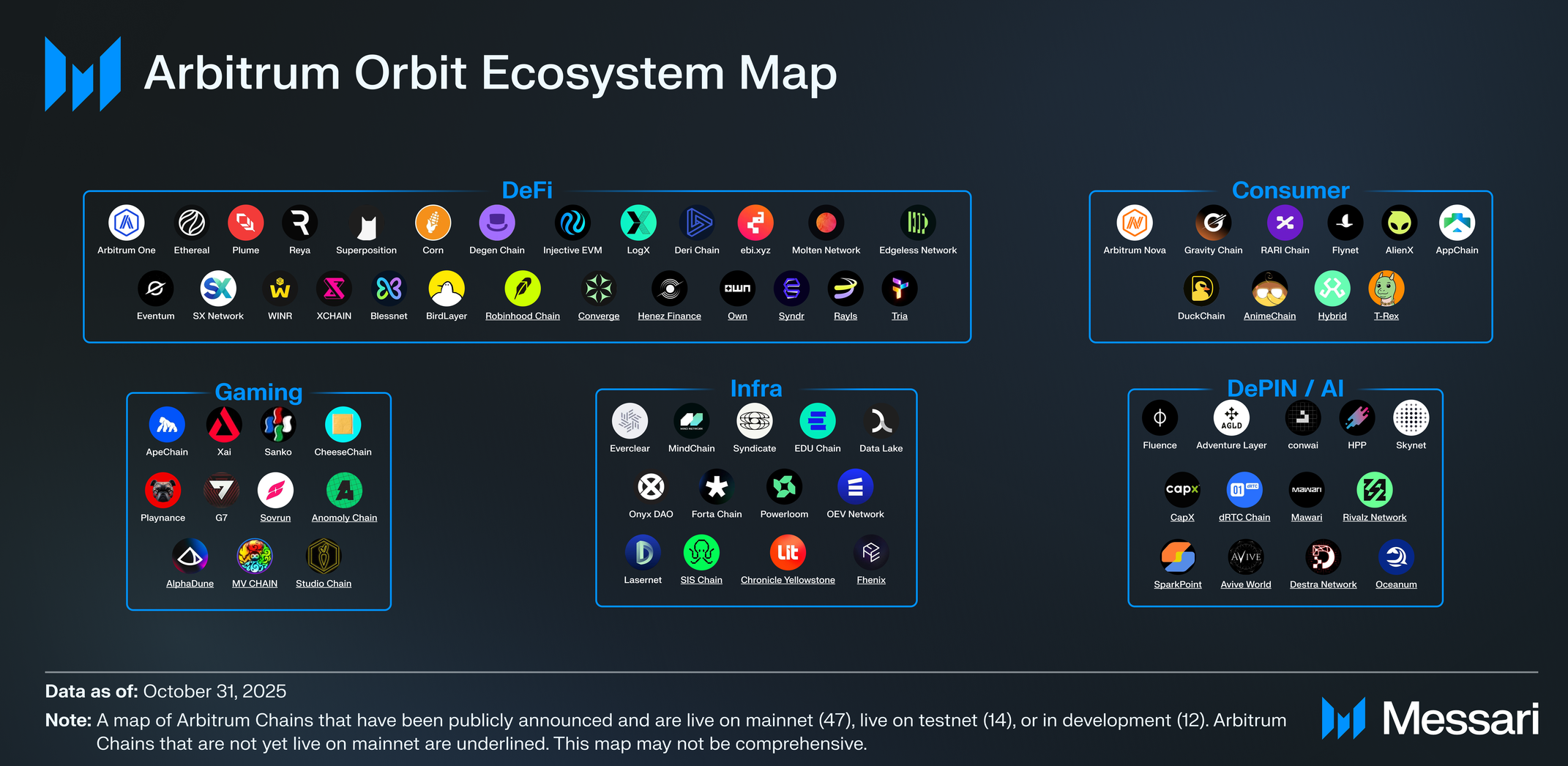
As of Oct. 31, 2025, the Arbitrum Orbit ecosystem comprises 47 publicly announced Arbitrum Chains live on mainnet, with an additional 14 in testnet and 12 in development that Messari can publicly verify. Cumulatively, Arbitrum Orbit has $16.63 billion in TVL, over 1.4 million weekly active addresses, 2.36 billion in all-time transactions, and captures 34% of all L2 transactions.
The app-to-chain model allows builders to go-to-market first on Arbitrum One to bootstrap a user base and iterate on their product while being supported by Arbitrum’s host of grant programs. This is done while maintaining the flexibility to migrate to a specialized Arbitrum Chain if the core team ever desires to do so. As a $120 billion company, Robinhood has the resources to develop its L2 in-house. However, builders who make this decision have the option to partner with Rollup-as-a-Service (RaaS) providers, such as Caldera, Gelato, Conduit, Alchemy, and AltLayer, to launch their rollups.
Enterprise Ready
The Arbitrum Everywhere framework is being validated by Arbitrum’s demonstrated ability to attract institutional participants building enterprise-grade products onchain. Several prominent examples across Arbitrum Orbit are highlighted below.
Robinhood
Robinhood drew significant attention on June 30, 2025, when it launched non-custodial, tokenized securities on Arbitrum One for its E.U. customers. This product envisions users being able to self-custody stocks while having the ability to productively use them across DeFi. This is emblematic of the shift seen in 2025, where traditional finance is merging with crypto infrastructure.
The initial launch on Arbitrum One was the first of three phases. On launch day, Robinhood supported 204 stocks for 24/5 trading, all of which had a corresponding token backed 1-to-1 with shares held on Robinhood. When a user buys or sells a share, the supply of the corresponding token is reflected by the number of tokens minted or burned.
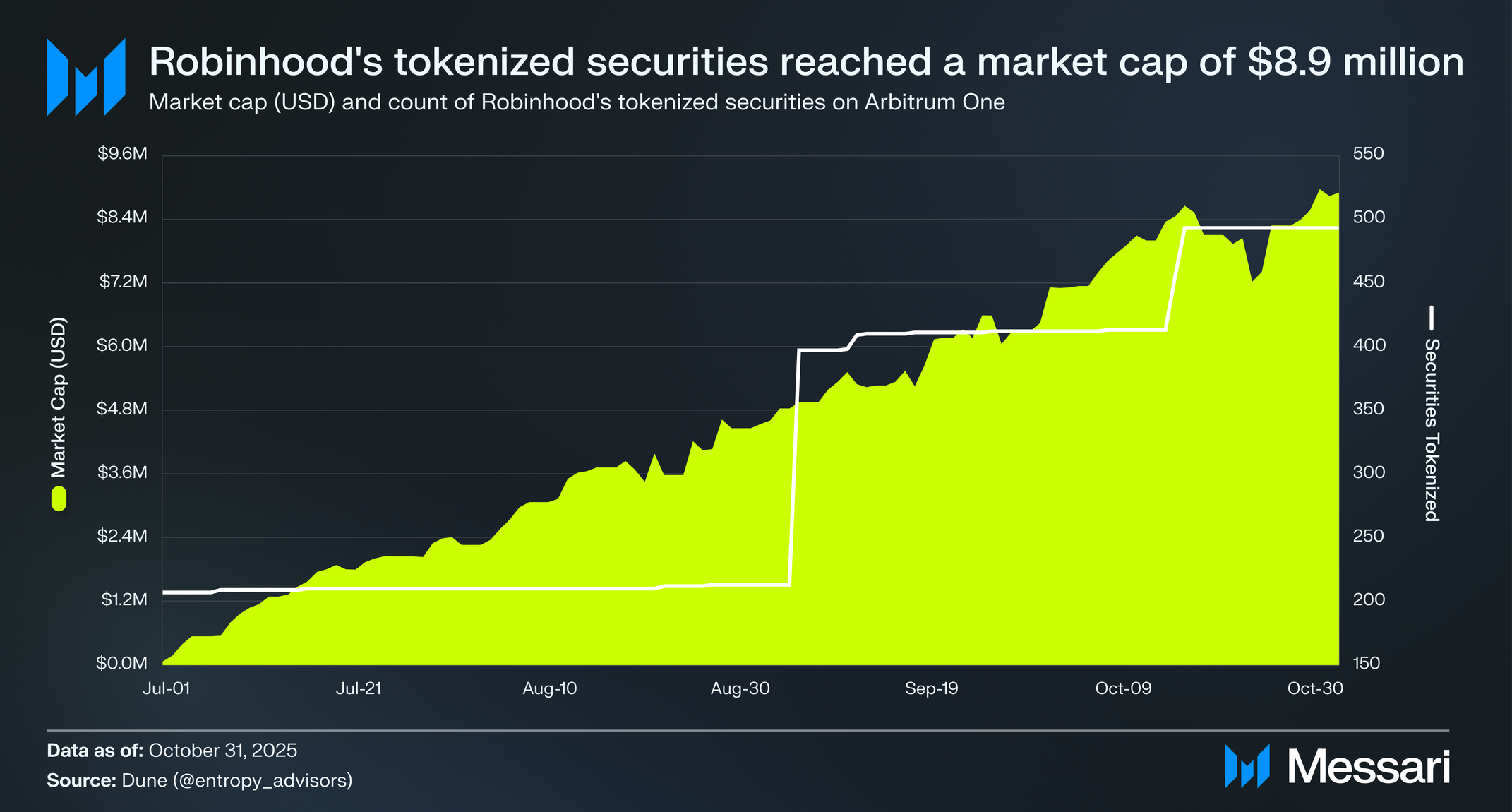
In the first four months since Robinhood’s launch, 491 securities have been tokenized onchain on Arbitrum One with a cumulative mint and burn volume (USD) of $38 million. The market cap (USD) of these tokens has reached $8.9 million, with 71.2% being stocks, 22.5% being exchange-traded funds (ETFs), and the remaining 6.3% across commodities, crypto ETFs, exchange-traded notes (ETNs), and U.S. Treasuries. The leading tokenized securities by market cap are GOOGL, BMNR, VOO, and HOOD, which represent 24.6% of Robinhood’s total onchain market cap. Notably, this product could also allow for exposure to private companies like OpenAI and SpaceX, though these shares are not yet tradable and the corresponding tokens have been burned as Robinhood awaits further regulatory clarity.
In Phase 2, Robinhood plans to follow the app-to-chain model and launch its own Arbitrum Chain, settling on Ethereum. While protocol-level details have yet to be announced, Robinhood Chain will be a permissionless L2 that will enable Bitstamp, which was acquired by Robinhood, to facilitate trading of tokenized securities on weekends. In Phase 3, Robinhood will enable users to withdraw tokens to their own wallets and self-custody their assets. Assuming integrations across Arbitrum’s DeFi ecosystem, users will be able to productively use the tokens in ways that aren’t available offchain.
USD.AI
USD.AI is a synthetic dollar issued by M0 that is capitalizing on the growing demand for artificial intelligence infrastructure to create a yield-bearing token pegged to the U.S. Dollar. The protocol is positioned to generate yield from what is one of the most capital-intensive growth markets. With AI inference projected to account for the majority of compute demand by 2030, AI Neoclouds are well-positioned to excel, and USD.AI envisions democratizing this model. It has raised $17.4 million and secured a $500 million credit facility from QumulusAI to acquire tokenized graphics processing units (GPUs) that are then lent out to entities in need of compute.
The protocol operates under a two-token model. The first is USDai, which is backed by U.S. Treasuries and has grown to a supply of 580 million since launching in May 2025. Since its launch, the protocol has experienced several periods of capped deposit increases, all of which were filled within the same day, with the most recent increase occurring on October 8, 2025. USDai tokenholders can stake USDai for sUSDai, a yield-bearing representation of USDai that is backed by a mix of U.S. Treasuries and GPU loans tokenized via MetaStreet's Liquid Credit Tokens.
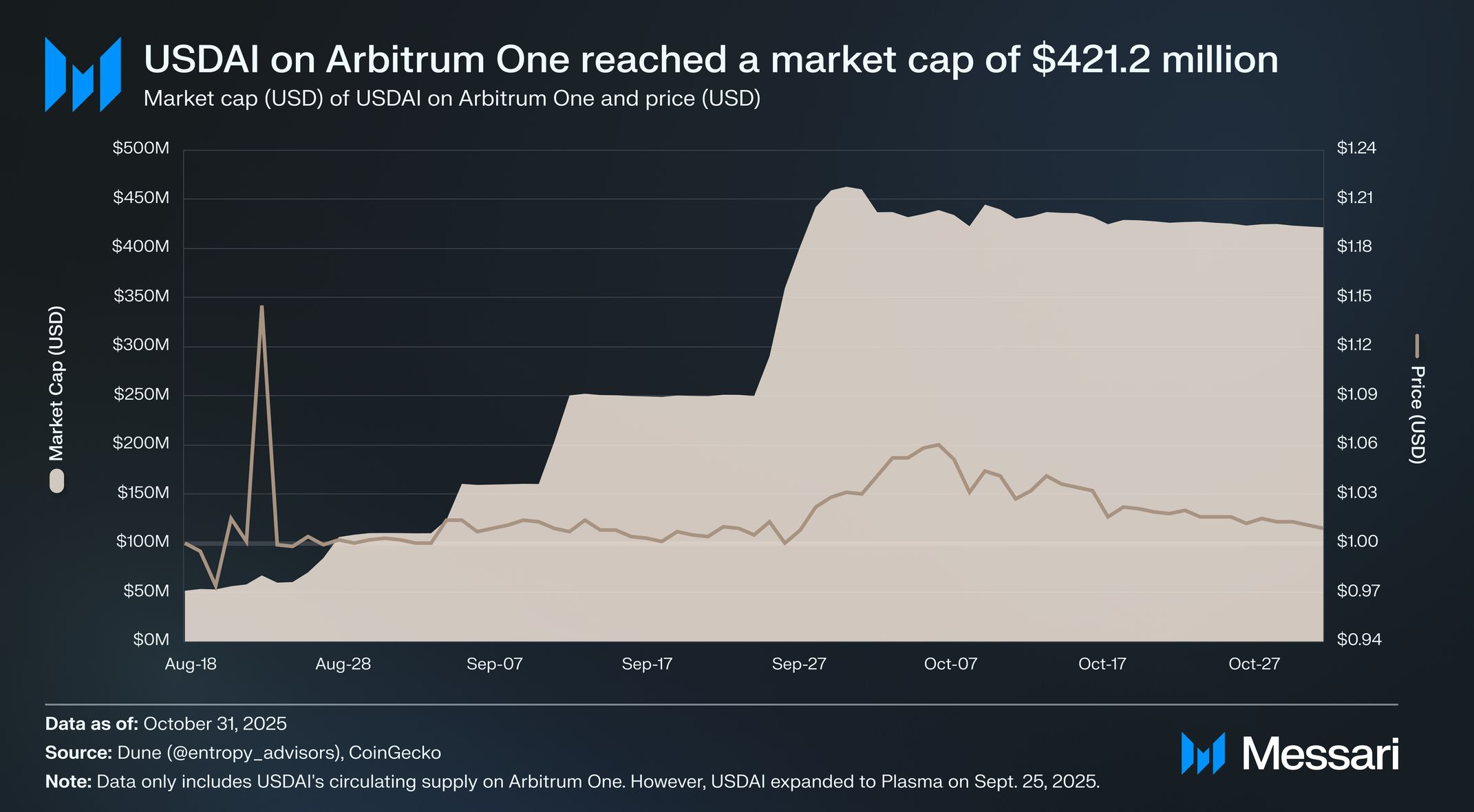
With 30.6% of USDai’s market cap (USD) of $581.8 million being staked, sUSDai is yielding 12.6% APY. As of Oct. 31, 2025, 99.9% of USDai’s collateral is still backed by U.S. Treasuries. Only 0.1% is in an active loan worth $614,000 for eight NVIDIA H200s under a three-year term yielding an APR of 15%. However, as the protocol scales, yield composition will continue to shift toward loan interest income, with $31.6 million in loans ranging from APYs 12.7% to 17% expected to close throughout November and December 2025.
USDai’s peg to the U.S. Dollar has deviated significantly compared to other synthetic dollars. However, the deviation has been to the upside, with USDai trading at $1.015 on Oct. 31, 2025, due to deposits being capped and demand for USDai exceeding the current maximum supply of 580 million. While demand has been driven by USD.AI’s Allo points program, it also reflects the intersection at which the protocol sits: stablecoins and AI. The success of Circle’s IPO and OpenAI's recent $500 billion valuation highlights that investors are interested in these sectors, and USD.AI offers exposure to both.
Ethereal
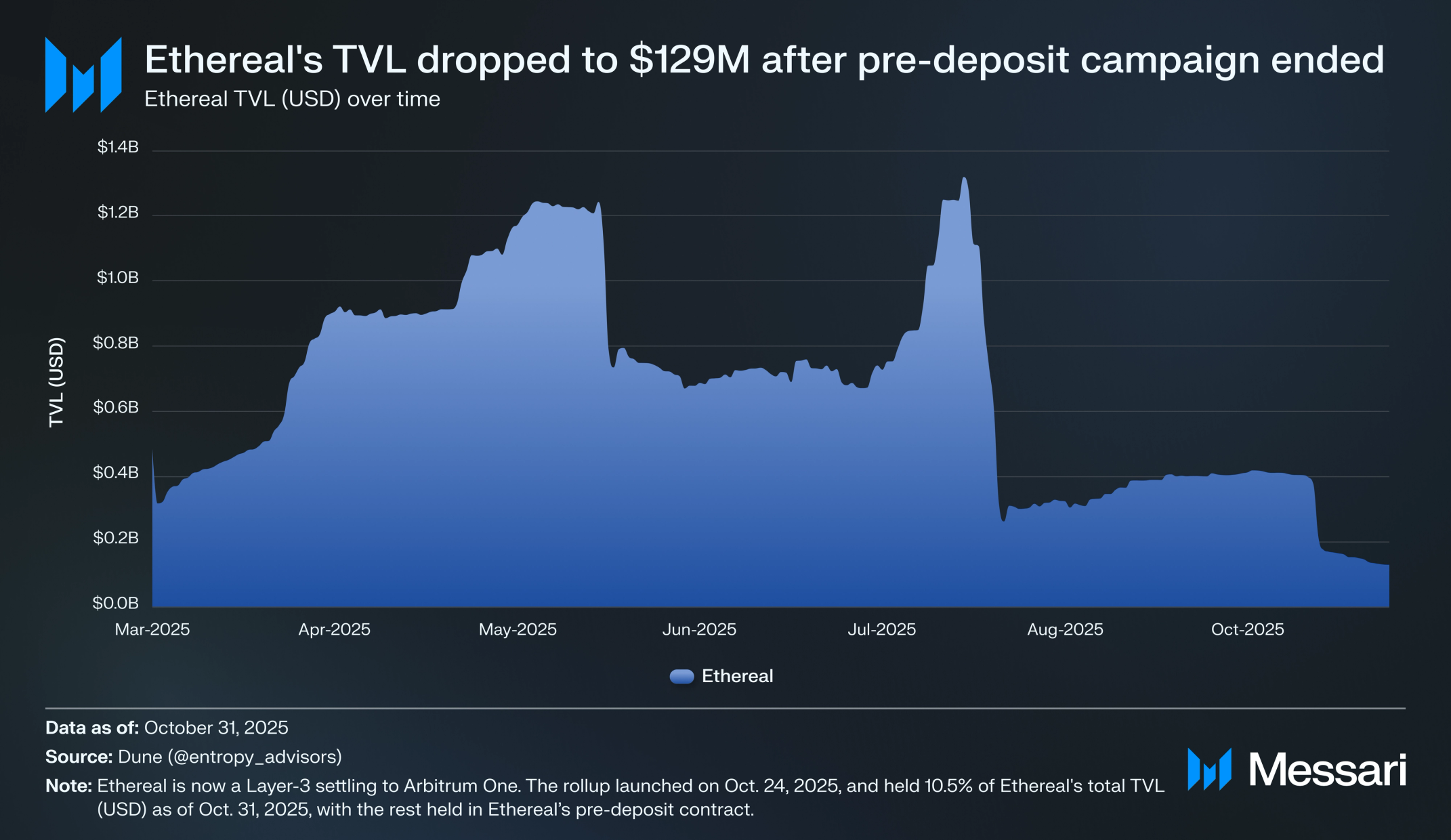
Ethereal is a decentralized perpetual futures exchange by Ethena that is offering institutional-grade performance, aiming for sub-20ms latency, one gigagas/second, and up to 1 million transactions/second. Ethereal launched for pre-deposits alongside its Season Zero points program in February 2025. In less than three months, pre-deposits had reached $1 billion, boosted by various DeFi partnerships with Aave, Pendle, Morpho, Euler, and others.
Ethereal launched on testnet in June 2025. Following a series of trading competitions and activities spanning several months, Ethereal commenced mainnet preparations. After establishing risk management from Chaos Labs, receiving an audit from ChainSecurity, and opening a waitlist, Ethereal launched on Oct. 16, 2025. While pre-deposit TVL (USD) reached a high of $1.32 billion on Aug. 8, 2025, Ethereal’s mainnet deployment is still undergoing a phased release, and had a TVL (USD) of $13.6 million as of Oct. 31, 2025.
Ethereal’s initial deployment is as an L3 settling to Arbitrum One. Ethereal will now compete in the central limit order book (CLOB) arena, with a core differentiating feature being the ability for users to trade against USDe and earn yield while doing so.
DeFi Unchained
Arbitrum One
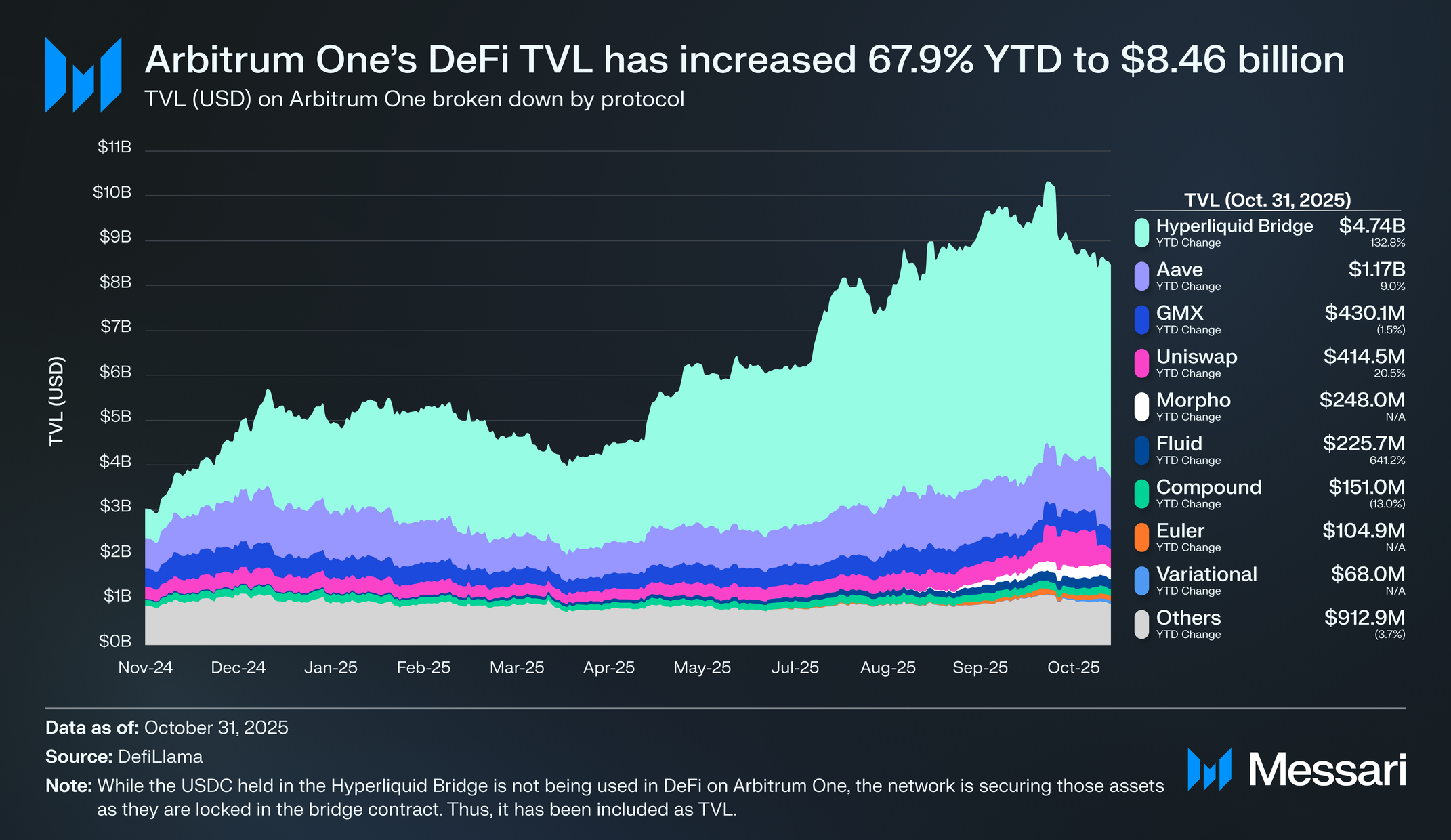
Arbitrum One is the most liquid venue in the Arbitrum Orbit ecosystem, with a DeFi TVL (USD) of $3.65 billion as of Oct. 31, 2025. However, when including Hyperliquid and the Hyperliquid Bridge, Arbitrum One’s TVL (USD) jumps to $8.46 billion, and is up 67.9% YTD. The bridge sources all of its USDC liquidity from Arbitrum One, making up 56% of TVL with $4.74 billion. Arbitrum One also features the largest L2 deployments of blue chip DeFi protocols like Aave ($1.17 billion), Uniswap ($414.5 million), Fluid ($225.6 million), and Arbitrum-native DeFi protocols like GMX ($430.1 million) and Variational ($68 million).
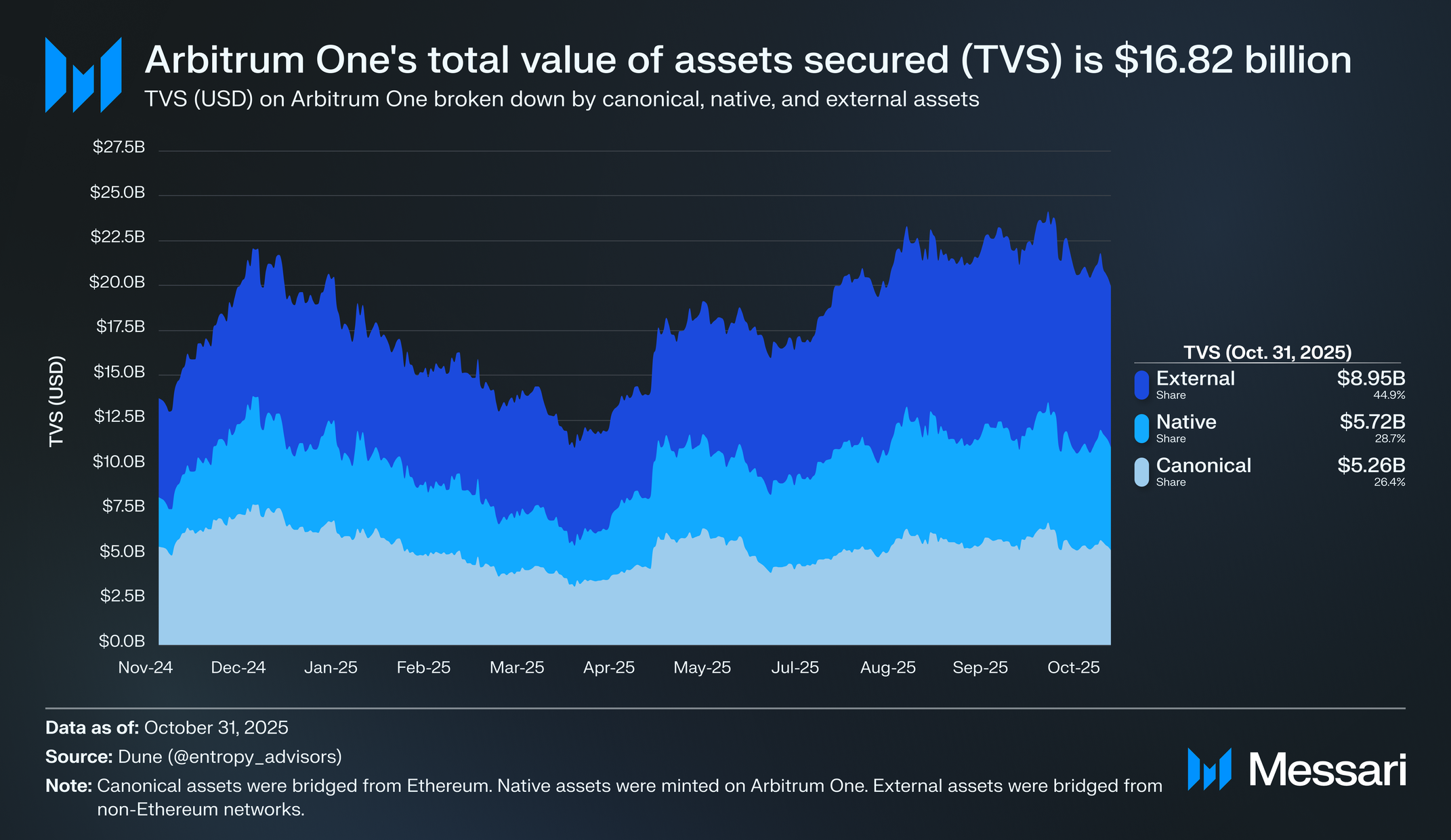
Total value secured (TVS) differs from TVL in that it is the total amount of fungible token value that exists on a given network, whether locked in a DeFi protocol or not. Specifically, TVS is calculated as the sum of canonical bridged tokens, externally bridged tokens, and native tokens. Arbitrum One’s TVS (USD) was $16.82 billion as of Oct. 31, 2025.
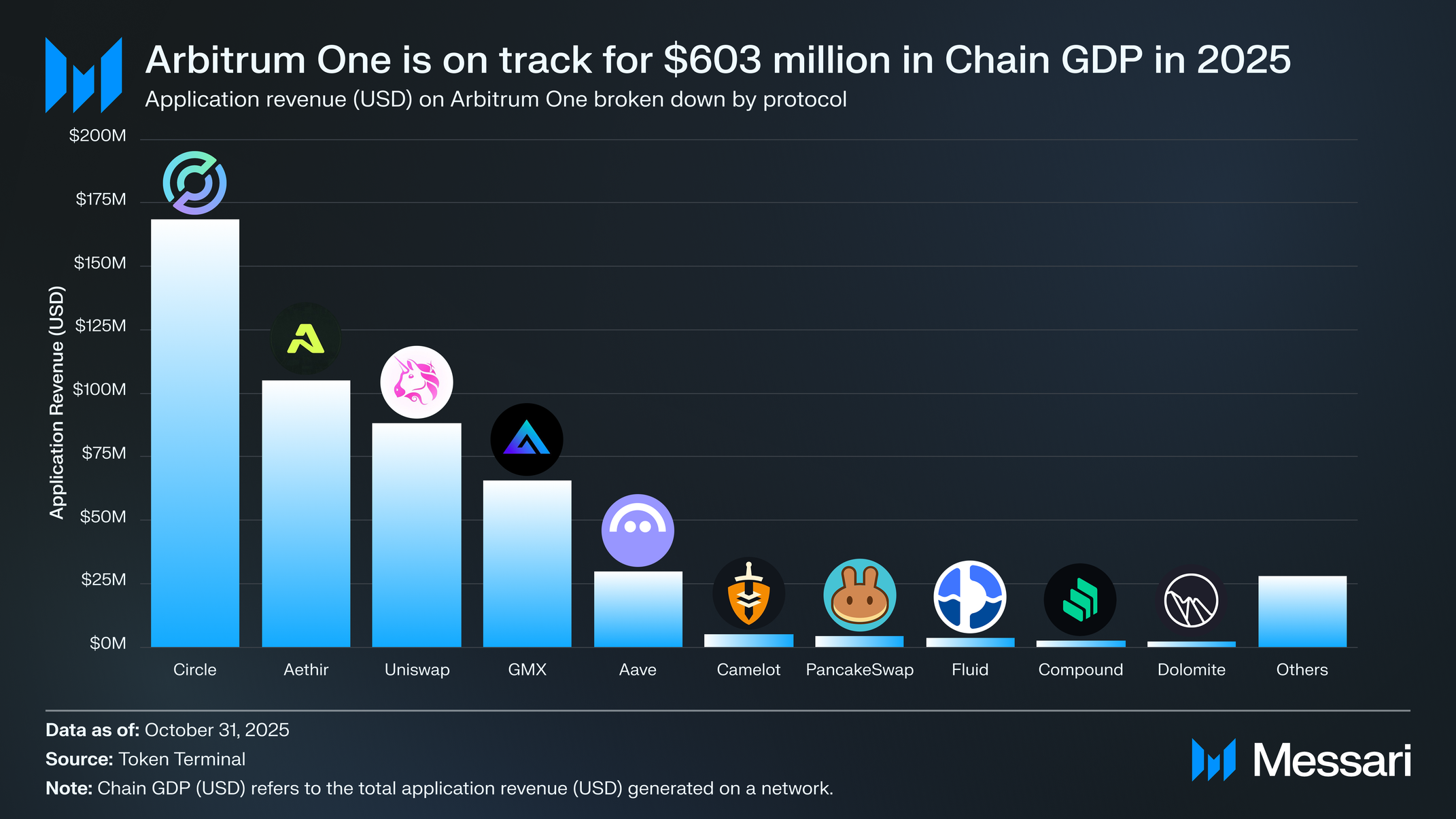
Arbitrum One’s Chain GDP (USD), which refers to the total application revenue generated on a network, was $502.5 million through ten months of 2025. Uniswap, GMX, and Aave make up 36.5% of Arbitrum One’s Chain GDP. On an annualized basis, the applications on Arbitrum One are on track to generate $603 million in 2025, which would result in 43% YoY growth.
A network’s App Revenue Capture Ratio (App RCR) is the ratio of revenue generated by its applications to its Real Economic Value (REV). In the case of Arbitrum One, REV is defined as the sum of base transaction fees, priority fees, and Timeboost auction revenue. The network’s REV in the first ten months of 2025 was $20.5 million, with an App RCR of 25.1x. This means that for every $100 spent in fees and auctions on Arbitrum One, applications earn $2,510 in revenue.
A network’s App RCR can be greater than one if its applications are successful in monetizing activity and/or the cost to transact is low. In the case of Arbitrum One, it appears to be both. Revenue streams for projects can flow downstream to project tokenholders. For example, application revenue generated on GMX is partially shared with GMX stakers.
DeFi Renaissance Incentive Program
The DeFi Renaissance Incentive Program (DRIP) has been a major catalyst for Arbitrum One’s growth in TVL and Chain GDP in recent months. DRIP incentivizes sustainable DeFi growth by targeting specific assets and onchain activities, aiming to create value that persists beyond the program. DRIP features four three-month seasons, with up to 20 million ARB (0.2% of the total token supply) allocated per season. Entropy Advisors, Arbitrum Foundation, and Offchain Labs serve as stewards of the initiative, which was approved on June 23, 2025, and officially began on Sept. 3, 2025.
Season 1 will distribute up to 24 million ARB (0.24% of the total token supply) over 10 two-week epochs, concluding on Jan. 20, 2026. The season’s focus is on growing leverage looping on Arbitrum One. Users earn ARB by supplying or borrowing eligible assets, including liquid staked ETH and stablecoins, on participating lending protocols. DRIP’s support for the Arbitrum Everywhere framework has been evident in the first two months, with many protocols having achieved strong momentum following DRIP's involvement.
Stablecoins
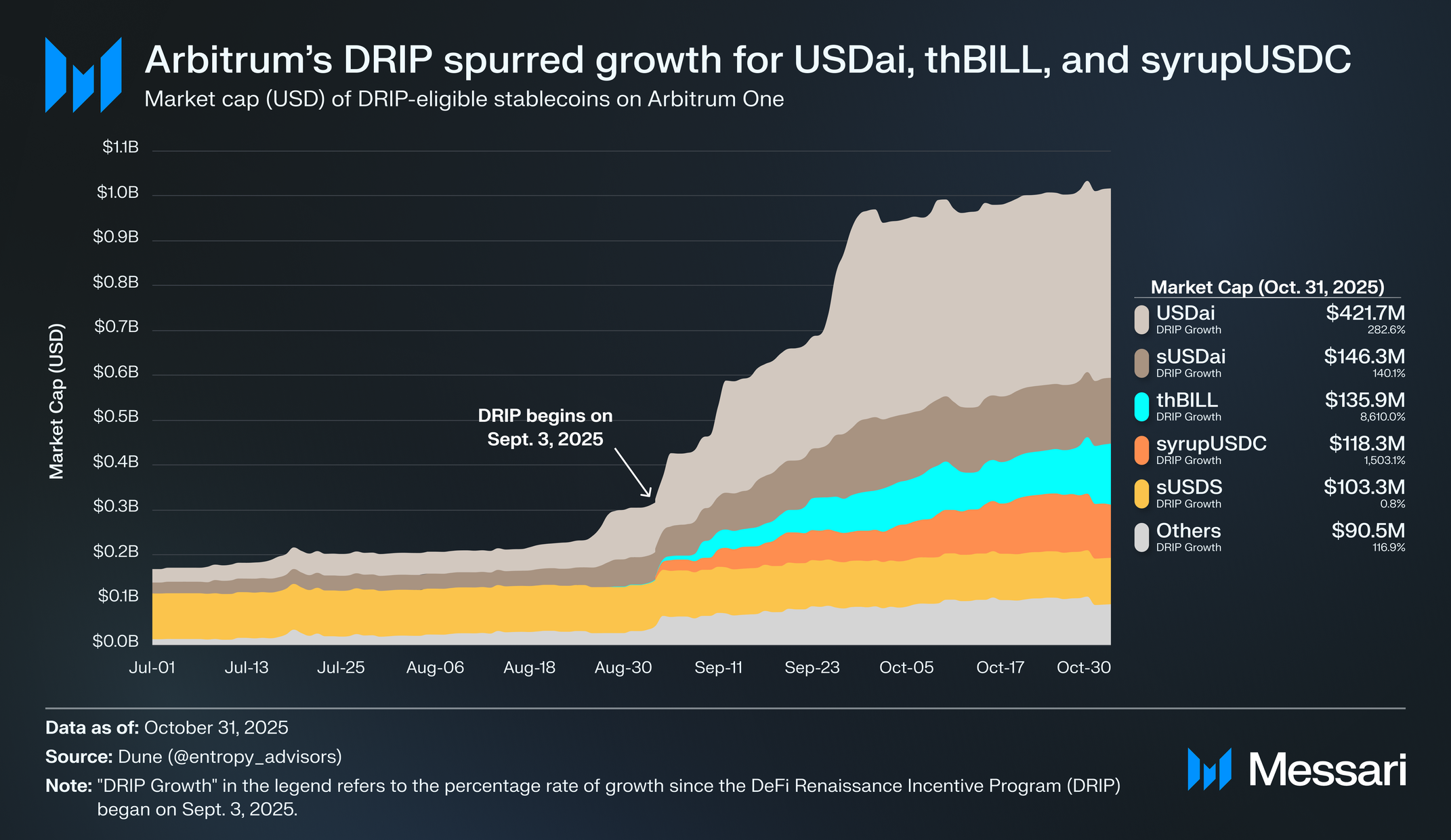
Season 1 of DRIP has not spurred notable growth in liquid staked ETH. However, it has resulted in a dramatic increase in the market cap, liquidity, and borrowing of stablecoins on Arbitrum One. The market caps (USD) of DRIP-eligible stablecoins have increased 229.4% to $1.02 billion since the program began on Sept. 3, 2025. The increase in market cap has been led by USDai (up 282.6%), sUSDai (up 140.1%), thBILL (up 8,610%),and syrupUSDC (up 1,503.1%).
Arbitrum One’s overall stablecoin market cap (USD) has benefitted from DRIP, reaching a high of $10.66 billion on Oct. 11, 2025, before ending the month at $8.97 billion. That is the most across all L2s, but is only up 4.4% YTD from $8.6 billion. The Hyperliquid Bridge holds 47.5% ($4.71 billion) of all stablecoins on Arbitrum One. This has made Circle the top revenue-generating protocol on Arbitrum One as it earned $168.4 million from the USDC issued on the network in the first ten months of 2025.
USDT is the second-largest stablecoin by market cap on Arbitrum One, accounting for 10.7% of all stablecoins with $963.7 million. In January 2025, USDT0 was launched as an omnichain implementation of USDT, utilizing Arbitrum One as its central liquidity hub. However, USDC’s growth has outpaced that of USDT despite the refreshed infrastructure. The supply of USDT on Arbitrum One has decreased 66.7% YTD, while USDC increased 21.5%, due in large part to the continued growth of Hyperliquid.
Perp DEXs
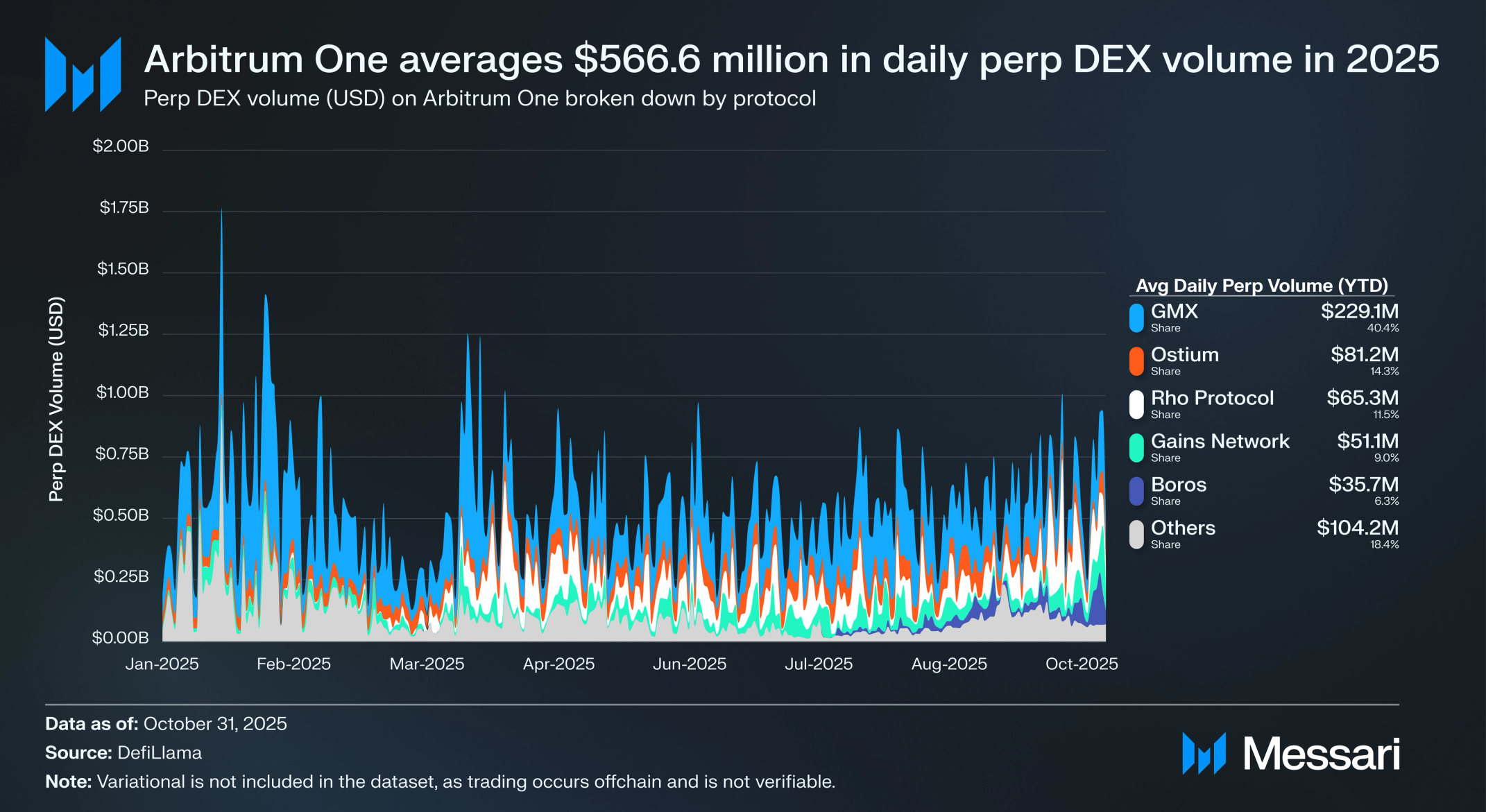
Perp DEX volume (USD) on Arbitrum One averages $551.7 million per day in 2025. GMX remains the top perp DEX on Arbitrum, with its average daily volume (USD) being $221.1 million in 2025. However, volume share has shifted with the emergence of Ostium, a perpetual futures exchange that expands outside of crypto and allows users to trade real-world assets (RWAs) like stocks, ETFs, and commodities. Ostium has raised $3.6 million and facilitated $4.9 billion in volume in October 2025, its all-time high over a single month. For an overview of real-world perpetual markets, including Ostium, see Messari’s report on the Perpification of Real-World Assets.
Another newcomer is Variational, a perpetual futures exchange with peer-to-peer infrastructure for clearing and settlement that has raised $11.8 million. Variational’s app, Omni, features no trading fees and a request-for-quote (RFQ) model for executing trades that reduces value leakage from users to external market makers. Since launching on Jan. 30, 2025, the protocol reached $68 million in TVL (USD), had 4,900 active addresses on Oct. 31, 2025, and claims to have facilitated over $40 billion in offchain trading volume.
Borrowing & Lending
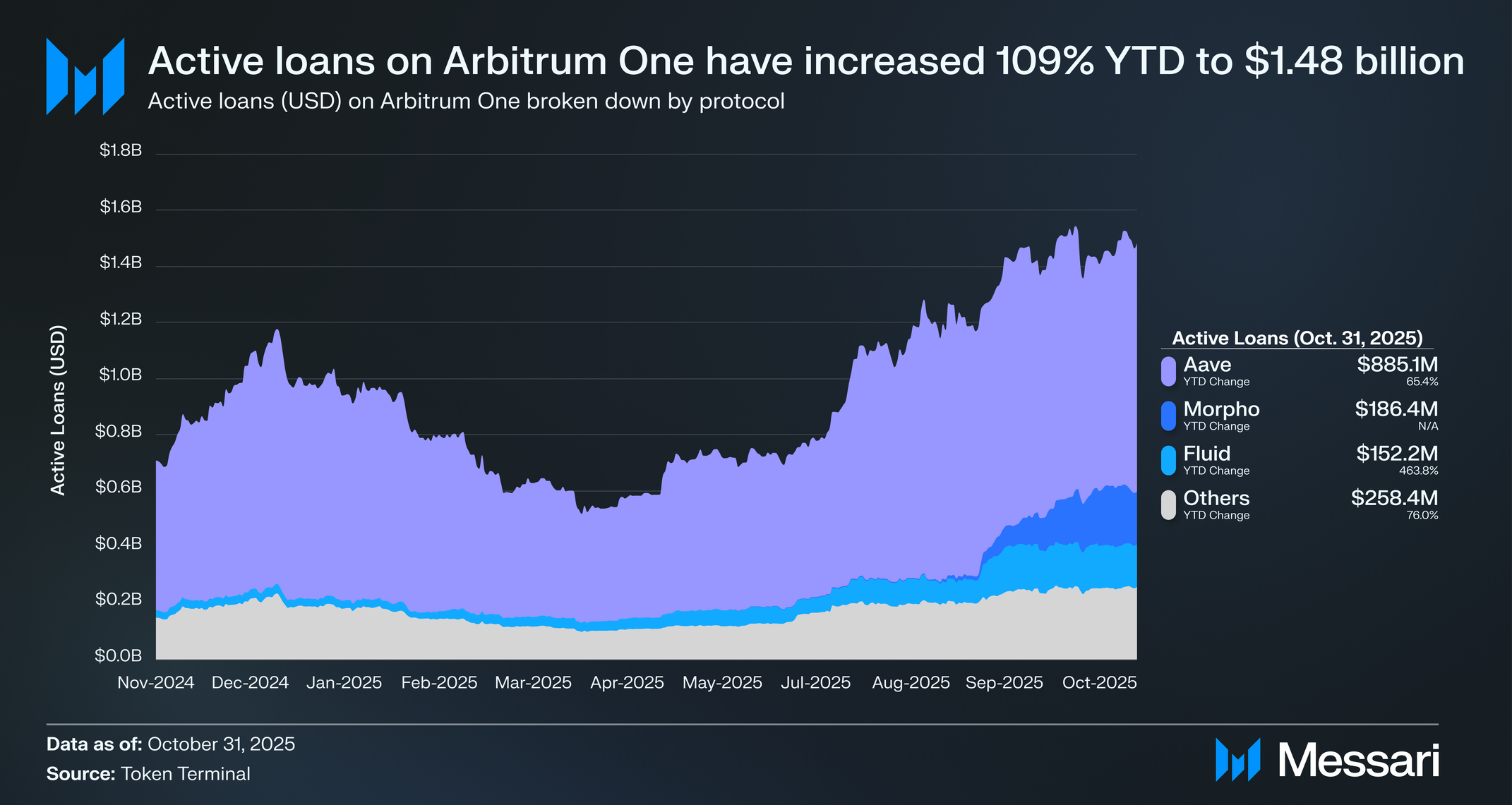
Active loans (USD) on Arbitrum One have increased 109% YTD, from $709 million to $1.48 billion as of Oct. 31, 2025. Money market activity on the network has always been dominated by Aave, which remains the leading protocol by TVL and active loans. The protocol’s active loans (USD) have increased 65.4% YTD to $885.1 million, accounting for 59.7% of all borrowing activity on Arbitrum One.
Fluid has emerged as an exciting player in the sector in 2025. Its active loans (USD) reached $152.2 million on Oct. 31, 2025, accounting for 10.3% of borrowing activity on Arbitrum One, up 463.8% YTD as its TVL (USD) reached $225.7 million. Fluid is an innovative lending protocol where deposited assets also power its decentralized exchange. Through its Smart Collateral and Smart Debt features, Fluid offers borrowers cheaper borrowing rates compared to traditional lending protocols like Aave, making it an attractive alternative. For a comprehensive overview of Fluid, see Messari’s Initiation of Coverage report.
RWAs
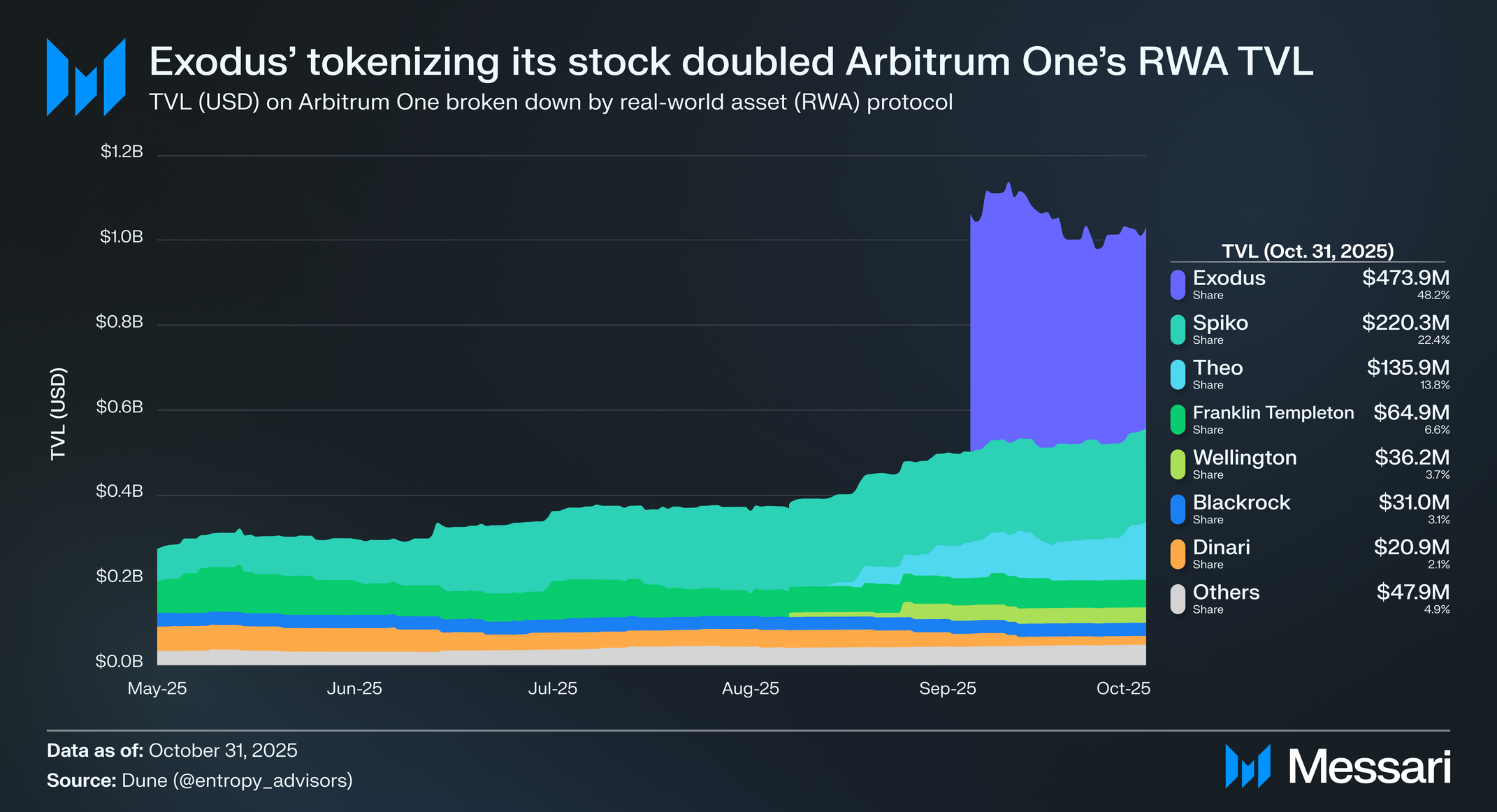
Arbitrum One’s RWA market cap (USD) reached an all-time high of $1.14 billion in October 2025. Several major traditional finance institutions have deployed RWAs on Arbitrum One and seen significant growth:
Exodus: A publicly traded crypto wallet provider (EXOD on Nasdaq) tokenized its Class B stock on Arbitrum One on Sept. 29, 2025. Arbitrum One’s RWA market cap jumped 111.3% that day as the token, EXODB, became the largest RWA on the network. Launched via Securitize, EXODB represents direct ownership of Exodus shares and has reached a market cap (USD) of $473.9 million with just one tokenholder.
Spiko: The Euro T-Bill (EUTBL) and U.S. T-Bill (USTBL) are tokenized money market funds. Spiko’s TVL (USD) on Arbitrum One, which includes the supplies of both tokens, reached $220.3 million on Oct. 31, 2025, making it the second-largest RWA on Arbitrum.
Franklin Templeton: The OnChain US Government Money Fund (FOBXX) invests in government securities, cash, and repurchase agreements and is tokenized as BENJI. BENJI was the largest allocation recipient in STEP 2, and the token reached a market cap (USD) of $64.9 million on Arbitrum One on Oct. 31, 2025.
A notable new entrant to Arbitrum’s RWA sector is Theo Network’s thBILL, a yield-bearing tokenized money market fund backed by short-duration U.S. Treasuries. Theo raised $20 million in April 2025, before launching on Arbitrum One in August 2025. While similar products exist in the market, Theo’s vision goes beyond the tokenization of RWAs and toward creating an institutional-grade, yield-bearing instrument that is as composable onchain across DeFi as other leading stablecoins. Theo’s ongoing points program has pushed Theo’s TVL (USD) on Arbitrum One to $135.9 million as of Oct. 31, 2025, with 80.5% of thBILL’s total supply existing on the network.
Digital Sovereign Nation
The “Arbitrum Everywhere” framework culminates with the vision of becoming a self-sustaining “Digital Sovereign Nation.” This nation comprises a diverse set of constituents and stakeholders represented by the ArbitrumDAO, which drives value to stakeholders via a growth flywheel comprising revenue generation, ecosystem investment programs, and economic zones of opportunity. For more on Arbitrum’s Digital Sovereign Nation, refer to our report, Arbitrum's Economic Engine: Foundations of a Digital Sovereign Nation.
Arbitrum’s Economic Engine
Arbitrum’s Digital Sovereign Nation features a growth flywheel that drives value back to its constituents and stakeholders, supporting the Arbitrum Everywhere framework. First, revenue is generated through digital resources, such as blockspace and execution environments. This revenue is distributed back to the treasury, which is fully governed by ArbitrumDAO. The DAO invests in ecosystem investment programs and economic zones of opportunity, leading to compounding demand for its products, while growing its asset base.
Core Protocol Revenue
ArbitrumDAO captures value directly from the usage of Arbitrum's core products, including Arbitrum One and Arbitrum Orbit. This model of direct value accrual to the DAO-controlled treasury is a key differentiator for Arbitrum. Arbitrum One regularly maintains a gross profit margin over 95%, contributing 100% of sequencer profit to ArbitrumDAO. All other Arbitrum Chains are required to share 10% of sequencer profit as part of the Arbitrum Expansion Program (AEP) licensing fee, with 8% going to ArbitrumDAO and 2% to the Arbitrum Developer Guild. Notably, L3s that settle to an Arbitrum Chain like Arbitrum One are exempt from profit sharing.
As of Oct. 31, 2025, ArbitrumDAO has received $15.9 million in year-to-date revenue (USD) attributed to these revenue sources, though its total annualized revenue from all sources is projected to be $26.6 million in 2025.
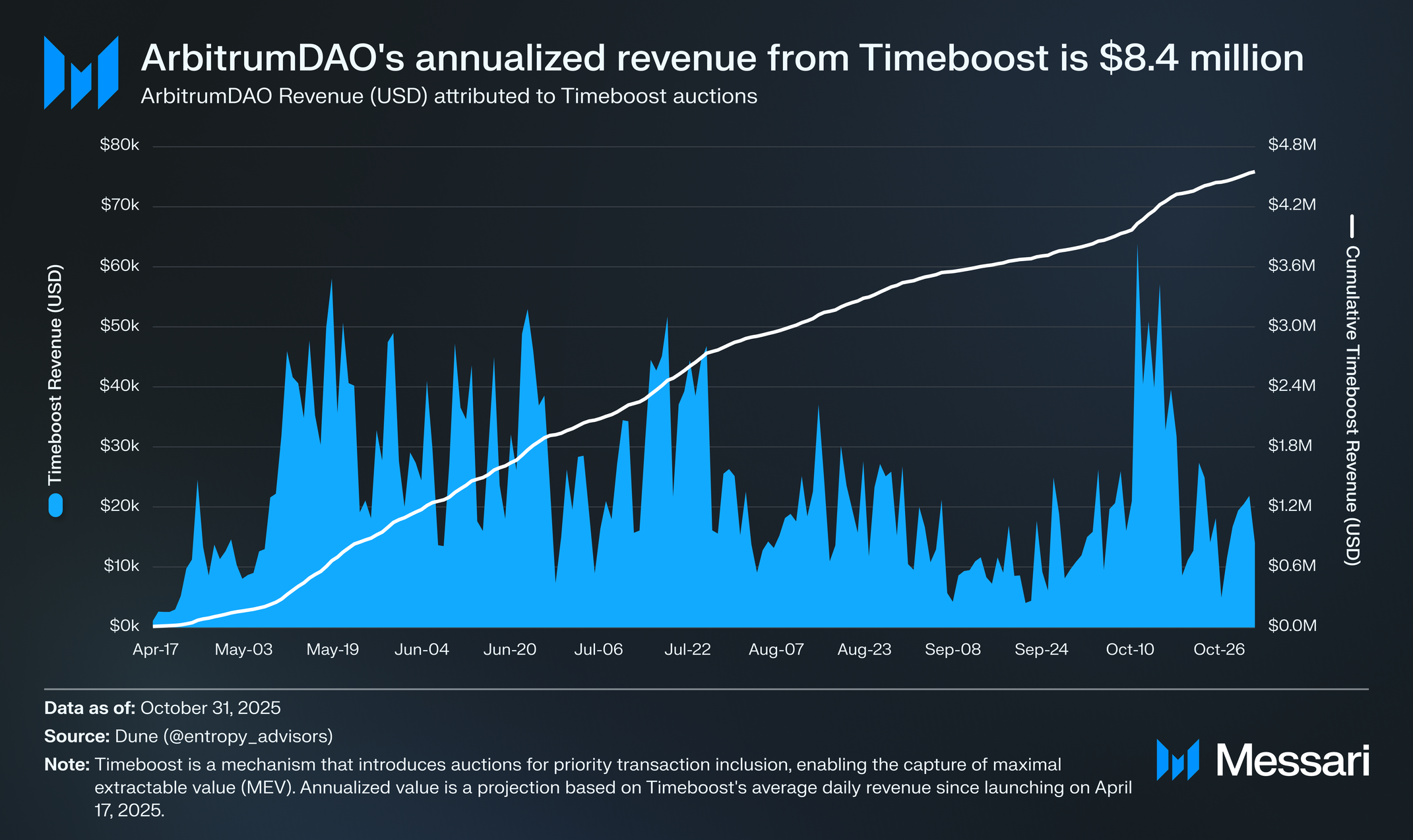
Timeboost quickly emerged as a major source of revenue for ArbitrumDAO. It was the largest source of revenue for one month in June 2025, flipping transaction fees ($890,700 versus $781,800), though this has since normalized. As of Oct. 31, 2025, Timeboost has generated $4.5 million in all-time revenue (USD). With an average of $23,000 per day, the annualized revenue (USD) projection becomes $8.4 million. The majority of this revenue, 97%, is distributed to ArbitrumDAO, while the remaining 3% goes to the Arbitrum Developer Guild.
Timeboost auctions consistently account for between 10% to 40% of Network REV (Real Economic Value) generated on Arbitrum One. While over 99% of auctions had active bidders in the first three months after Timeboost’s launch, this has since decreased to a range of 50 to 99% since August 2025, with Selini Capital and Wintermute making up 93.6% of auction activity. Notably, consistent with the Arbitrum Everywhere framework, all Arbitrum Chains have the option to implement Timeboost as part of their Arbitrum Nitro implementations.
Economic Zones of Opportunity
The assets held in the ArbitrumDAO Treasury are valued at $1.19 billion as of Oct. 31, 2025. As these assets continually grow from Arbitrum’s core protocol revenue, ArbitrumDAO deploys them toward ecosystem investment programs like DRIP, and to economic zones of opportunity that lead to new revenue streams. This strategy of active capital deployment is a core component of Arbitrum’s economic engine, enabling the DAO to feed the growth flywheel and continue reinvesting in Arbitrum’s growth.
Stable Treasury Endowment Program (STEP)
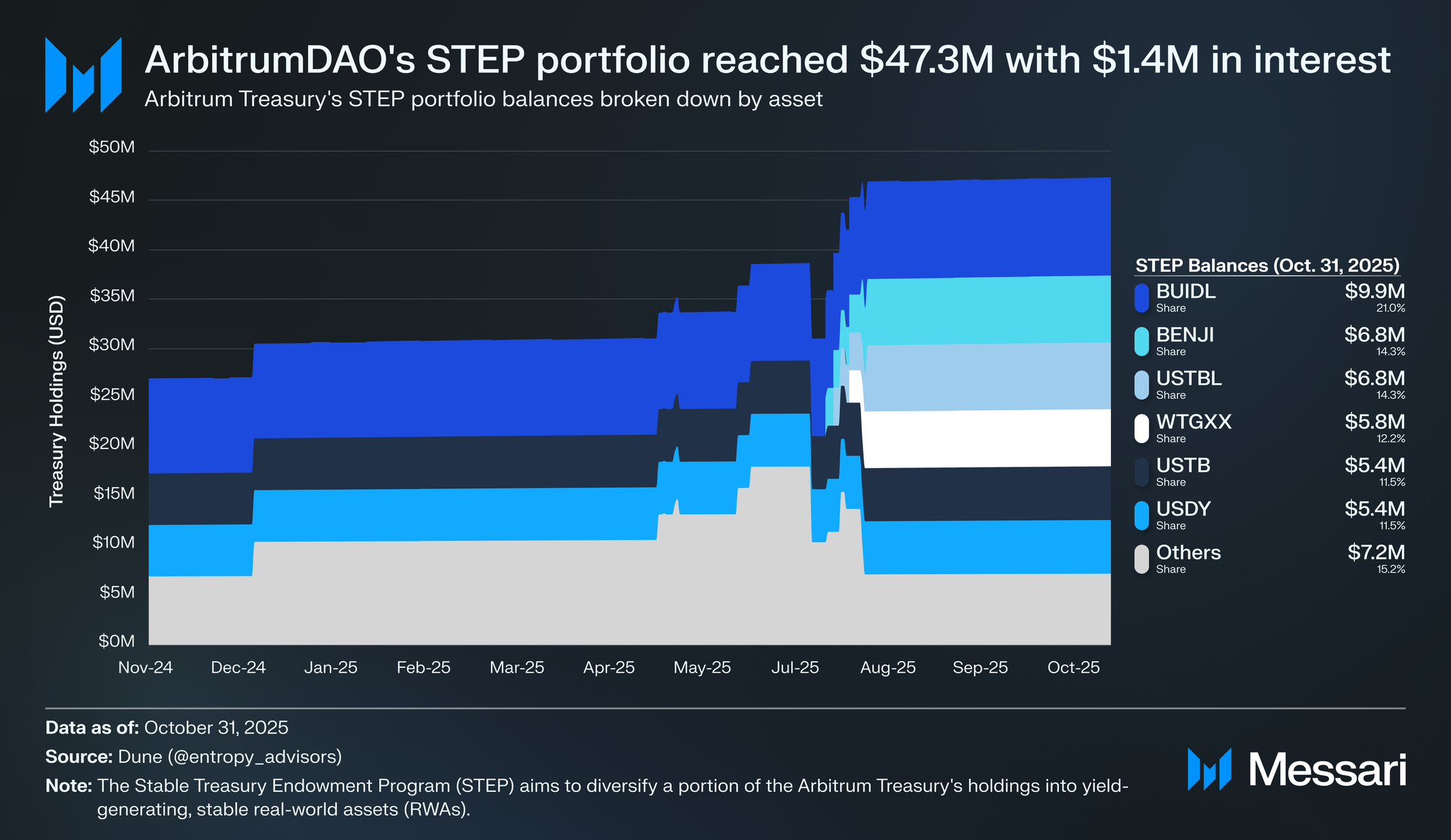
The Stable Treasury Endowment Program (STEP) aims to diversify a portion of ArbitrumDAO Treasury holdings into yield-generating, price-stable RWAs and has spurred major growth in RWA adoption on Arbitrum One.
STEP 1: Proposed by the Treasury and Sustainability Working Group and approved in April 2024, STEP 1 converted 35 million ARB (0.35% of the total token supply) to RWAs. A total of 33 applications were received, of which six were approved on Snapshot. The sale of ARB yielded $30.3 million, which was converted to Securitize’s BUIDL ($9.6 million), Ondo’s USDY ($5.2 million), Superstate’s USTB ($5.2 million), Mountain’s USDM ($3.5 million), OpenEden’s TBILL ($3.5 million), and Backed Finance’s bIB01 ($3.4 million).
STEP 2: Proposed by the Treasury and Sustainability Working Group and approved in February 2025, STEP 2 converted 35 million ARB (0.35% of the total token supply) to RWAs. Over 50 applications were received, of which three were approved on Snapshot. The sale of ARB yielded $15.7 million, which was converted to Spiko’s USTBL ($5.5 million), Franklin Templeton’s BENJI ($5.5 million), and WisdomTree’s WTGXX ($4.7 million). Notably, after USDM’s deprecation, $3.5 million USDM was converted pro-rata to STEP 2 assets.
As of Oct. 31, 2025, the ArbitrumDAO Treasury’s RWA holdings (USD) totaled $47.3 million. Since its inception, STEP has generated total interest revenue (USD) of $1.4 million.
Arbitrum Gaming Ventures (AGV)
Arbitrum Gaming Ventures (AGV), formerly known as the Gaming Catalyst Program (GCP), was approved in June 2024 to receive 135 million ARB (1.35% of the total token supply) to invest in early-stage Arbitrum Orbit gaming studios, apps, and chains. AGV is an Arbitrum-aligned entity that aims to “scale the next generation of gaming and entertainment on Arbitrum.” It leverages tools like milestone-based tranches and grant-to-investment pathways to de-risk while preserving upside on venture investments and maximizing the return on invested capital (ROIC) for ArbitrumDAO. AGV’s KPIs include three-year targets for Arbitrum Chain launches, studio investments, and daily active users across portfolio companies.
AGV announced its first investments on May 8, 2025, totaling $10 million, which were invested in Wildcard, Hyve Labs, T-Rex, and Xai. A full list of Arbitrum Gaming Ventures’ investments can be seen on Messari Fundraising. The H1 2025 Transparency Report stated that AGV reviewed 193 leads in H1'25, with 75 advancing to screening, 36 to due diligence, 20 to the investment committee, and eight ultimately receiving funding. This resulted in a 4% conversion rate, as 6.8 million ARB was deployed across the investments made, leaving 95.8% of the funds remaining to be deployed. AGV’s most recent updates highlighted the team’s expansion, game playtests, and conference attendance.
ArbitrumDAO Governance
ARB serves as the governance token of ArbitrumDAO, which collectively governs Arbitrum and steers the Digital Sovereign Nation growth flywheel that supports the Arbitrum Everywhere framework. ARB tokenholders can participate in offchain governance via Snapshot and onchain governance via Tally by delegating voting power to themselves or to another delegate. Arbitrum’s onchain governance system allows tokenholders to enact changes to Arbitrum’s smart contracts, allocate treasury funds, amend the ArbitrumDAO Constitution, and influence other critical aspects of Arbitrum.
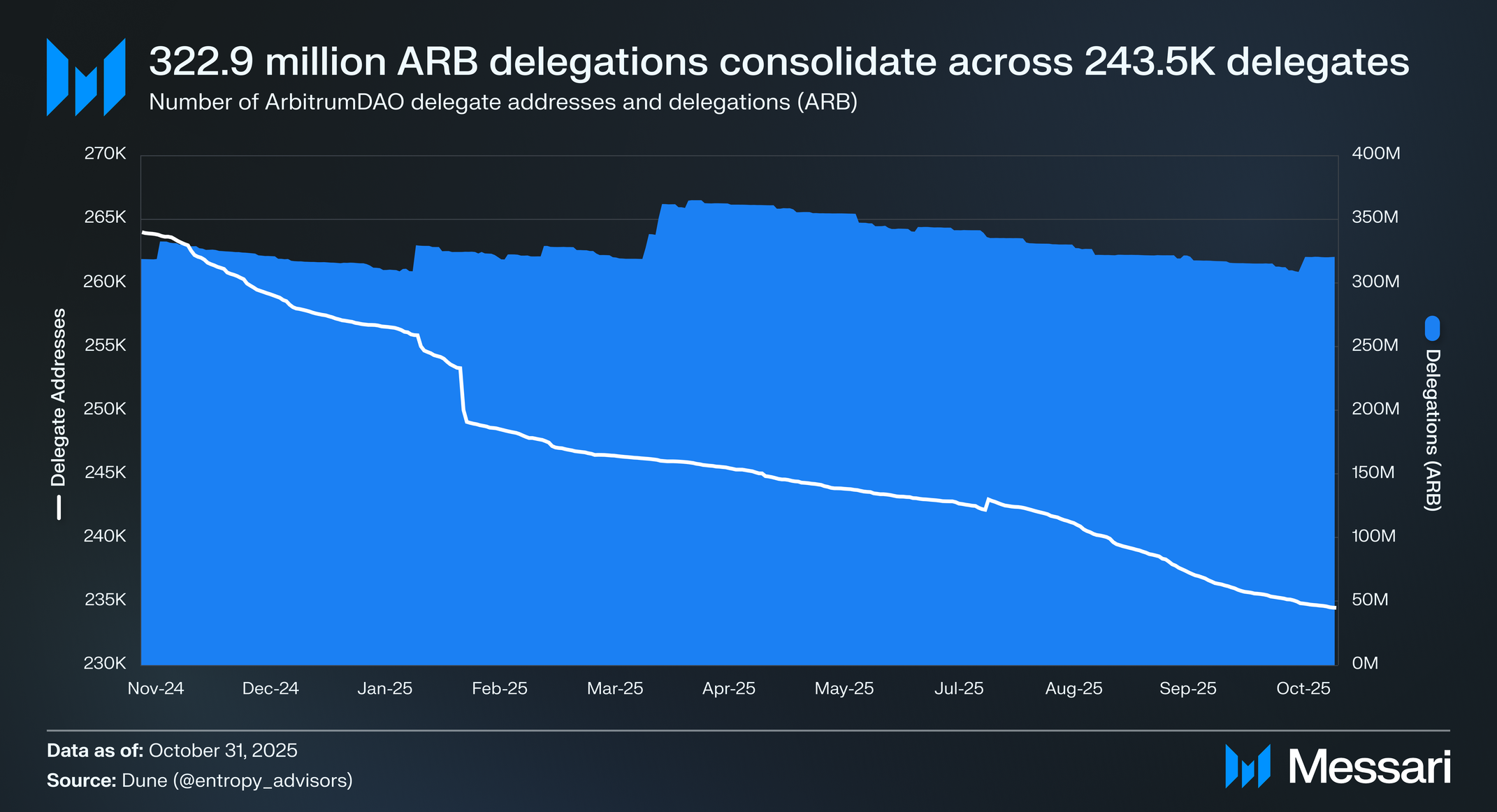
As of Oct. 31, 2025, there have been 82 onchain Arbitrum Improvement Proposals (AIPs) in ArbitrumDAO’s history, with 66 having passed. There are 243,500 delegates with a cumulative 322.9 million ARB delegated to them, which results in a delegation rate of 6.7% relative to the token’s circulating supply.
Governance: ARB grants the ability for a tokenholder to delegate ARB to themselves or to another delegate, granting governance power within ArbitrumDAO and ultimate ownership over the ArbitrumDAO Treasury and the protocol.
Funding: Arbitrum stakeholders are often incentivized to contribute to the Arbitrum ecosystem through ecosystem investment programs approved by ArbitrumDAO. Furthermore, ArbitrumDAO-approved operations are funded with ARB tokens.
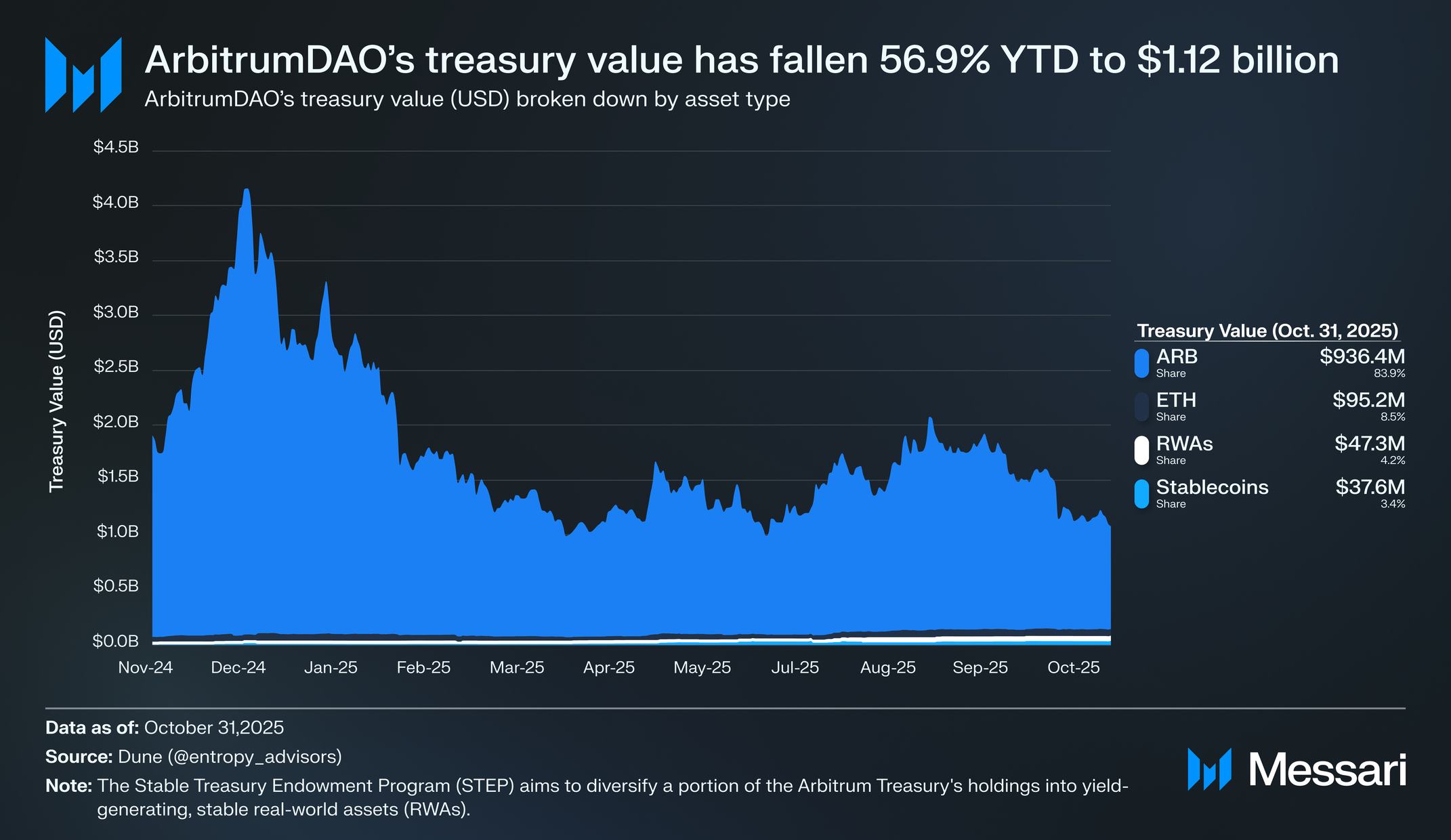
The ArbitrumDAO Treasury primarily consists of ARB, as 3.53 billion ARB (35.3% of the total token supply) was allocated to the treasury and is now being leveraged to fuel Arbitrum’s economic engine. However, efforts to continually diversify treasury holdings to generate yield through RWAs and DeFi are underway. The assets held in the ArbitrumDAO Treasury are valued at $1.12 billion as of Oct. 31, 2025. ARB comprises 83.9% of the ArbitrumDAO Treasury (USD), ETH and ETH-equivalents comprise 8.5%, RWAs comprise 4.2%, and stablecoins comprise 3.4%.
The Arbitrum Treasury Management (ATMC) council’s Investment Policy Statement (IPS) has set a long-term, non-ARB asset composition target of 30% in ETH and ETH-equivalents, 35% in stablecoins, and 35% in assets like BTC and tokenized securities like U.S. Treasuries and equities. There have been two treasury management proposals approved to further this goal, one in December 2024 and one on Nov. 1, 2025, which approved the deployment of 8,500 ETH across DeFi to generate additional yield and support Arbitrum’s ecosystem. As of Oct. 31, 2025, 30.6% of the ArbitrumDAO Treasury’s ETH has been liquid staked with Lido, lent on Aave and Fluid, or is being used to provide liquidity on Camelot. Meanwhile, 16.5% of the ArbitrumDAO Treasury’s stablecoins are deployed on Morpho or actively managed by kpk.
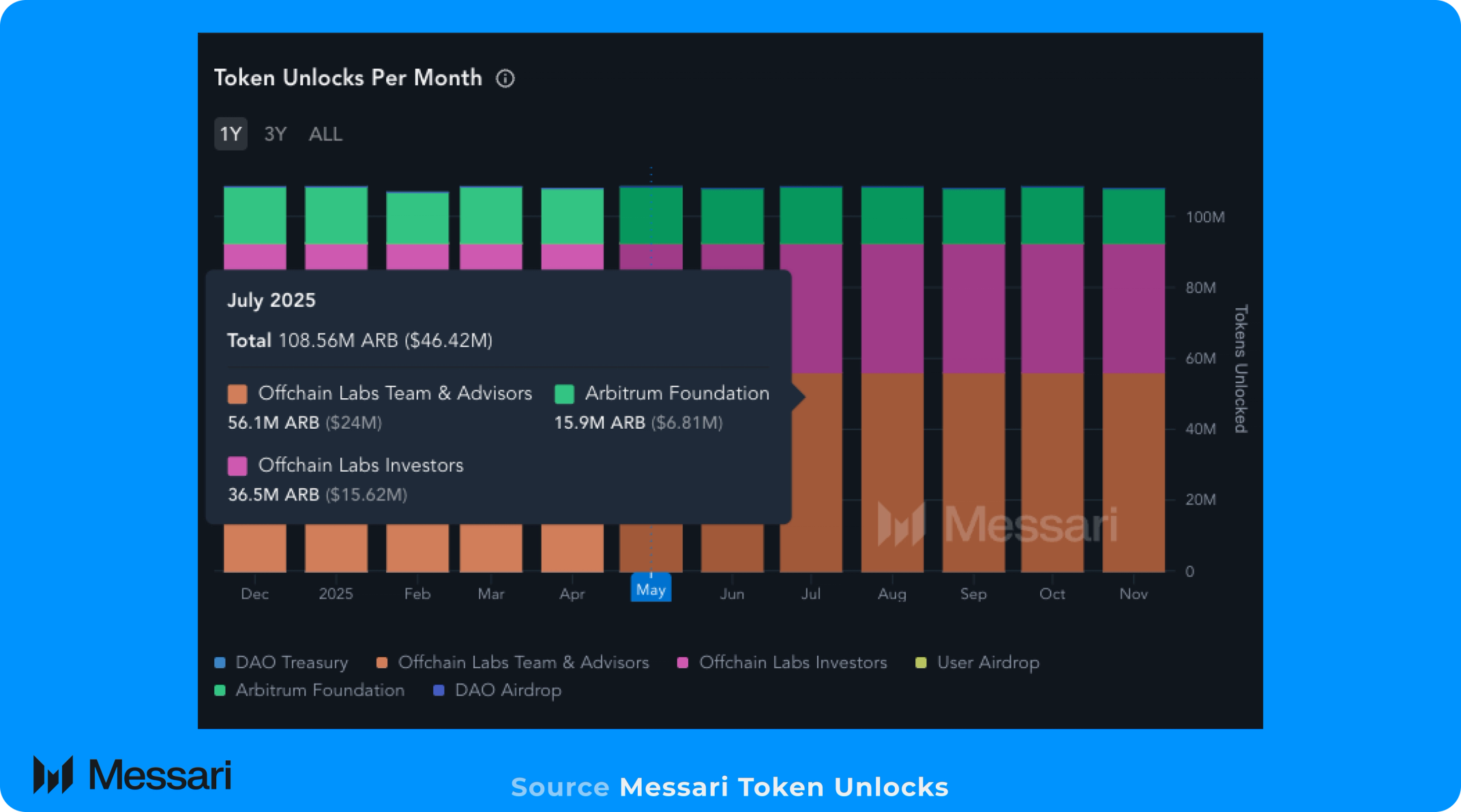
ARB is vesting at a monthly rate of 108.6 million ARB (1.1% of the total token supply) and is slated to have all allocations fully vested by March 2027. However, in March 2025, Offchain Labs reinforced its commitment to Arbitrum by announcing a strategic purchase plan, where the company will purchase ARB tokens on the open market at its discretion.
Closing Summary
Arbitrum’s evolution reflects a deliberate transformation from a scaling solution into a comprehensive infrastructure platform that adapts to the ambitions of builders, institutions, and decentralized communities alike. The “Arbitrum Everywhere” framework is exemplified through Arbitrum’s product set, where Arbitrum One anchors liquidity and user activity while Arbitrum Orbit extends configurability and customization through the Arbitrum Nitro tech stack. Together, they establish an app-to-chain pathway that allows builders to progress from experimentation to independence within a unified ecosystem.
Institutional adoption underscores Arbitrum’s maturity and market validation. Robinhood’s tokenized securities, USD.AI’s synthetic dollar backed by real-world compute, and Ethereal’s perpetual futures exchange demonstrate how enterprises are merging traditional financial products with enterprise-grade crypto infrastructure. In parallel, Arbitrum’s DeFi leadership continues to strengthen as DRIP catalyzes activity across the stablecoin and money market sectors, reinforcing Arbitrum One’s position as a liquidity hub.
At the governance layer, ArbitrumDAO continues its path toward becoming a self-sustaining Digital Sovereign Nation. By capturing protocol revenue across a diversified set of sources, ArbitrumDAO funds ecosystem investment programs like DRIP and fosters economic zones of opportunity through initiatives like STEP and AGV. This creates a self-reinforcing economic engine that aligns network growth, builder success, and stakeholder value.
Arbitrum’s story is no longer just about scalability alone. It is the story of an adaptive, self-sustaining economy that bridges traditional finance, decentralized innovation, and onchain governance. Arbitrum is everywhere, and its expanding ecosystem continues to evolve toward a future where every stakeholder benefits from the success of the whole.
This report was commissioned by Arbitrum Foundation. All content was produced independently by the author(s) and does not necessarily reflect the opinions of Messari, Inc. or the organization that requested the report. The commissioning organization may have input on the content of the report, but Messari maintains editorial control over the final report to retain data accuracy and objectivity. Author(s) may hold cryptocurrencies named in this report. This report is meant for informational purposes only. It is not meant to serve as investment advice. You should conduct your own research and consult an independent financial, tax, or legal advisor before making any investment decisions. Past performance of any asset is not indicative of future results. Please see our Terms of Service for more information.
No part of this report may be (a) copied, photocopied, duplicated in any form by any means or (b) redistributed without the prior written consent of Messari®.
During his 3.5-year tenure at Messari, Patryk contributed across Messari's Diligence, Protocol, and Enterprise research teams. As Research Manager, his primary focus was on Layer-1 and Layer-2 infrastructure and the DeFi ecosystems atop them.
During his 3.5-year tenure at Messari, Patryk contributed across Messari's Diligence, Protocol, and Enterprise research teams. As Research Manager, his primary focus was on Layer-1 and Layer-2 infrastructure and the DeFi ecosystems atop them.