XMTP: Unifying Web3 Communication

Key Points
- XMTP is building Web3’s messaging layer. It is a generalized messaging protocol and network, facilitating end-to-end encrypted messaging between on-chain addresses.
- Developers can permissionlessly integrate the XMTP SDK to offer in-app direct messaging and notifications. Like a Web3 social profile, an XMTP inbox is tied to a user’s blockchain address and is portable between apps.
- To gain significant adoption, new messaging projects are especially sensitive to network effects, as their value and utility largely depend on the number of users participating in the network.
- DeSoc protocols with growing traction are playing a crucial role in bootstrapping XMTP’s user base. Since launch in early 2022, nearly 1 million XMTP inboxes have been generated and over 300,000 DMs sent.
When considering the core differences between Web2 consumer apps and crypto-based consumer apps, there are two core architectural differences. First, crypto apps center identity around on-chain addresses which means that all user interactions, like follows, posts, and direct messages, are natively tied to blockchain addresses. This facilitates a unified user profile across various apps.
The second difference is the modularity of crypto architectures. For example, Web2 social platforms own all of the code and databases used to host social media profiles and messaging experiences under one entity. Whereas in crypto, each of the various functions, such as social profiles, data storage, and direct messaging are all broken apart into independent protocols. Both of these architectural differences introduce new competitive dynamics and market structures.
Within the modular framework of the crypto application stack, decentralized social protocols like Lens and their identity systems have received notable attention. However, messaging protocols haven't attracted the same level of attention. Effectively, how do addresses send messages in a scalable, private way, without needing to write state on-chain. There are a number of projects that are tackling the messaging function in crypto, but one that stands out is XMTP. The generalized messaging network has integrated with Lens as the default messaging solution and affords users a portable inbox across Web3.
XMTP: Unifying Web3 Communication
XMTP is a generalized messaging protocol and network, facilitating end-to-end encrypted messaging between on-chain addresses. Developers can permissionlessly integrate the XMTP SDK into apps to offer in-app direct messaging and notifications.
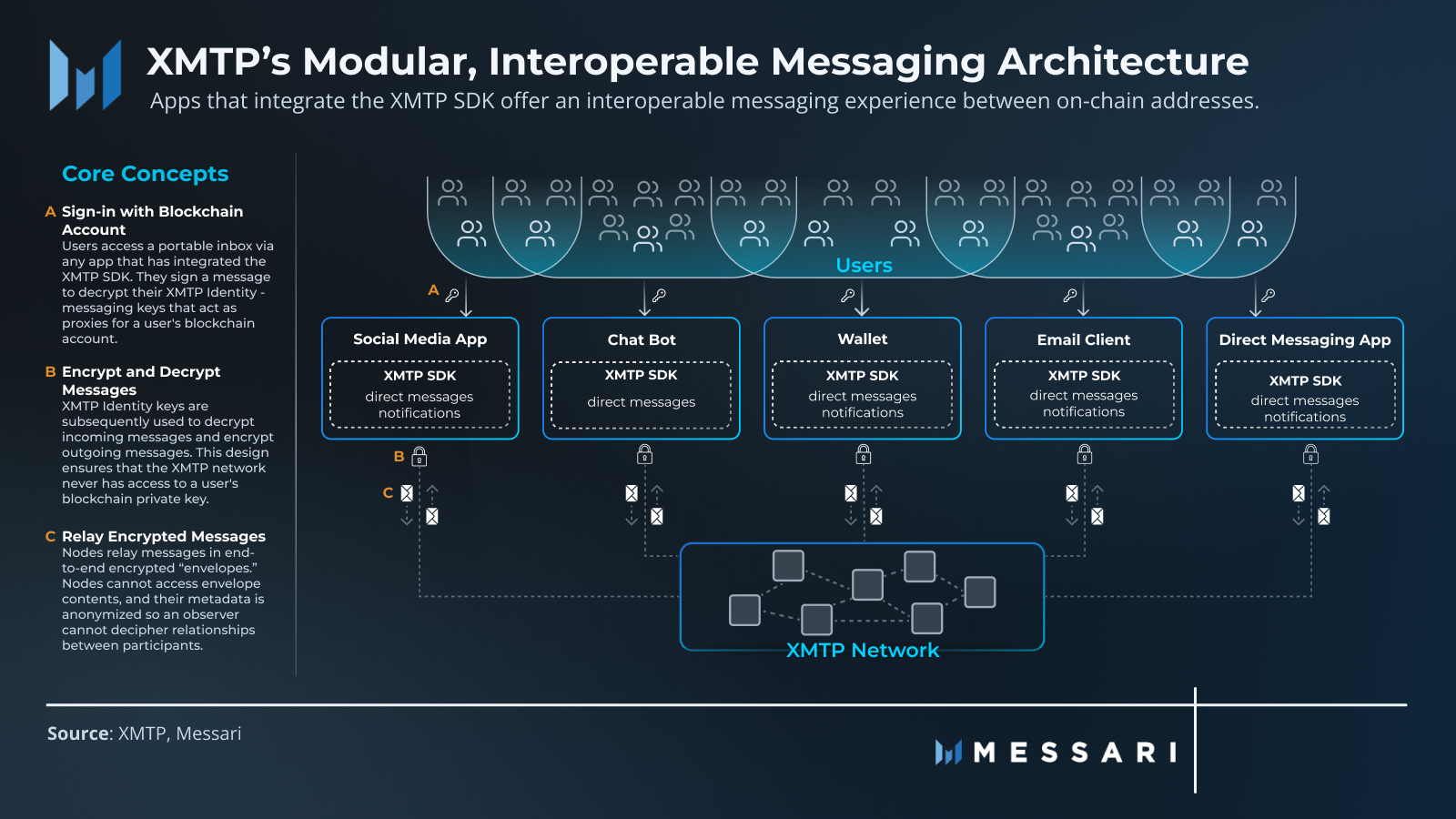
User messages are relayed over a p2p network of XMTP nodes. Developers can filter which type of messages appear on a specific app front end. But, like a Web3 social profile, an XMTP inbox is tied to a user’s blockchain address and is portable between apps. Effectively, a user can view and send their messages via a number of different applications. Since users value having their friends and messaging history accessible on any new app, the subsequent application developers would be inclined to integrate into XMTP for messaging. At scale, this is an example of how network effects can fuel growth and protect market position.
By meeting developers and users where they are, XMTP provides a simple, unified messaging solution. Apps can communicate with their users and allow users to communicate with each other, without needing to build messaging infrastructure from scratch. By offering an agnostic SDK that any app can integrate, XMTP is able to rapidly acquire new users as existing applications with wide user bases integrate with XMTP. Users benefit from retaining their Web3 social connections in an interoperable inbox thus avoiding the Web2 status quo of disjointed communication between various platforms.
XMTP is effectively building Web3’s messaging layer. It is well suited for social apps by affording users private and verifiable interactions tied to their existing social profile, but it is also useful for various other messaging use cases:
- In-App Messaging: Users of games, streaming apps, DeFi protocols, etc., can communicate with other users in live chats.
- Customer Service & Support: AI chatbots like Relay trained on project materials can handle user inquiries.
- Notifications: dApps can communicate with their users in-app and via Web2 apps like Telegram and Slack upon certain triggers (impending liquidation, protocol upgrade, etc.).
- Token-Gated Communities: Users can access direct or group messages based on fungible token or NFT ownership.
- Standalone Messaging: Apps like Converse provide a traditional direct messaging experience and also act as a catch-all where users can see all messages exchanged across apps that support XMTP.
As a modular, generalized messaging protocol, XMTP can integrate into any protocol to deliver direct messages and notifications. Because of its competitively neutral positioning, it has grown to attract a number of partnerships and permissionless integrations.
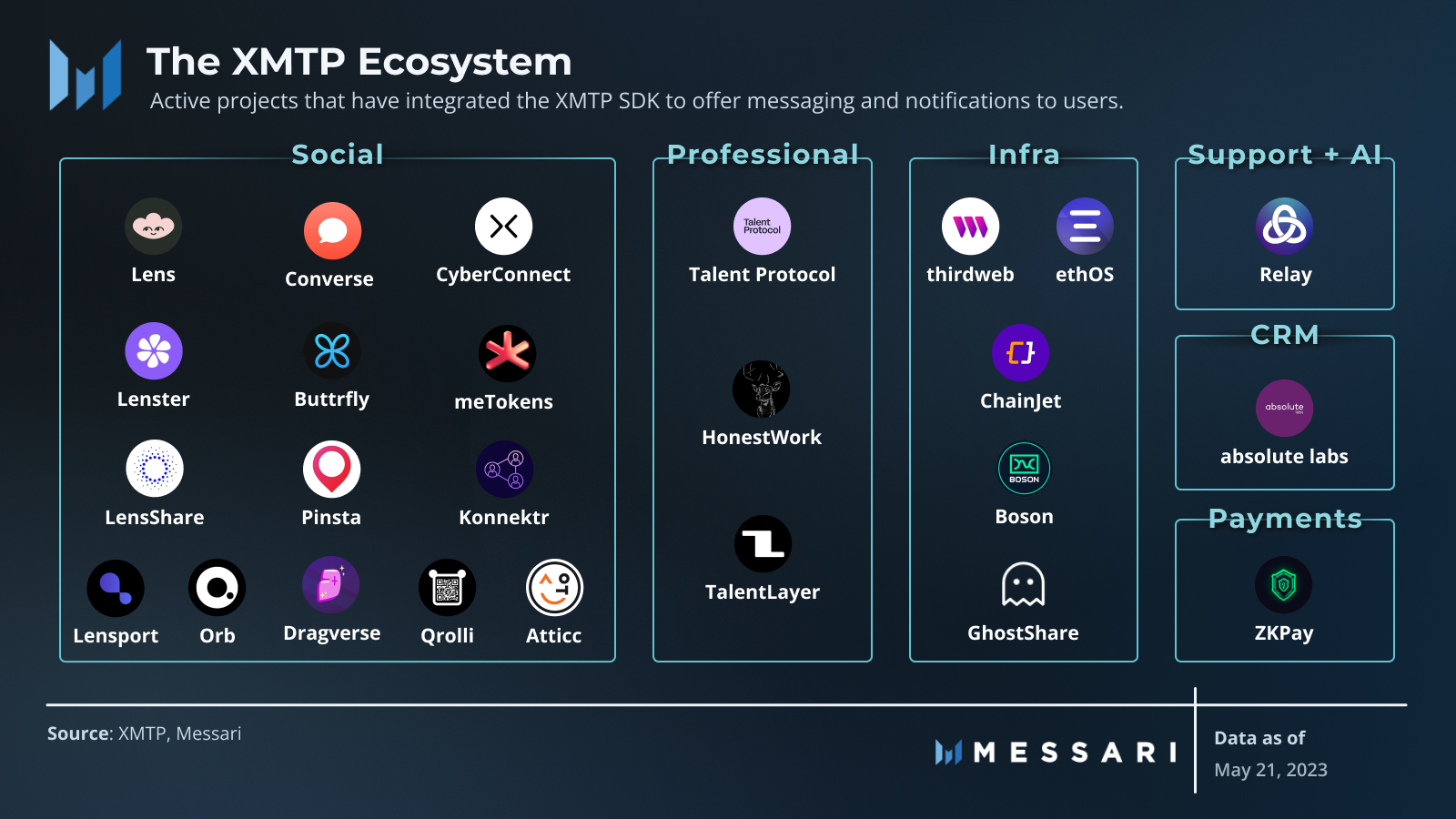
Since launch in early 2022, nearly 1 million XMTP inboxes have been generated and over 300,000 DMs sent. DeSoc protocols with growing traction are playing a crucial role in bootstrapping XMTP’s user base. In November 2022, the Lens API integrated with XMTP, introducing the network to all Lens users.
Lens has grown to over 116,000 profiles minted since its launch in Q2 2022. While the growth of new profiles has slowed since its peak in June 2022, Lens has yet to open its platform beyond whitelisted users. On the other hand, monthly active profiles have increased, showing growing engagement amongst its existing user base. Given XMTP’s privacy-focused design, it is impossible to ascertain which Lens users have been using the direct messaging function, but XMTP stands to benefit from the increasing use of Lens and its growing user base once the protocol becomes permissionless. XMTP will also benefit from growing traction and use of other DeSoc protocols given its competitive neutrality and universal adaptability.
XMTP Under the Hood
XMTP or the “Extensible Message Transport Protocol” facilitates end-to-end encrypted messaging between blockchain accounts. It presently enables messaging between EVM-compatible wallets, but its chain-agnostic design means that it can integrate with other networks in the future. As is, it acts as a unified messaging layer across Ethereum, Arbitrum, Polygon, etc., and in the future, it may serve as a unified messaging layer across non-EVM blockchain ecosystems.
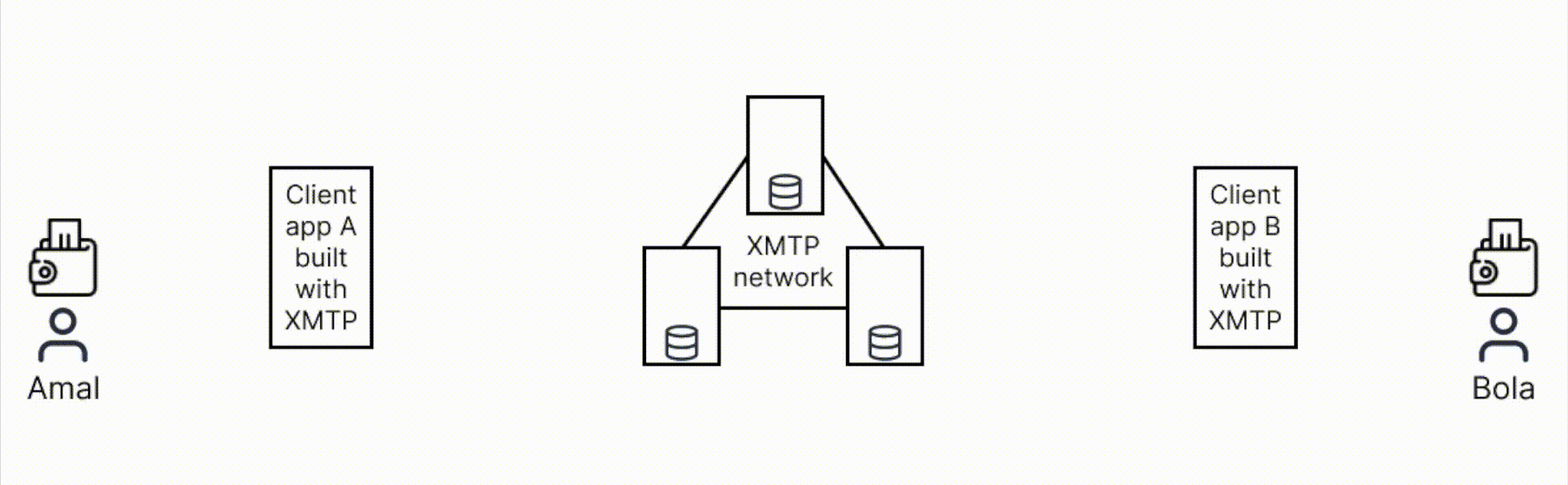
Source: XMTP
XMTP Identities are messaging keys that act as proxies for a user's blockchain account. Users access their inbox by signing a message to decrypt their XMTP Identity. These keys are subsequently used to decrypt incoming messages and encrypt outgoing messages. This design ensures that the XMTP network never has access to a user's blockchain private key. It also allows for the potential to support non-EVM blockchains in the future, once the system is configured to recognize different blockchain signatures.
Apps built on XMTP permissionlessly deploy the XMTP SDK to connect to the network and offer in-app messaging and notifications. Users of these apps send messages to other blockchain addresses, and nodes relay these messages in encrypted “envelopes.” The envelopes are end-to-encrypted such that nodes cannot access their contents, and the message metadata is anonymized such that an observer cannot decipher relationships between participants. Envelopes are retrieved by apps upon a user signing in with their blockchain private key, and decrypted with a user’s XMTP Identity.
XMTP presently only supports 1:1 and 1:many messaging and notifications but will soon expand to natively support group conversations. In the meantime, apps can develop group messaging or other unique experiences by modifying the SDK. Other notable features in the pipeline are native support for account abstraction and “secret conversations,” a new conversation type with additional Signal-level security properties such as forward secrecy and expiring message history. Replies, reactions, and payments are also around the corner.
XMTP’s Positioning and Approach to Mass Adoption
To gain significant adoption, new messaging projects are especially sensitive to network effects, as their value and utility largely depend on the number of users participating in the network. There are four core dimensions that drive success for a messaging protocol:
- User Experience: Offering an intuitive and seamless Web3-integrated experience. It must be cheap and performant to match existing messaging user standards.
- Interoperability: Ensuring cross-platform compatibility and communication.
- Scalability and Privacy: Ensuring efficient, encrypted communication and data protection for user privacy and sovereignty.
- Developer Experience: Providing robust tools for easy integration and third-party development.
All of the above dimensions contribute to a messaging protocol's competitive advantage. As the network grows, it becomes increasingly difficult for competitors to create an alternative messaging app capable of challenging the network effects and reaching a similar user base. A larger network solidifies the project’s competitive edge in the market.
While decentralized messaging is not a new concept, early attempts have struggled to achieve the network effects necessary for widespread adoption. This may be attributed to a lack of convenience and interoperability and hence high switching costs from traditional platforms. Messaging is most viable as a feature of a broader product, so without the adjacent product-market fit of consumer apps to drive users to a messaging protocol, it is difficult if not impossible for a standalone messaging platform to compete with centralized alternatives.
XMTP's neutral positioning and partnership-driven approach makes it stand out from standalone messaging apps each fighting for a piece of market share. Being highly interoperable allows XMTP to meet users where they are, and a single large integration can result in acquiring thousands of new users.
By contrast, the Web3 messaging app Status that dates back to 2017 offers smooth wallet-to-wallet messaging in a dedicated app, but it doesn’t offer an interoperable inbox. Status is thus tasked with converting users to its platform, whereas XMTP benefits from all of the apps that plug into it as a base messaging layer.
XMTP isn’t competing with its customers either, each aiming to implement messaging into apps. Instead, it has the potential to rapidly grow its user base from having these apps build on top of it. XMTP benefits from all of its users’ growing customer bases, while offering a portable inbox experience between them.
Many different types of apps, from group chat apps like Discord to marketing platforms like Mailchimp can utilize XMTP as a generalized communication protocol. XMTP can thus accrue substantial value from the developers that permissionlessly deploy the protocol to deliver messaging and notifications to their users. This is also beneficial to the XMTP developer ecosystem as many different types of builders interact with the open-source codebase and may develop unique features that can be later built into the protocol.
In terms of value accrual, using XMTP is currently free, and messaging between users that opt-in will always be free. While the full implementation details are yet known, it is expected that unsolicited messages will incur “postage” fees, where users will be required to either pay a nominal fee to send a message to a specific user for the first time, or stake a native asset in order to do so. In general, platforms that have viable paths to network effect moats have flexibility in monetization models once they reach scale.
Challenges & Path to Decentralization
XMTP is early in its development, and the features it offers are still limited compared to traditional messaging apps. This is expected to change over time as the project team and its budding developer community work to enhance the protocol.
Additionally, there are a few technical challenges to overcome in order to optimize and decentralize the protocol:
- Key Storage: Encrypted Identity keys are stored by network nodes and accessed by a user each time they access their inbox. This requires the user to sign in each time as there is presently no way to safely store keys oneself. In a recent release of the SDK, keys can be compartmentalized to secure local storage.
- Message Storage: Messages are presently stored by network nodes. Additional mechanisms that afford the user choice over where messages are stored are under development.
- Spam: Network nodes presently rate limit the number of messages sent from certain clients to avoid spam. Other techniques like cryptographic detection of spam addresses and block lists are under development.
- Network Nodes: All nodes are presently operated by the project team. An incentivization scheme is being developed for the permissionless operation of nodes. Just recently, XMTP announced that contributors are able to run testnet nodes on its path to decentralization.
Tackling these challenges will be important to solidify the network’s resilience and usability. Lastly, making a bet on XMTP is like making a bet on the success of the adjacent consumer apps that integrate the protocol. XMTP’s growth will ultimately hinge on the growth of its users’ user bases. Being generalizable and agnostic is a benefit in terms of user acquisition, yet XMTP will ultimately rely on its users to build sustainable apps to drive long-term growth to the network.
Parting Thoughts
XMTP is establishing itself as the go-to messaging protocol for Web3 applications. It enriches the Web3 experience by consolidating communication, transactions, and identity, making it easier to collaborate in the crypto economy. Key to XMTP’s value is its adaptability and interoperability, offering developers a convenient solution for incorporating messaging capabilities, while catering to users across the apps they already use. Looking forward, XMTP will continue to grow its user base through permissionless integrations and strategic partnerships. Rapid adoption is anticipated with the growth of DeSoc, and as more popular apps and wallets implement the protocol.

Stephanie graduated with a BSc in Psychology and began her career in startup operations and consultancy. Prior to joining Messari, she specialized in crypto technical communications. She was an early member of Messari's Diligence Team with ownership over product design, project management, and research quality. She produced and oversaw professional cryptoasset due diligence reports and helped scale the team to 20+ members. On the Enterprise Research team, Stephanie is best known for her work on validator decentralization, scaling, and the modular blockchain landscape.