What if Bitcoin had a treasury?

Like firms, markets, and governments, public blockchains are an institutional technology. Not merely limited to provisioning scarce digital assets, public blockchains could also provide a foundation for a wide variety of social, political, and economic activities.
Key to this vision is the notion of sovereignty. In order to fulfill these aforementioned promises public blockchains must become sovereign - laws unto themselves and resistant to outside interference.
With the twin ideas of institutional technology and sovereignty in mind, it's unsurprising that many blockchain projects have proposed and implemented features usually reserved for sovereign institutions like governments. Nearly all public blockchains implement some kind of mechanism for redistributing value to certain stakeholders that provide invaluable services to a blockchain. Colloquially these mechanisms are referred to as block rewards, but their analog is taxes.
To understand this phenomena, remember that supply inflation does not create value; it redistributes it. When Bitcoin issues new bitcoins to reward miners for their work, existing holders are diluted. At the current rate, Bitcoin holders are diluted by ~3.6% per year (soon to be 1.8%). This amount is Bitcoin’s annual issuance rate, and it is the economic equivalent of a tax holders pay to fund miners who secure the Bitcoin network.
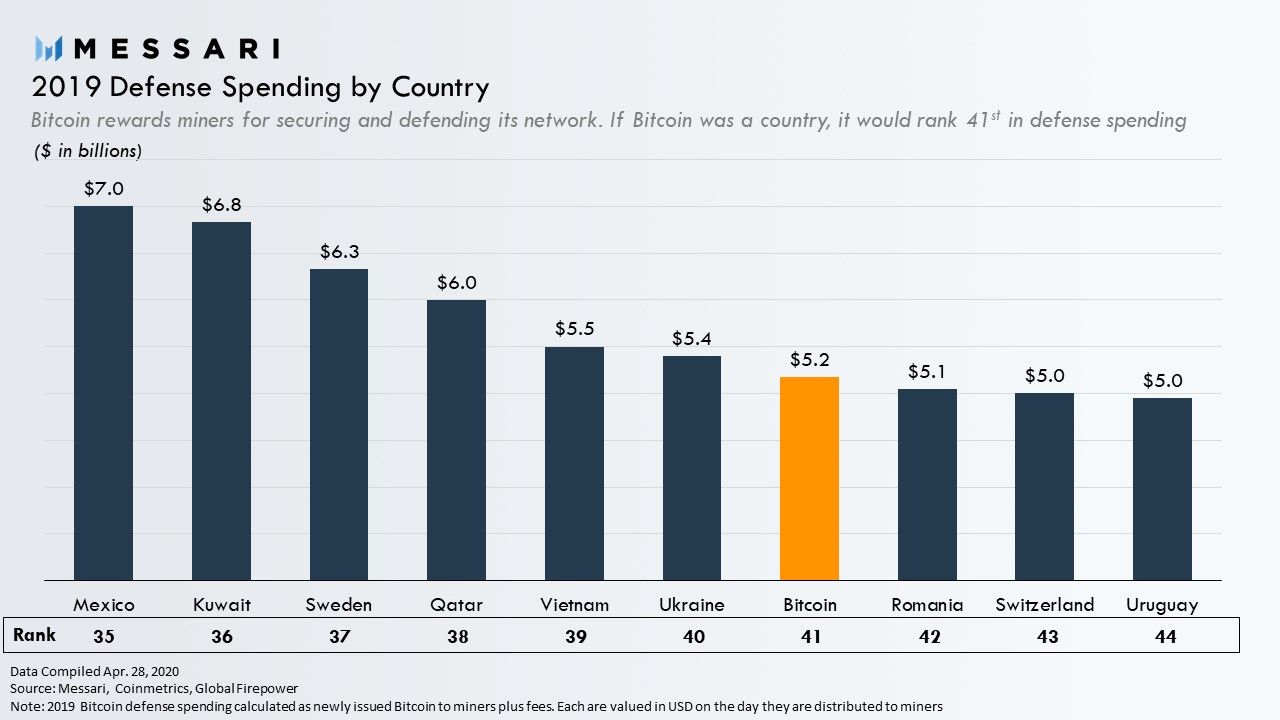
In essence, Bitcoin spends its entire “fiscal budget” on defense. In fact, Bitcoin spends so much on defense it would rank 41st in defense spending if it was a country.
Block reward innovation?

Ryan Watkins was a Senior Research Analyst at Messari. Previously, he worked at Moelis & Company as an Investment Banking Analyst where he worked on deals in the technology, telecom, and fintech sectors. Ryan graduated Magna Cum Laude from the Gabelli School of Business at Fordham University.