Everything you need to know about the next bitcoin halving

When is the next Bitcoin halving?
Expected Bitcoin halving date: May 12, 2020
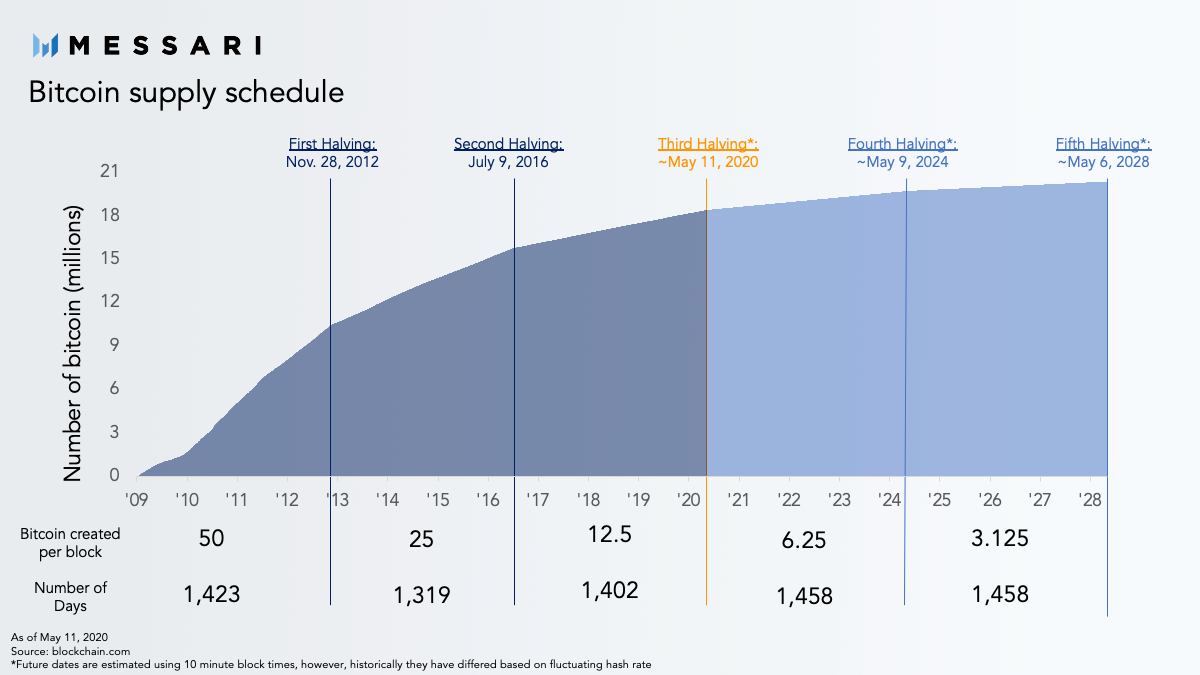
Based on current performance the next Bitcoin halving is expected to occur on May 11, 2020, when Bitcoin mines its 630,000th block. The date is an estimate because of fluctuations in Bitcoin block times. While Bitcoin’s target block time is 10 minutes, each individual block may take more or less time to mine due to the variability of hash power being contributed to the network.
Chart of historical and future halvings
What is the Bitcoin halving?
The Bitcoin halving is an event that occurs every 210,100 blocks (approximately four years) and cuts the number of bitcoin created every block in half. On average, every 10 minutes a block is added to the blockchain through a process known as mining, where specialized computers perform computationally expensive work in order to validate transactions. Miners receive this new bitcoin as compensation in what's known as a block reward. The purpose of the halvings is to decrease the issuance rate of new bitcoin until it eventually reaches its hard cap of 21 million.
Since Bitcoin’s launch, the Bitcoin block reward has halved twice. The first halving occurred in November 2012 when the block reward was halved from 50 BTC to 25 BTC. The second halving occurred in July 2016 when the block reward was halved from 25 BTC to 12.5 BTC. AroundMay 2020 when Bitcoin will reach its 630,000th block, the block reward will be cut in half for the third time, reducing the block reward from 12.5 BTC to 6.25 BTC.
Why does the halving matter?
Bitcoin’s supply is fixed at 21 million coins; however, at launch Bitcoin’s supply started at 0. By design Bitcoin periodically releases new coins every block at a decreasing rate until it ultimately reaches its 21 million cap. A key property of this decreasing issuance rate is that it slows the amount of Bitcoin that is released into circulation over time. Thus, while the current Bitcoin supply is around 18 million, which is about 85% of the 21 million cap, Bitcoin will not reach its 21 million cap until 2140.
The reason behind this decreasing issuance rate is not arbitrary. Bitcoin’s issuance rate and supply cap were implemented by Satoshi Nakamoto with specific intent in mind. Ethereum founder, Vitalik Buterin summarizes the need for a halving in a Bitcoin Magazine article from 2012:
The main reason why this is done is to keep inflation under control. One of the major faults of traditional, “fiat”, currencies controlled by central banks is that the banks can print as much of the currency as they want, and if they print too much, the laws of supply and demand ensure that the value of the currency starts dropping quickly.
Bitcoin, on the other hand, is intended to simulate a commodity, like gold. There is only a limited amount of gold in the world, and with every gram of gold that is mined, the gold that still remains becomes harder and harder to extract. As a result of this limited supply, gold has maintained its value as an international medium of exchange and store of value for over six thousand years, and the hope is that Bitcoin will do the same
The halving matters because it provides predictability about Bitcoin’s issuance rate and enforces Bitcoin’s scarcity, often thought of as a core value proposition of the asset. It is this predictable issuance rate and scarcity that lead many to compare Bitcoin to gold, one of the oldest and scarcest monetary metals in the world.
Beyond issuance rate predictability and scarcity, the halving also matters for Bitcoin’s security. Miners receive bitcoin as compensation for securing the network in the form of newly issued bitcoin and transaction fees. This compensation is considered revenue for miners. Yet, miners also have expenses, and when they receive bitcoin, they need to sell a portion in order to pay for their expenses. After the halving, miners will receive half as many bitcoins as revenue, meaning they will have half as many bitcoins to cover their expenses. Thus, the halving has implications on the security of the network because miners will receive less bitcoin for the work they perform securing the network. As time goes on, due to halvings, Bitcoin’s security will begin to rely more on transaction fees to compensate miners rather than newly issued bitcoins. Eventually, when Bitcoin reaches its 21 million cap, Bitcoin will be entirely secured by transaction fees.
Will the halving affect the price of bitcoin?
Given there have only been two prior halvings, it's impossible to prove what the impact will be. Below are the main arguments for and against the impact of the halving on bitcoin's price.
Bitcoin's price will increase after the halving
This argument relies on the theory that holding demand steady, a supply shock will increase the price of an asset. A popular model backing this idea is stock-to-flow (S2F) that finds a correlation between the ratio of stock (total supply) to flow (newly issued) and the price of bitcoin. With miners only able to sell half as many bitcoin, the price will naturally appreciate after a halving. Since the date is known, traders also bid up prices in advance of the date anticipating others to do the same. In the two prior halvings, this has seemed to play out giving proponents of this theory confidence it will happen again.
Bitcoin's price will not be affected by the halving
This argument states that since everyone knows when the halving will occur if it were to have an effect at all, it would be priced in well before the actual date. In addition, miner selling pressure is an insignificant portion of daily trading volume meaning it won't meaningfully reduce selling pressure. Lastly, this position argues that given the multitude of factors affecting bitcoin's price, the prior bull-runs were unrelated to the specific date of the halving.
Bitcoin's price will decrease after the halving
This is a lesser-discussed thesis but remains a possibility. The fact that the majority of people believe it will increase the price, they will purchase before in anticipation of the price appreciating. If the price doesn't shoot up, they will become disillusioned that their hypothesis was wrong and would sell. Another reason could because miners won't be able to stay in business with half of their revenue slashed and will be forced to shut down. This will lead to a decrease in the hash power of the network leading people to lose faith in the overall security of Bitcoin.
Historical Bitcoin Halvings
2012
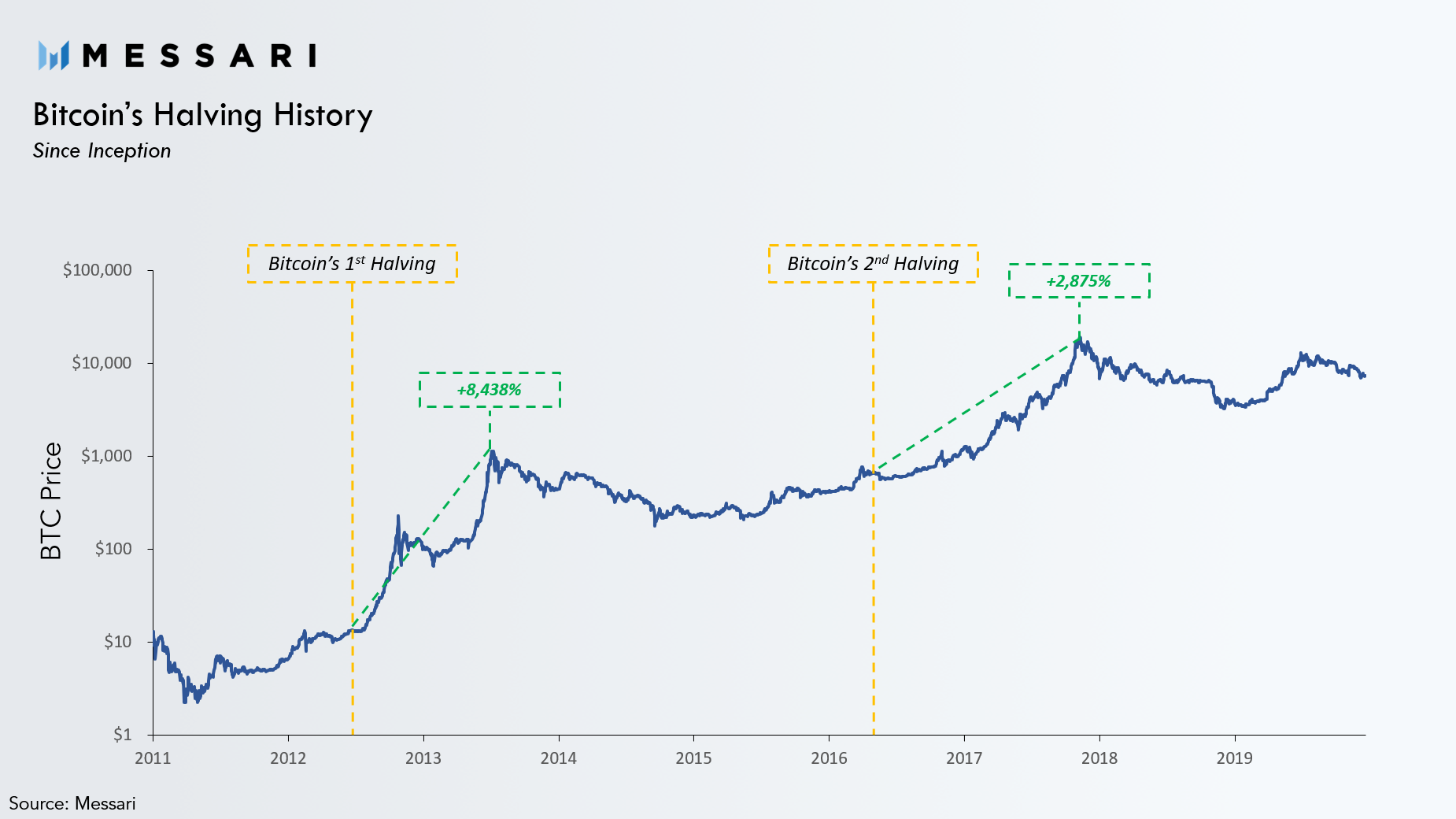
The first Bitcoin halving occurred on November 28, 2012. Going into the event, there were uncertainties around how Bitcoin would be affected, with many of the same hypotheses floating around that were stated above. Vitalik Buterin wrote one of the first pieces for Bitcoin Magazine around the potential implications. Although there was no immediate price impact, within 3 months of the halving Bitcoin’s price rose more than 174%, later rising more than 9100% to its cycle peak in December 2013.
2016
The second Bitcoin halving occurred on July 9, 2016. With the backdrop of the first halving, speculators had some historical precedent for what to expect leading up to the 2016 halving. Nevertheless, uncertainty remained and there existed similar hypotheses on how the halving would affect the price of Bitcoin this time around. Initially, the halving passed and nothing happened, and within 3 months the price of bitcoin was down more than 5%. However, a little over a year later as the great 2017 bull market took off, Bitcoin’s price began to rise dramatically, ultimately rising more than 2,800% to its cycle peak in December 2017.