VeChain is a Layer-1 blockchain purpose-built for real-world use cases. Its architecture includes features such as multi-party gas payment (MPP), adjustable gas fees, batched transactions, and deterministic finality to support data integrity.
VeChain’s adoption strategy focuses on VeBetter, a user-oriented platform developed with Boston Consulting Group. VeBetter enables token-based activity tracking and rewards.
VeChainThor currently operates under a Proof-of-Authority consensus with 101 KYC-verified Authority Masternodes. As part of its ‘VeChain Renaissance’ roadmap, the network is moving to a Weighted Delegated Proof-of-Stake model in December 2025.
VeChain uses a dual-token model: VET for staking and governance, and VTHO for transaction fees. VTHO issuance and burn mechanisms are designed to reduce supply as network activity grows, with recent updates aiming to reinforce this dynamic.
Recent protocol upgrades, including NFT-based staking, EVM compatibility enhancements, and fee adjustments, aim to modernize the network and support decentralized governance.
Introduction
When it comes to real-world use cases, blockchains have the power to greatly increase industrial efficiency, enhance data transparency, eliminate greenwashing, and help individuals monetize data. Whether breaking down data siloes across complex global supply chains, proving a product's sustainability credentials, or enhancing multi-stakeholder coordination, blockchains provide the remedy to contemporary issues of trust.
VeChainThor is a Layer-1 public blockchain purpose-built to tackle these issues. Before launching its public chain, VeChain, alongside PwC, met with various enterprise users to identify key requirements and incorporate tools based on real-world needs. Built on Ethereum’s EVM, VeChainThor introduces features such as a dual-token model for cost predictability, a low-energy consensus mechanism, and blockchain-as-a-service tools to reduce integration complexity. These design choices supported the launch of over 100 enterprise applications across sectors, including sustainability, energy, supply chains, and government services.
VeChain’s strategy focuses on real-world applications through VeBetterDAO (VeBetter), a platform built with Boston Consulting Group. VeBetter combines tokenized records of user actions, verifiable through AI, with a token incentive model, making everyday sustainable behavior both measurable and rewarded. Governed through a DAO structure, the platform has recorded over 20 million such actions to date, linking behavioral data with an onchain incentive system.
Background
VeChain was co-founded in 2015 by Sunny Lu with plans to build a blockchain for supply management solutions. The blockchain was launched in June 2016 as a private consortium chain with support from BitSE, a Chinese Blockchain-as-Service (Baas) company, and primarily focused on anti-counterfeiting and supply chain management through Near Field Communication (NFC) chips, Radio Frequency Identification (RFID) tags, and Quick Response (QR) code.
Early funding came from Fenbushi Capital, one of China’s first blockchain-focused venture firms. This support laid the financial groundwork for VeChain’s development. In 2017, the project launched an initial coin offering (ICO) that raised approximately $20 million through the sale of VEN tokens, VeChain’s original ERC-20 token. These funds were used to build out VeChain’s proprietary Layer-1 blockchain, VeChainThor, which launched in 2018.
Strategic corporate investors soon followed. In 2018, DNV, a European business assurance organisation, acquired a stake in VeChain and integrated its technology into their service offerings. Rather than relying on successive venture rounds, the project sustained itself through enterprise partnerships and its ICO reserves. In 2023, VeChain and Boston Consulting Group established a partnership under a similar premise, but with the goal of delivering a blockchain ecosystem that could solve sustainability challenges and demonstrate real-world adoption of decentralized applications.
Originally designed to solve inefficiencies in global trade for enterprise clients, VeChain’s strategy has expanded to include consumers and app users, with the Foundation driving a new frontier of adoption through VeBetter, its sustainability-focused Web3 app store. The platform builds on VeChain’s track record of real-world adoption to help deliver blockchain applications that target a broad array of sustainability-focused scenarios, from waste reduction to diet, EV charging, and exercise, as described by the UN’s 17 Sustainable Development Goals.
As of June 2025, the VeChain Foundation is approaching the second phase of its new technical roadmap, known as the VeChain Renaissance. This phase includes transitioning its consensus mechanism, introducing a new staking model, modifying its two-token economic structure, and adopting JSON RPC to improve interoperability. The Foundation is also adapting to regulatory developments, having established MiCAR compliance in early 2025 to support token use across the European Union. These changes reflect an effort to develop infrastructure for practical, real-world applications rather than speculative use.
Technology
Blockchain Architecture and Consensus
The VeChainThor network currently relies on a Proof-of-Authority (PoA) consensus model, which uses a pool of 101 KYC-verified validators, known as Authority Masternodes (AM), to produce blocks and maintain system integrity. In addition to the KYC requirements, each AM is required to hold 25 million VET as staked collateral. This design choice was made to reflect the regulatory and business environment VeChain operated in at the time, with clients in regulated industries preferring known validators over anonymous block producers. Through the PoA model, VeChainThor achieves ten-second block confirmation, with finality initiating after 1 epoch, or 180 blocks. Average transaction fees on VeChainThor are less than $0.01.
As part of its VeChain Renaissance upgrade roadmap, the VeChainThor network is migrating its consensus mechanism to a Weighted Delegated Proof of Stake (WDPos) model, removing KYC requirements and further decentralizing the blockchain. In this new model, any VET holder can stake tokens and mint a corresponding Delegator NFT, which serves as a receipt for staked collateral. This collateral can then be delegated to validators to earn block rewards, similarly to other PoS systems. Validators must still maintain a minimum of 25 million VET as collateral; however, the total stake in their pool (equal to total delegator + validator stake) can now total a maximum of 600 million VET, with a greater VET stake positively affecting chances of block production. This hybrid architecture maintains deterministic finality and fast transaction speeds while introducing economic decentralization and community governance.
In addition to AMs, VeChain’s architecture includes two additional node types that enhance network participation and governance:
Economic Nodes: Non-block-producing nodes designed to incentivize long-term VET holding. These nodes contribute to governance and are integrated into the broader staking architecture.
X-Nodes: A legacy category granted to early supporters meeting minimum VET holding thresholds. While no longer issued, X-Nodes confer ecosystem privileges in protocol governance, the VeBetter ecosystem, and other decentralized applications across the network.
As of July 1, 2025, both node types migrated to the new validator/delegator model as part of StarGate, VeChain’s new staking platform.
Smart Contracts, Built-in Tools, and Developer Resources
VeChainThor is EVM compatible, enabling developers to build and deploy Solidity-based smart contracts with minimal changes. This compatibility opens access to slightly modified versions of key Ethereum development tools and libraries, including Remix, Truffle, and Hardhat.
In addition to EVM support, VeChain offers proprietary developer resources such as:
Extension Contracts: Pre-deployed system-level contracts like Authority.sol, Executor.sol, and Energy.sol provide functionalities for validator management, fee delegation, and gas operations.
Multi-Party Payment: A native protocol on the VeChainThor blockchain. MPP enables the sender of a transaction to delegate gas payment to a third-party address. For business users, it removes the need for holding or managing crypto assets.
Multi-Task Transactions (MTTs): A native feature allowing multiple actions to be executed in a single transaction, reducing cost and complexity.
Connex API & VeChain SDK: Provide seamless dApp integration and access to blockchain data for web and mobile applications.
VeChain Kit: A dApp building resource with integrated Privy and social login support. Designed to create apps with simple and seamless interfaces for easier adoption.
VORJ: A no-code token deployment tool enabling developers to issue tokens and deploy smart contracts through a user-friendly interface.
These tools collectively support a developer-friendly environment, facilitating the rapid creation and deployment of blockchain-abstracted dApps on VeChainThor that can be used by users with minimal blockchain knowledge. In the Interstellar phase of VeChain Renaissance, VeChain will integrate JSON RPC, making the porting and integration of common tools, platforms, and services more simple and seamless, opening the network to new growth opportunities.
Network Security, Scalability, and Upgrades
VeChainThor’s architecture emphasizes cost-stability, reliability, and performance, maintaining 100% uptime since inception. Security is ensured through validator identity verification, economic bonding, and the ability to eject validators for misbehavior. With the upcoming validator/delegator system changes, identity verification is removed in favor of a collateral-based staking NFT model, securing the network while decentralizing participation.
The VeChain Renaissance Upgrade introduces new node tiers for Economic Nodes, further opening participation to users with lower stakes of VET. VeChain’s StarGate staking platform, which launched on July 1, 2025, increased APY for nodes in return for actively staking their VET. This stands in contrast to the contemporary model, where VTHO is passively generated by VET.
The StarGate system expands the legacy node programs and gamifies participation and rewards through tiered NFTs. These new node structures are part of a broader economic and governance transformation introduced by the VeChain Renaissance upgrade, which sees increases in staked VET help further secure and protect the blockchain from possible attack vectors.
In summary, VeChain’s technical infrastructure blends enterprise-grade performance with progressive decentralization, enabling verifiable data, programmable incentives, and scalable blockchain adoption across regulated and consumer environments.
Tokenomics
Dual-Token System
VeChainThor features a dual-token system designed to align economic incentives with network usage and security. This model separates value accrual from operational utility, offering stability for enterprise use while promoting active participation through staking and governance. The two native tokens are:
VET (VeChainThor Token): The primary utility and governance token of the VeChainThor protocol. It has a fixed supply of 86.7 billion tokens and is used for staking, voting, and generating gas. It acts as governance collateral, with minimum balances required to maintain different kinds of nodes within the ecosystem.
VTHO (VeThor Token): The gas token used to pay for transactions and smart contract execution. VTHO is automatically generated by holding VET. Beginning July 1, 2025, with the introduction of the gas fee market under the Galactica Upgrade, 100% of the VTHO used in a transaction is burned.
The VeChain Renaissance upgrade, specifically the Hayabusa Stage, which is due to reach mainnet in December 2025, will deliver significant changes to VeChain’s tokenomic model. One notable example being that new VTHO will only be generated through VET staking, reducing generation of ‘idle’ VTHO, such as those generated in exchange wallets, significantly reducing its overall inflation.
Economic Incentives and Flywheel Model
VeChain’s new tokenomic design creates a cyclical feedback loop that creates value from network usage and user growth:
Increasing dApp activity, driven by VeBetter and enterprise use cases, necessitates VTHO consumption.
Increased VTHO scarcity and burn rate, paired with increased market demand from transaction volume growth, potentially raises its value, increasing the fundamental value of VET tokens needed to generate VTHO.
Greater returns attract investors, users, and builders, encouraging more VET staking and network traffic.
More staked VET increases network security and boosts governance participation.
A secure and active network attracts more users and partners, continuing the cycle.
Staking and Reward Mechanisms
As part of the VeChain Renaissance Upgrade, VeChain’s validator and node model is undergoing a significant transformation. KYC will be removed, and new node tiers will be introduced to encourage greater adoption and participation. The VeChain Renaissance initiative introduces a new validator/delegator model where VET holders can participate in network security by staking and delegating collateral through NFT-based mechanisms.
Once the Hayabusa hard fork merges with VeChainThor mainnet in December 2025, validators will be rewarded with 30% of all block rewards, denominated in VTHO, while the pool of delegators delegating to a given validator are awarded the remaining 70%, distributed based on weighted staking. This system design is intended to motivate VET holders, who’ve historically earned passive VTHO rewards, to actively engage in VeChain’s economic security while advancing its decentralization.
The initiative also introduces new tiers of Economic/X-Node that offer varying rewards based on their staked amount. These include:
Dawn Node: The entry-level tier requiring 10,000 VET stake and offering a 1.0x reward multiplier.
Lightning Node: A mid-level tier requiring 50,000 VET stake and offering a 1.15x reward multiplier.
Flash Node: The highest-level tier, requiring 200,000 VET stake with a 1.3x multiplier.
Requisite stakes for existing Economic and X-Nodes range from 600,000 VET up to 15,600,000 VET, with reward multipliers varying by tier and type. X-Nodes generate more rewards than their Economic Node counterparts and have additional privileges within the ecosystem.
Details on VET collateral for differing node tiers can be found here. Please note that the current node system is being upgraded as part of VeChain Renaissance, and, while staking quantities remain the same, other attributes (such as the 5 billion VET collateral reserved for X-Nodes) are changing.
According to community-created staking calculators, VeChainStats and Redeno, staking rewards will grow from an estimated 1-2.5% to as high as 9.1% under some scenarios, increasing the attractiveness of staking on VeChainThor.
VeChain employs a structured onchain governance model that enhances transparency and stakeholder participation in network evolution. Upgrades to the VeChain network are proposed through VeChain Improvement Proposals (VIPs), which then go through a three-step governance process before being implemented.
In the current model:
Decision-Making: Stakeholders, including AMs and Economic/X-Nodes, vote on proposals, either onchain via smart contracts or offchain within the governing body.
Authorization: The Steering Committee, which consists of community elected representatives, submits approved proposals. A majority vote is required for final authorization.
Execution: Once approved, any network participant can execute the onchain action described in the proposal.
Currently, a community-elected Steering Committee acts as the highest layer of governance in VeChain’s model, holding ultimate approval rights for major protocol updates. This semi-centralized design aligns with established market needs in that it provides a competent authority to act in the case of critical issues, while remaining aligned to the decentralized nature of a blockchain. Community governance weighting consists of Economic Node holders, X-Node holders, and AMs, who are granted the right to vote onchain on matters submitted by the Steering Committee.
Committee members serve as decision makers on critical protocol changes such as validator management, protocol upgrades, gas parameters, and reward distribution models. Once proposals are submitted, the community votes for them.
Under VeChain Renaissance, the Steering Committee will be removed from the governance model as the VeChain Foundation continues its push toward greater decentralization and community representation. A decentralized voting platform, VeVote, is currently undergoing an upgrade and redesign to serve as the primary protocol level governance platform.
Ecosystem Overview
VeChain’s ecosystem focuses on application-layer tools designed to support practical use cases, particularly in sustainability. A central component is VeBetter, a Web3 ‘lifestyle’ platform for sustainability-focused decentralized applications (dApps) that reward users for actions such as exercising, adopting sustainable diets, using electric vehicles, or reducing waste. The platform is built for accessibility, with onboarding features tailored to non-crypto users.
VeBetter tokenizes user activities that contribute to sustainability but are difficult to track or monetize using traditional systems. For example, users driving electric vehicles reduce carbon emissions, which can be recorded onchain and assigned a market value. Blockchain reduces the cost of data capture, making it feasible to record and reward large volumes of low-value events.
The platform operates under a DAO structure, with weekly token allocations divided among dApps, users, and the Treasury. Treasury funds support grants, proposals, and ecosystem development based on community votes.
VeBetter takes a user-first approach, complementing VeChain’s existing enterprise and government integrations. This strategy has contributed to growth in transaction volumes and wallet activity since mainnet launch in June 2024. Two applications, Mugshot (for reducing single-use cups) and GreenCart (for more sustainable and healthy diets), each surpassed one million users in Q2 2025.
Governance also incorporates user participation, with incentives for engaging in proposal and voting processes. AI is used alongside blockchain infrastructure to help validate user actions and scale the platform, aligning with broader trends in combining AI with verifiable data systems.
VeBetterDAO Applications
VeBetter operates on two primary tokens: B3TR, the incentive token used to reward users for sustainable behavior, and VOT3, the governance token used to allocate voting weight on the platform's governance aspects.
The recent introduction of the Stella Pay Visa Card opens the ecosystem further, allowing users to spend rewards at over 130 million vendors worldwide.
GreenCart: A consumer-facing application that rewards sustainable, healthy grocery shopping choices. Users upload receipts from eligible retailers and earn B3TR tokens for actions such as buying fresh or organic produce.
Mugshot: An application that issues B3TR tokens to users who opt for reusable mugs instead of disposable ones when consuming coffee or tea. Mugshot records these choices as onchain actions, aiming to reduce reliance on single-use cups.
Cleanify: An app for organizing, joining, and recording environmental cleanup activities. Participants who complete verified cleanups receive B3TR tokens, with data logged onchain including types and weight of collected waste. The app has been actively used in Japan and South Korea.
Green Commuter: A decentralized Web3 app that promotes sustainable commuting by tracking eco-friendly travel. The app quantifies carbon savings from walking, running, and cycling, rewarding users in B3TR.
EVearn: An app that rewards users for driving and charging Tesla Electric Vehicles. Users can log in directly to their cars using their Tesla accounts, thanks to API integrations with Tesla’s open OS. Additional brands of vehicles are expected to be added in the coming months.
Build Your Body (BYB): An exercise and wellbeing app, co-branded by the UFC, that champions a ‘workout-2-earn’ philosophy. The app debuted at UFC 317, gaining exposure across the UFC’s 900 million global viewership.
Together, these applications, among others, form the backbone of the VeBetter ecosystem’s overarching mission: to gamify sustainability and expand real-world impact through tokenized incentive systems and mainstream adoption.
VeWorld
VeWorld is the ecosystem’s most popular wallet, developed and maintained by VeChain Foundation. It is the successor to the original VeChain wallet, VeChainThor, which launched in June 2018. VeWorld is VeChain’s designated ‘Super-App’ and portal into the VeChain ecosystem. With it, users can manage digital assets, including fungible and non-fungible tokens, as well as access VeBetter and its many applications.
The wallet supports functions such as social logins, powered by Privy, and is compatible with Ledger hardware wallets, increasing user options around digital asset security.
To date, VeWorld has had 4.22 million transactions across platforms and OS.
Governance and Infrastructure Tools
VeVote: Is VeChain’s onchain voting platform that allows token holders to participate in governance decisions, including VeChain Improvement Proposals (VIPs). VeVote provides transparent voting results and supports protocol-level decision-making. Only node holders carry governance weighting, and owning a node is a requisite for voting on the platform.
GM NFT Program: As part of VeBetter DAO governance, users can mint a free Earth-tier GM NFT, with upgrades requiring B3TR donations to the Treasury. These tiered NFTs (Earth to Galaxy) are needed to engage in proposals, token allocations, and other governance activities.
VePassport: VePassport is a decentralized identification tool that enables dApps to distinguish between real users and bots using wallet-level behavior. It evaluates wallets based on participation in VeBetterDAO apps, investment levels via GM NFTs, and bot-related signals.
ToolChain, VeCarbon and Enterprise Tools
VeCarbon: A carbon management toolkit built on VeChainThor that enables enterprises to log, certify, and share emissions data onchain. VeCarbon is designed to support carbon accounting frameworks and position enterprises for participation in sustainability markets and compliance regimes.
ToolChain: A Majority of enterprise dApps in the ecosystem are built on or integrated with ToolChain, VeChain’s enterprise-grade blockchain-as-a-service (BaaS) solution.
Notable Recent Partnerships
Ultimate Fighting Championship (UFC) (Jun 2022): VeChain entered a long-term partnership with UFC as its first top-tier blockchain sponsor, gaining recurring visibility across UFC’s global audience. The partnership has included technical integrations, such as embedding VeChain’s NFC and blockchain technology into updated fighter gloves. In 2024, UFC also began actively supporting the VeBetter platform.
Nitto ATP Finals (Nov 2022): VeChain signed a multi-year sponsorship with ATP in 2022, featuring in-person events and tech demonstrations. In 2023, it embedded NFC and blockchain technology into winner’s trophies and displayed sustainability-related use cases in the fan village, reaching hundreds of thousands of attendees.
Power Slap Title Partnership (Apr 2025):VeChain became the Official Title Partner of Power Slap, expanding its presence in sports and media. The partnership includes brand integration at events, digital broadcasts, and collaborations with UFC figures such as Dana White.
GreenCart Joins Retail Institute Italy (Apr 2025): GreenCart, a sustainability-focused app built on VeChainThor, joined Retail Institute Italy, gaining exposure to over 200 supermarket sector stakeholders and expanding VeChain’s footprint in retail applications.
Dana White Joins Advisory Board (Apr 2025): In April 2025, VeChain announced that UFC President Dana White joined as an ecosystem advisor. His appointment signals growing interest from mainstream entertainment and adds strategic input to VeChain’s outreach initiatives.
4Ocean Partnership (Apr 2025): VeChain and ocean cleanup non-profit 4ocean announced a collaboration to remove 300,000 pounds of plastic from global waterways. The initiative integrates blockchain to log, verify, and incentivize cleanup efforts via VeBetter.
Roadmap
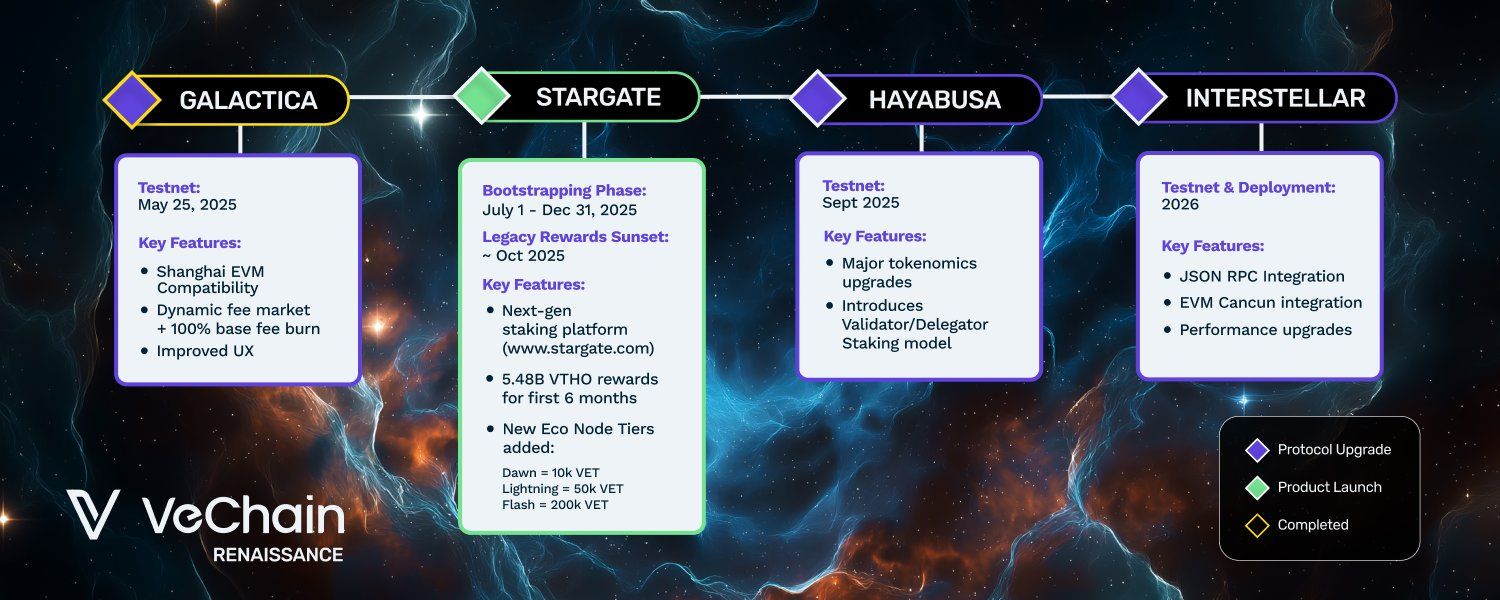
VeChain’s roadmap is anchored by the implementation of the Renaissance Upgrade, a phased initiative aimed at modernizing protocol architecture, refining tokenomics, and enhancing governance mechanisms. This upgrade represents a culmination of years of development and positions the network for future growth.
With the recent launch of the Galactica phase, which introduces dynamic gas fees, 100% base fees burned, and improved EVM compatibility, subsequent phases, including Hayabusa and Interstellar, will further expand staking incentives, interoperability, and decentralized governance. The Renaissance upgrade marks a major step in transforming VeChain into a more open, scalable, and economically aligned public blockchain.
Q2 2025 - Galactica Mainnet Launch: On July 1, 2025, VeChain implemented the Galactica hardfork, which introduced a dynamic gas fee model and EVM Shanghai alignment. These upgrades enhance EVM compatibility and make transaction fees more efficient, aligning VeChainThor with Ethereum’s evolving standards.
Q3 2025 - Hayabusa Testnet and Governance:Hayabusa will introduce overhauled tokenomics, a new VTHO consumption and distribution model, and additional consensus mechanism changes. A dedicated Hayabusa testnet and subsequent all-stakeholder vote will determine mainnet integration.
Q4 2025 - Hayabusa Mainnet Launch: Hayabusa upgrades will go live, including:
A revised VTHO issuance curve.
A new incentive framework prioritizing active staking, development, and governance participation.
Go-live of Validator and Delegator functionality.
Intergalactic Phase (Post-Q4 2025): The final phase of the Renaissance initiative will deliver full JSON RPC integration and seamless interoperability enhancements. These upgrades will standardize interaction with VeChainThor for external applications and developers.
Closing Summary
VeChain is positioning itself as a purpose-built blockchain infrastructure for real-world applications and everyday users focused on traceability, sustainability, and compliance. Its progression from a supply chain-focused network to a broader SDG-aligned platform reflects a pragmatic approach to solving real-world problems with verifiable, low-cost digital systems. Through enterprise partnerships, regulatory alignment, and technical upgrades such as NFT-based governance, EVM compatibility, and deflationary fee structures, VeChain is evolving into a blockchain ecosystem designed for durable institutional use rather than speculative activity.
With applications like GreenCart, MugShot, and an array of business use cases, VeChain offers a growing suite of tools that connect onchain incentives to real-world outcomes. Its dual-token model separates utility from value accrual, providing operational stability while promoting stakeholder participation. As organizations seek efficient systems to validate environmental and operational claims, VeChain’s infrastructure supports scalable, transparent, and programmable coordination across industries. These characteristics place VeChain in a strong position to support enterprise adoption in regulated and sustainability-driven sectors.
This report was commissioned by VeChain. All content was produced independently by the author(s) and does not necessarily reflect the opinions of Messari, Inc. or the organization that requested the report. The commissioning organization may have input on the content of the report, but Messari maintains editorial control over the final report to retain data accuracy and objectivity. Author(s) may hold cryptocurrencies named in this report. This report is meant for informational purposes only. It is not meant to serve as investment advice. You should conduct your own research and consult an independent financial, tax, or legal advisor before making any investment decisions. Past performance of any asset is not indicative of future results. Please see our Terms of Service for more information.
No part of this report may be (a) copied, photocopied, duplicated in any form by any means or (b) redistributed without the prior written consent of Messari®.
Alexander is a protocol researcher specializing in Layer-1 and Layer-2 infrastructure, as well as RWA's and Stablecoins. Before Messari, he worked at Jump Trading and Bull-Moose Consulting. He graduated from Northeastern University with a degree in Economics and Data Science, and helped run Northeastern's blockchain club.
Alexander is a protocol researcher specializing in Layer-1 and Layer-2 infrastructure, as well as RWA's and Stablecoins. Before Messari, he worked at Jump Trading and Bull-Moose Consulting. He graduated from Northeastern University with a degree in Economics and Data Science, and helped run Northeastern's blockchain club.