Humanity Protocol is a decentralized trust layer using palm biometrics and zero-knowledge proofs to verify human uniqueness and generate privacy-preserving credentials for identity, KYC, and broader trust use cases.
Founded by Terence Kwok, with guidance from Yat Siu (Animoca Brands) and Sandeep Nailwal (Polygon Labs), the project has raised over $30M from leading investors, including Kingsway Capital, Pantera Capital, and Jump Crypto.
Palm biometrics were chosen for accuracy, liveness detection, and accessibility. Mobile onboarding is live today, and hardware scanners are planned for public deployment.
Proof-of-Trust (PoT) issues private, verifiable credentials, enabling users to prove traits like age or residency with a palm scan, verified onchain by zkProofer Nodes.
In November 2025, Mastercard partnered with Humanity Protocol to allow verified users to access regulated financial services without exposing underlying personal or financial data.
Background
Trust remains a critical unresolved issue in online systems. In 2024, over 1.7 billion data breach notices were issued, a fourfold increase from the prior year. Blockchains have mitigated data theft at the consensus layer, yet users and applications remain exposed to fraud and botnets. Moreover, centralized identity providers such as governments or major e-commerce platforms control authentication systems in ways that often compromise privacy and limit user control.
Advances in generative AI escalate these vulnerabilities. Deepfakes, synthetic personas, and automated bots blur the line between real and artificial participants, creating new angles for data fraud. Existing safeguards offer little relief: CAPTCHAs are trivial for AI to bypass, document uploads create friction and privacy risks, and centralized KYC reinforces the trust problems mentioned above.
Humanity Protocol proposes a decentralized trust architecture that verifies uniqueness, identity and personal attributes onchain. Palm biometrics is used to verify that each participant is a unique, living human, without storing or exposing raw biometric data. On top of this, zero-knowledge cryptography enables Humanity to issue and verify privacy-preserving credentials about almost any attribute (e.g., age, residence, or income band) on behalf of users, which can be verified in a privacy-preserving manner.
By shifting control of identity away from centralized intermediaries and embedding privacy into the verification process, Humanity Protocol establishes an open identity layer, providing the foundation for trusted digital participation at a global scale.
Introduction
Humanity Protocol (H) is a decentralized EVM-compatible L2 network that leverages palm biometrics to verify users' liveness and identity. Humanity centers on a Proof-of-Trust protocol: a privacy-first, Sybil-resistant infrastructure that utilizes non-invasive biometrics and advanced cryptography to verify personal attributes across various applications without requiring users to expose their personal information to prove specific facts about themselves. The protocol was founded by Terence Kwok, with advisors Yat Siu (Animoca Brands) and Sandeep Nailwal (Polygon), to provide a scalable, Sybil-resistant identity layer using non-invasive biometrics and cryptography.
In 2024, Humanity Protocol raised $30 million in a seed round at a valuation of $1 billion. Investors included Kingsway Capital, Pantera Capital, Animoca Brands, Hashed, Shima Capital, and Jump Crypto. Funding was allocated to protocol development, ecosystem expansion, and hardware deployment. Humanity raised an additional $20 million from Pantera and Jump at a $1.1 billion valuation in January 2025.
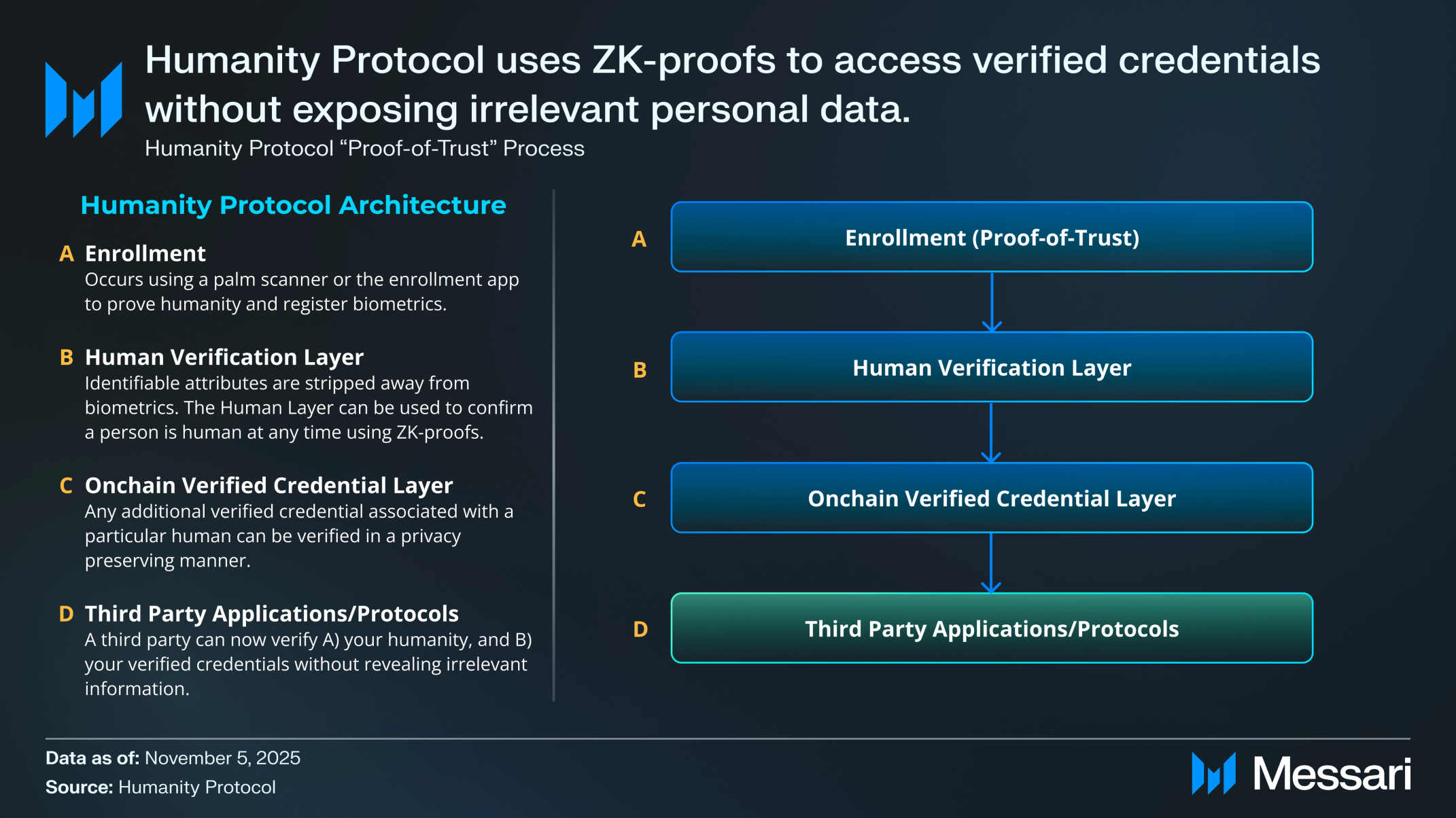
Humanity’s primary product, the Proof-of-Trust protocol, provides developers with unique human authentication mechanisms and users' ownership over identity-related data. Proof-of-Trust uses palm scanners or a mobile app to enroll and verify humans. After a user’s palm is scanned, the protocol generates a cryptographic proof that can’t be reverse-engineered or linked to the original image, ensuring no biometric data is stored and users retain control over their identity. Instead of storing biometric data, the system generates a hash tied to a Human ID, which can be verified using zero-knowledge (zk) proofs, a cryptographic method by which users can prove they possess certain knowledge. This allows users to prove liveness, or even individual traits like age, residency or income band, without revealing documents or biometric images. Users reverify using surface palm prints from the user’s mobile device or infrared vein scans from a palm scanner to confirm verified credentials.
In 2025, Humanity acquiredMoongate, an onchain ticketing and credentialing platform. The acquisition expanded the protocol’s scope beyond digital identity to include event access, loyalty programs, and real-world credential issuance. Moongate’s infrastructure is now integrated with Humanity’s Proof-of-Trust layer, allowing Human IDs to be used for fraud-resistant ticketing and access control.
The protocol’s mainnet went live in 2025 following a testnet phase with over two million Human IDs issued. To align token distribution with the protocol’s Sybil-resistant design, Humanity only airdropped the H token to verified human users. Distribution included early contributors, Kaito stakers, Discord members, and ecosystem builders. This approach aimed to mitigate the influence of Sybils or automated accounts.
Technology & Products
Proof-of-Trust
The Proof-of-Trust (PoT) mechanism, which uses surface palm prints from the user’s mobile device or infrared vein scans from a palm scanner, is Humanity Protocol’s core product. This allows users to prove their unique humanity and access services and experiences tied to Humanity Protocol in the physical world. The mechanism involves scanning a user's palm to generate a cryptographic representation that cannot be reverse-engineered or linked to the original biometric image.
This biometric data is decentralized and stored on Walrus. Users can demonstrate possession of a credential, such as being over 18, without disclosing their birthdate. When a user rescans their palm in the future, zkProofer Nodes conduct a proof and process it onchain to verify their identity. This privacy-preserving approach ensures that no raw biometric data or personal information is stored on centralized servers, so users retain complete control over their identity.
Humanity Protocol extends Proof-of-Trust into an onchain identity verification system by allowing verified users to generate and present verified credentials (VCs) after their initial enrollment. Without exposing underlying data, these cryptographic attestations confirm specific traits, such as age, residency, or event access. Credentials are non-transferable and bound to a single Human ID, which prevents delegation or resale.
The decentralized network of zkProofer Nodes is responsible for verifying VCs. zkProofer Nodes never access raw user data; they only process cryptographic proofs, ensuring privacy and censorship resistance. Node participation is incentivized via H rewards, and node licenses are distributed through a draw system to promote decentralization.
The total addressable market for privacy-preserving identity spans both Web2 and Web3 and is being addressed by major companies like Microsoft, Apple, and Google. Onchain use cases include voting, airdrops, and compliance-constrained applications such as KYC (Know Your Customer) in DeFi. In Web2, fintech, education, and gaming sectors often require repeated KYC processes or third-party credential validation that could expose users to unnecessary risk. Existing solutions are concentrated among centralized providers and data brokers. A decentralized system that supports programmable, user-owned verification offers a structural alternative with broad application.
Palm Scanner
Humanity Protocol uses palm biometrics to prove users’ humanity and uniqueness. Palm recognition was selected over other biometric methods, such as facial or iris scans, because it is less invasive, difficult to imitate, and can be captured with consumer-grade hardware. Palm prints and vein patterns provide a high degree of uniqueness while reducing privacy risks compared to more personally identifiable traits like facial features.
The protocol introduces verification in two phases. In the first and current phase, users enroll through a mobile application that captures surface palm prints using a device camera. This lowers the barrier to entry and enables quicker distribution of Human IDs without requiring dedicated hardware.
In the second phase, Humanity will deploy proprietary palm scanners that capture vein patterns using infrared imaging. These scanners improve accuracy, detect liveness with higher assurance, and enable secure offline enrollment for users without smartphones or stable internet access. The dedicated hardware extends the capabilities of the mobile application in several ways. Infrared vein scanning provides a stronger defense against spoofing and replay attacks, while also allowing the system to verify liveness in conditions where surface imaging may be less reliable.
Humanity's palm scanners verify ownership of credentials, such as tickets, memberships, or payment cards, without revealing the user's identity. When a user scans their palm, the device generates a zero-knowledge Proof of Trust that verifies they are the rightful holder of specific verifiable credentials stored on Humanity. Users present their palm instead of QR codes, plastic cards, or IDs, and the scanner confirms authenticity, validity, and ownership.
At scale, Humanity Scanner devices are designed to operate within a decentralized physical infrastructure network (DePIN). By placing scanners in public or institutional settings, the protocol can support enrollment and credential verification across use cases such as building access, transportation, education, healthcare, and payments.
zkProofer Nodes
zkProofer Nodes verify zk-proofs within the Proof-of-Trust system. When a user enrolls, their biometric scan is converted into a cryptographic commitment associated with a Human ID. To interact with an application, the user generates a proof demonstrating that their credential is valid and meets the required conditions, such as proving age or residency. zkProofer Nodes do not process or store biometric data. They only validate cryptographic proofs, which prevents operators from reconstructing biometric information.
Node participation is decentralized and permissioned through a licensing mechanism. Licenses will be allocated through a draw system (i.e., a lottery) rather than permanent ownership, reducing the concentration of power and encouraging turnover in node operation. This approach distributes verification responsibilities evenly across the network while still allowing operators to earn rewards for correct validation.
Incentives for zkProofer Nodes are paid in H, Humanity Protocol’s native token. Rewards are distributed for accurate and timely proof verification. Conversely, nodes that fail to follow protocol rules or attempt malicious behavior can be penalized through slashing, aligning operator incentives with network security and reliability.
The role of zkProofer Nodes is distinct from that of credential issuers and, in the future, Identity Validators, which have the authority to issue VCs. They guarantee that the Proof-of-Trust mechanism is both decentralized and privacy-preserving, preventing any single party from monopolizing identity verification or accessing user-level data.
zk-TLS
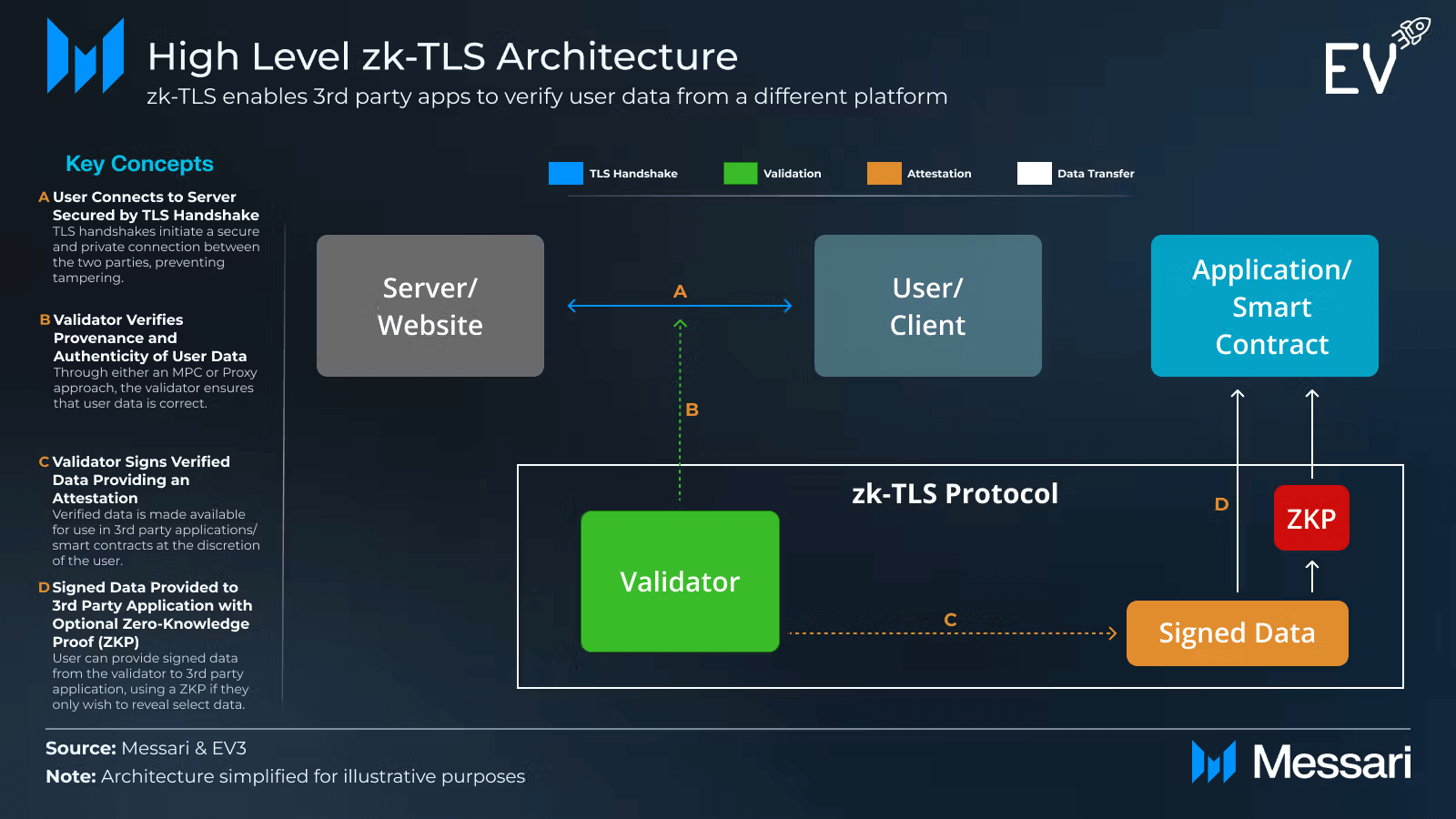
Humanity Protocol’s zk-TLS framework replaces the conventional KYC/identity verification model with cryptographic proof. Rather than uploading documents, users can prove specific identity traits, such as human verification or geographic eligibility, without disclosing underlying data. zk-TLS captures a TLS handshake (allows two parties to authenticate each other over the internet, establishing a secure channel for transferring data) between a user and server, allowing a validator to verify attributes like age or residency without exposing raw data. The validator signs the verified data, which the user can convert into a zero-knowledge proof and submit to an application. This lets third parties confirm identity traits without accessing the underlying information.
zk-TLS can be used in a range of identity-gated settings, including:
Regional compliance: Verify location eligibility for token sales or financial products without revealing geographic data.
Private logins: Authenticate users on education, gaming, or content platforms without storing credentials.
Event access: Verify ticket ownership or attendance eligibility without exposing personal identity.
Ecosystem Overview
Humanity Protocol’s ecosystem is structured around its Proof-of-Trust identity layer. By providing verifiable credentials and Sybil-resistant authentication, the protocol can integrate with applications across multiple sectors, including gaming, healthcare, and governance.
Mastercard (Finance): Humanity Protocol is integrated with Mastercard to enable users to access financial products, like loans and bank accounts, by verifying their financial information without ever exposing underlying data to third parties.
ApeChain (Gaming and NFTs): Humanity Protocol is integrated with ApeChain to support Sybil-resistant onboarding for gaming and NFT use cases. Human ID enables fair distribution of in-game assets and NFT drops by preventing automated account creation and multi-wallet manipulation.
Prenetics (Healthcare and Genomics): Humanity Protocol is integrated with Prenetics to issue verifiable healthcare and genomics credentials. These credentials can confirm traits such as test results or patient identity without exposing sensitive medical data.
Kaito (Data and AI Research): Kaito integrates Humanity’s Human ID to ensure that data contributors and participants in AI-related initiatives are verified, unique humans. This limits bot-driven manipulation in data collection and reinforces the integrity of crowdsourced intelligence. Kaito stakers were also included in Humanity’s Fairdrop, reflecting their early participation in the ecosystem.
Moongate Acquisition
In June 2025, Humanity Protocol acquired Moongate, an onchain ticketing and credentialing platform. The integration extended Humanity’s Proof-of-Trust system into event access, loyalty programs, and real-world credential issuance. By linking Human IDs with Moongate’s infrastructure, the protocol enables non-transferable event tickets and access passes that prevent resale, duplication, and Sybil-based manipulation. This acquisition marked Humanity’s first major expansion of its identity layer into practical, consumer-facing applications.
Mastercard Partnership
In November 2025, Humanity Protocol announced a partnership with Mastercard to integrate the company’s Open Finance technology into Humanity’s Human ID system. The collaboration bridges decentralized identity and traditional finance, allowing verified users to access regulated financial services, such as credit, loans, and bank accounts, without exposing underlying personal or financial data.
Through this integration, Human ID holders can create validated credentials based on financial attributes like income, cash flow, and asset ownership using ZK-proofs. Financial institutions and lenders can then confirm eligibility or creditworthiness through cryptographic attestations rather than document uploads or manual verification.
The partnership’s first deployment in the United States demonstrates the potential for privacy-preserving Open Finance, where reusable, verified credentials streamline access to both DeFi and regulated markets. Longer term, this integration could enable onchain credit scoring, undercollateralized lending, and trusted RWA participation, positioning Humanity Protocol as a bridge between self-sovereign identity and global financial infrastructure.
Tokenomics
The H token is Humanity Protocol’s native governance and utility asset. It is used to pay transaction fees, secure the network through staking, incentivize zkProofer Nodes and, eventually, pay validators and govern protocol upgrades. Credential issuers and validators must stake H to participate, while holders can delegate tokens to earn rewards.
To reinforce sybil resistance at launch, Humanity distributed an initial supply of H through a “Fairdrop”. To reduce the influence of automated accounts and concentrated capital, only verified humans were eligible. The first distribution included early community contributors, Kaito stakers, Discord members, and ecosystem builders.
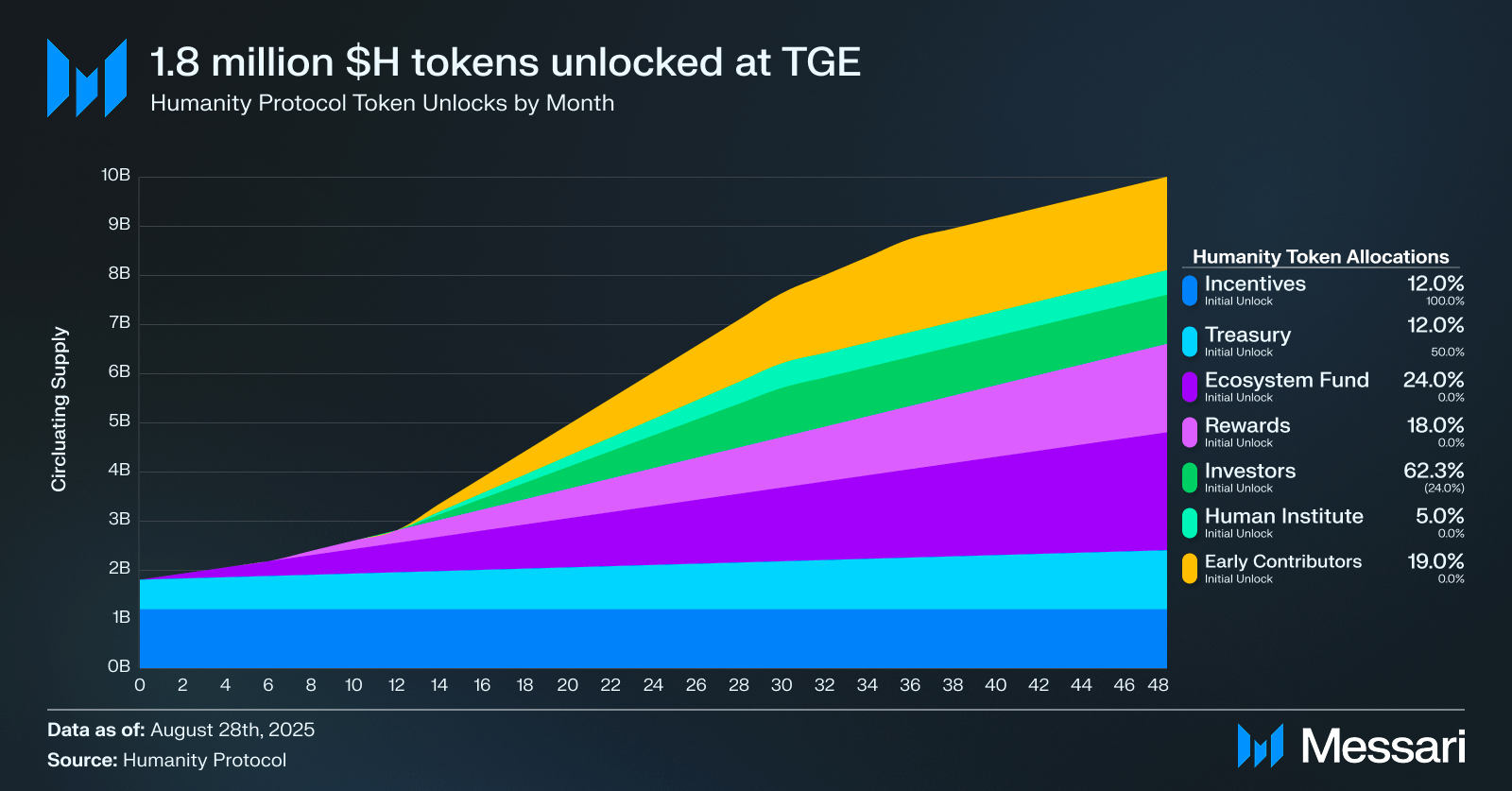
The total supply of 10 billion will be distributed over 48 months and allocated to the following groups.
Team (19%) – Reserved for founders and core contributors, subject to long-term vesting. Tokens have a 12-month cliff before vesting for 24 months afterward, with 0% unlocked at TGE.
Investors (10%) – Allocated to early backers from the $30M seed round, with vesting to align incentives. Tokens have a 12-month cliff before vesting for 12 months afterward, with 0% unlocked at TGE.
Strategic Reserve (5%) – Set aside for future partnerships and strategic initiatives. Tokens have a 12-month cliff before vesting for 12 months afterward, with 5% unlocked at TGE.
Foundation (12%) – Controlled by the Humanity Foundation to fund grants, governance, and ecosystem programs. Tokens vest for 48 months, with 50% unlocked at TGE.
Ecosystem Fund (24%) – Supports integrations, developer incentives, and long-term protocol growth. Tokens vest for 48 months, with 0% unlocked at TGE.
Identity Verification Rewards (18%) – Allocated to incentivize Human ID verification and ongoing proof maintenance. Tokens have a 6-month cliff before vesting for 42 months afterward, with 0% unlocked at TGE.
Community Incentives (12%) – Directed to community programs, hackathons, and additional Fairdrops. Tokens are fully vested at TGE.
Roadmap
Humanity Protocol’s roadmap is structured in phased deployments designed to progressively decentralize credential issuance and improve privacy guarantees.
Phase 1: Issuance with Core Platform
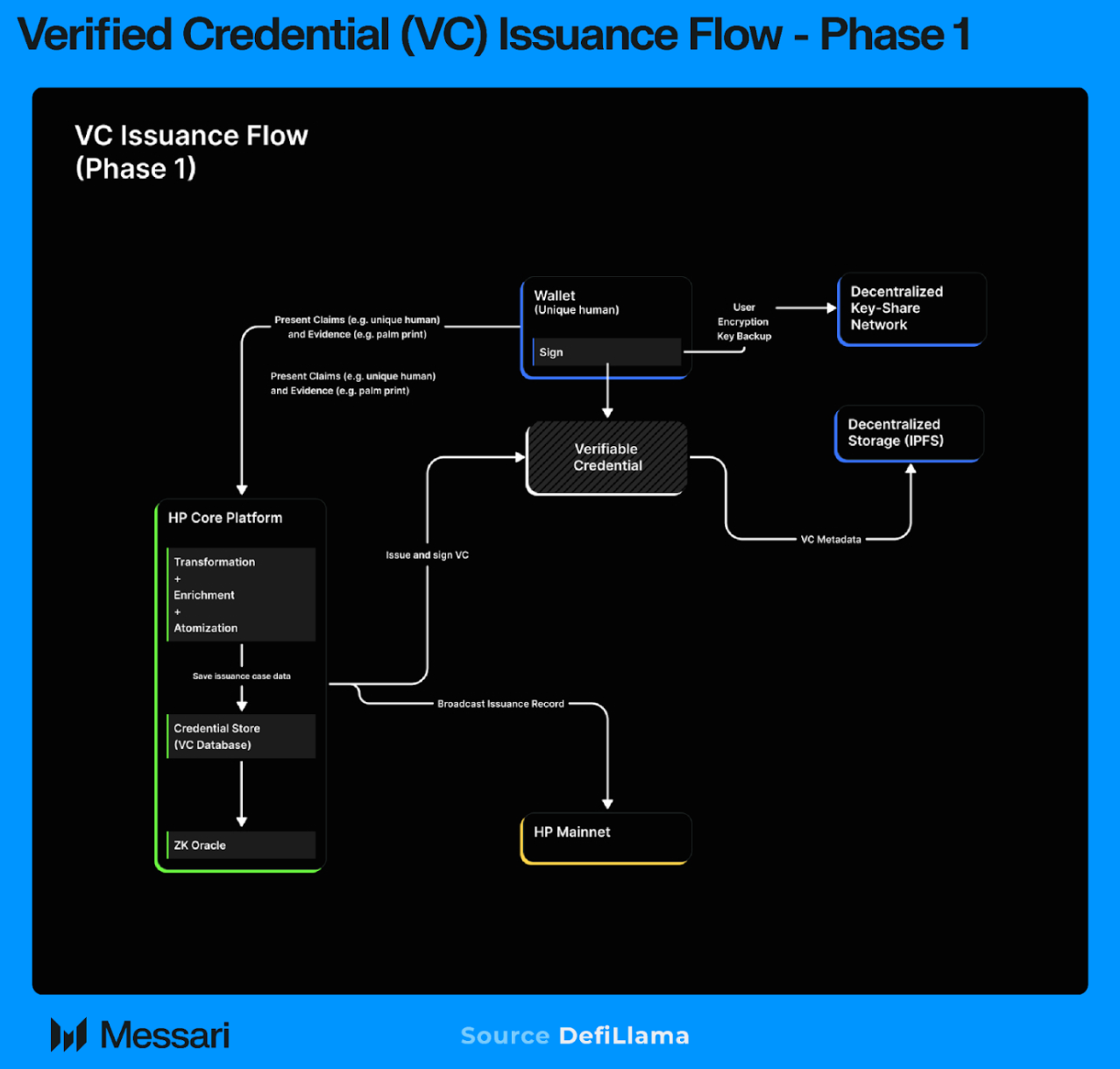
In Phase 1, verifiable credentials are issued and signed directly by the Humanity Protocol Core Platform. Users present claims (e.g., “unique human”) and biometric evidence (e.g., palm scan). The Core Platform transforms this data, stores issuance records in the credential database, and issues a verifiable credential to the user’s wallet. Credential metadata is backed up through decentralized storage (IPFS) and the decentralized key-share network, but the trust anchor in this phase remains the Core Platform itself. Validation relies on a zk-oracle for proof generation, but consensus from external validators is not yet part of the flow.
Phase 2: Issuance with Validator Consensus
Phase 2 introduces Identity Validators for credential issuance. Claims and biometric evidence are presented to validators, which collectively reach consensus before a credential is issued. This step removes sole reliance on the Core Platform and distributes verification authority across the network. Issuance records are written to the credential store only if consensus is achieved, and both personally identifiable (PI) and non-PI data are managed through this process. This phase strengthens decentralization and reduces trust assumptions by requiring validator agreement, aligning credential issuance with the protocol’s broader governance model.
Closing Summary
Humanity Protocol reimagines digital identity through a unique blend of privacy-preserving data sharing, user-owned biometrics, zero-knowledge cryptography, and decentralized governance. Its Proof-of-Trust system addresses the foundational problem of lack of verifiability and Sybil resistance, enabling secure, user-owned identity across both digital and real-world domains.
The project’s robust architecture, dynamic incentive structures, and rapidly expanding ecosystem position it as a foundational layer for the future of trusted digital interactions. Backed by a world-class team, top investors, and a global community, Humanity Protocol stands at the frontier of decentralized identity innovation, poised to onboard new users to a more secure, private, and inclusive digital society.
This report was commissioned by Humanity Protocol. All content was produced independently by the author(s) and does not necessarily reflect the opinions of Messari, Inc. or the organization that requested the report. The commissioning organization may have input on the content of the report, but Messari maintains editorial control over the final report to retain data accuracy and objectivity. Author(s) may hold cryptocurrencies named in this report. This report is meant for informational purposes only. It is not meant to serve as investment advice. You should conduct your own research and consult an independent financial, tax, or legal advisor before making any investment decisions. Past performance of any asset is not indicative of future results. Please see our Terms of Service for more information.
No part of this report may be (a) copied, photocopied, duplicated in any form by any means or (b) redistributed without the prior written consent of Messari®.
Sam was previously a product manager at ether.fi, as well as LifeMed AI. He graduated from Ohio State University, where he founded the Ohio State Blockchain Club. He is now an Enterprise Research Analyst at Messari focused on finding the next best applications and protocols in internet finance.
Sam was previously a product manager at ether.fi, as well as LifeMed AI. He graduated from Ohio State University, where he founded the Ohio State Blockchain Club. He is now an Enterprise Research Analyst at Messari focused on finding the next best applications and protocols in internet finance.