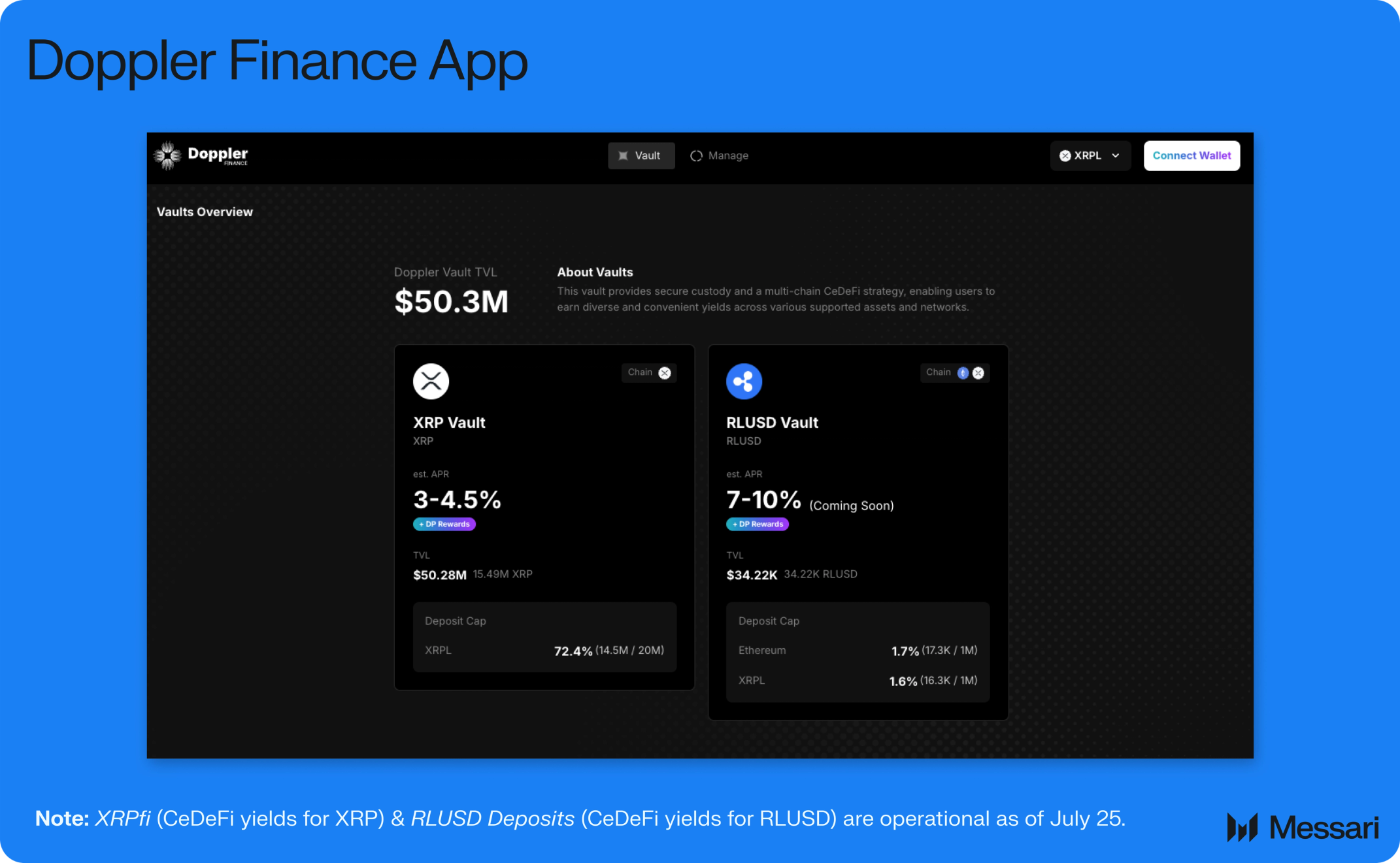
Doppler Finance is a yield-generation protocol built on the XRP Ledger. Its core product, XRPfi, allows users to deposit XRP and earn yield through CeDeFi strategies, which require centralized custody and offchain execution. Doppler also operates an RLUSD vault that accepts deposits on XRPL or Ethereum, with yield strategies in development and scheduled to go live in Q3 2025.
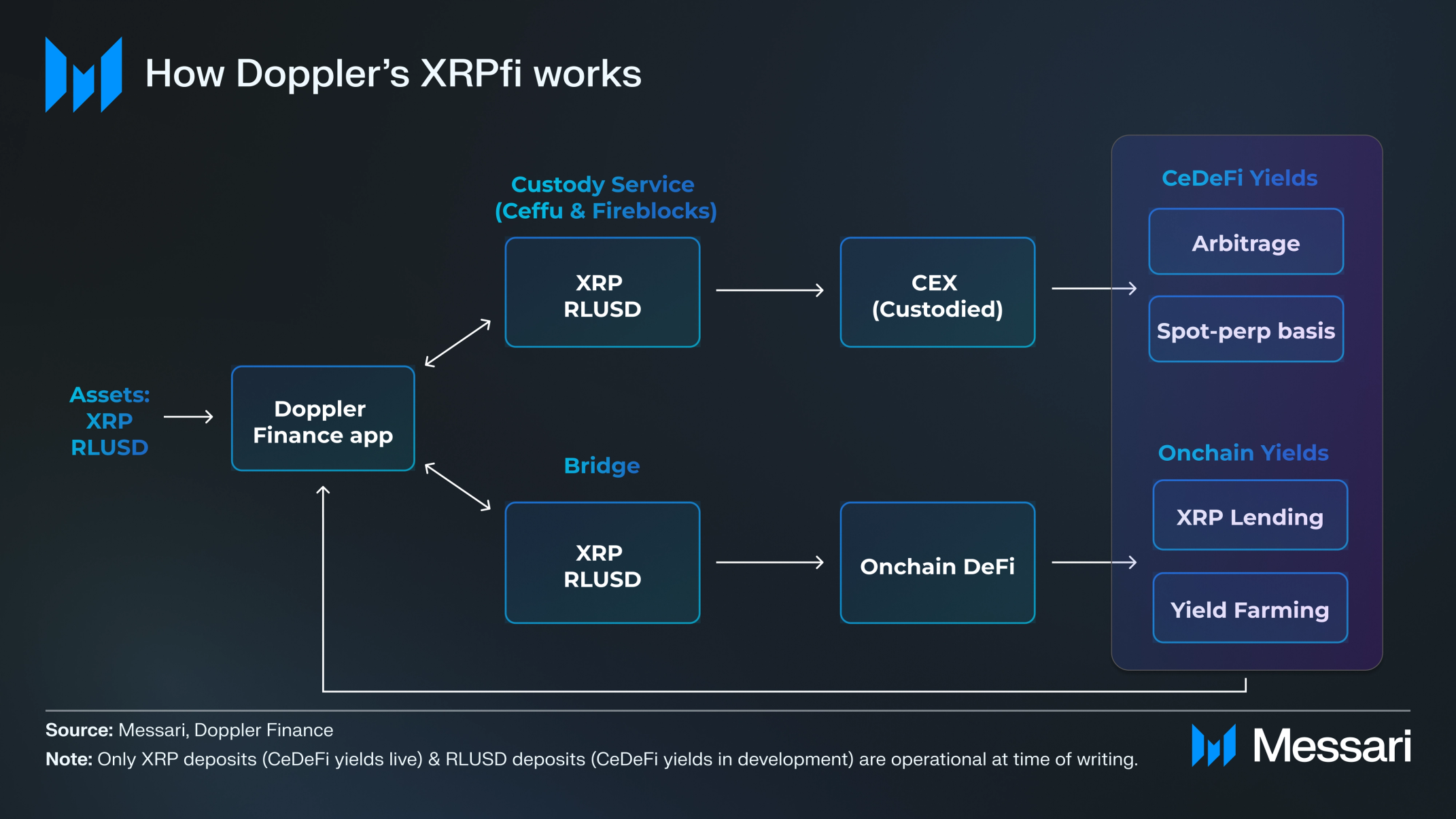
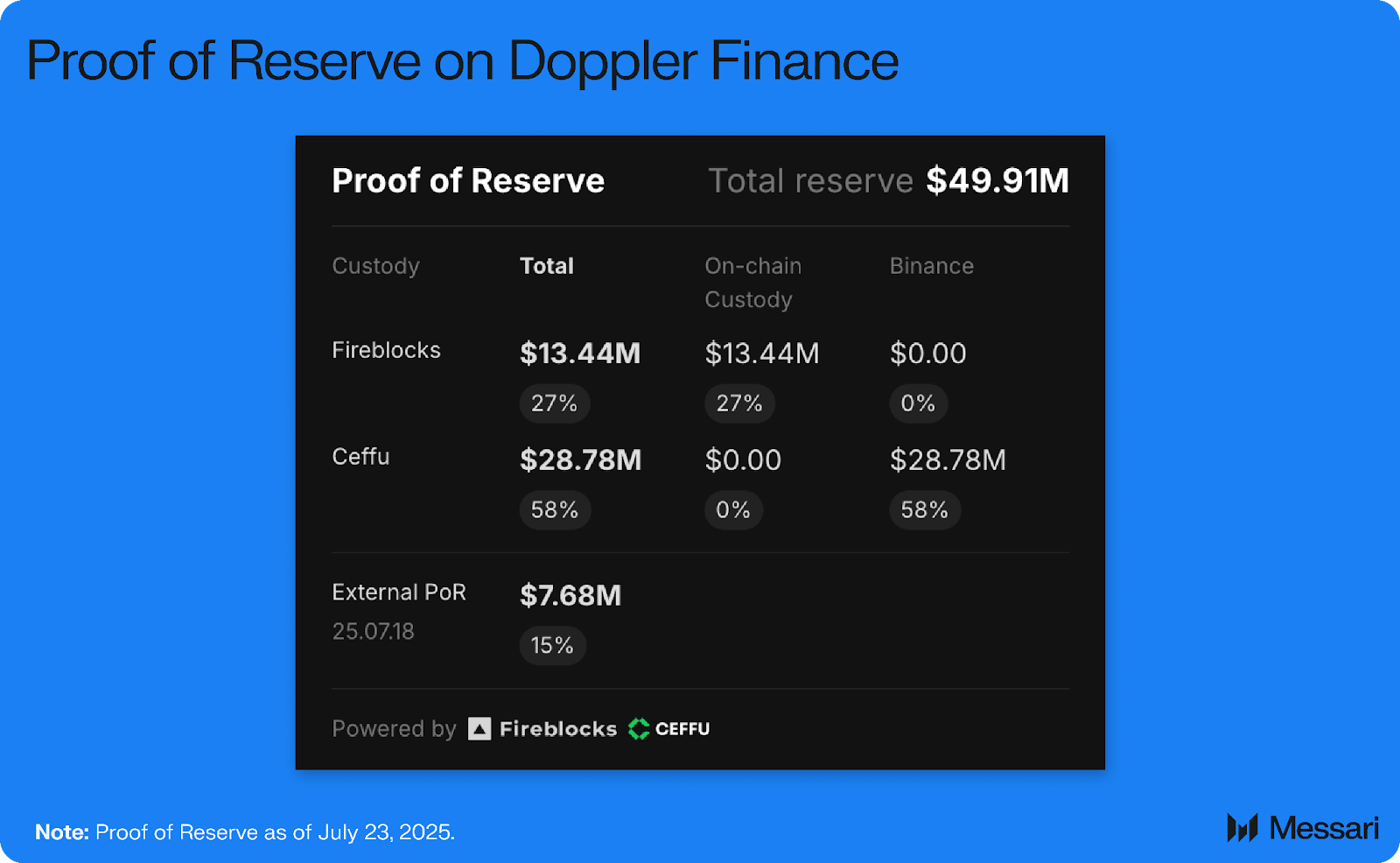
Custody is handled by Fireblocks and Ceffu, which manage user deposits for Doppler’s offchain arbitrage strategies. Currently, these strategies are only executed on Binance, though more exchange partners are coming. BitGo partnered with Doppler as a third custodian on May 26, but its custody integration is not yet live.
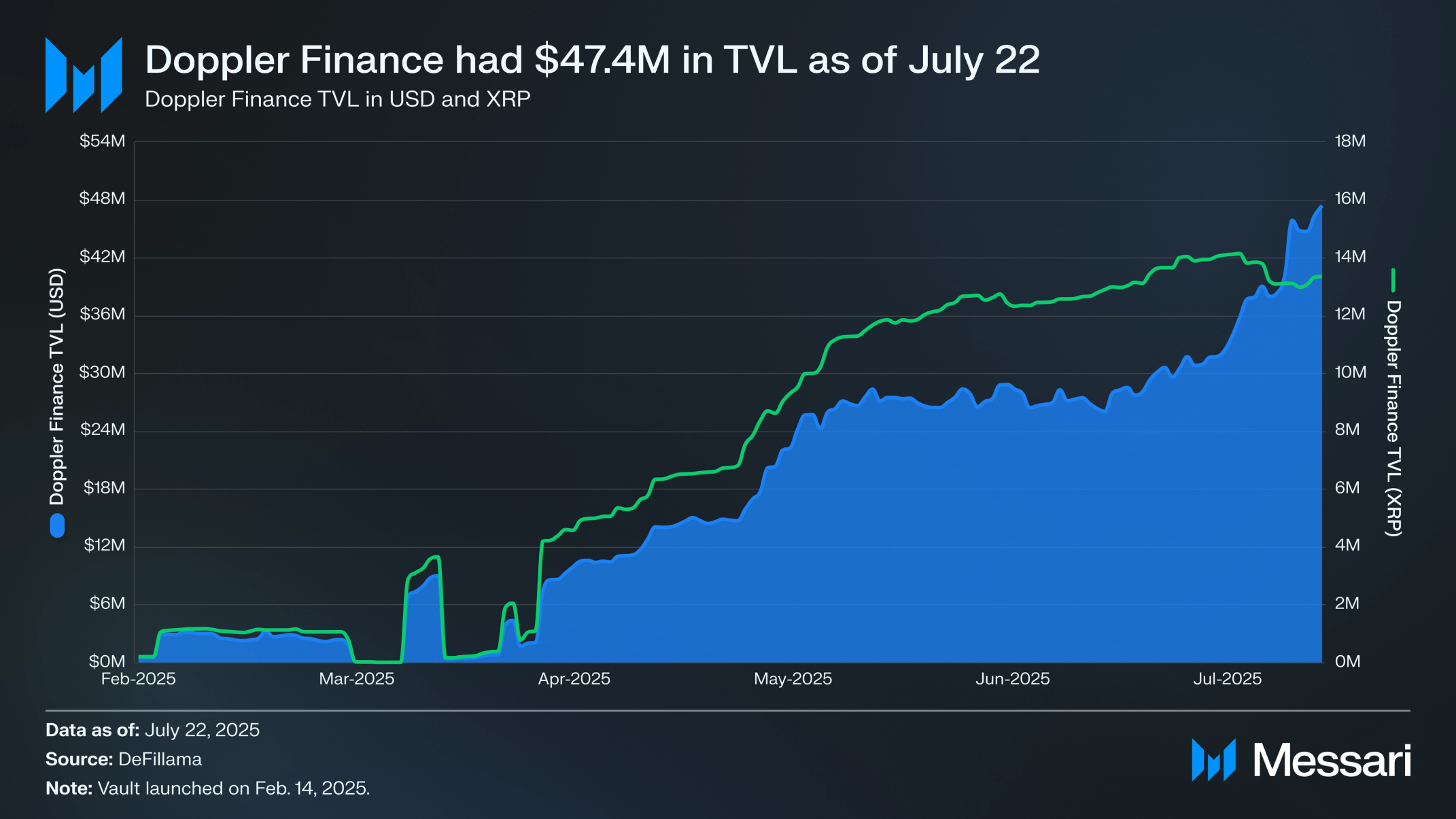
As of July 22, Doppler Finance had $47.4 million in TVL, up 222% ($32.7 million) from $14.7 million on April 30.
Doppler limits XRP deposits on XRPfi using a capped ‘batch’ system. Batch 1 (200,000 XRP) reached capacity in one minute on Feb. 14, and Batch 2 (1 million XRP) reached capacity in 15 minutes on Feb. 16. Batch 3 and Batch 4 were capped at 5 million and 10 million XRP, respectively, and filled completely on April 13 and May 13, respectively. Batch 5 launched on May 15 with a 20 million XRP cap and had reached 67% of capacity (13.4 million XRP) as of July 22.
Doppler Finance is building new products, including a lending protocol (currently in beta on the Root Network) and liquid staking for XRPL-compatible assets.
Introduction
Doppler Finance (formerly Lotus Protocol) is a protocol on the XRP Ledger (XRPL) that enables XRP holders to earn yield on their assets through the XRP vault. Since XRPL does not have native smart contract support, nor use a consensus mechanism that rewards tokens to XRP holders for contributing to the network’s security, XRP holders have effectively no meaningful yield options onchain. Doppler addresses this gap with a mix of offchain and hybrid strategies.
Doppler Finance launched in February 2025, with its first XRP yield product, XRPfi, quickly gaining traction and reaching $50 million in TVL by July 2025. This product uses a Centralized Decentralized Finance (CeDeFi) model that combines centralized custody and offchain execution for yield generation. CeDeFi targets users seeking a balance between traditional financial oversight and blockchain-based financial services.
Fireblocks, Ceffu (formerly Binance Custody), and BitGo provide custody for XRP deposited into Doppler’s XRPfi product. The XRP tokens are then deployed into two yield strategies on Binance: spot–perpetual arbitrage, whereby operators take opposing positions in the spot and perpetual markets to capture funding rate differentials, and XRP-neutral arbitrage, which earns yield by exploiting price differences for XRP across markets without directional exposure.
Doppler also operates a deposit vault for RLUSD (Ripple’s U.S. dollar–pegged stablecoin on XRPL) holders on XRPL or Ethereum. RLUSD yield generation is still in development but is scheduled to go live in Q3 2025. In addition to these products, Doppler plans to launch a lending protocol (currently in beta) on the Root Network, a blockchain integrated with XRPL, and a liquid staking offering for XRPL-compatible networks.
Co-founded by Rox and Claud, Doppler Finance’s name reflects the team’s broader mission to reshape the XRP ecosystem with DeFi. Just as the Doppler Effect alters how we hear a sound, Doppler aims to enable the movement of assets and unlock new opportunities in an otherwise static ecosystem.
XRPfi
Overview
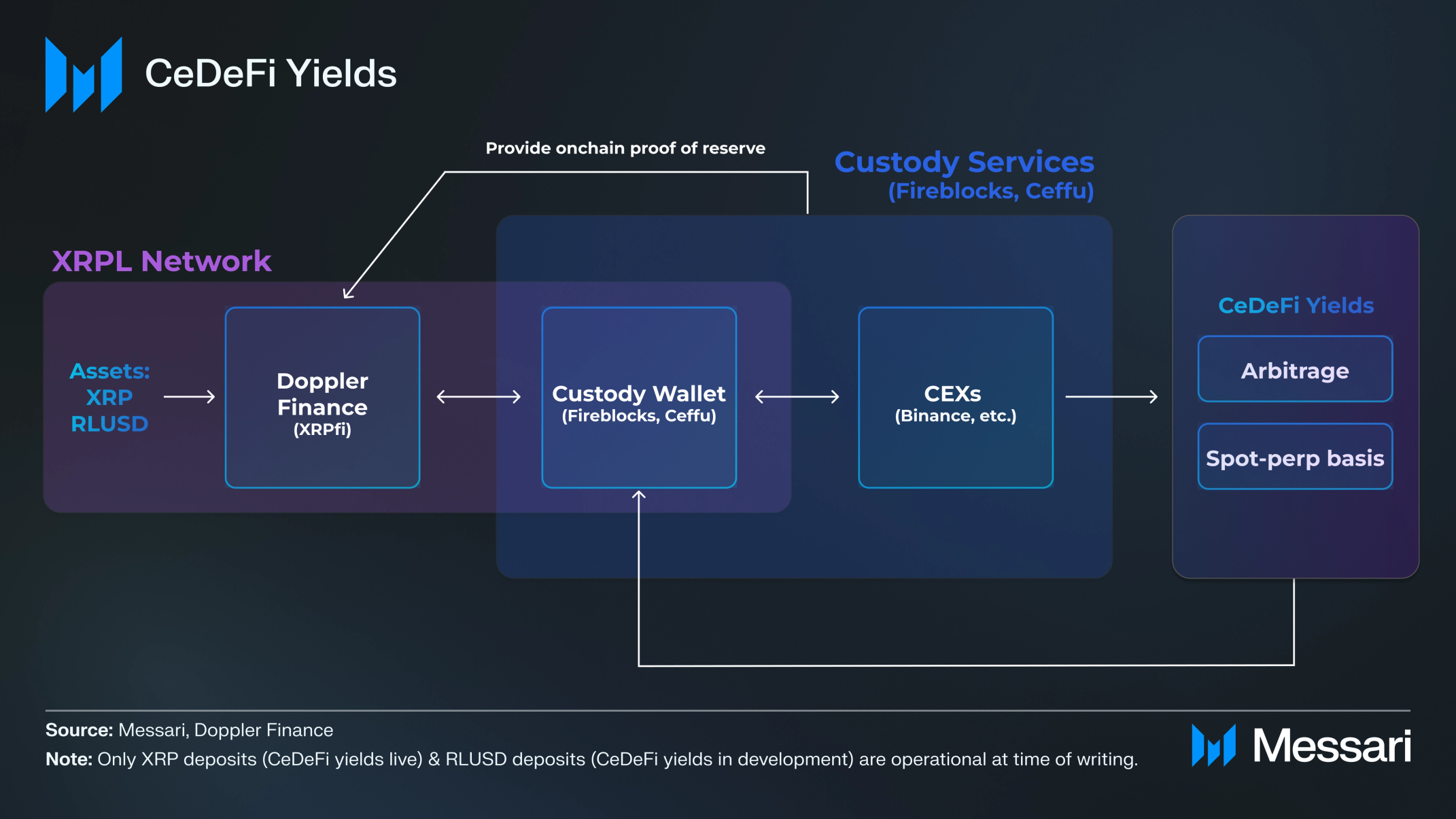
Doppler Finance’s XRPfi is a yield-generation protocol on the XRPL. Through the Doppler Finance application, users deposit XRP into the XRPfi deposit wallet address. Currently, the XRP is ultimately transferred to a Ceffu wallet address for custody. XRP in this wallet address can then be delegated using Ceffu’s MirrorX off-exchange settlement solution, which grants an equivalent amount of XRP to Doppler’s quant operator partners on Binance to execute two arbitrage strategies: spot-neutral arbitrage and XRP-neutral arbitrage.
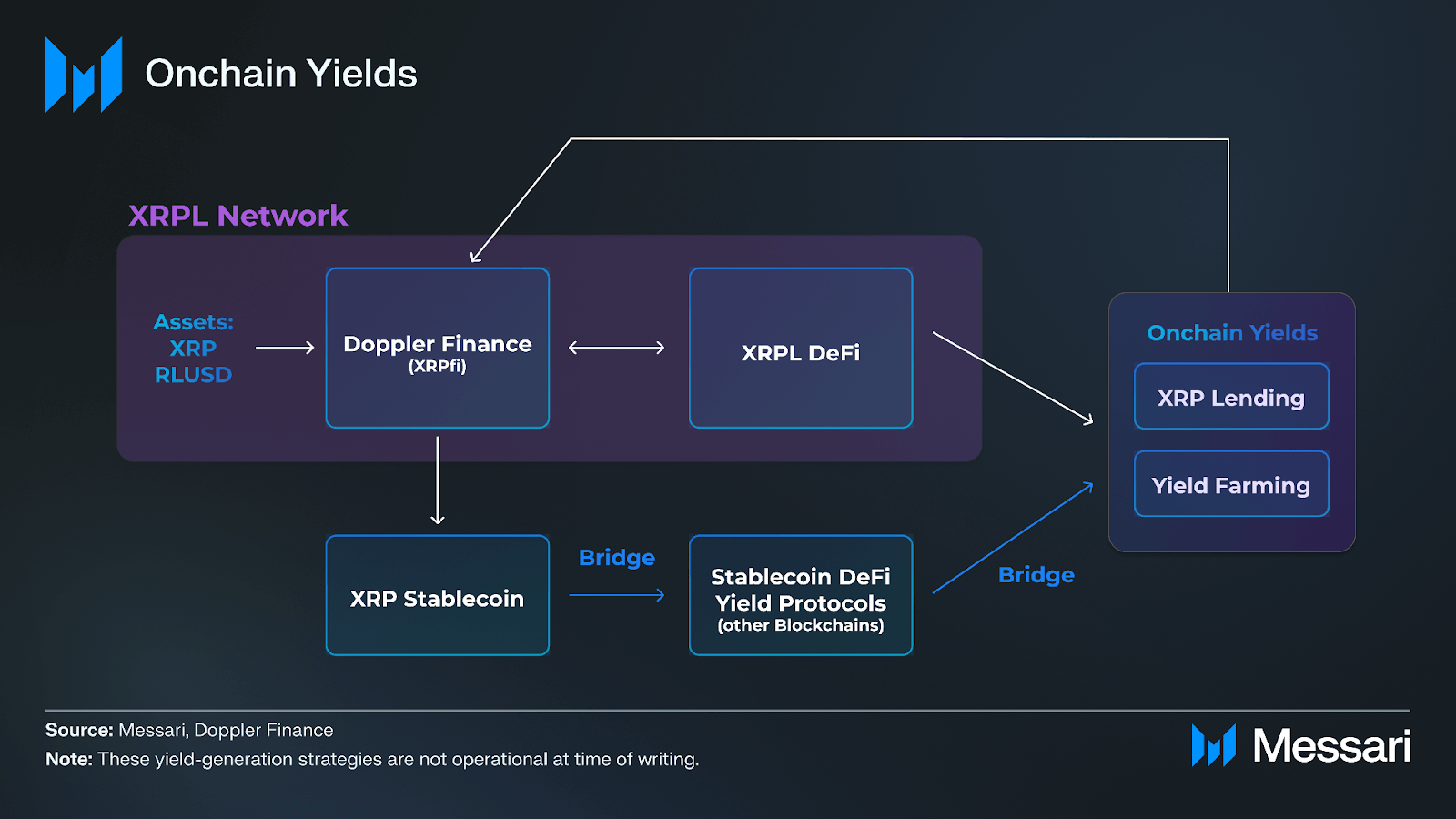
In the future, Doppler Finance also plans to introduce onchain yield strategies, whereby XRP deposited on Doppler is reallocated across multiple yield-generating protocols on different blockchains, including EVM-compatible sidechains with the XRPL.
CeDeFi Yield Strategies (XRP vault)
Spot-perpetual Arbitrage
Spot–perpetual (spot-perp) arbitrage generates yield using deposited XRP as collateral to borrow stablecoins, which are then deployed in delta-neutral trading strategies. These strategies aim to earn yield from funding rate differential on exchanges by holding opposing positions in the spot and perpetual markets. Funding rates are recurring fees used by exchanges to keep perpetual contract prices aligned with the underlying asset price. They are typically paid every 8 to 12 hours and fluctuate based on market positioning.
Doppler users’ deposited XRP tokens act as collateral to borrow stablecoins to buy XRP in the spot market, and simultaneously short XRP on perpetual markets to create delta-neutral positions. The loan-to-value (LTV) ratio measures how many stablecoins are borrowed relative to the value of the XRP collateral. According to Doppler, the borrowed stablecoins maintain an LTV of 70-75%.
To illustrate how spot–perp arbitrage works, the following example assumes an LTV of 50%. If the quant operator partner deposits 1,000 XRP and each XRP is valued at $2, the total collateral is worth $2,000. With an LTV of 50%, only $1,000 in stablecoins would be borrowed against that collateral. A lower LTV means the position is less likely to be liquidated, even if XRP’s price falls, because the value of the collateral remains well above the loan balance.
Once the stablecoins have been borrowed, an equivalent amount of XRP is bought in the spot market and shorted in the perpetual market. For example, suppose the quant operator partner starts with 1,000 XRP. They deposit 1,000 XRP as collateral, valued at $2 each, to borrow $1,000 in stablecoins (reflecting a 50% LTV ratio). $500 of the $1,000 is used to buy XRP, bringing the total XRP owned to 1,250. The remaining $500 is then used to open an equivalent short position of 1,250 XRP at 5x leverage ($500 worth of XRP at 5x leverage = $2,500, which is equal to spot XRP owned, 1,250 XRP = $2,500). If the funding rate on the perp contract is +0.03% every 8 hours (about 0.09% per day), the short position earns $2.25 daily in funding payments from long traders. Over a 30-day month, this adds up to approximately $67.50 in yield. Because the spot and perp positions are offsetting, the strategy remains delta-neutral and insulated from XRP price movements, allowing the operator to focus solely on collecting the funding rate premium.
When funding rates are positive, traders holding long perpetual positions pay a recurring fee to traders holding shorts. In this scenario, the quant operator partner deposits and buys additional XRP in the spot market and shorts the same notional amount in perpetual futures. When rates are negative, the trade is reversed. The quant operator partner sells XRP in the spot market and opens a long position in the perpetual market for the same notional amount of XRP, maintaining a delta-neutral position while collecting funding from short traders.
XRP-neutral Arbitrage
XRP-neutral arbitrage generates yield by exploiting small price discrepancies between XRP spot trading pairs to accumulate additional XRP. For example, if XRP is priced at $2.97 in the XRP/USDC market and $3.00 in the XRP/USDT market, an operator could buy 337 XRP with $1,000 in USDC and simultaneously sell 333 XRP for $1,000 in USDT, resulting in a net gain of 4 XRP.
Doppler primarily focuses on spot–perpetual arbitrage. A small portion of yield comes from XRP-neutral arbitrage on Binance, using intra-exchange spreads between XRP/USDT and XRP/USDC.
Ceffu (MirrorX) is an off-exchange settlement solution. XRP in the Ceffu (MirrorX)-operated treasury wallet address can be delegated using Ceffu (MirrorX), which grants an equivalent amount of XRP to Doppler’s quant operator partners on Binance to execute the two arbitrage strategies. Quant operator partners can access Binance’s liquidity to execute trades, but cannot withdraw or transfer the underlying XRP. Assets remain in Ceffu’s secure vault, protected by multi-party computation (MPC) and multi-approval schemes. MPC splits transaction approvals across multiple settlement parties, requiring a predefined number of them to jointly authorize any fund movement to prevent unauthorized settlements. Once the XRP is delegated from the Ceffu (MirrorX)-operated treasury wallet to Binance, this wallet’s balance is no longer visible onchain.
Yield Generation, Distribution, and Doppler Points
Quant operators then employ the arbitrage strategies described above. For spot-perp, profits are converted back into XRP and routed to the Ceffu-operated treasury wallet address. XRP profits are then sent back to a Fireblocks-operated withdrawal wallet address, which holds funds for user redemptions.
Doppler updates user balances every Friday at 01:00 UTC to reflect weekly XRP yield accruals. To withdraw, a user initiates a request that triggers the platform to earmark their share of XRP in the withdrawal pool and, if necessary, unwind any portion of their XRP still deployed in active strategies. Doppler enforces a 7-day withdrawal window for XRPfi deposits.
On May 26, Doppler announced a partnership with BitGo, bringing the institutional digital asset custodian’s multi-sig custody, $250 million Lloyd’s of London insurance policy, and compliance controls to Doppler’s platform. The partnership is designed to reduce risk for current users and meet the custody requirements of enterprise clients, who may require insured custody as a prerequisite.
On July 18, Doppler announced that the yield distribution from July 11 to July 17 reflected an annualized yield of approximately 3.3% APR.
In addition to CeDeFi yields, Doppler Finance rewards depositors in the XRPfi solution with Doppler Points (DP). Depositors earn DP continuously based on their deposit size and duration. The base rate is 0.01 DP per hour for every $1 worth of assets deposited.
Doppler offers bonus point multipliers to reward early users. The current boost is 1.5x for XRP deposits, meaning that 0.015 DP is earned per hour per $1 deposited. Users continue earning points while their assets remain in the vault. They can track their own points on the dashboard and see the top 100 DP earners on the leaderboard.
As of July 22, the top 100 DP earners had accumulated a combined 1.2 billion DP. The top wallet held 14% of the top 100 total market share (159.7 million DP), followed by the second at 6% (71.4 million DP) and the third at 6% (68.7 million DP).
RLUSD Vault
RLUSD is Ripple’s U.S. dollar–pegged stablecoin, backed 1-for-1 by cash and short-term U.S. Treasuries. In Q3 2025, Doppler Finance launched the RLUSD vault that allows users to deposit RLUSD on XRPL or Ethereum through the Doppler interface. The RLUSD vault does not yet generate yield, but is scheduled to have yield-generation operational in Q3 2025. Doppler plans to implement the same CeDeFi strategy to generate RLUSD-denominated yield.
The RLUSD vault has the same 7-day withdrawal period as the XRP vault. After this window, redemptions are batch-processed around 01:00 UTC. On XRPL, withdrawals are sent directly to the user’s wallet, while on Ethereum, users must manually claim their funds.
Doppler accepts deposits via a controlled system called ‘batches’, where each batch sets a cap on the amount of deposits accepted. The RLUSD vault has a 1 million RLUSD cap on XRPL and a separate 1 million RLUSD cap on Ethereum. Depositors earn Doppler Points (DP) on their RLUSD deposits, with a DP boost applied to early participants in lieu of yield.
Onchain Strategies
Doppler aims to expand XRP’s utility in DeFi through two onchain yield strategies that have yet to launch: XRP lending and stablecoin-based yield. The protocol intends to deploy user-deposited XRP, and eventually RLUSD, into yield-generating protocols on XRPL sidechains. Doppler will use cross-chain infrastructure to bridge assets from the XRPL to smart contract-enabled blockchain networks (i.e., EVM-compatible sidechains).
Notably, Root Network (Root), a Polkadot-based XRPL sidechain enabling EVM smart contracts, is a focus for Doppler’s upcoming lending product.
XRP Lending
Deposited XRP will be supplied to onchain lending protocols where other users can borrow it against posted collateral. Yield will be earned through borrower-paid interest and potentially through application-specific incentive tokens (i.e., governance tokens). As of May 2025, Doppler has not announced integration plans with a specific lending protocol.
Stablecoin-Based Yield
The protocol plans to use XRP as collateral to borrow stablecoins onchain, then deploy those stablecoins into DeFi services that generate returns on dollar-denominated assets. Doppler plans to use conservative LTV ratios to reduce liquidation risk in stablecoin strategies. Further implementation details have not yet been disclosed.
In the longer term, Doppler intends to use deposited XRP to provide a security layer for XRPL sidechains and ecosystem services such as bridges and oracles. This would involve committing user-deposited XRP on Doppler to these services in exchange for token rewards.
User Info
Users access XRPfi through the Doppler Finance application, which will also serve as the interface for future Doppler products. The interface provides a dashboard with deposit balance, earned yield, and accumulated DP. Doppler supports four XRPL wallets, Crossmark, a self-custodial desktop browser-based wallet, and three self-custodial mobile wallets: Girin Wallet, Xaman Wallet, and Bifrost.
Since launching XRPfi on Feb. 14, Doppler Finance’s TVL has grown significantly, reaching $47.4 million as of July 22. Since April 30, TVL increased 222% ($32.7 million) from $14.7 million to $47.4 million on July 22. Over the same time frame, TVL in XRP terms increased 103% (6.8 million XRP), from 6.5 million XRP to 13.4 million XRP. This growth reflects increasing demand from XRP holders to earn yield on idle assets and earn Doppler Points. It also signals increasing confidence in Doppler’s custody and risk management framework.
Similar to the RLUSD vault, the XRP vault uses a batch system that sets a cap on the amount of XRP deposits accepted per batch. Batch 1 (200,000 XRP) reached capacity in one minute on Feb. 14, and Batch 2 (1 million XRP) reached capacity in 15 minutes on Feb. 16, indicating initial supply-constrained demand. Doppler expanded cap limits after seeing this demand, launching Batch 3 (5 million XRP) on April 13 and Batch 4 (10 million XRP) on May 13, which both also reached capacity. On May 15, Doppler launched Batch 5 (20 million XRP), and on July 22, it reached 67% (13.4 million XRP) of its capacity, reinforcing ongoing demand.
To manage inflows and limit risk exposure, Doppler plans to raise deposit caps gradually as XRPfi demand grows.
Future Products
Doppler is building a lending protocol for XRPL and its sidechains. A beta version is live on the Root Network and accessible to a limited user group. The initial pool includes XRP, USDC, and ROOT. Doppler also plans to launch isolated pools for liquid staking tokens and Futureverse ecosystem assets.
Additionally, Doppler plans to launch a one-click leverage tool for ROOT liquid staking. This feature will enable users to select a leverage ratio and execute the full leveraged staking process in a single transaction. XRPL’s native lending protocol (XLS-66d) is also intended to be integrated after its mainnet launch. Notably, the above-mentioned features remain in development and are subject to change ahead of full launch.
Closing Summary
Doppler Finance is a yield-generation protocol that currently addresses XRP’s limited onchain utility through a CeDeFi model, which is a hybrid approach that combines centralized custody and offchain execution for yield-generation strategies. Doppler launched their XRPfi product on Feb. 14, which attracted growing user demand and reached $47.4 million in TVL as of July 22. To manage inflows and limit risk exposure, Doppler uses a batch-based deposit system that caps the amount of XRP deposits accepted per batch. Early batches on the XRP vault filled within minutes, and later batches expanded in size, with Batch 5 (launched on May 15) having reached over 67% of its 20 million XRP capacity on July 22. In Q3 2025, Doppler also launched an RLUSD vault that accepts deposits on XRPL or Ethereum, with yield strategies scheduled to go live in Q3 2025. Integrated partners Fireblocks, Ceffu, and BitGo provide institutional-grade custody, while a $2.5 million pre-seed round has enabled the team to build beyond its initial CeDeFi offering.
Looking ahead, Doppler plans to expand its product suite with a dedicated lending protocol, and liquid staking for XRPL-compatible networks. A beta lending product is already live on the Root Network, and the team has outlined plans to integrate XRPL-native lending once live. While much of the roadmap is still under development, Doppler’s early traction, including sustained deposit demand for XRPfi and measured batch expansions, positions it as a foundational contributor to the XRP Ledger’s emerging ecosystem.
This report was commissioned by Doppler Finance. All content was produced independently by the author(s) and does not necessarily reflect the opinions of Messari, Inc. or the organization that requested the report. The commissioning organization may have input on the content of the report, but Messari maintains editorial control over the final report to retain data accuracy and objectivity. Author(s) may hold cryptocurrencies named in this report. This report is meant for informational purposes only. It is not meant to serve as investment advice. You should conduct your own research and consult an independent financial, tax, or legal advisor before making any investment decisions. Past performance of any asset is not indicative of future results. Please see our Terms of Service for more information.
No part of this report may be (a) copied, photocopied, duplicated in any form by any means or (b) redistributed without the prior written consent of Messari®.
Austin is a Sr. Research Analyst for Messari’s Protocol Services team. He focuses on Prediction Markets, DeFi, & Interop. protocols. He previously worked on PwC's Digital Assets team.
Austin is a Sr. Research Analyst for Messari’s Protocol Services team. He focuses on Prediction Markets, DeFi, & Interop. protocols. He previously worked on PwC's Digital Assets team.