The Rise of Credentialing-as-a-Service

Interest in on-chain credentials is growing. On-chain credentials allow users to showcase digital identity and credibly engage with protocols as anonymous individuals. These credentials are NFTs that can either be exchanged or “stuck” to a wallet as soulbound tokens.
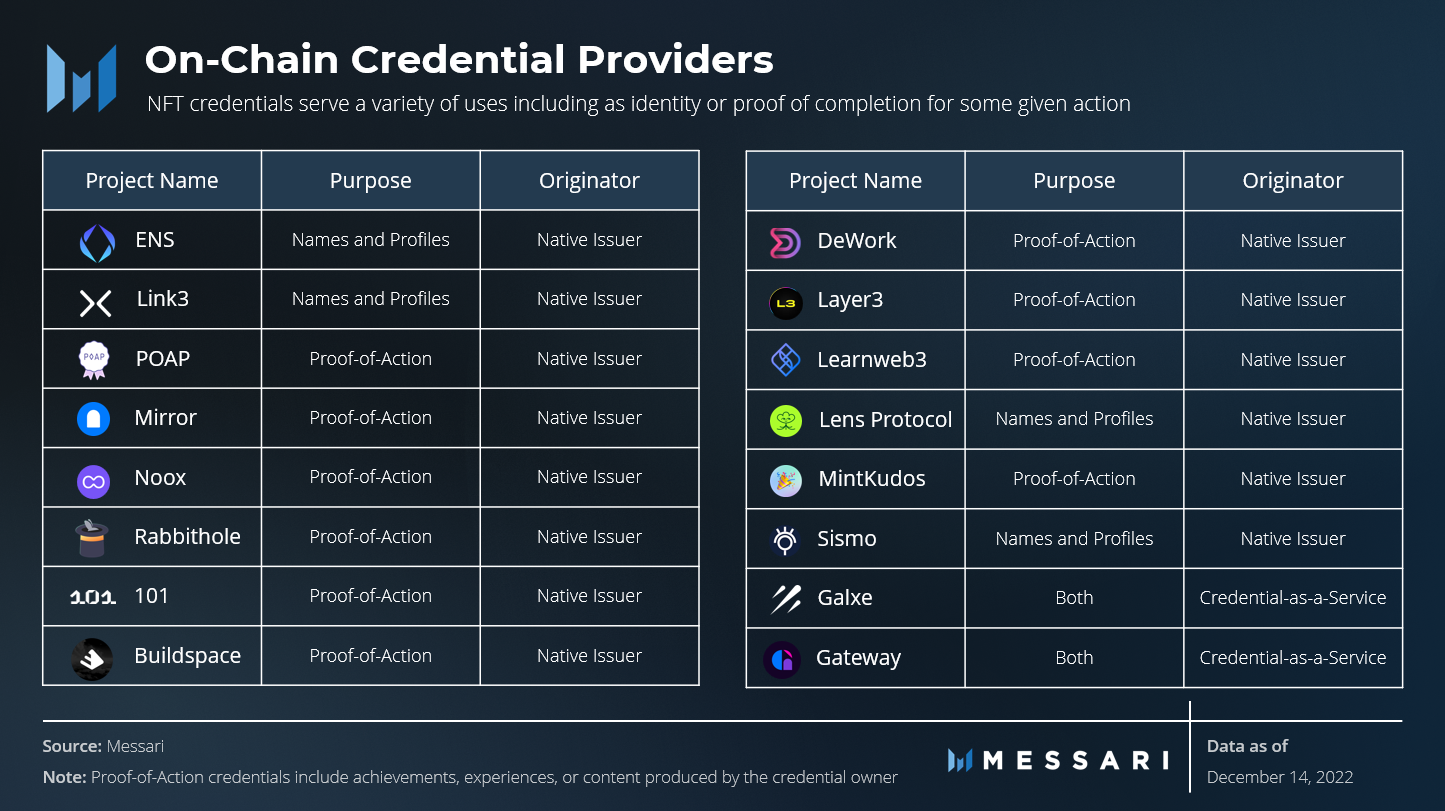
Today’s on-chain credentials can be classified by their purpose and originator. The subsegments of purpose will generally either be to prove identity or to prove some action was completed. In our classification, “Name and Profiles” reveals information like domain names and social accounts. Alternatively, “Proof-of-Action” highlights user activity: on-chain achievements, contributions, certifications, or content.
The NFT’s originator is the source of the credential. Apps that offer their own credentials are native issuers. Think of the writing platform, Mirror, which tokenizes published content for wallets. Apps without their own NFTs can opt to work with a Credentialing-as-a-Service (CaaS) provider like Galxe or Gateway to develop and distribute credentials. CaaS simplifies the process of launching credentials to third parties by providing the necessary API and infrastructure.
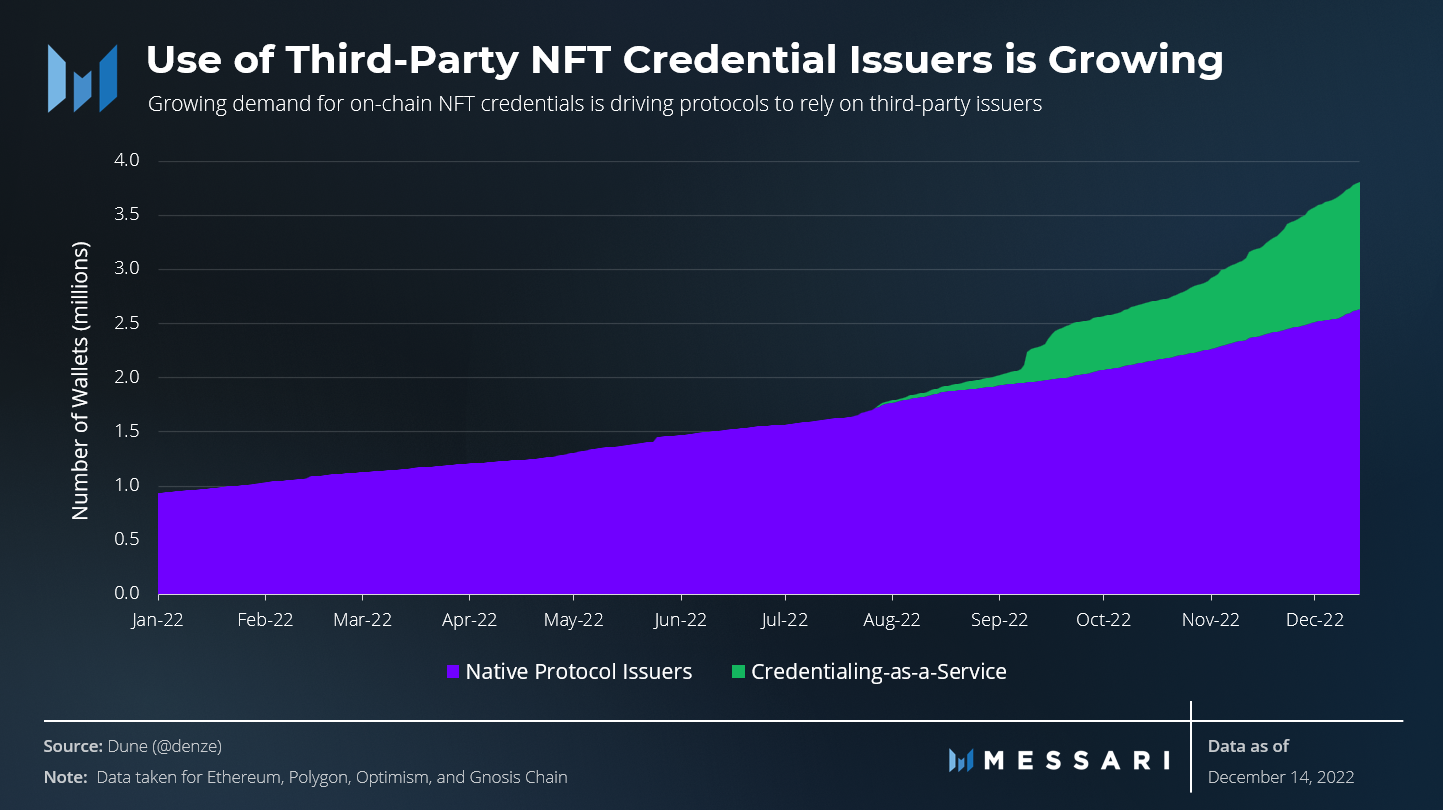
Whereas most credential issuers were historically native protocols, the Web3 ecosystem has more recently utilized partnerships with CaaS providers. The number of wallets owning credentials from CaaS providers stands at just over 1.1 million today, equivalent to 45% of the distribution from native protocol issuers. CaaS providers have managed to capture almost half of the market from native protocol issuers in just a few months.

Jerry joined Messari as a Research Analyst after working in management consulting. He graduated with a B.S. in finance and a minor in computer science from Indiana University's Kelley School of Business.