The Sandbox is a creator-centric ecosystem that combines user-generated content, branded experiences, and Web3 infrastructure, supported by the SAND token.
The SAND token functions as the unifying asset across the entire ecosystem, including The Sandbox Game, SANDchain, DAO, and upcoming projects, providing the primary medium for transactions, rewards, governance, and liquidity, and aligning creation, engagement, and financing within a single economic system.
AI and no-code tools such as Game Maker and VoxEdit are being used to lower the barriers to creation, with generative AI features aimed at reducing the time, skill, and effort required to turn ideas into playable experiences, thereby broadening the base of viable creators.
SANDchain introduces a dedicated financial layer for creators, powered by a ZKsync Layer 2 that supports low-cost microtransactions, onchain payouts, and engagement tracking via SANDpoints and Creator Points.
Primer
The Sandbox, a subsidiary of Animoca Brands, is a global distribution ecosystem for digital culture that connects brands, creators, institutions, and consumers worldwide. Leveraging Web3 technologies and AI, The Sandbox enables end-user creation, decentralized economies, and digital social experiences, all powered by its token SAND. With over 400 partners, including Warner Music Group, Gucci, and NBC Universal’s Jurassic World, 8 million users, and 30 million onchain transactions, The Sandbox ecosystem remains one of the largest cultural distribution networks in Web3, with an economic layer provided by SAND.
SAND is the utility token that powers The Sandbox ecosystem, which includes The Sandbox Game, The Sandbox DAO, SANDchain, and upcoming projects in Web3 and AI. It fuels The Sandbox’s in-game economy and marketplace, enabling users to buy and sell digital assets, grants holders governance rights through the DAO, provides liquidity, transactions, and rewards on SANDchain and Corners.
The Sandbox ecosystem comprises many products, interoperable assets, and tools:
SAND - an ERC-20 token that powers The Sandbox Game, The Sandbox DAO, and SANDchain. It serves as the primary currency for in-game purchases, creator rewards, governance, and SANDchain liquidity. SAND is listed on 80+ exchanges and used as a payment token beyond the platform.
The Sandbox Game - A LAND-based gaming platform where players control AVATARS (their in-world characters) to explore and participate in user-generated 3D experiences. Creators use tools such as VoxEdit and Game Maker to build and publish games on LAND parcels.
SANDchain - A ZKsync Layer 2 rollup designed as a financial infrastructure layer for creators, enabling low-cost transactions, rewards, and the creator token economies powered by SAND across the Sandbox ecosystem and external platforms.
The Sandbox DAO - The governance forum made up of SAND and LAND holders to engage with the greater community, share insights, and contribute to and develop the Sandbox ecosystem.
The Sandbox is moving toward its next chapter, highlighting growth in creator activity, new forms of digital ownership, stronger distribution channels, deeper integrations, expanded utility for SAND, and the momentum of a platform maturing into core creative infrastructure and distribution. Together, these efforts position The Sandbox as a creator-centric ecosystem rather than just a standalone metaverse game, with SAND serving as the common token that links creation tools, in-world content, and emerging financial infrastructure.
SAND is the primary unit of value across The Sandbox ecosystem. It fuels The Sandbox’s in-game economy and marketplace, enabling users to buy and sell digital assets, and provides the reward and incentive structure for both creators and players. It also underpins governance through the DAO, where SAND holders can influence decisions related to platform development, incentive structures, and other strategic choices.
Beyond the core game client, SAND extends into SANDchain, where it serves as the token for gas fees, network-wide reward programs, and creator token pairs on the SAND DEX. In future initiatives, SAND is expected to provide the base asset for creator-linked financial instruments and liquidity pools.
SAND also serves as a real-world payment token, allowing users to pay for goods and services on a wide range of platforms and websites. Listed on over 80 exchanges, like Binance, Coinbase, and Crypto.com, SAND can be bought, held, and exchanged, offering broad access to the token economy. This ecosystem will expand further in the coming months to provide more ways for Web3 and AI to empower creators, using SAND to drive creation, monetization, and play.
By placing SAND at the center of tools for creation, engagement, and financing, The Sandbox aligns its initiatives into a single economic system, aiming to create a new global distribution ecosystem for digital culture that connects brands, creators, institutions, and consumers worldwide. AI-assisted content production, creator-first Season design, SANDchain’s Layer 2 infrastructure, and ICM-based monetization initiatives all point back to SAND as the common foundation. This design is intended to ensure that growth in one part of the ecosystem can reinforce others through shared token incentives and liquidity.
Evolving The Sandbox Game
The current evolution of The Sandbox Game is defined by shifts in how value flows through SAND and how creators drive content. SAND remains the foundational asset of the platform, continuing to fuel the creator and player economy through transactions, asset purchases, and reward mechanisms. At the same time, creators are moving to the center of the model through programs such as Seasons, Game Jams, and avatar initiatives that distribute SAND-based rewards and in-game placement to community-built content. Together, these shifts establish a creator-first content pipeline in which SAND-denominated incentives shape what is built and featured in the game.
Creator-First Content Pipeline
The Sandbox Game has always been focused on leveraging Web3 and technology to empower the next generation of user-generated content with easy-to-use tools and digital ownership. In doing so, the platform offers Creators a new distribution network to showcase their content and reach a global player base.
This distribution and awareness offered by the platform will expand in the coming Seasons, as The Sandbox Game aims to have over half of the content come from end-users. Seasons are time-bound content cycles, typically spanning several weeks to a few months, during which curated experiences, events, and rewards are packaged together for players, providing a structured way to surface new games and activations. Each Season is expected to feature multiple Game Jams, showcasing new creator-built games. Selected entries will receive SAND-denominated rewards, LAND, and dedicated Season slots.
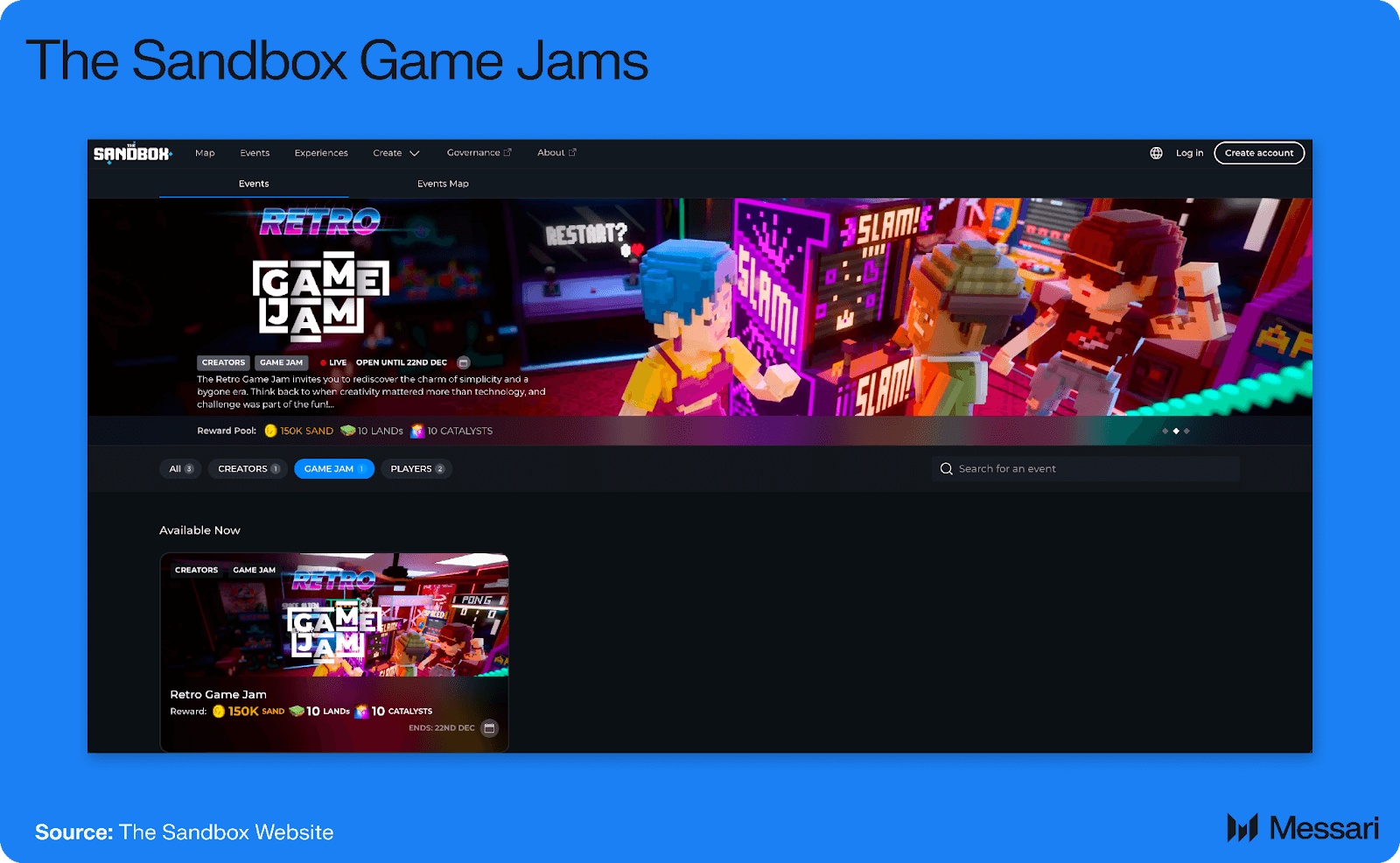
The latest example is the Retro Game Jam, which invites creators to build experiences inspired by classic and retro game aesthetics. Registrations run from November 27 to December 10, 2025, and submissions are due on December 23, 2025. The event offers a total of 150,000 SAND, 10 LAND, and Catalyst Packs, including a 50,000 SAND prize pool for the highest-ranked entries and an additional 100,000 SAND plus 10 LAND for ten experiences selected for inclusion in an upcoming Alpha Season. Each of these chosen experiences receives a 10,000 SAND contract and a 1x1 LAND plot, and the first 100 valid entries are also eligible for participation rewards in the form of Catalyst Packs. Live touchpoints, such as an AMA and workshop, are scheduled during the event window, reinforcing Game Jams as a structured mechanism for discovery, rewards, and Season integration.
Earlier this year, The Sandbox unveiled the Community Avatar Collection contest, providing a new way for creators to monetize in the marketplace by designing their very own custom avatars. It’s programs like these that enable The Sandbox to realize its vision of a UGC social gaming platform, where end users can shop, learn, and play experiences from a global creator base.
AI Tools for User-Generated Content
Building high-quality interactive experiences has traditionally required a combination of technical skills, artistic ability, and a meaningful time investment. In many game and content ecosystems, this combination limits participation to a relatively small group of professionals or highly committed hobbyists. For most creators, the gap between an initial idea and a finished, playable experience is substantial, involving 3D modeling, animation, logic design, and polish. As a result, the potential for a broader creator economy is often constrained at the very first step, where many ideas never make it to a usable prototype.
The Sandbox began addressing this problem by introducing VoxEdit and Game Maker as no-code tools that move much of the complexity into accessible interfaces. VoxEdit enables creators to design and animate 3D assets without relying on traditional modeling pipelines, while Game Maker provides a visual environment for assembling these assets into interactive scenes and games. This past year, Game Maker saw two major updates, 0.11 and 0.12, which introduced new features such as saved data, matchmaking, platforming, and racing.
Even with no-code tooling, however, immersive content creation still requires significant time and effort. The Sandbox plans to utilize artificial intelligence (AI) to reduce the burden, thereby accelerating the path from idea to a playable experience. The platform maintains a vast library of 1.7M unique 3D assets, hundreds of templates, and community content, providing a foundation for training models that can assist with asset generation, environment design, and other creative tasks. The team has already begun implementing AI initiatives for everything from agentic coding to cheat detection and customer support, while increasing operational efficiency and user-facing creation.
The Sandbox has already begun training custom AI models focused on asset generation and is now actively developing user-facing generative AI capabilities for the platform. Both sit within The Sandbox itself and on top of existing AI Integrated Development Environments.
In addition, The Sandbox has partnered with Rosebud AI, a fast-growing vibe-coded games platform. Creators on The Sandbox platform will soon have the chance to be whitelisted to code games with Rosebud AI using custom templates and assets from The Sandbox.
SANDchain: A New Financial Layer for Creators
While AI and no-code tools reduce friction at the creation stage, many of the most persistent challenges for creators arise after content is built. These include distribution, user acquisition, sustained engagement, and monetization. These issues are not unique to The Sandbox and are also common across traditional creator platforms, where algorithms and rigid monetization schemes often constrain income potential. On Sept. 30, 2025, SANDchain, a ZKsync-powered Layer 2, was launched by The SANDchain Foundation as an initiative to address this problem.
SANDchain is intended to function as the financial infrastructure for the broader creator economy and is built to interoperate with both The Sandbox and external Web2 platforms. SANDchain is built on ZKsync, providing a modular execution environment that targets high throughput and low transaction costs, which are crucial for facilitating frequent microtransactions, such as payments, tipping, and community rewards.
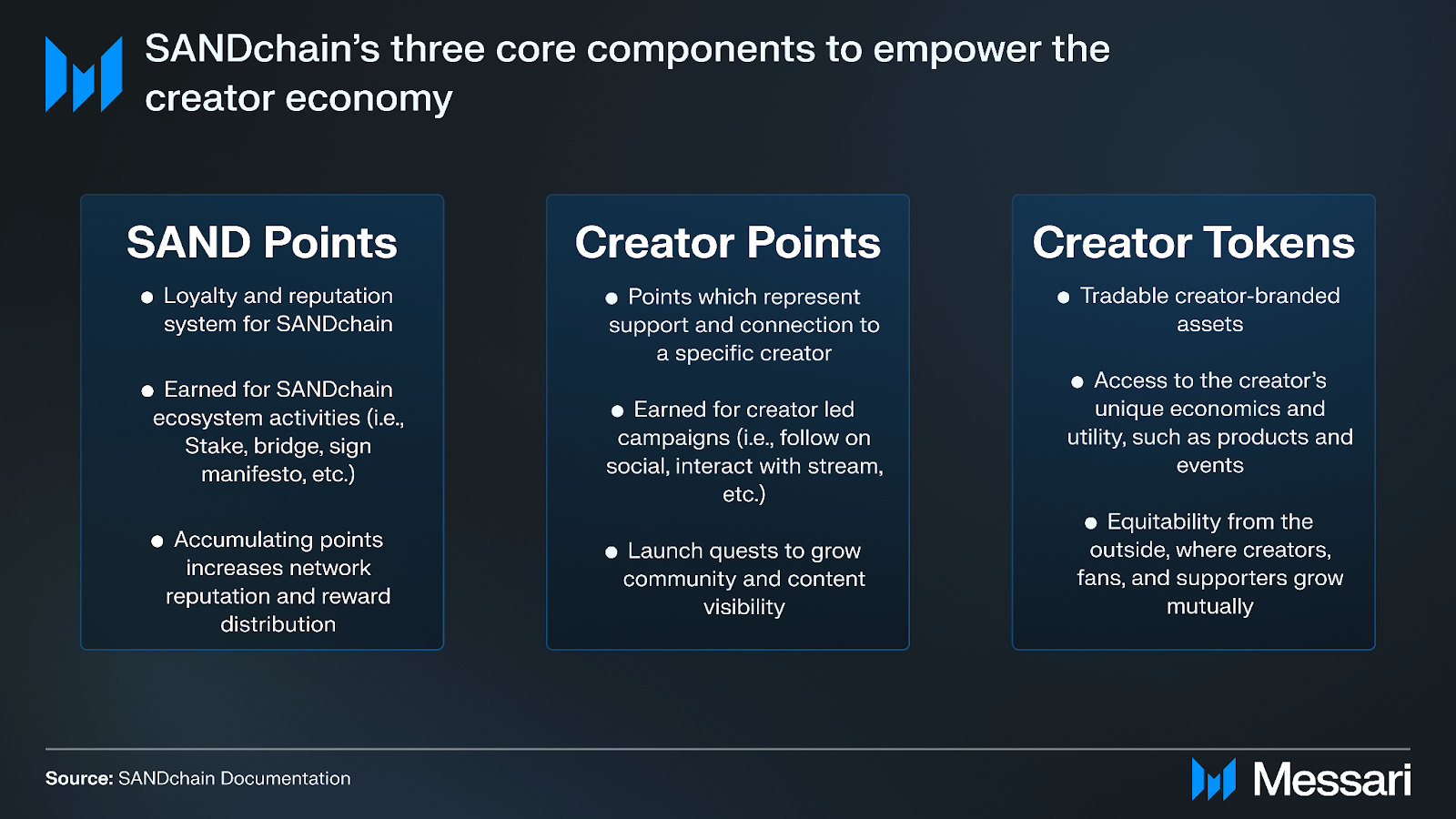
The network is designed to complement existing creator channels rather than replace them. Creators can continue to distribute content on platforms such as YouTube, TikTok, Twitch, and others, while utilizing SANDchain to manage onchain payouts, reward fan participation, and access funding mechanisms. Engagement within SANDchain is tracked through network-wide SAND Points and Creator Points that record participation and fan support across the ecosystem. These metrics can then be used to determine eligibility for rewards, access to perks, and potential future token allocations, effectively linking social activity to onchain economic rights.
Closing Summary
The future of The Sandbox ecosystem is defined by a shift from a single metaverse platform to a broader distribution ecosystem for digital culture that spans tools, infrastructure, and economic layers. The core game and no-code creation tools remain central, while AI initiatives are being developed to lower barriers to creation and improve operational efficiency. In parallel, new Web3 infrastructure, including SANDchain, is being introduced to support scalable engagement and onchain reward systems for creators.
Monetization is a key focus within this evolution. The Sandbox will supplement the engagement layer for creators on SANDchain with an economic layer, adopting an ICMs (Internet Capital Markets) approach to provide creators with more dynamic ways to tokenize and monetize their existing content and audiences. This framework is intended to move beyond the rigid, limited models of traditional creator platforms by enabling more flexible and transparent mechanisms for funding, curation, and discovery, while also strengthening native curation across the network.
Across these components, SAND functions as the unifying asset that links participation, ownership, and financial activity. It powers in-game transactions, marketplace activity, and DAO governance, and serves as the foundational liquidity and reward asset for both SANDchain and future platforms. In aggregate, The Sandbox is positioning itself as an environment where culture is globally distributed as creators can move from ideation to creation to engagement to monetization within a connected system of tools and financial layers built around a shared token foundation. Through its emphasis on creator empowerment, AI-accelerated workflows, and Web3-native economic rails, the ecosystem is being structured so that creativity, ownership, and play remain durably aligned around SAND.
This repot was commissioned by The Sandbox. All content was produced independently by the author(s) and does not necessarily reflect the opinions of Messari, Inc. or the organization that requested the report. The commissioning organization may have input on the content of the report, but Messari maintains editorial control over the final report to retain data accuracy and objectivity. Author(s) may hold cryptocurrencies named in this report. This report is meant for informational purposes only. It is not meant to serve as investment advice. You should conduct your own research and consult an independent financial, tax, or legal advisor before making any investment decisions. Past performance of any asset is not indicative of future results. Please see our Terms of Service for more information.
No part of this report may be (a) copied, photocopied, duplicated in any form by any means or (b) redistributed without the prior written consent of Messari®.
Eric is a research analyst at Messari and an ambassador for Maple Finance. He previously was a Product Manager for FINTRX and is passionate about DeFi and AI.
Eric is a research analyst at Messari and an ambassador for Maple Finance. He previously was a Product Manager for FINTRX and is passionate about DeFi and AI.