The evolution of utility on Ethereum

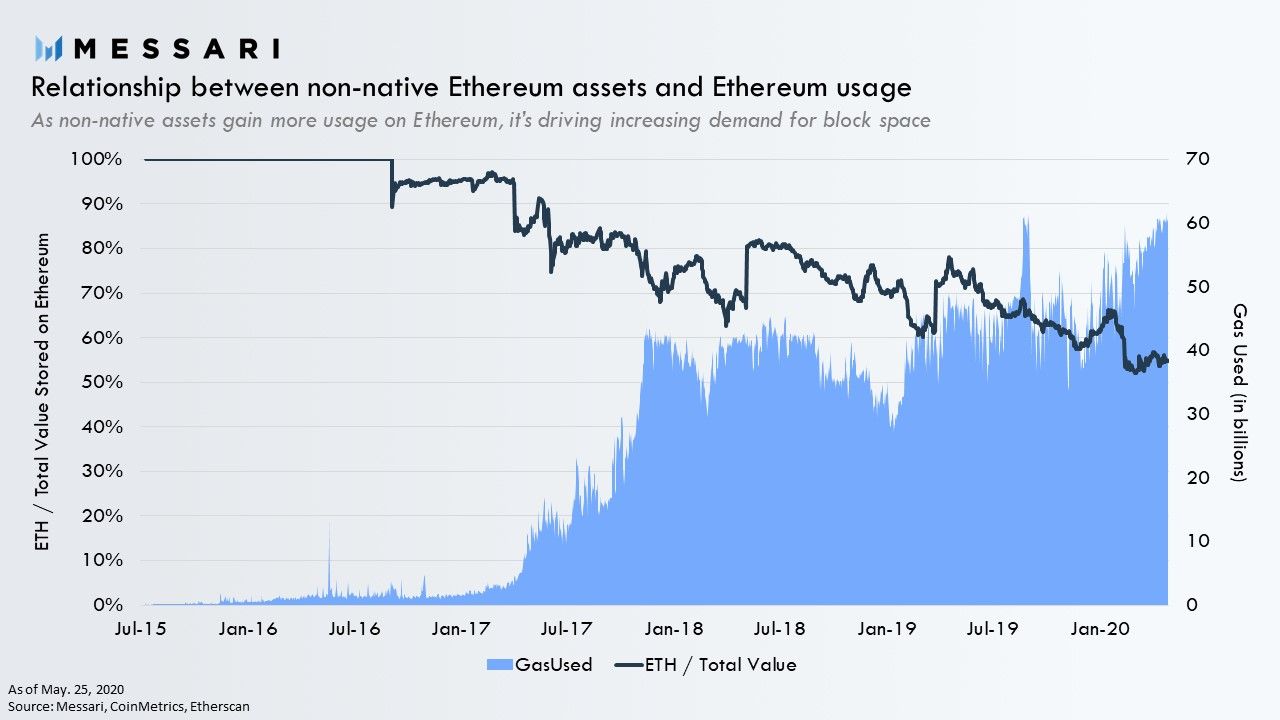
A couple of weeks ago, we explored the evolution of value on Ethereum. As the story goes, ETH was the primary asset stored and exchanged by network users early on. But the infamous ICO boom brought on a Cambrian explosion of new assets and applications that dramatically shifted the nature of user activity. The recent rise of Ethereum-based stablecoins is perpetuating this shift towards non-ETH use cases.
The success of these experimental tokens and apps, particularly those within the DeFi landscape, have directly translated into increased usage (as measured by daily gas used below) and adoption (active addresses up 77% YTD) of Ethereum.
But how network value has shifted is only part of Ethereum’s story. Under the surface are critical pieces of infrastructure that support platform growth and enable developers to create new token types and applications more efficiently. These foundational elements have seen a corresponding evolution cycle - the yin to a consumer application’s yang - that has indirectly, yet equally contributed to prior waves of adoption.
The evolution of utility on Ethereum
For better or worse, the ICO boom was a defining moment in Ethereum’s history. Network activity was relatively quiet before retail speculators investors flocked to token sales in search of overnight riches. While token sales date back to 2013 with Mastercoin, they didn’t rise to prominence until 2017. The reason for this gap was two-fold: (1) a lack of awareness as crypto was still in its infancy, and (2) developer teams didn’t have the resources to build and manage their projects at scale.
A series of new developer tools led by Metamask’s release in early 2016 helped address the latter. These infrastructural pieces alleviated the complexity of self-managing a node (Infura), supplied a library of pre-packaged and audited contracts (OpenZeppelin), and made data on Ethereum more accessible (Web3.js). This combination of developer tools lowered the barrier to contract creation. They set the stage for the new wave of apps and use cases launched in 2017, which had a profound impact on Ethereum’s rate of utilization.

Wilson Withiam was a Senior Research Analyst at Messari. Previously, he worked at Circle Research where he conducted research on cryptoassets. He graduated with a B.Sc. in Kinesiology and Exercise Science before studying computer science and economics at UConn.