The evolution of value on Ethereum

In their most abstract form, blockchains are a new way of organizing economic, social, and political activity. Not to be simply understood as a next-generation computing platform, blockchains instead are an institutional technology, more similar to the invention of publicly traded joint stock companies in 1602. Blockchains allow millions if not billions of independent, diverse, and untrusting participants to coordinate on a global scale.
At the core of blockchains are cryptoassets, which are the centerpiece of blockchains’ game-theoretic underpinnings. Cryptoassets incentivize participants to contribute economic resources to a network in order to provision goods and services. The first instantiation of this was Bitcoin, which incentivizes participants to contribute computing power towards maintaining a global ledger of transactions. This ledger is the ultimate source of truth containing a full history of who spent and who owns what. This innovation alone created the world’s first asset with absolute scarcity, Bitcoin.
Since the invention of Bitcoin, blockchain technology’s use has been expanded beyond the maintenance of a transaction ledger. The most prominent example of this is Ethereum, which not only maintains a ledger of transactions but also stores and executes arbitrary code, opening up an infinite number of potential use cases. The latter feature has allowed Ethereum to host a wide variety of assets and applications beyond that of its native asset Ether (ETH), provoking analogies for Ethereum such as the “Anti-Fragile Hydra,” named after the mythical creature with many heads.
The evolution of value on Ethereum
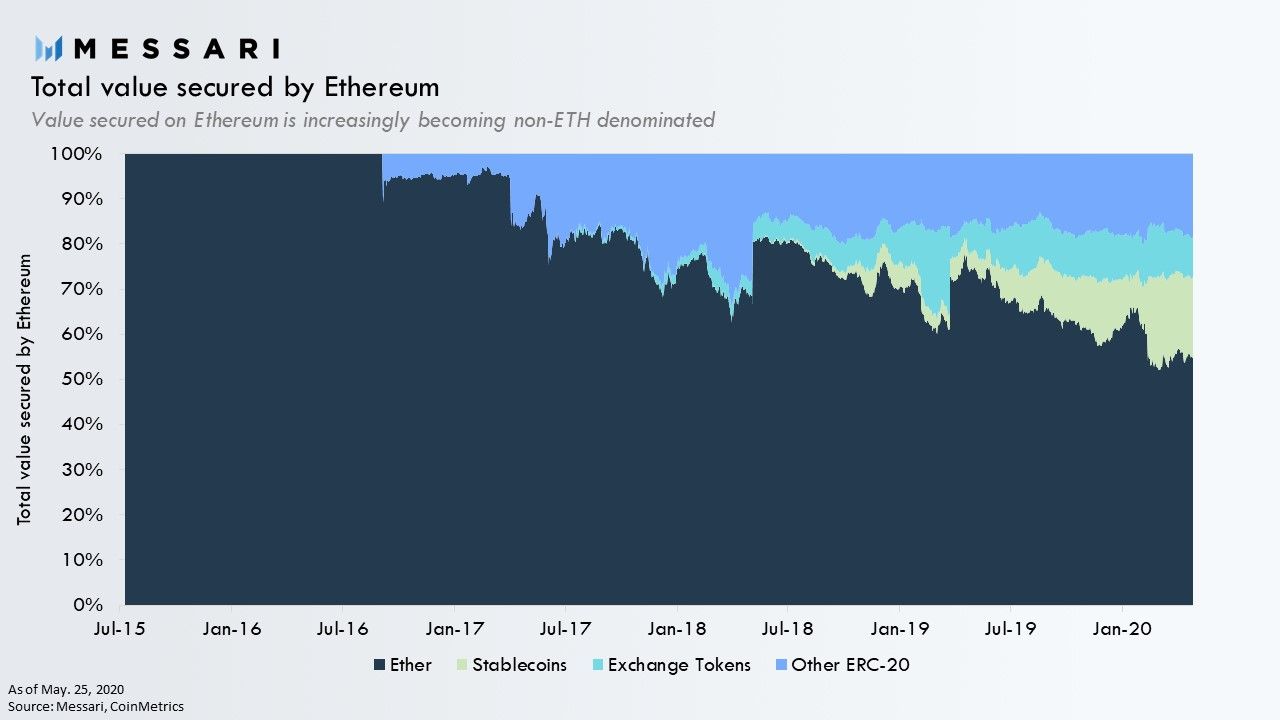
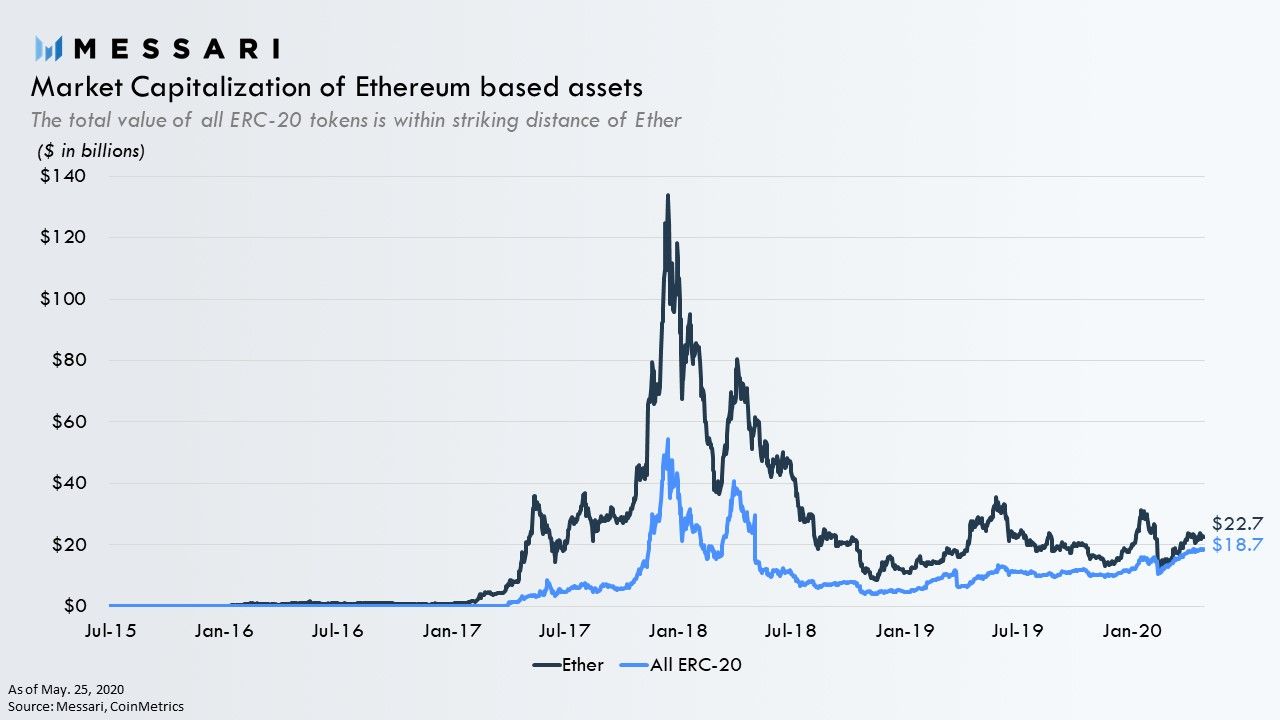
For the first year of its life the only valuable asset stored and transacted on Ethereum was ETH. This was the case until the latter half of 2016, in the early days of the infamous ICO boom. Since then a Cambrian explosion of new assets and applications have spawned on Ethereum. The growth in assets stored on Ethereum has been so explosive that non-ETH assets are approaching 50% of the total value stored on Ethereum. Nearly 50% of the value stored on Ethereum now incentivizes economic activity beyond the maintenance and execution of the Ethereum blockchain.

Ryan Watkins was a Senior Research Analyst at Messari. Previously, he worked at Moelis & Company as an Investment Banking Analyst where he worked on deals in the technology, telecom, and fintech sectors. Ryan graduated Magna Cum Laude from the Gabelli School of Business at Fordham University.