VeChain deployed the Hayabusa upgrade on Dec. 2, 2025, which transitioned VeChainThor from Proof of Authority (PoA) to Delegated Proof of Stake (DPoS).
StarGate 2.0 replaced the legacy node-based system with a staking NFT model that increases economic security, VTHO rewards, and user participation with the addition of new Node tiers. VeChain also began phasing out the Legacy Node rewards program.
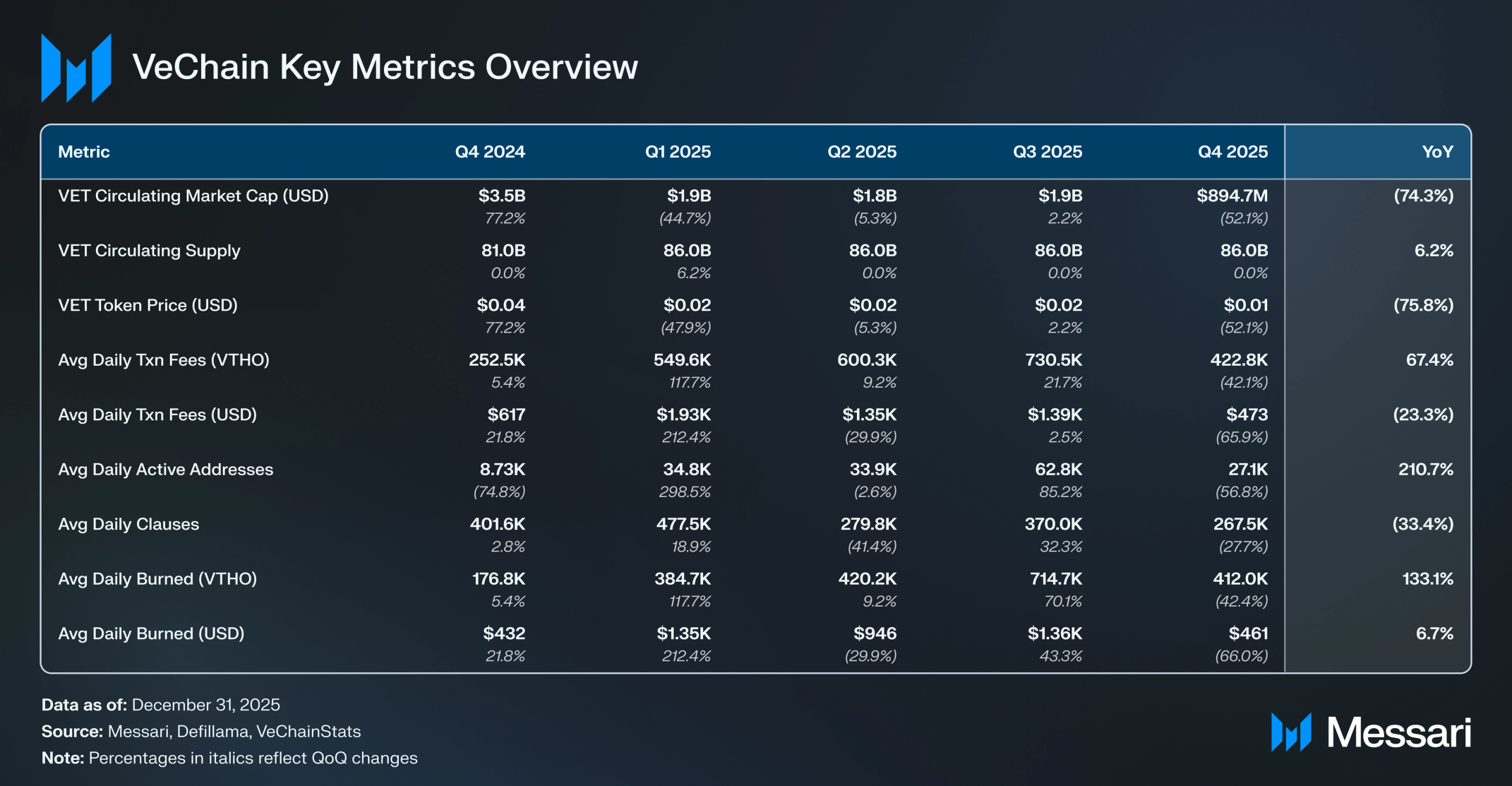
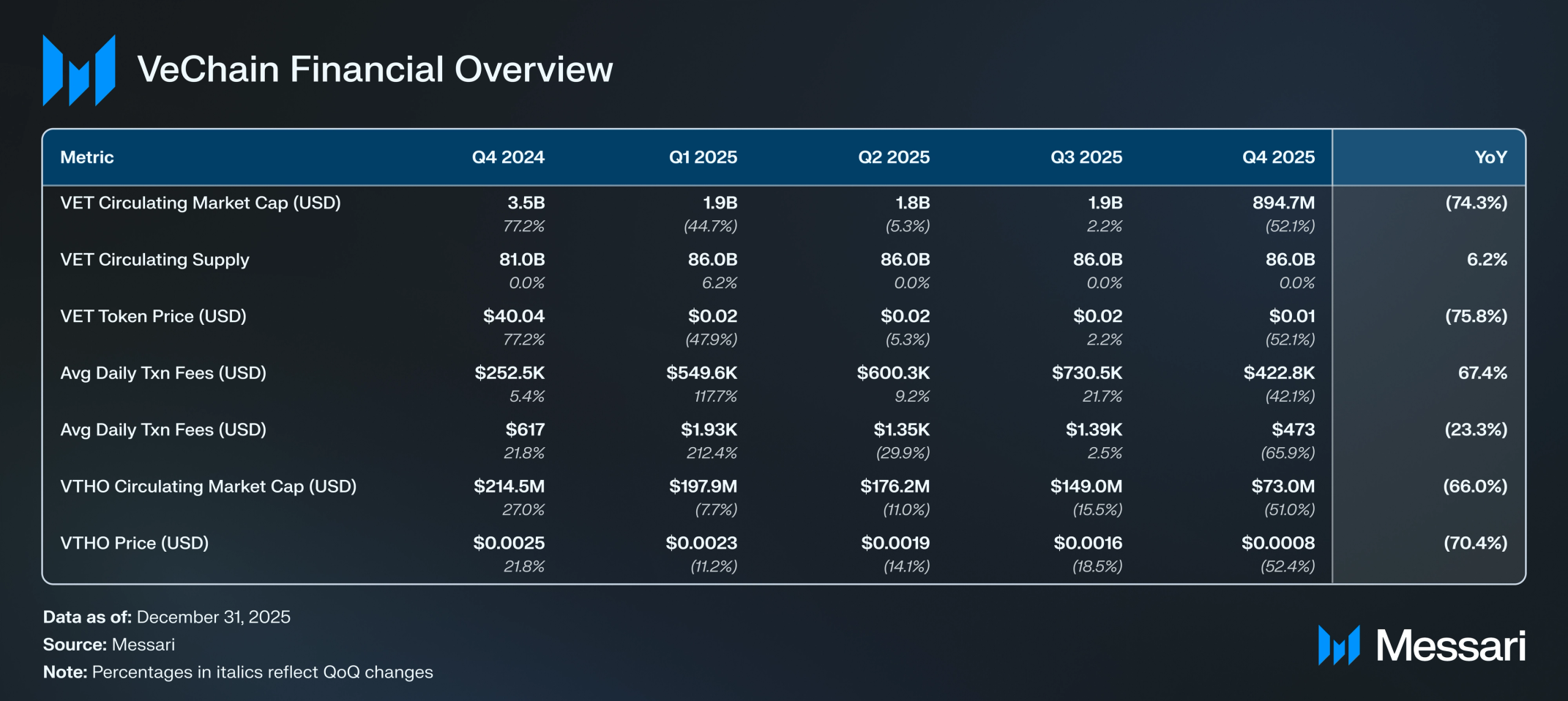
VET’s market capitalization declined 52.1% QoQ to $894.7 million, and VTHO’s market cap fell 51.0% QoQ to $73.0 million amid weakened market conditions.
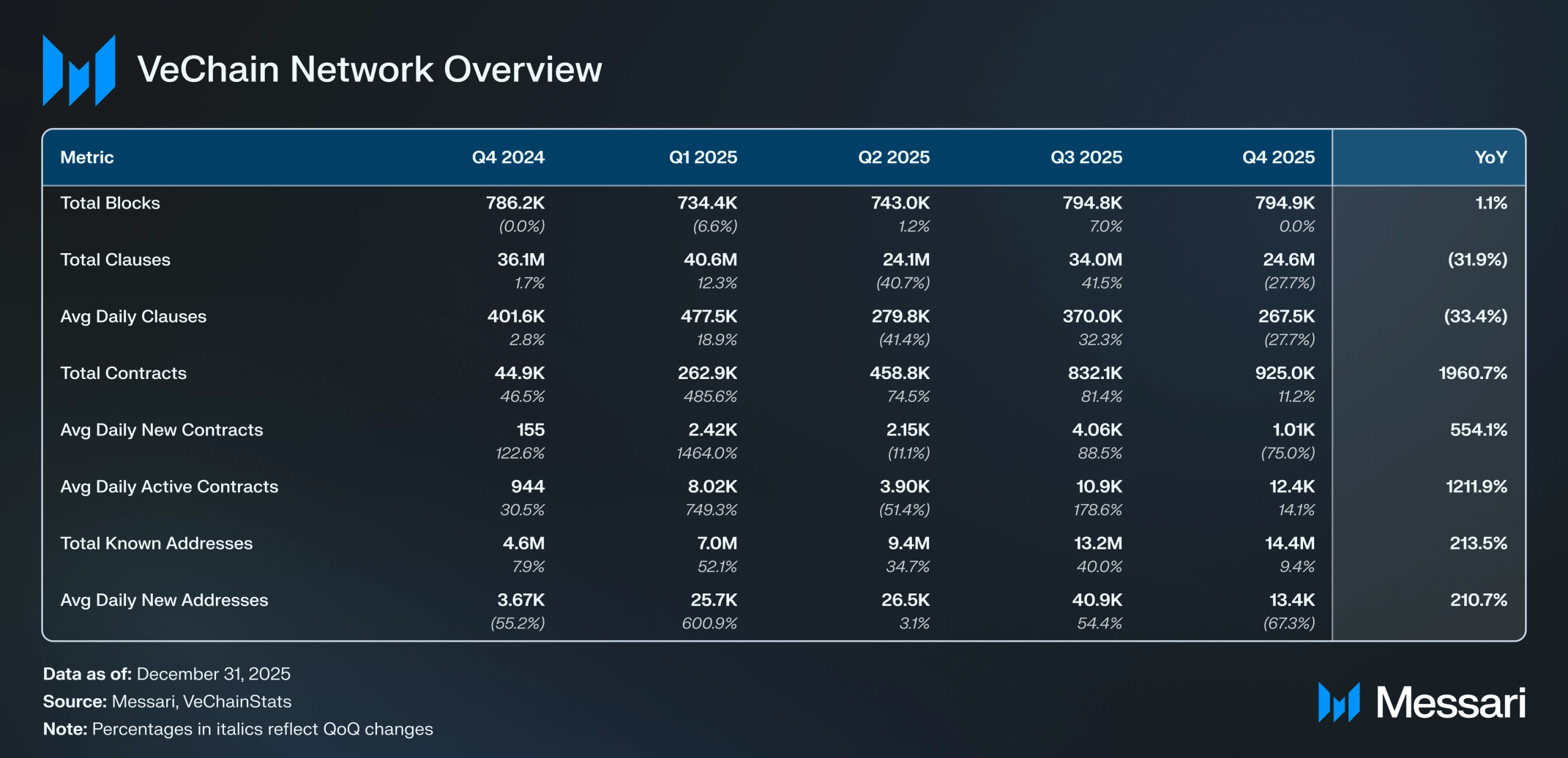
Network adoption continued to expand with total known addresses increasing 9.4% QoQ to 14.4 million and rising 213.5% YoY.
VeBetter expanded its governance and incentive framework with the launch of the Galaxy GM NFT tier and automated DAO voting.
Primer
VeChain, founded in 2015, uses blockchain technology to incentivize sustainability efforts and tackle real-world problems. At the heart of VeChain is VeChainThor, a Layer-1 public smart contract platform, which launched in 2017, and is designed for predictable fees and real-world application support.
The network uses a dual-token model with VET as the primary token, used for staking and governance, and VTHO as the gas token used to pay for transactions and smart contract execution. This separation is intended to stabilize fees for users and developers while allowing VET to capture network value.
VeChainThor now uses Delegated Proof of Stake (DPoS) as its consensus mechanism following the activation of the Hayabusa upgrade in December 2025. Under this model, block production is performed by a dynamic set of validators that compete for delegated stake rather than a fixed group of authority nodes. This transition replaced the network’s former Proof of Authority (PoA) framework, which relied on a limited set of KYC-verified authority master nodes under VeChain Foundation governance. While PoA prioritized throughput and deterministic finality, DPoS expands participation by allowing any VET holder to contribute to network security through staking and delegation. The result is a more decentralized and economically secure consensus model that aligns rewards with active participation and network performance.
For a full primer on VeChain, refer to our Initiation of Coverage report.
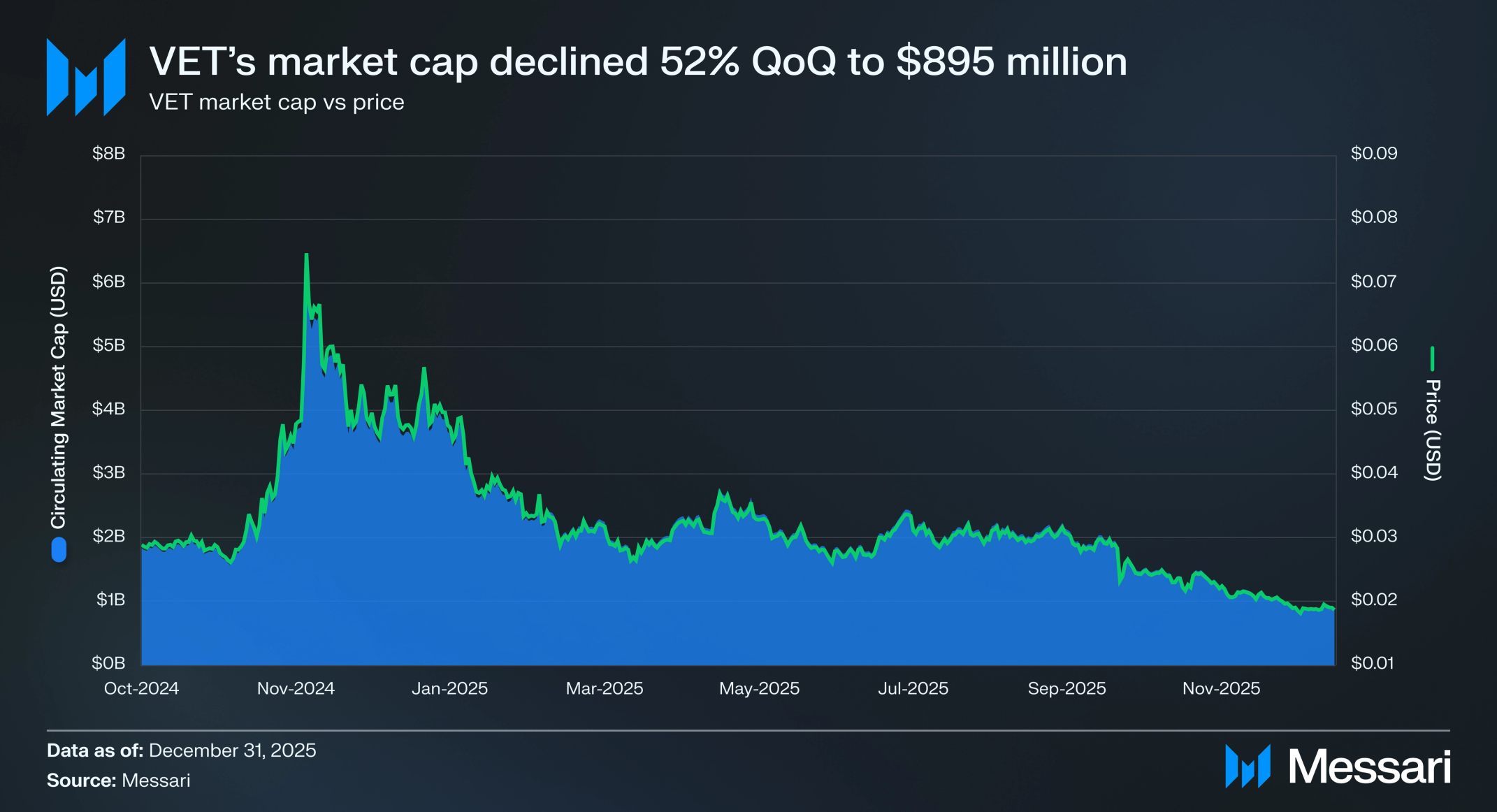
VET’s market capitalization fell 52.1% QoQ in Q4 2025, decreasing from $1.9 billion to $894.7 million. The token’s price mirrored this decline and closed the quarter at $0.010, down 52.1% from $0.022 in Q3. As a result, VET finished the quarter as the 63rd largest asset in terms of market cap compared to all other cryptocurrencies.
VTHO Market Cap
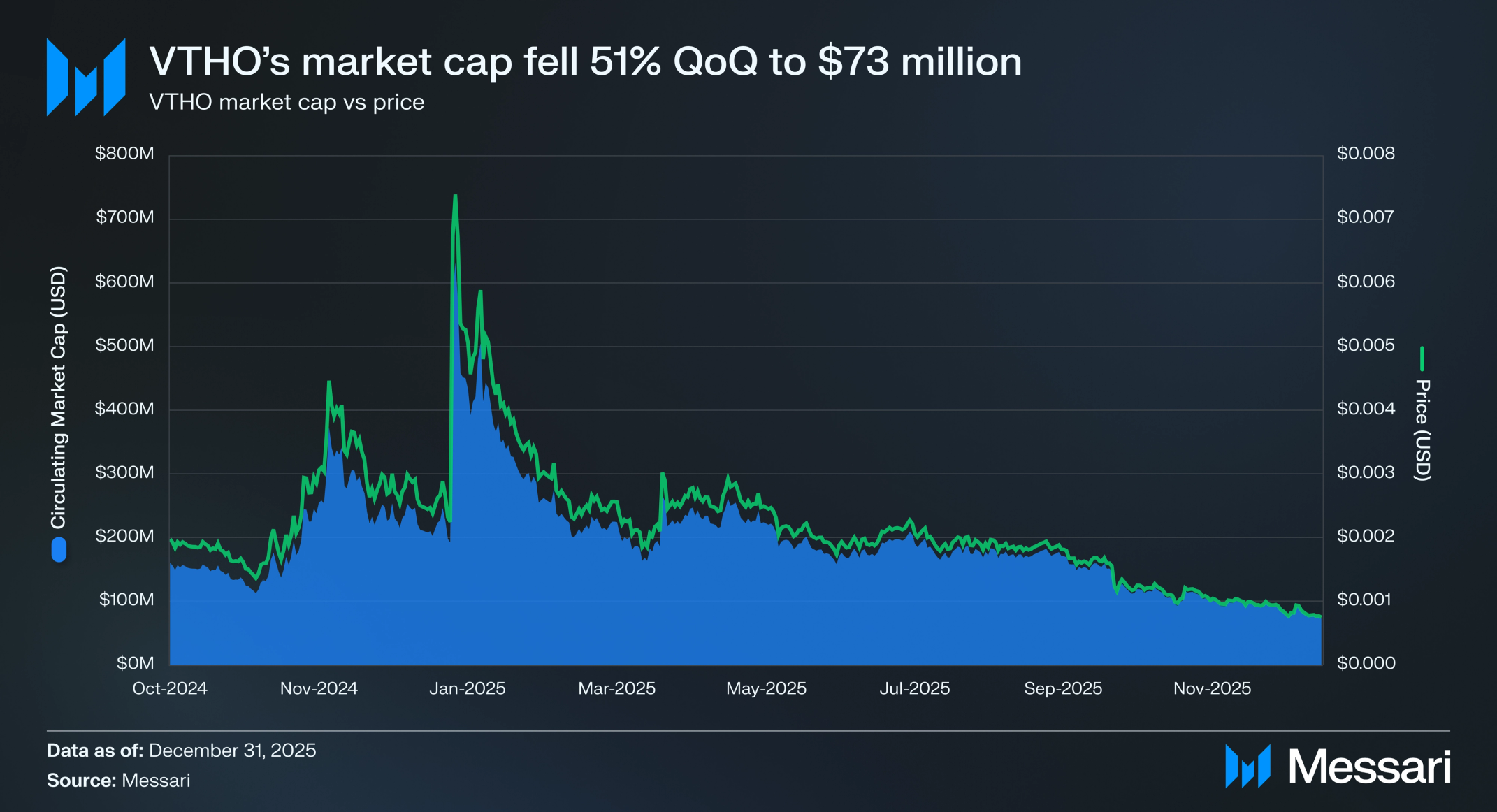
VTHO, VeChainThor’s gas token, which is earned through staking rewards, contracted in Q4 2025. Its total market capitalization fell 51.0% QoQ to $73.0 million, down from $148.8 million in Q3. VTHO’s price declined at a similar rate, dropping 52.4% QoQ to $0.00075 from $0.00158 in the prior quarter.
Transaction Fees
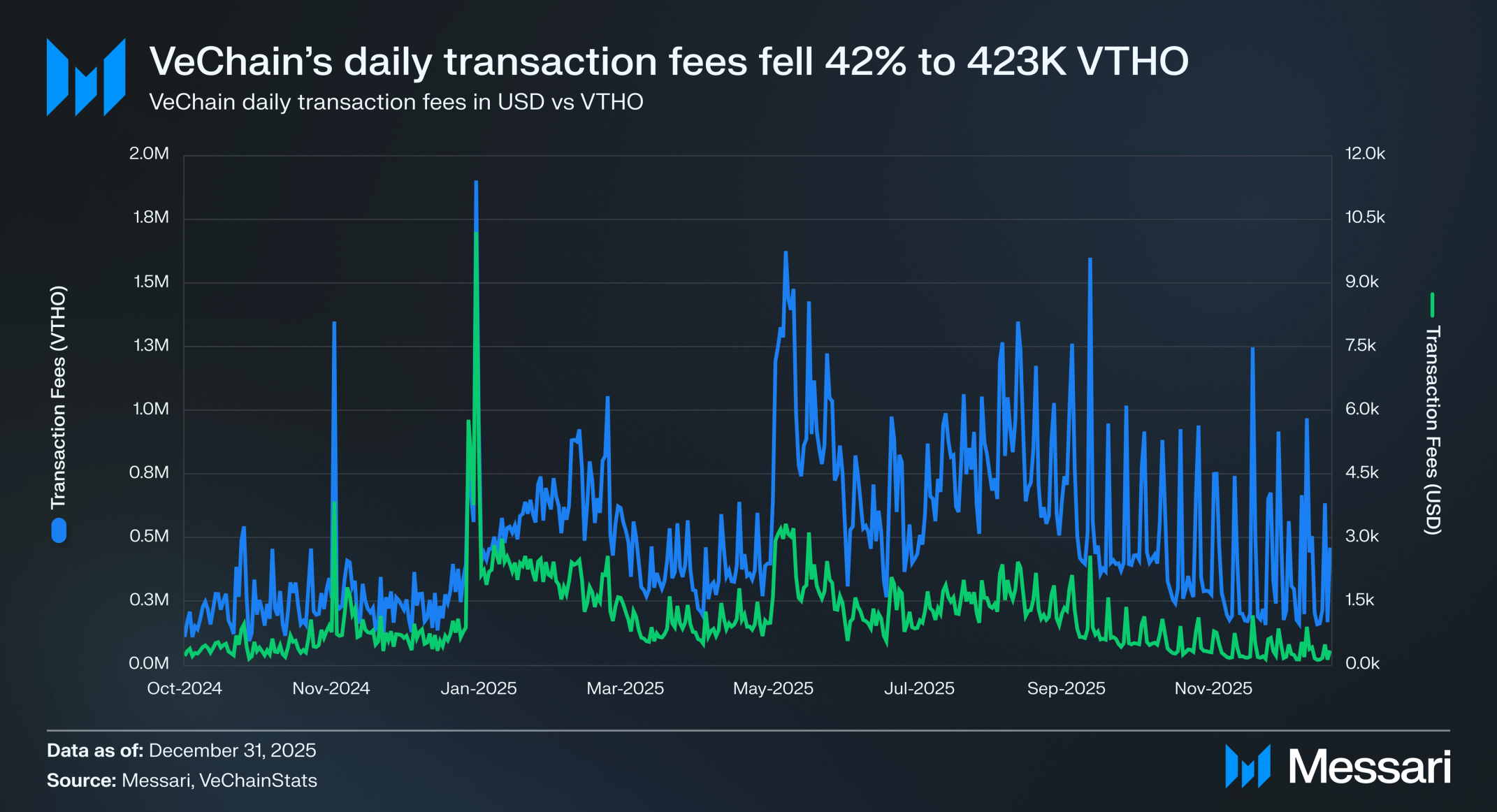
VeChainThor’s onchain fee generation declined in Q4 across both VTHO and USD terms. Average daily transaction fees fell 42.1% QoQ to 422,800 VTHO, down from 730,500 VTHO in Q3. In USD terms, average daily fees dropped more sharply by 65.9% QoQ to $473, compared with $1,390 in the prior quarter. This divergence was primarily due to the decline in VTHO’s price, which offset the growth in network activity.
Network Overview
Onchain Activity
VeChainThor transactions are composed of clauses, which are discrete components that allow multiple actions, such as transfers or smart contract calls, to be bundled together in a single transaction. This design enables users and dApps to execute complex operations efficiently while minimizing gas costs.
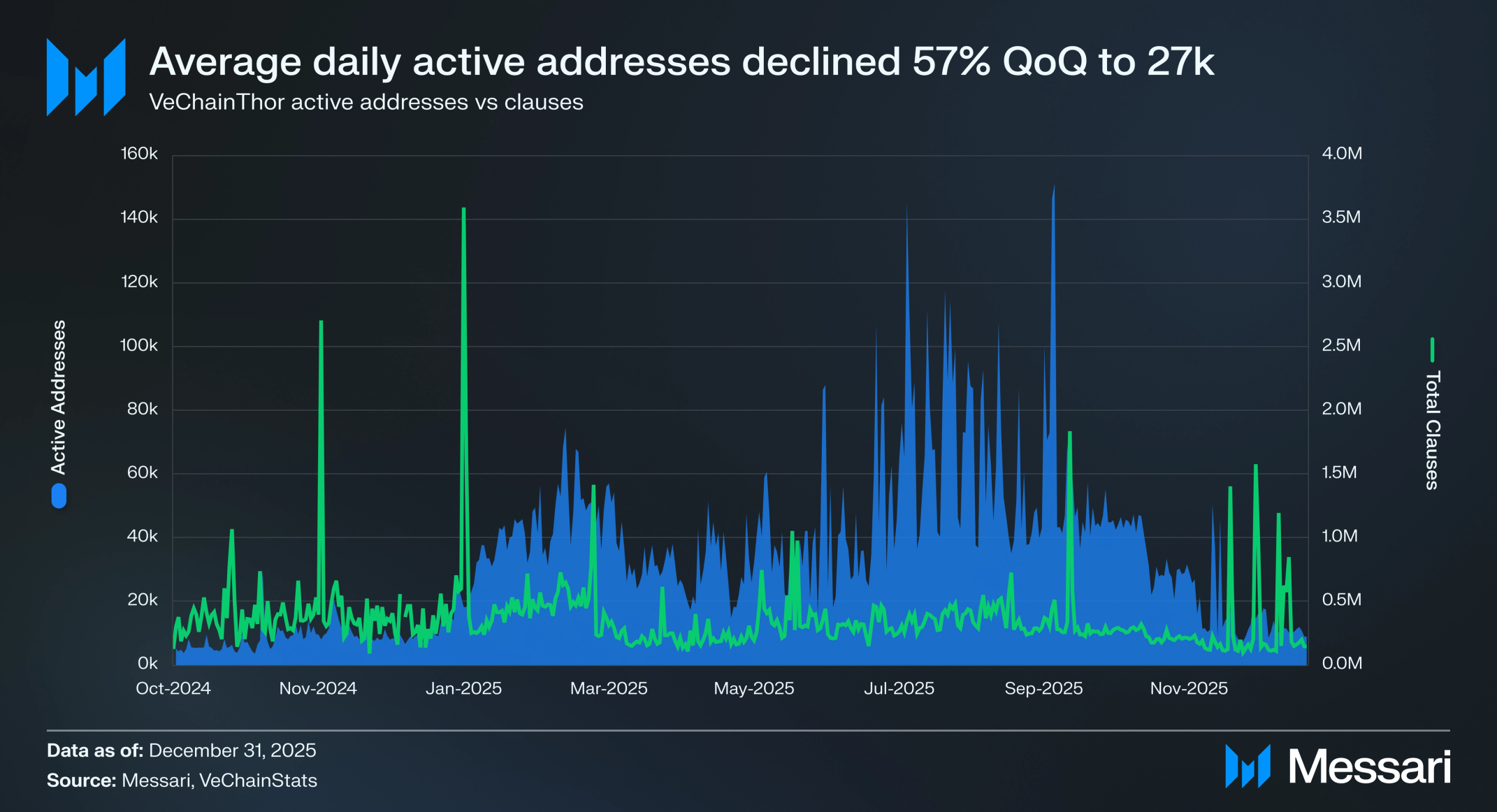
VeChainThor’s onchain activity contracted in Q4 2025 after the expansion seen in the prior quarter. Average daily active addresses declined 56.8% QoQ to 27,100, down from 62,800 in Q3. Transaction clauses also decreased, falling 27.7% QoQ to 267,500 from 370,000 in the previous quarter.
Protocol Developments
Hayabusa Upgrade
Hayabusa was introduced on Dec. 2 and transitioned the network from Proof of Authority (PoA) to Delegated Proof-of Stake (DPoS). It revised block production and validator selection while eliminating passive VTHO emissions. Under the updated model, VTHO issuance occurs only through protocol rewards distributed to validators and delegators that secure the network. Hayabusa also implemented a full burn of base transaction fees while maintaining predictable application-level costs, changing how transaction activity affects token supply.
As the network transitioned to Delegated Proof of Stake, institutional operators including Meria, Draper Lab, and Fenbushi Capital joined the active validator cohort, alongside well-known KOLs and community members. VeChain also reported early operational milestones, with Keyrock surpassing 200,000 validated blocks on VeChainThor.
StarGate 2.0
A new participation and reward model was introduced alongside the Hayabusa upgrade through StarGate 2.0, replacing the legacy node-based participation with a staking NFT framework. Under this system, staking NFTs represent delegated VET collateral and function as the sole mechanism for earning VTHO rewards. To facilitate early adoption of the new model, VeChain enabled boosted VTHO rewards ahead of mainnet activation to encourage migration and initial validator delegation.
Following the activation, VeChain initiated a phased wind-down of the Legacy Node rewards system. Legacy reward accrual was discontinued, with holders instructed to claim outstanding rewards by March 15, 2026. Migration of Legacy Nodes to StarGate will remain available indefinitely without restriction, allowing legacy node NFTs to be converted into Delegator Nodes and continue participating in validator delegation and VTHO generation under the new framework.
Developer Ecosystem
Developer activity in Q4 2025 focused on ecosystem continuity, security validation, governance tooling, and technical transition support ahead of the Hayabusa mainnet upgrade.
Security validation formed a core component of Q4 developer activity. On Oct. 1, VeChain launched the Hayabusa Attackathon in collaboration with Immunefi, which ran through Oct. 26. The program offered up to $160,000 in USDT rewards for identifying vulnerabilities related to consensus changes, tokenomics, and decentralization within the Hayabusa upgrade.
The VeChain Global Hackathon, which launched in late Q3, concluded on Oct. 5 with 119 participating developers and 63 submitted projects. Following the submission deadline, nine projects were selected to receive rewards.
Builder-facing governance and funding infrastructure were also updated through the VeBetter ecosystem. On Oct. 14, VeChain revised the VeBetter grant and proposal submission process to simplify application and review workflows. Updated grants documentation and transparency reports were published to improve disclosure around funding allocation and DAO operations.
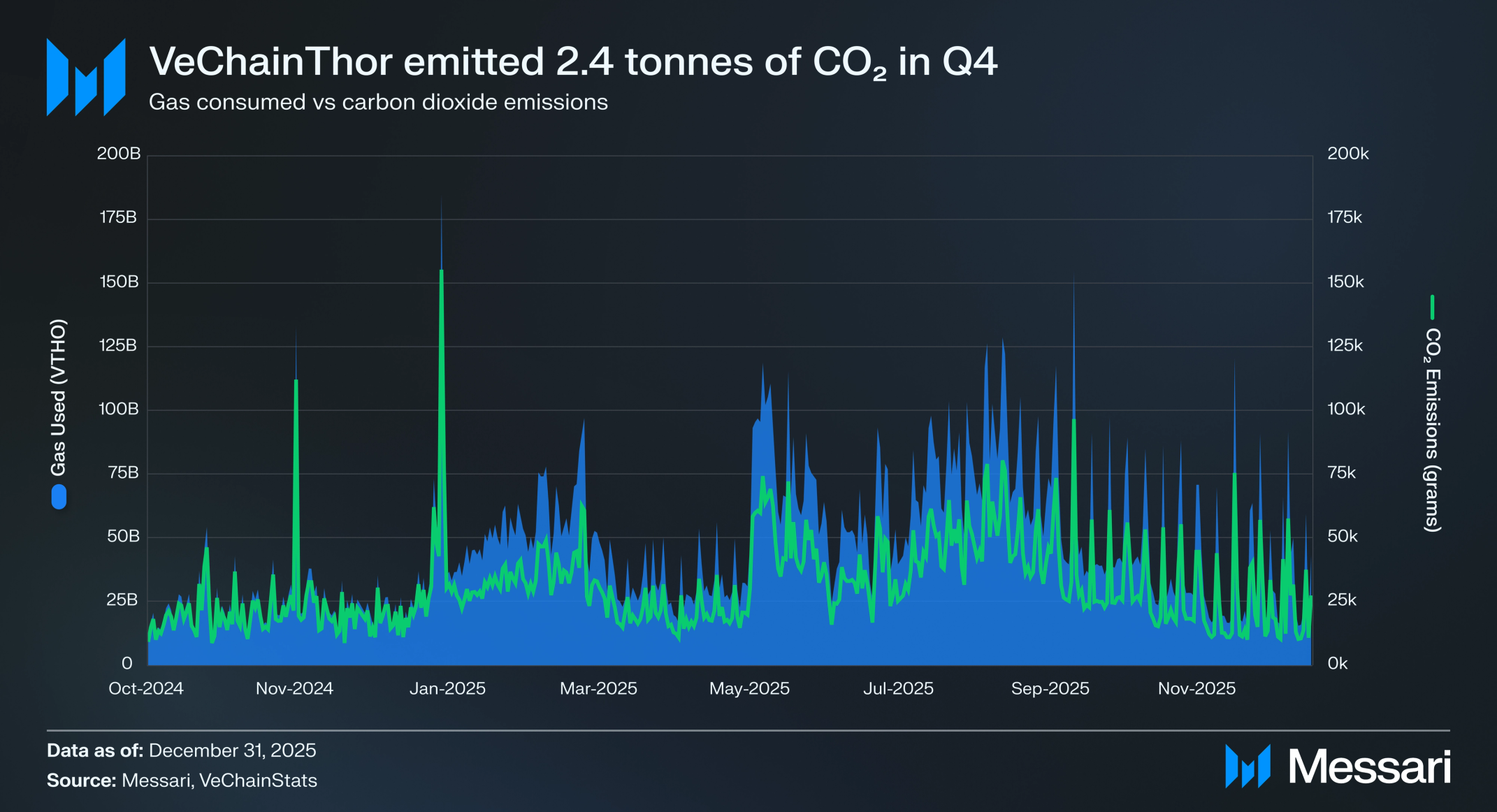
VeChainThor’s CO₂ emissions declined in Q4 2025. The network emitted an estimated 2.4 tonnes of CO₂ during the quarter, a 41.8% decrease from Q3, roughly equivalent to the annual energy usage of about 269 gallons of gasoline consumed.
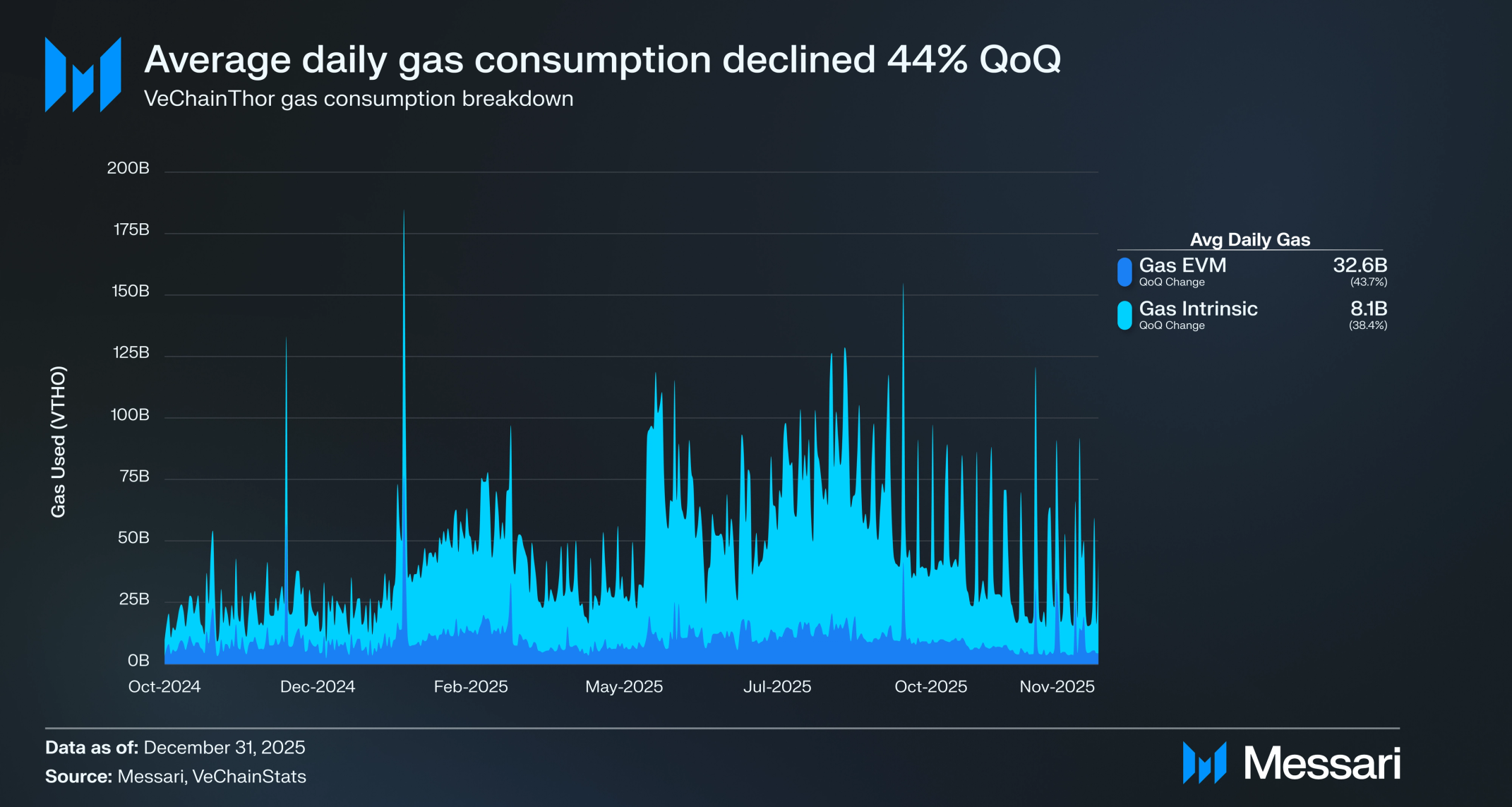
EVM-based transactions continued to account for the majority of network gas usage but fell 43.7% QoQ to an average of 32.6 billion gas units per day, down from 57.9 billion in Q3. Intrinsic gas usage also decreased, dropping 38.4% QoQ to 8.1 billion daily gas units from 13.1 billion in the prior quarter.
Ecosystem Overview
DeFi
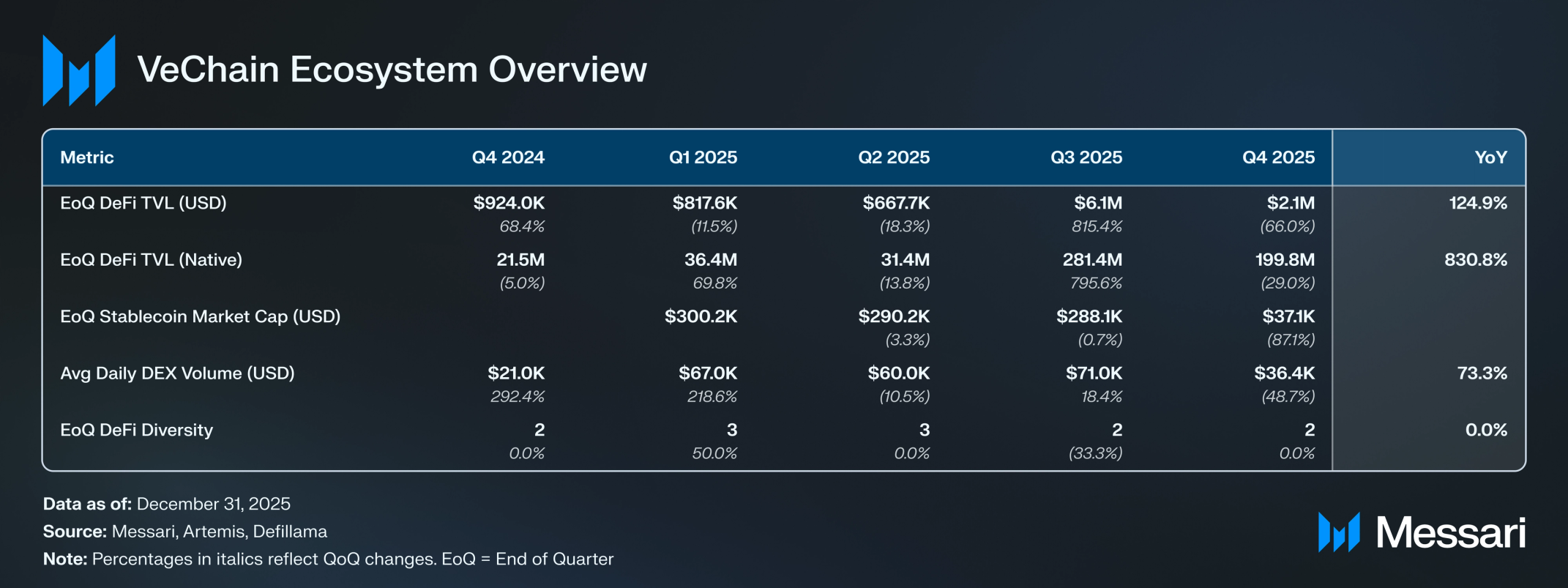
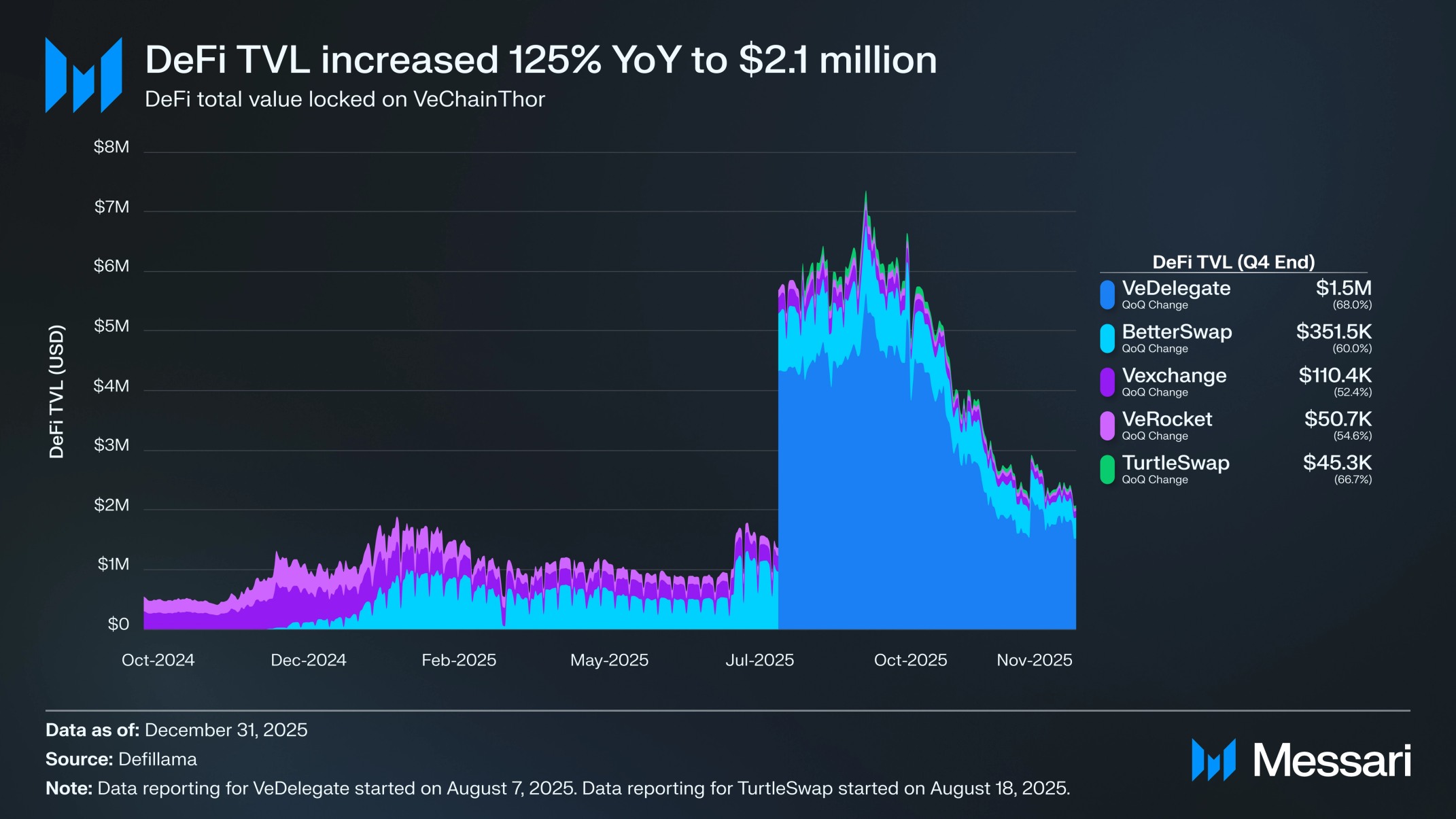
VeChainThor’s DeFi ecosystem contracted in Q4 2025 after rapid expansion in the prior quarter. Total value locked declined 66% QoQ to $2.1 million, down from $6.1 million at the end of Q3. VeDelegate remained the largest protocol by TVL with 73.2% of the overall market share, but saw a 68.0% QoQ decline to $1.5 million. However, on a year-over-year basis, the DeFi sector remained in expansion, with aggregate TVL up 124.9% compared with Q4 2024.
BetterSwap ranked second with $351,500 in TVL and recorded a 145.6% increase in TVL YoY.. Other protocols also recorded drawdowns over the quarter, with Vexchange, VeRocket, and TurtleSwap each posting TVL declines of more than 50% QoQ. Despite the pullback, VeDelegate continued to represent the largest share of DeFi liquidity on VeChainThor by the end of Q4.
VeBetter
One of the leading platforms in VeChain’s ecosystem is VeBetter, an onchain app store and incentive layer. VeBetter focuses on the development of sustainability-focused applications and rewarding users for participating in sustainability efforts.
The VeBetter ecosystem centers around two tokens:
B3TR: the primary incentive and participation token, awarded to users for participation in the VeBetter ecosystem.
VOT3: the primary governance token for VeBetter, implemented via a suite of smart contracts deployed on VeChainThor. Together, these components enable voting, treasury management, and rewards aligned to user activity across partner dApps.
Galaxy GM NFTs Launch
On Nov. 20, VeChain confirmed the launch of the Galaxy GM NFT tier, the tenth and final tier in the GM progression system. Galaxy introduced the highest reward multiplier and governance weighting in the framework and requires a substantial B3TR contribution to the VeBetter treasury. The launch established the upper bound for participation incentives and governance influence within the ecosystem.
VeBetter DAO Automated Voting
Governance infrastructure also expanded in December with the introduction of automated voting for VeBetter DAO participants. The system enables automated weekly governance participation under a capped fee model applied to B3TR rewards. Under this model, a 10% service fee is applied to weekly B3TR rewards to cover the cost of the auto-voting service, capped at 100 B3TR per week regardless of reward size. VeChain stated that the initial implementation operates through a centrally managed service, with future phases intended to support additional community-operated voting solutions.
VeWorld
VeChain updated its user-facing access infrastructure in Q4 2025 through targeted enhancements to VeWorld and deeper integration with StarGate and VeBetter.
VeWorld version 2.4.6, released on Oct. 13, introduced interface refinements, expanded dashboards, and improved navigation for tokens, staking, and VeBetter activity. The update consolidated core wallet functions and improved visibility into balances and participation status. On Nov. 17, VeWorld version 2.4.10 expanded token discovery and analytics through enhanced token graphs, activity tracking, and expanded token information pages.
VeBetter functionality was integrated directly into VeWorld through a native dashboard. Users can track B3TR rewards, application usage, and tokenized sustainability actions within the wallet.
Stablecoins
On March 18, 2025, USDGLOlaunched on VeChain, replacing VeUSD as the primary stablecoin on the network. The introduction of USDGLO marked an important step in building out the network’s financial infrastructure, providing a stable settlement layer for DeFi protocols, trading pairs, and retail use cases. By reducing exposure to volatility, stablecoins like USDGLO create a predictable medium of exchange that can support both enterprise adoption and consumer-facing applications.
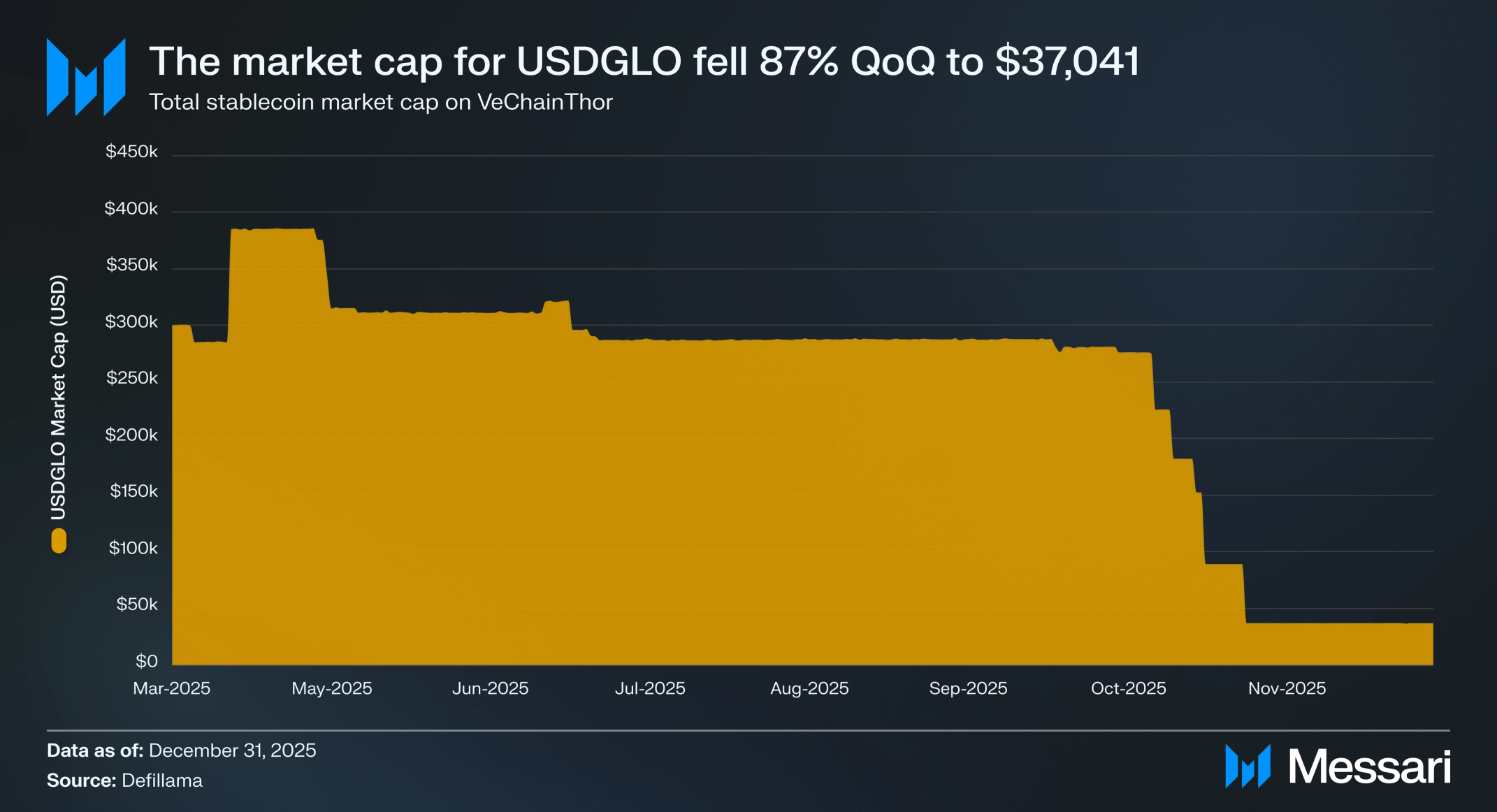
Additionally, profits from USDGLO are directly allocated to the VeChain Foundation and used to purchase B3TR tokens. B3TR tokens purchased with USDGLO profits are allocated to VeBetter and used to support ecosystem initiatives and incentivize participation within the ecosystem. USDGLO ended Q4 with a market cap of $37,040, down 87.1% QoQ.
The sharp decline in market cap during Q4 followed the announcement by VeChain and the Glo Dollar team that they would wind down support for USDGLO by Jan. 1, 2026. This move was based on limited adoption and resource constraints, prompting the ecosystem to transition toward more widely used stablecoins like USDC and leading holders to gradually exit USDGLO ahead of the sunset.
Partnerships & Adoption
VeChain advanced enterprise adoption in Q4 2025 through regulatory-aligned partnerships and production deployments.
Product Launches and Consumer Applications
On Nov. 24, VeChain announced a partnership with Rekord to support Digital Product Passports under the European Union’s Ecodesign for Sustainable Products Regulation. Under the collaboration, Rekord’s data verification layer anchors product and sustainability data to VeChainThor, positioning the blockchain as public infrastructure for compliance-driven use cases. In December, VeChain highlighted Rekord’s disclosure that the integration processed more than 100,000 transactions within one month of activation on VeChainThor, indicating sustained production usage rather than a pilot deployment.
Closing Summary
In Q4 2025, VeChain activated the Hayabusa hard fork on mainnet. Hayabusa introduced a protocol-level shift to Delegated Proof of Stake (DPoS), which enabled VET holders to contribute to network security by staking and delegating collateral to earn protocol rewards. In parallel, StarGate 2.0 provided the NFT-based staking and delegation framework that governs how delegation is performed and how VTHO rewards are distributed to active participants. The quarter also marked the retirement of VeChain’s legacy participation system and the establishment of a unified incentive structure based on active network contribution. At the application layer, VeBetter remained the primary driver of consumer adoption through the launch of the Galaxy GM NFT tier and the introduction of automated DAO voting.
Q4 also reflected structural change amid broader market contraction. VET’s market capitalization declined 52.1% QoQ to $894.7 million, while VTHO’s market cap fell 51.0% QoQ to $73.0 million. Despite near-term pressure on market and activity indicators, longer-term adoption signals strengthened. Total deployed smart contracts increased 11.2% QoQ to 925,000 and rose 1960.7% YoY, while total known addresses grew 9.4% QoQ to 14.4 million and increased 213.5% YoY. Alongside these trends, the transition to Delegated Proof of Stake expanded VeChain’s validator set to include institutional operators such as Meria, Fenbushi Capital, and Draper Lab. Enterprise adoption also advanced through production deployments such as Rekord’s Digital Product Passport integration.
This report was commissioned by VeChain. All content was produced independently by the author(s) and does not necessarily reflect the opinions of Messari, Inc. or the organization that requested the report. The commissioning organization may have input on the content of the report, but Messari maintains editorial control over the final report to retain data accuracy and objectivity. Author(s) may hold cryptocurrencies named in this report. This report is meant for informational purposes only. It is not meant to serve as investment advice. You should conduct your own research and consult an independent financial, tax, or legal advisor before making any investment decisions. Past performance of any asset is not indicative of future results. Please see our Terms of Service for more information.
No part of this report may be (a) copied, photocopied, duplicated in any form by any means or (b) redistributed without the prior written consent of Messari®.