VeBetter closed Q1 with more than 50 live applications, 5.5 million wallets, and 48 million verified onchain actions. Mugshot and GreenCart each surpassed two million users, establishing the platform’s first two consumer-scale super apps.
VeChain, Rekord, and the University of Sheffield’s AMRC launched production-scale Digital Product Passport (DPP) infrastructure for the EU on Jan. 15, 2026, processing more than 300,000 onchain events by quarter-end. The deployment positions VeChainThor ahead of most public chains for compliance with the EU’s 2027 mandatory DPP regulation.
VeChain confirmed its partnership with Decent Hands, a workplace health and safety platform that integrates blockchain to anchor compliance and safety activities directly on VeChainThor. Safety inspections, equipment checks, facility rounds, and audit-grade reporting are written to the chain as immutable, verifiable records rather than paper logs or siloed databases.
VeBetter Whitepaper 2.0 formalized the platform’s agentic positioning, framing B3TR as the coordination layer between human and AI agent economic activity.
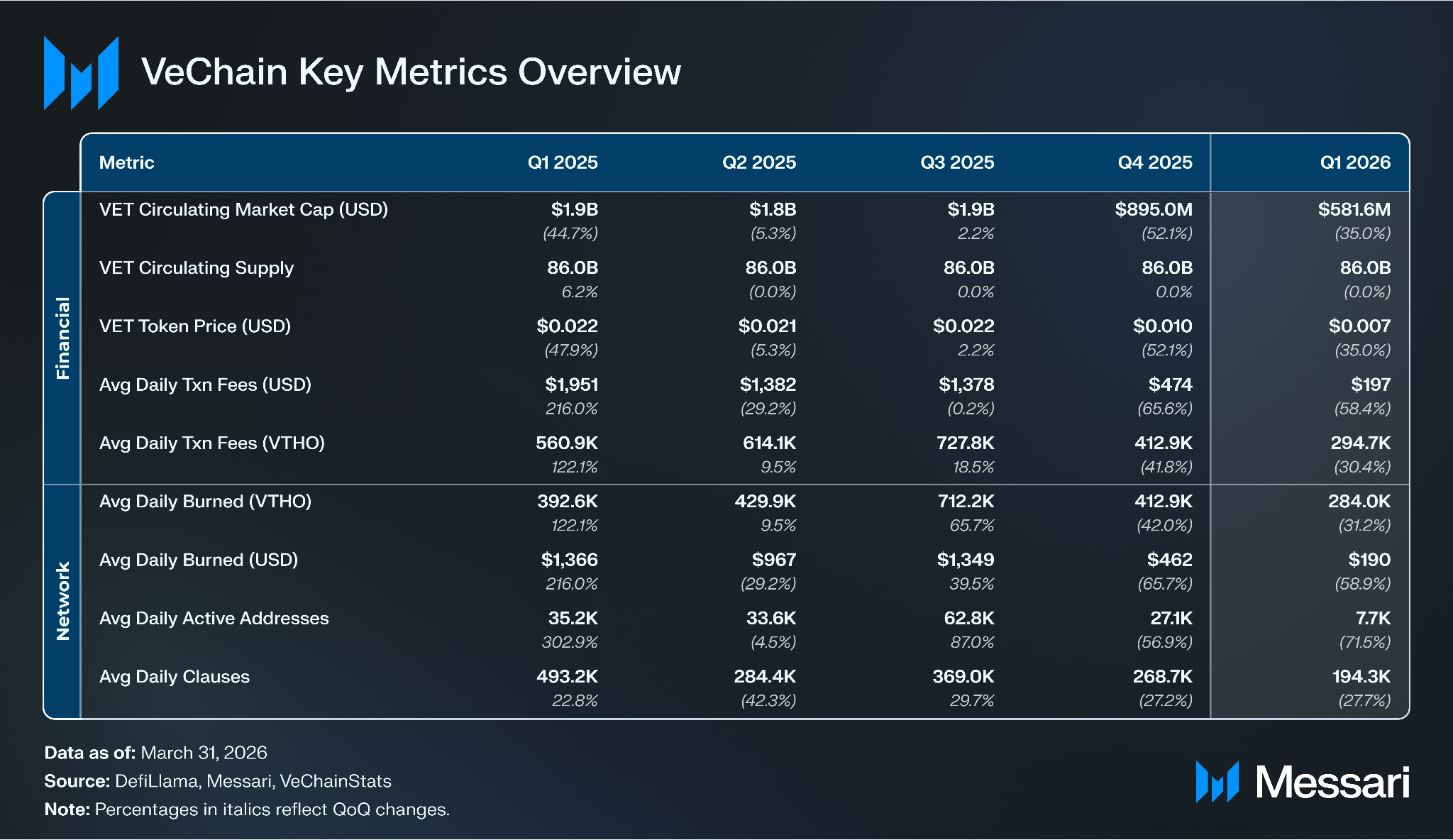
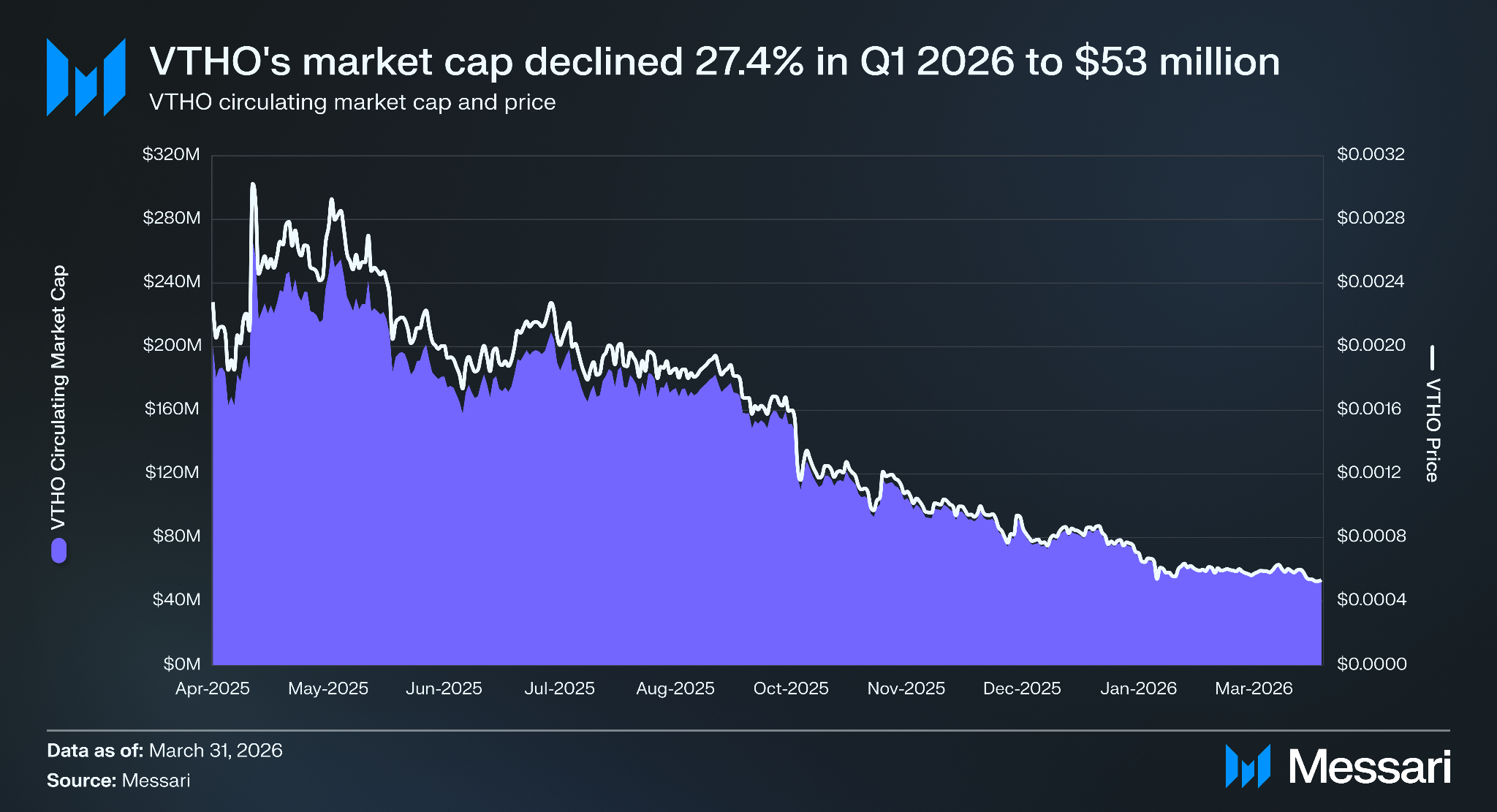
VET’s market cap fell 35.0% QoQ to $581.6 million, and VTHO’s market cap declined 27.4% to $53.0 million on broad market weakness. The quarter included five new exchange listings (VET on Bullish, Coinbase, and Revolut; VTHO on Kraken and Bullish), expanding distribution into major U.S. and European retail and institutional rails.
Primer
VeChain is a Layer-1 blockchain founded in 2015 to bring real-world supply chains, sustainability programs, and consumer applications onchain. Its base network, VeChainThor, launched in 2017 and is built around predictable transaction costs and enterprise application support, the attributes that distinguish it from general-purpose smart contract platforms competing primarily for DeFi capital.
The network operates a dual-token model. VET is the primary asset, used for staking and governance, while VTHO is the gas token that pays for transactions and smart contract execution. The structure decouples the cost of using the network from the market price of its native asset, giving developers and enterprise integrators stable fee assumptions and giving long-term VET holders exposure to network growth through VTHO generation. That predictability is foundational to VeChain’s enterprise strategy.
VeChainThor uses a Delegated Proof-of-Stake (DPoS) consensus mechanism following the Hayabusa upgrade on Dec. 2, 2025. DPoS replaced the prior Proof-of-Authority framework, opening block production to any validator able to attract delegated stake and aligning network security with active participation rather than VeChain Foundation curation. This consensus shift modified how the protocol’s tokenomics functioned: VTHO, previously generated by VET tokens at the minting of every 10 seconds, was now generated only by staked VET, eliminating a key source of inflationary pressure for the gas token. More details on that can be found here.
For a full primer on VeChain, refer to our Initiation of Coverage report.
The Project Team Commentary section of this report was written by the VeChain team and reflects the views, opinions, and forward-looking statements of VeChain only. This section is included to provide additional context on the project's strategy, priorities, and outlook and does not necessarily reflect the views or opinions of Messari, Inc.
The first quarter of 2026 was about technical positioning for a fast-evolving macro environment. Coming off the December 2025 Hayabusa mainnet activation and a year of upgrades under the VeChain Renaissance campaign, the team set out to convert the work done into a public, evidence-based case for blockchain utility.
The quarter opened with the 2026 Manifesto, with a defiant framing: “Fighting for utility in a casino market". As always, our goal has been to push the frontiers of possibility using blockchain, developing use cases that let enterprise and individual users experience the tech firsthand. While much of the industry spent the back end of 2025 chasing speculative narratives, we were focused on rebuilding tokenomics, consensus, and reward distribution at the protocol layer to support the next legs of mass adoption. On March 13, VeChain published 13-week post-Hayabusa data showing VTHO emissions down 50.2% and active staking participants nearly doubled, with total VET staked on StarGate jumping from 2.52 billion to 13 billion, increasing economic security, positively affecting VTHO inflation, and further decentralizing the protocol.
The second strategic objective; The 2026 Roadmap, "Agentic Foundations for Tomorrow & Beyond," was published to offer forward-looking scaffolding on our next steps, and the integration of a third actor into our vision for the future of blockchain adoption: AI Agents. TrustLayer was introduced, anchored to three concrete substrates (MPP protocol, fee delegation via VIP-191, EVM parity through Interstellar), with Agent Indexer and the new Explorer signposted as deliverables. The thesis — billions of AI agents will need blockchain-based trust to scale agentic commerce — was a logical extension of our utility argument. The technical updates support and enhance the value capture derived from billions of new digital actors arriving on-chain in the coming years.
Real-world adoption expanded with the VeChain and Rekord partnership on February 12, with AMRC as a partner, enabling VeChain to engage with production-scale Digital Product Passport infrastructure for the EU. 300,000+ DPP events have already been processed on VeChainThor, positioning VeChain ahead of the EU's 2026 and 2027 regulatory deadlines. Institutional momentum from becoming a client of Franklin Templeton, as well as BitGo, and Keyrock integrations, expanded VeChain’s network and opportunities through the quarter. VeChain confirmed its partnership with Decent Hands, a workplace health and safety platform that integrates blockchain to anchor compliance and safety activities directly on VeChainThor. Safety inspections, equipment checks, facility rounds, and audit-grade reporting are written to the chain as immutable, verifiable records rather than paper logs or siloed databases. The integration uses fee delegation, so field workers never touch tokens or gas, keeping the experience identical to any conventional mobile workflow while the verification layer runs beneath. The partnership is a clean example of the utility thesis at work, blockchain doing the unglamorous structural job of making real-world accountability provable, in a category — workplace safety — where the absence of trustworthy records carries genuine human and regulatory consequences.
VeBetter, the X-2-earn sustainability app ecosystem, ran underneath both arcs as the daily utility driver - 5 million users, 50-plus apps, tens of millions of tokenized actions logged on-chain, despite the economic headwinds facing the industry at the time. We believe this is a testament to the stickiness of Web3 with genuine utility, beyond speculation alone.
Our next quarter is equally packed, with the upcoming launch of agentic products that will enable VeChain to seamlessly expand its product offerings to a global audience and put the power of agentic Web3 in the average person’s hands.
Follow our X account to stay updated on the latest developments!
Ecosystem Overview
VeBetter
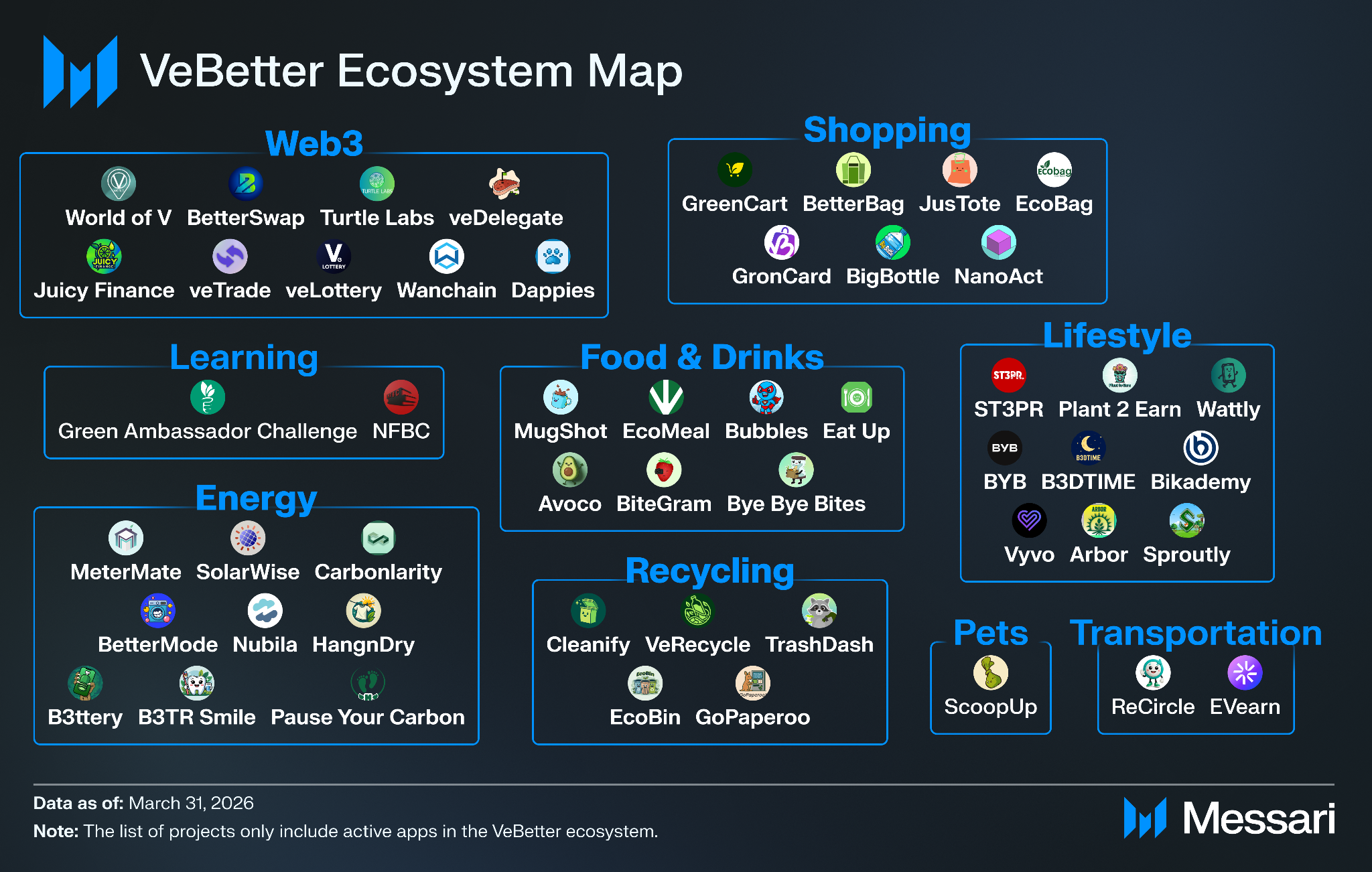
VeBetter is the consumer app platform on VeChainThor focused on real-world sustainability programs such as recycling, sustainable shopping, and energy reduction. It is the current centerpiece of VeChain's real-world adoption strategy for retail users, and it is soon to be expanded by its push into agentic tooling and new product launches. The platform operates as a marketplace for X-to-Earn applications, where users complete verified sustainable actions inside third-party apps and receive B3TR rewards from a shared, weekly token pool. Each application earns its share of the pool through a community vote in VOT3, the governance token tied 1:1 to B3TR, with allocations weighted by quadratic funding to prevent capture by large holders. VeBetter ended Q1 2026 with more than 50 live applications, 5.5 million wallets, and 48 million verified onchain actions.
VeBetter’s strategic framing sharpened over the quarter as the team formalized an agentic vision for the platform. VeBetter Whitepaper 2.0 repositions the platform as the coordination layer for an emerging AI agent economy, in which agents execute sustainable actions, manage rewards, and interact with smart contracts directly via Model Context Protocol (MCP) standards. Under this framing, B3TR’s role extends beyond user incentives to coordinating value flows between human participants and machine-controlled agents.
Ecosystem Composition
Mugshot and GreenCart anchor VeBetter’s ecosystem as the two “super apps,” each with over 2 million users. Mugshot rewards sustainable coffee and tea consumption by verifying purchases through reusable-cup imagery. GreenCart turns grocery receipts into blockchain-verified sustainability proofs through a Shop, Scan, Earn flow that ties B3TR rewards to specific food choices. VeBetter’s scale proves an X-to-Earn model can run on a public chain without the centralized rewards custody Web2 loyalty programs require.
Around the super apps sits a long tail of sector-specific applications with focused mandates. Cleanify rewards verified community cleanups, with plastic waste collection logged onchain by weight. Solarwise and EVearn target home solar generation and electric-vehicle charging, respectively, with EVearn extending coverage to more than 30 EV brands during the quarter through a SmartCar integration. BetterSwap and VeDelegate sit at the financial layer, providing token utility once users accumulate B3TR rewards.
Q1 Ecosystem Highlights and Additions
VeChain highlighted several VeBetter applications during the quarter that broadened the platform’s range of rewarded actions:
ST3PR: A movement-based earning app that pays B3TR for daily steps and runs verified through Apple Health, Google Fit, and Strava integrations. ST3PR’s strategic value lies in its distribution model. By piggybacking on incumbent fitness platforms, the app onboards users with no Web3 interaction beyond a VeWorld wallet for rewards.
Zeloop: A community mapping application that rewards users in B3TR for spotting litter and locating recycling bins, contributing to a crowdsourced database of waste hotspots and recycling points. Zeloop pre-dates VeBetter and represents the type of established sustainability project that the ecosystem absorbs and re-incentivizes through token-denominated rewards.
Wattly: A digital wellness application that rewards users in B3TR for reducing daily screen time, with AI-verified usage tracking that turns healthier device habits into onchain rewards. Wattly extends VeBetter into the personal-wellness category, tying tokenized incentives to behavioral health metrics.
CleanmateDAO: A community sustainability application that rewards users in B3TR for joining cleanups, hosting workshops, discovering local sustainability events, and maintaining weekly sustainability streaks. CleanmateDAO extends VeBetter beyond one-off action verification by using gamified streaks to reward consistent daily habits.
Punchcards: A collectible card game where players forge packs through "Coalburn the Smith" to reveal and collect cards, with gameplay integrated into VeBetter's B3TR reward structure. Punchcards extends VeBetter beyond sustainability apps and into onchain gaming.
Endorsement System Overhaul
VeBetter apps need 100 endorsement points from node holders to qualify for weekly B3TR allocations. Before Feb. 19, 2026, node holders had to commit their entire endorsement balance to a single app at a time, which kept endorsements concentrated on established apps and starved newer projects of support.
Node holders can split endorsement points across multiple applications, freeing previously locked capital.
Withdrawals can now be partial. Only the points a node pulls enter the cooldown period; the rest stay active on the app.
A 35-point cap per node per application and a 115-point ceiling per application prevent any single node from carrying a project by itself. The 100-point qualification threshold is unchanged.
The upgrade shortens onboarding time for new apps, which can now collect smaller endorsements from multiple nodes rather than waiting for a single node to commit its full balance. It also spreads curation across more participants, requiring broader node support before an app qualifies for B3TR rewards.
VeRelayer
The VeBetter Relayer system, launched on March 13, 2026, allows tokenholders to opt in to automated X Allocation voting and reward claiming. Before the launch, VOT3 holders who wanted automated voting had to use centralized services like veDelegate, which handled weekly voting but required users to lock their tokens with a third party in exchange for service tokens.
The new design replaces that pattern with an opt-in toggle inside VeBetter:
Users select up to 15 applications to support, with voting power split equally across them.
Relayers cast votes and claim rewards on the user’s behalf in exchange for a 10% fee, capped at 100 B3TR per user per round (both parameters are governance-configurable).
VOT3 never leaves the user’s wallet, and the B3TR-to-VOT3 conversion stays a manual step.
Eligibility requires holding at least 1 VOT3 and completing three sustainable actions under VeBetterPassport.
Relayers share a pooled fee, with payouts weighted by action type so that more gas-intensive actions pay more. At launch, only the internal VeChain team can operate as a relayer. After six months, registration opens to outside parties.
VeWorld
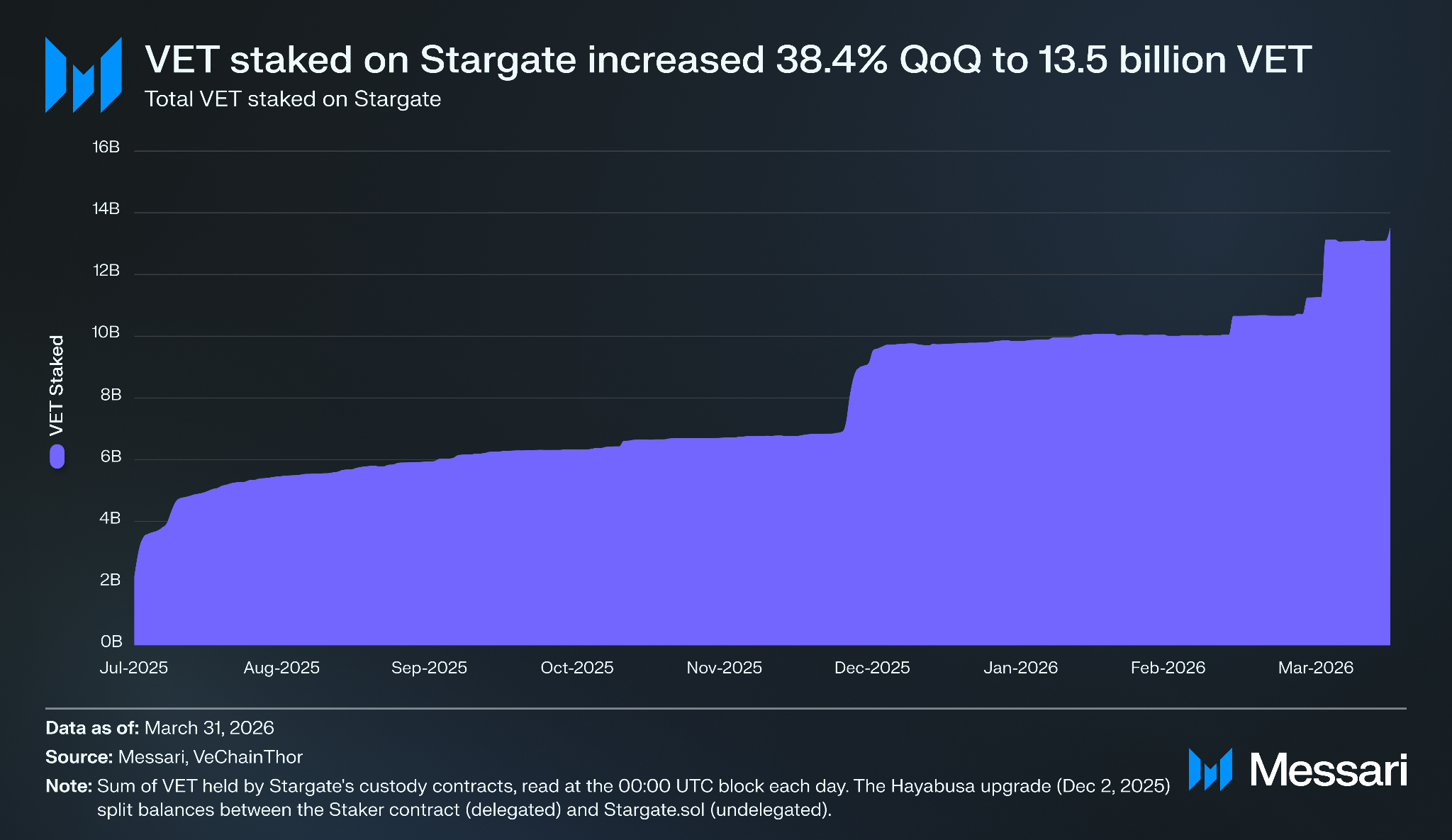
VeWorld is the self-custodial wallet at the entry point of the VeChain ecosystem. The application provides users with a single interface for managing VET, VTHO, B3TR, and VOT3 balances, accessing VeBetter applications, and managing StarGate staking positions via a node NFT. StarGate, VeChain’s native staking platform, closed Q1 2026 with 13.5 billion VET ($91.6 million) staked, a 38.4% QoQ increase in token terms from 9.8 billion VET at year-end 2025.
The headline UX update of the quarter was the launch of social logins on Feb. 25, 2026. Users can now create a VeWorld wallet using existing social accounts rather than the seed-phrase setup that had been the standard since launch. The change is a step toward account abstraction patterns that remove one of the largest drop-off points in consumer crypto adoption.
Enterprise and Real-World Adoption
The production-scale launch of Digital Product Passport (DPP) infrastructure for the European Union (EU) was the quarter’s greatest enterprise development. VeChain, Rekord, and the University of Sheffield’s Advanced Manufacturing Research Centre (AMRC) announced the deployment on Jan. 15, 2026. Manufacturer operational data is converted into privacy-preserving proofs anchored on VeChainThor, with product identifiers exposed to regulators and end buyers via QR codes, NFC, or RFID. The system processed more than 300,000 DPP events onchain by quarter-end. The launch coincides with the EU’s Ecodesign for Sustainable Products Regulation (ESPR), under which the first mandatory DPPs take effect in 2027, and the EU Commission is set to deploy a central registry by July 2026. AMRC counts Boeing and Rolls-Royce among its industrial partners, supplying the manufacturing credibility that has historically gated enterprise blockchain adoption. The combination of regulatory deadline, credible partners, and a working production deployment positions VeChain ahead of most public chains for ESPR compliance.
VeBetter and the broader ecosystem were featured in a Global Sustainable Trade Initiative (GSTI)documentary distributed through CNBC on Jan. 16, 2026. The piece, produced by Acumen with CNBC as a media partner, traces VeChain’s evolution from supply chain pilots with BMW and Walmart to consumer-facing sustainability efforts and cites more than 300,000 kilograms of plastic waste reduction logged through ecosystem applications.
VeChain announced a technical partnership with Decent on Feb. 19, 2026. Decent's workplace operations platform anchors safety inspections, equipment audits, facility operations, and compliance reports to VeChainThor through the VeChain ToolChain enterprise infrastructure. The integration follows the same architecture as the DPP deployment: the blockchain layer stays invisible to the end user, who interacts with a conventional mobile interface, while the underlying tamper-proof record creates an audit trail verifiable across parties.
Network Overview
Onchain Activity
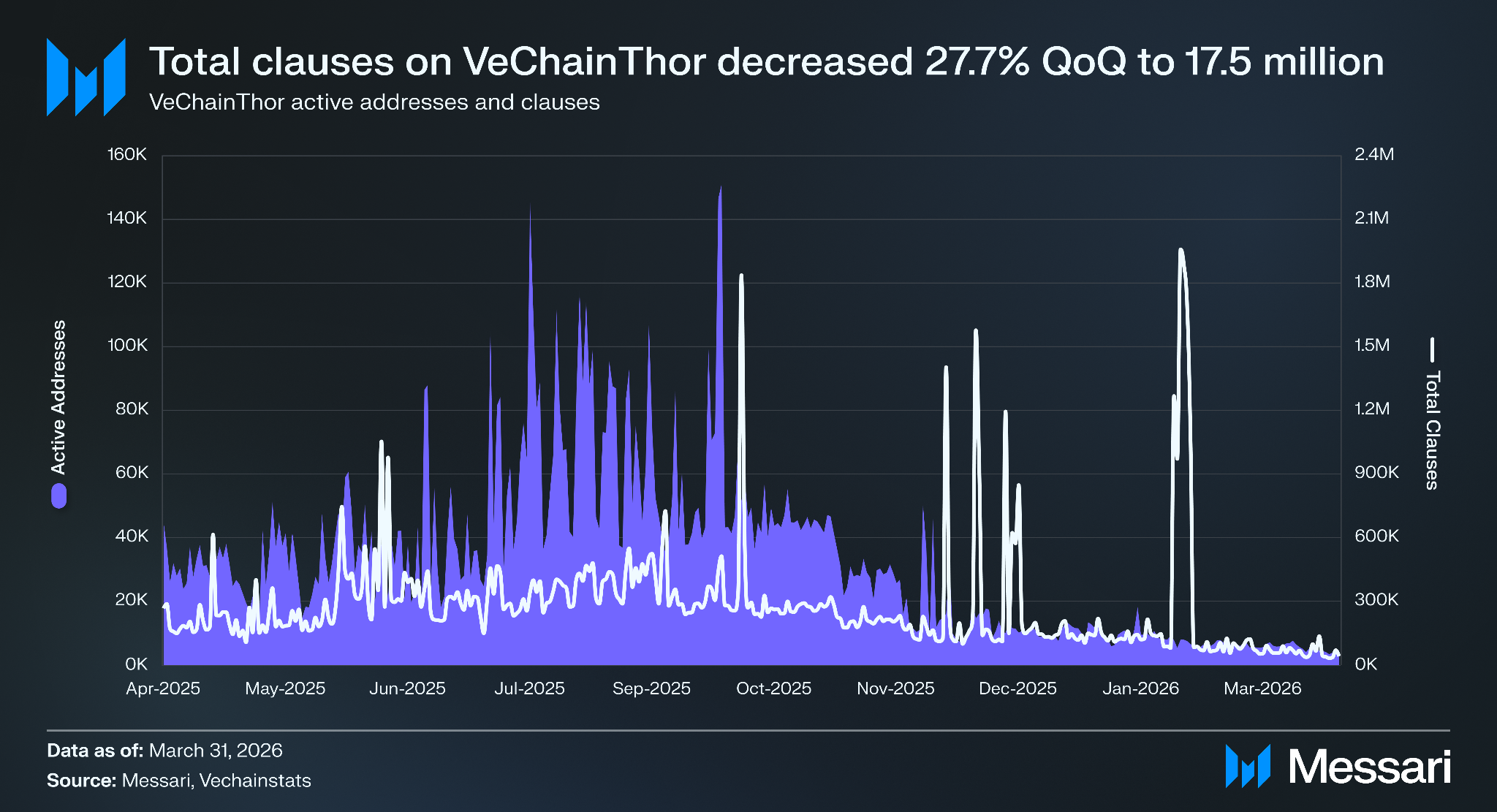
VeChainThor measures network activity in clauses rather than transactions. A clause is a single operation, such as a token transfer or a contract call, and a VeChain transaction can bundle multiple clauses. Clause count gives a more granular view of network activity than transaction count alone.
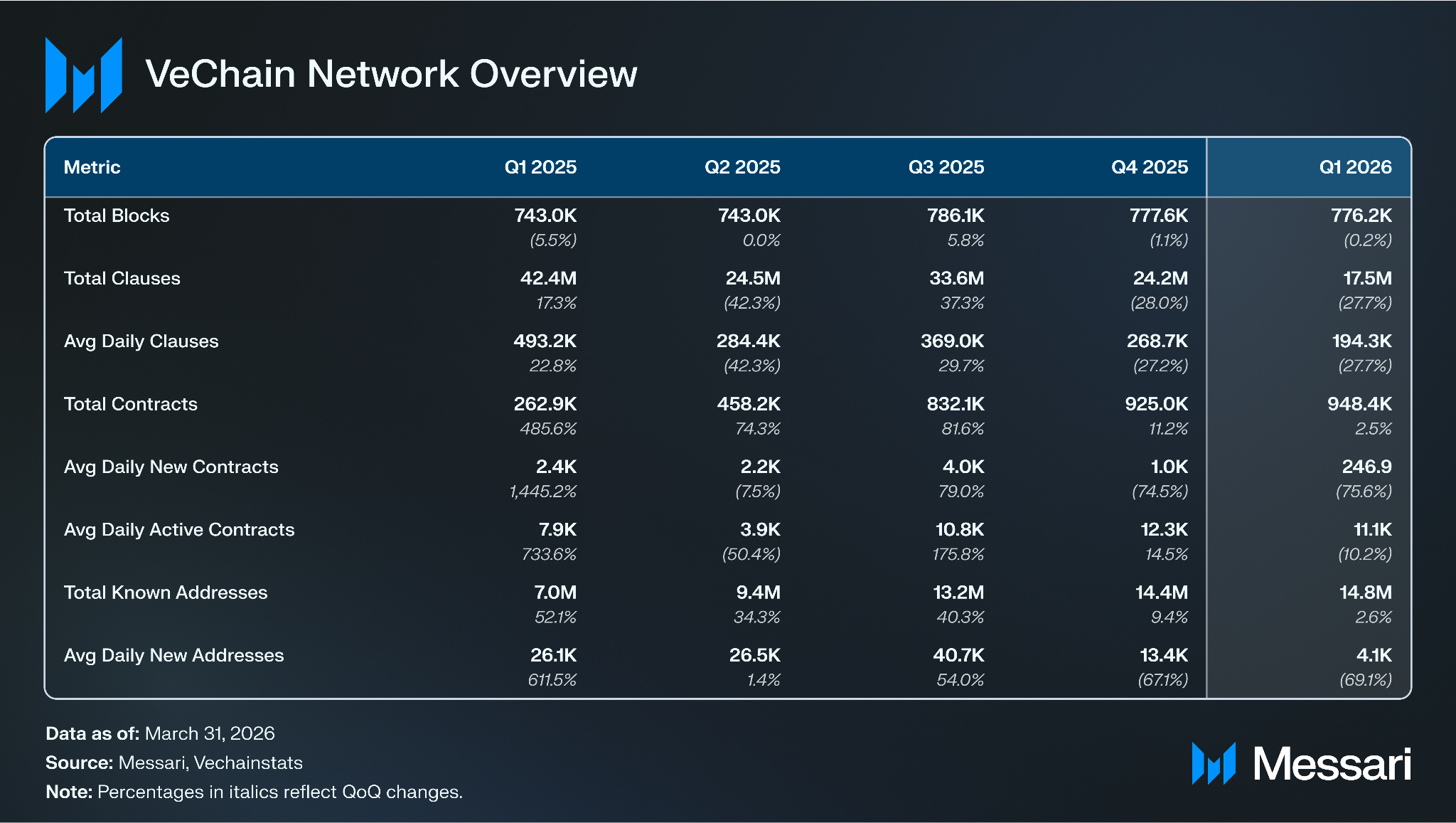
Average daily active addresses fell 71.5% QoQ to 7,700 from 27,070 in Q4 2025. Average daily clauses decreased 27.7% QoQ to 194,300 from 268,700 in Q4 2025. Addresses fell harder than clauses, meaning fewer users transacted more per session. The contraction tracks broader market weakness rather than a VeChain-specific catalyst.
Block production remained in line with VeChainThor’s 10-second target, with 776,180 blocks produced in Q1 2026. This was the first quarter under DPoS, post-Hayabusa upgrade, with no disruptions to block cadence.
Alongside the decline in activity, average daily new addresses fell 69.1% QoQ to 4,140, and daily new contract deployments dropped 75.6% QoQ to 247. Total addresses grew 2.6% QoQ to 14.8 million, the slowest rate over the trailing year, while total contracts rose 2.5% QoQ to 948,430.
VeChainThor v2.4.3 Upgrade
VeChainThor v2.4.3 went live on mainnet March 31, the first protocol upgrade since Hayabusa activated DPoS in December 2025. The release is a maintenance update with improvements in three areas: network robustness, transaction accounting, and smart contract execution efficiency.
The biggest changes for application developers are the addition of the MCOPY opcode and an upgrade of the node software's Go runtime to version 1.26.1. MCOPY is a smart contract instruction that lets contracts copy data between memory regions at a lower gas cost, making any contract that moves data internally cheaper to run. The Go runtime upgrade brings standard security patches and minor performance improvements to the software that runs each VeChainThor node. The release also adds a gas cap on individual transactions to keep any single transaction from filling an entire block, improves how the network tracks pending transactions so failures are reported clearly instead of silently, and removes outdated bootnodes (the entry points new nodes use to find the network) to simplify onboarding for new validators.
v2.4.3 reflects VeChain's post-Hayabusa development pattern: regular, incremental upgrades to the execution layer, the part of the protocol that runs every smart contract interaction. MCOPY support, in particular, brings VeChainThor closer to Ethereum's current capabilities, reducing friction for Ethereum-native developers porting their contracts to the chain.
Sustainability & Green Metrics
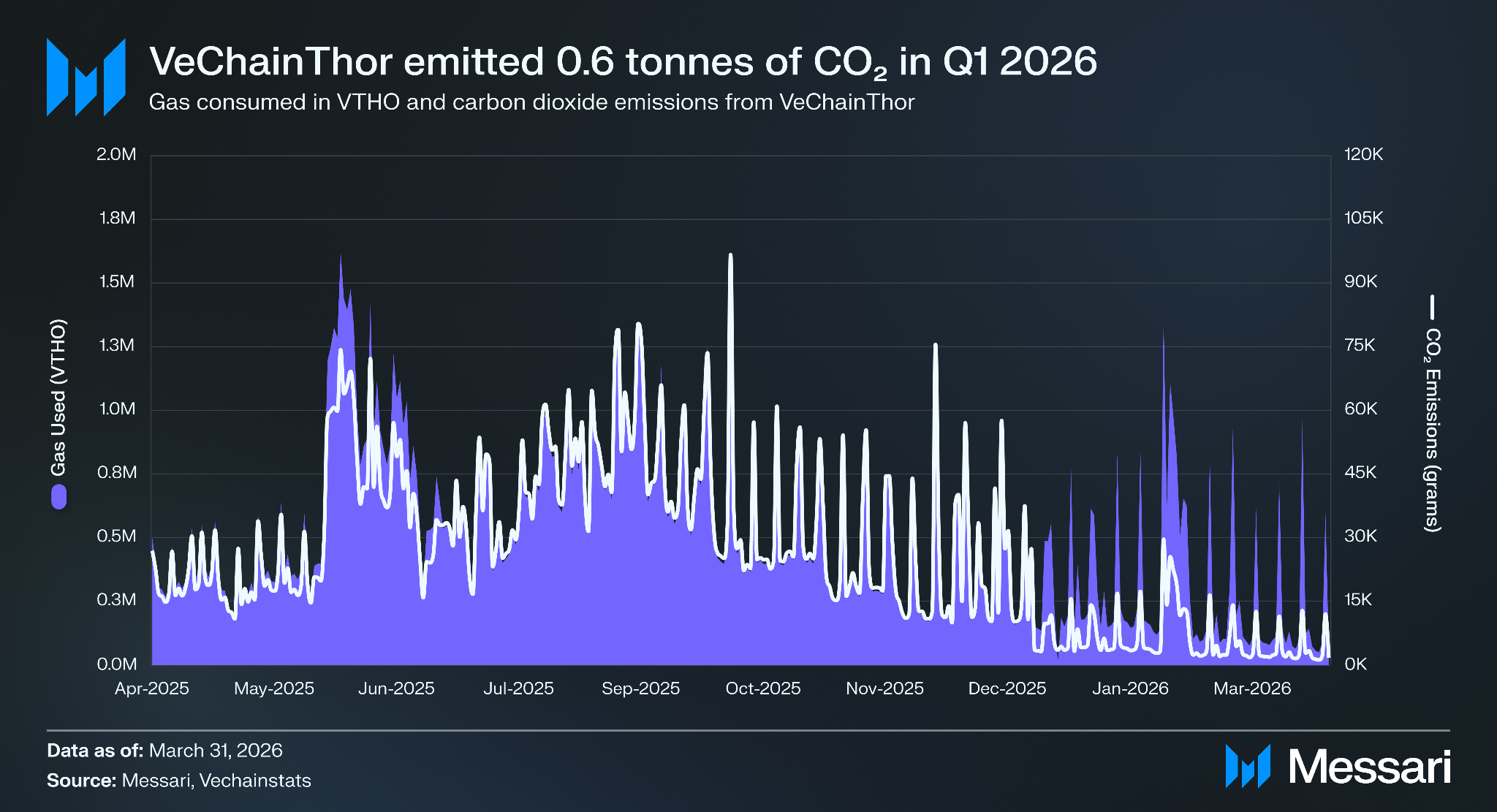
VeChainThor consumed 2.4 trillion VTHO during Q1 2026, down 35.6% QoQ from 3.7 trillion. Due to the decreased onchain activity, VeChainThor's CO₂ emissions also fell in Q1 2026. The network emitted an estimated 0.6 tonnes of CO₂ during the quarter, a 75.8% decrease from Q4 2025, roughly equivalent to the annual carbon absorption of 0.003 acres of forest.
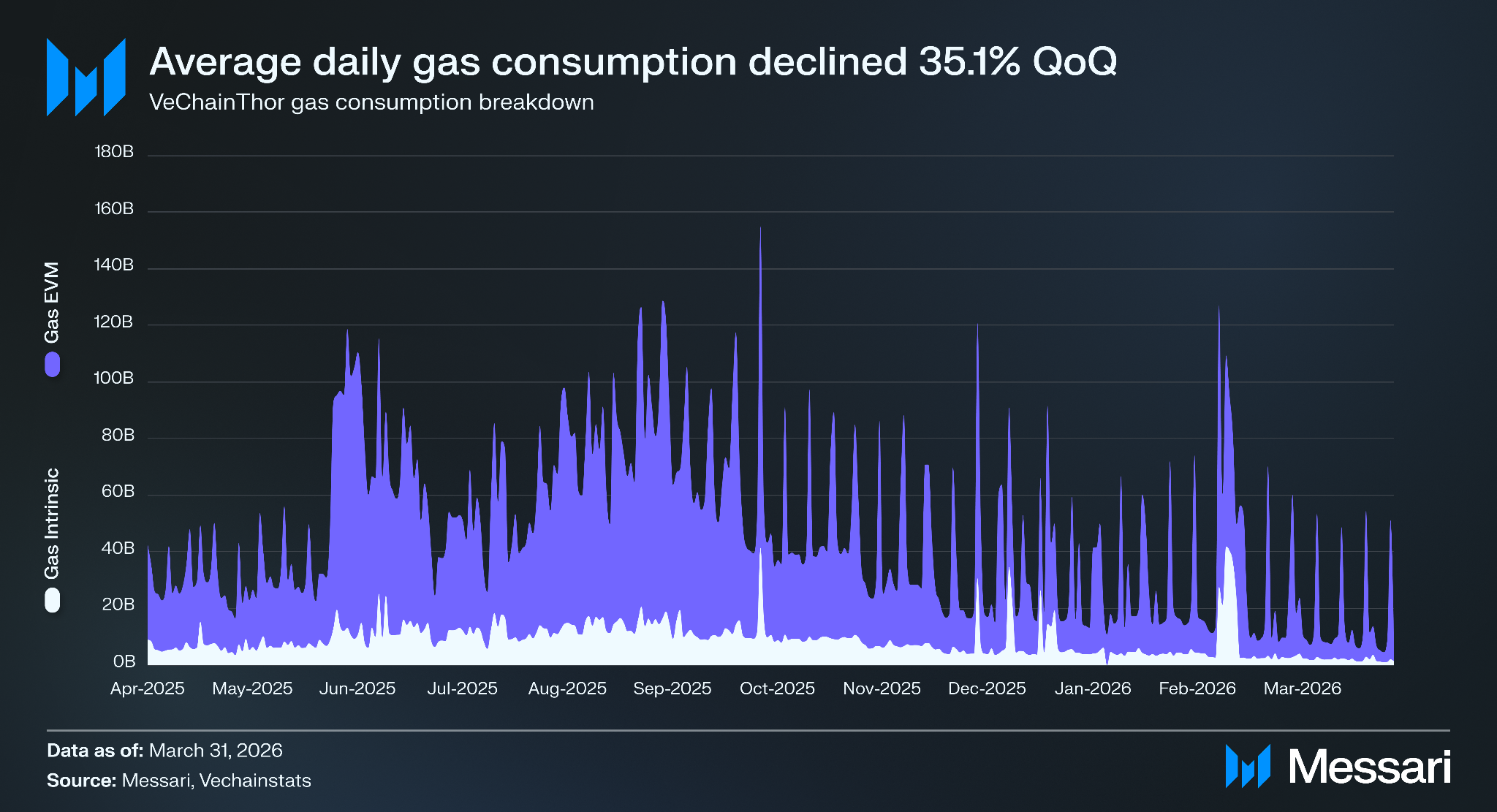
Gas usage continued to be dominated by EVM-based transactions, the gas consumed when smart contracts execute their code, which accounted for 80.6% of total gas consumed, averaging 21.2 billion gas units per day. This represented a 35.2% decrease QoQ in EVM-based gas consumption. Intrinsic gas usage, the base cost charged for processing any transaction regardless of complexity, also fell 37.1% QoQ to an average of 5.1 billion daily gas units, representing 19.4% of overall network activity.
Financial Overview
VET Market Cap
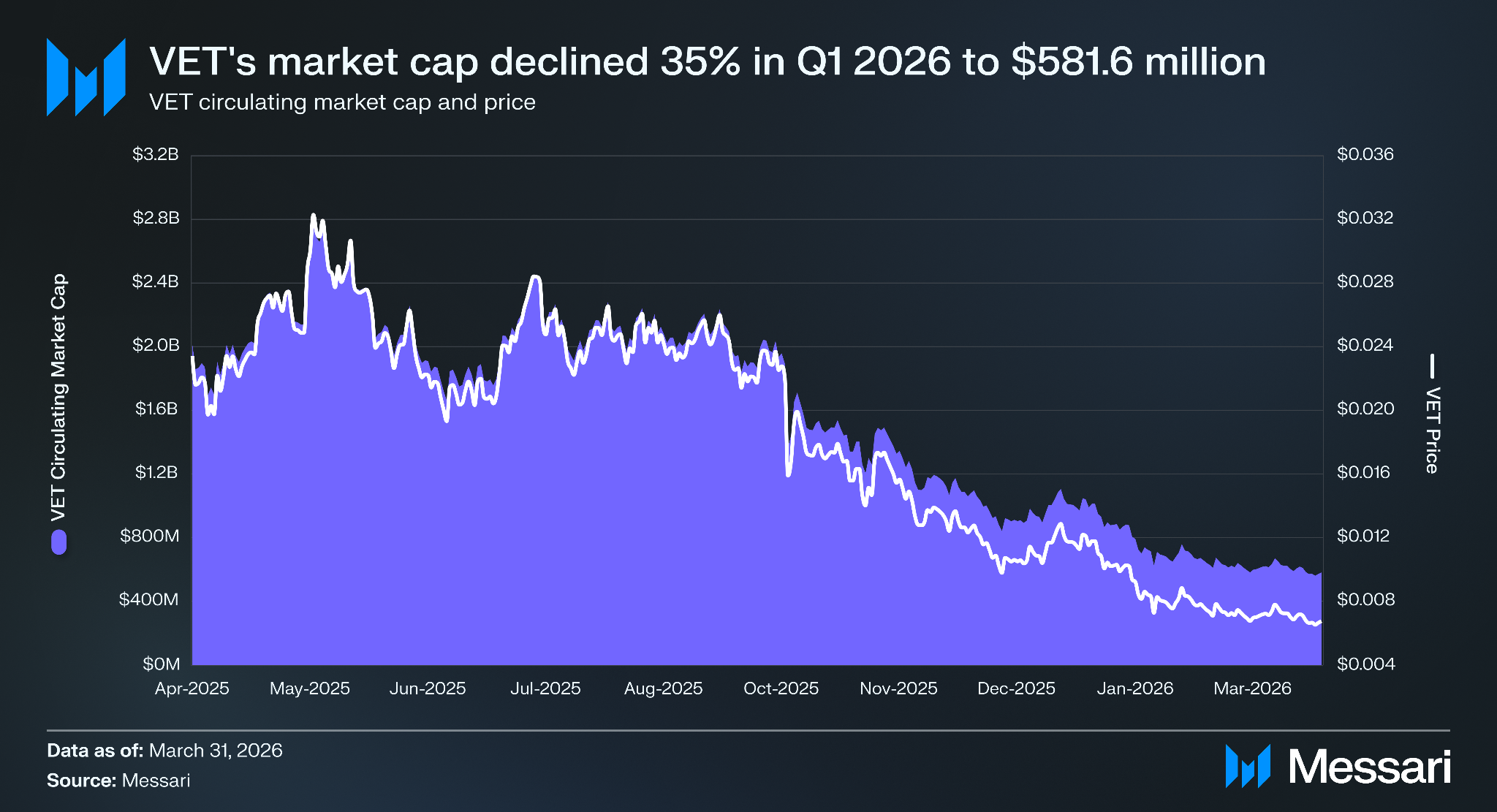
VET ended Q1 2026 with a circulating market cap of $581.6 million on a token price of $0.0067, down 35.0% QoQ from $895.0 million at year-end 2025. VET reached its quarterly high of $0.013 on Jan. 6, 2026, before drifting lower through February and March to a quarterly low of $0.0065 on March 29, 2026.
VET had three exchange listings throughout Q1 2026. On Feb. 6, 2026, Bullish listed VET (alongside VTHO) for spot trading, broadening access for the accredited and institutional trader audience. On Feb. 23, 2026, Coinbase listed VET on its retail platform, expanding U.S. accessibility for retail and institutional users. On Feb. 25, 2026, Revolut added VET to its supported asset list, extending mainstream retail availability across Revolut’s European customer base. The listings landed during a quarter of broad market weakness and did not produce immediate price tailwinds, but they meaningfully expanded VET’s distribution into the U.S. and European rails that drive longer-term institutional adoption.
VTHO Market Cap
VTHO ended Q1 2026 with a circulating market cap of $53.0 million, down 27.4% QoQ from $73.0 million at year-end 2025. The token traded near $0.0005 at quarter-end versus $0.0008 at the end of Q4 2025. Alongside the Bullish listing covered in the VET subsection, Kraken added VTHO to its supported assets on Jan. 16, 2026, expanding U.S. spot trading access.
Transaction Fees
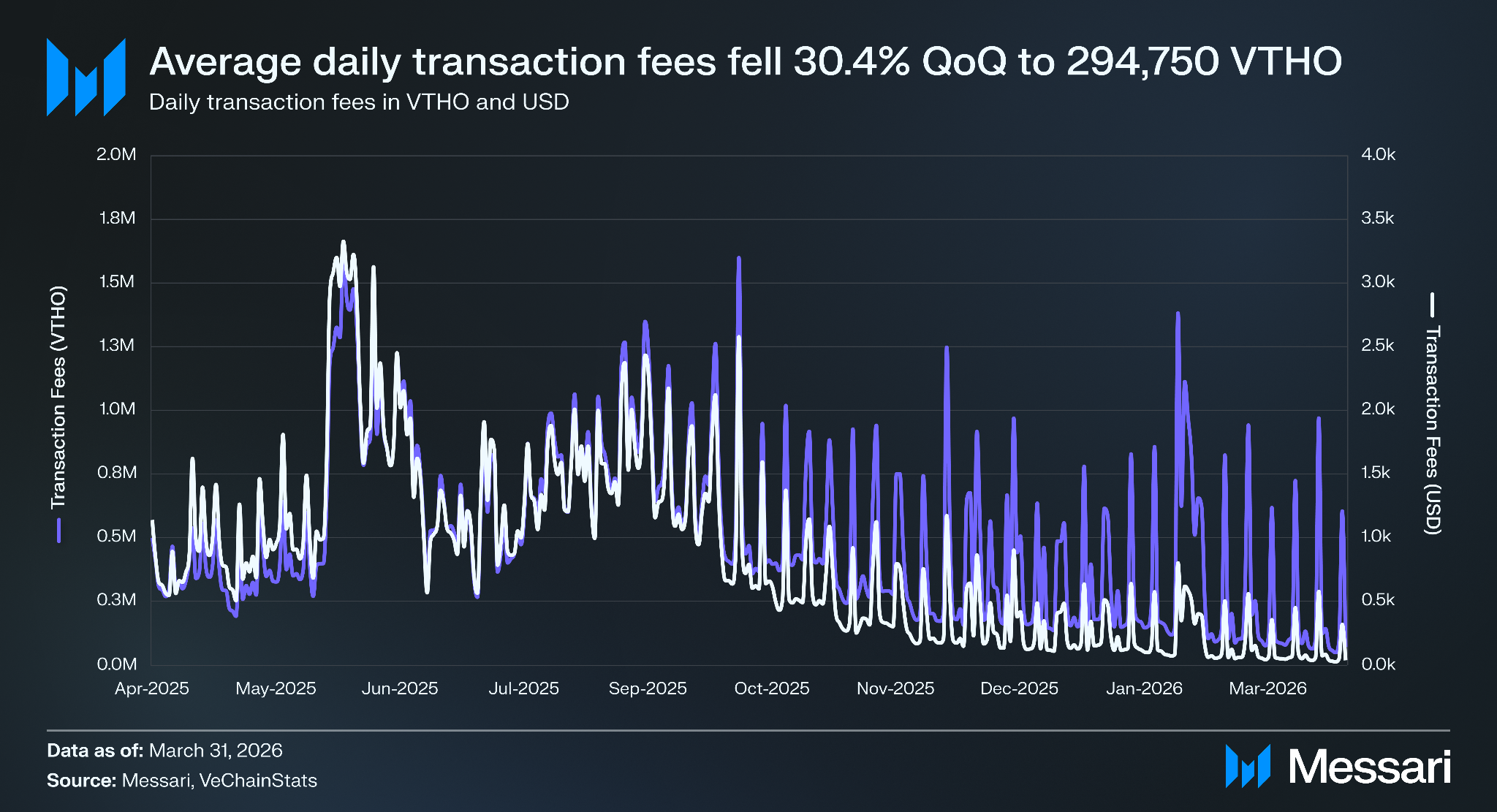
Average daily transaction fees fell 30.4% QoQ to 294,750 VTHO during Q1 2026, from 423,700. The USD-denominated decline was steeper, at 58.4% QoQ, to $197.18 per day, reflecting price weakness in VET and VTHO on top of the contraction in activity.
DeFi
VeChain’s DeFi footprint reflects the network’s enterprise and sustainability orientation rather than a contest for DEX volume or lending TVL against general-purpose Layer-1s. The Q1 2026 numbers are consistent with that positioning: total DeFi activity on VeChainThor remains small in absolute terms, dominated by the VeBetter ecosystem protocols rather than deeper DEX and lending stacks found in other ecosystems.
Q1 2026 was Stargate’s strongest growth quarter since launch. Total VET staked through the protocol rose 38.4% QoQ from 9.8 billion VET, worth $101.9 million at year-end 2025, to 13.5 billion VET, worth $91.6 million at the end of Q1 2026. The USD-denominated balance declined 10.1% QoQ, reflecting VET’s 35.0% price drop rather than net outflows. Two events drove the inflows. The Hayabusa upgrade on Dec. 2, 2025, introduced active validator delegation, adding roughly 2 billion VET to the system within its first week as legacy node stake auto-migrated into the new DPoS architecture. The March 15, 2026, legacy node migration deadline triggered a second wave, with total staked VET rising 16.6% over the surrounding week as remaining holders converted before the cutoff. Stargate now holds 15.6% of VET’s circulating supply, making staking the largest onchain capital allocation on VeChain by orders of magnitude relative to other DeFi protocols on the chain.
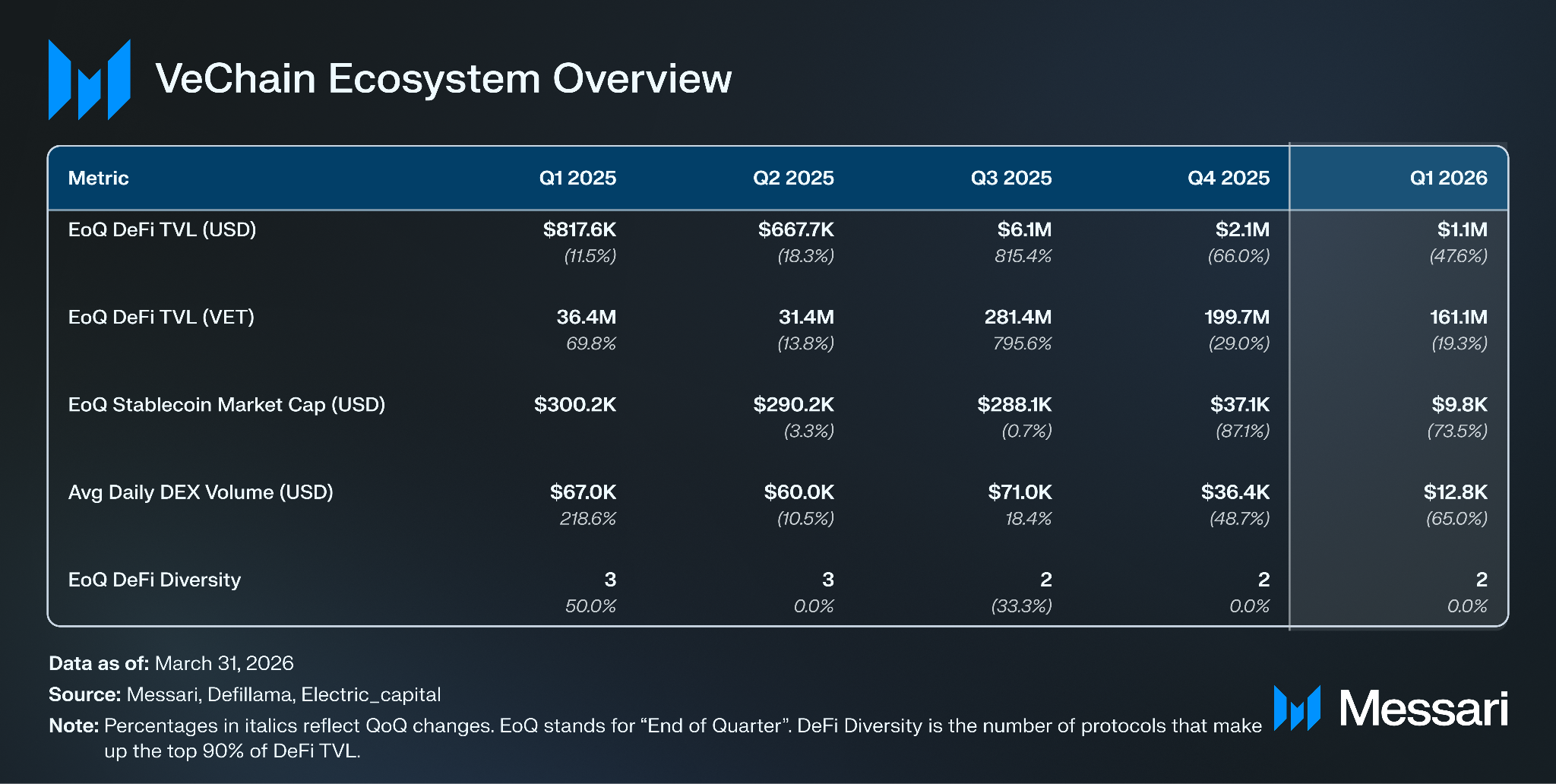
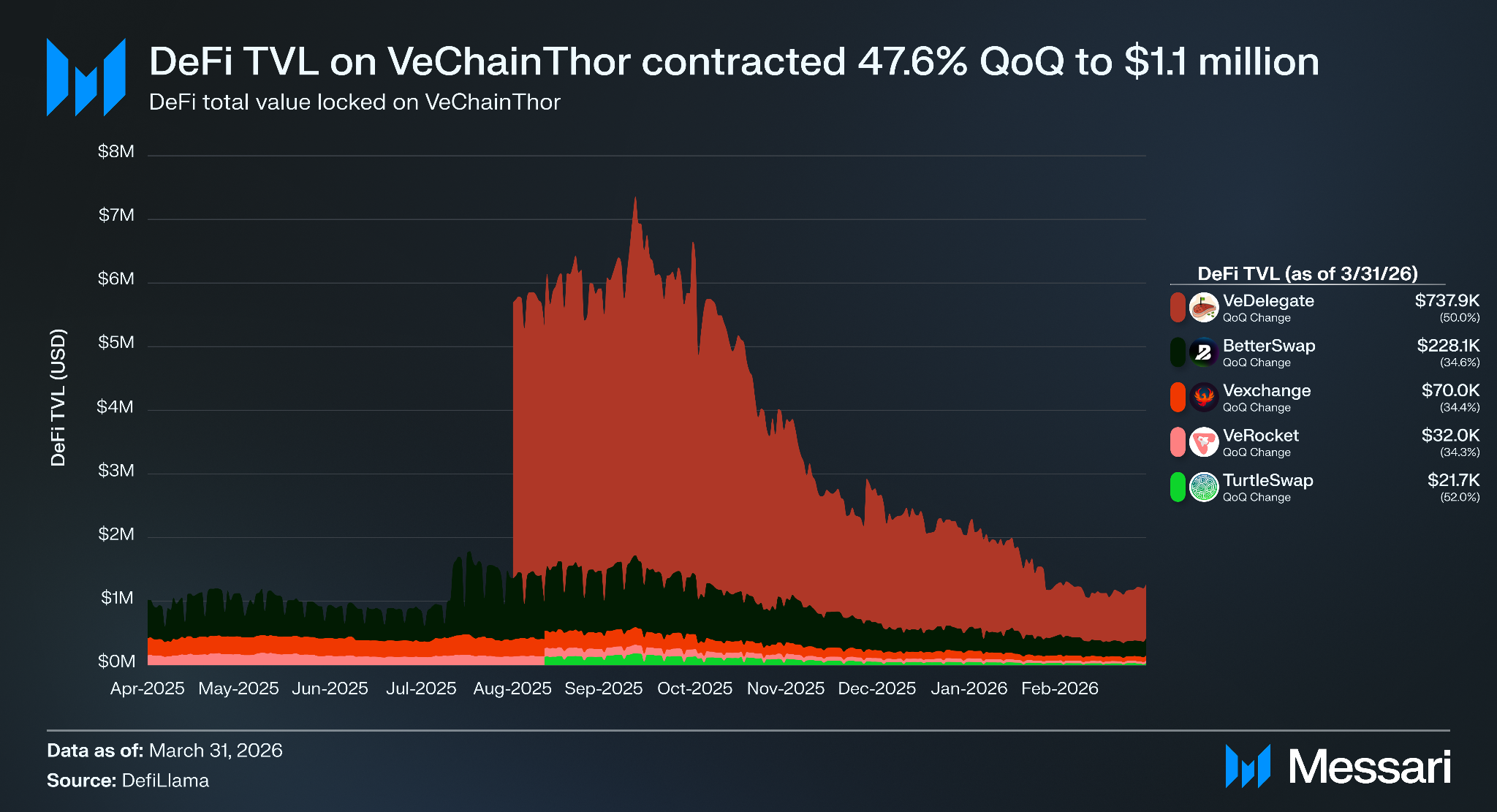
Total DeFi TVL on VeChainThor closed Q1 2026 at $1.1 million, down 47.6% QoQ from $2.1 million at year-end 2025. The top 5 protocols accounted for nearly all tracked TVL with no rank changes QoQ.
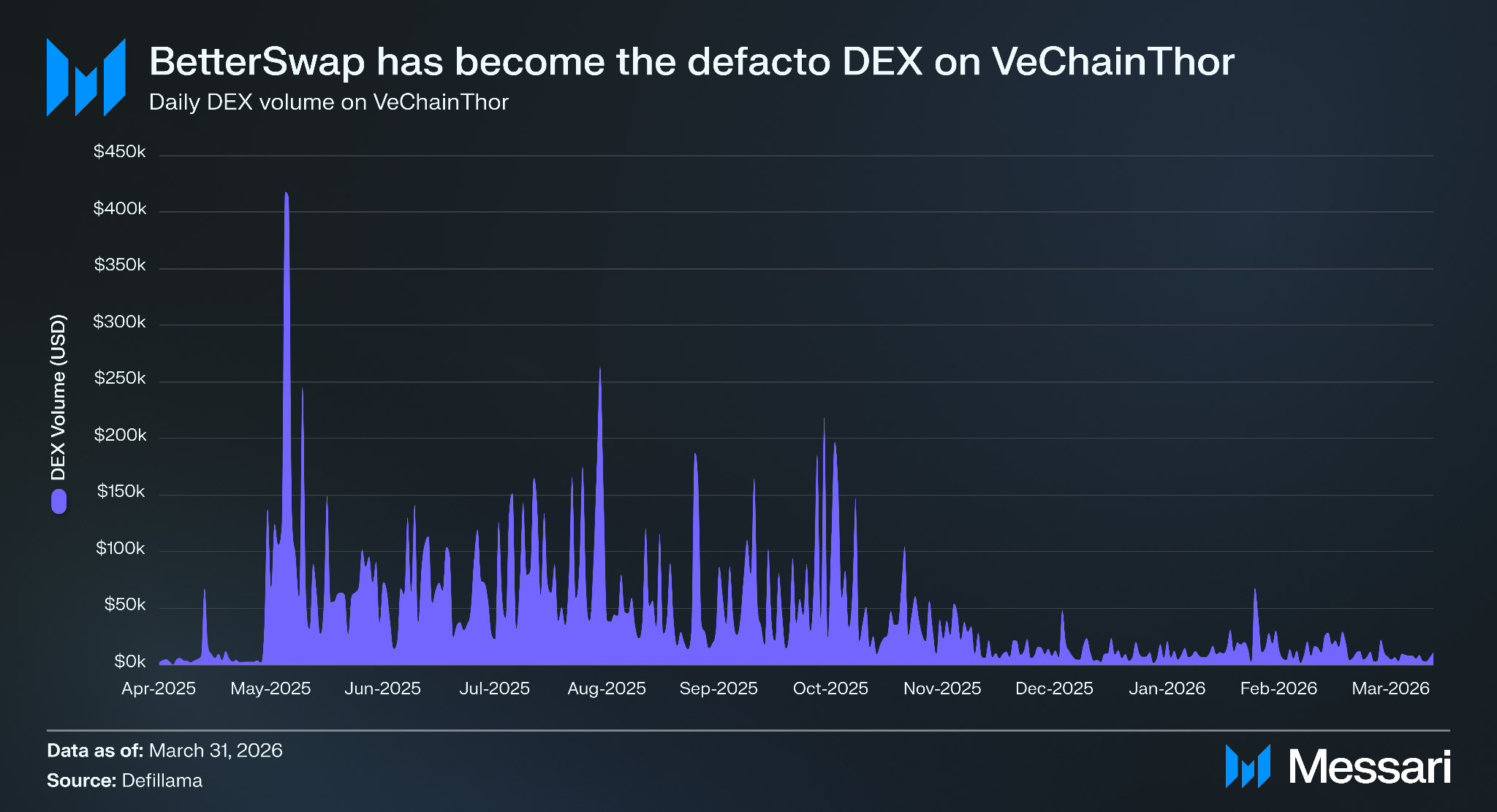
Average daily DEX volume contracted alongside the broader network slowdown, falling 65.0% QoQ to $12,770 from $36,450 in Q4 2025. BetterSwap captured all reported DEX volume during the quarter and has become the de facto DEX on VeChainThor.
Looking Ahead
VeChain’s 2026 roadmap, “Agentic Foundations for Tomorrow & Beyond,” positions VeChainThor as the trust layer for an emerging AI agent economy. The idea is that as autonomous agents become economic actors, they will need a verifiable settlement and identity layer to transact and route value. VeChain is betting its enterprise compliance track record, dual-token fee predictability, and existing VeBetter user base position the network to capture that role. The development sees the foundation driving adoption in a tripartite manner: Through enterprise users, individuals in the case of VeBetter, and now, agentic actors, projected to reach billions of active users over the coming years.
Four deliverables anchor the year ahead: the TRUST marketplace and agentic product suite, the Interstellar protocol upgrade, committee-based consensus, and an onchain attestation layer paired with a native real-world assets platform.
Interstellar is the structurally important release because it brings full EVM and JSON-RPC equivalence with the Ethereum developer stack and adds bridges and interoperability with the wider crypto sector, removing the porting friction that has historically gated Ethereum and EVM-native developers from deploying on VeChain. Committee-based consensus replaces probabilistic confirmations with instant transaction finality.
The Agent Marketplace is the roadmap’s centerpiece. It will let AI agents hold verifiable onchain identities, build onchain reputation scores, execute escrow, interact with smart contracts through the Model Context Protocol, and accept tasks from other agents or people. The minimum viable product launches with B3MO as one of the first listings. A native RWA platform with VeWorld-integrated self-custody extends the Digital Product Passport work delivered this quarter, targeting the projected $16 trillion tokenization market by 2030.
Supporting work fills out the roadmap: additional VeWorld features (custodial services, native token swap, multichain bridges, expanded fiat on/off ramps), B3MO’s evolution into a VeBetter coordination layer, and SDK v3 with agent-compatible tooling.
Closing Summary
VeChain enters Q2 2026 with the strategic infrastructure for its agentic thesis materially advanced. VeBetter Whitepaper 2.0 formalized the agentic positioning, the VeRelayer system operationalized the delegation pattern that AI agents will eventually use, and the Rekord/AMRC DPP deployment created a regulatory-aligned enterprise pipeline ahead of the EU’s 2027 ESPR deadlines. The post-Hayabusa protocol proved operationally stable through its first full quarter under DPoS, with block production unchanged and the network’s onchain CO2 footprint falling to 0.6 tonnes for the quarter. This is a foundation that absorbs market-driven price weakness without compromising the longer-term thesis.
The catalysts that determine VeChain’s trajectory through the rest of 2026 are concrete and dated. Interstellar’s EVM and JSON-RPC equivalence will test whether Ethereum-native developers begin deploying at scale, the Agent Marketplace MVP within VeBetter will indicate whether the agentic positioning translates into actual onchain commerce, and the RWA platform launch will show whether VeChain can extend the DPP framework into the broader tokenization stack. The next three quarters will measure whether VeChain can build on Q1’s foundation at the pace its roadmap requires.
This report was commissioned by VeChain. All content was produced independently by the author(s) and does not necessarily reflect the opinions of Messari, Inc. or the organization that requested the report. The commissioning organization may have input on the content of the report, but Messari maintains editorial control over the final report to retain data accuracy and objectivity. Author(s) may hold cryptocurrencies named in this report. This report is meant for informational purposes only. It is not meant to serve as investment advice. You should conduct your own research and consult an independent financial, tax, or legal advisor before making any investment decisions. Past performance of any asset is not indicative of future results. Please see our Terms of Service for more information.
No part of this report may be (a) copied, photocopied, duplicated in any form by any means or (b) redistributed without the prior written consent of Messari®.
Eric is a research analyst at Messari and an ambassador for Maple Finance. He previously was a Product Manager for FINTRX and is passionate about DeFi and AI.
Eric is a research analyst at Messari and an ambassador for Maple Finance. He previously was a Product Manager for FINTRX and is passionate about DeFi and AI.