MTONGA (Make TON Great Again), launched post-quarter, is TON's first concrete forward catalyst. Three of seven announced steps have rolled out, delivering sub-second finality via Catchain 2.0, a 6x transaction fee reduction, and Telegram as TON's largest validator. The tradeoff is an inflation step-up from 0.6% to 3.6%.
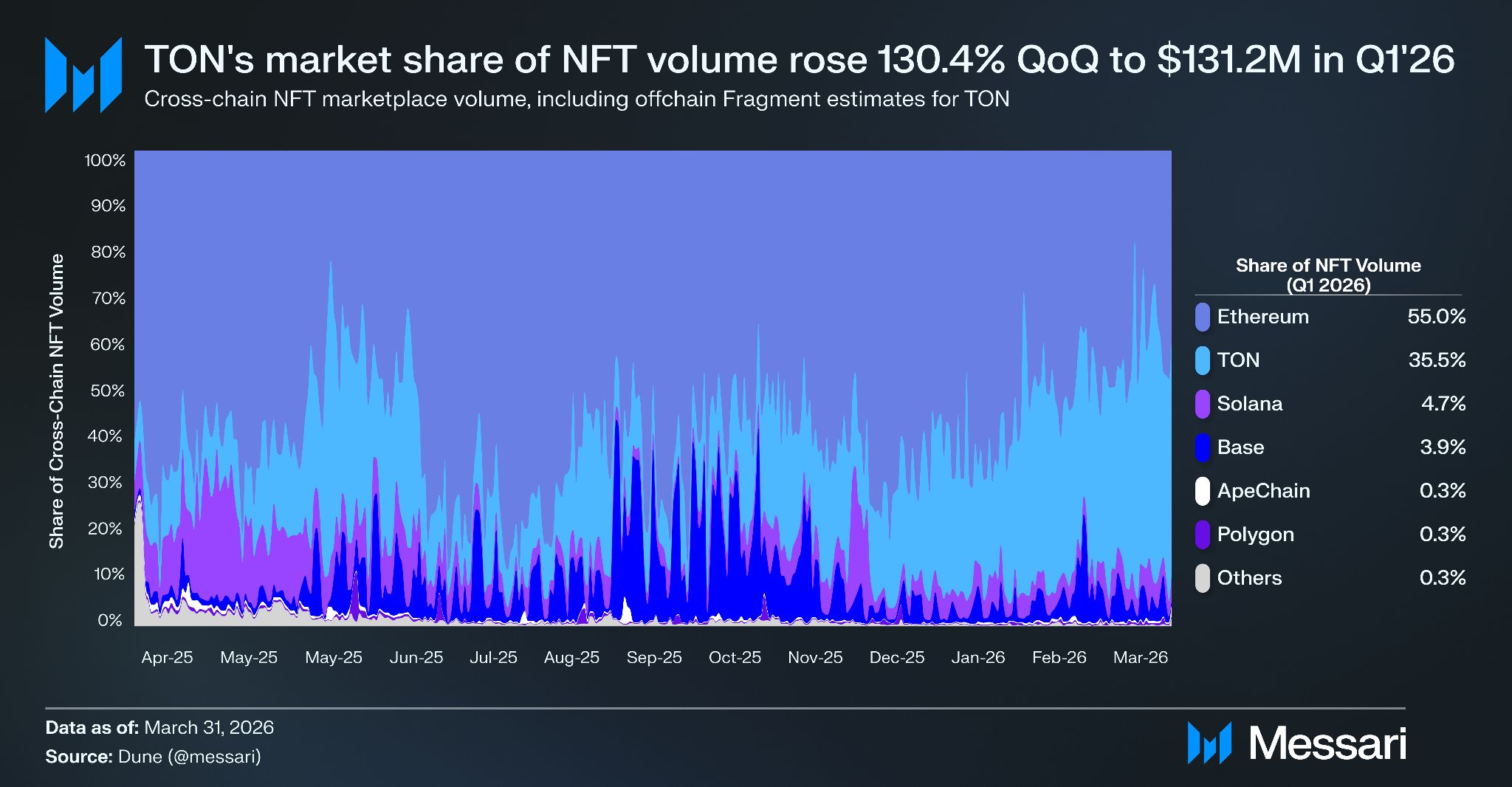
TON's NFT market share rose 130.4% QoQ to 35.5% of cross-chain volume, the only major chain to grow NFT share in Q1 2026. NFT volume (USD) remained stable while all other major chains’ volumes fell by over 50%. TON's NFT footprint is concentrated in Telegram-issued primitives that function as actual consumer products inside Telegram, insulating them from traditional speculative cycles.
Telegram-issued products routed $88.5 million through TON in Q1 2026. This flow is consumer-product revenue rather than speculative onchain activity, giving TON an economic surface that doesn't track with typical crypto cycles.
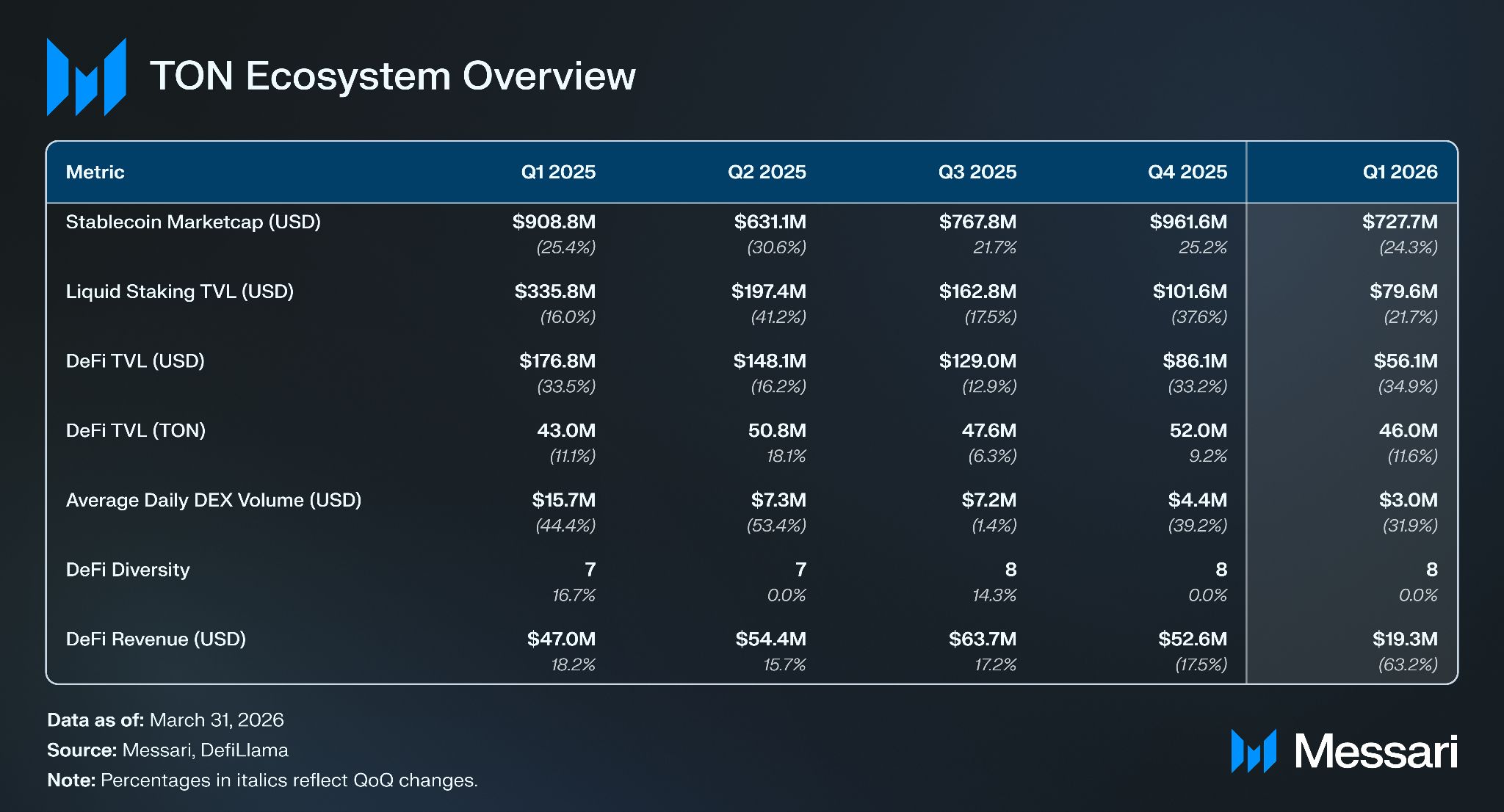
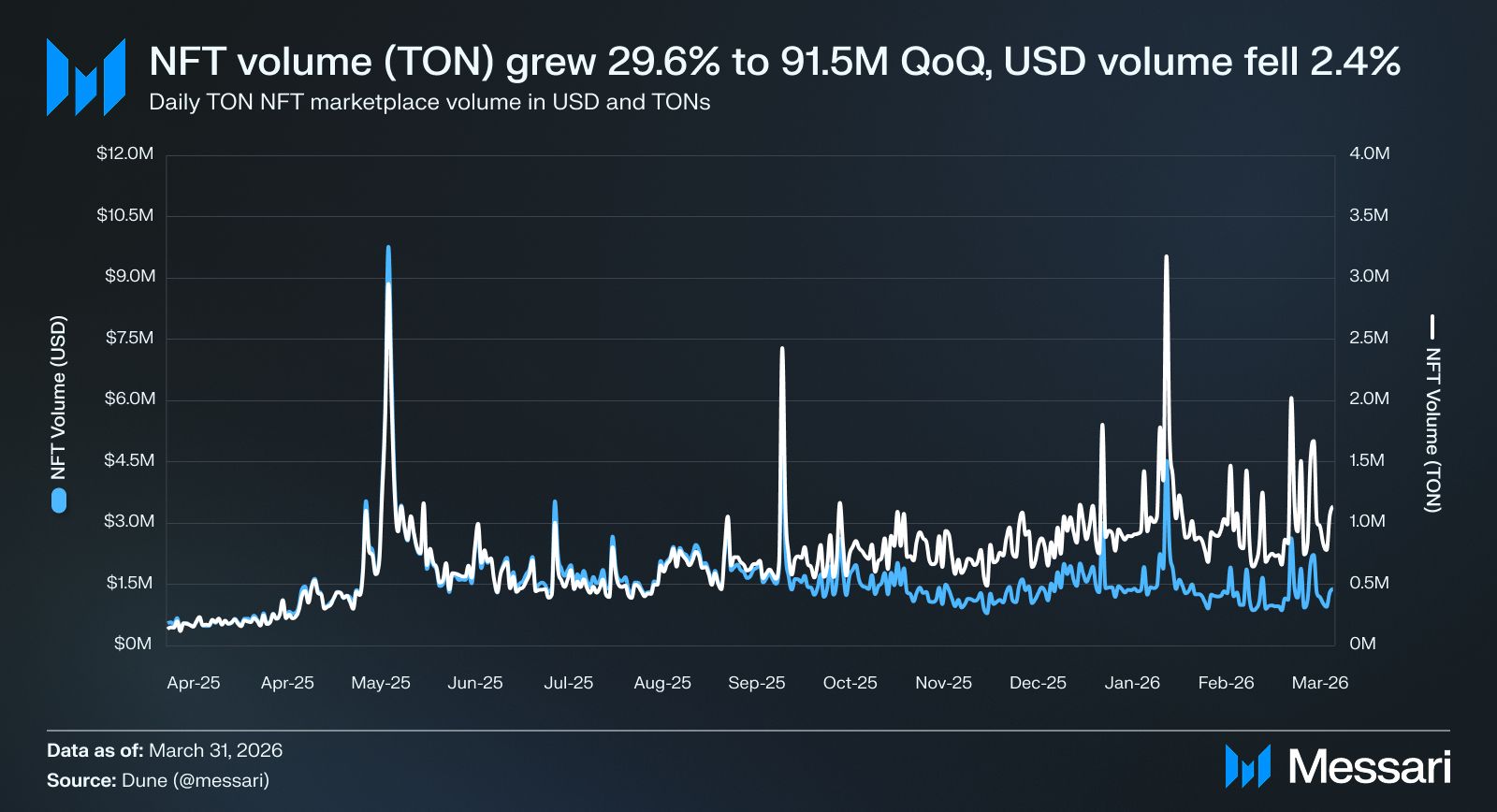
TON-denominated metrics held up better than their dollar equivalents during Q1's contraction. Native-denominated DeFi TVL fell only 11.6% against a 34.9% USD decline, NFT volume grew 29.6% QoQ in TON against a 2.4% USD decline, and aggregate NFT trade count grew 9.5% QoQ. The USD contractions across multiple metrics primarily reflected TON's 26.4% price decline.
TON's PoS validator set ranks among the most decentralized of any major chain, with a Nakamoto Coefficient of 77 at quarter-end. A high coefficient means institutional stakers like TON Strategy Company, which holds over 220 million TON staked or 8.9% of the circulating supply, can participate at scale without degrading the network's decentralization profile.
Primer
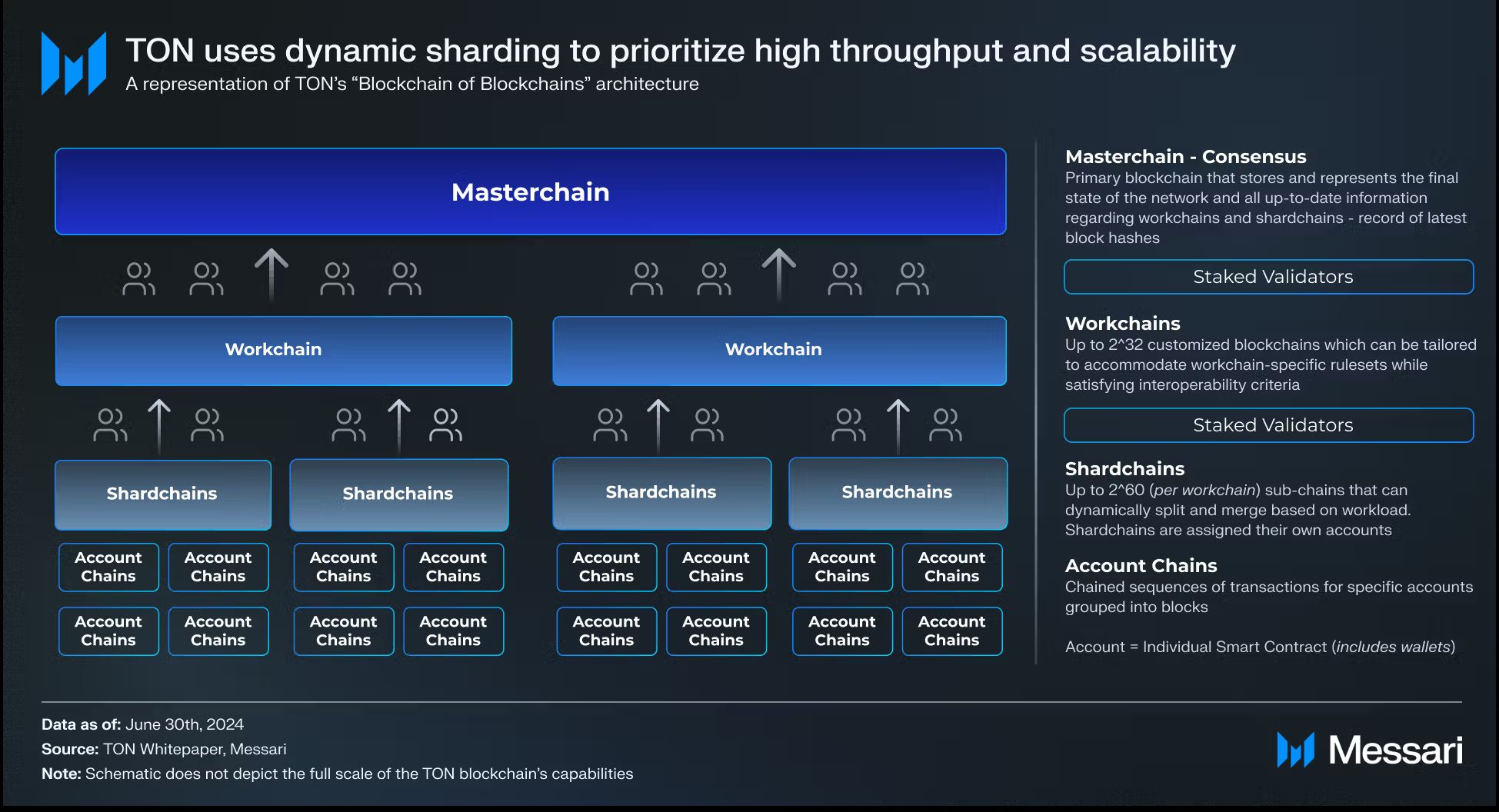
The Open Network (TON) is a Proof-of-Stake (PoS) Layer-1 blockchain originally launched in 2018 as the Telegram Open Network by Telegram co-founders Pavel Durov and Nikolai Durov, who raised $1.7 billion across two private token sales to fund development. Following the U.S. Securities and Exchange Commission (SEC) enforcement in October 2019, Telegram abandoned the project, and the codebase was open-sourced and relaunched in 2021 by independent contributors. TON uses a sharded "blockchain of blockchains" architecture: a top-level masterchain coordinates network state and the validator set, parallel workchains execute transactions, and each workchain may be partitioned into shardchains for parallel execution. The TON Virtual Machine (TVM) executes smart contracts in an asynchronous message-passing model with Hypercube Routing for cross-shard latency, and tokens follow the Jetton (TEP-74) standard. Consensus runs on a Byzantine Fault Tolerant (BFT) protocol called Catchain, with Catchain 2.0 targeting sub-second finality and currently in mainnet validator deployment as of Q1 2026.
In September 2023, the TON Foundation announced a formal partnership with Telegram that integrated a crypto wallet natively into the messenger and positioned TON as the settlement rail for Telegram's in-app economy. In January 2025, Telegram required all crypto Mini Apps on its platform to migrate to TON, establishing TON as the exclusive blockchain infrastructure for the Mini App platform. TON Connect became the standard wallet-connection method, and Toncoin (TON) became the exclusive cryptocurrency for in-app payouts and ad revenue share. Wallet in Telegram, operated by The Open Platform, is the primary entry point for Telegram users into the TON ecosystem and supports both custodial and self-custodial modes, while Tonkeeper is the most widely used standalone self-custodial wallet.
The network operates with around 400 validators, securing about 450 million TON. New TON is issued at 73,000 to 97,000 TON per day, and 50.0% of transaction fees are burned. Total supply is 5.15 billion TON, of which 2.46 billion is freely circulating as of Q1 2026. The ecosystem has been stewarded by the TON Foundation, with the TON Core team leading protocol development. However, in early May 2026, Telegram became TON's largest single validator, shifting primary network stewardship from the TON Foundation toward Telegram itself.
While the MTONGA rollout falls outside of Q1 2026, its design is the clearest signal yet of where TON is heading.
On April 9, 2026, TON activated Catchain 2.0 on mainnet. Pavel Durov, Telegram’s founder, framed the activation as Step 1 of a seven-step roadmap labeled "Make TON Great Again" (MTONGA), a coordinated performance and cost overhaul of the TON network aimed at making the chain viable for Telegram-scale consumer commerce. Three of the seven steps have been publicly disclosed as of early May 2026.
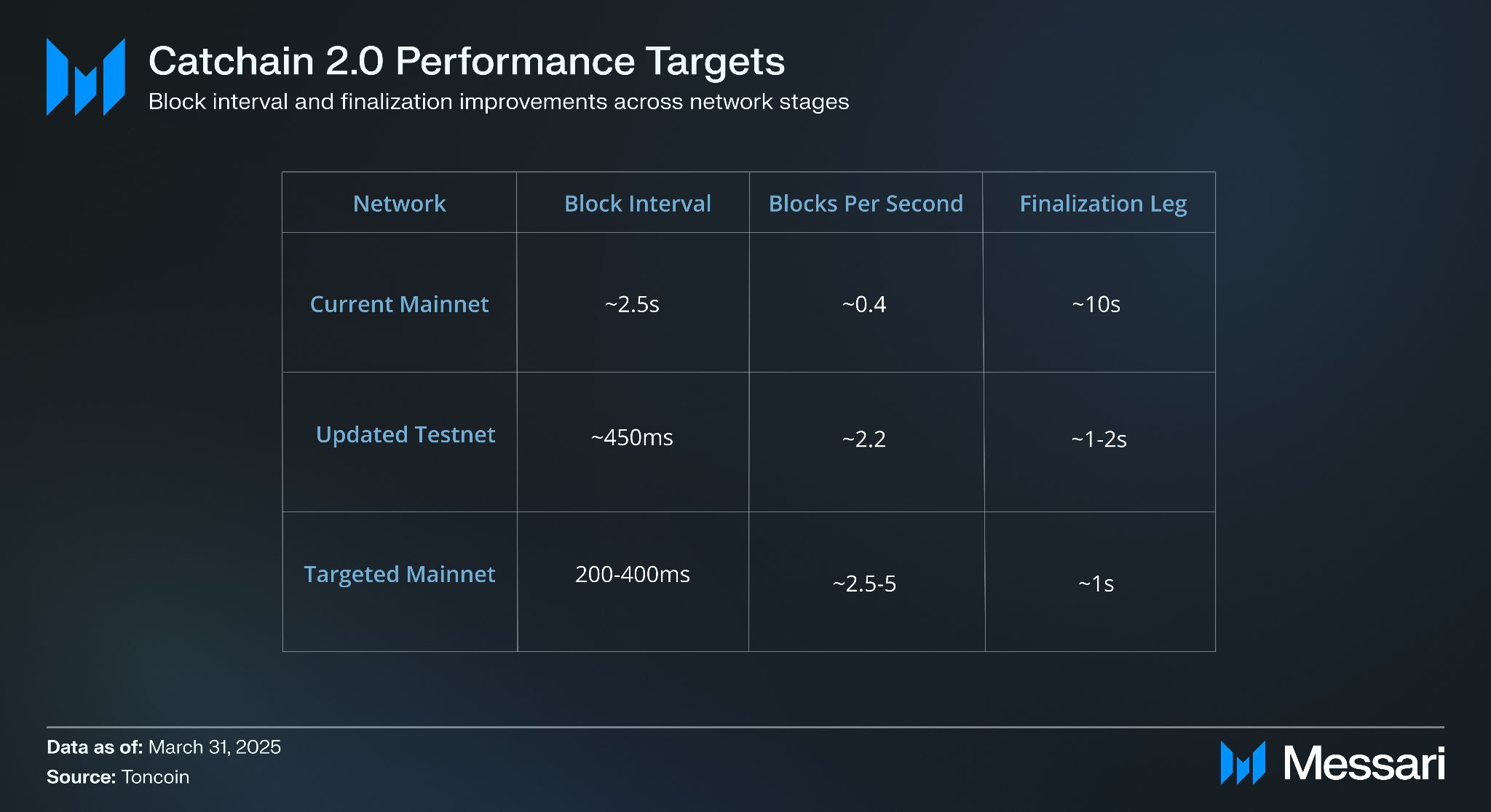
Step 1 reduced block times from 2.5 seconds to ~400 milliseconds, increased throughput ~10x, and reduced transaction finality from ~10 seconds to sub-second. A new streaming layer pushes state updates to applications, replacing polling-based architectures and enabling real-time use cases that were not viable at 10-second finality.
Step 2, rolled out in mid-April 2026, cut TON transaction fees 6x to roughly $0.001 for simple native transfers, $0.0023 for simple USDT transfers, and $0.015 for one-trade DEX swaps. The longer-term intent is to move most transaction types to zero commission over time, with validator economics supported by block rewards.
Step 3, announced in early May 2026, was Telegram becoming TON's largest validator, with 2.2 million TON staked, shifting primary network stewardship from the TON Foundation to Telegram. The move is the most direct signal of Telegram's long-term commitment to TON as its blockchain layer. Telegram is now actively earning validator rewards and assuming block-production responsibility, rather than relying solely on TON as the settlement rail for in-app commerce.
Step 4, proposed post-quarter, is a community vote to rename the network's native token from Toncoin to Gram, the founders' original name from the TON White Paper. This change would only apply to the token's name and ticker. The blockchain stays TON / The Open Network, and all balances, contracts, NFTs, staking positions, and DeFi protocols are unaffected. The vote runs for one week on TON Vote, the network's open DAO platform, with voting power weighted by TON balances.
Steps 5 through 7 remain publicly unannounced, although public discussion has referenced further fee reductions and additional developer tooling, but specific timelines and contents have not been disclosed.
In Q1 2026, TON's USD-denominated metrics declined across DeFi, NFTs, fees, and stablecoins; however, activity tied to Telegram-issued products held up much better. The consumer-distribution thesis entered Q2 2026 needing a concrete forward catalyst slate to be measured against; MTONGA is that slate.
Team Commentary
As part of the broader MTONGA (Make TON Great Again) initiative, Telegram proposed renaming the native token from Toncoin to Gram. The rename reflects a real shift in what TON has become, on two fronts that reinforce each other.
The first is structural. Telegram is becoming the driving force behind TON (https://t.me/durov/501) and the network's largest validator. This change in stewardship is what gives the technical roadmap its new pace and direction.
The second is at the protocol level. Recent upgrades have made the network 10 times faster, with subsecond transactions, and cut fees by roughly 6 times to nearly zero, alongside a strong focus on technical excellence.
Taken together, these changes mark a milestone for the network — and a natural moment to refresh how the token is known publicly. In the original TON White Paper, the network's founders called the native token Gram. The name has lived on inside the core TON codebase ever since. Surfacing it now is how the network shows it is stepping into a new chapter.
Ecosystem Analysis
Stablecoins
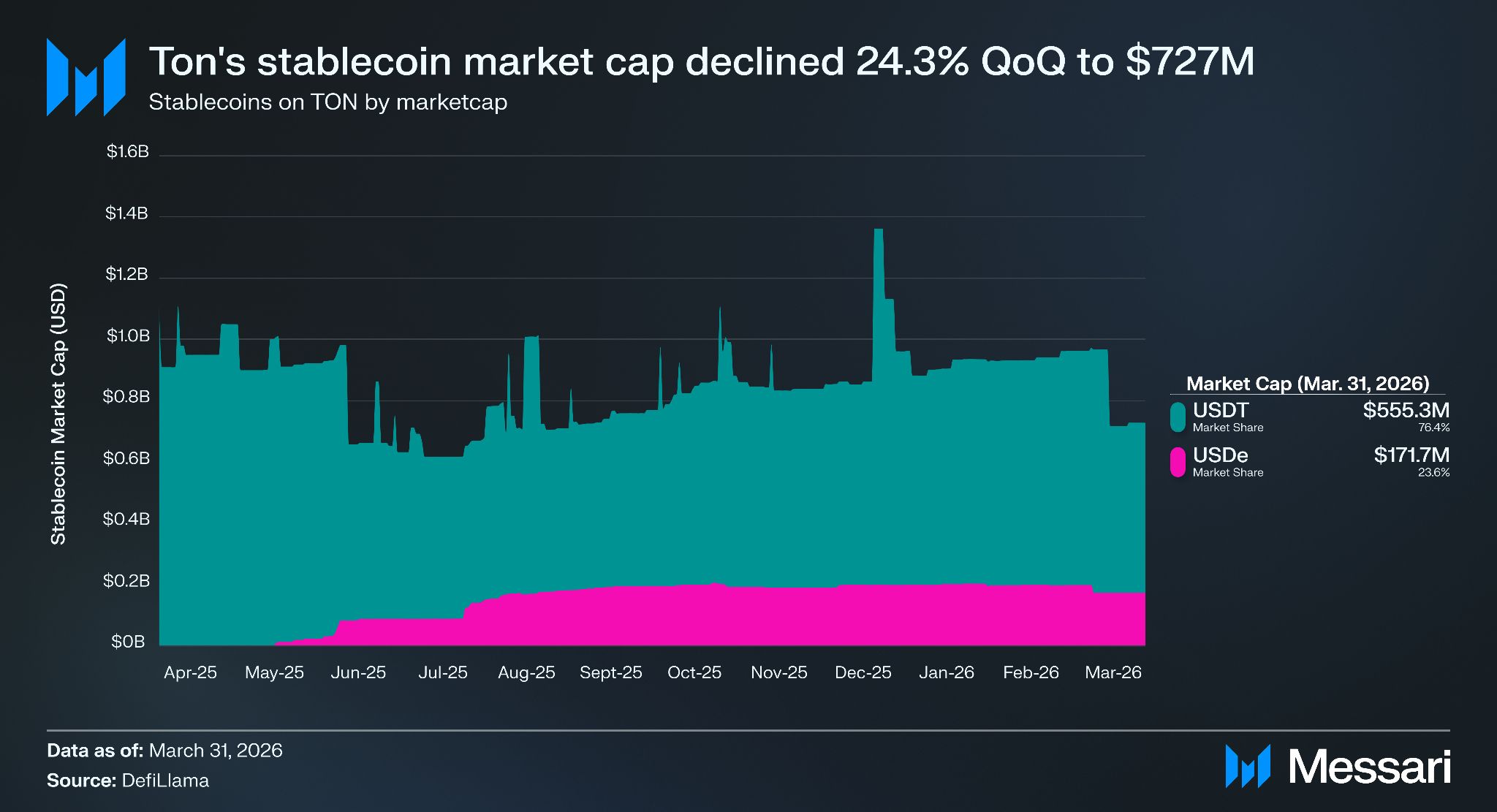
Stablecoins remained TON's largest onchain footprint in Q1 2026. Total stablecoin market cap on TON ended the quarter at $727.7 million, down 24.3% QoQ from $961.6 million. USDT continued to anchor the ecosystem, but its share of cross-chain USDT supply slipped to a multi-quarter low as TON's stablecoin lineup diversified into Ethena's USDe.
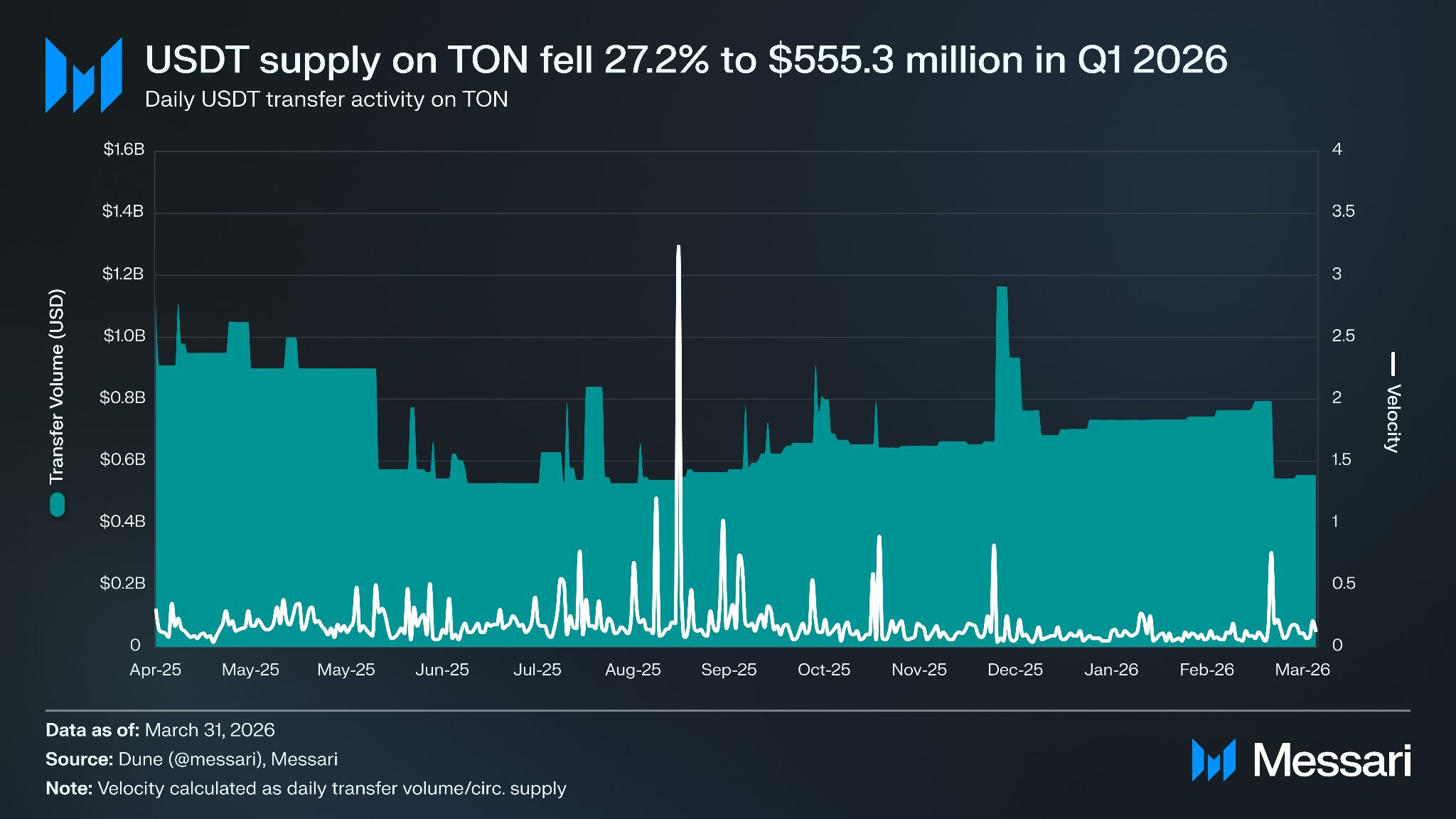
USDT: Tether's USDT is the largest stablecoin globally by market cap and the primary onchain dollar settlement asset on TON. USDT on TON is issued under the Jetton (TEP-74) standard and remains the default dollar for Wallet in Telegram, the major DEXs, and the chain's emerging merchant rail integrations. It held 76.3% of TON's stablecoin float at quarter-end, down from 79.3% in Q4 2025 and from 100% a year earlier. USDT supply on TON declined 27.2% QoQ from $762.8 million to $555.3 million.
USDe: Ethena's USDe is a synthetic dollar backed by delta-hedged perpetuals and spot collateral, distributing native yield to holders. It became the second-largest stablecoin on the network, ending the quarter at $171.8 million, accounting for 23.6% of TON's stablecoin float, down 13.0% QoQ from $197.4 million. The pullback was less than half of USDT's, consistent with steady demand for yield-bearing dollars across the ecosystem since Ethena's TON deployment in April 2025. USDe alone accounts for TON's stablecoin diversification, as USDT held 100% of the float prior to its entrance.
USDT
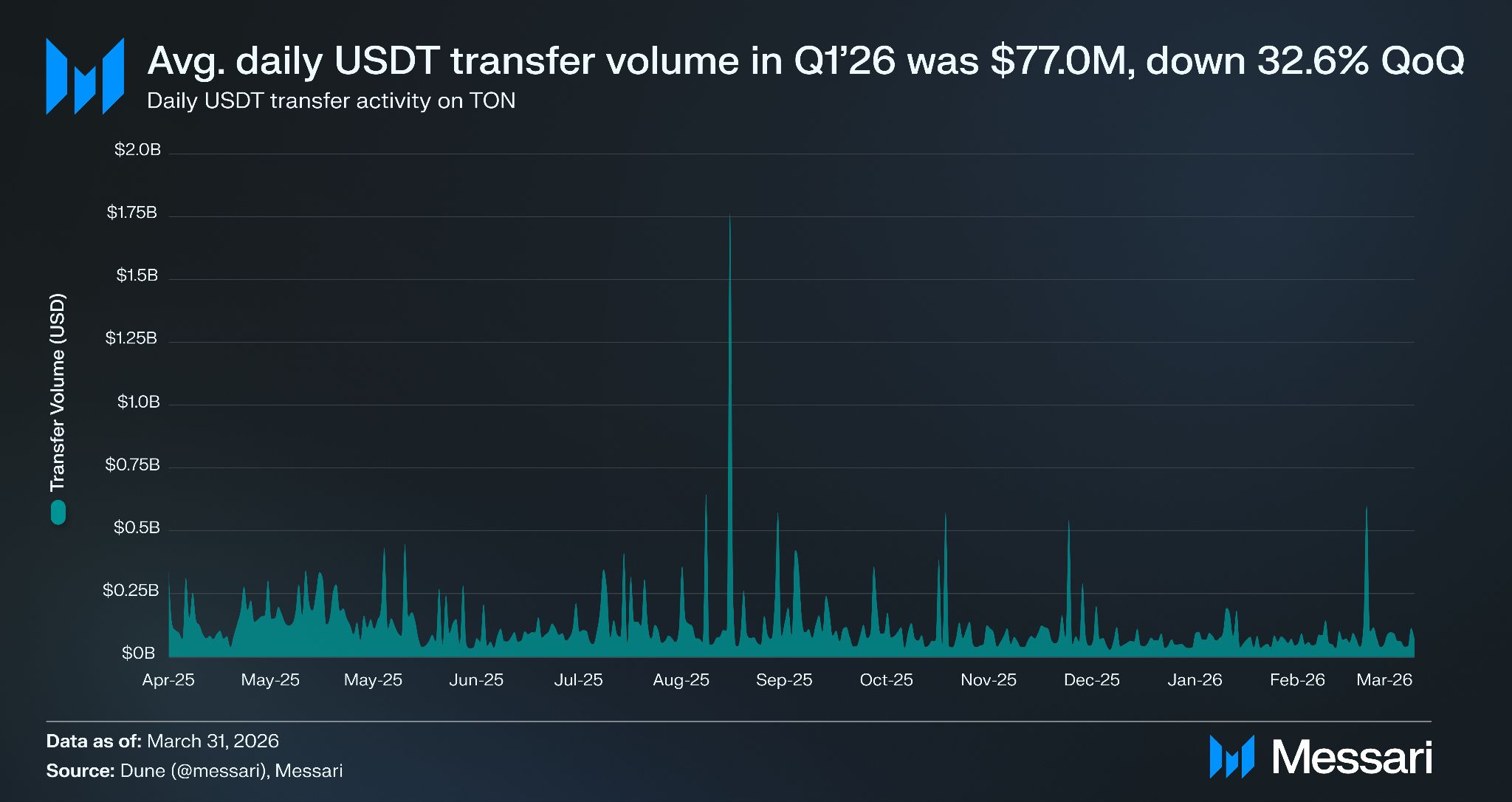
Average daily USDT transfer volume on TON declined 32.5% QoQ from $114.1 million in Q4 2025 to $77.0 million in Q1 2026. TON processed $6.93 billion in cumulative USDT transfers during the quarter, with average transfer count holding essentially flat at 73,600 per day and average daily active USDT addresses at 31,260, down 1.1% QoQ. Meanwhile, average stable transfer size declined from $1,580 in Q4 2025 to $1,050 in Q1 2026, a 33.7% QoQ decline. The decline came from larger transfers falling while smaller-value flows remained constant. High-value DeFi swaps and routing through DEXs like STON.fi and DeDust declined sharply alongside a 34.9% contraction in USD TVL, while small-value flows from P2P USDT transfers in Telegram via @Wallet and Tonkeeper, along with active Mini Apps, held steady.
USDT velocity on TON averaged 0.11 in Q1 2026, down from 0.16 in Q4 2025. Velocity is calculated as average daily transfer volume divided by average circulating supply. TON's velocity has fallen each of the last three quarters as transfer volume contracted faster than supply.
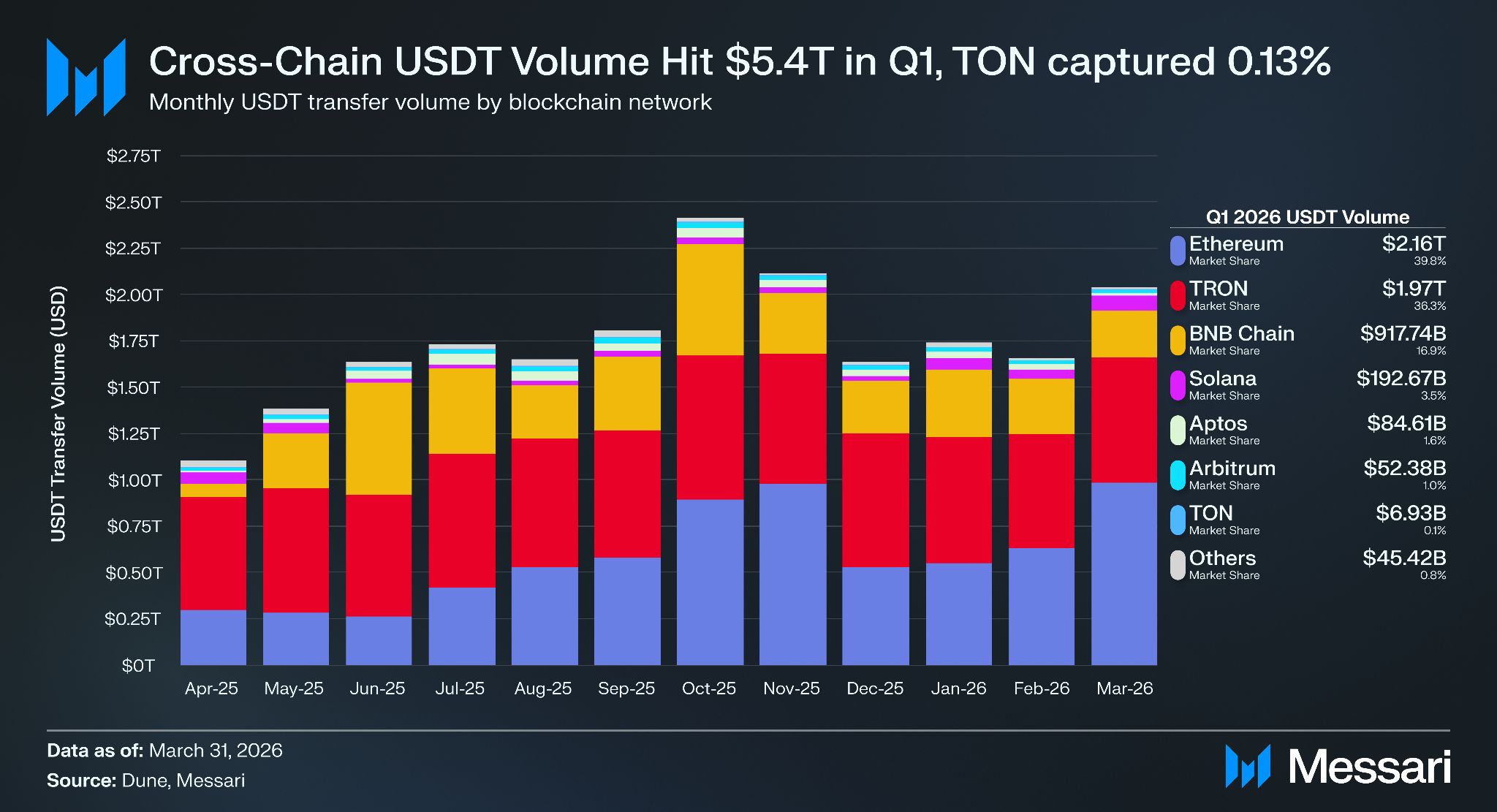
At $77 million in average daily USDT transfer volume, TON accounted for 0.13% of the $5.43 trillion in cross-chain USDT volume tracked across major L1s in Q1 2026, below the chain's 0.30% share of supply. The ~2:1 ratio of supply share to volume share characterizes USDT on TON as a held-balance asset rather than a payment-rail asset, where dollars sit in Wallet in Telegram for occasional use rather than churning through exchanges and remittance corridors at high frequency. The Q2 test is whether transfer count grows faster than transfer volume, signaling smaller, higher-frequency payments as the MTONGA Agenda drops transaction fees and introduces faster finality.
Bridges and Cross-Chain Stablecoin Flows
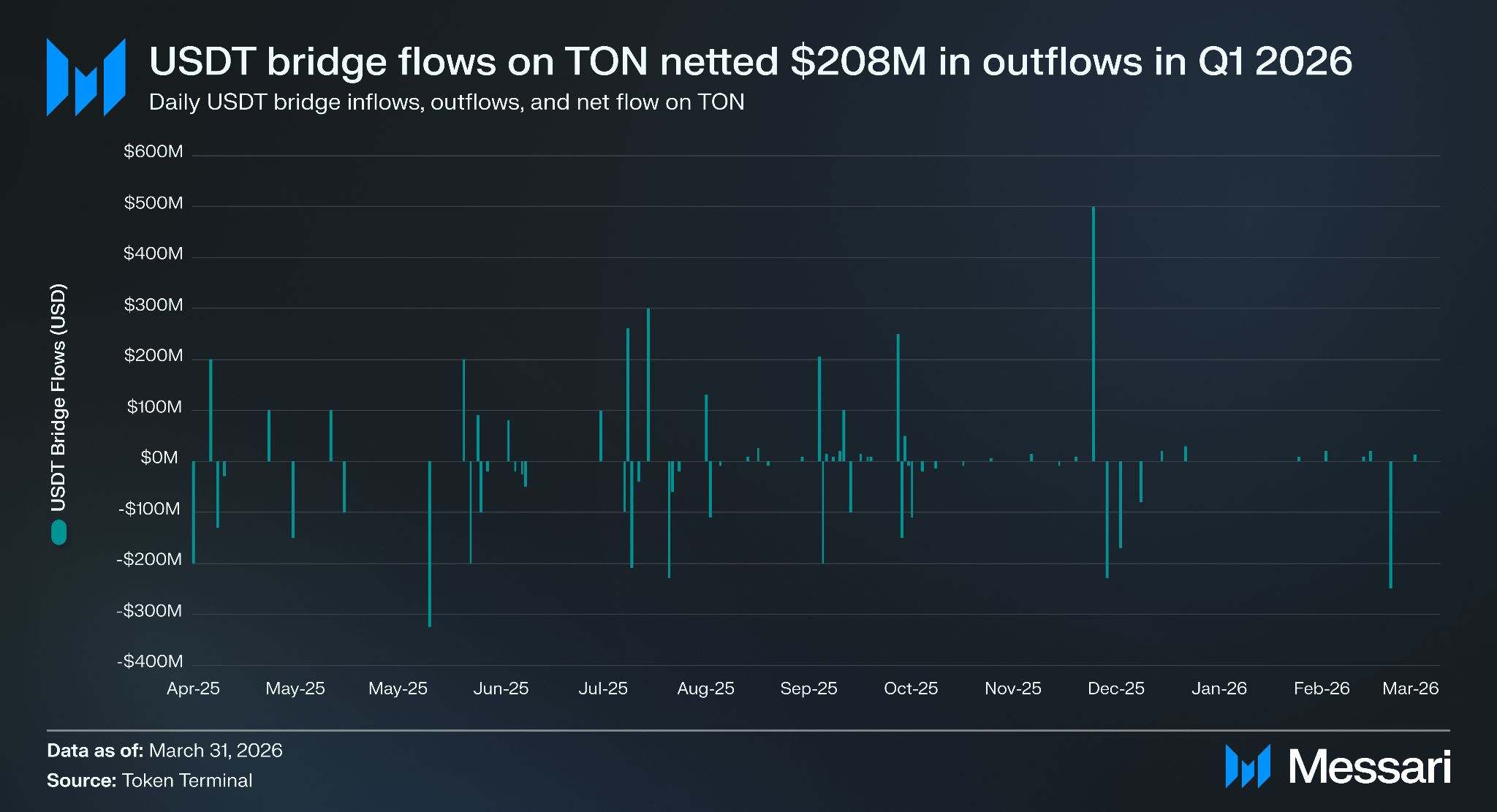
Cross-chain USDT flows on TON in Q1 2026 were limited to nine active flow days in the quarter. Net inflows totaled $122.0 million, while outflows reached $330.0 million, resulting in a net outflow of $208.1 million. Two days drove the entire net contraction. An $80.0 million Tether burn on January 3, 2026, and a $250.0 million Tether burn on March 17, 2026. The March event alone accounted for 32.8% of TON's USDT float at the start of the quarter.
USDT on TON is natively minted by Tether rather than bridged from other chains, so TON's USDT supply follows Tether's mint and burn decisions across chains. Tether burned ~$5.5 billion of USDT globally in Q1 2026, the first net quarterly contraction in USDT supply since Q2 2022, and TON's USDT supply contracted ~20x faster than the global aggregate as Tether redirected mint capacity toward other chains.
As of March 31, 2026, USDT0, Tether's omnichain dollar token, had not been deployed at scale on TON. The chain's dollar layer remains dependent on Tether's allocation decisions and concentrated in a single issuer. The only offset is USDe, which is held primarily for the native yield it pays. USDe's growth diversifies issuer risk while increasing the share of TON's stablecoin supply held passively for yield.
DeFi
Liquid Staking
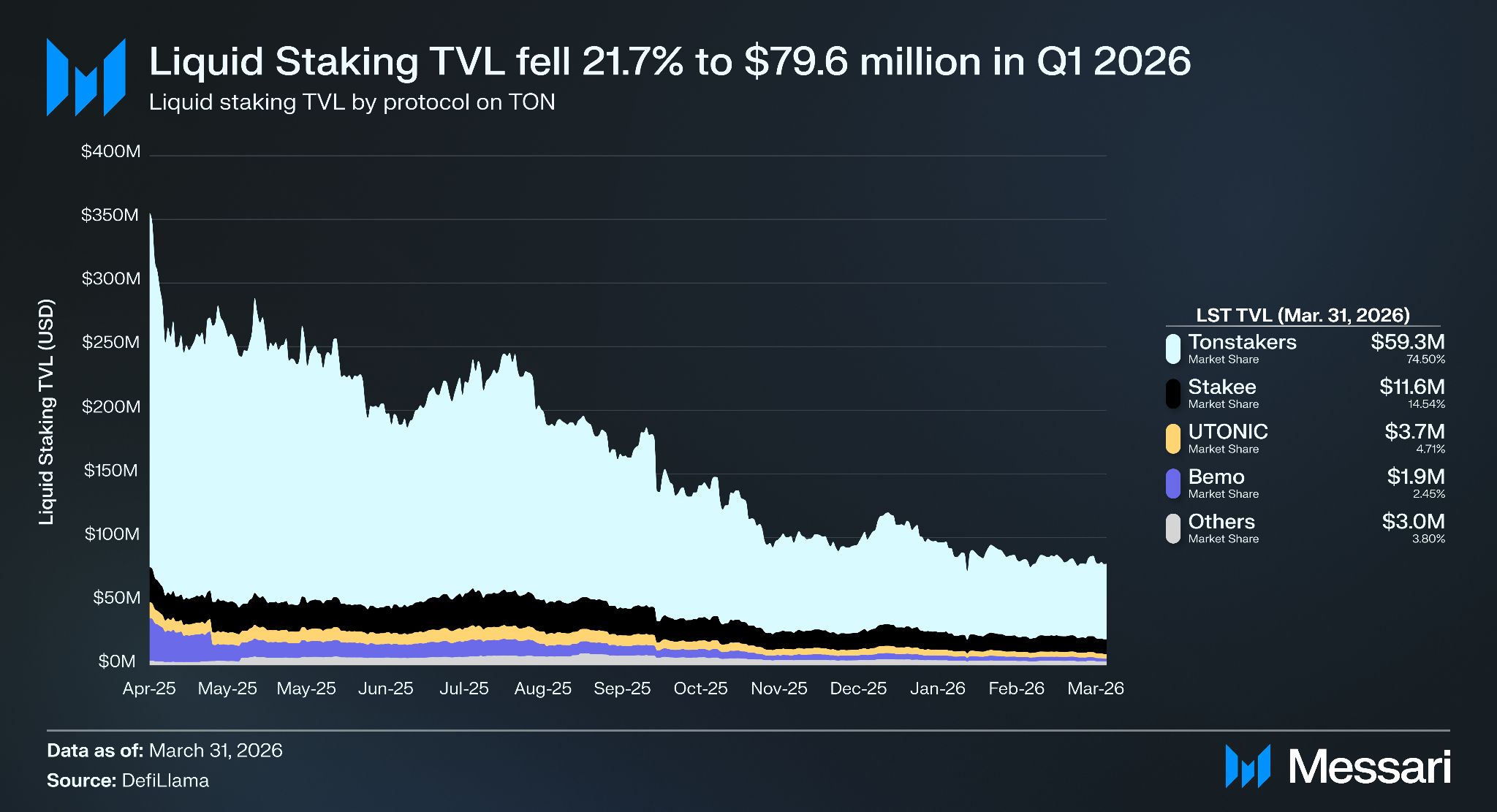
Liquid staking remained the largest DeFi category on TON in Q1 2026 at $79.6 million in total TVL, compared to the chain's combined non-LST DeFi TVL of $56.1 million. LST’s contracted 21.7% QoQ from $101.6 million in Q4 2025, slightly less than the 33.3% non-LST DeFi decline. The LST layer remains heavily concentrated, with the named top four collectively holding 96.2%.
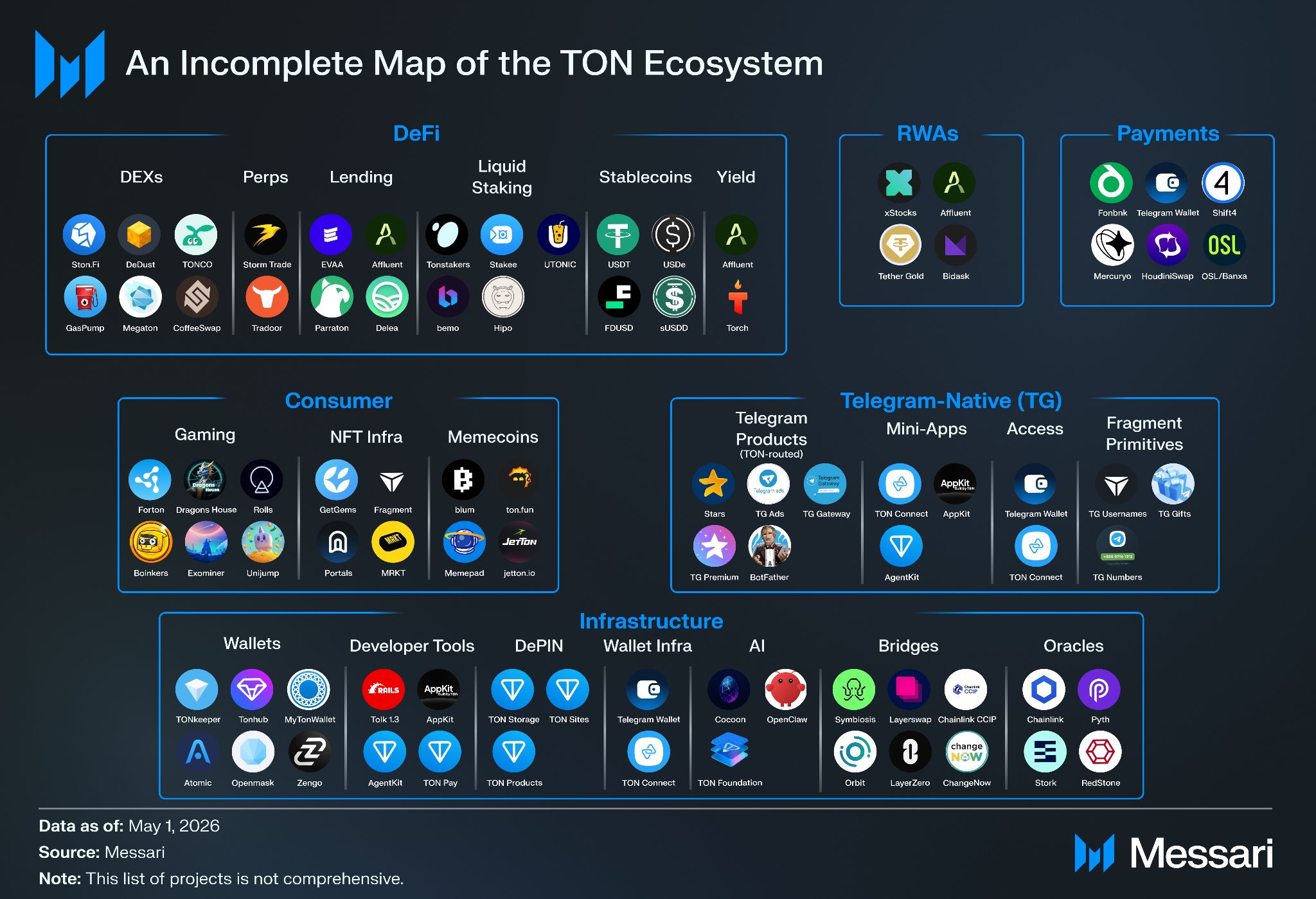
Tonstakers: TON's largest liquid staking protocol, issuing tsTON as a yield-bearing receipt token for staked TON. Tonstakers held $59.3 million in TVL at quarter-end, down 20.0% QoQ from $74.1 million. Tonstakers' market share lifted from 72.9% in Q4 2025 to 74.5%, indicating further consolidation within the LST layer.
Stakee: TON's Telegram-native LST, designed for retail-scale staking through @StakeeBot with a 1-TON minimum and instant withdrawals. Stakee held $11.6 million in TVL at quarter-end, down 20.2% QoQ from $14.5 million. Market share held essentially flat from 14.3% in Q4 2025 at 14.5%.
UTONIC: TON's first liquid restaking protocol. Stakers mint uTON, a liquid restaking token (LRT), by depositing either TON directly or by restaking existing LSTs, and earn validator, AVS, and farming yields concurrently. UTONIC held $3.7 million in TVL at quarter-end, down 23.9% QoQ from $4.9 million. Market share held essentially flat at 4.7% in Q1’26.
bemo: TON's first liquid staking protocol, issuing bmTON as a receipt token for staked TON. The v2 upgrade added custom unstaking data and dynamic gas pricing. bemo held $1.9 million in TVL at quarter-end, down 51.2% QoQ from $4.0 million. The 51.2% decline was the steepest among LSTs and meaningfully larger than the cohort average. Market share fell from 3.9% to 2.4% over the quarter.
The LST layer's concentration in Tonstakers distinguishes TON's liquid staking from peer chains, where LST protocols compete more evenly across the leaderboard.
DeFi TVL
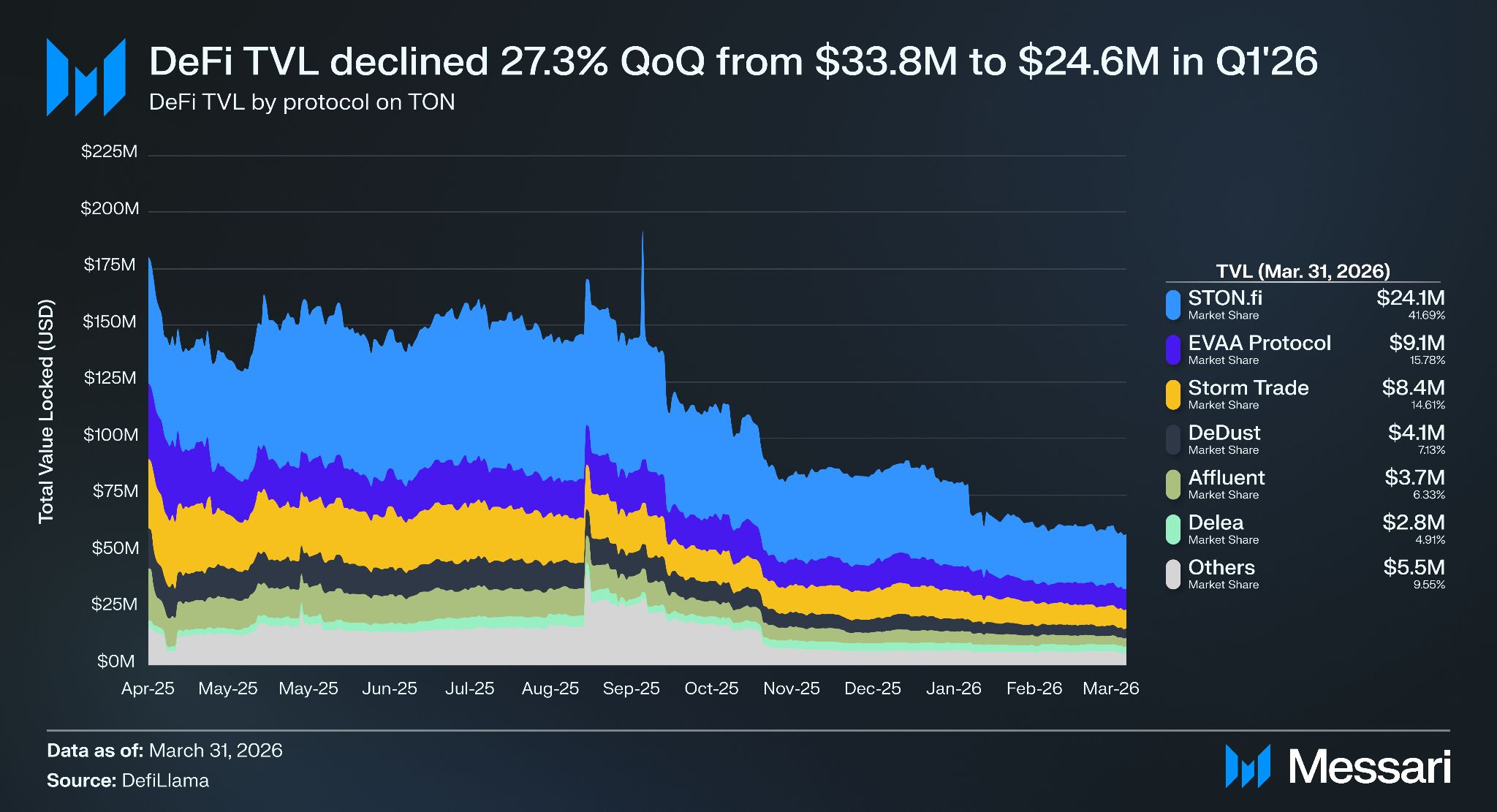
TON's DeFi TVL ended Q1 2026 at $56.1 million, down 34.9% QoQ from $86.1 million. TON-denominated TVL ended the quarter at 46.0 million TON, down only 11.6% from 52.0 million TON. TON's DeFi diversity score (the number of protocols that make up 90% of TVL) held flat at 8 throughout the quarter.
STON.fi: TON's largest decentralized exchange (DEX), providing AMM-based liquidity and token swaps for TON-native and bridged assets. STON.fi held $24.1 million in TVL, a 41.7% share, down 38.7% QoQ from $39.3 million.
EVAA Protocol: TON's primary onchain lending and borrowing market. EVAA's TVL fell to $9.1 million in Q1 2026, down 29.5% QoQ from $12.9 million, and capturing 15.8% of TVL. EVAA executed its Token Generation Event (TGE) in October 2025, with EVAA trading throughout Q1 2026. The protocol's 2026 roadmap pivots from pure lending toward Telegram-native crypto neobanking, including planned undercollateralized loan products and cross-chain interoperability.
Storm Trade: TON's leading onchain perpetuals platform, offering up to 50x leverage on crypto, forex, equities, and commodities. Storm Trade's TVL fell to $8.4 million in Q1 2026, down 34.2% QoQ from $12.8 million. Storm Trade held 14.8% of TVL at quarter-end.
DeDust: One of TON's earliest decentralized exchanges, providing AMM-based liquidity and swaps for native jettons. DeDust held a 7.1% market share at quarter-end with $4.1 million in TVL, down 31.9% QoQ from $6.0 million.
Affluent (formerly Factorial): a trustless asset-management protocol that runs as a Telegram Mini App. Affluent's vault-of-vaults architecture includes a TON Multiply Vault and Strategy Vaults targeting institutional yield on RWA collateral. Affluent ended Q1'26 with a 6.3% share of DeFi TVL equating to $3.7 million, down 27.4% QoQ from $5.0 million.
Delea: A yield-bearing CDP protocol on TON that operates as a mini-app. Users deposit TON, jBTC, or jETH as collateral and mint DONE, the protocol's stablecoin. Delea fell 21.2% QoQ from $3.6 million to $2.8 million in Q1’26, the shallowest decline among the top six. Delea retained a 4.9% share of DeFi TVL in Q1’26.
TON DeFi remains small in absolute terms. TVL is one-thirteenth the size of TON's USDT float and ~40% the size of Fragment's NFT volume in Q1. DeFi serves as a supporting layer in TON's economic mix, behind stablecoin float and Telegram-native primitives.
DEXs
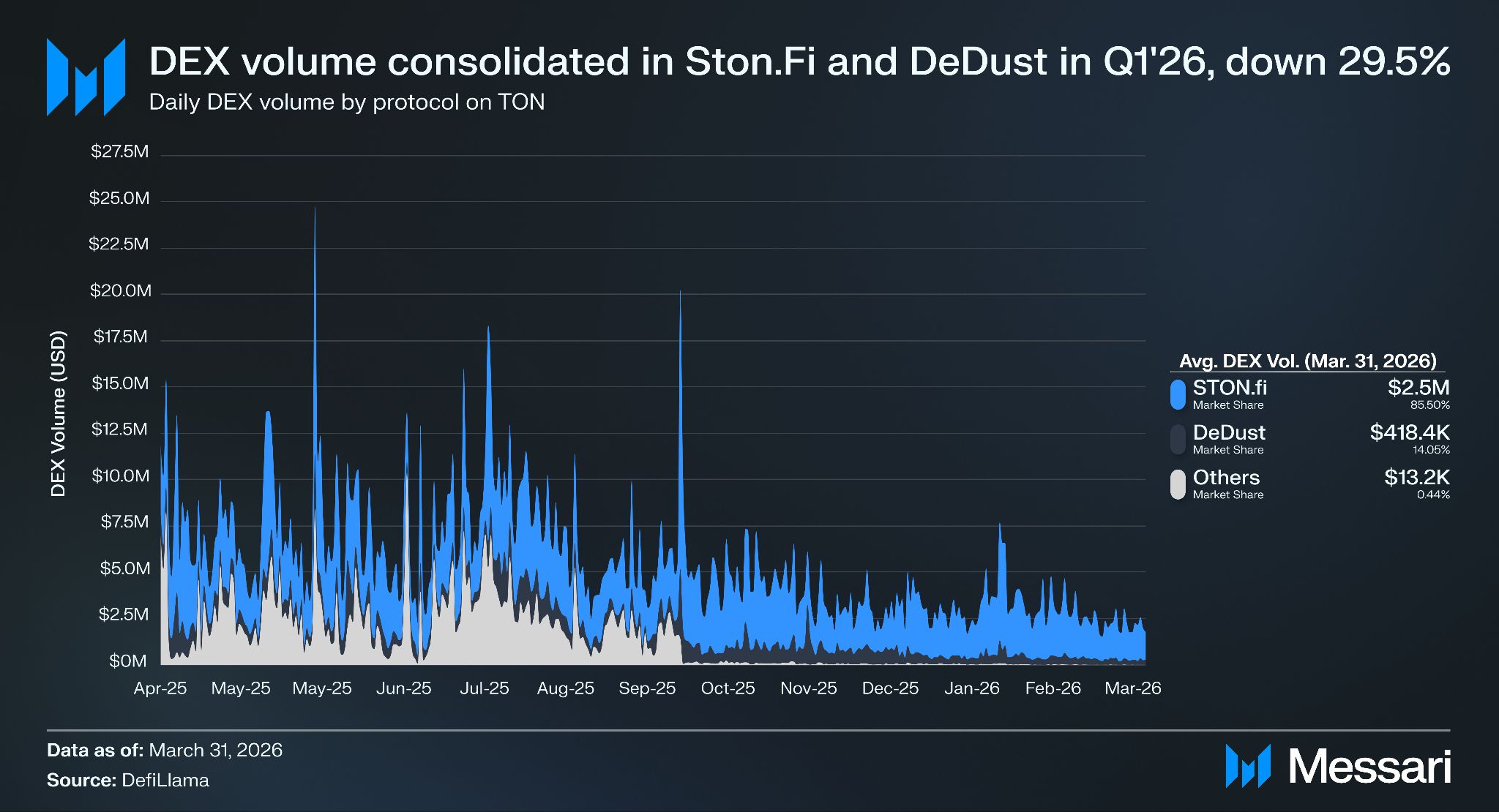
Average daily DEX volume on TON declined 29.5% QoQ to $3.0 million in Q1 2026, with an aggregate volume of $269.5 million. The contraction extended a multi-quarter decline from Q1’25’s $15.7 million daily average.
STON.fi averaged $2.55 million in daily DEX volume in Q1 2026, a 20.1% decline from $3.19 million in Q4 2025. STON.fi's share of TON DEX activity widened from 72.5% in Q4 2025 to 85.5% in Q1 2026 as other venues contracted faster.
DeDust fell 55.2% QoQ from $933K in volume to $418K Q1 2026.
TON DEX volume remains a small slice of the chain's overall onchain activity. Q1 aggregate DEX volume of $269.5 million was less than 4% of TON's $6.93 billion in cumulative USDT transfer volume across the quarter.
Telegram-Native Ecosystem
Onchain app income on TON reached $118.1 million in Q1 2026 across labeled merchant and gaming recipients, including Fragment. This figure measures direct TON inflows, direct USDT inflows, and Telegram Stars cashouts settled through Fragment, while excluding arbitrary non-USDT jettons to avoid thin-liquidity token-pricing distortions. Fragment was the largest recipient, with $60.0 million in visible on-chain income, followed by a long tail of Telegram-native merchants, Stars services, and gaming apps. This activity should be framed as app/merchant income or settlement volume rather than Telegram revenue. Fragment is Telegram-owned, but onchain data does not reveal Telegram’s retained margin or offchain payment rails, such as Apple or Google purchases. The relevance for TON is that these flows represent recurring consumer-product settlement activity, separate from DeFi and speculative NFT cycles.
Revenue of Fragment does not flow directly to TON tokenholders; instead, it accrues to Telegram, channel owners, users, and mini-app developers, with the benefit to TON running through demand for the token. Advertisers buy ad inventory in TON, bidders acquire TON to participate in Username and Telegram Gift auctions on Fragment, channel owners receive Telegram Ads payouts in TON, and mini app developers withdraw Stars earnings into TON-denominated wallets. The aggregate effect is sustained by the buy-side demand for TON proportional to Telegram product volume. Onchain gas fees from these transactions are also subject to TON's 50% network burn, marginally reducing circulating supply.
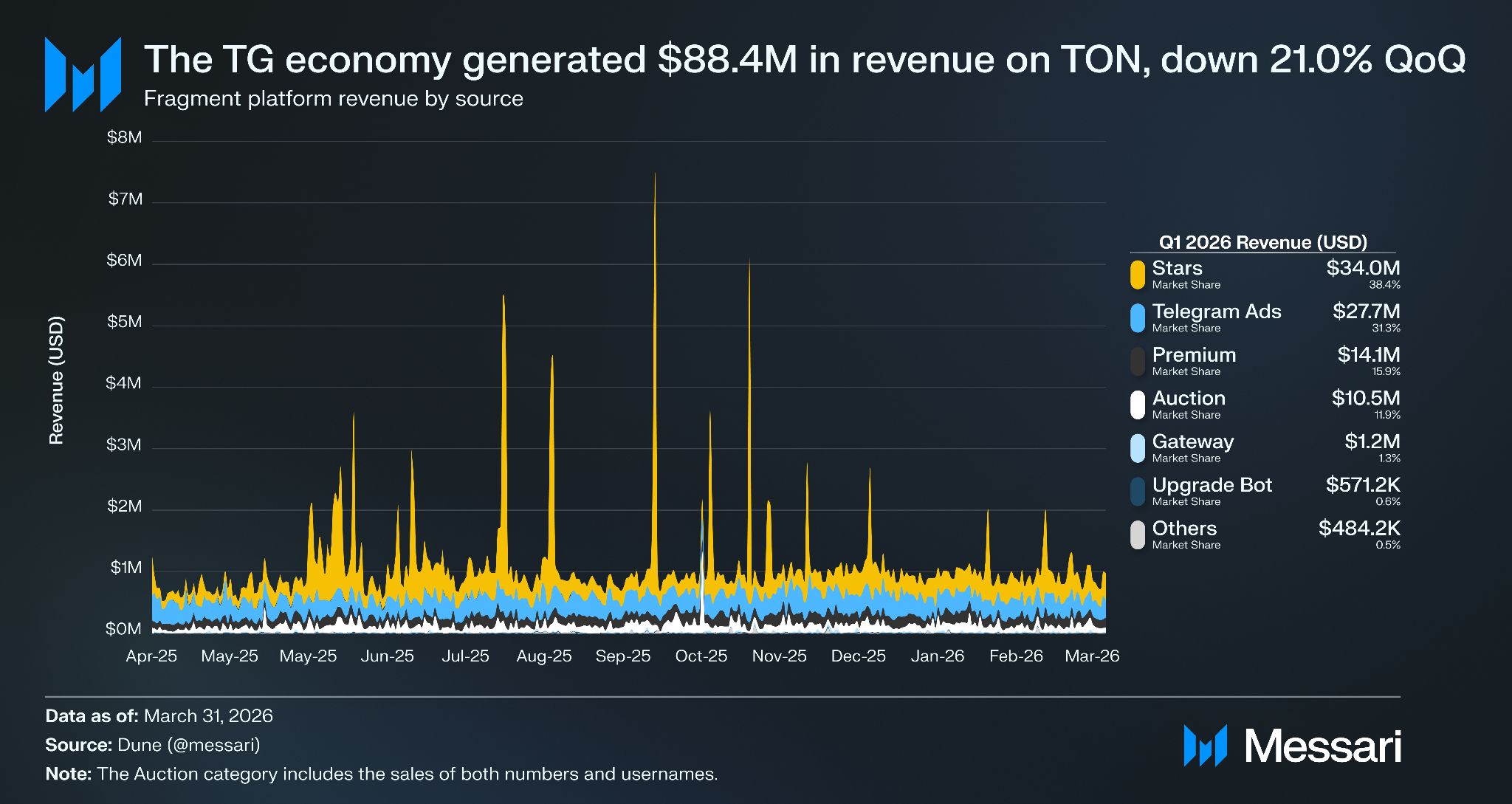
Despite a decline in revenue, Fragment remained the network's largest direct source of demand in the quarter. Stars drove most of the contraction, with recurring revenue products like Premium and Ads seeing softer declines.
Stars: Telegram's in-app currency for digital goods, premium content, gifts, and bot transactions. Stars accounted for 38.4% of Telegram product revenue in Q1'26, generating $34.0 million on Fragment. Stars' revenue fell 30.7% QoQ from $49.1 million in Q4 2025, the steepest decline among all categories.
Telegram Ads: Telegram's advertising program for public channel owners, with revenue share paid in TON. Telegram Ads accounted for 31.3% of Telegram product revenue in Q1'26, generating $27.7 million, distributed directly to channel operators, down 10.8% QoQ from $31.0 million. Ads' share rose from 27.7% in Q4’25 as Stars contracted faster, giving Telegram-side influencers a direct stake in TON.
Premium: Telegram's flagship paid subscription. Premium accounted for 15.9% of Telegram product revenue in Q1'26, generating $14.1 million on Fragment, down 10.1% QoQ from $15.7 million.
Numbers + Usernames Auction: Fragment's primary issuance mechanism for collectible Telegram phone numbers and usernames. The auction layer accounted for 11.9% of Telegram product revenue in Q1'26, generating $10.5 million on Fragment, down 21.0% QoQ from $13.3 million.
Gateway: Telegram's two-factor-authentication SMS-replacement service, payable in Stars. Gateway accounted for 1.3% of Telegram product revenue in Q1'26, generating $1.2 million on Fragment, down 12.9% QoQ from $1.4 million.
Upgrade Bot: Facilitates Telegram service upgrades on the user side. Upgrade Bot accounted for 0.7% of Telegram product revenue in Q1'26, generating $589,990 on Fragment, down 3.9% QoQ from $613,700.
Recurring revenue held up materially better than discretionary revenue during Q1's contraction. Recurring revenue (Premium and Telegram Ads) accounted for $41.8 million, or 47.2% of Telegram-product revenue in Q1’26, contracting only 10.5% QoQ versus the 30.7% Stars decline. The revenue stream grows with Telegram's user base and product adoption, which is unusual for an L1. Other L1s typically derive revenue from onchain DeFi volume, NFT activity, and speculative flows that scale with crypto market sentiment. TON's recurring product revenue scales with Premium subscriber growth, Telegram Ads spend, and broader Telegram product engagement. This gives TON a revenue base that grows with Telegram's product trajectory, independent of crypto market cycles.
NFTs
TON's NFT volume held at $131.2 million in Q1 2026, declining only 2.4% QoQ in USD terms while growing 29.6% QoQ to 91.5 million in TON terms.
Every other major chain's NFT volume contracted significantly. Ethereum NFT volume fell 63.4% QoQ, Solana 58.2%, Base 88.7%, and Polygon 72.6%. TON's market share rose 130.4% QoQ from 15.4% to 35.5%, narrowing the gap with Ethereum from 4.1x to 1.5x in a single quarter.
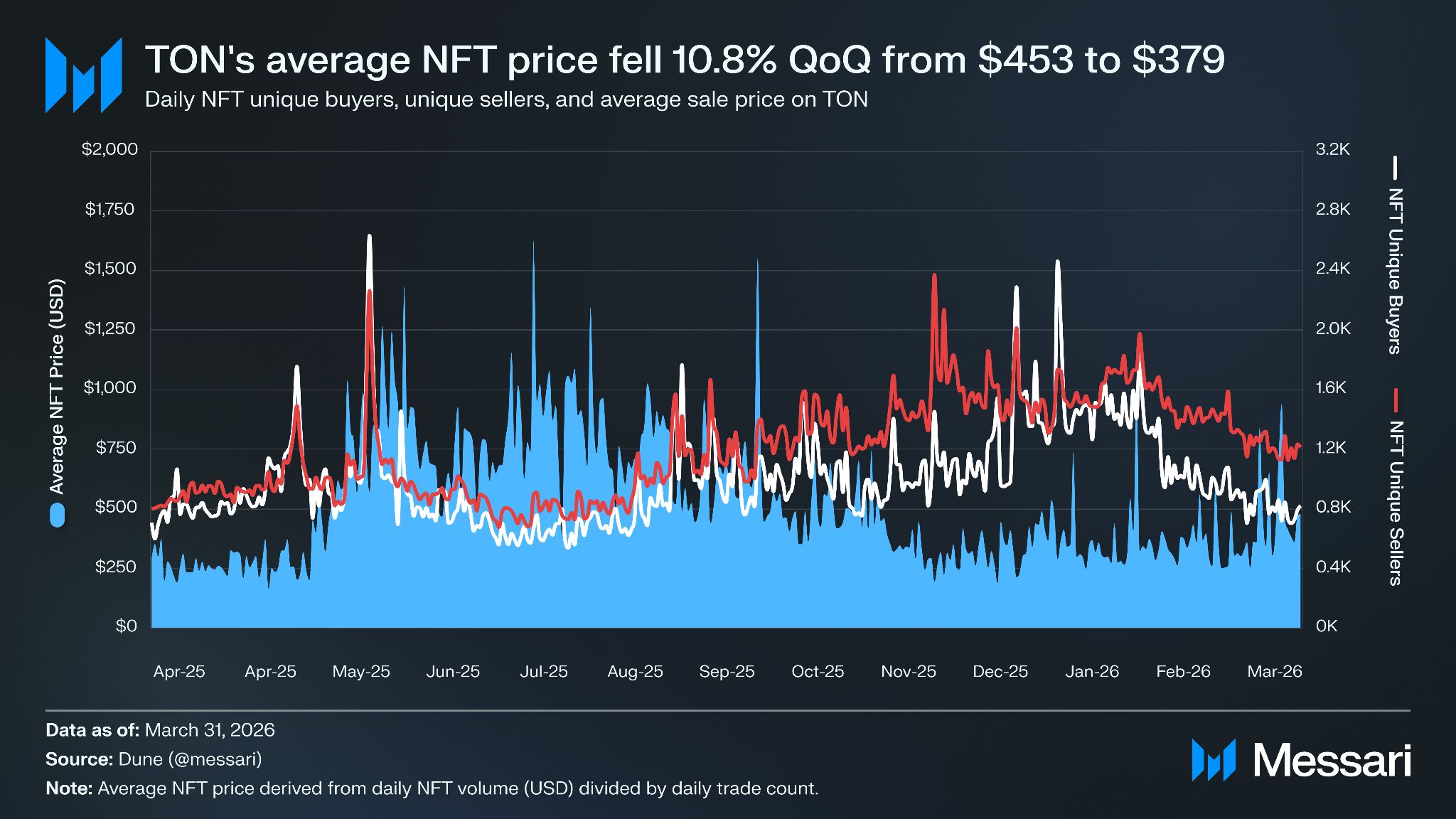
TON's aggregate NFT trade count totaled 345,990 in Q1 2026, up 9.5% QoQ from 316,100 in Q4 2025. Unique buyers rose 0.7% QoQ to 131,790, and unique sellers rose 11.4% QoQ to 107,670. Meanwhile, the average NFT price fell 10.8% QoQ to $379 in USD terms. In native terms, the average NFT price rose 18.4% QoQ to 264.5 TON. The buyer-to-seller ratio fell to 1.22 from 1.35 in Q4 2025, reflecting sellers entering the market faster than buyers.
Among the named NFT verticals on TON, three account for the vast majority of measured volume.
Telegram Numbers: Anonymized Telegram phone numbers issued and traded as NFTs on Fragment, used as functional Telegram account identifiers for SIM-less anonymous login. Q1 Numbers volume totaled $25.2 million (18.0 million TON) across 6,050 sales to 5,000 unique buyers. USD volume fell 7.8% QoQ from $27.3 million, while TON-denominated volume rose 26.1% QoQ from 14.3 million to 18.0 million TON. Sale count fell 31.4% QoQ, indicating fewer but higher-ticket transactions.
Telegram Usernames: Vanity Telegram handles issued and traded as NFTs on Fragment. Q1 Usernames combined volume totaled $19.5 million across 61,830 unique buyers, up 16.1% QoQ in buyer count. Primary issuance totaled $13.1 million across 38,630 buyers, a 15.1% QoQ decline. However, unique buyers rose 12.8% QoQ, indicating more buyers at lower per-buyer spend. Secondary trading rose 24.8% QoQ to $6.4 million across 24,630 buyers, the strongest growth signal among Telegram-issued NFT categories.
Telegram Gifts: Telegram-issued collectible gifts sent peer-to-peer within the messenger and traded on Fragment. Q1 Gifts marketplace volume totaled $8.7 million (5.6 million TON) across 92,570 sales, with 151,360 primary mint events. USD volume rose 16.0% QoQ from $7.5 million, and TON-denominated volume rose 42.8% QoQ from 3.9 million TON. Sale count fell 17.2% QoQ, and primary mint count fell 35.7%, indicating concentrated higher-value trading.
AI
Telegram is emerging as a native interface for AI agents, with TON positioning as the settlement and infrastructure layer for this convergence. Cocoon, the Confidential Compute Open Network, is a decentralized AI compute network built on TON. Pavel Durov announced Cocoon at Blockchain Life 2025, and the network launched on mainnet in December 2025. GPU operators contribute compute capacity and earn Toncoin, with user data encrypted throughout execution via Trusted Execution Environments. Telegram, alongside large AI agents like Mira, currently routes lightweight AI operations through Cocoon, including message translation and summarization, while heavier workloads, such as media processing and conversational assistants, are on the planned roadmap. With Telegram's billion-plus user base and the platform's agentic product tooling lowering the barrier to deploying AI agents, Cocoon is among the larger real-world deployments of decentralized AI compute.
Telegram's bot infrastructure also progressed toward AI-native use cases during Q1. Telegram shipped streaming responses for bots and threaded conversations for multi-topic chats in early 2026, both built for AI assistant use cases. OpenClaw, the most popular self-hosted AI assistant framework, defaults to Telegram as its messaging layer, and a Telegram developer became its maintainer during Q1 2026. BotFather, Telegram's built-in tool for creating and configuring bots, reached 7.3 million monthly active users by early 2026, more than doubling from 3.5 million in January 2025. Combined with native Toncoin withdrawal support for bot earnings, these updates tighten the economic link between Telegram's bot ecosystem and TON.
Consumer-scale AI agent adoption happens through chat interfaces people already use, and TON is positioned to capture this activity as Telegram's settlement layer. WeChat's trajectory shows the model. The Chinese messenger app reached 1 billion MAU in 2018, WeChat Pay scaled to over 800 million users, and Mini Programs reached over 900 million users by integrating consumer services and payments natively inside the messaging app. AI agents follow the same scaling path, with TON providing the onchain settlement layer for autonomous transactions, programmable identity, and decentralized compute payments. TON's onchain AI agent ecosystem remains in its early stages, with the TON Foundation running dedicated AI contests to accelerate tooling and adoption.
Network Analysis
Workchain / Shardchain Architecture
TON is structured as a hierarchical multichain system commonly described as a blockchain of blockchains. A top-level masterchain coordinates network state and validator configuration. Workchains operate in parallel under the masterchain's coordination, each able to define its own virtual machine, token standards, or execution logic while remaining interoperable. Each workchain may further partition into shardchains, smaller state partitions that enable parallel transaction and smart-contract execution. The architecture theoretically supports up to 2^32 workchains and 2^60 shardchains per workchain, though in practice the system runs with a single workchain (the basechain) and dynamically partitions shardchains under it as load demands.
Smart contracts execute on the TON Virtual Machine (TVM) in an asynchronous message-passing model. A single user-initiated transaction can produce a chain of internal messages routed across shards using Hypercube Routing, which calculates the shortest path between source and destination shards rather than broadcasting globally. Tokens follow the Jetton (TEP-74) standard, with data stored in a cell-based structure and packaged into Bag-of-Cells (BoC) format for compact, verifiable storage. The asynchronous model enables horizontal scaling via shardchain partitioning, but it also means a single user-facing transaction (e.g., a USDT transfer between Telegram users) generates multiple internal messages that count toward the chain's total transaction count.
Usage
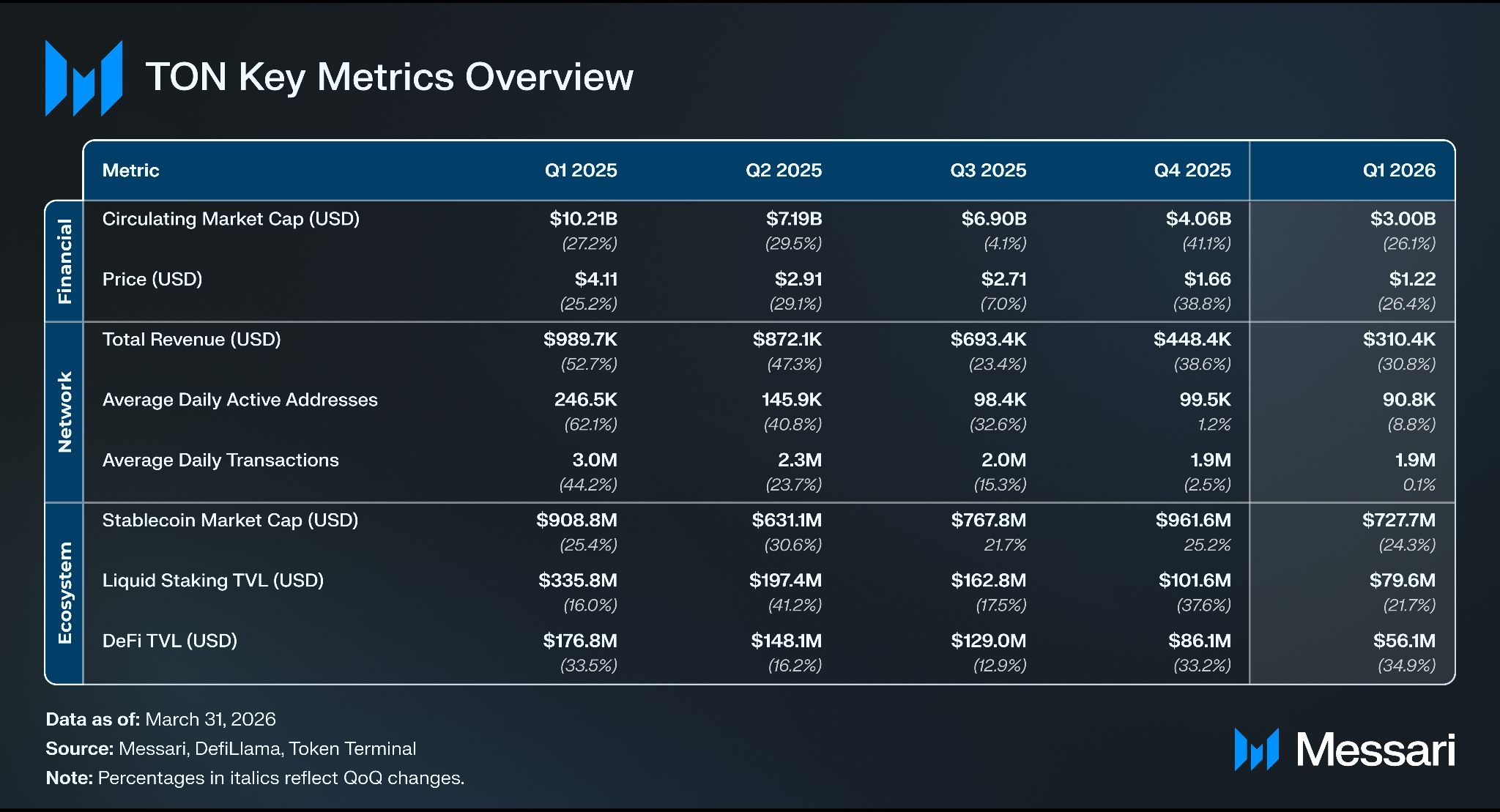
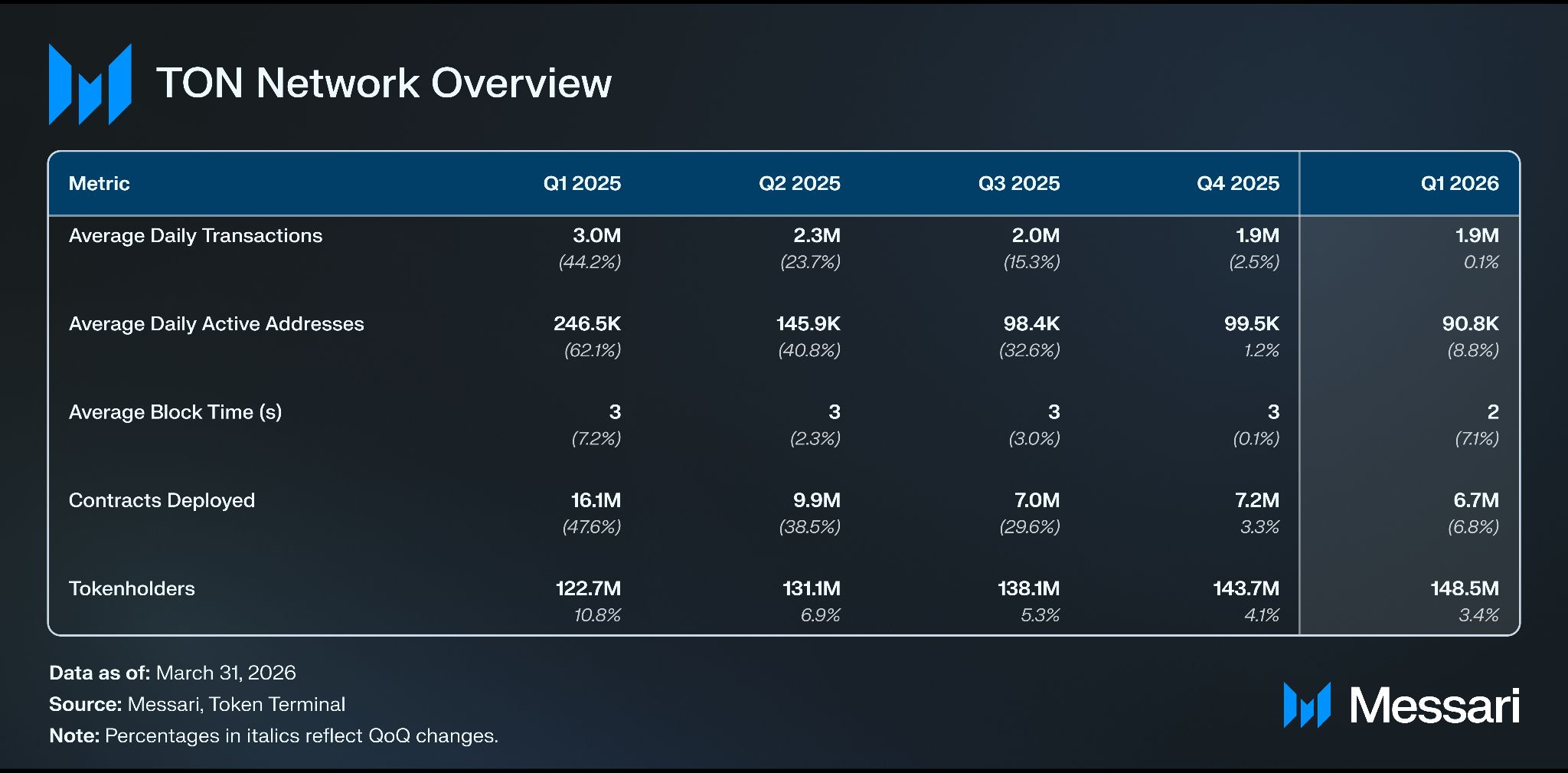
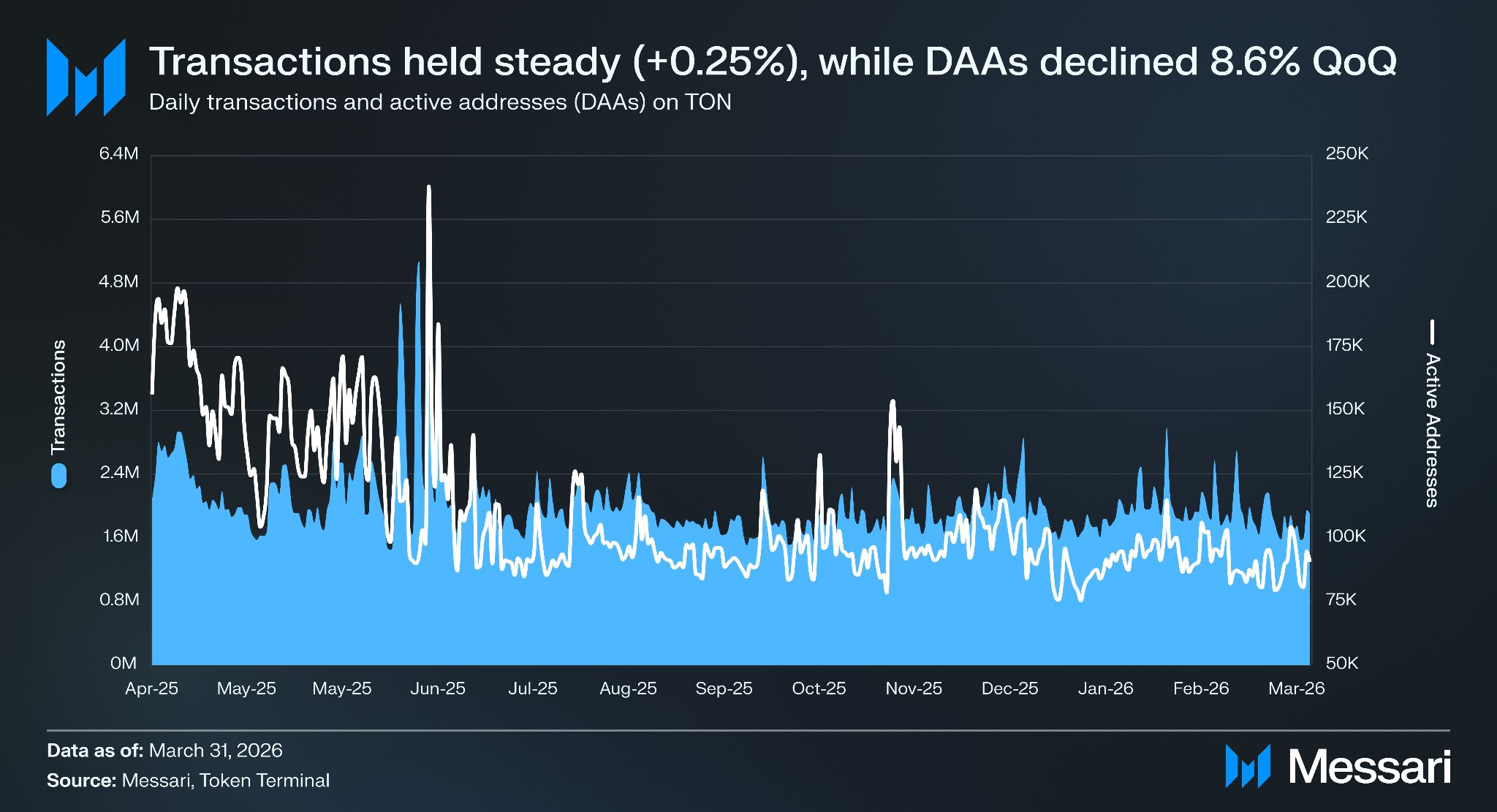
Transactions on TON totaled 171.9 million in Q1 2026, down 4.0% QoQ from 179.5 million in Q4 2025, with average daily transactions essentially flat at 1.91 million. Transaction count has trended downward throughout 2025 from TON's 2024 peak, which was driven by tap-to-earn games like Notcoin and Hamster Kombat that distributed tokens to users for in-app tapping. Q4 2025 and Q1 2026 mark two consecutive quarters of stabilization at this level.
Average daily active addresses on TON ended Q1 2026 at 90,790, down 8.8% QoQ from 99,540. The decline in DAAs was well below TON's 26.4% spot-price decline, indicating the user base contracted less than economic activity did.
Mini Apps
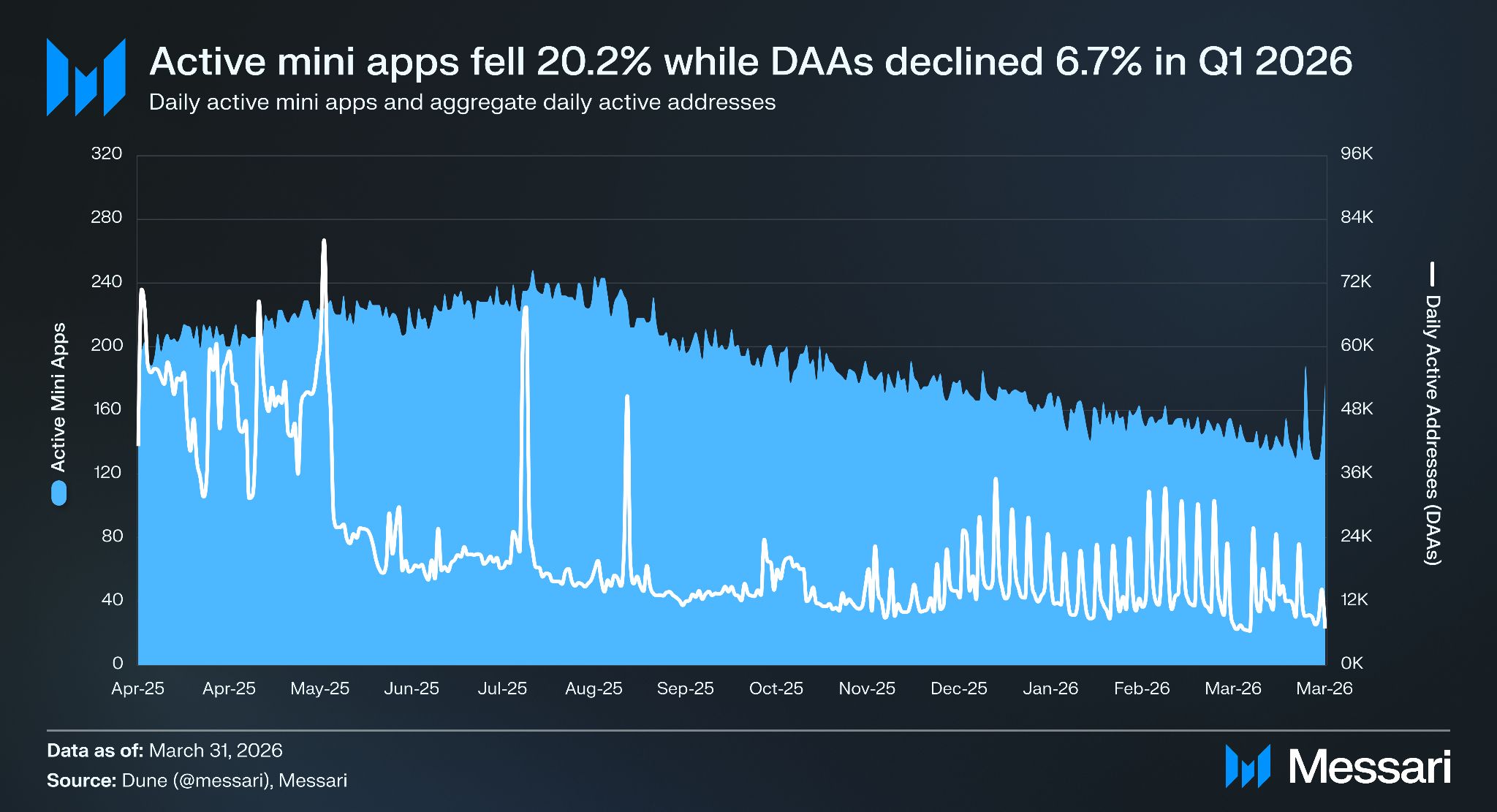
Q1 2026 averaged 152 Telegram Mini Apps with onchain activity per day and 13,980 aggregate Mini App DAAs. Against Telegram-side Mini App reach estimated at 150-190 million MAU entering Q1, the implied onchain conversion ratio is around 0.01%. The low conversion floor reflects the structural reality that most Mini App engagement on Telegram, such as free games, ad-supported content, conversational interfaces, and offchain commerce, does not require onchain settlement. The question for the rest of 2026 is whether the conversion ratio can shift from 0.01% to a 1-5% band, which would multiply the current Mini App DAA by 100-500x while still leaving the bulk of Telegram engagement offchain. Mini App DAAs represented 15.4% of TON's 90,789 total daily active addresses, making Mini Apps a meaningful slice of the chain's overall onchain user activity.
Developer Activity
Throughout Q1 2026, TON Core continued several developer-tooling workstreams aimed at lowering the barrier for third-party builders. The Tolk 1.3 smart-contract language, a FunC successor, targets up to 40% lower gas costs with TypeScript- and Rust-inspired syntax. AppKit, a unified application-layer SDK stack maintained by TonTech, packages wallet, payment, and DeFi primitives into one stack for faster developer integration. The Rust Node, a validator-stack reimplementation, improves operational reliability for node operators.
Third-party developer tooling also expanded during Q1. On March 26, 2026, WalletConnect launched production support on TON, standardizing wallet-connection flows for dApps and Mini Apps. On March 31, 2026, Dynamic (a Fireblocks company) launched embedded wallet infrastructure for TON, allowing developers to deploy wallets within applications without requiring a standalone wallet installation.
Network Upgrades
Catchain 2.0
The Catchain 2.0 Update progressed from testnet validation to mainnet preparation across Q1 2026. The TON testnet activated Sub-Second mode on January 23, 2026, with the network averaging 2-3 blocks per second under real organic load. On February 12, 2026, TON Core released version 2026.02, updating mainnet validators to the new accelerated network layer and the Catchain 2.0 consensus code, while gating activation pending continued testing. A service update, TON 2026.02-1, followed on February 24, 2026, with stability and performance fixes. Load testing on the testnet demonstrated 1,000 transactions per second in a single shardchain at sub-second operation time, well above the 500 TPS peak that TON mainnet reached during the Notcoin, DOGS, and Hamster Kombat minting events.
TON Core began the three-stage mainnet activation on March 31, 2026, by upgrading validator nodes to the new consensus version. The remaining stages took place in early April 2026. A basechain consensus activation vote took place on April 2, 2026, and a full basechain-plus-masterchain activation vote on April 7, 2026. The public bug bounty contest closed before activation, with no major consensus changes required to the final codebase.
Parallel application-layer improvements landed during Q1, with Toncenter releasing a Streaming API V2 on both TON’s mainnet and testnet. The new API replaces polling-based RPC requests with persistent connections that push state updates as transactions confirm, eliminating the round-trip latency of repeated client polls. MyTonWallet and tonscan.org switched over during the quarter, halving operation times in those products ahead of the consensus upgrade itself.
Security and Decentralization
TON's PoS validator set comprised 380 validators at Q1 2026 close, with 397.5 million TON staked. TON's Nakamoto Coefficient (NC) was 77 at quarter-end, ranking second across major blockchain networks, behind only Polkadot. The Nakamoto Coefficient measures the minimum number of independent validators required to control 33% of the stake, with higher values indicating more decentralized validator distribution. TON's NC sits well above peer L1S, including Solana (19), Sui (18), Aptos (14), TRON (13), and BNB Chain (7). TON's high Nakamoto Coefficient means exchanges, custodians, and public-market treasuries can stake material TON positions with limited impact on network decentralization.
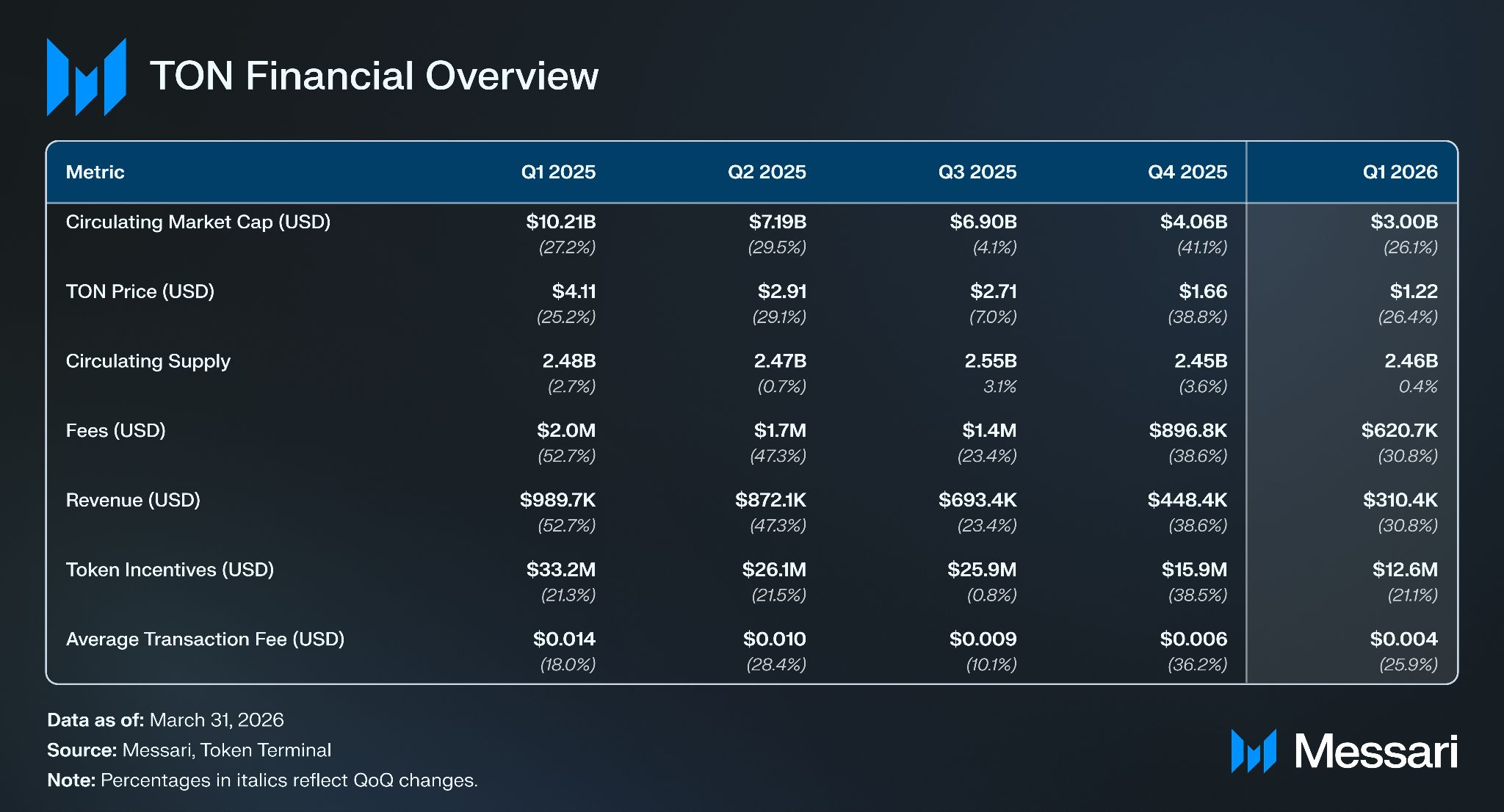
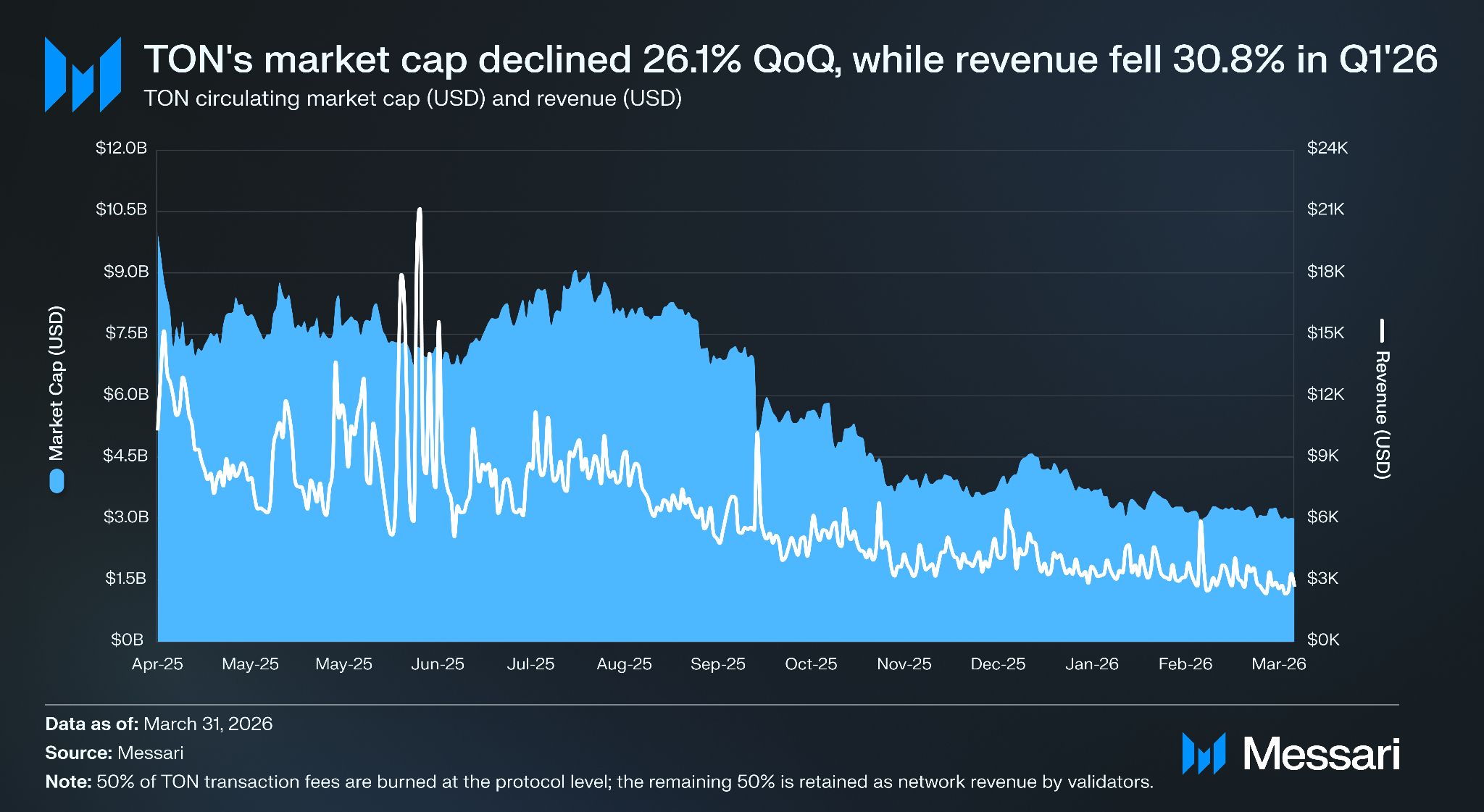
Circulating market cap on TON ended Q1 2026 at $3.00 billion, down 26.1% QoQ from $4.06 billion, while TON's spot price closed Q1 2026 at $1.22, down 26.4% QoQ. Q1 spot price traded between a $1.90 high on January 6, 2026, and a $1.20 low on March 1, 2026, with the $1.20 low marking TON's trailing-twelve-month bottom.
Total network fees on TON declined 26.7% QoQ to $719,080 in Q1 2026, from $981,320 in Q4 2025. Total network revenue declined by the same rate to $359,540, reflecting TON's fixed 50.0% transaction-fee burn schedule. Average fee per transaction declined 25.9% QoQ to $0.0042, down from $0.0056 in Q4 2025.
The fee compression reflects a transaction mix that has shifted toward lower-value Mini App and stablecoin transfer activity, and away from higher-value DEX swaps and contract interactions, which historically generated higher per-transaction fees. TON's onchain fee economics now run at payment-rail levels, consistent with the chain's consumer-distribution positioning.
Token Supply and Issuance
TON's circulating supply ended Q1 2026 at 2.46 billion TON, up 0.4% QoQ. Total supply remained at 5.15 billion TON.
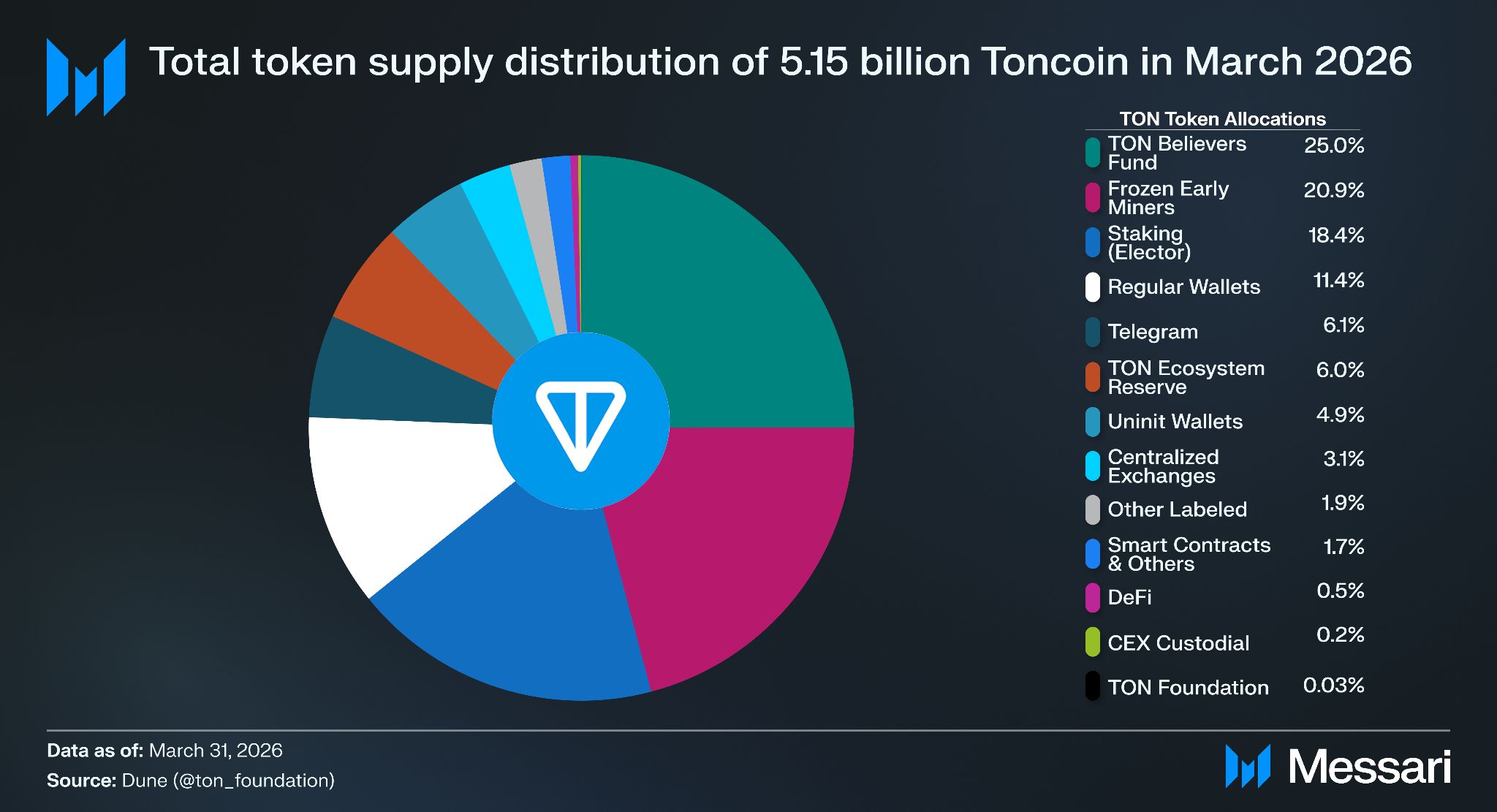
Restricted allocations, including the TON Believers Fund, Frozen Early Miners, Telegram, and the TON Ecosystem Reserve, sum to 58.0% of total supply at quarter-end. The Staking Elector holds another 18.4%, and actively held retail and exchange supply totaled 15.2% of the total supply, or 33.6% of the 2.46 billion TON circulating supply.
The TON Believers Fund unlocks through 36 fixed monthly releases of 36.59 million TON each. As of March 2026, 6 of 36 releases have been completed, leaving 30 monthly releases of 1.10 billion TON remaining through October 2028.
The 48-month freeze on the 171 inactive miner addresses, totaling 1.08 billion TON, expires around February 2027. However, the expiration does not automatically place those tokens into circulation. The majority of these wallets have never transacted; owners must manually activate them, and many keys are likely permanently lost. Additionally, the community could vote to extend the freeze. Telegram's holdings include 21 million TON in vesting contracts issued to team members and partners, with a 1,440-day vesting schedule and a 360-day cliff. Sell-side pressure from these vesting recipients has been negligible to date.
PoS emissions during Q1 2026 ranged between 73,000 and 97,000 TON per day, comprising 1.7 TON per masterchain block and 1.0 TON per basechain block. This translated to an annualized inflation rate of 0.6%. Fifty percent of transaction fees are burned at the protocol level.
Post-quarter, the April 9, 2026 Catchain 2.0 mainnet activation changed TON's inflation trajectory. Faster block production (400ms blocks vs Q1's ~2.5-second cadence) generates more validator rewards over a fixed period, stepping the annualized inflation rate from 0.6% pre-activation to 3.6% post-activation. Daily emissions are projected to rise 6x from the Q1 range to 440,000-580,000 TON per day. Staking APY rose from 3.3% pre-activation to 18.4% following, reflecting the higher rewards distributed across a similar staked base. The higher inflation rate is a mechanical consequence of Catchain 2.0's roughly 6x faster block production at constant per-block rewards. TON could have scaled per-block rewards down to keep emissions flat, but chose to let inflation rise in order to fund the higher staking APY that compensates validators for operating the faster consensus.
Digital Asset Treasury (DAT) Holdings
The accumulation of TON in publicly listed treasury vehicles partially offsets the Q1 2026 price contraction on the demand side. TON Strategy Company (Nasdaq: TONX), the first publicly listed TON treasury company, rebranded from Verb Technology Company and began trading under the TONX ticker on September 2, 2025, following a $558 million private placement led by Kingsway Capital.
By the end of Q1 2026, TON Strategy Company held over 220 million TON, worth about $268 million at quarter-end, and equivalent to 8.9% of TON's circulating supply. The company actively stakes its position to participate in network rewards.
TON Strategy Company serves as a leveraged public equity wrapper for TON's consumer distribution narrative. Its mission is to accumulate TON, stake it, and provide U.S. public-market exposure to the network's infrastructure layer.
While the holder concentration compresses circulating float and provides a steady source of structural demand against the speculative cycle, it also concentrates a sizable share of supply with a single entity whose disclosure cadence is quarterly. TON Strategy Company is currently the only major publicly listed TON treasury vehicle. The DAT space for TON is less developed than Bitcoin or Ethereum equivalents, but TONX's emergence is consistent with the broader 2026 DAT cycle across L1s.
Closing Summary
Q1 2026 was a coordinated contraction across TON's USD-denominated metrics. TON's spot price declined 26.4% QoQ, dragging DeFi TVL down 34.9%, transaction fees lower by 31.0%, and stablecoin supply down 16.4% on a dollar basis. Native-denominated activity tells a different story. DeFi TVL measured in TON fell only 11.6%, native-denominated NFT volume grew 29.6%, and aggregate NFT trade count rose 9.5%. This split defines the quarter: TON's onchain surface held its weight in native units, while dollar-anchored exposure repriced with the broader market.
The Telegram-native surface was the clearest source of stability. Telegram-issued products routed $88.5 million through TON in Q1, with Premium subscription revenue declining 10.1% and Telegram Ads declining 10.8%, while Stars declined 30.7%. TON also captured 35.5% of cross-chain NFT volume, up 130.4% QoQ, while every other major chain's NFT volume fell more than 50%. The footprint reflects what the consumer-distribution thesis predicts: a network whose economic activity tracks Telegram's product surface more than crypto's speculative cycle.
MTONGA (Make TON Great Again) sits outside the Q1 window but resets the forward case. Three of seven announced steps have shipped post-quarter: Catchain 2.0, which brought sub-second finality and 10x throughput on April 9, 2026; mid-April fees fell 6x to $0.0005 per transaction; and Telegram became TON's largest single validator, with 199.1 million TON staked in early May 2026. The tradeoff is an inflation step-up from 0.6% to 3.6% annual issuance. TON Strategy Company (Nasdaq: TONX) closed Q1 with over 220 million TON staked, equivalent to 8.9% of circulating supply. TON's Nakamoto Coefficient of 77 at quarter-end means treasury vehicles can take positions of that size without compressing the network's decentralization profile. The question for the rest of 2026 is whether MTONGA's post-quarter performance gains translate into measurable user growth and fee throughput in Q2, or whether the inflation step-up arrives ahead of the demand it is meant to enable.
This report was commissioned by the TON Foundation. All content was produced independently by the author(s) and does not necessarily reflect the opinions of Messari, Inc. or the organization that requested the report. The commissioning organization may have input on the content of the report, but Messari maintains editorial control over the final report to retain data accuracy and objectivity. Author(s) may hold cryptocurrencies named in this report. This report is meant for informational purposes only. It is not meant to serve as investment advice. You should conduct your own research and consult an independent financial, tax, or legal advisor before making any investment decisions. Past performance of any asset is not indicative of future results. Please see our Terms of Service for more information.
No part of this report may be (a) copied, photocopied, duplicated in any form by any means or (b) redistributed without the prior written consent of Messari®.