Toncoin (TON) functions as the network’s core execution asset (i.e., paying gas, supporting DeFi liquidity, securing Proof-of-Stake consensus, and acting as a settlement layer) and as the foundation of Telegram's in-app economy.
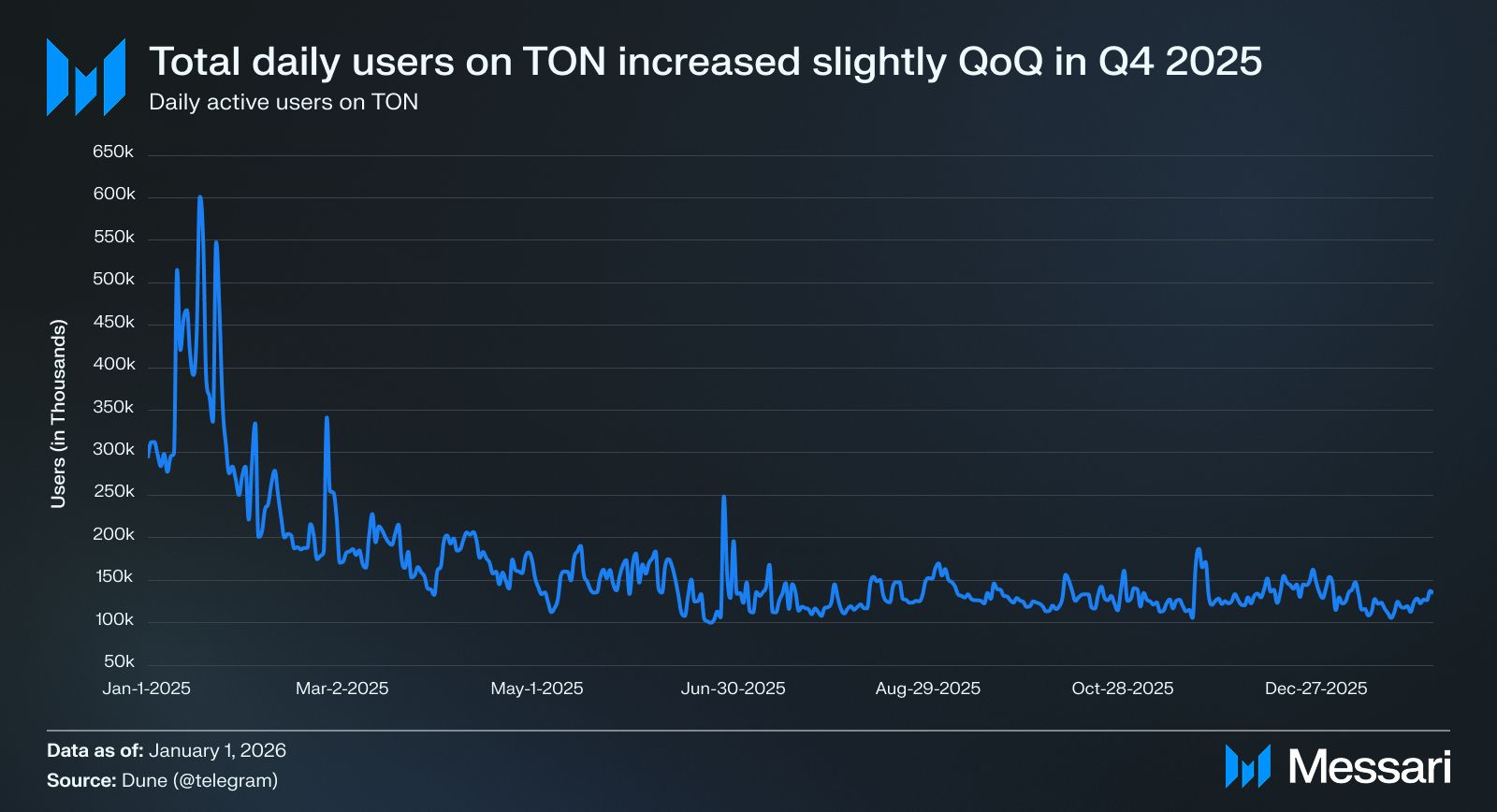
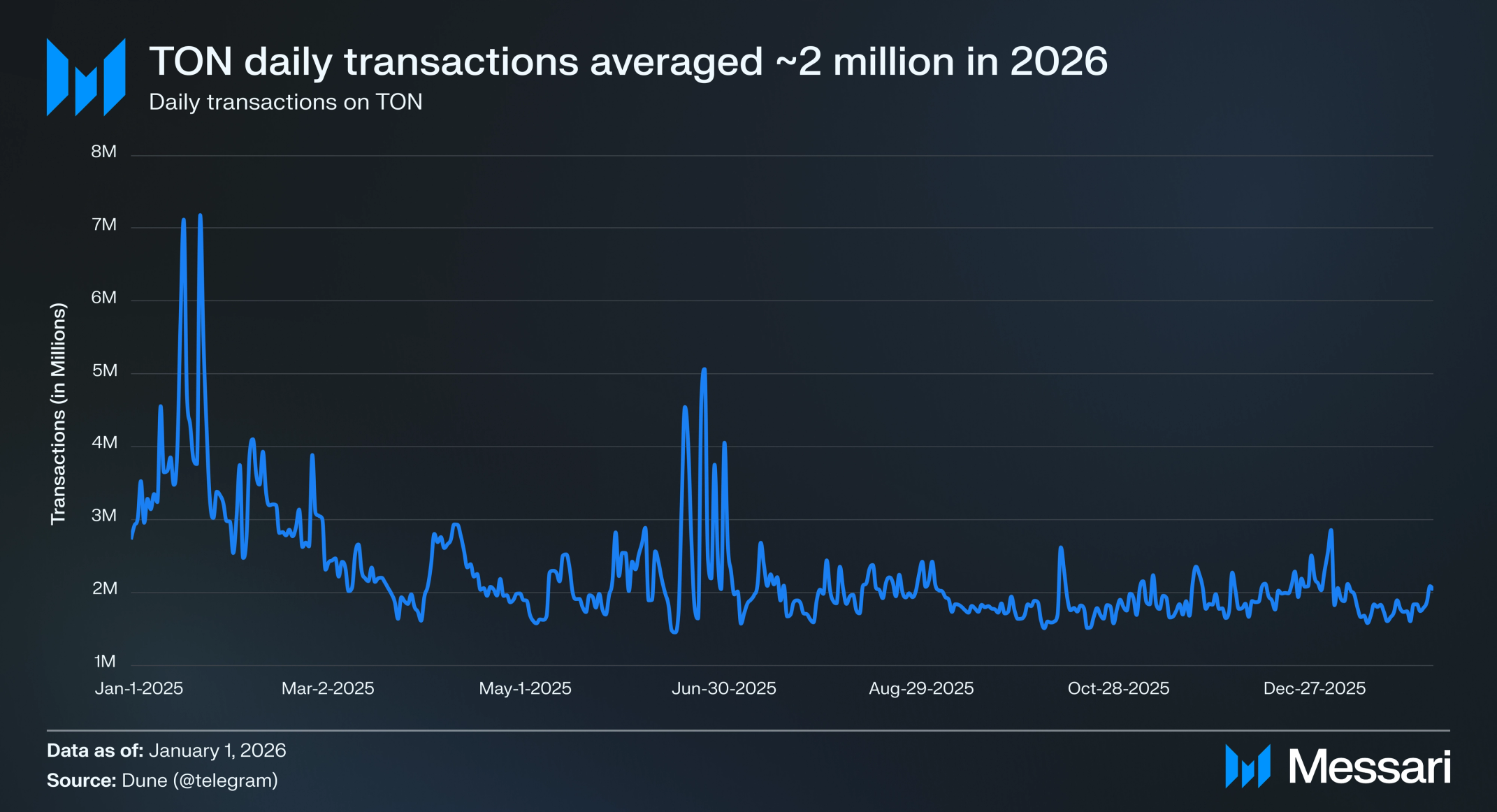
2025 activity shows TON shifting from early-year viral surges into a steadier baseline (~100K–150K daily active users and ~1.5–2.5 million daily transactions).
TON’s ecosystem is evolving into a Telegram-native financial stack, with stablecoins, yield products, and RWAs increasingly embedded in wallets and mini-apps; highlighted by xStocks, Ethena, Tether, Affluent, and liquidity routing via STON.fi + Omniston.
TON's 2026 roadmap pivots from infrastructure refactoring to performance and developer accessibility. Catchain 2.0 targets sub-second finality, the Rust Node reimplements the validator stack, and a unified developer layer that includes developer kits for smart contracts, apps, wallets and payments.
TON is emerging as a native infrastructure layer for AI inside Telegram, with Cocoon providing decentralized compute, AgentKit connecting autonomous agents to onchain actions, and vibe-coding workflows enabling builders to quickly generate and share working prototypes.
Introduction
Consumer crypto adoption typically breaks down into two bottlenecks: distribution and cost/latency. Most blockchains rely on standalone wallets and browser-based dApps, creating multi-step onboarding funnels that deter mainstream users. Even when infrastructure works, blockchain interactions often feel slow, expensive, or fragmented compared to Web2 applications; particularly in consumer use cases like payments, gaming, and social applications, where users expect instant feedback and low friction.
TON’s thesis is that mass adoption requires both scalable infrastructure and native distribution. At the base layer, TON is built as a dynamically sharded Proof-of-Stake (PoS) network with asynchronous smart contracts, allowing parallel execution and horizontal scalability. Rather than relying solely on high single-chain throughput, TON’s architecture is designed to maintain stable performance under load. Complementing the Layer-1 are native protocol services, including (i) TON DNS (human-readable “.ton” names), (ii) TON Storage (decentralized file storage), (iii) TON Payments (payment channels), (iv) TON Proxy (censorship-resistant routing), (v) TON Sites (decentralized websites), and (vi) Tolk (smart contract language), and (vii) AppKit (an all-in-one SDK for building Telegram Mini Apps with TON), which together form a vertically integrated blockchain stack with easy developer tooling.
What differentiates TON is its distribution and tight integration with Telegram. TON Wallet, natively embedded in the messenger, allows users to transact onchain without leaving the app. TON Connect, the wallet-connection protocol for Telegram Mini Apps (TMAs), opens this to any compatible third-party wallet, though TON Wallet remains unique as Telegram's built-in wallet. Combined with in-chat app distribution, the result is onchain actions that feel like normal in-app behaviour, collapsing the traditional crypto UX stack into a single consumer environment.
TON was founded in 2018 as the “Telegram Open Network” by Telegram co-founders Pavel Durov and Nikolai Durov, and raised $1.7 billion across two private token sales in February–March 2018 to fund development. In October 2019, the U.S. Securities and Exchange Commission (SEC) filed an emergency action against Telegram alleging an unregistered token offering, and Telegram ultimately ceased active involvement in May 2020. Development continued through the community-led “Newton” effort initiated by Anatoliy Makosov and Kirill Emelyanenko, and in May 2021, the community voted to formalize governance under the TON Foundation and promote the V2 testnet into TON Mainnet.
Following the community relaunch, TON attracted additional strategic and private investment. Since 2022, TON has completed eight additional funding rounds, with at least three publicly disclosed raises totaling $50 million ($10 million from DWF Labs in 2022, $30 million in a private sale backed by Foresight Ventures and Bitget in 2024, and $10 million in a strategic investment from Gate in 2024).
Since 2022, TON has attracted significant institutional backing. In March 2025, the TON Foundation disclosed that a group of investors, including Sequoia Capital, Pantera Capital, and Ribbit Capital, collectively purchased over $400 million in Toncoin. Combined with earlier rounds and subsequent investments from Coinbase Ventures, Pantera Capital, and others, publicly confirmed capital inflows exceed $550 million. Later in August 2025, two publicly traded Toncoin treasury vehicles, TON Strategy Co. and AlphaTON Capital, have also launched, modeled on MicroStrategy's BTC accumulation strategy.
In March 2025, TON Foundation disclosed that a group of investors - including Sequoia Capital, Ribbit Capital, Benchmark, Draper Associates, Kingsway Capital, Vy Capital, Libertus Capital, CoinFund, SkyBridge, Hypersphere, and Karatage - collectively purchased and held $400 million in Toncoin. Pantera Capital, which has called Toncoin its largest single investment to date, reportedly deployed over $100 million. In August 2025, Coinbase Ventures purchased Toncoin directly from Telegram as a long-term venture position. In total, publicly confirmed capital inflows into TON exceed $550 million since 2022 across at least ten discrete investment events.
A later turning point came through renewed alignment with Telegram distribution. In September 2023, the TON Foundation announced a partnership with Telegram, aiming to integrate and promote the TON ecosystem for Telegram’s userbase. Thanks to this partnership, Telegram natively integrated a crypto wallet known as @Wallet, supported TON Sites in an in-app browser, and issued Fragment collections (usernames, collectable numbers, and gifts) on TON.
A later turning point came through renewed alignment with Telegram distribution. In January 2025, TON became the exclusive blockchain infrastructure for Telegram’s Mini App platform, with TON Connect positioned as the standard wallet connection method and Toncoin (TON) serving as the exclusive cryptocurrency for non-fiat payments across Telegram services (e.g., Stars, Premium, Ads). This shifted TON to a technically differentiated L1 focused on consumer distribution, with Telegram serving as its primary onboarding and application surface.
Today, TON is maintained through a foundation and open-source contributors, so leadership is best understood through its public-facing executives and operating entities rather than a single corporate team. Makosov and Emelyanenko are cited as founding/core members of the TON Foundation. Steve Yun served as President of the TON Foundation Council and later launched the $100 million ecosystem venture fund, TVM Ventures, in February 2025, while remaining on the board. Maximilian Crown was appointed CEO in April 2025 and later President in August 2025, with prior experience as a MoonPay co-founder (CFO/COO).
Technology
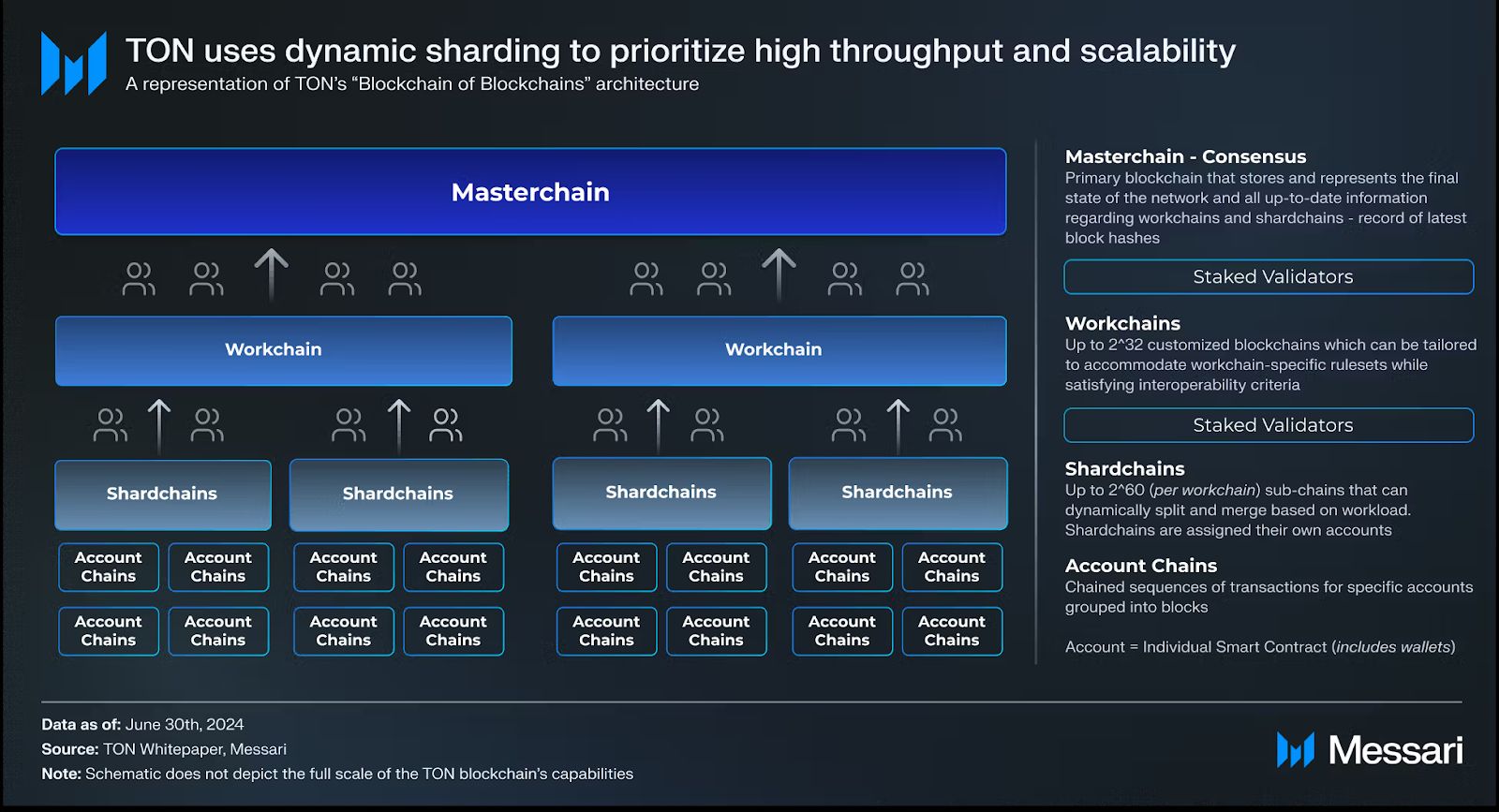
TON’s architecture is commonly described as a “blockchain of blockchains.” Instead of relying on a single monolithic chain, TON is built as a hierarchical system in which a top-level chain coordinates with multiple parallel chains, which can be further subdivided. This structure is designed to enable scalability at the consumer scale while maintaining interoperability and shared security. At a high level, TON consists of three core components: (i) the masterchain, (ii) the workchains, and (iii) the shardchains, which are explained below in more detail.
Architecture
Masterchain
The masterchain is the top-level coordinating chain. It does not process regular user transactions. Instead, it maintains critical network state, including (i) network configuration parameters, (ii) the validator set and their stakes, and (iii) references to the latest finalized blocks of all workchains and shardchains. In simple terms, the masterchain acts as the global source of truth for the TON network, ensuring consistency and finality across all parallel chains.
Workchains
Workchains operate in parallel under the coordination of the masterchain. Each workchain can, in theory, define its own rules (e.g., virtual machine, token standards, or execution logic) while remaining interoperable within the TON ecosystem. The architecture theoretically supports up to 2³² workchains, though in practice, only the base workchain is currently active in most production contexts. The workchain layer enables long-term flexibility, allowing TON to support specialized environments without fragmenting security.
Shardchains
From there, each workchain can be split into shardchains, i.e., smaller partitions of the network state. Sharding allows transactions and smart contract execution to be processed in parallel across multiple shards rather than sequentially on a single chain. TON’s design theoretically supports up to 2⁶⁰ shardchains per workchain, although the network dynamically creates and merges shards as needed. The defining feature of TON’s scalability model is dynamic sharding. Rather than permanently fixing the number of shards, shardchains split automatically under high load to increase processing capacity and merge when activity declines, reducing unnecessary overhead. This allows network capacity to expand or contract in response to real-time demand. The goal is to maintain stable performance and predictable transaction times even as user activity scales to consumer levels.
Consensus
TON uses a Proof-of-Stake (PoS) consensus model. Validators are selected based on the amount of TON staked and participate in block production and validation. Consensus is achieved using a Byzantine Fault Tolerant (BFT) protocol called Catchain, which is specifically designed to operate efficiently in a sharded environment. Catchain enables validators to coordinate across shards while preserving security and finality guarantees.
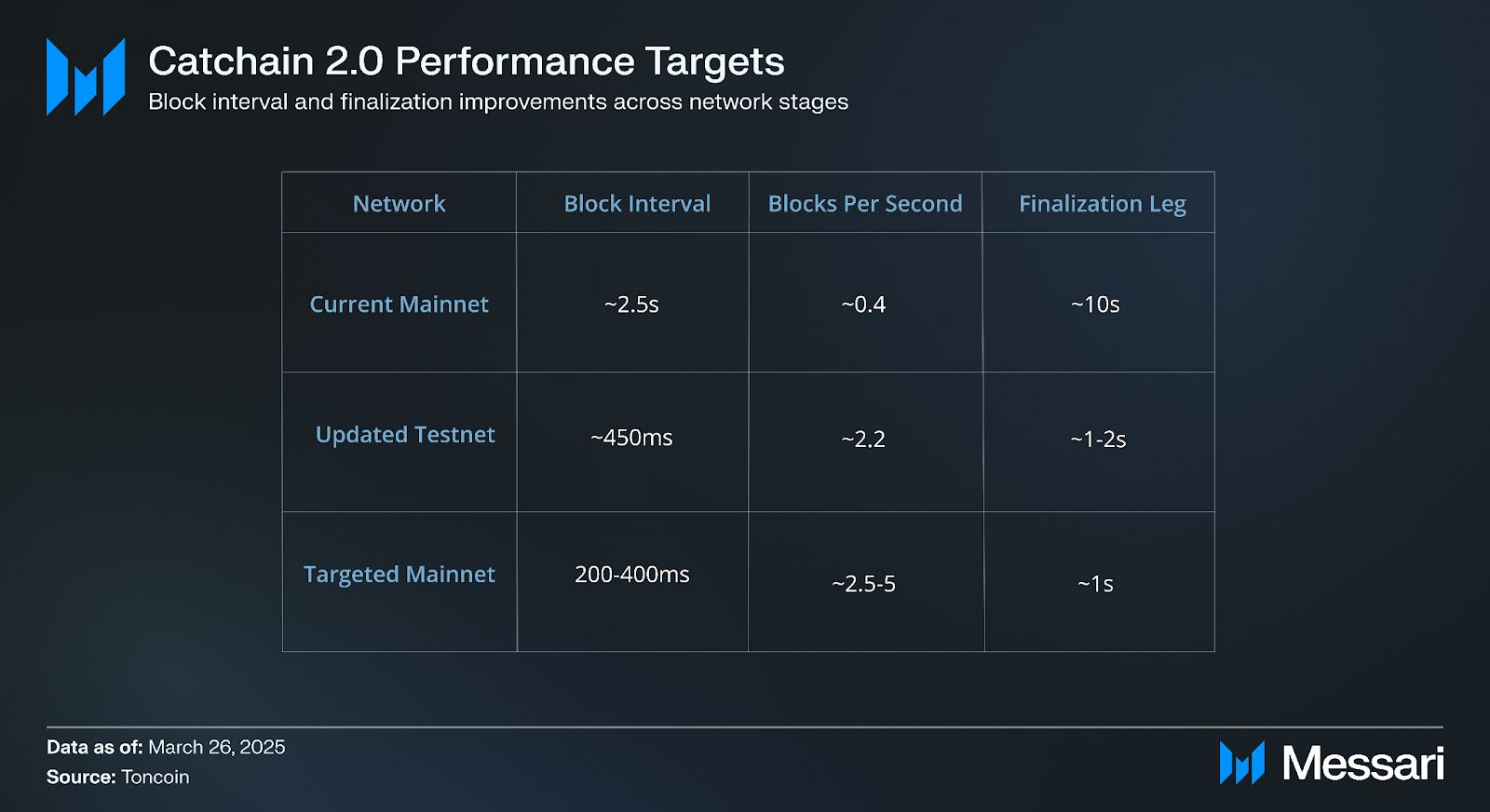
TON Core is releasing Catchain 2.0, a consensus upgrade targeting sub-second finality to bring the onchain experience closer to Web2 responsiveness. The upgrade reduces block intervals from ~2.5s to 200–400ms, delivers roughly 2.5–5x throughput improvement, and cuts finalization lag from ~10s to ~1s.
Development is complete: the testnet, updated on January 23, 2026, has been running stably at ~450ms block intervals with ~1–2s finalization. Mainnet validators were updated on February 12, 2026 with the Catchain 2.0 code and accelerated network layer, though activation remains dormant pending final testnet validation.
Validators
Within the above architecture, there are two primary roles: (i) Validator and (ii) Nominators.
Validators secure TON’s PoS network by staking Toncoin to participate in block production and validating transactions across shardchains. Operators must run high-performance, highly available infrastructure and stake a minimum of 300,000 TON to enter validator elections, though winning typically requires ~700,000 TON or more, depending on competition and the cycle's validator cap. Validators stake for a fixed validation term, with stake and rewards returned after the round completes.
Validators earn rewards from (i) transaction fee surpluses (users attach small extra Toncoin amounts as validator incentives) and (ii) newly issued Toncoin with proportional distribution based on stake weight. Validators can be penalized in two ways: (i) idle behavior: If a validator fails to participate in block creation or transaction signing during a validation round, it may be fined; and (ii) malicious misbehavior, where any network participant can submit a complaint with cryptographic proof to the Elector contract. Validators vote on the complaint, and if 66.0% of validators approve, a slashing penalty is deducted from the validator's stake. To receive rewards, a validator must successfully (i) win election into a validation cycle, and (ii) validate blocks throughout the entire cycle without being penalized.
Nominators, on the other hand, (i) delegate TON to validators, and (ii) share in staking rewards. They do not operate the infrastructure directly. The cited minimum delegation amount is ~10,000 TON. Nominators increase validator stake weight and help decentralize participation in consensus.
Beyond direct nomination, pooled staking services such as TON Whales, Kiln, ChorusOne, and P2P aggregate smaller stakes to meet validator thresholds. Alternatively, liquid staking protocols (Tonstakers, KTON, bemo, Hipo) issue transferable receipt tokens that let holders earn staking rewards while keeping capital liquid across DeFi.
AI
Telegram is emerging as a native interface for AI agents, with TON positioning itself as the settlement and infrastructure layer for this convergence.
Cocoon (Confidential Compute Open Network) is a decentralized AI compute network built on TON, announced by Pavel Durov at Blockchain Life 2025 and launched on mainnet in December 2025. GPU owners contribute computing power and earn Toncoin, while user data remains encrypted throughout execution via Trusted Execution Environments (TEEs). Telegram already routes lightweight AI operations through Cocoon, including message translation and summarization, with heavier workloads such as media processing and conversational assistants planned next. With Telegram's 1B+ user base as built-in distribution and Telegram’s recent efforts to simplify the creation of agentic products, Cocoon represents one of the most significant real-world deployments of decentralized AI compute to date.
Telegram's bot infrastructure has also evolved toward AI-native use cases. In early 2026, Telegram shipped streaming responses for bots (purpose-built for AI assistants) and threaded conversations for multi-topic chats. Third-party traction reinforces the direction: OpenClaw, the most popular self-hosted AI assistant framework, defaults to Telegram as its messaging layer. Additionally, a Telegram developer became its new maintainer. BotFather, Telegram's built-in tool for creating and configuring bots, reached 7.3M monthly active users (MAUs) by early 2026, more than doubling from 3.5 million in January 2025. Combined with native Toncoin withdrawal support for bot earnings, these updates tighten the economic link between Telegram's bot ecosystem and the TON network.
TON's deeper integration with onchain AI agents remains at an earlier stage. To accelerate development, TON Foundation is running dedicated AI contests to bootstrap tooling and adoption.
Putting It All Together
The components described above (i.e., masterchain coordination, dynamic shardchains, asynchronous smart contracts, TVM execution, cell-based data storage, and hypercube routing) operate within a broader multi-layer architecture designed for consumer-scale usage inside Telegram. Rather than functioning as a single monolithic execution engine, TON operates as an interconnected system composed of: (i) User Interface Layer, (ii) Application Layer, (iii) Execution Layer, (iv) Routing & Sharding Layer, (v) Consensus Layer, (vi) Validator Infrastructure Layer, (vii) Indexing & API Layer, (viii) Storage & Data Layer. Together, these layers allow TON to support real-time financial interactions embedded directly inside Telegram’s social graph.
For example, consider a user sending USDT to a friend inside Telegram:
The transaction begins inside the Wallet in Telegram. The user enters an amount and taps send. The experience feels identical to sending a message.
The wallet constructs a Jetton (TEP-74) transfer transaction. Because TON uses an asynchronous model, a message is sent to the sender’s USDT contract, which then sends a follow-up message to the recipient’s wallet contract.
The TON Virtual Machine executes the smart contract logic:
Validates balances
Deducts TON for gas
Updates Jetton balances
Emits internal messages
Each contract runs independently
If the sender and receiver reside on different shardchains, the message is routed using Hypercube Routing. Rather than broadcasting globally, the system calculates the shortest path between shards, minimizing latency.
If network load increases, shardchains may automatically split to distribute execution load. This is TON’s “infinite sharding” in action.
Validators on the relevant shardchain produce and validate the block. The masterchain later finalizes shard references to ensure global consistency.
Collators assemble transactions while validators confirm them, enabling parallelization and improved stability.
Toncenter APIs and indexers immediately update transaction status. Wallets can display “pending” and then a confirmed state using trace APIs and action parsing.
All state changes are stored in TON’s cell-based structure and packaged into a Bag-of-Cells (BoC), ensuring compact storage and verifiable hash-linked data.
To the user, this entire multichain, asynchronous, routed, validated process appears as a simple chat-based transfer.
Toncoin (TON Token)
Token Functions
As the project’s documentation outlines, Toncoin is a native coin of the TON blockchain. It serves several key functions within the network, including:
Paying for network execution: Toncoin is required to execute transactions (e.g., asset transfers and swaps), with fees paid in Toncoin and designed to remain low for consumer-scale usage.
Securing the network: Validators stake Toncoin to participate in PoS consensus and earn rewards, with penalties for downtime or misbehavior. Nominators can delegate Toncoin to share in validator staking rewards.
Telegram in-app economy: Telegram uses TON as its blockchain layer for ownership, transfers, and payouts. Toncoin serves as the payment rail for collectible usernames, SIM-less phone numbers, and collectible gifts - all of which are onchain assets. Creator earnings from ads and in-app purchases (for channel authors, bot developers, and mini-app owners) are withdrawn exclusively via Fragment.com in Toncoin. Toncoin is also the currency for purchasing ads on the Telegram Ads platform.
Storage of blockchain data: Toncoin is required to maintain smart contracts onchain, where validators charge storage rent proportional to the data held. For larger files, TON Storage provides a decentralized persistence layer where storage providers are paid in Toncoin and must cryptographically prove file integrity to claim rewards.
Tokenomics
The initial TON supply of 5 billion tokens was placed into 20 Proof-of-Work Giver smart contracts and mined permissionlessly between July 2020 and June 2022. Since the PoS transition (June 28, 2022), new TON is minted via validator block rewards (~0.5–0.7% annually). The current total supply is ~5.16 billion TON. At $1.33 (Mar. 26, 2026), this implies a fully diluted valuation (FDV) of ~$6.9 billion. Note: TON has no max supply cap.
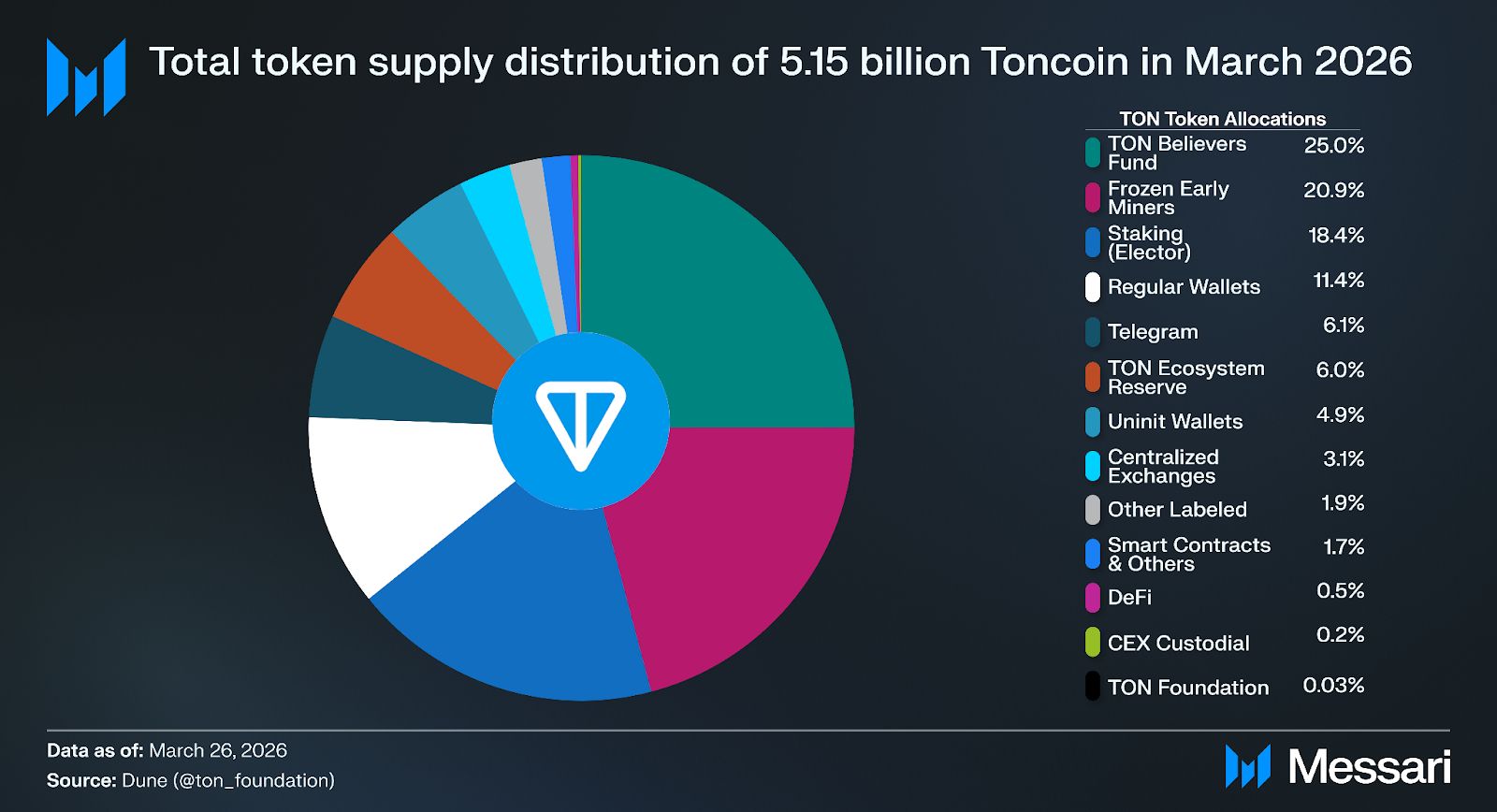
The pie chart above depicts the current supply distribution of ~5.15 billion Toncoin as of March 2026, broken into 14 categories. For simplicity, these can be grouped into four macro buckets:
Freely Circulating: ~48% (~2.46B TON). Includes Regular Wallets, Staking (Elector), Centralized Exchanges, CEX Custodial, DeFi, Smart Contracts & Others, Uninit Wallets, TON Ecosystem Reserve, TON Foundation, and Other Labeled.
TON Believers Fund: 25% (~1.32B TON). A voluntary lockup where existing holders deposited tokens into a Locker smart contract (Jul–Oct 2023). Now vesting in 36 monthly installments (~36.6M TON/month) through Oct 2028. As of March 2026, 6 of 36 periods have been completed; actual claim rates have been low, with only a fraction of unlocked tokens withdrawn so far. Onchain data.
Frozen Inactive Miners: 20.9% (~1.08B TON). 171 addresses that mined TON during the PoW phase but never transacted. Frozen by community governance vote (Feb 2023) for 48 months. After expiration (~Feb 2027), owners must manually activate, and many keys are likely lost. The community could vote to extend the freeze or burn these tokens before expiration, though no formal proposal has surfaced as of this writing. Address list.
Telegram: ~6% (~327M TON). Tokens held by Telegram, plus ~21M in vesting contracts deployed to team members and partners (1,440-day vesting, 360-day cliff). Sell pressure from vesting recipients has been negligible thus far.
IPoW Mining (Premine): Fully mined and distributed. The original ~5B TON was mined from 20 Giver contracts between July 6, 2020, and June 28, 2022. Mining was permissionless with a variable rate based on PoW difficulty, not a linear release schedule. No further unlocks.
TON Believers Fund: Unlocks through 36 fixed monthly releases of ~36.59 million TON/month (~2.8% of the fund). As of March 2026, 6 of 36 periods have been completed; 30 periods remain (~1.098 billion TON still to unlock through ~Oct. 2028).
Frozen Inactive Miners: The 48-month freeze on 171 addresses (~1.081 billion TON) expires around Feb. 2027. This does not mean tokens enter circulation: these wallets have never transacted, owners must manually activate them, and many keys are likely permanently lost. The TON community could also vote to extend the freeze or burn these tokens before expiration. Address list.
Vesting contracts: Use a 1,440-day schedule with a 360-day cliff. Most early contracts have already fully vested; remaining contracts continue vesting at ~3.45M TON/month (per CEX listing model).
PoS Emission (Inflation): Ongoing, perpetual issuance at ~73,000–97,000 TON/day (1.7 TON per masterchain block + 1.0 TON per basechain block). 50% of transaction fees are burned.
Governance
TON's governance spans three layers: validators, core development, and ecosystem coordination.
At the protocol layer, approximately 400 validators distributed across 40 countries, with over 450M Toncoin staked, govern upgrade decisions directly. Any change to network parameters or consensus rules must pass an onchain vote among active validators, ensuring no single entity can push through protocol changes unilaterally. According to Chainspect, TON ranks 3rd among Layer-1s by Nakamoto coefficient, placing it among the most decentralized Proof-of-Stake networks.
TON Core, the network's core development arm, maintains the TON node software, ships protocol upgrades, and builds node tooling. The TON Foundation, a non-profit dedicated to the ecosystem's long-term growth, provides grants, resources, and technical support to projects building on TON.
Beyond these two bodies, a growing set of independent teams contributes to infrastructure and developer tooling. TonTech, an engineering team supported by the TON Foundation, maintains core developer primitives including AppKit, AgentKit, WalletKit, and TON Connect. RSquad, a blockchain development team active in the TON ecosystem since its early days, has contributed critical infrastructure, including the Rust TON Node, TON Pay, and TON Teleport, a trustless cross-chain bridge for asset transfers between TON and external networks.
TON Ecosystem
Partners and Projects
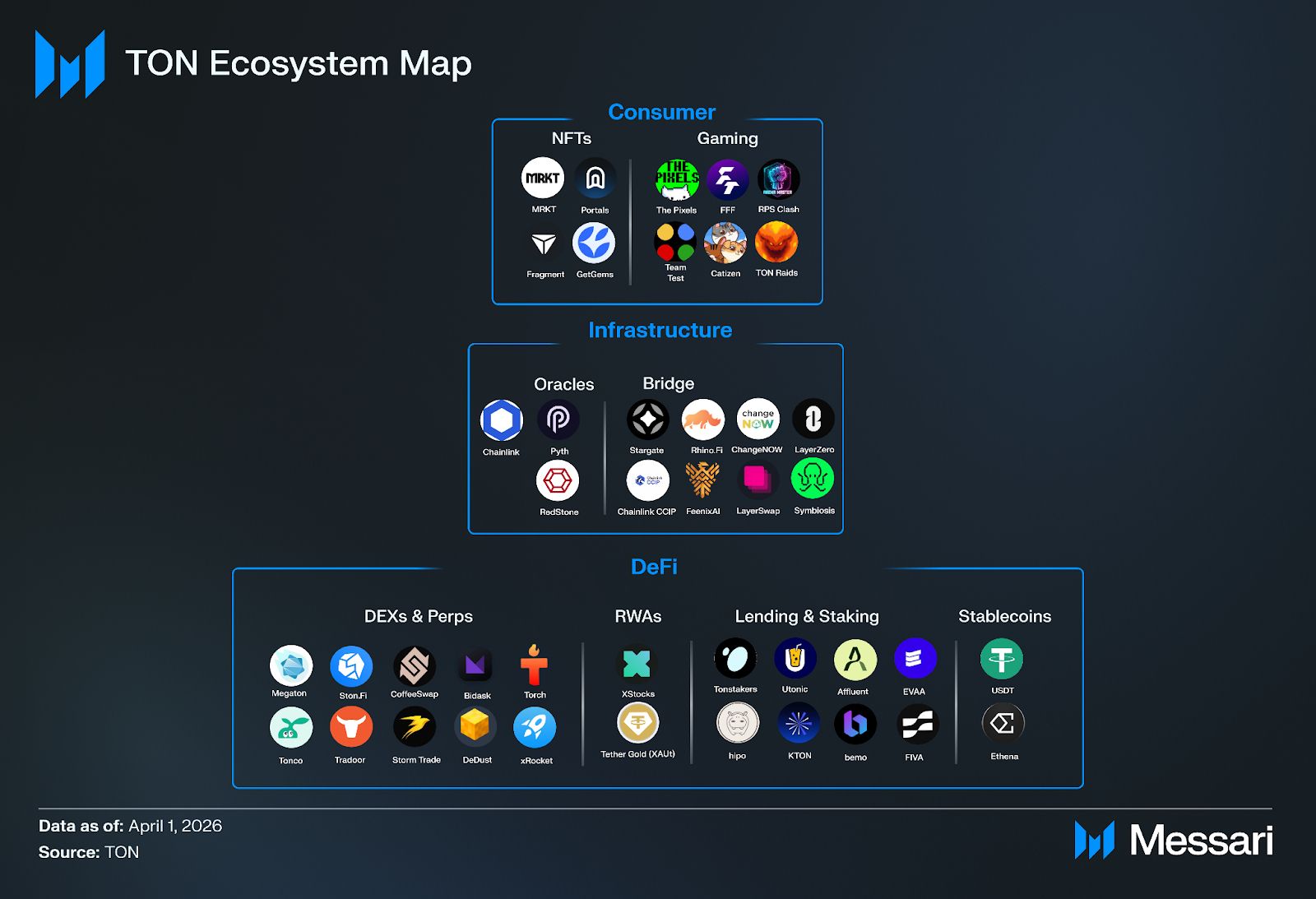
Key projects that highlight the variety of benefits the TON ecosystem and blockchain provide:
The Open Platform (TOP): The largest Web3 product development company within the Telegram ecosystem, building and investing in infrastructure and consumer applications on TON. TOP's portfolio includes Wallet in Telegram, Tonkeeper, STON.fi, and Getgems, and the company reached a $1 billion valuation in 2025 after raising over $70 million from Ribbit Capital, Pantera Capital, and others.
Wallet in Telegram: A crypto wallet natively integrated into Telegram, developed by TOP, supporting both custodial and self-custodial modes dependent on region. It serves as the primary onramp for Telegram's 1B+ user base, enabling in-chat transfers, Toncoin purchases, and direct access to Telegram Mini Apps without leaving the messenger.
Tether (USDT): The dominant stablecoin on TON by circulating supply and the default asset for payments and most DeFi activity across the ecosystem. TON currently holds roughly $1.28 billion in stablecoins, with USDT serving as the primary settlement unit for wallets, DEXs, and merchant payments.
Ethena: Introduced synthetic yield-bearing digital dollars (USDe and sUSDe) into TON's Telegram-native DeFi stack, expanding stablecoin use cases beyond payments into passive yield products. Eligible users holding tsUSDe in a TON wallet earn boosted yields, with plans for neobanking and peer-to-peer payments powered by Ethena within Telegram.
xStocks: Tokenized U.S. equities launched on TON, bringing real-world stock exposure (e.g., Apple, Tesla, Microsoft) directly into TON wallets with a self-custodial UX. The platform currently supports over 60 tokenized stocks and ETFs powered by Backed Finance under Kraken's institutional framework, with plans to expand to 500+ by end of 2026.
Fragment: Onchain marketplace integrated into Telegram where collectible usernames, SIM-less phone numbers, and digital gifts are minted and traded as NFTs powered by Toncoin. Fragment is the primary driver of TON's #2 ranking in NFT trading volume behind Ethereum, with transaction activity tied directly to Telegram's social graph.
Mar. 31, 2026: Dynamic launched embedded wallet infrastructure for TON, letting developers automatically deploy wallets inside their apps and Telegram Mini Apps.
Mar. 26, 2026:WalletConnect launched production support on TON, enabling standardized wallet connections across dApps and Telegram Mini Apps.
Feb. 17, 2026:TON Foundation partnered with OSL's Banxa to expand stablecoin payment infrastructure for Asia-Pacific merchants.
Jan. 7, 2026: TON announced Toncoin support in Atomic Wallet, expanding TON's reach into a multichain, non-custodial wallet user base.
Dec. 24, 2025:Fonbnk + Tether expanded USDt on Telegram Wallet, positioning mobile-money conversion as the core bridge for Africa-focused remittances and stablecoin banking flows.
Dec. 23, 2025:HoudiniSwap launched private TON payments, allowing users to request payments without exposing wallet addresses or transaction history, with inbound support across 120+ chains.
Dec. 22, 2025:Shift4 launched a global stablecoin settlement platform, unlocking faster payments for merchants.
Aug. 5, 2025:Zengo wallet added native Toncoin support, expanding TON's presence across non-custodial mobile wallets.
Upcoming:Chainlink CCIP cross-chain interoperability integration (announced 2025, launch pending). Revolut soft-launched TON support in select regions, with broader availability now live.
Toncoin is also listed on major U.S. exchanges, including Robinhood (Aug. 2025), Gemini (Sep. 2025), and Coinbase (Nov. 2025).
For a recap of category-specific ecosystem developments, please read the following DeFi, Institutional, and NFT reports.
Network Metrics
TON’s network activity in 2025 reflects a chain that has moved past the initial hype spike and is settling into a more durable, consumer-driven usage baseline. Daily active users peaked sharply in early 2025 (~600K), then normalized throughout the year, finishing Q4 2025 with ~1.0% QoQ growth and a relatively stable range of ~100K–150K.
In parallel, TON has sustained meaningful throughput, with daily transactions spiking above ~7 million during early 2025 surges, then stabilizing around ~1.5–2.5 million/day, with periodic bursts and an end-of-year lift similar to daily user data.
On Jan. 22, 2025, the TON Core team published its H1 2025 roadmap, centered on shipping the long-in-the-works “Accelerator” upgrade, an architecture-level refactor intended to better realize the sharded execution model described in the TON whitepaper and to keep performance stable as load scales. The roadmap prioritized (i) scaling and stability at the protocol layer, (ii) validator operability and resilience, and (iii) faster, more human-readable UX through better APIs and indexing.
Building on the Accelerator foundation, TON's 2026 roadmap shifts focus from the infrastructure-level refactoring of the Accelerator era toward developer accessibility and its top priority, sub-second finality. At the protocol layer, Catchain 2.0 targets sub-second block finalization, while the Rust Node brings institutional-grade operability and resilience to the validator set.
On the developer side, the roadmap prioritizes four workstreams: (i) smart contract tooling through Tolk 1.3 and toolchain, the successor language and SDK stack to FunC, offering TypeScript/Rust-inspired syntax and up to 40% lower gas costs; (ii) AppKit, a unified application layer via development kits for apps, wallets, and payments (TON Pay), compressing the path from idea to shipped Telegram Mini App; (iii) vibe-coding workflows that let developers describe an app to an AI agent and receive a working prototype, ready to share on Telegram; and (iv) AgentKit, an MCP-based toolkit giving autonomous AI agents structured access to wallets, transfers, and DeFi modules on TON.
Closing Summary
TON is positioning itself as one of the few L1s explicitly engineered for consumer-scale adoption, not just DeFi-native throughput benchmarks. Its core bet is that mainstream crypto use breaks on two constraints, distribution and latency/cost, and that solving both requires more than a fast chain. TON’s dynamically sharded, asynchronous architecture is designed to maintain stable performance under load, while its vertically integrated protocol services (DNS, Storage, Payments, Proxy, Sites) reduce reliance on third-party infrastructure. Most importantly, TON’s deep integration with Telegram collapses the traditional crypto UX stack (wallet → browser → dApp) into a single messaging-native environment where onchain actions can feel like normal in-app behavior.
In 2025, TON shifted to a technically differentiated L1 focused on consumer distribution, with Telegram serving as its primary onboarding and application surface. The ecosystem has increasingly matured into a Telegram-native financial stack while network activity reflects a chain transitioning from hype-driven spikes to a steadier transactional baseline.
Looking forward, TON's 2026 roadmap shifts from infrastructure refactoring to performance and developer accessibility. Catchain 2.0 targets sub-second finality, the Rust Node reimplements the validator stack, and a unified developer layer (Tolk, AppKit, TON Pay) compresses the path from idea to shipped Telegram Mini App. In parallel, Telegram is becoming a native interface for AI agents, with Cocoon providing decentralized compute and AgentKit connecting autonomous agents to onchain actions. If the vibe-coding loop works at scale, where builders generate working prototypes from a natural-language prompt, share them inside Telegram for instant feedback, and iterate daily rather than quarterly, TON becomes not just a settlement layer for digital finance inside Telegram, but the fastest path from idea to testable product in crypto.
This report was commissioned by the TON Foundation. All content was produced independently by the author(s) and does not necessarily reflect the opinions of Messari, Inc. or the organization that requested the report. The commissioning organization may have input on the content of the report, but Messari maintains editorial control over the final report to retain data accuracy and objectivity. Author(s) may hold cryptocurrencies named in this report. This report is meant for informational purposes only. It is not meant to serve as investment advice. You should conduct your own research and consult an independent financial, tax, or legal advisor before making any investment decisions. Past performance of any asset is not indicative of future results. Please see our Terms of Service for more information.
No part of this report may be (a) copied, photocopied, duplicated in any form by any means or (b) redistributed without the prior written consent of Messari®.