Tezos X became publicly testable for the first time in Q1 2026. Tezlink Shadownet launched on Jan. 26, 2026, as the first public testnet for the Michelson runtime component of Tezos X, joining Tallinn's mainnet activation and Ushuaia's stabilization phase to establish a predictable cadence toward full Tezos X mainnet activation.
Ushuaia's headline feature is a 15x expansion of Data Availability Layer (DAL) bandwidth. Tezos' 21st protocol upgrade proposal entered stabilization on Mar. 19 with DAL bandwidth rising from 0.66 to 10 MB/s, dynamic DAL attestation lag reduction, WASM PVM v6 for Etherlink storage, and feature-flagged enshrined liquid staking (sTEZ) and post-quantum tz5 signatures.
Uranium.io's Q1’26 resilience validates the RWA-on-Etherlink thesis, and metals.io extends the blueprint. Uranium.io grew 1.2% QoQ to $7.3 million and expanded its share of Etherlink DeFi TVL from 10.6% to 14.7% in a quarter that saw total Etherlink DeFi TVL fall 27.2%, while Trilitech's launch of metals.io extended the same custody-and-compliance stack to physical gold (VNXAU) and a basket of strategic and rare-earth metals.
Bitnomial's launch of CFTC-regulated XTZ futures brought Tezos into U.S. institutional derivatives for the first time. Combined with Ledger's native Etherlink integration and Meria's baker addition, Q1 2026 extended Tezos' regulated-exposure surface across U.S. derivatives, hardware-wallet custody, and AMF-supervised European staking infrastructure within a single quarter.
Tezos has had production-grade shielded transactions live since 2021, ahead of peer networks now shipping privacy primitives in 2026. As Stellar's X-Ray activated in January 2026 and Midnight launched its mainnet, Tezos' Sapling-based stack, including Umami and Shield Bridge, has nearly five years of operational history behind it.
Primer
Tezos (XTZ) is a Proof-of-Stake (PoS) blockchain recognized for its strong emphasis on security, upgradeability, and community-driven governance. Smart contracts on its Layer-1 (L1) network are implemented using the Michelson language, designed to facilitate formal verification while also offering Ethereum virtual machine (EVM) compatibility through Etherlink, a community-governed, non-custodial Layer-2 (L2). The network features onchain governance and self-amending functionality, enabling stakeholders to adopt protocol upgrades without requiring a network hard fork.
Tezos’ recent upgrades have focused on scalability and performance through Smart Rollups and a Data Availability Layer (DAL). The Mumbai upgrade in March 2023 introduced Smart Rollups, an L2 scaling solution designed for high throughput and customization to adapt to specific use cases, such as implementing new coding environments. The Paris upgrade in June 2024 reduced L1 block times from 15 to 10 seconds, bringing 20-second finality. It also introduced the DAL, a data-availability solution that boosts Smart Rollup scalability. Finally, the Paris upgrade implemented a new staking mechanism and Adaptive Issuance, which adjusts token issuance based on the staked ratio of XTZ.
Current R&D work from teams across the ecosystem focuses on realizing “Tezos X,” a proposed roadmap that enhances the blockchain’s performance, composability, and interoperability, delivering a “cloud-like” developer experience. Leveraging Smart Rollup technology and the built-in Data Availability Layer, developers can build complex, scalable applications on a unified application layer with multiple runtimes, using mainstream programming languages, and with improved connectivity across Tezos and other blockchain ecosystems.
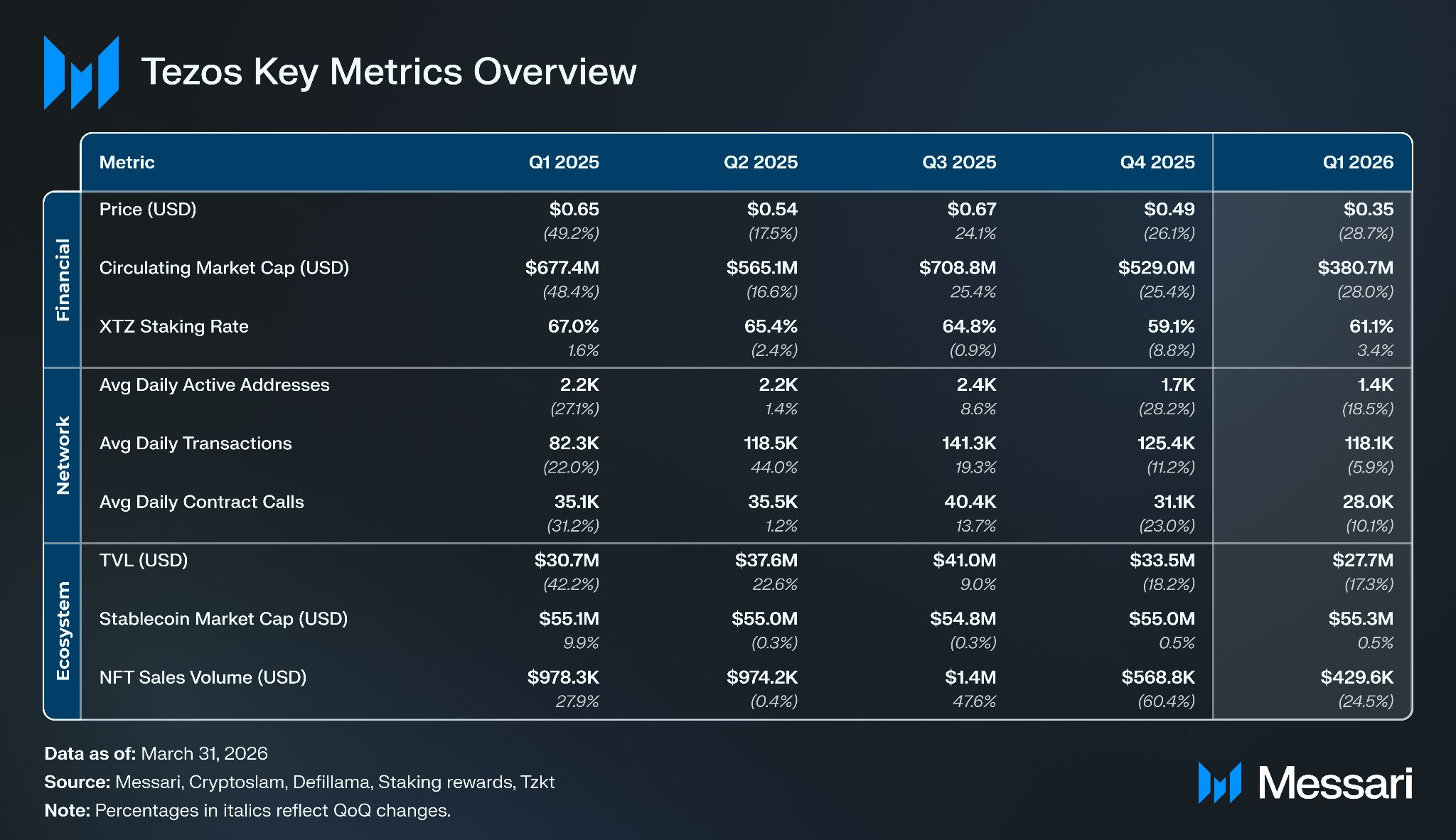
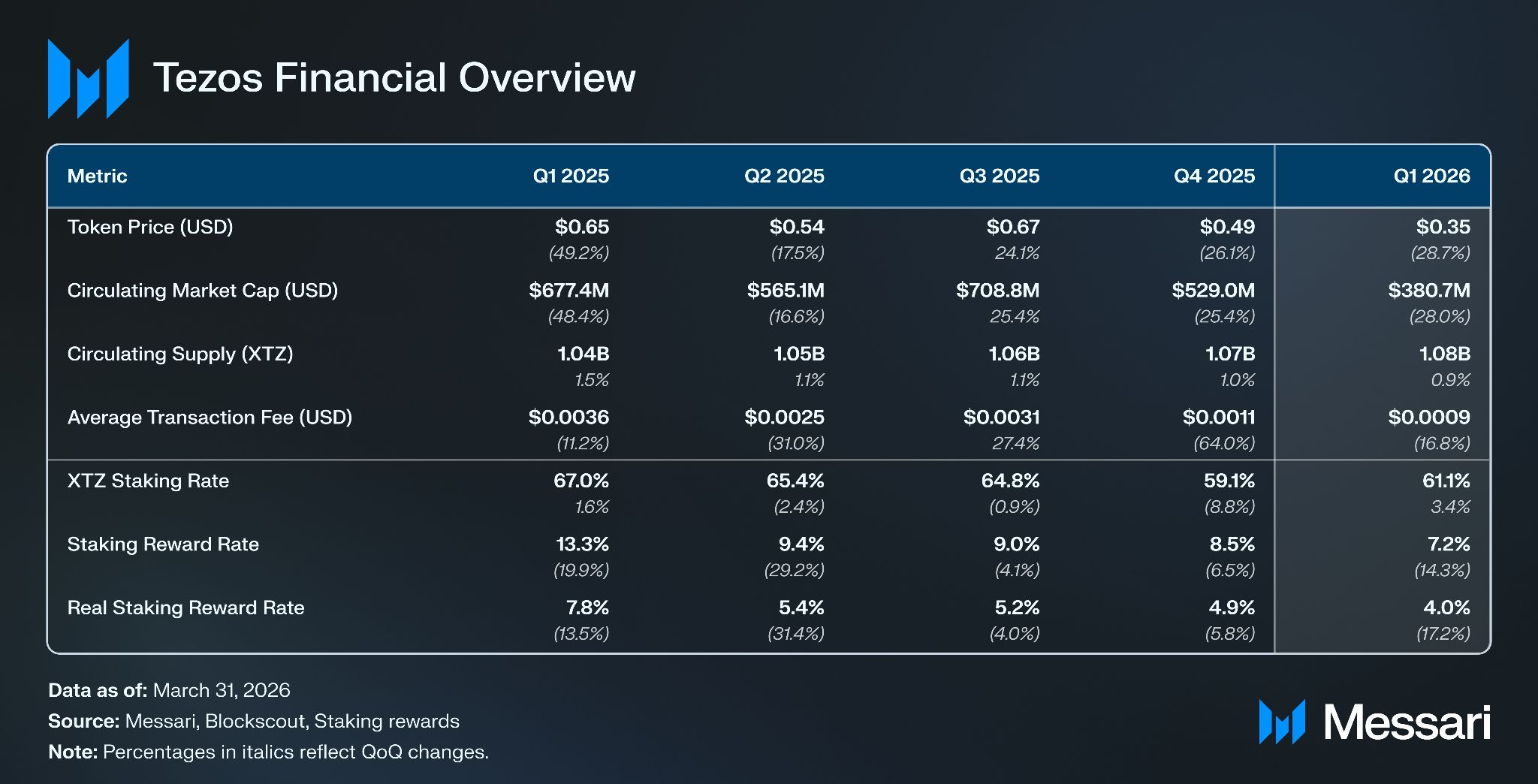
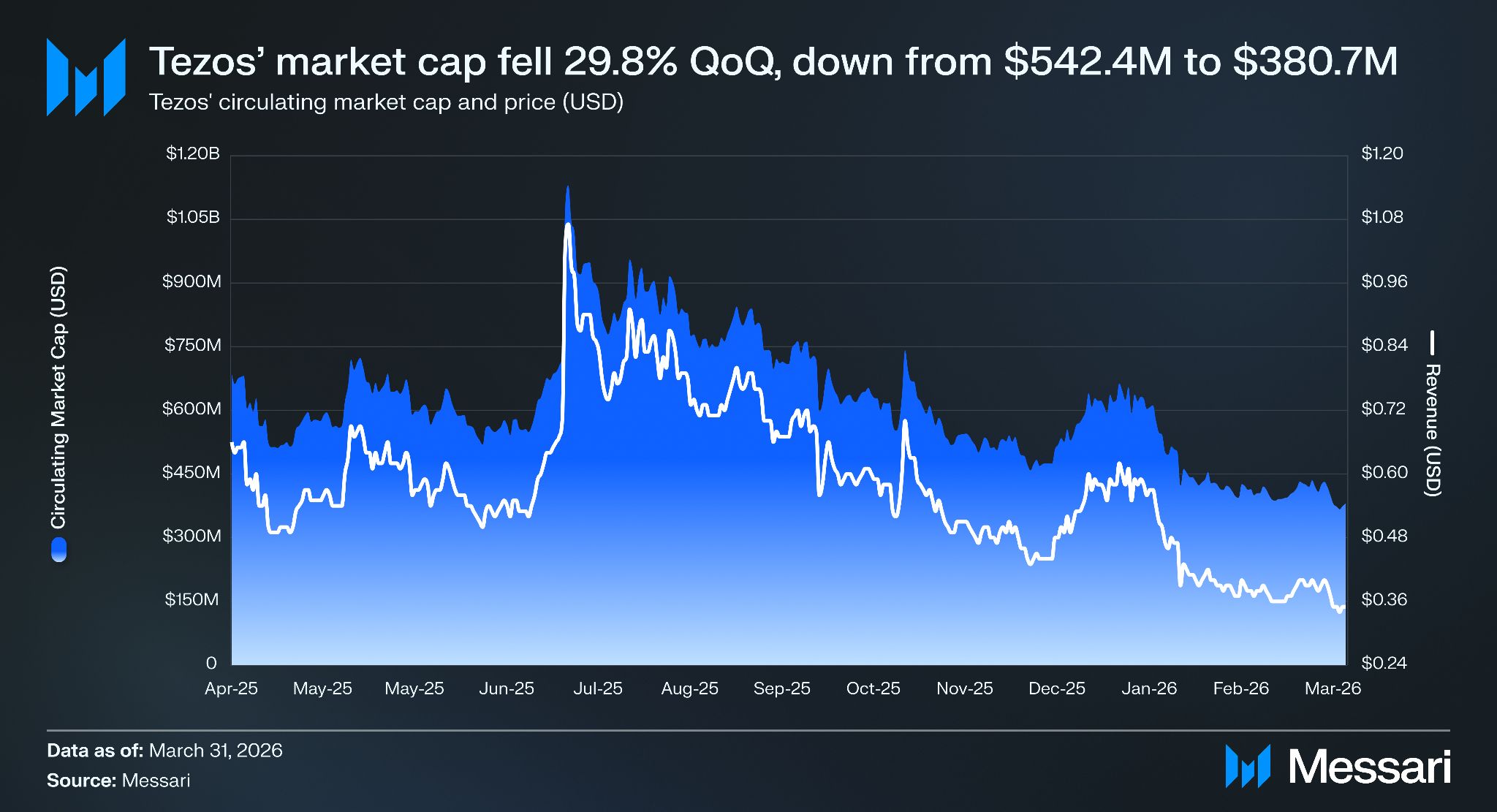
Tez (XTZ) is the native token of the Tezos blockchain. It is used (i) for staking, delegation, and governance and (ii) as the primary medium for paying transaction fees on both the Tezos Layer-1 (L1) and the EVM-compatible Layer-2 (L2) network, Etherlink. In Q1 2026, XTZ's price fell 28.7% QoQ to $0.35, while circulating market cap contracted similarly, declining 28.0% QoQ to $380.7 million. The drawdown was concentrated in February and March 2026, with the average monthly price moving from $0.56 in January to $0.41 in February and $0.37 in March, aligning with a broader decline across the top 10 L1s by market cap, which posted a median QoQ return of -27.5%. The slight discrepancy is due to XTZ’s circulating supply increasing 1.0% QoQ to 1.08 billion XTZ, in line with the protocol's inflation schedule. XTZ's circulating market cap ranking fell from 80th in Q4 2025 to 91st in Q1 2026.
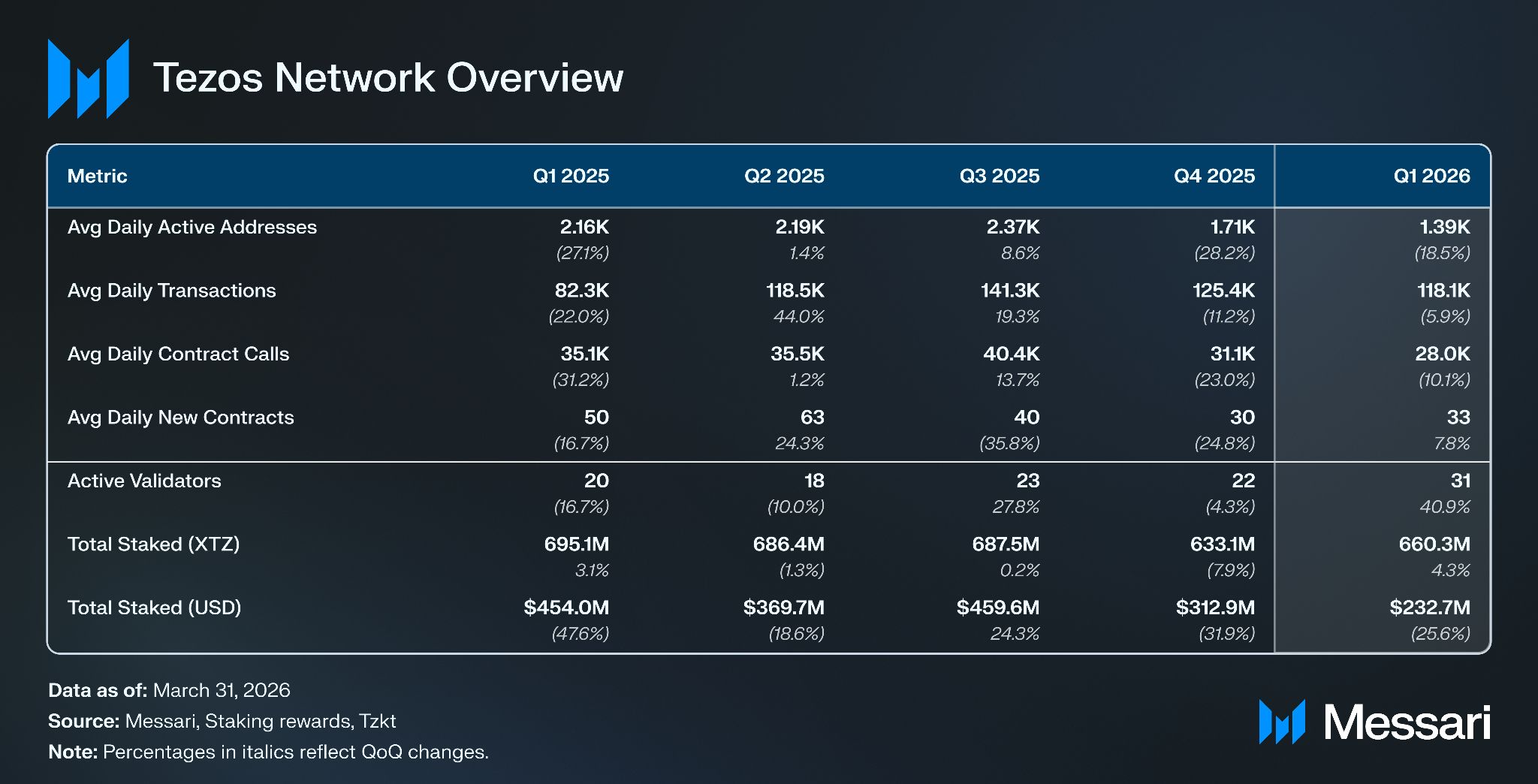
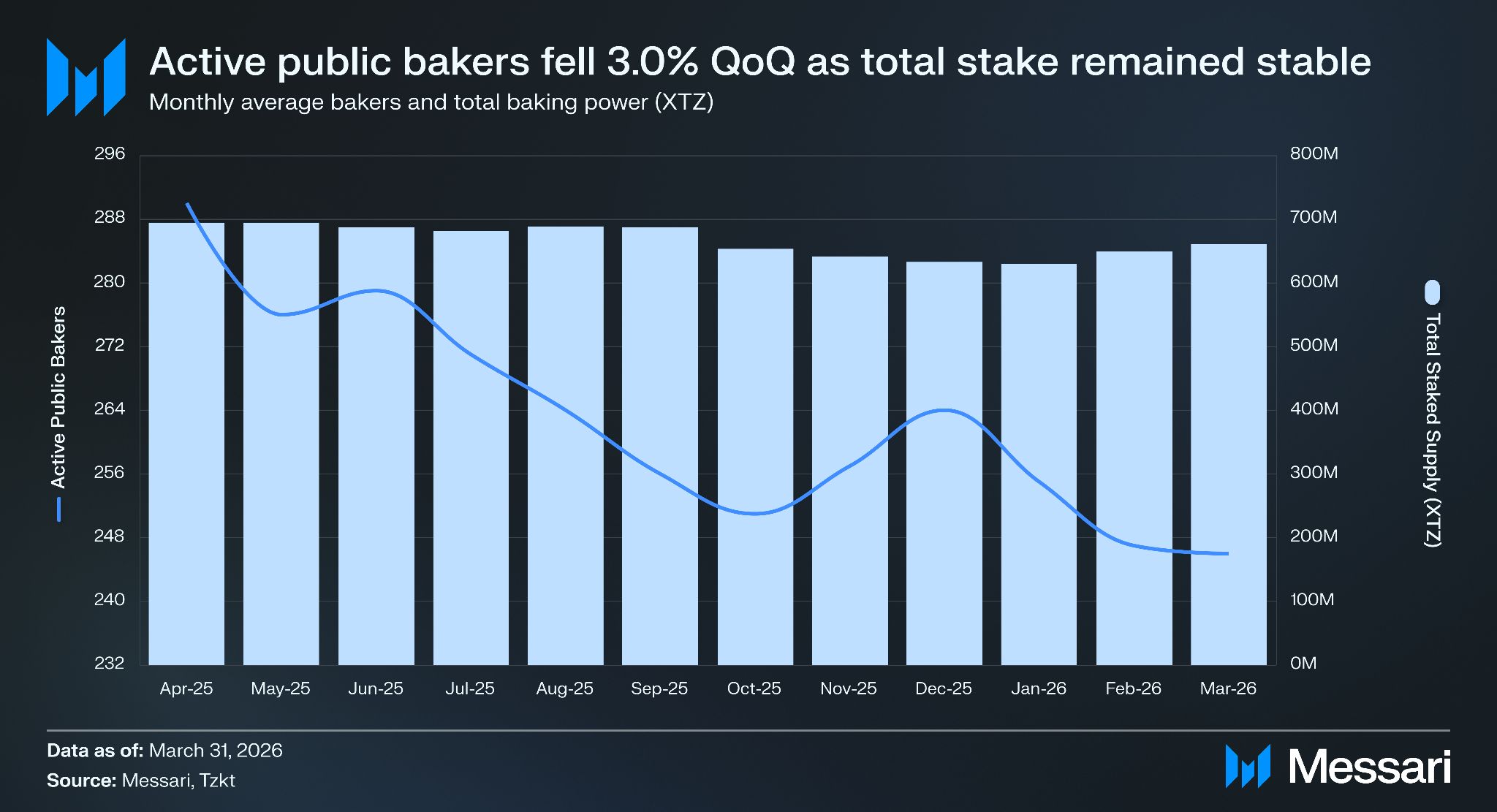
The Paris upgrade, launched in April 2024, introduced the Adaptive Issuance mechanism, designed to incentivize a secure network while minimizing inflation. The target for staking is 50% of the total XTZ supply, and the mechanism dynamically adjusts staking rewards to achieve this with the least possible XTZ issuance. The aim is to minimize XTZ dilution, improve liquidity, reduce inefficiencies, and optimize XTZ for real-world use cases. The total XTZ staked on the network increased by 4.3% from 633.1 million in Q4’25 to 660.3 million at the end of Q1’26. With the staking rate running above target at 61.1%, Adaptive Issuance reduced new issuance to bring staked supply back toward the protocol's 50% target. The nominal staking reward rate compressed 14.3% QoQ to 7.2% while the real staking yield fell 17.2% QoQ to 4.0%. Real yield fell faster than nominal because issuance fell less than the reward rate did.
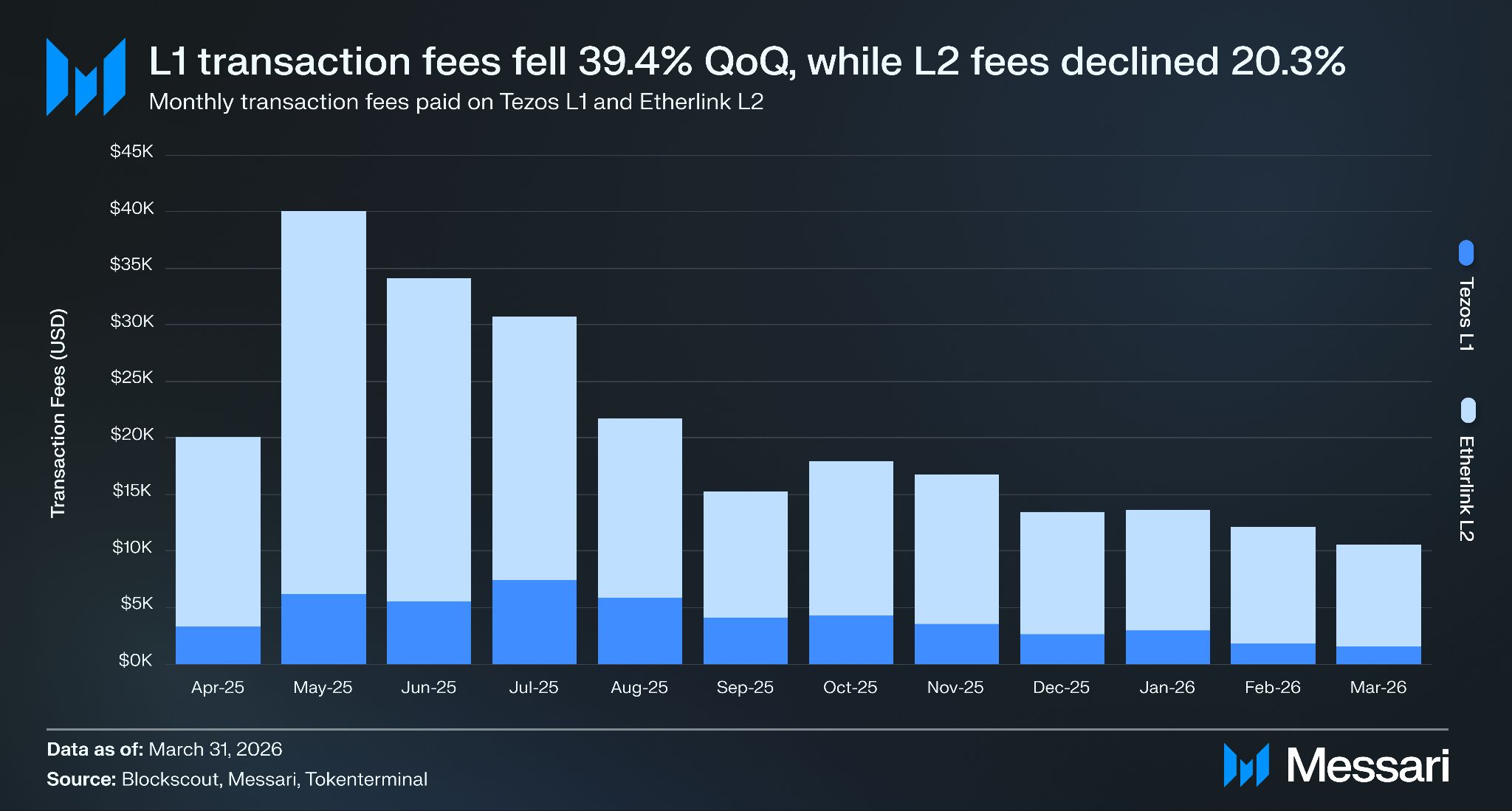
In Q1 2026, total fees paid on Tezos L1 fell 39.4% QoQ to 6,360 XTZ, while Etherlink L2 fees declined at roughly half that, falling 20.4% QoQ to 30,000 XTZ. The average L1 transaction fee dropped 16.8% QoQ to $0.00094, reflecting softer XTZ pricing. Despite the Tallinn and Ushuaia governance events during the quarter, fee revenue continued to migrate to Etherlink, where the throughput increase from the Farfadet upgrade in Q4’25 sustained higher activity per fee unit than the L1.
Network Overview
Usage
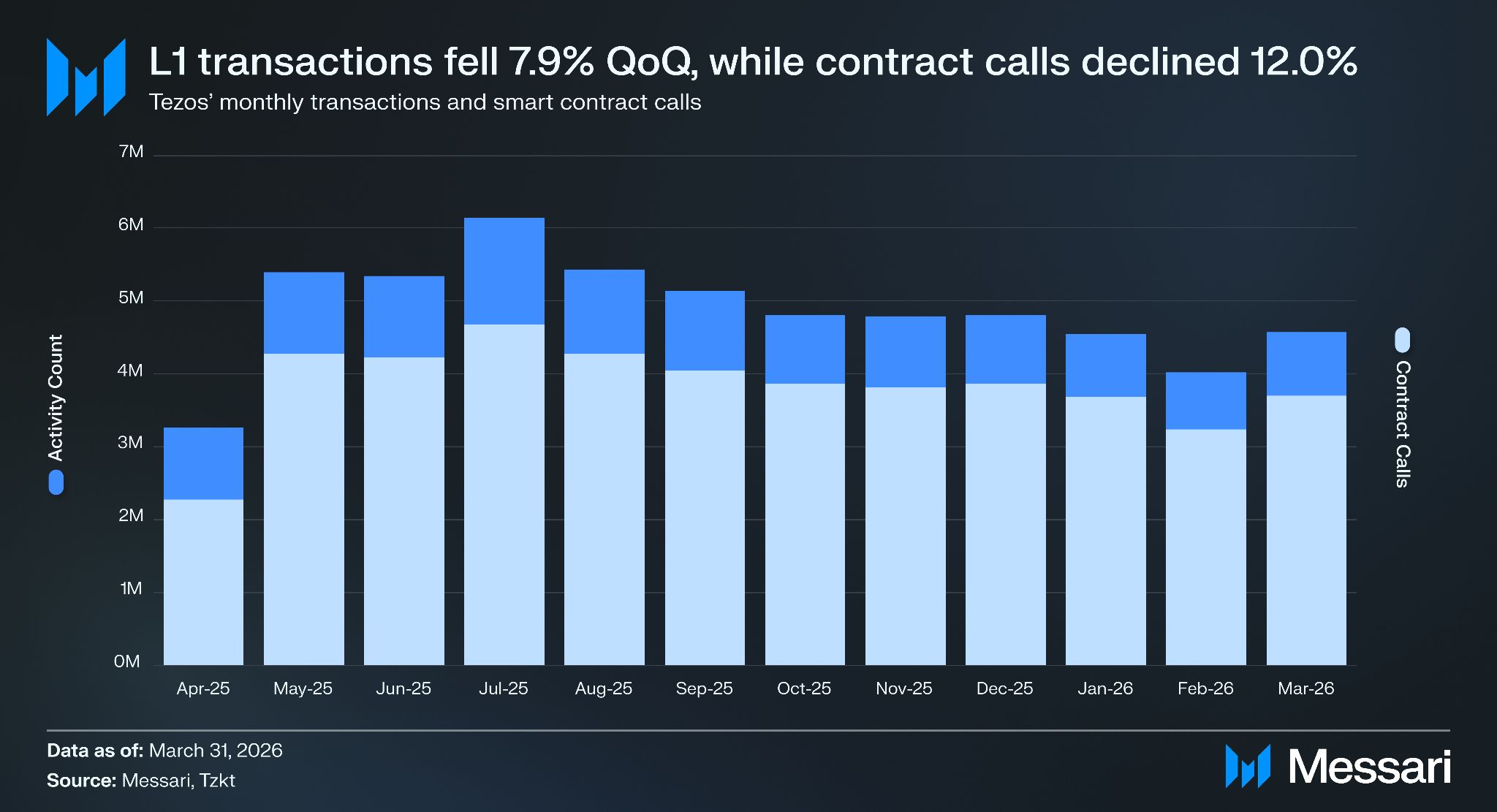
Transactions on Tezos L1 fell 7.9% QoQ in Q1 2026 to 3.5 million, down from 3.8 million in Q4 2025, while contract calls declined 12.0% QoQ to 838,700 from 953,280. The moderating pace of decline after Q4's sharper 11.2% drop suggests L1 activity is stabilizing at a lower floor as higher throughput activity continues to migrate to Etherlink. Tallinn's reduction of L1 block time from 8 to 6 seconds also compressed per-block transaction counts while raising daily throughput capacity.
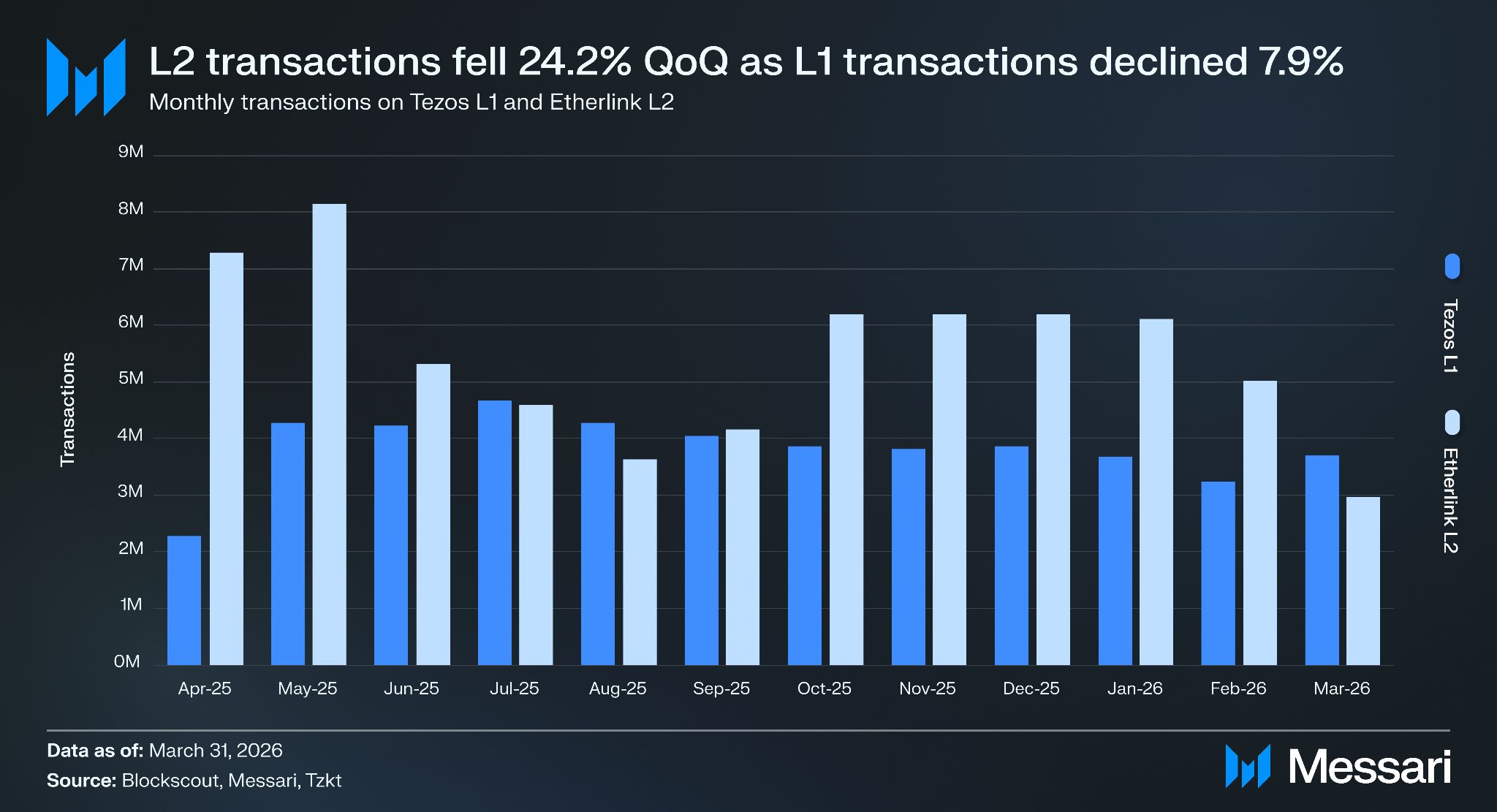
Etherlink processed 14.1 million transactions in Q1 2026, a 24.2% QoQ decline from 18.6 million in Q4’25. The pullback came despite Etherlink carrying forward the full throughput expansion delivered by the Ebisu and Farfadet kernel upgrades in Q4. The March decline was particularly steep, with only 2.97 million transactions versus 6.11 million in January, coinciding with XTZ's steepest price compression of the quarter and the broader drawdown among L1’s.
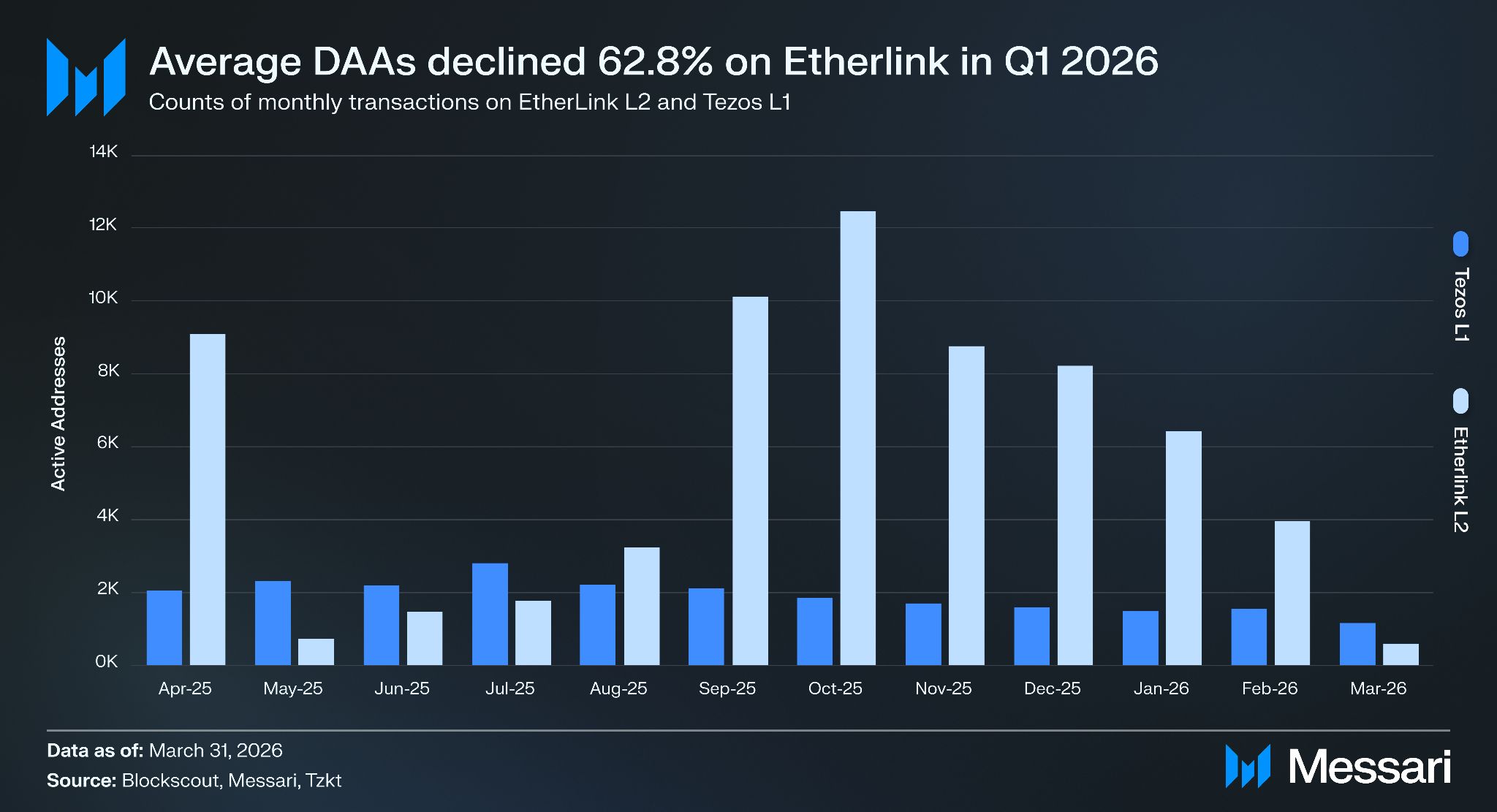
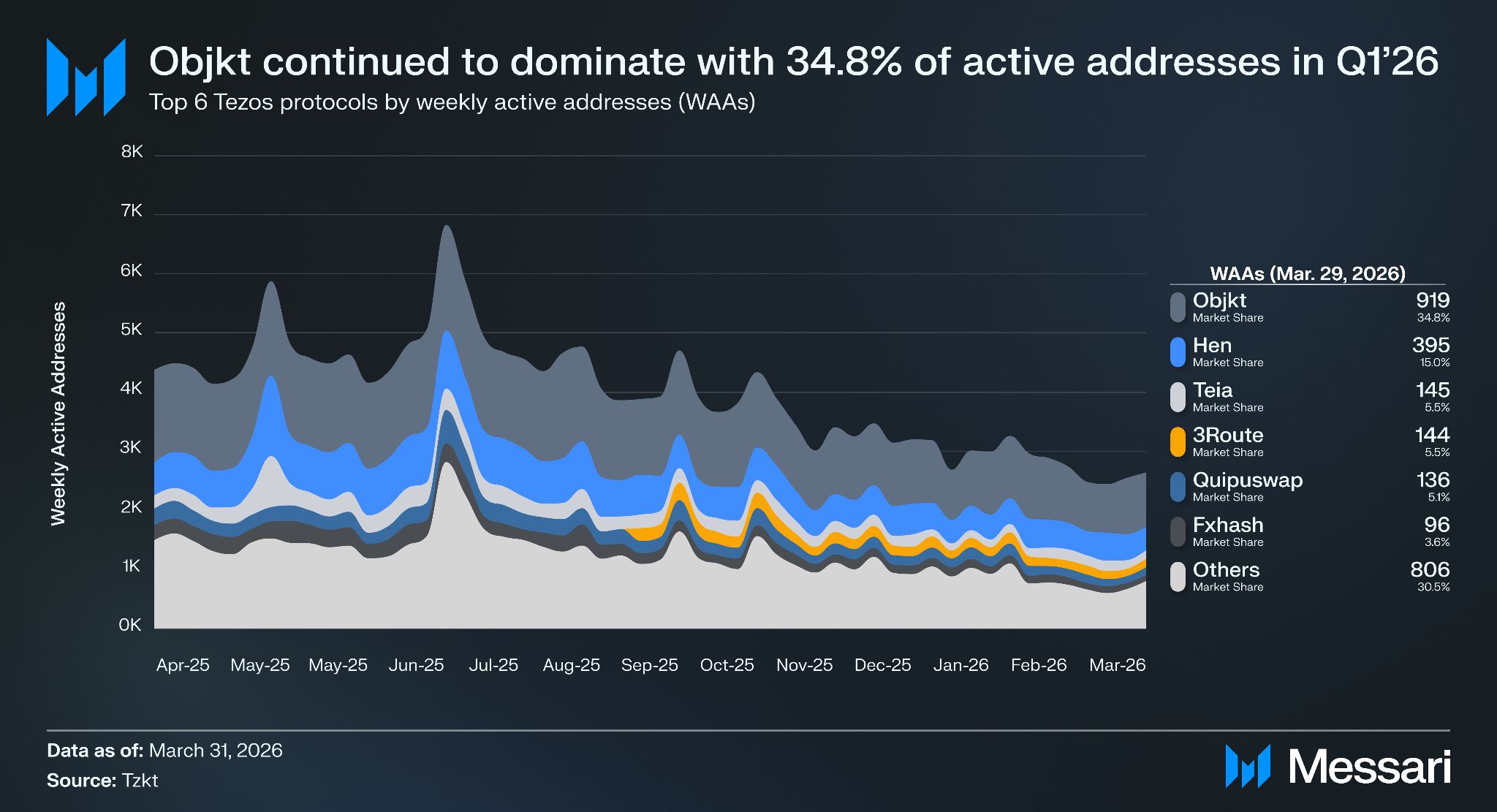
In Q1 2026, daily active addresses (DAAs) on Tezos L1 averaged 1,390, an 18.5% QoQ decline from 1,710. On Etherlink, DAAs averaged 3,660 per day, a 62.8% decline from 9,820 in Q4 2025. Etherlink saw the steepest decline in March 2026, where DAAs fell to 600 from 3960 in February. Address composition on Tezos L1 skewed NFT-heavy, with Objkt, Teia, and Fxhash combined accounting for 59.7% of L1 WAAs in Q1, while DEX/DeFi venues (3Route and QuipuSwap) accounted for 10.8%. The remaining 29.6% of addresses were involved in a mix of stablecoin transfers, governance and validator operations, contract deployments, and XTZ transfers.
Governance and Network Upgrades
Tezos utilizes an LPoS mechanism, enabling staked XTZ to be used for both network security and governance. The network's self-amending blockchain reduces the need for hard forks by employing onchain governance for protocol upgrades. Users delegate their XTZ to bakers, and governance voting power is weighted by delegated balances, independently of staking participation. The governance process is divided into five periods, spanning approximately two months and ten days.
To complement protocol governance, Tezos Commons established the Tezos Ecosystem DAO, which manages and allocates XTZ for community projects. The DAO’s initial funding came from NFT sales on Objkt and donations from ecosystem participants.
Etherlink follows an onchain governance model similar to Tezos L1, ensuring fairness and transparency. Governance for Etherlink features the same self-amending properties (meaning no hard fork needed) and is controlled by L1 bakers. Unlike L1, Etherlink governance pilots both upgrades. Additionally, it has an alternative “fast governance” process mostly for swift incident responses, with shorter duration but higher participation requirements. The governance process occurs solely on Tezos L1 through dedicated smart contracts and consists of a proposal period and a promotion period.
Tallinn Protocol Upgrade
Tallinn, Tezos’ 20th protocol upgrade, was proposed in November 2025 and was activated on mainnet on January 24, 2026. Tallinn introduces three changes to Tezos L1:
Reduced Block Times: Cut L1 block times from 8 seconds to 6 seconds, increasing throughput and reducing confirmation latency for both L1 transactions and Smart Rollup commitment posting.
Address Indexing Registry: Assigns compact numerical indices to addresses, reducing storage costs for contracts that reference many accounts. This is particularly useful for NFT ledgers and token registries.
All-Baker Attestations: Enables every active baker to attest each block, replacing the committee-based sampling model. This tightens finality guarantees and aligns with the shorter block-time cadence. This feature will be triggered once 50% of bakers, regardless of stake, have switched to BLS signatures. Once triggered, this feature will never deactivate, even if the proportion of bakers using BLS decreases below 50%.
Together, these changes target L1 throughput and cost efficiency, two areas most relevant to Etherlink’s rollup posting and to NFT-heavy use cases that remain on the L1.
Ushuaia Protocol Upgrade Proposal
Ushuaia, Tezos' 21st protocol upgrade proposal, entered its stabilization phase on Mar. 19, 2026. Where Tallinn delivered L1 throughput and indexing improvements, Ushuaia targets the Data Availability Layer (DAL) and the L1 staking architecture, tightening the security and bandwidth link between L1 and Etherlink as the network prepares for higher sustained rollup throughput.
Ushuaia introduces five changes relevant to the Tezos X roadmap:
Data Availability Layer (DAL) bandwidth expansion: Ushuaia raises DAL throughput roughly 15x, from approximately 0.66 MB/s to 10 MB/s. This is the headline Tezos X feature, as DAL is the foundation that carries Etherlink's rollup data, and a 15x bandwidth expansion materially raises the ceiling on L2 throughput and on the number of enshrined L2s the network can host concurrently.
Dynamic DAL attestation lag: Reduces DAL confirmation latency from 66 seconds to roughly 12 to 18 seconds, shortening the window between rollup data publication and L1 finality.
WASM PVM Version 6: Introduces a dual-backend architecture for Etherlink storage migration and forward support for RISC-V execution, giving Etherlink a clean upgrade path as rollup execution requirements evolve.
Enshrined liquid staking (sTEZ), feature-flagged: Introduces a protocol-native liquid staking token for testnet validation. If enabled on mainnet, sTEZ would give delegators access to a liquid position without surrendering staking rewards or bespoke wrapper trust assumptions.
Post-quantum signatures (tz5), feature-flagged: Adds support for NIST-standardized ML-DSA-44 signatures via a new tz5 account type. This is a forward-compatible cryptographic layer for quantum-capable adversaries, available for experimentation before mainnet activation.
Ushuaia is a candidate for mainnet activation in Q2 2026, pending completion of the adoption phase. Its pairing with Tallinn, which shipped two months earlier, gives Tezos two consecutive L1 upgrades in six months that are directly mapped to the Tezos X architectural plan:
Tallinn handles L1 block time and address indexing.
Ushuaia handles DAL bandwidth, staking structure, and long-horizon cryptographic modernization.
Looking ahead, the cadence of Q1 milestones establishes a precedent for the rest of 2026. Ushuaia is the next candidate for activation once stabilization is complete, and the remaining open question for the year is the timing of the full Tezos X public testnet, in which Tezlink and Etherlink will run side-by-side with atomic composability. Tezos X became publicly testable for the first time in Q1’26, and the L1 upgrade pipeline is shipping the remaining infrastructure layers that the full Tezos X mainnet activation will ultimately rest on.
Tezlink Shadownet: The First Tezos X Testnet
On Jan. 26, 2026, Tezlink Shadownet launched as the first public testnet for Tezlink, the Michelson runtime component of the Tezos X architecture. Tezlink is designed to run Tezos L1's existing Michelson smart contracts within a high-scalability rollup context, delivering sub-second latency and lower fees while preserving the L1 development model, toolchain, and security properties that existing Tezos applications already depend on.
Shadownet is the first publicly testable instance of an enshrined non-EVM runtime on the Tezos stack. With Shadownet live, developers can test Michelson contracts running alongside Etherlink's EVM environment, a precursor to the longer-term Tezos X milestone where Tezlink and Etherlink operate side-by-side with atomic composability under a single enshrined L1. The open question for the rest of 2026 is the timing of the full Tezos X public testnet, where the two runtimes compose atomically rather than running as independent testnets.
Etherlink Performance Milestones
On Jan. 21, 2026, Etherlink publicly enabled Instant Confirmations, reducing user-visible transaction latency to under 50 milliseconds. The system issues a transaction receipt as soon as the sequencer commits a transaction to the next block, rather than waiting for the block to be fully produced. The architectural groundwork was laid by the Q4’25 Farfadet kernel upgrade.ns.
Governance Cycle Simplification Proposal
On Mar. 3, 2026, Nomadic Labs published a proposal on Tezos Agora to reduce the governance cycle from 70 days to 28 days. The proposal also restructures the cycle from five periods to three (Selection, Promotion, and a 14-day Adoption period). The existing five-period cycle, while deliberate, has been cited by core developers and bakers as a source of voting fatigue and an operational drag on the pace at which protocol upgrades reach mainnet. A 60% compression in cycle length, alongside the structural simplification, would accelerate the rate at which Ushuaia-style upgrades can ship, which matters for the Tezos X rollout given that the plan requires multiple sequenced L1 upgrades through 2026 and 2027. The proposal is under community discussion and would itself need to pass via the existing governance process before activation.
App Development
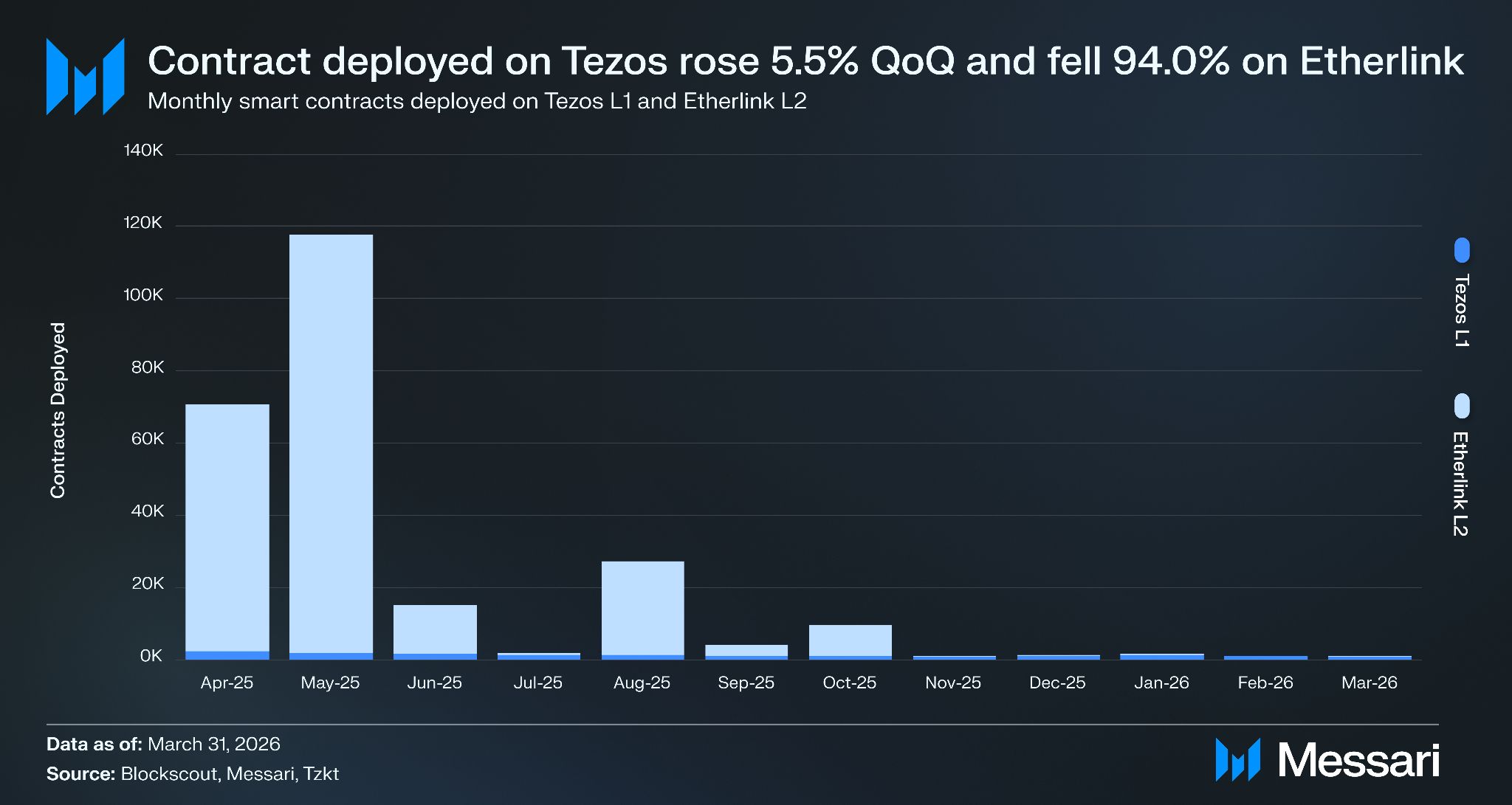
Smart contract deployments on Tezos L1 rose 5.5% QoQ in Q1 2026 to 2,930, the first increase since Q2 2025. Etherlink deployments fell 94.0% QoQ to 540, an outsized drawdown from 8,956 in Q4 2025 that reflected the normalization after the H2’25 spike tied to the Apple Farm Season 2 contract-farming burst. Combined, 3,470 contracts were deployed across both networks in Q1 2026, down from 11,732 in Q4 2025 and back in line with the quarterly pace observed before Apple Farm.
Tezos supported 230+ monthly active developers across more than 4,300 Git repositories at Q1-end, extending the QoQ developer-count growth observed through 2025. The continued developer base expansion through a quarter of compressed activity indicates builder interest is tracking the Tezos X technical roadmap rather than short-term network throughput.
Economic Security
In Q1 2026, total XTZ stake rose 4.3% QoQ to 660.3 million tokens, partially recovering from an 8.1% decline in Q4’25. In dollar terms, total staked value fell 25.6% QoQ to $232.7 million, as the XTZ price decline outweighed the increased staking. Average monthly active bakers declined 5.6% QoQ to 250, from 264 at the end of Q4.
The Tezos network has demonstrated consistent year-over-year stability in the number of validators and delegators, as well as in the amount of staked XTZ. This stability is crucial for secure and scalable L2 growth. Validators in the ecosystem are also decentralized geographically and by host service providers, further ensuring the network's resilience and security.
Ecosystem Overview
Q1 2026 ecosystem-level signals were consistent with the Tezos X architectural arc, where the plan is to scale vertically rather than horizontally by deepening a single enshrined stack rather than fragmenting activity across independently governed L2s. Uranium.io held flat through a 27.2% DeFi drawdown on Etherlink, metals.io launched in March 2026, and Bitnomial introduced the first CFTC-regulated U.S. XTZ futures in February, extending regulated Tezos exposure into U.S. institutional derivatives markets. On Tezos, address activity is increasingly anchored in NFT and art-collector cohorts, consistent with the L1 specializing as a governance-and-cultural layer while throughput migrates to Etherlink.
DeFi
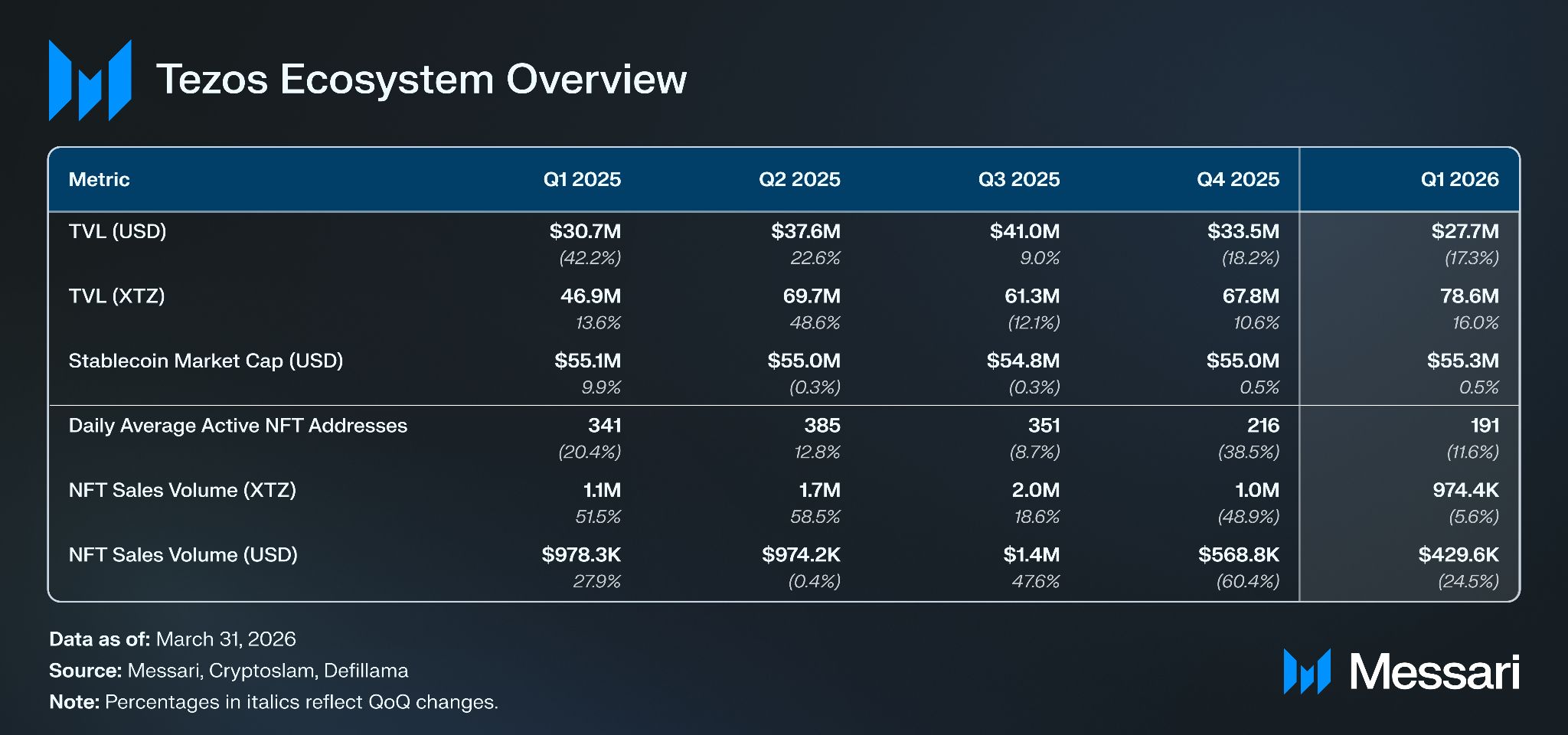
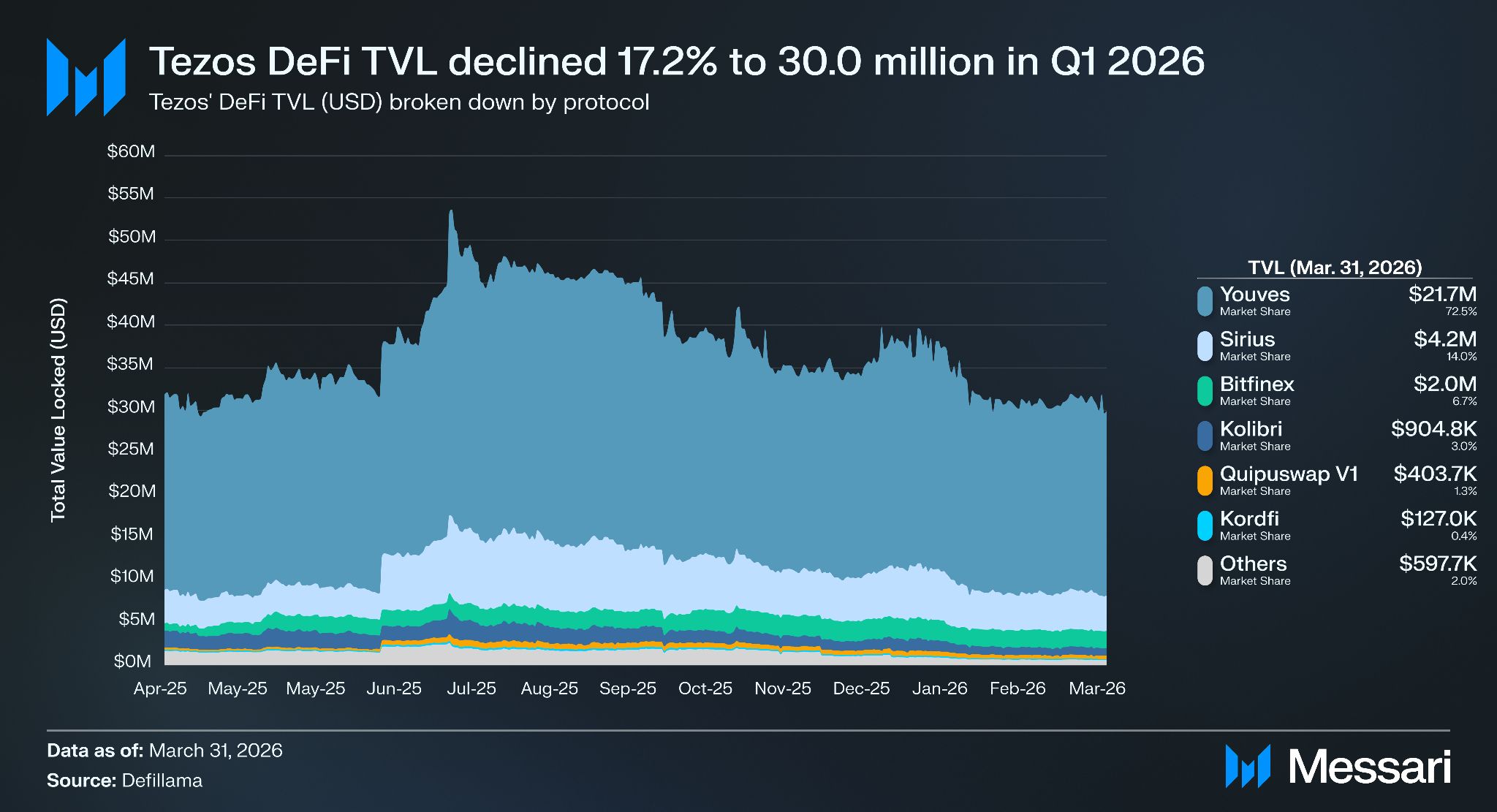
Tezos L1 DeFi TVL fell 17.2% QoQ to $30.0 million, extending the drawdown that began in mid-2025 as Etherlink absorbed the majority of DeFi liquidity. The decline was concentrated in Youves, which retains a dominant share of L1 TVL, with smaller venues including Kolibri, Sirius, and QuipuSwap all seeing double-digit declines. A robust L1 DeFi ecosystem remains relevant to the broader Tezos architecture because L1 TVL anchors synthetic asset issuance, provides the XTZ-denominated collateral base that Etherlink's L2 DeFi ultimately references, and supports the Liquid Proof of Stake (LPoS) stake-weighting that secures both layers.
Youves: A suite of tools for onchain treasuries and synthetic assets on Tezos L1.
Youves contributed the largest dollar decline to L1 DeFi TVL in Q1 2026. Its TVL fell 13.7% QoQ from $25.2 million to $21.7 million, though Youves' share of Tezos L1 DeFi TVL expanded to 72.5% from 69.6% as smaller protocols contracted faster. Youves remains the largest DeFi venue on Tezos L1. Share concentration in Youves now sits at its highest level of the past year, even as absolute TVL has compressed, reflecting the structural anchoring of L1 DeFi activity around its uUSD synthetic stablecoin and treasury-management surface.
Sirius: A liquidity venue that facilitates swaps across XTZ and wrapped BTC (tzBTC).
Sirius ended Q1 2026 with $4.2 million in TVL, a 23.6% QoQ decline from $5.5 million. Its share of L1 DeFi TVL contracted to 14.0% from 15.2%. In Q1, a community discussion was initiated on Tezos Agora, urging bakers to disable the liquidity baking mechanism, the protocol-level subsidy that funds the Sirius pool. If the proposal advances and passes governance, Sirius' TVL basis would compress materially absent a replacement liquidity source.
Bitfinex: Provides custodial staking and liquidity channels that connect institutional users to Tezos.
Bitfinex closed Q1 2026 with $2.0 million in TVL, a 15.5% QoQ decline from $2.4 million. Its share of L1 DeFi TVL held broadly flat at 6.7% (from 6.6%), as the protocol's TVL contracted in line with the broader L1 DeFi drawdown, reversing the QoQ gain it posted in Q4 2025.
Kolibri: An overcollateralized stablecoin backed by onchain collateral on Tezos.
Kolibri ended Q1 2026 with $0.9 million in TVL, a 29.5% QoQ decline from $1.3 million. Its share of L1 DeFi TVL fell to 3.0% from 3.6%.
QuipuSwap V1/V2: A concentrated-liquidity AMM that supports fee tiers and tighter pricing around the middle bands. While assets are primarily concentrated on V2, QuipuSwap V1 provides a legacy constant-product AMM that continues to serve long-tail assets.
Together, QuipuSwap V1 and V2 ended Q1 2026 with $555,000 in TVL, a 47.7% QoQ decline from $1.06 million in Q4 2025. The selloff was driven primarily by V2's liquidity compression as stablecoin and XTZ pairs thinned alongside the broader L1 DEX-volume decline.
Kordfi: A leveraged yield-farming protocol built on top of liquidity baking, allowing farmers to access up to 4x leverage on the XTZ/tzBTC pair while lenders provide either side of the pair to earn interest.
Kordfi ended Q1 2026 with $127,020 in TVL, a 23.2% QoQ decline from $165,320. Its share of L1 DeFi TVL slipped to 0.4% from 0.5%. Because Kordfi is a leverage layer on top of liquidity baking, the same Q1 Agora community discussion threatening Sirius' liquidity baking subsidy is also a structural risk to Kordfi's underlying yield basis.
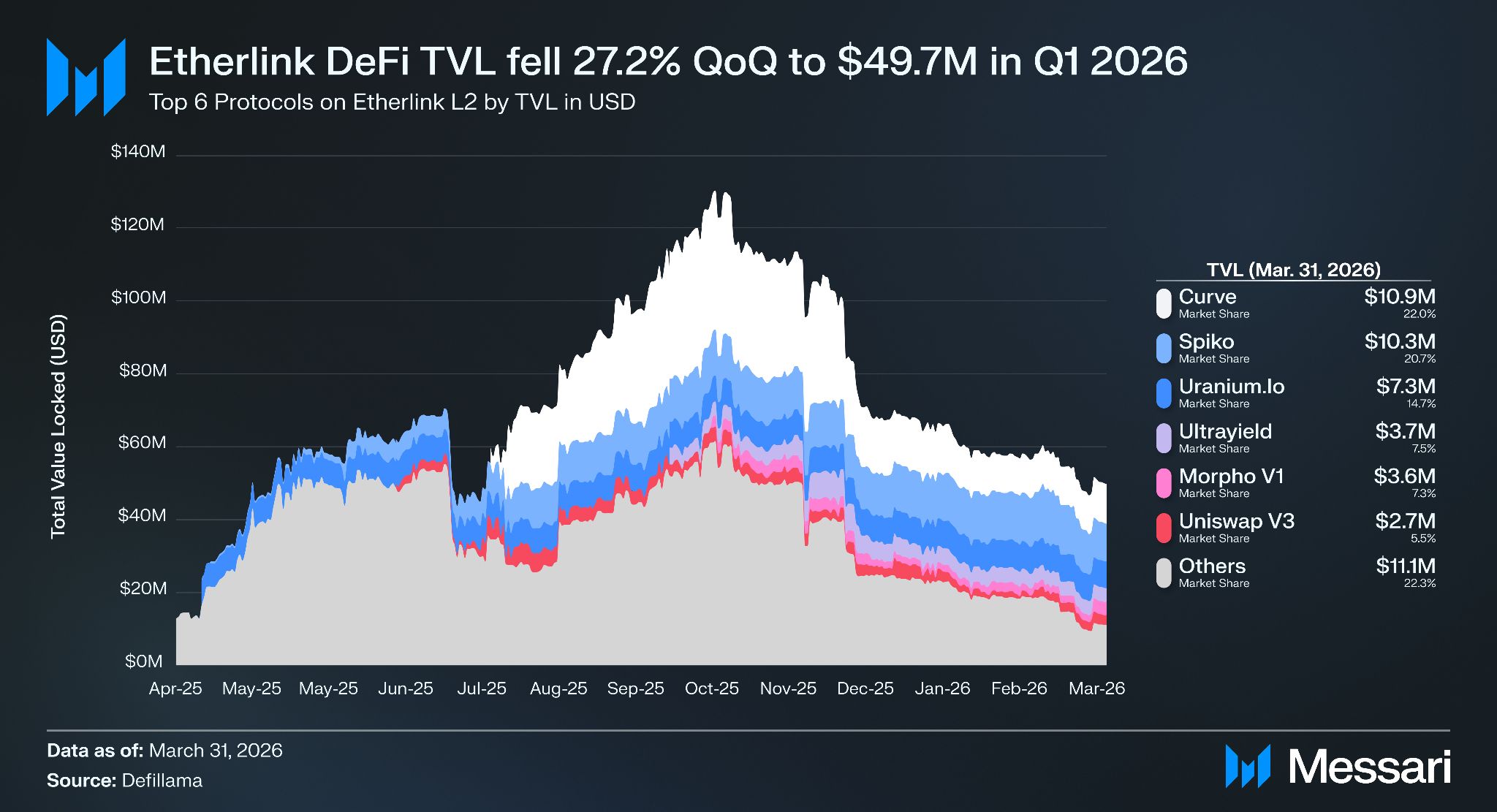
Etherlink DeFi TVL fell 27.2% QoQ to $49.7 million at Q1-end, extending Q4 2025's 30.3% decline. The drawdown was broad-based across the major protocol cohort, with three top-cohort protocols posting counter-trend resilience or growth.
Curve: A concentrated-liquidity AMM on Etherlink that supports fee tiers and tight ranges for stable and volatile pairs. Liquidity concentrates in a small set of core pools, which aggregate most routing.
Curve saw the largest dollar decline in Etherlink DeFi TVL in Q1 2026. Its TVL fell 28.7% QoQ from $15.3 million to $10.9 million, though it retained the largest share of Etherlink DeFi TVL at 22.0%. On the protocol side, Curve launched FastBridge in March 2026, a LayerZero-based module that compresses the crvUSD L2-to-Ethereum withdrawal window from seven days to roughly 15 minutes, with Etherlink as one of the supported source networks.
Spiko: Issues tokenized money market funds on Etherlink, offering UCITS-style shares backed by U.S. and EU T-Bills that settle onchain.
Spiko closed Q1 2026 with $10.3 million in TVL, a 10.9% QoQ decrease from $11.6 million. Its share of Etherlink DeFi TVL expanded to 20.7% from 16.9% as other DeFi protocols contracted faster. Spiko's Q1 resilience indicates its tokenized money-market-fund product is holding a stickier base of yield-seeking depositors than Etherlink's reward-program cohort. In March 2026, Spiko launched the Spiko Amundi Overnight Swap Fund (SAFO) in partnership with Amundi, broadening its institutional product surface, though the fund's primary shareholder registers sit on Ethereum and Stellar rather than Etherlink.
Uranium: A tokenized-commodity platform on Etherlink that gives investors direct, onchain ownership and transfer of physical uranium held with regulated custodians.
Uranium.io ended Q1 2026 with $7.3 million in TVL, a 1.2% increase QoQ, making it the only Etherlink top-cohort protocol to post positive TVL growth in a quarter that saw total Etherlink DeFi TVL fall 27.2%. Its share of Etherlink DeFi TVL expanded from 10.6% to 14.7%. In February 2026, Uranium.io launched the Critical Mass podcast on the intersection of commodities and onchain markets.
UltraYield: A vault curator built by the hedge fund, Edge Capital, that manages market-neutral yield strategies on behalf of depositors.
UltraYield ended Q1 2026 with $3.7 million in TVL, a 24.6% QoQ decline from $4.9 million. UltraYield's share of Etherlink DeFi TVL expanded to 7.5% in Q1’26. On January 29, 2026, UltraYield partnered with Nexus Mutual and Kelp to launch a DeFi vault with embedded smart contract exploit insurance covering over $30 million in core positions, an institutional-grade product structure that few perpetual yield curators currently offer.
Morpho: An onchain lending and borrowing primitive that pairs lender deposits with isolated, configurable borrowing markets. On Etherlink, Morpho serves as the underlying lending substrate for several Etherlink-native protocols and curators.
Morpho's Etherlink TVL grew 95.3% QoQ to $3.6 million in Q1 2026, expanding its share of Etherlink DeFi TVL from 2.7% to 7.3%. The growth came against a backdrop of an ecosystem-wide Morpho V2 migration push that incentivized V2 deposits with exclusive MORPHO rewards throughout Q1’26, with Morpho's protocol-wide TVL crossing $6.6 billion across all chains by Jan. 31, 2026.
Uniswap V3: The Uniswap V3 deployment on Etherlink, accessible via the Oku aggregator interface.
Uniswap V3 ended Q1 2026 with $2.7 million in TVL on Etherlink, a 15.2% QoQ increase from $2.4 million, expanding its share of Etherlink DeFi TVL from 3.5% to 5.5%.
Real-World Assets (RWAs)
Real-world assets (RWAs) on Etherlink matured from a single-protocol proof-of-concept to a multi-asset tokenized-commodities vertical in Q1 2026. The cornerstone is Uranium.io, which launched on Etherlink on Dec. 2, 2024, and issues xU3O8, a token backed 1:1 by physical uranium oxide (U₃O₈) held with regulated custody partners including Archax, a UK-regulated digital-asset custodian, and Cameco, a major uranium producer providing regulated depository services. Uranium.io's onchain pricing is supplied by an aggregating oracle that pulls uranium-related ETF and mining company data. Secondary-market trading is concentrated on Oku, which integrated xU3O8 with limit orders and charting, and launched Morpho-powered xU3O8 lending in November 2025.
Uranium.io’s resilience in Q1 2026 is notable specifically because the protocol has no native incentive-farming or rewards program driving deposits. Its depositor base holds xU3O8 for regulated exposure to physical uranium rather than for reward-driven yield, which makes the TVL composition structurally different from the rotational capital that contracted across the rest of the Etherlink DeFi cohort in Q1.
On Mar. 30, 2026, Trilitech launched metals.io, extending the Uranium.io model to a broader basket of tokenized commodities. Initial listings include xU3O8 (uranium), VNX Gold (VNXAU), representing LBMA-certified physical gold, and the RARE Token by Noemon Tech, a basket exposure to five strategic and rare-earth metals, including hafnium and rhenium, with the platform explicitly targeting the under-tokenized industrial and base-metals sector. Most of the cost of bringing a regulated commodity onchain sits in legal entities, compliance filings, and onchain-settlement infrastructure, all of which are commodity-agnostic. Metals.io reuses that stack from Uranium.io and adds only per-commodity custodians and oracles, allowing it to launch with multiple commodities at once.
RWA momentum on Tezos is specifically relevant to the Tezos X architectural story because regulated commodity issuers require three properties that independently governed L2 ecosystems struggle to provide:
Deterministic finality inherited from the base layer
Enshrined custody and governance
Predictable upgrade paths that do not require issuers to re-audit their deployments every time a generic L2 ships a new execution-layer version
Etherlink's position as an enshrined L2 under Tezos L1, with governance controlled by L1 bakers and upgrades ratified through onchain voting, makes it a structurally better fit for regulated commodity tokenization than a typical bridge-dependent rollup ecosystem.
Looking ahead, metals.io's launch is the first data point on whether the uranium.io blueprint generalizes to broader commodity tokenization. If the playbook transfers cleanly to additional commodities, Etherlink's RWA TVL will likely trend up through 2026 independent of crypto-cycle direction, because the depositor base is institutional and macro-driven rather than reward-driven. The thesis was pressure-tested by Q1 2026 itself, as Uranium.io was the only RWA-anchored Etherlink protocol to post positive TVL growth in a quarter that saw total Etherlink DeFi TVL fall. Key Q2’26 markers to watch are the specific commodities metals.io expands its listings to, the custody provider roster, and whether regulated-wrapper issuance on Etherlink accelerates beyond the current uranium-and-metals footprint.
Privacy and Shielded Transactions
Tezos has had native shielded-transaction capability at the protocol layer since the Edo upgrade activated on Feb. 13, 2021. Edo enshrined a Sapling-inspired design drawn from Zcash's shielded-pool construction. This gives developers a protocol-level cryptographic toolkit for building private payment and asset flows without reliance on offchain or bridge-dependent privacy layers.
Live infrastructure built on the shielded primitive includes:
Umami Wallet: A Tezos desktop wallet supporting transparent-to-shielded and shielded-to-transparent transfers via a native Sapling interface.
AirGap Wallet: A mobile Tezos wallet that includes Sapling shielded-transaction support alongside standard transparent operations.
Shield Bridge: Native onchain functionality allowing XTZ to move between the public transparent pool and a private shielded pool, with cryptographic commitments preserving balance integrity.
The capability set is not new for Tezos, but what has changed is the external environment. Privacy has returned as a live institutional and regulatory conversation across crypto in 2026, with zero-knowledge proofs, shielded transfers, and selective-disclosure schemes moving from theoretical specifications to shipping infrastructure on multiple L1s. Tezos shipped Sapling in 2021, well before privacy became a mainstream institutional concern. As peer networks build their first privacy primitives in 2026, Tezos already has Sapling, Umami, and Shield Bridge in production with nearly five years of operational history behind them.
Looking ahead, three factors are pushing institutional demand for shielded primitives in 2026. First, stablecoin payment adoption, such as PYUSD's September 2025 Stellar launch, MiCA-compliant euro stablecoins like EURCV, and the expansion of enterprise-issued stablecoins, is creating demand for payer privacy in large-transfer workflows. Second, RWA secondary markets increasingly require confidentiality of counterparty positions for institutional participants who cannot reveal treasury positions onchain. Third, the regulatory conversation has moved from "privacy is suspect" to "selective disclosure is compliant," making shielded-with-view-key designs a first-choice architecture. Tezos' shielded primitive has been production-grade since 2021. The question is whether 2026's privacy-sensitive applications deploy on Tezos' existing Sapling stack or on newly-launched alternatives like Stellar's X-Ray or Midnight.
Institutional Integrations
Q1 2026 saw three institutional integration milestones that expanded Tezos' regulated-market footprint:
Bitnomial CFTC-regulated XTZ futures (Feb. 4, 2026):Bitnomial, a Chicago-based CFTC-regulated digital-asset derivatives exchange, launched the first U.S.-regulated futures product for XTZ. Institutional traders access the contracts directly on Bitnomial, with retail access provided through a partnered platform. The listing brings XTZ into the same regulated-derivatives category as Bitnomial's prior crypto products and enables mature price discovery and institutional hedging, a prerequisite for larger allocators to treat XTZ as an investable asset.
Ledger native Etherlink integration (Jan. 29, 2026):Ledger added native Etherlink support to its hardware wallet line, allowing users to interact with EVM applications on Etherlink directly via hardware-backed signing. Full Ledger support is a gating dependency for institutional custody and self-custody of regulated assets held on Etherlink, including the expanding RWA cohort.
Meria validator addition (Jan. 28, 2026):Meria, a French regulated digital-asset platform, joined Tezos as a baker in Q1 2026. Meria's addition extends the network's regulated-validator footprint in Europe, complementing the existing institutional and geographic distribution of the baker set.
Protocol Interactions
objkt, the largest NFT marketplace on Tezos, remained the single largest destination for Tezos L1 activity by unique addresses, averaging 920 weekly active addresses (WAAs) in Q1 2026, a 24.0% QoQ decrease from 1,210 in Q4 2025. Hen, the contract for the original Hic et Nunc NFT marketplace, followed at 400 weekly active addresses, the NFTs continue to be traded both on objkt and the community-run marketplace Teia. objkt and HEN contracts combined accounted for 49.8% of L1 WAAs in Q1. Against the broader L1 WAA contraction, the NFT and art-collector cohort's share of L1 activity expanded in Q1 2026.
Community & Development
Q1 2026 saw a continuation of the institutional-adjacent art programming that has characterized Tezos' art ecosystem since 2021. Four Q1 exhibitions and partnerships stood out:
HeK Basel year-long partnership (January 2026): The Tezos Foundation announced a year-long partnership with Haus der elektronischen Künste (House of Electronic Arts), Basel, one of Europe's leading media and digital-art institutions. The partnership covers exhibitions, programming, and research collaborations throughout 2026.
Bar CodeX at macLYON (March 2026): An interactive digital-art exhibition launched at the Musée d'art contemporain de Lyon, backed by the Tezos Foundation and Art on Tezos, featuring onchain works and interactive elements that let visitors earn Tezos-minted NFTs. The exhibition broadens Tezos' European institutional art footprint beyond Basel.
bitforms gallery at Art Basel Hong Kong (March 2026): The New York-based bitforms gallery, which specializes in digital and computational art, presented a booth at Art Basel Hong Kong featuring works by Quayola sold via objkt.
Lick Pic at MoMI, NYC (February-May 2026):Lick Pic by Sarah Friend and Yehwan Song opened at the Museum of the Moving Image in New York as part of the Tezos Foundation and MoMI 2025-2026 partnership programming.
The pattern across Q1's art programming is consistent with Tezos' positioning over the past five years. The network continues to function as the preferred chain for institutional-adjacent digital-art programming, chosen by museums and galleries around the world. Objkt and HEN contracts together account for nearly half of L1 WAAs. The art ecosystem on Tezos continued to solidify its place as a structural pillar of L1 activity.
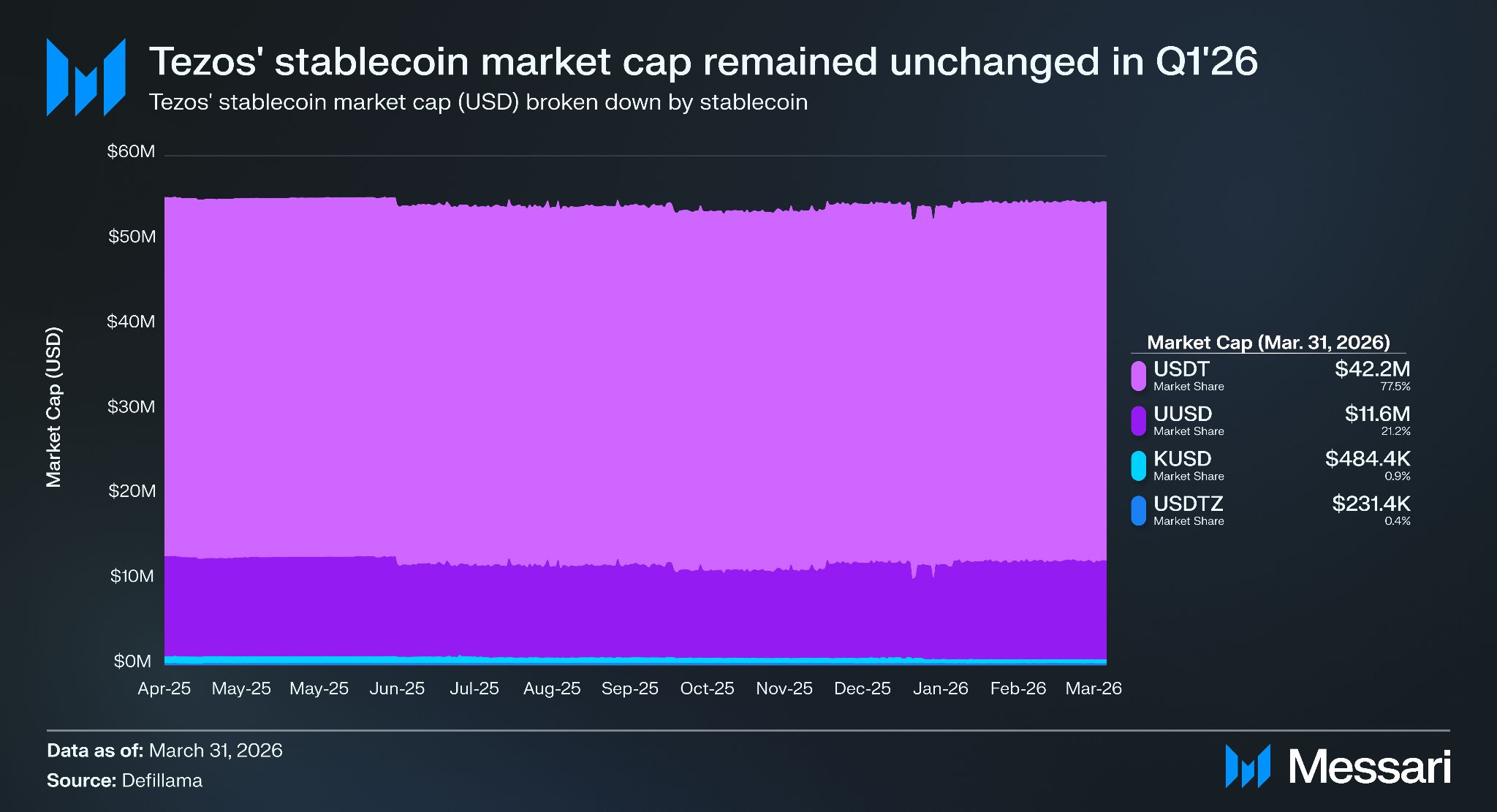
The circulating supply of stablecoins on Tezos was effectively flat in Q1 2026, rising 0.5% QoQ from $54.2 million to $54.5 million. USDT remained the dominant stablecoin at $42.2 million, capturing 77.5% of the network’s stablecoin supply, followed by uUSD at $11.6 million, and kUSD at $484,410. The Tezos-native stablecoins uUSD and kUSD combined held 22.1% of stablecoin supply at Q1-end, with uUSD continuing to absorb share from kUSD. Tezos' stablecoin supply stability through a quarter that saw DeFi TVL contract 17.2% on L1 and 27.2% on L2 indicates the stablecoin float is serving a genuine medium-of-exchange and unit-of-account role on the network.
Closing Summary
Q1 2026 was a quarter of architectural groundwork moving into production against a softer broader Layer-1 market backdrop. XTZ's price fell 28.7% QoQ to $0.352, and circulating market cap contracted 28.0% to $380.7 million, with the drawdown concentrated in February and March 2026, tracking with the decline across the top 10 L1’s that posted a median decline of 27.5% QoQ. Activity-level metrics compressed in line, with L1 transactions falling 7.9% QoQ to a monthly average of 3.5 million, Etherlink transactions declining 24.2% to 14.1 million, and DeFi TVL falling 17.2% on L1 and 27.2% on Etherlink. Against that drawdown, the staking rate rose to 61.1%, total XTZ staked increased 4.3% QoQ to 660.3 million tokens, stablecoin supply held effectively flat at $54.5 million, and Uranium.io grew 1.2% QoQ to $7.3 million while expanding its share of Etherlink DeFi TVL to 14.7%.
The technical and institutional story was the defining layer of the quarter. Tallinn activated on January 24, 2026, with shorter L1 block times, address indexing, and groundwork for all-baker attestations. Two days later, Tezlink Shadownet launched as the first public testnet for the Michelson runtime component of Tezos X, making the vertically scaled architecture publicly testable for the first time. Ushuaia entered stabilization on March 19, 2026, with a 15x DAL bandwidth expansion as its headline feature, and Nomadic Labs separately published a proposal on March 3, 2026, to compress the governance cycle from 70 days to 28 days. On the institutional side, Bitnomial launched the first CFTC-regulated U.S. XTZ futures in February 2026, with Ledger adding native Etherlink hardware-wallet support and Meria joining the baker set in January 2026. On March 30, 2026, Trilitech launched metals.io, extending the Uranium.io blueprint to a broader basket of tokenized commodities.
Headline financial and activity metrics declined in line with the broader Q1 L1 drawdown. Underneath that surface, the architectural foundation moved forward materially. Tallinn, Tezlink Shadownet, and Ushuaia are sequenced milestones on the Tezos X plan to scale vertically rather than horizontally, preserving enshrined governance and the L1-to-L2 security link as throughput scales rather than fragmenting activity across independently governed rollups. Ecosystem signals consistent with that direction are already visible. Etherlink is becoming a settlement venue for regulated commodity exposure, the institutional surface widened through Bitnomial and Ledger, Tezos L1 is increasingly anchored in NFT and art-collector cohorts, and the network's native shielded primitive is positioned to serve the privacy-compliant environment institutional stablecoin and RWA flow now demands. Q2’26 signals worth tracking are Ushuaia's adoption-phase progress, the timing of the full Tezos X public testnet with atomic Tezlink-and-Etherlink composability, and whether metals.io's commodity expansion translates into RWA TVL growth that's structurally independent of crypto-cycle direction.
This report was commissioned by the Tezos Foundation. All content was produced independently by the author(s) and does not necessarily reflect the opinions of Messari, Inc. or the organization that requested the report. The commissioning organization may have input on the content of the report, but Messari maintains editorial control over the final report to retain data accuracy and objectivity. Author(s) may hold cryptocurrencies named in this report. This report is meant for informational purposes only. It is not meant to serve as investment advice. You should conduct your own research and consult an independent financial, tax, or legal advisor before making any investment decisions. Past performance of any asset is not indicative of future results. Please see our Terms of Service for more information.
No part of this report may be (a) copied, photocopied, duplicated in any form by any means or (b) redistributed without the prior written consent of Messari®.