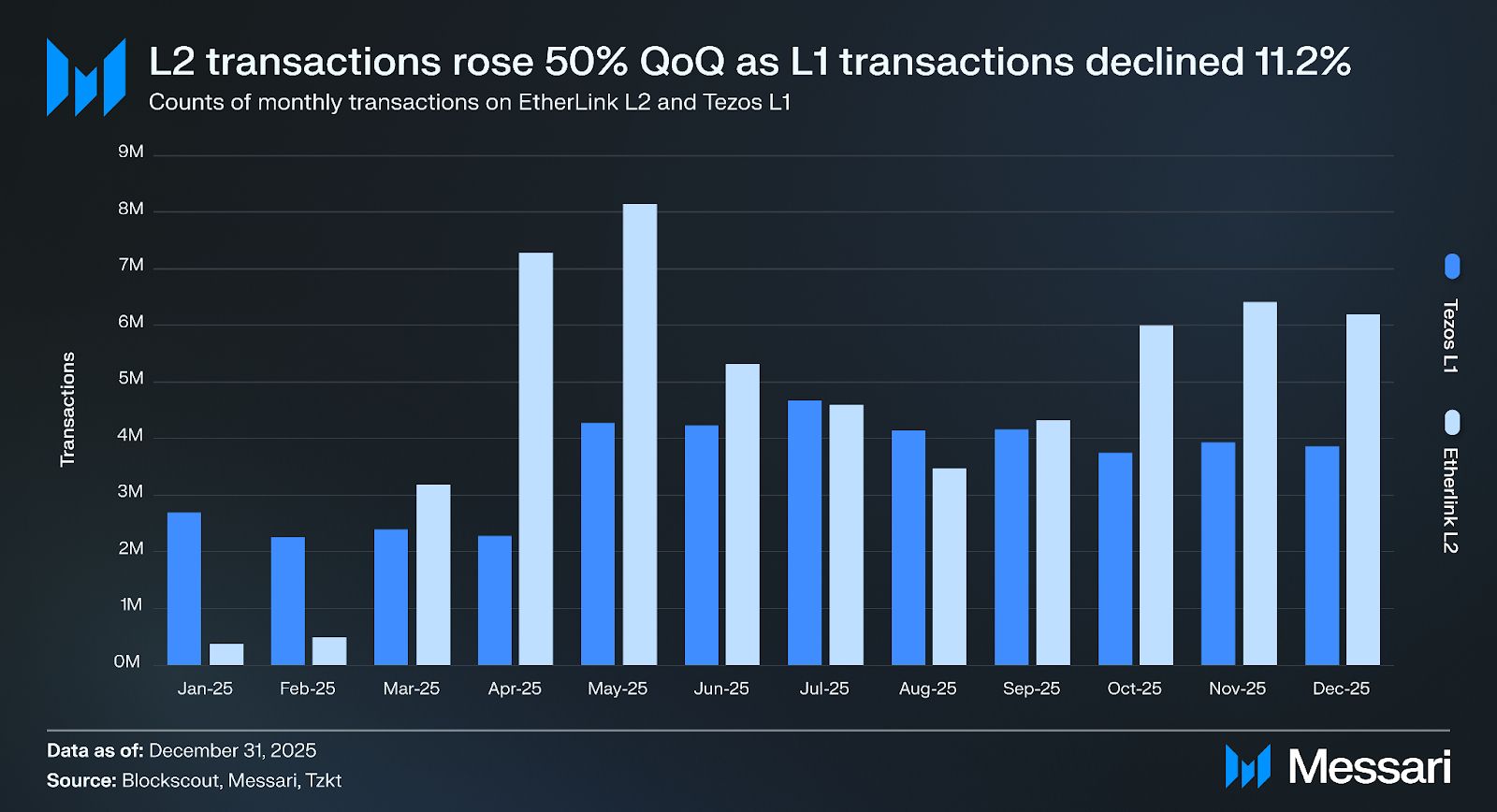
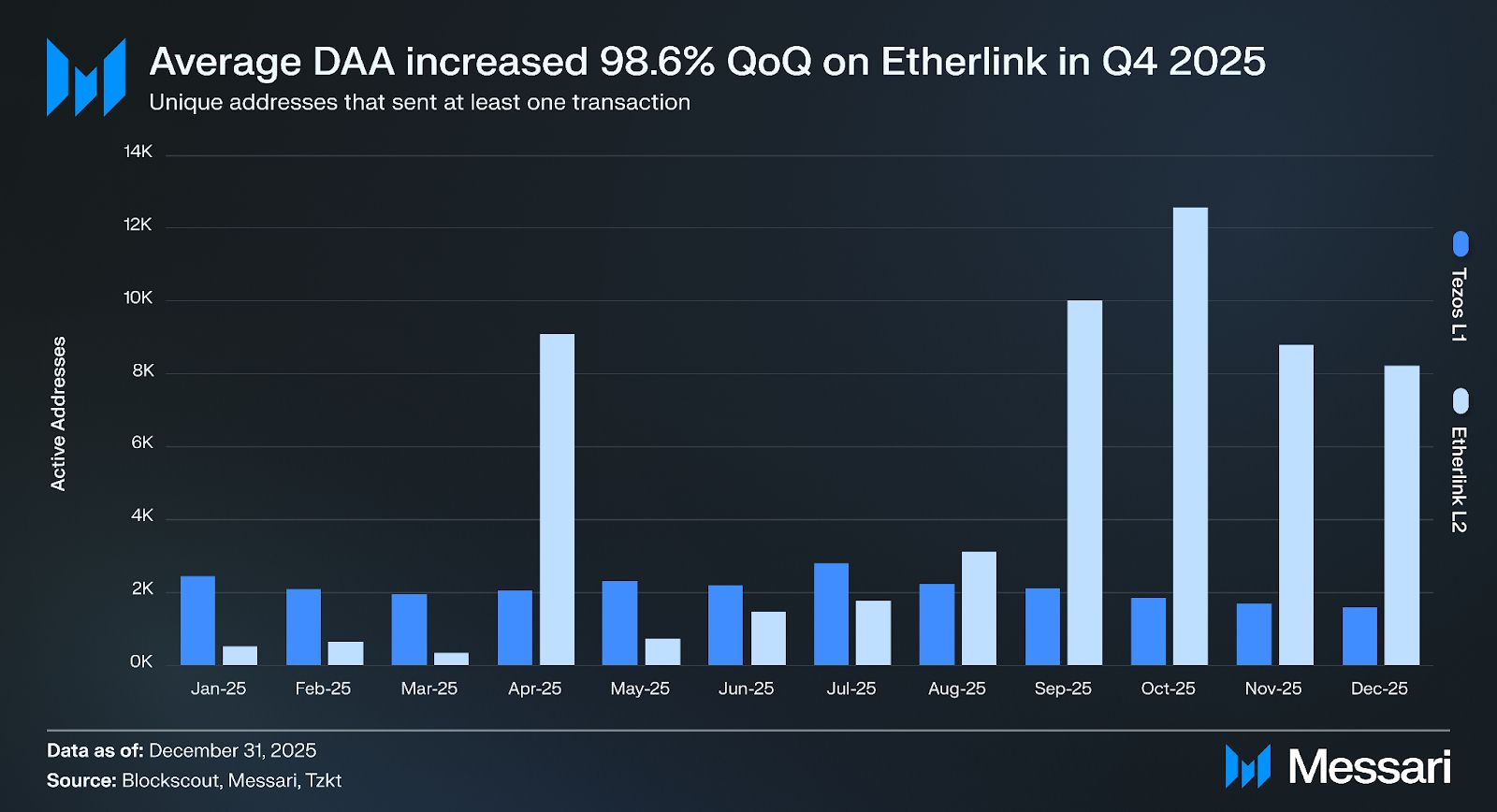
Etherlink transactions increased 50% QoQ to 18.6 million, and daily active addresses nearly doubled to 9,860, solidifying Etherlink’s role as the primary execution layer for the Tezos ecosystem.
DeFi TVL declined across both layers, with Etherlink falling 39.3% QoQ to $37.2 million and Tezos L1 falling 18.2% to $33.5 million. The decline on Etherlink was concentrated in Curve, which lost 50.4% of its TVL and accounted for over half of the total loss.
Two back-to-back kernel upgrades brought all-time highs in governance participation and more than tripled Etherlink's throughput in Q4 2025. Ebisu was activated in October 2025, raising capacity to 14 million gas per second, with Farfadet following in December, nearly doubling throughput again to 27 million gas per second.
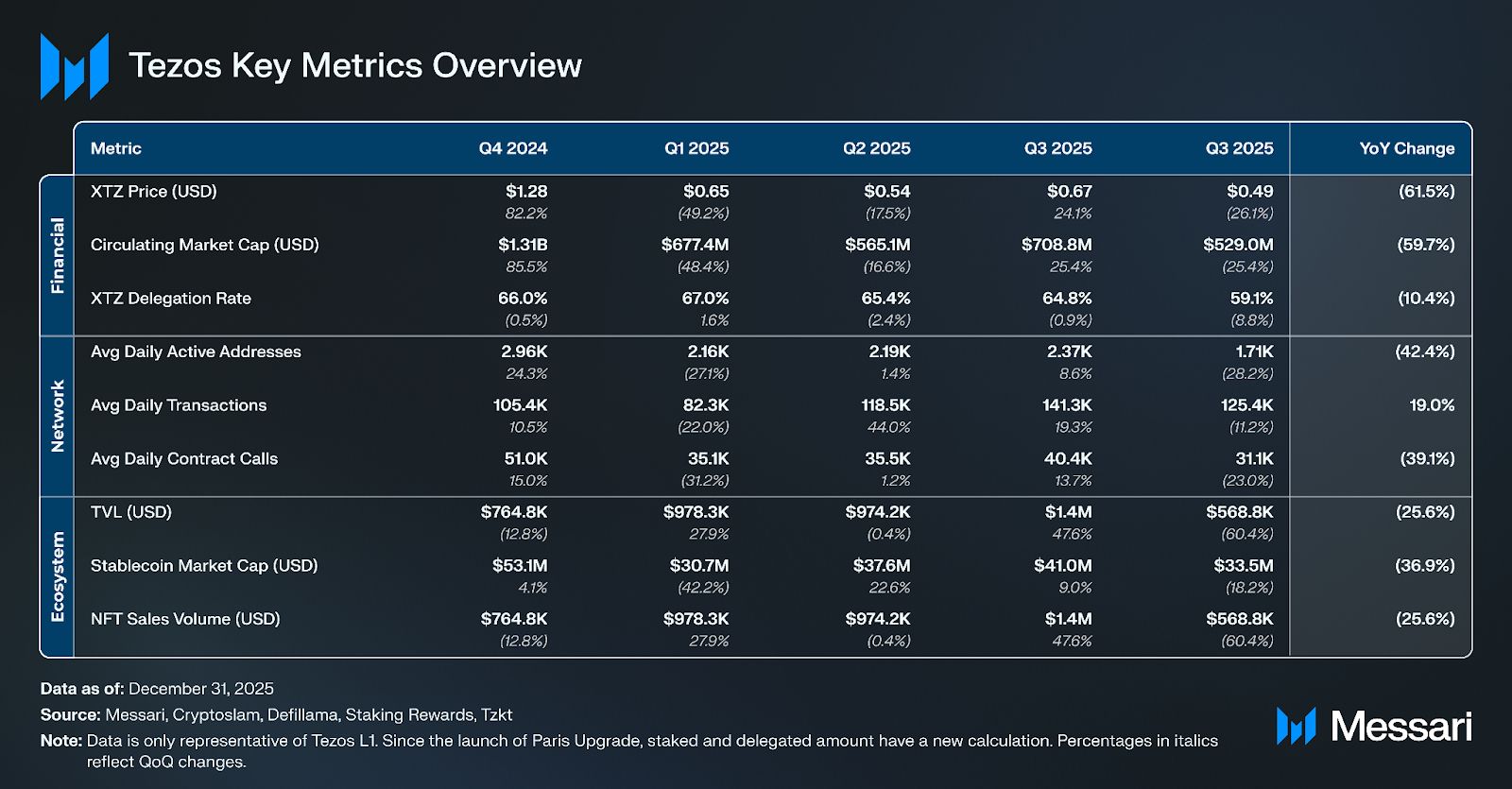
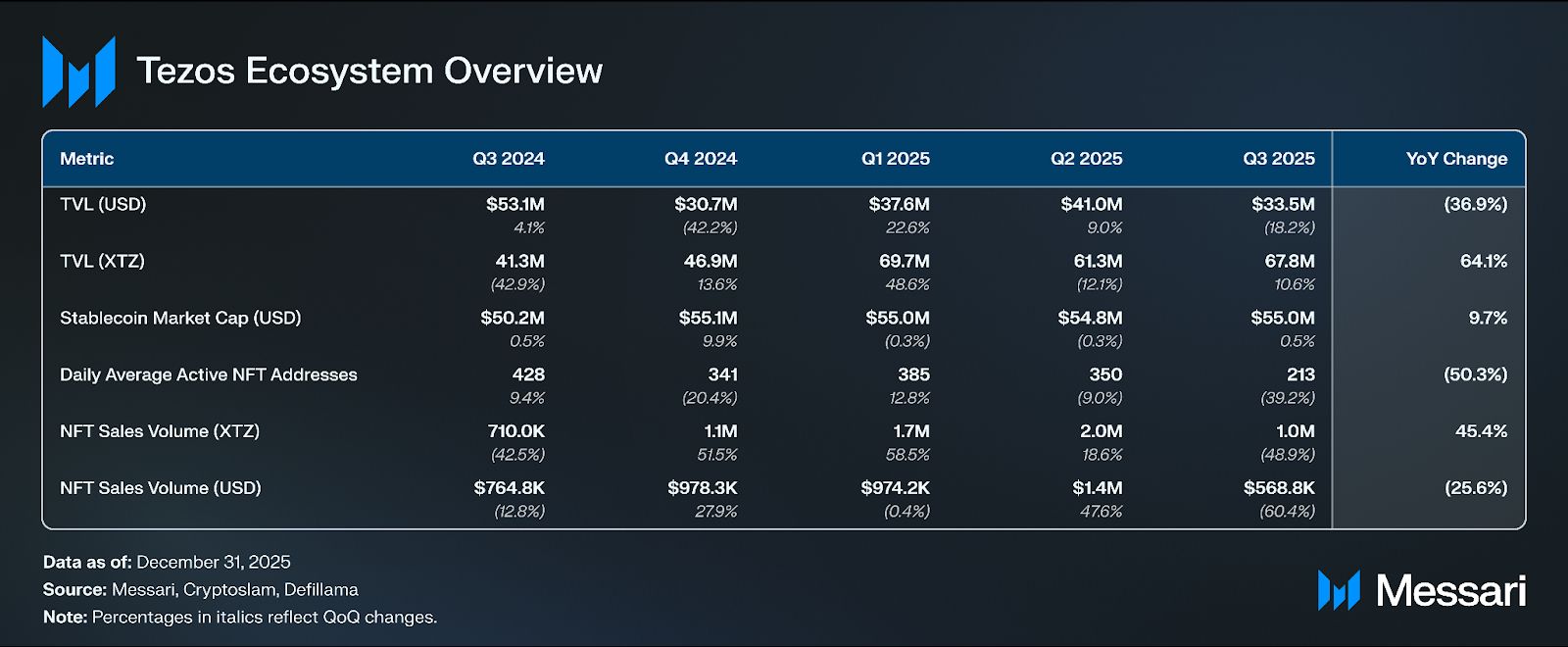
XTZ's price fell 26.1% QoQ to $0.49 but outperformed the broader altcoin market, with its circulating market cap rank improving from 98th to 80th. Stablecoin supply on Tezos remained essentially flat at $54.2 million, and the active validator count grew 3% QoQ to 264.
Q4 was the strongest quarter for Tezos art in 2025. The Art on Tezos: Berlin festival in November 2025 was highlighted by Francisco Carolinum's acquisition of 15 TeleNFT works and qubibi's sale of "hello world" for 62,000 XTZ.
Primer
Tezos (XTZ) is a Proof-of-Stake (PoS) blockchain recognized for its strong emphasis on security, upgradeability, and community-driven governance. Smart contracts on its Layer-1 (L1) network are implemented using the Michelson language, designed to facilitate formal verification while also offering Ethereum virtual machine (EVM) compatibility through Etherlink, a community-governed, non-custodial Layer-2 (L2). The network features onchain governance and self-amending functionality, enabling stakeholders to adopt protocol upgrades without requiring a network hard fork.
Tezos’ recent upgrades have focused on scalability and performance through Smart Rollups and a Data Availability Layer (DAL). The Mumbai upgrade in March 2023 introduced Smart Rollups, an L2 scaling solution designed for high throughput and customization to adapt to specific use cases, such as implementing new coding environments. The Paris upgrade in June 2024 reduced L1 block times from 15 to 10 seconds, bringing 20-second finality. It also introduced the DAL, a data-availability solution that boosts Smart Rollup scalability. Finally, the Paris upgrade implemented a new staking mechanism and Adaptive Issuance, which adjusts token issuance based on the staked ratio of XTZ.
Current R&D work from teams across the ecosystem focuses on realizing “Tezos X,” a proposed roadmap that enhances the blockchain’s performance, composability, and interoperability, delivering a “cloud-like” developer experience. Leveraging Smart Rollup technology and the built-in Data Availability Layer, developers can build complex, scalable applications on a unified application layer with multiple runtimes, using mainstream programming languages, and with improved connectivity across Tezos and other blockchain ecosystems.
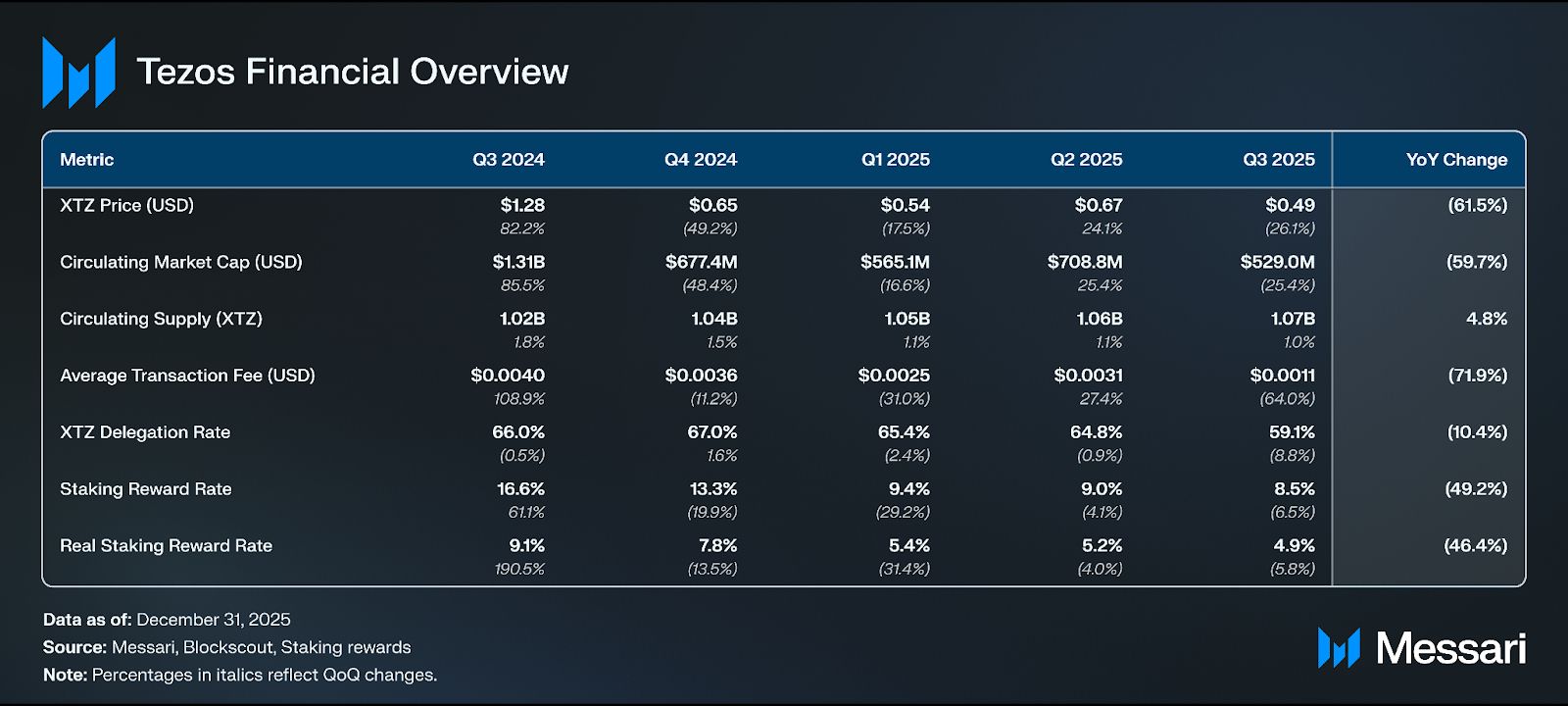
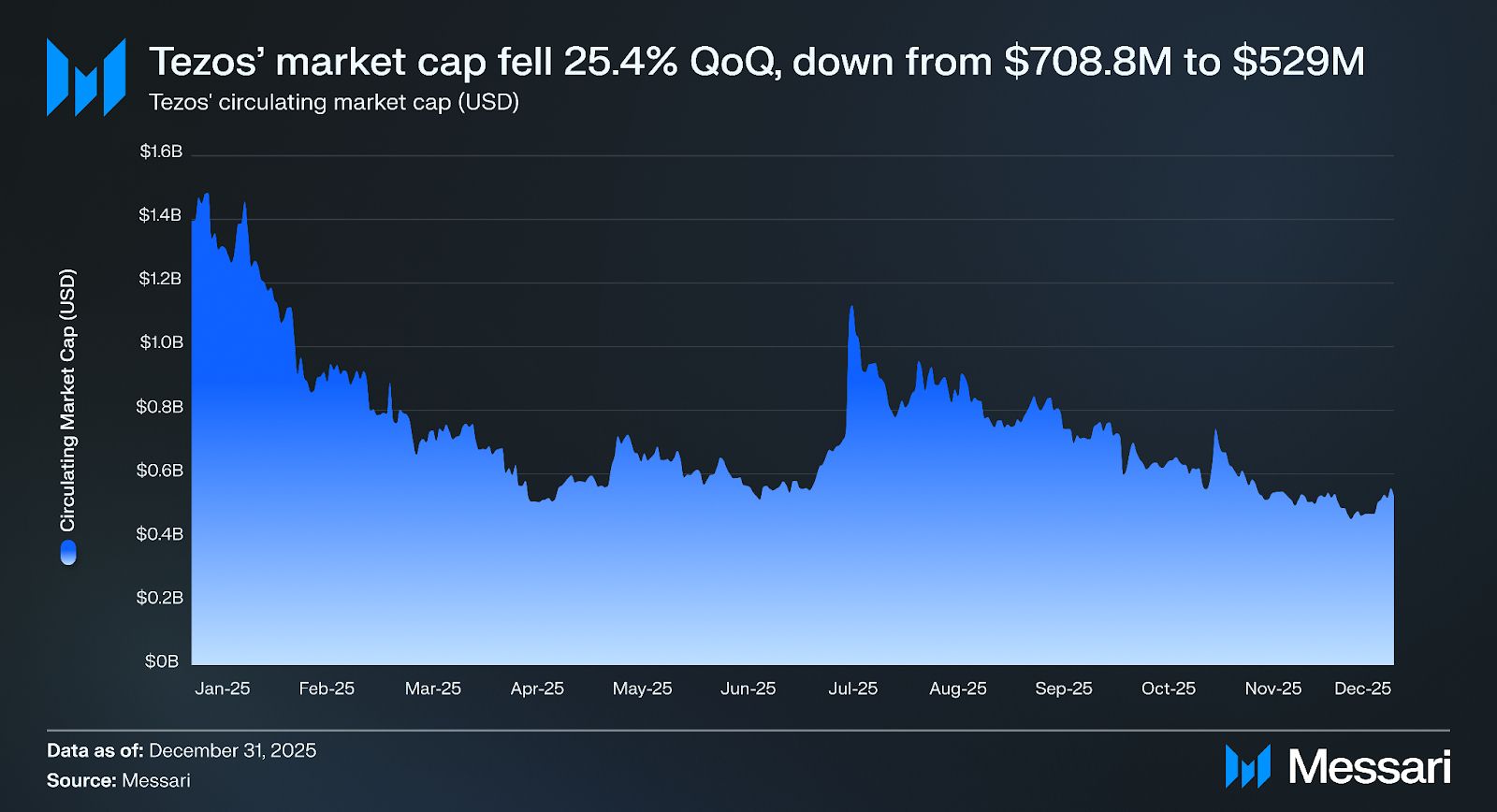
Tez (XTZ) is the native token of the Tezos blockchain. It is used (i) for staking, delegation, and governance and (ii) as the primary medium for paying transaction fees on both the Tezos Layer-1 (L1) and the EVM-compatible Layer-2 (L2) network, Etherlink. In Q4 2025, XTZ's price decreased 26.1% QoQ from $0.67 to $0.49, while its circulating market cap (USD) fell 25.4% QoQ to $529 million. The slight discrepancy is due to XTZ’s circulating supply increasing 1.0% QoQ to 1.07 billion XTZ, in line with the protocol's inflation schedule. XTZ's circulating market cap ranking rose from 98th in Q3 2025 to 80th in Q4 2025, suggesting that XTZ held up better than other assets during the market-wide downturn.
As of Dec. 31, 2025, XTZ’s circulating supply was 1.07 billion. The Paris upgrade, launched in April 2024, introduced the Adaptive Issuance mechanism, designed to incentivize a secure network while minimizing inflation. The target for staking is 50% of the total XTZ supply, and the mechanism dynamically adjusts staking rewards to achieve this with the least possible XTZ issuance. The aim is to minimize XTZ dilution, improve liquidity, reduce inefficiencies, and optimize XTZ for real-world use cases. The total XTZ staked on the network decreased by 8.1% from 688.1 million in Q3’25 to 633.1 million at the end of Q4’25.
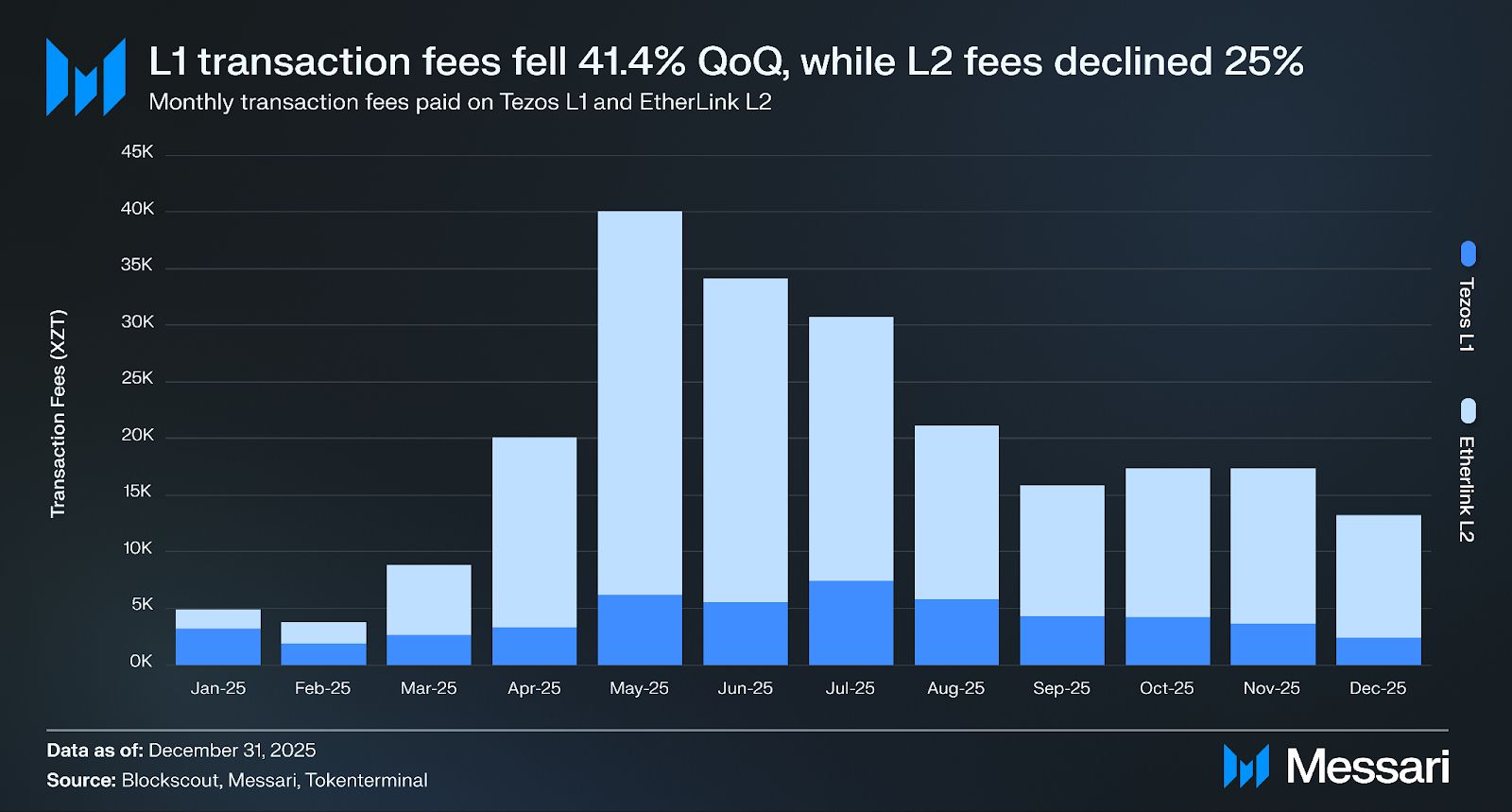
In Q4 2025, total fees paid on Tezos L1 fell 41.4% QoQ to 10,230 XTZ, while Etherlink L2 fees declined only 25% QoQ to 37,660 XTZ. The L1 fee decline coincided with reduced onchain activity as both transactions and contract calls fell QoQ. Multiple governance votes executed in Q4’25 on Tezos L1 and Etherlink generated ballot transactions, helping sustain activity throughout the quarter. However, these governance-related fees were not enough to offset the broader decline in L1 usage.
On Etherlink, the Ebisu upgrade activated on Oct. 15, 2025, switching the EVM engine from SputnikVM to REVM and raising the throughput limit from 8 million to 14 million gas per second. The Farfadet upgrade followed on Dec. 17, 2025, nearly doubling capacity again to 27 million gas per second and introducing instant transaction confirmations. These capacity increases allowed Etherlink to handle a 50% QoQ increase in transactions while the demand-indexed base fee continued to fall, resulting in lower total L2 fees despite increased throughput. Etherlink L2 fees remained higher than the L1 because each batch of L2 transactions must be written to the Tezos base layer for settlement, adding L1 data costs on top of Etherlink’s own base fee.
Network Overview
Usage
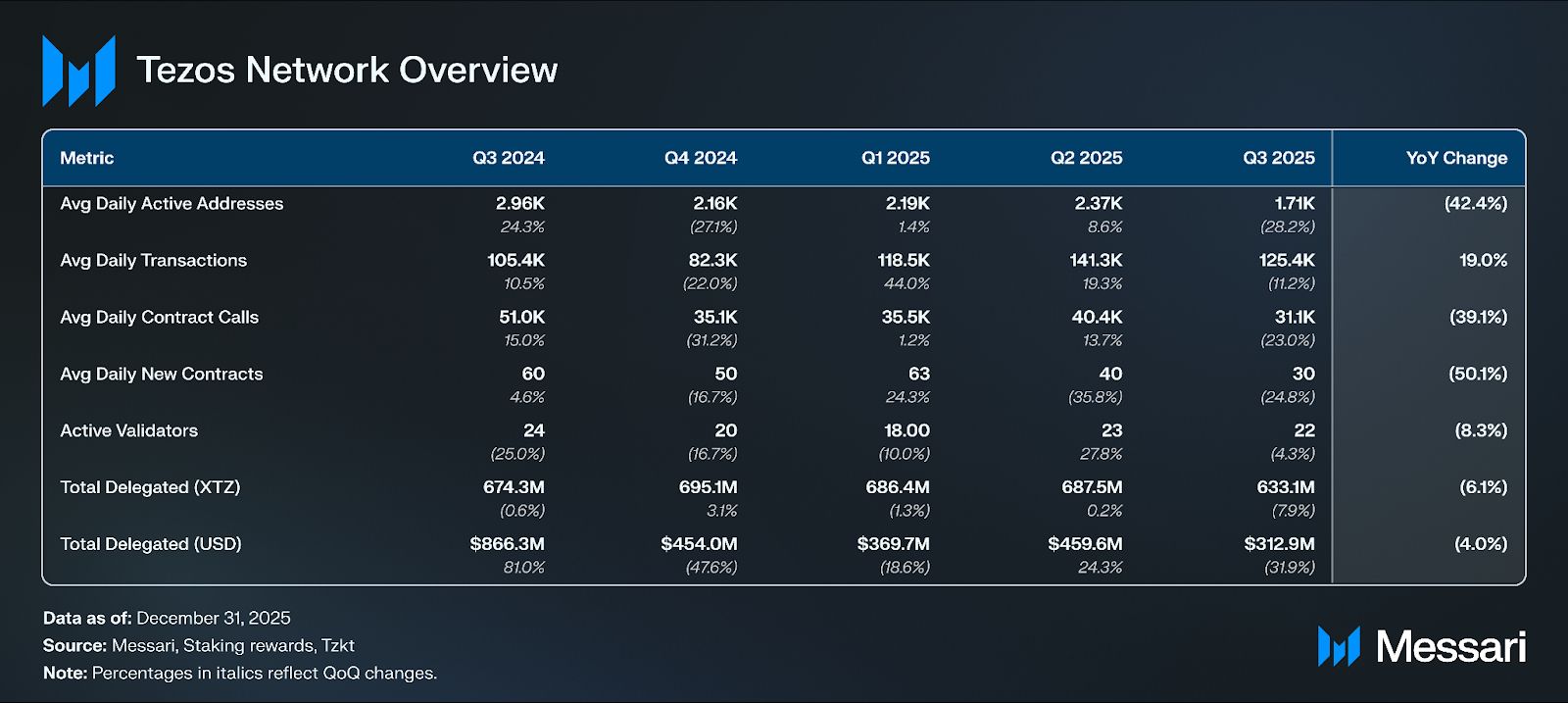
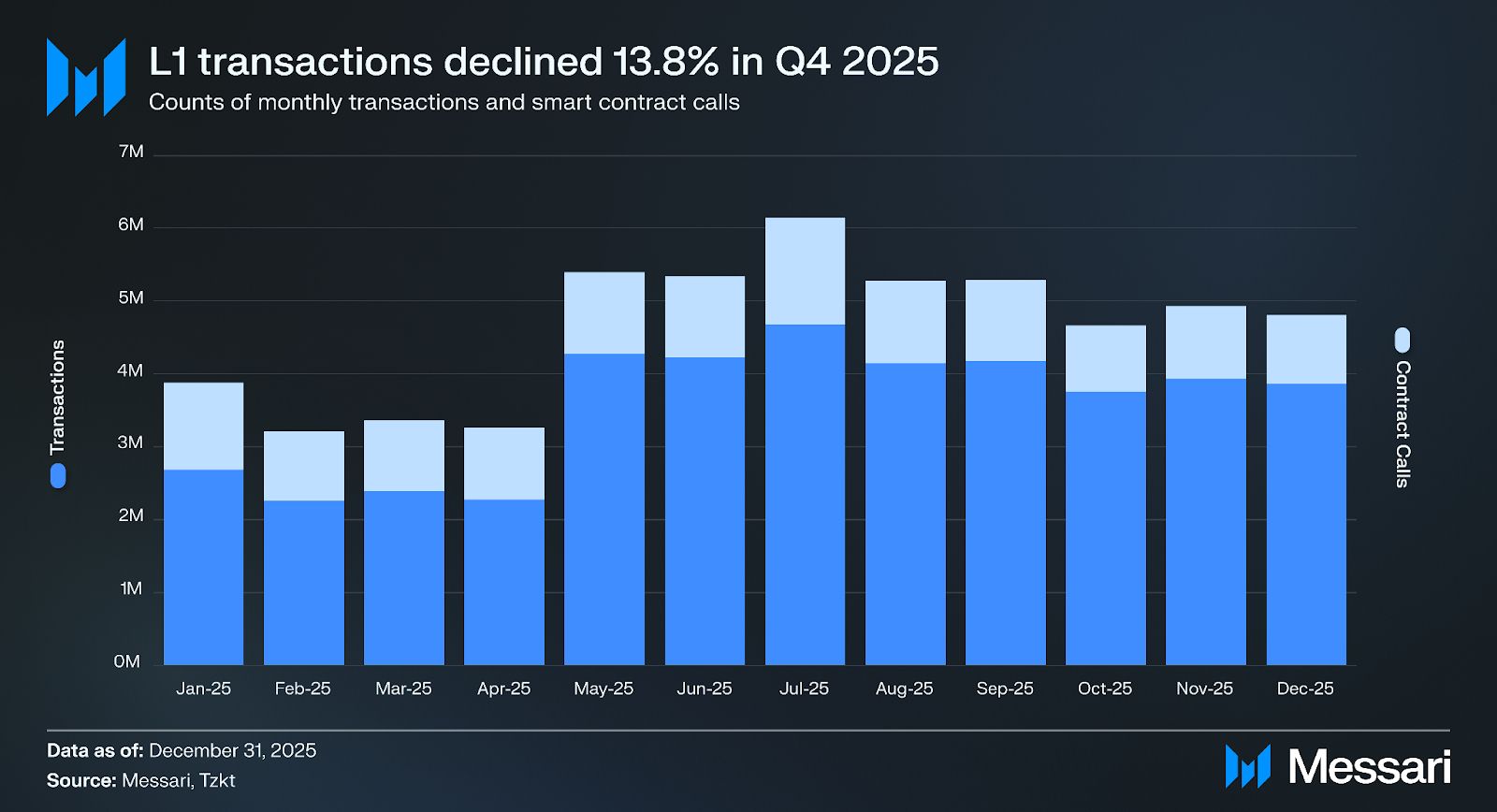
Transactions on Tezos L1 fell 11.2% QoQ in Q4 2025, falling to an average of 3.8 million transactions, down from 4.8 million in Q3’25. Additionally, contract calls declined 23% QoQ, down to 953,270 million from 1.2 million in Q3. The decline likely reflects L1 activity continuing to migrate toward Etherlink, which processed 50% more transactions QoQ in the same period. The Seoul upgrade activated at the end of Q3’25, and its efficiency improvements to attestations and unstaking may have contributed to the reduced volume of repetitive L1 operations in Q4. Meanwhile, the Tallinn governance cycle generated ballot and voting transactions in November and December 2025, but was insufficient to offset the shift toward Etherlink.
Etherlink processed 18.6 million transactions in Q4 2025, a 50% QoQ increase from 12.4 million in Q3. Two kernel upgrades drove much of Etherlink’s growth in Q4’25. Ebisu, activated on Oct. 10, 2025, provided developers with broader EVM compatibility and higher throughput. Farfadet followed on Dec. 17, 2025, pushing throughput to 27M gas per second and enabling instant transaction confirmations. Together, these upgrades allowed Etherlink to absorb more activity without increasing fees. Apple Farm Season 2 incentives ran through most of Q4 2025, and kept DeFi-related transactions elevated as users farmed rewards across Curve, Superlend, and other integrated protocols. MEXC also enabled native XTZ deposits on Etherlink on Nov. 5, 2025, adding another onramp that likely contributed to the increase in transaction volume.
In Q4 2025, daily active addresses (DAAs) on Tezos L1 decreased 28.1% QoQ, averaging 1,710 unique addresses per day. On Etherlink, DAAs surged 98.7% QoQ, from averaging 4,960 in Q3’25 to over 9,860 in Q4’25. The increase in DAAs on Etherlink was likely driven by a combination of new exchange onramps, gaming launches, and ongoing DeFi incentives. Following KuCoin’s XTZ integration in Q3’25, MEXC added support for XTZ in Q4, giving users two major centralized exchange (CEX) pathways directly onto the L2. The Reaper Actual Foundation Alpha launched on Oct. 8, 2025, onboarding a new cohort of wallets in advance of the game's full release. Additionally, Apple Farm Season 2 rewards sustained DeFi participation across integrated protocols in Q4 2025.
Governance and Network Upgrades
Tezos utilizes an LPoS mechanism, enabling staked XTZ to be used for both network security and governance. The network's self-amending blockchain reduces the need for hard forks by employing onchain governance for protocol upgrades. Users delegate their XTZ to bakers, and governance voting power is weighted by delegated balances, independently of staking participation. The governance process is divided into five periods, spanning approximately two months and ten days.
To complement protocol governance, Tezos Commons established the Tezos Ecosystem DAO, which manages and allocates XTZ for community projects. The DAO’s initial funding came from NFT sales on Objkt and donations from ecosystem participants.
Etherlink follows an onchain governance model similar to Tezos L1, ensuring fairness and transparency. Governance for Etherlink features the same self-amending properties (meaning no hard fork needed) and is controlled by L1 bakers. Unlike L1, Etherlink governance pilots both upgrades. Additionally, it has an alternative “fast governance” process mostly for swift incident responses, with shorter duration but higher participation requirements. The governance process occurs solely on Tezos L1 through dedicated smart contracts and consists of a proposal period and a promotion period.
Ebisu: Prague EVM Compatibility
Ebisu, the fifth Etherlink kernel upgrade, activated on October 15, 2025, aligning Etherlink’s EVM with Ethereum’s Prague execution changes, the execution-layer portion of Ethereum’s broader Pectra upgrade. Pectra is the umbrella name for two halves of a single upgrade: Prague (execution layer) and Electra (consensus layer). Since Etherlink implements the EVM execution environment rather than Ethereum’s consensus mechanism, Ebisu adopted only the Prague changes.
Ebisu added three Prague features to Etherlink in Q4’25:
EIP-7702: Allows a regular, externally owned account to attach contract code for a single transaction and delegate what it can do. This enables smart-account features, including batching steps, session keys, and sponsored fees, without transferring funds to a new contract wallet. After the transaction completes, the account returns to normal.
EIP-2537: Added a native precompile for BLS12-381 curve operations, making BLS signature verification and certain ZK-proof computations faster and cheaper than equivalent Solidity implementations. Apps using light-client proofs or zero-knowledge tooling benefit directly because these operations previously had to be implemented in Solidity at significantly higher gas costs.
EIP-7623: Increased the gas charged per byte of calldata. This mostly impacts data-heavy transactions, discouraging spam and aligning fee math with mainnet Ethereum tooling. Contracts that send large payloads now need to compress data or batch more carefully.
Beyond Prague compatibility, Ebisu also migrated the EVM engine from SputnikVM to REVM, raising the throughput speed limit to 14 million gas per second under the target-based fee model, nearly a 75% increase over the prior Kernel 4.1 ceiling.
Farfadet Protocol Upgrade
The Farfadet Upgrade (Kernel 6.0) followed on December 17, 2025, nearly doubling capacity again to 27 million gas per second. Farfadet also introduced instant transaction confirmations through a new JSON-RPC method. Under this model, the sequencer advertises its intended transaction set before block creation, allowing clients to compute receipts before the block is actually produced. On the compatibility front, Farfadet moved Etherlink's EVM from Prague to Osaka, adding four new EIPs, including:
EIP-7951: Extended secp256r1 support to enable batch verification of multiple P-256 signatures in a single call, reducing gas costs for applications that validate several passkey or hardware-backed signatures per transaction.
EIP-7939: Introduced the CLZ (count leading zeros) opcode, a low-level bitwise operation used in fixed-point math, binary search, and compact encoding.
EIP-7883 and EIP-7823: Set an explicit upper bound on the gas limit a block can carry, preventing misconfigured or adversarial validators from proposing blocks with unreasonably high limits that could destabilize node performance.
This made Etherlink one of the first rollups to activate a new EVM version within days of an Ethereum hard fork.
Etherlink 6.1: Farfadet Bugfix
On Dec. 17, 2025, a regression in Farfadet broke FA token deposits through the Tezos bridge. The bug caused deposit transactions to fail during the ownership transfer step, locking tokens in the rollup's L1 smart contract rather than minting them on Etherlink. Only one user depositing Lyzi tokens was directly affected, and their funds remained safely held on L1 throughout. The issue extended to all FA token types, prompting Optimistic Labs to pause FA deposits in the bridge frontend as a precaution, though tez transfers and other bridges were unaffected. The community used Etherlink's fast governance process, which compresses the standard multi-period governance cycle into a single day with higher participation thresholds, to propose and promote a 6.1 patch from December 19-20, 2025. The patch included a migration function that re-injected the stuck deposit into the delayed inbox for automatic delivery upon kernel activation. Kernel 6.1 went live on December 20, 2025, restoring full bridge functionality within 72 hours.
Tallinn Protocol Upgrade
Tallinn, Tezos’ 20th protocol upgrade, was proposed in November 2025 and was activated on mainnet on January 24, 2026. Tallinn introduces three changes to Tezos L1:
Reduced Block Times: Cut L1 block times from 8 seconds to 6 seconds, increasing throughput and reducing confirmation latency for both L1 transactions and Smart Rollup commitment posting.
Address Indexing Registry: Assigns compact numerical indices to addresses, reducing storage costs for contracts that reference many accounts. This is particularly useful for NFT ledgers and token registries.
All-Baker Attestations: Enables every active baker to attest each block, replacing the committee-based sampling model. This tightens finality guarantees and aligns with the shorter block-time cadence. This feature will be triggered once 50% of bakers, regardless of stake, have switched to BLS signatures. Once triggered, this feature will never deactivate, even if the proportion of bakers using BLS decreases below 50%.
Together, these changes target L1 throughput and cost efficiency, two areas most relevant to Etherlink’s rollup posting and to NFT-heavy use cases that remain on the L1.
App Development
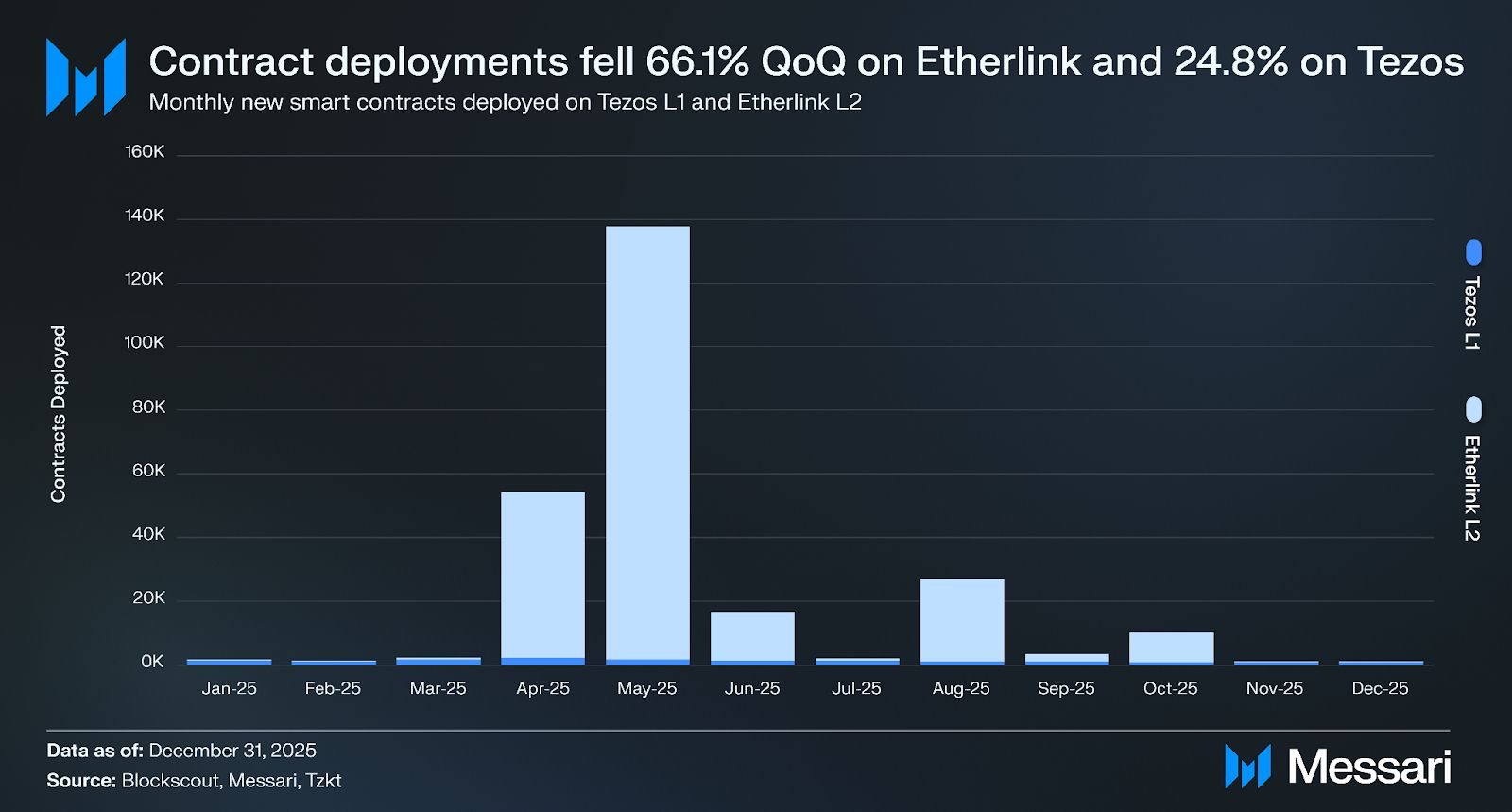
Despite a 24.8% and 66.1% QoQ decline in contract deployments across both Tezos L1 and Etherlink L2, respectively, over 12,000 smart contracts were deployed across both networks in Q4'25. The Q3’25 deployment spike, largely driven by Apple Farm Season 2 launches and Kernel 4.1 tooling, inflated the baseline that Q4 was measured against. Etherlink deployments fell to 9,760, though several new protocols, such as UltraYield and Reaper Actual, deployed their initial contracts during the quarter. On Tezos L1, the Tallinn upgrade proposal introduced contract-level changes to address indexing and storage costs, which may influence deployment patterns going forward. Quarterly contract deployments on Etherlink declined to 9,760, down 66.1% QoQ from 28,780 in Q3’25. Tezos L1 deployments had a smaller drop to 2,780, a 24.8% QoQ decrease.
As of December 2025, Tezos continues to maintain a growing base of active open‑source contributors, with 229 monthly active developers working across more than 4,300 Git repositories, a 16.2% QoQ increase from Q3’25.
Economic Security
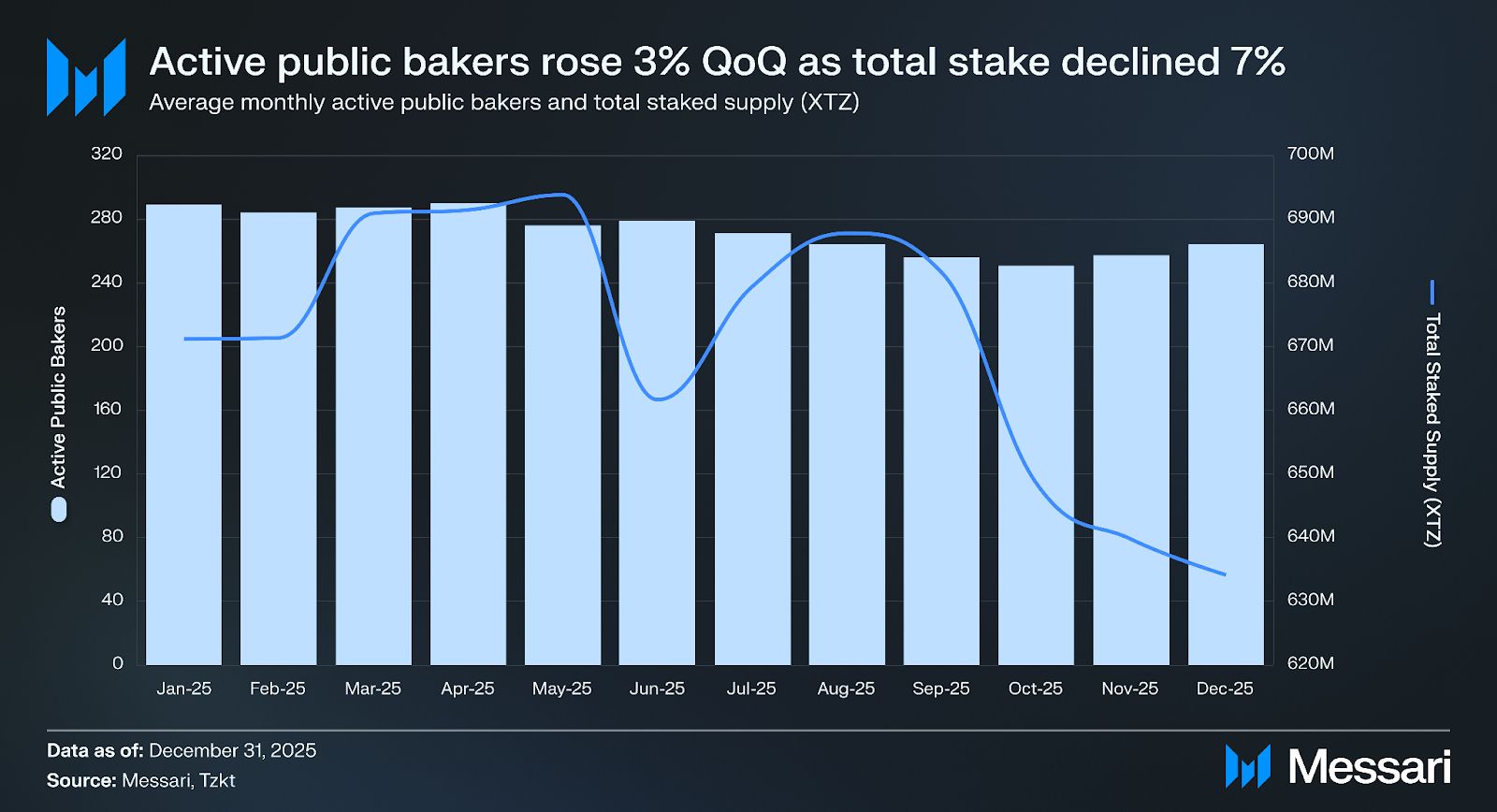
Tezos uses a Liquid Proof-of-Stake (LPoS) mechanism, which requires validators (known as “bakers” in the Tezos ecosystem) and delegators to stake XTZ as collateral to secure the network. Rewards and fees collected from transactions are paid to validators and delegators to maintain the network. In Q4 2025, the number of active public validators grew 3% QoQ, from 256 in September 2025 to 264 in December 2025. Public validators make a fraction of the total validator set. Total stake decreased 8.1% over the same period, decreasing from 688.1 million XTZ to 633.1 million XTZ. Despite the ongoing downtrend in staking participation, overall staking levels have remained stable, indicating continued network security and economic alignment among participants.
Adaptive Issuance dynamically adjusts the issuance of XTZ based on the proportion of staked tokens to the total supply. At the end of each blockchain cycle, the issuance rate is modified to target a protocol-defined staking level, currently set at 50%. This mechanism incentivizes staking to provide stable security for the network.
The Tezos network has demonstrated consistent year-over-year stability in the number of validators and delegators, as well as in the amount of staked XTZ. This stability is crucial for secure and scalable L2 growth. Validators in the ecosystem are also decentralized geographically and by host service providers, further ensuring the network's resilience and security.
Ecosystem Overview
Two back-to-back kernel upgrades on Etherlink reshaped the network’s throughput in Q4’25. Additionally, the technical issue with Farfadet prompted additional onchain activity to pass the 6.1 patch within 72 hours. On the L1 side, the Tallinn protocol upgrade entered its exploration vote in December and reached promotion by December 27, 2025. Meanwhile, Etherlink consolidated its position as the primary DeFi venue across the Tezos ecosystem, accounting for roughly 68% of the combined TVL by the end of Q4. New entrants like Reaper Actual and UltraYield, along with MEXC’s native XTZ deposit support in November 2025, broadened Etherlink’s reach beyond its existing DeFi user base. The Tezos art community also had a strong quarter, highlighted by the Art on Tezos festival in Berlin and the 12 Days of Tezmas campaign.
DeFi
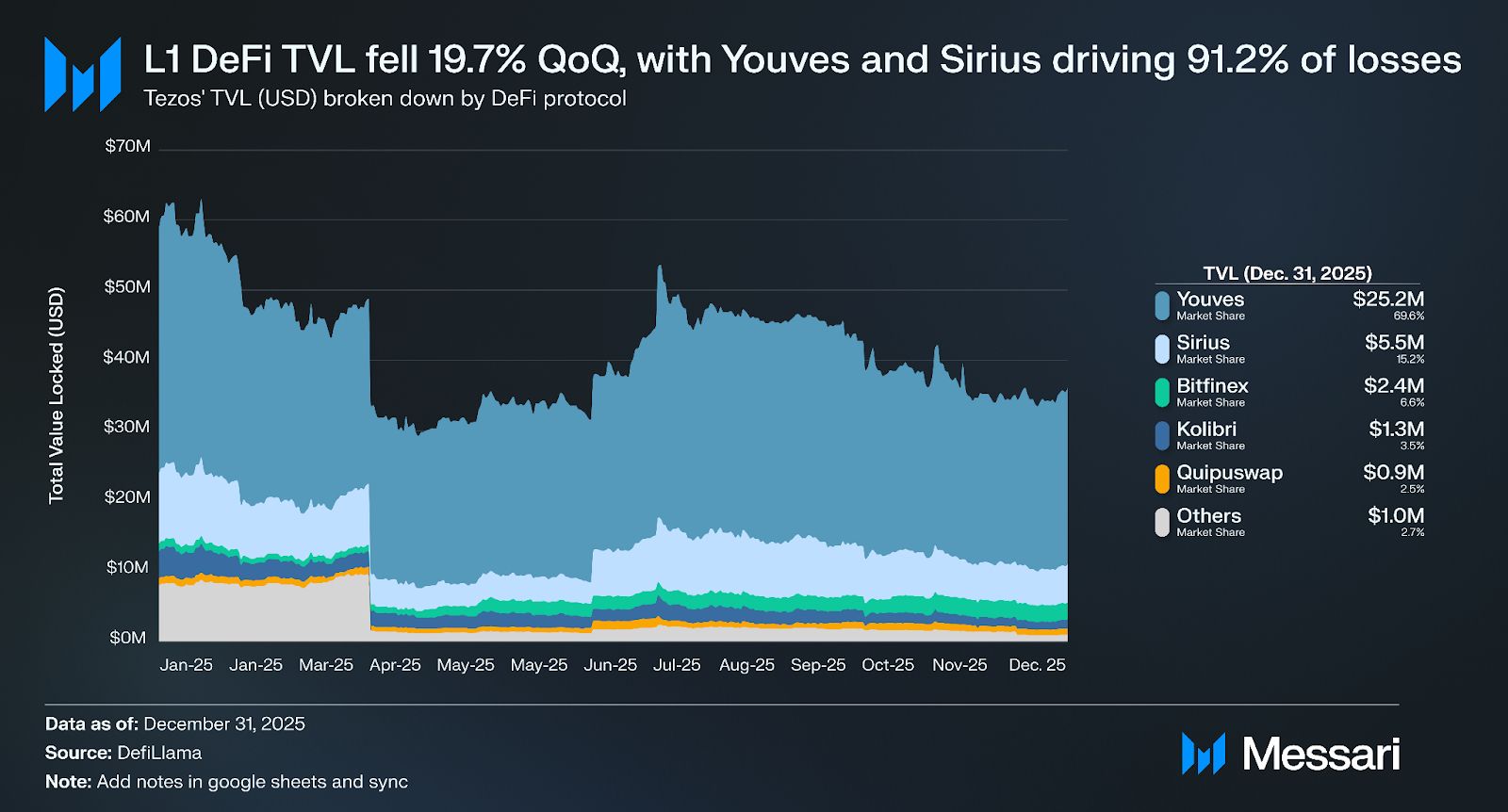
Tezos’ DeFi TVL fell 19.7% QoQ to $36.2 million. The decline was driven largely by Youves, due to its dominant share of TVL in the Tezos ecosystem. A robust DeFi ecosystem can create a more vibrant and self-sustaining economy on Tezos, providing users with opportunities to earn yields, trade assets, and access financial services.
Youves: A suite of tools for onchain treasuries and synthetic assets on Tezos L1.
Youves had the largest contribution to the overall decline in DeFi TVL on Tezos. Its TVL declined 19.8% from $31.4 million to $25.2 million; however, Youves remained the dominant protocol, capturing 69.6% of TVL in Q4’25.
Sirius: A liquidity venue that facilitates swaps across XTZ and wrapped BTC (tzBTC).
Sirius ended Q4 with $5.5 million in TVL. This is a 25.5% decrease from the previous quarter. However, its market share only declined from 16.3% to 15.2% of the network's TVL.
Bitfinex: Provides custodial staking and liquidity channels that connect institutional users to Tezos.
Bitfinex closed Q4 with $2.4 million in TVL, a 20.5% QoQ increase from Q3. As a result, its market share increased from 4.4% to 6.6%.
Kolibri: An overcollateralized stablecoin backed by onchain collateral on Tezos.
Kolibri ended Q4 with $1.3 million in TVL, a 23.6% QoQ decline, while its share of overall TVL fell from 3.7% to 3.5%.
QuipuSwap V1/V2: A concentrated-liquidity AMM that supports fee tiers and tighter pricing around the middle bands. While assets are primarily concentrated on V2, QuipuSwap V1 provides a legacy constant-product AMM that continues to serve long-tail assets.
Together, Quipuswap V1 and V2 ended Q4 with a TVL of $0.89 million, a 0.2% decline from Q3.
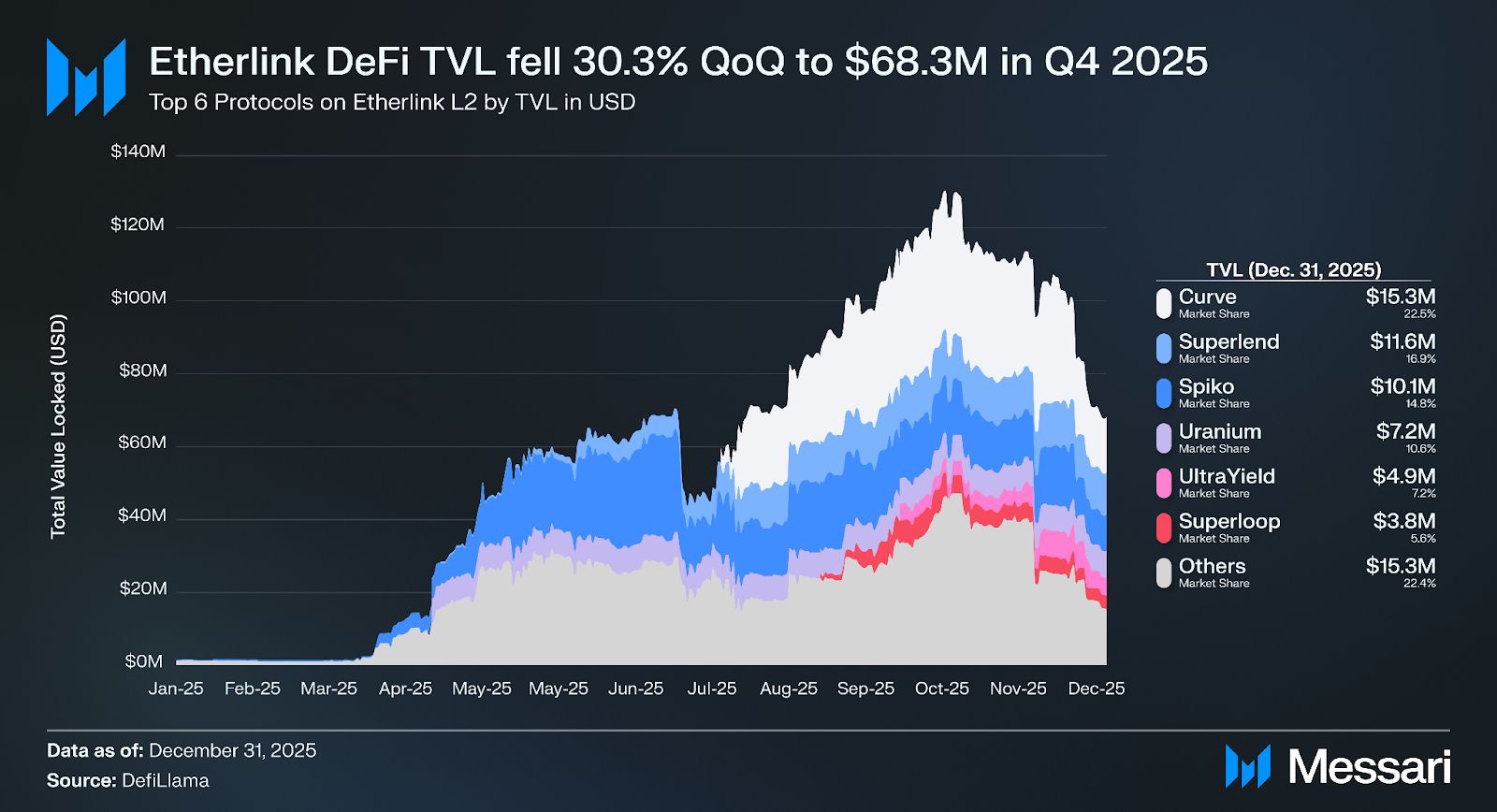
Etherlink’s DeFi TVL fell 30.3% QoQ to $68.3 million. This decline was largely driven by Curve, which lost a significant share of the TVL in the Etherlink ecosystem in Q4’25. The Etherlink DeFi ecosystem has quickly become the primary venue for DeFi liquidity across both Tezos L1 and Etherlink L2.
Curve: A concentrated-liquidity AMM on Etherlink that supports fee tiers and tight ranges for stable and volatile pairs. Liquidity concentrates in a small set of core pools, which aggregate most routing.
Curve had the largest drop in DeFi TVL on Etherlink in Q4. Its TVL declined from $31 million in August to $15.3 million, a 50.4% drop that accounted for 52.7% of the overall TVL loss. Curve remains the dominant DeFi destination on Tezos, accounting for 22.5% of all TVL on Etherlink in Q4 2025.
Curve did not become active on Etherlink until August 2025
Superlend: A lending and borrowing market with variable rates and risk controls tuned for Etherlink.
Superlend ended Q4 with $11.6 million in TVL, a 1.3% increase from the previous quarter. Notably, its market share increased from 11.7% to 16.9% of the network's TVL.
Superloop, a subset of Superlend, is infrastructure for moving assets and liquidity across Etherlink and connected venues with lower operational overhead. Superloop launched in September 2025 and ended Q4 with a TVL of $3.8 million, capturing 5.6% of all DeFi TVL Q4’25.
Spiko: Issues tokenized money market funds on Etherlink, offering UCITS-style shares backed by U.S. and EU T-Bills that settle onchain.
Spiko closed Q4 with $10.1 million in TVL, a 38.1% QoQ decrease from Q3 2025. Its market share decreased from 16.6% to 14.8%, likely reflecting broader outflows as Apple Farm incentives wound down and Curve’s TVL contraction reduced the liquidity available for pairing with Spiko’s tokenized fund shares.
Uranium: A tokenized-commodity platform on Etherlink that gives investors direct, onchain ownership and transfer of physical uranium held with regulated custodians.
Uranium ended Q4 with a TVL of $7.2 million, a 0.1% decrease QoQ. Uranium saw its market share increase from 7.4% to 10.6% even as larger protocols like Curve experienced a TVL reduction.
UltraYield: A vault curator built by the hedge fund, Edge Capital, that manages market-neutral yield strategies on behalf of depositors.
Ultrayield launched in October 2025 and finished Q4 with $4.9 million in TVL, capturing 7.2% of Etherlink's overall TVL in its first active quarter.
Protocol Interactions
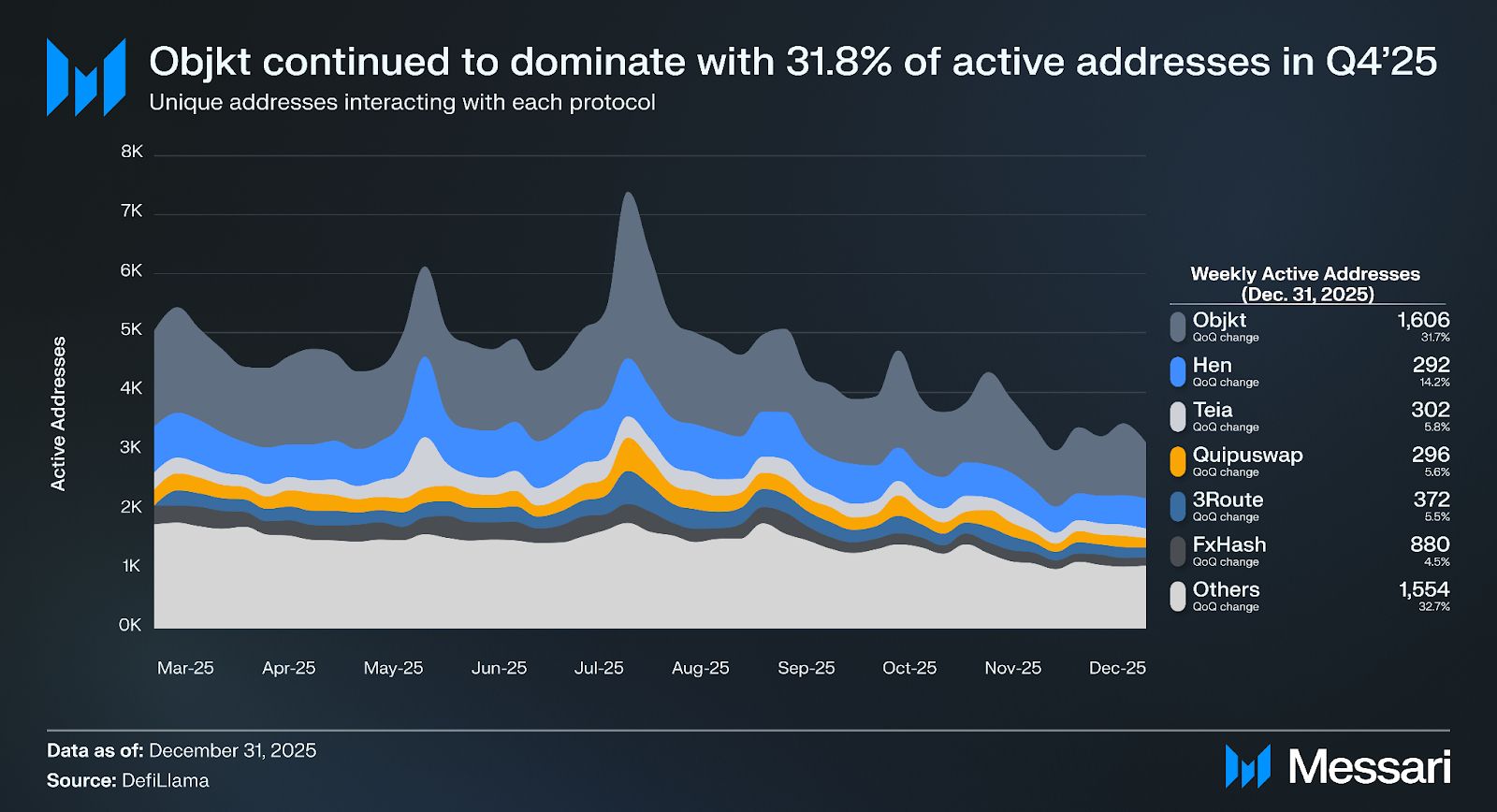
Objkt remained the leading marketplace on Tezos by unique address activity, averaging 1,170 weekly active addresses in Q4 2025, a 25.3% QoQ decrease from 1,570. Objkt continued to dominate the NFT category, maintaining the largest share of active users across the network. Objktlabs launched drop.art, enabling artists to release blind mint drops with fully customizable landing pages. In the DeFi category, QuipuSwap and 3route experienced similar declines. QuipuSwap fell from 305 to 207 average weekly users, while 3route fell from 317 to 204. The “Others” category, which includes dozens of smaller or emerging protocols, fell from 1,560 to 1,210 weekly active addresses, representing a similar decline in participation across the long tail of applications.
Community & Development
Q4 was the strongest quarter for Tezos art events in 2025. The flagship Art on Tezos: Berlin festival ran from November 6–9, 2025, drawing over 700 visitors and featuring more than 200 artists and platforms across exhibitions, talks, and live performances. Francisco Carolinum's acquisition of 15 pieces from the TeleNFT exhibit at the festival marked a major milestone for institutional investment in onchain art. Another notable sale during the event was qubibi’s generative work, “hello world,” which sold for 62,000 XTZ. At the Paris Photo fair, Artverse presented a booth featuring prominent artists Niceaunties, Grant Yun, Reuben Wu, Shavonne Wong, Emi Kusano, and Genesis Kai, several of whom were releasing works on Tezos for the first time. The Museum of the Moving Image and the Tezos Foundation renewed their partnership, this time focusing on blockchain as a creative medium. The first commissioned work, ‘Contingent’ by James Bloom and Gottfried Jager, opened at MoMI in November 2025. The 12 Days of Tezmas campaign ran from December 12–23, 2025, and offered daily artistic rewards through quests and raffles. Tezos Wrapped ran alongside this campaign, offering users a personalized onchain activity recap for 2025. On the education side, the Tezos Foundation expanded its partnership with the Processing Foundation to produce a series of p5.js 2.0 tutorials led by generative artists, with interactive artwork releases on EditArt.
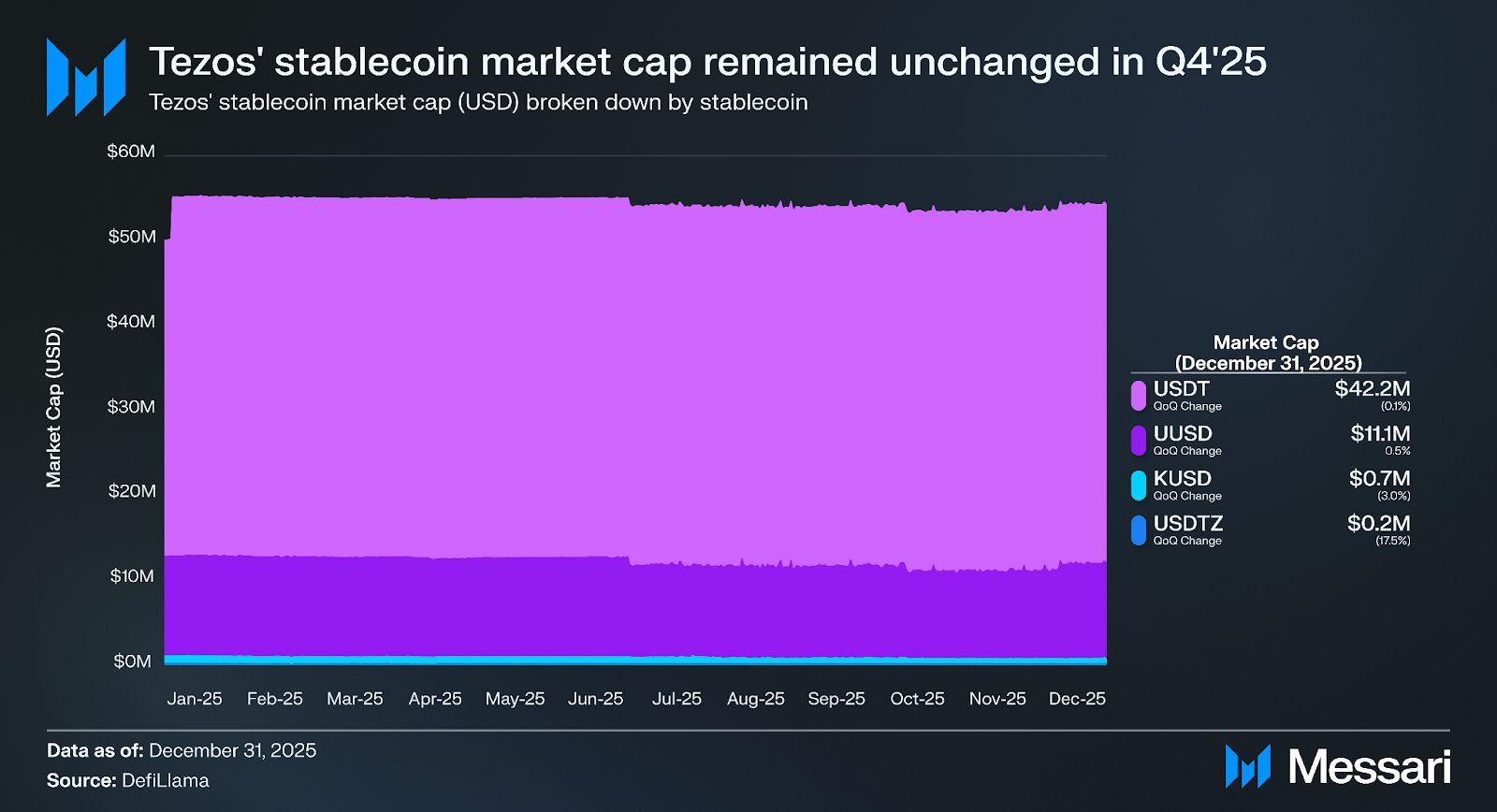
The circulating supply of stablecoins on Tezos remained largely unchanged, declining only 0.1% QoQ, from $54.3 million to $54.2 million. USDT remained the dominant stablecoin on the network with $42.2 million in issuance, followed by uUSD at $11.1 million. The largest Tezos-native stablecoins, kUSD and USDTez, had a circulation of $650,680 and $224,340, respectively. The small decrease in TVL was primarily driven by a decrease in the balance of USDT and USDtez, while uUSD remained stable throughout the quarter.
Closing Summary
In Q4 2025, Tezos’ center of gravity continued to shift toward Etherlink, extending a trend that began earlier in the year. Etherlink transactions rose 50% QoQ to 18.6 million, and daily active addresses nearly doubled to 9,860, while L1 transactions and DAAs fell 11.2% and 28.1%, respectively. DeFi liquidity declined on both layers, with Etherlink TVL dropping 39.3% QoQ to $37.2 million, with Curve accounting for over half of that loss. L1 TVL saw a softer decline, falling 18.2% to $33.5 million as XTZ's price declined 26.1% QoQ.
Infrastructure was the quarter's clear highlight. Two kernel upgrades, Ebisu in October and Farfadet in December 2025, raised Etherlink's throughput from 8 million to 27 million gas per second and introduced instant transaction confirmations. On Tezos L1, the Tallinn upgrade reached its promotion period just before year-end, bringing reduced block times, address indexing, and tighter finality guarantees. Developer activity expanded as well, with monthly active contributors rising 16.2% QoQ to 229 across more than 4,300 repositories, and the Tezos art community had its strongest quarter of the year with Art on Tezos: Berlin, a booth at Paris Photo in collaboration with ArtVerse, and the renewal of the MoMI x Tezos Foundation Partnership.
Heading into 2026, attention shifts to whether recent infrastructure upgrades can support sustained liquidity and usage beyond incentive-driven activity such as Apple Farm. Tallinn's reduced block times will lower L1 costs for Etherlink's rollup posting, but the end of Apple Farm Season 2 creates a natural test of organic demand going forward. Superlend, Uranium, and UltraYield held or modestly grew TVL through the incentive wind-down, indicating that a portion of Etherlink’s DeFi activity persisted beyond subsidized liquidity, though longer-term sustainability remains unproven.
This report was commissioned by the Tezos Foundation. All content was produced independently by the author(s) and does not necessarily reflect the opinions of Messari, Inc. or the organization that requested the report. The commissioning organization may have input on the content of the report, but Messari maintains editorial control over the final report to retain data accuracy and objectivity. Author(s) may hold cryptocurrencies named in this report. This report is meant for informational purposes only. It is not meant to serve as investment advice. You should conduct your own research and consult an independent financial, tax, or legal advisor before making any investment decisions. Past performance of any asset is not indicative of future results. Please see our Terms of Service for more information.
No part of this report may be (a) copied, photocopied, duplicated in any form by any means or (b) redistributed without the prior written consent of Messari®.