The content of this report was produced independently by the author(s) and does not necessarily reflect the opinions of Messari, Inc. (“Messari”) or any of the organizations that requested the report. Messari and/or the author(s) are solely responsible for the content of the report and all editorial decisions. Author(s) may hold cryptocurrencies named in this report. This report is meant for informational purposes only. It is not meant to serve as investment advice. You should conduct your own research and consult an independent financial, tax, or legal advisor before making any investment decisions. Past performance of any asset is not indicative of future results. Please see our Terms of Service for more information.
Quarterly ReportsLayer-1
State of Solana Q1 2026

Key Insights
- Real-world asset (RWA) market cap on Solana grew 43% QoQ to $2.01 billion, led by BlackRock's BUIDL doubling to $525.4 million after Anchorage Digital added custody support, PRIME rising 124% QoQ to $361.2 million via Kamino integration, and ONyc growing 101% QoQ to $145.4 million.
- Chain GDP, Solana's total application revenue, held essentially flat quarter-over-quarter (QoQ) at $342.2 million, led by Pump.fun ($124.7 million, up 17% QoQ), Axiom ($42.4 million, up 36% QoQ), and Bags (up 1,347% QoQ to $11.5 million on January's AI meta). App Revenue Capture Ratio (App RCR) ticked up from 379% to 382%, making Solana a strong platform for apps to build sustainable businesses on.
- DeFi total value locked (TVL) declined 22% QoQ to $6.16 billion, with the contraction driven primarily by SOL's 33% price decline rather than user attrition; Solana's share of total DeFi TVL held roughly flat at 6.7%. Kamino reclaimed the top protocol spot at $1.72 billion, edging out Jupiter ($1.69 billion) and Raydium ($992.5 million), while the lending standout was PRIME, whose deposits rose 121% QoQ to $330.3 million following its Kamino integration.
- REV, the sum of vote, base, and priority transaction fees plus MEV tips paid to validators, declined just 1% QoQ to $89.5 million, ranking Solana second among all networks behind Hyperliquid ($156.0 million).
- Alpenglow, Solana's most consequential consensus upgrade, is targeted for the Agave 4.1 release and would replace Proof-of-History (PoH), Tower BFT, and gossip-based vote propagation with Rotor (data propagation) and Votor (offchain voting), reducing transaction finality from roughly 12.8 seconds to 150 milliseconds.
Primer
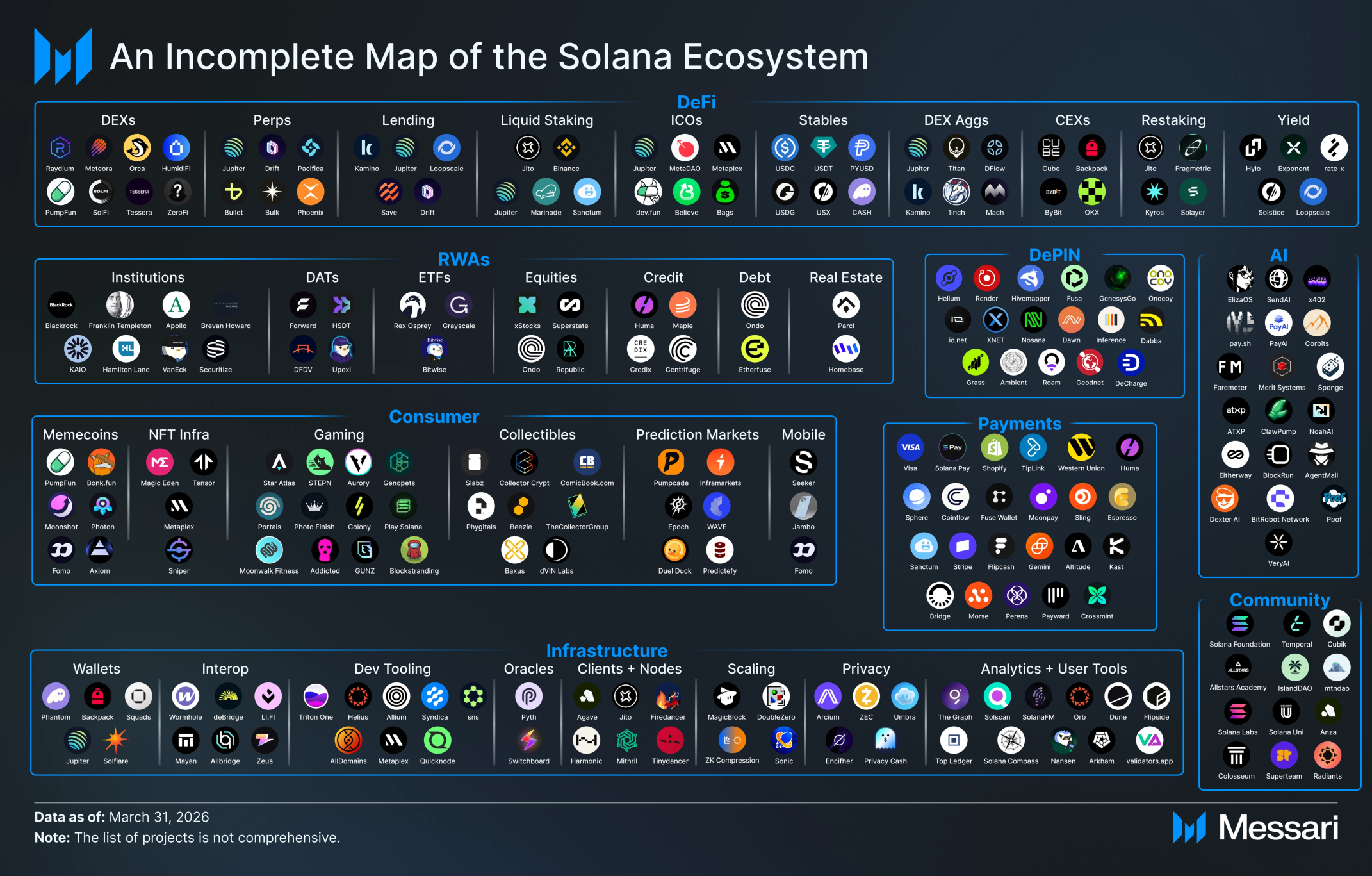
Solana (SOL) is an integrated, open-source Layer-1 network with the goal of synchronizing global information at the speed of light. Solana optimizes for increasing bandwidth and reducing latency. It accomplishes this through features such as its novel timestamp mechanism called Proof-of-History (PoH), a block propagation protocol called Turbine, and parallel transaction processing. Since mainnet launch in March 2020, several network upgrades have brought further network performance and resilience, including QUIC, stake-weighted Quality of Service (QoS), and local fee markets.
The network’s development and growth, and its ecosystem are supported by the non-profit Solana Foundation, for-profit Solana Labs, and various third-party organizations, including Anza, Colosseum, Helius, Superteam, and many others. Solana Labs has raised over $335 million in private and public token sales. Solana features a growing ecosystem of projects across many sectors, including DeFi, consumer, DePIN, and payments. To stay up-to-date with all things Solana, visit the Solana Portal.
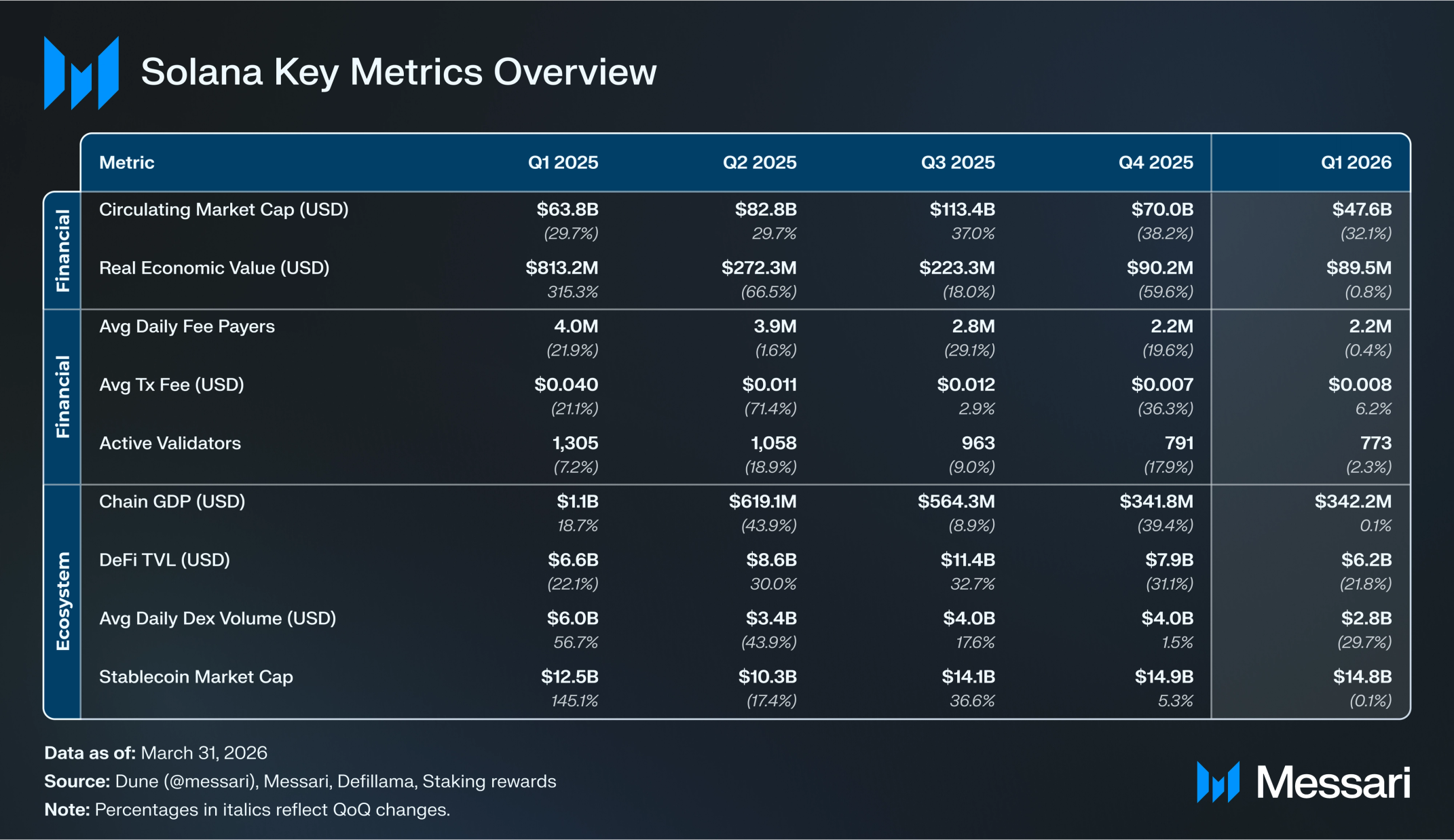
Key Metrics
Ecosystem Analysis
Application Revenue
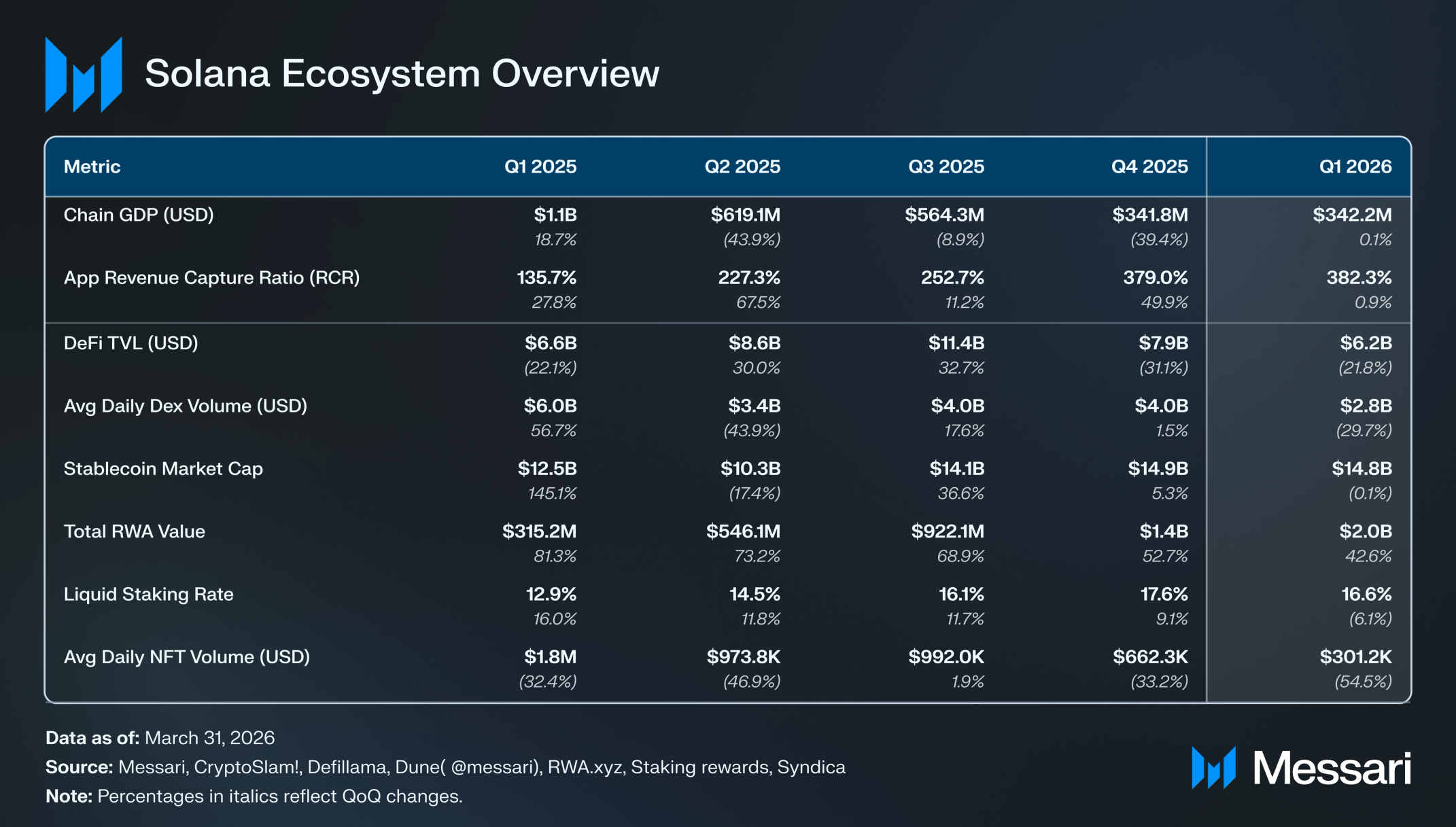
Chain GDP is defined as the total application revenue generated on a network. In total, Solana’s Chain GDP was essentially flat QoQ from $341.8 million in Q4’25 to $342.2 million in Q1’26.
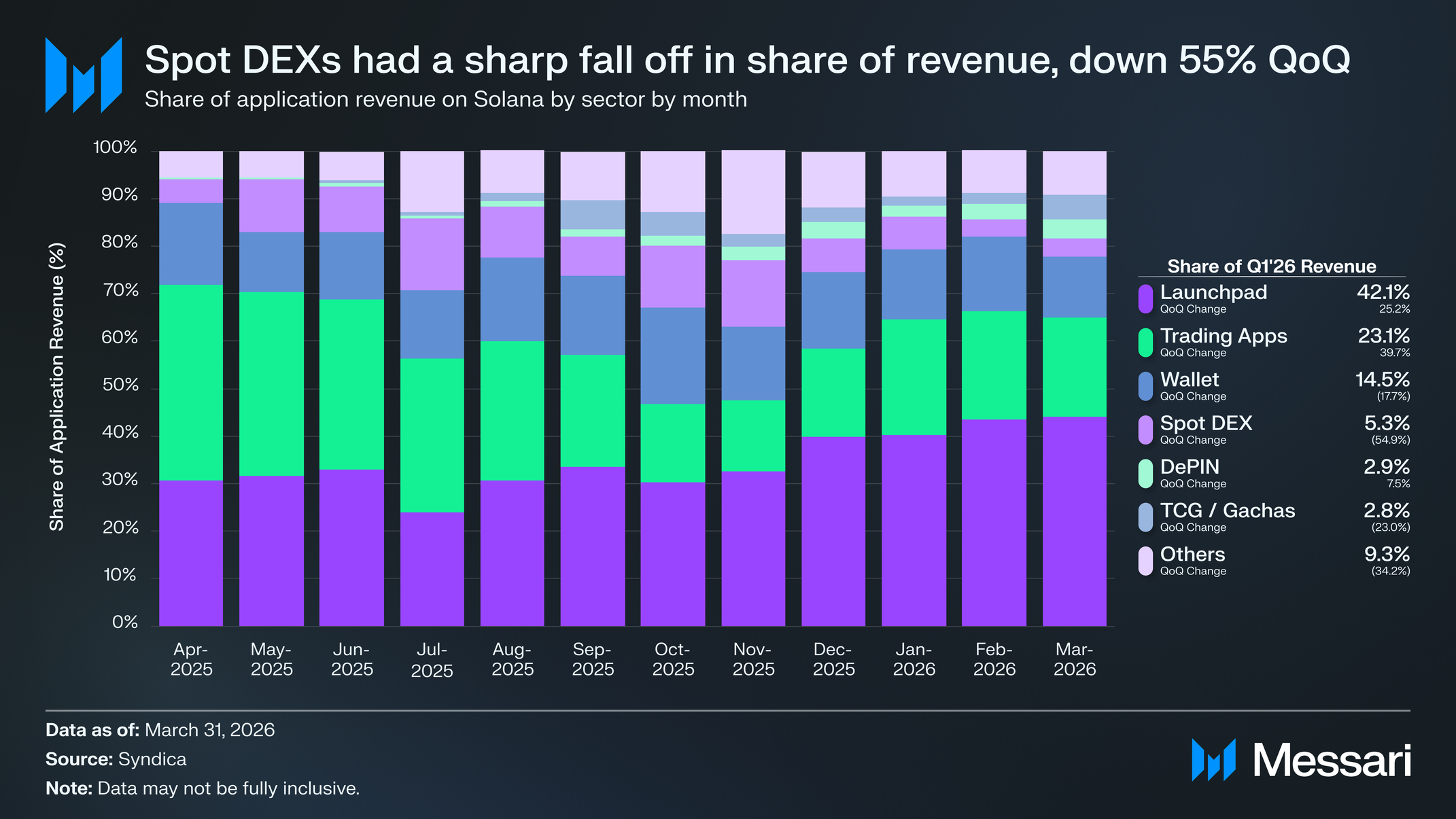
The biggest driver of application revenue on Solana is trading, specifically longtail trading such as memecoins and newly issued assets. Launchpads generate more revenue than any other sector as they facilitate the creation and initial trading of these high-velocity assets. As the initial trading venues, they become the primary facilitator of price discovery, allowing for higher revenue take rates compared to more traditional onchain trading venues. For Q1, they generated $144.0 million in revenue (up 25% QoQ), which was approximately 42% of Solana’s application revenue this quarter.
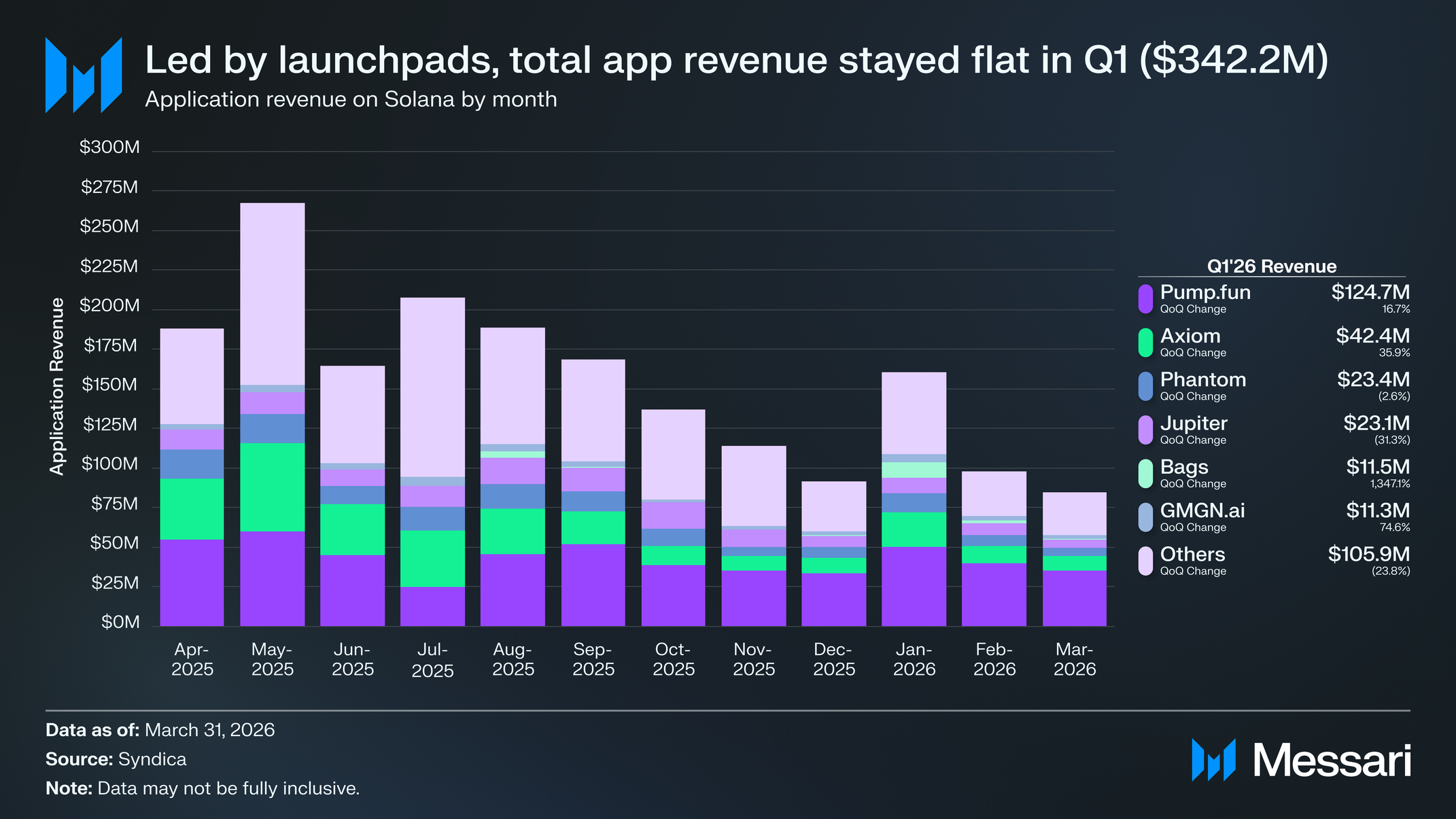
The largest application by revenue within the launchpad sector, and Solana as a whole, is Pump.fun, which generated $124.7 million in revenue in Q1, up 17% QoQ. Pump.fun’s core business has proven quite sticky despite increased competition, even as broad-based memecoin activity has declined.
Bags
A notable gainer within the launchpad sector in Q1 was Bags, whose revenue increased 1,347% QoQ from $792,800 to $11.5 million. Bags enables anyone to launch a coin and share associated trading fees with accounts across most social media platforms. The platform had breakout success in January, driven by advances in open-source AI, particularly projects like Ralph Wiggum and Gas Town. RALPH and GAS were memecoins deployed on Bags by third parties, who directed a portion of trading fee revenue to the creators of the underlying AI projects, Geoffrey Huntley (Ralph Wiggum) and Steve Yegge (Gas Town). While these memecoins generated millions in trading volume and helped spark a new wave of AI-related tokens, the momentum proved short-lived. Bags’ revenue declined 85% MoM, falling from $9.6 million in January to $1.5 million in February. Although this iteration of the “AI meta” was brief, it serves as another example of Solana’s role at the forefront of experimentation at the intersection of AI and crypto.
Fomo
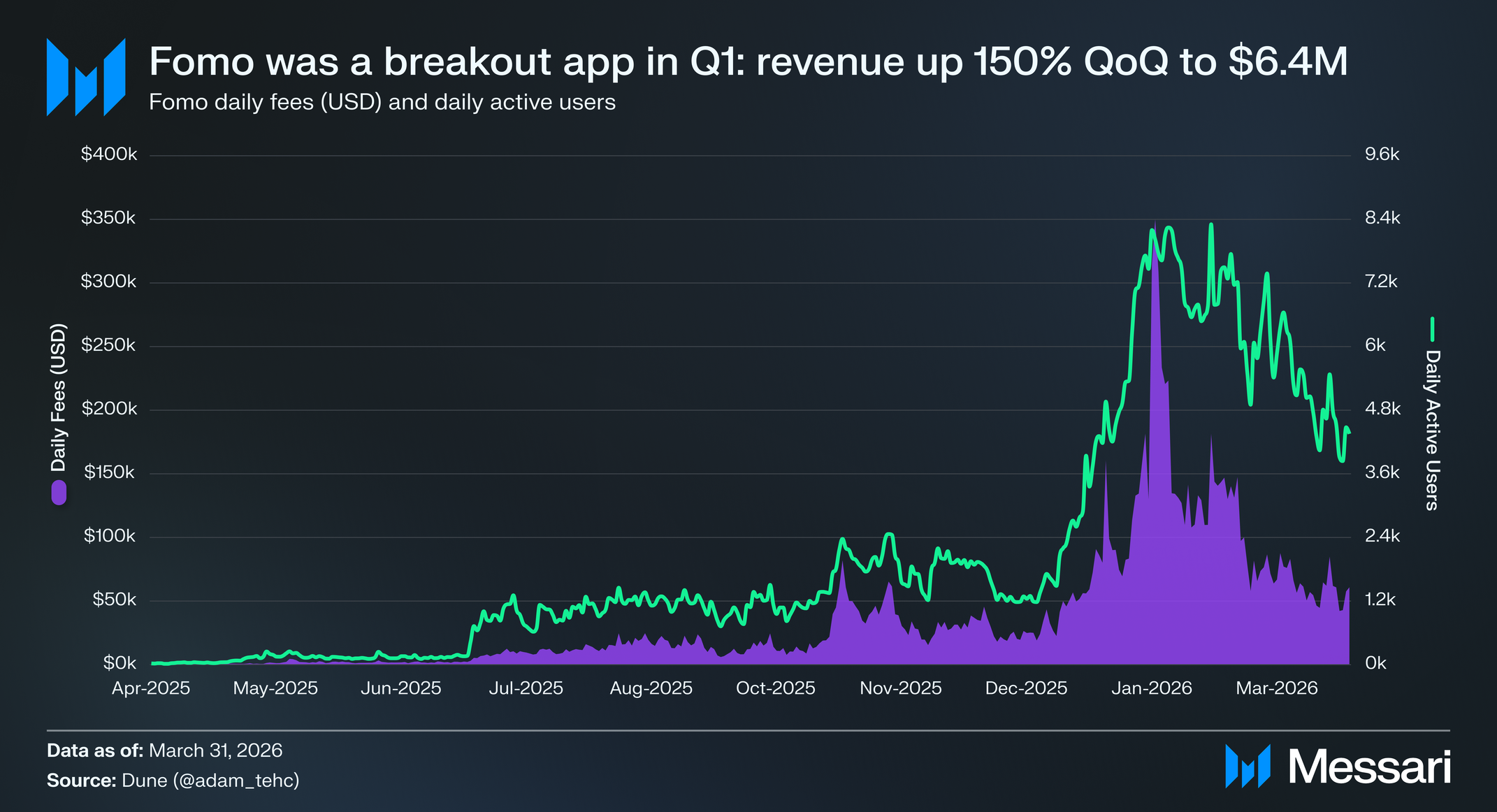
A secondary beneficiary of this Q1’26’s AI meta was Fomo. Fomo is a mobile trading app that introduces social elements. All trades, positions, PnL’s, etc. on the app are viewable by any other user, and users can follow other users on the platform to track their activity. Fomo had a large increase in both daily active users and fees in January as it became a popular venue to trade RALPH, GAS, and other popular memecoins on Solana. Compared to December, monthly fees increased 259% MoM to $3.1 million while average daily active users increased over 200% MoM to 4,600.
Beyond Fomo, the trading app sector recorded the largest QoQ revenue increase, rising 40% from $56.5 million to $79.0 million. Similar to launchpads, these platforms derive a majority of revenue from memecoin and other long-tail asset activity. However, the nature of this activity is evolving.
Memecoin trading has shifted from longer-duration, concentrated bets toward shorter holding periods and higher-frequency trading across a broader set of tokens. For example, the average hold time for tokens on Solana declined from 81 seconds in Q4 2025 to 57 seconds in Q1. This shift toward high-velocity trading favors trading apps, as their value proposition centers on enabling faster discovery and execution.
The trading app that generated the most revenue in Q1 was Axiom. At $42.4 million in revenue (up 36% QoQ), it accounted for over half of all trading app revenue and additionally had the second-most revenue across all applications on Solana.
Wallets ranked as the third-largest sector by revenue, generating $49.6 million in Q1, down 18% QoQ. Leading the category is Solana’s flagship wallet, Phantom, which brought in $23.4 million, a modest 3% decline over the same period. Like trading apps, Phantom’s revenue is primarily driven by in-wallet swaps, linking its business model closely to speculative trading activity.
Jupiter
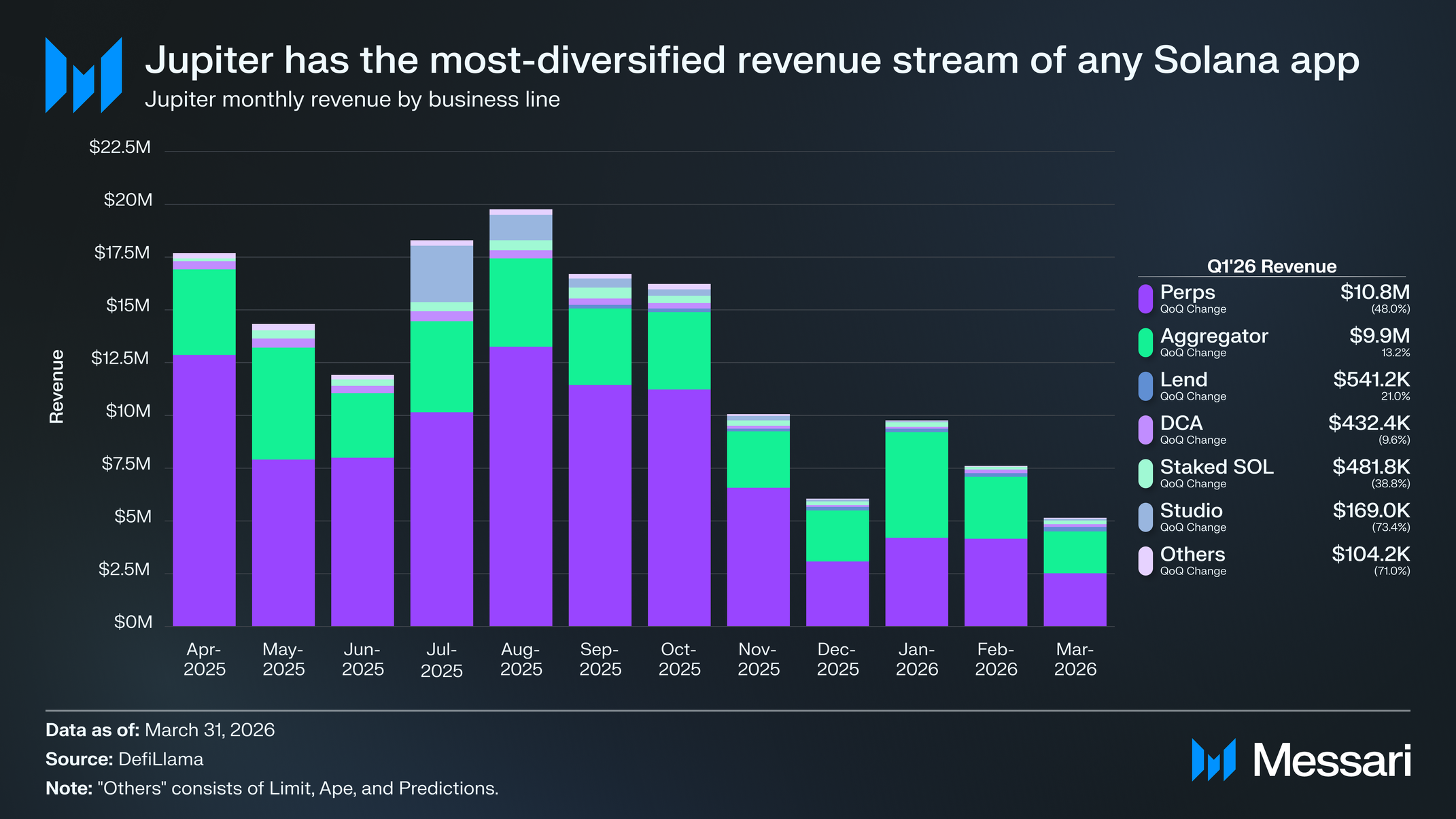
Following Phantom, Jupiter ranked as the fourth-highest revenue-generating application. While its revenue declined 31% QoQ, Jupiter stands out for having the most diversified revenue mix among Solana applications. In Q1, multiple product lines generated meaningful revenue, including Perps ($10.8 million) and the Aggregator ($9.9 million), alongside smaller but still material contributions from Lend ($541,200), DCA ($432,200), Staked SOL ($481,800), and Studio ($169,000), each exceeding six figures.
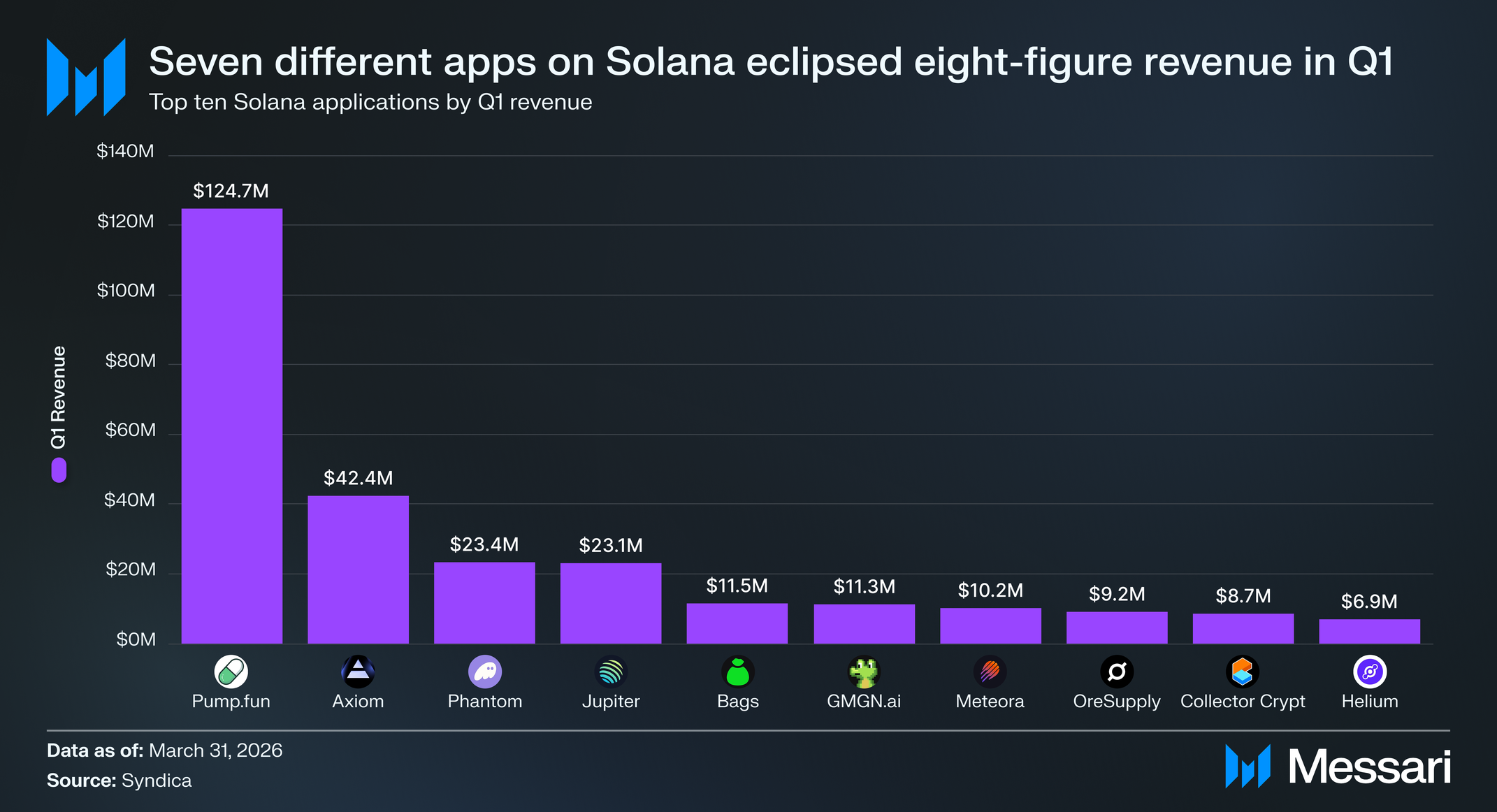
In sum, the top ten applications by revenue in Q1’26 were as follows:
- Pump.fun: $124.7 million (up 17% QoQ)
- Axiom: $42.4 million (up 36% QoQ)
- Phantom: $23.4 million (down 3% QoQ)
- Jupiter: $23.1 million (down 31% QoQ)
- Bags: $11.5 million (up 1,347% QoQ)
- GMGN.ai: $11.3 million (up 75% QoQ)
- Meteora: $10.2 million (down 62% QoQ)
- OreSupply: $9.2 million (down 40% QoQ)
- Collector Crypt: $8.7 million (down 4% QoQ)
- Helium: $6.9 million (up 32% QoQ)
App Revenue Capture Ratio (App RCR)
A network’s App Revenue Capture Ratio (RCR) is the ratio of revenue generated by its apps to its Real Economic Value (REV). REV is defined as the sum of base transaction fees, priority fees, and MEV tips paid to validators. App RCR reflects the efficiency with which applications leverage economic activity on the network. A higher App RCR suggests that application revenue is driven by lower-velocity, higher-margin activity such as lending, borrowing, or stablecoin-related flows. Conversely, a lower App RCR indicates that revenue is more closely tied to higher-velocity activity, such as trading, payments, or token launches, where economic throughput is higher, but monetization per unit of activity is lower.
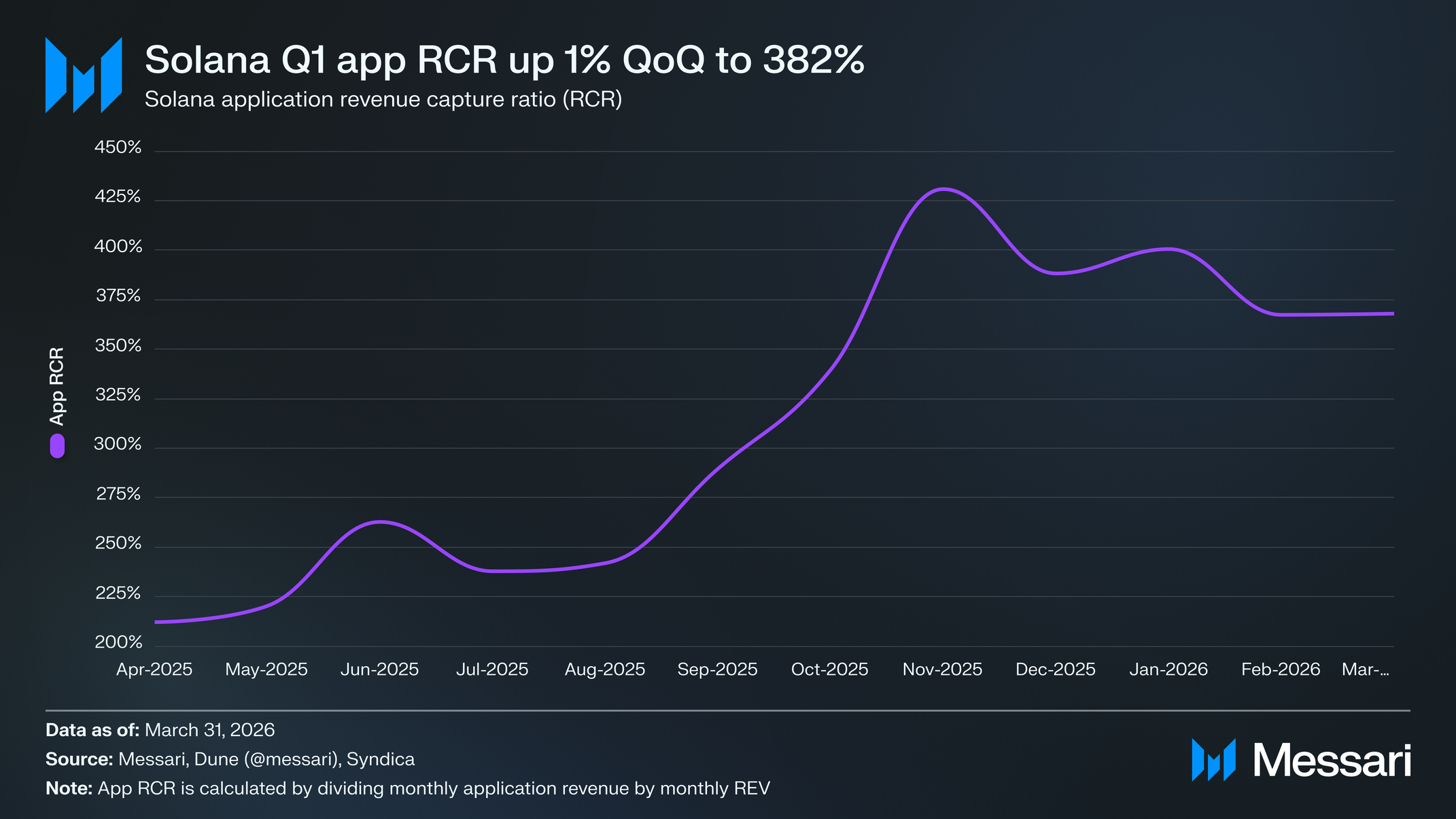
If App RCR equals 300%, this implies that for every $1 of REV generated by the network, $3.00 is captured as revenue by apps. A network’s App RCR can exceed one when its applications successfully monetize activity, driving revenue streams for project teams and, potentially, tokenholders. In Q1 2026, App RCR on Solana was 382%, up from 379% in Q4’25.
DeFi
TVL
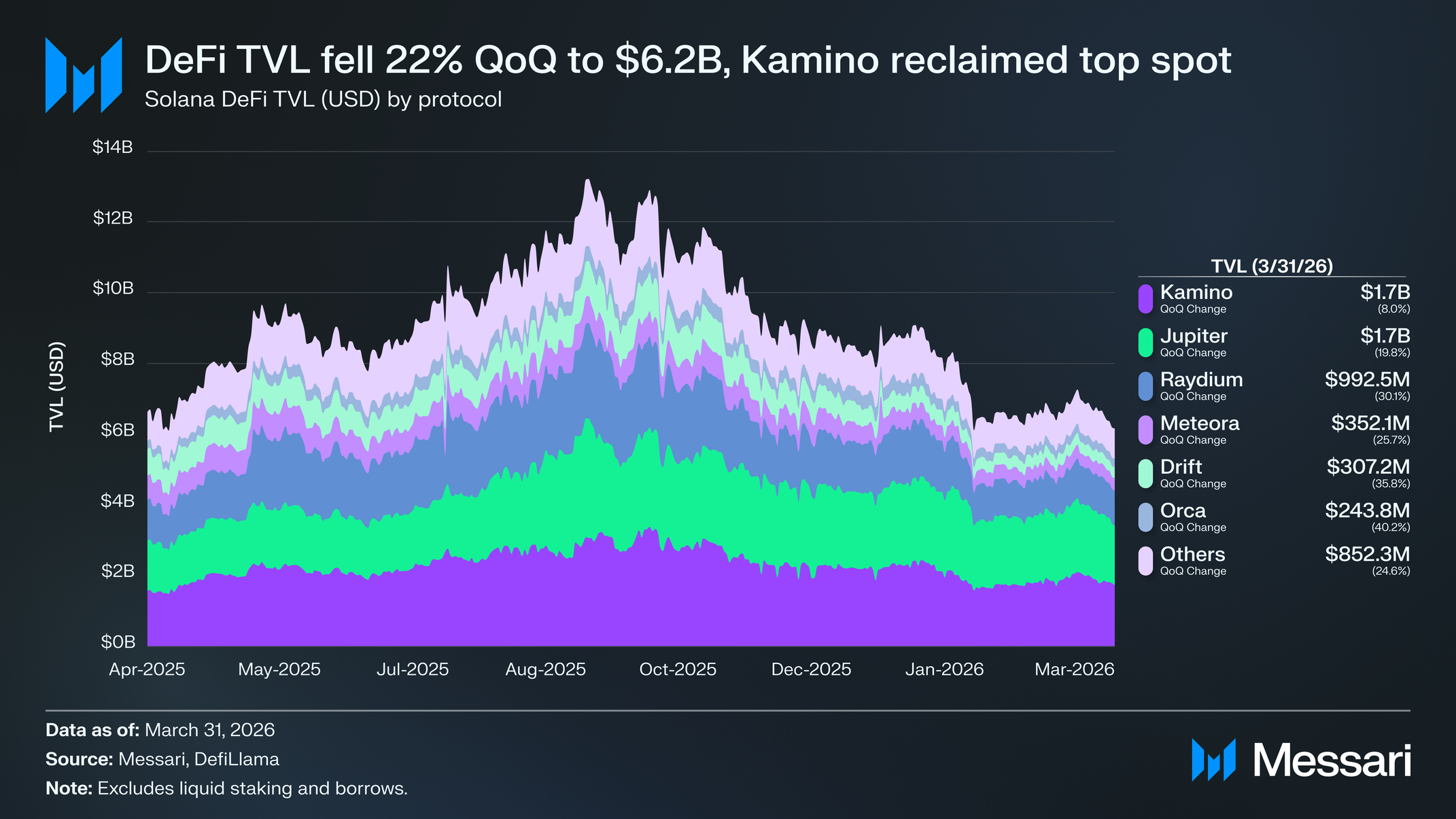
Solana’s DeFi TVL declined 22% QoQ to $6.16 billion, maintaining its second-place position among networks and representing 6.7% of total DeFi TVL. The decrease was largely driven by a 33% QoQ depreciation in SOL price, from $124.44 to $83.11. Notably, despite the decline in dollar-denominated TVL, Solana’s share of total DeFi TVL remained relatively stable, compared to 6.9% at the end of Q4. TVL contraction was broad-based across the industry, rather than specific to Solana.
The top two protocols by DeFi TVL are Kamino and Jupiter, which are also the primary lending and borrowing venues on Solana. Kamino reclaimed the top spot from Jupiter this quarter after its TVL declined slightly less, down 8% QoQ to $1.72 billion. Jupiter, on the other hand, had its TVL decline 20% QoQ to $1.69 billion. Of the $1.69 billion in TVL, $864.8 million came from Jupiter Lend.
Lending
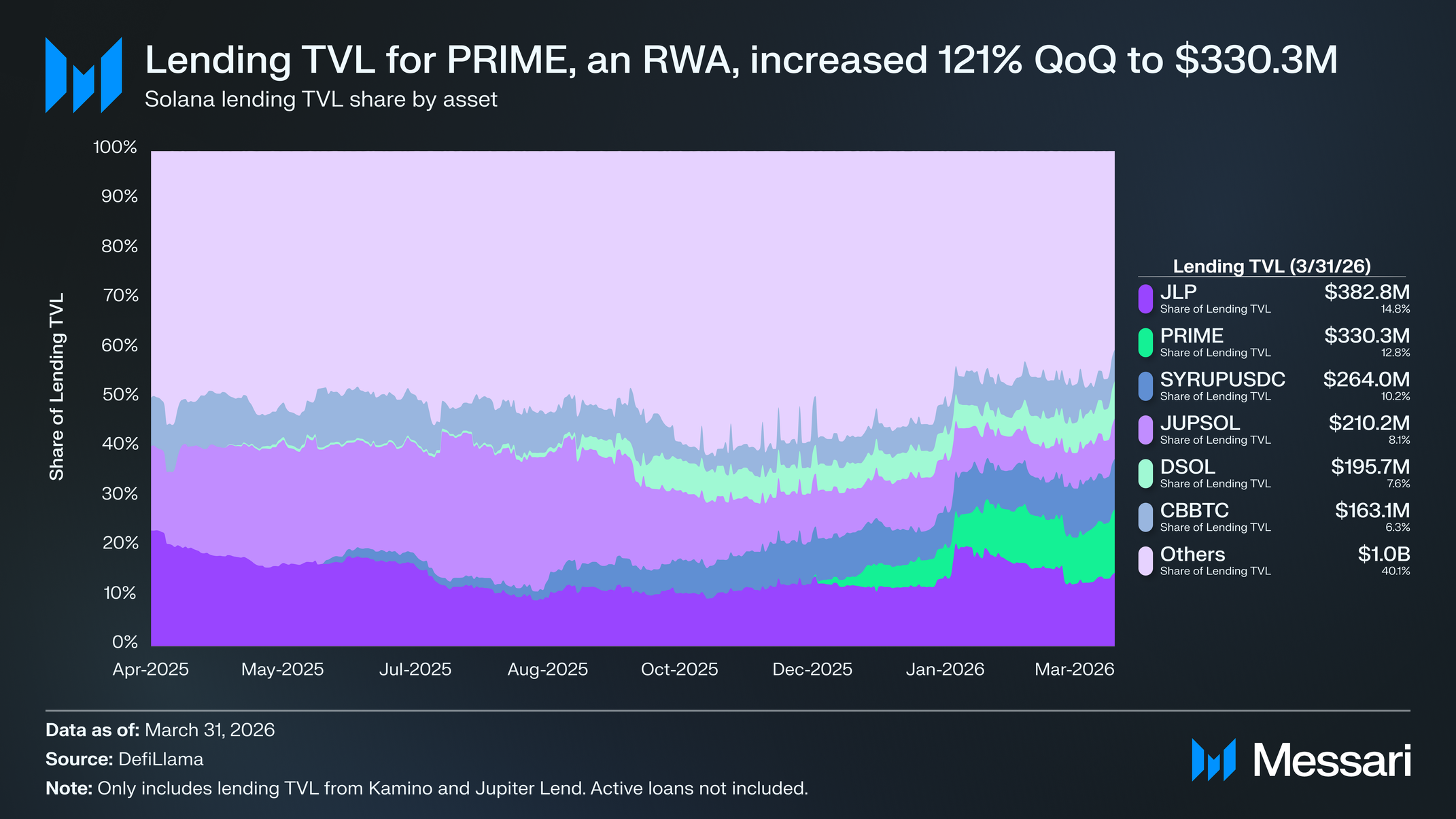
Breaking down deposits across Kamino and Jupiter Lend, JLP is the largest asset at $382.8 million, accounting for nearly 15% of total deposits. The most notable increase in Q1 came from PRIME, with deposits rising 121% QoQ to $330.3 million, representing roughly 13% of the total. PRIME is a tokenized asset that provides exposure to short-term, overcollateralized financing of newly originated HELOCs prior to securitization, allowing holders to earn yield. The majority of PRIME deposits were concentrated in Kamino, helping offset declines in its broader DeFi TVL.
The only other asset exceeding a 10% share of deposits was SYRUPUSDC, at $264.0 million (down 2% QoQ). SYRUPUSDC is a yield-bearing tokenized asset tied to Maple’s USDC lending vault, where returns are generated from overcollateralized loans to institutional borrowers.
Outside of the top six, one asset that had meaningful growth in lending TVL was OnRe’s ONyc, a yield-bearing tokenized asset that allocates stablecoin capital into private reinsurance markets, offering investors high, uncorrelated returns backed by real-world underwriting. Its deposits on Kamino grew 235% QoQ from $19.9 million to $66.6 million. Overall, Solana’s lending markets remain relatively well-diversified, with no single asset dominating the deposit base.
Active Loans
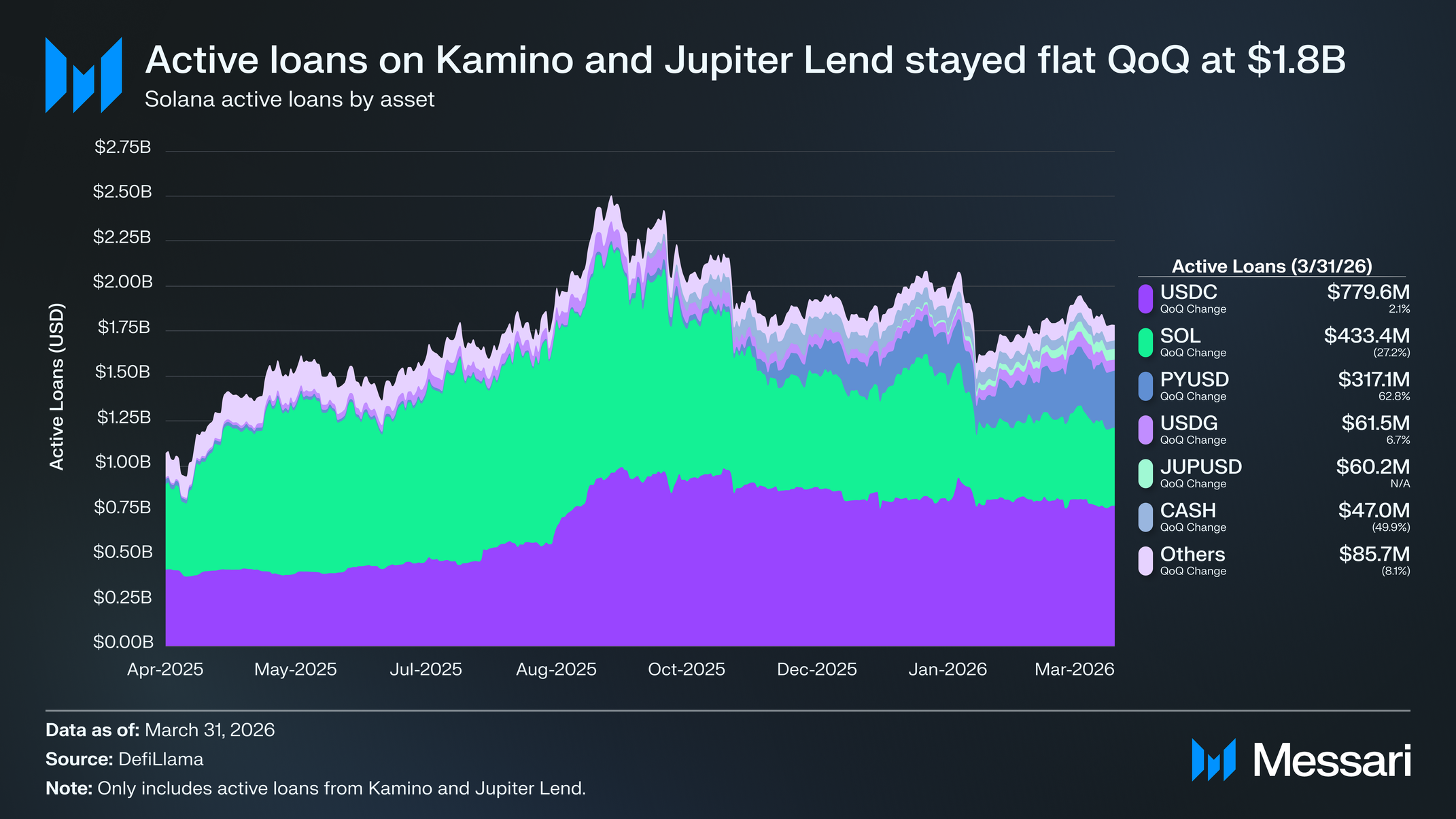
Active loans across Kamino and Jupiter Lend remained largely flat QoQ, declining slightly from $1.80 billion in Q4 to $1.78 billion in Q1. USDC continued to dominate as the primary borrowed asset, with $779.6 million in active loans, up 2% QoQ and representing 44% of active loans.
PYUSD had the strongest growth over the period, with active loans increasing 63% QoQ to $317.1 million. This growth was primarily driven by the Sentora PYUSD vault on Kamino, which offers a relatively higher APY than competing stablecoin markets, supplemented by weekly PYUSD-denominated incentives.
TVL by Protocol (continued)
Returning to DeFi TVL, Raydium ranked as the third-largest protocol in Q1, with $992.5 million in TVL, down 30% QoQ and accounting for roughly 16% of Solana’s total DeFi TVL. Given that a majority of Raydium’s liquidity is held in SOL and other SOL-denominated assets, this decline closely tracked SOL’s 33% QoQ price decrease.
Beyond Raydium, there is a notable drop-off in TVL. Meteora ranked fourth with $352.1 million (down 26% QoQ), followed by Drift in fifth with $307.2 million (down 36% QoQ). In aggregate, the top five protocols accounted for $5.06 billion in TVL, representing approximately 82% of Solana’s total DeFi TVL.
Of note, after the quarter ended, Drift suffered an exploit that resulted in the loss of TVL. For more information, please check out the Drift V2 Exploit event page on Messari.
Drift V2 Exploit
Event Timeline · 4 updates
Apr 5, 2026, 3:58 PM UTC
The Drift team has published an update on the V2 exploit, assessing with "medium-high confidence" that the attack was carried out by the same threat actors responsible for the October 2024 Radiant Capital hack, attributed by Mandiant to UNC4736, a North Korean state-affiliated group.
While the investigation is ongoing, the preliminary report describes a social engineering operation that has been approximately six months in the making. In fall 2025, individuals presenting as a quantitative trading firm approached Drift contributors at a major crypto conference and established an ongoing Telegram group. The group continued to meet contributors in person at multiple major industry conferences across multiple countries over the following months. From December 2025 through January 2026, they onboarded an Ecosystem Vault on Drift, submitted strategy documentation, conducted multiple working sessions with contributors, and deposited over $1 million of their own capital. The Drift team states that the individuals who appeared in person were not North Korean nationals and that DPRK-linked threat actors operating at this level are known to deploy third-party intermediaries for in-person relationship-building.
The Drift team believes the exploit may have proceeded through three vectors:
- A contributor may have been compromised after cloning a code repository shared by the group. One possibility identified is a known VSCode and Cursor vulnerability that allowed silent arbitrary code execution simply by opening a file or folder, with no user prompt, warning, or clicks required. The security community was actively flagging this vulnerability from December 2025 through February 2026.
- A second contributor may have been compromised after downloading a TestFlight application the group presented as their wallet product.
- Forensic review of all affected devices, accounts, and communication histories is ongoing. The group's Telegram chats and malicious software were completely scrubbed at the time of the exploit.
Apr 2, 2026, 1:49 PM UTC
The Drift team has provided an update confirming ~$280 million was withdrawn during the attack. The incident combined Solana durable nonce accounts, which allowed transactions to be pre-signed weeks in advance with delayed execution, with unauthorized or misrepresented approvals obtained from at least two Security Council multisig members. The team has confirmed no smart contract bug or compromised seed phrases were involved.
The team outlined the following timeline of the attack:
- March 23: Four durable nonce accounts were created, two linked to Security Council multisig members and two attacker-controlled, enabling pre-signed transactions with delayed execution.
- March 27: Drift executed a planned Security Council migration due to a council member change. The attacker subsequently obtained durable nonce access from a member of the updated multisig.
- March 30: A new durable nonce account was created for a member of the updated multisig, maintaining the attacker's 2/5 signing access.
- April 1: Drift executed a legitimate test withdrawal from the insurance fund. Within ~1 minute, the attacker submitted two pre-signed durable nonce transactions executing a malicious admin transfer that granted protocol-level control. The attacker then introduced a malicious asset and removed withdrawal limits to extract funds.
Apr 1, 2026, 7:04 PM UTC
The Drift team has confirmed that the Drift Protocol is experiencing an active attack, and deposits and withdrawals have been suspended. The team is coordinating with security firms, bridges, and exchanges to contain the incident, and has committed to providing additional updates as more information becomes available.
Apr 1, 2026, 5:39 PM UTC
Multiple community members have reported a potential ongoing exploit of Drift V2. The suspected attacker appears to have extracted ~$200 million so far. The Drift team has acknowledged the reports and advised against depositing funds into the protocol while they investigate the issue.
Spot DEXs
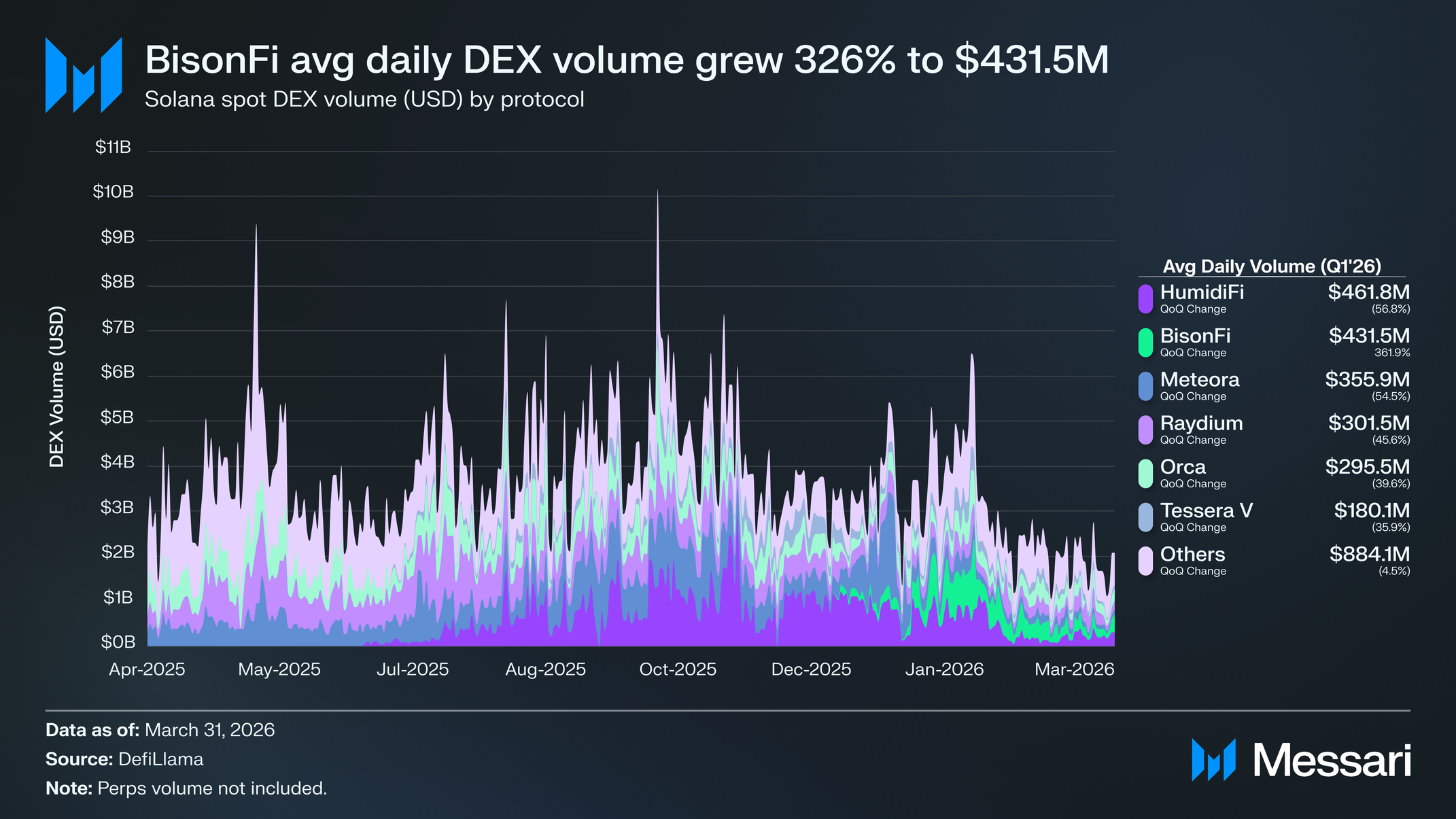
As crypto entered a bear market in Q1, DEX volumes fell across the industry. Solana was no exception, with average daily spot DEX volume declining 30% QoQ from $4.04 billion to $2.84 billion. However, Solana increased its share of spot DEX volume from 29% in Q4’25 to 33%.
Prop AMMs
There was also a continued shift in trading activity on Solana, away from longtail assets and toward SOL and other blue-chip assets, a trend that has been building over multiple quarters. This shift has been largely driven by the rise of Prop AMMs as these venues provide deep liquidity for major pairs, particularly SOL, by using offchain price oracles for real-time price discovery, enabling tighter spreads and better execution.
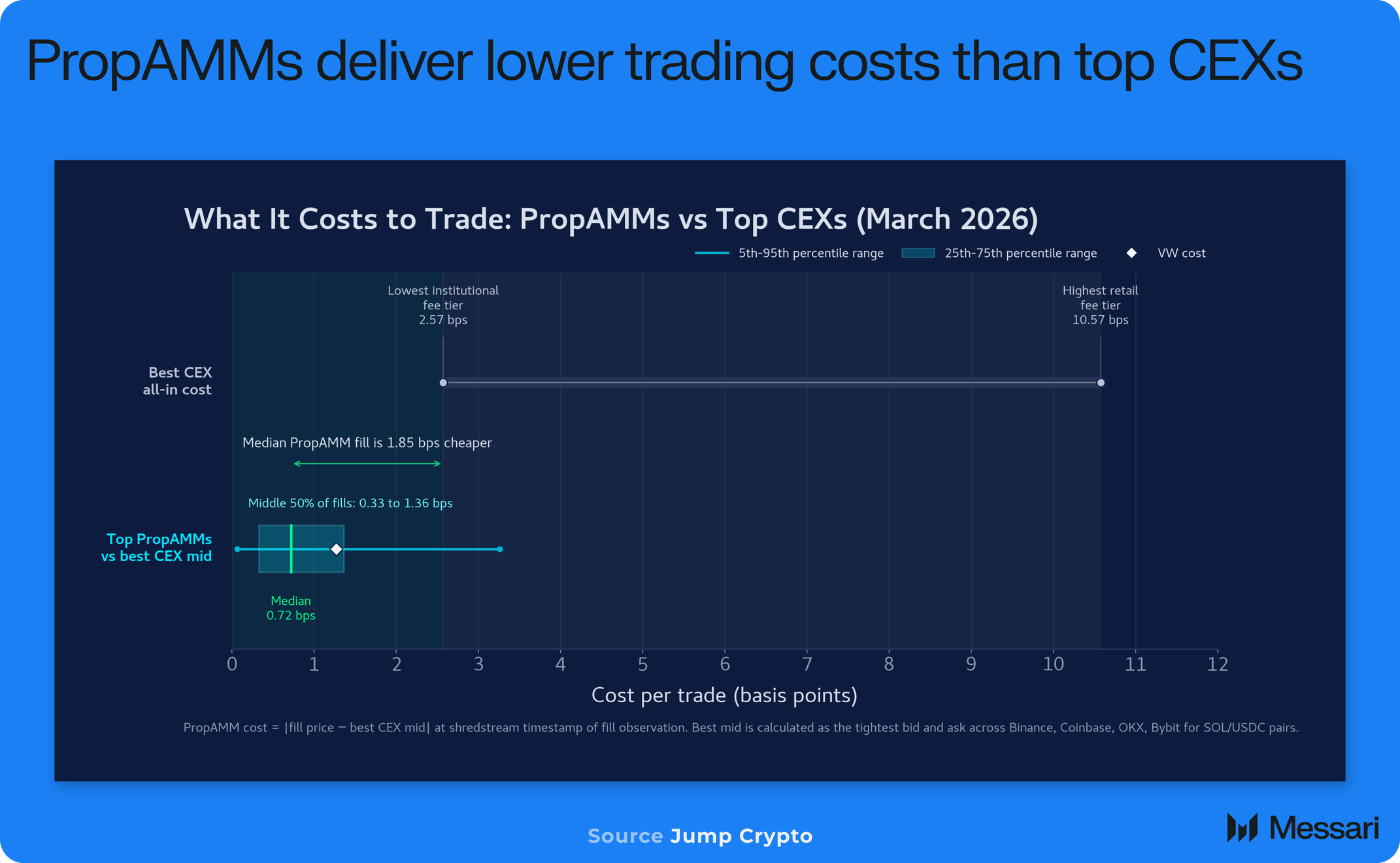
Prop AMMs represent a genuine shift in onchain market architecture, as they finally enable DEXs to outcompete CEXs on execution quality and trading costs. According to Jump Crypto, the median Prop AMM fill in March 2026 was 0.72 bps, compared to 2.57 bps for the lowest institutional CEX fee tier and 10.57 bps for the highest retail tier, making Prop AMMs cheaper than top CEXs even for sophisticated traders. These pricing advantages were achieved at comparable trading volumes (~$19-20 billion), demonstrating that Prop AMMs can deliver lower costs without sacrificing liquidity or scale. More importantly, Prop AMMs have materially improved execution quality for onchain traders by consistently delivering tighter spreads and better fills than both traditional AMMs and leading CEXs.
The top two DEXs by average daily volume this quarter were both Prop AMMs, HumidiFi and BisonFi. HumidiFi retained the top spot, though its average daily volume declined 57% QoQ to $461.8 million, largely due to increased competition from BisonFi. BisonFi’s average daily volume rose 362% QoQ to $431.5 million, closing much of the gap. As both venues primarily quote SOL-stablecoin pairs, they are effectively competing for the same pool of order flow. Another leading Prop AMM, Tessera V, also lost market share to BisonFi, with average daily volume declining 36% QoQ to $180.1 million, ranking sixth among Solana DEXs in Q1.
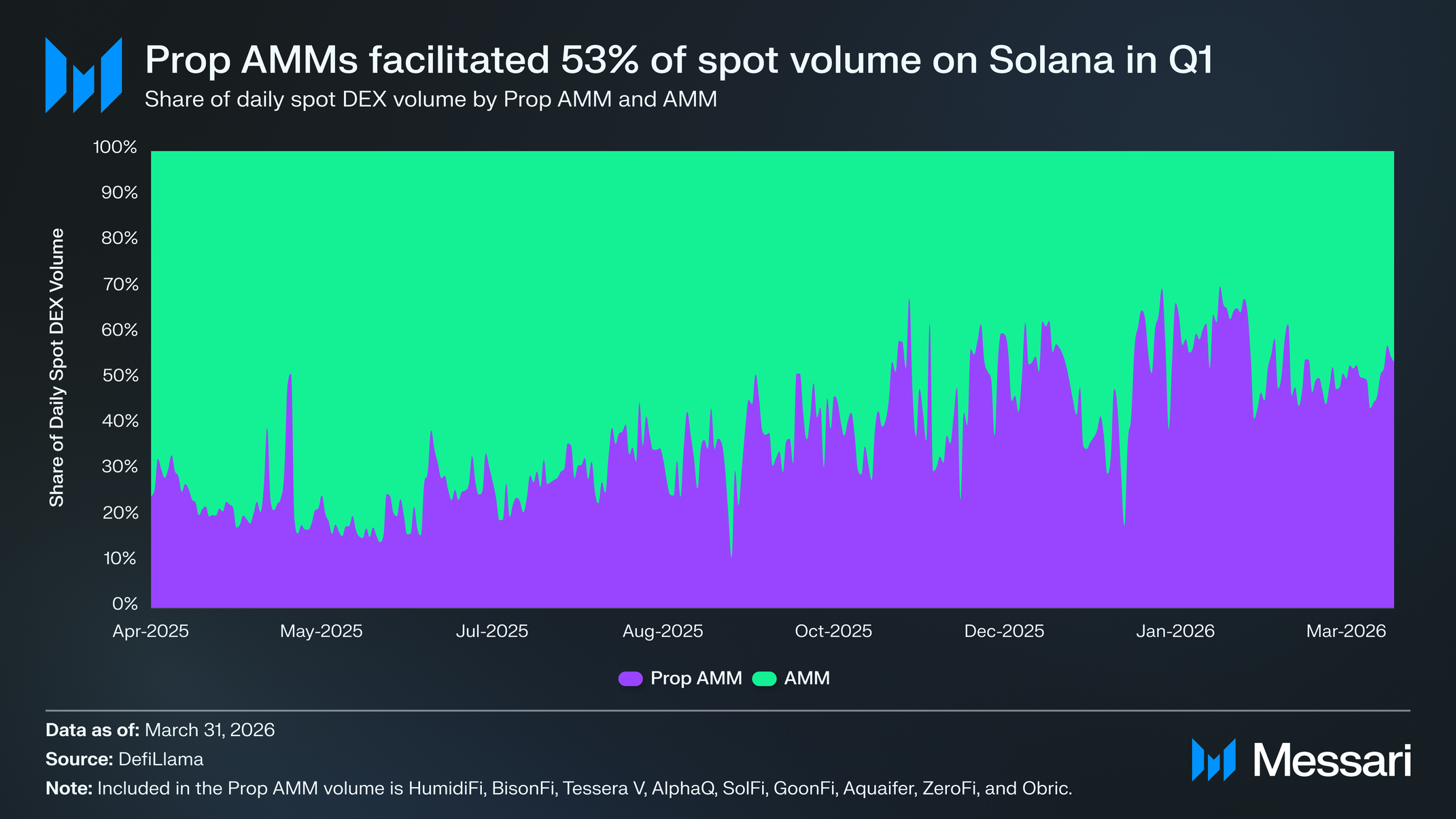
Prop AMMs have overtaken traditional AMMs as the dominant venue for spot DEX volume on Solana. In Q1, 53% of total volume was routed through Prop AMMs, up from 45% in Q4. As trading activity continues to shift away from longtail assets toward SOL and other blue-chip assets, Prop AMM dominance is likely to strengthen further.
Lastly, another important aspect of the Solana DEX ecosystem is Sunrise. Sunrise, a brand under Wormhole Labs, is a unified gateway for non-Solana-native assets to be bridged into Solana with deep liquidity from day one. Built on Wormhole’s Native Token Transfer (NTT) framework, Sunrise allows assets from external ecosystems to become natively tradable across Solana DeFi venues without relying on fragmented wrapped-token liquidity or multi-step bridging flows.
While Sunrise launched in Q4 2025 with Monad’s MON token as its first major integration, the platform began gaining meaningful traction in Q1 2026 as Solana increasingly positioned itself as the primary liquidity venue for external assets, token launches, and eventually tokenized RWAs. Notable assets added in Q1 by Sunrise included HYPE, LIT, AVAX, and DIME, among others.
Perp DEXs
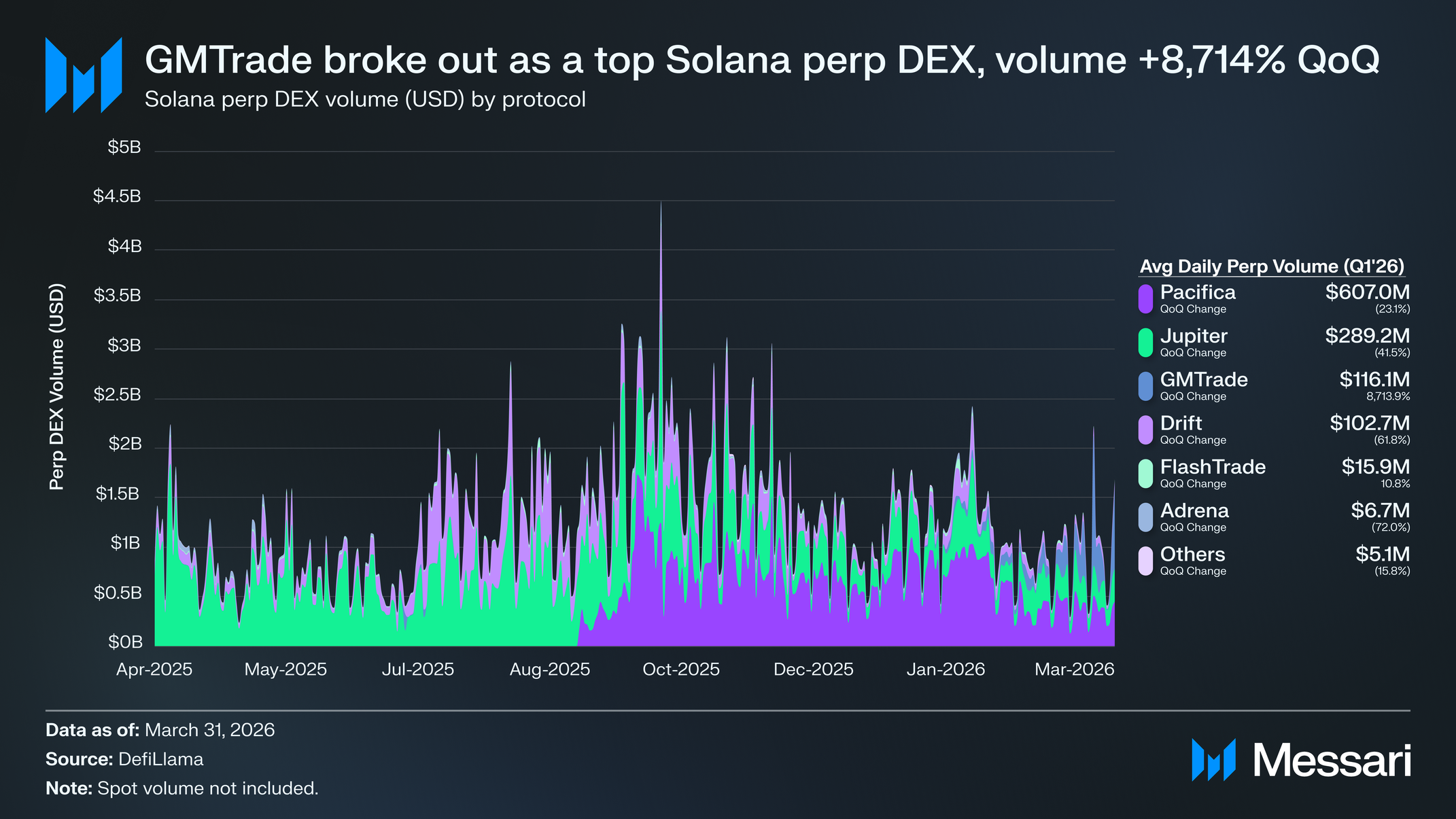
Solana’s average daily perp DEX volume declined 29% QoQ from $1.60 billion to $1.14 billion. The sector continues to feel the impact of the 10/10 liquidation event, which has meaningfully reduced appetite for perp trading across the industry. At the industry level, perp DEX volume fell 34% QoQ from $3.694 trillion to $2.434 trillion in Q1. Against this backdrop, Solana was a relative share gainer within the perp DEX market.
GMTrade
One notable outlier in Q1 was GMTrade, a friendly fork of GMX on Solana, whose average daily perp volume increased by over 8,000% QoQ to $116.1 million. While the protocol has been live since March 2025, it only began gaining meaningful traction in 2026 following a strategic pivot toward RWA perps. GMTrade now offers exposure to forex, commodities, and equities, among other real-world asset pairs.
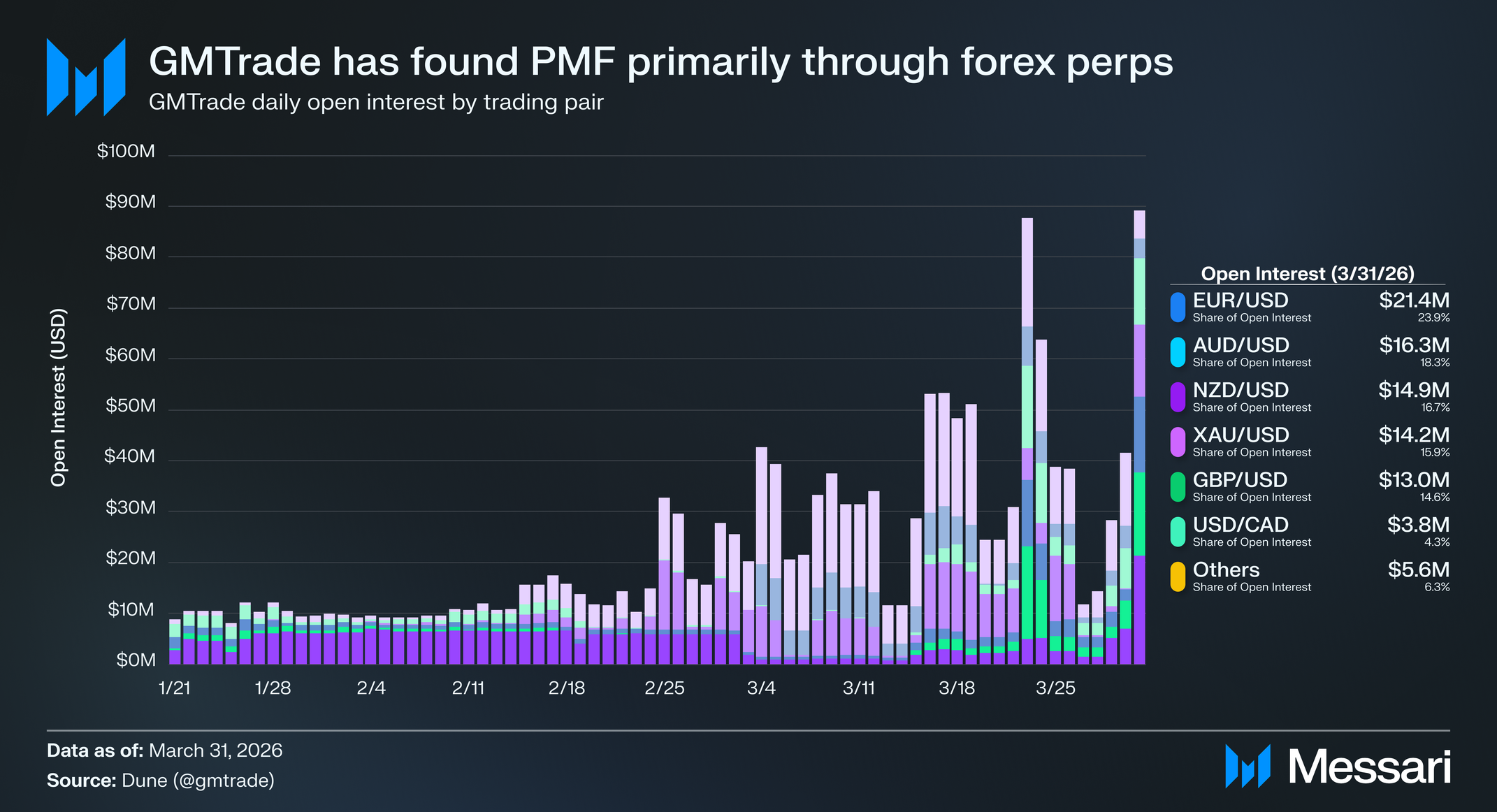
The strength of this positioning is most evident in its open interest (OI) composition. GMTrade ended Q1 with $89.2 million in OI (up 468% MoM), with the top six pairs all tied to RWAs. Notably, five of these were forex pairs (EUR/USD, AUD/USD, NZD/USD, GBP/USD, and USD/CAD). GMTrade may also be tapping into a distinct user base, as crypto-native pairs (historically the greatest driver of perp volumes) have seen relatively limited traction. SOL/USD and BTC/USD accounted for just $242,000 and $179,500 in OI, respectively.
Other Perp DEXs
One of the most anticipated Solana perp DEXs, Phoenix Perps, began ramping up its private beta in Q1. Developed by Ellipsis Labs, the team behind Phoenix Spot and SolFi, the protocol is the first perp DEX to utilize Prop AMMs as its liquidity source. This design aims to bring the benefits of Prop AMMs, including tighter spreads, deeper liquidity, and more dynamic pricing, to the perp market. However, Phoenix Perps remains in private beta, limiting early activity. As a result, the platform generated just $44.5 million in volume in March. As it opens to a broader set of traders, it will be important to watch whether Prop AMM-based perp DEXs can replicate their success in spot markets and capture a larger share of perp trading volume.
Lastly, another Solana perp DEX to monitor in 2026 is Bulk. Bulk is introducing a sidecar implementation for Solana perps by forking the Jito-Agave client, enabling validators to run Bulk-Agave. Users’ positions remain on mainnet, but matching occurs through Bulk Tile, which runs on every validator node running Bulk-Agave. This architecture separates order propagation and matching from onchain settlement, enabling low latency and fast propagation. Bulk has also stated that they will share 12.5% of revenue with validators running their client.
Stablecoins & Payments
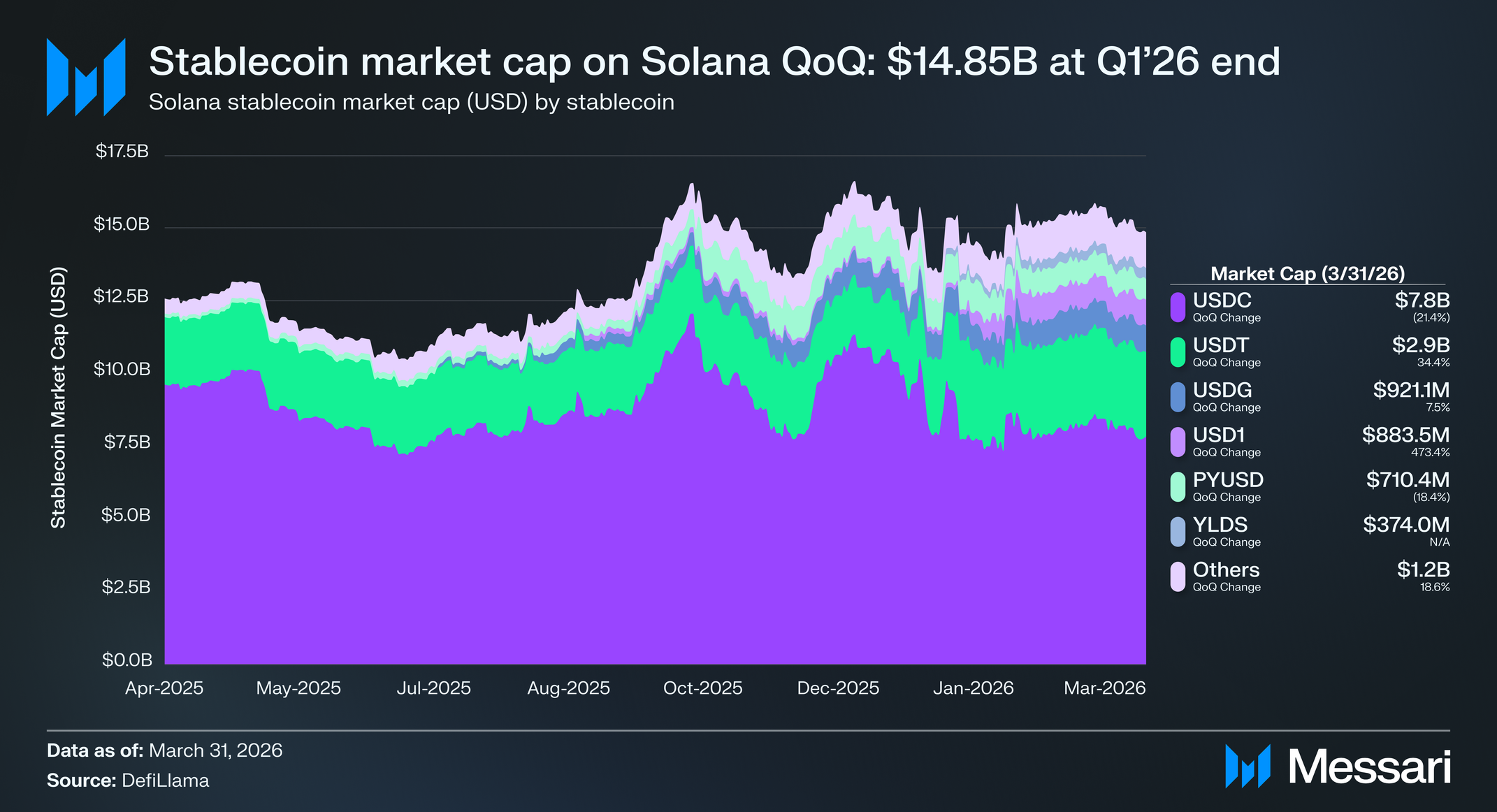
Stablecoin market cap on Solana ended Q1 at $14.85 billion, ranking it third among all networks. Solana outperformed Ethereum’s Q1 growth (0.3% QoQ decrease), but underperformed Tron’s Q1 growth (5% QoQ increase). Much of 2025's growth came after the TRUMP token launched on January 17, 2025, which brought an influx of liquidity to Solana and led to various high-liquidity USDC pairs. The sustained increase in stablecoin market cap indicates that much of the new capital remained on the network.
While the total stablecoin market cap on Solana remained relatively flat QoQ, there were notable shifts at the asset level. USDC ended the quarter at $7.83 billion, down 21% QoQ from $9.97 billion. Despite the decline, it remained the largest stablecoin on Solana, accounting for 53% of total market cap (down from 66% in Q4).
Outflows from USDC were largely offset by inflows into other stablecoins. USDT maintained its position as the second-largest, with market cap increasing 34% QoQ from $2.15 billion to $2.89 billion. Meanwhile, USD1 had the largest percentage increase, rising 473% QoQ to $883.5 million and becoming the fourth-largest stablecoin on Solana. This growth was primarily driven by Binance reallocating a significant portion of customer USD1 holdings to the network.
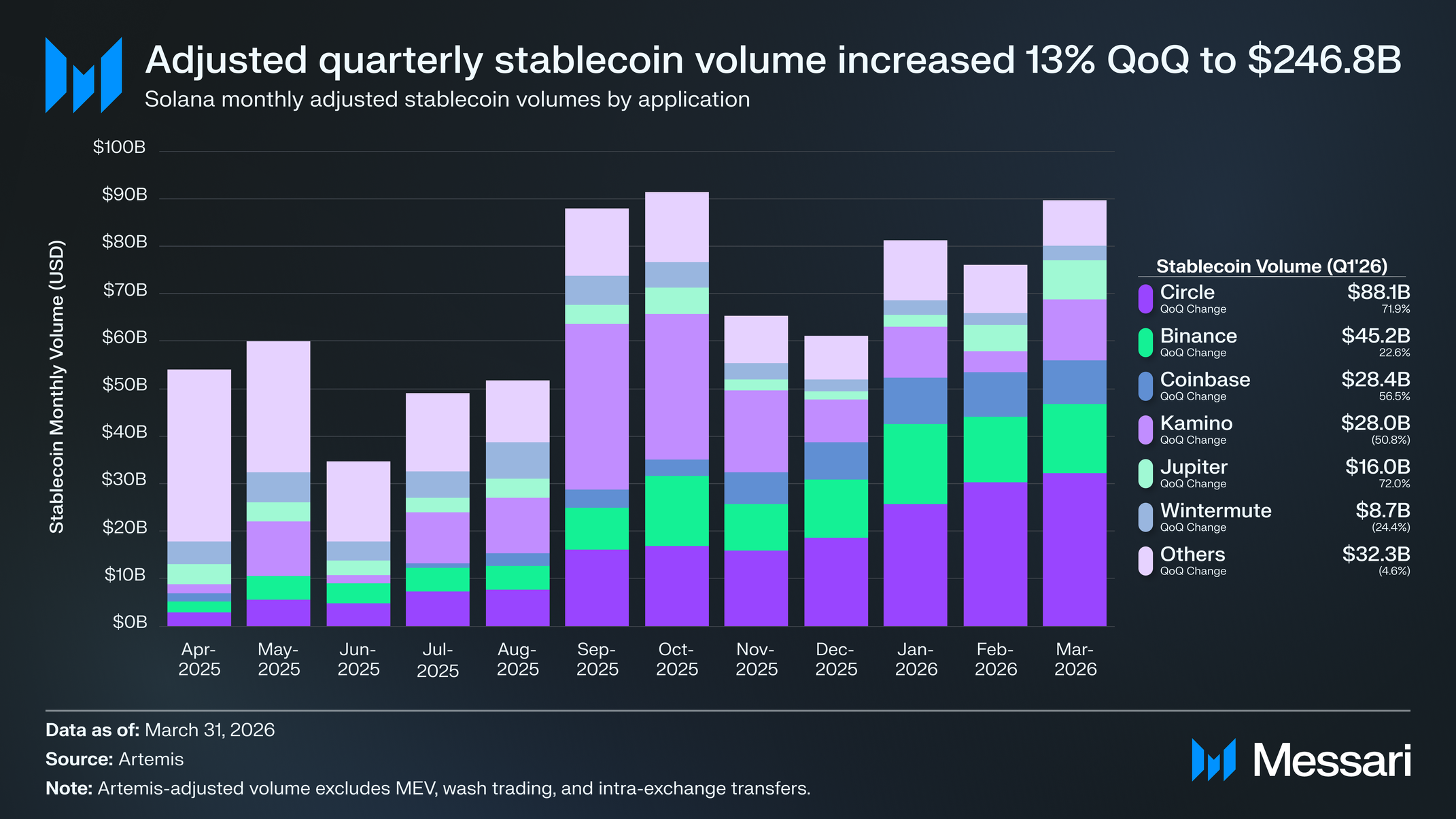
Over the past year, stablecoin volumes have grown alongside market cap, indicating that capital on Solana is actively utilized rather than idle. Artemis-adjusted quarterly stablecoin volume increased 13% QoQ from $217.85 billion to $246.76 billion.
By source, Circle was the primary driver of this growth, with volume increasing 72% QoQ to $88.10 billion, accounting for 36% of total stablecoin volume in Q1. Exchange-driven activity also contributed, with Binance and Coinbase volumes rising 23% QoQ to $45.23 billion and 57% QoQ to $28.41 billion, respectively.
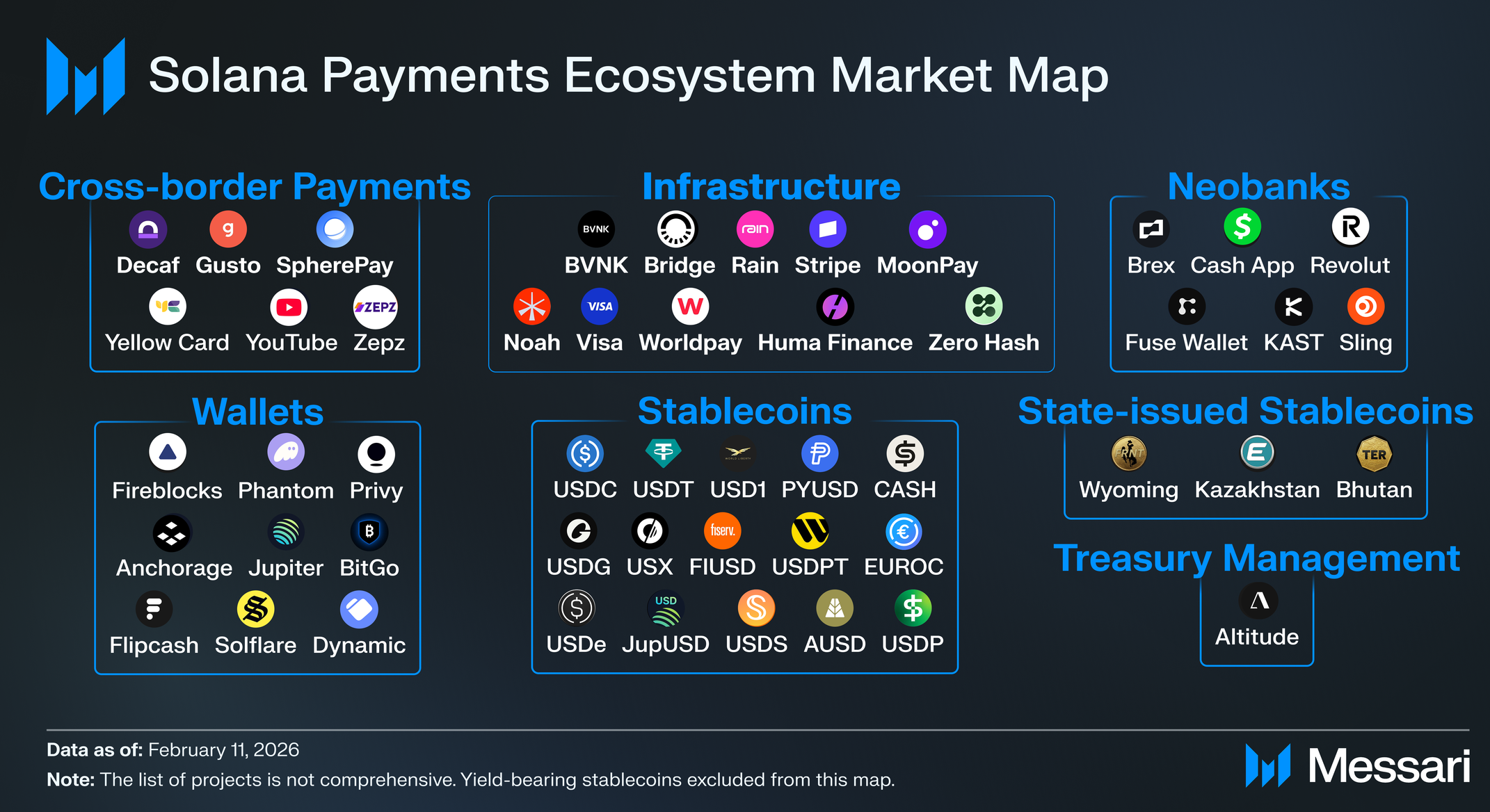
A major focus for Solana in 2026 is payments. As a part of these efforts, the Solana Foundation launched payments.org, a platform designed to educate fintech and payments professionals about stablecoins and the infrastructure supporting them while also providing tools for building payment products within the Solana ecosystem. More broadly, Solana has increasingly positioned itself as a modular payments infrastructure layer spanning stablecoin settlement, remittances, embedded finance, treasury management, and merchant payments.
This institutional push has coincided with accelerating adoption of Solana-based payment rails across both fintech and traditional finance. Over the past year, firms including Visa, Stripe, Worldpay, Western Union, Fiserv, and PayPal either integrated Solana for stablecoin settlement or launched Solana-native payment products. These integrations have been driven by Solana’s ability to provide near-instant finality, 24/7 settlement, and significantly lower operational costs relative to legacy payment infrastructure. Stablecoin adoption has been a major driver of this growth, with Solana facilitating nearly half of stablecoin transfer volume among major blockchain networks while stablecoin supply remained near all-time highs at the end of Q1 2026.
For a deeper dive into Solana’s growing payments ecosystem, including stablecoins, neobanks, treasury management, and cross-border settlement infrastructure, see Messari’s State of Solana: Payments report.
Also, in March, the Solana Foundation introduced the Solana Developer Platform (SDP), an enterprise-focused infrastructure suite designed to simplify the development of payment, stablecoin, and financial applications on Solana. SDP provides modular tooling and integrations across custody, compliance, wallets, treasury management, fiat on/offramps, and stablecoin infrastructure, allowing enterprises to assemble production-ready financial stacks without building core infrastructure from scratch. Early users of SDP include Mastercard, Worldpay, and Western Union, highlighting growing institutional adoption of Solana-based payment infrastructure.
RWAs
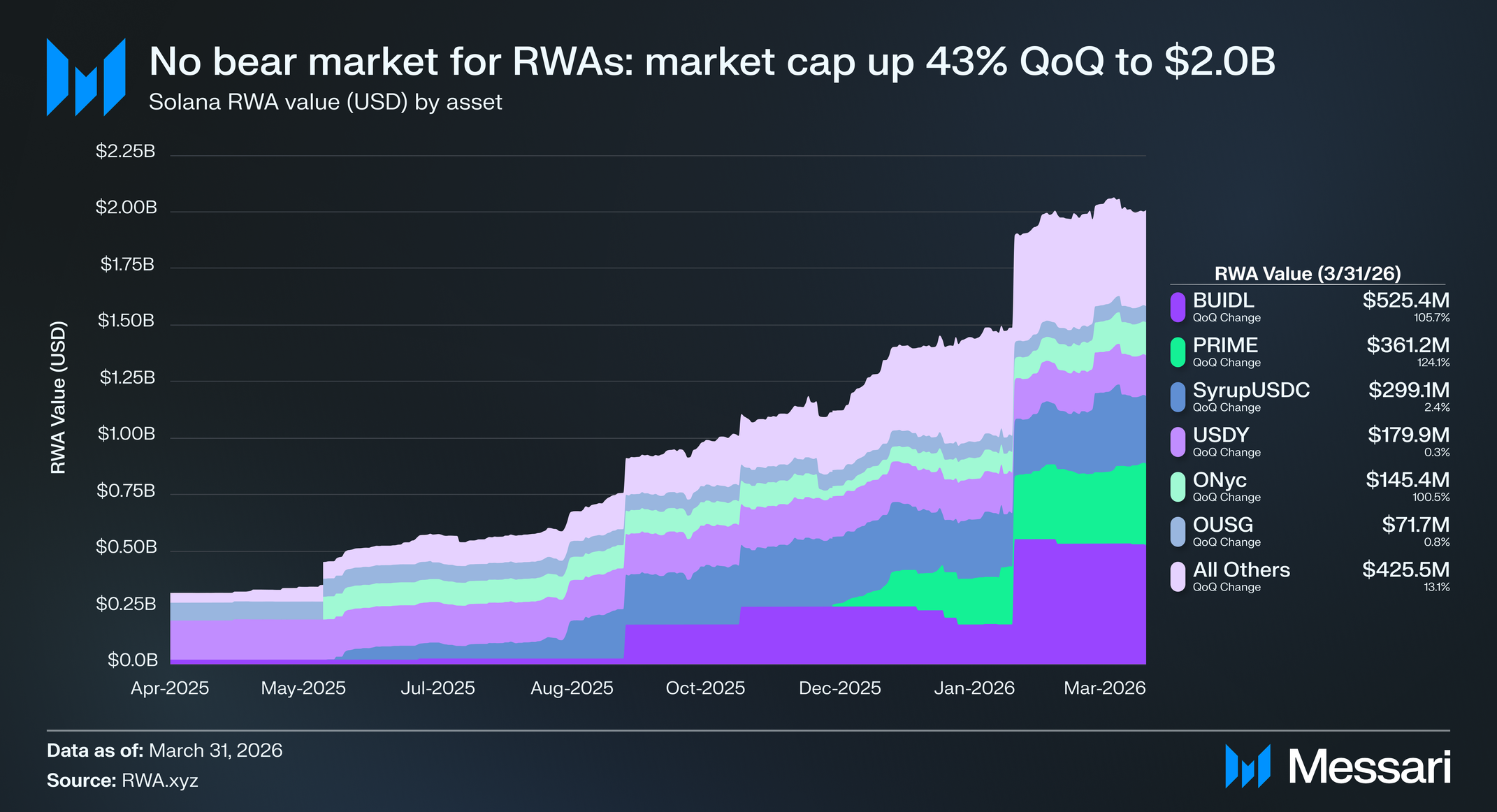
One of the defining industry trends over the past year has been the growth of RWAs, and in Q1, this momentum continued on Solana. RWA market cap increased 43% QoQ from $1.41 billion to $2.01 billion.
The primary driver of this growth was BUIDL, a tokenized U.S. money market fund developed by BlackRock in partnership with Securitize, which invests in cash and short-term U.S. Treasuries. BUIDL’s market cap on Solana rose 106% QoQ from $255.5 million to $525.4 million. This $269.9 million increase was largely driven by Anchorage Digital adding custody support for BUIDL on Solana. By the end of the quarter, Anchorage was custodying $423.1 million, representing approximately 81% of the total BUIDL supply on the network.
The biggest QoQ gainer in percentage terms was PRIME, as its market cap increased 124% QoQ to $361.2 million. As mentioned previously, PRIME benefited from an integration with Kamino that allows PPRIME to be used as collateral on the platform. Another RWA that benefited from a Kamino integration was ONyc, a yield-bearing tokenized asset that allocates stablecoin capital into private reinsurance markets, offering investors high, uncorrelated returns backed by real-world underwriting. Its market cap increased 101% QoQ to $145.4 million, with 48% of the supply being deposited in Kamino.
Beyond the overall composition of the RWA market on Solana, other notable events related to RWAs include:
- Ondo Finance launched Ondo Global Markets on Solana, deploying 200+ tokenized U.S. stocks and ETFs (blue-chips like NVDA/AAPL, major ETFs like SPY/QQQ, plus leveraged, inverse, and commodity-linked assets). This enabled 24/7 on-chain access to TradFi equities. Ondo Finance also tokenized BitGo stock on the same day as the company’s NYSE IPO, enabling eligible non-U.S. users to gain immediate onchain exposure to newly listed public equities through Ondo Global Markets.
- WisdomTree expanded its full suite of tokenized funds (money market, equities, fixed income) to Solana for broader institutional and retail access.
- Citigroup completed a full-lifecycle Proof-of-Concept for a tokenized Bill of Exchange (trade finance instrument) on Solana, covering issuance, financing, distribution, and settlement (with PwC).
- Multiliquid protocol partnered with Metalayer Ventures to launch the first dedicated institutional liquidity facility for instant RWA redemptions on Solana. The facility allows holders of supported tokenized RWAs (from issuers including VanEck, Janus Henderson, and Fasanara Capital) to instantly convert positions into stablecoins 24/7, addressing slow issuer-controlled redemption windows by acting as a standing buyer at a dynamic discount to NAV.
- Ondo Finance partnered with Franklin Templeton ($1.7T AUM) to tokenize five ETFs (U.S. equities/growth, fixed income/high-yield, equity income, and gold) via Ondo Global Markets. These became available for 24/7 on-chain trading (including on Solana) for eligible non-U.S. investors, the first time Franklin Templeton products went onchain.
- Hanwha Asset Management partnered with the Solana Foundation to expand its digital asset ecosystem initiatives, including Solana-linked ETPs and institutional tokenization infrastructure, further signaling growing interest from major Asian financial institutions in Solana-based RWAs.
- Institutional staking infrastructure on Solana continued to mature during the quarter, with firms such as Fidelity Center for Applied Technology expanding validator and staking offerings aimed at institutional capital allocators and professional delegators.
- Matrixdock launched XAUm, a fully backed tokenized gold product, on Solana. The launch introduced institutional-grade tokenized gold with instant settlement and planned DeFi integrations, further expanding the diversity of RWAs available on the network beyond traditional financial assets.
Read more about Solana’s RWAs developments in Messari’s State of Solana: Real-world Assets report.
Liquid Staking
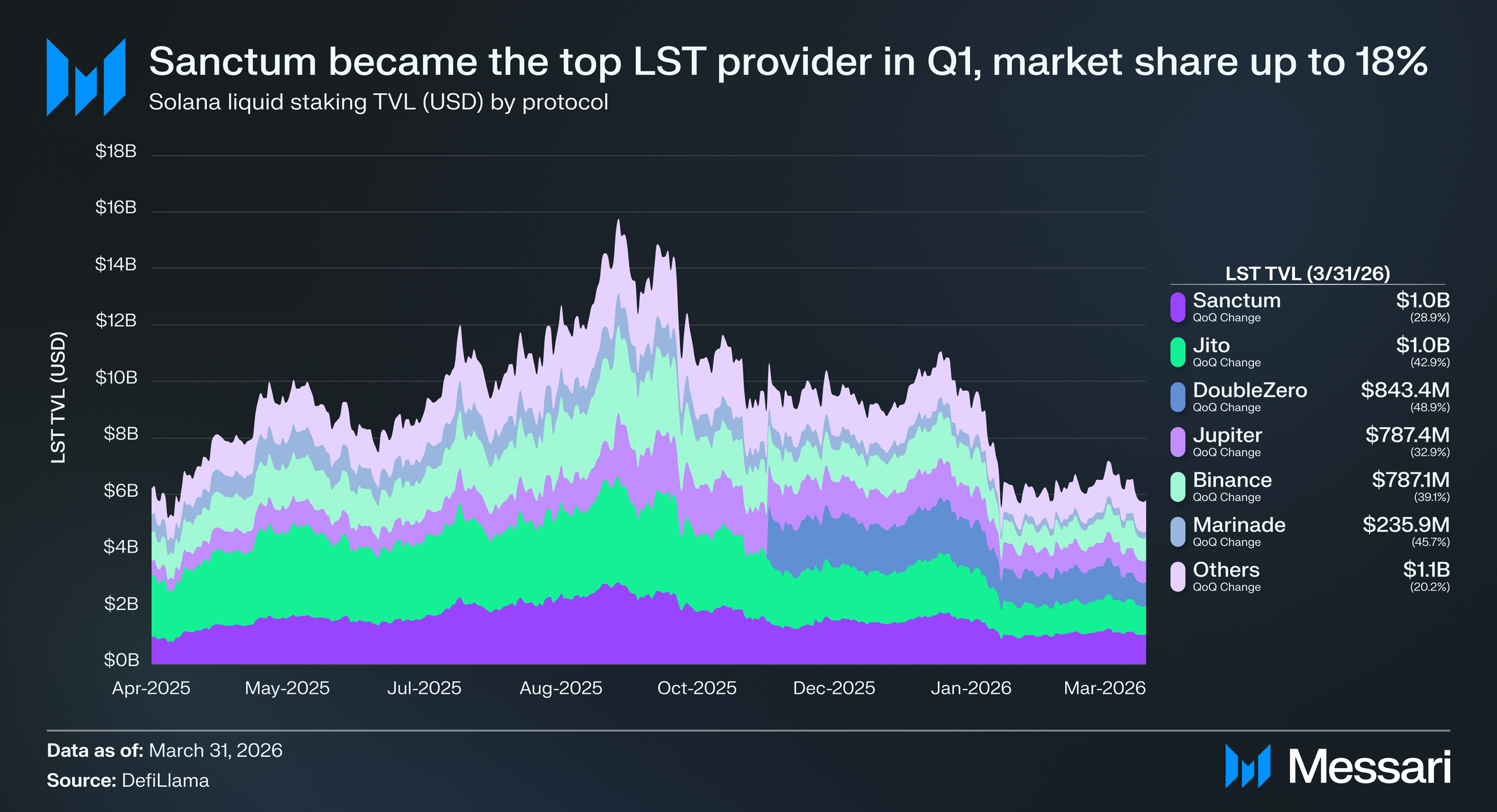
The liquid staking rate on Solana slightly decreased from 17.6% to 16.6% QoQ. With 68% of SOL’s circulating supply staked, liquid staking is particularly important, as its growth increases the supply of yield‑bearing SOL that can be deployed across DeFi applications.
- Sanctum’s liquid staking token (LST) regained the top spot as its market share increased 12% QoQ to 18% of all liquid staked SOL. By the end of the quarter, $1.05 billion SOL was staked through Sanctum.
- Jito’s jitoSOL had the second-largest market cap of any LST on Solana at $1.02 billion, just barely being edged out by Sanctum. jitoSOL’s market share fell 10% QoQ to just under 18%.
- DoubleZero’s DZSOL claimed the third spot after launching last quarter on Nov. 13, 2025. At the end of Q1’26, DZSOL had a market share of 15% and total market cap of $843.4 million.
AI
In Q1 2026, AI agent activity on Solana advanced from experimentation to measurable economic output. The network's sub-cent fees and sub-second finality continued to attract machine-native applications, with the x402 payment protocol expanding across multiple infrastructure providers, a Solana Foundation-backed Agent Registry launching onchain, and early metrics pointing toward what the ecosystem is beginning to call Agentic GDP, economic value generated autonomously by non-human actors.
Notable AI-related developments in Q1 include:
- x402 Protocol Expansion: The x402 payment standard for AI agents extended across several major infrastructure providers.
- QuickNode open-sourced an x402 npm package for agentic USDC payments.
- Messari added Solana support for x402 payments across its API endpoints.
- Alchemy enabled Solana agents to pay for its APIs with USDC through the same standard.
- Agentmail introduced AI agent inbox creation using x402.
- At the application layer, AgentCard went live supporting payments for APIs and prediction market trades.
- AgentCash launched a unified USDC balance for access to more than 250 APIs. MoonPay open-sourced a wallet standard for AI agents with support from more than 15 contributors, including Solana.
- Machine Payments Protocol (MPP): Solana added support for Stripe’s Machine Payments Protocol (MPP), an open standard designed for autonomous AI-to-service payments. With support for both MPP and x402, Solana became the only major blockchain ecosystem compatible with both emerging agent payment standards, positioning the network as a key settlement layer for AI-native commerce and machine-to-machine payments.
- Agent Payment Infrastructure: Crossmint announced Lobster.cash, a payment infrastructure product designed to secure transactions for OpenClaw AI agents. The launch expanded Solana’s emerging stack for agent-native payments and identity, adding dedicated tooling for autonomous payment authorization and execution.
- AI Agent Hackathon: The Solana Foundation and Colosseum hosted the AI Agent Hackathon from February 2 to 12, a competition in which human participants were prohibited from writing code. The event offered a $100,000 USDC prize pool across five tracks and received 454 submissions. Colosseum subsequently shipped Copilot in March, a product for using agents to support startup building.
- Agent Registry: The Solana Foundation unveiled Agent Registry via Quantu AI in March, creating an onchain registry for verifiable AI agent identity. The registry provides a standardized way for agents to establish and verify their provenance across the Solana ecosystem.
- Application-Layer Activity: March brought a significant volume of agent-native application launches. PlayBabylon, a multiplayer prediction game for humans and AI agents, recorded 490,000 trades across 1,171 agents within five days of launch. StormRae AI ran a public AI red-teaming challenge with roughly 15,000 participants on Solana. Trends.fun launched the Agent Economy Hackathon with $30,000 in prizes. The Anagram team introduced the SolanaClaw Agent for executing Solana transactions through WhatsApp or Telegram.
As AI agents require programmable payments, composable financial rails, and verifiable identity, Solana's performance characteristics and growing infrastructure position it as a natural coordination layer for autonomous economic activity.
Consumer
NFTs & Collectibles
Average daily NFT trading volume (USD) on Solana secondary NFT marketplaces fell 55% QoQ to $301,200 in Q1.
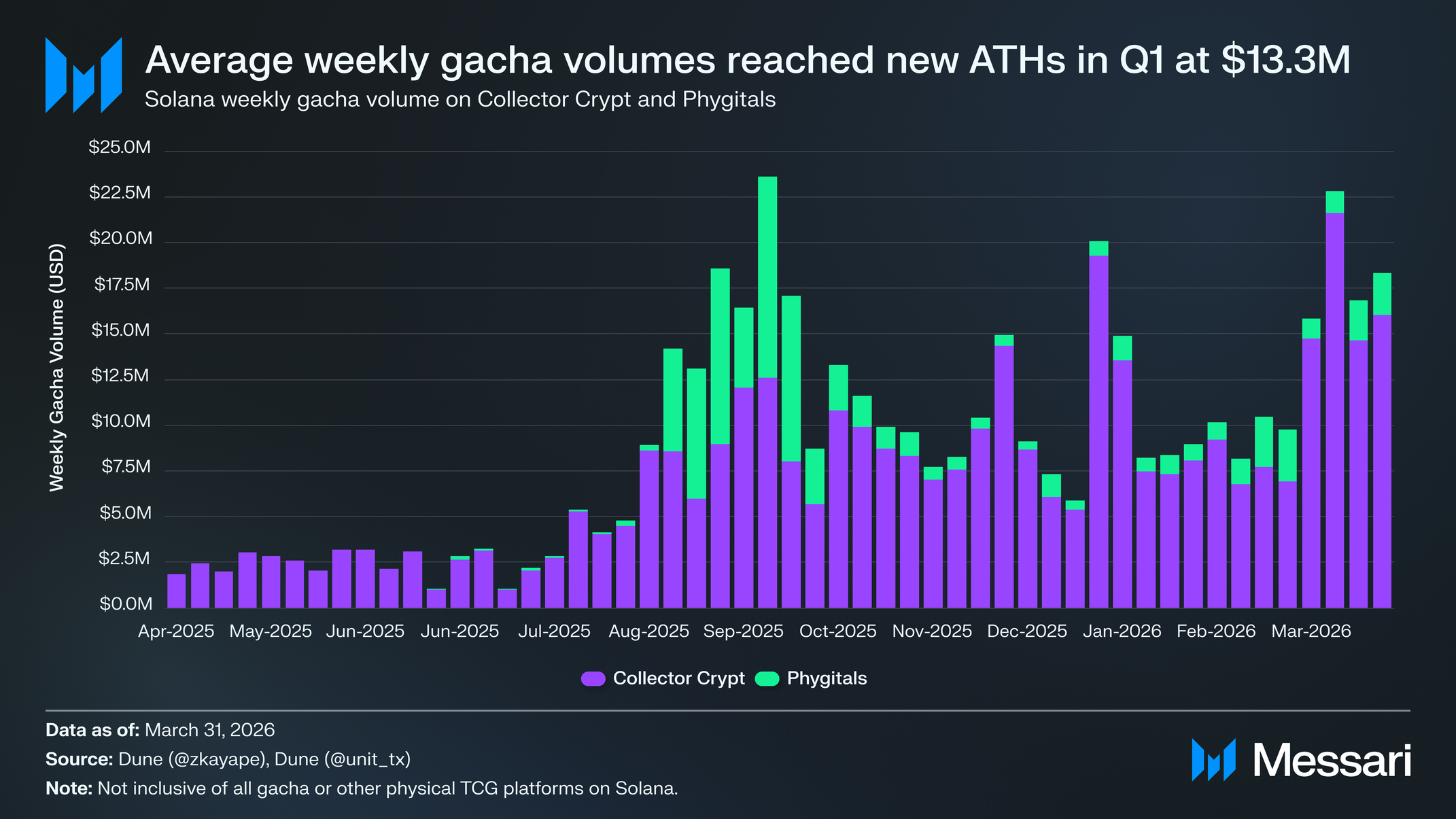
Arguably, one of the biggest breakout consumer crypto trends of the past year has been the rise of tokenized trading card games (TCGs), particularly Pokémon cards. Platforms like Collector Crypt and Phygitals have found product-market fit through onchain gachas, where users purchase digital packs to reveal randomized tokenized cards.
In Q1, average weekly gacha volume reached a record high, increasing 29% QoQ from $10.3 million to $13.3 million. Collector Crypt dominated activity, accounting for 89% of volume, while Phygitals made up the remaining 11%. If the Pokémon bull market persists through 2026, onchain gachas are well-positioned for continued growth.
Gaming
Notable gaming developments in Q1 include:
- Star Atlas: In March, Star Atlas released a major update featuring Holosim Chapter 2, expanding the browser-based strategy game set within the Star Atlas universe.
- PlaySolana: In March, PlaySolana premiered the first Gaming dApp Store on the PSG1 device, creating a dedicated distribution surface for onchain games built on Solana Mobile hardware.
Play.fun: In February, Play.fun released a gamified growth platform connecting developers and players, adding an incentive layer to app distribution on the network.
Other Consumer-related News
Prediction markets expanded significantly in Q1, with a wave of new products reflecting genuine market segmentation across the category. Inframarkets debuted the first energy prediction market on Solana in February. Epoch introduced private prediction markets powered by Arcium's encrypted computation. WAVE went live with zero-fee prediction markets, and Duel Duck enabled custom predictions using any SPL token. By March, Predictefy opened its public beta for cross-platform prediction market tracking, and Kairos TradeX, Big Dance Fun, and Scorely each launched prediction and tournament-based trading products.
- Pump.fun Build in Public Hackathon: Pump.fun launched its Build in Public Hackathon on January 19, committing $3M to fund 12 projects at $250,000 each at a $10M valuation. The program uses an unconventional selection model: participants launch a token on Pump.fun, build in public through daily social updates and live streams, and let market momentum serve as the primary selection mechanism. Applications closed February 25, with the first winner announced on February 18. Nine of 12 winners have been announced to date: zauth, Opal, Pumpcade, BloxAPI, ClawPump, Dexter, Clude, and SolScanner.
- Solana Mobile: Solana Mobile crossed 200,000 devices shipped in February, with users generating more than $3 billion in onchain volume. The network also launched Builder Grants in March to support mobile-native development, and introduced SeekerClaw, enabling sub-one-minute AI agent deployments from a phone.
- Magic Eden: In February, Magic Eden announced it would wind down its Bitcoin and EVM-based NFT markets to refocus exclusively on Solana and Packs, consolidating its marketplace around the network.
- Phantom: Phantom was named to the 2026 Forbes Fintech 50 in February.
- OnePay: In March, Walmart-backed OnePay added SOL to its platform, extending crypto access to its 3 million monthly active users.
DePIN
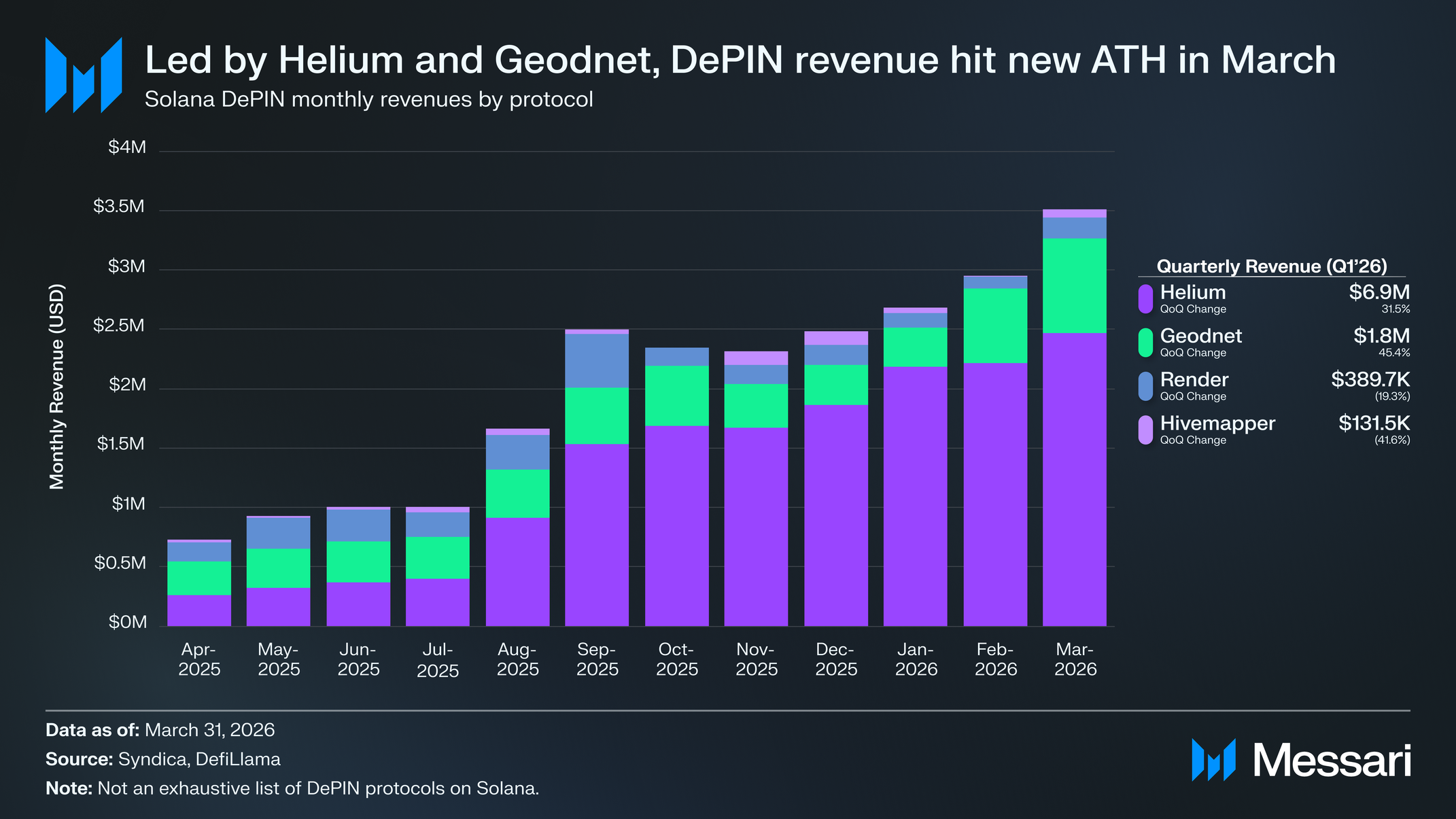
Solana continues to be a hub for DePIN applications, hosting Helium, Hivemapper, GEODNET, Render, Nosana, Jambo, NATIX, and more. Revenue-generating DePIN apps reached a record monthly high of $3.5 million in March, with total quarterly revenue increasing 28% QoQ from $7.1 million to $9.1 million. This growth was primarily driven by Helium and GEODNET, whose revenues rose 32% QoQ to $6.9 million and 45% QoQ to $1.8 million, respectively. Together, the two protocols accounted for 94% of total DePIN app revenue in Q1. Helium Mobile has proven to be one of DePIN’s breakthrough applications with nearly 600,000 subscribers. Geodnet maintained its position as the world’s largest RTK network with over 21,000 active Satellite Miners by the end of Q1.
Infrastructure
Notable infrastructure-related events from Q1’26 include:
- Constellation: In March, Anza introduced Constellation, a Multiple Concurrent Proposers (MCP) design for Solana that would replace the current single-leader block production model with a system in which multiple proposers submit transactions simultaneously. The proposal is designed to address transaction ordering and censorship resistance, and fits into the broader upgrade path alongside Alpenglow.
- P-Token (SIMD-0266): The P-Token standard was approved in early March and went live on testnet in mid-March. The standard reduces token transfer computational costs by 95% to 98%, with mainnet deployment targeted for later in 2026.
- Light Protocol: Light Protocol launched the Light Token SDK on mainnet, reducing Solana Associated Token Account fees to $0.001 for all SPL tokens, including USDC, PYUSD, and USDG.
- Arcium: In February, Arcium entered mainnet-alpha, offering encrypted computation for privacy-preserving applications on Solana.
- DoubleZero Edge: In March, DoubleZero introduced DoubleZero Edge for real-time market data delivery to traders and market participants.
Events
The Solana Accelerate APAC conference took place on February 11 at the Hong Kong Convention and Exhibition Centre. Announcements at the event included Kamino's offchain collateral pilot with Anchorage Digital and Alibaba Cloud's high-performance Solana RPCs. Sessions covered staked SOL ETF products and expansion plans for Asian markets.
In March, Solana Accelerate: Fintech, an invite-only working session in New York City, brought together leaders from more than 140 companies, including American Express, JPMorgan, Moneygram, Zelle, Apple, and Amazon, for discussions on payments and stablecoin infrastructure built on Solana.
Events occurring in Q1:
- MTN DAO: Feb. 1-28, 2026
- Webinar - Payments on Solana: Feb. 10, 2026
- Solana Accelerate APAC: Feb. 11, 2026, Hong Kong
- AI Agent Hackathon: Feb. 2-12, 2026
- Solana Graveyard Hackathon: Feb. 12-27, 2026
- Monolith Mobile Hackathon: Feb. 2-March 9, 2026
- StableHacks Hackathon: early March 2026
- Solana Accelerate: Fintech: March 2026, New York City
Events occurring in Q2:
- Solana Frontier Hackathon: April 6-May 11, 2026
- Solana Summit: Washington x Wall Street: April 13, 2026, New York City
- Ship Week V3: May 4-10, 2026, Miami
- Accelerate USA: May 5, 2026, Miami
- Solana Summit Germany: June 13, 2026, Berlin
The full list of community events can be found here.
Network Analysis
Usage
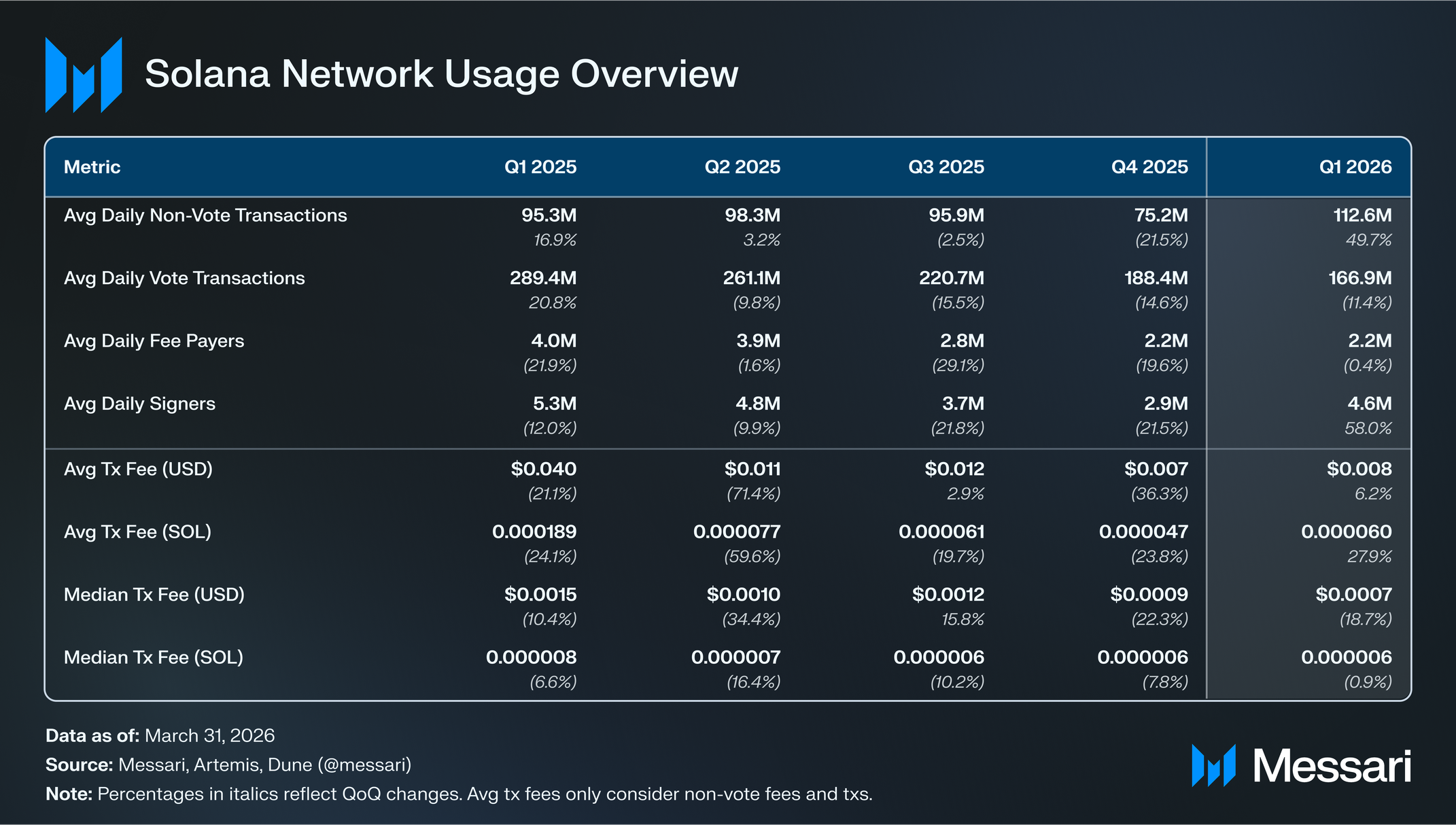
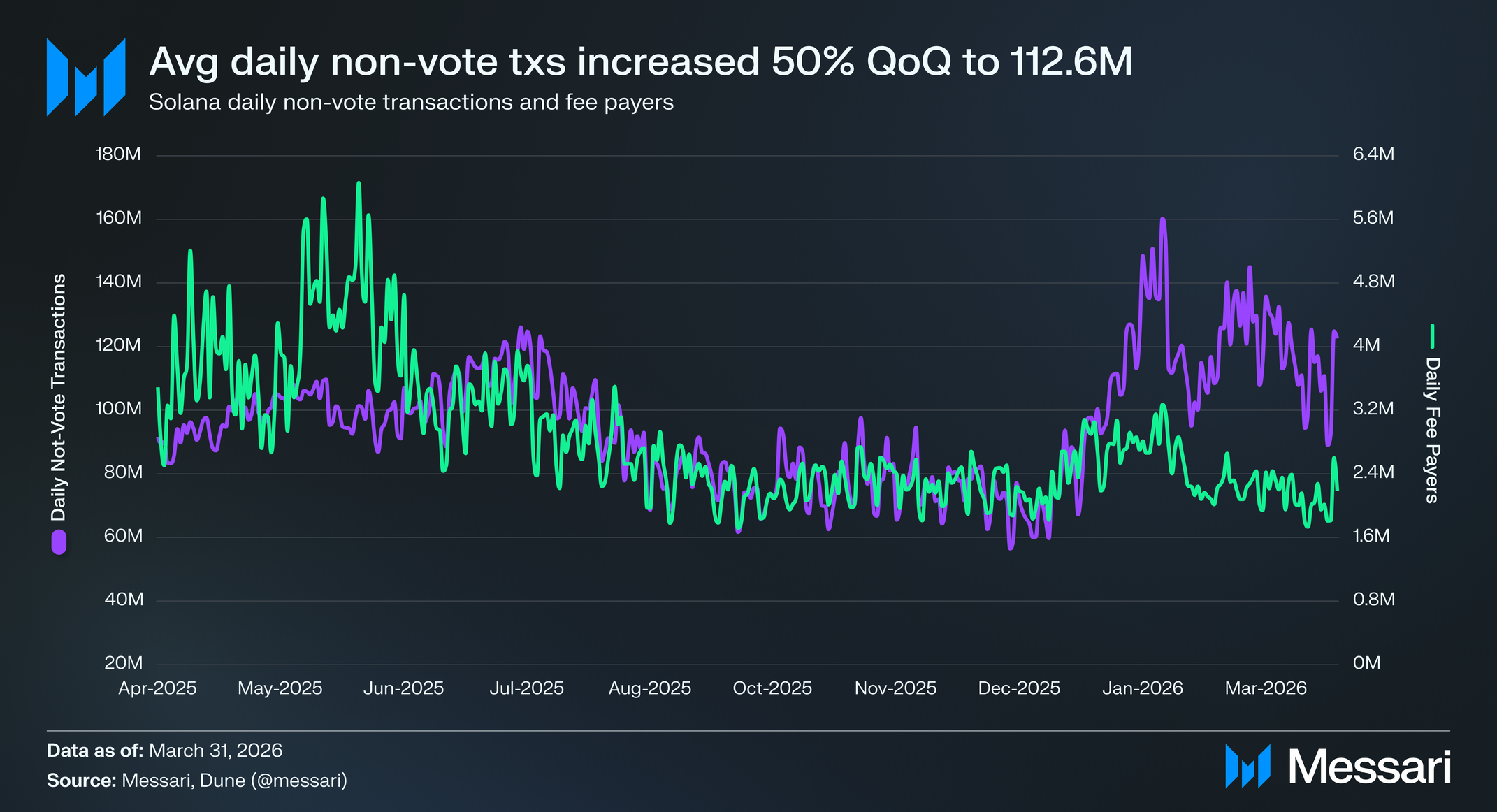
Network activity, measured by non-vote transactions and fee payers, increased in Q1 2026. Average daily non-vote transactions increased 50% QoQ to 112.6 million, while average daily fee payers remained roughly flat at 2.2 million. This quarter set a new ATH for average daily non-vote transactions, eclipsing the previous ATH of Q2’25’s 98.3 million by 15%.
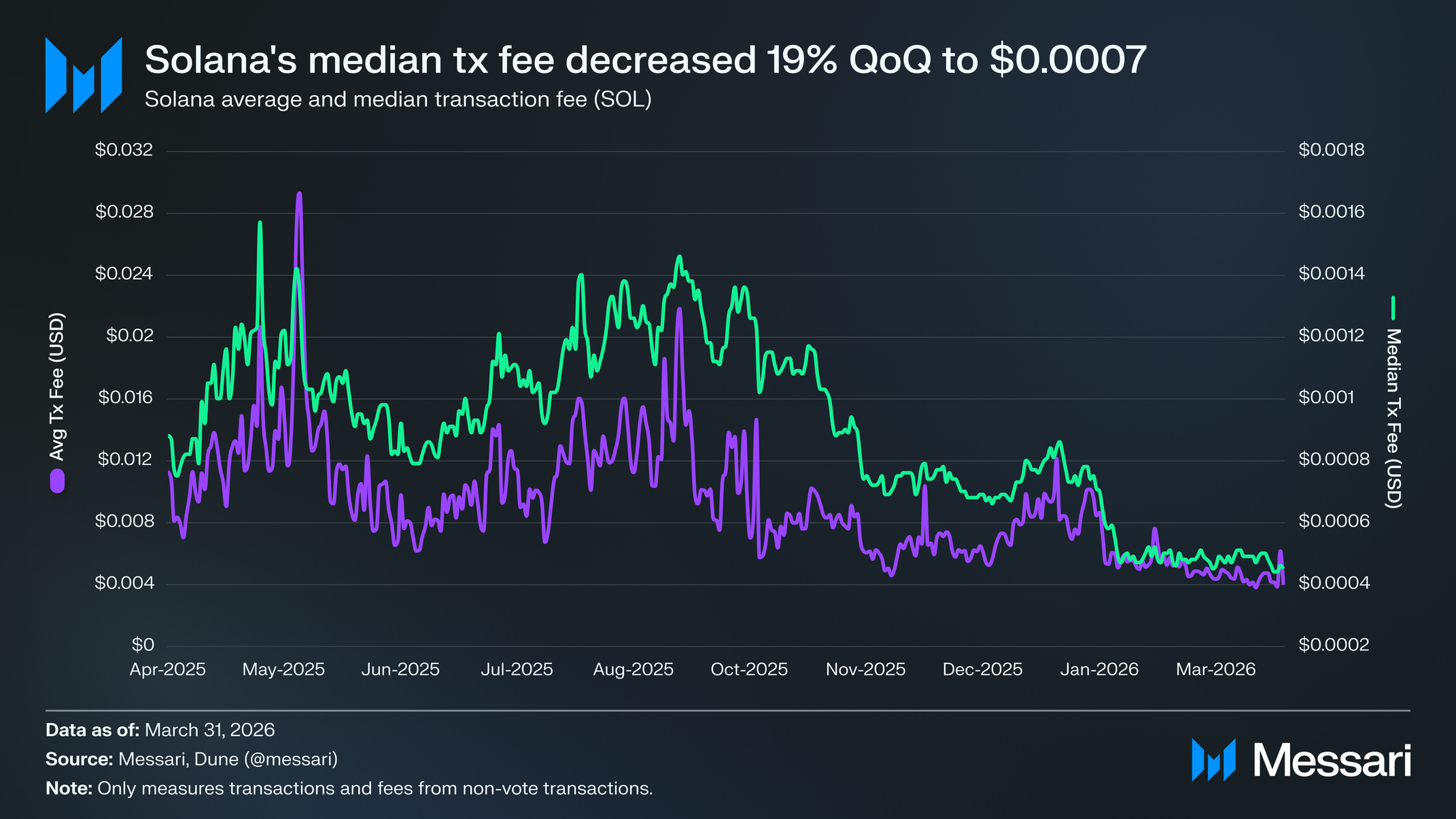
The average transaction fee increased by 28% QoQ to 0.00006 SOL ($0.008), and the median transaction fee decreased by 1% QoQ to 0.000006 SOL ($0.0007). The gradual decline in average and median transaction fees from last year can be partly attributed to overall improvements to the network. One example is the increase in CUs that each block can hold, and developers optimizing transactions to consume fewer CUs.
Security & Decentralization
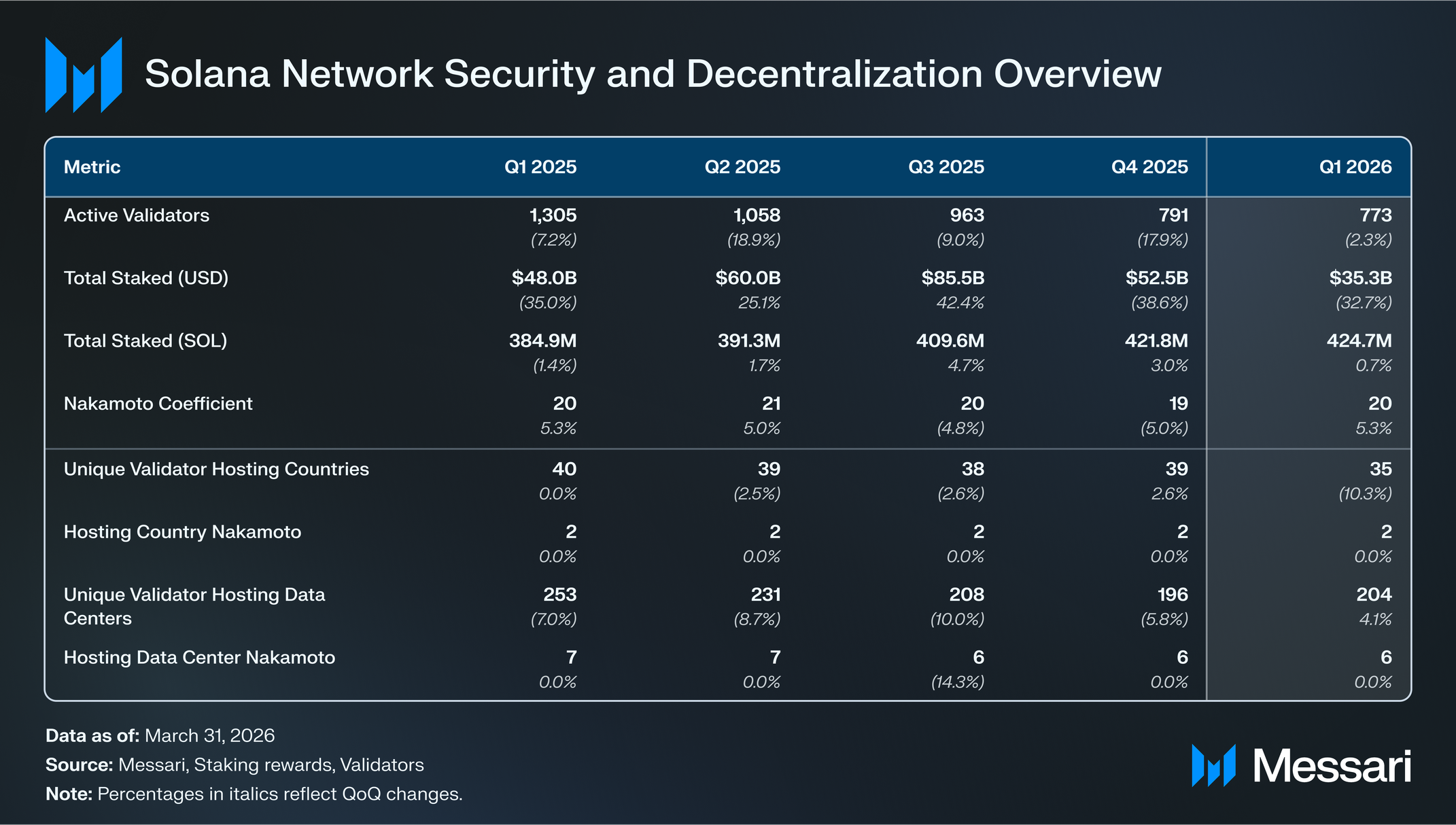

Total staked SOL ended Q1 at a new ATH of 424.7 million (+1% QoQ. However, due to the declining price of SOL in Q1, the total stake in USD decreased 33% QoQ from $52.48 billion to $35.30 billion.
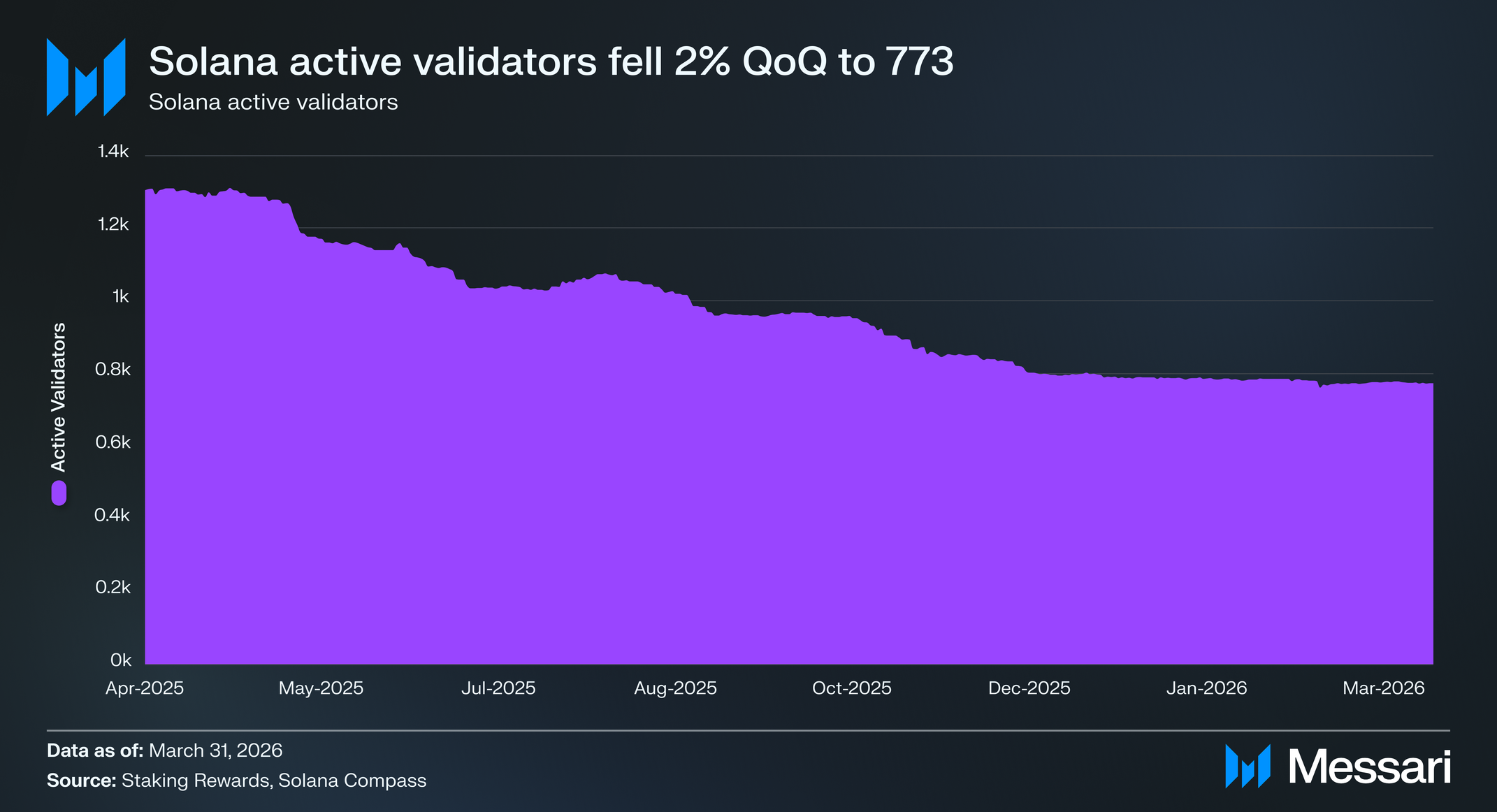
The Nakamoto coefficient is the minimum number of nodes needed to break liveness. The metric can also be measured across other dimensions important to the resilience of a validator network, including distribution of stake by location, hosting provider, and clients.
Solana’s Nakamoto coefficient ended Q1 at 20, which is above the median of other networks. Solana’s 773 active validators are hosted in 35 countries. Solana validators are hosted across 204 unique data centers, up 4% QoQ, and its Nakamoto coefficient for hosting data centers remained at 6.
Since the change in strategy for the Solana Foundation Delegation Program (SFDP) that began on Apr. 24, 2024, the quality of validators has increased. The SFDP stake fell from 12% at the end of 2024 to roughly 5% of the total stake at the end of Q1.
Performance, Upgrades, & Roadmap
On February 3, the Solana Foundation published a roadmap for upcoming protocol releases. XDP (eXpress Data Path), a high-performance networking technology from the Linux kernel, became available in Agave 3.0 and reduces validator packet-processing latency by up to 200x. Early testing showed that 100 million compute unit (CU) blocks are achievable when validator operators enable XDP.
Several protocol improvements are under active development targeting the Agave 4.x release series. SIMD-286 proposes raising block capacity from 60 million to 100 million CUs, a 66% increase in throughput. SIMD-296 would raise the maximum transaction size beyond the current 1,232-byte limit, enabling more complex single-transaction composability. SIMD-268 proposes doubling the Cross-Program Invocation (CPI) nesting limit from 4 to 8, expanding the depth of program-to-program calls. SIMD-123 would enable validators to automatically distribute block revenue, including transaction fees, priority fees, and MEV, to delegators at the end of each epoch. Rent reduction, targeted for Agave 4.0, would lower per-byte account creation costs by up to 90%.
Alpenglow remains the most significant protocol upgrade on the roadmap, targeting Agave 4.1. The new consensus protocol would replace Proof-of-History (PoH), Tower BFT, and gossip-based vote propagation with two streamlined mechanisms: Rotor for data propagation and Votor for offchain voting. Alpenglow is projected to reduce transaction finality from roughly 12.8 seconds to 150 milliseconds. The proposal also introduces a Validator Admission Ticket (VAT), a 1.6 SOL fee that validators pay each epoch to participate in consensus. VAT removes vote transactions from blocks, paving the way for faster block times and increased CU capacity.
Financial Analysis
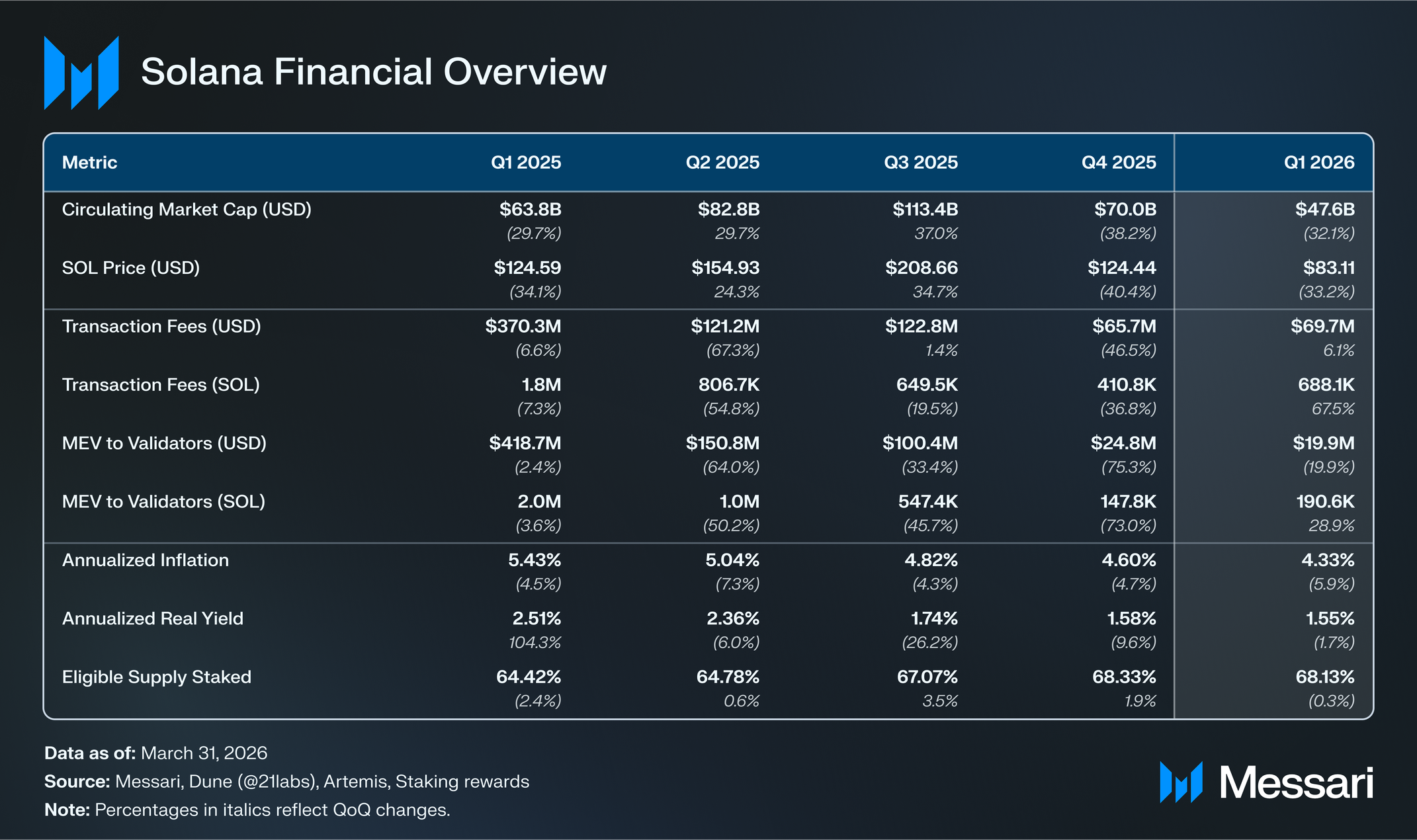

As previously noted, Q1 was a challenging quarter for the broader crypto market, with prices retreating into bear market territory. SOL was no exception, declining 33% QoQ to $83.11. Market cap held up slightly better, falling 32% QoQ to $47.59 billion, partly due to continued token inflation.
SOL maintained its fifth-place ranking among non-stablecoin assets, behind BTC, ETH, XRP, and BNB. However, its share of the total crypto market cap declined from 2.2% to 1.9%. This trend is consistent with prior bear markets, during which BTC typically gains share relative to other assets, including SOL.
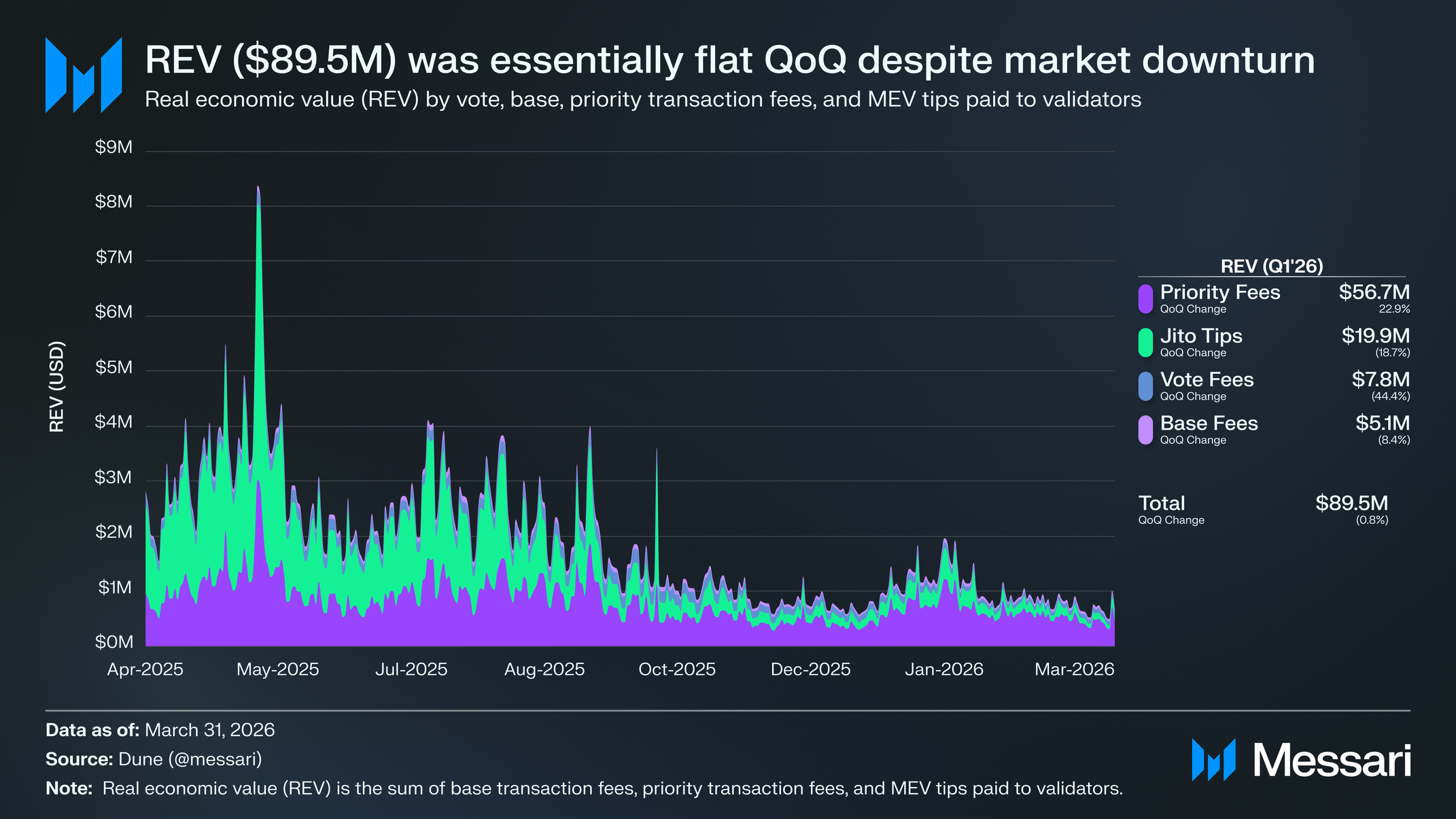
Real Economic Value (REV), which is the sum of vote transaction fees, base transaction fees, priority transaction fees, and MEV tips paid to validators, decreased 1% QoQ from $90.2 million to $89.5 million. Amongst all networks, Solana had the second-highest REV in Q1, only behind Hyperliquid ($156.0 million).
Corporate Holdings
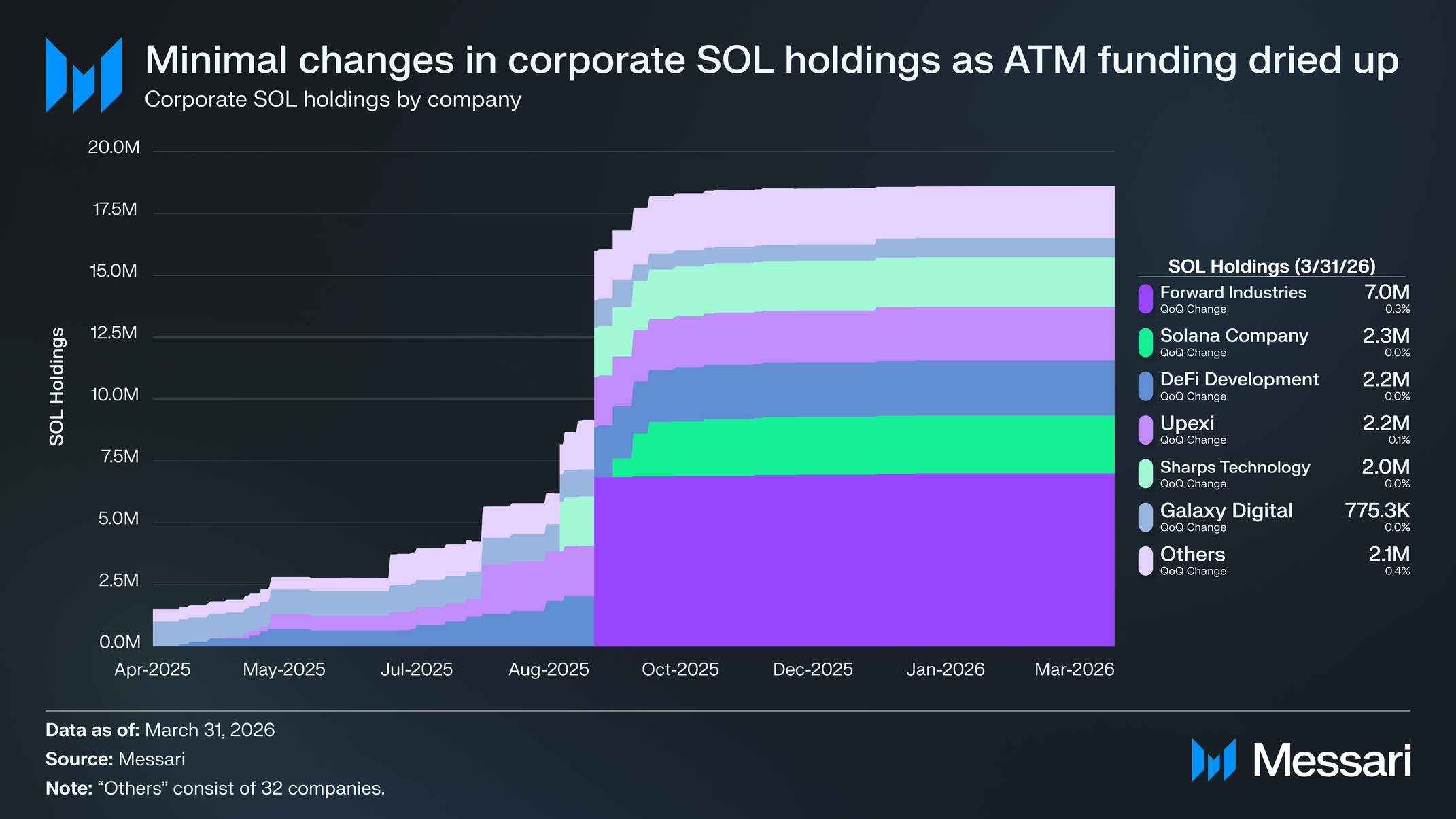
Corporate holdings of SOL greatly accelerated last year, particularly in Q3, due to the rise of Digital Asset Treasuries (DATs) across the industry. Since then, however, DAT ‘euphoria’ has subsided, and with it, increased accumulation of SOL on corporate balance sheets. Q1 holdings stayed rather consistent across all companies, with total holdings remaining at 18.6 million SOL, equivalent to $1.54 billion. The top six companies by SOL held at the end of Q1 were:
- Forward Industries - 7.0 million SOL ($580.2 million)
- Solana Company - 2.3 million SOL ($194.6 million)
- DeFi Development - 2.2 million SOL ($184.6 million)
- Upexi - 2.2 million SOL ($180.8 million)
- Sharps Technology - 2.0 million SOL ($166.3 million)
- Galaxy - 775,300 SOL ($64.4 million)
Closing Summary
Solana's first quarter of 2026 was defined by record onchain activity and continued capital efficiency, even as the broader crypto market entered a bear phase, and SOL declined 33% QoQ to $83.11. Average daily non-vote transactions reached a new all-time high of 112.6 million, up 50% QoQ, while Chain GDP held essentially flat at $342.2 million and App RCR ticked up to 382%. Stablecoin market cap held at $14.85 billion as composition shifted toward USDT, USD1, and PYUSD, and RWA market cap on Solana grew 43% QoQ to $2.01 billion, led by BUIDL's doubling to $525.4 million. Together, these trends underscore Solana's deepening role as a settlement layer for tokenized finance, even amid a broad-based decline in dollar-denominated DeFi total value locked (TVL).
Network and validator metrics held firm against the price drawdown. REV decreased only 1% QoQ to $89.5 million, the second-highest of any network behind Hyperliquid, while total staked SOL ended the quarter at a new all-time high of 424.7 million. Solana's 773 active validators are distributed across 35 countries and 204 data centers, and the Solana Foundation Delegation Program continued to wind down, falling from 12% of stake at the end of 2024 to roughly 5% by quarter-end. On the roadmap, Agave 3.0 shipped with XDP, while SIMD-286, SIMD-296, SIMD-268, and SIMD-123 advanced under the Agave 4.x release series. Anza also introduced Constellation, a Multiple Concurrent Proposers design intended to complement Alpenglow.
Looking ahead, Solana's structural setup heading into the rest of 2026 is anchored by Alpenglow, the network's most consequential consensus upgrade since mainnet, which is targeted for Agave 4.1 and projected to compress transaction finality from roughly 12.8 seconds to 150 milliseconds. Alongside protocol-level work, Q1 marked the first measurable economic output from AI agent activity on Solana, with the x402 payment standard expanding across QuickNode, Messari, Alchemy, and others, and the Solana Foundation-backed Agent Registry going live onchain. Continued growth in RWAs, the broadening of corporate SOL treasuries to 18.6 million SOL across 39 companies, and the expansion of consumer rails through Solana Mobile, Phantom, and OnePay all suggest a network that is maturing across financial, infrastructure, and consumer layers in parallel.
To stay up-to-date with all things Solana, visit Messari's Solana Portal.
Let us know what you loved about the report, what may be missing, or share any other feedback by filling out this short form. All responses are subject to our Privacy Policy and Terms of Service.

AJC is a Research Manager at Messari for the Enterprise team. His primary focuses are on Bitcoin and Consumer. Prior to joining Messari, AJC wrote an independent crypto blog.
Mentioned Assets