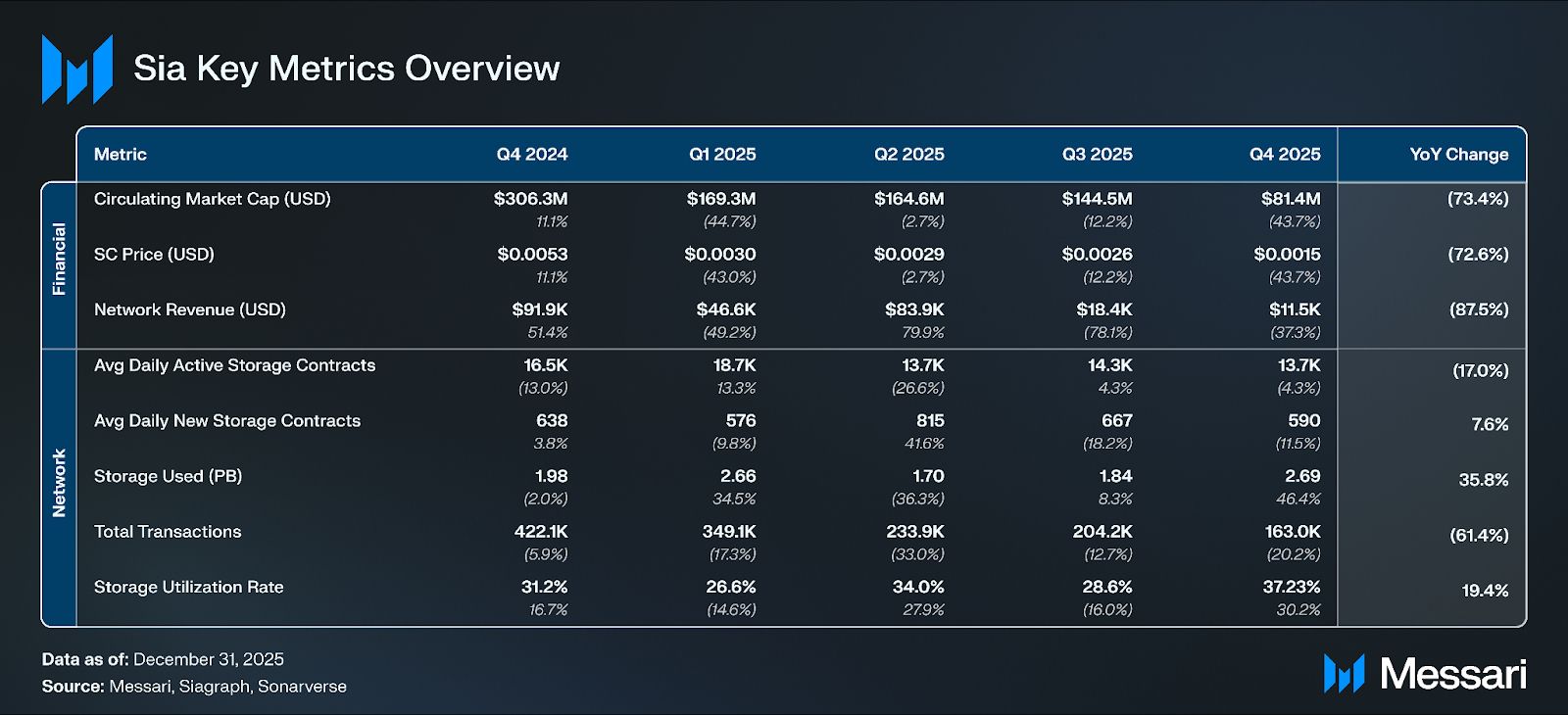
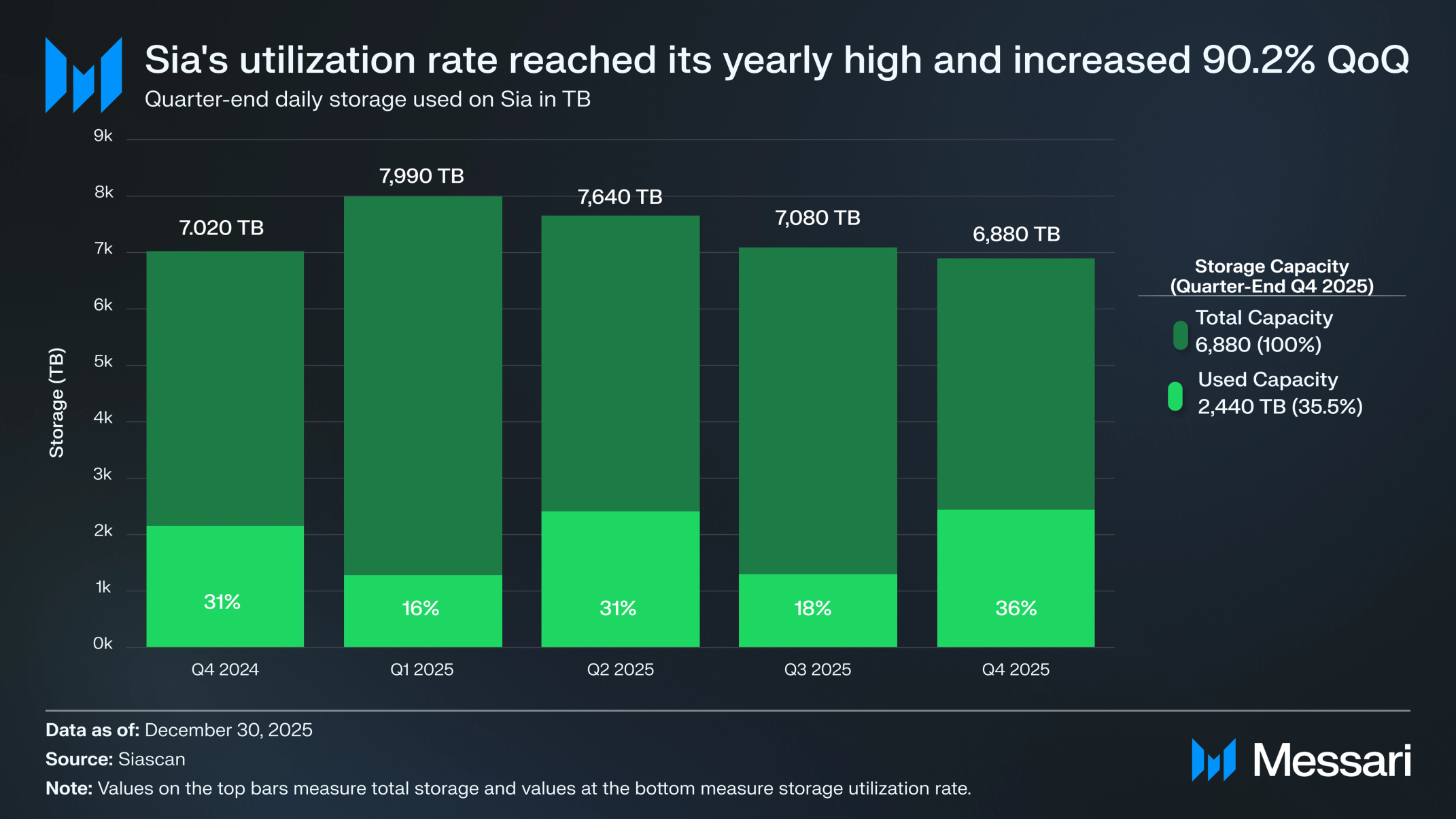
Storage utilization rebounded 90.2% QoQ as the network stabilized following the V2 fork. Utilization rose to 35.5% from 18.1%, though total storage capacity fell to 6,880 TB from 7,080 TB in Q3 2025.
Sia completed the final V2 cleanup fork, dubbed “V2: The Final Cut,” on Dec. 2, 2025. The upgrade removed remaining V1 fields, fixed a difficulty-adjustment bug, and moved the network toward a single transaction and consensus format.
The Sia Storage app progressed through internal alpha with reliability and UX improvements, including iOS and Android compatibility. If the app can become reliable at scale, it could be Sia’s clearest path to expanding beyond operator-led usage into new renter onboarding.
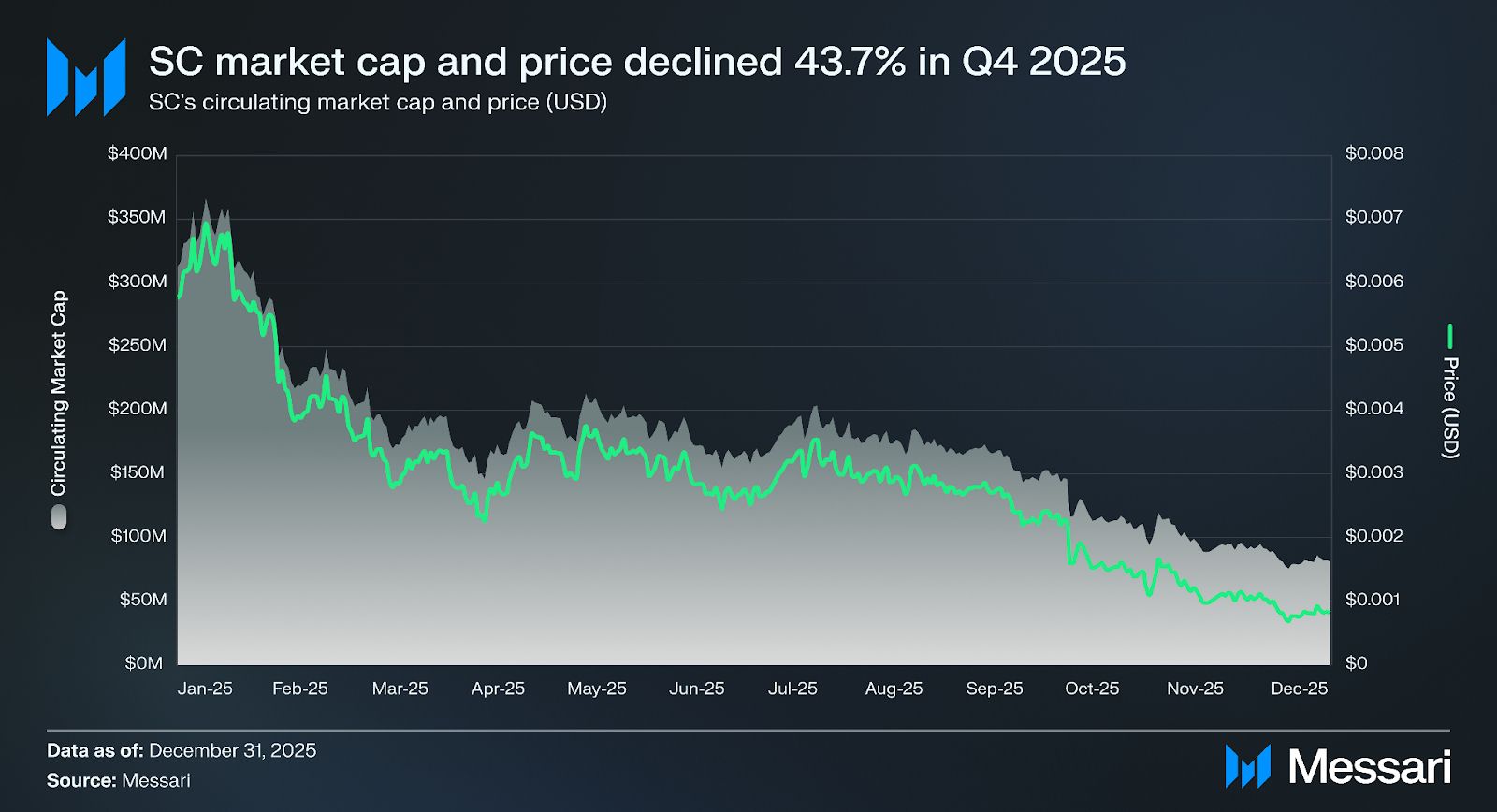
SC token price fell 43.7% QoQ to $0.0015 as an estimated $1.2 trillion was erased from total crypto market value over the six weeks preceding Nov. 18, 2025.
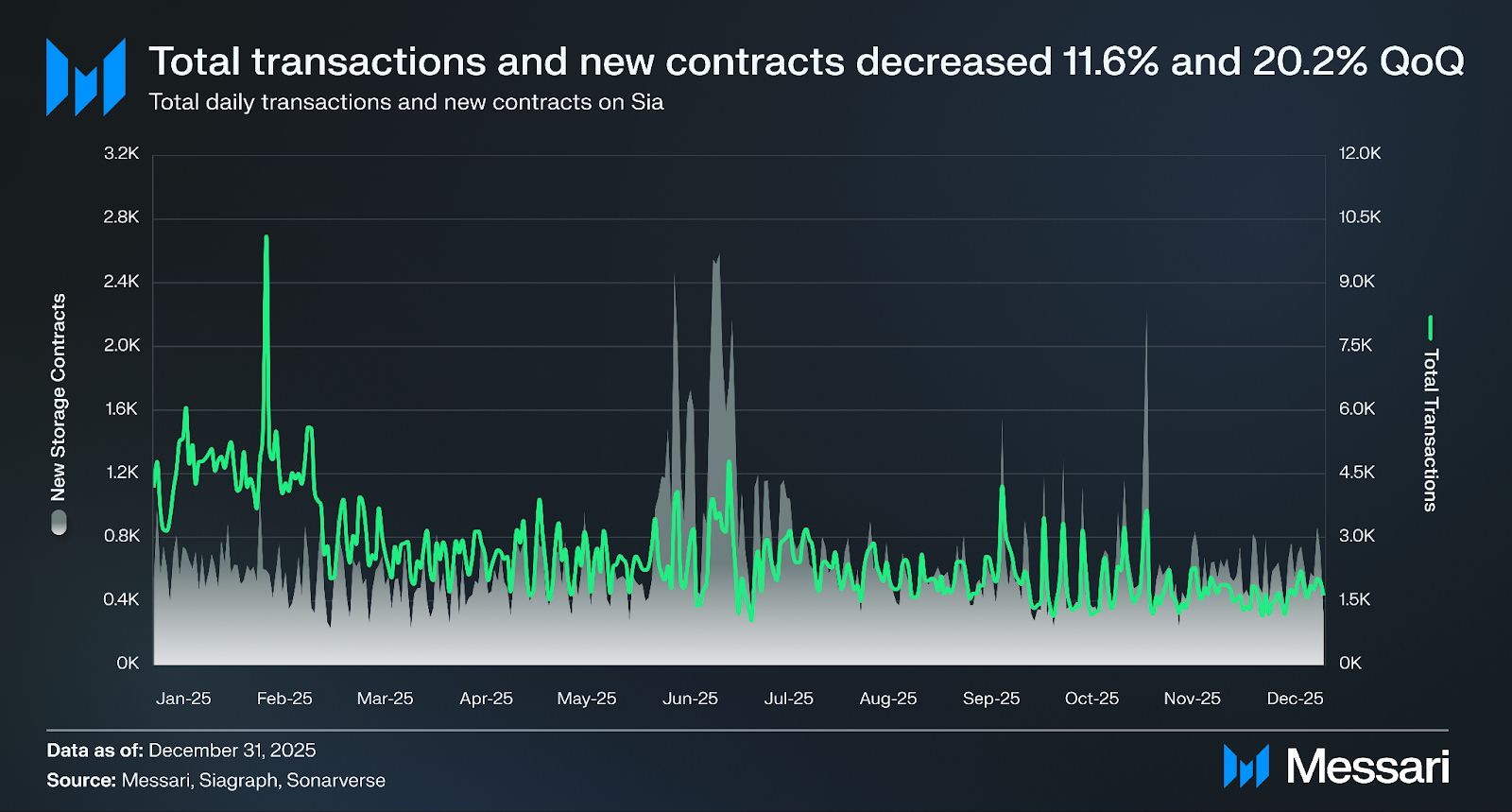
Network activity on Sia continued to decline in Q4 2025 as average daily transactions fell 20.2% QoQ to 1,770, while daily new storage contracts fell 11.6% to 590.
Primer
Sia (SC) is a decentralized cloud storage network that combines a Proof-of-Work (PoW) blockchain with a contract-based storage model. Storage contracts uphold storage agreements between hosts (storage providers) and renters (storage consumers). Renters define the amount of data to be stored, the timeframe for storage, and the price. Users and storage providers enter into storage contracts and deposit the native asset, Siacoin (SC), into an escrow account. Storage providers must cryptographically prove that they are hosting the required data, and if they fail to uphold the storage contract, their collateral is forfeited. At contract expiry, the storage provider receives the majority of the escrowed funds, with a small portion (4%) allocated to holders of Siafund (SF) tokens. Siafunds are security tokens that accrue SC to the SF holder from finished contracts on Sia.
Siacoin can be used to pay transaction fees on the Sia blockchain and as a medium of exchange for the storage market. Renters pay a storage fee, upload/download bandwidth prices, and gas to create storage contracts. Encryption ensures that uploaded files remain private, and redundancy ensures security by distributing files across multiple servers. Files uploaded to Sia are split into 30 shards, or chunks, and sent to various hosts. Only 10 shards are required to rebuild the file, and their copies are re-duplicated to new hosts whenever one is offline. For a full primer on Sia, refer to our Initiation of Coverage report.
Siacoin (SC) is the native token of the Sia network, used to facilitate decentralized cloud storage. Specifically, SC is used to (i) pay for encrypted peer-to-peer storage through file contracts, (ii) incentivize hosts and serve as collateral for reliable data retention, and (iii) distribute block rewards to miners for securing the network.
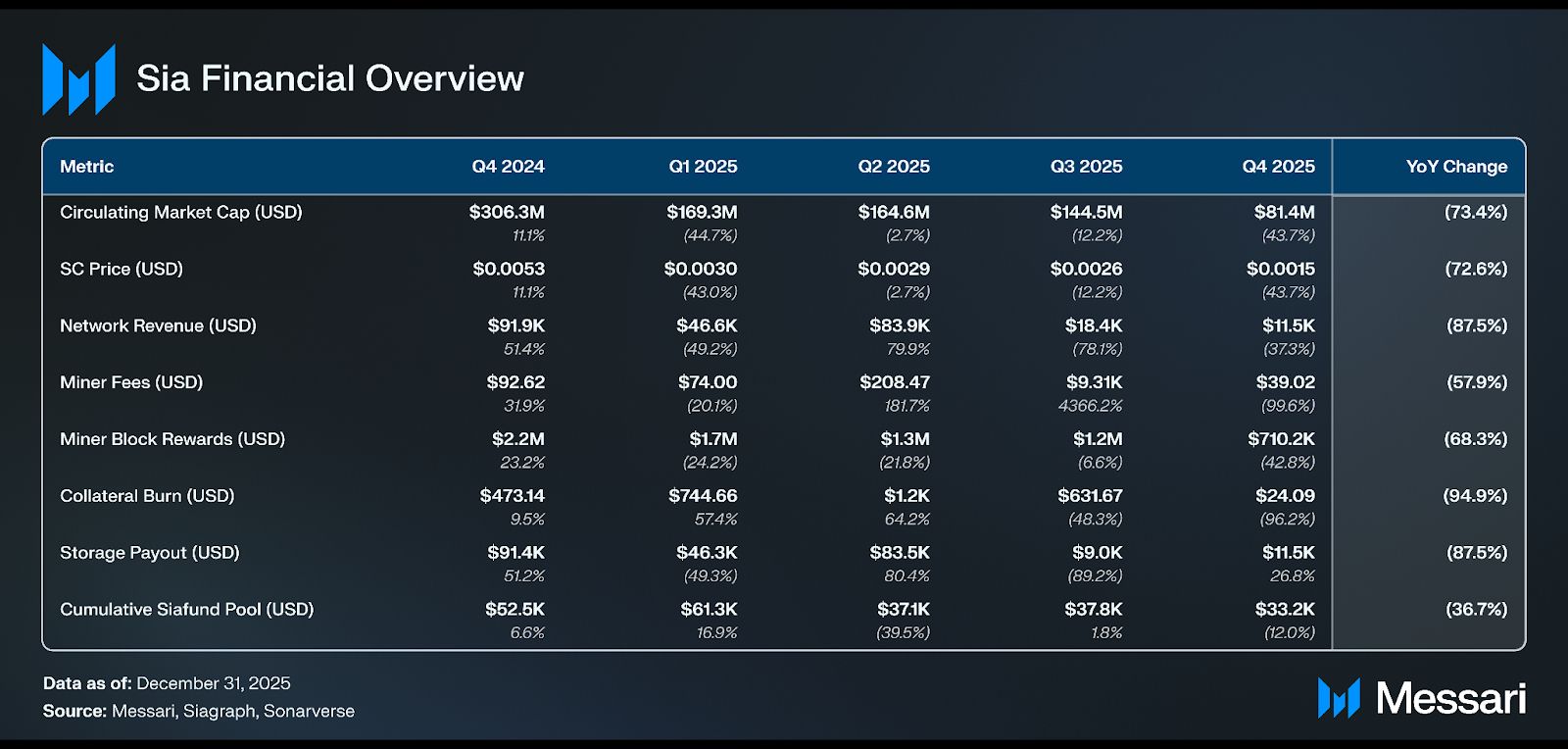
The price of SC fell 43.7% QoQ from $0.0026 to $0.0015 in Q4 2025. The circulating supply, generated through ongoing miner block reward emissions rather than token unlocks or vesting schedules, increased only marginally, resulting in the circulating market cap (USD) also declining by 43.7% from $144.5 million to $81.4 million. As a result, SC’s market cap rank decreased from 285th to 373rd.
SC’s Q4 drawdown came during a broader risk-off move in crypto. An estimated $1.2 trillion was erased from the total cryptocurrency market value over the six weeks leading up to Nov. 18, 2025, as risk appetite faded. For a smaller-cap asset like SC, broad market de-risking tends to hit harder because liquidity is thinner.
Sia also experienced a reduction in spot trading availability on one major venue, as OKXannounced the delisting of SC/USDT and SC/USD on Sept. 29, 2025. Losing a liquid trading venue can weaken day-to-day depth and make price moves more severe during a market downturn. Around the network upgrade in December 2025, some exchanges, such as CoinEx and ByBit, temporarily paused deposits and withdrawals. While these pauses mostly cause transfer issues rather than directly affecting price, they can reduce cross-venue flows during the maintenance window.
Transactions & New Contracts
Network activity on Sia decreased in Q4 2025, extending the slowdown that began earlier in the year. Daily transactions averaged 1,770 during the quarter, a 20.2% QoQ decline from 2,220 in Q3 2025. New storage contract creation also fell, averaging 590 contracts per day, down 11.6% QoQ from 667.
New storage contracts are a key indicator of renter budget formation on the Sia network. The decline in new contract formation is consistent with SC-denominated repricing on the host side. In Q3 2025, hosts raised storage pricing in SC terms, and upload pricing increased sharply. Allowances are set in SC, so higher SC-per-TB pricing means a renter’s budget buys less storage duration and bandwidth than it did before. If renter budgets did not increase in SC terms, renters would respond by funding fewer contracts or setting smaller allowances, which pulls down new contract counts.
They are initiated when renters allocate a prepaid budget known as an allowance. This allowance reflects the maximum amount of SC the renter is willing to spend on storing data across contracts and is calculated by multiplying the storage price (in SC per terabyte) by the total data volume and the intended storage duration.
For instance, storing 2 TB of data for two months at a rate of 500 SC per TB per month would require an allowance of 2,000 SC (2 × 2 × 500). In addition to the allowance, renters pay contract formation and upload bandwidth fees at the time of contract initiation.
Hosts, in turn, are required to secure collateral, which can be slashed if they fail to uphold the terms of the agreement, ensuring a financial incentive for uptime, data availability, and contract integrity. This is the core enforcement mechanism for storage contracts.
Active Storage
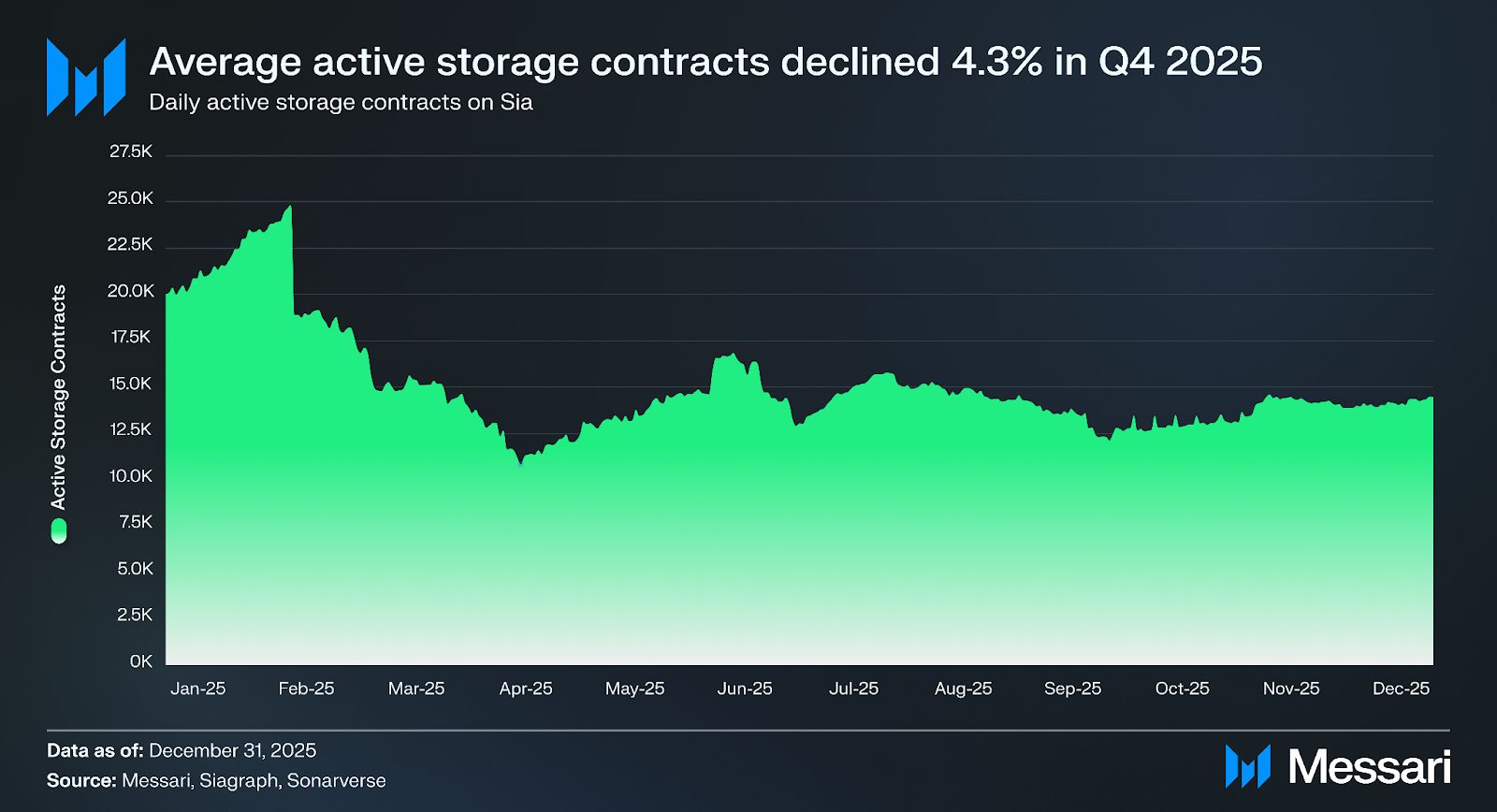
The average number of daily active storage contracts on Sia declined to 13,670 in Q4 2025, down 4.3% QoQ from 14,300. The drop in active contracts was modest relative to the decline in new contract formation, which points to existing renters maintaining positions through renewals rather than the network adding more renters. This suggests lower churn in Q4’25 even as new demand slowed, with the weakness concentrated in new contract formation rather than a significant reduction in active contracts.
Utilization
Storage utilization on Sia increased in Q4 2025 as the network stabilized following the V2 upgrade. Total data stored increased to 2,440 TB from 1.280 TB, representing a 90.2% QoQ increase. Meanwhile, total available storage capacity decreased from 8,080 TB to 6,880 TB in Q3’25. Together, this resulted in a utilization rate of 35.5%, up from 18.1% in Q3’25.
The utilization rate increase is a clear signal that renterd storage usage recovered from Q3 lows, even while other network metrics declined. With more data under contract, a larger share of host capacity is earning, which improves the economics of hosting and supports more stable pricing. Host revenue is driven by contract fees plus storage and bandwidth pricing, so higher utilization raises billable capacity.
Storage Prices
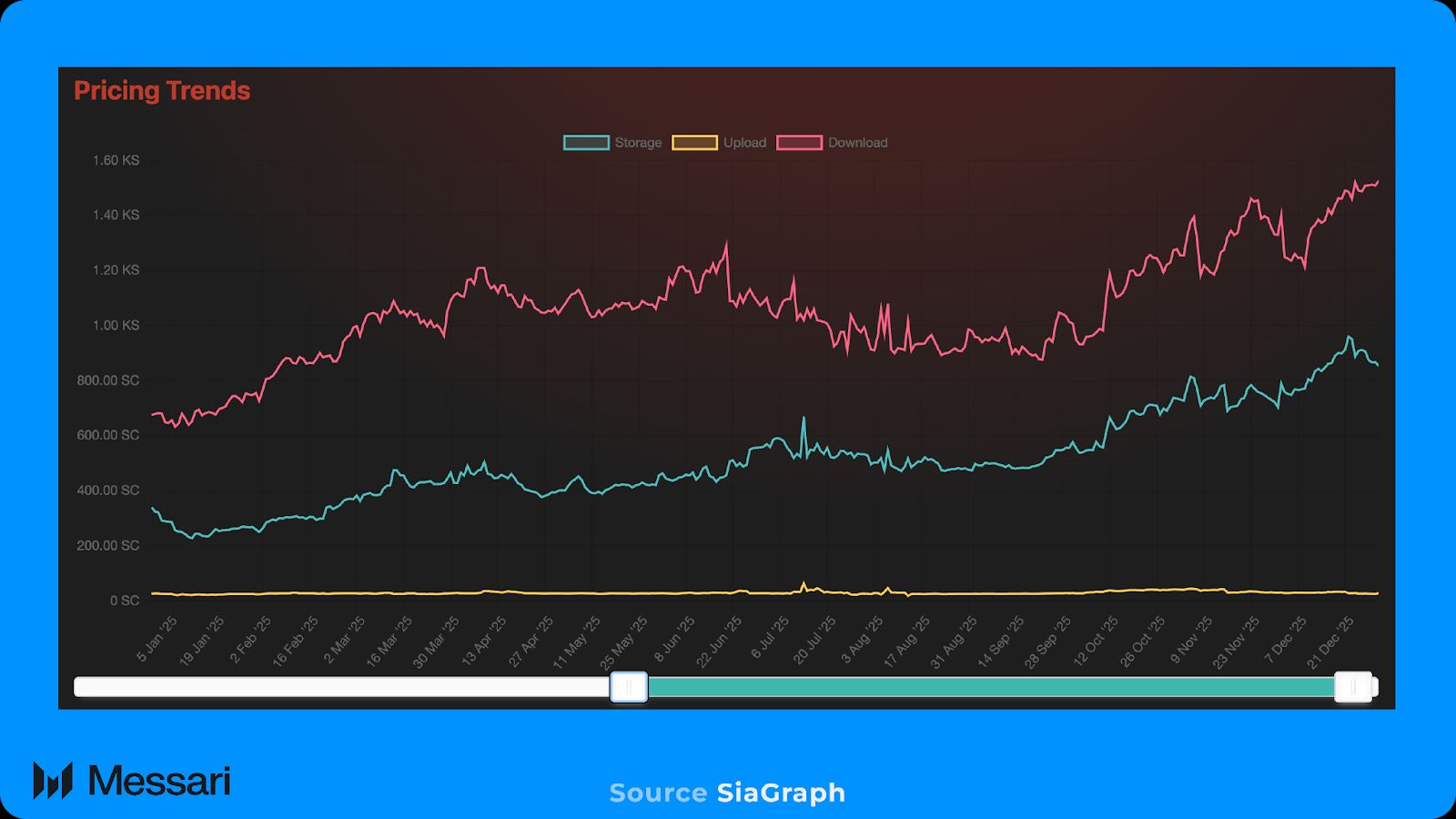
In Q4 2025, the average storage cost on Sia increased to 738.3 SC per TB/month, a 32.8% QoQ increase from 555.8 SC in Q3’25. When denominated in USD, average costs fell from $1.43 in the prior quarter to $1.37. This continued divergence that began earlier in the year indicates that while hosts raised SC-denominated prices to offset the decline in USD value of Siacoin, the increase did not preserve USD-denominated pricing.
Because renter spend is capped by an allowance denominated in SC, higher SC/TB-month pricing changes what an allowance buys. If a renter keeps the same SC budget, they either cover fewer TB-months, shorten the contract duration, or contract with fewer hosts. Given the decline in new contracts earlier in the quarter, higher SC pricing likely reduced new budget formation. However, renewals and new contracts measure different behavior. Existing renters can renew to keep their current data online, while new contract formation reflects incremental budgets and new onboarding. This split helps explain why stored data recovered even as new contract formation continued to soften.
For hosts, this implies they repriced in SC terms but did not fully keep pace with SC’s USD move. Host income is paid through contract fees plus storage and bandwidth pricing set by the host. If USD value declines, utilization becomes much more important because more stored data per host can offset weaker USD pricing by increasing billable volume over time.
Bandwidth Costs
Sia’s bandwidth pricing increased in terms of both upload and download costs. Upload costs increased 19.8% QoQ to 33.7 SC per TB, while download costs increased 24% to 1,280 SC per TB, continuing the reversal that began in Q3 2025.
Download pricing is the first cost hosts usually defend because downloads consume outbound bandwidth, and that cost can repeat every time data is retrieved. The wide gap between upload and download pricing keeps Sia more suited for write-heavy use cases, as backups and archives can tolerate expensive downloads since full restores are rare, while retrieval-heavy workflows feel the price increase immediately. In that context, bandwidth repricing in Q4’25 reflects hosts managing outbound bandwidth exposure based on SC price action and signaling that Sia is not priced to serve repeated large-scale content distribution.
Revenue
Sia’s network revenue consists of payouts to hosts, miner fees, Siafund (SF) fees, and burned collateral. Hosts earn most storage-related payments, while miners capture transaction fees and block rewards to secure the network. SF tokenholders receive a fixed fee of 3.9% from completed storage contracts. While not directly paid to any party, burned collateral reduces SC token supply and is included as revenue due to its scarcity-enhancing effect on the token.
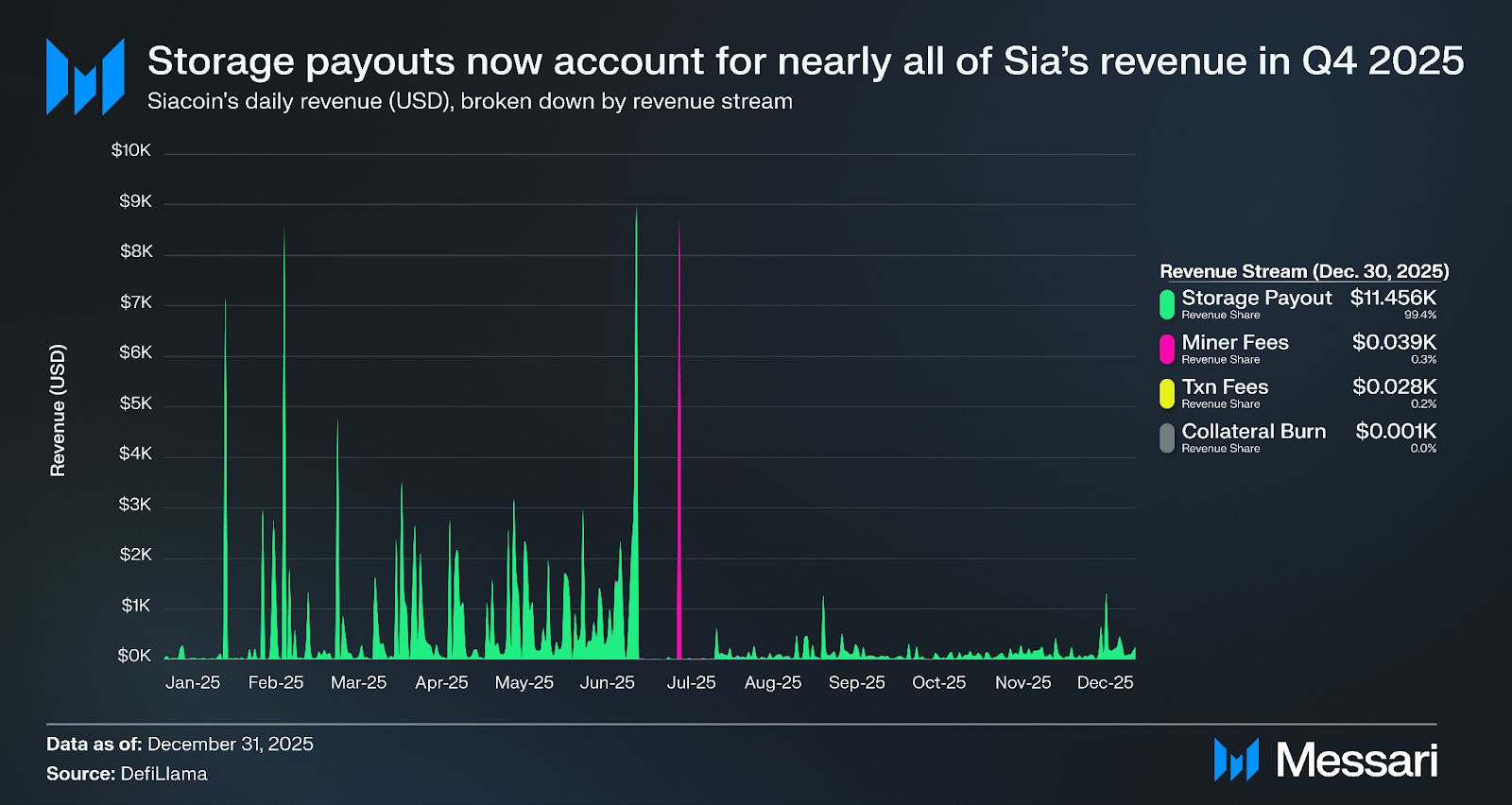
Sia’s network revenue fell sharply in Q4’25, with quarterly revenue totaling $11,520, down 37.3% QoQ from $18,390 in Q3’25. On a daily basis, revenue averaged $125 versus $200 in the prior quarter.
The revenue mix in Q4’25 reverted toward Sia’s historic pattern, where storage payouts are the primary source of revenue. In Q3’25, revenue was distorted by V2 migration activity, with contract conversions and renewal mechanics driving a spike in miner fees and shifting the timing of when storage revenue is recognized. As the migration completed, miner fees and transaction fees fell back to normal levels.
The QoQ revenue decline is also consistent with how payouts occur on Sia. Hosts are paid for storage through file contracts, but those payments are not cyclical in the way typical subscriptions like Netflix or Amazon Prime are. Storage payouts are tied to each specific contract lifecycle rather than the amount of data sitting on the network, so revenue is realized as contracts are formed, revised, and successfully proven through their term. When new contract activity slows, fewer contracts are entering or rolling through those paid parts of the lifecycle, so revenue can fall even if stored data improves later in the quarter.
Additionally, the increase in SC-denominated storage pricing may have further contributed to this. When hosts raise SC prices, a fixed allowance covers less storage time and bandwidth unless the renter increases the limit. This tends to affect new usage first, since starting new contracts or expanding stored data forces an up-front budgeting step, so the easiest adjustment is to start fewer new contracts or scale back new uploads before touching existing datasets. Renewals are different in that if the renter wants to keep existing data available, they renew even when pricing is less favorable, because the alternative is letting contracts lapse and risking data becoming unavailable. Over time, that split can produce what can be seen in Q4’25, which is softer new contract activity and weaker near-term revenue, alongside improving stored data and utilization as existing renters keep their data under contract.
Network Analysis
Sia’s Q4 centered on the final planned cleanup fork in the V2 rollout. The “V2: The Final Cut” upgrade was activated without issue on Dec. 2, 2025, and removed remaining deprecated V1 fields, fixed a difficulty-adjustment bug, and set up the chain for parallel and instant syncing. Additionally, Sia reported that the majority of its ecosystem partners successfully upgraded, including exchanges that accounted for 92.5% of all daily volume. Following the completion of this upgrade, the network now supports a single transaction and consensus format. hostd, renterd, walletd, and exchange software no longer require V1 integrations and test coverage for legacy fields that were only retained for the transition. The supported path is now V2-only, which makes upgrades and regression testing simpler going forward.
Technical Developments
The finalization of Sia V2 introduced technical enhancements focused on contract lifecycle reliability, clearer failure behavior, and fewer ways to end up stuck mid-upgrade. Noteworthy improvements included:
hostd v2.5.1: Added wallet-seed-change rescans, fixed renewal failures when “capacity > size”, and returned the correct RPC error when a host is out of storage. It also hardened revision handling to prevent revision-number rollback attacks, archived V1 contracts once the proof window closes, and began monitoring plus rate-limiting QUIC connections for bandwidth accounting. This results in fewer renewal failures, fewer ambiguous errors when a host is out of storage, and fewer disputes over what bandwidth was actually served.
renterd v2.7.1: Added an automatic chain-state reset when consensus.db is missing and removed the slab key label from the health tooltip. This addresses a common user failure case where, after an incomplete restore or accidental delete, renterd can restart from a clean state rather than continuing with a broken consensus database.
indexd (in development): Added UTXO splitting for contract formation, backoff for slab repair, and protections for unsynced contracts. Migration logic improved with parallel shard uploads and by excluding full hosts from upload candidates. Account and data controls tightened with connect-key scoped accounts and per-app pinned-data limits. Together, these changes secure contracts and repair correctness, reduce migration failure loops caused by selecting full hosts, and add the access controls needed once multiple apps share one indexer.
core and coreutils: core added parallelized sector-root computation, reducing the time spent computing and aggregating Merkle roots during storage operations that hosts and renters run constantly. coreutils updates corrected maximum-collateral validation during contract refreshes that involve partial rollovers and enabled QUIC keepalives for long-running connections. These changes prevent refreshes from failing or accepting bad parameters when only part of a contract rolls over and reduce mid-transfer drops during long sessions.
OpenAPI: Both hostd and walletd added OpenAPI specs. For exchanges and backends, this makes it easier to keep internal wallet tooling and monitoring in sync as hostd and walletd change.
s3d: Implemented DeleteObjects and CopyObject, built a reader for unsigned payload requests, and added Sia SDK integration to the Sia backend. This fills gaps that break S3 tooling during normal workflows like batch deletes and server-side copies.
react-native-sia: Achieved full Android compatibility and reduced package size by switching to release builds of indexd. This was a significant step in moving the React Native path closer to launch for cross-platform apps.
Sia Storage App
Historically, Sia has only been accessible via node software and desktop tooling, keeping the addressable user base narrow because this requires the average user to run infrastructure. The Sia Storage app lets a user upload and sync files without touching hostd, renterd, or walletd directly, and it gives other teams a concrete reference for how V2 storage should behave on constrained devices.
While Sia Foundation kept the Sia Storage app in internal alpha throughout Q4’25, the product made significant progress with upgrades around usability and sync reliability. In October 2025, the Foundation announced they added the basics a storage app needs to feel usable, such as broader file viewing support, onboarding, queued uploads, and device-wide event syncing so changes made on one device can show up on another. In November 2025, the work shifted to increasing reliability when using real user datasets. The app adopted SHA-256 content hashes as file identifiers so the same file can be recognized across devices, added cross-device metadata sync with last-update-wins, streamed uploads from disk instead of memory, and added background uploads on iOS and Android. Together, these changes target common failure cases such as duplicates, drift between devices, uploads that fail when the app is backgrounded, and memory issues during large transfers. Once the Foundation releases Sia Storage, it will likely be Sia’s most direct distribution channel for non-technical usage and the clearest reference implementation of V2 sync and upload patterns.
Ecosystem Analysis
Grants & Programs
In Q4’25, the Sia Foundation published its year-end grants calendar and made one policy change. Grants committee meetings paused while the Foundation was closed Dec. 24, 2025, through Jan. 4, 2026, with the last 2025 meeting on Dec. 9 and the next review window starting Jan. 25.
Beginning Nov. 28, 2025, the Foundation requires new grant-funded software to ship under an OSI-approved (Open Source Initiative) open-source license and to declare that license in the repo via README or LICENSE. This means funded tools need a standard license that allows others to use, modify, and redistribute the code without negotiating bespoke terms. This increases the odds that grant outputs can be picked up by exchanges, wallet teams, and app developers instead of stalling at unclear usage rights.
Grant work during the quarter leaned toward tooling and integrations that encourage V2 adoption. Notable examples of funded work in Q4’25 include:
S5 Gateway & TypeScript Client (completed): Finished all milestones, including a documentation suite, demo scripts, a screencast, and a final PR submission. For Sia, this is “last-mile” work. This work reduces integration lift for teams evaluating S5 by providing a maintained client and examples instead of requiring each team to build their own gateway and tooling from scratch.
S5 Rewrite in Rust (v1.0.0-beta.1): Re-architected S5 in Rust with a beta release that includes FUSE integration, encrypted filesystem features, and cross-language bindings. This means that S5 becomes easier to embed into non-JS environments and easier to ship as a filesystem-style interface, which is how a lot of storage software gets adopted.
Cypherock X1 hardware wallet integration (final milestone complete): Shipped new firmware and cySync releases, plus user guides and tutorial videos. This directly improves custody UX for SC holders because it adds a hardware signing path instead of keeping everything exclusively in hot wallets.
DecaNotes (completed): Delivered a Markdown editor with block-based editing and renterd integration, plus improved save logic and version reporting. While it is a small app, it is a concrete example of a V2-era product that stores user data through the new renterd stack.
Lume Web – LBRY Integration (in progress): Reported progress included forking the LBRY DHT, creating liblbry, and resolving DHT reliability issues, with next steps focused on frontend UI integration. If successful, it is another backend storage integration where Sia is used to store content that otherwise disappears when peers go offline.
Where – Crowd-Powered Location Insight App (in progress): Migrated location and comment data storage to Sia using S5 and moved from Zen to mainnet. The mainnet transition is important as it turns S5 usage into real production writes beyond testnet experimentation.
Developer Enablement & Community
Q4’25 was primarily about finishing the remaining V2 migrations and reducing integration risk around the December fork. However, the two S5-related grants mentioned introduced integration materials that are directly useful to developers for the S5 Gateway and TypeScript client and the Rust rewrite. On the community side, Sia has continued to leverage its monthly “State of Sia” posts as the main distribution channel for release context, grant status, and what changed month to month. Separately, the Foundation maintained a public cadence of transparency reporting, which keeps grant spending, development work, and operational updates centralized and auditable for developers deciding whether to commit engineering time.
Closing Summary
Select network demand indicators weakened in Q4 2025 with daily transactions down 20.2%, new storage contracts down 11.6%, and daily active storage contracts down 4.3% QoQ. With the price of SC falling 43.7% QoQ to $0.0015, and its circulating market cap declining to $81.4 million, hosts raised storage prices in SC terms to 738.3 SC per TB-month, a 32.8% increase QoQ. Quarterly network revenue fell 37.3% QoQ to $11,520, consistent with slower new contract formation and revenue recognition tied to file contract lifecycles.
Despite falls in various key metrics, Sia’s storage utilization rebounded as the network stabilized after completing the V2 migration. Total data stored increased 90.2% QoQ to 2,440 TB while capacity fell to 6,880 TB, and lifted utilization to 35.5% from 18.1%. The mix of rising utilization alongside weaker new contracts implies demand was driven more by renewals and expansion of existing datasets than by new renter budget formation.
The quarter also completed the final planned V2 cleanup fork, “V2: The Final Cut,” removing remaining V1 fields and moving the chain to a single transaction and consensus format for host, renter, wallet, and exchange software. In parallel, the Sia Storage app progressed through internal alpha, positioning it as the primary distribution path for converting post-V2 stability into new renter onboarding. If Sia can stabilize new contract formation while maintaining higher utilization in 2026, it would signal that post-V2 improvements are translating into incremental renter budgets rather than renewals alone. If not, utilization may remain renewal-driven and cause revenue to be constrained by weaker contract throughput.
This report was commissioned by Sia Foundation. All content was produced independently by the author(s) and does not necessarily reflect the opinions of Messari, Inc. or the organization that requested the report. The commissioning organization may have input on the content of the report, but Messari maintains editorial control over the final report to retain data accuracy and objectivity. Author(s) may hold cryptocurrencies named in this report. This report is meant for informational purposes only. It is not meant to serve as investment advice. You should conduct your own research and consult an independent financial, tax, or legal advisor before making any investment decisions. Past performance of any asset is not indicative of future results. Please see our Terms of Service for more information.
No part of this report may be (a) copied, photocopied, duplicated in any form by any means or (b) redistributed without the prior written consent of Messari®.