Sia completed the V2 hard fork on July 3, 2025, enabling Utreexo for light nodes and faster syncs, the RHP4 storage protocol for parallel transfers and browser access, QUIC networking, and modular clients (renterd, hostd, walletd).
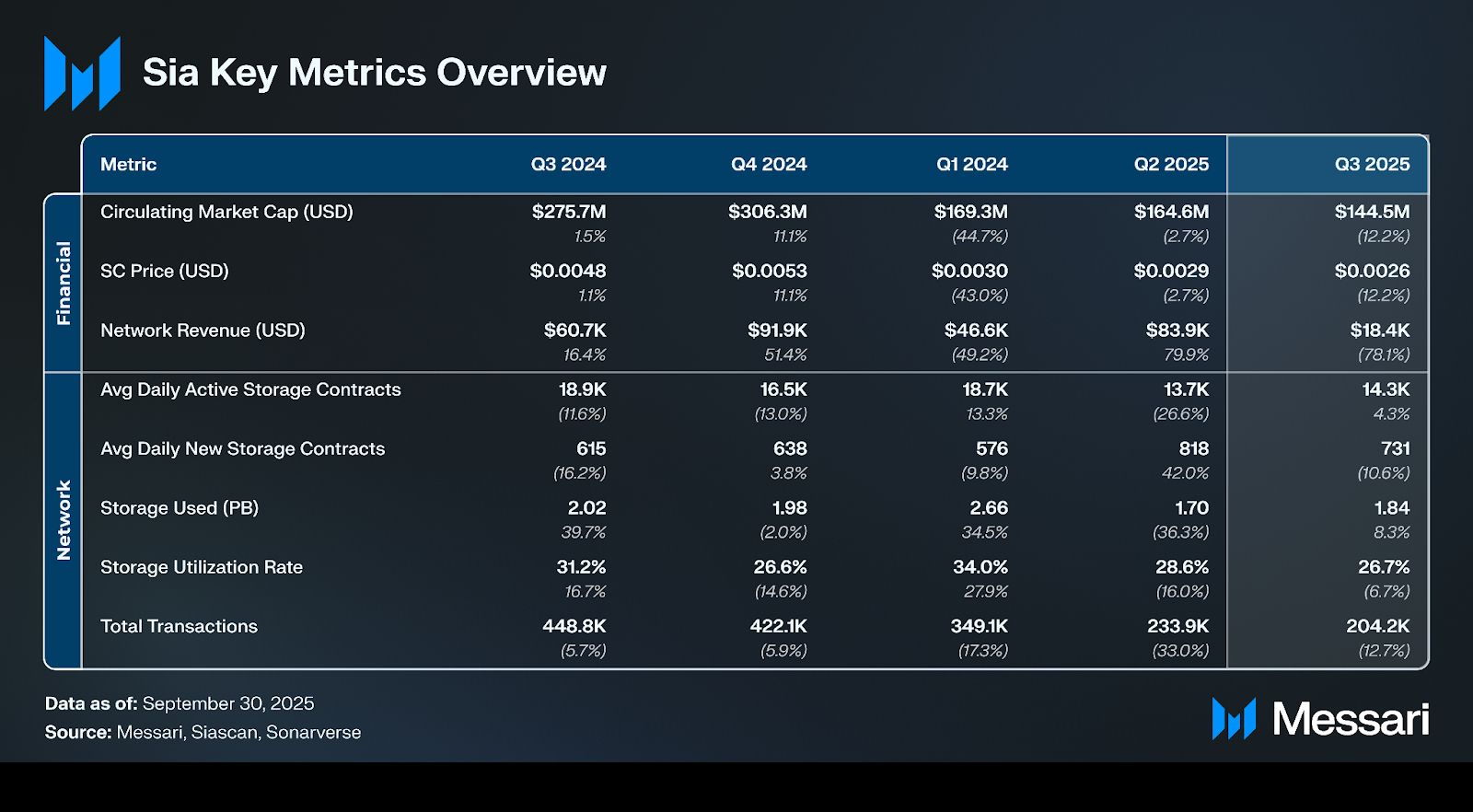
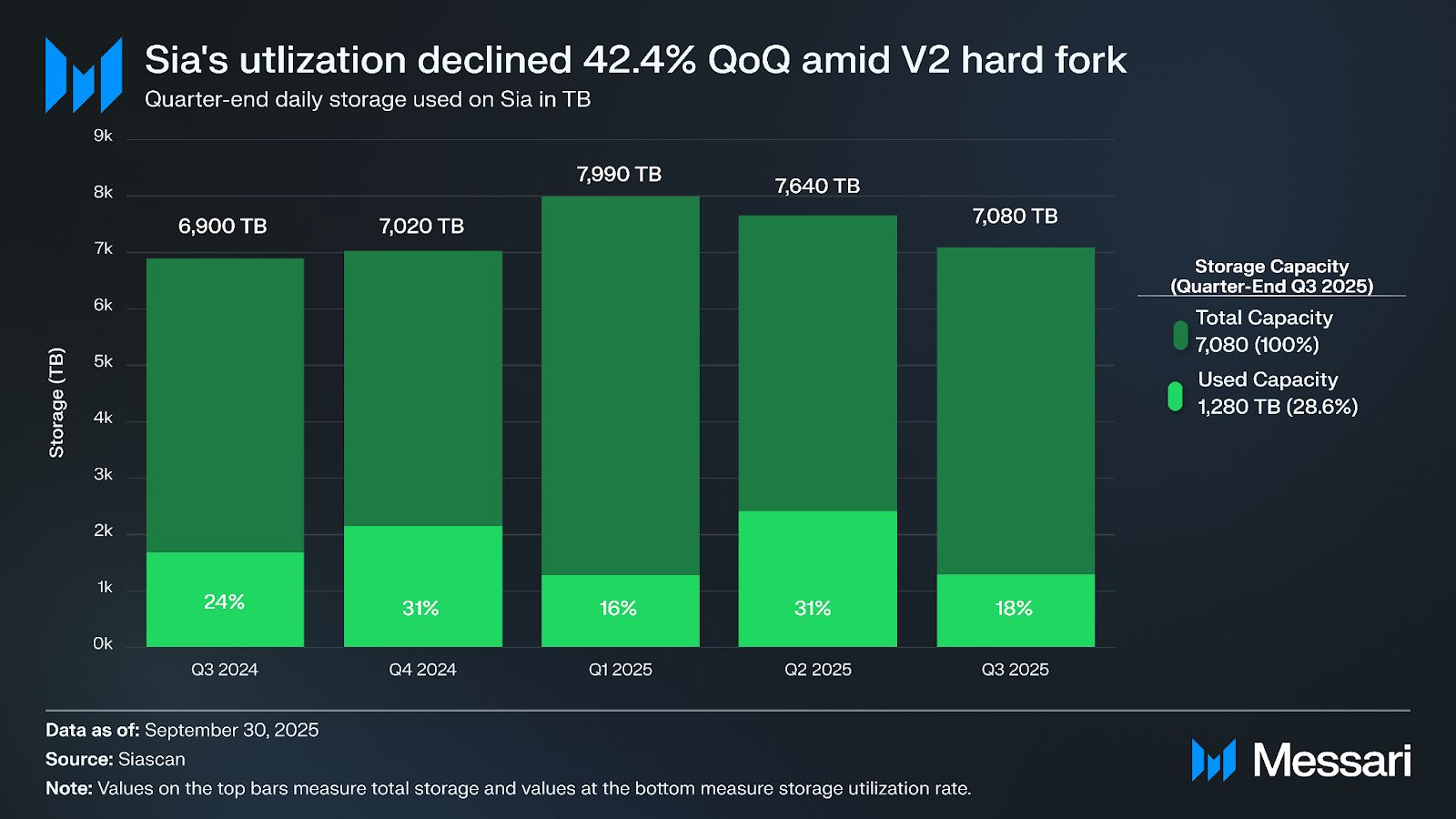
Sia’s storage utilization rate declined to 1,280 TB, down 46.6% QoQ, as many contracts expired following the V2 hard forks’ completion.
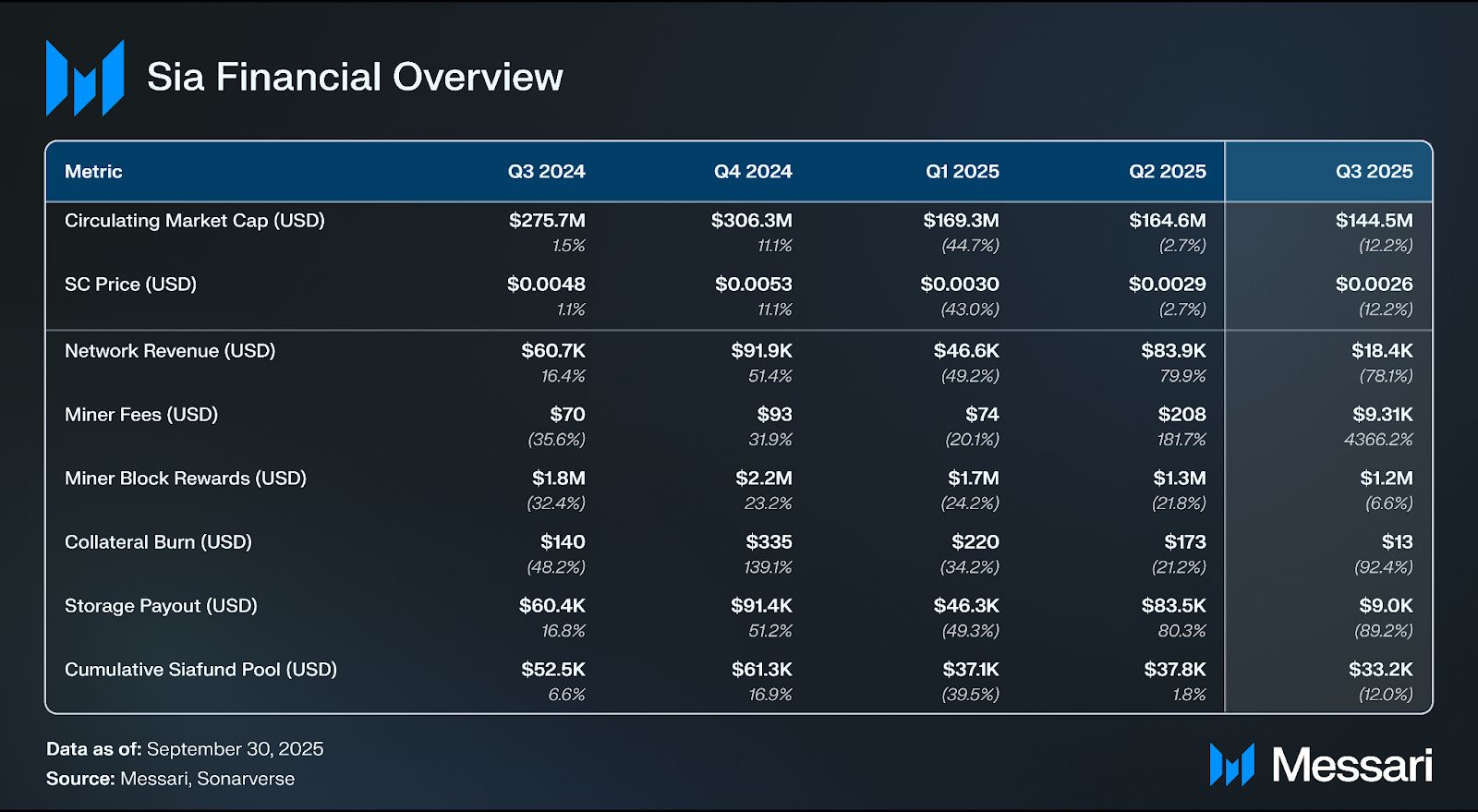
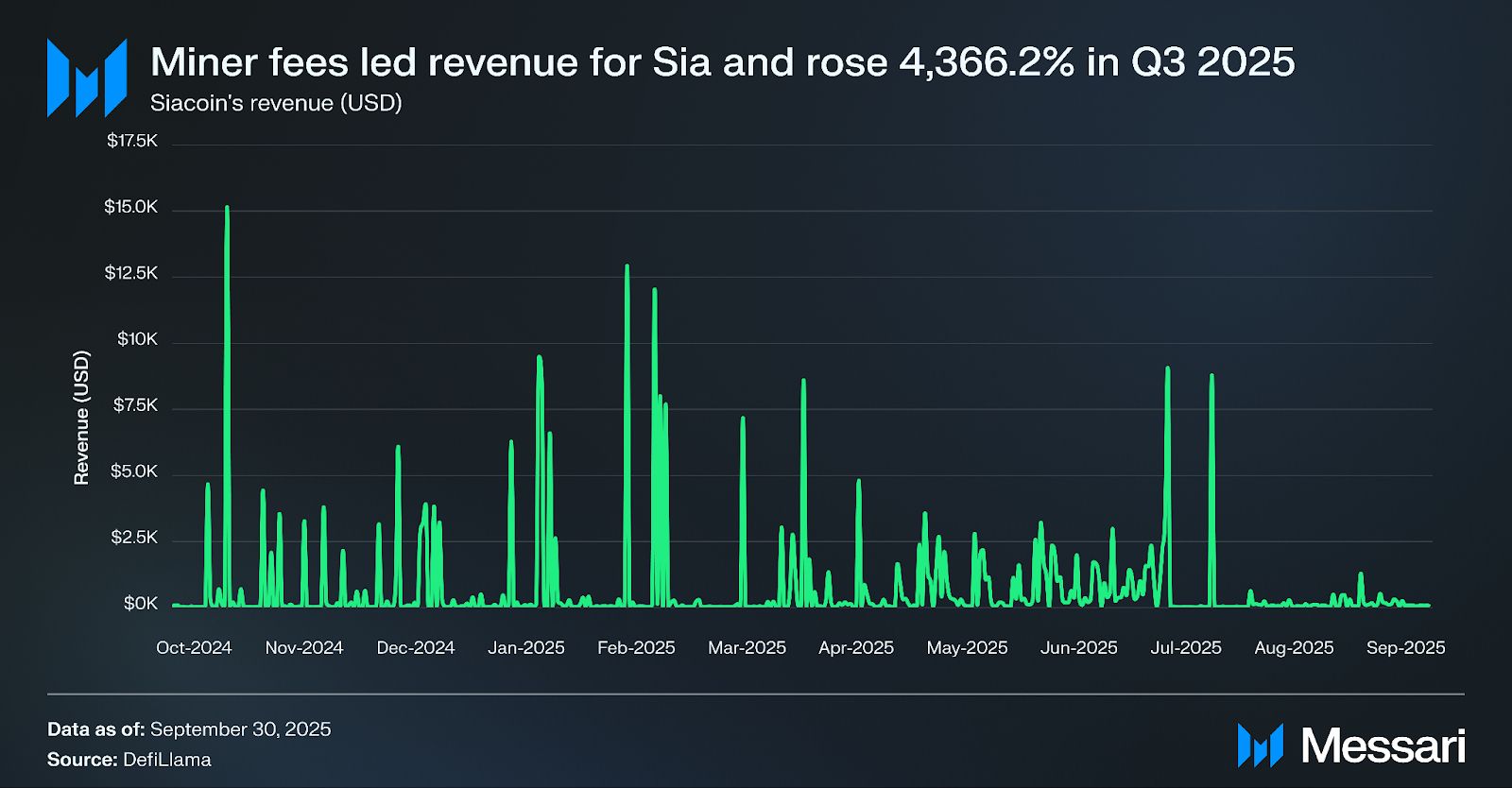
Despite a 78.1% QoQ decline in revenue, miner fees rose 4,366.2% in Q3 2025 as V1 contracts were closed and reopened as V2 contracts.
After V2 completion, Sia professionalized its grants program with a program manager and a standardized milestone framework, which supported faster V2 adoption across user apps, infra, wallets, and analytics.
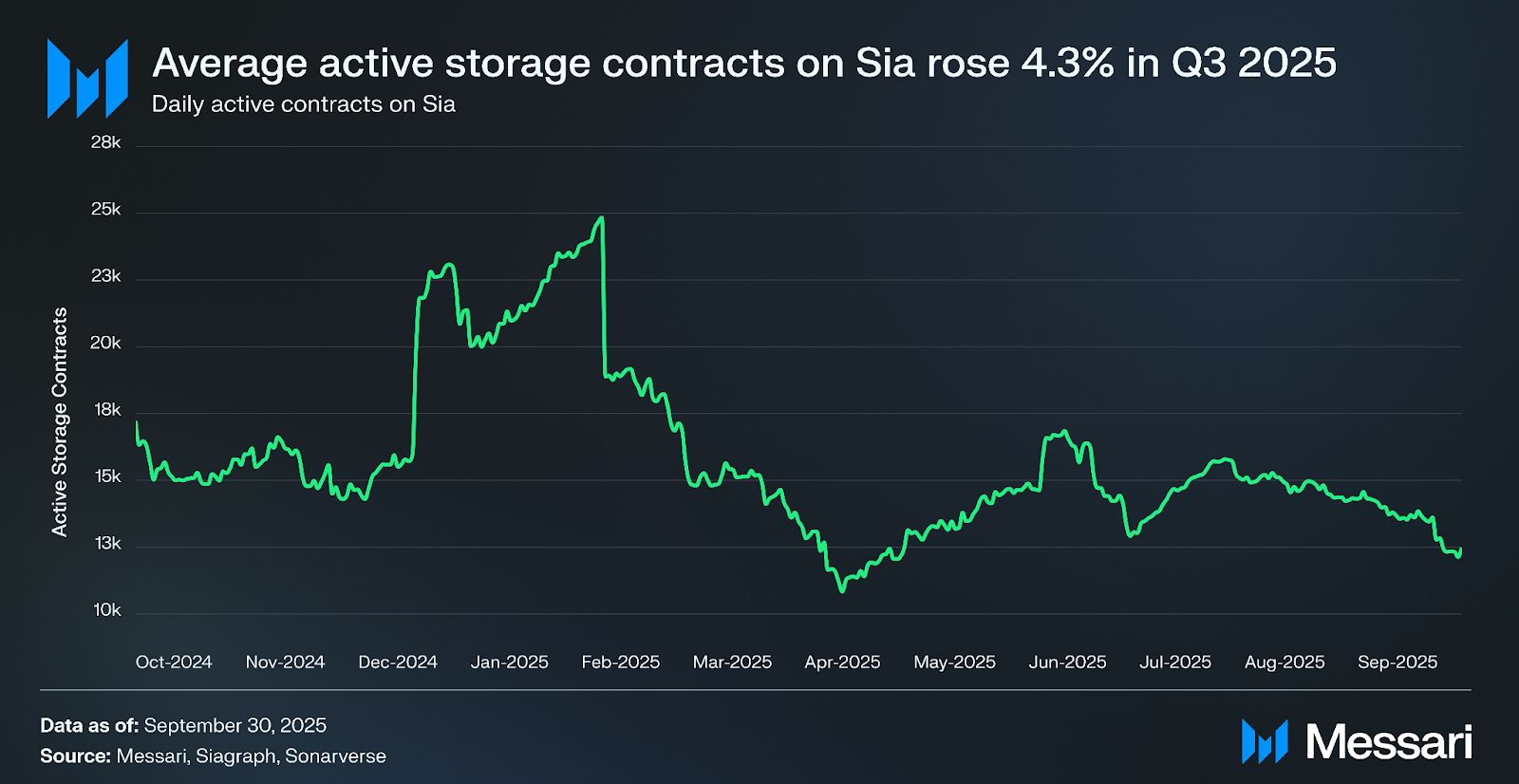
Average daily active storage contracts rose 4.3% QoQ, despite demand for new storage contracts decreasing 10.6% QoQ.
Primer
Sia (SC) is a decentralized cloud storage network that combines a Proof-of-Work (PoW) blockchain with a contract-based storage model. Storage contracts uphold storage agreements between hosts (storage providers) and renters (storage consumers). Renters define the amount of data to be stored, the timeframe for storage, and the price. Users and storage providers enter into storage contracts and deposit the native asset, Siacoin (SC), into an escrow account. Storage providers must cryptographically prove that they are hosting the required data, and if they fail to uphold the storage contract, their collateral is forfeited. At contract expiry, the storage provider receives the majority of the escrowed funds, with a small portion (4%) allocated to holders of Siafund (SF) tokens. Siafunds are security tokens that accrue SC to the SF holder from finished contracts on Sia.
Siacoin can be used to pay transaction fees on the Sia blockchain and as a medium of exchange for the storage market. Renters pay a storage fee, upload/download bandwidth prices, and gas to create storage contracts. Encryption ensures that uploaded files remain private, and redundancy ensures security by distributing files across multiple servers. Files uploaded to Sia are split into 30 shards, or chunks, and sent to various hosts. Only 10 shards are required to rebuild the file, and their copies are re-duplicated to new hosts whenever one is offline. For a full primer on Sia, please take a look at our Initiation of Coverage report.
Siacoin (SC) is the native token of the Sia network, used to facilitate decentralized cloud storage. Specifically, SC is used to (i) pay for encrypted peer-to-peer storage through file contracts, (ii) incentivize hosts and serve as collateral for reliable data retention, and (iii) distribute block rewards to miners for securing the network.
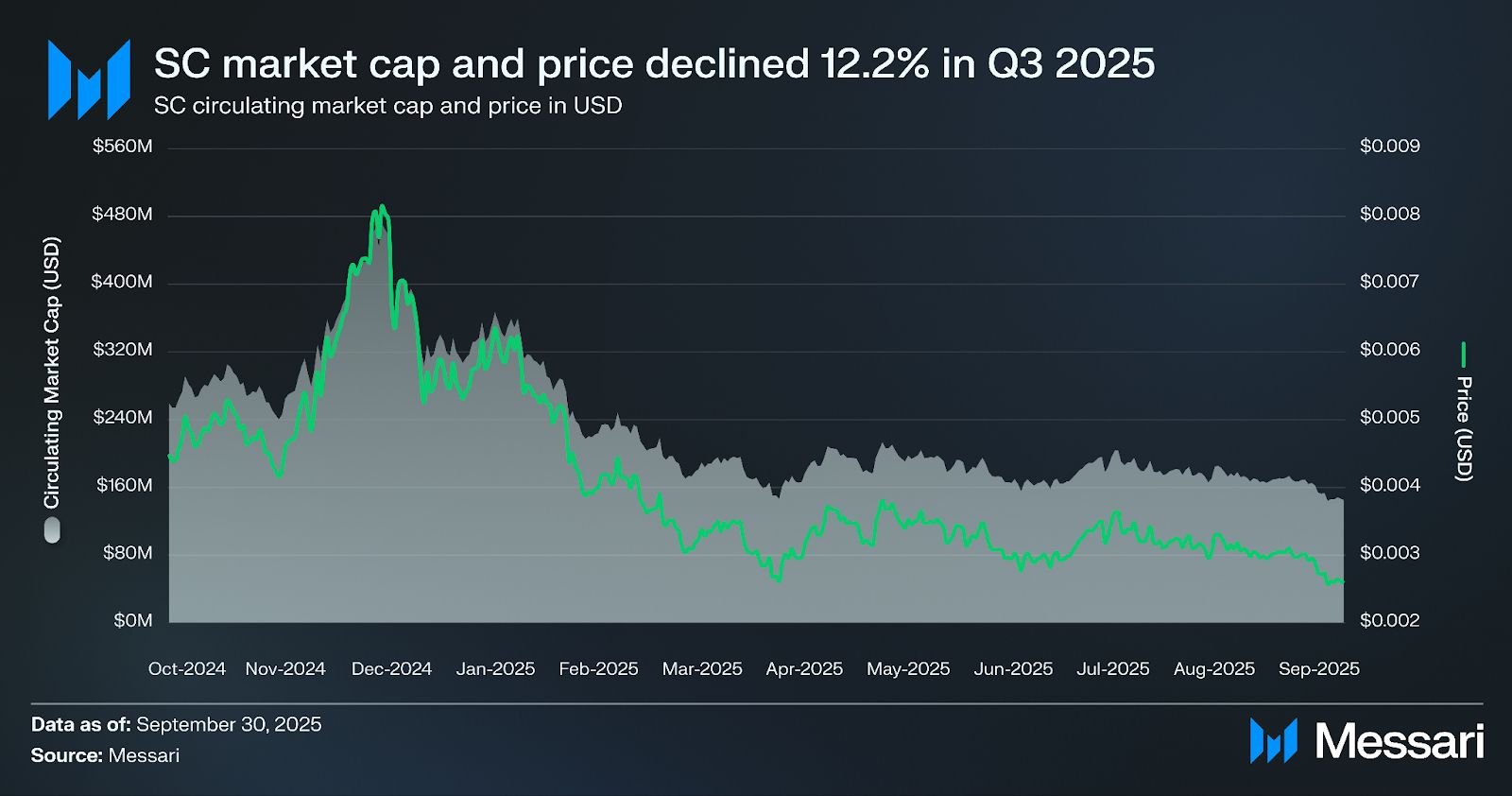
The price of SC fell 12.2% QoQ from $0.0029 to $0.0026 in Q2 2025. The circulating supply, generated through ongoing mining rather than token unlocks or vesting schedules, increased only marginally, resulting in the circulating market cap (USD) also declining by 12.2% from $164.6 million to $144.5 million. As a result, SC’s market cap rank decreased from 234th to 285th.
Transactions & New Contracts
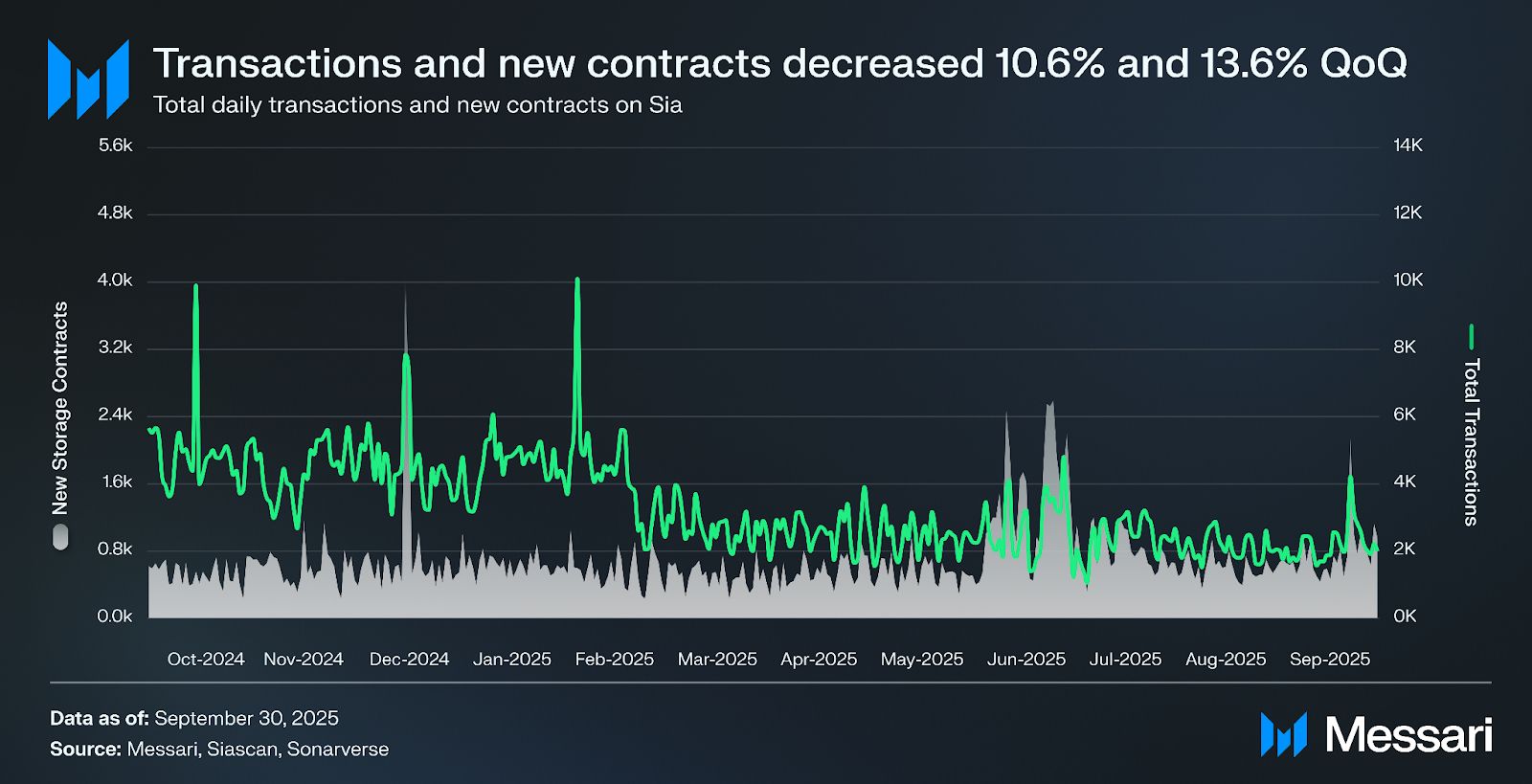
Network activity on Sia decreased in Q3 2025, extending the slowdown that began earlier in February 2025. Daily transactions averaged 2,220 during the quarter, a 13.6% QoQ decline from the 2,570 in Q2 2025. New storage contract creation also fell, averaging 731 contracts per day, down 10.6% QoQ from 818.
New storage contracts are a key indicator of demand generation on the Sia network. They are initiated when renters allocate a prepaid budget known as an allowance. This allowance reflects the maximum amount of SC the renter is willing to spend on storing data across multiple hosts and is calculated by multiplying the storage price (in SC per terabyte) by the total data volume and the intended storage duration.
For instance, storing 2 TB of data for two months at a rate of 500 SC per TB would require an allowance of 2,000 SC (2 × 2 × 500). In addition to the allowance, renters pay contract formation and upload bandwidth fees at the time of contract initiation.
Hosts, in turn, are required to secure collateral, which can be slashed if they fail to uphold the terms of the agreement, ensuring a financial incentive for uptime, data availability, and contract integrity. This structure underpins the economic foundation of Sia’s decentralized storage marketplace.
Active Storage
The average number of daily active storage contracts on Sia increased to 14,300 in Q3 2025, up 4.3% QoQ from 13,710 in Q2 2025. While the number of new contracts decreased, the increase in active contracts suggests longer contract lifetimes and lower churn rates compared to new demand. Activity trended lower through most of the quarter, though the successful completion of the V2 hard fork in July 2025 provided a foundation for future stabilization. While new user engagement dropped during the transition, the upgrade’s scalability and usability improvements position the network for stronger contract retention and renewals in subsequent quarters.
Utilization
Storage utilization on Sia declined in Q3 2025 as many contracts lapsed following the V2 upgrade. Total data stored declined to 1,280 TB from 2,400 TB in the prior quarter, representing a 46.6% QoQ decrease. Meanwhile, total available storage capacity decreased to 7,080 TB, down from 7,640 TB in Q1’25. Together, this resulted in a utilization rate of 18.1%, down from the 31.5% in Q2’25.
The sharp decline was likely tied to the V2 upgrade rather than hosts leaving the network permanently. After the transition, nodes that did not upgrade could no longer sync to the chain or broadcast transactions. Due to this, renters who failed to upgrade or reopen the renterd application to trigger renewals saw their contracts expire. When a contract expires, Sia deletes the associated files immediately, which reduces storage utilization even if total storage capacity remains unchanged. In August, hostd application also removed RHP2/3 and V1 support, which increased churn for late movers until both renters and hosts were on V2. With the client set now consolidated, future storage utilization should better reflect renter demand as renewals and new uploads reestablish on the V2 chain.
Storage Prices
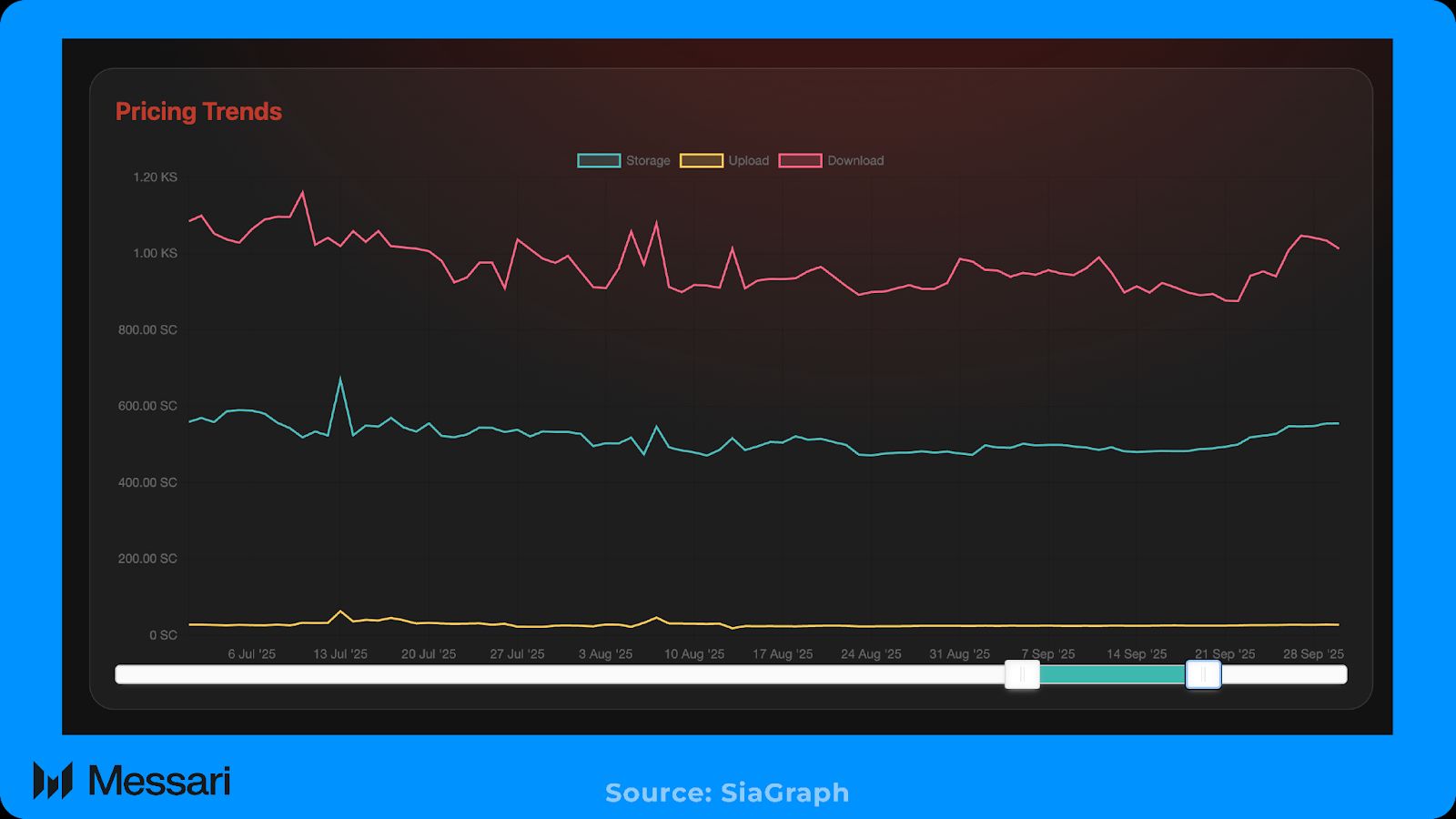
In Q3 2025, the average storage cost on Sia increased to 555.8 SC per TB/month, a 17.2% QoQ increase from 474.2 SC in Q2’25. When denominated in USD, average costs diverged, falling from $1.49 in the prior quarter to $1.43. The divergence of SC and USD-denominated storage costs reflects a continued trend in dollar-denominated host pricing decreasing each quarter following the sharp adjustments made earlier in the year.
Unlike Q2’25, where demand softened and renters faced fewer upward cost pressures, this divergence is likely due to hosts increasing the prices of storage in SC to keep up with their costs. The decline in utilization during the quarter further contributed to easing costs, as reduced renter activity likely limited hosts’ ability to sustain higher price points.
For renters, the environment remained favorable. Storage costs in USD reached their lowest level in a year, sustaining affordability amid weaker network activity. For hosts, however, the combination of lower utilization and reduced SC pricing posed ongoing revenue challenges, which set the stage for potential re-pricing dynamics as the market adjusts to post-hard fork conditions.
Bandwidth Costs
Sia’s bandwidth pricing increased in regard to both upload and download costs. Upload costs increased by 50.1% QoQ to 28.1 SC per TB, while download costs increased 12.2% QoQ to 1,030 SC per TB after a steep decrease in Q2’25.
The increase in upload pricing reflects both the disruptions caused by ongoing network improvements and potentially stronger renter demand, which together have placed upward pressure on host pricing. This was a 180-degree turn from the sharp drop in costs seen in Q2’25, suggesting that host pricing is beginning to return to its steady uptrend that can be seen in previous quarters before Q2.
Revenue
Sia’s network revenue consists of payouts to hosts, miner fees, Siafund (SF) fees, and burned collateral. Hosts earn most storage-related payments, while miners capture transaction fees and block rewards to secure the network. SF tokenholders receive a fixed fee of 3.9% from completed storage contracts. While not directly paid to any party, burned collateral reduces Siacoin supply and is included as revenue due to its scarcity-enhancing effect on SC.
Sia’s network revenue dropped sharply in Q3 2025. Quarterly revenue reached $18,390, a 78.1% QoQ decline from $83,880 in Q2 2025. On a daily basis, this equated to an average of $204 per day compared to $932 in the previous quarter.
The extreme swings likely stemmed from the V2 migration, which increased fee-paying activity and shifted storage revenue timing via contract conversions and proof windows. When contracts reset to V2, prepaid periods ended, and storage accrual restarted on new terms after proofs, creating a gap in billable time. This led to fees rising from renewals, but recognized storage revenue declined. Consequently, the quarter contained fewer billable days, despite an increase in renewal transactions and miner fees. The V2 hard fork began at block 526,000 on June 6, 2025. As a result, older software could not sync or transact if it was not upgraded, creating brief periods of reduced effective capacity as renters and hosts transitioned to renterd and hostd. When the upgrade window opened, renterd replaced V1 file contracts by immediately forming new V2 contracts with existing hosts and then deleting legacy contracts, bunching many formations and cleanups onchain. These events were recorded as transactions that included explicit miner fees. Consequently, a concentrated renewal wave led to a significant increase in miner fees, even as user storage activity remained flat or declined.
Storage payouts decreased because fewer contracts were fully resolved within the quarter, and more balances were rolled forward. Sia file contracts pay hosts as contracts resolve or are revised, and V2 emphasizes explicit renewals with the ability to roll over unspent funds into the next contract cycle, which reduces the number of end-of-period settlements recognized as storage payouts. The phased window also concentrated upgrade traffic between June and July 2025, adding to the disruption of renter and host behavior before activity normalizes on the RHP4 stack.
Network Analysis
Protocol Upgrades
Following the V2 hard fork activation window, the Sia Foundation marked the hard fork as complete on July 3, 2025, and focused the quarter on improvements across renterd, hostd, and walletd. Renterd shipped guards against unnecessary chain resets and added periodic rebroadcasts, hostd corrected proof and contract-handling edge cases, and walletd refined routing, UI, and migration tooling. If you would like more information on the V2 hard fork activation, you can read the State of Sia Q2 2025.
Technical Developments
The completion of Sia V2 introduced technical enhancements aimed at boosting the network’s performance, scalability, and usability. Noteworthy improvements included:
renterd v2.6.0: Increased contract funding, periodically rebroadcasted transactions, added a “minimum” option to wallet redistribution, and exposed raw object metadata for external download tools. These changes improved contract continuity and reduced the likelihood of stuck transactions during renewals, while simplifying external download workflows for integrators.
hostd V2.4.0: Removed RHP2/RHP3 and V1 support, added a wallet-events endpoint, introduced a 6-block buffer before reclaiming storage to avoid small-reorg failures, and tightened V2 contract integrity checks. This de-risked contract failures around chain reorgs and pushed the network decisively onto RHP4, reducing interoperability issues with legacy paths.
Consensus and Reliability Improvements: Pruned oversized RPCs in core, began WebTransport experiments in core-rs for fetching host settings, and increased RHP4 RPC timeouts in coreutils. Together, these changes make protocol calls more robust and advanced, providing browser-friendly transport, which helps stabilize RHP4 usage under real-world network conditions.
renterd V2.7.0: Added configurable per-sector upload timeouts, removed the 64-byte client-side encryption alignment requirement, and updated host scoring to factor protocol versioning. This provided operators with finer control over upload reliability and steered traffic toward fully compliant V2/RHP4 hosts, thereby improving successful upload rates.
hostd V2.4.1: Updated core and coreutils dependencies and aligned the UI’s suggested maximum collateral to keep hosts on the stable dependency line and make pricing and collateral settings more predictable across providers.
walletd V2.11.0: Added an “allowVoid” parameter to prevent accidental burns to the zero address, reducing operational risk for users and integrators during transaction broadcasting in the new V2 environment.
Ecosystem Analysis
Grants & Programs
On July 3, 2025, the Sia Foundation confirmed the V2 hard fork was complete. Q3 priorities then centered on stabilizing renterd, hostd, and walletd, and helping grantees build SDKs and apps on V2. In August 2025, the Foundation introduced a Grants Program Manager to handle a larger pipeline and ensure grant milestones are met on schedule. Grantee support was further expanded when the Sia Foundation published a Grants Development Guide in September 2025, which standardized the milestone structure and moved the monthly reporting deadline to the 25th of the current month from the 2nd of the following month. This improved auditability for grantees allows delays to be identified and addressed much sooner.
Notable examples of funded work in Q3 are:
Luogo (completed): A privacy-focused group location-sharing app built on the S5 network. Luogo’s release put a live, user-facing product on V2 directly after its completion, giving developers a concrete reference point to evaluate and build against. Available for iOS and Android at luogo.app.
S5 Rust rewrite (in progress): Released encrypted filesystem support, a unified registry/streams spec, and an S3-backed blob store. The next phase began the process of adding dynamic blob protocols and RHP4 uploads. View the project here.
Cypherock X1 integration (demo released): Finished Sia address generation and transaction signing on the hardware wallet. A public demo version was released in September 2025, with companion app integration planned next. Available for purchase at cypherock.com.
SiaGraph (in final review): Launched a redesigned analytics site with Redis caching, added new financial and growth pages, and expanded API endpoints. View the project at siagraph.info.
Developer Enablement & Community
In September 2025, Sia Foundation previewed a native mobile app built on the new Sia SDK, featuring upload, download, syncing, host exploration, and peer-to-peer sharing capabilities. The mobile app preview provided teams with a reference for iOS and Android work, as well as for V2 integrations.
The Sia team also attended several conferences to gather feedback from developers on the new SDK, including DEF CON 33 in August 2025 and RustConf in September 2025. Input from these events helped shape SDK APIs, async patterns, and the mobile app roadmap, improving fit for production teams.
Closing Summary
Sia’s Q3 2025 reflected a migration-driven reset. Network activity softened, with daily transactions down to 2,220 and new contracts to 730, extending the slowdown from Q2. Active contracts still rose 4.3% to 14,300, but utilization fell as legacy contracts lapsed following the upgrade, bringing used storage down to 1,280 TB and the utilization rate to 18.1%. Revenue declined 78.1% to $18,390 as contract conversions concentrated fee-paying transactions and pushed storage payouts later in the cycle.
With the hard fork marked complete on July 3, 2025, the Sia Foundation focused on stabilizing renterd, hostd, and walletd, and shipped upgrades that improved renewal reliability, protocol integrity, and operational safety. Ecosystem execution accelerated through a formalized grants program and clear milestone standards, alongside visible deliverables such as Luogo, S5 Rust progress, a Cypherock demo, and SiaGraph, plus an SDK-based mobile app preview and developer outreach. Overall, Q3 2025 completed the transition to V2, clarified true demand by flushing legacy contracts, and set the groundwork for steadier renewals and V2-native applications in subsequent quarters. Subsequent quarters should better reflect post-upgrade adoption as V2 contracts mature, renewals stabilize, and billing normalizes.
This report was commissioned by Sia Foundation. All content was produced independently by the author(s) and does not necessarily reflect the opinions of Messari, Inc. or the organization that requested the report. The commissioning organization may have input on the content of the report, but Messari maintains editorial control over the final report to retain data accuracy and objectivity. Author(s) may hold cryptocurrencies named in this report. This report is meant for informational purposes only. It is not meant to serve as investment advice. You should conduct your own research and consult an independent financial, tax, or legal advisor before making any investment decisions. Past performance of any asset is not indicative of future results. Please see our Terms of Service for more information.
No part of this report may be (a) copied, photocopied, duplicated in any form by any means or (b) redistributed without the prior written consent of Messari®.