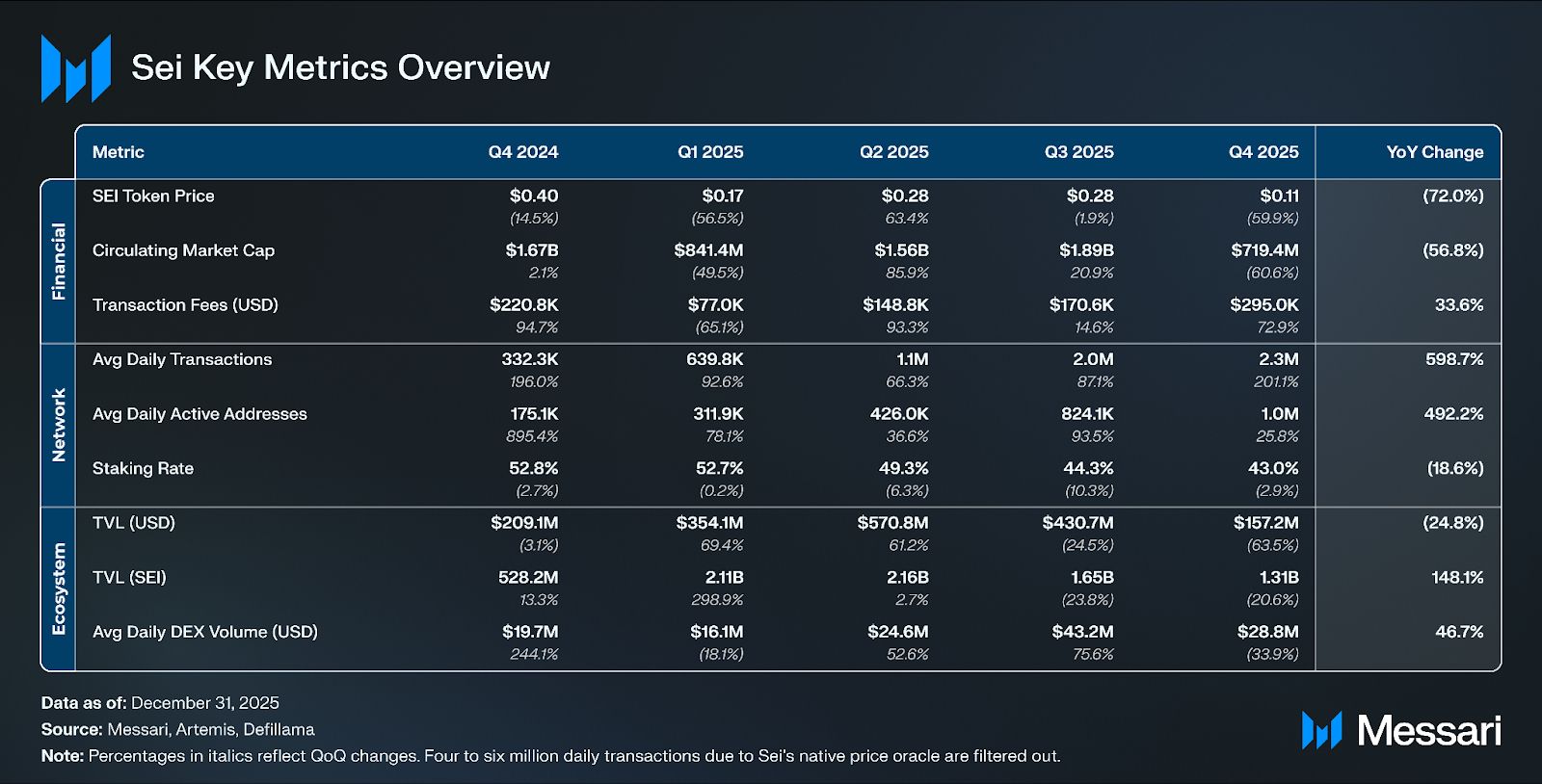
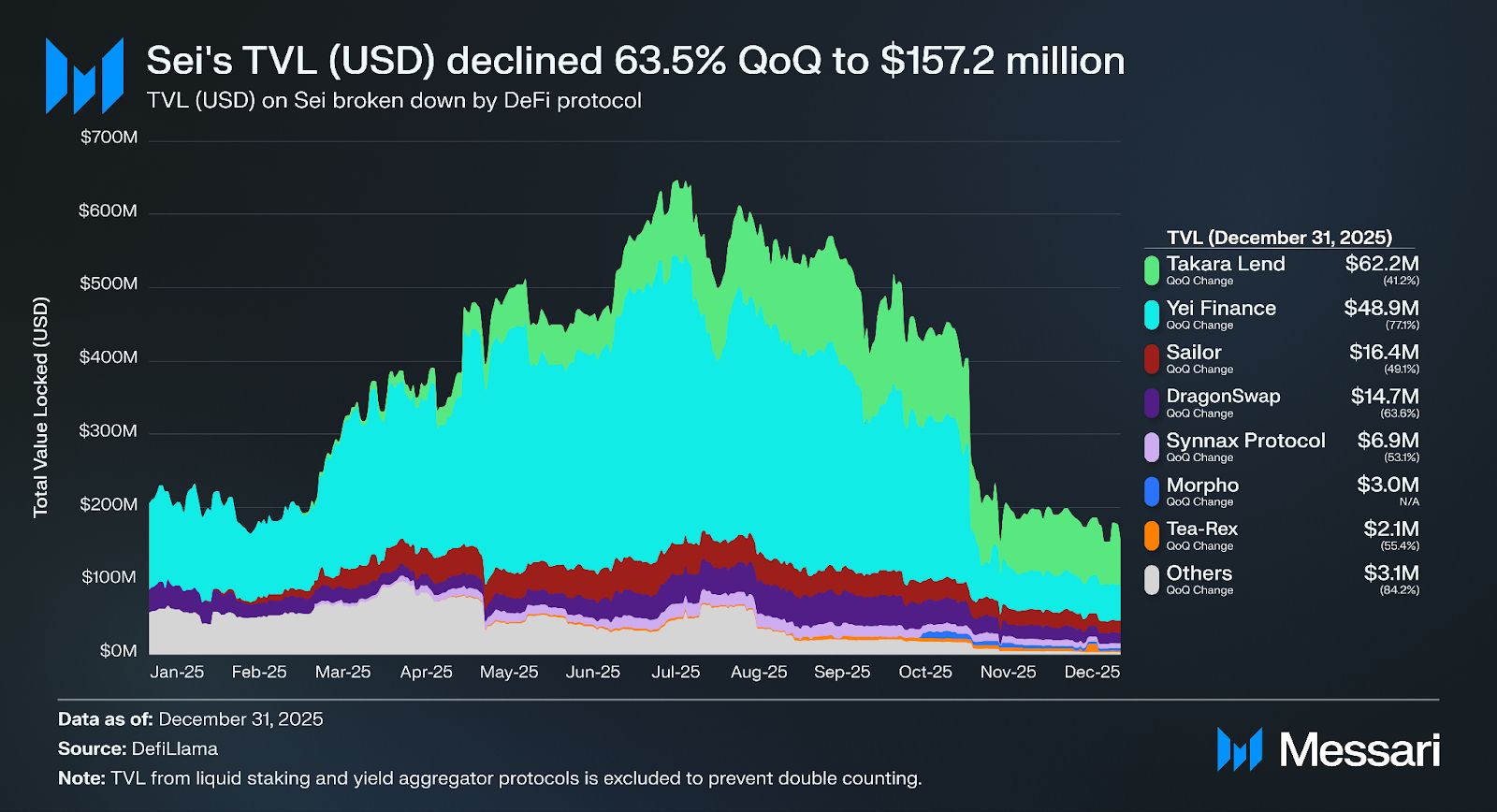
Sei experienced a sharp reset in DeFi activity in Q4 2025 as TVL (USD) fell 63.5% QoQ to $157.2 million alongside a 33.4% QoQ decline in stablecoin supply, reflecting broader DeFi deleveraging during the quarter.
DeFi drawdowns were concentrated in lending and driven by Yei Finance and Takara Lend. Together, they accounted for 76.1% of the quarterly loss in TVL, highlighting how Sei’s TVL concentration amplified the impact of withdrawals.
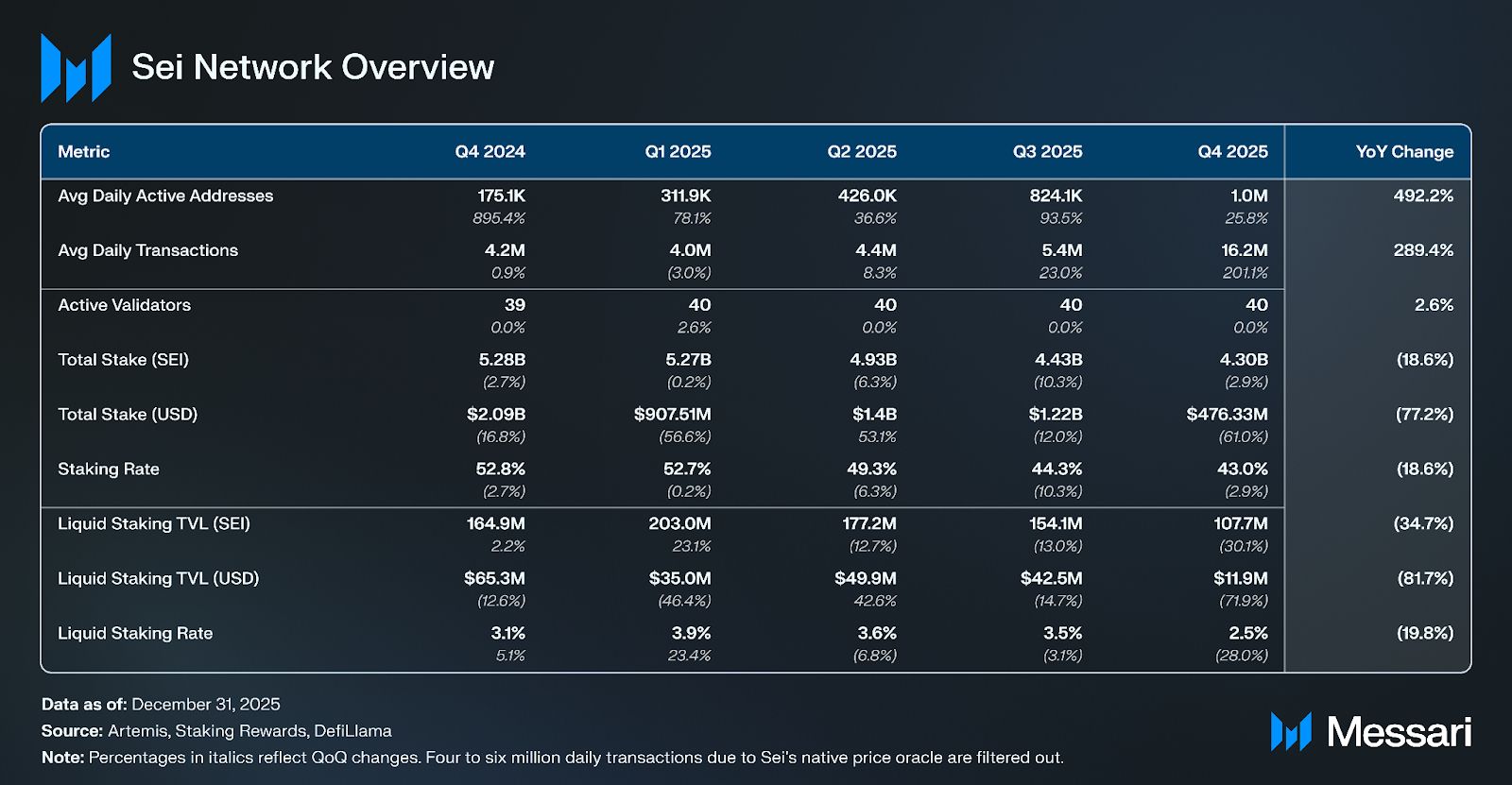
Network activity remained an area of strength for Sei, growing for a 6th straight quarter. Average daily active addresses (DAAs) increased 492.2% YoY to 1 million, and average daily transactions made by active addresses rose 598.7% QoQ to 2.3 million.
Trading infrastructure continued to expand despite DEX volume declining 33.9% QoQ. Average daily DEX volume (USD) declined to $28.8 million, but DragonSwap retained AMM dominance, and Oxium launched onchain perpetuals in November.
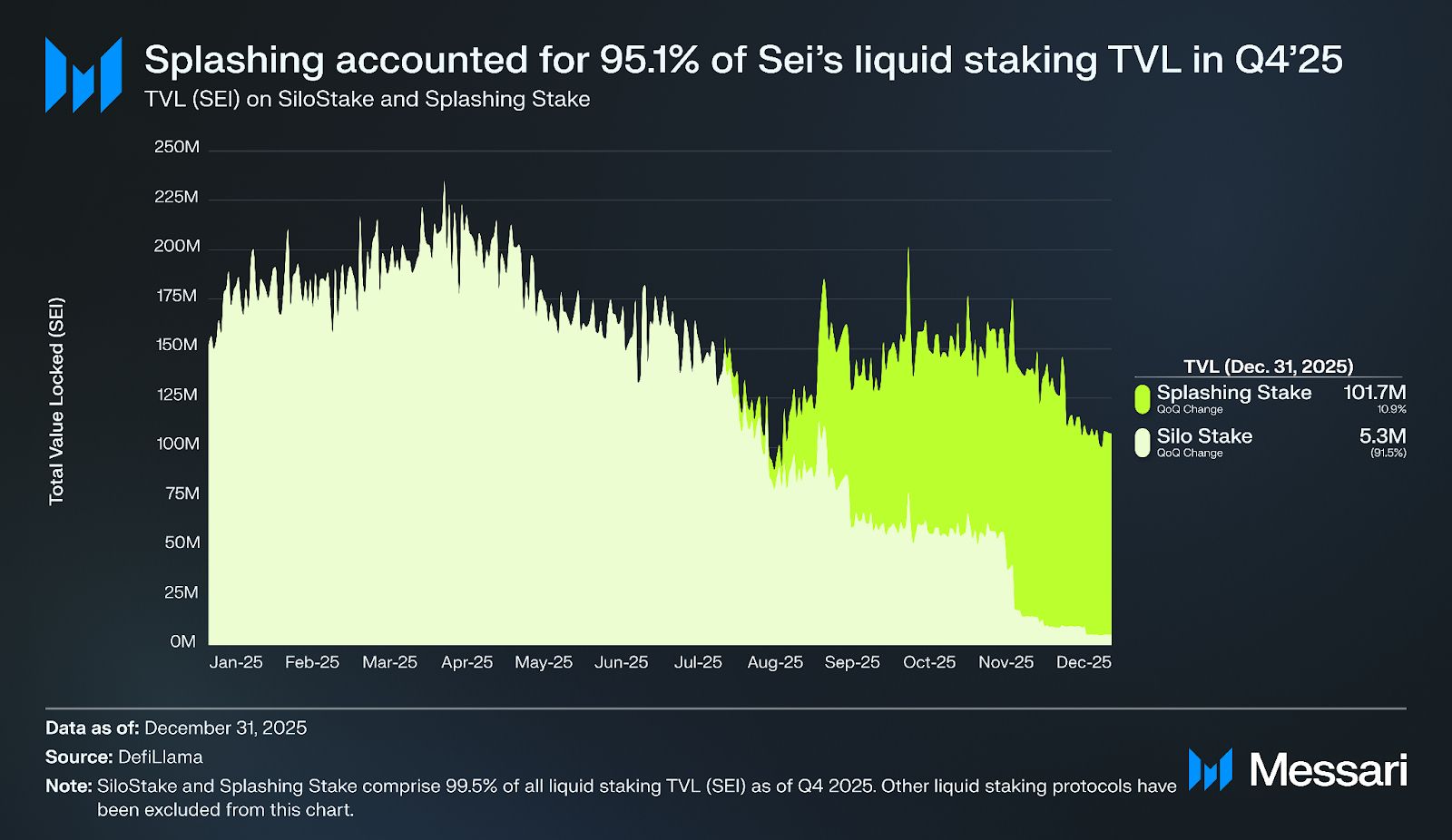
Liquid staking consolidated as Silo Stake exited the market. Splashing Stake ended the quarter with a 95.1% share of Sei’s liquid staking TVL following Silo's shutdown as iSEI tokenholders withdrew the SEI from the protocol.
Primer
Sei (SEI) is a general-purpose Layer-1 network that combines the best of Ethereum and Solana. Specifically, the developer tooling, mindshare, and network effects of the Ethereum Virtual Machine (EVM), with the performance and scalability of high-performance networks like Solana. For a full primer, refer to our Initiation of Coverage report.
The Project Team Commentary section of this report was written by the Sei Labs team and reflects the views, opinions, and forward-looking statements of Sei Labs only. This section is included to provide additional context on the project's strategy, priorities, and outlook and does not necessarily reflect the views or opinions of Messari, Inc.
Global Finance Is Coming Onchain
Not maybe. Not eventually. It's already starting. Tokenized Treasuries crossed $9.5 billion. Stablecoin volumes rival Visa. BlackRock, Franklin Templeton, and Hamilton Lane are issuing onchain products. The conversation shifted from "will institutions adopt crypto" to "how fast."
But here's the problem: most blockchain infrastructure was built for crypto as it has existed. DeFi summer. NFT mints. Memecoin speculation. It works fine for that. It won't work for what's coming.
Global finance at scale means hundreds of thousands of transactions per second, not thousands. It means finality fast enough that settlement risk disappears. It means fees low enough that micropayments make sense. Today's infrastructure doesn't handle the volume that tokenized money markets, 24/7 equity settlement, and global stablecoin payments will generate.
Sei is being built for that future, not this present.
Horizons Are Longer Than Any One Quarter
Q4 was a difficult quarter across crypto. Sei wasn't exempt. But Sei's value proposition draws a particular kind of builder.
Building on Sei means building with technology that lets you do things you can't do elsewhere. That attracts a very specific startup mentality. Surviving the downturns, staying focused, building through noise, because your time horizon isn't measured in cycles but decades. Long-term builders planting flags.
We see it across the Sei ecosystem. Monaco brought in institutional leadership and began work on a sub-millisecond CLOB. Oxium is building a next-generation perps DEX. Institutional financial assets are landing on high-performance rails—private credit via Hamilton Lane, tokenized treasuries, stablecoins—all unlocking capabilities that weren't possible before.
None of this work stopped because markets pulled back. The horizon is longer than any single quarter. The teams building on Sei are building for what's coming, not what's here today.
Building for a Post-Convergence World
The Nasdaq handles millions of messages per second at peak load. Visa's network can process 65,000 transactions per second. Global payment systems collectively settle hundreds of billions of transactions annually. If blockchain is going to become the infrastructure layer for global finance—not a parallel experiment but the actual rails—it needs to meet that scale.
Most networks aren't remotely close. 1k TPS was impressive in 2021. 10k TPS is impressive today. Neither is sufficient for a world where tokenized treasuries, stablecoin payroll, cross-border settlement, and 24/7 equity markets all run onchain simultaneously. The financial world is simply bigger than what current blockchain infrastructure can serve.
The race to decentralize Wall Street doesn’t even start until blockchains are at least on par in terms of capacity.
This is why we're building Giga. The upgrade takes Sei to 5 gigagas(roughly 200k TPS) per second with sub-400ms finality and introduces multi-proposer consensus—multiple validators proposing transactions simultaneously, a first for any EVM Layer 1. The SIP-3 transition, which will make Sei Protocol an EVM-only chain, is already underway. Once that’s complete, the protocol’s execution and storage will be upgraded. And then, Giga goes to mainnet.
At that point, Sei stops being a fast L1 and starts being genuine financial infrastructure. The kind of onchain order books, clearing systems, and settlement layers that institutions actually need become possible—not as compromises that tolerate blockchain latency, but as systems that compete with traditional finance on performance while surpassing it on transparency, accessibility, and composability.
Crypto for the past five years has been an exciting proof of concept. But the end game is global finance, and Sei Giga will be the first blockchain at the start line.
Jayendra Jog, Co-Founder, Sei Labs
Ecosystem Analysis
Gaming
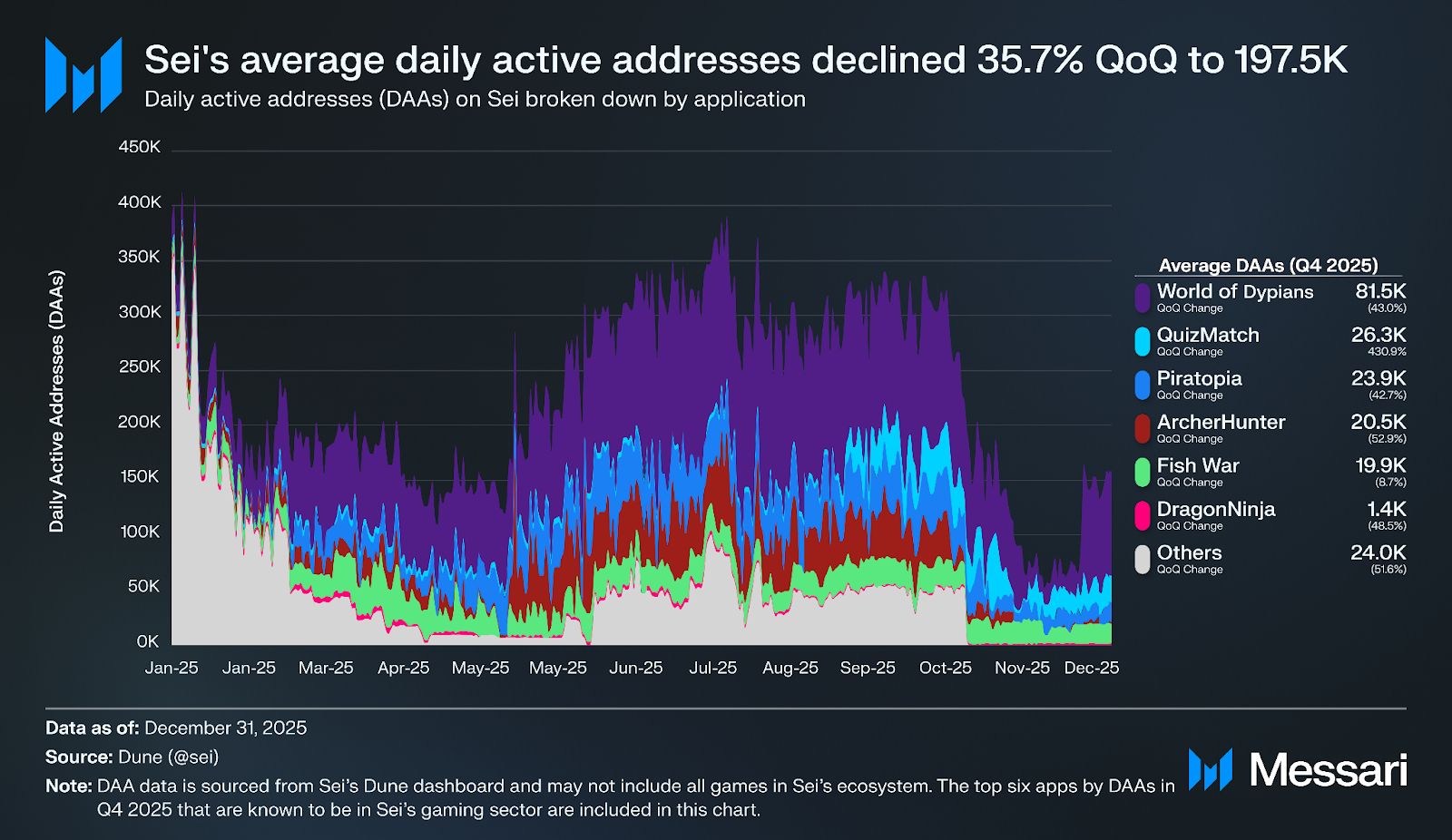
Sei’s gaming ecosystem retraced from the new highs set in Q3’25, with a total of 28 million gaming-related transactions, a decrease of 28.4% from 39.2 million in Q3’25. In terms of daily active addresses (DAAs), average DAAs in Sei’s gaming sector were 197.5K, down 35.7% QoQ from 307.2K in Q3’25. World of Dypians remained a standout as the leading game by average DAAs in Q4’25, while QuizMatch helped offset broader declines, and Piratopia saw a smaller pullback than most other titles.
World of Dypians: A massively multiplayer online role-playing game (MMORPG) available on the Epic Game Store. Similar to World of Warcraft, players control heroes to interact with the game world. The game is multichain, available on many networks including Sei, and features onchain elements such as the WOD token and two NFT collections. World of Dypians took the top spot in terms of average DAAs in Q4’25, averaging 81.5KK per day, a 43% QoQ decrease.
QuizMatch: A trivia-based casual game built around short, competitive quiz rounds and tournament play. QuizMatch records scores and leaderboard data onchain and uses NFTs as gameplay boosters, such as hints and point multipliers. The project supports Gem-denominated tournaments, with onchain verification of results and leaderboard integrity, and it also offers NFT power-ups such as hints and point multipliers. Quizmatch was second in terms of average DAAs in Q4’25, averaging 26.3K per day. This was a 403.9% QoQ increase that ultimately helped offset declining usage across other games in 2025.
Piratopia: A pirate-themed strategy game delivered via Steam, with progression built around NFT player items, collectibles, and an onchain marketplace. Piratopia has an internal currency, GolD, for in-game use, but it is not a liquid, externally traded token. Piratopia averaged 23.9K DAAs per day in Q4’25, a 34.4% QoQ increase.
Other notable gaming ecosystem highlights include projects like Archer Hunter, SpinCity, Final Glory, Idle Glory, Dragon Land, Guardian Base, Bike Master Challenge, Mokoko Games, Dawnshard, and more. Notably, Archer Hunter’s steep drop off in Q4 was due to previous quarters being inflated by gas fee subsidies. Specifically, a primary wallet was dispersing small amounts of SEI to many secondary wallets, which were then used to perform repetitive “Daily Quest Submit”-type transactions. All in all, Sei’s gaming sector had a large retrace in network activity in Q4’25 after growing for five straight quarters.
DeFi
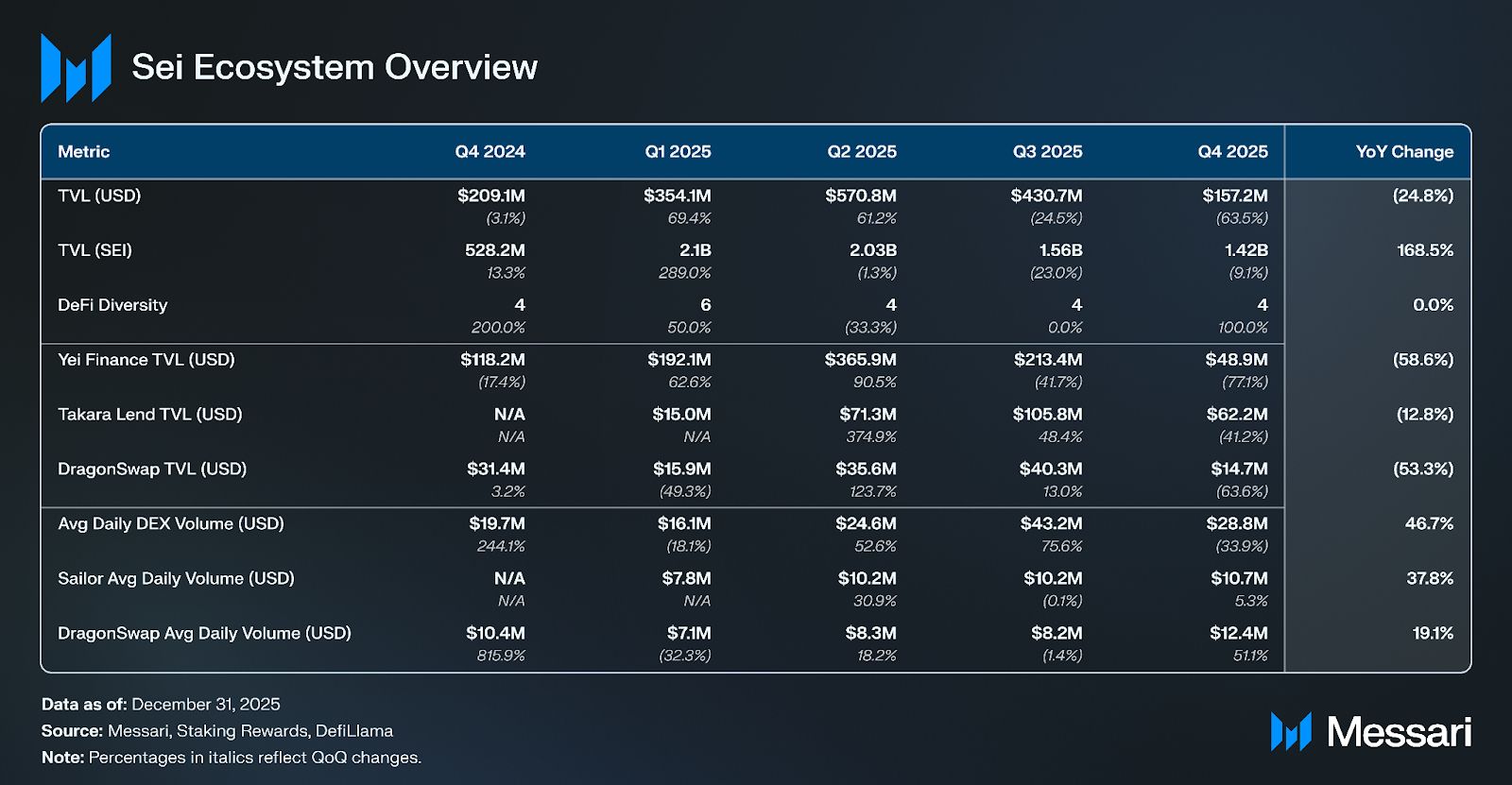
In Q4 2025, TVL (USD) fell 63.5% QoQ to $157.2 million. With SEI’s price dropping sharply, decreasing 59.9% QoQ to $0.11, TVL (SEI) fell by just 9.1% QoQ to 1.42 billion. The drawdown coincided with a broader risk-off move that began with a liquidation cascade in early October 2025 and did not stabilize until December, keeping collateral values depressed and limiting rebuilding of money market positions.
Sei’s DeFi Diversity score (i.e., the number of protocols making up 90% of a network’s TVL) remained at four for the second quarter in a row in Q4’25. Sei’s top DeFi protocols, Takara Lend, Yei Finance, Sailor, and DragonSwap have continued to hold onto the bulk of deposited assets for another quarter.
Borrowing & Lending
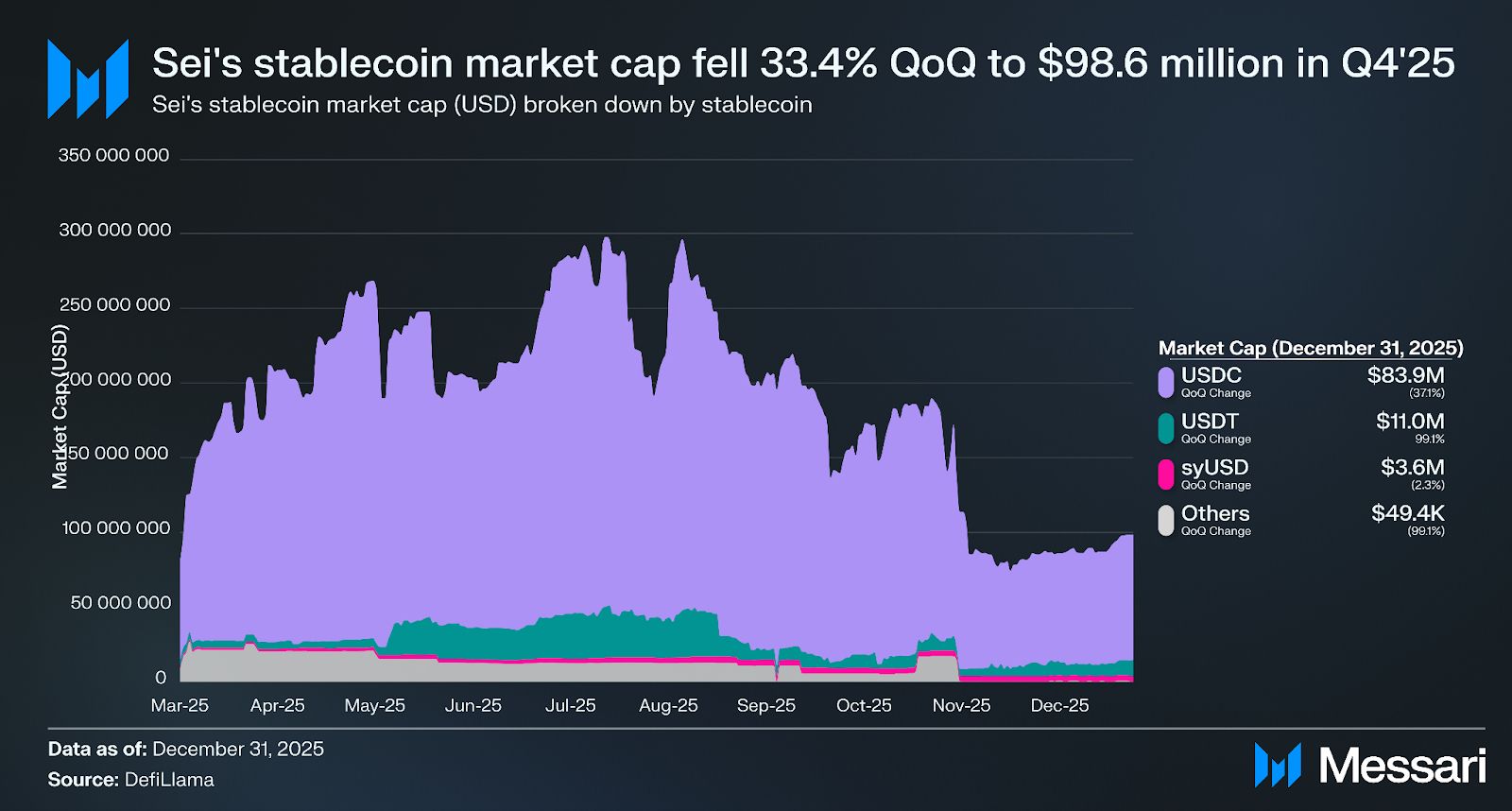
Sei’s stablecoin market cap (USD) fell 33.4% QoQ to $98.6 million by the end of 2025. USDC accounted for 85.1% of stablecoins on Sei at $83.9 million, though its supply fell 37.1% QoQ. Tether’s USDT comprised 11.2% of Sei’s stablecoins, with supply rising 199.1% QoQ to $11 million after a 78.1% drop in Q3’25.
Stablecoins are a core part of borrowing and lending activity on Sei. Yei Finance historically led this segment, but Takara Lend overtook Yei in Q4’25. Takara’s TVL declined 41.2% QoQ to $62.2 million, yet it still accounted for 39.5% of Sei’s total TVL. Takara’s sharp decline in early November 2025 likely reflected incentive-driven outflows as Bitget Wallet’sUSDT yield program with Takara ended on Nov. 8, 2025.
Yei Finance experienced a larger contraction, ending Q4’25 with a TVL of $48.9 million, down 77.1% QoQ, but still accounting for 33.1% of Sei’s TVL. On Nov. 4, 2025, Yei temporarily suspended operations due to irregularities in its fastUSD market, which likely contributed to the sharp withdrawal spike observed during the first week of November 2025. fastUSD was a yield-bearing, synthetic stablecoin on Sei built by Elixir and backed by deUSD. Soon after, Elixir announced it would wind down deUSD as it broke its peg to the dollar. Two days later, Yei Finance stated that user funds remained fully accessible and that it would fully repay $8.6 million of USDC bad debt collateralized by sfastUSD in its main pool. Withdrawals were temporarily paused during the repayment process, with Yei indicating it had resumed normal operations. Together, Yei and Takara accounted for 76.1% of the TVL loss in Q4 2025.
DEXs
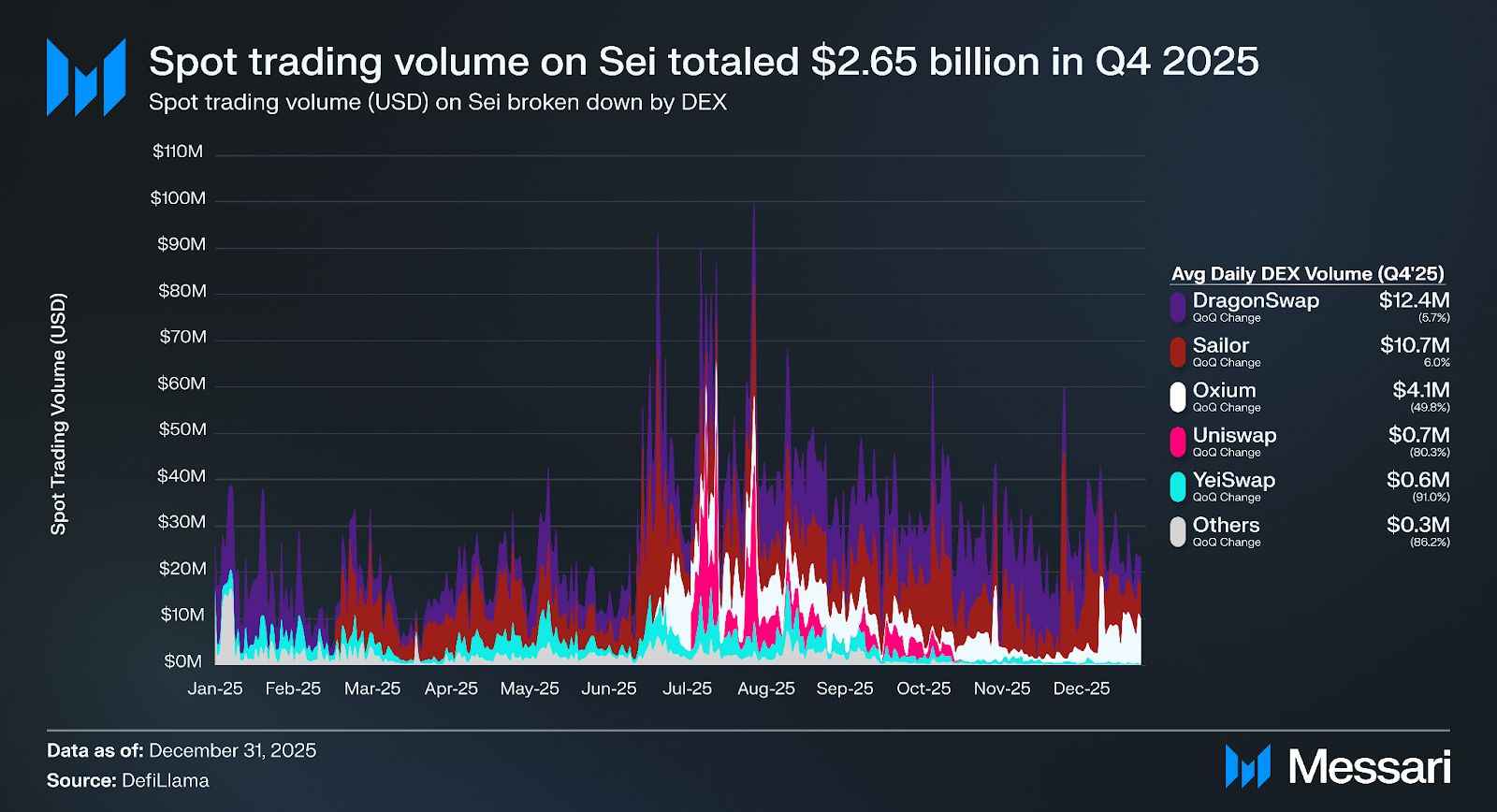
Average daily DEX volume (USD) on Sei decreased 33.9% QoQ to $28.8 million, but has remained elevated throughout 2025 compared to 2024. DragonSwap continued to lead activity in Q4 2025.
DragonSwap: On Oct. 15, 2025, DragonSwap shipped a major upgrade that included a redesigned trading UI, an upgraded staking module, and the release of $250K in USDC rewards for staking DRG. The upgrade also pushed users toward DragonSwap’s Concentrated Liquidity Pools, where LP positions are represented as NFTs and can be staked for additional incentives.
DragonSwap averaged $12.4 million in daily trading volume in Q4’25, a decrease of 5.7% QoQ. The protocol ended Q4’25 with a TVL of $14.6 million, down 63.6% QoQ for a total share of 9.3% of Sei’s TVL.
Sailor: Launched in January 2025, Sailor has emerged with a focus on majors and stablecoins. The protocol’s average daily trading volume of $10.7 million in Q4’25 was a 6% QoQ increase.
Sailor's largest liquidity pool consists of USDC/SEI and contributes over $2 million a day to Sailor’s DEX volume. Sailor ended the quarter with a TVL of $16.4 million, decreasing 49.1% QoQ but still accounting for 10.4% of Sei’s TVL.
Oxium: Launched in June 2025 and averaged $4.1 million in daily spot trading volume in Q4’25. In November 2025, Oxium expanded into perps on Sei with up to 100x leverage and a broad set of trading pairs, further positioning the app as a CLOB for high-frequency trading.
Monaco Protocol: A perpetual futures exchange incubated by Sei Labs. In November 2025, Monaco Research appointed Simran Singh, the former Head of DeFi Trading at GSR, as CEO, to help scale Monaco’s institutional push and go-to-market strategy.
As seen in Messari’s report on Next Generation CLOBs, CLOBs are the optimal architecture for capital efficiency, price discovery, and scalability. With Sei’s Giga upgrade looming, the network is perfectly primed to return to its roots and become a leading venue for highly performant, next-gen CLOBs.
Development, Growth, & Community
In Q4 2025, Sei saw key developments spanning institutional RWAs, exchange distribution, infrastructure, and new trading venues:
In October 2025, KAIO brought Hamilton Lane’s Senior Credit Opportunities Fund (SCOPEx) onchain on Sei via an access-fund structure, expanding Sei’s lineup of regulated, tokenized private credit products.
SEI was listed on Robinhood in October 2025, adding a mainstream U.S. retail venue. Previously, SEI spot liquidity was mostly concentrated on global exchanges such as Binance and Bybit that restrict access for U.S. users.
Binance joined Sei’s validator set in November 2025, adding a top-tier operator to consensus as Sei pushes toward its Giga roadmap focused on higher throughput and lower latency.
Canary’s proposed staked SEI ETF was registered on the DTCC in November 2025 under the ticker SEIZ. This was an “active and pre-launch” listing, a procedural step that does not imply SEC approval but signals operational readiness.
Derivatives coverage broadened in November 2025 as Oxium launched perpetuals on Sei and OKX listing SEI/USDT perpetual futures, expanding both onchain and centralized venues for leveraged SEI exposure.
In December 2025, KuCoin’s Web3 Wallet integrated Sei mainnet, enabling users to send, receive, and swap assets directly from KuCoin’s self-custody wallet interface.
Financial Analysis
SEI Token
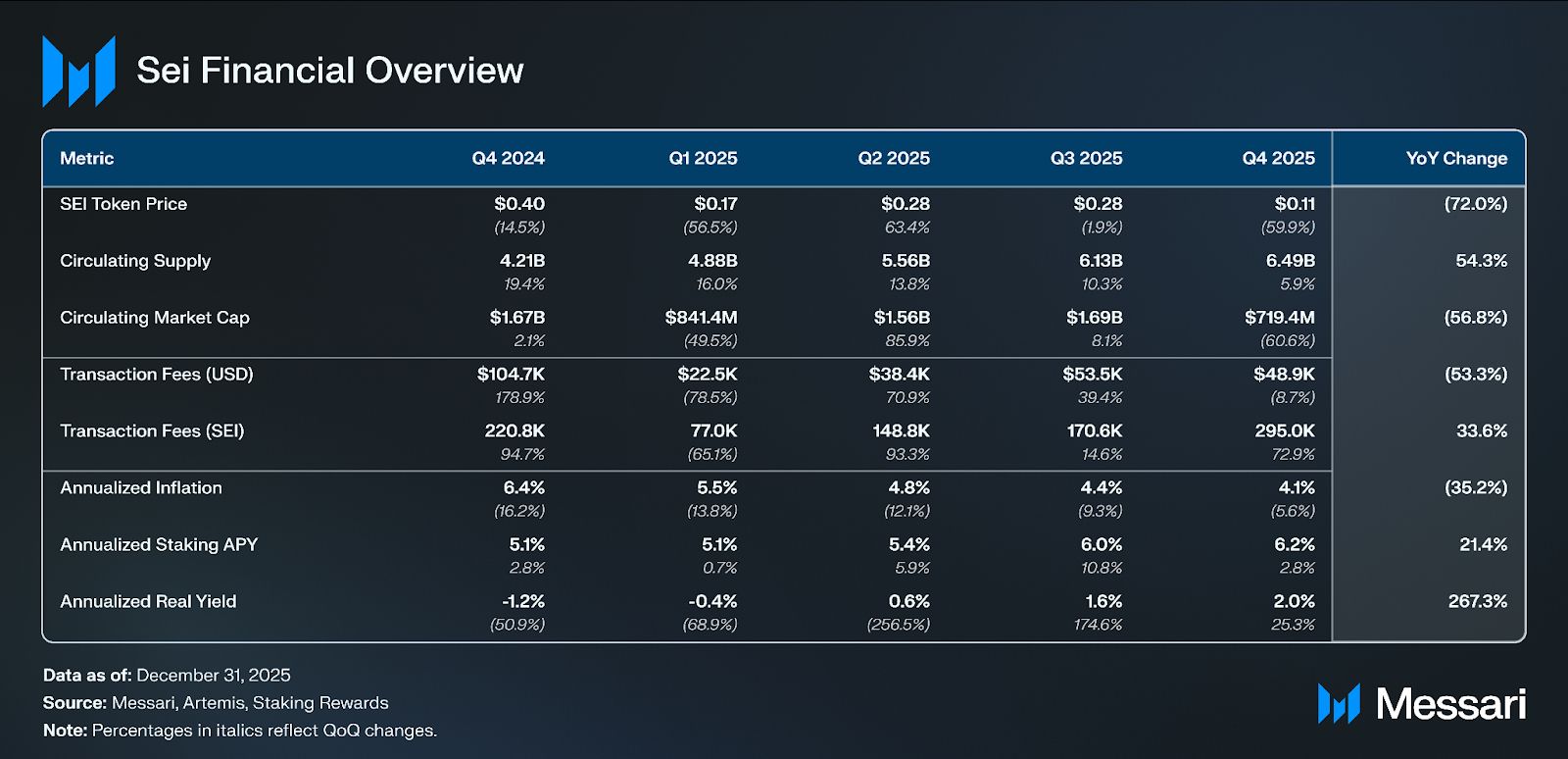
SEI sold off sharply in Q4’25, declining 59.9% QoQ from $0.28 to $0.11. The bulk of the drawdown occurred in October 2025, when SEI broke below its Q3 trading range and failed to recover through the remainder of the quarter. While no single protocol-specific event explains the move, the decline coincided with the broader selloff across altcoins and fastUSD’s depegging impacting money markets on Sei.
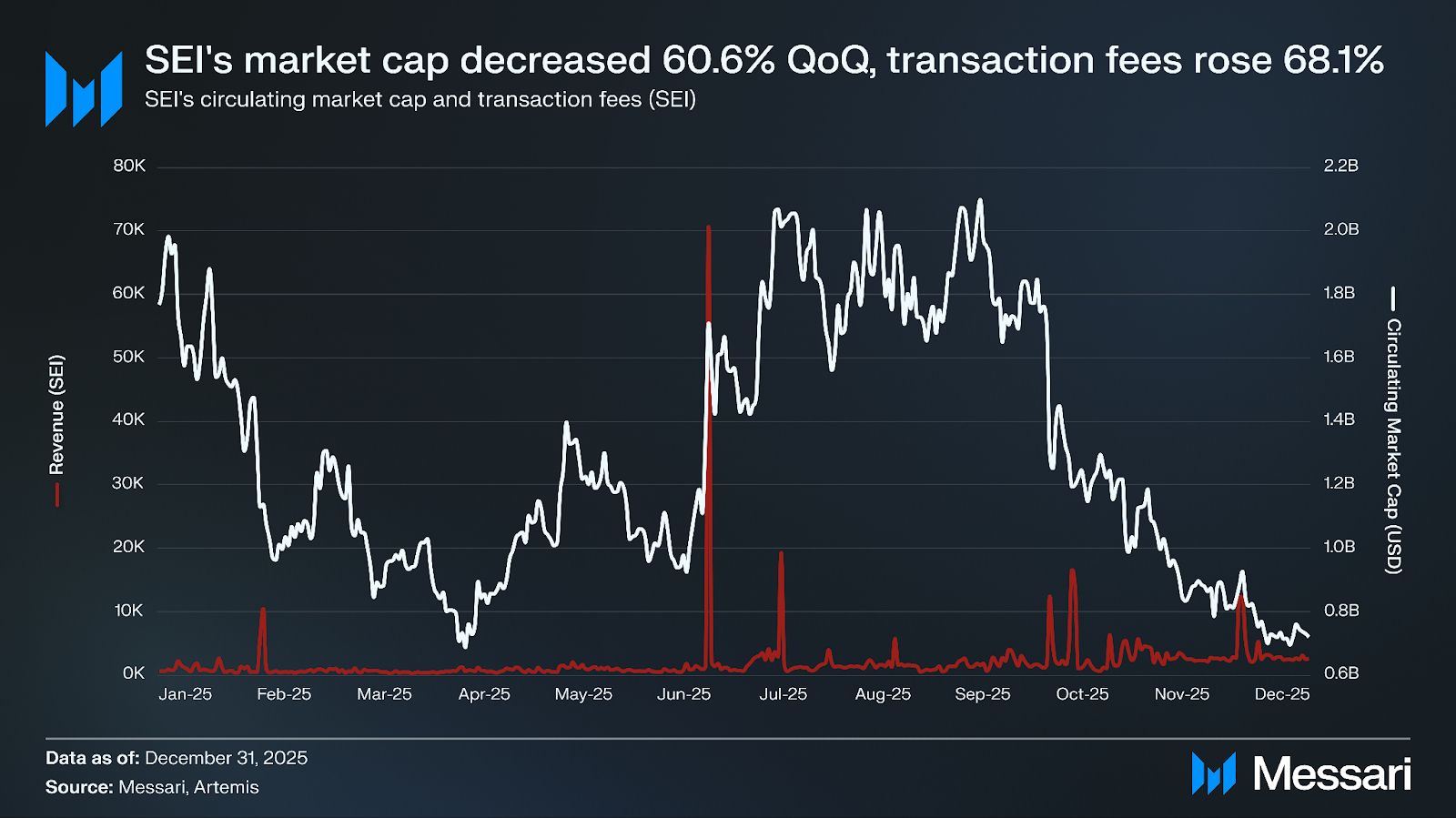
SEI’s circulating market cap fell 60.6% QoQ to $719.4 million despite a 5.9% increase in circulating supply to 6.49 billion tokens. SEI’s market cap rank declined from 61st to 70th by quarter-end, indicating slight underperformance versus the broader market. Meanwhile, network activity continued to grow as Sei’s quarterly transaction fees (SEI) increased 68.1% QoQ to 292K, though quarterly transaction fees (USD) declined by 8.7% QoQ to $48.9K due to SEI’s price decline.
Token Supply
Annualized inflation fell from 4.4% to 4.1% in Q4’25. Combined with a 2.9% QoQ decrease in the amount of staked SEI, annualized staking APY increased from 6% to 6.2%. This resulted in the third quarter, in which SEI stakers experienced a positive annualized real yield, with this quarter’s annualized real yield being 2%.
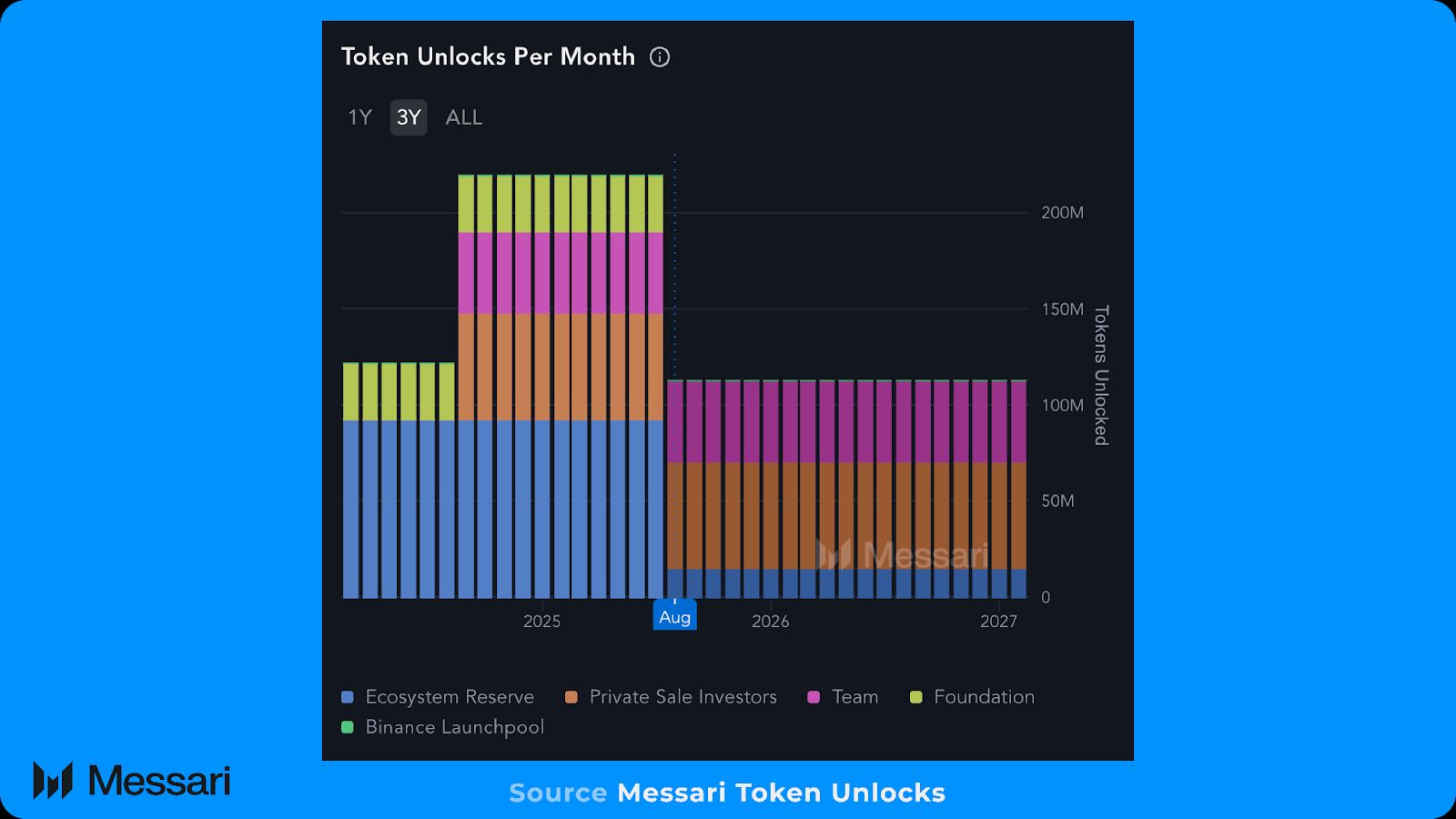
SEI’s circulating supply increased 5.9% QoQ to 6.49 billion, due to a mix of token unlocks and staking rewards. The vesting decrease beginning in August 2025 will persist into 2026, with SEI vesting at 113 million tokens per month. In total, 338.9 million SEI vested during the quarter. With the Foundation allocation fully vested, ongoing unlocks are driven almost entirely by the private investor and core team allocations, which together contribute 97.8 million SEI per month, alongside smaller releases from the ecosystem reserve. SEI tokens will continue to vest until Aug. 14, 2033.
Network Analysis
Usage
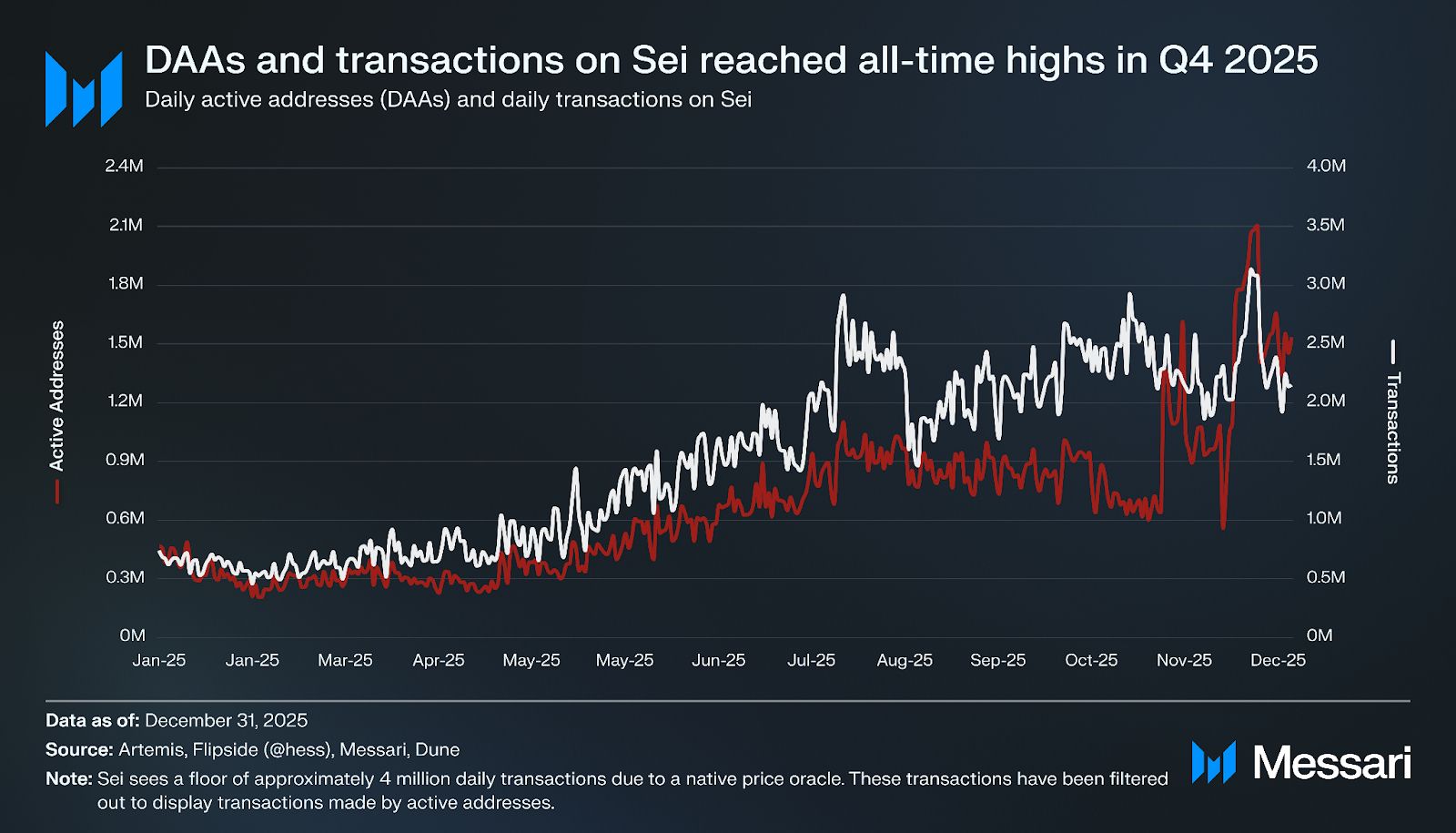
Average daily active addresses (DAAs) increased 25.8% QoQ to 1 million in Q4 2025, while average daily transactions made by active addresses increased 16.6% QoQ to 2.3 million. A major uptrend in DAAs and transactions began in November 2024 and continued throughout 2025, reaching another new all-time high in Q4’25. Specifically, 2.1 million DAAs and 3.1 million transactions both in mid-December 2025.
Notably, Sei sees a floor of four to six million daily transactions due to a native price oracle. All validators are required to participate as oracles by sending vote transactions and providing updated price data every other block. Filtering out these transactions leaves only transactions made by active addresses, which is more indicative of network usage trends over time.
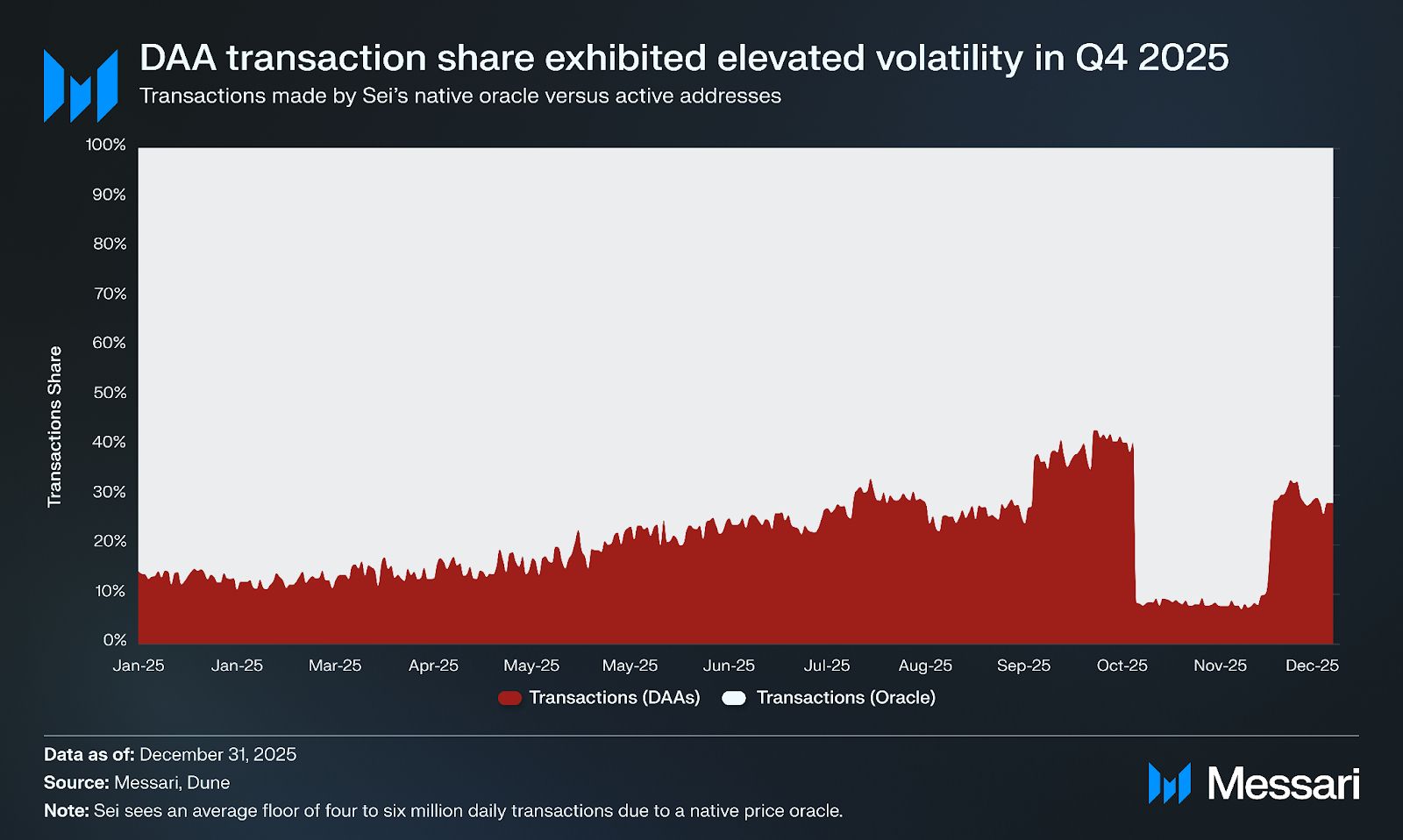
The portion of Sei’s total transactions made by active addresses has been continually increasing until Q4 2025. Specifically, transactions made by active addresses made up 13.5% of all transactions on Sei in Q1’25, 19.5% in Q2’25, 23.2% in Q3’25, and then declined to 14.3% in Q4’25. Overall, the long-term trends in daily transactions and DAAs show that activity on Sei stayed flat YoY despite a broader market selloff.
While there appear to be sharp swings in Q4’25, this is a denominator effect. The figure is based on the daily transaction mix, and Oracle activity spiked materially in Q4’25. From Nov. 1 to Dec. 8, 2025, Oracle transactions exceeded 25 million per day, reducing the share by active addresses on those days, even as users were transacting at similar levels. The quarterly share is calculated using totals over the full quarter, including days outside that Oracle spike. Once those days are included, active-address transactions make up a larger portion of the quarter’s overall activity than they did in Q3’25.
Staking
Sei’s total stake (SEI) decreased by 2.9% QoQ to 4.3 billion. Due to the aforementioned drop in SEI’s price, total stake (USD) saw a much larger change, decreasing 61% QoQ to $476.3 million. Notably, these metrics include unvested, locked SEI tokens that can be staked to earn liquid rewards.
Liquid Staking
SiloStake has historically allowed users to stake SEI in return for their liquid staking token, iSEI, which could be redeemed to receive the underlying SEI after a 21-day unbonding period. Before July 2025, SiloStake comprised 99.5% of all liquid staking TVL (SEI) on Sei; however, that shifted with the launch of Splashing Stake and its spSEI token on July 17, 2025.
Splashing Stake overtook Silo in Q3’25 and solidified its dominance in Q4’25, accounting for 95.1% of Sei’s liquid staking TVL (SEI) compared to Silo’s 4.9%. The shift in market share was largely due to Silo announcing its shutdown, which forced users to withdraw and unbond iSEI before Dec. 31, 2025. As iSEI wound down, Splashing benefited as the remaining active LST with established onchain liquidity and integrations.
By the end of Q4’25, 107 million SEI had been liquid staked on Sei, a 30.2% QoQ decrease from the 153.3 million SEI that had been liquid staked by the end of Q3’25. This was the third quarter in which liquid staking activity on Sei decreased. Compared to Sei’s total stake (SEI), the liquid staking rate fell from 3.5% to 2.4%.
Technical Developments
In December 2024, Sei Labs announced Giga, an in-development upgrade that plans to offer a 50x improvement in throughput over other EVM-compatible networks. Specifically, Giga aims to reach a maximum capacity of five gigagas per second. Gigagas is a measure of a blockchain’s computational capacity that replaces the commonly used measure of transactions per second (TPS). However, the anticipated maximum TPS post-Giga is approximately 200,000, with a time-to-finality (TTF) of under 400ms.
This level of performance will be achieved by revamped execution, consensus (Autobahn), and storage workstreams. Key upgrades include intelligent transaction parallelization that predicts dependencies, the decoupling of consensus over transaction ordering from transaction execution, and the introduction of the first-ever instance of multiple concurrent proposers on an EVM Layer-1 network, allowing multiple validators to propose transactions simultaneously.
In May 2025, Sei Labs published the Sei Giga whitepaper, along with updated metrics. Sei achieved 5.2 gigagas per second, approximately 148,900 TPS, and 211ms TTF in an internal devnet environment using a set of 20 validators distributed across the United States, Europe, and Asia Pacific.
In Q4’25, Sei advanced the path to Giga with the rollout of SIP-3 wallet upgrades, enabling users with Cosmos-only wallets to migrate funds from native addresses to EVM addresses. The update is part of Sei’s transition from a hybrid CosmWasm + EVM network to an EVM-only architecture, with CosmWasm components slated for deprecation as ecosystem wallets, dApps, and custodians complete the migration.
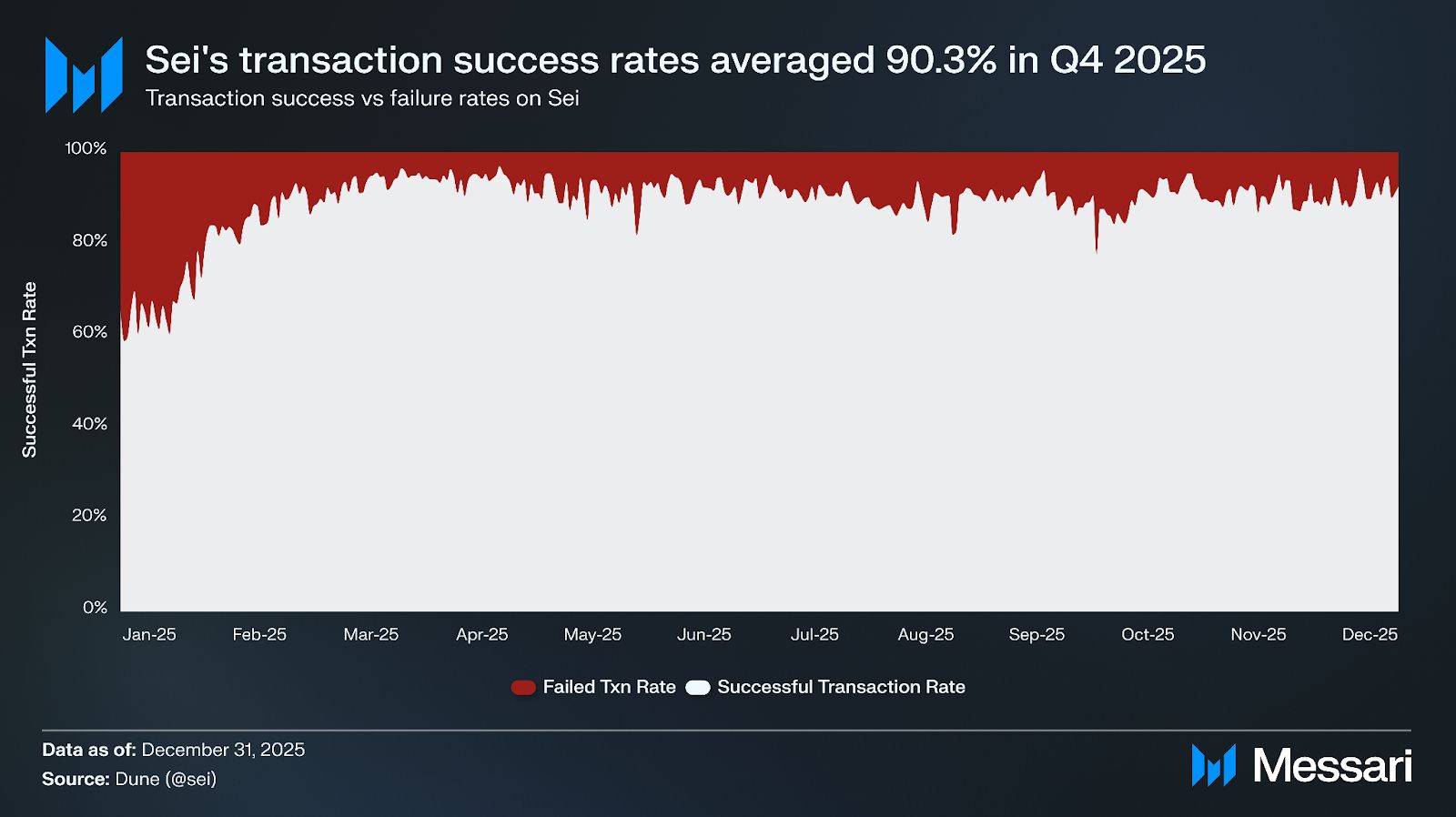
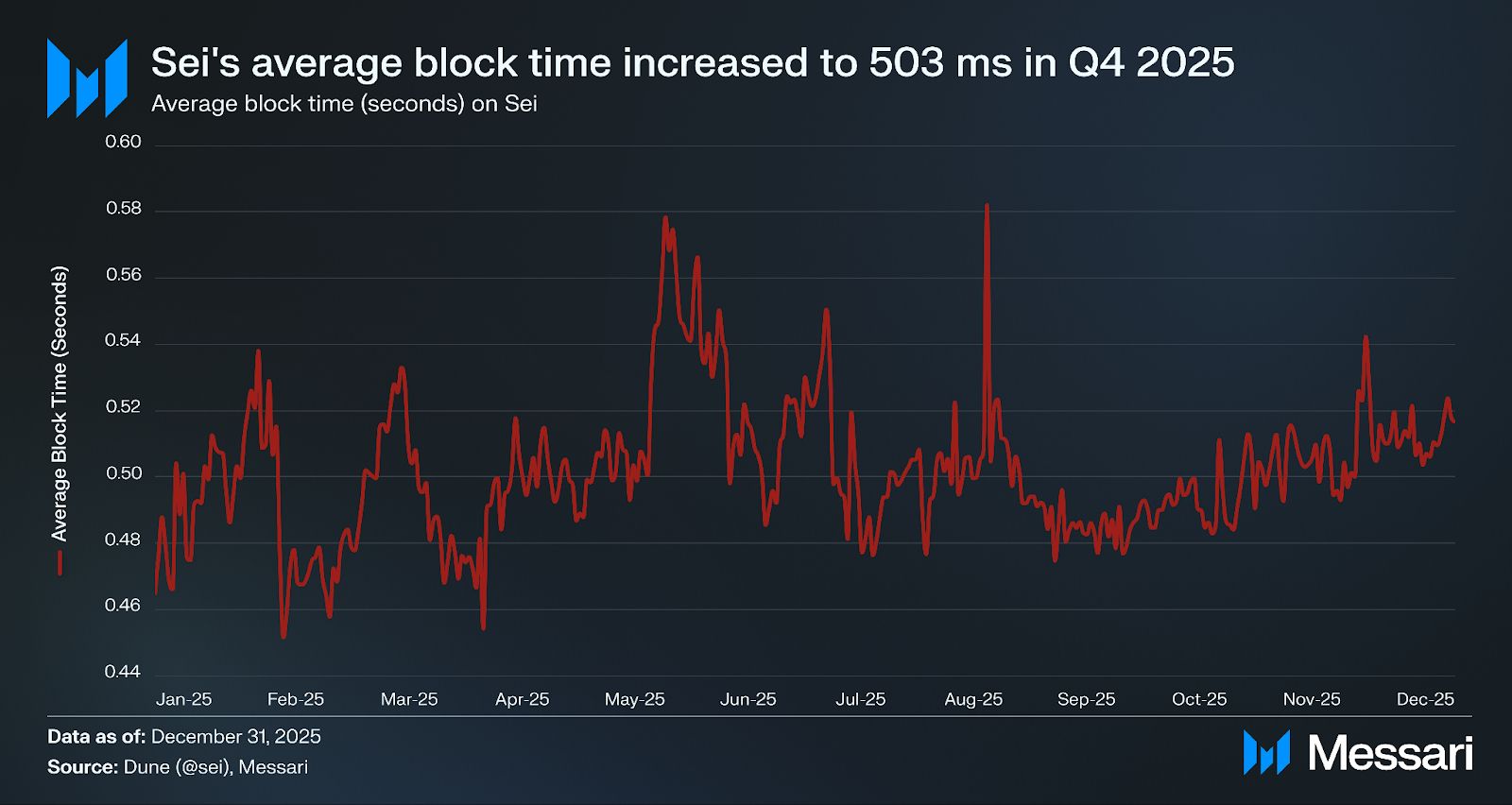
In December 2024 and January 2025, Sei experienced a surge in transaction failure rates, rising to 22.7% and 29.7%, respectively. Since then, failure rates normalized throughout the rest of 2025, falling to 12.5% in February and 6.4% in March, and stabilizing later in the year at 9.8% in Q3’25 and 9.7% in Q4‘25. This level is broadly consistent with other high-throughput networks, with Base averaging 9.6% and Solana averaging around 6% transaction failure rate over the same period. Meanwhile, average block times on Sei remained flat, going from an average of 499ms in Q3’25 to 503ms in Q4’25, a 0.8% QoQ increase.
Closing Summary
Q4 2025 was a sharp reset for Sei. TVL (USD) fell 63.5% QoQ to $157.2 million along with a 33.4% decline in stablecoin supply, while DEX volumes cooled as average daily spot volume (USD) dropped 33.9% QoQ to $28.8 million. DeFi deleveraging was concentrated in lending, and the decrease was dominated by Yei Finance and Takara Lend, which together accounted for 76.1% of the quarter’s TVL decline. Liquid staking also contracted for a third straight quarter and underwent a structural shift as Splashing Stake consolidated market share into spSEI amidst the closure of Silo.
User activity was a bright spot as Sei extended its growth streak to a sixth consecutive quarter, with average daily active addresses reaching 1 million and average daily transactions by active addresses increasing to 2.3 million. Elevated Oracle traffic during Q4 distorted the daily transaction mix, but quarterly averages still point to relatively sticky user-driven throughput, despite declines across most other metrics in 2025.
Even as DEX volumes trended lower, Sei’s trading stack continued to evolve, with DragonSwap remaining the top AMM and Oxium expanding into onchain derivatives. Token unlocks remained steady at 113 million SEI per month, while stakers recorded a third consecutive quarter of positive real yields as inflation fell to 4.1% and staking APY rose to 6.2%. The key question for 2026 is whether Sei can translate sustained user growth and ongoing infrastructure progress into a recovery in stablecoin supply, DeFi liquidity, and trading activity.
This report was commissioned by Sei Labs. All content was produced independently by the author(s) and does not necessarily reflect the opinions of Messari, Inc. or the organization that requested the report. The commissioning organization may have input on the content of the report, but Messari maintains editorial control over the final report to retain data accuracy and objectivity. Author(s) may hold cryptocurrencies named in this report. This report is meant for informational purposes only. It is not meant to serve as investment advice. You should conduct your own research and consult an independent financial, tax, or legal advisor before making any investment decisions. Past performance of any asset is not indicative of future results. Please see our Terms of Service for more information.
No part of this report may be (a) copied, photocopied, duplicated in any form by any means or (b) redistributed without the prior written consent of Messari®.