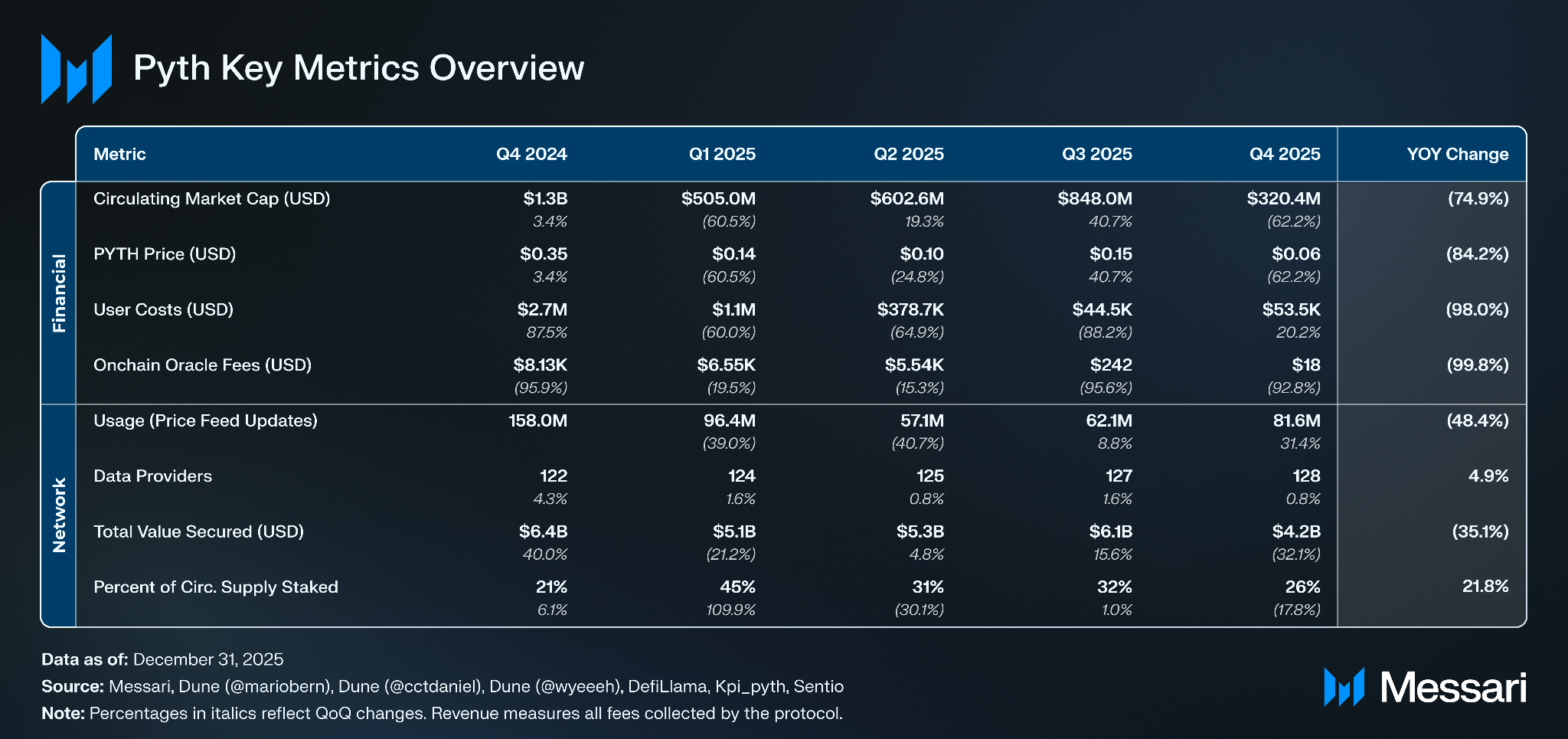
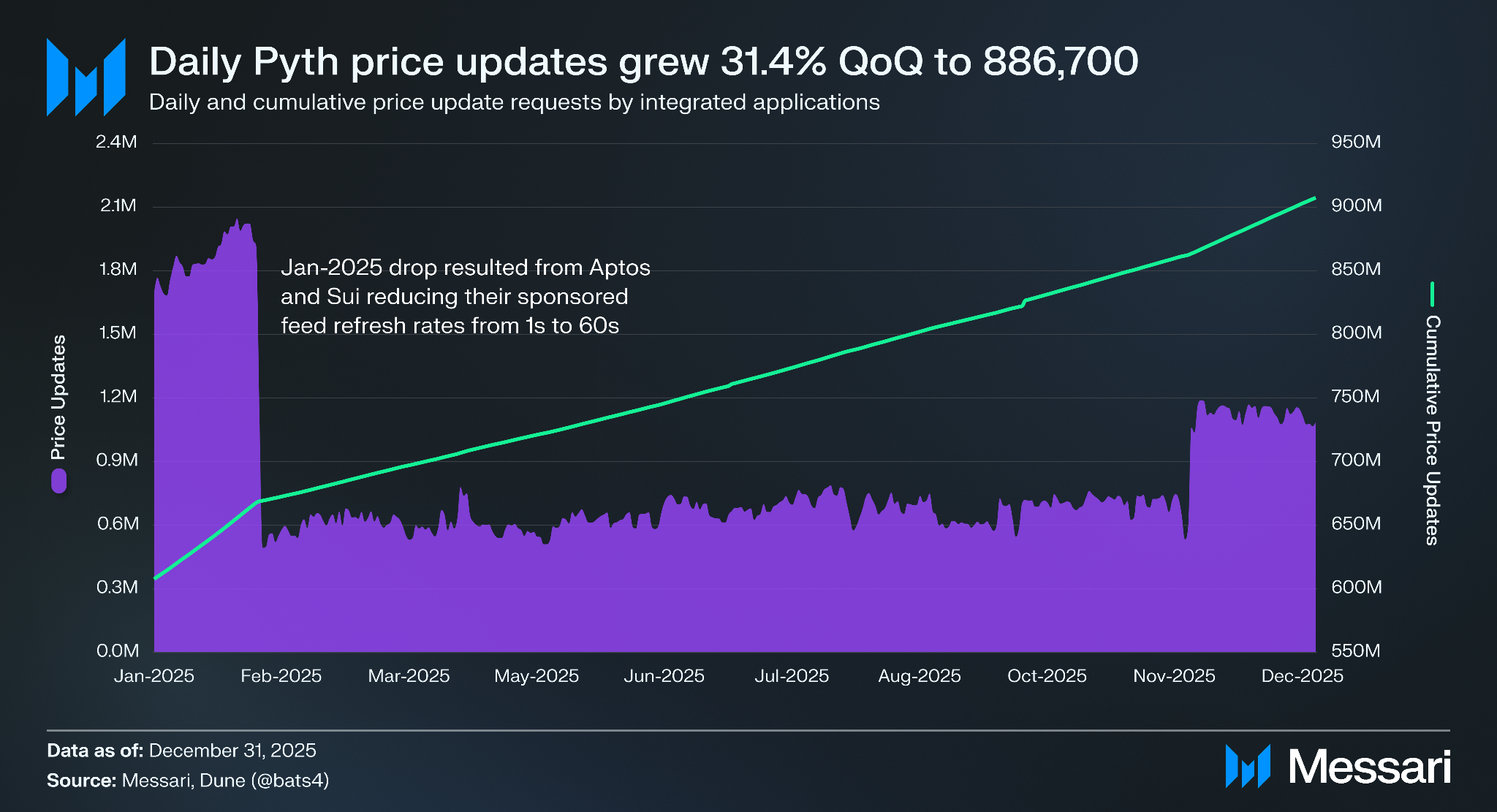
Pyth’s average daily price updates increased 31.4% QoQ from 675,100 in Q3 to 886,700 in Q4. Cumulative price updates reached 907.1 million at the end of Q4, up 10.3% QoQ from 822.0 million.
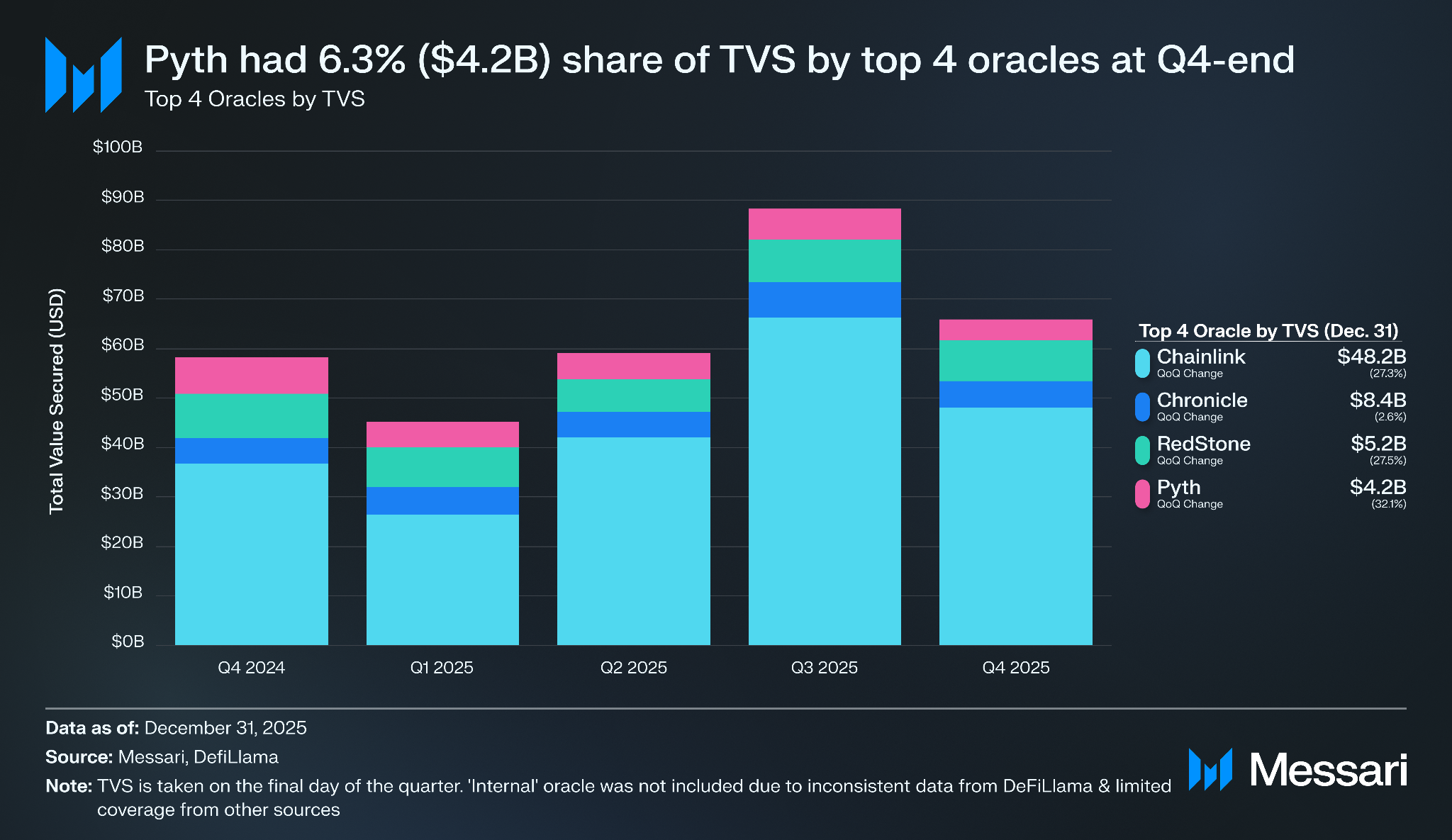
In Q4, Pyth’s total value secured (TVS) decreased 32.1% QoQ from $6.2 billion at Q3-end to $4.2 billion at Q4-end, in line with TVS declines across all major oracle networks in Q4.
Pyth price feed listings increased 27.0% QoQ to 2,850 at Q4-end from 2,250 at Q3-end, contributed in part by the Oct. 13 partnership with Kalshi to publish prediction market data onchain.
On Sept. 24, Pyth launched Pyth Pro, a data service for institutions that provides 1ms updates across all Pyth price feeds. The service generated $352,600 in Q4 revenue.
On Dec. 12, Pyth introduced the Pyth Reserve, a token buyback initiative to allocate 33% of monthly protocol revenue to open-market PYTH purchases, and on Jan. 5, the DAO executed its first purchase, acquiring 2,157,100 PYTH.
Primer
Pyth (PYTH) is an oracle network that provides price data on cryptocurrencies, equities, foreign exchange pairs, ETFs, and commodities to onchain applications by sourcing it from offchain venues such as exchanges and trading platforms. Pyth coordinates a network of first-party data providers, including primary sources and aggregators, and uses a pull oracle model, where user transactions trigger price updates on the destination blockchain, and users cover the associated update fees.
Price feeds are Pyth’s core product and are offered in three versions: Pyth Crypto, a free service that provides 1s price updates on crypto assets, Pyth Crypto+, a $5,000 per month service that provides 1ms price updates on crypto assets, and Pyth Pro, a $10,000 per month service that provides 1ms price updates on over 2,800 price feeds, including crypto assets, real-world assets, and economic indicators. Pyth price feeds include benchmarks, which provide historical price data.
Other Pyth products include Entropy, a random number generator service for onchain applications, and Express Relay, an offchain auction-based execution system. Both Entropy and Express Relay were deprioritized by the Pyth team in Q4.
Pyth’s data integrity relies on over 128 data providers, including global exchanges, trading firms, and market makers. Notable data providers include Jane Street (trading firm), Cboe Global Markets (exchange), Binance (CEX), Raydium (DEX), Osmosis (DEX), Galaxy (asset manager), and 0x (infrastructure provider). Pyth delivers financial market data to over 113 blockchains. For a full primer on Pyth, refer to our Initiation of Coverage report.
Pyth total value secured (TVS) fell 32.1% QoQ ($2.0 billion) from $6.2 billion at Q3-end to $4.2 billion at Q4-end. In Q4, all major oracle networks recorded TVS declines, alongside a 23.6% drop in total crypto market cap from $3.99 trillion to $3.05 trillion over the same period.
Chainlink led oracle TVS with $48.2 billion at Q4-end, down 27.3% QoQ ($18.1 billion) from $66.3 billion. Chronicle followed with $8.4 billion at Q4-end, falling 2.6% QoQ ($224.0 million) from $8.6 billion, while RedStone had $5.2 billion, a 27.5% QoQ ($1.9 billion) decrease from $7.1 billion over the same period. Out of the top four oracles by TVS, Pyth had a 6.3% market share at Q4-end, down from 7.0% at Q3-end, which trailed Chainlink (73.1%), Chronicle (12.8%), and RedStone (7.8%). Drift Protocol, a Solana-based perpetual futures exchange, recorded a 49.3% QoQ TVL decline from $943.0 million at Q3-end to $478.5 million at Q4-end, accounting for a large portion of Pyth’s Q4 TVS decline. Notably, WINkLink and Internal remain excluded from the comparison due to inconsistent reporting on DefiLlama and limited external coverage.
Price Updates
Pyth operates as a pull or push oracle, depending on a user’s required use case. The pull integration is the default choice for most applications and publishes price updates in response to application-level requests. When a user transaction calls a smart contract secured by Pyth, the network delivers the requested price update within the same transaction. This mechanism reduces latency, allowing applications to retrieve fresh data without incurring ongoing publishing costs.
In Q4, Pyth processed an average of 886,700 daily price updates, a 31.4% QoQ increase from 675,100 in Q3. The increase was driven in part by the Nov. 24 Monad mainnet launch, after which Pyth sustained daily price updates above 1.0 million.
Cumulative price updates reached 907.1 million, up 10.3% QoQ from 822.0 million. The continued increase reflects broader adoption at the application level and sustained activity across supported ecosystems.
The Pyth Data association operates the Pyth Scheduler, an offchain service that submits sponsored price updates at regular intervals. Applications that need consistent, time-based pricing typically use these sponsored updates.
Pyth data providers publish price data on Pythnet, an oracle program then combines the individual data providers' prices into a single aggregate price and confidence interval, which Pythnet validators submit to Wormhole. Wormhole guardians, a set of 19 distributed nodes that monitor the state on several blockchains, sign the Merkle root of the aggregated prices. Applications retrieve these signed price updates through Hermes, a web service that monitors Pythnet and Wormhole and delivers the updates through APIs.
When a user requires a price update in a transaction, the onchain contract verifies it by checking the Guardian signatures and Merkle proofs before storing the price. To verify the price update, the contract requires signatures from at least 13 of the 19 guardian nodes.
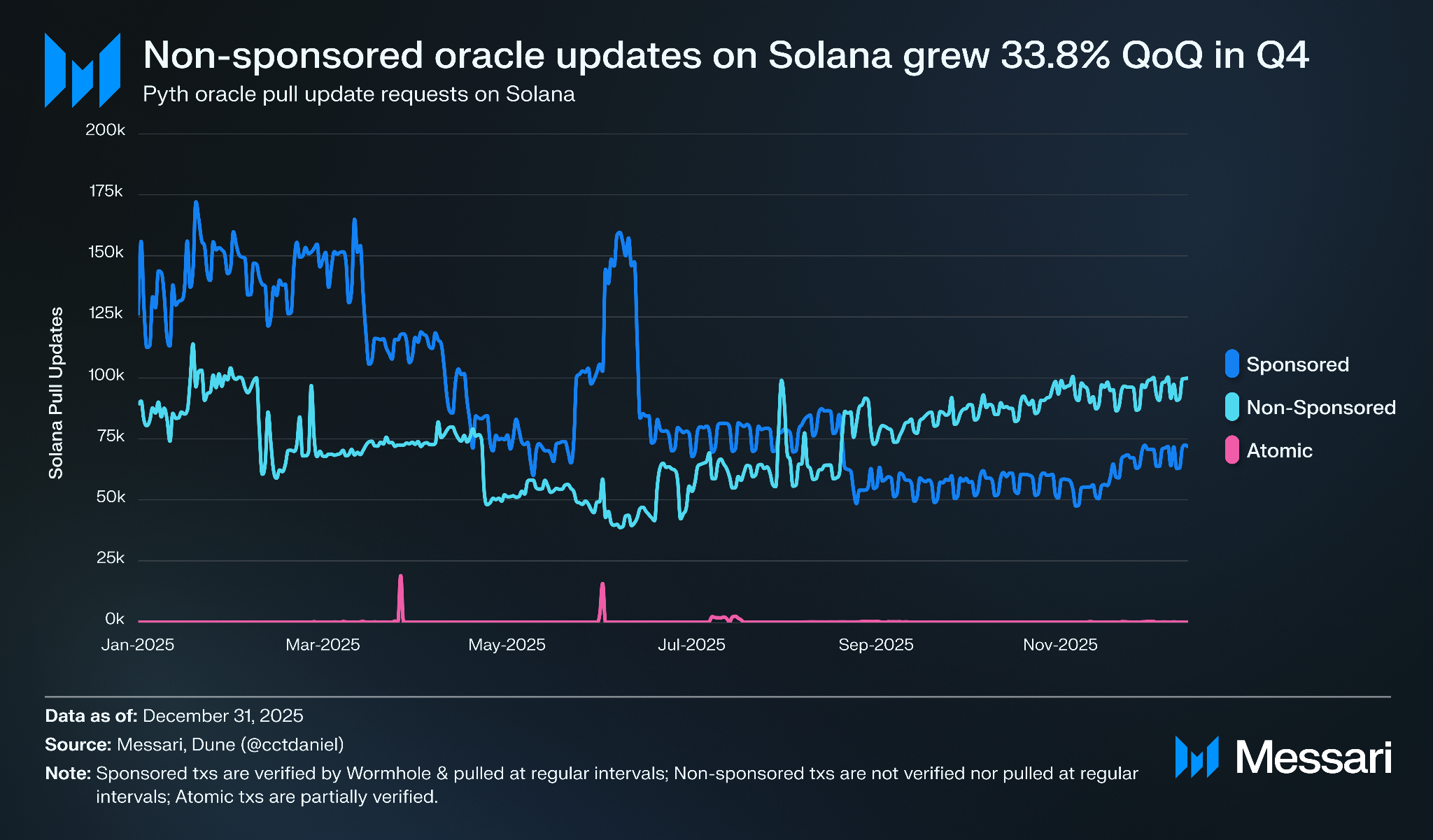
Non-sponsored updates are manually triggered and submitted directly by protocols without fixed scheduling. These transactions offer greater control for applications that prefer to request price data on demand, often in response to specific events or user activity.
Atomic updates use a reduced set of Guardian signatures, five or fewer, to support atomic execution paths that require a price update and a consuming transaction to occur together. They are less common and used in cases where latency or execution order matters more than complete verification.
In Q4, Pyth processed 5.5 million sponsored updates on Solana, down 16.6% from 6.6 million in Q3. Non-sponsored updates increased 33.8% QoQ to 8.4 million, up from 6.3 million, while atomic updates declined 82.8% QoQ from 27,600 to 4,700. The decline in scheduled, verified updates alongside growth in non-sponsored transactions indicates a shift by protocols toward manual, on-demand requests. In September 2025, daily non-sponsored updates exceeded sponsored updates for four consecutive days for the first time since September 2024.
Entropy
In Q4, Pyth deprioritized Entropy product development to allocate resources towards its price feed products.
Pyth Entropy provides developers with a way to generate secure, verifiable random numbers onchain using a two-party randomness mechanism to support applications that require unpredictability, such as NFT mints or games. Randomness is generated offchain and returned onchain in two steps: a smart contract requests a random number and defines a callback function, then a second transaction delivers the random value and its cryptographic proof by executing the callback.
On Aug. 1, Pyth launched Entropy V2, an upgrade to its onchain randomness protocol. Entropy V2 lets developers set custom gas limits for callbacks, supporting operations that require more computational resources. On Nov. 7, Pyth launched the Entropy Explorer, which reports details about randomness requests, including success rates, gas usage, and failure reasons.
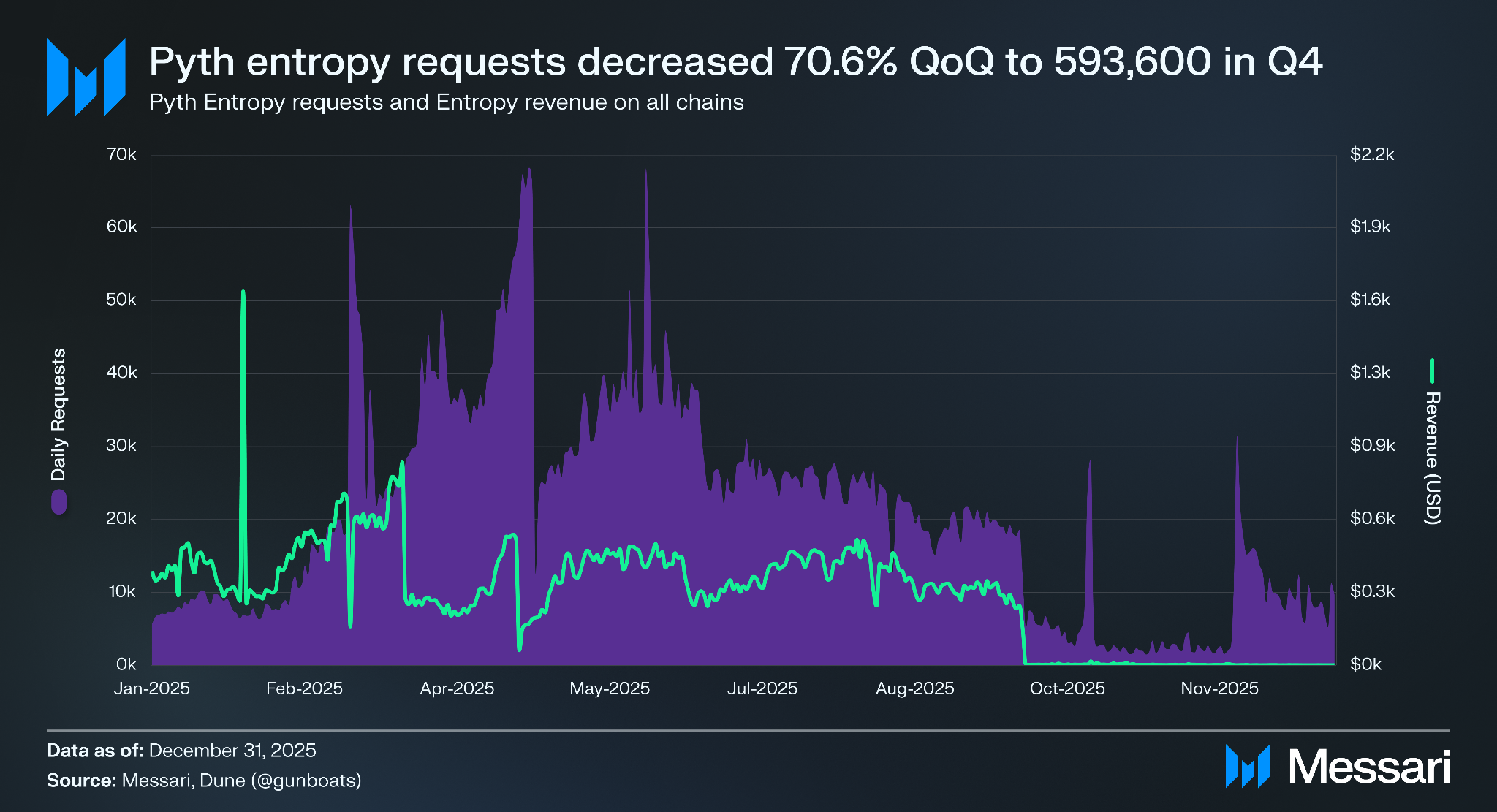
In Q4, Entropy processed 593,600 requests, down 70.6% from 2.0 million in Q3. Entropy revenue decreased 99.0% QoQ from $33,800 to $190. Blast, an Ethereum L2, led Entropy requests across all chains during the first three quarters of 2025. However, on Sept. 27, Blast Entropy requests stopped, which drove most of the Q4 decline in Pyth’s randomness usage.
RWA and Crypto Price Feeds
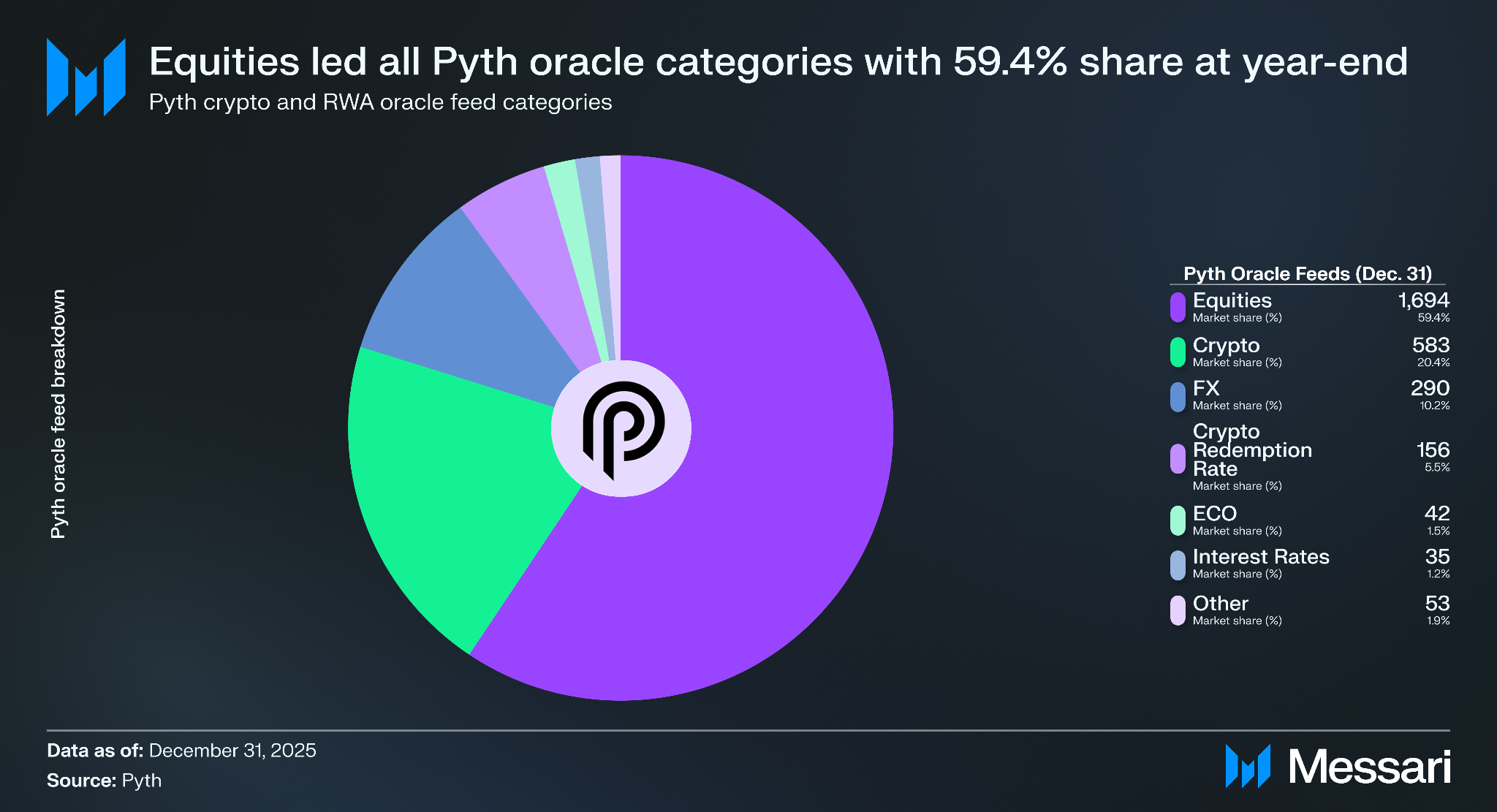
Pyth publishes price feeds across most major asset classes, including equities, crypto assets, foreign exchange, economic indicators, interest rates, and metals. It also publishes redemption rate products that track the conversion value of tokens redeemable for underlying assets, such as stablecoins or wrapped tokens. Pyth ended Q4 with 2,850 price feed listings, upe 27.0% QoQ from 2,250 at Q3-end.
As of Dec. 31, equities accounted for 59.4% of all active price feeds with 1,694 listings. Crypto followed at 20.4% with 583 feeds, while foreign exchange rate feeds ranked third at 10.2% with 290. On Dec. 31, 2024, equities and foreign exchange rates accounted for 21.8% (109 listings) of Pyth price feeds, compared to 69.4% as of Dec. 31, 2025. The increase in this concentration reflects Pyth’s expansion beyond DeFi-focused pricing toward broader multi-asset market data coverage.
Express Relay (Kamino Swap Usage on Solana)
In Q4, Pyth deprioritized Express Relay product development to allocate resources towards its price feed products.
Express Relay is Pyth Network’s offchain auction-based system that mitigates Maximum Extractable Value (MEV) in DeFi by removing miners and validators from the transaction ordering process.
Instead of competing for block space, searchers bid in isolated, protocol-controlled auctions for the right to execute specific transactions, such as liquidations or swaps. The highest bidder wins execution rights and pays a tip, which is redirected to users or the protocol, recapturing value otherwise lost to MEV and lowering execution costs when returned to users.
Express Relay can be integrated with protocols across 11 blockchains, including Solana, Optimism, Arbitrum, and Base. Usage has been highest on Solana, driven by the Kamino Swap integration, Kamino Finance’s Solana-based trading platform. As of Dec. 31, Express Relay was also integrated with exchanges Titan and Jupiter, though historical Express Relay trading volume data for those integrations was not publicly available. As a result, Kamino Swap provides the primary observable dataset for evaluating Express Relay usage and performance on Solana.
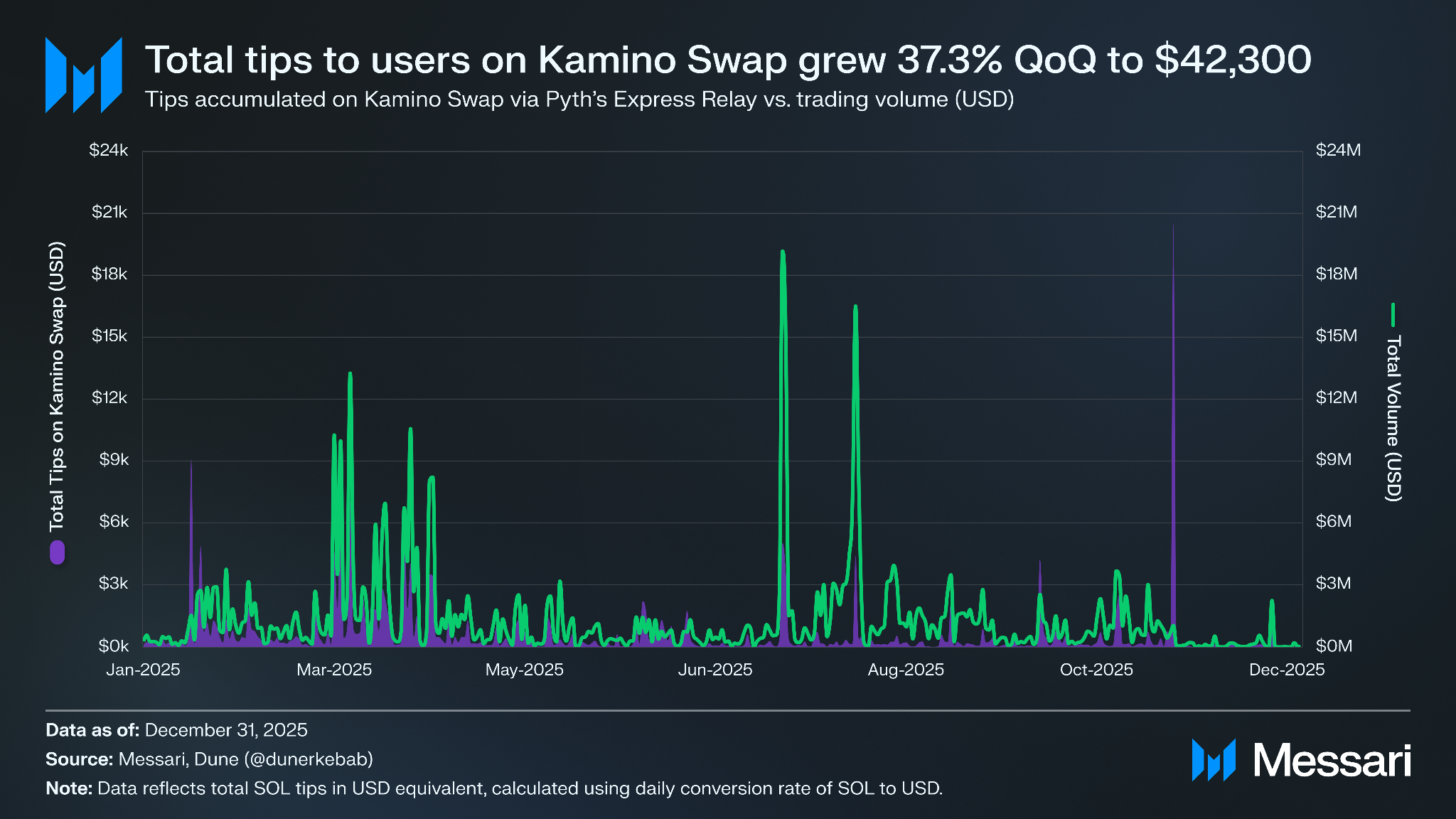
In Q4, Kamino Swap processed $54.9 million in volume, down 68.4% from $173.9 million in Q3. The protocol and users received $42,300 in SOL-denominated searcher tips, a 37.3% increase from $30,800 in Q3. This divergence suggests that Express Relay usage on Kamino Swap concentrated in a smaller set of transactions with higher execution value, where searchers were willing to bid more aggressively to secure execution rights.
Oracle Integrity Staking (OIS)
On Sept. 21, 2024, Pyth introduced Oracle Integrity Staking (OIS) to strengthen data reliability through economic alignment. The mechanism allows participants to stake PYTH tokens toward specific data publishers, linking financial incentives directly to data accuracy. Publishers earn rewards for reliable price submissions and face penalties for deviations, creating an incentive-based system that secures Pyth’s price feeds through active market participation.
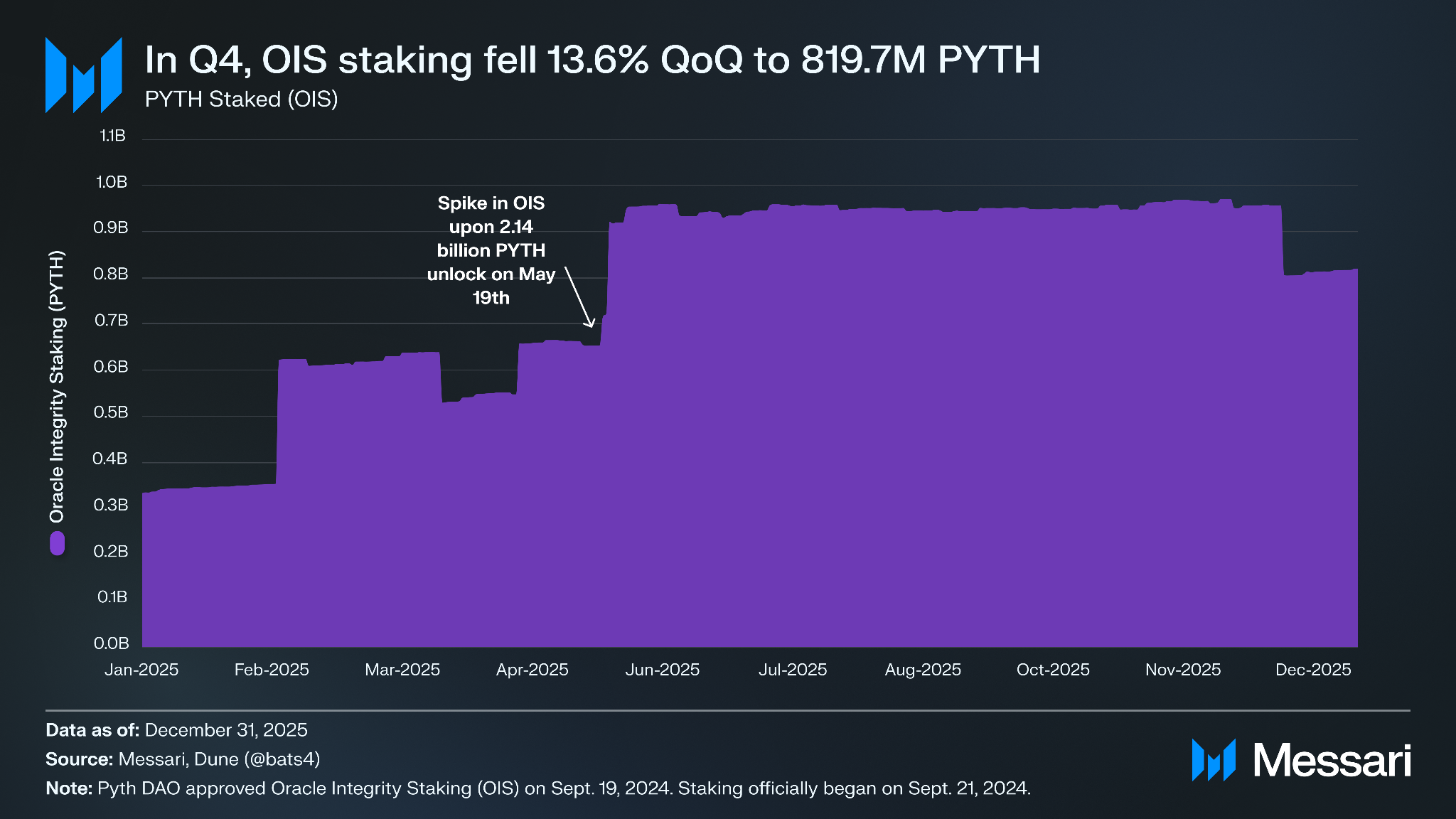
As of Dec. 31, total PYTH staked in OIS was 819.7 million, down 13.6% QoQ from 948.5 million at the end of Q3. On Dec. 9, PYTH staked in OIS declined by 150.8 million, the largest one-day decrease in total staked PYTH during 2025. After Dec. 9, total PYTH staked increased through the remainder of December.
Qualitative Analysis
Pyth Pro
On Sept. 24, Pyth launched Pyth Pro, formerly Pyth Lazer, a permissioned service providing low-latency proprietary financial data for institutions. Pyth now offers three service tiers:
Pyth Crypto, a free service providing 1s update frequency on crypto assets with monthly additions of new tickers.
Pyth Crypto+, a $5,000 per month service providing 1ms update frequency on crypto assets with weekly additions of new tickers.
Pyth Pro, a $10,000 per month service with 1ms update frequency on over 2,800 price feeds, including crypto assets, equities, futures, commodities, and interest rates, with weekly additions of new tickers.
In Q4, Pyth Pro had 54 active subscribers, up 92.9% from 28 in Q3 and eight in Q2. On Jan. 5, Pyth reported $352,600 in Q4 revenue from Pyth Pro, surpassing $1 million in annual recurring revenue.
Each subscriber’s monthly payment contributes to a growing and predictable revenue stream for the protocol, and as more institutions prioritize direct access to high-fidelity market data, Pyth Pro could see continued adoption beyond its early base. Early access partners include Jump Trading Group and Jane Street. With latency as low as 1ms and accuracy within 1.4 basis points, Pyth Pro positions itself alongside traditional data vendors for institutional use cases.
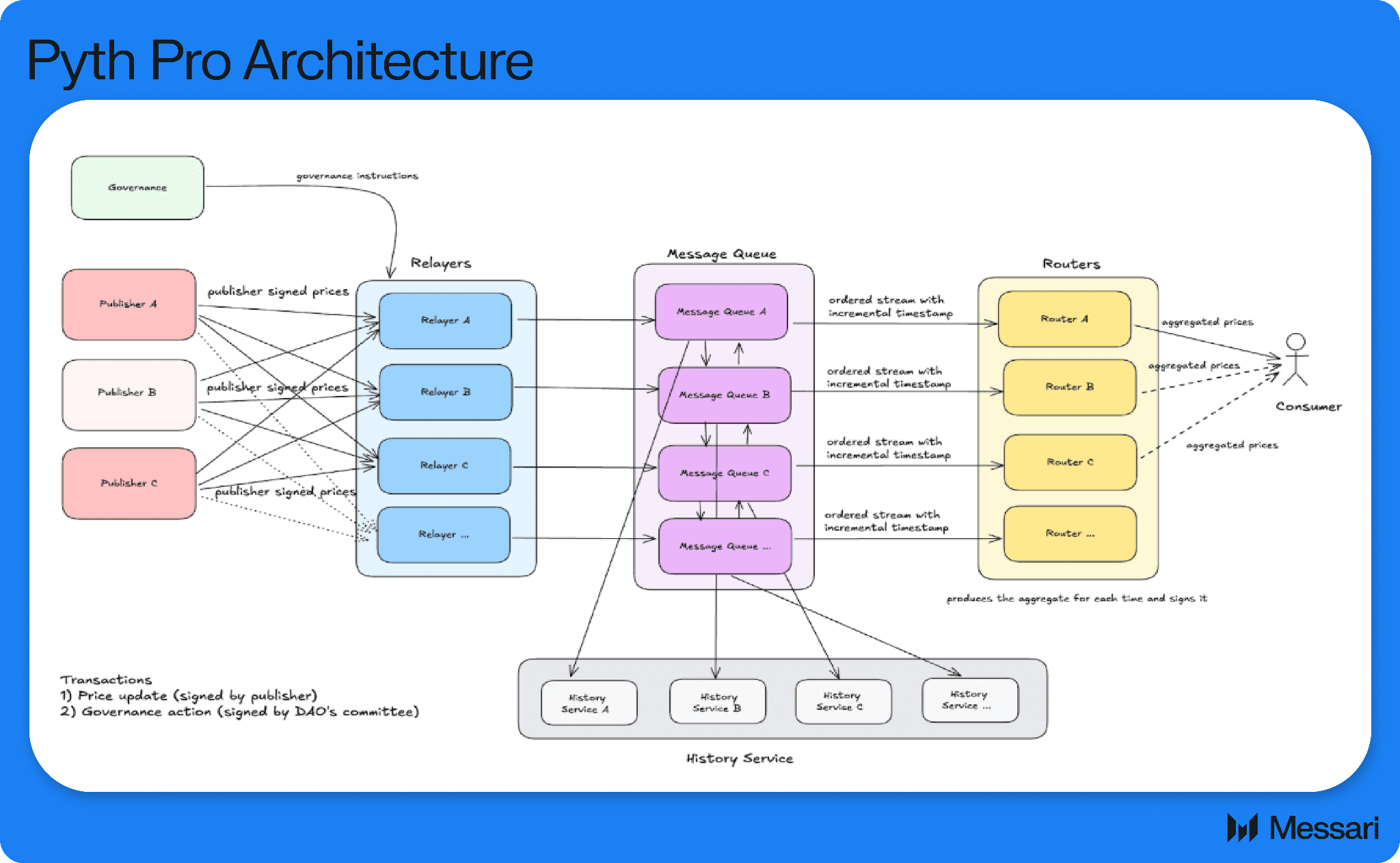
In November 2025, Pyth published the architecture behind Pyth Pro, which consists of five coordinated services that deliver the 1ms latency to consumers: publishers, relayers, a message queue, a router, and a history service. This architecture provides deterministic low-latency pricing while preserving data integrity across multiple independent publishers, which is required for institutional trading systems that depend on low execution timing.
Publishers supply raw market data to Pyth Pro and operate under permissions that authorize which price feeds each publisher can update. Douro Labs operates the relayer service, which ingests price updates from publishers, validates feed identifiers and message formatting, and forwards verified updates to the message queue on a first-come, first-served basis.
The message queue preserves the exact ordering of updates for each price feed and guarantees that every individual publisher update is delivered at least once to the aggregated price feed for that asset.
The router serves as the distribution service by consuming ordered updates from the message queue, computing aggregated price feeds, and delivering data to consumers. Aggregation logic calculates median prices to exclude outlier publisher data, computes confidence intervals, and removes stale publisher data using configurable timeouts. The history service stores publisher and aggregated data to support historical price queries for downstream users.
PYTH is an SPL token on Solana used for governance, where holders can stake and vote on Pyth Improvement Proposals (PIPs), which guide protocol parameters, publisher incentives, and treasury decisions. As of Dec. 31, PYTH’s circulating supply was 5.75 billion out of a 10 billion maximum supply.
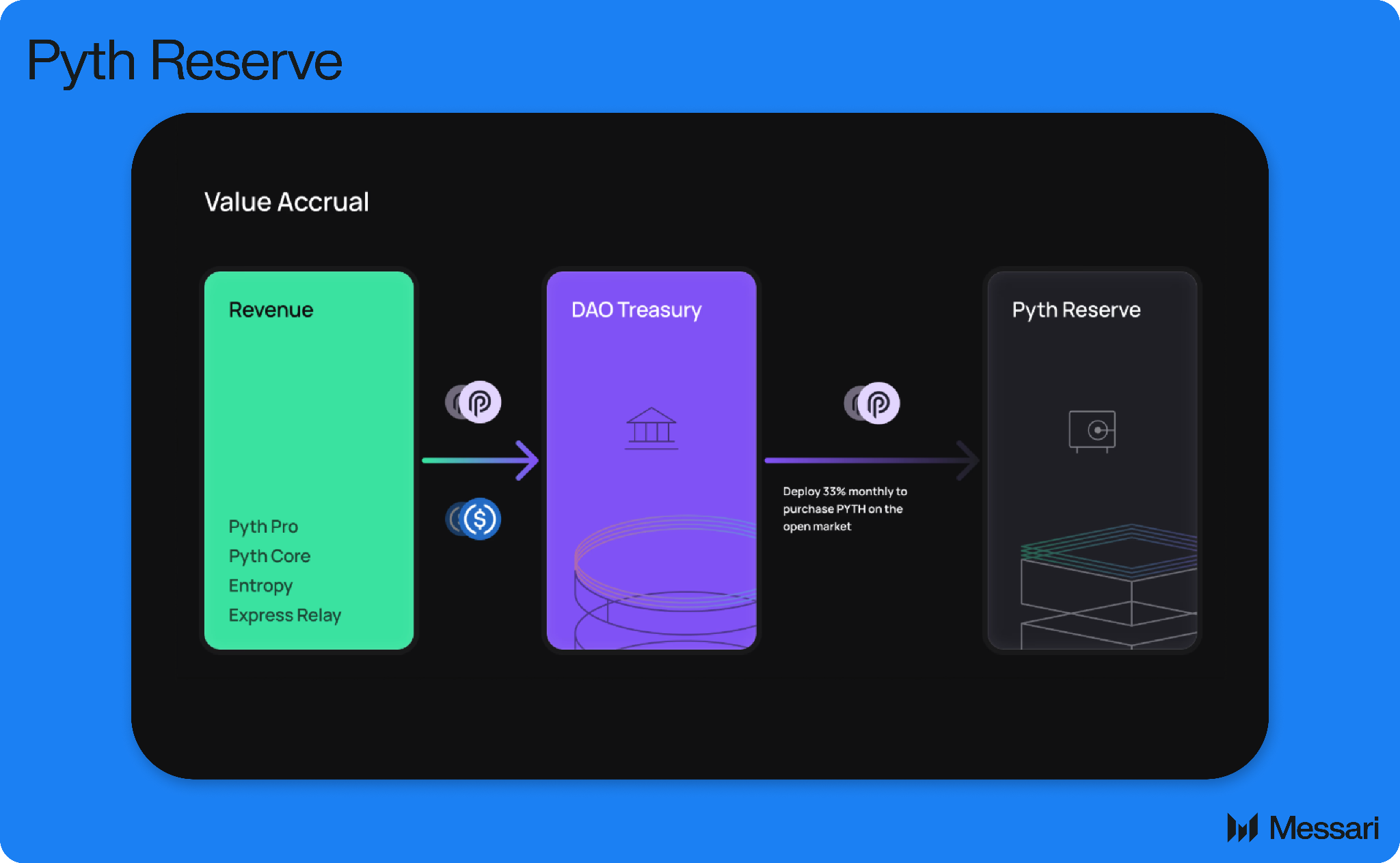
On Dec. 12, Pyth introduced the PYTH Reserve, a token-buyback program that will direct protocol revenue from Pyth Pro, Pyth Core, Entropy, and Express Relay to the DAO treasury, then use 33% of monthly revenue to purchase PYTH on the open market.
The Pythian Council is an eight-member elected governance body in the Pyth Network DAO that manages protocol operations, strategic decisions, and the Pythian Multisig Wallet. On Dec. 12, Pyth stated that the Council plans to conduct quarterly pricing reviews across Core, Entropy, and Express Relay using onchain usage data and competitor benchmarks to adjust fees when needed, balancing revenue generation with continued adoption. On Jan. 5, the PYTH DAO executed its first buy, purchasing ~2.16 million PYTH (0.02% of the total token supply).
Kalshi
On Oct. 13, Pyth partnered with Kalshi, a CFTC-regulated prediction market exchange, to publish prediction market data across Pyth’s 113 connected blockchains. Developers can access Kalshi’s prediction market probabilities onchain, including political, economic, sports, crypto, and cultural markets, to build applications.
Kalshi’s regulated status differentiated the partnership from informal prediction market venues, as its transparent operations and auditable processes aligned with Pyth’s institutional data strategy. Since Kalshi is an offchain platform, the integration also supports Kalshi’s stated intent to establish an onchain presence alongside its existing offchain markets. Initial market data published by Pyth included the New York City mayoral election, the Formula 1 Drivers’ Championship, the MLB Championship, and the number of interest rate cuts in 2025. As of Dec. 31, Pyth published 19 Kalshi price feeds.
HIP-3
On Oct. 13, Hyperliquid launched HIP-3 (Hyperliquid Improvement Proposal-3), an upgrade that allows permissionless creation of perpetual futures markets across multiple asset classes, including crypto assets, equities, commodities, and foreign exchange pairs, provided the market meets predefined oracle and settlement requirements.
On Oct. 15, Pyth launched the Pyth HIP-3 Relayer, a Pyth-managed oracle infrastructure service that handles oracle operations for HIP-3 market deployers. Pyth serves as an infrastructure partner within the HIP-3 ecosystem by supplying the offchain price data required for market settlement.
Deploying and operating a HIP-3 market requires submitting oracle price updates every three seconds to satisfy Hyperliquid’s settlement constraints. The Pyth HIP-3 relayer handles this requirement by submitting continuous oracle price updates, allowing deployers to focus on market design rather than oracle maintenance. Trade.xyz, a non-custodial perpetual contracts platform built on Hyperliquid, was one of the first protocols to use the Pyth HIP-3 relayer.
Governance
Pyth Improvement Proposals (PIPs) fall into two categories: Constitutional, which require 67% approval and cover structural changes to the Pyth DAO, and Operational, which pass with a simple majority and manage council elections, treasury spending, and protocol upgrades. Stakers can delegate voting to the Pythian Council or Price Feed Council, responsible for executing approved Operational PIPs.
In Q4, Pyth passed one Constitutional PIP and six Operational PIPs, as governance activity continued on Solana. The relevant proposals are listed below.
CO-PIP-9: Passed on Sept. 23, this proposal authorized Douro Labs to distribute Pyth Network data through a subscription-based model, later launched as Pyth Pro, on behalf of the Pyth DAO for 24 months. Under the proposal, Douro Labs received permission to market Pyth Pro, negotiate and execute subscription contracts, operate subscription infrastructure, and provide customer support, while reporting distribution progress and revenue to the DAO on a quarterly basis. Over the 24-month period, Douro Labs will transfer 60% of subscription revenue to the DAO treasury on a monthly basis, and retain 40% to cover distribution and operational costs.
OP-PIP-82 and OP-PIP-83: Passed on Oct. 8, these proposals upgraded Entropy contracts on testnet and mainnet to fix a callback gas handling bug that incorrectly marked callbacks as failed when sufficient gas was provided.
OP-PIP-84: Passed on Dec. 3, this proposal approved six nominees for the fourth Pythian Council and authorized stipend payments of 12,500 PYTH to each eligible member of the third council.
OP-PIP-85: Passed on Dec. 3, this proposal approved five nominees for the fourth Price Feed Council and authorized stipend payments of 45,000 PYTH to each eligible member of the third council.
OP-PIP-87: Passed on Dec. 9, this proposal established the Pyth Reserve and authorized the Pythian Council to execute monthly token buybacks using 33% of the DAO treasury balance.
Pyth Team Commentary
Team Commentary Disclaimer
The Project Team Commentary section of this report was written by the Pyth team and reflects the views, opinions, and forward-looking statements of Pyth only. This section is included to provide additional context on the project’s strategy, priorities, and outlook and does not necessarily reflect the views or opinions of Messari, Inc.
The Inflection Point
Last year was the year Pyth crossed a threshold. What began as critical infrastructure for onchain markets evolved into a shared data layer that the world’s largest financial institutions both contribute to and rely on.
Pyth kicked off 2025 by partnering with Revolut, which became a symbolic milestone for what transpired throughout the rest of the year.
Pyth would go on to work with banks, exchanges, market makers, fintechs, and government agencies to scale a financial data network that met institutional standards without sacrificing transparency or speed. Pyth expanded its market data coverage across asset classes and geographies.
And then something remarkable happened. Those same institutions publishing data to Pyth Network started asking a different question: “How do we get access to this data ourselves?”
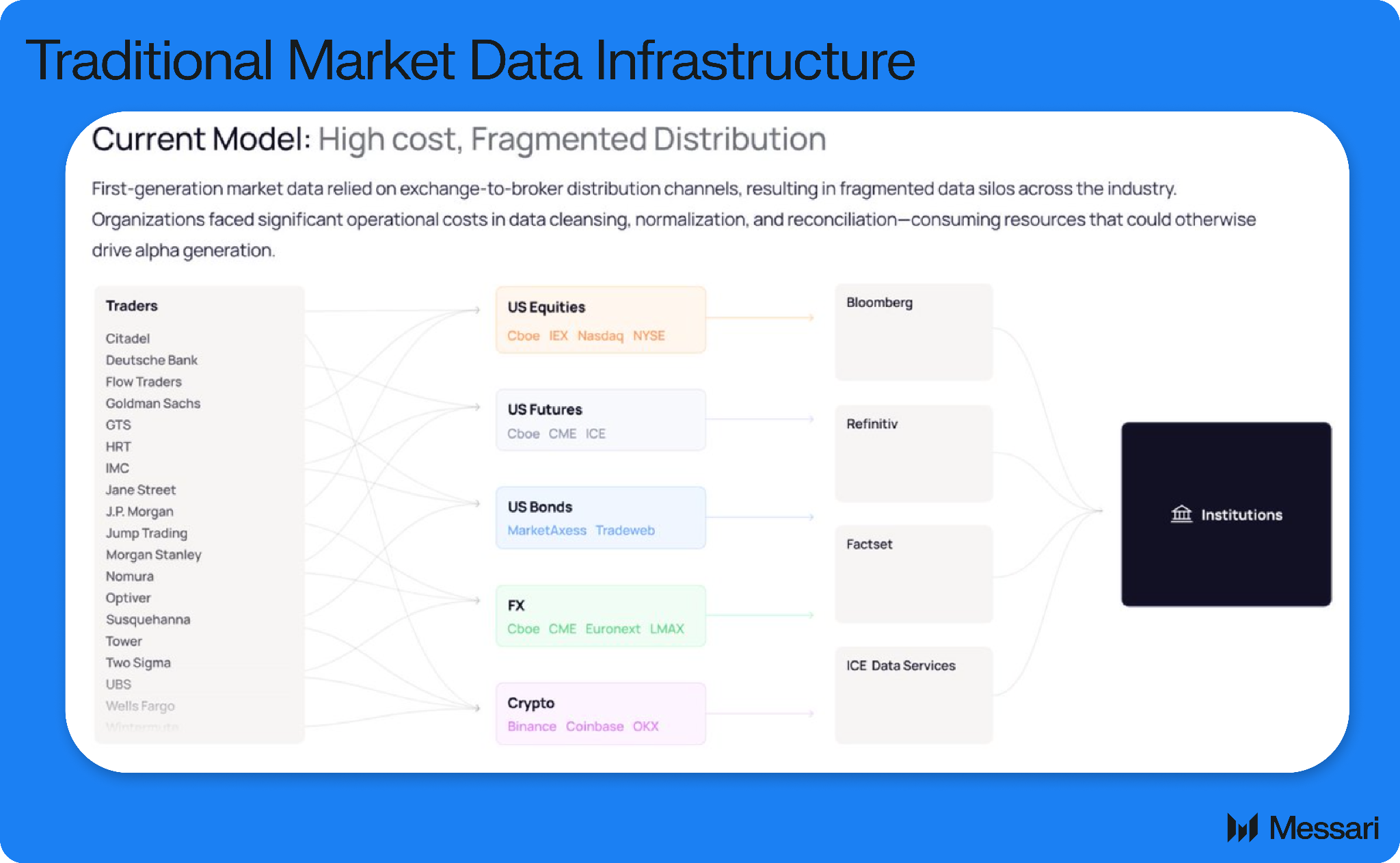
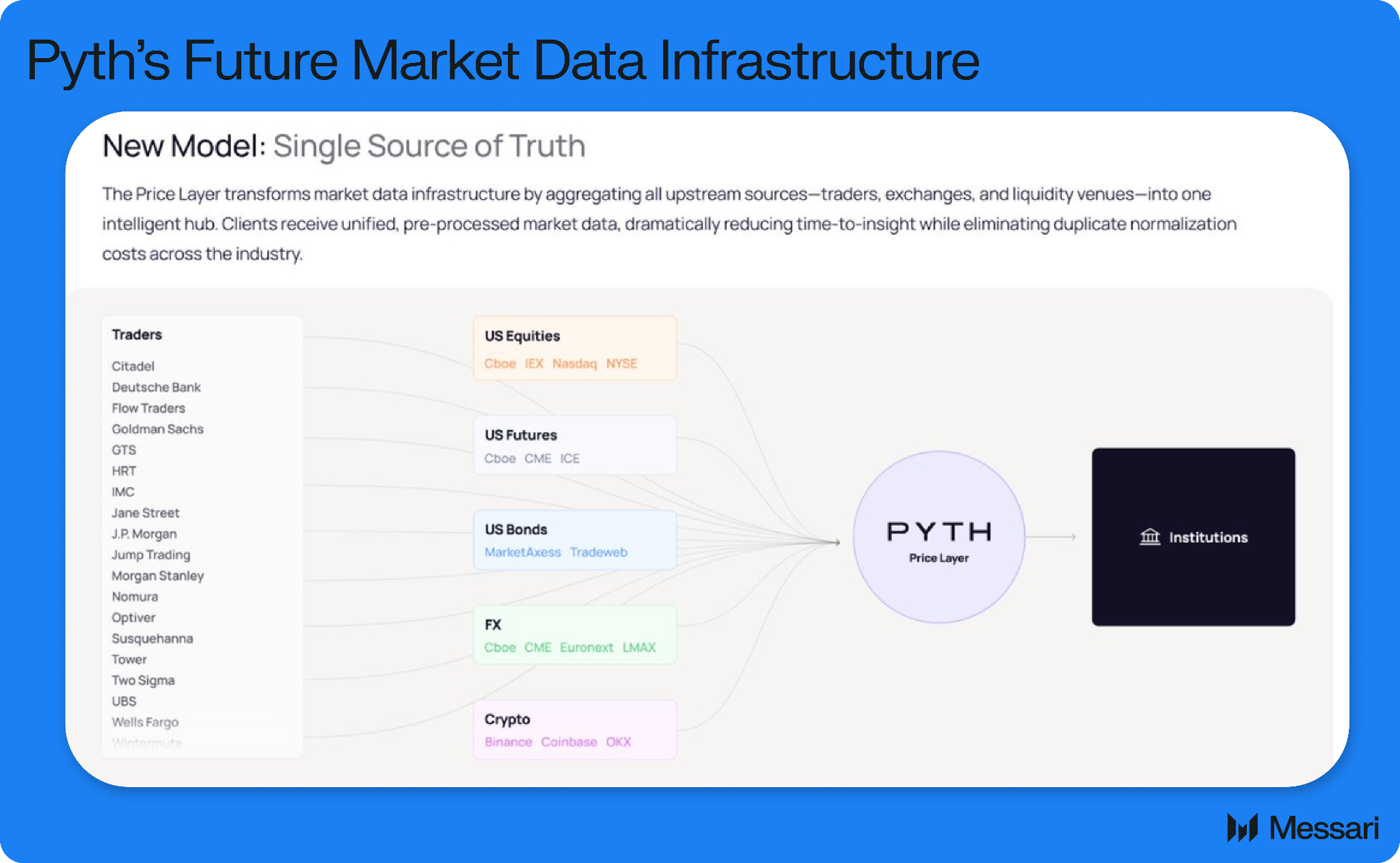
That demand led directly to the launch of Pyth Pro, which transformed the market data supply chain from this:
Pyth Pro reinforced the view that lowering barriers to high-quality market data expands access and usage. Within its first month, Pyth Pro surpassed $1 million in ARR, with customers spanning trading firms, fintechs, and financial institutions. Firms had considered the status quo market data paradigm unshakable, but now began evaluating blockchain-based distribution models as an alternative to legacy market data infrastructure.
By the end of the year, we collaborated with the U.S. Department of Commerce, bringing GDP and other economic datasets onchain for the first time. We partnered with Kalshi to bridge prediction markets and real-world data at an institutional scale.
We launched the PYTH Reserve, laying the foundation for network revenues to be reinvested directly back into the ecosystem for long-term sustainability.
And the network itself grew at a pace that still amazes me. In January 2025, Pyth supported 545 price feeds. By December, that number exceeded 2,800.
More asset classes. More geographies. More users. More real-world relevance.
In 2026, the results of everything Pyth started in January 2024 will become clear.
Expect marquee partnerships with more household names across banking, fintech, and global markets.
Pyth Pro will expand well beyond blockchains and even beyond traditional finance, as it begins to power AI-driven financial systems.
The number and diversity of datasets will continue to accelerate as institutions realize that publishing once and distributing everywhere is no longer optional.
The idea behind Pyth remains delightfully simple: Lower the barrier to high-quality market data, and grow the global pie.
This is how every major technology shift has played out. Uber didn’t invent transportation; it unlocked it. Netflix didn’t invent streaming; it expanded it. Spotify didn’t invent music; it democratized it.
Pyth is the Spotify of financial market data. A single, high-quality subscription to the world’s markets, constantly expanding, constantly improving, and accessible to anyone building the future of finance.
The future of finance is not one thing. It’s blockchains, AI, internet capital markets, institutions, banks, exchanges, governments, and people all operating on better infrastructure. It’s systems that need data that is fast, transparent, and globally accessible.
Pyth is establishing itself as the next generation of financial data that makes all of this possible.
Closing Summary
In Q4 2025, Pyth Network grew across core metrics and expanded its institutional footprint, as average daily price updates increased 31.4% QoQ from 675,100 in Q3 to 886,700 in Q4. TVS decreased 32.1% QoQ from $6.2 billion at Q3-end to $4.2 billion at Q4-end, consistent with TVS declines across all major oracle networks. Pyth price feed listings increased 27.0% QoQ from 2,250 at Q3-end to 2,850 at Q4-end, contributed in part by an Oct. 13 partnership with Kalshi to publish prediction market data onchain.
On Sept. 24, Pyth launched Pyth Pro, a data service for institutions that provides 1ms updates across all Pyth price feeds, which generated $352,600 in Q4 revenue. On Dec. 12, Pyth introduced the Pyth Reserve, a token buyback initiative that allocates 33% of monthly revenue to open-market PYTH purchases, aligning Pyth Network subscription revenue with PYTH tokenholder value accrual through DAO-controlled token purchases. The DAO executed its first buyback on Jan. 5, acquiring ~2.16 million PYTH (0.02% of the total token supply).
These developments expanded Pyth’s scope from a DeFi-focused oracle toward a broader multi-asset financial data infrastructure network. The protocol delivers low-latency pricing for crypto, equities, and macroeconomic indicators, supporting both institutional clients and onchain applications. As adoption expands across new user groups and markets, Pyth is poised to deepen its reach and solidify its role as a core data layer for both traditional and onchain markets.
This report was commissioned by Pyth Data Association. All content was produced independently by the author(s) and does not necessarily reflect the opinions of Messari, Inc. or the organization that requested the report. The commissioning organization may have input on the content of the report, but Messari maintains editorial control over the final report to retain data accuracy and objectivity. Author(s) may hold cryptocurrencies named in this report. This report is meant for informational purposes only. It is not meant to serve as investment advice. You should conduct your own research and consult an independent financial, tax, or legal advisor before making any investment decisions. Past performance of any asset is not indicative of future results. Please see our Terms of Service for more information.
No part of this report may be (a) copied, photocopied, duplicated in any form by any means or (b) redistributed without the prior written consent of Messari®.
Austin is a Sr. Research Analyst for Messari’s Protocol Services team. He focuses on Prediction Markets, DeFi, & Interop. protocols. He previously worked on PwC's Digital Assets team.
Austin is a Sr. Research Analyst for Messari’s Protocol Services team. He focuses on Prediction Markets, DeFi, & Interop. protocols. He previously worked on PwC's Digital Assets team.