Pyth delivers institutional-grade market data to onchain and offchain applications by sourcing prices directly from trading firms and exchanges.
Originally a crypto oracle, Pyth has expanded into a cross-asset data platform covering equities, FX, commodities, and rates with stricter latency and precision offerings.
The launch of Pyth Pro marked a shift into institutional data distribution, surpassing $1 million in ARR within its first month.
In December 2025, Pyth announced the PYTH Reserve, directing roughly 33% of monthly network revenue to DAO-managed open-market purchases of PYTH.
This economic model is supported by real-world adoption at scale, with 125+ publishers, 650+ integrations, and over $2.3 trillion in cumulative traded volume.
Primer
Pyth (PYTH) was originally designed to deliver secure, real-time market data to onchain applications, addressing the limitations of legacy oracle models that relied on downstream, intermediary-aggregated feeds. Over time, the protocol has expanded beyond its crypto-native origins to reimagine how market data is sourced, distributed, and monetized across the broader financial system. At its core, Pyth aggregates first-party pricing directly from trading firms, exchanges, and market makers, capturing price discovery upstream rather than repackaging data after it has already propagated through traditional venues.
This evolution is most clearly reflected in Pyth Pro, an institutional-grade market data product that extends Pyth’s low-latency pricing beyond crypto into equities, foreign exchange, commodities, rates, and other global asset classes. Pyth Pro delivers millisecond-resolution data through a unified integration, positioning the network as a direct alternative to legacy market data vendors. Complementing this expansion, Pyth introduced the PYTH Reserve, a value-capture mechanism that links protocol revenue to token economics by routing a portion of recurring product revenue into DAO-managed PYTH purchases. Together, Pyth Pro and the Reserve mark a shift from oracle infrastructure toward a full-stack market data platform with a sustainable, usage-driven economic model.
Pyth was founded in 2021 to provide institutional-grade pricing data to decentralized finance (DeFi), addressing early reliance on downstream, intermediary-aggregated oracle data that proved ill-suited for high-frequency financial activity. Its first major integration was with Serum, Solana’s earliest large-scale central limit order book (CLOB) DEX, which helped establish Pyth’s initial focus on latency-sensitive trading environments.
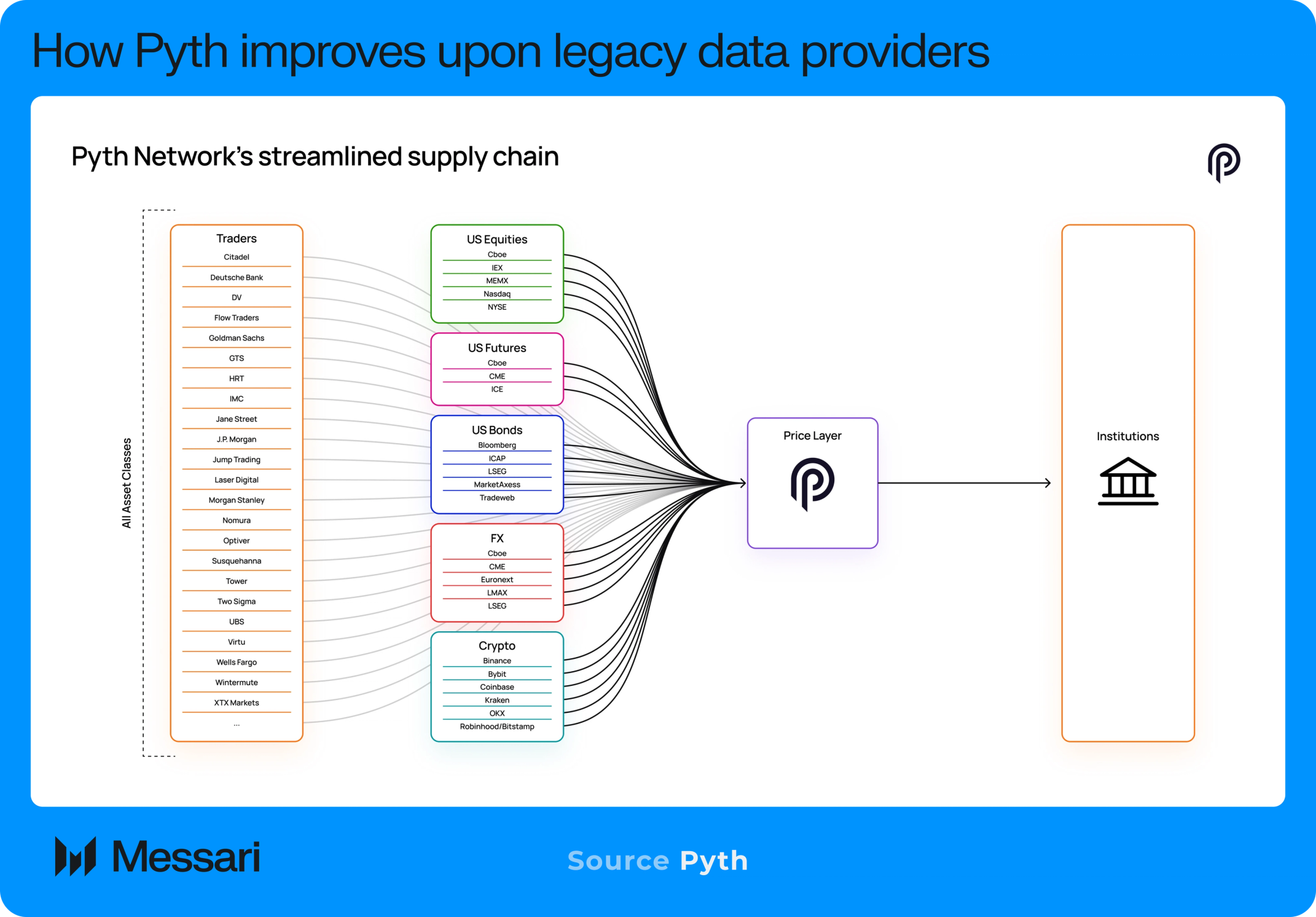
Since its inception, Pyth has expanded its scope beyond crypto-native markets to deliver high-frequency pricing across a broader set of asset classes, with more rigorous latency and precision requirements. By capturing price discovery directly from trading firms and exchanges, before it is fragmented or repackaged, Pyth provides a transparent and auditable alternative to legacy market data vendors that rely on siloed feeds, opaque licensing, and bundled pricing. This model contrasts sharply with traditional market data vendors, which often repurpose siloed exchange feeds through opaque licensing arrangements and expensive, bundle‑based pricing.
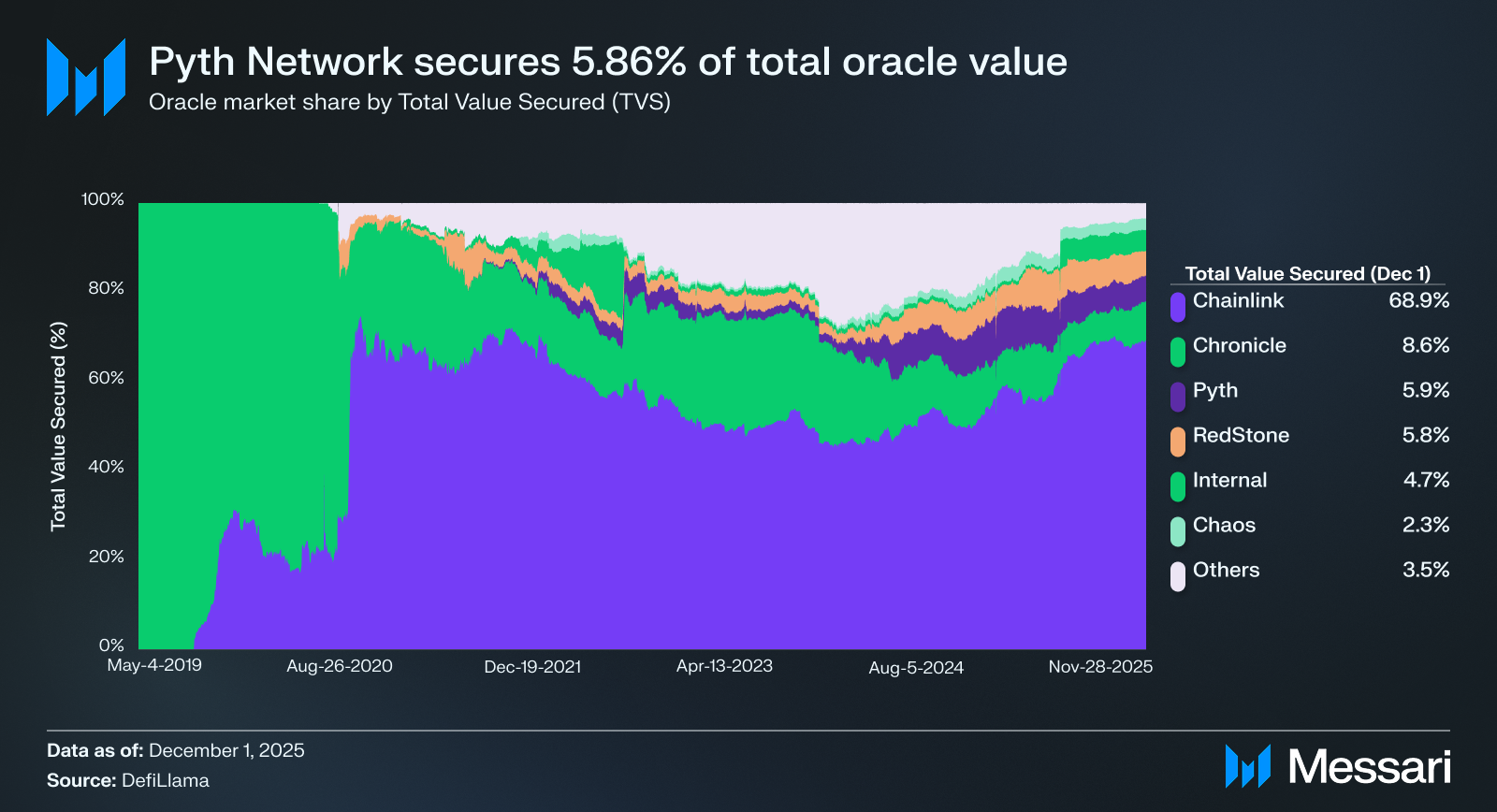
By mid-2025, the network powered $2.3 trillion in cumulative traded volume across onchain and offchain venues, attracted price contributions from more than 125 institutions, including Jane Street, Cboe, Jump Trading, DRW, and Optiver, and had been integrated into over 650 onchain applications. To put this into perspective, as of Dec. 1, 2025, Pyth secures more than $6 billion in value across 301 protocols, representing 5.9% of total oracle market share by value secured and placing it among the top three oracle providers globally.
Crypto Oracle to Institutional Data
Specifically, as demand for this data expanded beyond crypto-native applications into latency-sensitive trading, risk management, and institutional workflows, Pyth formalized its architecture into a tiered product stack alongside its other core offerings (i.e., Pyth Entropy and Express Relay). Pyth’s product surface is now best understood as three tiers of market data distribution, complemented by its onchain oracle feeds and a separate randomness primitive.
At the base is Pyth Crypto, a free tier that delivers cryptocurrency pricing at one-second update intervals, including confidence intervals, and serves developers and applications without strict latency or cross-asset needs. Pyth Crypto+ builds on this foundation by offering millisecond-level updates for the same crypto asset universe, along with faster listings and broader symbol coverage, targeting professional trading firms, derivatives platforms, and infrastructure providers that operate under tighter timing constraints. At the top of the stack, Pyth Pro extends Pyth’s data offering beyond crypto into a fully institutional, cross-asset product, delivering millisecond-resolution data across equities, futures, ETFs, commodities, foreign exchange, rates, and digital assets through a single integration.
Crucially, Pyth Pro includes enterprise-grade licensing and redistribution rights, positioning it as a compliant alternative to legacy market data vendors rather than a DeFi-only oracle product. This includes Pyth’s role as the exclusive distributor of overnight U.S. equity market data from Blue Ocean ATS, allowing institutions to access regulated, off-hours equity pricing through a unified data feed. Within its first month of launch, Pyth Pro surpassed $1 million in annual recurring revenue (ARR), highlighting early institutional demand for a licensed, first-party market data distribution model.
Collectively, these offerings form a cohesive market-data stack that spans public crypto feeds, low-latency professional data, and institutional-grade cross-asset distribution, unified by a common sourcing model and shared infrastructure rather than separate, siloed products.
Economic Flow and the PYTH Reserve
This tiered pricing also reframes the role of PYTH, the network’s token. PYTH was first distributed in November 2023 via a large-scale retrospective airdrop, rewarding early users, ecosystem participants, and protocols that had integrated Pyth’s price feeds, alongside allocations to data publishers, ecosystem growth, private stakeholders, and core contributors. PYTH functions primarily as the governance and coordination layer for Pyth’s market data economy, allowing tokenholders to set protocol parameters, oversee publisher incentives, and guide the network’s long-term evolution.
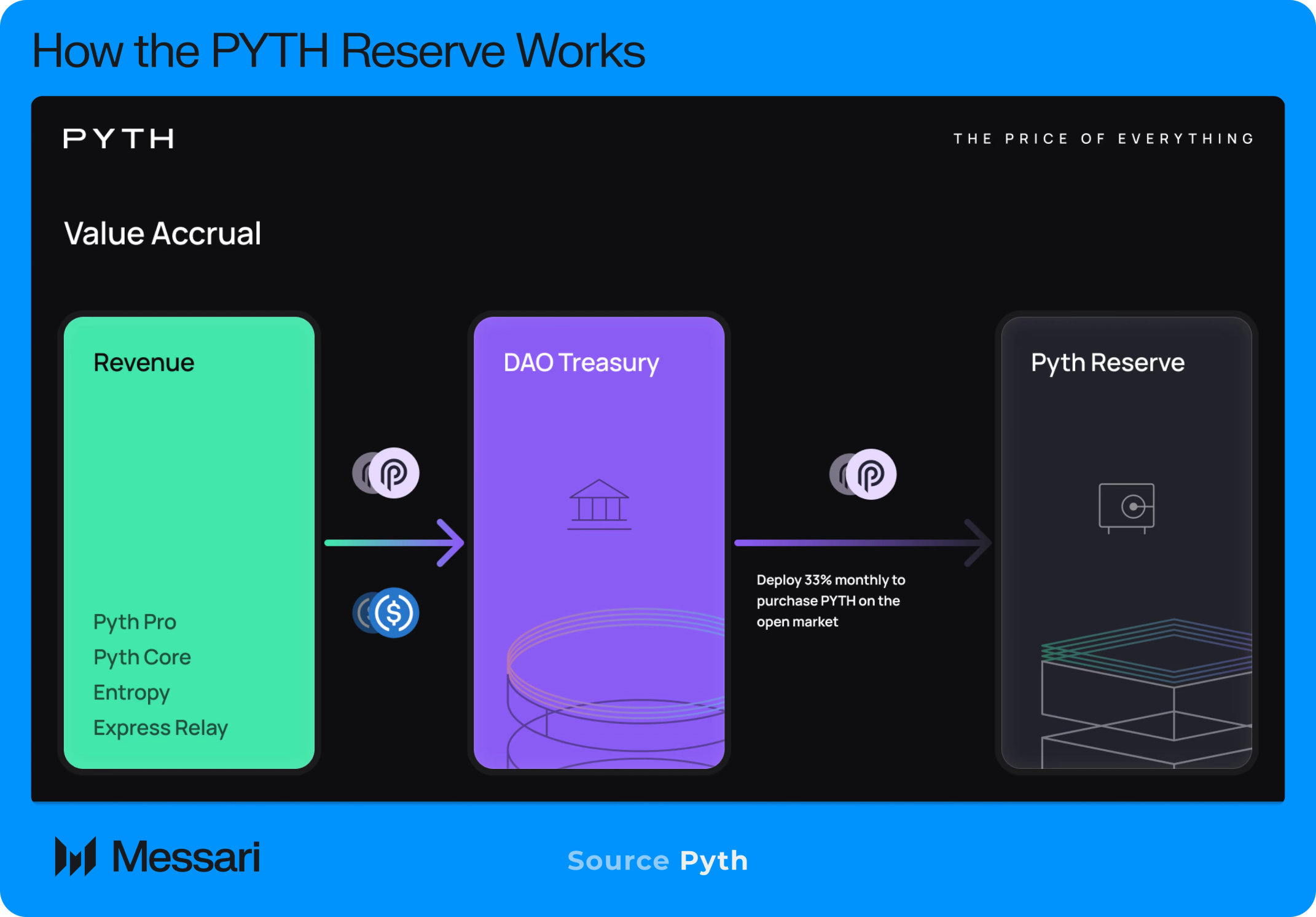
However, in December 2025, Pyth introduced the PYTH Reserve, formalizing a value-capture mechanism directly tied to protocol revenue. All revenue generated across Pyth’s product surface (i.e., Pyth Pro, Pyth Core price feeds, Entropy, and Express Relay) is consolidated into the DAO treasury. Each month, the DAO deploys one-third (i.e., 33%) of its treasury balance to purchase PYTH on the open market. In parallel, the Pythian Council now conducts systematic quarterly pricing reviews across Core, Entropy, and Express Relay, using onchain performance data and competitive benchmarks to optimize fees while preserving adoption. Together, these mechanisms anchor PYTH’s economics to recurring product usage and disciplined monetization, rather than inflationary incentives or speculative fee assumptions.
This economic flow inverts the traditional market data stack, where legacy vendors extract value downstream through opaque pricing and restrictive licenses. Instead, Pyth routes revenue upstream to data producers and inward to the network itself.
Pyth Use Cases
Pyth’s economic design is backed by real usage at scale. The network aggregates data from 125+ publishers, supports 2,800+ price feeds across 113 blockchains, and is integrated into 650+ applications and protocols, collectively powering more than $2.3 trillion in cumulative traded volume. This level of production adoption provides the revenue base that makes Pyth’s reserve and buyback mechanism economically meaningful rather than purely theoretical.
DeFi
In DeFi, Pyth is embedded across lending, derivatives, and synthetic asset platforms. Representative examples include:
Jupiter: Jupiter Lend,a lending platform on Solana, launched by Jupiter, that relies on Pyth’s reliable price feeds to manage collateral and liquidations.
Kamino: Kamino Lend, part of the Kamino Finance suite, which offers integrated lending and liquidity services, uses Pyth oracles as a core risk-management tool.
SuiLend: The largest lending protocol on the Sui blockchain (built by the former Solend team). SuiLend sources asset prices from Pyth to determine loan-to-value (LTV) ratios and trigger liquidations.
Drift Trade: A leading decentralized perpetual futures exchange on Solana. Drift uses Pyth as its main oracle provider for pricing all trading markets.
Avantis: A decentralized leverage trading platform for both crypto and real-world assets. Avantis’ trading engine is powered by Pyth oracles, which enable Avantis to offer onchain trading of gold, oil, and forex pairs with prices that mirror real-world markets in real-time.
Institutional
Beyond DeFi, Pyth is increasingly used by centralized exchanges, market makers, and professional trading firms that operate under strict latency and data-quality requirements:
Coinbase International Exchange: Integrated Pyth Lazer to enhance the speed and precision of pricing data used across its derivatives and trading infrastructure, supporting real-time market responsiveness comparable to centralized data sources.
Blue Ocean: Pyth serves as the exclusive onchain distributor of Blue Ocean’s overnight U.S. equity market data, enabling regulated off-hours equity pricing to be accessed programmatically by onchain and institutional applications through Pyth Pro.
Revolut: A digital banking giant contributes pricing data for crypto assets, FX, and more.
Kalshi: Provides prediction market data to Pyth, enabling real-time probabilities on elections, macro events, and other outcomes to be accessed programmatically onchain.
Etherea: Uses Pyth Lazer to power institutional-grade perpetuals trading onchain, relying on millisecond-resolution price updates to deliver execution quality and risk management comparable to centralized derivatives platforms.
Closing Summary
Pyth’s trajectory reflects a broader shift in how financial infrastructure is being rebuilt: from downstream aggregation toward upstream price discovery, and from fragmented data distribution toward unified, network-owned systems. What began as a crypto-native oracle has evolved into a comprehensive market data platform serving both decentralized applications and traditional financial institutions, encompassing crypto, equities, FX, commodities, and rates. The launch of Pyth Pro marks a structural inflection point, extending Pyth’s publisher-first model beyond onchain consumption and into institutional workflows that have historically been dominated by legacy vendors. Crucially, this expansion is paired with a deliberate economic design release, the PYTH reserve. By capturing subscription and licensing revenue from institutional users and routing it into the reserve, the network aligns data production, distribution, and long-term sustainability within a single economic loop. This model inverts the traditional market data stack: value no longer accrues primarily to intermediaries, but instead flows upstream to data contributors and inward to the protocol itself. As institutional adoption scales, Pyth’s economics become less dependent on cyclical DeFi activity and more reflective of durable demand for global market data.
This report was commissioned by Pyth Data Association. All content was produced independently by the author(s) and does not necessarily reflect the opinions of Messari, Inc. or the organization that requested the report. The commissioning organization may have input on the content of the report, but Messari maintains editorial control over the final report to retain data accuracy and objectivity. Author(s) may hold cryptocurrencies named in this report. This report is meant for informational purposes only. It is not meant to serve as investment advice. You should conduct your own research and consult an independent financial, tax, or legal advisor before making any investment decisions. Past performance of any asset is not indicative of future results. Please see our Terms of Service for more information.
No part of this report may be (a) copied, photocopied, duplicated in any form by any means or (b) redistributed without the prior written consent of Messari®.