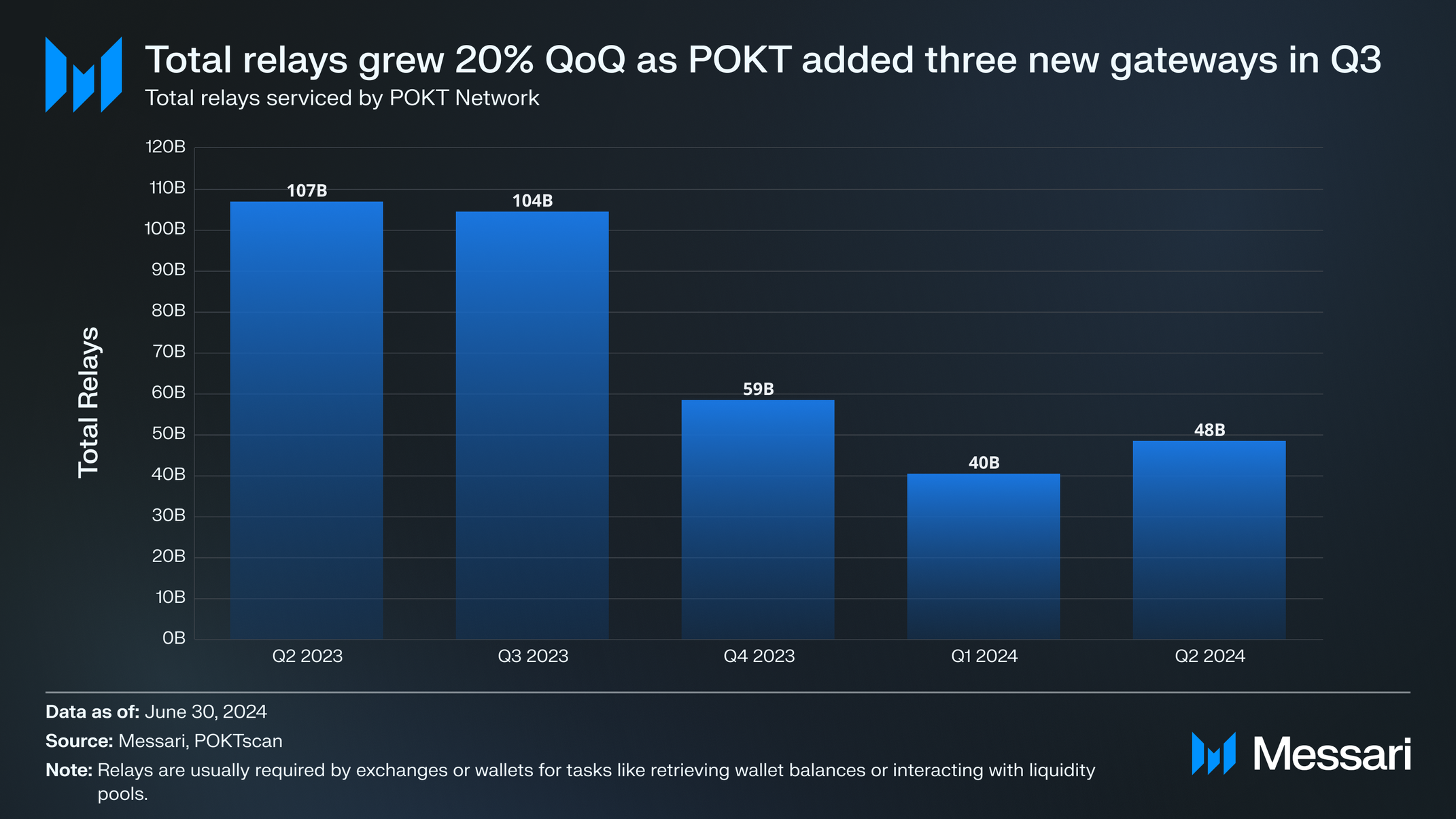
POKT Network’s relay demand and gateway revenue grew 20% and 10% QoQ, respectively, as three new gateways (Liquify, Chainstack, and Porters) started serving relays in Q2.
Supply-side rewards grew 52% to $6 million in Q2 2024 due to the 68% increase in net new POKT emitted to network participants.
Relay requests to Solana (6.0 billion) and Base (2.7 billion) saw the largest significant growth in Q2, increasing by 263% and 100% QoQ, respectively. The outsized growth in Solana and Base relays suggests that developers are increasingly interested in building applications on these chains.
POKT Network emphasized its focus on AI in Q2, funding an AI-focused R&D project (POKT AI Lab) and publishing an AI Litepaper outlining its strategy.
POKT Network made plans to expand POKT liquidity across various EVM chains with the launch xPOKT in the future.
Primer
POKT Network (POKT) is a Decentralized Physical Infrastructure Network (DePIN) focused on blockchain middleware and Remote Procedure Calls (or RPC). It coordinates and incentivizes a network of infrastructure providers (suppliers) around the world to provide the computing power needed to host and serve access to any open data source via RPCs. POKT Network is best known for a decentralized RPC service that enables users (applications and developers) to read and write to 60+ blockchains through a network of ~14,000 nodes distributed across 22 countries. However, POKT Network has a number of teams and RPC businesses within its ecosystem focused on expanding to serve adjacent use cases such as account abstraction, indexing, and oracles, as well as non-Web3 use cases such as inference requests for open-source LLMs.
Using a Stake-for-Access model, suppliers must stake the POKT token to serve RPC requests and builders must stake POKT to access the network. Gateways are businesses built on top of POKT Network that abstract away POKT staking and node communication for end users. Gateways provide end users with tailored pricing, customer support, and value-added features. POKT Network benefits from the synergies created by many different gateways with specialized BD teams. Also, gateways benefit from reselling the protocol’s core service while only paying the protocol the low-cost gateway fee of $0.85 per million relays, which is ultimately used to buy back and burn POKT.
POKT Network currently runs on its own Proof-of-Stake (PoS) blockchain built using a custom version of Tendermint Core. However, the network is transitioning to leveraging the Cosmos SDK, backed by CometBFT's PoS consensus. It will also use the Rollchains module to leverage Celestia's data availability layer, enabling interoperability with the Celestia ecosystem and other rollup networks. The module also introduces Inter-Blockchain Communication (IBC) interoperability. In addition to this transition, the Shannon Upgrade will enable any gateway to permissionlessly join the POKT Network. Permissionless gateways are turning the POKT Network into an RPC base layer that can host novel access points specializing in any use case, broadening the network’s user base.
POKT Network’s tokenomic model encompasses both supply-side incentives and demand-side revenue. Below are the key aspects of POKT’s value generation:
Supply-side rewards: generated from POKT issuance, where 70% is distributed to suppliers in proportion to the number of relays they service, 15% is distributed to sources, and 5% is distributed to block proposers (validators). The remaining 10% goes to POKT DAO and is not counted as revenue.
Gateway revenue: accounts for Gateway fees burned by POKT DAO and accrued fees from transactions. POKT Network has a gateway fee of $0.85 per million relays serviced, where gateway operators send gateway fees to POKT DAO to be burned.
Transaction fee revenue: accounts for 1% of the transaction fees rewarded to block proposers, while the remaining 99% goes to POKT DAO.
Supply-Side Rewards
The 2% QoQ increase in POKT supply led supply-side rewards to jump 52% in USD terms, despite the average POKT price falling 35% QoQ. This is because in Q1, 20 million POKT was emitted, and in Q2, 34 million POKT was emitted, up 68% QoQ. POKT aims to maintain a consistent profit margin in USD for node operators. In other words, a fall in the POKT price led to an increase in the POKT emitted to the network. Though incentives are still heavily favored over revenue, POKT Network’s gateway strategy aims to increase network demand and narrow the gap between revenue and incentives.
Gateway Revenue
Gateway revenue is a function of relays, at $0.85 per million relays serviced. Gateway revenue followed the 20% bump in relays, rising by 10% QoQ. Although three new gateways went live in Q2, POKT Network is unlikely to see a bump in revenue for another quarter or two, until they onboard users and start routing serious traffic through the network. With the pending Shannon Upgrade and POKT Network’s gateway strategy, the protocol aims to start increasing its revenue enough to flip inflationary rewards in the future.
Though the following analysis was given in the previous quarter, it is still relevant to consider when observing revenue: Currently, the rewards given to supply-side participants exceed the amount of POKT burned by gateway fees. These gateway fees are currently fixed in USD, so the total POKT burned is determined by the number of relays processed and the current market price of POKT. A relay refers to an instance where a gateway burns $0.00000085 in POKT. As the price of POKT increases, the quantity of POKT needed to pay for fees decreases, leading to less being burned.
When gateways pay their fees by purchasing the required amount of POKT, they add upward pressure on the asset's price, enhancing the deflationary effect of the burn. In addition to the deflationary effect, POKT aims to maintain a consistent profit margin in USD for node operators. In other words, increases in the price of POKT reduce the token’s inflation rate.
Market Cap
POKT’s market cap fell 68% QoQ. In Q1, it reached a high of $470 million before falling to $115 million to end Q2. Regardless, the POKT market cap is still up 135% YoY.
Network Usage
POKT Network is a decentralized solution that enables RPC businesses to outsource their RPC infrastructure to POKT Network, providing builders with access to blockchain data. These builders can range from exchanges to wallets to other applications that want to read from blockchains (e.g., retrieve wallet balances or smart contract event logs) or write to them (e.g., interact with DeFi liquidity pools).
POKT Network implemented an update (from PIP-33) that enables suppliers to adjust the calculation of custom multipliers of relay rewards. Gateways used to pay fixed fees regardless of the relay request. Some examples of these requests include standard eth_getBalance requests, more complex archival calls, requests from more computationally intensive chains such as Solana, or adjacent RPC request types such as data from DePIN networks or LLM inference requests. This protocol update lays the foundation for onboarding new data types with higher costs per request. The update incentivizes suppliers to serve expensive relay calls (e.g., relays from AI projects or LLM models). These more expensive costs per request are expected to be matched by higher gateway fees, which would increase protocol revenue.
Relays Served
Relays served are a proxy for measuring the demand for POKT Network services. Though this demand originates at gateways, it is processed by suppliers on POKT Network and directly relates to the revenue generated by the protocol.
Relays serviced by POKT Network increased by 20% QoQ. POKT Network is still recovering after all subsidized traffic was turned off in Q4 2023, reaching its lowest point in Q1. Three new gateways went live in Q2 and started routing demand through the protocol. A new gateway was launched in each new month of the quarter: Liquify in April, Chainstack in May, and Porters (Raid Guild) in June. Chainstack may be the most exciting new gateway for users, given its widely used API regularly sees over 5 billion daily requests. Just a fraction of Chainstack’s current usage routed through POKT Network could add significant demand-side activity and boost revenue.
Relay Chains
Relay requests are routed to any of the 70+ supported blockchains (relay chains). POKT Network can support the routing of relay requests from any relay chain that uses the remote procedure call (RPC) standard.
The 20% QoQ increase in relays largely came from Solana, Polygon, Ethereum, and Base. Having previously never accounted for a significant number of relays, Solana requests surged 263% QoQ to 6 billion relays, making it a top three relay chain. After two consecutive quarters of trailing Ethereum, Polygon relays narrowly surpassed those of Ethereum as both accounted for roughly 10 billion relays, growing by 39% and 16% QoQ, respectively. Base also saw impressive growth, reaching almost 3 billion relays, up 100% QoQ. The outsized growth in Solana and Base relays suggests that developers are increasingly interested in building applications on these chains.
Suppliers
Suppliers (staked node operators) on the POKT Network route relay requests between gateways and relay chains before the responses are ultimately forwarded to applications. They must stake at least 15,000 POKT ($500 as of August 15, 2024) to serve RPC requests. Nodes that unstake POKT are referred to as unstaking nodes and must wait 21 days before their POKT is unstaked. Staked suppliers that double-sign a block or fail to sign a certain amount of blocks within a set time period are jailed.
POKT Network ended Q1 with roughly 14,000 suppliers, down 7% QoQ. Unstaking nodes increased by 133% QoQ, though still accounting for less than 4% of total nodes. With supply-side rewards increasing by 52% QoQ and POKT’s strategic moves to grow profitability for higher-cost relay types, more suppliers may be incentivized to join the network, especially as POKT Network’s role in serving AI projects becomes more prevalent.
Gateways
A year ago, Grove was POKT Network’s sole gateway. Nodies launched in Q4 2023 and started to account for a chunk of POKT Network’s gateway traffic, ultimately hovering around 25%. In Q2, three new gateways started serving relays and generating revenue for the protocol. A new gateway was launched in each new month of the quarter: Liquify in April, Chainstack in May, and Porters (Raid Guild) in June. Despite the three new gateway launches, Grove and Nodies collectively accounted for 99% of relays in Q2 2024. POKT Network’s gateway growth throughout the past year demonstrates that its decentralization efforts continue to be fruitful with its expansion to five active gateways.
Staking Participation
POKT Network uses a Stake-for-Access model, also known as a utility token model, to capture value. POKT's total supply is 1.7 billion and is inflating at 4–5% annually, with reductions targeted.
Newly issued POKT is distributed to network participants as follows:
Suppliers: 70%
Sources:15%
POKT DAO: 10%
Validators (Block Proposers): 5%
POKT supply will continue to grow until revenue from relays outpaces POKT minting. In Q2, 34 million net new POKT entered circulation. The increase in supply combined with the 7% QoQ drop in staked POKT led to a 4% drop (46% to 42%) in the percentage of POKT staked compared to the circulating supply. The 57 million POKT unstaked throughout Q2 may have added sell pressure to the asset, contributing to its 69% QoQ price decline.
Developments
Shannon Updates
POKT Network planned to implement the V1 version of Shannon Upgrade in H2 2024. It has since iterated on the original design and now plans to launch with the Cosmos SDK, using CometBFT's PoS consensus. It will now deploy from the Rollchains module and settle blocks on data availability layers like Celestia. These changes will enable interoperability with the IBC and Celestia ecosystems, with plans to be executed in early 2025. The Shannon public testnet was launched in late May, showing the progress POKT Network is making in the protocol’s upgrade, despite recent delays.
AI Focus
POKT Network published an AI litepaper outlining its vision and strategy for extending its decentralized infrastructure to provide AI inference services and enable open-source AI models to be deployed and accessed without reliance on centralized entities. It aims to create a transparent, permissionless marketplace (through its Relay Mining algorithm) that aligns incentives for AI researchers (sources), hardware operators (suppliers), API service providers (gateways), and users (applications). Key points from the litepaper are highlighted below.
Decentralized AI Inference: Enable large-scale AI models to be deployed and accessed without relying on centralized entities.
Modular Architecture: Separate infrastructure from services, allowing each participant (model providers, hardware operators, gateways, and applications) to specialize in their strengths.
Cryptographically Verified Usage: Generate cryptographic proofs to verify the number of AI inference requests serviced. The feature would link costs and earnings to actual usage, incentivizing quality and honest service delivery across the network.
Permissionless Access: POKT Network’s permissionless nature will extend AI model access and contribution.
Open Data and Integrations: POKT Network is the largest decentralized RPC protocol for blockchain data, enabling the AI models hosted on the network to access large amounts of data and integrate with other crypto protocols.
Future Development: The litepaper outlines ongoing and future work in areas such as tokenomics, trusted execution environment (TEE) support, model verification, and adversarial mitigation.
Governance
Retroactive POKT Goods Funding (PEP-72)
PEP-72 was approved in April by the POKT DAO. This proposal requested 750,000 POKT, 70,000 ARB, and 60,000 OP (roughly totaling $475,000 at the time of the proposal) in funds already held by the POKT Network Foundation. The funds will be used for a retroactive grant program that will reward active community contributors to the POKT Network.
POKT Liquidity on CEXs (PEP-71)
PEP-71 was approved in April by POKT DAO. This proposal requested $25,000 in POKT to fund the Encode Club’s educational programs. The educational programs from Encode Club will promote POKT Network as its developers’ preferred RPC service and will include time for POKT Network representatives to interact with program participants.
Supplier Scalability (PUP-34)
PUP-34 was approved in June by POKT DAO. This proposal decreased the MaxChains parameter for suppliers from 15 to 1, making it easier for new nodes to join the network. This update will help the protocol better transition to the pending Shannon Upgrade and dramatically reduce the costs for running nodes. It should also attract hardware specialists from particular chains.
Multichain POKT (PEP-73)
PEP-73 was approved in early July by the POKT DAO. This proposal seeks to deploy a native (not wrapped) version of POKT across various EVM ecosystems. The asset will be called xPOKT. The proposal will also facilitate bridging through a custom UI. In June, Nethermind Security audited the xPOKT contracts, ensuring safety within the relevant contracts.
Change in Leadership/Economics (PIP-38)
PIP-38 was originally proposed in July and, after revisions, approved in August by the POKT DAO. This proposal reforms the POKT Network Foundation (PNF) and POKT DAO by changing the PNF’s leadership (re-appointing Michael O'Rourke, of Grove, as director). The move added an incentive-based pay structure that will focus on shipping deliverables and the performance of the POKT price. It also gave the PNF control of the DAO Treasury. The original proposal suggested removing the DAO and the PNF’s multi-director structure. The community pushed back to ensure the DAO retains oversight of director compensation, which led to the revised, and ultimately approved, version of the proposal. Three former directors of the PNF resigned following the publication of the original proposal and before the vote of the revised proposal.
Ecosystem Updates
POKTradar
In addition to full governance proposals, POKT Network also issues Quick Grants, which are small experimentation grants that can be decisively approved and issued by PNF to support builders. Launched in May, POKTradar is the network’s second POKT Network explorer and was funded by a Quick Grant of $3,000.
POKT AI Lab
POKT AI Lab is a Quick Grant recipient and dedicated AI-focused research and development initiative within the POKT Network community. It is focused on exploring and advancing the integration of AI and machine learning technologies into the network's decentralized infrastructure, with a focus on the Quality of Service (QoS) of ML models deployed on the POKT Network. After the final Morse upgrade, POKT Network incorporated incentives for node operators to service more expensive relay requests, which are often made from projects in AI or LLM models. As a result, POKT Network nodes could use their infrastructure to support AI models, and POKT Network further explored potential AI use cases, creating a need for a team like POKT AI Lab. POKT AI Lab published its first research report in April and its third at the beginning of July.
First Research Report
Proof of Concept Stage: Highlighted that the AI model integration is in the proof of concept stage, particularly with the local-net setup. This stage is focused on deploying and testing the integration of machine learning models like large language models (LLMs) and diffusion models for text-to-image generation on a local network environment within the POKT Network.
Technical Capabilities: Identified the limitations and capabilities of the POKT Network regarding AI model deployment. POKT’s current infrastructure can handle inference for arbitrary models using HTTP requests, but it has limitations. These include a lack of support for large payloads (e.g., video processing) and a lack of onchain validation of model outputs, which will be addressed in future upgrades.
Challenges and Future Directions: Outlines challenges such as the "black box" problem, where enforcing specific model families or variations on the network is impractical. Instead, it suggests focusing on ensuring models meet certain performance metrics and comply with standardized APIs (like OpenAI's API) to facilitate integration into the network.
Third Report
Machine Learning Test-Bench: The MLTB was developed by POKT AI Lab to replicate the Huggingface Open Language Model Leaderboard (HFOLML), allowing the POKT Network to benchmark AI models. The report detailed the workflows and interactions between different MLTB modules, including checking signatures, sampling tokenizers, and evaluating various metrics.
Experiments and Results: The MLTB was tested with three different models, comparing them against known benchmarks. The results showed a high correlation with the HFOLML, demonstrating the MLTB's effectiveness in evaluating machine learning models with fewer samples and lower costs.
Conclusions: The MLTB successfully recreated the HFOLML and demonstrated its scalability and modularity. It can process tests from many nodes concurrently, making it suitable for the POKT Network.
Future Work: The report suggests expanding the MLTB to include more leaderboards, developing custom tests, and exploring onchain implementation to further decentralize machine learning evaluations.
POKT AI Lab progressed throughout Q2 as it went from establishing a proof of concept for deploying machine learning models on the POKT Network (from its first report) to integrating and benchmarking these models using the Machine Learning Test-Bench (from its third report). This move from initial testing and infrastructure setup to achieving milestones in model evaluation and performance presentation greatly informs POKT Network as it continues to grow its focus on serving AI use cases.
Closing Summary
POKT Network went through many changes in Q2 updating its governance structure, adding new gateways, and enhancing its focus on AI. The three new gateways that started routing relays through POKT Network include Liquify, Chainstack, and Porters. On the protocol side, POKT Network emphasized its focus on AI, funding an AI-focused R&D project (POKT AI Lab) and publishing an AI Litepaper outlining its strategy. It also made plans to expand POKT liquidity across various EVM chains with the future launch of a new token called xPOKT. Administratively, POKT DAO voted for POKT Network co-founder Michael O’Rourke to lead the PNF.
Amid the updates and changes, POKT Network experienced a 20% jump in relays serviced, a 10% increase in revenue, and a 52% increase in supply-side rewards (USD), though the POKT price fell 69% QoQ. Relay requests to Solana (6.0 billion) and Base (2.7 billion) saw the largest significant growth in Q2, increasing by 263% and 100% QoQ, respectively. POKT Network is well-positioned for growth as it continues to onboard new gateways and expand its focus on AI.
This report was commissioned by the POKT Network Foundation. All content was produced independently by the author(s) and does not necessarily reflect the opinions of Messari, Inc. or the organization that requested the report. The commissioning organization may have input on the content of the report, but Messari maintains editorial control over the final report to retain data accuracy and objectivity. Author(s) may hold cryptocurrencies named in this report. This report is meant for informational purposes only. It is not meant to serve as investment advice. You should conduct your own research and consult an independent financial, tax, or legal advisor before making any investment decisions. Past performance of any asset is not indicative of future results. Please see our Terms of Service for more information.
No part of this report may be (a) copied, photocopied, duplicated in any form by any means or (b) redistributed without the prior written consent of Messari®.