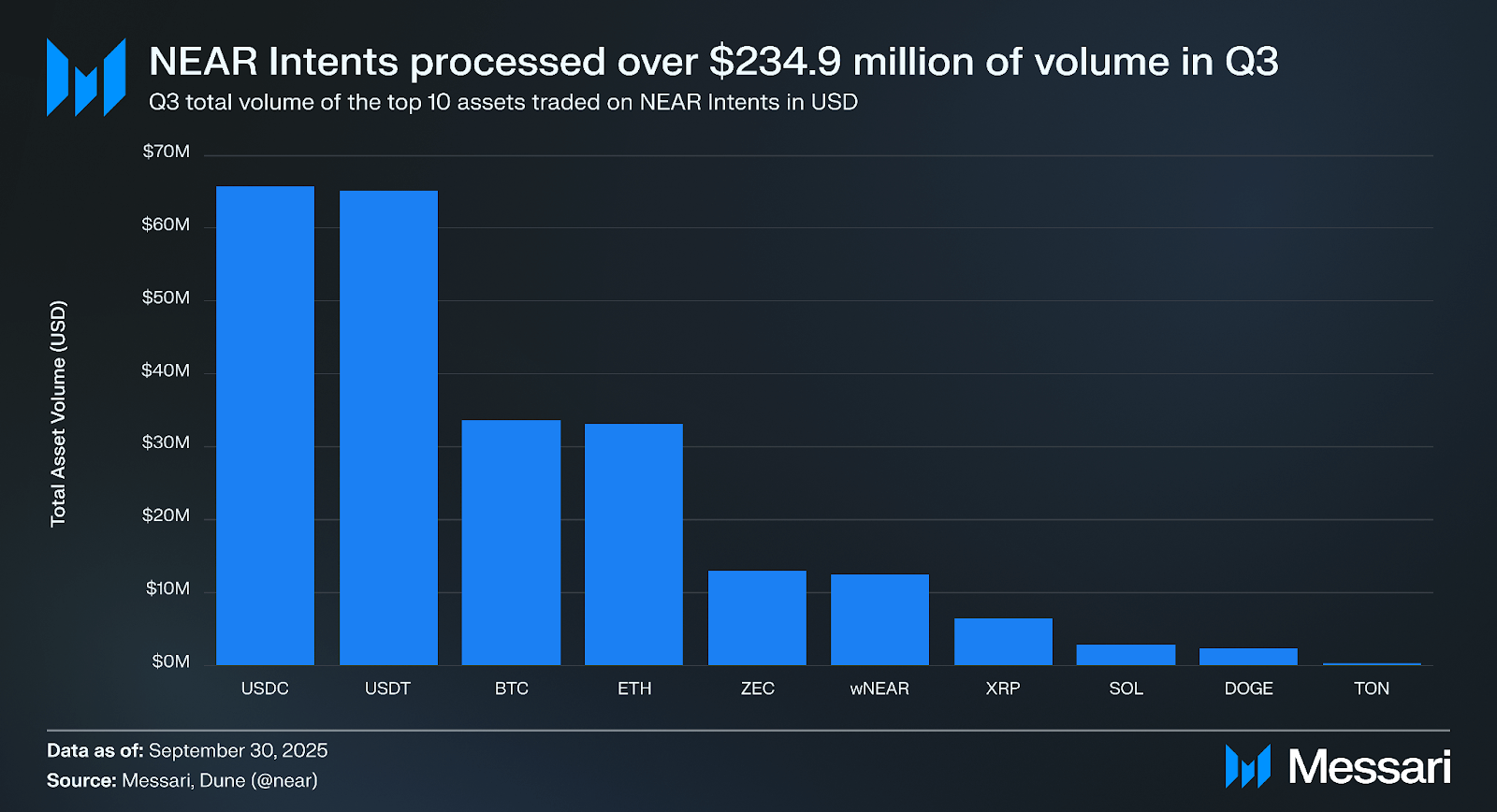
NEAR Intents evolved into a core multichain coordination layer, enabling seamless cross-chain transactions and autonomous agent interactions through a decentralized solver network and verifier smart contracts. In Q3, over 2.3 million swaps totaling $234.9 million in volume went through NEAR Intent’s infrastructure.
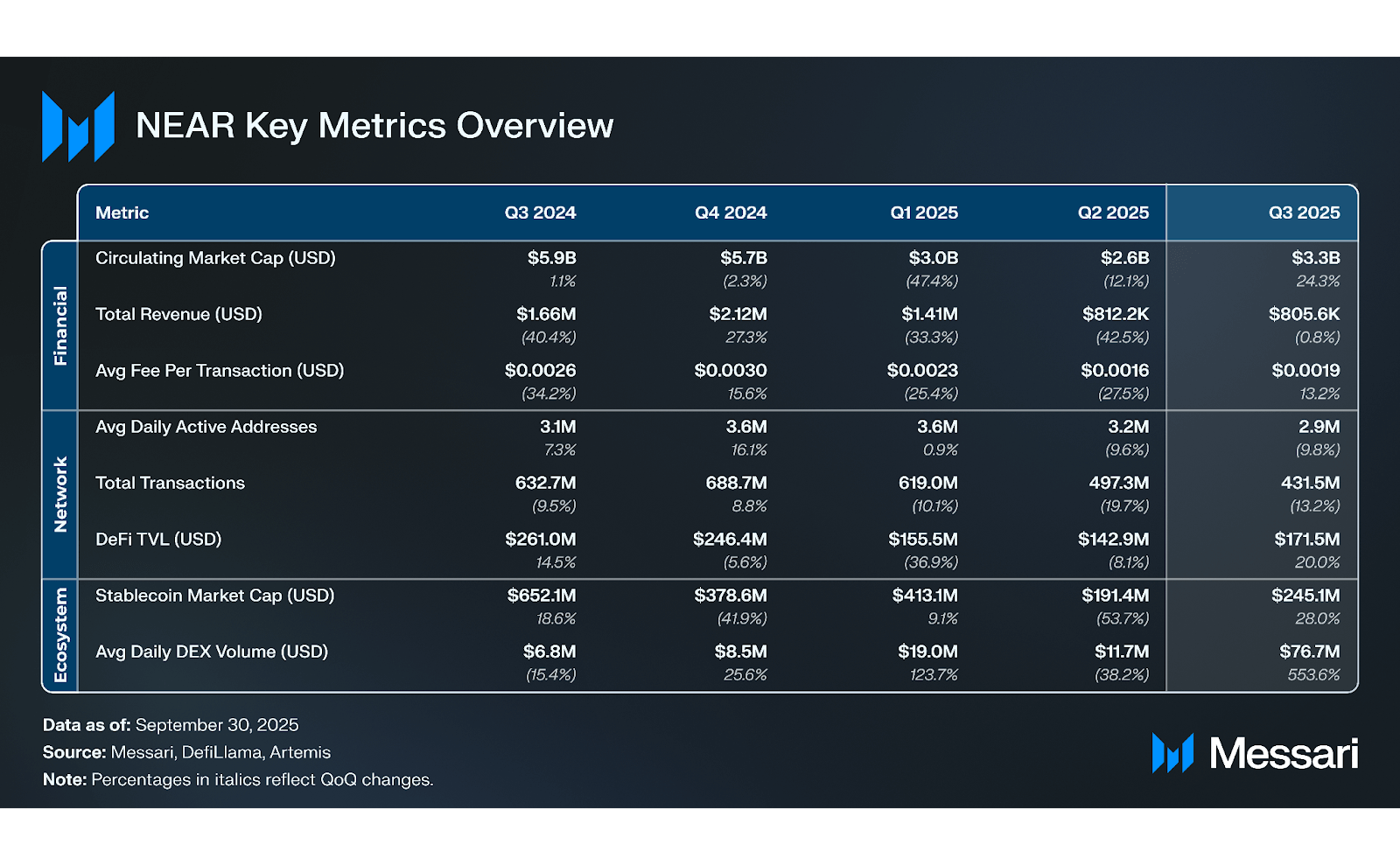
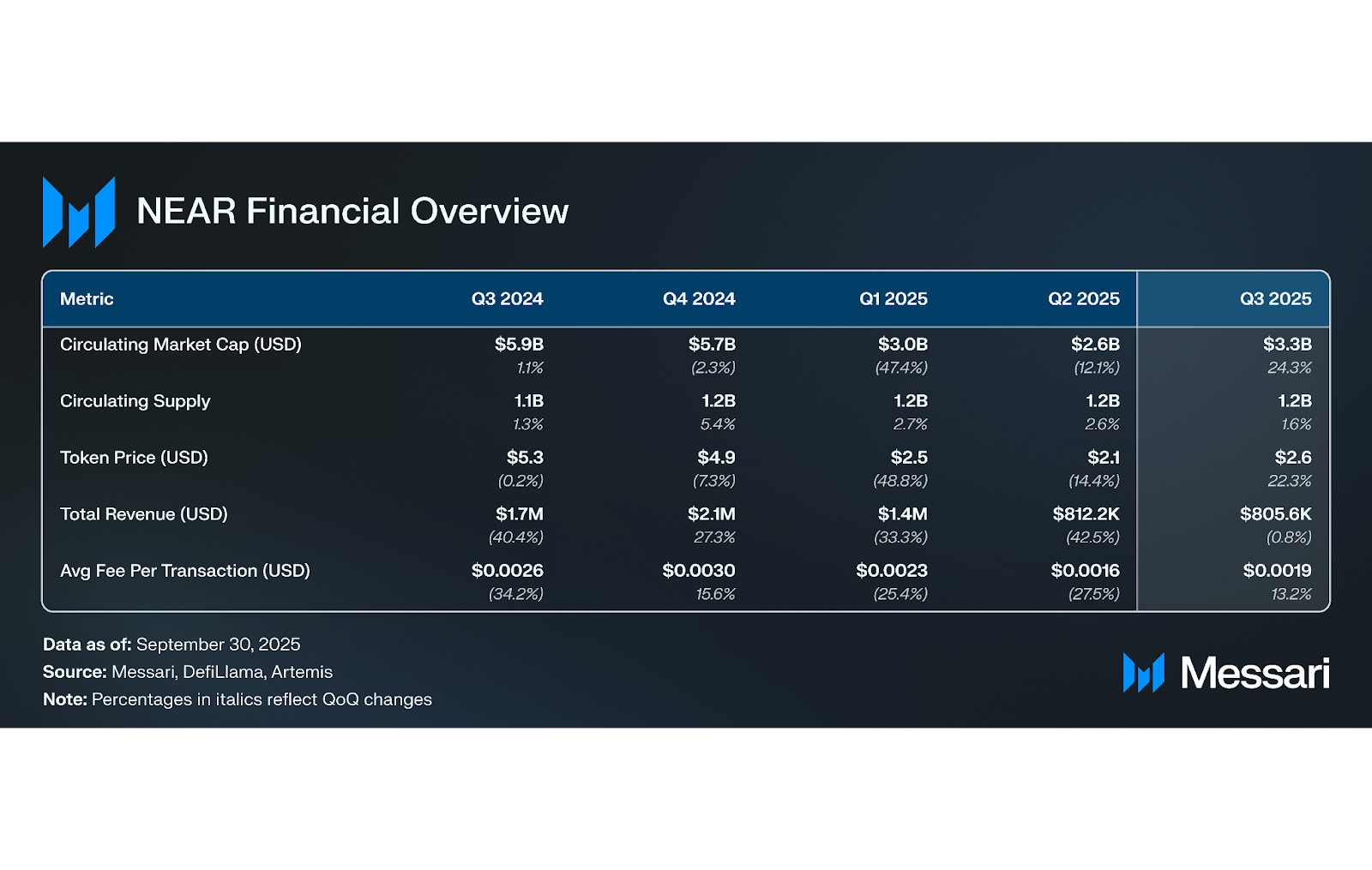
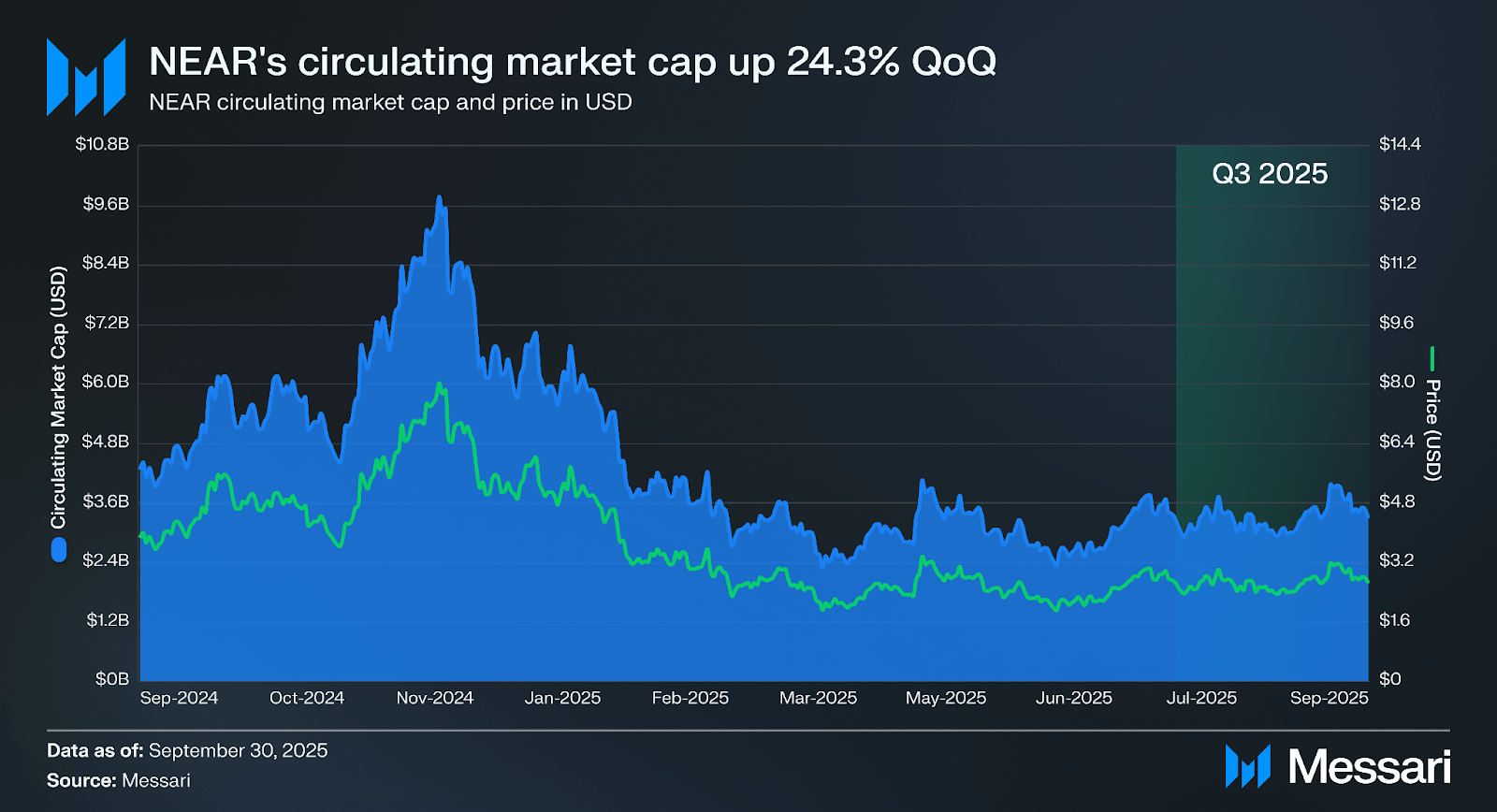
NEAR maintained its market cap ranking of 17th overall, performing similarly to leading assets. NEAR’s market cap ended Q3 at $3.3 billion, a 24.3% QoQ increase, with the token price of $2.6, up 22.3% QoQ.
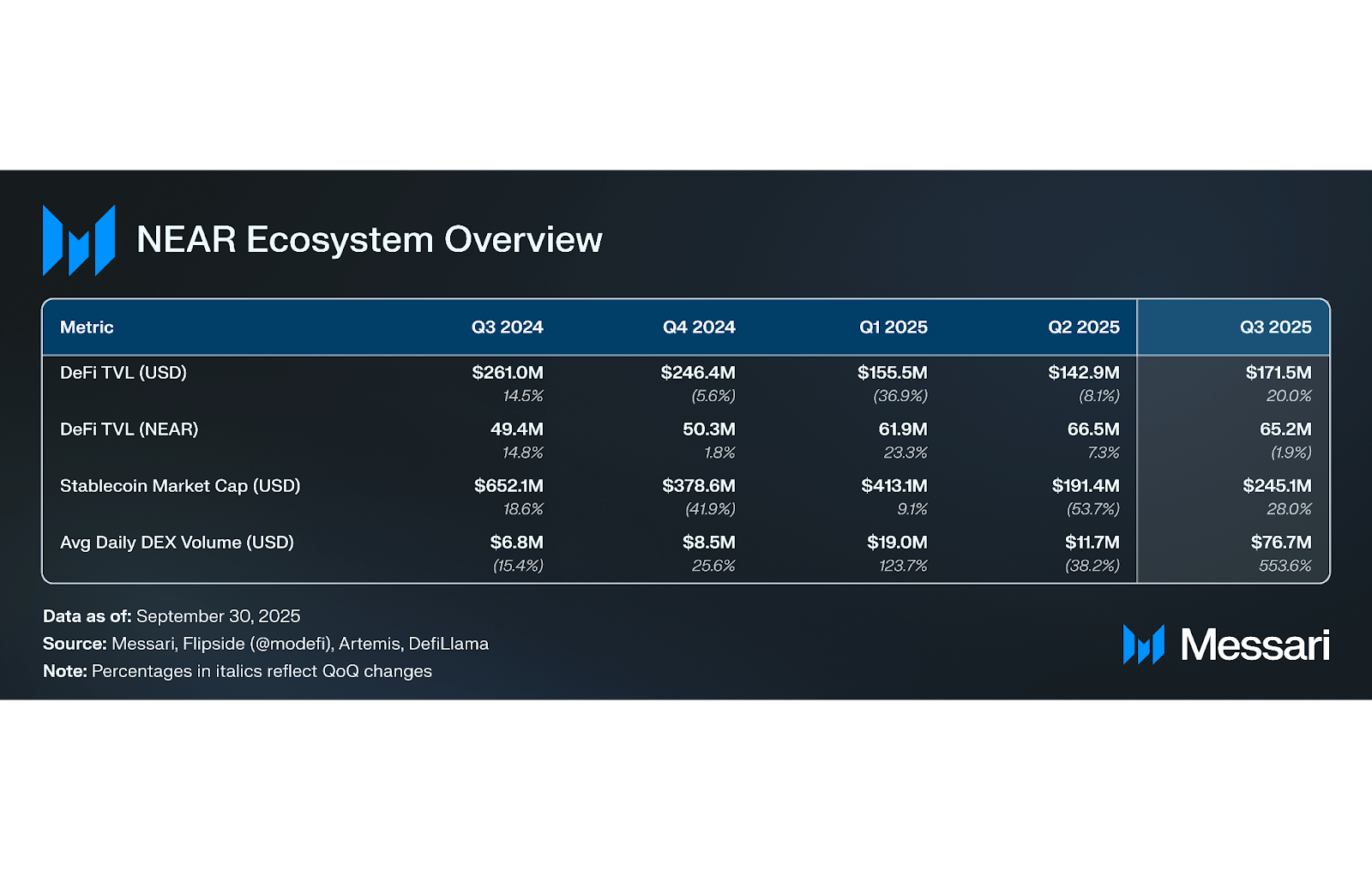
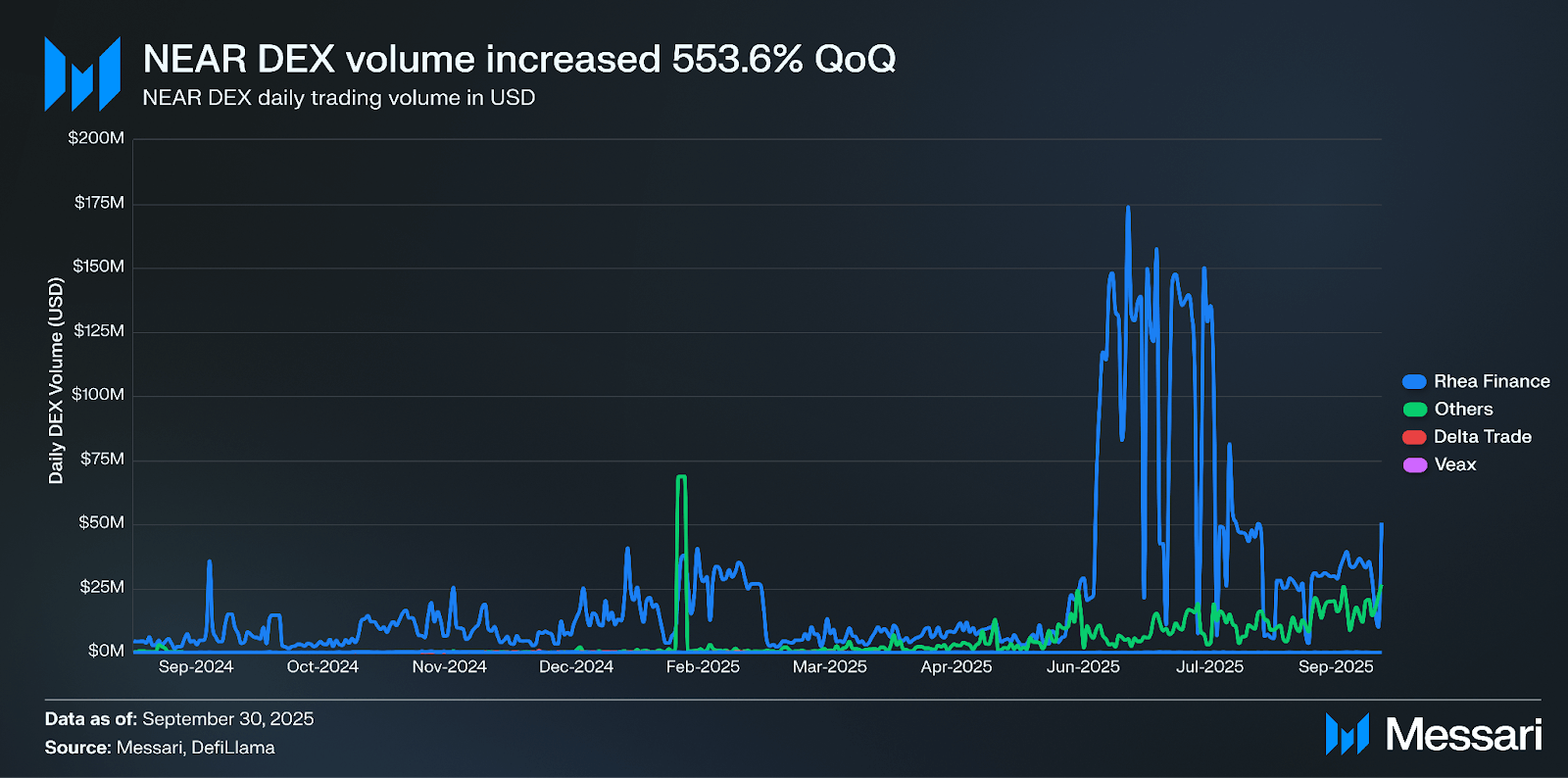
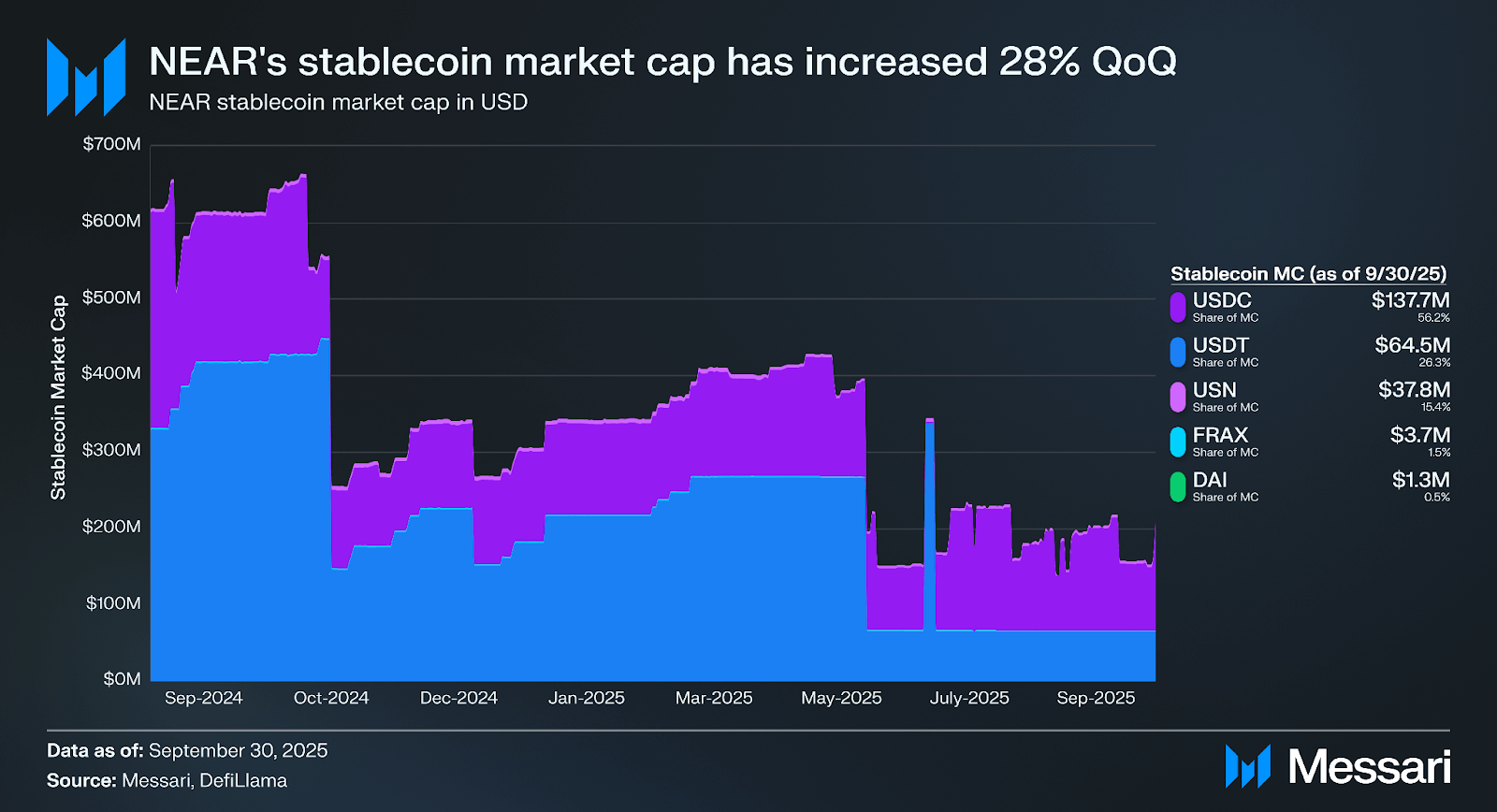
Despite a moderate decline in network activity, NEAR’s ecosystem strengthened with DEX volume surging 533.6% QoQ to an average of $76.7 million per day and its stablecoin market cap growing 28.0% QoQ to $245.1 million.
NEAR has upgraded from eight to nine shards, increasing overall network throughput by 12.5%. The latest protocol updates, Nearcore v2.7.0 and v2.8.0, expanded the total number of chunk validators from 300 to 500 and introduced key optimizations like P2P state sync, increased mandate limits, and enhanced data recovery tools.
In Q3, collaborations with Privy, Everclear, Shelby, Aurora, IQ AI, and PublicAI advance NEAR’s vision of a chain-abstracted, AI-powered network. Enabling unified wallet flows, cross-chain liquidity clearing, decentralized storage, autonomous agent frameworks, tokenized AI economies, and community-owned data models.
Primer
NEAR Protocol (NEAR) is a smart contract platform that utilizes a Thresholded Proof-of-Stake (PoS) consensus algorithm to execute transactions and aims to provide foundational infrastructure for decentralized applications, AI-powered systems, and cross-chain interoperability. NEAR incorporates the Nightshade 2.0 sharding mechanism, which facilitates increased transaction throughput and scalability by taking a novel approach to basic network functionality and is EVM-compatible via Aurora.
The NEAR ecosystem is expanding chain abstraction across many blockchains and ecosystems, with the goal of abstracting the blockchain away from the end user and developer experience. The vision for chain abstraction is to enable applications to function seamlessly across all blockchains, with effortless onboarding and features like gas fees and bridging becoming invisible to the end users. To achieve this, NEAR is developing the following core building blocks:
NEAR Intents: A transaction framework that enables AI agents and users to autonomously execute transactions and requests across Web3, allowing for frictionless, cross-chain interactions without manual oversight. Built on Chain Signatures, NEAR Intents ensure secure, automated execution at scale.
Account Aggregation: A key component of chain abstraction that enables users to manage identities, assets, and transactions across multiple blockchains through a unified experience, eliminating fragmentation and reducing complexity.
Sharded Blockchain: NEAR, powered by Nightshade 2.0, is designed to support billions of AI-driven interactions with high-speed, low-cost transactions. As of Q3 2025, NEAR operates on nine shards, introducing single-block resharding and eliminating hour-long state rebuilds.
The NEAR Foundation is focusing its efforts and resources on making NEAR the home for User-Owned AI, built on a foundation of a sharded blockchain, chain abstraction, and NEAR Intents. All key innovations that enable AI to operate autonomously, transact seamlessly, and scale securely, helping establish NEAR as the Blockchain for AI. The foundation is investing significant capital and resources in creating the best ecosystem for the development of AI agents, including core AI infrastructure investments and additional R&D efforts through NEAR.AI. Over 50 teams are actively building AI-driven applications, research projects, and tooling on NEAR, laying the groundwork for being a leader in the decentralized AI space.
NEAR ended the quarter with a circulating market cap of $3.3 billion, a 24.3% QoQ increase, while the token price also increased to $2.6, a 22.3% QoQ increase. NEAR maintained its market cap ranking of 17th overall, indicating it performed similarly to other leading assets by quarter’s end.
Revenue
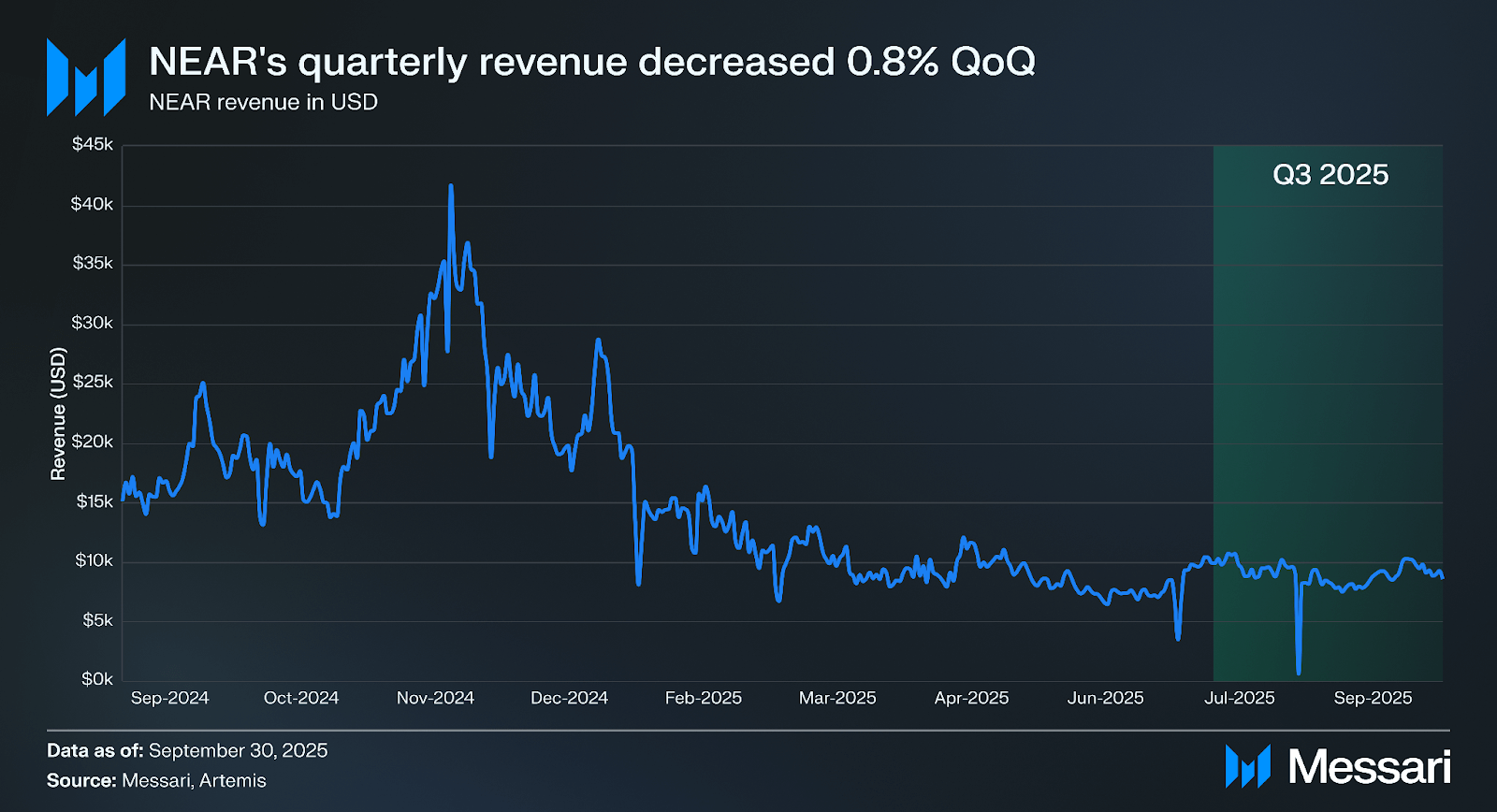
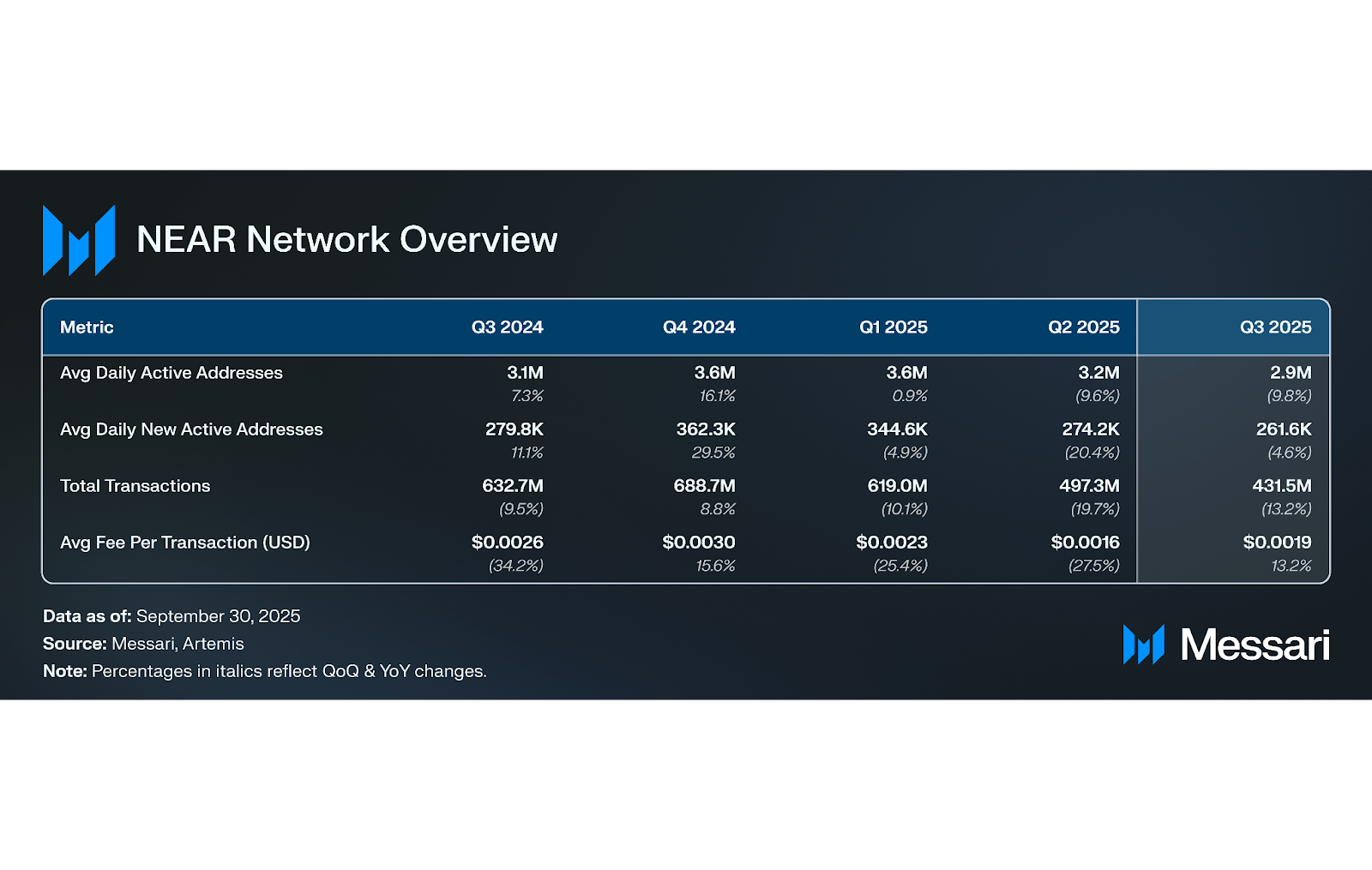
In Q3 2025, NEAR's revenue, which measures network transaction fees but excludes storage staking, decreased to $805,614, marking a 0.8% QoQ drop. This decrease can be attributed to the decline in overall transactions and average transaction fees. The average transaction fee in Q3 was $0.0019, a 13.2% QoQ increase coming off back-to-back quarters of over 25% decreases.
NEAR employs a fee-burning mechanism for transaction fees, where 70% of all fees are burned while the remaining 30% is directed to the contract from which the transaction originated.
Supply
NEAR's native token (NEAR) is used for staking, transaction fees, and storage fees. NEAR employs a combination of inflationary and deflationary measures with no fixed token supply. The network follows a fixed annual inflation rate of 5%, with 90% of the inflationary rewards directed toward validators and 10% to the protocol treasury.
Network Analysis
Usage
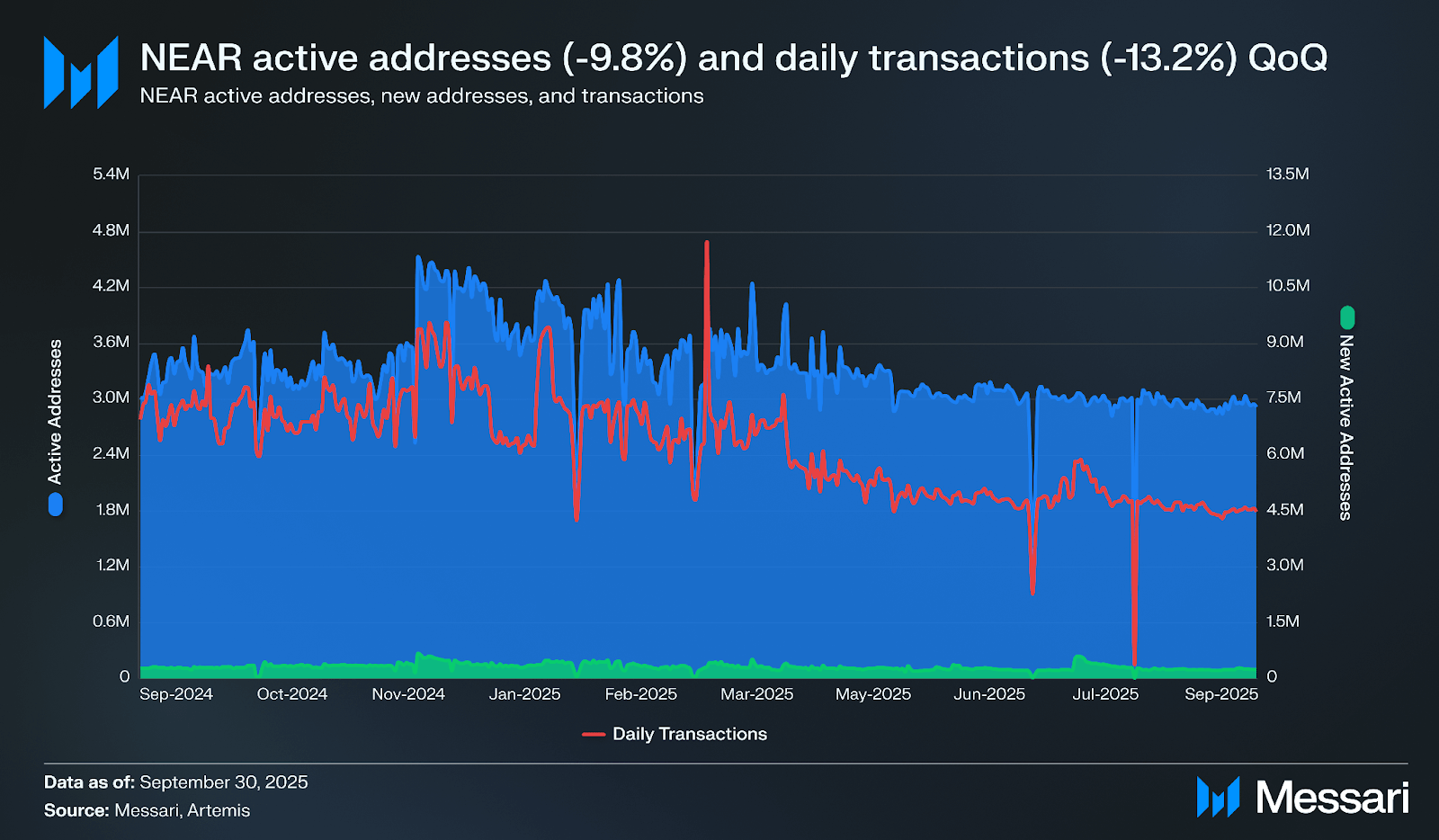
NEAR experienced a decrease in both activity and transaction volume in Q3 2025. The average daily active returning addresses decreased 9.8% QoQ to 2.9 million; the average daily new addresses decreased 4.6% QoQ to 261,613; and the average daily transactions decreased 14.2% QoQ to 4.7 million.
Development
NEAR emphasizes supporting developers, with 30% of transaction fees distributed to the creators of the smart contract called by a given transaction. In addition to this fee structure, NEAR offers an extensive suite of tools tailored for developers working within its ecosystem. These include SDKs for popular coding languages, sandbox environments, a NEAR CLI, and NEAR Developer Governance. The NEAR Dev Hub is a resource repository for developers, facilitating collaboration and innovation within the ecosystem. Early successes include sponsored hackathons, the formation of community groups, and collaboration on NEAR Enhancement Proposals.
NEAR.ai is the launchpad for developers building in the crypto x AI space to gain exposure to the infrastructure and tools NEAR has developed. With two projects, AI Research Hub and AI Assistant, NEAR is showing the developer community why it is the blockchain for AI. Over 940 NEAR agents have been deployed and can be viewed on the developer hub.
Additional development activities in Q3 2025 included:
HOT and LiNEAR Protocol initiated a sensing vote proposing to reduce NEAR’s inflation rate from 5% to 2.5%. Although this was not an official governance vote, it revealed strong community support; over 90% of participating validators voted in favor, while others abstained due to regulatory constraints (e.g., exchanges, custodians, and VCs). Following this signal, NEAR One launched a formal protocol upgrade that allowed validators to opt into the new tokenomics or remain on the existing version. After clear communication and FAQs were distributed to all validators, the upgrade passed within seven days, officially reducing NEAR’s emission rate to 2.5%.
Nearcore v2.7.0, released ahead of the Protocol Version 79 upgrade on Aug. 18, 2025, introduces several network and performance enhancements. The update adds one more shard to production networks, increasing the total from 8 to 9, and implements NEP-536 to reduce refund receipts while setting the gas refund penalty to 0. It also introduces P2P synchronization for state sync headers, raises the missing chunk rejection threshold to 100 during periods of high congestion, and enables saturating float-to-int conversions in runtime.
Nearcore v2.8.0, released on Sept. 15, 2025, introduces protocol version 80, expands the total number of chunk validators from 300 to 500, and increases mandates per shard from 65 to 105. The update also resolves an issue in state snapshot migration involving absolute hot database paths, adds a new “neard” subcommand tool for recovering data lost during resharding, and includes commands and instructions for using the archival data recovery tool.
Security
NEAR employs a Thresholded Proof-of-Stake (TPoS) consensus mechanism with three distinct validator roles: Block Producers, who are responsible for validating transactions across all shards; Chunk-Only Producers, who focus on individual shards with reduced hardware requirements; and Hidden Validators, who act as independent third-party monitors.
The implementation of Nightshade sharding began with Phase-1 in September 2022, enhancing the network's capacity to support Chunk-Only Producers. By Q1 2024, NEAR launched Phase-2 of Nightshade sharding with six shards operational on mainnet, progressing towards the plan to expand to 100 shards. Q1 2024 also saw the launch of the Enterprise Node Operators program by Meta Pool in partnership with the NEAR Foundation, which started onboarding leading institutions into the ecosystem, including Deutsche Telekom and NTT DATA. Stateless Validation, also known as Nightshade 2.0, launched on mainnet on Aug. 22, 2024. This upgrade improved throughput for each shard by 5x and increased the total number of shards available for the network. NEAR has since upgraded from eight to nine shards.
By the end of Q3 2025, NEAR had 333 active validators and 46% of the eligible supply staked.
Governance
Building off the House of Stake governance proposal from Q2 2024, the Gauntlet partnership continues to advance NEAR’s governance structure. House of Stake is a permissionless, stake-weighted voting system designed to support ecosystem growth, responsibly deploy the HoS treasury, enhance network economics and security, and improve quality of life for validators.
On Dec. 5, 2024, Gauntlet announced the NEAR Call for Delegates proposal, inviting individuals to apply to become Endorsed Delegates in the House of Stake. The application window closed on Feb. 16, 2025, and the NEAR Foundation later announced its selection of the first 11 Endorsed Delegates during an X Space. NEAR also partnered with Agora to build the House of Stake frontend, which officially went live on mainnet on Aug. 7, 2025. The launch introduced onchain governance functionality, allowing users to lock NEAR (or derivative tokens) to receive veNEAR and participate in governance decisions.
The next phase of House of Stake focuses on expanding protocol economics, governance, and treasury management, followed by the introduction of autonomous AI agent delegates that will support human governors by managing routine decisions and enabling swarm governance.
Ecosystem Analysis
DeFi
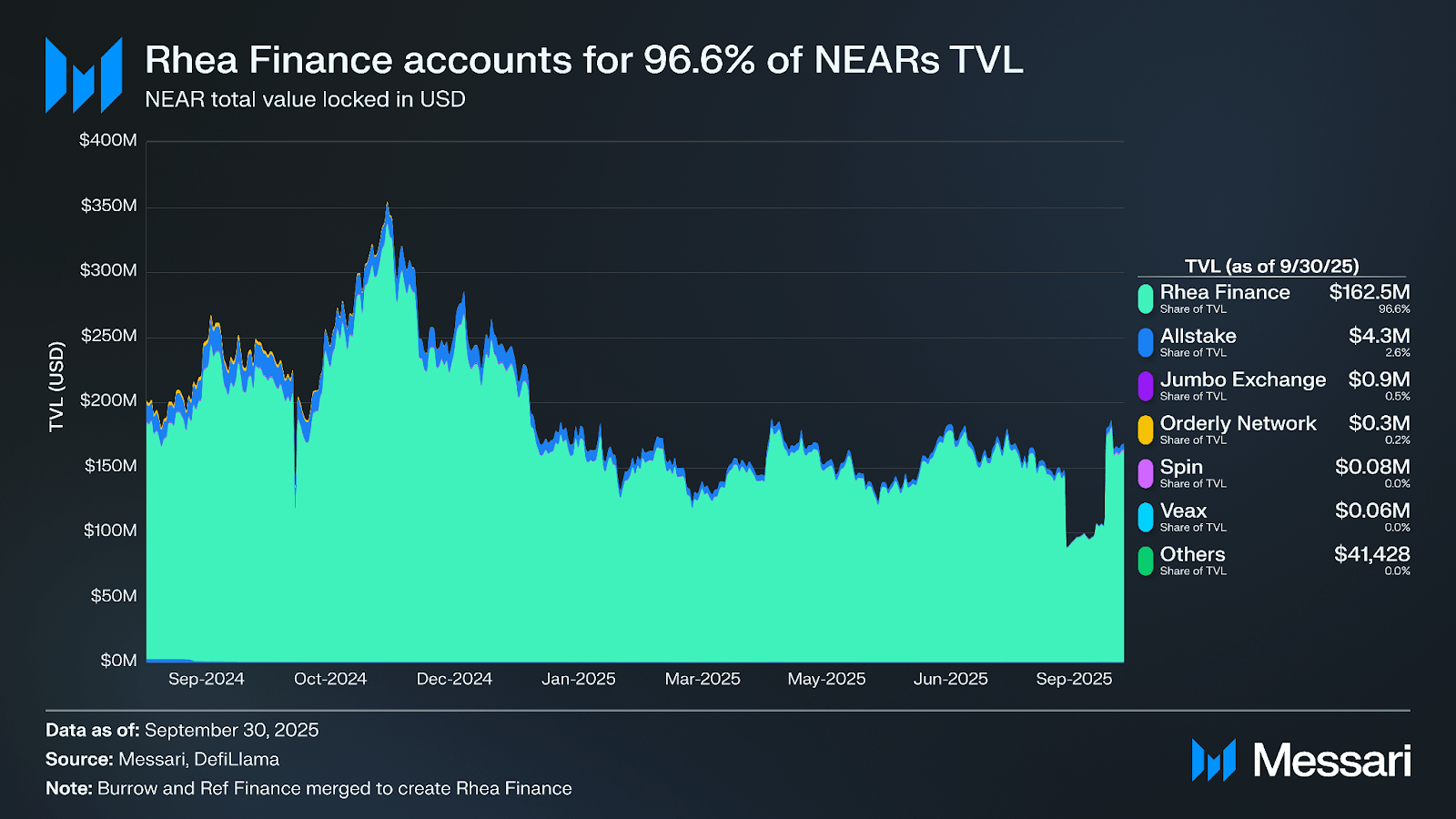
In Q3 2025, the landscape of players who contributed to NEAR’s TVL remained similar. Rhea Finance accounts for 96.6% of NEAR’s TVL, at $162.5 million, up 17% QoQ. Allstake, which launched on June 20, 2024, finished Q3 with $4.3 million in TVL, an increase of 21.8% QoQ. Jumbo Exchange saw the largest QoQ increase of 439.4%.
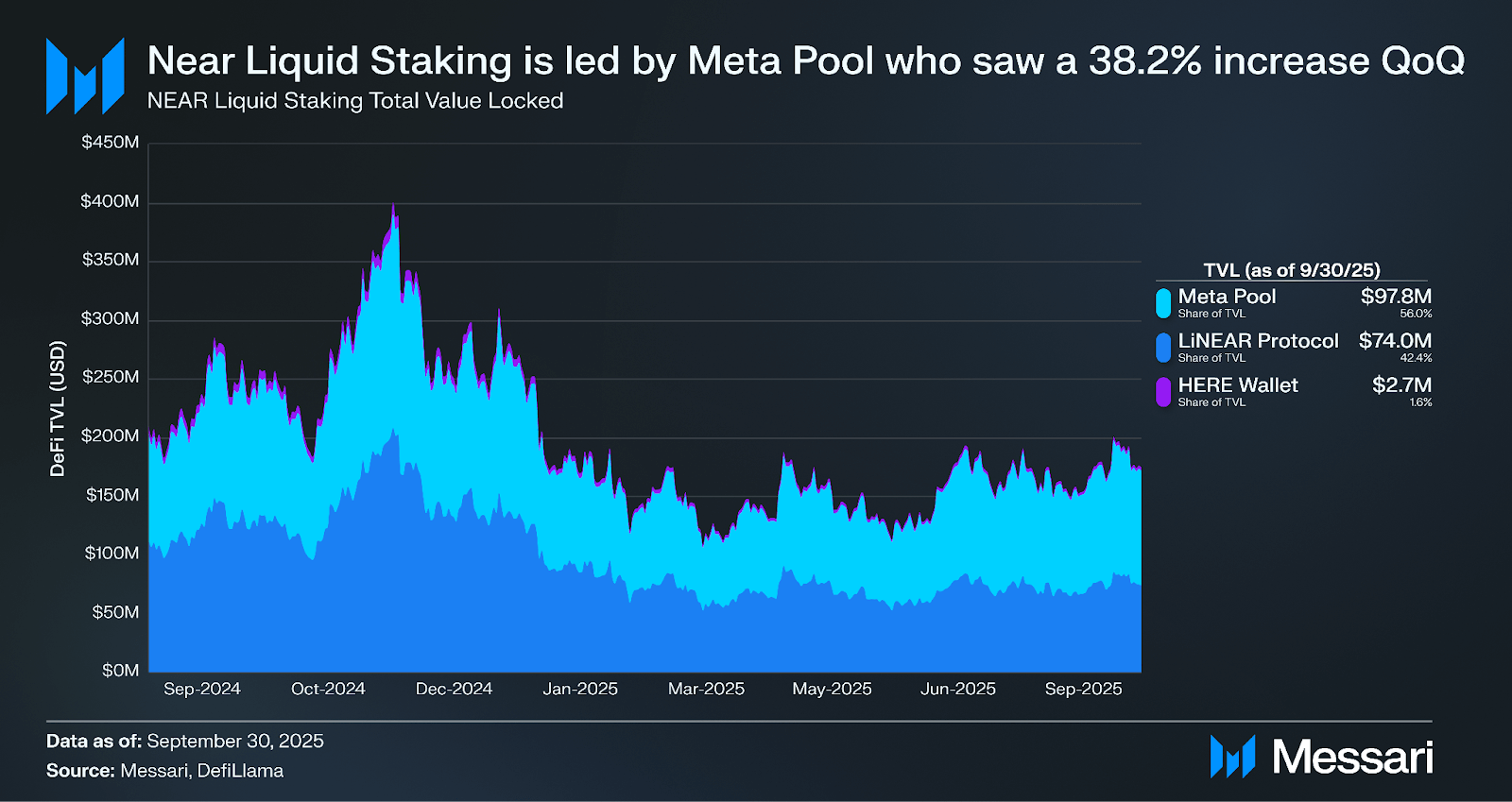
In Q3, NEAR’s Liquid Staking TVL increased 28.5% QoQ to $174.5 million. Meta Pool had $97.8 million, showing a 38.2% QoQ increase, while LiNEAR Protocol had a TVL of $74 million, reflecting an 18.3% QoQ increase.
Throughout the quarter, NEAR’s average daily DEX volume was $76.7 million, reflecting a 533.6% increase from the previous quarter. Rhea Finance remains the leading DEX by volume on NEAR, with an average daily volume of $65.2 million.
In Q3, NEAR’s stablecoin market cap increased 28% QOQ, reaching $245.1 million from $191.4 million.
User-Owned AI
NEAR’s User-Owned AI initiative is a leader in integrating artificial intelligence with blockchain technology. This effort focuses on democratizing AI development, ensuring user control over data and assets, and fostering a decentralized framework for AI applications. Central to this effort is the concept of chain abstraction, which makes NEAR Intents possible, allowing AI to autonomously execute cross-chain transactions and requests across both Web2 and Web3, breaking down silos and enabling seamless operations for AI agents and related business models. Meanwhile, the sharded NEAR blockchain provides scalable, low-cost blockchain infrastructure that is built to handle large magnitudes of AI transactions.
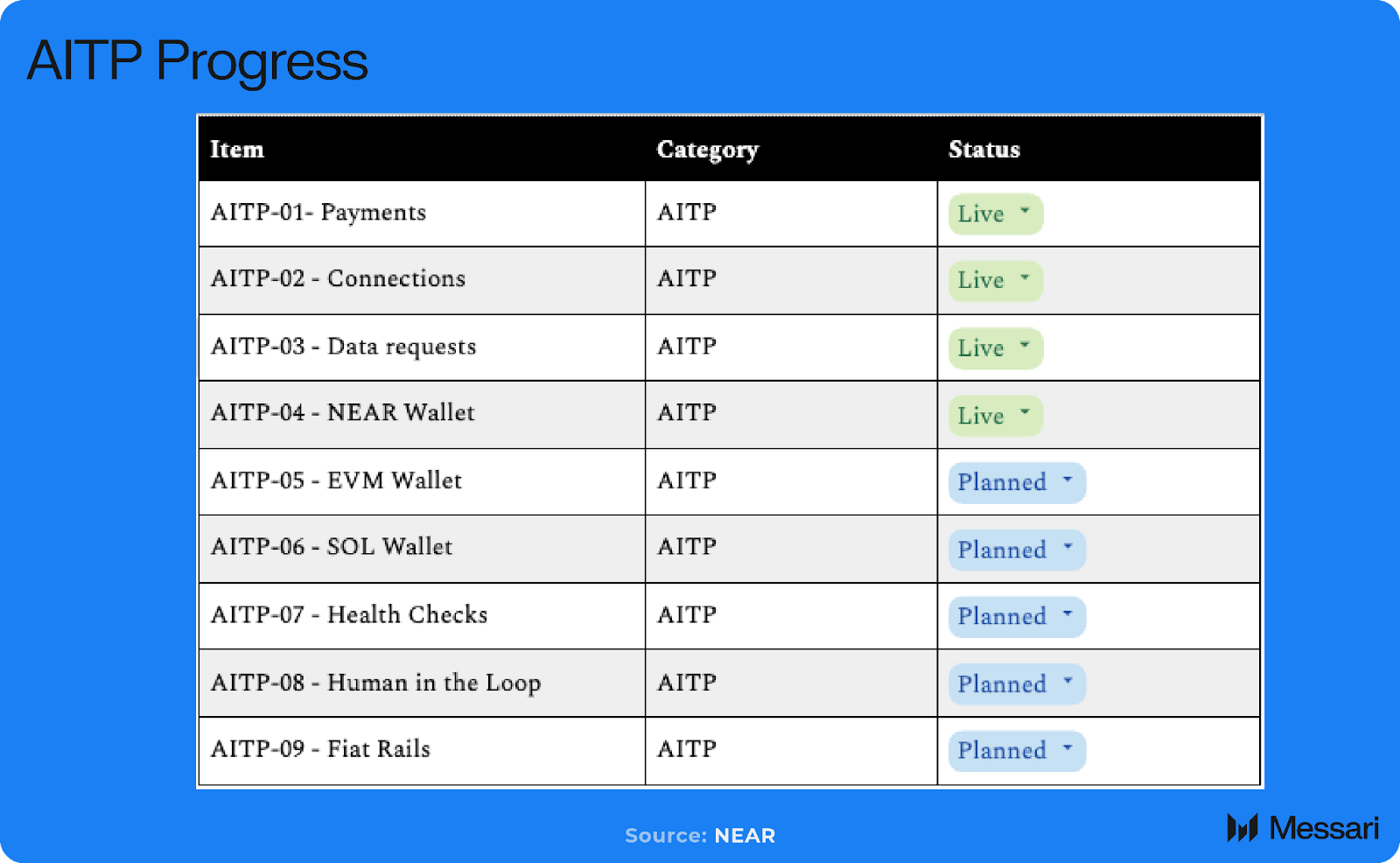
The NEAR AI team published a paper on Decentralized Confidential Machine Learning (DCML), detailing a business model for user-owned AI on NEAR. Since the publication of this paper in early 2025, it has been seen as a framework by the community and spawned many products. These include the NEAR Agent Hu and Forest AI. Another framework NEAR is pioneering is the Agent Interaction and Transaction Protocol (AITP). AITP is meant to enable AI agents to communicate securely across trust boundaries while providing extensible mechanisms for structured interactions. AITP, while still in development, has a few modules live and more planned to go live.
Proof of Response
Proof of Response (PoR) is a cryptographic protocol developed by NEAR AI that allows anyone to verify that a specific AI model generated a particular output in response to a given input, without needing to rerun the model. This is achieved through a combination of verifiable inference techniques and cryptographic commitments. Unlike traditional approaches that rely on trusting centralized model providers, PoR introduces a way to confirm AI responses in a decentralized, trust-minimized manner. This is especially important for onchain AI agents that require transparency and verifiability when executing tasks or making decisions.
From a technical standpoint, PoR can be integrated with zero-knowledge proofs (ZKPs) or multi-party computation (MPC) frameworks to ensure that both the model’s integrity and the computation process remain tamper-proof. This enables onchain agents to sign and verify responses with cryptographic assurance, making it possible to build applications that use AI outputs in smart contracts, governance decisions, or financial logic. By enabling verifiable AI execution onchain, PoR supports the broader vision of decentralized AI infrastructure, where models become accountable actors in the blockchain ecosystem. For a more in-depth look at PoR and Decentralized Confidential Machine Learning, reference this research paper by the NEAR AI team.
Other notable AI events in Q3 2025 included:
NEAR announced a partnership with Shelby, a decentralized hot storage network co-developed by Aptos Labs and Jump Crypto, to integrate into NEAR’s AI infrastructure. NEAR will benchmark Shelby’s performance in live agent memory workloads to assess its capacity for real-time data access. The collaboration also includes early-stage exploration of using NEAR Intents.
Aurora has introducedShade Agents to its Aurora Virtual Chains (VCs) on the NEAR network, creating a framework for autonomous, verifiable AI agents integrated with blockchain systems. Shade Agents run inside Trusted Execution Environments (TEEs) and are directly linked to NEAR smart contracts, ensuring non-custodial control, multichain functionality, and privacy through remote attestation and onchain code hash verification. Aurora Virtual Chains provide dedicated execution environments for these agents, enabling developers to deploy customizable, AI-driven chains via the Aurora Marketplace.
The NEAR Foundation announced a strategic partnership with IQ AI to accelerate the development of tokenized AI agents capable of autonomously operating across multiple blockchains. IQ AI’s Agent Tokenization Platform (ATP) allows developers to create agents that can manage assets, execute financial strategies, and interact within decentralized economies, each backed by a tradable token. Through this partnership, NEAR Intents is integrated into IQ AI’s Agent Development Kit (ADK), enabling tokenized agents to access NEAR’s infrastructure for cross-chain trading, staking, and asset movement. Future collaboration will also integrate NEAR Shade Agents, extending functionality for advanced smart contract execution and aligning with NEAR’s broader chain abstraction roadmap. As part of the ecosystem alignment, the NEAR Foundation acquired IQ and FRAX tokens to support liquidity on NEAR Intents, while IQ’s governing DAO, BrainDAO, reciprocally acquired NEAR tokens for staking and protocol integration.
The NEAR Foundation helps powerPublicAI, a community-driven platform, aiming to democratize artificial intelligence through contributor-owned data and token-backed rewards. PublicAI leverages NEAR’s stablecoins and blockchain infrastructure to enable fast, reliable payments and real-time monetization of high-quality data contributions. All issued tokens are directly tied to actual revenue, encouraging long-term participation by allowing users to stake tokens in datasets and benefit as those data sets grow in value.
NEAR Intents
NEAR Intents is a live, multichain transaction protocol that enables users and AI agents to define desired outcomes, such as swapping assets or transferring value across networks, without needing to manage the underlying execution steps. It leverages a decentralized network of solvers and a Verifier smart contract on NEAR to securely coordinate, execute, and settle these cross-network intents. Solvers compete to fulfill user intents with the most efficient execution path, sourcing liquidity from both onchain DEXs and offchain venues to optimize price and performance. NEAR Intents currently supports over 125 assets and includes simulation tools to preview intent outcomes before execution, improving safety and transparency. The protocol supports multiple signing standards (including NEP-413 and Ed25519) and integrates with NEAR’s account abstraction model to enable flexible wallet interactions. Building on this foundation, NEAR has introduced several complementary user experience upgrades, including passkeys for passwordless authentication, OTC trading functionality for peer-to-peer fixed-price settlements facilitated through NEAR Intents, shareable crypto gift links, and a 1-Click API for intents that allows single-transaction cross-chain swaps by simply sending tokens to a provided deposit address. Together, these innovations make NEAR Intents a core component of NEAR’s broader vision for seamless, trustless, and user-centric Web3 interoperability.
In Q3 2025, over 2.3 million swaps were conducted through NEAR Intents, for an overall volume of $234.9 million.
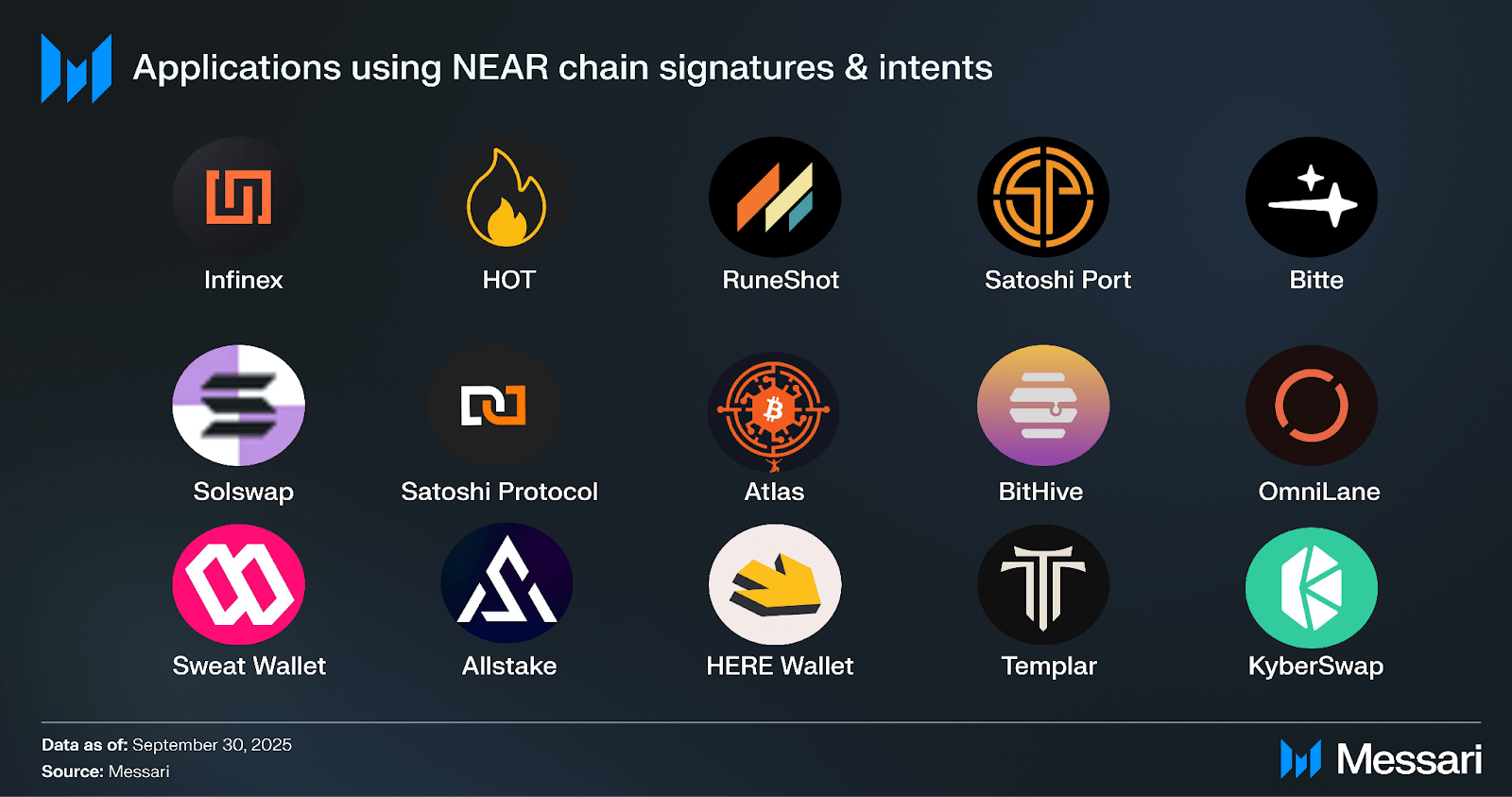
NEAR Intents take shape through multiple front ends like Infinex, KyberSwap, Near-Intents, Rhea Finance, Meteor Wallet, Templar Protocol, and others. Another application of NEAR Intents is Calyx, an intents-based launchpad that supports both fixed-price and auction-style token sales. The launchpad is available to any wallet or asset listed on NEAR Intents, enabling participation in upcoming launches of NEP‑141 tokens between July 2025 and January 2026. Featured projects include AI infrastructure, RWA protocols, social sentiment platforms, and multi-token DEXs, all using the Intents Launchpad mechanism.
The NEAR Foundation also announced a strategic partnership with Everclear Foundation on July 23, 2025, to integrate Everclear’s cross-chain clearing and settlement capabilities with the NEAR Intents infrastructure. Under the agreement, NEAR’s Chain Abstraction and intent-framework technology will power Everclear’s automated liquidity rebalancing and netting across multiple chains, enabling transactions up to $5 million with near-zero fees and no reliance on centralized exchanges. The investment is aimed at scaling Everclear’s clearing layer to support billions in monthly volume while jointly tackling liquidity fragmentation in the rapidly growing stablecoin and multichain ecosystem.
NEAR has also partnered with Privy to enable unified wallet flows. With Privy leveraging NEAR Intents, users of the Privy wallet infrastructure can more easily perform “one-click” actions (deposit here, swap across chains, withdraw there) without needing to manage intermediate steps.
Chain Signatures
Building off the successful launch of Chain Signatures, which allows NEAR accounts, including smart contracts, to sign transactions across multiple blockchains and removes the need for traditional bridges, NEAR has taken the first steps toward realizing a fully chain-abstracted future. The system combines NEAR’s scalable, sharded infrastructure with access to external assets and liquidity, operating through derivation paths, a multichain smart contract framework, and a decentralized multi-party computation (MPC) network that securely coordinates transaction signing without centralized custody. Upcoming upgrades will integrate trusted execution environments (TEEs) for node validation and expand the MPC network to roughly twenty independent operators, further enhancing the security and decentralization of cross-chain activity.
Several applications already utilize Chain Signatures and Intents on NEAR's mainnet, including the Sweat Wallet, which allows over 2.5 million active users to bridge assets to/from various blockchains. Allstake, an omnichain restaking protocol, utilizes Chain Signatures for cross-chain state synchronization, enabling users to restake assets across NEAR, Solana, Ethereum, and Bitcoin. HERE Wallet and Bitte Wallet are also leveraging Chain Signatures to offer multichain experiences, with Bitte Wallet enabling passkey wallets for any network, including Bitcoin. Hot Protocol has had 21+ million wallets created, powered by chain signatures and NEAR Intents to provide users a seamless experience swapping across chains. Both Chain Signatures and NEAR Intents have open SDKs that developers can use to integrate into their own applications.
In Q1 2025, the NEAR One team launched OmniBridge, utilizing Chain Signatures, to enhance NEAR's cross-chain interoperability and facilitate transactions and liquidity across multiple blockchain networks. OmniBridge expands NEAR’s interoperability beyond the Ethereum-focused Rainbow Bridge, with the aim of establishing NEAR as a unified liquidity hub while improving capital efficiency and reducing fragmentation. OmniBridge, an open-source architecture, empowers developers to build interoperable DeFi, AI, and consumer applications across major blockchain ecosystems.
Nightshade 2.0
Nightshade 2.0 represents a significant advancement in NEAR’s sharding architecture and introduces stateless validation. A concept popularized by Vitalik Buterin, stateless validation allows validators to confirm transactions without storing the entire blockchain state locally and retrieve the necessary state information directly from the network, reducing resource requirements and operational costs, in addition to eliminating the need to maintain local shard states. In Q3, NEAR upgraded from eight to nine shards, resulting in a 12.5% improvement in throughput.
Nightshade 2.0 bolsters NEAR’s capacity to handle a growing number of users and transactions by an estimated 400.00% increase in transaction execution speed. The reduced operational costs lower barriers to entry for validators while enhancing decentralization and security. Improved performance through faster transaction execution is crucial for supporting high-demand applications in DeFi and emerging use cases like User-Owned AI. Nightshade 2.0 lays the foundation for integrating future technologies, including dynamic re-sharding, further gas cost reductions, and optimized state witness sizes.
Dynamic resharding to increase efficiency when a shard is overloaded or underutilized.
Runtime performance improvements (still in the idea stage).
Faster block times.
Addition of leaderless consensus.
Addition of sharded smart contracts to help with scalability.
Closing Summary
In Q3 2025, NEAR continued to advance its ecosystem through technical innovation, governance expansion, and AI-driven integrations, despite modest declines in network activity and transaction volume. The network maintained financial stability, with steady revenue and a 24% increase in market capitalization, while implementing major protocol upgrades, Nearcore v2.7.0 and v2.8.0, that expanded validator capacity and improved scalability. Key ecosystem milestones included the launch of the House of Stake governance platform, the evolution of NEAR Intents into a live multichain coordination layer, and partnerships with Everclear, Privy, IQ AI, and PublicAI that deepened NEAR’s role at the intersection of blockchain and artificial intelligence. Developments in Nightshade 2.0 and Chain Signatures further strengthened NEAR’s chain abstraction vision, setting the stage for seamless cross-chain interoperability. As NEAR moves into the future, its focus on verifiable AI agents, user-centric interoperability, and decentralized governance continues to position the network as a foundational layer for a scalable, AI-powered Web3 future.
This report was commissioned by the NEAR Foundation. All content was produced independently by the author(s) and does not necessarily reflect the opinions of Messari, Inc. or the organization that requested the report. The commissioning organization may have input on the content of the report, but Messari maintains editorial control over the final report to retain data accuracy and objectivity. Author(s) may hold cryptocurrencies named in this report. This report is meant for informational purposes only. It is not meant to serve as investment advice. You should conduct your own research and consult an independent financial, tax, or legal advisor before making any investment decisions. Past performance of any asset is not indicative of future results. Please see our Terms of Service for more information.
No part of this report may be (a) copied, photocopied, duplicated in any form by any means or (b) redistributed without the prior written consent of Messari®.
Jeremy is a research analyst at Messari with interests in Infra, DeFi, and Enterprise adoption. Prior to joining Messari, Jeremy worked as an analyst at Fidelity Digital Assets.
Jeremy is a research analyst at Messari with interests in Infra, DeFi, and Enterprise adoption. Prior to joining Messari, Jeremy worked as an analyst at Fidelity Digital Assets.