Chromia’s mainnet crossed 120 million cumulative transactions on Sept. 15, 2025, up 37.9% from over 87 million at its one-year anniversary on July 16.
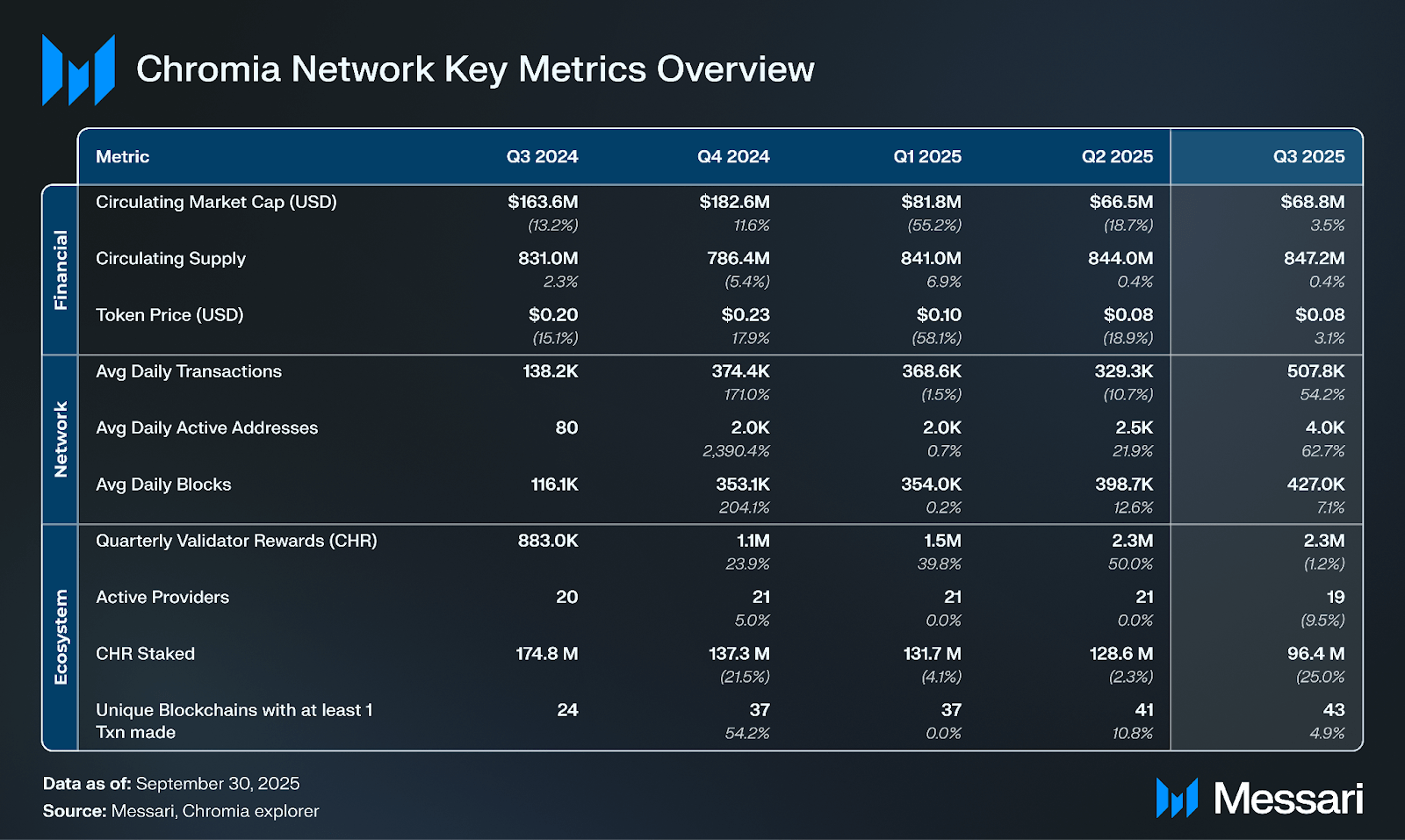
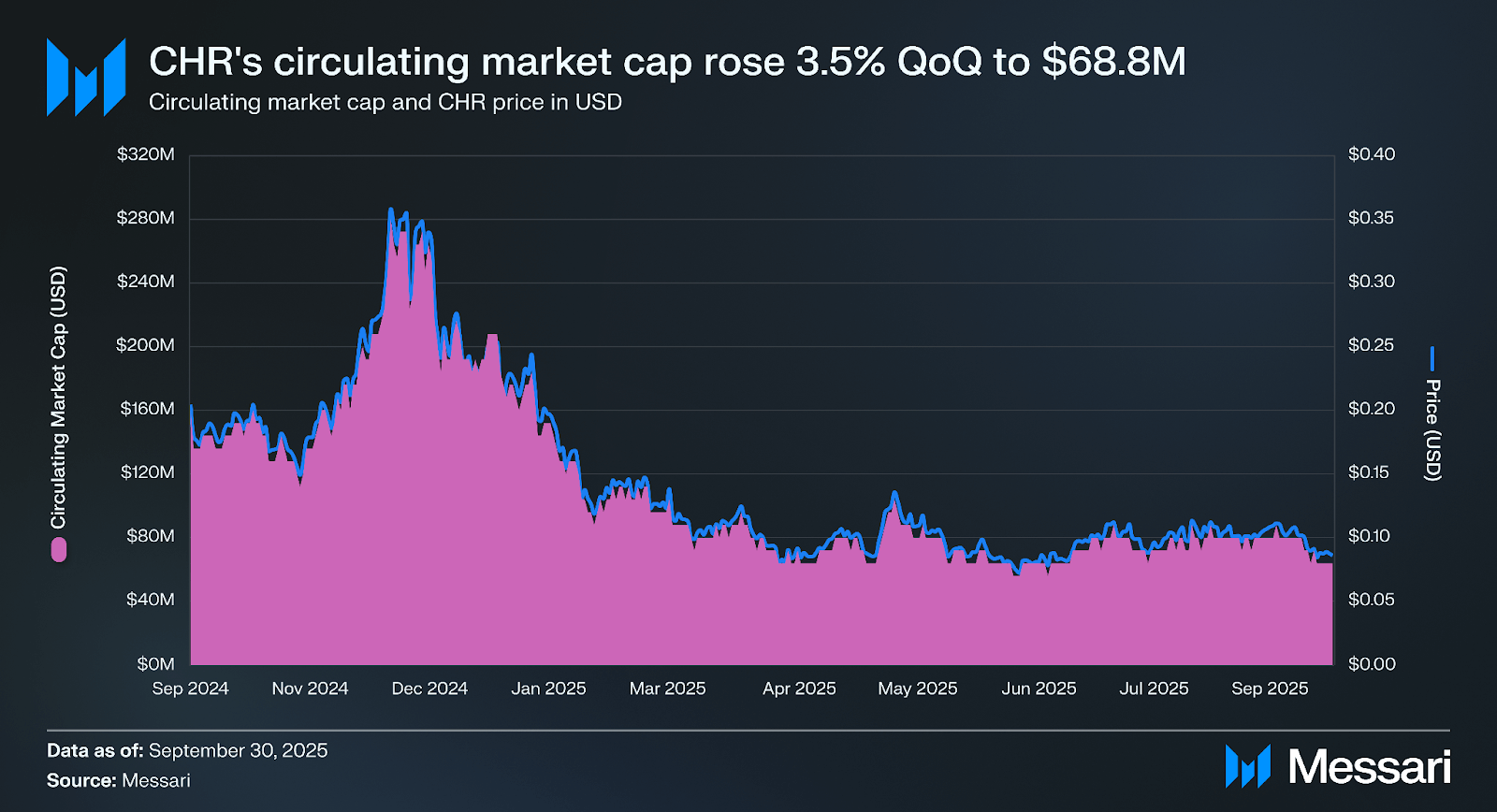
CHR ended Q3’25 with a circulating market cap of $68.8 million, up 3.5% QoQ from $66.5 million. Circulating supply increased 0.4% from 844.0 million to 847.2 million.
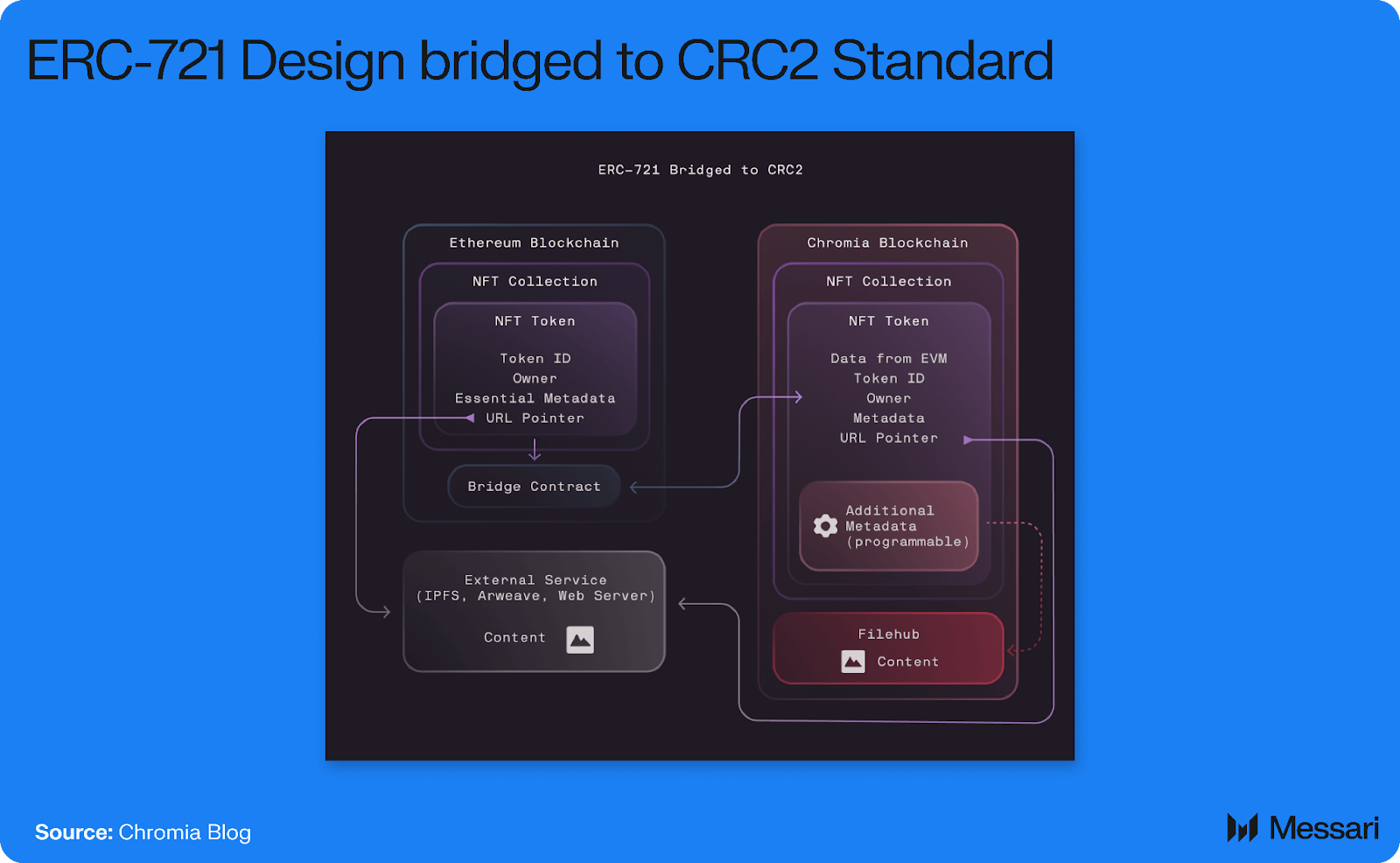
On Aug. 19, 2025, the CRC2 NFT standard was publicly released alongside an EVM-compatible CRC2 bridge, bringing programmable, metadata-rich, onchain NFTs with ERC-721 and ERC-1155 interoperability, and direct Chromia storage via Filehub.
Physical AI, Chromia’s term for robotic AI agents that interact with the physical world while anchoring data onchain, transitioned from concept to pilot through ChromBot, a desktop robot connected to the Chromia infrastructure. The Q3 pilot phase concluded, and research and development shifted toward a more capable second-generation device.
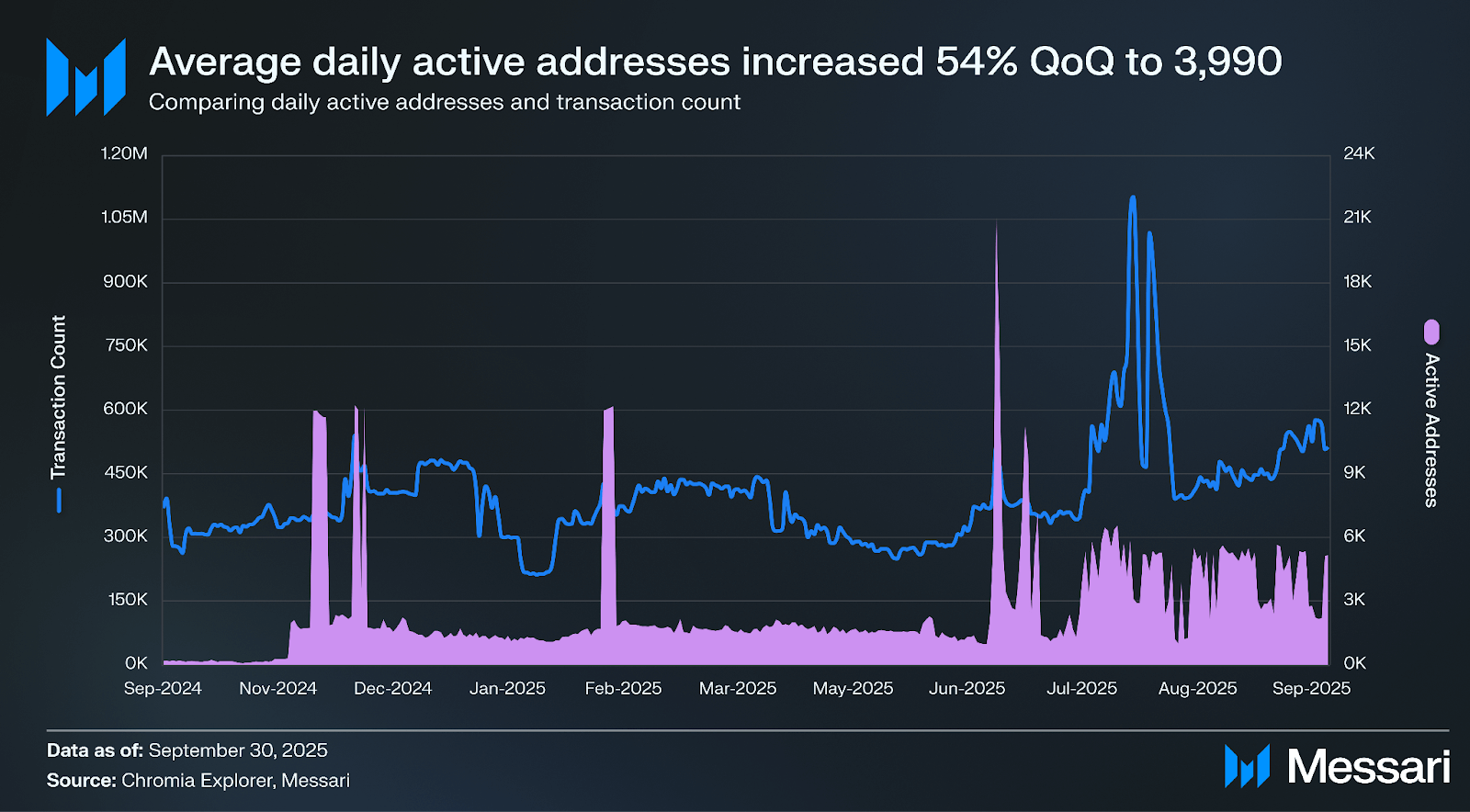
Average daily transactions on Chromia rose 54.2% QoQ from 329,300 to 507,800, while average daily active addresses (DAAs) climbed 62.7% QoQ from 2,450 to 3,990.
Primer
Chromia (CHR) is a Layer-1 network designed for data-intensive decentralized applications. Its architecture is built around a cluster-based design, where different groups of nodes called clusters are responsible for running specific parts of the network. Instead of relying on a single global chain, Chromia delegates execution and state management to independent clusters, each with a consensus group, storage backend, and execution environment. This modular approach isolates workloads, enables application-specific fine-tuning, and allows the network to scale horizontally without causing network congestion as more applications come online.
Clusters are divided into two main types: System Clusters and Application Clusters. System Clusters run the protocol's core infrastructure. Application Clusters are dedicated to running application-specific blockchains. Each application operates in a Standard Container Unit (SCU), a self-contained environment with its own PostgreSQL database server (software that stores application data and allows users to run queries against it) and an execution engine for smart contracts. For a full primer on Chromia, refer to our Comprehensive Overview.
CHR ended Q3 2025 with a circulating market cap of $68.8 million, a 3.5% QoQ increase from $66.5 million in Q2 2025. Over the same period, the average token price was broadly stable, rising 3.1% QoQ from $0.079 to $0.081 as the market consolidated after the sharp drawdown in H1 2025. Circulating supply increased 0.4% from 844.0 million to 847.2 million CHR.
Network Analysis
Average daily transactions on Chromia increased 54.2% QoQ to 507,800 in Q3, up from 329,300 in Q3. Likewise, average daily active addresses increased 62.7% QoQ from 2,450 in Q2 to 3,990 in Q3. These increases reflect a clear shift toward higher sustained engagement across the network.
Each application on Chromia features its own blockchain. These blockchains are run by a set of nodes using a lightly modified version of Practical Byzantine Fault Tolerance (PBFT) consensus, called eBFT. Each blockchain within Chromia is associated with a set of validators, known as providers, and is hosted on a subset of nodes that establish consensus on any modifications to the application state. Chromia software runs on nodes controlled by individuals or organizations.
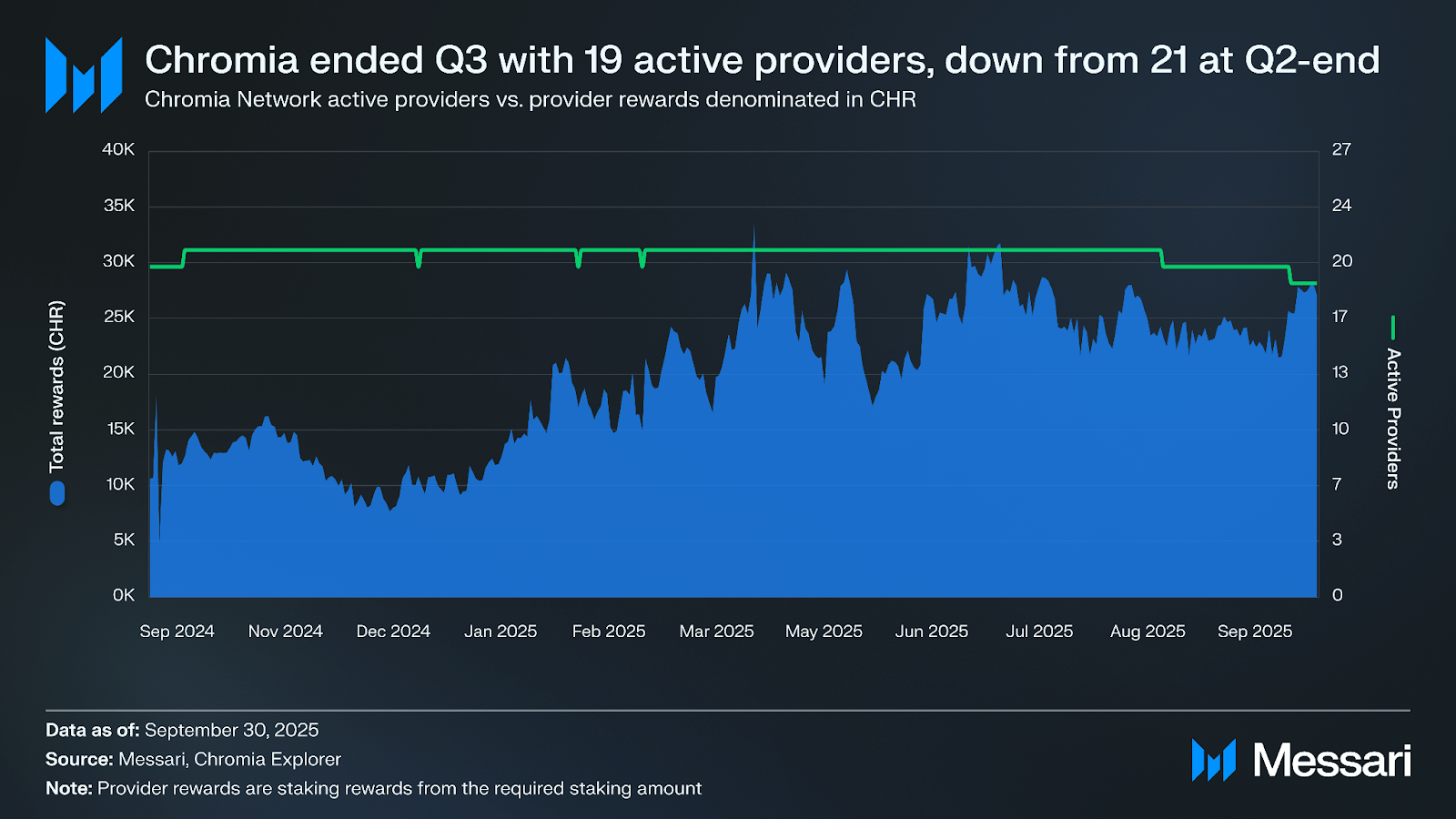
At the end of Q3 2025, Chromia had 19 active providers, down 9.5% QoQ from 21 at the end of Q2 2025. During Q3 2025, provider rewards totaled 2.3 million CHR, down 1.2% from Q2 2025.
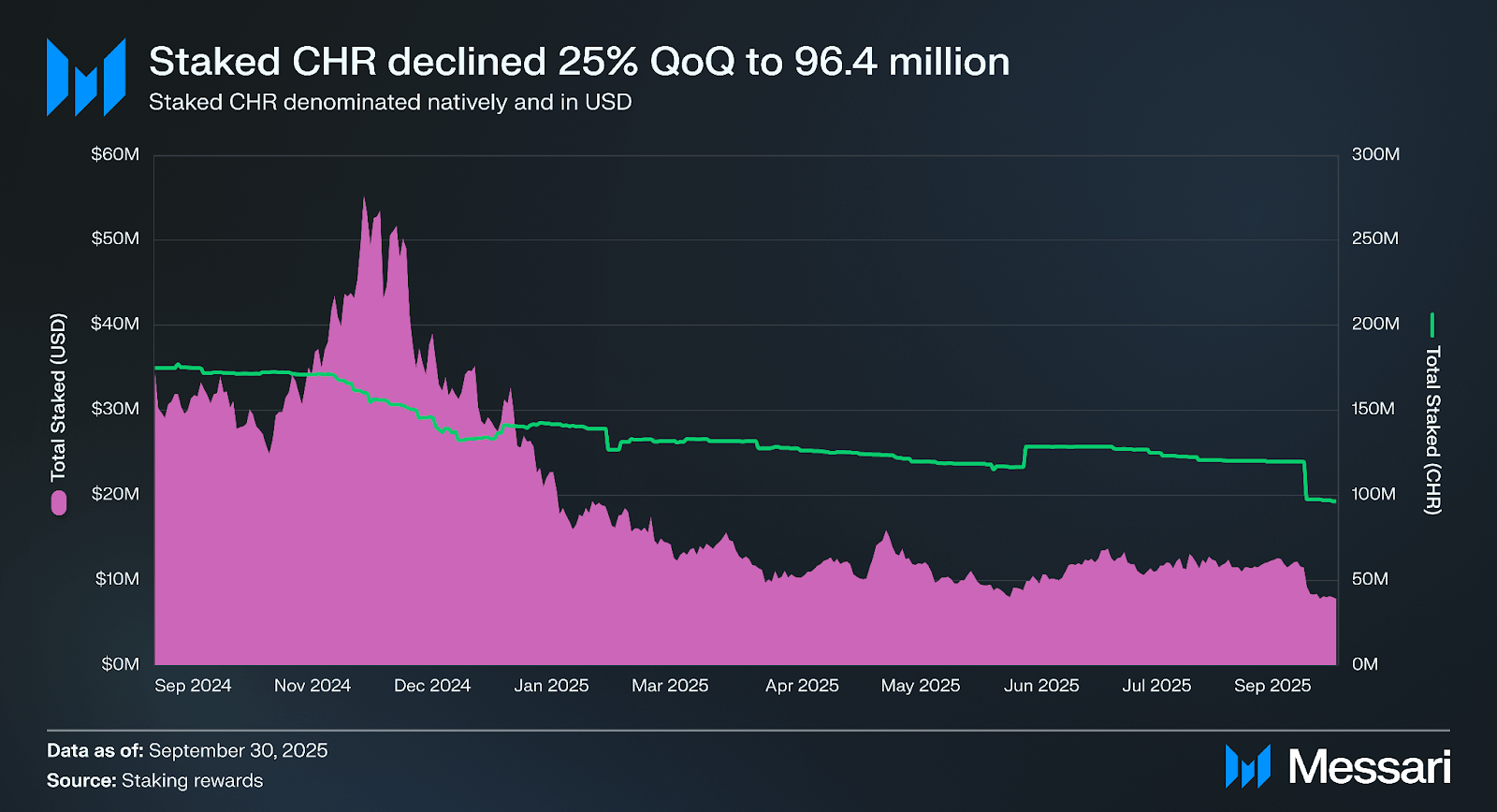
Staking activity reflects a similar pattern of consolidation. Staked CHR declined 25% QoQ from 128.6 million at the end of Q2 2025 to 96.4 million at the end of Q3 2025. In USD terms, the value of staked CHR decreased 22% QoQ from about $10.1 million at the end of Q2 2025 to $7.8 million at the end of Q3 2025.
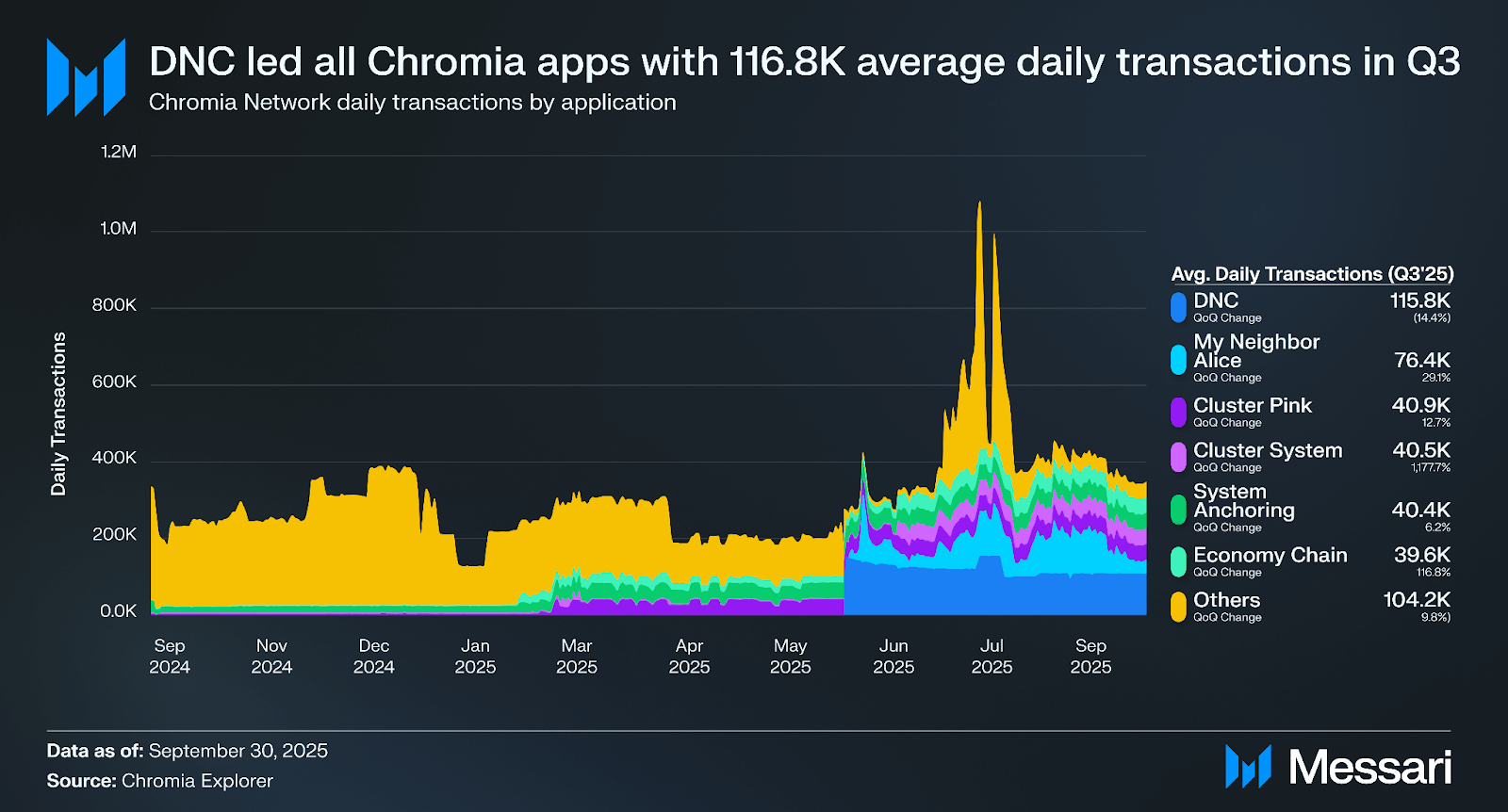
The number of unique blockchains with at least one transaction increased 4.9% QoQ from 41 in Q2 2025 to 43 in Q3 2025. In Q3’25, the leaders for daily transactions by application were as follows:
DNC: A dedicated high-throughput application chain that launched in June 2025 and has rapidly become Chromia’s single largest source of application-layer transactions. , from 135,330 in Q2 2025 to 115,840 in Q3 2025.
My Neighbor Alice: A fully onchain multiplayer farming and builder game that mixes land management, crafting, and NFT trading, built on Chromia’s relational architecture. My Neighbor Alice’s average daily transactions increased 29.1% QoQ, from 59,160 in Q2 2025 to 76,830 in Q3 2025.
Chromia uses several specialized system chains to support the broader application ecosystem:
Cluster Anchoring Chains: Chains that periodically commit Merkle roots of cluster‑level state to a higher‑level anchoring chain, improving tamper resistance and enabling external verification. The cluster system chain is a system-level blockchain that collects block headers from all application chains in a given cluster, hashes them, and produces anchoring blocks that represent the cluster’s overall state. The “Pink” cluster is an application cluster within Chromia that hosts dozens of individual application chains.
Economy Chain: A governance and configuration hub that manages network‑wide economic parameters such as SCU (System Capacity Unit) pricing, provider registrations, and reward settings.
System Anchoring Chain: Posts aggregated commitments from Chromia clusters to external chains such as Bitcoin and Ethereum, providing an auditable, time‑stamped integrity layer for Chromia’s state.
Qualitative Analysis
CRC2 NFT Standard
CRC2, Chromia’s native programmable NFT standard, was publicly released in August 2025. The standard is designed as Chromia’s native NFT format with several design goals:
Full interoperability with ERC-721 and ERC-1155, including preservation of token identity during bridging.
Expanded metadata capabilities with structured fields that can be extended as needed.
Optional onchain content storage using Chromia’s Filehub, which reduces reliance on offchain storage such as centralized servers or external decentralized storage networks.
Built-in programmability through a modular design where developers can attach behavior modules that define upgrade paths, level systems, or dynamic traits.
The CRC2 specification was released to the public, accompanied by code and documentation published in open repositories, along with an EVM-to-CRC2 bridge implementation. That bridge enables existing ERC-721 or ERC-1155 collections to migrate to Chromia while retaining CRC2 features. For example, an NFT bridged from Ethereum can keep its original token identifier while gaining access to onchain metadata expansion or game-specific modules.
From a technical standpoint, CRC2’s modular structure is the key difference compared with typical EVM NFT standards. Instead of encoding behavior in a monolithic contract, CRC2 separates base token semantics from optional capabilities, such as onchain leveling, time-based evolution, or bindings to external application events. This approach aligns with Chromia’s relational data model, as state updates for NFTs can be expressed as updates to rows and tables, rather than opaque contract storage slots.
On the ecosystem side, CRC2 is already connected to live use cases. My Neighbor Alice’s Chapter One update uses CRC2 for in-game assets and benefits from the EVM bridge for integrations like the Pudgy Penguins collaboration, where external NFTs can serve as in-game companions. Zanmang Loopy Drops, a free-to-mint, limited-time-only campaign using licensed Korean IP, also illustrates CRC2’s suitability for high-volume NFT distributions and collection challenges.
Chrombot Proof of Concept
Chromia’s Q3 narrative prominently featured “Physical AI,” a term the team uses for embodied AI agents that interact with the physical world while anchored to onchain data, with the ChromBot pilot serving as the initial proof of concept. ChromBot is a small desktop robot that combines sensors, a display, and an onboard AI model with connectivity to Chromia. The device can be linked to a Chromia wallet, allowing parts of its behavior and identity to be verifiable and programmable onchain. The first public demonstrations took place during the Chromia China Tour in Hangzhou on July 12 and at subsequent events in Korea, where attendees interacted with the device and a limited batch of units was distributed to gather real-world feedback on both hardware and software.
The pilot also explored Chromia as a verification and coordination layer for Physical AI. Design paths under consideration include recording behavior logs, performance metrics, and AI agent state updates onchain so that multiple devices can share and compare information in a verifiable way. Within this framework, Chromia highlighted three directions for future ChromBot development: behavioral benchmarking across devices, semantic similarity searches on device logs using the VectorDB Extension, and cross-device learning in which insights from one robot can be written to an onchain knowledge base and then reused by others.
VectorDB and AI Stack
Chromia’s AI strategy centers on its VectorDB Extension and AI Inference Extension, which together aim to make the network a verifiable backend for AI agents rather than a compute silo.
VectorDB Extension and LangChain Integration
The VectorDB Extension stores vector embeddings directly onchain in Chromia’s relational data model and exposes similarity search operations as part of smart contract logic. That design allows applications to trigger state transitions based on approximate nearest neighbor search results, such as recommending resources, matching users, or routing queries between AI agents.
In September, Chromia released an integration between the VectorDB Extension and LangChain, a popular framework for building large language model applications. The integration ships as an npm package that lets developers configure Chromia as a vector store backend for LangChain-based agents. This provides Chromia with a direct on-ramp into the AI developer tooling ecosystem, positioning the chain as an alternative to centralized vector databases.
AI Inference Extension
The AI Inference Extension complements VectorDB by enabling users to submit inputs to AI models, perform inference on a designated node, and record transaction and inference details onchain. A public testnet demo released in September uses CPU-based computation and the SmolLM2 model to showcase basic end-to-end flows.
Performance in the current version is not yet production-ready, particularly for large models, but the architecture demonstrates how requests, model selection, and outputs can be tied to onchain records. This creates a path to fully auditable inference where both inputs and outputs can be verified and replayed.
Zero-Knowledge Proofs on Chromia
Zero-knowledge proofs continued to mature within Chromia’s extension framework in Q3. The Zero Knowledge Proof (ZKP) Extension was first made available on testnet on July 1, 2025, and provides generic support for proof generation and verification within Chromia’s environment.
The initial public demos focus on shielded transfers, where users can move value between transparent and shielded states while using proofs to demonstrate correctness without revealing intermediate details.
From a network perspective, ZK capabilities slot into the broader extension model alongside Oracle, VectorDB, and AI Inference modules. This placement keeps the base protocol lean while allowing privacy features to be adopted by specific chains that need them, such as gaming applications that want private state or DeFi protocols that require selective disclosure.
The mainnet rollout timing has not yet been announced, but ZKP support is now live on the testnet and available to early adopters who wish to experiment.
Ecosystem Growth and Application Development
DeFi
Chromia’s DeFi footprint continued to expand in Q3 2025.
ColorPool DEX. ColorPool remained Chromia’s primary native DEX, supporting trading pairs such as CHR, USDC, COLOR, ALICE, and D. Liquidity mining campaigns that launched in mid-July continued through the quarter with multi-year timelines. ColorPool TVL is now tracked on DefiLlama, providing increased visibility for Chromia DeFi.
Udon Finance operates as a DeFi protocol within the Chromia ecosystem, offering lending and borrowing services, and will soon enable users to leverage the yield on their assets.
Nomisma is an AI-driven DeFi platform built as a Layer-1 subchain within the Chromia network, utilizing Chromia’s relational blockchain stack to address high gas costs, front-running, and limited onchain data processing in traditional DeFi. During Q3 2025, Chromia acquired 9,210 Chips in Nomisma’s sale, was granted 25% of the Foundation’s Chips reserved by the Nomisma Foundation for protocol and ecosystem development, and began running Nomisma nodes. This deepens the alignment between the two projects, channeling more liquidity and economic upside back into Chromia-aligned products.
Transak’s July 23 integration added a direct fiat onramp to native CHR across more than 160 countries, enabling users to purchase CHR using local payment methods and immediately onboard to the Chromia mainnet. Binance’s Sept. 5 mainnet integration then provided a high-liquidity centralized exchange route, allowing users to deposit and withdraw directly between Binance and Chromia’s Economy Chain without going through a bridge.
Gaming and NFTs
Gaming remained one of Chromia’s most active verticals during Q3:
My Neighbor Alice’sChapter One, which launched in June, ran through its first full quarter on Chromia. The game offers browser-based gameplay, a wallet-free onboarding experience that abstracts away blockchain, and deep onchain integration for in-game assets and the ALICE token economy. A collaboration with NFT collection Pudgy Penguins enables holders to bring their specific NFTs into the game as animated companions, featuring exclusive in-game benefits. This partnership offers a high-visibility example of NFT interoperability, leveraging Chromia’s Token Chain and CRC2 stack.
Zanmang Loopy Drops ran a Korea-focused NFT growth campaign that used a free-to-mint collection based on officially licensed IP. The project reported over 2.5 million transactions and nearly 3,000 accounts on its chain in July after its launch, highlighting how collection-style campaigns can drive significant throughput onto dedicated application chains.
Developer Tools and Upgrades
Several infrastructure improvements aimed at developers were also delivered in Q3 2025:
The FT4 Go Client shipped as part of the Binance integration. It provides Go developers with a first-class library for interacting with FT4 tokens and was essential to enabling centralized exchanges to integrate Chromia in a manner that resembles EVM-style token clients.
The Chromia Vault wallet and dapp explorer received a UI update that simplifies account activation, mainnet onboarding, and application discovery. A new mainnet onboarding guide ties together Transak, Binance, and existing bridges to show users how to move CHR into native staking and application usage.
Chromia and ColorPool were listed on DefiLlama as dedicated chains and protocols, respectively, providing DeFi users with a familiar data source for tracking TVL and volumes.
Roadmap
Chromia’s Q4 2025 roadmap, published on Oct. 7, 2025, outlines three main areas of focus.
AI Development
AI cluster with GPU support: Launch a dedicated mainnet cluster backed by four GPU-enabled provider nodes, one run by ChromaWay and three by independent providers with proven operational track records.
VectorDB as a Service (VaaS): Build a managed service layer on top of the VectorDB Extension to offer a one-click, developer-friendly vector database solution with onchain transparency.
AI Inference Extension V2: Upgrade the AI Inference Extension to utilize the GPU cluster for inference, enhancing both latency and model size support while maintaining onchain auditability of inference processes and outputs.
Network and Governance
Base and Arbitrum support: Extend the existing Ethereum and BNB Chain interoperability framework to include Base and Arbitrum, enabling asset bridging between these ecosystems and Chromia mainnet.
Chromia Governance Module: Release a governance module that allows native CHR stakers on mainnet to nominate providers, propose grants, and vote.
Dynamic fee sharing: Allow providers to choose the percentage of network fees they share with their delegated stakers, with Chromia Vault updating to display projected yields per provider.
Extensions Infrastructure
Extensions SDK: Release an SDK that lets developers build and deploy custom extensions, including documentation and tooling.
Extensions Marketplace: Introduce a marketplace and managed repository for extensions, improving discovery, deployment, and monetization.
Closing Summary
Chromia ended Q3 2025 with continued growth in onchain usage, as a larger share of transactions came from gaming, NFT campaigns, and application chains such as DNC and My Neighbor Alice. Transactions, active addresses, and active chains all increased QoQ, reflecting broader engagement across these applications and the underlying system infrastructure. System and infrastructure chains, including the Economy Chain, cluster anchoring chains, and the System Anchoring Chain, provided a steady baseline of throughput by handling anchoring, configuration, and cross-chain commitments. Over the same period, the team delivered the CRC2 NFT standard and its EVM bridge, added DeFi applications such as ColorPool, Udon Finance, and Nomisma, and improved access through Transak, Binance mainnet integration, and an updated Chromia Vault user interface. Together, these changes expanded the ways users and developers can transact, deploy applications, and move assets on Chromia.
The Q4 2025 roadmap focuses on scaling Chromia’s AI and data infrastructure and strengthening protocol-level incentives. Planned initiatives include a GPU-enabled AI cluster, “VectorDB as a Service,” and a second iteration of the AI Inference Extension, alongside ongoing Physical AI work with ChromBot as a concrete demonstration of onchain AI infrastructure. At the protocol and ecosystem level, new bridges to Base and Arbitrum, the introduction of a native governance module and dynamic fee-sharing for stakers, along with an open Extensions SDK and marketplace, are designed to strengthen alignment and lower integration friction for third-party teams. If these roadmap items land as planned, Chromia will enter 2026 with a larger base of live applications, deeper liquidity and access channels, and a clearer positioning around AI and data-centric use cases, creating a foundation for any future rerating to be tied directly to observable network usage.
This report was commissioned by Chromia. All content was produced independently by the author(s) and does not necessarily reflect the opinions of Messari, Inc. or the organization that requested the report. The commissioning organization may have input on the content of the report, but Messari maintains editorial control over the final report to retain data accuracy and objectivity. Author(s) may hold cryptocurrencies named in this report. This report is meant for informational purposes only. It is not meant to serve as investment advice. You should conduct your own research and consult an independent financial, tax, or legal advisor before making any investment decisions. Past performance of any asset is not indicative of future results. Please see our Terms of Service for more information.
No part of this report may be (a) copied, photocopied, duplicated in any form by any means or (b) redistributed without the prior written consent of Messari®.
Eric is a research analyst at Messari and an ambassador for Maple Finance. He previously was a Product Manager for FINTRX and is passionate about DeFi and AI.
Eric is a research analyst at Messari and an ambassador for Maple Finance. He previously was a Product Manager for FINTRX and is passionate about DeFi and AI.