Midnight launched mainnet on Mar. 30, 2026, a privacy-enhancing L1 and Cardano's first partner chain, secured by Cardano SPOs under the Partner Chains framework. Its dual-component model (NIGHT, an unshielded token for governance and rewards, and DUST, a shielded resource for transaction fees) and federated institutional validator set position Cardano as a regulated tokenization venue.
DReps ratified a 350 million ADA Net Change Limit covering Feb. 13, 2026, through Jul. 3, 2027, turning Cardano's treasury into a capped multi-year capital plan. The Critical Integrations Budget is the first major allocation funded under this cap, supporting Pentad's five-pillar institutional roadmap.
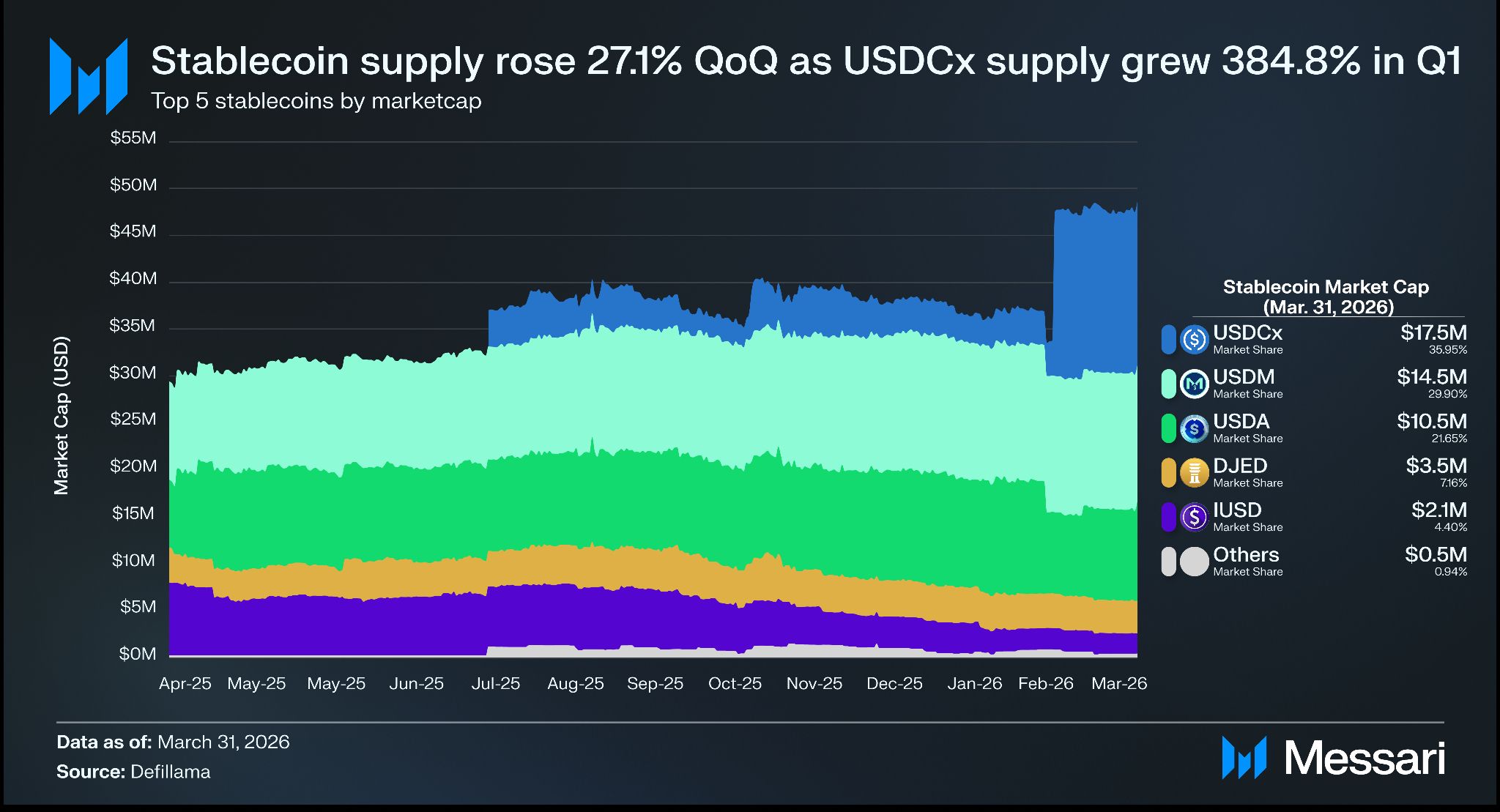
Circle's USDCx launched on Cardano on Feb. 27 with day-one integrations across Minswap, Liqwid, and SundaeSwap, capturing 36.0% of the network's stablecoin market and ending Q1 at $17.5M in supply. Combined with the EMURGO-Wirex Cardano Card and the February 2026 launch of Stablecoin Push-to-Card via Visa Direct, Cardano put the infrastructure in place for an end-to-end regulated payments stack.
The Critical Integrations Budget added three additional Tier-1 partnerships in Q1, including LayerZero on Mar. 17 (cross-chain bridges, $80B+ in omnichain liquidity reach), Pyth Network at code-complete with Q2 mainnet (oracles), and Dune Analytics data coverage (onchain analytics), alongside USDCx as the Tier-1 stablecoins pillar.
Grant Thornton Switzerland completed the first global onchain financial audit through the Cardano Foundation's Reeve framework, providing L1 issuers with a regulated audit framework that no other peer network has matched.
Cardano advanced protocol infrastructure across multiple fronts in Q1, including Van Rossem hard fork preparation (Protocol V11, June 2026 launch), Leios consensus reaching first working prototypes, and the LSM Tree update reducing SPO hardware requirements from 24GB to 8GB RAM. Hydra v1.3.0 and Amaru also progressed toward production parity with the primary Haskell node.
Primer
Cardano (ADA) is a Proof-of-Stake (PoS) Layer-1 blockchain launched in 2017. Cardano aims to provide security, scalability, and functionality to decentralized applications and systems building atop the network. In addition to its community of developers, node operators, and projects, entities like Input Output, Cardano Foundation, Intersect, EMURGO, Pragma, and others support the network’s development, adoption, and finances. Enacted through the Voltaire (Governance) phase of its roadmap, Cardano has transitioned to a community-driven network, where each ADA holder can influence the future roadmap, network rules, funding, and protocol upgrades via onchain voting and elected committees. As of December 2025, Cardano governance is fully decentralized, supported by a tripartite ‘government’ comprising the Constitutional Committee, delegated representatives (DReps), and Stake Pool Operators (SPOs).
With a dedicated community of users and developers, Cardano has demonstrated staying power. After the launch of smart contract support via the Alonzo hard fork in 2021, Cardano began to compete in more traditional crypto markets, such as DeFi and NFTs. For a full primer on Cardano, refer to our Initiation of Coverage report.
ADA is the native currency of Cardano that is used as the primary medium of exchange when transacting on the network. ADA has three primary network-level use cases:
To stake as a stake pool operator or delegator to help secure the network, earn token rewards, and participate in protocol governance.
In Cardano's liquid democracy model, ADA holders delegate their voting power to Delegated Representatives (DReps), who then vote on governance proposals on behalf of the delegators. A DRep's influence is proportional to the total ADA delegated to them. Additionally, the Cardano community allocates treasury funds through onchain governance proposals approved by delegated representatives (DReps) and the Constitutional Committee. In 2025, these votes directed ADA from the Treasury to fundProject Catalyst and other initiatives.
ADA’s circulating token supply inflates until it reaches its maximum supply of 45 billion tokens. After each five-day epoch, 0.3% of ADA reserves (i.e., the ADA not in circulation) are distributed as SPO rewards, allocated in proportion to each pool’s total delegated stake and adjusted for pool performance (uptime and blocks produced) and the operator’s pledged ADA. Inflation trends towards zero as the reserves deplete and the circulating supply approaches 45 billion.
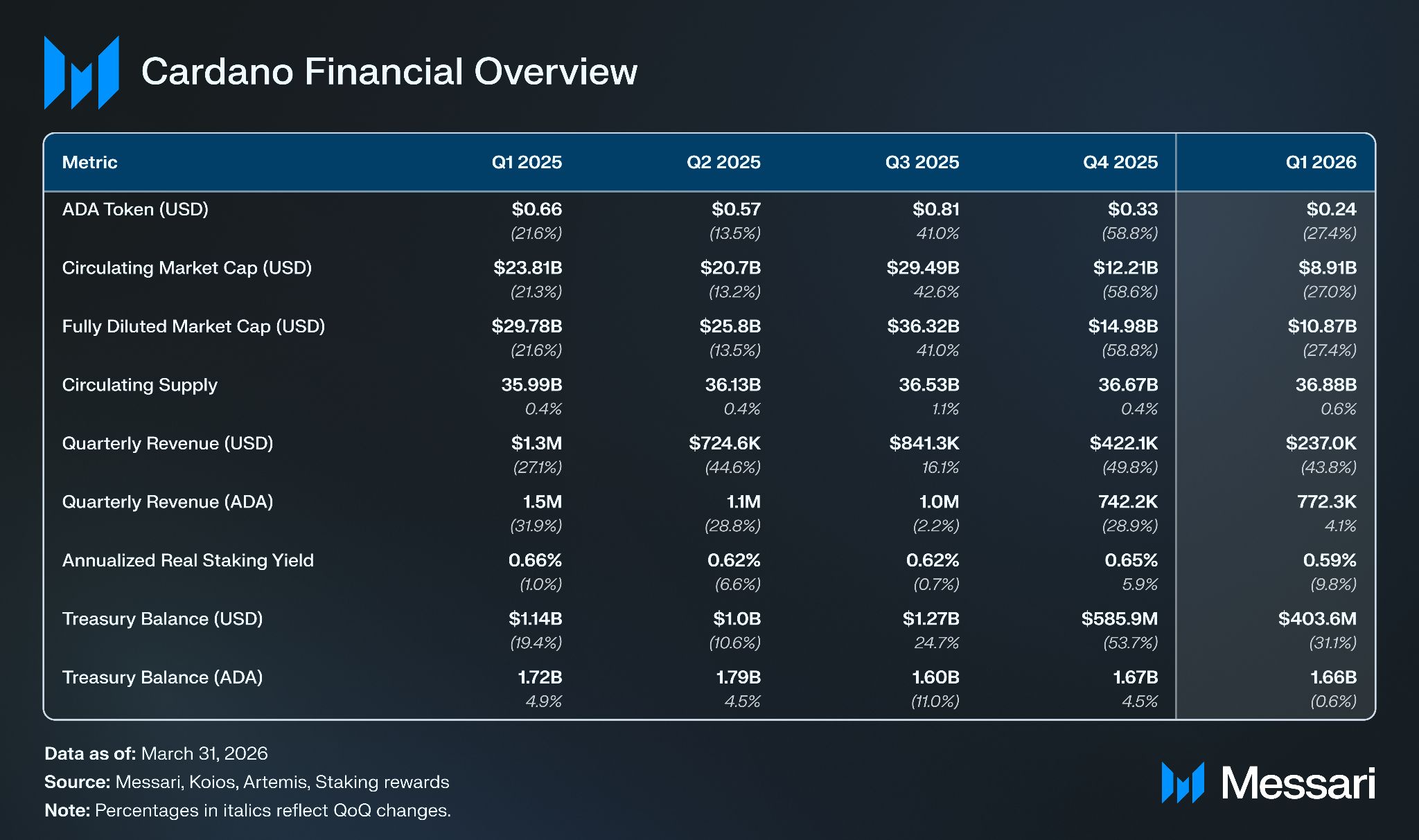
Real staking yield is the nominal staking yield minus the rate of new ADA issuance, capturing how much a staker's relative share of supply actually grows. Annualized real staking yield accounts for inflation. In Q1 2026, the real staking yield decreased from 0.61% to 0.59%, while nominal yields ranged between ~2.0% and 3.0% across stake pools.
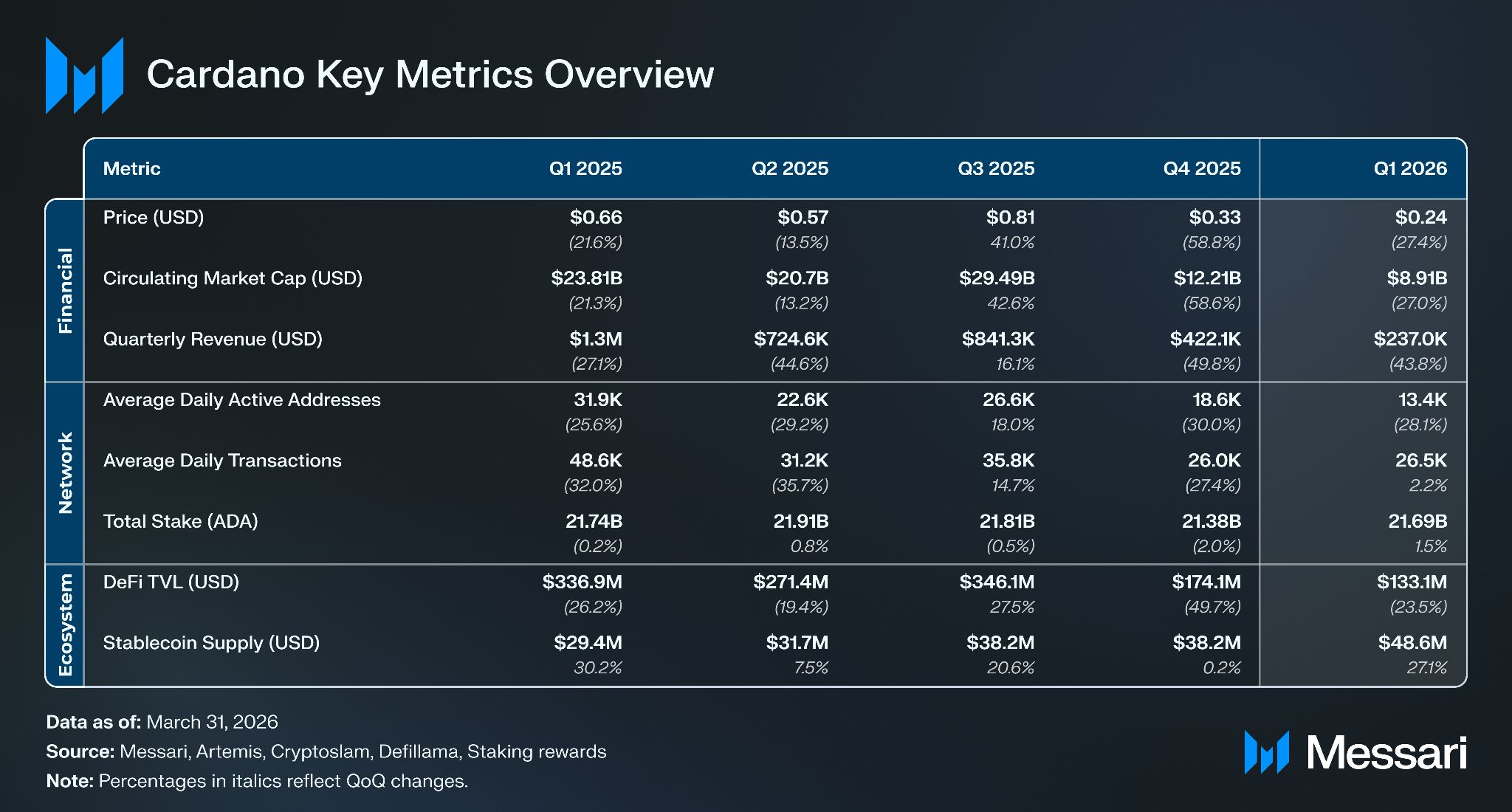
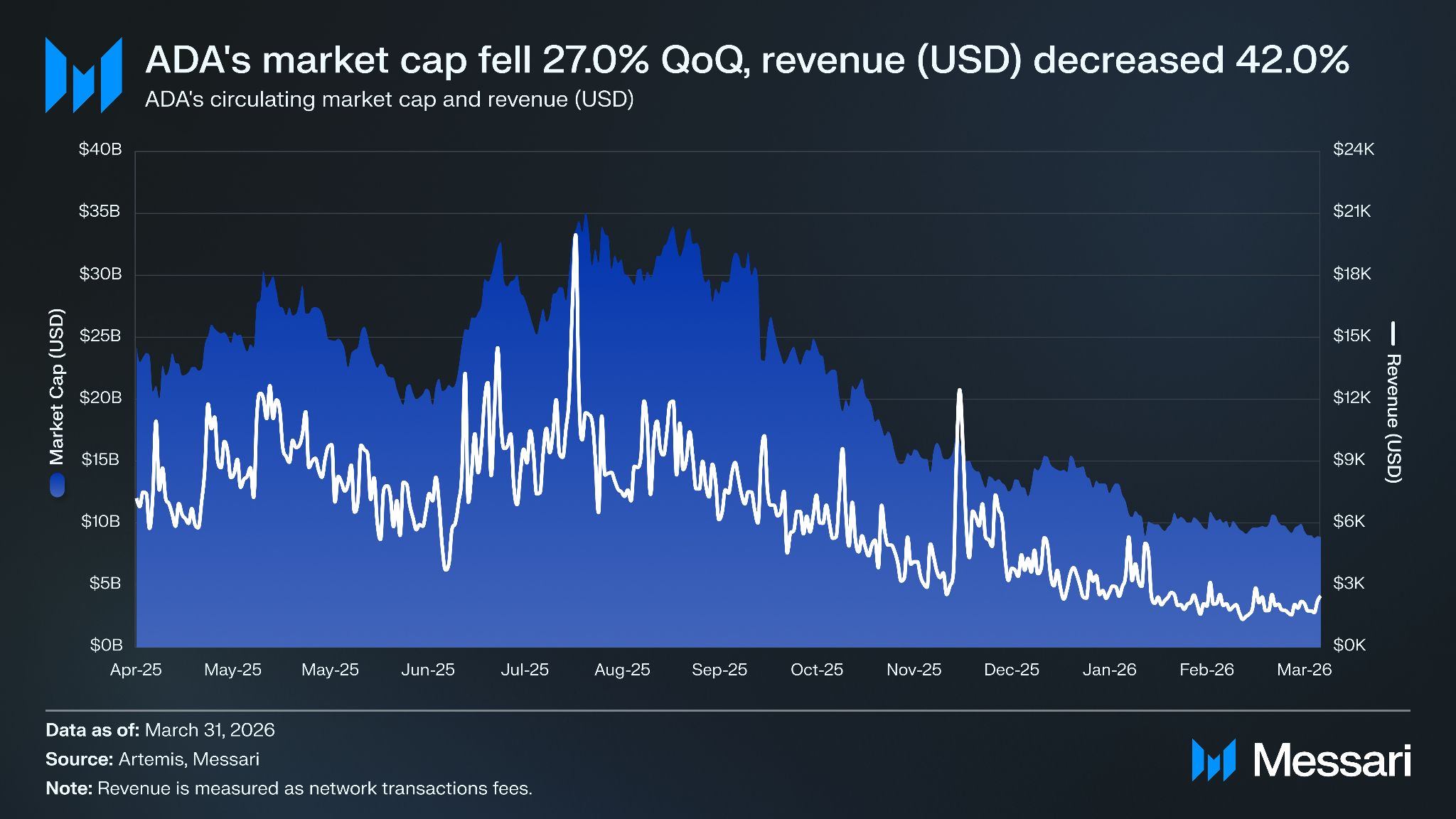
ADA's price fell 27.4% QoQ to $0.24 at the end of Q1’26, lowering its circulating market cap from $12.21 billion to $8.91 billion. The decline outpaced the broader crypto market's 23.1% drop over the same period, with ADA's market dominance falling from 0.39% to 0.37%. At quarter-end, ADA's circulating market cap rank was 13th, down two spots QoQ from 11th at Q4-end, as WhiteBIT (WBT) and Bitcoin Cash (BCH) overtook it.
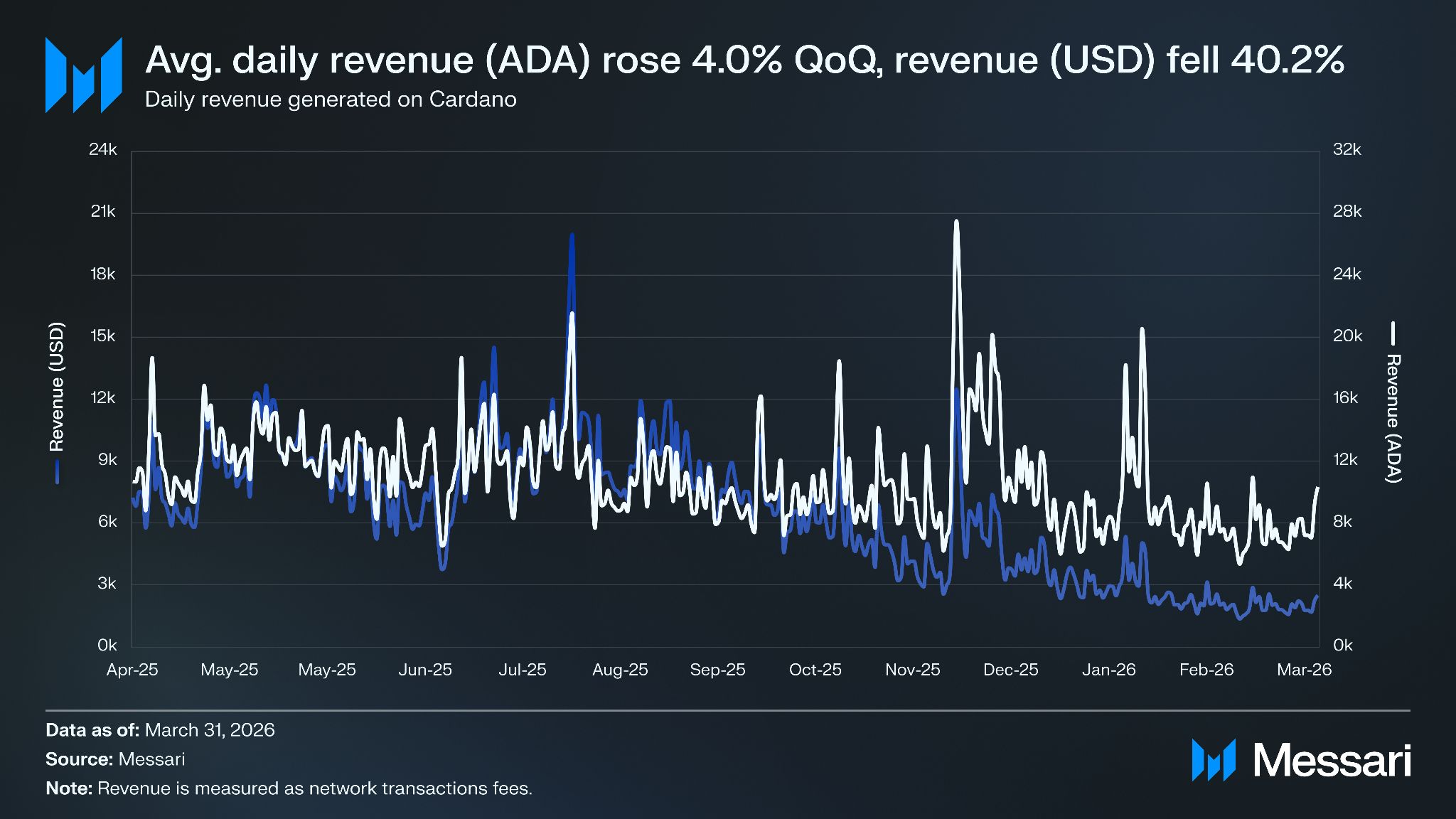
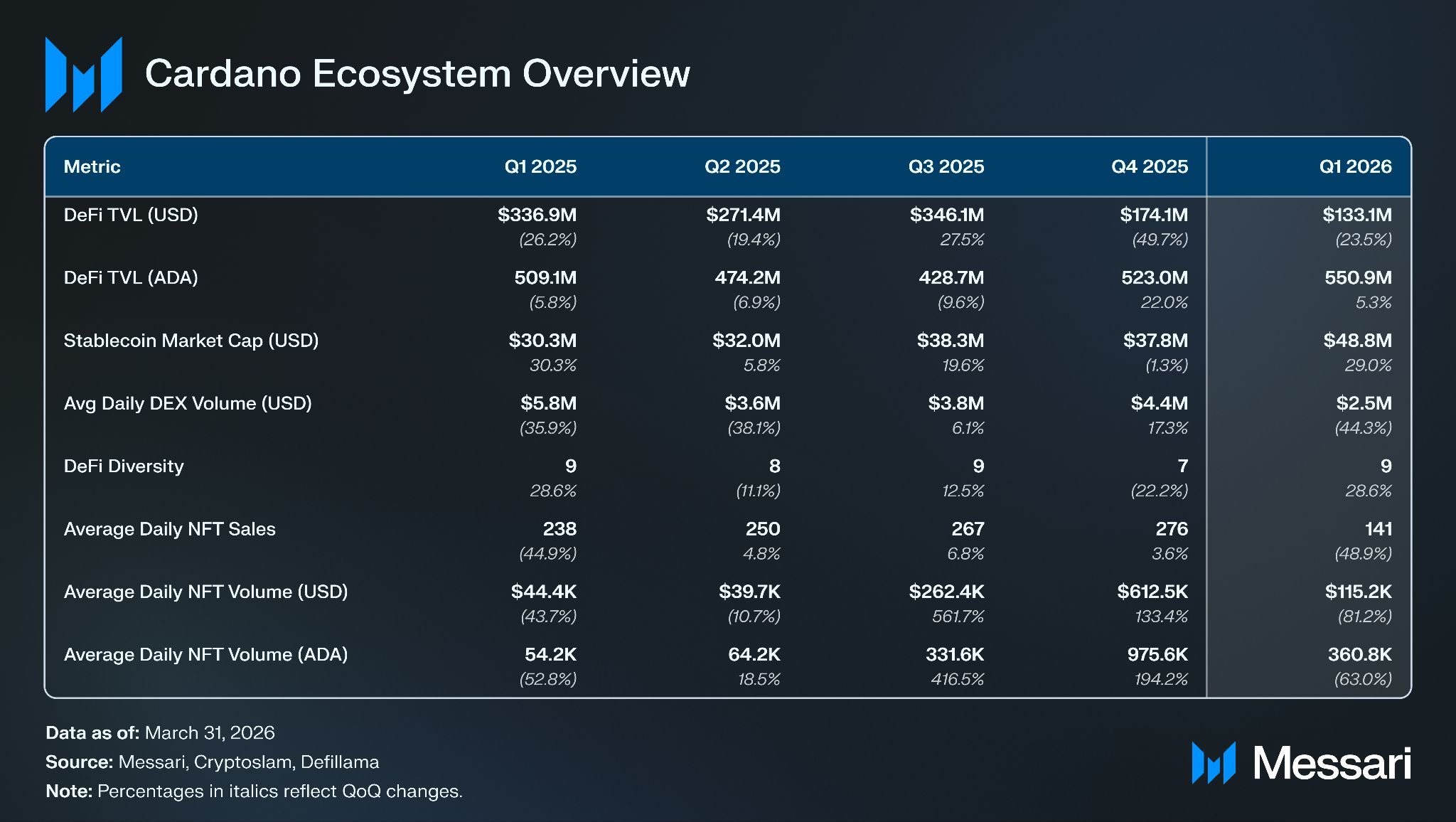
Each transaction on Cardano incurs a network transaction fee to cover processing and storage costs. Fees are calculated by a minimum fee plus a variable fee based on transaction size. Fees (USD) decreased 43.8% QoQ to $237,040, while fees (ADA) increased 4.1% QoQ to 772,310 ADA. This USD-ADA gap reflects ADA's price decline over Q1’26, while transaction activity remained relatively stable, with average daily transactions rising 2.2% QoQ to 26,550 and fees (ADA) rising 4.1% in parallel.
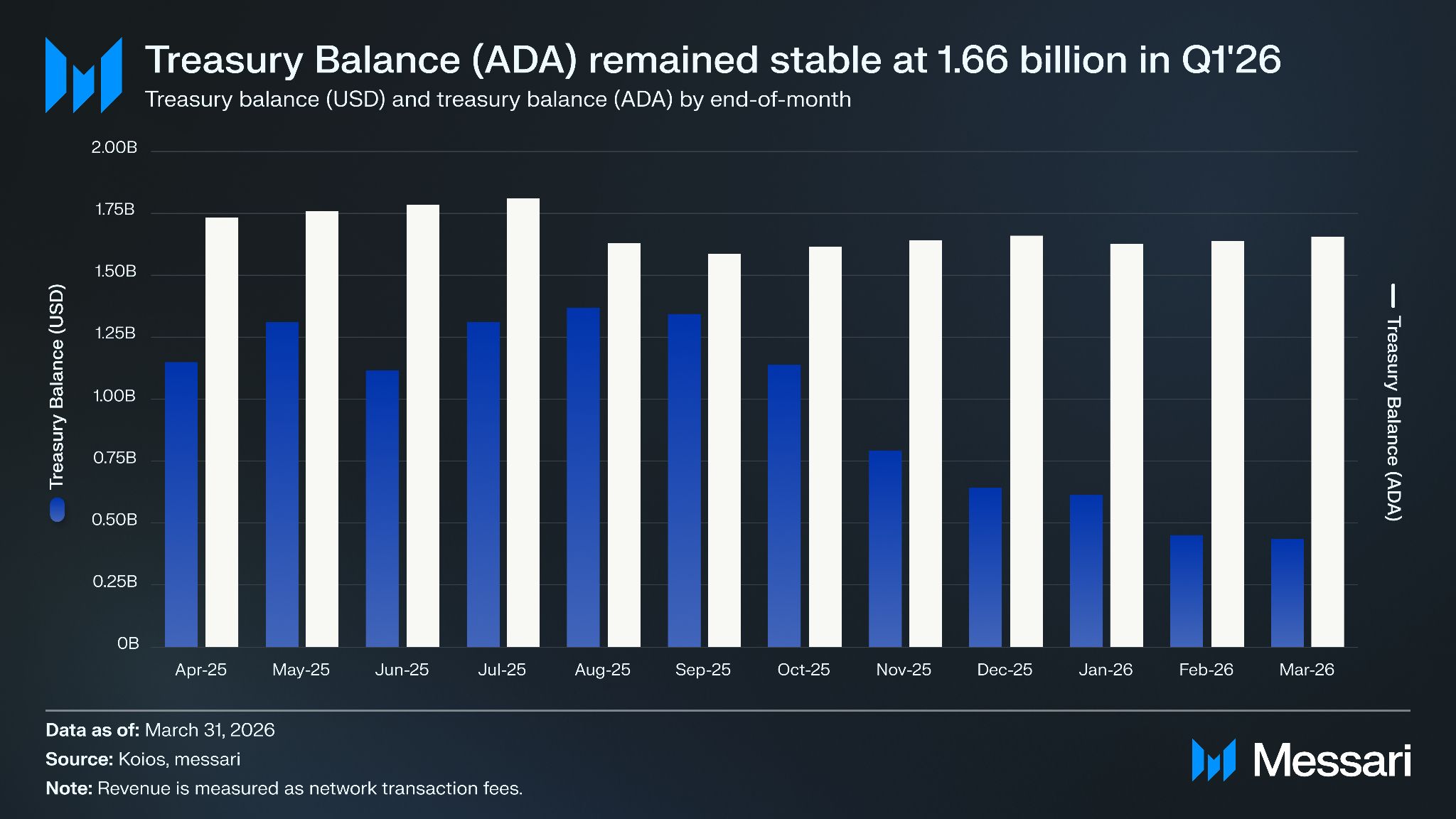
Cardano's treasury balance (ADA) decreased 0.6% QoQ to 1.66 billion ADA. Its USD value decreased 31.1% QoQ to $403.6 million. The treasury provides funds to maintain and develop Cardano, with resources deployed through community governance following the Plomin hard fork on Jan. 29, 2025. Currently, 20% of Cardano’s epoch rewards are allocated to the treasury, which can be adjusted through governance.
Despite the near-flat ADA balance, the treasury saw meaningful activity in Q1 2026. 80.1 million ADA was deployed through two governance-approved withdrawals during the quarter:
Critical Integrations Budget: 70 million ADA, enacted Jan. 10, 2026. Administered by Intersect, the budget funds the integration of five institutional infrastructure pillars: Tier-1 stablecoins, institutional custody and wallets, cross-chain bridges, oracles, and onchain analytics platforms. USDCx, LayerZero, and Pyth Network (code-complete) were the first Q1 deliverables against the budget, with a Dune Analytics integration announced at the end of March 2026.
Amaru Node: 10.1 million ADA, enacted at the epoch 620/621 boundary in late March 2026. The withdrawal funds a Rust-based alternative Cardano node implementation for the full 2026 calendar year, supporting client diversity alongside the primary Haskell node. The Amaru team returned 920,400 ADA of unused 2025 funding to the treasury before this allocation.
Inflows from the treasury's reward share partly offset these outflows.
The Q1 activity reflects a structural shift in how Cardano's treasury is used. The 350 million ADANet Change Limit ratified in Q1 caps cumulative treasury withdrawals through Jul. 3, 2027, replacing the uncapped grant pool with a fixed capital budget that ecosystem proposals must now compete within. No other major PoS L1 runs its treasury on this structure. Looking ahead, success will be defined by whether subsequent tranches ship at the same cadence throughout 2026.
Network Analysis
Cardano 2030 Vision
On Jan. 21, 2026, DReps ratified the Cardano 2030 Vision Info Action with 67.8% approval, with 200 DReps voting yes against 26 no and 19 abstaining. The action was facilitated by the Intersect Product Committee and informed by a process involving more than 700 community contributors across 2024 and 2025. It is the first instance in which a community-driven strategic document was cleared onchain, signaling a maturation of the Voltaire process for setting the ecosystem’s direction.
The Vision is a non-binding strategic framework that positions Cardano as the most secure, reliable, and censorship-resistant blockchain for mission-critical applications, a deliberate bet on institutional, regulated, and government-aligned use cases over the general-purpose L1 race. It organizes future ecosystem investment around five strategic pillars:
Infrastructure
Adoption
Governance
Ecosystem growth
Long-term sustainability
DReps retain full autonomy in how, or whether, to apply the framework when evaluating proposals. The 2026 Budget Process Framework, discussed in Governance Updates, already references the Cardano 2030 Vision KPIs as a baseline for proposal evaluation.
The Vision is the first instance of Cardano's onchain governance producing strategic direction instead of informing future funding decisions. Beyond this, Q1’s other deliverables build out the institutional infrastructure the Vision commits to, with USDCx providing the regulated dollar rail, CIP-0113 embedding compliance at the asset layer, Reeve delivering the audit framework, and Midnight establishing the institutional privacy and tokenization venue.
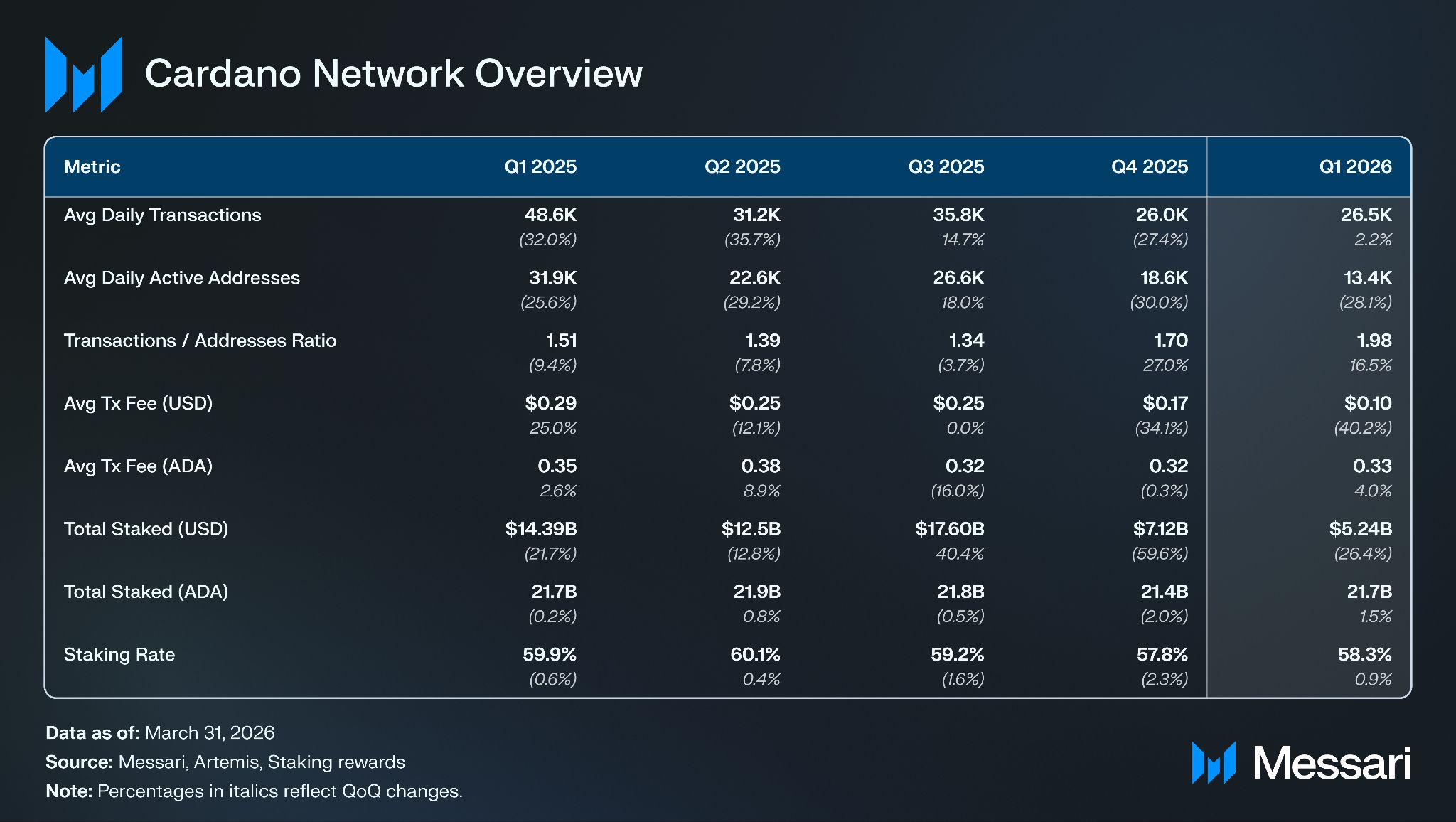
Cardano's average transaction fee (ADA) rose 4.0% QoQ to 0.33, while the average transaction fee (USD) fell 40.2% QoQ to $0.10, reflecting ADA's depreciation during the quarter.
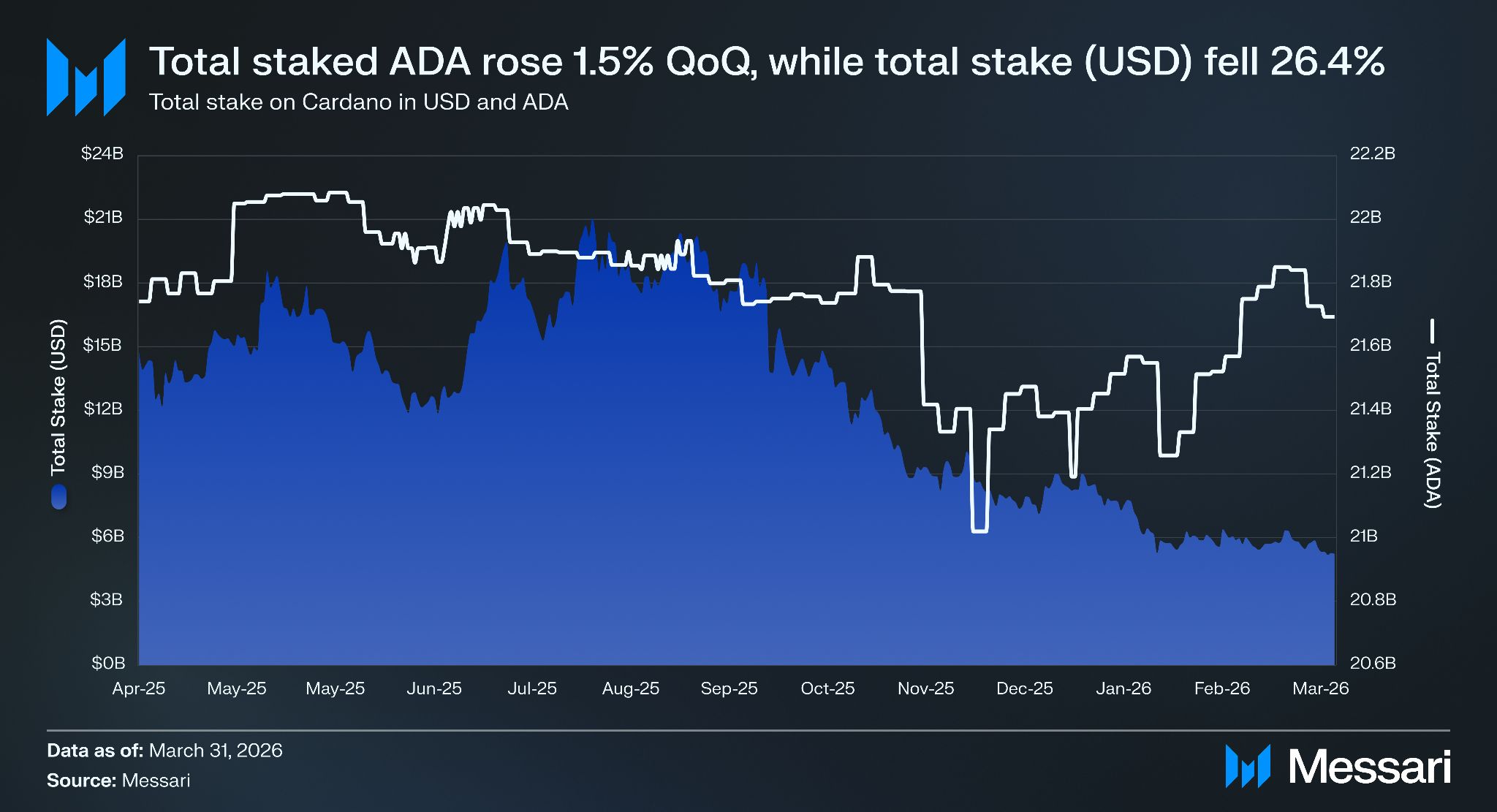
Total staked ADA increased 1.5% QoQ to 21.7 billion, while the staking rate increased 0.9% QoQ to 58.3%. In USD terms, total stake fell 26.4% QoQ to $5.2 billion, driven by lower ADA prices despite a small increase in staked supply.
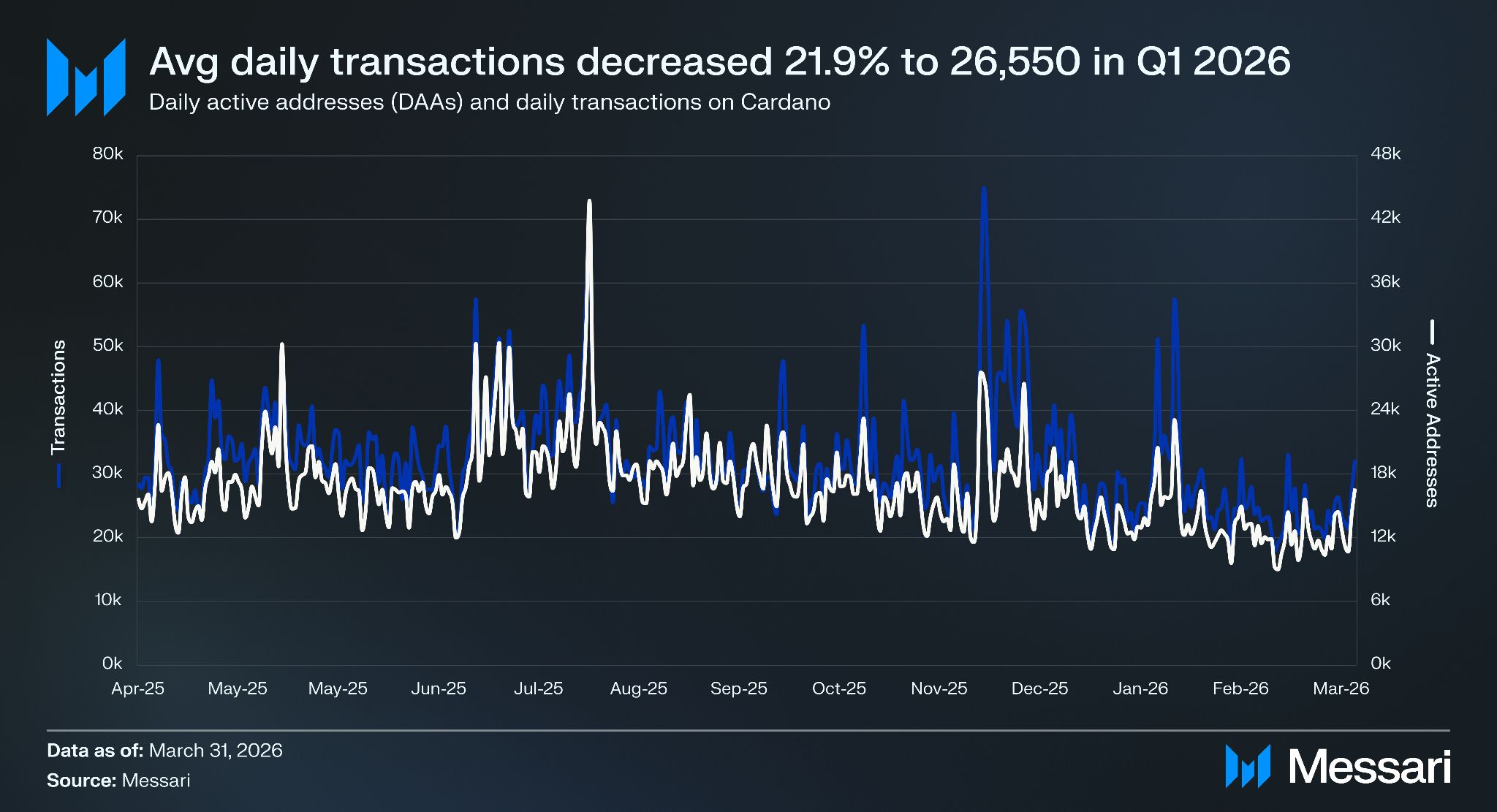
Cardano's transaction throughput held roughly flat in Q1 even as daily active addresses (DAAs) contracted. Average daily transactions rose 2.2% QoQ to 26,550, while average daily active addresses fell 28.1% QoQ to 13,400, lifting the transactions-per-address ratio 16.5% QoQ to 1.98. This pattern is consistent with activity concentrating among a narrower set of more active users, rather than broader network expansion. DeFi drove the bulk of onchain activity, with the launch of the NIGHT token and the USDCx debut spiking transactions across Minswap, SundaeSwap, and Liqwid in February 2026.
Governance Updates
Q1 2026 produced three governance ratifications, including the Cardano 2030 Vision covered in Key Metrics, Constitution v2.4, and the 2026 Budget Process Framework.
Updated Constitution (v2.4)
The community ratified version 2.4 of the Cardano Blockchain Ecosystem Constitution on Jan. 19, 2026, with approximately 79% of active DRep voting stake in favor. The updated Constitution took effect at the epoch boundary on Jan. 24, 2026.
The most substantive change removes the requirement for a Budget Info Action before treasury withdrawal governance action can be submitted. Under v2.4, all treasury allocations must be documented and justified entirely within their associated Treasury Withdrawal governance actions, rather than being split between an information-only budget proposal and a separate withdrawal. Budget Info Actions may still exist onchain as sentiment records, but no longer a constitutional requirement. v2.4 also tightens rules around linked documentation by requiring immutable references for any offchain documents associated with a governance action, and clarifies the thresholds and roles that govern the ratification process.
2026 Net Change Limit and Budget Process Framework
Following the Feb. 8, 2025, expiration of the extended 2025 Net Change Limit (NCL), DReps ratified a new 350 million ADA NCL covering the period from Epoch 613 (Feb. 13, 2026) through Epoch 713 (Jul. 3, 2027). The ceiling sets the maximum aggregate amount that can be withdrawn from the treasury across that window, and per the Cardano Constitution, individual treasury withdrawals cannot be ratified if they would cause cumulative withdrawals to exceed the active NCL.
On Mar. 5, 2026, Intersect submitted the Budget Process Framework 2026 Info Action to structure how capacity under the NCL is allocated. The framework introduces standardized proposal templates, an offchain review stage in which proposals require at least 67% of participating DRep stake before advancing to onchain Treasury Withdrawal actions, and explicit alignment with the Cardano 2030 Vision KPIs.
The Q1 ratifications establish a coordinated model: a strategic plan (Cardano 2030 Vision), a multi-year capital budget (350 million ADA NCL), and a procurement-execution cadence (2026 Budget Process Framework) aligned through onchain governance. The Cardano Pentad (Cardano Foundation, Input Output Global, EMURGO, Intersect, and the Midnight Foundation) operates as the execution arm against the Critical Integrations Budget.
Ecosystem Analysis
DeFi
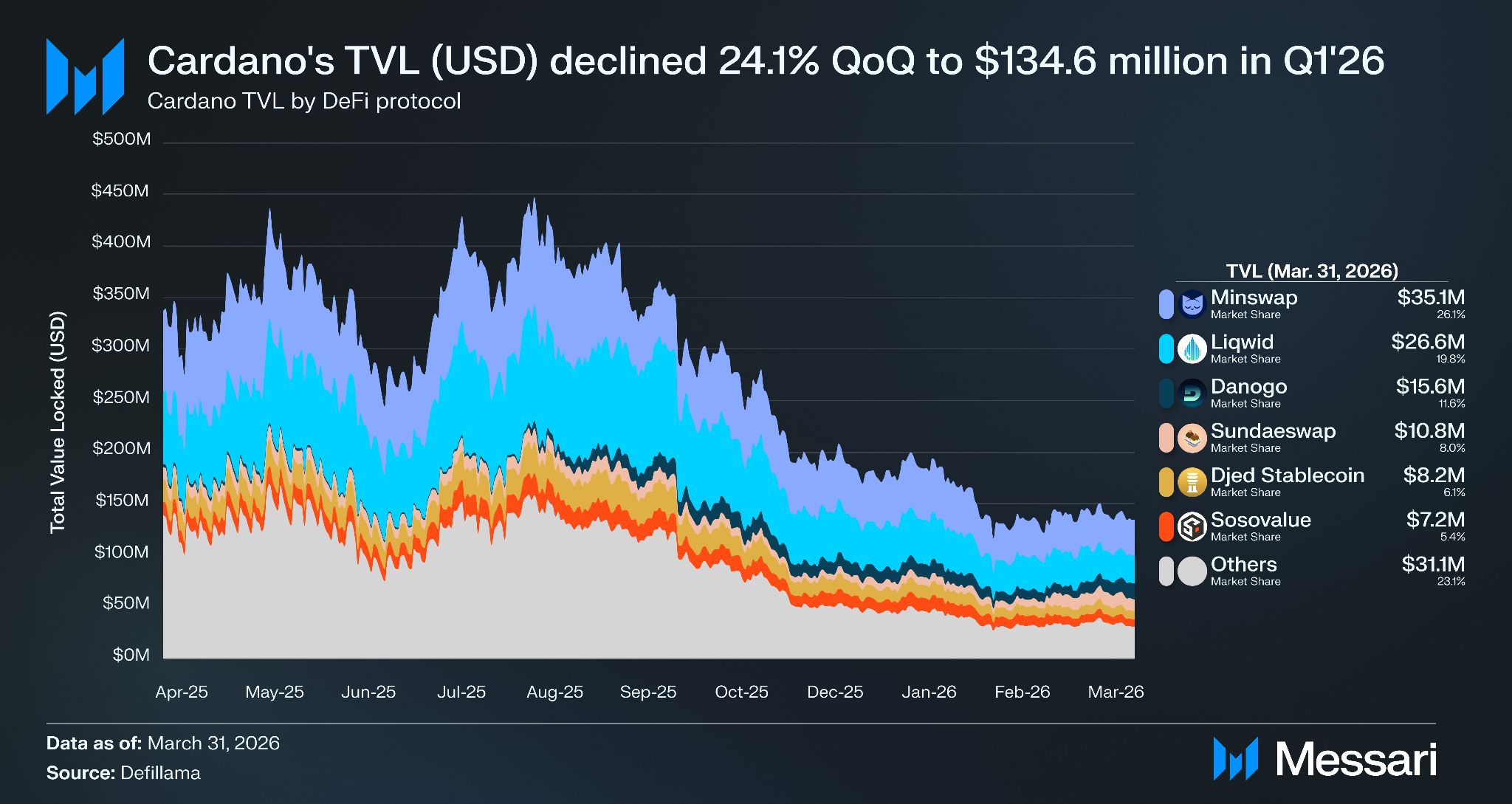
Cardano's DeFi TVL decreased 23.5% QoQ to $133.1 million in Q1 2026, modestly worse than the industry-wide DeFi TVL decrease of 18.9%. The contraction closely aligned with ADA's 27.4% price decline over the quarter, with most protocols declining in line with the network-wide drop. Cardano's DeFi diversity score (the number of protocols making up 90% of a network's TVL) remained at 9, with TVL slightly consolidating across top protocols. By sector, DEX TVL across the top two protocols held up best, falling 17.3% QoQ to $45.9 million combined. Meanwhile, lending and borrowing TVL across Liqwid and Danogo fell 22.9% QoQ to $42.2 million. TVL across smaller DEXs and synthetic asset platforms had the steepest declines, with both Indigo and Splash falling out of the top six. Danogo and SoSoValue entered the top six in Q1, displacing Indigo and Splash.
Minswap retained its position as Cardano's largest DeFi protocol with TVL falling 26.9% QoQ to $35.1 million, while its market share eased to 26.1% from 27.0%. The decline tracked ADA's price contraction since most of Minswap's pools sit in ADA-paired liquidity. Minswap was one of three day-one integration partners for USDCx, and USDCx-paired pools accounted for $5.3 million of Minswap's TVL by quarter-end.
Surge Protocol advanced its public testnet in Q1 as a non-custodial market-making layer that executes automated trading strategies using Minswap liquidity, with Testnet V2 introducing expanded Cardano wallet management capabilities. Mainnet launch is still pending.
Liqwid is Cardano's largest lending and borrowing protocol, with interest-bearing tokens representing collateral in lending pools known as qTokens, as its primary deposit asset. Liqwid saw the steepest decline among the top three, falling 37.9% QoQ to $26.6 million, bringing its market share down to 19.8%. Active loans fell 45.1% QoQ to $7.3 million from $13.3 million at Q4-end, a steeper contraction than the TVL decline that reflects ADA-collateralized borrowers delevering as ADA's price fell. The qToken model concentrates exposure in ADA-collateralized positions, amplifying the protocol's sensitivity to ADA price moves. Liqwid was also a day-one USDCx integration partner, and brought $6.0 million USDCx into the protocol by quarter-end, accounting for 22.6% of its TVL.
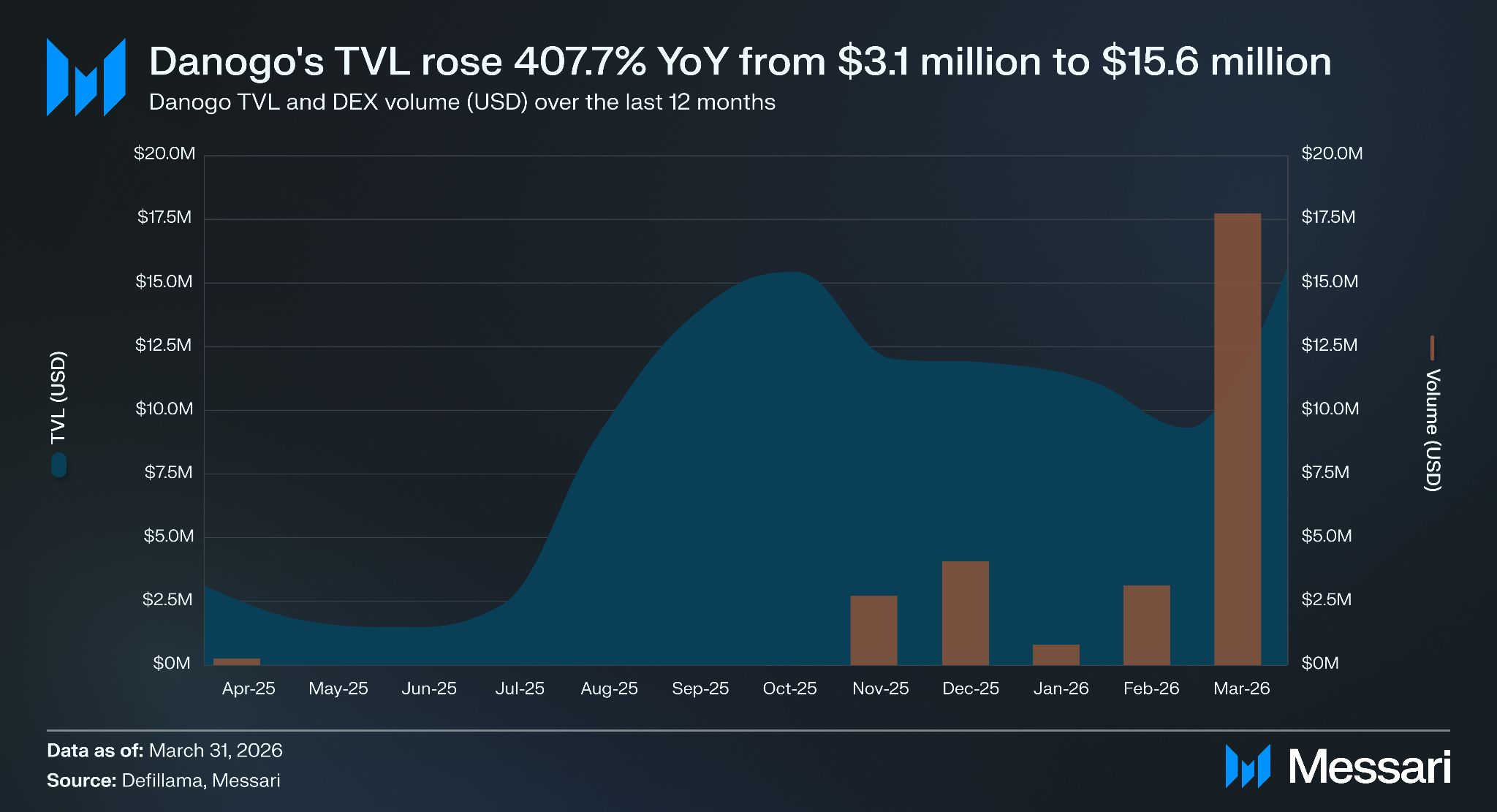
Danogo is a Cardano-native protocol combining a decentralized bond exchange with ADA staking-rights lending and fixed- and flexible-rate pools. Danogo entered the top three by TVL in Q1, growing 31.7% QoQ to $15.6 million and lifting its market share to 11.6% from 6.7%. The protocol's bond exchange and lending products continued to attract capital through Q1, and Danogo launched a dedicated USDCx lending pool in early March 2026 that gave yield-seeking users a dollar-denominated destination on the platform.
SundaeSwap is one of Cardano's earliest DEXes, providing AMM-based liquidity and token swaps. SundaeSwap's TVL grew 45.0% QoQ to $10.8 million, lifting its market share to 8.0% from 4.2%, driven by its role as one of three USDCx day-one integration partners, with the bulk of the growth occurring after the launch. Trading volume moved the other way, with TVL inflow reflecting USDCx LP deposits arriving ahead of organic swap flow rotation.
DJED is an overcollateralized stablecoin developed by Input Output and operated by COTI that uses SHEN as the reserve coin. DJED's TVL fell 28.1% QoQ to $8.2 million, leaving its market share roughly flat at 6.1%. COTI executed its Helium hard fork on Jan. 12Mar. 5, improving MPC execution and adding support for 128-bit and 256-bit operations, and partnered with Artifi Labs in February to advance development of Private DJED, which uses COTI V2 infrastructure to shield transaction details.
SoSoValue is a multi-product DeFi platform offering crypto spot indexes through its SSI protocol and a DEX through SoDEX. SoSoValue entered the top six with $7.2 million in TVL and a 5.4% market share at quarter-end. Its appearance in the top six reflects the broader contraction across Indigo and Splash rather than absolute TVL growth on its own platform.
The Q1 TVL contraction obscures a stablecoin-liquidity expansion that began with USDCx's launch. SundaeSwap and Danogo were the only top-six venues with QoQ TVL growth, the two protocols where USDCx liquidity became a material share of their pools. The larger day-one partners, Minswap and Liqwid, tracked closer with ADA's drop because their base liquidity is ADA-paired and ADA-collateralized. For the rotation to continue, USDCx will need to pull liquidity out of Minswap and Liqwid's ADA-paired core in future quarters.
Several ecosystem-wide DeFi events outside the top six shaped Q1's broader picture. On the Bitcoin DeFi front, FluidTokens executed the first native Bitcoin-Cardano atomic swap on Mar. 25, 2026, exchanging 0.0001 BTC for 50 ADA without wrapped assets, bridges, or centralized intermediaries. On the oracle side, Pyth Network reached code-complete status on its Cardano implementation in March 2026, with mainnet launch scheduled for Q2’26. Separately, Indigo Protocol launched Indigo Leverage on Feb. 4, 2026, allowing users to gain up to 4x leveraged exposure on iAssets through a single guided action.
RWAs
Cardano's L1 RWA footprint remained early-stage through Q1 2026, but the quarter delivered the foundational compliance and audit primitives that enable institutional tokenization on Cardano L1 going forward.
The Cardano Foundation released CIP-0113 (Programmable Tokens) on Mar. 9, 2026, an open-source standard that allows issuers to embed compliance rules, including KYC/AML checks and asset freezing, directly into native Cardano assets. The Foundation also advanced its Reeve framework for encrypted financial auditability, with Grant Thornton Switzerland completing what the Foundation described as the first global onchain financial audit secured through Reeve in Q1’26. At the protocol level, FluidTokens launched a gold-backed lending service in February 2026, marking one of the first native RWA-collateralized products on Cardano. Empowa continued financing affordable housing across Africa toward its goal of supporting one million homes by 2030 through onchain capital raising and homebuyer agreement management.
Taken together, Q1 assembled three foundational institutional primitives on Cardano L1 that did not exist before the quarter began:
USDCx as a Tier-1 dollar rail with day-one DEX and lending integrations.
CIP-0113 as an opt-in compliance standard for native asset issuance, with adoption still ramping.
The Reeve framework, along with Grant Thornton Switzerland, as an onchain audit mechanism.
Q1 RWA volume reached approximately $330 million, supported by Galaxy's $75 million tokenized CLO and Progmat's migration of more than $2 billion in tokenized securities from R3's Corda. Cardano's L1 RWA footprint remains early-stage in comparison, but these components set the institutional baseline the network needs to attract larger tokenization deals in future quarters.
Infrastructure
Q1 2026 advanced Cardano's core protocol infrastructure across multiple fronts simultaneously, centering on preparation for the upcoming Van Rossem hard fork to Protocol Version 11 (PV11), scheduled for launch in June 2026.
Preparation for the upgrade progressed through three Cardano node releases. Node v10.5.4 on Feb. 6, 2026, patched networking robustness following the November 2025 incident, introducing outbound governor reconnection limits and randomized chain-sync timeouts. Node v10.6.2 on Feb. 12, 2026, expanded Plutus capabilities with Array, Value, modular exponentiation, and BLS12-381 multi-scalar multiplication, removed the legacy networking stack, and added transaction fee estimation to the CLI. Node v10.7.0 in late March 2026 finalized the ledger packages for the intra-era hard fork and integrated the LSM Tree update, which reduces SPO RAM requirements from 24GB to 8GB and lowers the hardware barrier to block production. Just outside the quarter, an SPO call on April 2, 2026, confirmed the June 2026 launch for the Van Rossem hard fork.
Ouroboros Leios, the proposed high-throughput successor to Cardano's Praos consensus, reached its first working prototypes in Q1 2026. The team demonstrated end-to-end block minting in the Endorser/Ranking block architecture, released a CLI for local testing, and are moving to validating benchmarks and prototypes on all fonts. The team also expanded Leios's testing infrastructure across multiple layers in Q1, with the cardano-recon-framework enabling trace verification via linear temporal logic (LTL), as well as mempool fragmentation simulations, low-level network multiplexer test harnesses, large-scale network simulations, and deterministic fault-injection suites. Leios targets a 30x to 50x throughput improvement over the current Praos consensus, and the Q1 milestones established a working prototype baseline that subsequent iterations will refine.
LayerZero went live on Cardano on Mar. 17Apr. 2, 2026, using the Omnichain Fungible Token (OFT) standard, connecting the network to more than 160 blockchains and opening access to approximately $80 billion in omnichain liquidity without wrapped-asset bridging.
Separately, Midnight, a privacy-enhancing L1 and first partner chain of Cardano, launched mainnet on Mar. 30, 2026. The network runs its own ledger and consensus, secured at launch by nine institutional validator partners, with Cardano SPO integration planned for the Mōhalu phase in mid-2026. Compact, Midnight's TypeScript-based smart contract language, gives developers a ZK-native DApp framework without requiring cryptographic expertise. The dual-component model splits NIGHT (an unshielded token for governance and validator rewards) from DUST (a shielded, non-transferable resource for transaction fees), providing selective disclosure for regulated environments rather than blanket transaction anonymity. Midnight's activity does not accrue to Cardano L1, but NIGHT distribution to ADA holders via the Glacier Drop and the planned Cardano SPO integration tie its trajectory to the Cardano ecosystem.
Alternative node implementations and developer tooling also advanced in Q1 2026. PRAGMA's Rust-based Amaru node progressed toward matching functionality with the primary Haskell node, with Q1 work focused on mobile-device client testing and block-production path development. CIP-118 (Nested Transactions) finalized its design and binary formats in January 2026, and work on CIP-159 (Account Address Enhancement) began in Q1 as a prerequisite for supporting micropayments. Cardano-cli v10.16.0.0 shipped alongside the node releases with transaction fee estimation and ledger-aligned TxBodyContent types, and Hydra v1.3.0 released in March 2026 with partial fanout support and high-transaction-volume handling improvements. Separately, the Mithril team finalized its Halo2 circuit and SNARK aggregation primitives for succinct bootstrap proofs.
Leios, LayerZero, and Amaru each moved closer to production in Q1, with LayerZero reaching mainnet, Leios delivering working prototypes, and Amaru progressing toward functional parity with the Haskell node. The Van Rossem hard fork is the most tangible development, but the production cadence across the three lays the infrastructure base that institutional capital weighs when evaluating whether Cardano L1 is production-grade enough to build on.
Stablecoins
Cardano's stablecoin market cap rose 27.1% QoQ to $48.6 million in Q1 2026, driven primarily by the launch of USDCx in February 2026, a dollar-denominated stablecoin on Cardano. USDCx ended Q1 as the largest stablecoin on the network, displacing USDM from the top position, while every other major stablecoin supply declined as capital rotated toward the new Tier-1 issuer.
USDCx is a dollar-denominated stablecoin issued on Cardano through Circle's xReserve infrastructure, with each unit fully convertible 1:1 to native USDC through the Circle xReserve smart contract on Ethereum. The asset launched on Feb. 27, 2026, with day-one integrations from Minswap, Liqwid, and SundaeSwap, making it immediately usable across the ecosystem's largest DEX and lending platforms. USDCx was delivered through Cardano's Critical Integrations program, funded by a 70-million-ADA treasury allocation ratified in January 2026, and Input Output Global (IOG) subsidized bridge fees for the first 10 days of launch, extended by another 90 days to encourage adoption. USDC supply on Cardano rose 384.8% QoQ to $17.5 million by quarter-end, capturing 36.0% of the stablecoin market and making USDCx the largest stablecoin on the network. The xReserve structure gives Circle a direct financial stake in Cardano stablecoin growth, since Circle earns reserve yield on all USDCx in circulation.
Moneta's USDM launched on Mar. 16, 2024, as the first fiat-backed stablecoin natively issued on Cardano, and is collateralized 1:1 with the U.S. dollar and dollar equivalents. USDM held essentially flat, ending Q1’26 at $14.5 million in circulation, bringing its market share down to 29.9% from 38.4% in Q4, but holding its position as the ecosystem's second-largest stablecoin after USDCx displaced it from the top. Moneta continued to build out its MiCA-compliant distribution in Europe through its regulated Norwegian partner, NBX.
USDA is a Cardano-native, U.S. dollar-pegged stablecoin issued by Anzens under Encryptus ownership, with EMURGO as the technology provider and BitGo Trust serving as qualified custodian for reserves. Like USDM, USDA is fully backed by U.S. dollar reserves and equivalents and pegged 1:1 with the U.S. dollar. USDA supply fell 9.9% QoQ to $10.5 million in Q1’26, causing USDA's market share to drop from 30.5% to 21.7% as capital rotated into USDCx.
DJED is an overcollateralized stablecoin developed by IOG that uses SHEN as the reserve coin. Development work on Private DJED, which leverages COTI V2 infrastructure to shield transaction details, continued through Q1 2026 alongside COTI's broader network upgrades. DJED supply fell 10.8% QoQ to $3.5 million, bringing its market share down from 10.2% to 7.2%.
iUSD is a synthetic, overcollateralized stablecoin issued by Indigo Protocol. iUSD is minted when users lock ADA into Collateralized Debt Positions (CDPs), creating a pegged asset that tracks the median price of major stablecoins such as USDC and USDT, which allows iUSD to maintain its peg even if one external reference asset deviates. In early February 2026, Indigo launched Indigo Leverage, a new product that allows users to deposit ADA and gain leveraged exposure via protocol-native loans governed by the Maintenance Ratio and sourced from the Redemption Order Book, with no DEX routing required. The Indigo DAO separately approved a 500,000 ADA Protocol-Owned Liquidity proposal to acquire iUSD through the Redemption Order Book and stake it to the Stability Pool, bootstrapping day-one liquidity for the leverage product. Supply fell 36.2% QoQ to $2.1 million, reducing iUSD's share from 8.8% to 4.4%.
Cardano's Q1-end stablecoin market cap of $48.6 million still sits well below larger L1 networks, a meaningful gap unlikely to close in 2026. However, the more useful measure is how quickly Cardano's stablecoin and RWA footprint expands now that the institutional infrastructure is laid. USDCx launched with active Tier-1 issuer support, day-one integrations across Minswap, Liqwid, and SundaeSwap, and extended a 10-day IOG bridge fee subsidy, positioning the network for a steeper adoption curve than the organic growth seen across Cardano's native and bridged stablecoins in 2025.
DEXs
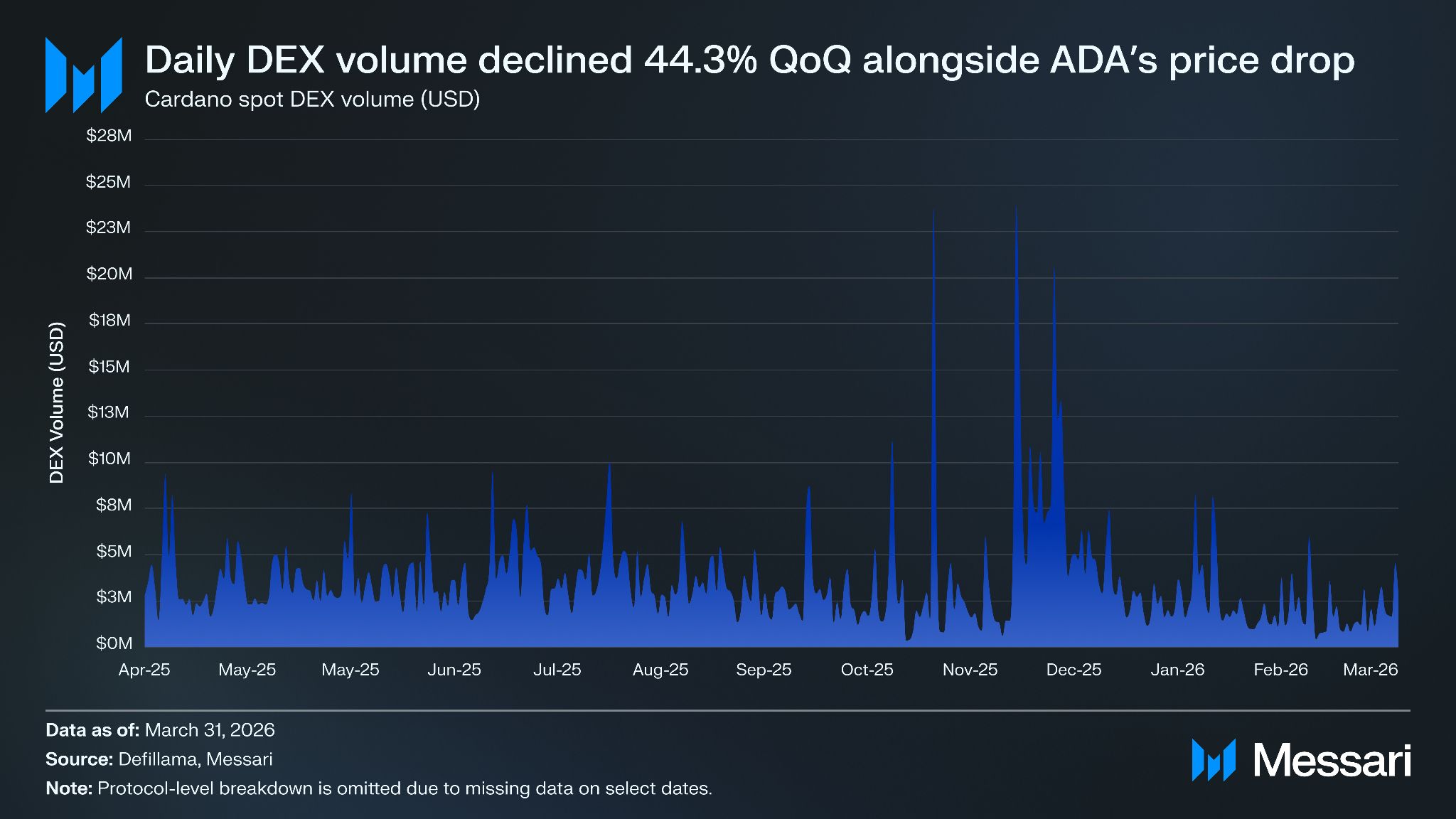
Average daily DEX volume on Cardano, including spot AMM and order-book trading, decreased 44.3% QoQ to $2.5 million in Q1 2026. The Cardano network is home to several DEXs, such as:
Minswap is Cardano's leading DEX, offering multi-pool swap routing, yield farming, and its own MIN governance token. The protocol retained its dominant position, with average daily swap volume of $1.7 million, capturing 67% of network DEX activity in Q1, down modestly from around 71% in Q4. However, volume fell 47.6% QoQ from $3.2 million, in line with the 44.3% contraction in total network DEX volume.
WingRiders is a Cardano AMM DEX offering token swaps, liquidity provision, ADA auto-staking, and yield farming. The protocol was the second-largest DEX with an average daily volume of $333,700 in Q1, or approximately 13% of network DEX volume. Volume fell 37.9% QoQ from $537,400, a smaller decline than the 44.3% broader network contraction.
Danogo was the only top-five DEX with positive volume growth in Q1, averaging $242,700 in daily volume for approximately 10% of network DEX activity, up from $163,300 and roughly 4% share in Q4. The 48.6% QoQ growth extends the traction Danogo built through its leveraged trading features and was reinforced in March by the launch of a USDCx lending pool, which gave yield-seeking capital a dollar-denominated destination on the protocol following USDCx's debut in February 2026.
SundaeSwap is one of Cardano's earliest DEXes, providing AMM-based liquidity and token swaps. Average daily volume fell 56.8% QoQ to $206,900, reducing its share of network DEX volume to approximately 8% from roughly 11% in Q4. SundaeSwap was integrated into Orcfax's oracle infrastructure in Q1’26, which uses liquidity-weighted analysis across SundaeSwap pools to provide manipulation-resistant price feeds for Cardano native tokens.
Splash is a DEX that also developed snek.fun, a pump.fun-style launchpad for Cardano native tokens. Average daily volume fell 84.2% QoQ to $18,600, and its share of network DEX volume slipped to under 1% from approximately 3% in Q4, aligning with the broader cooldown in memecoin-launchpad activity.
NFTs
Average daily NFT sales on Cardano fell 48.9% QoQ to 141.0, while average daily trading volume (USD) declined 81.2% QoQ to $115,240 in Q1’26. Sales count, a more normalized measure of marketplace activity, fell at roughly half the rate of volume. jpg.store remained Cardano's top NFT marketplace based on transaction volume. The single largest NFT trading day in Q1 occurred on Feb. 5, 2026, when daily volume spiked to 550,350 ADA.
Development, Growth, and Community
Project Catalyst Transitions to Cardano Foundation Stewardship
In February 2026, the Cardano Foundation agreed to assume stewardship of Project Catalyst from IOG, with the appointment ratified onchain on Apr. 20, 2026. The transition was framed as a step toward maintaining funding continuity with tighter administrative controls and milestone-based gating. The handover triggered a pause for Fund 15 and Fund 16, with Fund 15's 18.5 million ADA and 250,000 USDM budget returned to the treasury, while the Cardano Foundation charted the next phase with Intersect to redesign the operating model. The transition aims to maintain funding for the 500+ active projects administered against agreed milestones through Fund 14, with the Foundation and Intersect jointly redesigning Catalyst's operating model.
CME ADA Futures and Spot ETF Path
On Feb. 9, 2026, CME Group launched regulated futures contracts for ADA, offering both standard (100,000 ADA) and micro (10,000 ADA) contract sizes. ADA became the third cryptocurrency, after Bitcoin and Ether, to have regulated CME futures. The launch initiated the six-month period required under SEC generic listing standards for a potential spot ADA ETP, with the earliest eligibility falling on Aug. 9, 2026. ADA also gained ground in existing institutional vehicles during the quarter. Hashdex expanded its Nasdaq Crypto ETF in March 2026 to include ADA and Chainlink, broadening the fund's basket to seven cryptocurrencies, and Grayscale increased ADA's weighting in its Smart Contract Fund to 19.55% in February, up from 18.55% in January.
Peer L1s sit at different points on the regulated-derivatives and spot ETF track. Ethereum leads with multiple spot ETFs trading, with Solana following and accounting for $1.45 billion in cumulative net inflows by March 2026. Avalanche shipped two spot ETFs in Q1’26, including VanEck's VAVX on Jan. 26Aug. 9, 2026, and Grayscale's GAVA on Mar. 12, 2026. Stellar has none filed or approved. Cardano sits approximately one quarter behind Avalanche and two to three quarters behind Solana on this track, with the Aug. 9, 2026, generic listing standard eligibility window as the next forward catalyst.
Cardano Card Adoption Progress
The EMURGO-Wirex Cardano Card, launched at Cardano Summit 2025 in Q4'25, is built on Wirex's Banking-as-a-Service (BaaS) stack. The broader Wirex BaaS infrastructure surpassed $1 billion in annualized onchain payment volume within 131 days of launch. On Feb. 18, 2026, Wirex launched Stablecoin Push-to-Card powered by Visa Direct, enabling stablecoin-funded payouts to more than 3 billion cards across 200+ countries and territories. The Cardano Card enables Cardano holders to spend USDC, EURC, and USDT (settled on Base) at Visa-accepting merchants, complementing USDCx's launch as the inbound side of Cardano's regulated payments infrastructure. USDCx and the Cardano Card together put the infrastructure for Cardano's first end-to-end payments stack in place, with institutional dollar liquidity inbound through Circle's xReserve and Visa merchant access outbound through Wirex.
Wallets
The major Cardano wallets also advanced their feature sets throughout Q1'26 in preparation for the Midnight mainnet launch and the broader stablecoin and cross-chain expansion. Lace prioritized native support for the Midnight Network and advanced its LaceID identity feature, a "proof of humanity" primitive for permissioned applications. Yoroi implemented dual rewards for staking pools, allowing users to earn both ADA and NIGHT tokens simultaneously through a single staking position. Zengoannounced plans in January 2026 to integrate Cardano with a focus on the Bitcoin DeFi market, and both NuFi and Vespr added USDCx support, coinciding with the stablecoin's launch.
Developer Tooling and Events
Cardano's developer tooling continued to mature through Q1. The Aiken smart contract language saw continued adoption, while the Cardano Foundation released Yaci Store 2.0.0, a high-performance Cardano indexer, and Rosetta Java v2.1.0 to support Conway-era governance features.
Cardano had a strong presence at Consensus Hong Kong in February 2026, where Charles Hoskinson used his keynote speech to announce the LayerZero integration timeline and Midnight's mainnet launch date. The conference drew 11,000 attendees with a heavy focus on the agentic economy and institutional infrastructure. Buidler Fest #3 followed on Mar. 24-25, 2026, in Buenos Aires, and focused on developer tooling and formal verification. A January 2026 UNDP report noted that approximately 50% of the blockchain solutions featured were built on Cardano, providing third-party validation of Cardano's enterprise positioning.
Closing Summary
Q1 2026 was a quarter where Cardano's price and its institutional stack moved in opposite directions. ADA fell 27.4% QoQ to $0.24, DeFi TVL compressed 23.5% to $133.1 million, and daily active addresses dropped 28.1% to 13,400. The staking rate rose to 58.3%, average daily transactions held steady at 26,550, and stablecoin market cap grew 27.1% to $48.6 million behind USDCx's $17.5 million close. The quarter's substantive signal lies in the institutional events it produced: USDCx on Feb. 27, CIP-0113 on Mar. 9, LayerZero enabled cross-chain transfers and messaging on Mar. 17, Midnight mainnet on Mar. 30, and Grant Thornton Switzerland's first global onchain financial audit secured through the Reeve framework.
While Cardano is not winning on the consensus institutional metrics such as ETF flows, stablecoin scale, RWA, and TVL, it has assembled an institutional infrastructure base no peer L1 has put together in one window. The coordinated Pentad execution against a multi-year capital budget, audit credibility through Reeve and Grant Thornton, compliance programmability via CIP-0113, and an FSCS-protected tokenization venue in Midnight all lay the groundwork for institutions to build on Cardano. Looking ahead, the August 2026 spot ETP eligibility window, Van Rossem's late-June enactment, and the Q2 to Q4 cadence on the remaining Critical Integrations pillars are the three forward markers that will determine whether the Q1 foundation compounds.
This report was commissioned by Intersect. All content was produced independently by the author(s) and does not necessarily reflect the opinions of Messari, Inc. or the organization that requested the report. The commissioning organization may have input on the content of the report, but Messari maintains editorial control over the final report to retain data accuracy and objectivity. Author(s) may hold cryptocurrencies named in this report. This report is meant for informational purposes only. It is not meant to serve as investment advice. You should conduct your own research and consult an independent financial, tax, or legal advisor before making any investment decisions. Past performance of any asset is not indicative of future results. Please see our Terms of Service for more information.
No part of this report may be (a) copied, photocopied, duplicated in any form by any means or (b) redistributed without the prior written consent of Messari®.