
Executive Summary
More businesses built on Avalanche in the third quarter, and their products set records. Growth across institutional finance, real-world asset, and embedded payments points to a broader shift toward invisible adoption, where blockchain powers financial products and services behind the scenes without requiring customers to understand or interact with the underlying technology. ICE, the owner of the New York Stock Exchange, is evaluating Avalanche for its planned 24/7 onchain trading platform and has not yet named a chain. Charles Schwab plans to add AVAX for its brokerage clients, Janus Henderson became a validator, and New York Life Investment Management is bringing its first tokenized fund to Avalanche. Ethena launched its Ethena Pay neobank app, and Uptop's card-linked fan rewards grew from three programs to eight. Avalanche Summit NYC in September drew more than 1,500 attendees from more than 600 companies in more than 50 countries.
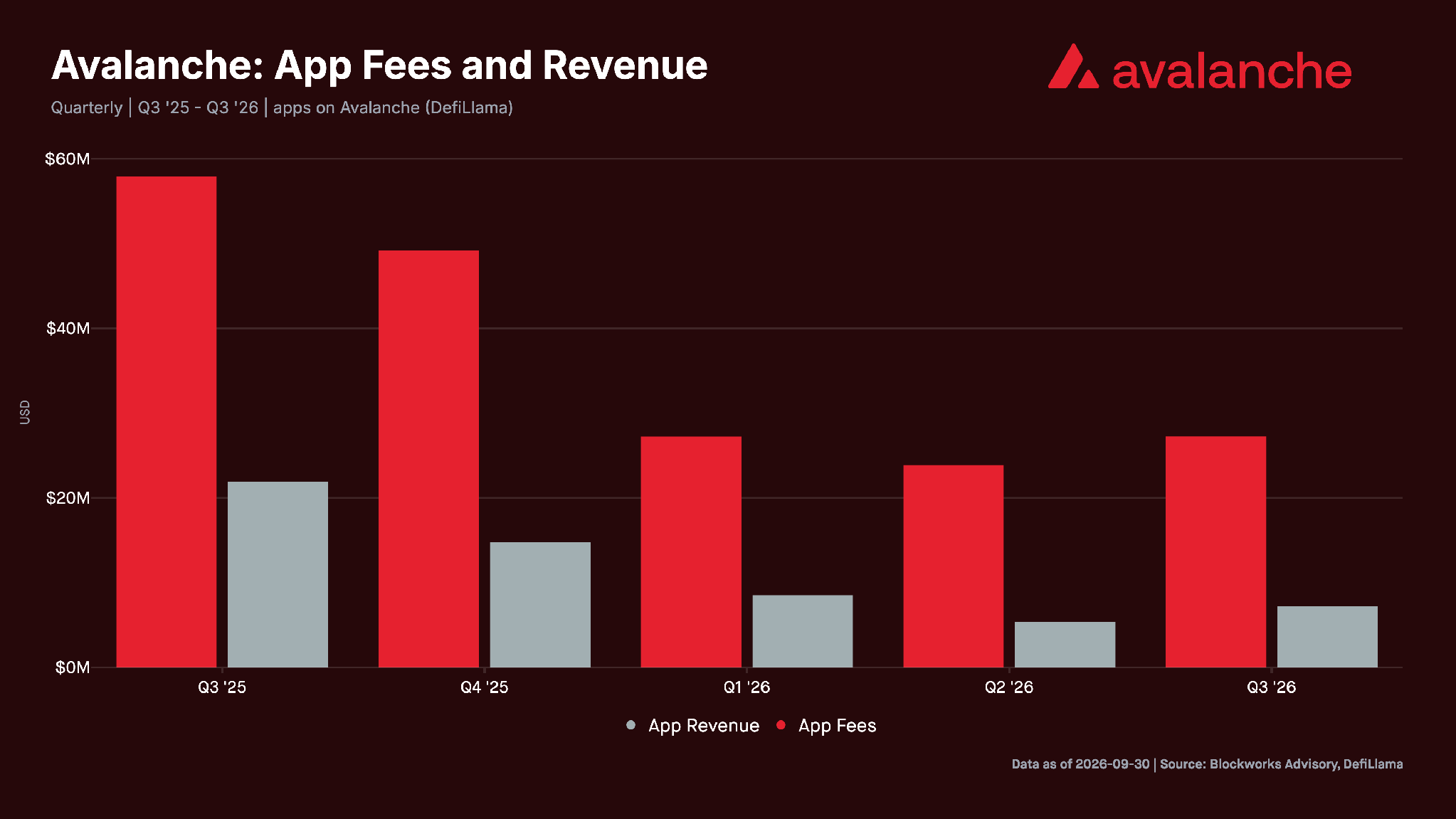
That shift toward invisible adoption is increasingly reflected in measurable economic activity, particularly in payments and settlement, where blockchain can improve how money moves without changing how financial institutions or the end user interact with financial products. Card spend on Avalanche reached a record $10.05 million, net of refunds, up 74% from the second quarter, and Ethena Pay accounted for more than a third of September's total. Pharaoh, the main exchange for AVAX pairs on the C-Chain, Avalanche's Ethereum-compatible smart-contract chain, doubled its volume to $5.33 billion. September alone brought a record $2.86 billion. Pharaoh also climbed from 28th to 21st among DEXs on all chains. Axiym's settlement pools moved a record $529 million, and purchases of tokenized stocks and ETFs on Dinari's chain reached a record $9.0 million. Apps on Avalanche generated $27.2 million of fees, up 14%, and $7.25 million of revenue, up 35%, the first quarterly increase in both since the third quarter of 2025.
Tokenized real-world assets on the C-Chain reached $1.22 billion at quarter-end, fourth among 24 tracked networks, a total that includes $407 million of SECZ, Securitize's own listed stock issued as a token. BlackRock's BUIDL fund grew 21% on Avalanche to $486.5 million. The fund overall was roughly flat. This growth reflects how blockchain is becoming part of the underlying infrastructure for traditional financial assets, supporting their issuance, management, and transfer without requiring institutions to fundamentally change the financial products they offer.
The Helicon upgrade activated on September 22. It lets the C-Chain run consensus and execution in parallel, and it cuts the minimum validator commitment from two weeks to 48 hours. Network fees rose 44% to 61,583 AVAX (about $519,000), the first quarterly increase since the fourth quarter of 2025, and all of the increase came in the nine days after the upgrade. Staked AVAX ended the quarter at about 198 million across 594 validators. Continued infrastructure improvements support Avalanche's ability to serve a growing range of financial applications, from institutional markets and tokenized assets to payments embedded directly into existing products and services.
Financials
Apps on Avalanche generated $27.2 million of fees in the third quarter, up 14%, and $7.25 million of revenue, up 35%, the first quarterly increase in both since the third quarter of 2025. September fees of $10.4 million were the highest monthly total since January. Pharaoh produced more than half of app revenue, and fees from BlackRock's BUIDL fund doubled to $5.86 million.
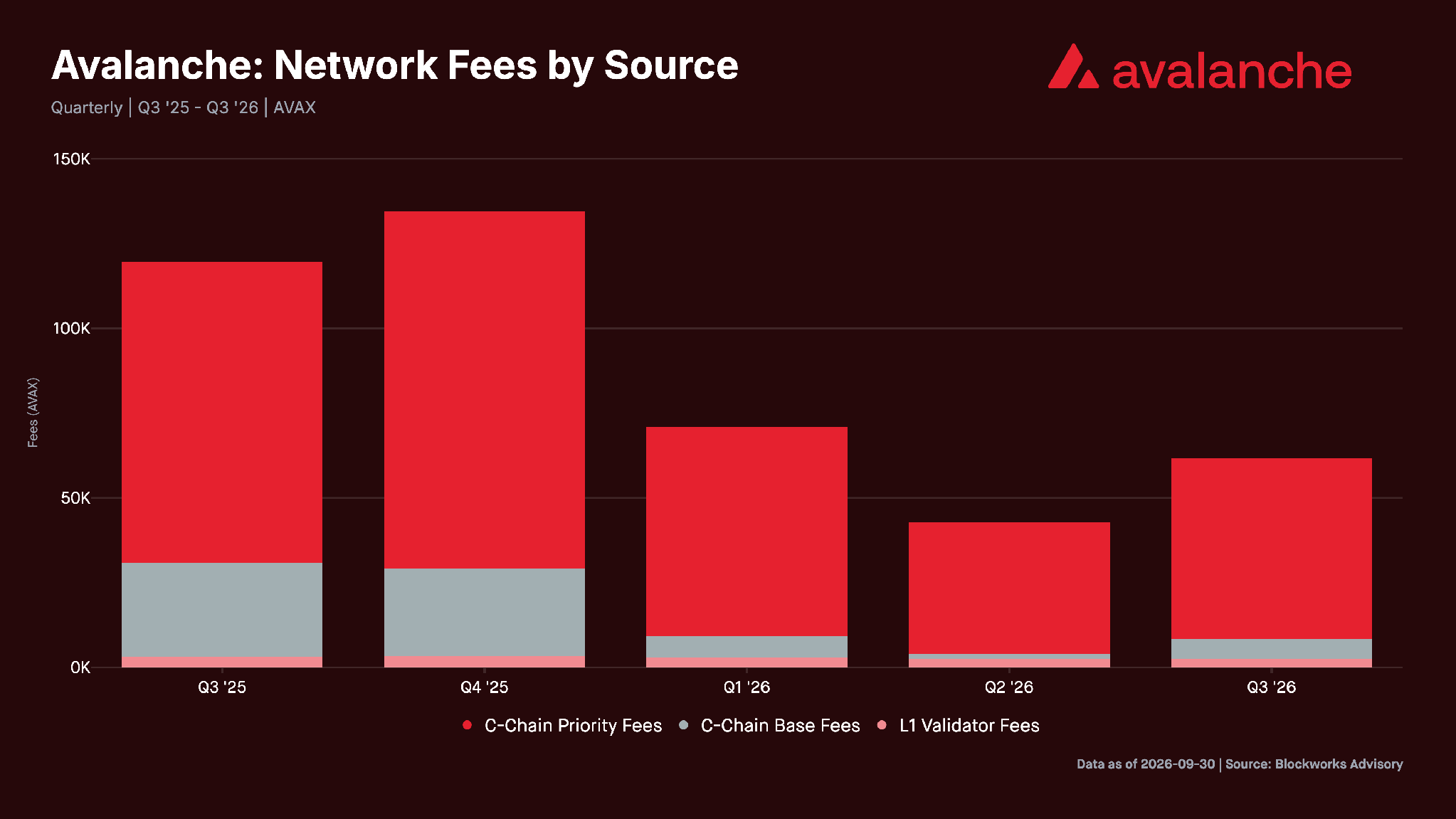
Network fees totaled 61,583 AVAX (about $519,000), up 44% from the second quarter and the first quarterly increase since the fourth quarter of 2025. The increase came after the Helicon upgrade activated on September 22. C-Chain fees from July 1 to September 21 totaled 39,402 AVAX, close to the 40,053 AVAX of the whole second quarter, and the nine days that followed added 19,724 AVAX. The higher level carried into October, when C-Chain fees through the 22nd reached about 25,300 AVAX, more than 40% of the third quarter's total.
C-Chain priority fees made up 86% of the total and base fees about 10%, and both are burned. The C-Chain's minimum gas price had been 1 wei since April 2025, so base fees stayed close to zero. Helicon lets validators change that minimum. Each validator states the gas-price floor it prefers, and the network moves toward the stake-weighted median, so the floor can change without another upgrade. It binds only when demand is light; on busy days, the existing fee market sets the price. After validators raised it, base fees averaged about 620 AVAX a day from September 27 to 30, against about 40 a day earlier in the quarter. The continuous fees that L1 validators pay to stay active on the P-Chain, which manages Avalanche's validators, added 2,444 AVAX (about $18,000), 6% less than in the second quarter.
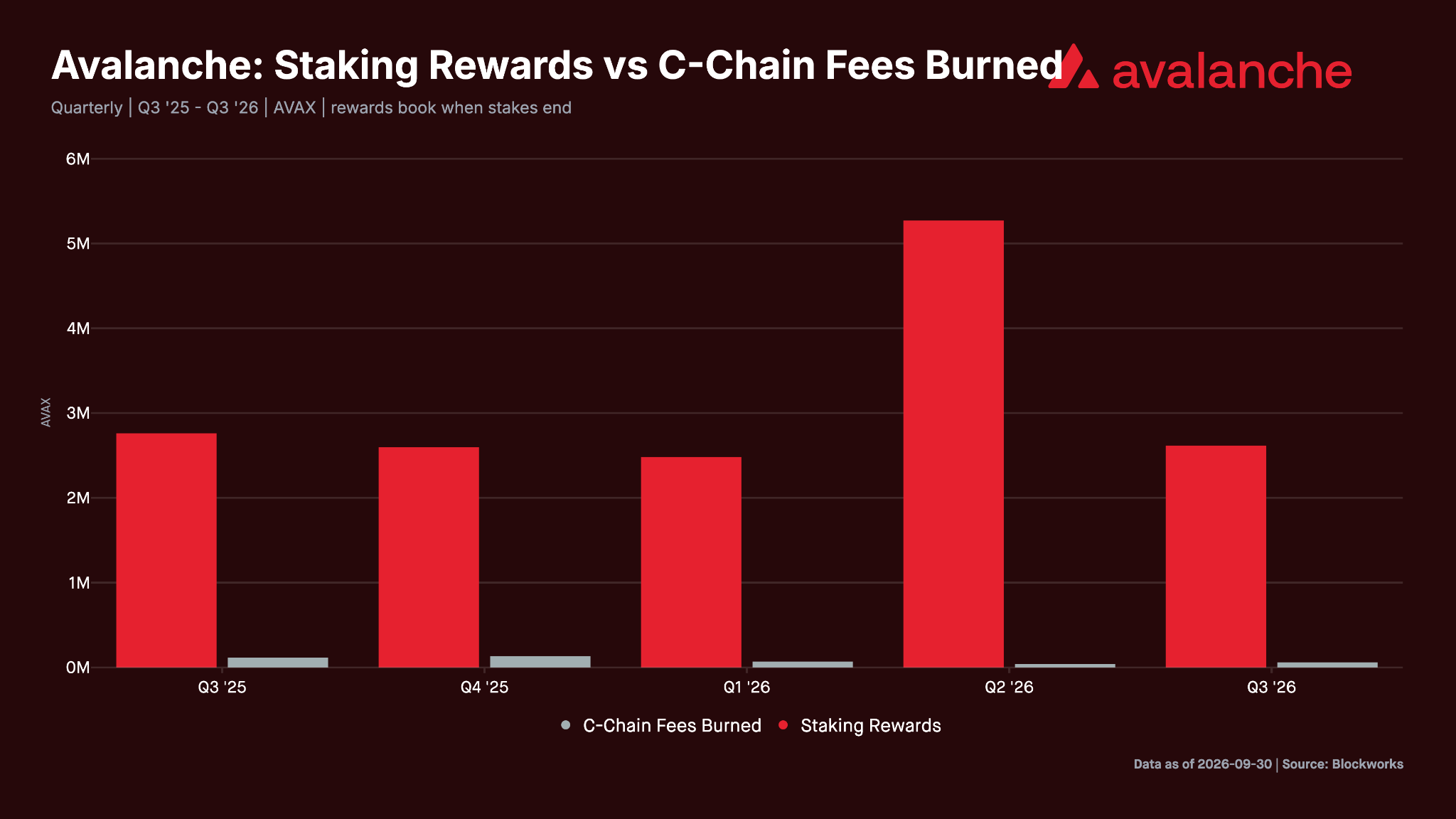
Staking rewards totaled about 2.62 million AVAX (about $19.1 million) in the third quarter, and the network burned 59,126 AVAX (about $501,000) of C-Chain fees, about 2.3% of rewards, for net issuance of about 2.56 million AVAX (about $18.6 million). Quarterly totals are uneven because a validator receives its reward at the end of its staking period. The second quarter's 5.27 million AVAX (about $47.2 million) reflected a large set of stakes that ended in May. Validators can now renew their stakes automatically and receive rewards at the end of each cycle, which can be as short as 48 hours, so rewards should book more evenly from the fourth quarter.
Helicon also introduced a new reward curve. It lowers the minimum consumption rate in the staking-reward formula from 10% to 7.5% and leaves the one-year rate unchanged, so the reward rate for a 14-day stake falls by about 1.3 percentage points while the gap between 14-day and one-year stakes widens from about 1 point to 2.3. The change phases in over 90 days, through about December 21. Each stake keeps the rate set when it starts, so the new curve applies only to stakes that began after September 22. The proposal's own modeling of staking behavior projects that annual AVAX inflation will fall by 0.5 to 1 percentage point. The Avalanche Foundation will study Helicon's effects as part of its economic research agenda, which focuses on sustainable value accrual and validator economics.
Staked AVAX ended the quarter at about 198 million across 594 validators, roughly 42% of total supply, against about 208 million at the end of June.
Revenue Drivers
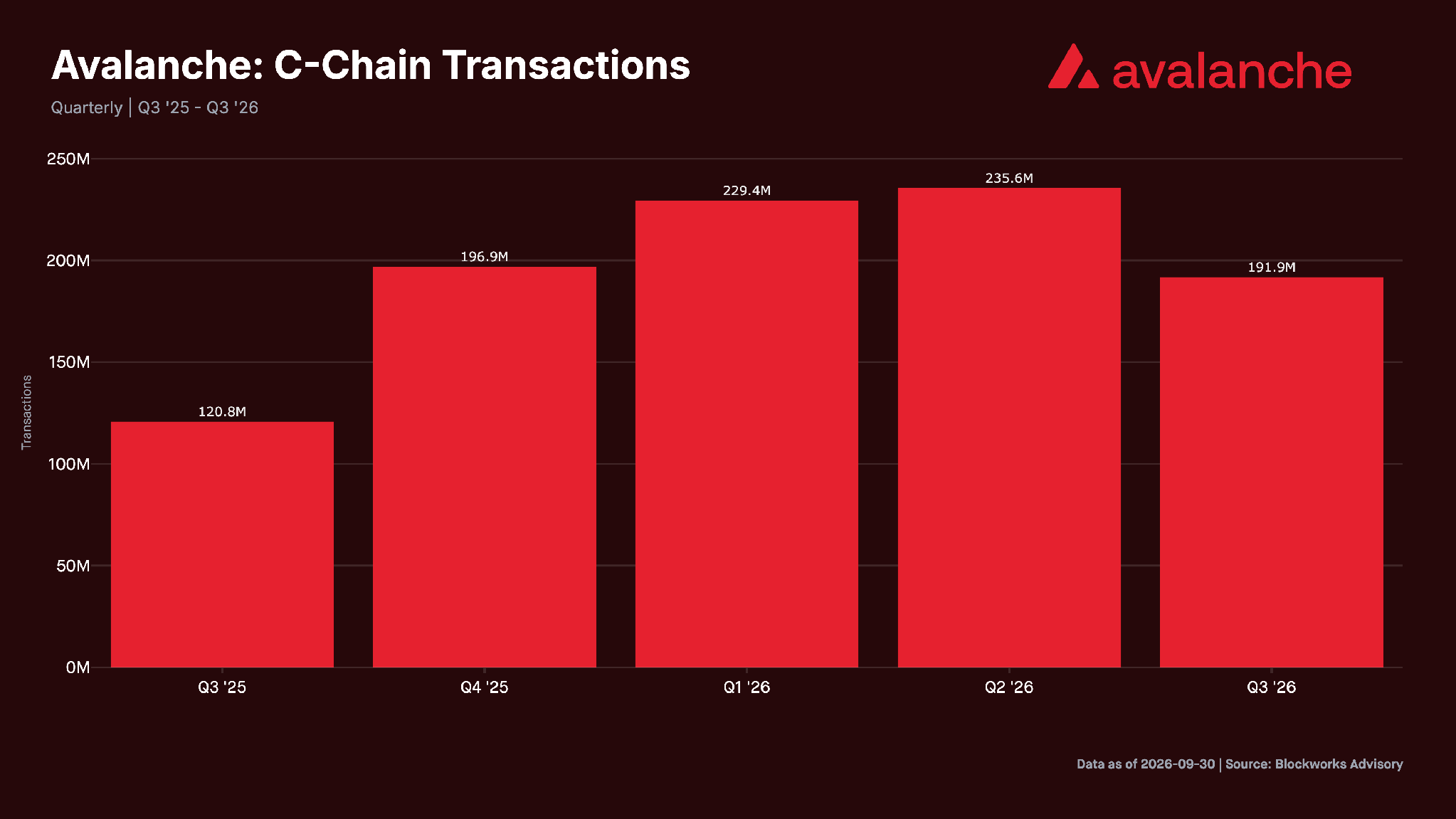
C-Chain transactions totaled 191.9 million, down 19% from the second quarter. Monthly transactions fell from 91.2 million in July, nearly half the quarter's total, to 31.6 million in September. Daily active addresses averaged about 144,000, against 621,000 in the second quarter, and fell from about 304,000 a day in July to about 23,000 in September. C-Chain fees per transaction rose about 81% from the second quarter in AVAX terms.
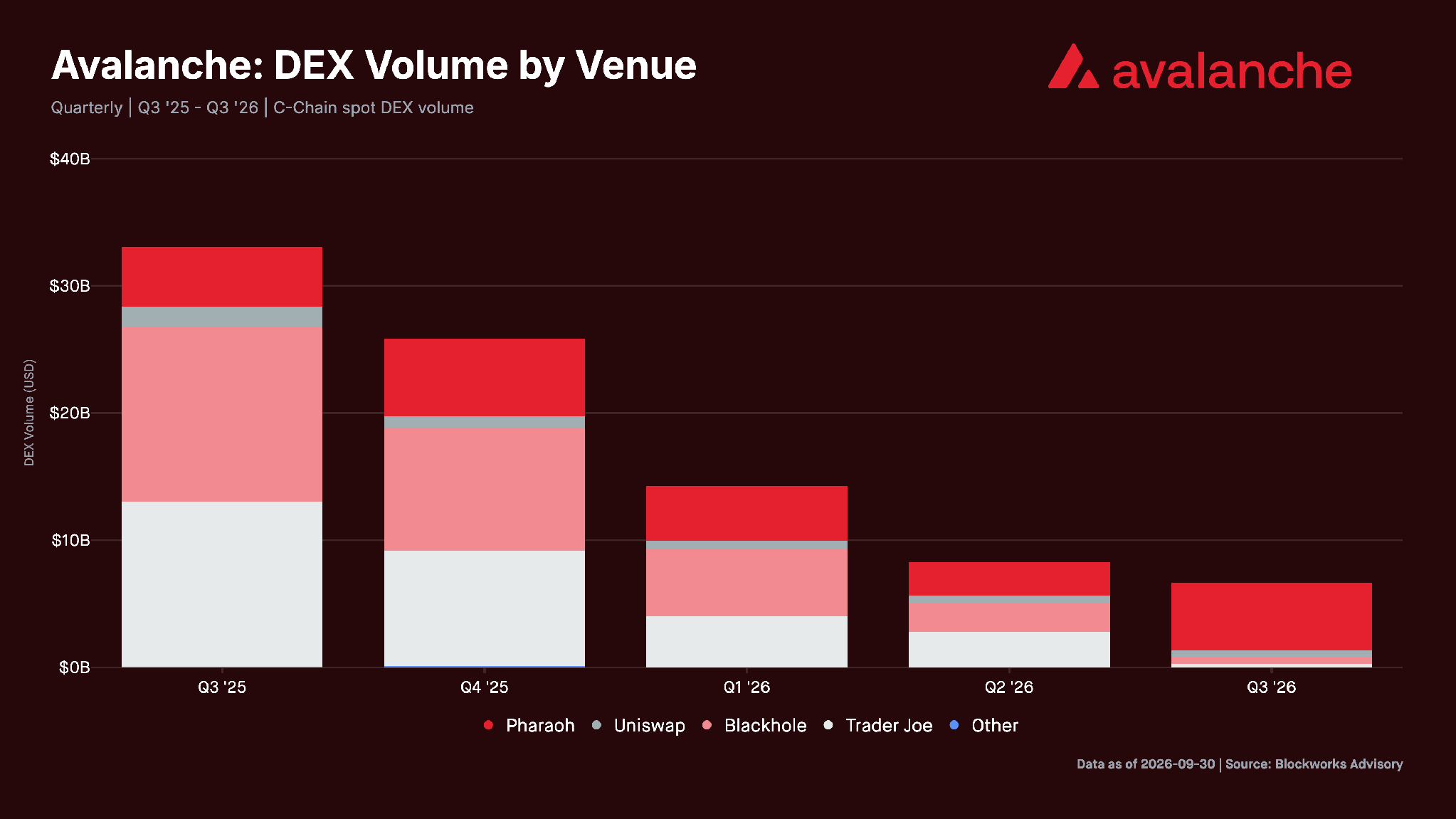
Pharaoh handled $5.33 billion of trading on the C-Chain in the third quarter, double its second-quarter volume and about 80% of the C-Chain's $6.64 billion of DEX volume, which fell 20% from the second quarter. C-Chain DEX volume rose every month, from $1.30 billion in July to $3.46 billion in September, and Pharaoh's share climbed from 74% to 83%. Its September volume of $2.86 billion was a record, and it climbed from 28th to 21st among DEXs on all chains by quarterly volume. Pharaoh plans to add 24/7 trading of tokenized US stocks and has not yet named an issuer or launch date. Among the other venues, Uniswap handled $0.54 billion (from $0.58 billion), Blackhole $0.49 billion (from $2.27 billion), and Trader Joe $0.29 billion (from $2.76 billion).
The app fee total includes $5.86 million attributed to BlackRock's BUIDL fund; without it, app fees were about $21.4 million. Pharaoh's fees reached $4.2 million, 2.4 times the prior quarter, and its share of app revenue rose to 57% from 31%, while revenue from all other apps fell from $3.7 million to $3.1 million.
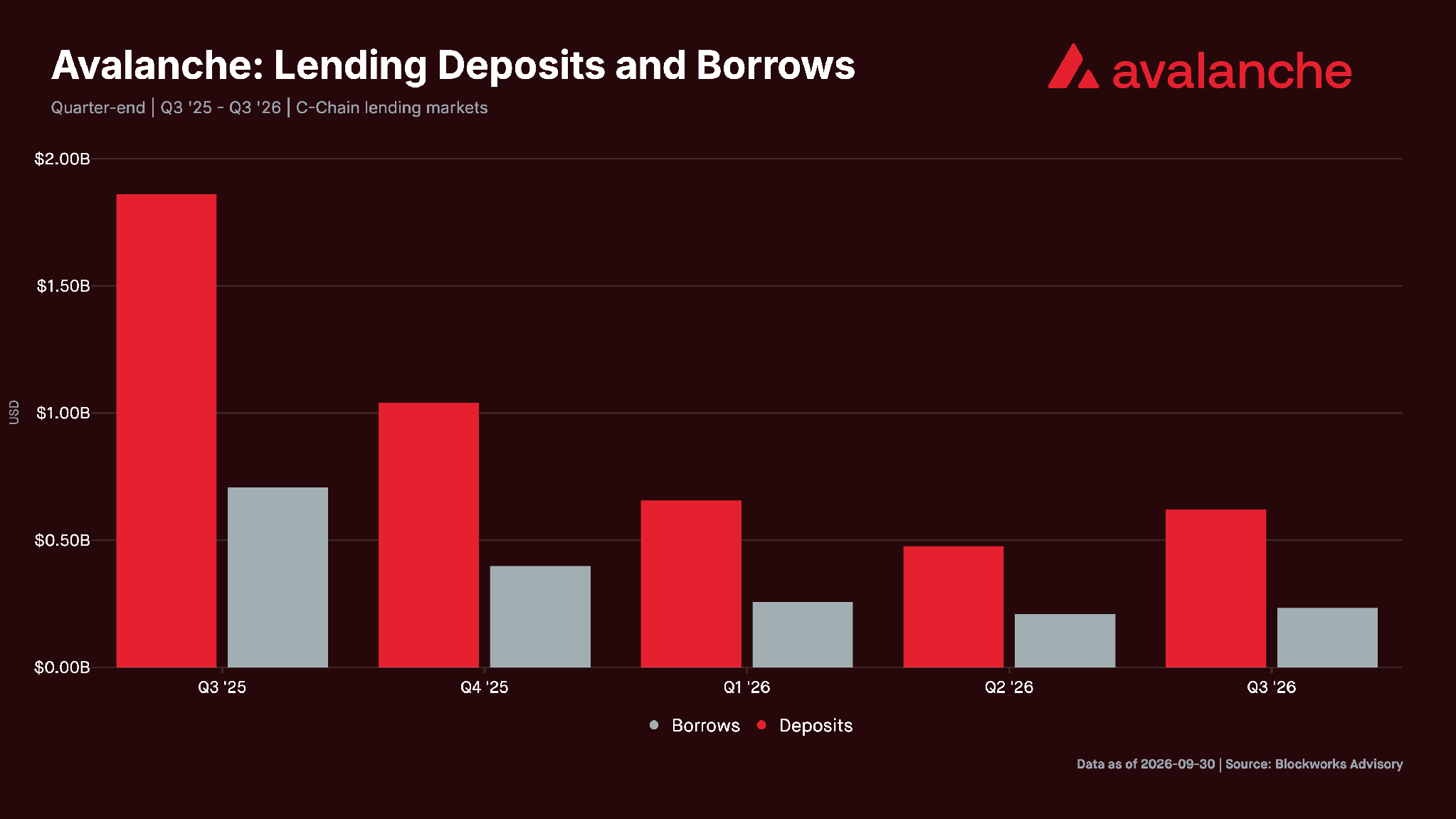
Lending markets on the C-Chain held $622 million of deposits at quarter-end, up from $476 million at the end of June. Borrows stood at $234 million, up from $209 million. Lending revenue slipped to $0.40 million from $0.54 million.
Tokenized Assets
Value and Rank
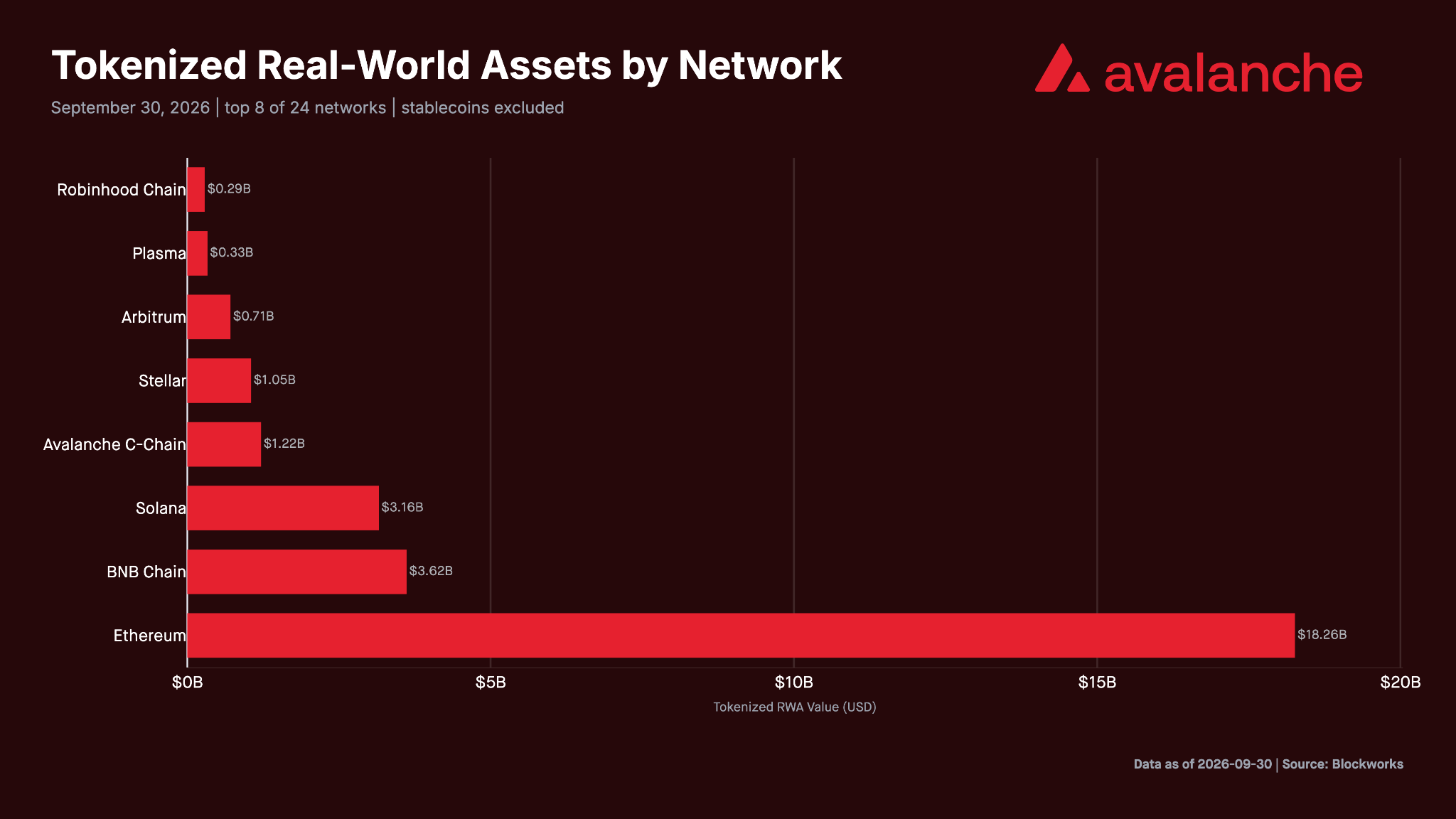
Tokenized real-world assets on the C-Chain reached $1.22 billion at quarter-end, fourth among 24 tracked networks and up from sixth at the end of June. SECZ, Securitize's own listed stock issued as a token, accounted for $407 million of that total; without it, the C-Chain's tokenized assets rose 10% from June. BlackRock's BUIDL fund is the largest single tokenized product on the C-Chain. It held $486.5 million on Avalanche at quarter-end, up 21% in the quarter while the fund overall was roughly flat, which put more than a fifth of the fund on Avalanche.
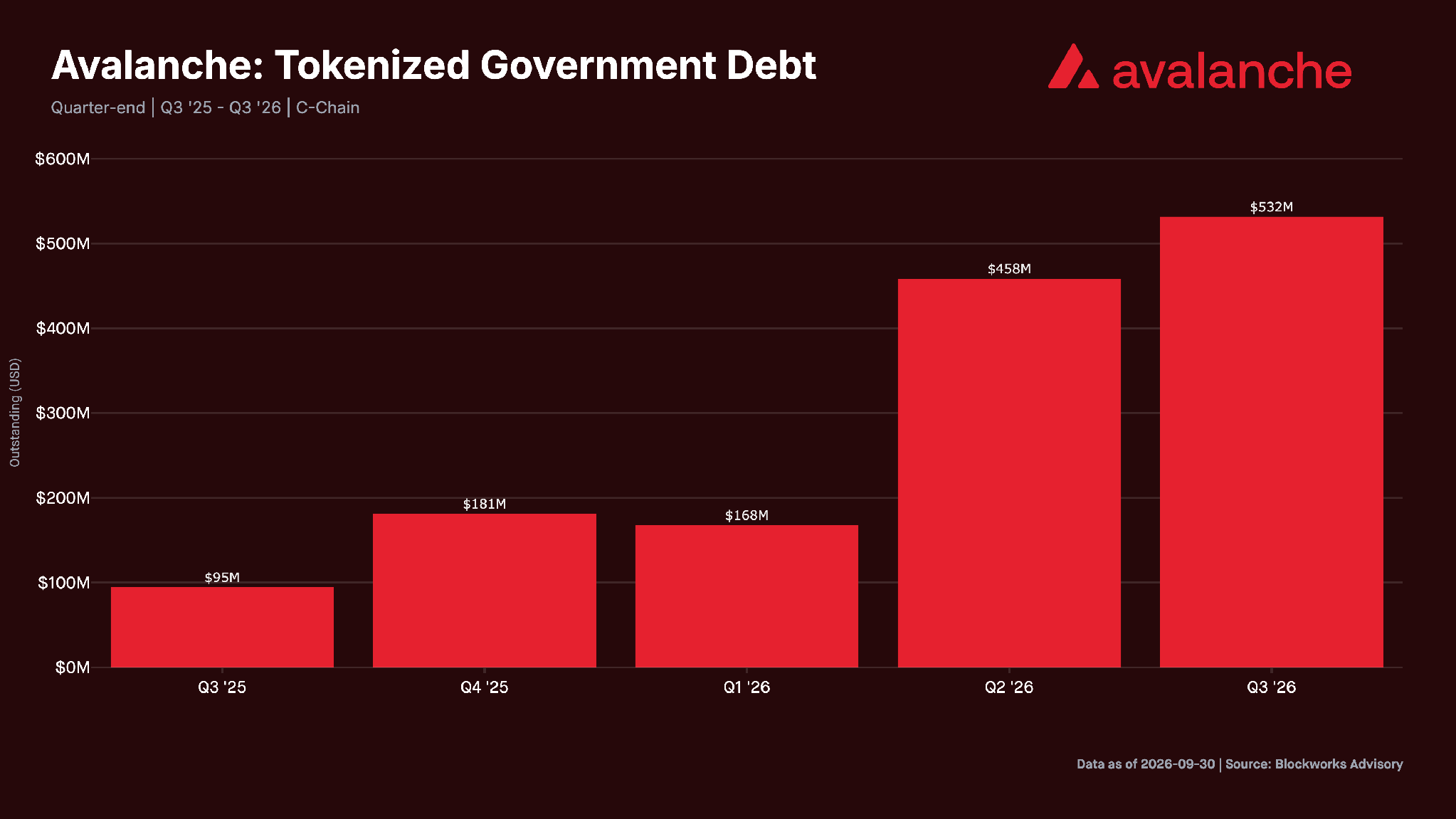
Tokenized government debt on the C-Chain, mostly BUIDL, reached $531.6 million, fifth among 16 networks and up 16% from June. A year earlier it was $94.6 million and ranked sixth. Avalanche's share of tokenized government debt across networks rose from 1.4% to 4.9% over the year, moving it past Arbitrum.
Issuers and Funds
Outside the C-Chain, tokenized securities also run on dedicated chains, the model Avalanche calls customization without isolation, in which each platform runs its own Avalanche L1 with its own validators and rules while staying connected to the rest of the network. Progmat completed its migration on July 10, and 45 of Japan's 89 publicly disclosed security-token projects now run on its L1, with more than ¥452 billion (about $2.8 billion) of assets across its active projects. Dinari opened tokenized US stocks and ETFs, including the full S&P 500, to eligible US investors on August 4. The number issued on its chain rose from 258 to 528 during the quarter, and purchases reached a record $9.0 million, up 34%.
Lynq, Tassat's settlement network, began offering Goldman Sachs' Treasury Instruments Fund to qualified US firms through tZERO Securities on September 28. The shares are the fund's ordinary institutional class, not a tokenized version. Lynq connects more than 30 institutions, and moving it onto a dedicated Avalanche L1 made processing 65% faster and cut infrastructure costs by 50%.
Securitize launched HINC on Avalanche on August 18, with Neuberger Berman as sub-adviser. New York Life Investment Management is bringing HYB, its first tokenized fund, to Avalanche through Centrifuge, and Midas brought tokenized Wellington and Fasanara strategies on September 22. Cashlink is bringing its European institutional securities infrastructure to Avalanche. Hanwha Investment & Securities has built a tokenized-securities platform that uses Avalanche ahead of Korea's rules for tokenized securities, which take effect in February 2027.
Lending, Yield, and Trading
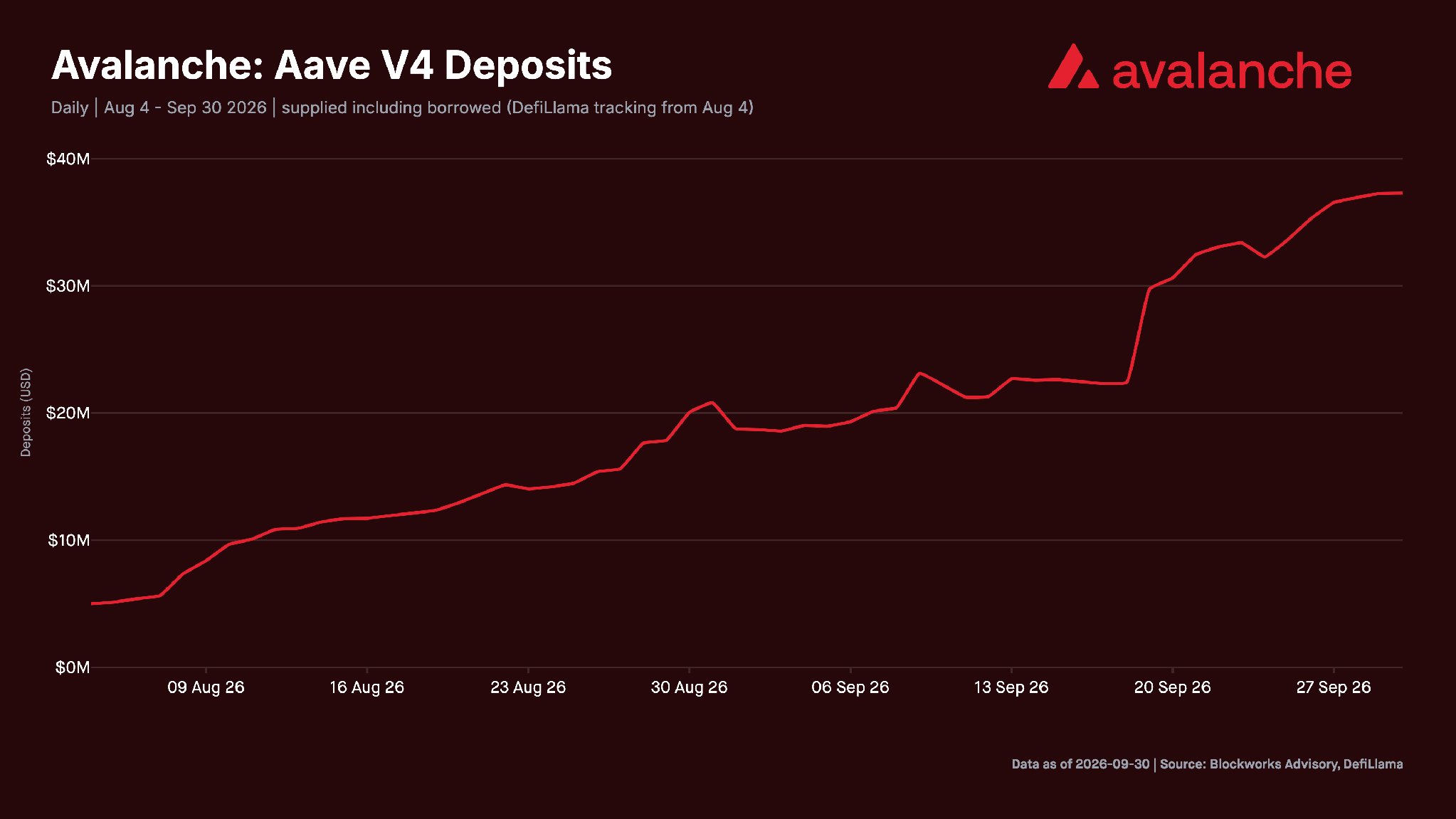
Aave V4 went live on Avalanche on July 15, its first deployment beyond Ethereum, and held $37.3 million of supplied assets on September 30, including the portion borrowed. Aave plans its first V4 RWA Hub on Avalanche, where institutions would borrow stablecoins against tokenized assets, with Tether's USA₮, issued by Anchorage Digital Bank, as the primary dollar asset. The hub awaits Aave governance and has no launch date. Aave founder Stani Kulechov wrote on September 30 that "Avalanche will be the hub for RWAs for Aave."
OpenTrade's RWA-backed vaults held $171.9 million on Avalanche at quarter-end, up from $164.9 million, making Avalanche its largest chain with 64% of its total. Littio, a Colombian neobank, runs its yield product on those vaults. The OatFi, Valinor, and Fence credit facility lent about $19 million in the quarter; payouts and repayments together reached a record $38.2 million, up 37% from the second quarter, a total that counts each loan roughly twice. Tare raised a $13.25 million seed round led by Blockchain Capital, with Janus Henderson and the Avalanche Foundation participating, to build a private-credit exchange on Avalanche that is not yet live.
ICE announced its planned 24/7 onchain trading platform in January, designed to support multiple chains for settlement and custody, and is evaluating Avalanche for it. At Avalanche Summit NYC, Michael Blaugrund, ICE's Vice President of Strategic Initiatives, described Avalanche as checking "a lot of those boxes for us." ICE has not yet named a chain.
Protocol Analysis
Businesses used Avalanche to add products and revenue lines in the quarter, including a neobank, college fan rewards, cross-border payment rails, and public records.
Neobanks, Cards, and Fan Rewards
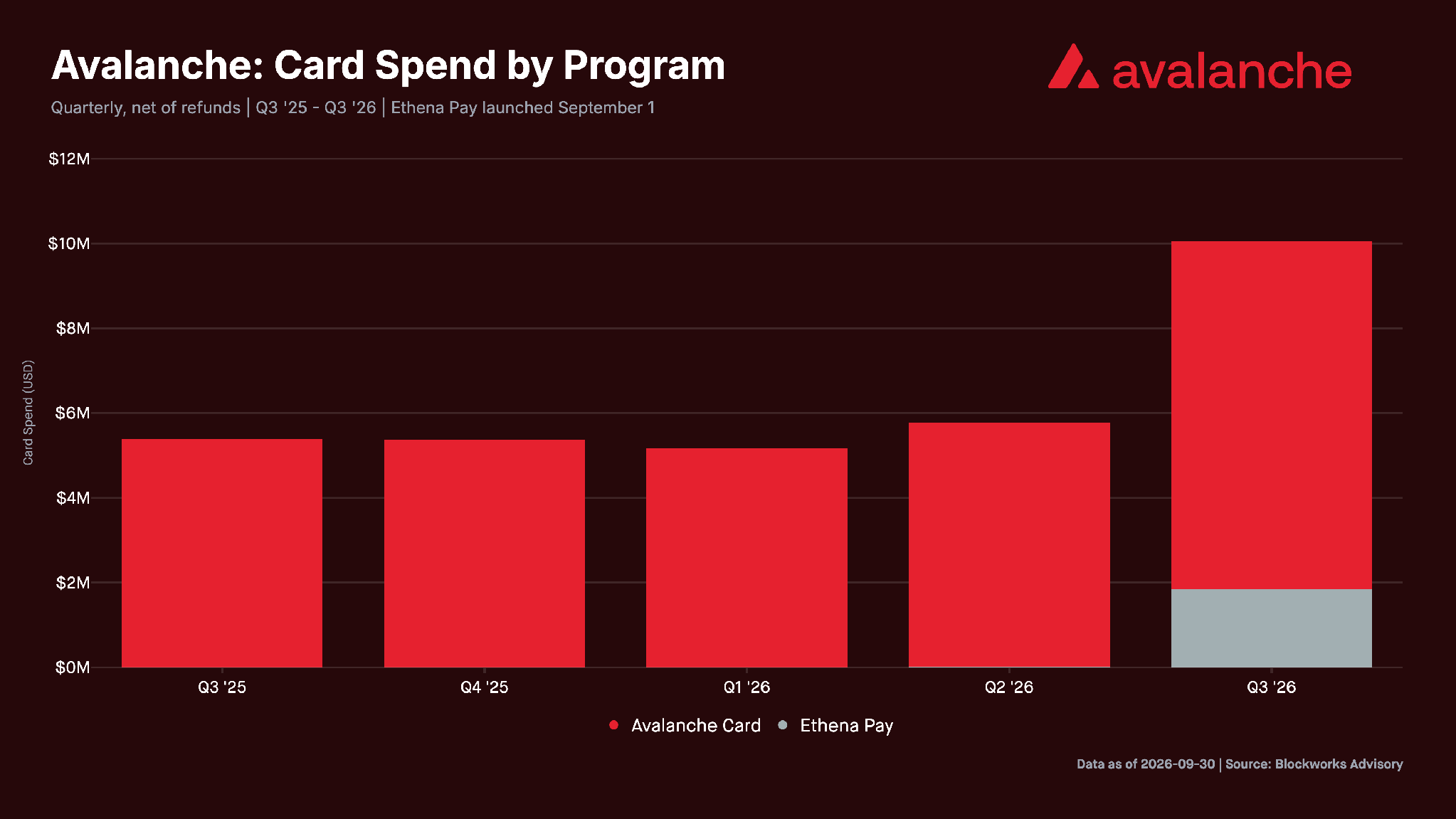
Card spend on Avalanche set a quarterly record of $10.05 million, net of refunds, up 74% from the second quarter, with a new monthly record in each of July, August, and September. Avalanche Card, Rain's Visa card that spends stablecoins and AVAX held by the cardholder, grew 42% to $8.2 million, and in July it was the second-fastest-growing card program among those with more than $1 million of monthly spend. Ethena Pay, a neobank app that lets users save, send, and spend USDe, opened in early access on September 1 on iOS in more than 50 countries. Its card is offered only to non-US persons. Its September spend was about six times August's, the fastest growth among card programs with more than $1 million of monthly spend, and it accounted for more than a third of September's card spend on Avalanche. Funded accounts rose from 190 at the end of August to 842 at quarter-end, and Ethena Pay's October spend through the 25th already exceeded its September total. Ethena CEO Guy Young described Ethena Pay as "almost invisible infrastructure that sits in the background."
Uptop, a Rain company since November 2025, runs card-linked fan rewards on Avalanche. It added Penn State, Baylor, Nevada, Memphis, and Michigan between August 24 and September 16, giving it six Division I programs, part of the eight programs it runs on Avalanche alongside the Cleveland Cavaliers and Detroit Pistons. LSU was its first college program. Fans link a card they already carry and earn points. Michigan's partners include Meijer, Coca-Cola, and CITGO. Rain, which runs stablecoin-funded Visa card programs, plans to let its cards link to the Uptop rewards marketplace, and Penn State, Memphis, and Michigan have announced co-branded prepaid cards or loaded-value credentials, which could bring stablecoin payments into these programs over time. Insomniac, the Live Nation company whose more than 450 events and 30 festivals draw more than 7 million fans a year, is exploring an onchain fan loyalty program with Rain on Avalanche. Sports Illustrated Tickets has put more than 1 million tickets onchain over the past year, and FIFA Collect passed 1 million users.
Payments and Treasury
Axiym's stablecoin settlement pools sent and received a record $529 million for cross-border payments, up 13% from the second quarter and 4.4 times the level a year earlier. Nonco converted $154.5 million of US dollars to Mexican pesos, up every quarter since its launch a year ago, and since July it has provided 24/7 stablecoin liquidity against Lynq's tokenized fund shares. Hyundai Card and Hyundai Motor moved $20,000 of treasury funds as USDT from the US to Mexico in a July pilot with Tether and Axiym. The transfer took about seven minutes, against three to four hours by interbank transfer. Hyundai Card's next step is proving the model at scale.
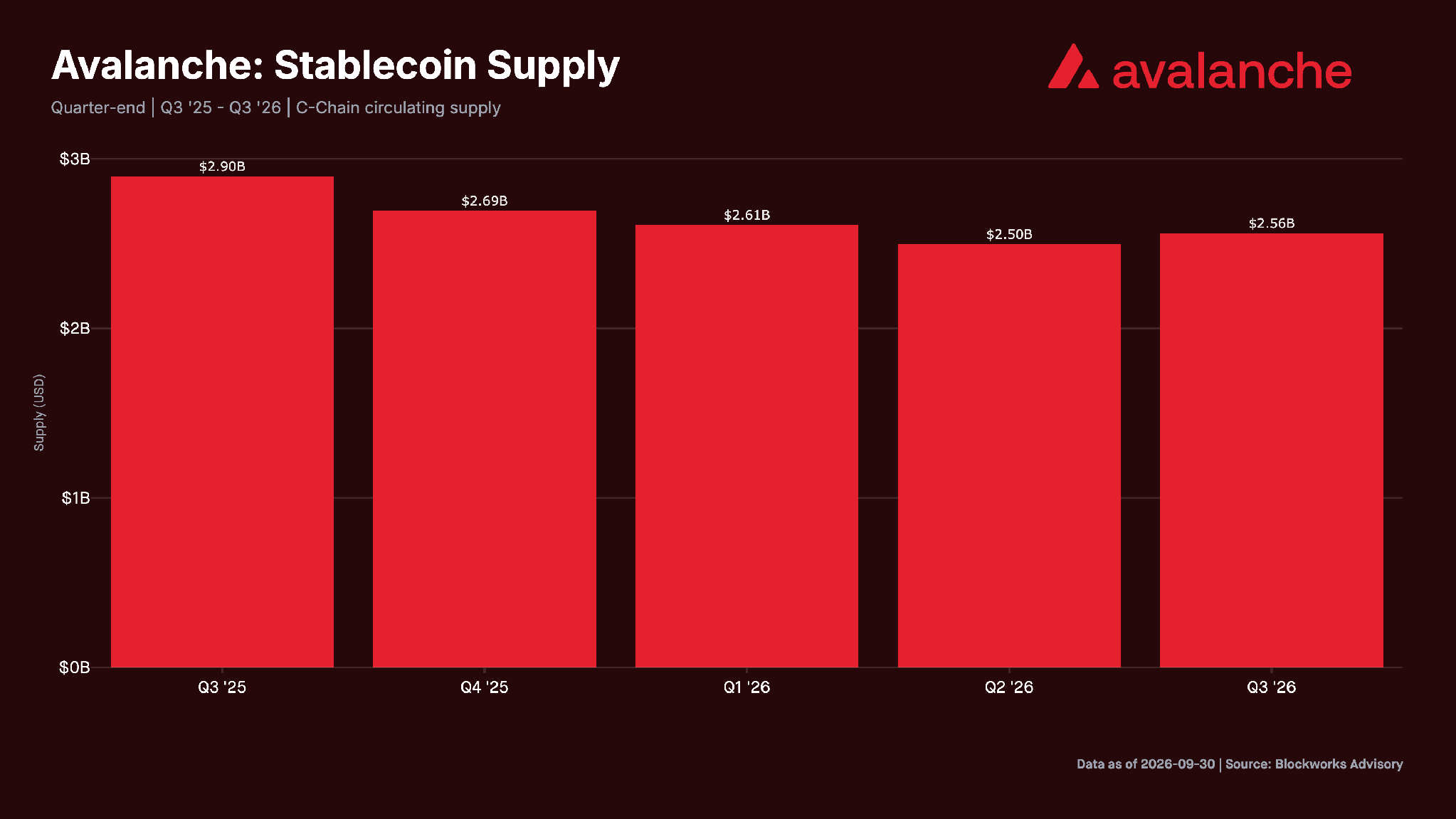
Rain plans to add card support for KRW1, the Korean won stablecoin built on Avalanche, and in the Philippines, GCash added EURC on Avalanche in August. Iris, an Avalanche L1 behind the ALVA mobile app, raised more than $40 million, and ALVA is live through VIVA in Bolivia, which serves more than 3 million mobile subscribers. Stablecoin supply on the C-Chain, across 26 stablecoins, was $2.56 billion at quarter-end, 3% above June.
Avalanche L1s and the Public Sector
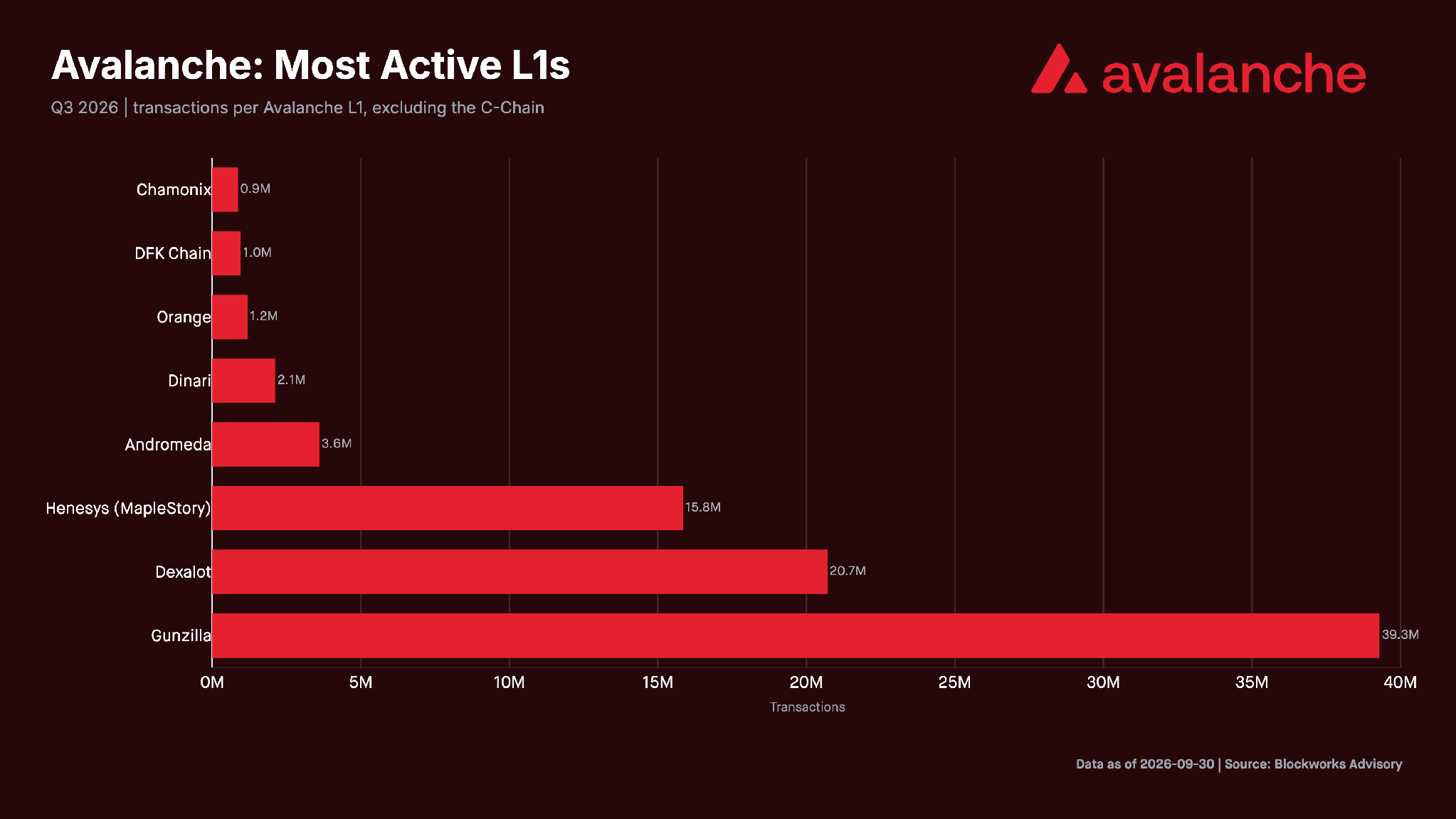
By transactions, the most active Avalanche L1s were Gunzilla (39.3 million in the quarter), Dexalot (20.7 million), and MapleStory's Henesys (15.8 million).
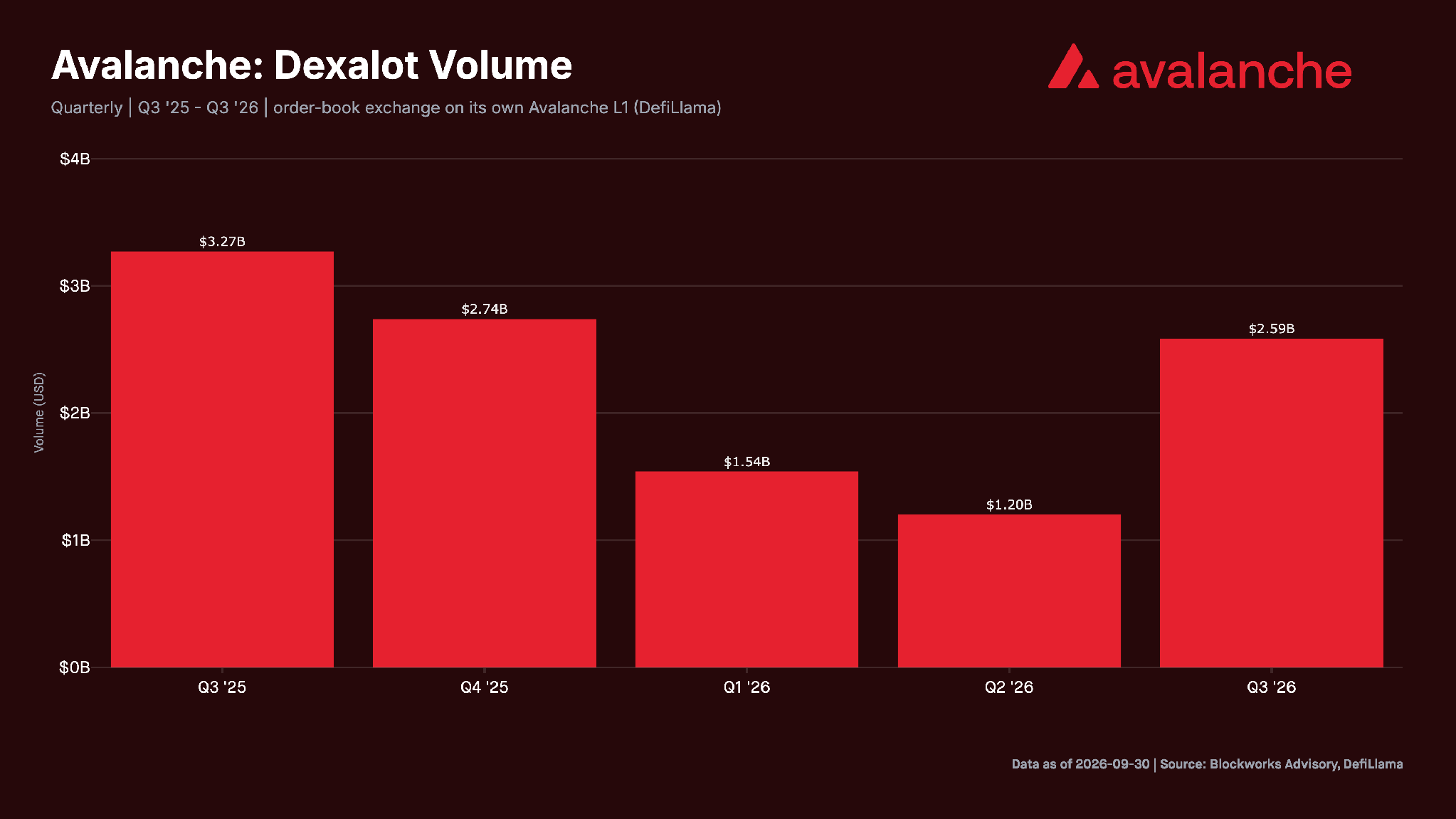
Dexalot's order-book exchange traded $2.59 billion, more than double the second quarter. POSCO International recorded trade-receivable documents on Intain's L1 in an August pilot, with Olea buying the receivables, and Arya.ag is setting up an L1 for lending against grain warehouse receipts in India. In the public sector, Kenya's national examinations council anchors academic records on Avalanche, and Uruguay's AGESIC and Blerify are piloting a cross-border digital ID registry on Avalanche and LNet. The UAE's federal digital-government regulator is moving the Digital Vault of UAE PASS, the national digital ID used by more than 12 million people, to a dedicated Avalanche L1, a move announced in September with no date set. NEC and Ava Labs agreed in July to build biometric-verified blockchain services, and Bloxtel is bringing private 5G infrastructure onchain with its new AP 201 unit.
Helicon and the Validator Set
Helicon introduced six protocol changes. Continuous Execution lets consensus accept blocks into a queue while a separate process executes them in parallel, so the C-Chain no longer pauses for each block to execute, and per-block verification fell from 20–60 milliseconds to about 2 milliseconds. The minimum validation period fell from two weeks to 48 hours, and a validator's own stake can now renew automatically at the end of each period, though delegations do not. The 2,000 AVAX minimum stake is unchanged. Validators need 90% uptime, up from 80%, for staking periods that start on or after activation. Janus Henderson, which managed about $480 billion at March 31, joined the validator set on September 16.
For businesses, Continuous Execution means more consistent transaction confirmations as payments and trading volumes grow. The 48-hour minimum with automatic renewal shortens the capital commitment for institutional validators, which could make staking AVAX easier for ETP providers. The 90% uptime requirement rewards reliable, always-on infrastructure for mission-critical applications, and the new reward curve and validator-set gas floor are steps toward more sustainable AVAX issuance and fees that adjust to network conditions.
Regulated Access to AVAX
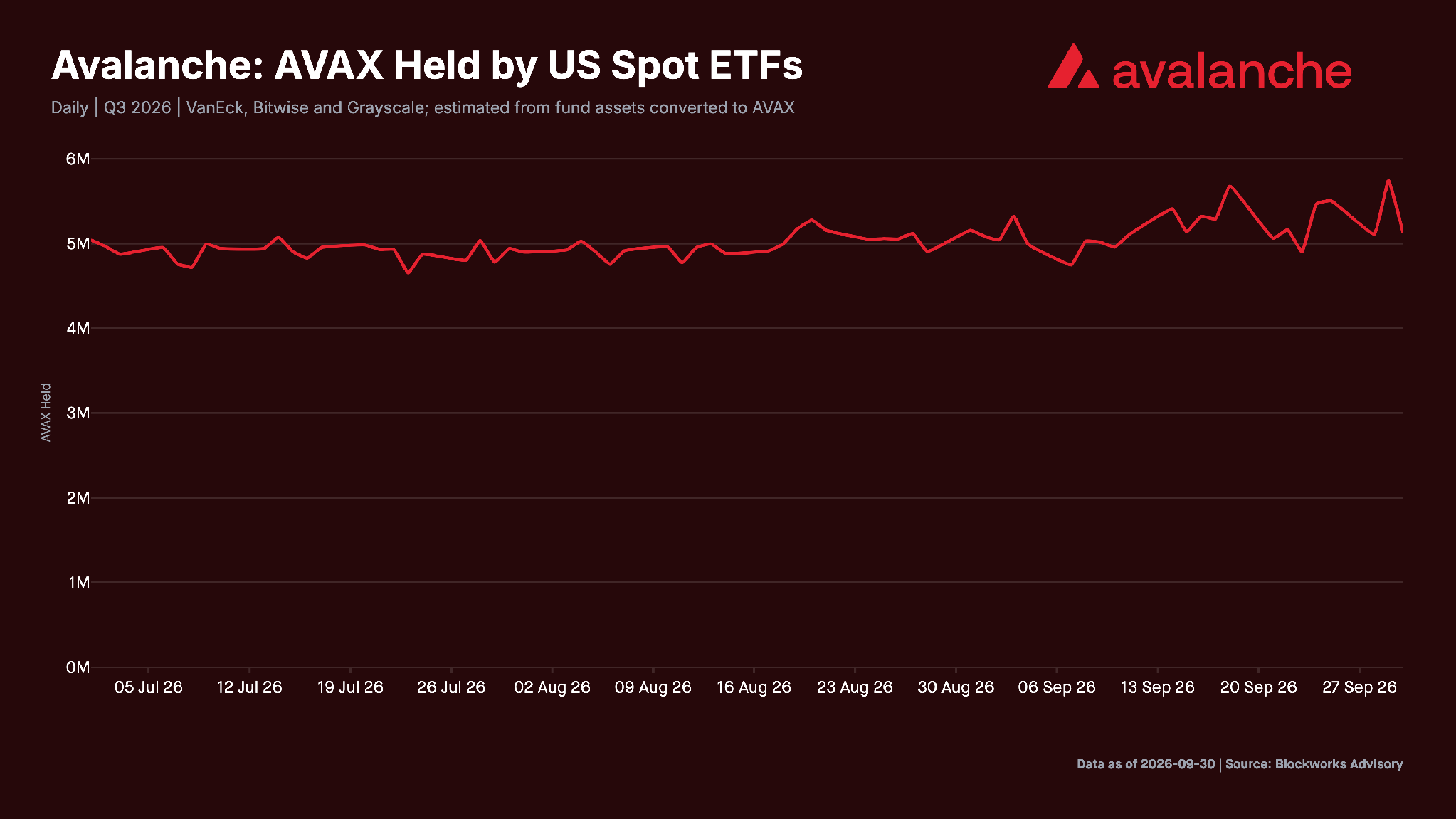
US spot ETFs from VanEck, Bitwise, and Grayscale held an estimated 5.1 million AVAX at quarter-end (their combined dollar assets converted to AVAX), up about 6% from 4.8 million at the end of June, and took in $3.95 million of net inflows during the quarter. Clearstream, Deutsche Börse's post-trade arm, added AVAX to institutional custody through Crypto Finance on July 6, and Paxos, whose infrastructure serves more than 650 institutions, integrated AVAX and Avalanche-native USDC on September 17. Charles Schwab plans to add AVAX to Schwab Crypto "in the coming months," a route for its 40.1 million active brokerage accounts; the listing was not live by mid-October. CME has listed AVAX futures since May.
Among companies holding AVAX as a treasury asset, Nasdaq-listed Avalanche Treasury Corp held about 15.3 million AVAX at the end of June. It sold 2.08 million AVAX on September 23 to Avalanche (BVI), Inc., the Avalanche Foundation entity named in its filing, for $15 million, leaving about 13.2 million. AVAX One held 14.09 million AVAX on August 13. Neither company disclosed a purchase during the quarter.
Product & Ecosystem Updates
Helicon reached mainnet in three steps. It went live on Fuji Testnet on July 28, shipped in the AvalancheGo v1.15.0 release on September 8, and activated on mainnet on September 22. The Avalanche Audit Marketplace went live on the Builder Hub on September 29, sending one request to every Ava Labs-vetted audit firm and covering up to 75% of audit costs. Uniswap's Continuous Clearing Auctions went live on Avalanche on August 11 for onchain token auctions. COTI's Privacy-on-Demand and Privacy Portal followed on September 16 for private data processing. Primit launched a perpetual futures exchange with a fully onchain order book on July 15.
The Avalanche Payments Collective had 29 member organizations by July 31, with GoKiteAI joining on July 8 as its first member focused on AI agents. Avalanche became a founding member of the Agentic Payments Alliance, organized by Rain, on August 18. Deloitte and Avalanche published a stablecoin playbook for institutions on July 23. The Avalanche Foundation published its Economic Research Agenda on July 30 and a Gross Chain Income framework on August 12.
Team1 launched Builder Grants on July 1, with Mini Grants of up to $10,000 and committee-reviewed Accelerator Grants of up to $30,000, and made its first Accelerator Grant to YourGrails on July 30. The Avalanche Foundation concluded Retro9000 on August 20 after its final disbursements, and activity from projects in its last two C-Chain rounds burned nearly 4,000 AVAX. The Foundation's Call for Research Proposals drew more than 160 submissions, about 95 of which moved to committee review. Team1 opened official chapters in Korea on August 19 and Africa on September 30.
Closing Summary
More businesses built on Avalanche in the third quarter, and the products they run set records in card spend, Pharaoh's September volume, Axiym's payment flows, and Dinari's purchases. App fees and revenue rose for the first time since the third quarter of 2025. Tokenized real-world assets on the C-Chain reached $1.22 billion, fourth among tracked networks, with BUIDL up 21%. Activity on the C-Chain itself fell, with transactions and total DEX volume each down by about 20%.
Network fees rose 44%, and all of the increase came after Helicon activated on September 22. Staking rewards still ran about 44 times the C-Chain fees burned in the quarter, at 2.62 million AVAX against 59,126 AVAX. The new reward curve, fully phased in around December 21, is projected to lower annual inflation by 0.5 to 1 percentage point, and the Avalanche Foundation will study Helicon's effects on validator economics and value accrual.
Several items that are not live yet will shape the next quarters. ICE is evaluating Avalanche for its 24/7 trading platform and has not yet named a chain. Aave plans its first V4 RWA Hub on Avalanche, pending Aave governance, and Pharaoh plans 24/7 trading of tokenized US stocks. Charles Schwab plans to add AVAX to Schwab Crypto. Hanwha's platform awaits Korea's tokenized-securities rules, which take effect in February 2027. Arya.ag is still setting up its L1, the UAE PASS Digital Vault move has no date, and Tare's private-credit exchange is not yet live. Rain plans to add KRW1 card support, and Hyundai Card aims to prove its stablecoin payment model at scale.
The quarter's deployments show what Avalanche means by "Technology Built for Business." Across institutional finance, real-world asset tokenization, and embedded payments, businesses are increasingly adopting blockchain as foundational infrastructure that improves how financial products and services operate, while the technology itself remains largely invisible to the end user. Progmat, Dinari, and Lynq run chains with their own validators and rules, Ethena Pay and Uptop put Avalanche underneath services people already use, and Helicon shortened the commitment an institution must make to help secure the network. Together, these developments reflect Avalanche's broader vision of a future where blockchain adoption is measured not by how visible the technology is, but by the value it delivers to businesses and their customers.