
Executive Summary
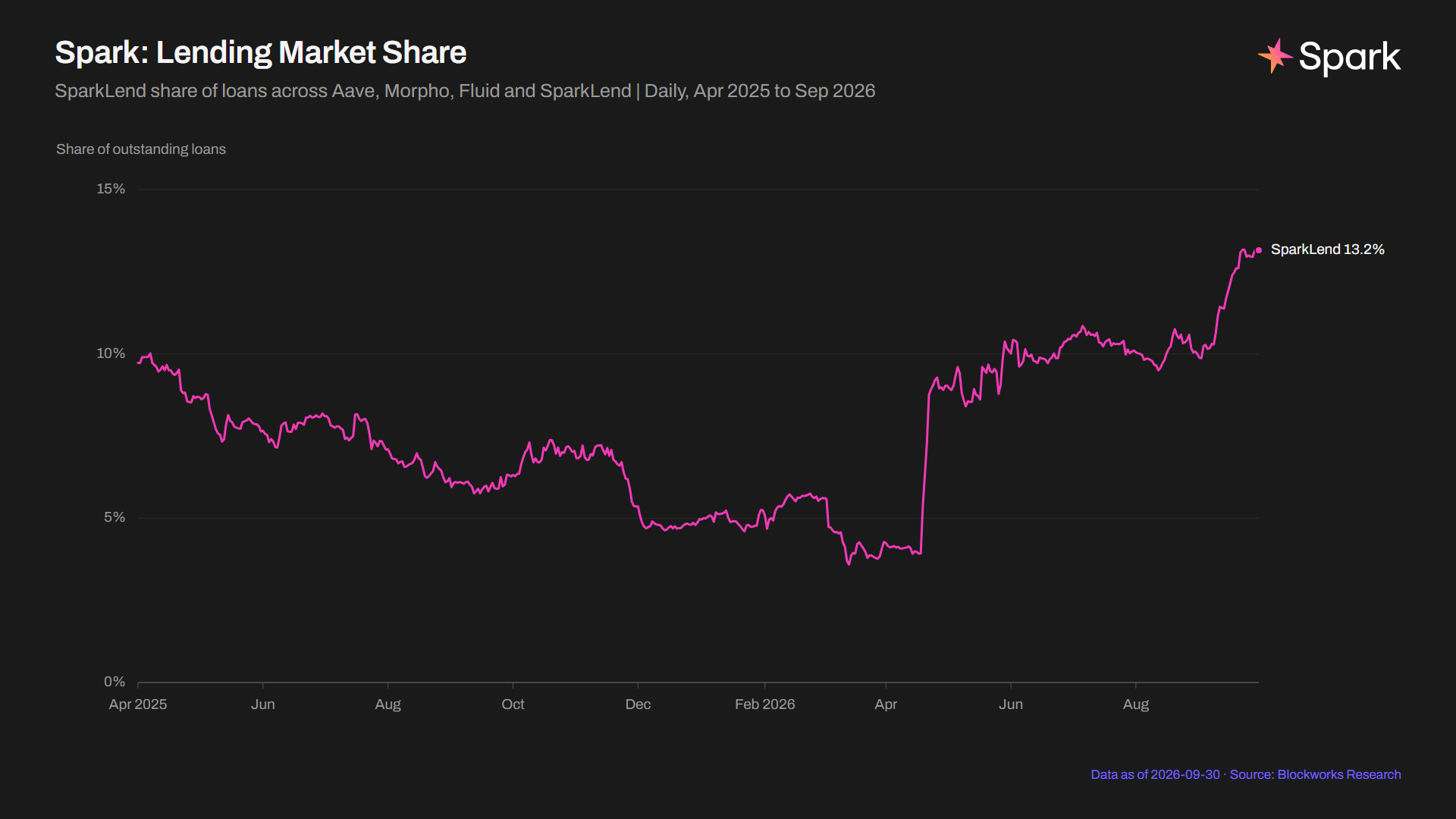
Spark's share of outstanding loans across the major lending venues rose from 10.4% to 13.2% in Q3 2026, a second consecutive quarterly gain from 4.3% at the end of Q1. Borrowing demand returned across the sector this quarter, with combined loans across Aave, Morpho, Fluid and Spark growing 37% to $22.0B by quarter end. Spark's own lending book grew roughly twice as fast, with borrows up 73% to $2.89B by quarter end. Interest paid by borrowers on Spark's lending market rose 38% to $16.05M while Aave's interest income fell 17%. Net revenue was $4.41M, down 30% from Q2, mainly because the distribution reward rate was cut from 0.5% to 0.2% on July 9th. Gross protocol returns declined 27% to $30.0M as Spark Liquidity Layer (SLL) rebate and reward income fell, with lower funding costs absorbing most of the SLL decline.
The SLL now carries capital across three fronts: stablecoin exchange liquidity, savings distribution and credit. The Stablecoin FX Layer built with Uniswap and Sky processed $13.9B of cumulative volume across its USDT, PYUSD and RLUSD markets on Uniswap v4 between its June 25th launch and quarter-end, with RLUSD joining in late August. Savings distribution reached exchange and fintech users through OKX's onchain earn product and Robinhood Earn, and institutional credit expanded through custody-supported structures with Anchorage Digital.
Key highlights:
- Lending market share: 13.2% of outstanding loans across Aave, Morpho, Fluid and Spark (from 10.4%), with Spark's borrows up 73% against a 37% rise in the combined loan book
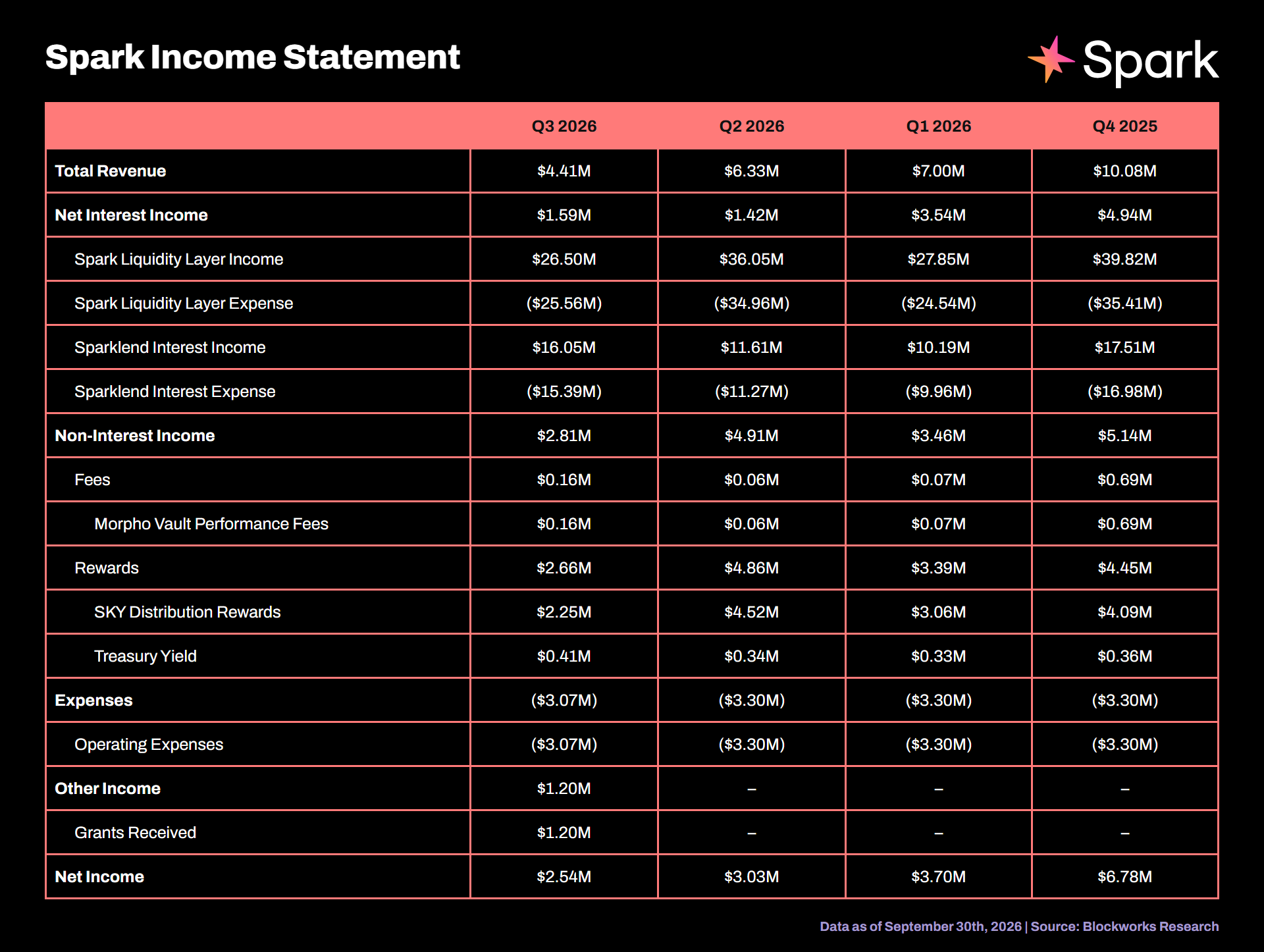
- Net income: $2.54M, against $3.0M in Q2; net revenue was $4.41M (-30% QoQ) after the distribution reward rate cut, partly offset by a $1.20M grant and lower operating expenditure
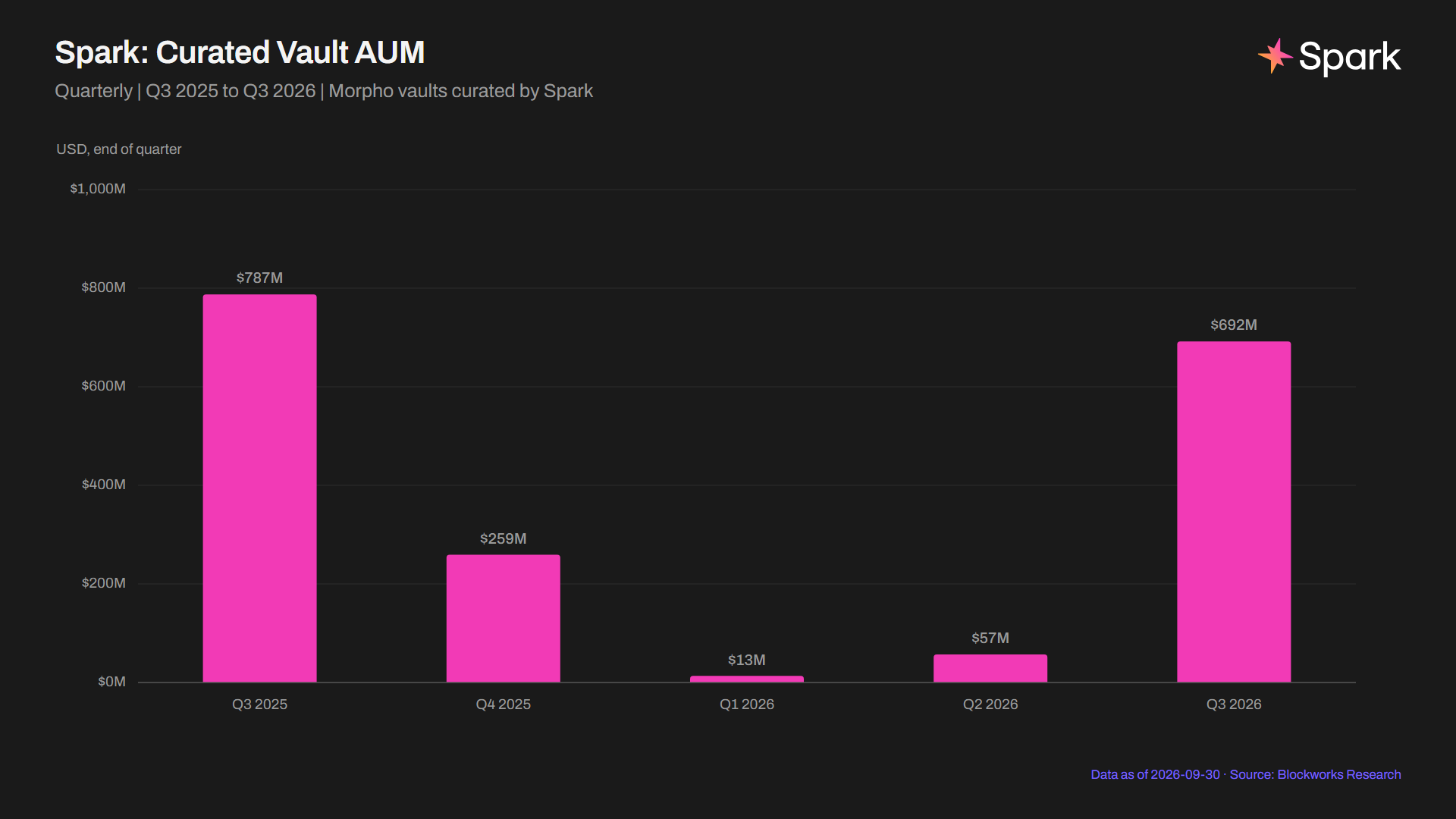
- SLL allocated assets: $3.71B at quarter-end (+10% QoQ), including $0.17B of FX Layer liquidity; assets in Spark-curated Morpho vaults grew from $57M to $692M
- RLUSD integration: $375M of RLUSD committed across exchange liquidity, a jointly curated Morpho vault and Spark’s lending market, with the RLUSD/USDS market clearing more than $600M of volume in its first week
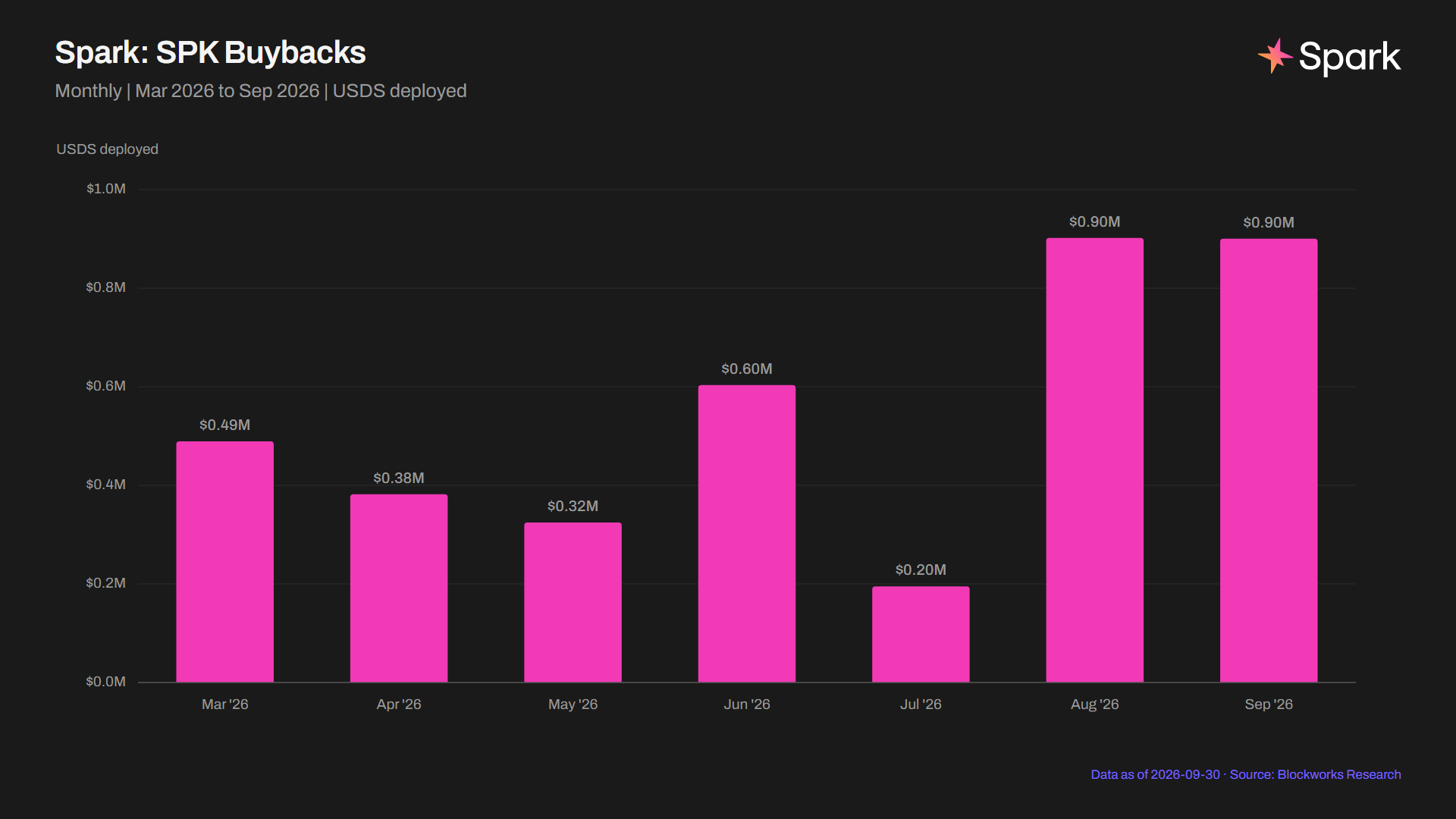
- SPK buybacks: $2.0M deployed for 106.9M SPK (about 3.2% of circulating supply and 1.07% of total supply), up from $1.31M in Q2; treasury USDS rose 17% to $45.95M
Net income after operating expenditure was $2.54M, against $3.0M in Q2. Net revenue fell to $4.41M after the distribution reward rate was cut from 0.5% to 0.2% on July 9th, and two items partly offset the decline: a $1.20M grant received in September and operating expenditure that eased to $3.07M from $3.3M. Spark was profitable for the quarter, grew its treasury to $73.3M and accelerated buybacks from surplus while its share of the lending market reached its highest level of the period.
How Spark Works
Spark is a capital allocator within the Sky ecosystem. It sources stablecoin liquidity from Sky's allocation system, routes it across chains, and deploys it into lending markets, liquidity venues and institutional credit, managing each deployment within governance-approved risk limits. The Spark Liquidity Layer is the engine that performs this routing and is the main driver of Spark's balance sheet and returns.
Three product lines sit on top of the SLL. SparkLend is Spark's lending market, where depositors supply assets and borrowers draw against collateral. Spark Savings packages the yield the SLL generates into savings vaults (sUSDS, plus Savings v2 vaults for USDC, USDT, PYUSD, ETH and USDG) that users can hold directly or access through partner platforms. The third line, added through the Stablecoin FX Layer, extends the SLL into exchange liquidity: USDS is the common base asset on Uniswap v4, so USDT, PYUSD and RLUSD can trade against one another through USDS markets without each issuer building separate pools against every other stablecoin.
Distribution increasingly runs through other platforms. Exchanges and fintechs integrate Spark Savings into their own products (OKX's onchain earn, Robinhood Earn, BitGo institutional wallets), so end users earn the savings rate without interacting with DeFi infrastructure directly.
As a Prime Agent SubDAO, Spark operates with strategic and operational autonomy under the Sky Atlas governance framework while drawing funding from Sky. It manages its own products, partnerships and liquidity strategies, and protocol changes execute onchain through governance spells coordinated with Sky.
Financials
Income Statement
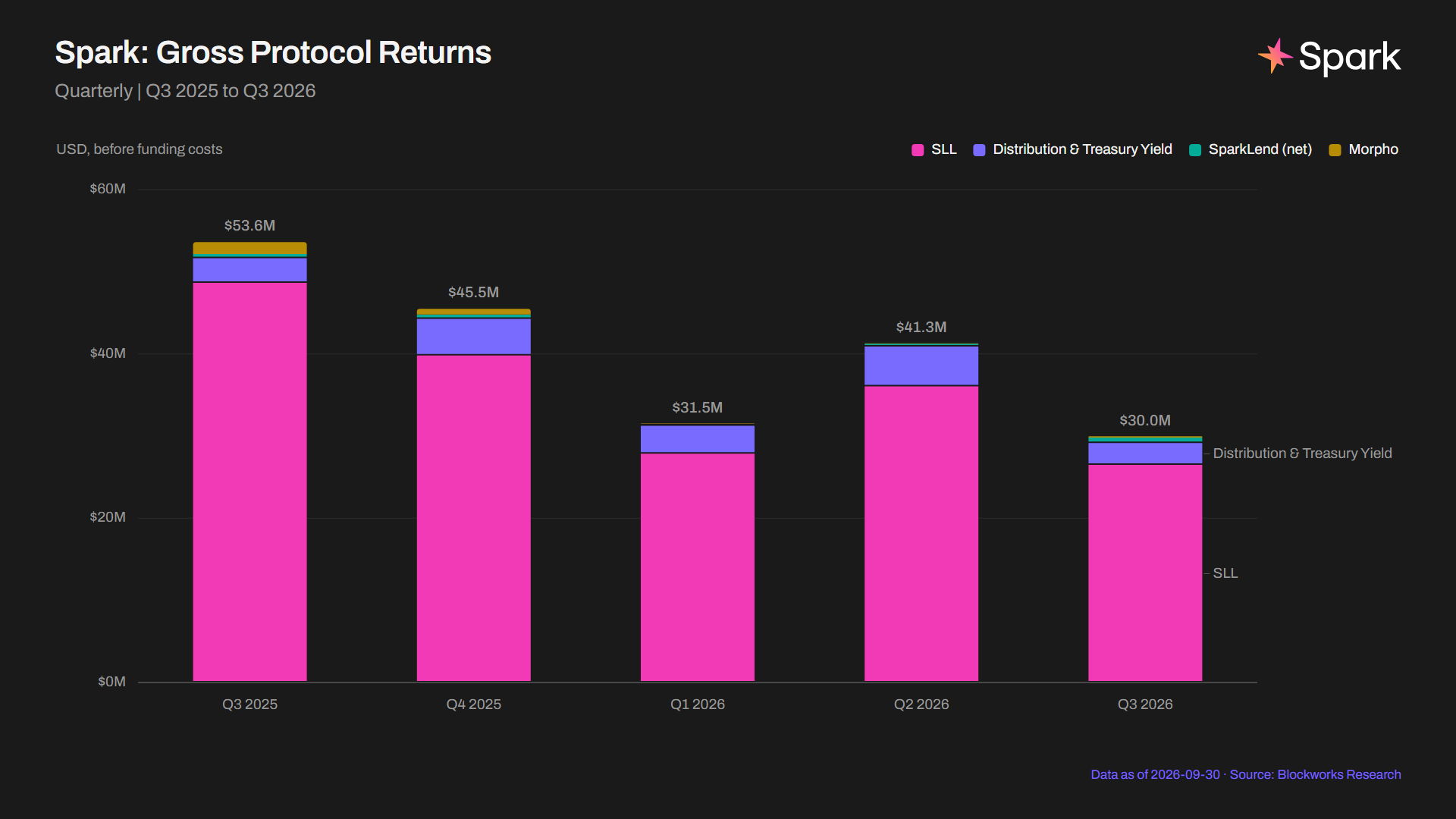
Gross protocol returns, combining SLL gross returns, distribution rewards, treasury yield, vault curation fees and the SparkLend reserve-factor contribution, were $30.0M in Q3, down 27% from $41.3M in Q2. SLL gross returns fell 27% to $26.50M. Interest earned on SLL deployments rose to $16.28M from $13.56M, but rebate income fell to $6.50M from $15.26M and reward income to $3.71M from $7.23M, and average allocated capital was lower over the quarter ($2.76B against $4.10B in Q2) even as quarter-end balances rose.
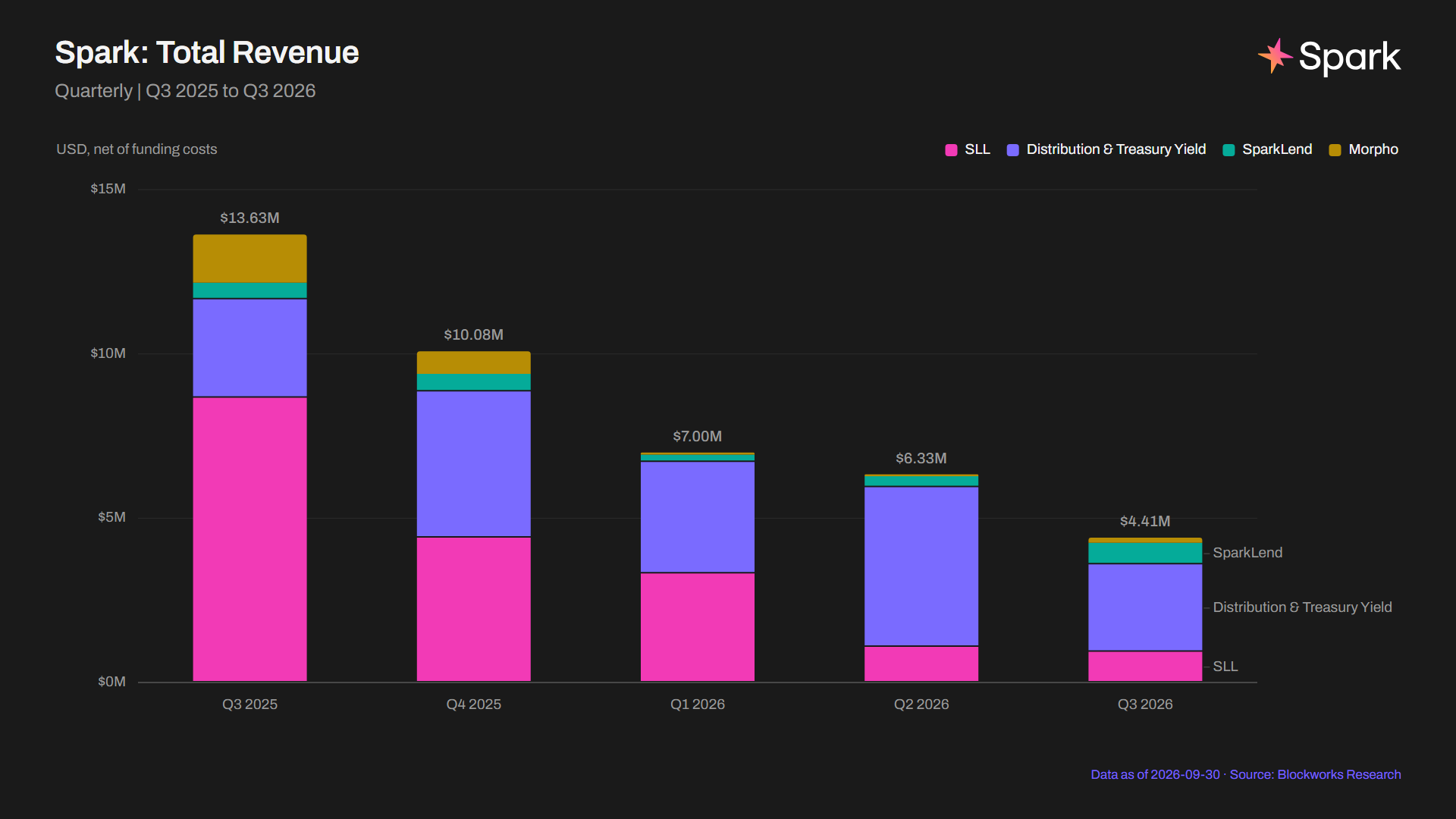
Total revenue net of funding costs was $4.41M in Q3, down 30% from $6.33M in Q2, with the decline concentrated in distribution rewards. The distribution reward rate on distributed supply was cut from 0.5% to 0.2% effective July 9th, and Sky distribution rewards fell to $2.25M from $4.52M while remaining the largest net contributor at about half of net revenue. In the SLL, gross returns fell by $9.6M while funding costs fell by $9.4M: average funded balances dropped by about a third, with Sky borrow averaging $2.07B against $2.44B and Savings v2 $0.69B against $1.65B as savings deposits declined, so SLL net income slipped only to $0.94M from $1.09M. In SparkLend, most of the 38% rise in borrower interest is paid through to depositors, so the larger book added $0.32M of net revenue, with the reserve-factor contribution roughly doubling to $0.66M (from $0.33M). Vault curation fees from Spark-curated Morpho vaults, most of them paid on the SLL’s own deposits, rose to $0.16M from $0.06M, and yield on treasury USDS added $0.41M (from $0.34M).
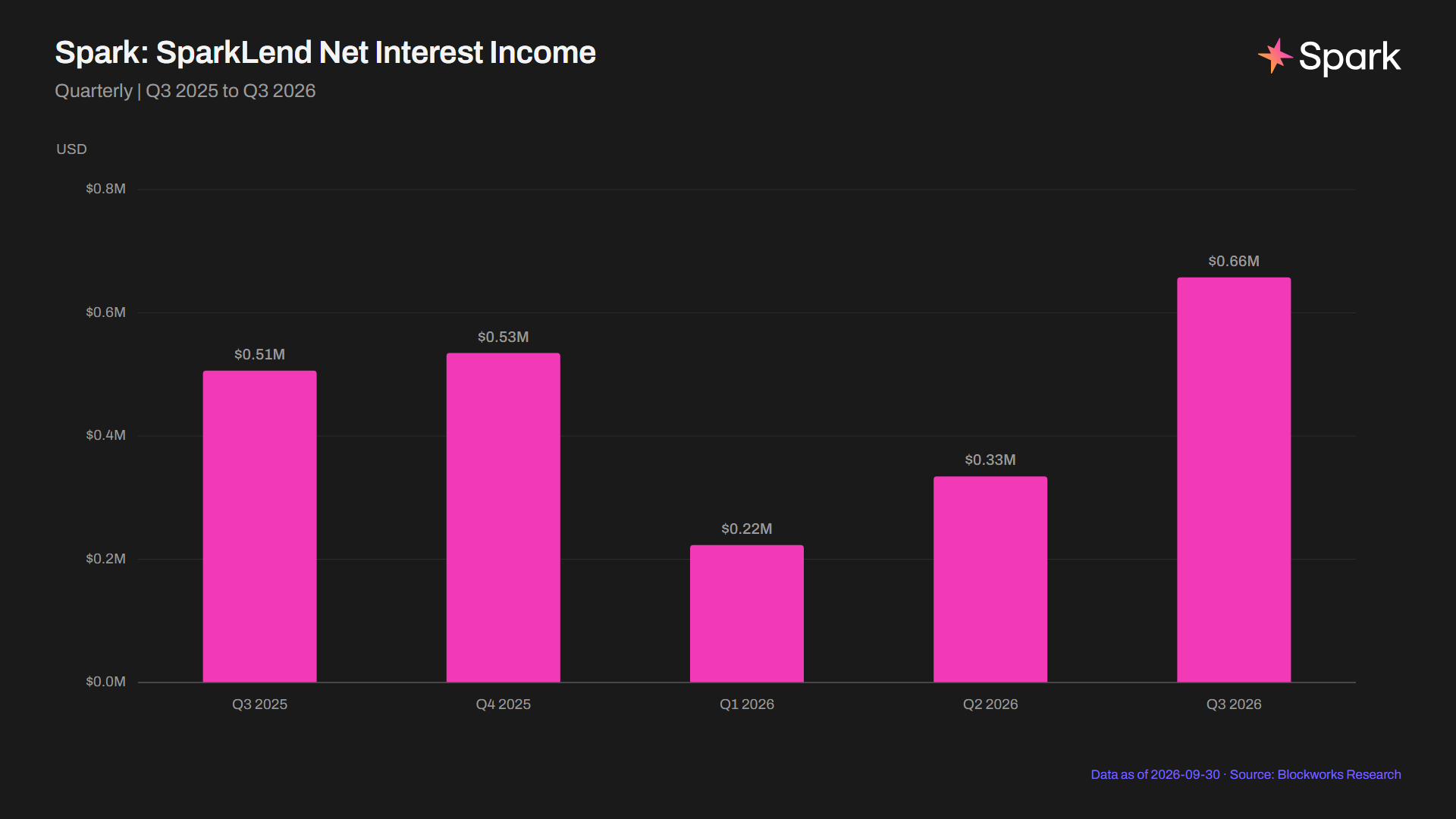
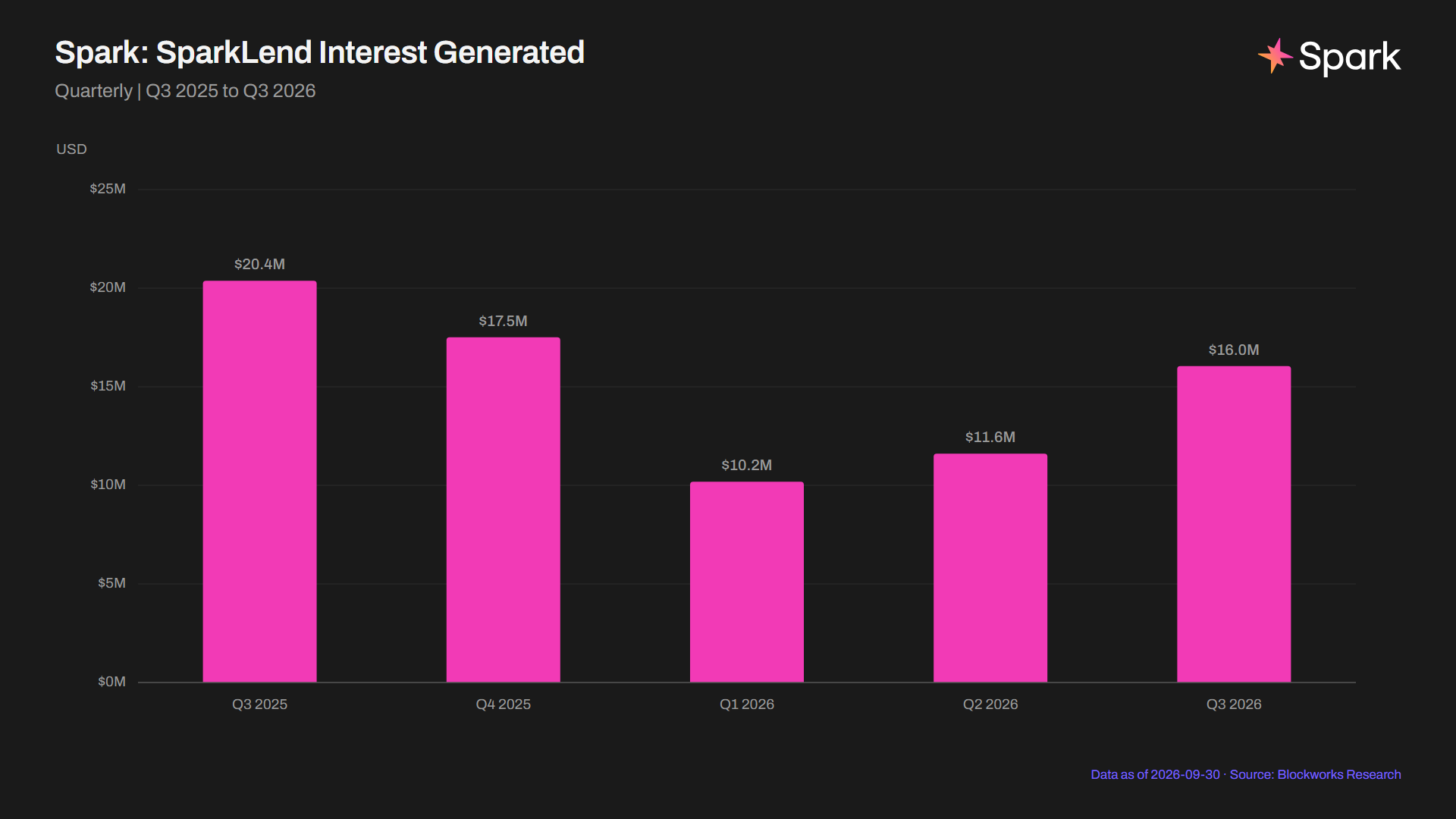
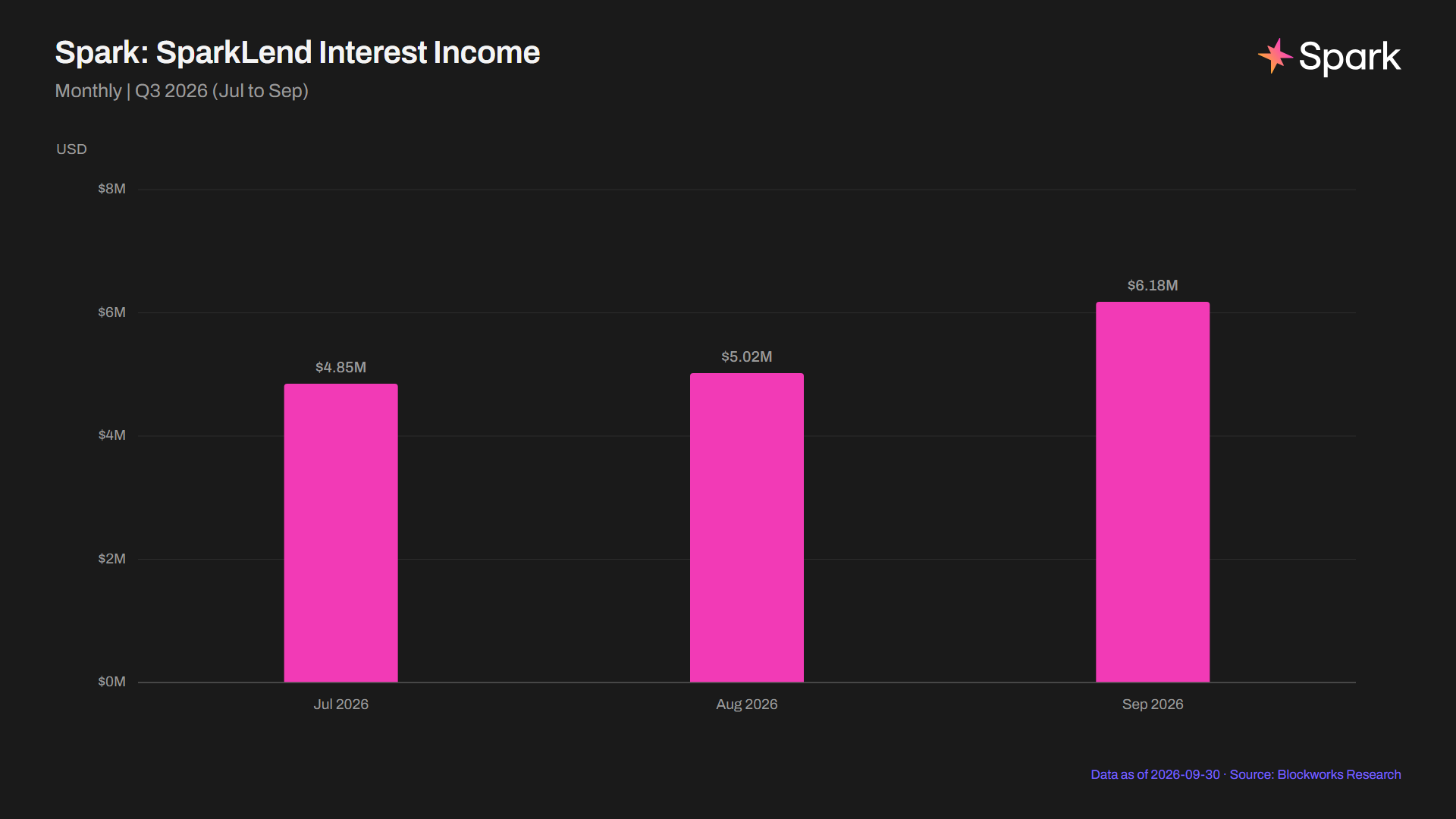
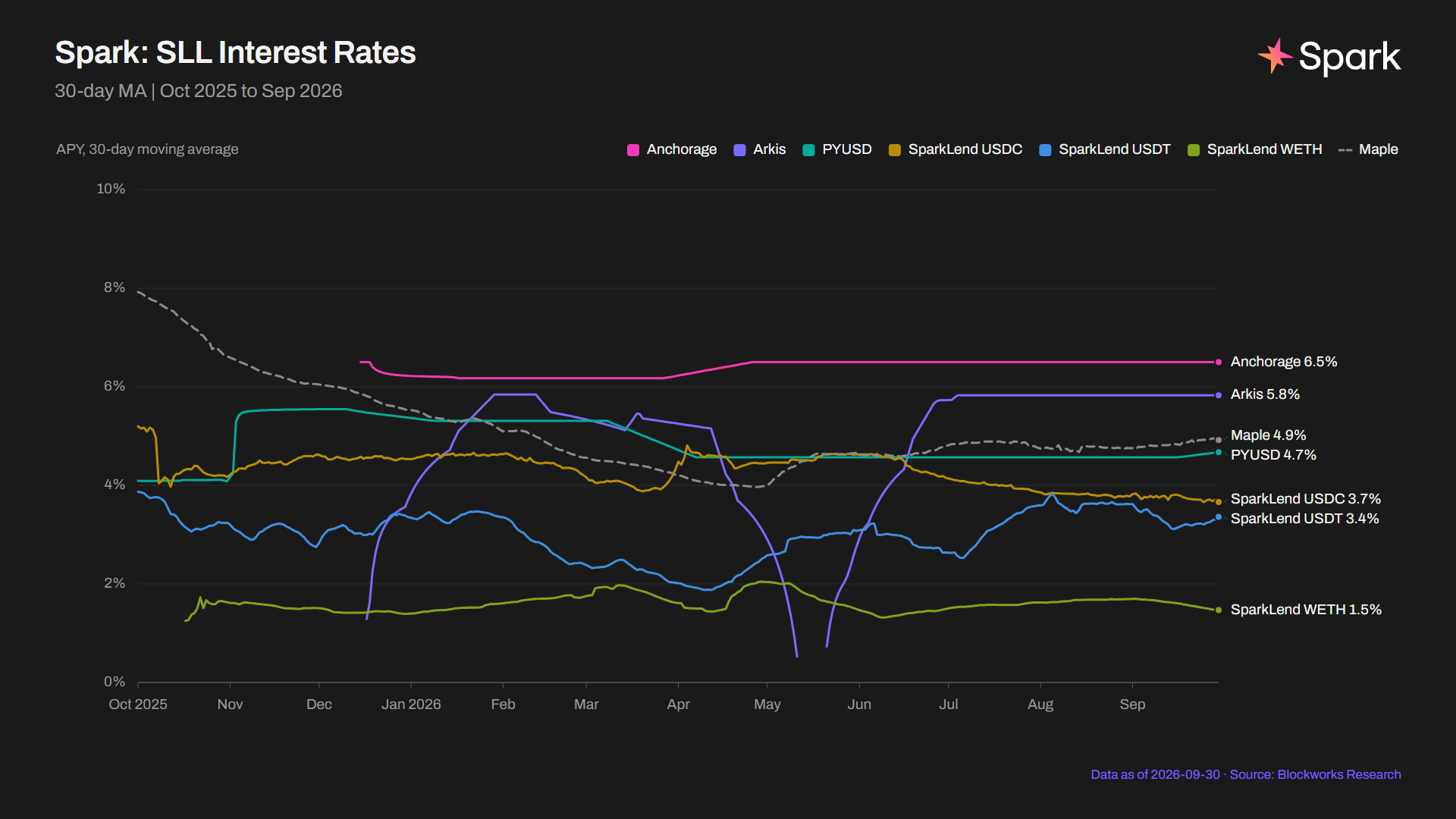
SparkLend gross interest generated rose 38% to $16.05M, a second consecutive quarterly increase, and monthly interest income climbed through the quarter to $6.18M in September. At quarter-end, 30-day average rates placed Anchorage at 6.5%, Arkis at 5.8%, Maple at 4.9% and PYUSD at 4.7%, with SparkLend USDC at 3.7%, USDT at 3.4% and WETH at 1.5%. SparkLend USDT rates rose from 2.6% at the end of Q2, and the September 10th spell installed a new USDT interest rate model.
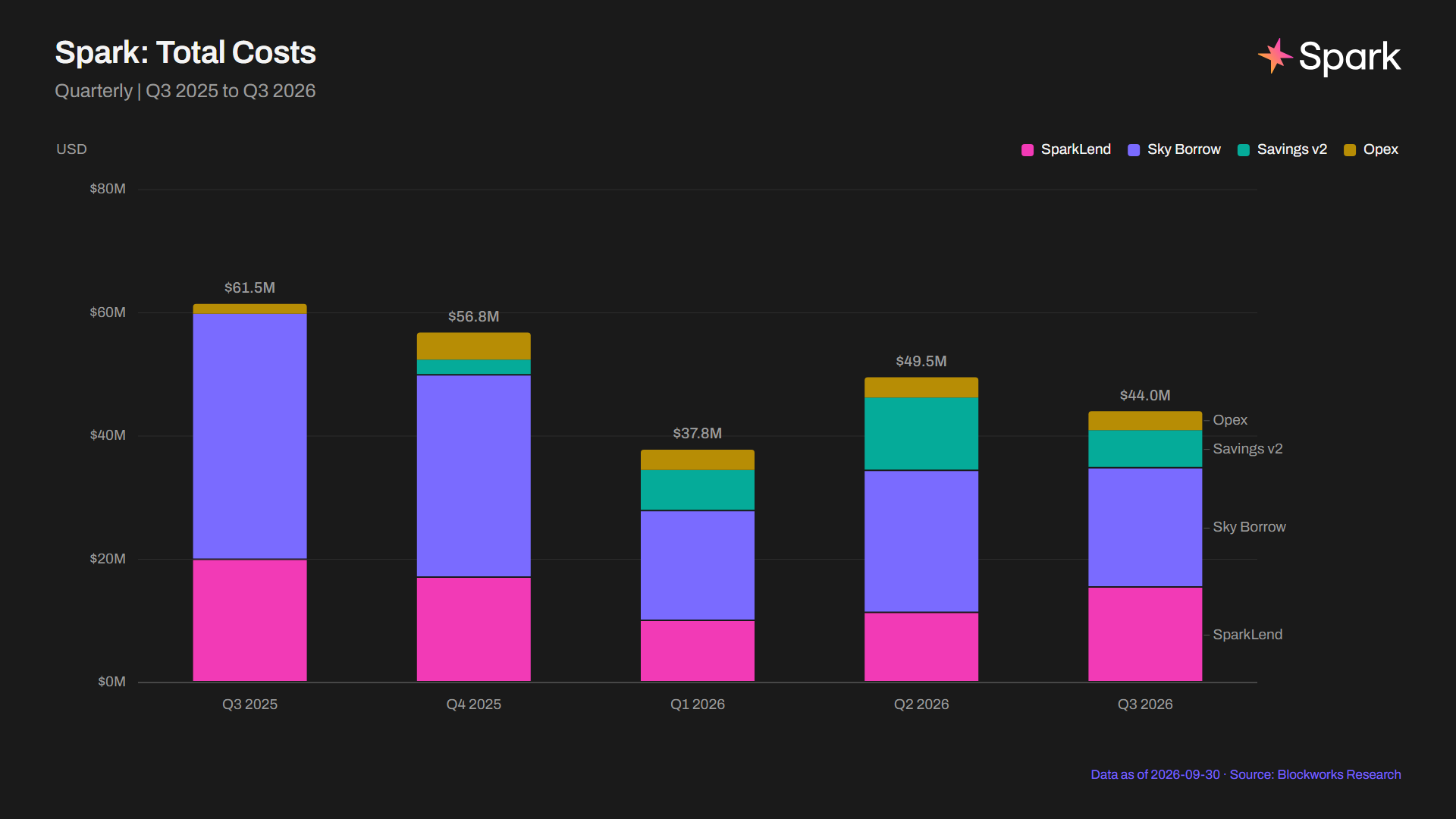
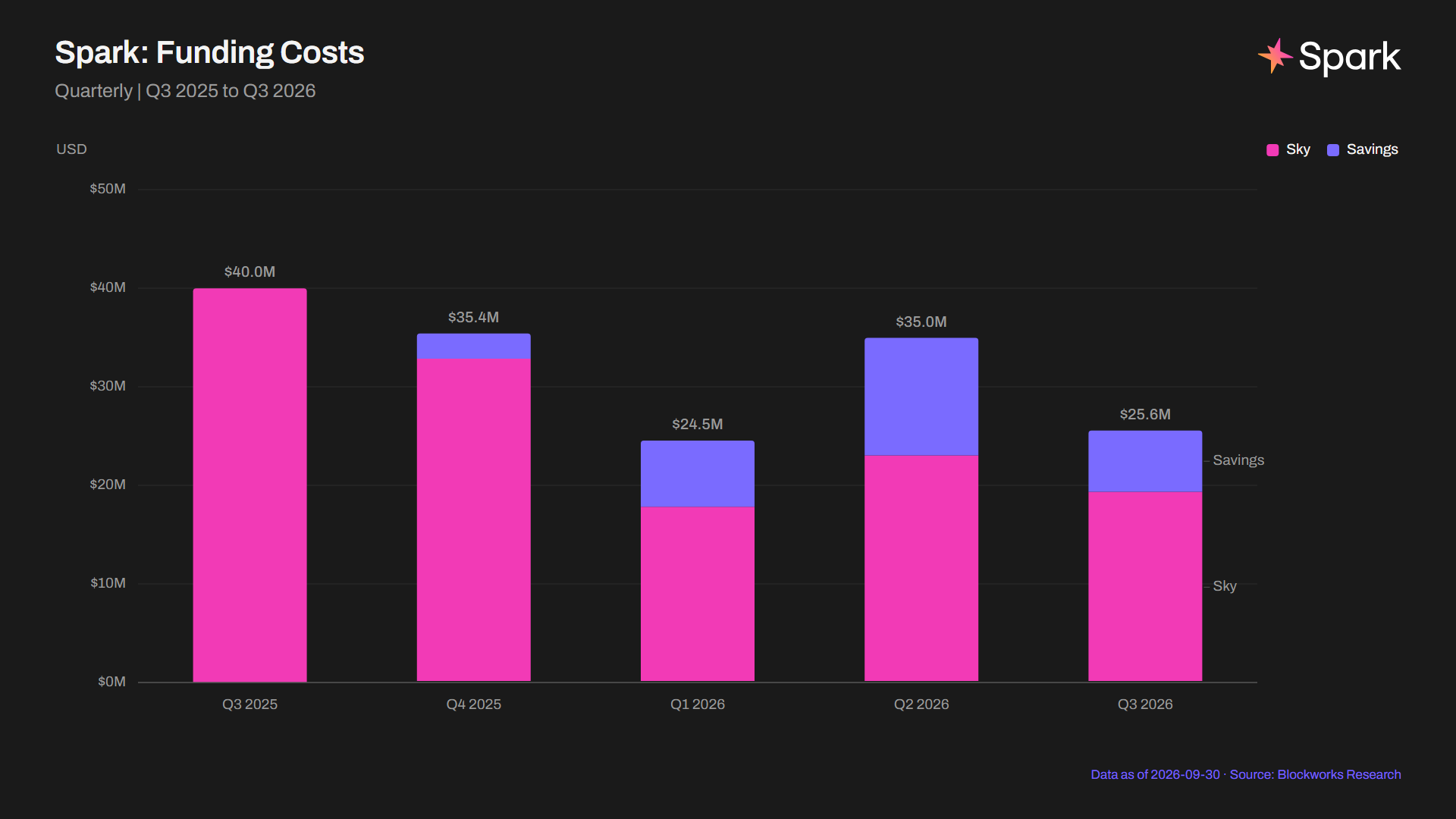
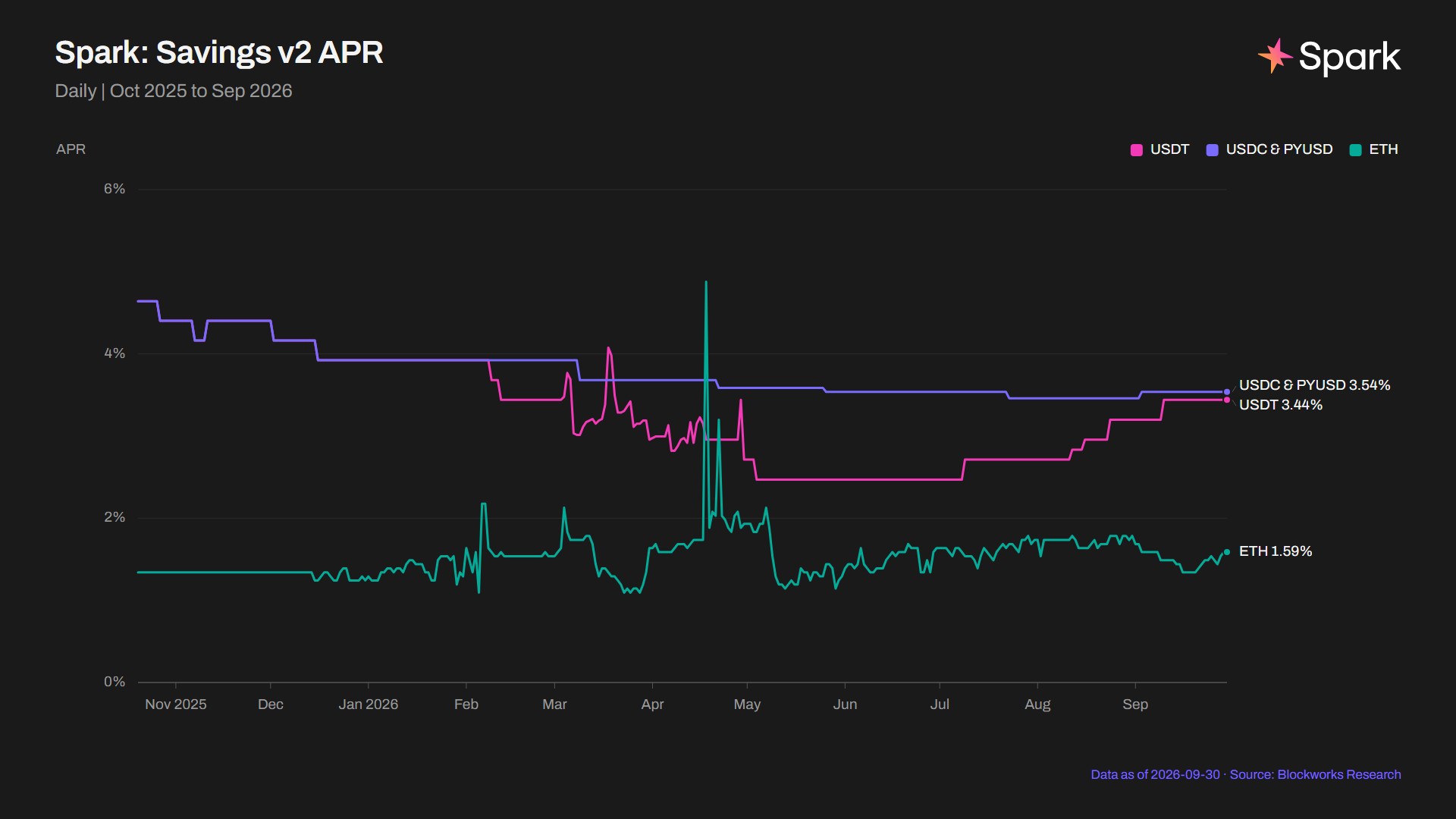
Total costs fell 11% to $44.0M in Q3. Interest paid to SparkLend depositors rose to $15.39M with the larger book, while funding costs (Sky borrow plus Savings v2) fell 27% to $25.6M: Sky borrow costs declined to $19.34M from $23.04M and Savings v2 reward costs roughly halved to $6.22M from $11.92M. Savings v2 rates ended the quarter at 3.54% for USDC and PYUSD, 3.44% for USDT and 1.59% for ETH.
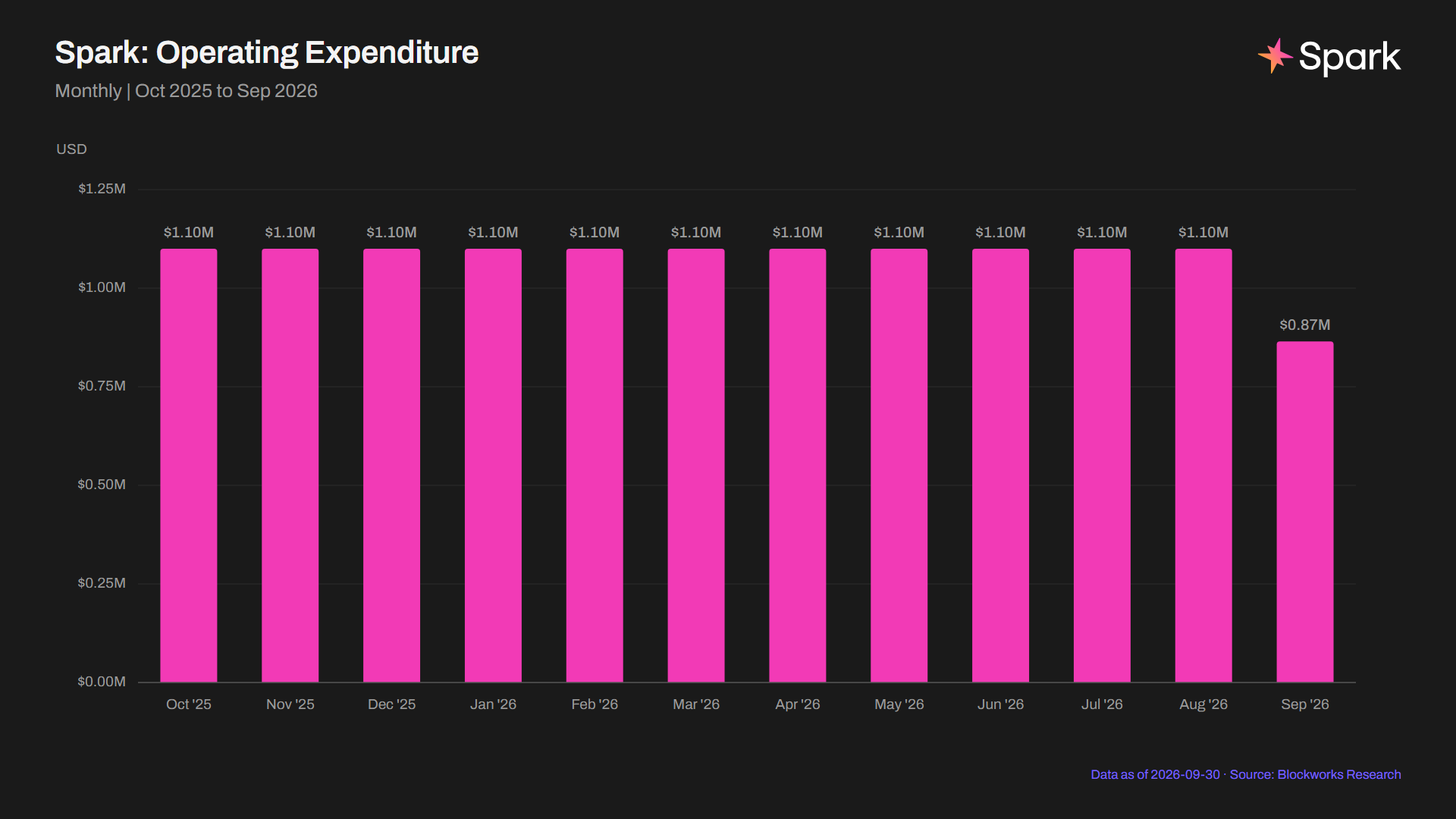
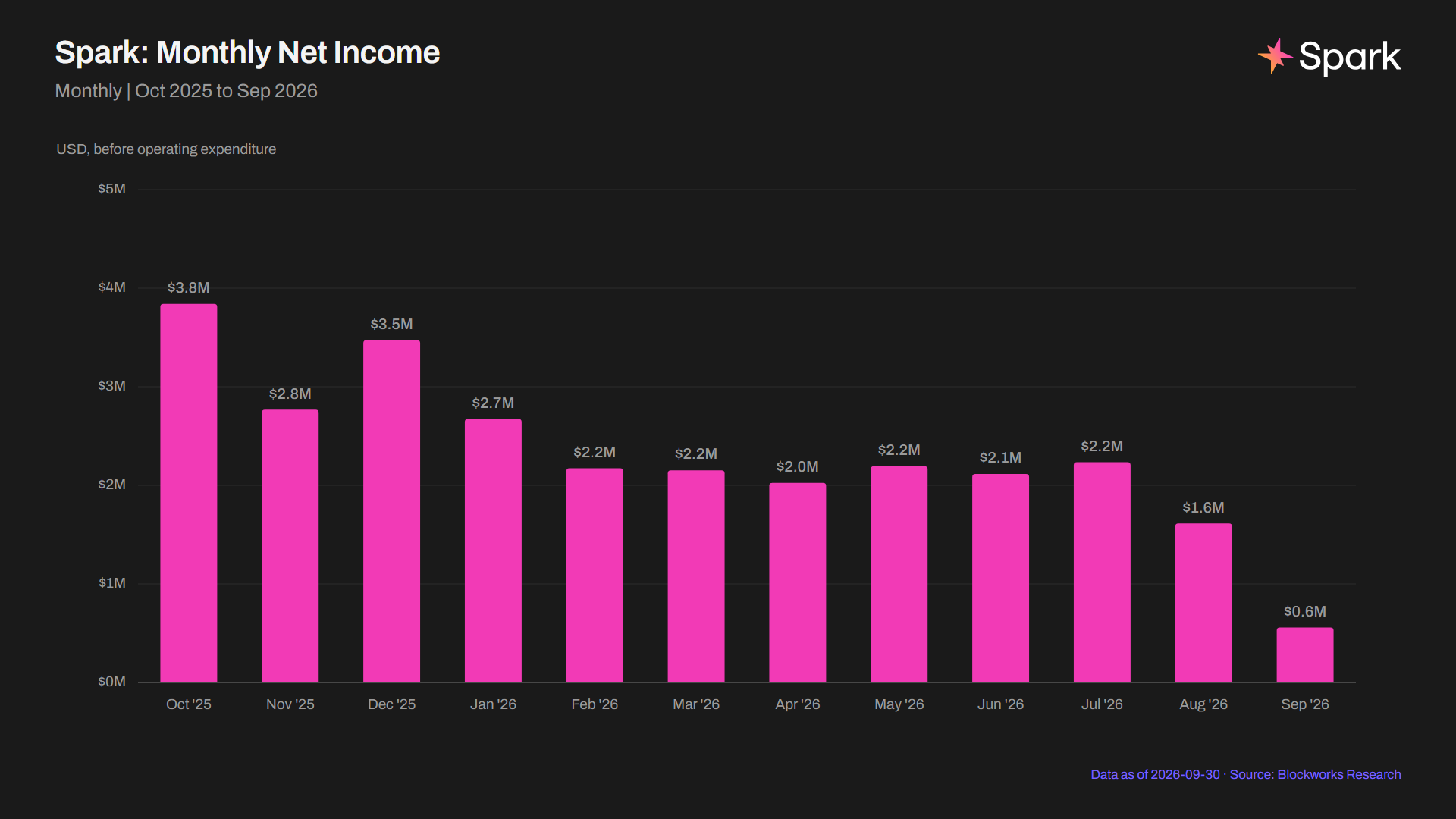
Operating expenditure eased to $3.07M from $3.3M in Q2, with monthly spend between $0.87M and $1.10M. Monthly net revenue after funding costs declined over the quarter, from $2.24M in July to $0.56M in September. Spark also received a $1.20M grant in September. After operating expenditure, quarterly net income was $2.54M, against $3.0M in Q2.
Balance Sheet
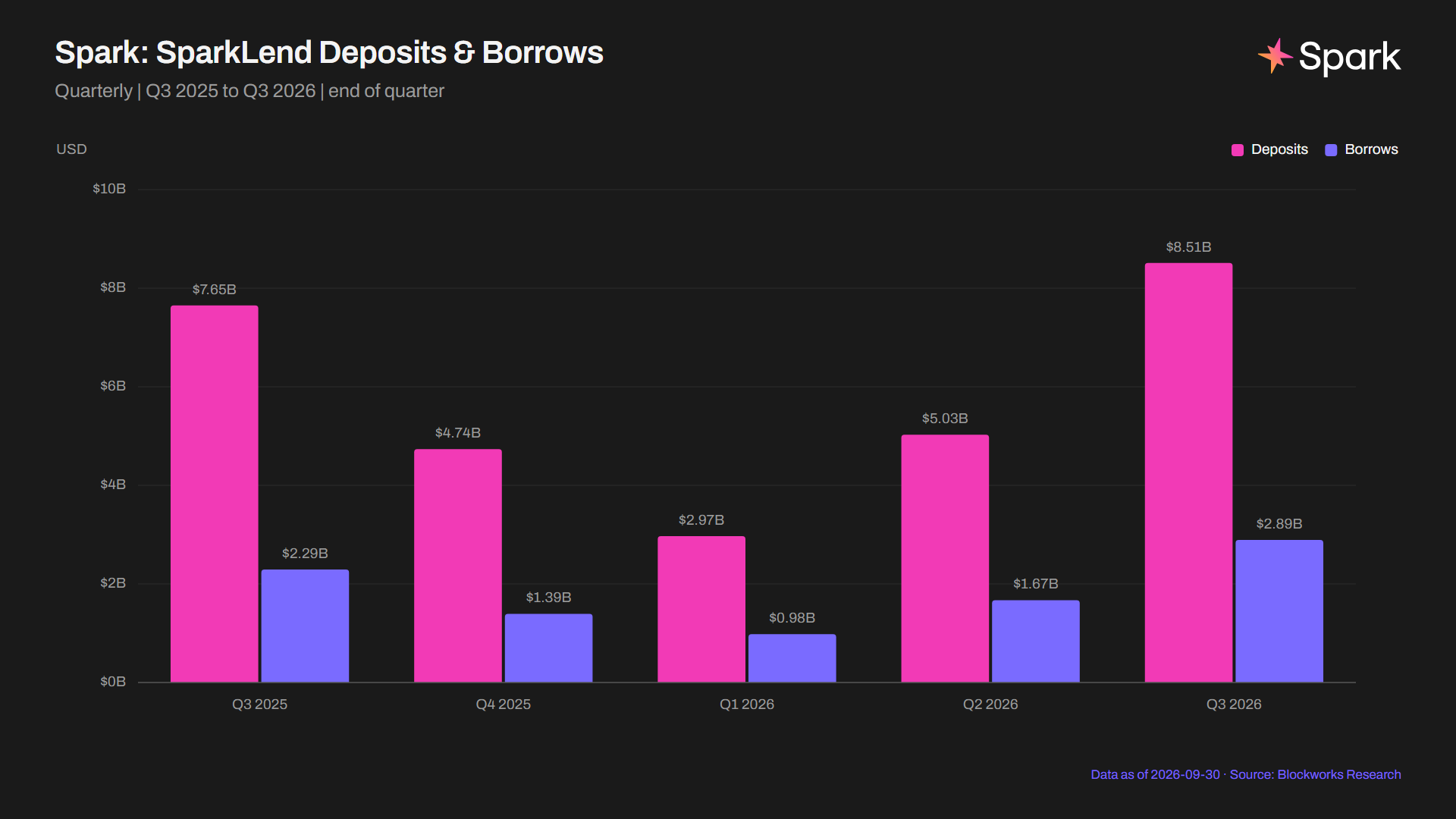
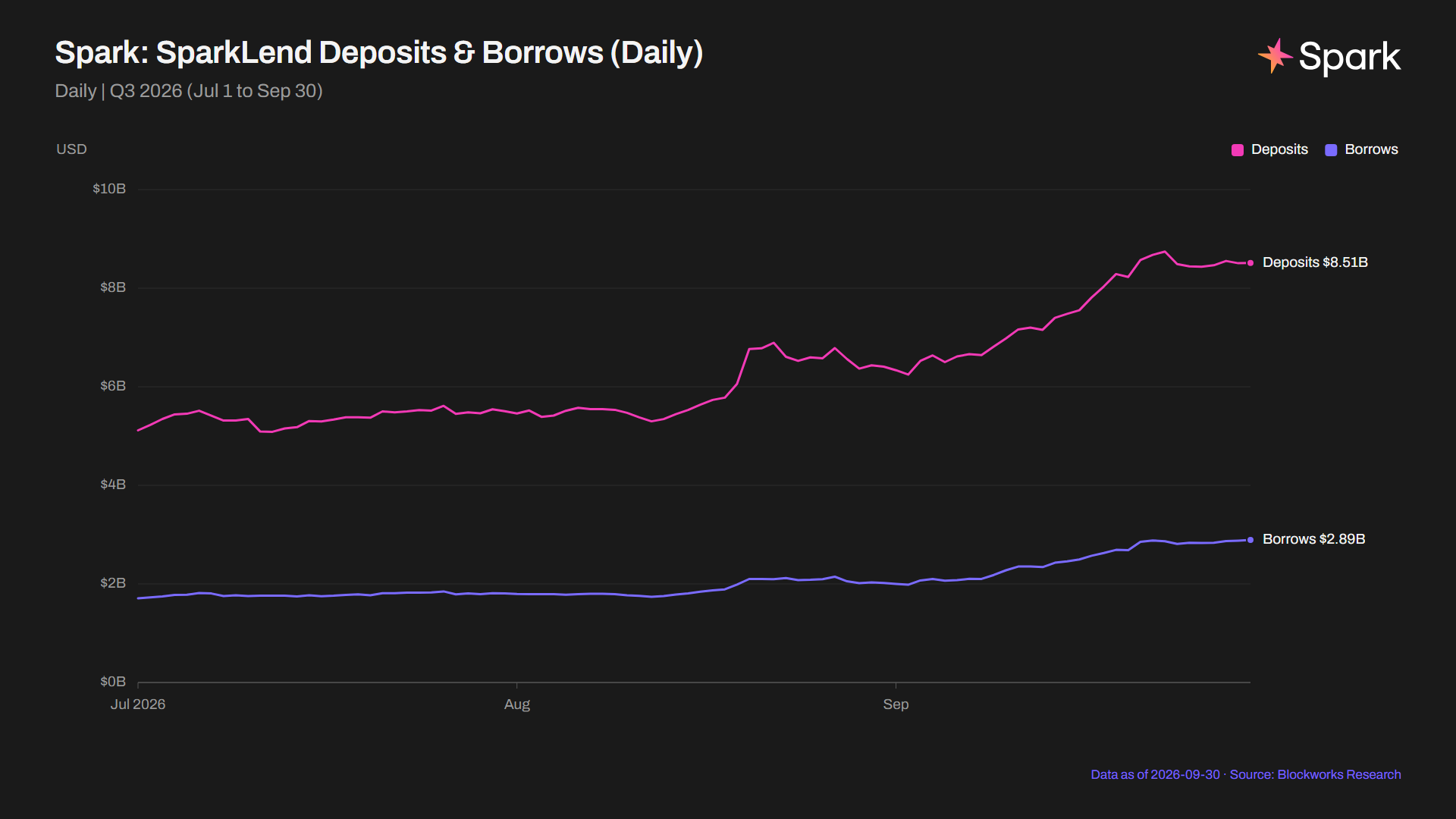
SparkLend deposits reached $8.51B at quarter-end (+69% QoQ from $5.03B), peaking at $8.74B on September 23rd, and borrows rose to $2.89B (+73% from $1.67B). Utilization held steady at 34%, so the book grew on both sides without stretching liquidity. ETH deposits crossed 600,000 ETH in mid-September, a new high for the market.
The growth outpaced a recovering sector. Combined loans across Aave, Morpho, Fluid and Spark rose 37% to $22.0B, with Aave's borrows up 28%, and Spark's share of that combined book rose from 10.4% to 13.2%. Aave's interest income still fell 17% QoQ as rates compressed, while SparkLend interest generated rose 38% on its larger balances.
Allocated Assets Breakdown
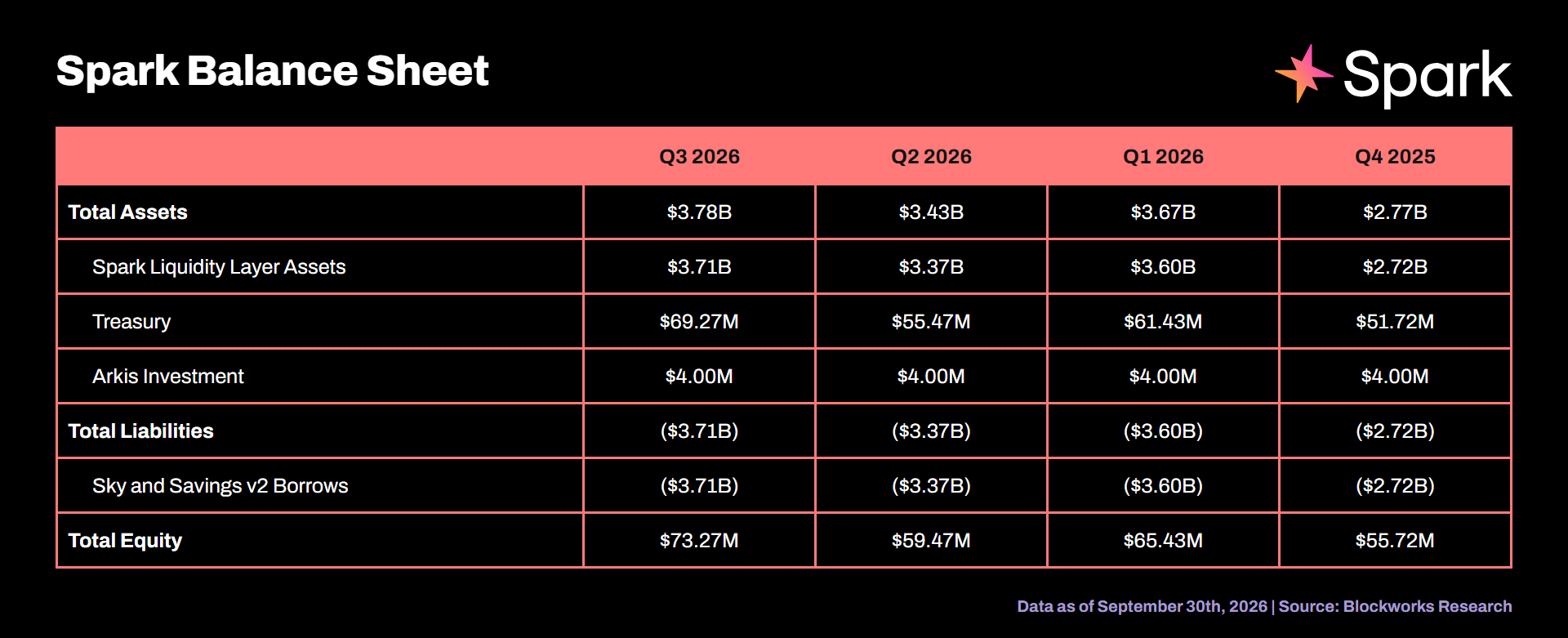
SLL-allocated assets stood at $3.71B at quarter-end, up 10% from $3.37B at Q2-end, in line with the Sky and Savings v2 borrowings that fund them. The figure includes idle balances and protocol-owned liquidity held in the SLL ALM proxy, and the Stablecoin FX Layer liquidity ($0.17B at quarter-end, from $0.15B).
The mix moved further toward Spark's own lending market. SparkLend rose to $2.13B, 57% of the allocated book (from 43%), following borrowing demand. The largest new line was Morpho at $0.69B (from $0.05B), which includes the jointly curated Sentora x Spark RLUSD vault; Spark-curated Morpho vaults as a whole grew from $57M to $692M across ten vaults. Maple was wound down to zero, PayPal eased to $0.20B and Anchorage stood at $0.21B, with Arkis steady at about $0.02B. The unallocated remainder fell to $0.30B from $1.09B as capital moved into venue deployments.
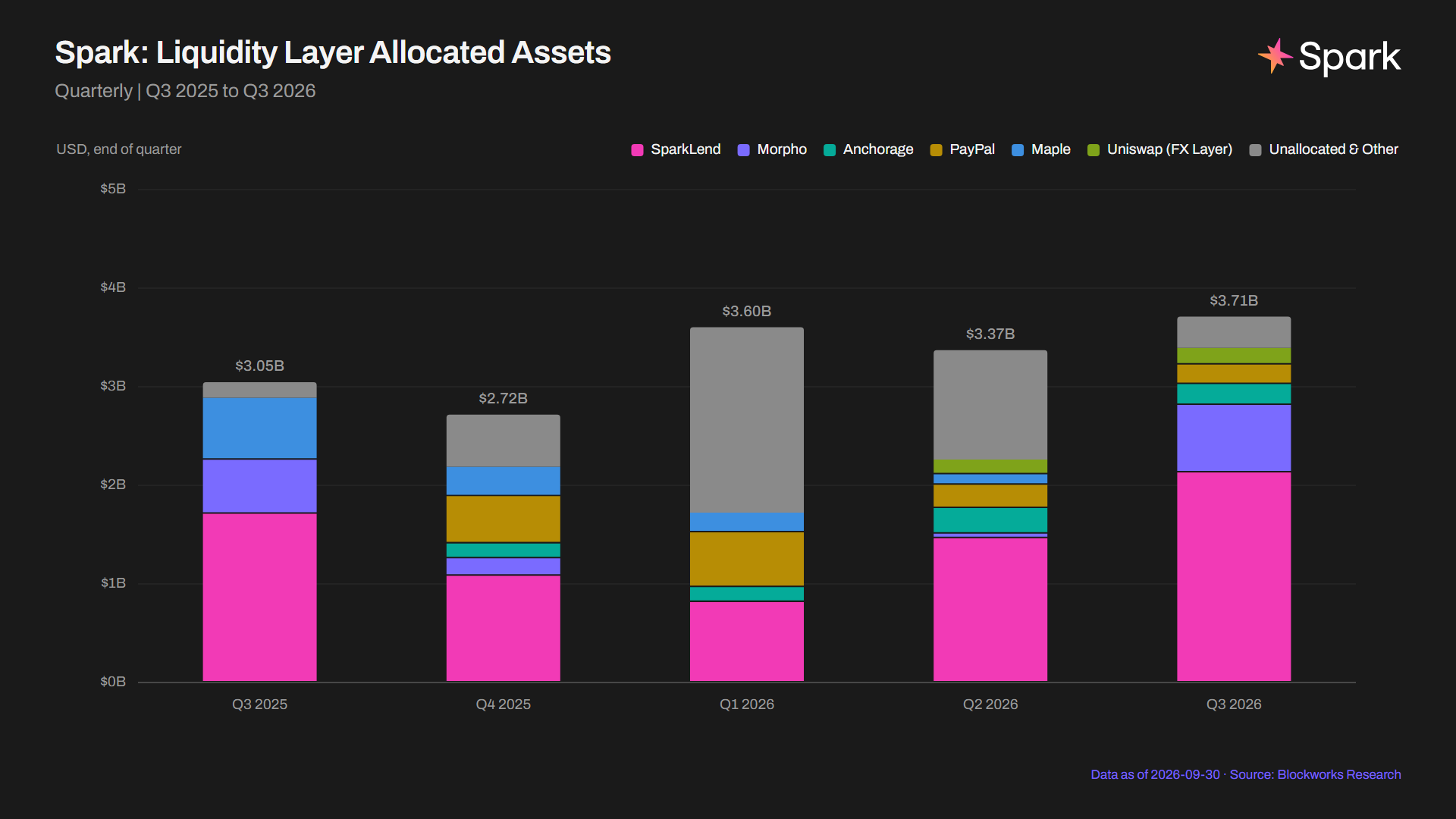
External channels span credit, payments and exchanges. Anchorage provides crypto-overcollateralized institutional lending at the highest yield in the book. PYUSD reflects Spark's role as the liquidity provider behind a payments stablecoin, and RLUSD now extends that model to a second issuer across exchange liquidity, curated lending and SparkLend credit at once.
Total Liabilities (Sky vs Savings)
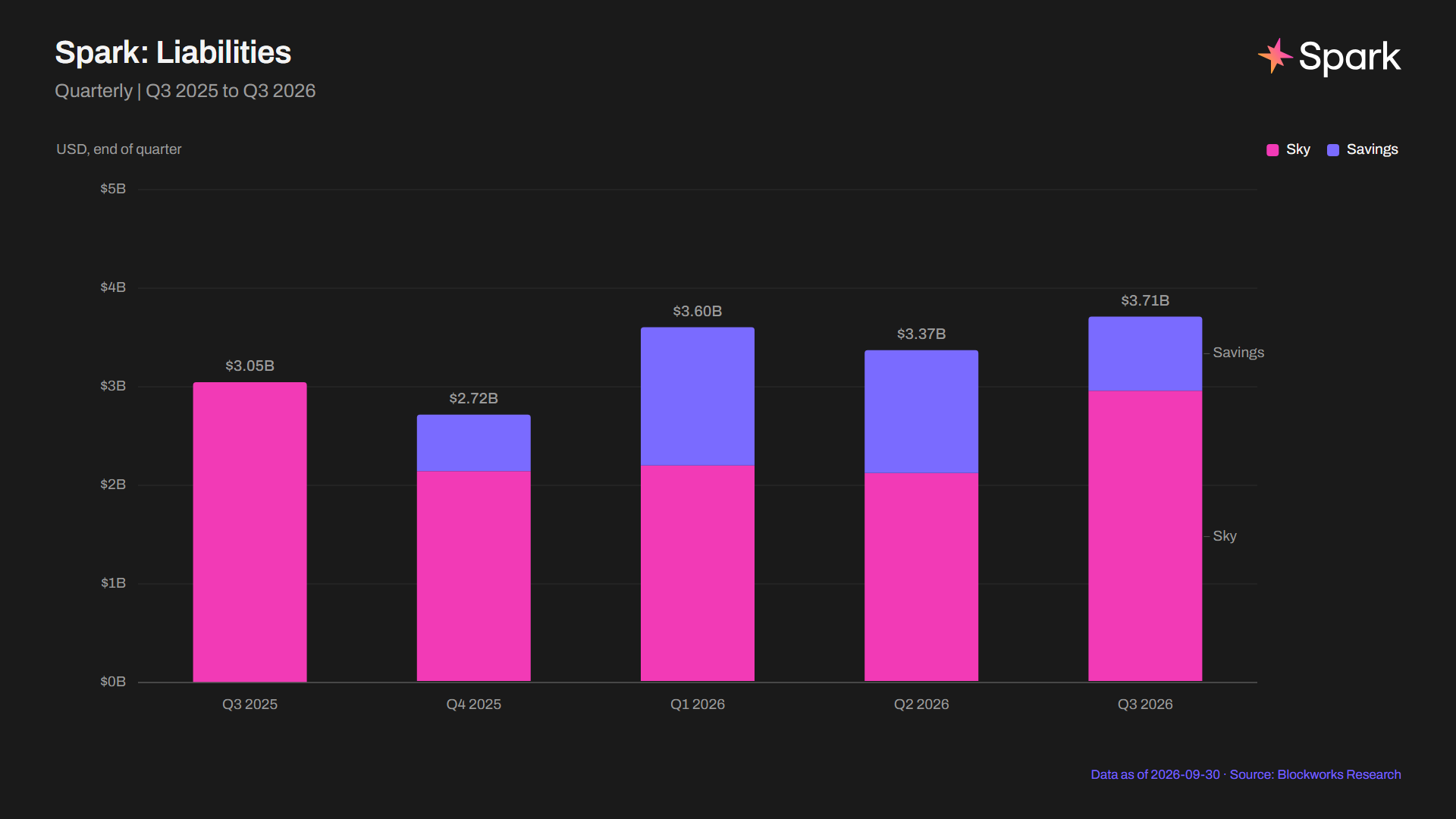
Total liabilities rose 10% to $3.71B at quarter-end. Sky borrow increased to $2.98B (from $2.12B), funding most of the SparkLend expansion, while Savings v2 liabilities declined to $0.73B (from $1.25B). The Savings v2 share of the funding base fell from 37% to 20%. Funding costs still fell 27%: Savings v2 reward costs halved with the smaller savings balance, and Sky borrow costs declined despite the larger Sky balance.
Savings TVL
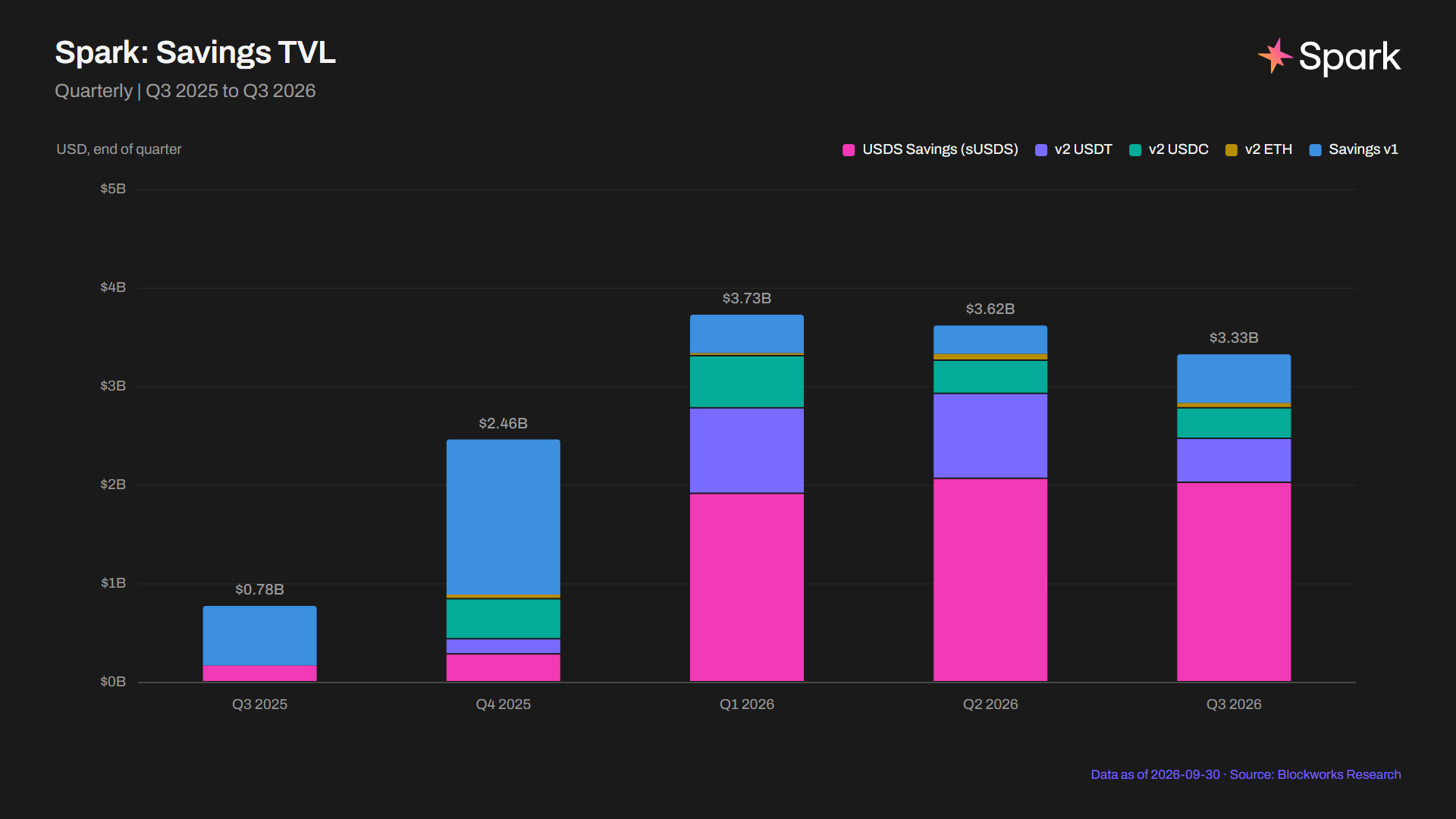
Savings TVL ended Q3 at $3.33B (-8% QoQ from $3.62B), after peaking at $3.92B in early July. USDS Savings (sUSDS) held steady at $2.02B. Savings v2 declined to $0.81B, led by the USDT vault, which fell to $0.45B from $0.86B after Spark held USDT savings rates near 2.5% through the start of the quarter; Spark then raised the USDT rate in steps to 3.44% by quarter-end, and opened the vault to OKX users in September. USDC was $0.31B and ETH $0.06B, while legacy Savings v1 balances rose to $0.49B.
Treasury
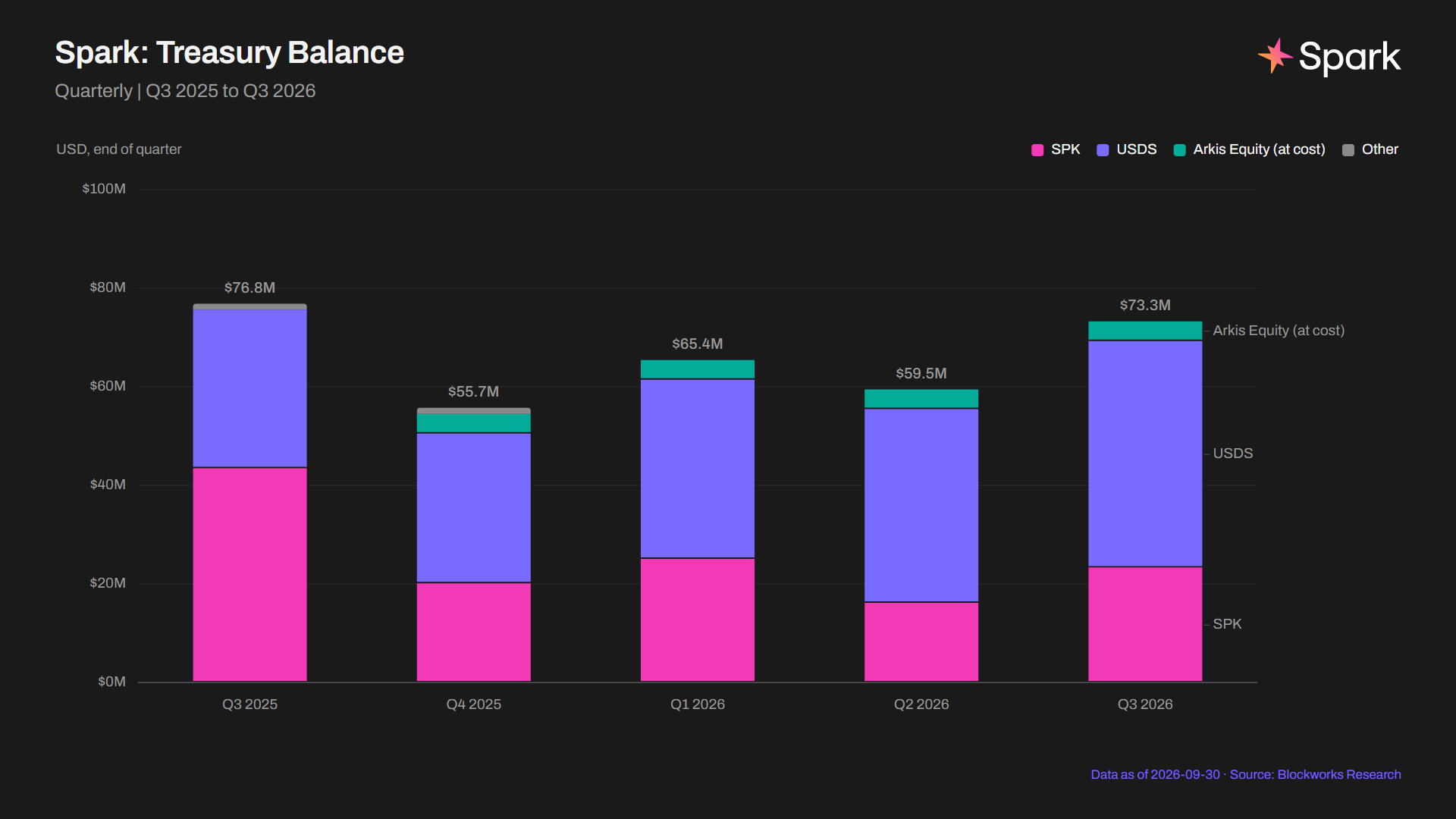
Treasury assets ended the quarter at $73.3M, up 23% from $59.5M at Q2-end, including SPK at market value and the $4M Arkis equity investment carried at cost. Liquid holdings were $69.3M. Treasury USDS rose 17% to $45.95M (from $39.30M), comfortably above the roughly $35M operating-reserve target that governs the buyback program, and SPK holdings were valued at $23.3M (from $16.2M) as repurchased tokens accumulated. Spark funded a larger buyback program and grew its spendable reserves in the same quarter, entirely from operating surplus.
Arkis Investment
Spark holds a strategic investment in Arkis, a CeFi/DeFi margin-lending platform, made in Q4 2025 ($4M invested, carried at cost). Through Arkis, Spark lends to institutions running cross-venue strategies such as delta-neutral trades, gaining exposure to strategies that would otherwise require an in-house trading team. The SLL allocation to Arkis held at about $20M through Q3, earning a 30-day average rate of 5.8% at quarter-end, second only to Anchorage in the book.
Token Financials
SPK has a fixed supply of 10 billion tokens, of which 3.35 billion were circulating at quarter-end. Under the buyback program, funded by treasury surplus above the operating-reserve target, up to 25% of the monthly excess is directed to open-market SPK repurchases, and repurchased tokens are held in treasury.
Buybacks accelerated in Q3: $2.0M of USDS repurchased 106.9M SPK, up from $1.31M and 58.3M SPK in Q2. Purchases stepped up from $0.2M in July to about $0.9M in each of August and September. The Q3 repurchases equal about 3.2% of circulating supply and 1.07% of total supply. Cumulative repurchases since the program began in March reached $3.8M for 187.8M SPK, about 1.88% of total supply.
Product Updates
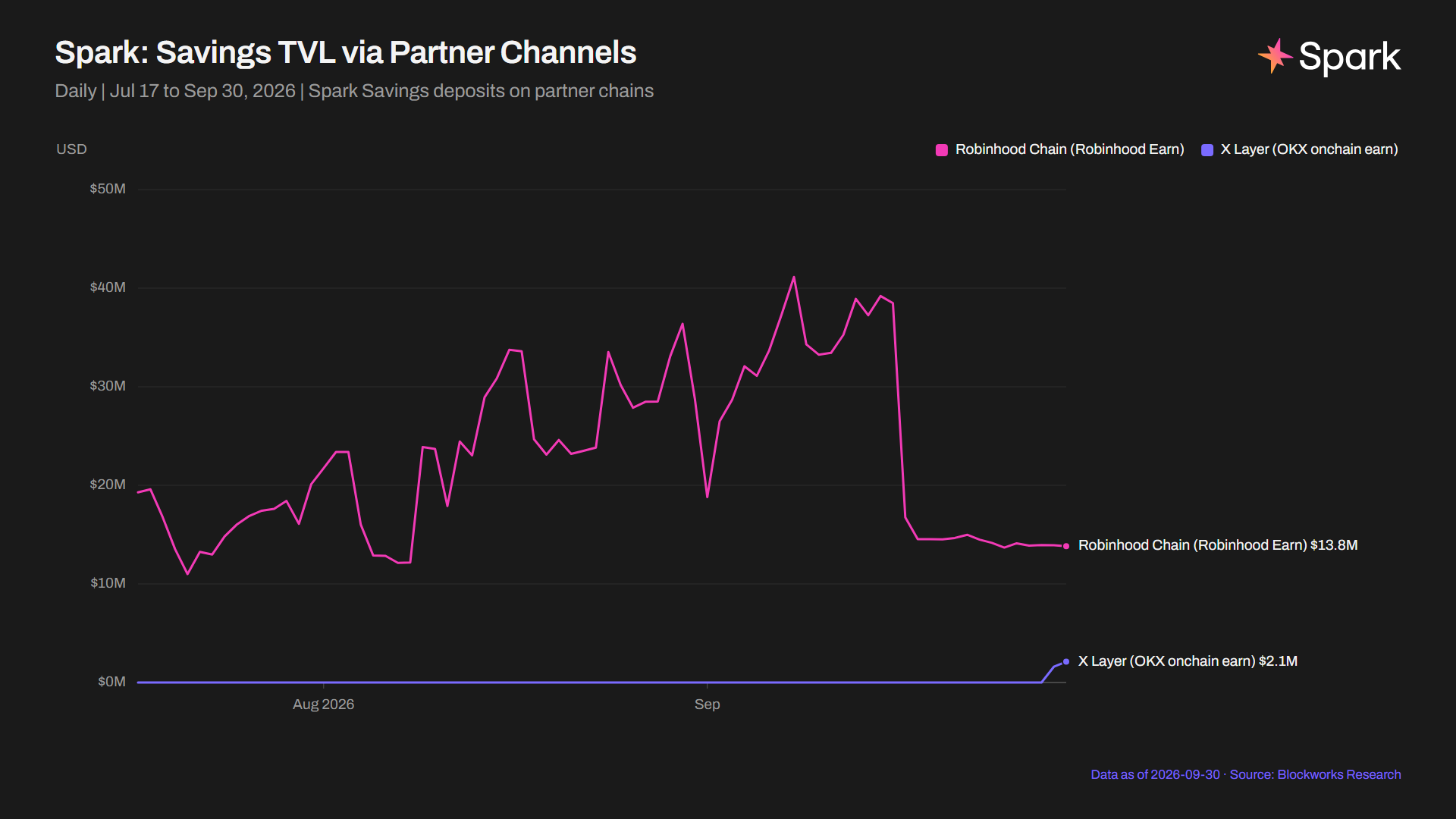
Savings deposits through the two partner channels opened in Q3 stood at $15.9M at quarter-end. Robinhood Chain, home of the spUSDG vault behind Robinhood Earn, peaked at $41.1M on September 8th before settling near $14M from mid-September and ending at $13.8M. X Layer, where OKX’s onchain earn deposits land, held $2.1M at quarter-end, with deposits first appearing in the final days of September. Both channels remain small against the $3.33B savings base so far.
Q3 updates spanned exchange liquidity, savings distribution and credit:
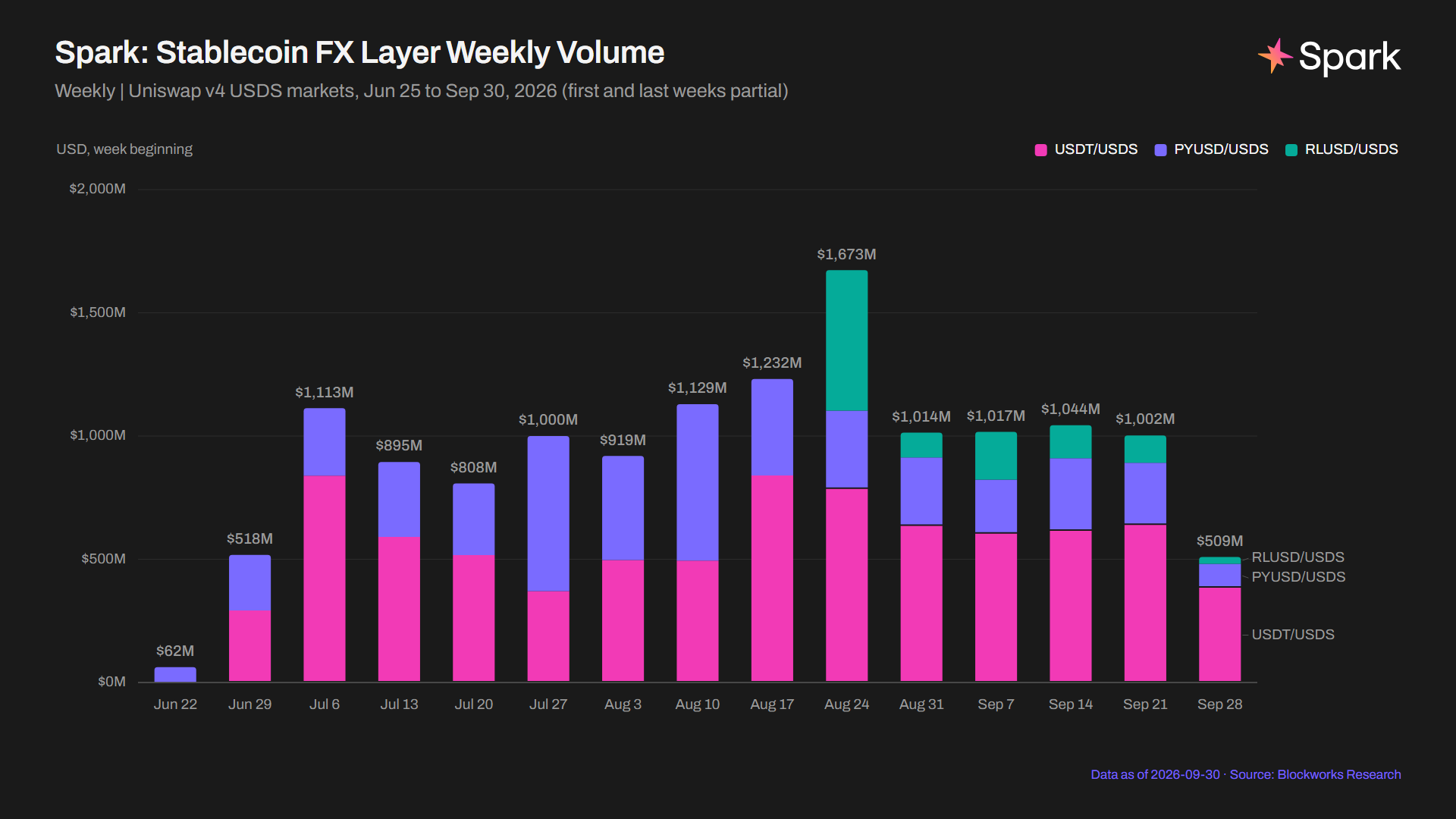
- Stablecoin FX Layer. The shared liquidity network launched with Uniswap and Sky on June 25th processed $13.9B of cumulative volume through September 30th: $8.1B in USDT/USDS, $4.7B in PYUSD/USDS and $1.1B in RLUSD/USDS.
- RLUSD. RLUSD joined USDT and PYUSD on the FX Layer, backed by $375M of planned deployment: $250M in the Sentora x Spark RLUSD Morpho vault, $50M in the RLUSD/USDS market on Uniswap v4 (about $25M RLUSD paired with $25M USDS), and $100M in the SparkLend RLUSD lending market. The RLUSD/USDS market processed more than $600M in its first week and $1.14B by quarter-end.
- OKX onchain earn. In September, OKX connected Spark's USDT savings vault to its onchain earn feature on X Layer, giving OKX users in select markets outside the European Union direct access to the Spark savings rate.
- Robinhood Earn. Robinhood Earn launched on July 1st, alongside the public mainnet debut of Robinhood Chain, with spUSDG, powered by Spark, as its yield-bearing component.
- USDT0 on Arbitrum. Spark Savings on Arbitrum added USDT0, Tether's omnichain USDT, alongside USDC and USDS.
- Institutional credit. Spark allocated $210M to institutional loans backed by BTC held in custody at Anchorage Digital, extending the tri-party structure launched in January.
- Risk ratings. Credora's September assessment rated Spark's Savings vaults from A to B+ with a stable outlook: A for PYUSD, USDG and ETH, A- for USDS, USDC and USDT, and B+ for Staked USDS. Credora rated all SparkLend markets A.
Governance Updates
Spark's Q3 spells onboarded USDG and RLUSD, deprecated the Gnosis market and funded October operations and buybacks:
- September 10th spell. Added USDG and RLUSD to SparkLend with SLL configuration and initial reserve funding, integrated the Sentora x Spark RLUSD Morpho vault, installed a new USDT interest rate model, set LBTC's loan-to-value to zero on SparkLend Ethereum, transferred foundation grants and completed the deprecation of the Gnosis market.
- SparkLend Gnosis deprecation. SparkLend's first deployment beyond Ethereum, launched in September 2023, was fully deprecated on September 14th after a wind-down that began in early 2026 with frozen deposits and borrows and a 50% reserve factor. The deployment generated little revenue relative to Ethereum, and the wind-down concentrates SparkLend's risk management on its core market.
- September 24th spell. Funded October operations with transfers of 865,000 USDS to the Spark Foundation and 45,000 USDS to the Spark Assets Foundation, allocated USDS for SPK buybacks through the operations multisig, configured the Sentora RLUSD Morpho Vault V2 integration and updated USDT interest rate parameters.
- RLUSD vault parameters. A separate proposal updated the force-deallocate penalty on the Sentora x Spark RLUSD vault and was merged on September 17th.
- Sky settlement. Sky's July 16th executive included the June monthly settlement cycle, minting 16.9M USDS of debt in Spark's allocator vault for transfer to the Sky Surplus Buffer, and whitelisted Spark's proxy spells in its StarGuard module.
Closing Summary and Outlook
Q3 showed the infrastructure built over the past year operating at scale. Spark's lending market grew faster than a recovering sector, taking its share of outstanding loans across the major venues to 13.2% and lifting interest on its lending market 38% while Aave's interest income fell 17%. The SLL extended beyond lending into exchange liquidity, where the FX Layer reached $13.9B in cumulative volume and added RLUSD, and into curated credit, where Spark-curated Morpho vaults grew more than tenfold to $692M. Distribution reached exchange and fintech users through OKX and Robinhood, and institutional credit grew through the $210M Anchorage allocation. Spark funded all of this while staying profitable, growing treasury USDS 17% and repurchasing 106.9M SPK.
The items to watch into Q4 are the conversion of FX Layer volume and the RLUSD deployment into revenue, the first full quarter at the lower distribution reward rate, and the rebuild of Savings v2 balances now that USDT rates have risen and OKX distribution is live. Curation becomes outside revenue as third-party deposits join the SLL’s own capital in the $692M of Spark-curated Morpho vaults. With more than half of the allocated book now in its own lending market and sector borrowing demand recovering, Spark enters Q4 at a 13.2% lending share with FX Layer, OKX and Robinhood channels live.
This report was commissioned by the Spark Foundation. By providing this disclosure, we aim to ensure that the research reported in this document is conducted with objectivity and transparency. All content was produced independently by the author(s) and does not necessarily reflect the opinions of Blockworks. or the organization that requested the report. The commissioning organization may have input on the content of the report, but Blockworks maintains editorial control over the final report to retain data accuracy and objectivity. Author(s) submit financial conflict of interest (FCOI) disclosures on a monthly basis that are reviewed by appropriate internal parties and may hold cryptocurrencies named in this report. This report is meant for informational purposes only. It is not meant to serve as investment advice. You should conduct your own research and consult an independent financial, tax, or legal advisor before making any investment decisions. Past performance of any asset is not indicative of future results. Please see our Terms of Service for more information.