Solana Perps: Engineering the Missing Piece

Introduction
Perpetual futures have become crypto's dominant trading instrument, and the ability to host competitive perps markets onchain is arguably Solana’s highest-value problem left to solve.
The performance-sensitive trader, the systematic desk running funding arbs, or the market maker who needs sub-second fills and deep books, has largely consolidated on Hyperliquid. Volume ranges from 5 to 10x the entire Solana perps complex combined, and the gap is self-reinforcing: more volume attracts tighter spreads, tighter spreads attract more volume. Hyperliquid achieved this by controlling the full stack, running a purpose-built L1 with deterministic ordering and an execution environment designed around orderbook matching.
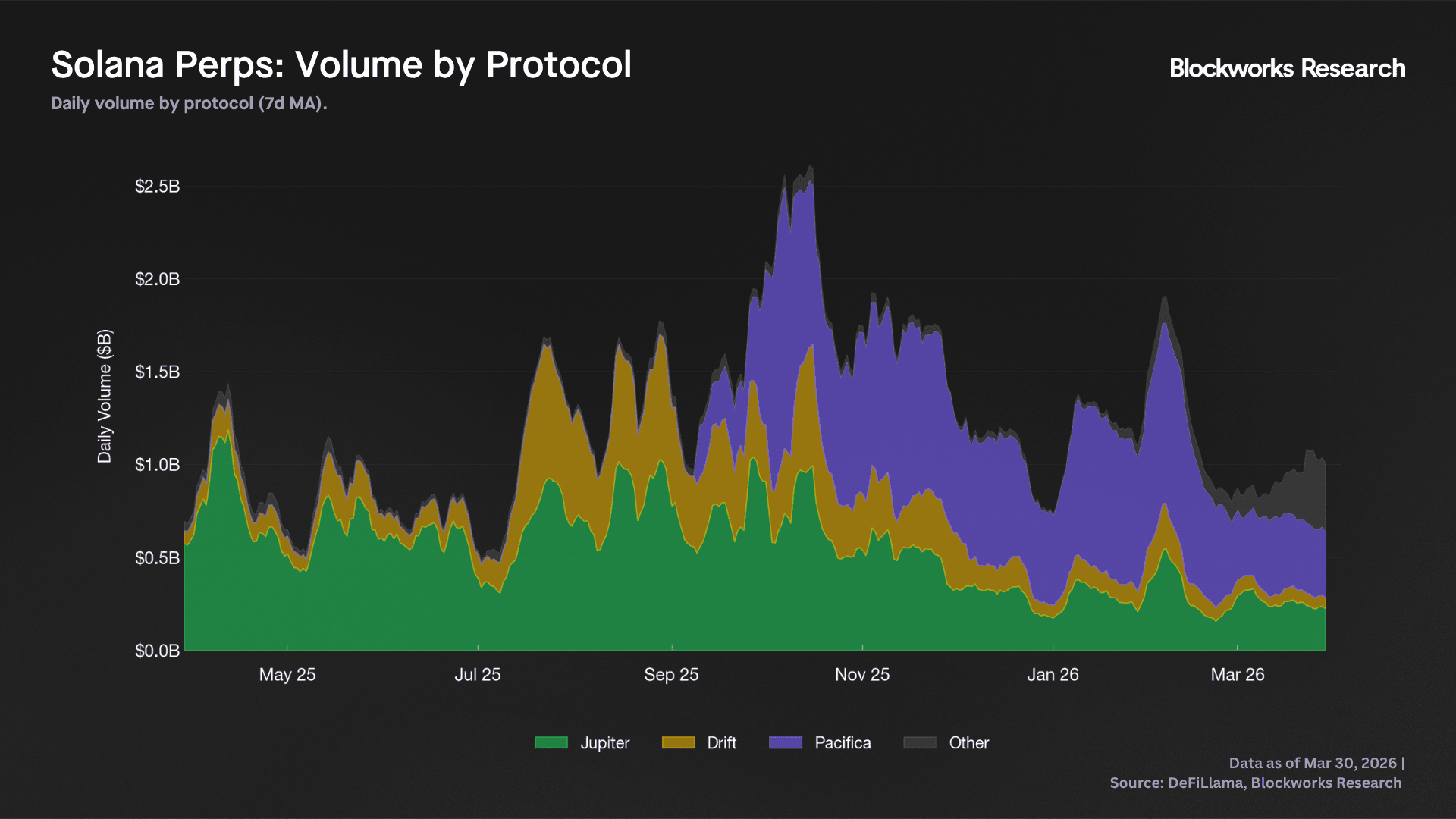
Solana's perps market has lagged, a consequence of optimizing for general-purpose blockspace rather than the execution guarantees perps trading demands. Unlike a purpose-built chain where the entire environment serves a single orderbook, Solana perps operate alongside every other application on the network, while also inheriting block-to-block variability. Jupiter, Drift, and Pacifica are the primary venues today, each with meaningfully different execution models.
If the execution problem is solved natively, onchain perps inherit the full composability of Solana's DeFi stack, allowing atomic cross-protocol liquidations, perps positions as lending collateral, and yield strategies spanning multiple primitives. That composability compounds with every new application the ecosystem ships, an advantage a purpose-built, single-application chain structurally struggles to replicate.
Hyperliquid is building its own integrated composability stack through HyperEVM, but Solana still has the broader external ecosystem advantage if onchain perps execution becomes competitive.
Historically, Solana onchain perp venues are composable but lag on execution. Standalone chains (like Hyperliquid) have offered the best performance but must start from scratch. Offchain extensions risk the worst of both worlds if they sacrifice onchain composability without being able to match execution quality and book depth. The target state is the top-right quadrant: execution competitive enough to retain performance-sensitive flow, delivered in a form that compounds value through composability with the rest of the ecosystem.
