Pushin P - A DePIN Debate


Primer
Haseeb Qureshi, managing partner at Dragonfly Capital, kicked off an engaging DePIN debate last Friday.
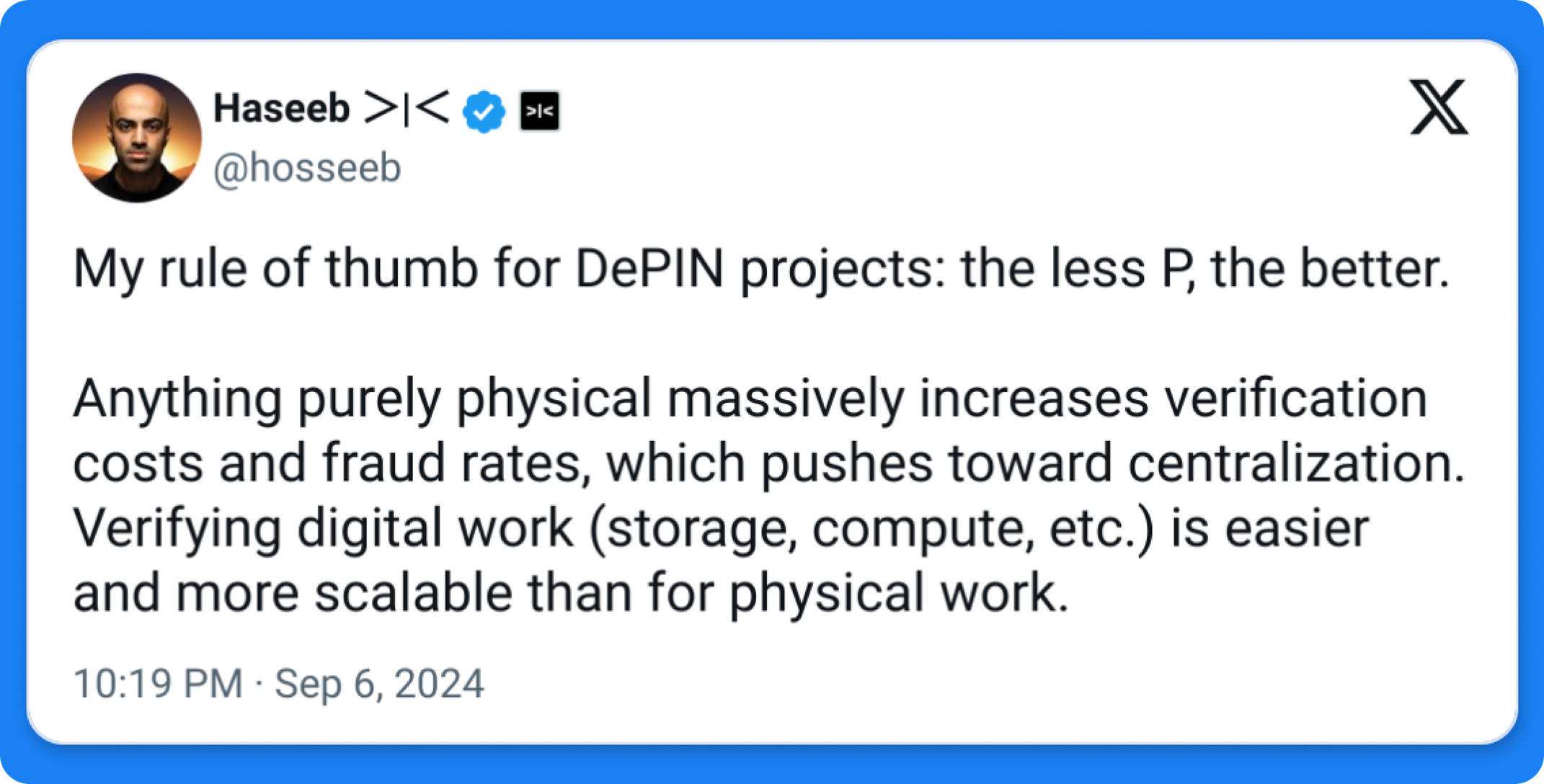
As the broader umbrella DePIN category has matured, there has become a much clearer delineation between projects that leverage physical (Physical Resource Networks, or, PRNs) and digital resources (Digital Resource Networks, or, DRNs). PRNs generally deploy physical hardware for services like energy and wireless connectivity, while DRNs focus on digital resources like compute and storage.
Haseeb’s claim cites verification as one of the prominent bifurcation points between these two classes of networks. Specifically, from Haseeb’s perspective, the feasibility of verification is crucial in determining how well a network can scale while remaining decentralized. But what exactly is meant by verification in the context of this discussion?
Verification largely boils down to determining whether a requested service was successfully rendered. Within the broader class of crypto networks, there are several ways to achieve verification, as Guy Wuollet from a16z describes:
- Blockchain Consensus Mechanisms: Every blockchain uses some form of consensus to ensure state changes are valid. Typically, network nodes or validators re-execute transactions to reach this consensus.

Prior to joining Messari, Seth worked in traditional finance software and services, and has a MSc in Applied Mathematics. Seth is a Senior Research Analyst on the Enterprise Research team, and focuses on infrastructure, verifiable compute, and the AI x Crypto intersection.

Dylan is a Sr. Enterprise Research Analyst focusing on DePIN, DeFi, AI, and RWAs. He previously worked as a digital assets investment analyst at T. Rowe Price and in venture capital. Dylan is a graduate of Princeton University and co-founded the Princeton Blockchain Club.

Prior to joining Messari, Chris was the Growth Lead at a Paradigm and a16z-backed gaming startup called LootRush. His primary focus is Consumer Products, Music x Crypto, Gaming, Digital Art, and market buying local tops.

Kunal previously worked in equity research and now considers himself a financial analyst in crypto. He specializes in valuation and bottom-up analysis for Layer-1 and DeFi protocols because he has yet to learn of a way to value NFTs.