Optimism's Bedrock Upgrade: The Road to the Superchain

As of June 6, 2023 Optimism has successfully executed the Bedrock upgrade, a crucial milestone for the future of the L2. Bedrock introduces several major enhancements to the network and is an important precursor to Coinbase’s upcoming BASE mainnet. Through these enhancements, the network is poised to experience further growth, both on the core L2 and on upcoming OP Stack networks. Bedrock paves the way for Optimism’s Superchain vision, where developers can utilize the OP Stack’s tools to easily deploy optimistic rollups that share security and are able to communicate with each other.
A good comparison can be made between Optimism and the Cosmos SDK, where Optimism aims to provide a software suite of different modules that teams can implement to create an interoperable network of L2s. This is very similar to how the Cosmos SDK offers modules for the development of app-specific chains, such as Osmosis. In a way, the Optimism Superchain seeks to provide similar architecture, but tied more closely to Ethereum. However, as modular capabilities improve, the OP Stack could theoretically support other data availability layers, such as Celestia.
Lower Transaction Fees
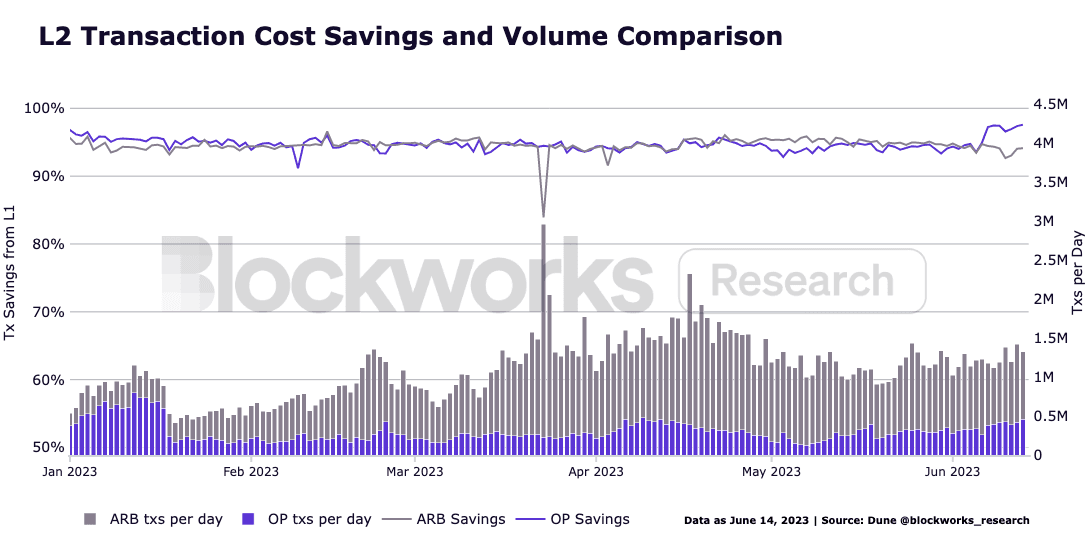
Transaction fees are up to 50% cheaper than before thanks to optimized batch compression. Data compression is now optimized, where lists of L2 transactions, referred to as sequencer batches, are organized into channels before being submitted to the L1. These channels are further compressed into channel frames so that entire batches of transactions can fit in a single L1 transaction. These can be submitted in parallel, optimizing available space for data on the L1. However, this is not to be confused with parallel processing, as this is just parallel submission of transactions to the L1. The architecture minimizes Ethereum transaction fees when compared to the early days of Optimism. Note in the chart below that Optimism transaction savings experienced a jump when compared to Arbitrum transaction savings immediately following the Bedrock upgrade.
Ethereum Equivalence
Bedrock also optimizes node performance. Prior deployments only allowed for execution of one transaction per block, but Bedrock enables execution of multiple transactions per block, which can help reduce state growth. Further, the upgrade introduces more efficient transaction data querying from the L1, important because L2s may sometimes need to look up historical transaction call data. Bedrock also adds support for EIP-1559 gas computation and chain reorganizations.

Pibblez leads coverage on emerging L1s, infrastructure, and stablecoins. Previously worked as a Research Analyst at Kraken.