
Executive Summary
Olympus is an onchain reserve asset. Its token, OHM, floats freely against a treasury of stablecoin reserves and loans to holders, and its backing per OHM, the liquid backing behind each OHM in backed supply, anchors the design. Holders cannot redeem OHM for backing. Policy runs as a monetary computer, with its core terms written into smart contracts: holders borrow against backing at a fixed 0.5% with no price-based liquidations, treasury income and reserves fund daily buybacks, and new OHM can be created only by the protocol's own onchain contracts. The main route is Convertible Deposit auctions, which the Emissions Manager opens while OHM trades at a governance-set premium to backing, a threshold of $17.54 in Q3. Running since 2021, and the protocol that pioneered owning its liquidity (POL), Olympus aims for backing to hold its purchasing power over time.
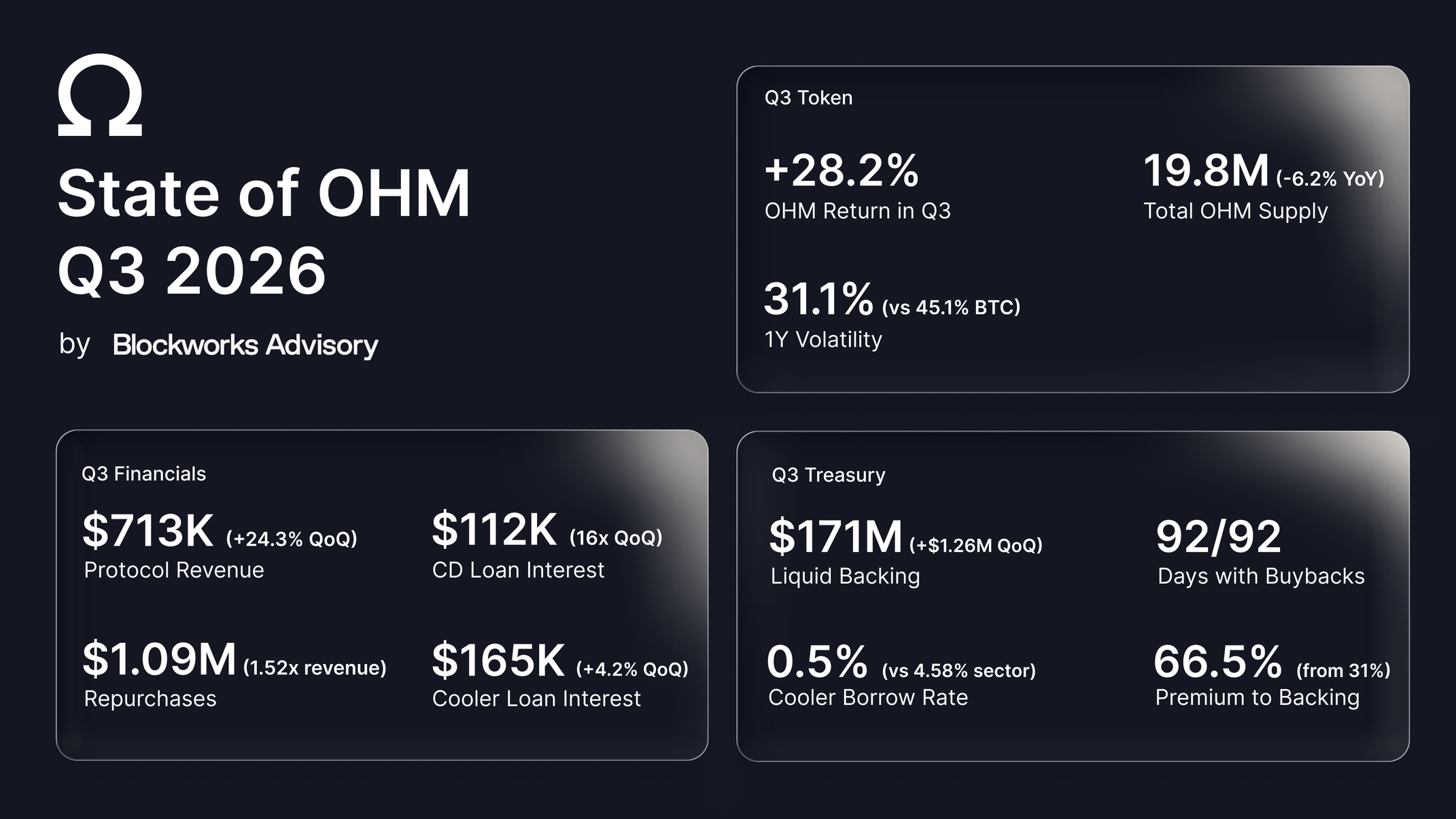
Olympus closed Q3 2026 with backing of $12.04 per OHM, Q3 revenue of $712,950 and $1.09 million spent on OHM repurchases, with repurchases on every day of the quarter ($0.18 million bought and burned through the YRF and $0.91 million bought and held by the treasury). Revenue rose 24.3% from Q2. Backing per OHM opened the quarter at $11.97 and then held between $11.98 and $12.10 for the rest of the quarter.
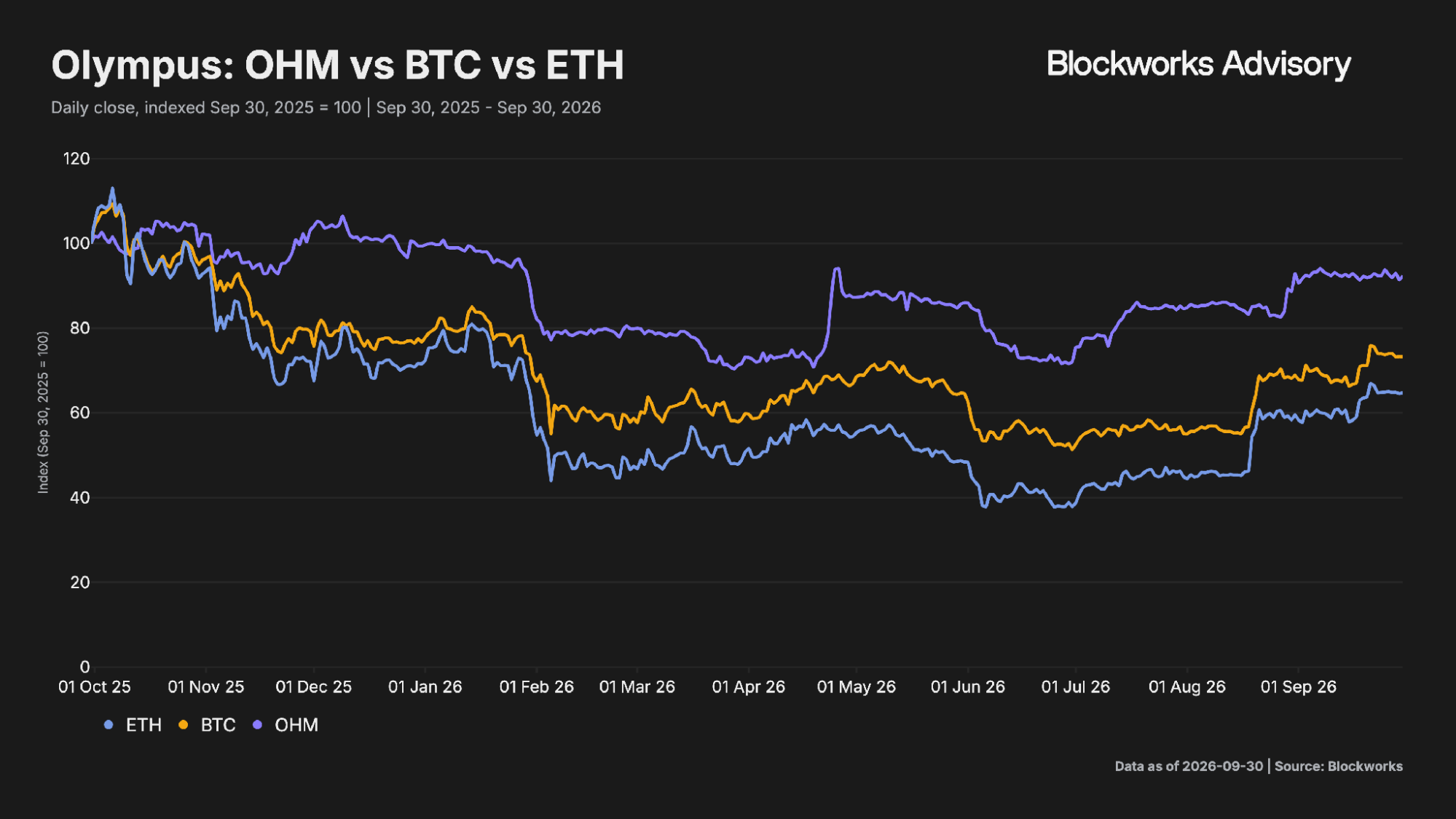
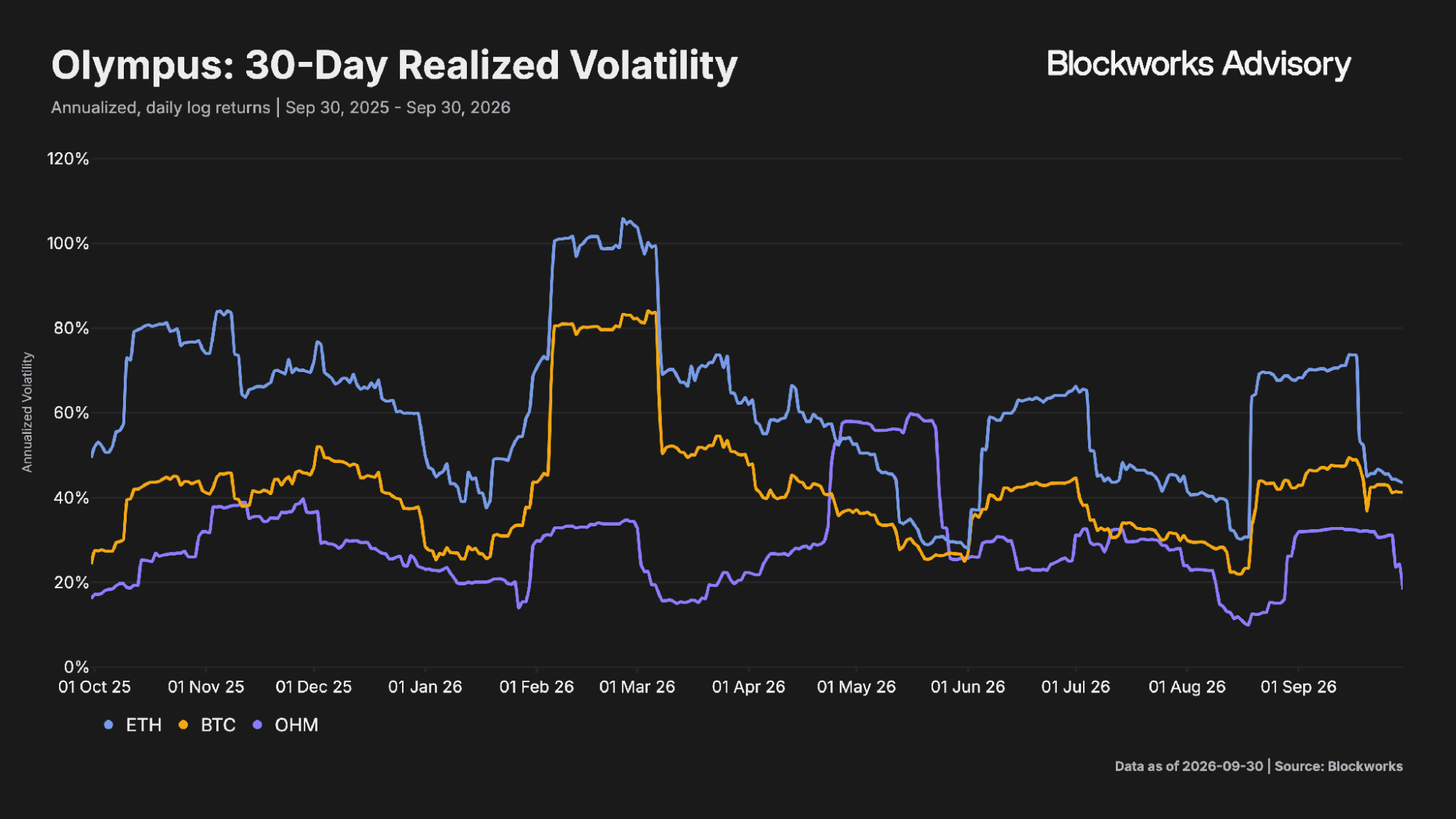
Backing held steady in a year that tested every crypto asset. Over the twelve months to September 30, BTC's deepest drawdown from its peak was 53.1% and ETH's 66.6%. OHM's was 33.9%, and its one-year realized volatility was 31.1%, against 45.1% for BTC and 63.7% for ETH. In Q3 itself OHM returned 28.2% as crypto rallied, behind BTC at 42.7% and ETH at 71.0%, with roughly half of ETH's volatility.
Backing per OHM rose 2.8% over the twelve months to September 30, from $11.71 to $12.04, with the gain coming from retiring claims on the treasury, chiefly the February OIP-191 burn of legacy migration inventory. Backed supply fell 5.1% over the same months, so each remaining OHM holds a larger share of backing.
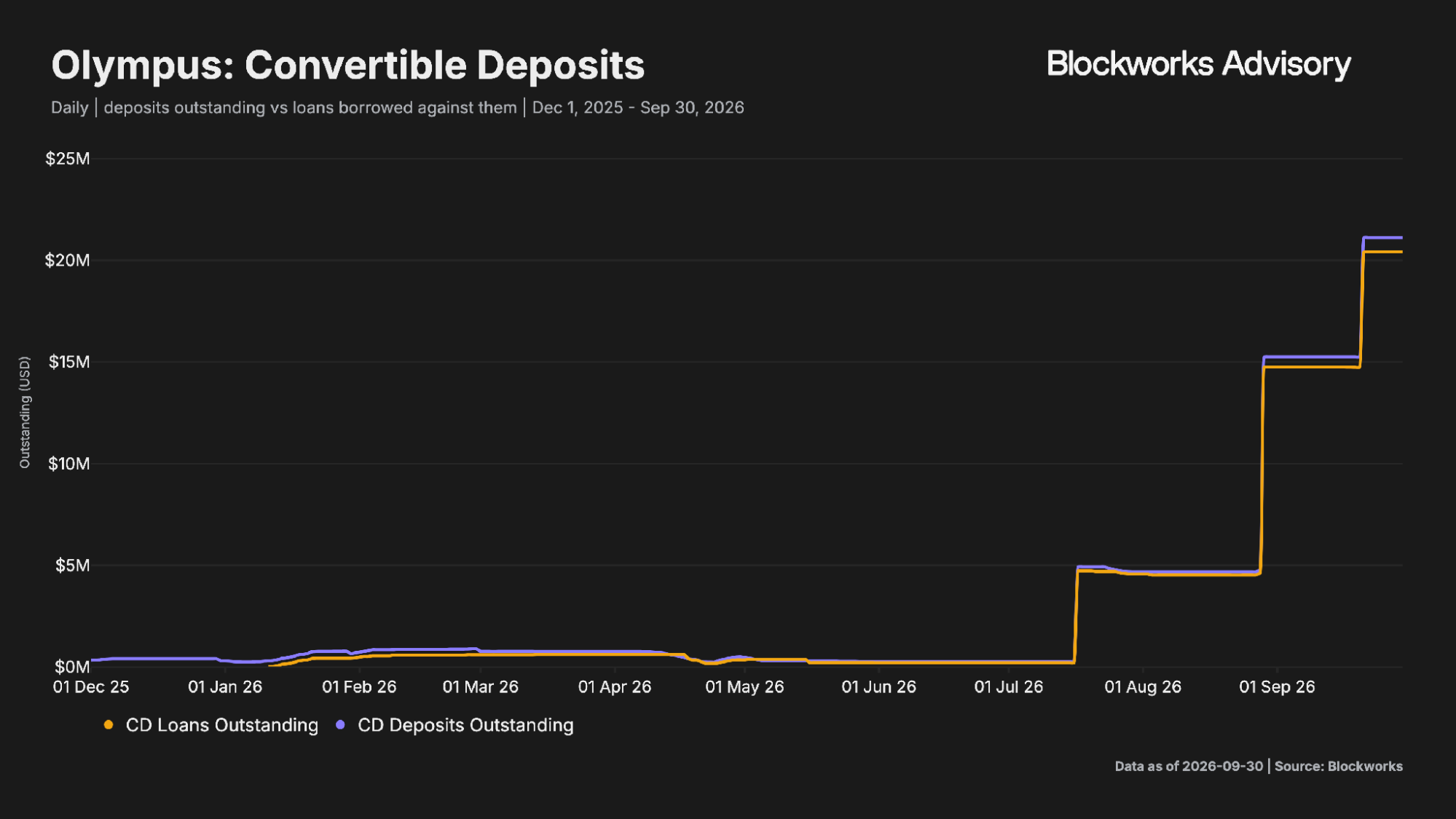
Convertible Deposit loan interest was the quarter's fastest-growing revenue line. Deposits rose from $0.26 million to $21.1 million, and the interest depositors pay to borrow against them grew from $6,881 in Q2 to $112,457, or 15.8% of Q3 revenue. Each deposit carries the right to convert into OHM at a fixed price, and the weighted strike of $20.87 is 1.73 times backing per OHM. Conversion is economic for depositors only if OHM trades above the strike, and OHM closed the quarter at $20.05. If conversions occur, they would mark the start of Olympus's next supply expansion, with new OHM issued above backing and the deposits joining the treasury.
Contributor Letter
Olympus was built around a simple question: what would a reserve asset look like if its monetary policy were written in code and no government could direct it? Every national currency depends on the restraint of whoever issues it, and that record is poor. The dollar has lost most of its purchasing power since 1971, and central banks have spent the past three years adding gold to their reserves. OHM is built to be the onchain alternative: a floating asset backed by a treasury, whose rules for issuing and buying back supply live in smart contracts and change through public governance.
The backing behind each OHM should keep its purchasing power over time. That is the aim that matters most to us, ahead of price or revenue.
Q3 showed what that discipline looks like in a volatile market. Backing held near $12.04 per OHM through the quarter. Revenue rose 24% to $712,950, before operating expenses, from yield on stablecoin reserves to interest on loans and fees on the liquidity the protocol owns. OHM rose 28% with about half the volatility of ETH, and over twelve months it fell 7.7% while BTC fell 26.7% and ETH 35.3%.
The design runs in cycles. When the market pays a premium for OHM, the protocol can sell new supply into that demand and the proceeds go to the treasury. The treasury uses its income and reserves to buy supply back. Since April 2022, Olympus has bought back 11.9 million OHM for about $156 million. Most of that was funded from treasury reserves rather than revenue. In Q3, depositors committed $21.1 million to Convertible Deposits for the right to buy OHM at a weighted $20.87, which is 1.73 times backing per OHM. If those rights convert, new supply will enter at a price the market set at auction, and the deposits will move into the treasury.
Close to 80% of liquid backing is lent to OHM holders through Cooler Loans at a fixed 0.5%, with no liquidation tied to the market price. A treasury run for maximum return would not do that. We do it because a reserve asset should let its holders borrow against what stands behind it, cheaply, without being forced to sell in a drawdown. The rest of the treasury earns yield under allocations set by governance or under authority governance has delegated. Governance moved most stablecoin reserves into sUSDe this year. The YRF v2 proposal would let buybacks draw on several reserve assets.
Much of OHM's policy does not depend on trust in the people who manage its treasury. Supply rules and loan terms sit in contracts. Treasury allocations trace to public governance decisions, or to authority governance has delegated, and they are carried out as decided. Decisions made under delegated authority, including the post-quarter ETH allocation, involve discretion by the people exercising it. In 2023 governance made Cooler Loans conditional on moving the treasury into stablecoins. Some of us would have preferred a different route, and the treasury sold 15,710 ETH over six weeks because the vote required it. Treasury balances and buybacks are readable onchain, and since July any AI agent can query the protocol's live state directly via the Olympus MCP. Thirty-five external audits sit behind the contracts; audits reduce smart contract risk but do not eliminate it.
Olympus has now run for five and a half years, and its core contributors have been here for most of them. We think about this work in decades. If the deposits opened this quarter convert, that will mark the protocol's second expansion, and we will report it the way we report everything else, with the numbers attached.
Olympus Today: A Monetary Computer
Olympus launched in March 2021 and has run its own monetary policy onchain since. OHM is a floating, treasury-backed token with no peg. Each backed OHM is matched by what Olympus calls liquid backing, made up of the protocol's reserves and its Cooler loans to holders, which totaled $171.3 million on September 30, or $12.04 per OHM. Backing per OHM divides liquid backing by backed supply, 14.23 million OHM on September 30, which excludes OHM held by the treasury and OHM in protocol-owned liquidity; total supply was 19.82 million.
The protocol works as a monetary computer, running rules-based monetary policy with each lever written into smart contracts:
- Treasury and backing. Reserves held in stablecoin savings products (sUSDe and sUSDS), protocol-owned liquidity (POL) and the Cooler loan book.
- Cooler Loans. Holders borrow stablecoins against gOHM at a fixed 0.5% rate, with no expiry and no price-based liquidations. Loan sizes are set against backing, so under current terms a falling market price does not force a sale.
- Convertible Deposits. Depositors lock stablecoins and receive the right to convert into OHM at a locked price before expiry, to wait for full redemption, or to exit early at a discount.
- Yield Repurchase Facility (YRF). Treasury yield buys OHM on the market and burns it, then puts the backing each burn releases into further purchases.
- Emissions Manager. Part of the Convertible Deposit system. It opens deposit auctions while OHM trades at a governance-set premium to its backing price, 50% above $11.69 in Q3, a threshold of $17.54, and governs how much new supply can be sold. New OHM is created when a deposit converts.
- Protocol-owned liquidity. Olympus pioneered owning its trading liquidity, so OHM markets do not rely on liquidity-mining incentives.
Policy alternates between expansion and contraction phases. Supply expands when the market pays a premium for OHM: conversion rights sold at auction turn into new OHM, and buyers take OHM out of protocol-owned liquidity at rising premiums, moving it into circulation. Supply contracts through buybacks funded by treasury income and reserves. Expansion now runs through the Emissions Manager and contraction through the YRF and open-market purchases. An earlier mechanism, Range Bound Stability, which bought and sold OHM to keep its price within a range, is no longer used.
Getting here took five years, a surprisingly long lifespan for a crypto protocol. Olympus opened with a $4-per-OHM community sale in March 2021 and became known for its rebases. They were supply inflation: with OHM trading far above its backing, issuing new supply was the way to bring the premium down, and staking spread that issuance evenly so stakers were not diluted.
This very record, the test of time, is the protocol's main credential as an onchain reserve asset. Olympus has earned revenue in every year of its recent history, $11.9 million from January 2023 through September 2026, and has bought back 11.93 million OHM for $155.9 million since its first buyback in April 2022.
Financials
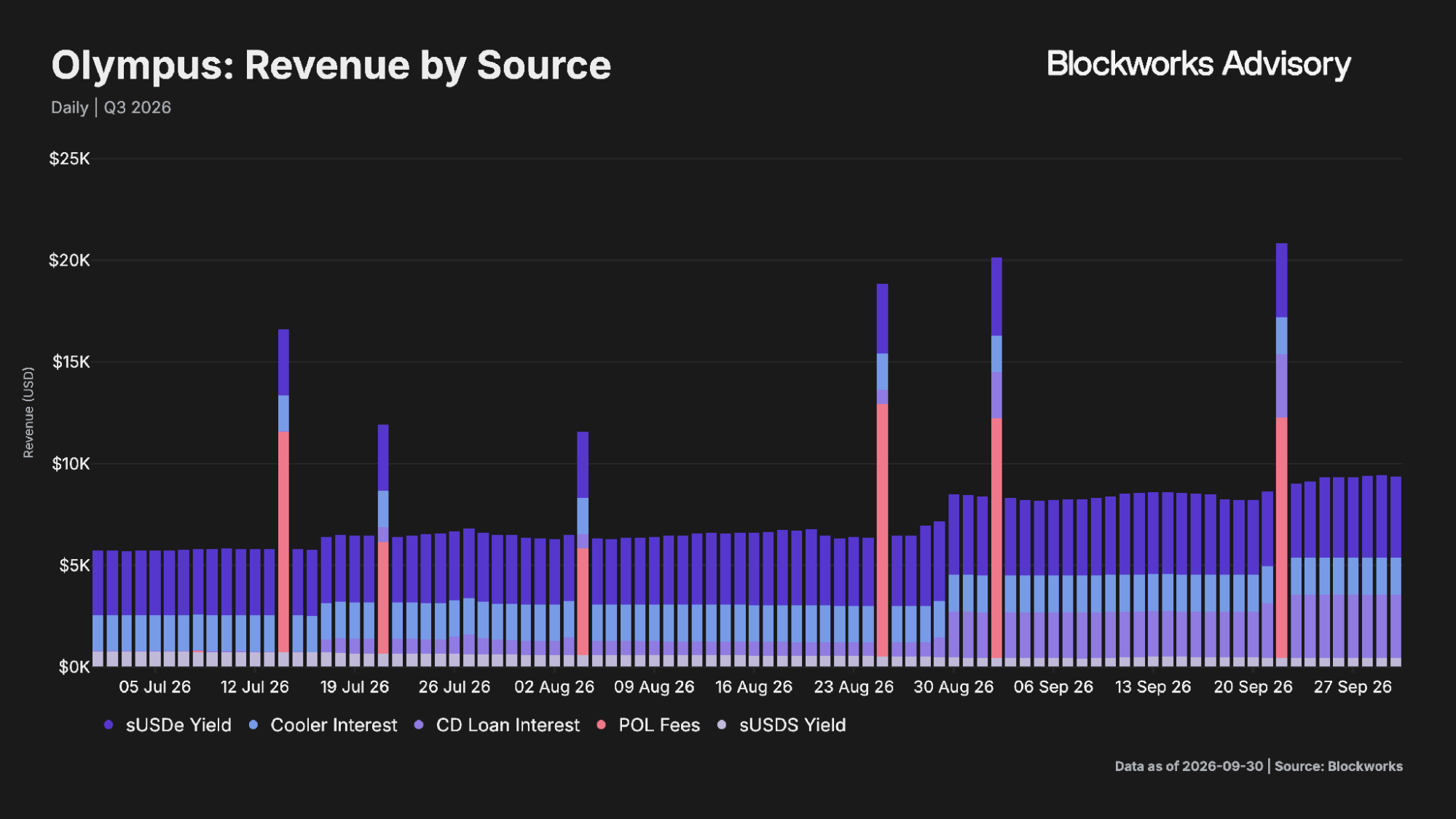
Q3 revenue was $712,950, up 24.3% from $573,409 in Q2 and level with Q3 2025 at $712,817. The quarter ended two quarters of decline from the Q4 2025 level of $723,632, and about three quarters of the recovery came from Convertible Deposit loan interest.
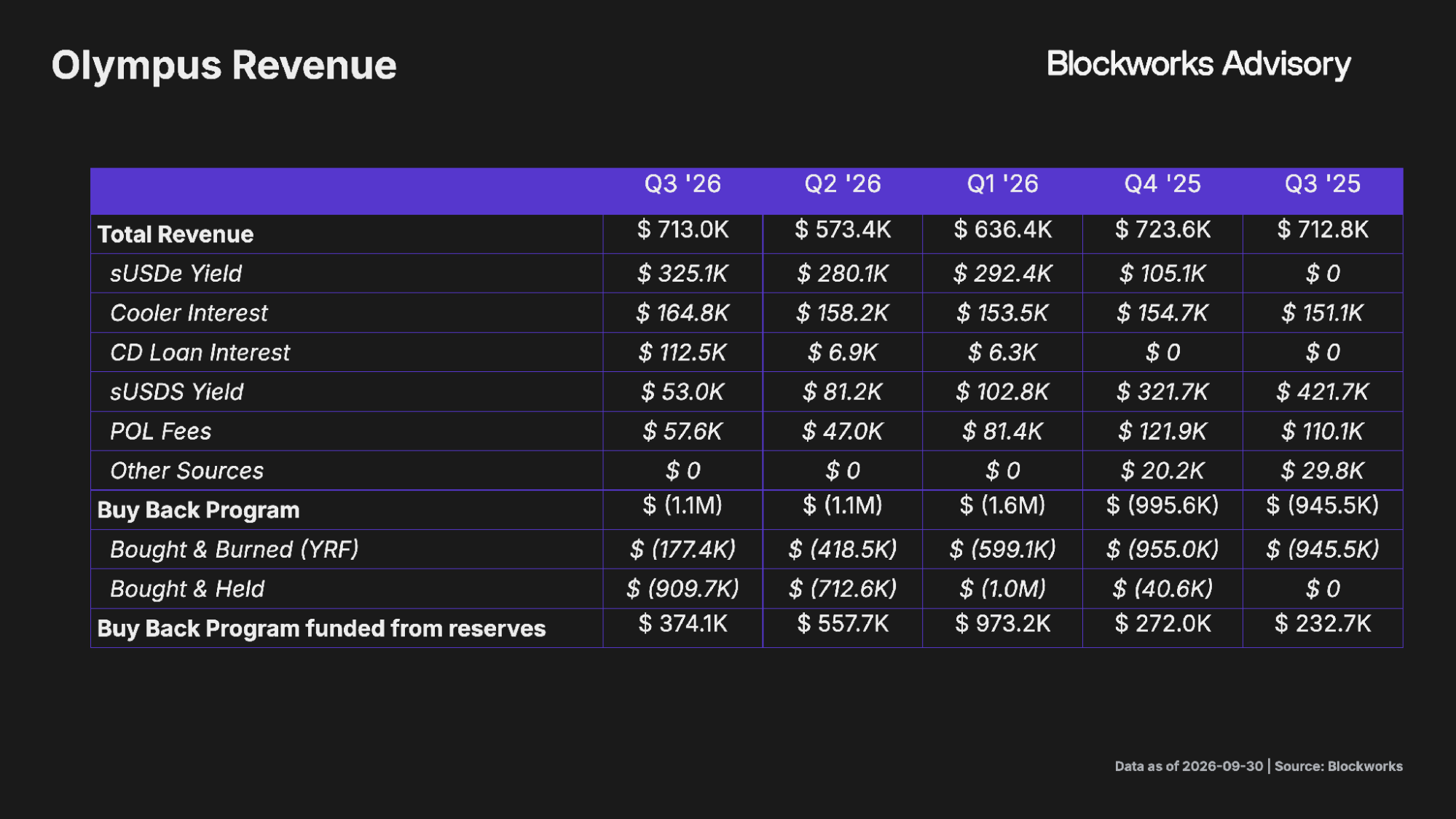
Revenue counts all treasury income: yield on the sUSDe and sUSDS reserves, interest on Cooler loans, interest on Convertible Deposit loans and trading fees on protocol-owned liquidity. Convertible Deposit loan interest accrues daily at a fixed 5.5% and arrives in cash when a loan is repaid or extended.
Olympus spent $1,087,017 on OHM repurchases in Q3, 1.52 times revenue. The YRF bought and burned 9,520 OHM for $177,358, and the treasury bought 47,797 OHM on the open market for $909,659 and held it. The YRF bought on all 92 days of the quarter and the open-market program on 58 of them. Repurchase spending has exceeded revenue in each of the last five quarters, at between 1.33 and 2.53 times, with the difference funded from treasury reserves.
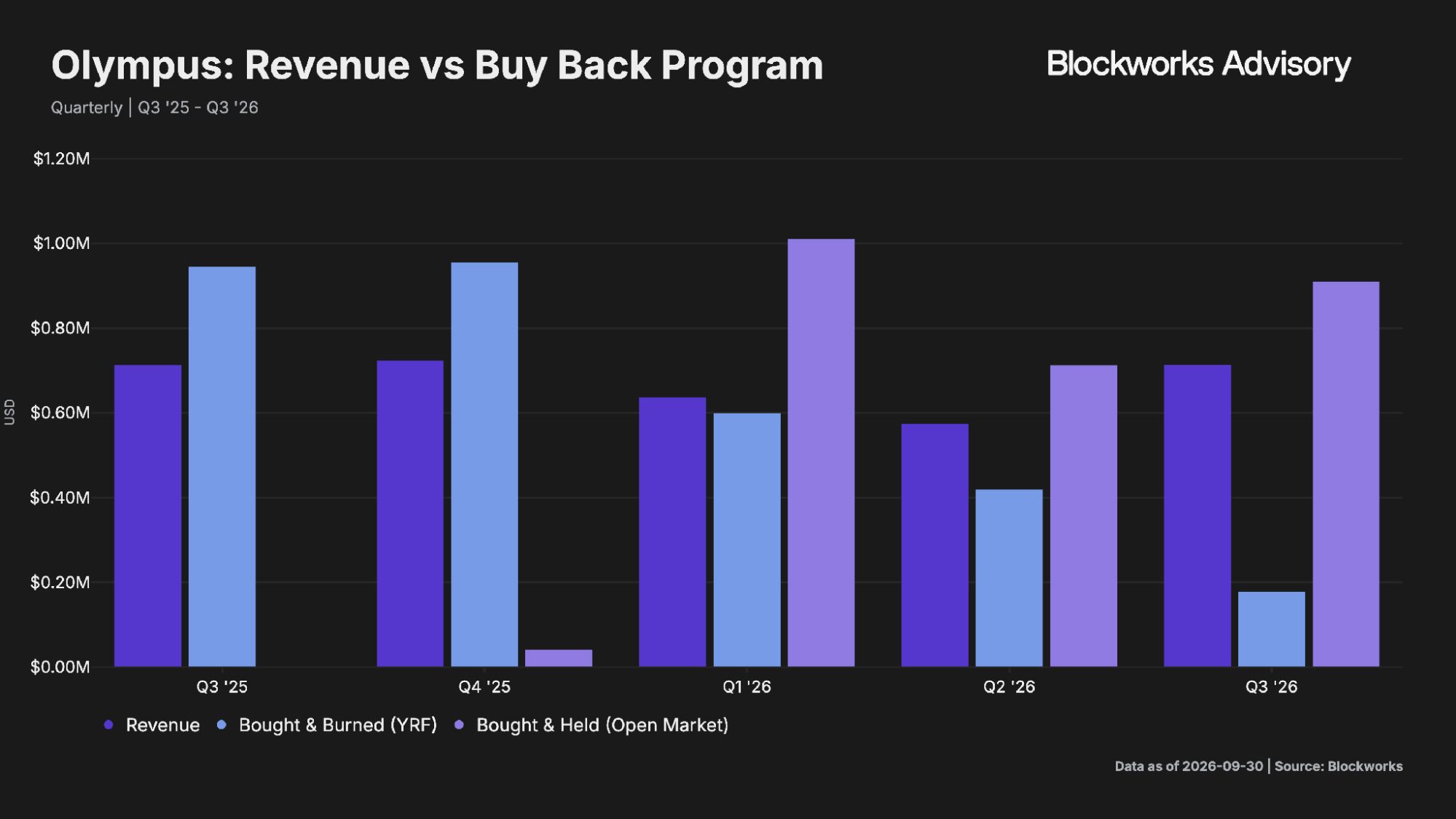
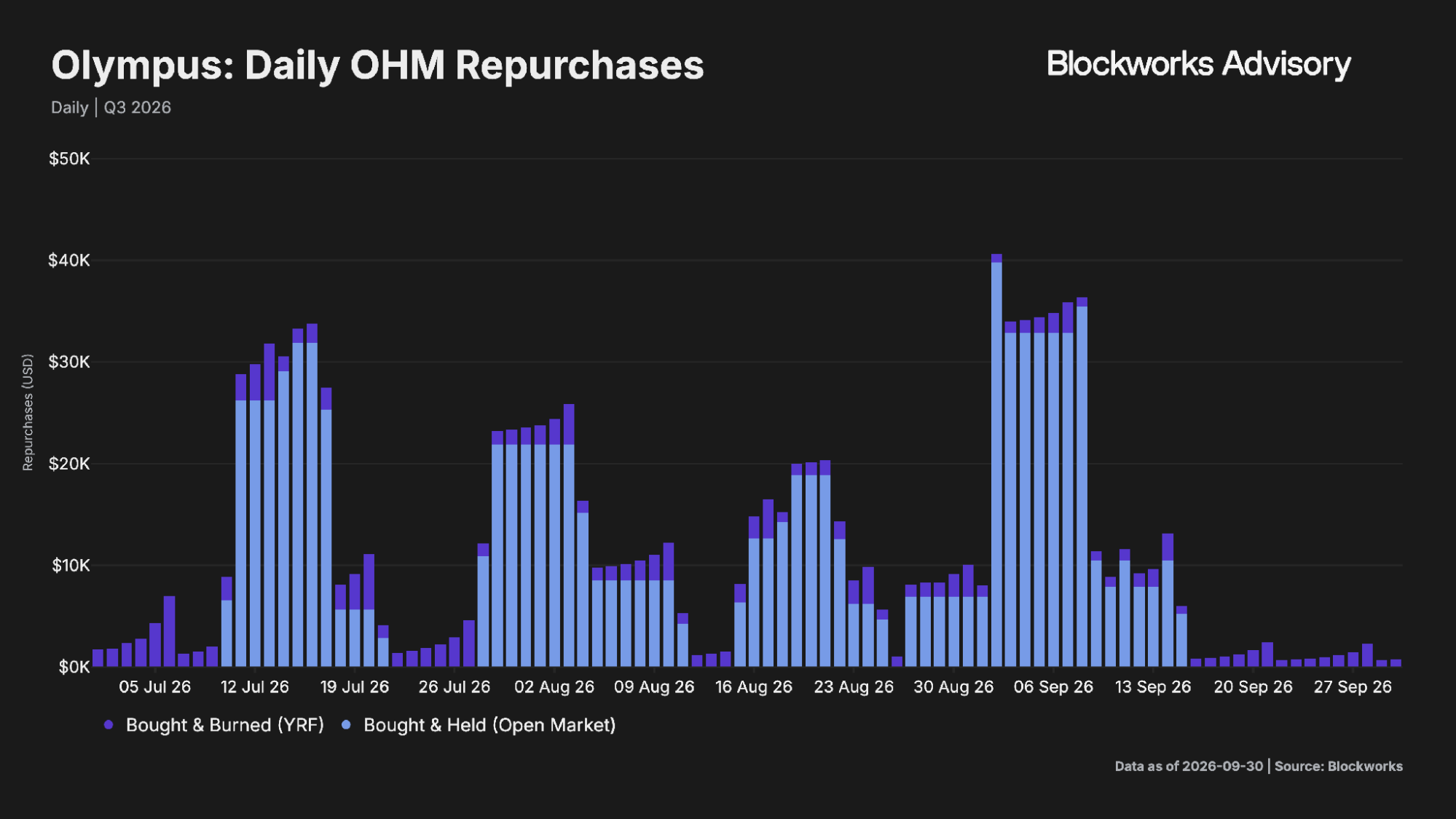
Governance set the funding rule in OIP-190: harvested yield goes either through the YRF, to buy and burn OHM, or onto the market to buy OHM as a supplement. The YRF burns each OHM it buys, releases the backing that OHM carried and uses it to buy more, so buying above backing leaves backing per OHM intact and the facility works as a slightly levered buyback relative to backing. OHM bought and held stays outside backed supply; the treasury held 4.88 million OHM in mid-October.
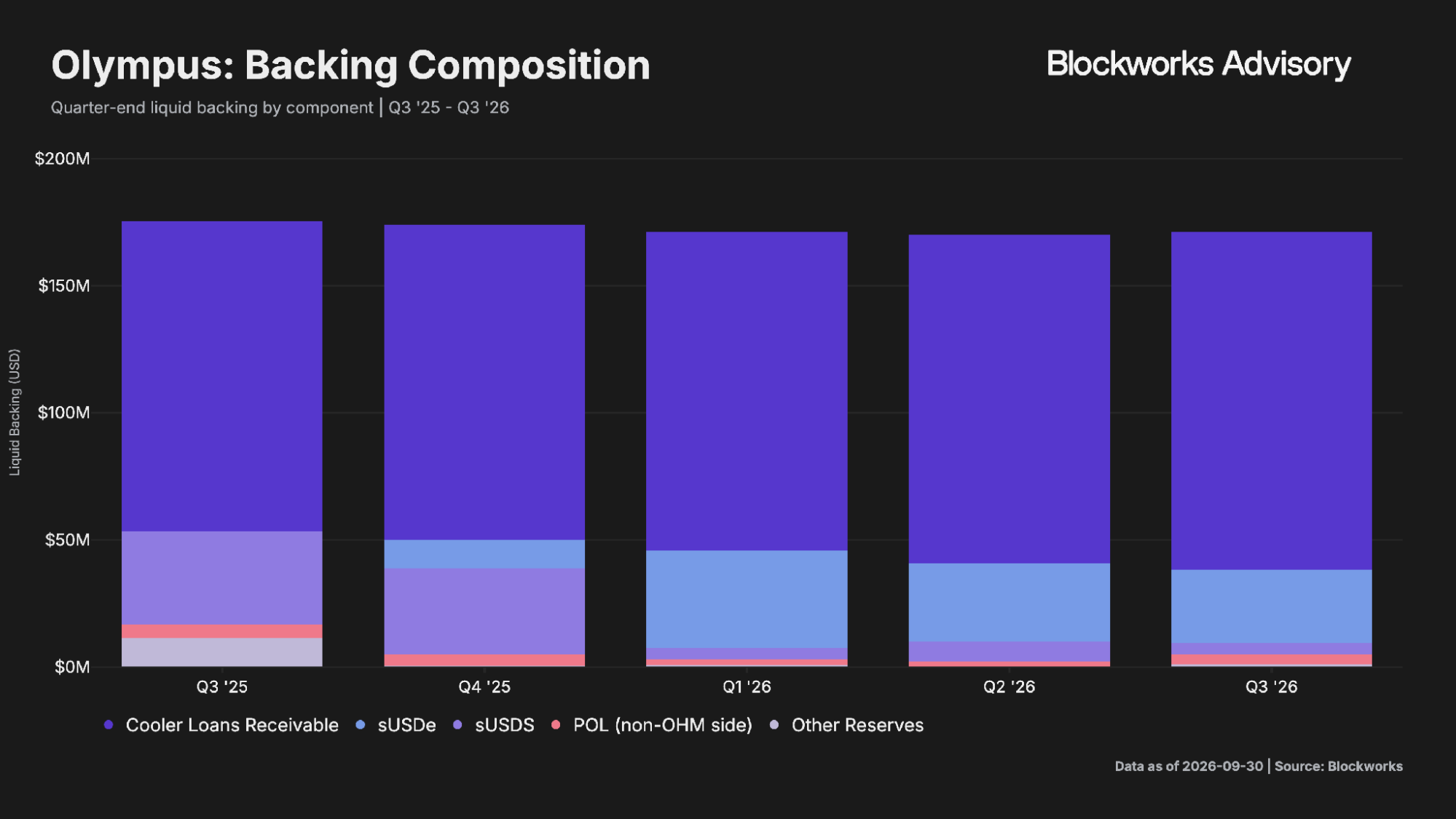
Liquid backing still rose during the quarter, by $1.26 million to $171.3 million. Cooler loans grew by $3.80 million, the reserve side of protocol-owned liquidity by $1.91 million and other reserves by $0.80 million. The sUSDS balance fell by $3.34 million as new Cooler borrowing drew on it, and sUSDe fell by $1.91 million.
Revenue Drivers
sUSDe Yield
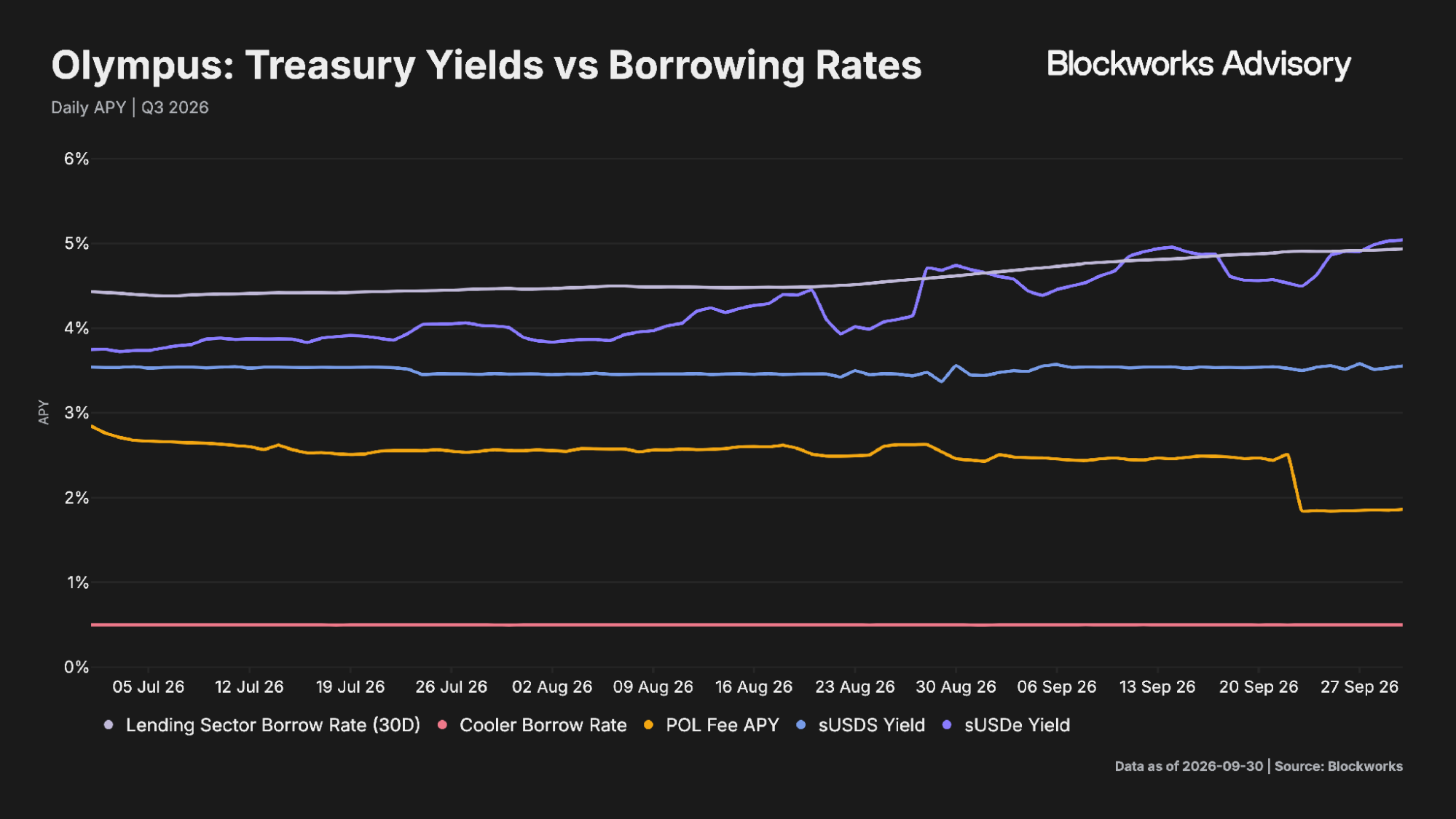
sUSDe yield was the largest source at $325,078, 45.6% of Q3 revenue and 16.1% more than in Q2. Governance added Ethena's USDe and sUSDe as reserve assets in OIP-188 and set the deployment framework in OIP-190. The yield averaged 4.25% across Q3 and reached about 5% by the end of September. Ethena is the treasury's largest outside counterparty, at $28.9 million or 16.9% of liquid backing on September 30.
Cooler Interest
Cooler loans earned $164,765, up from $158,183 in Q2, on a book that grew from $129.1 million to $132.9 million. The rate is 0.5% by policy. Borrowers across onchain lending markets paid an average of 4.58% in Q3, so Cooler gives holders low-cost credit against backing, and the treasury accepts a low yield on 78% of its liquid backing in exchange. Through the quarter the borrowing limit per gOHM kept rising on a governance-set schedule to pass the 4.2% backing gain from the February OIP-191 burn through to borrowers. New borrowing drew on the sUSDS reserve, and sUSDS yield fell 34.7% to $53,050.
Convertible Deposit Loan Interest
The fastest-growing line went from $6,881 in Q2 to $112,457 in Q3. Deposits outstanding rose from $0.26 million to $21.1 million, most of it opened in late August and September. Depositors then borrowed $20.4 million against their deposits, 97% of the total, at a fixed 5.5%. Each depositor holds a right to convert into OHM at the strike, and Olympus earns 5.5% on the loan while the right is outstanding. The deposits stay outside backing until they convert.
Liquidity Fees and Treasury Productivity
Fees on protocol-owned liquidity added $57,601, up 22.5%. Across all sources, Q3 revenue annualizes to about 1.7% of liquid backing, a rate set mostly by the Cooler policy on the largest asset. Three changes can move it. YRF v2, proposed in July, would fund buybacks from several reserve assets and let governance keep part of each asset's yield as backing. A May request for comment explores tokenized real-world income assets for the treasury. The Cooler borrowing-limit ramp ends around October 27, after which the limit stops rising.
Protocol Analysis
Backing per OHM
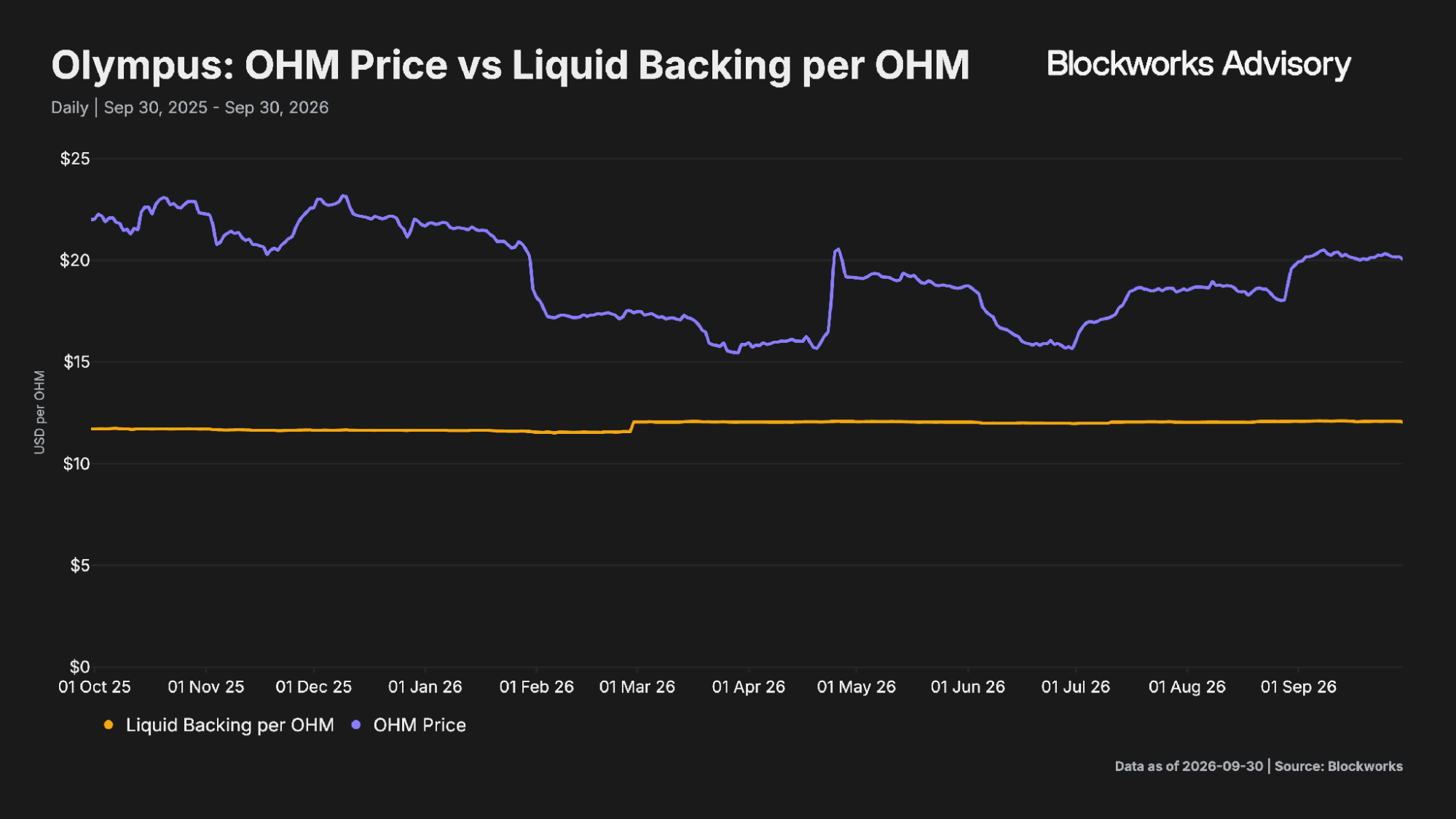
Olympus's stated aim for backing is to hold its purchasing power over time. Liquid backing per OHM rose from $11.71 at the end of September 2025 to $12.04 at the end of September 2026, a 2.8% gain. It jumped 4.2% when OIP-191 burned legacy migration inventory in February, and moved within a narrow range from spring onward.
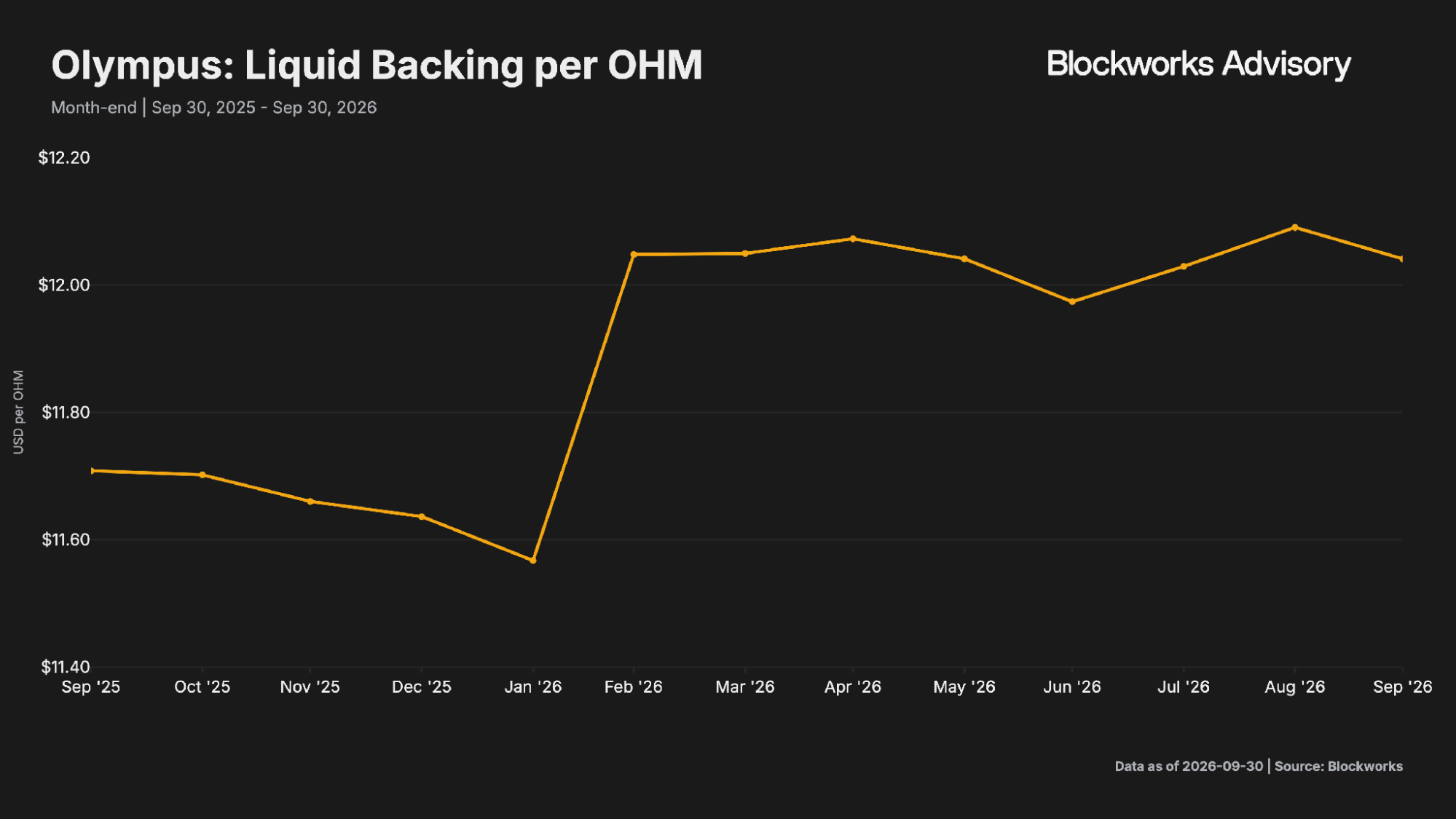
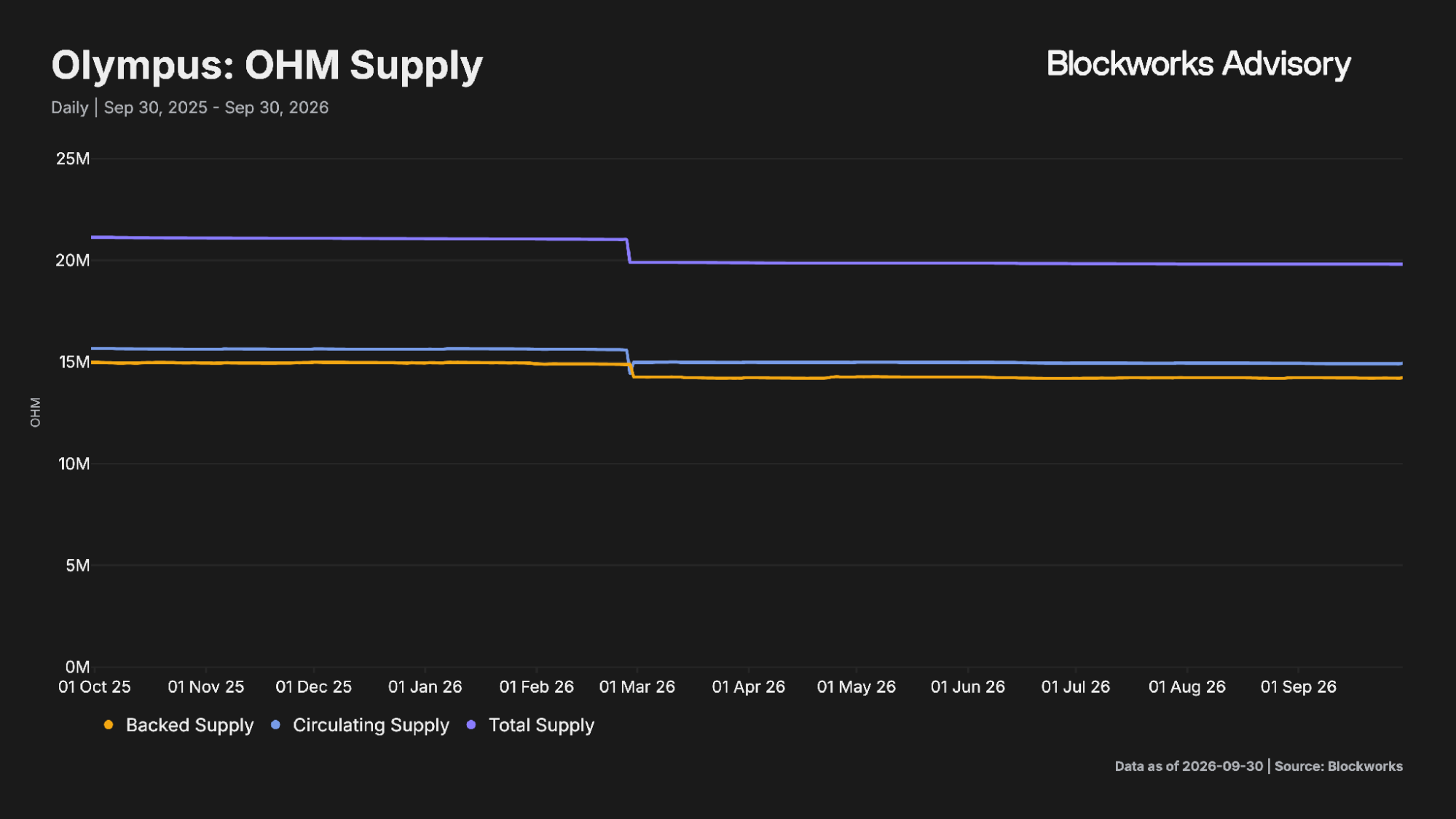
Over the twelve months to September 30, liquid backing in dollars fell 2.36%, from $175.4 million to $171.3 million, while backed supply fell 5.1%, from 14.98 million to 14.23 million OHM, so the per-OHM gain came from supply.
Defaults in the Cooler book are rare: collateral burned from defaulted loans in Q3 came to about 0.04% of the book. A loan defaults only if unpaid interest builds up past a set threshold, never because of the market price, and at quarter end the average loan sat well inside that threshold, with the margin widening through the quarter. Loans are sized below backing, at up to $3,104 per gOHM against $3,242 of backing, so a defaulted loan removes more OHM from backed supply than dollars from backing. A stress test of the current book, using October 11 data, shows backing per OHM rising from $12.03 with no defaults to $12.51 if half the Cooler book defaulted. Total backing in dollars would fall in that scenario, by about $67 million to about $105 million; the per-OHM figure rises only because defaulted collateral leaves backed supply.
Risk Profile
Measured on close-to-close daily prices for all three assets, OHM returned 28.2% in Q3 against 42.7% for BTC and 71.0% for ETH. Over six months OHM gained 26.2%, between BTC's 22.5% and ETH's 27.5%. Over twelve months OHM fell 7.7%, while BTC fell 26.7% and ETH 35.3%. Annualized volatility was 26.0% in Q3 and 31.1% over the year, about two thirds of BTC's 38.2% and 45.1% and about half of ETH's 52.6% and 63.7%.
The premium above backing, which sets when issuance opens, widened from 30.7% at the end of June to 66.5% at the end of September as crypto rallied, averaging 56.6% in Q3, so a buyer at quarter end paid $20.05 for $12.04 of backing. The Emissions Manager measures its premium against its own backing price of $11.69, so Convertible Deposit auctions open once OHM trades above $17.54, 50% above that price. The gate went live on July 14 and stayed open on all 79 days from then through September 30, with the premium on that measure between 53.5% and 75.6%.
Supply and the Expansion Cycle
Total supply fell 6.2% to 19.82 million OHM over the year to September 30. Most of the drop came in February, when OIP-191 burned 1.14 million OHM of legacy migration inventory, about 596,000 of which had still counted toward backed supply. In Q3 supply fell by another 13,526 OHM, as YRF burns of 9,520 and other burns outpaced 282 OHM of new issuance.
Q3 auctions set terms for a possible next expansion, selling conversion rights on 1.01 million OHM against $21.1 million of deposits at a weighted strike of $20.87. To convert, a depositor repays the loan taken against the deposit, cancels the pending redemption and converts before expiry, so none of the rights were free to convert on September 30. They roll off in three cohorts from January 2027. Any conversion would issue OHM at 1.73 times quarter-end backing per OHM and move the deposit into the treasury. Conversion is economic only if OHM trades above the $20.87 weighted strike, against a quarter-end price of $20.05.
Treasury, Counterparties and Governance
On September 30, Cooler receivables made up 78% of liquid backing at $132.9 million, followed by sUSDe at 16.9%, sUSDS at 2.6%, the reserve side of protocol-owned liquidity at 2.3% and other reserves at 0.6%. The receivables are loans to OHM holders secured by 43,569 gOHM, worth $141.3 million at backing value and $235.2 million at market prices on September 30. Because loans are sized against backing, the book stood at 94% of its collateral's backing value.
Major treasury allocations are set by governance vote, and the record shows those decisions are executed as voted; other allocations are made under authority governance has delegated. For example, in July 2023, governance passed TAP-28, which directed the sale of volatile treasury assets into stablecoins to support Cooler Loans. The treasury then sold 15,709.84 WETH for $26.66 million in 28 transactions between August 9 and September 20, 2023, at an average of about $1,697 per ETH. This example shows that, for decisions put to a vote, token holders decide how the treasury is allocated. In hindsight the timing was costly, since ETH ended September 2026 at about $2,684 against the sale's average of about $1,697, but the same process gives holders a standing check on the people who run the treasury and can reduce conflict-of-interest risk.
Security
Olympus's audit registry lists 35 external audits since April 2021, 14 of them since the start of 2025, with recent work covering new products as they shipped: Cooler Loans and Origami's hOHM vault in 2025, Convertible Deposits in September and October 2025, the OHM v1 migrator in February 2026, the new price feed in May and the bridge upgrade in June. Reviewers include Guardian Audits, Electisec, Sherlock, Nethermind, Spearbit and OtterSec, and a bug bounty on Immunefi has run since 2022. Two exploits are on record. In October 2022 an attacker drained 30,437 OHM, about $300,000, from a Bond Protocol contract Olympus used for OHM bonds and returned the funds within hours. In September 2024 an attacker used the Cooler Consolidation Contract to take about $29,000 in DAI and gOHM from eight wallets that had approved it. Governance approved reimbursement in OIP-167, and all eight wallets were repaid in October 2024. Cross-chain bridging is where the protocol has moved most carefully: the LayerZero V1 bridge has stayed disabled while Olympus rebuilds those routes with per-route rate limits and a cap on bridged supply, first in a hardened LayerZero V2 design and now, under OIP-198, on Chainlink CCIP.
Distribution and Adoption
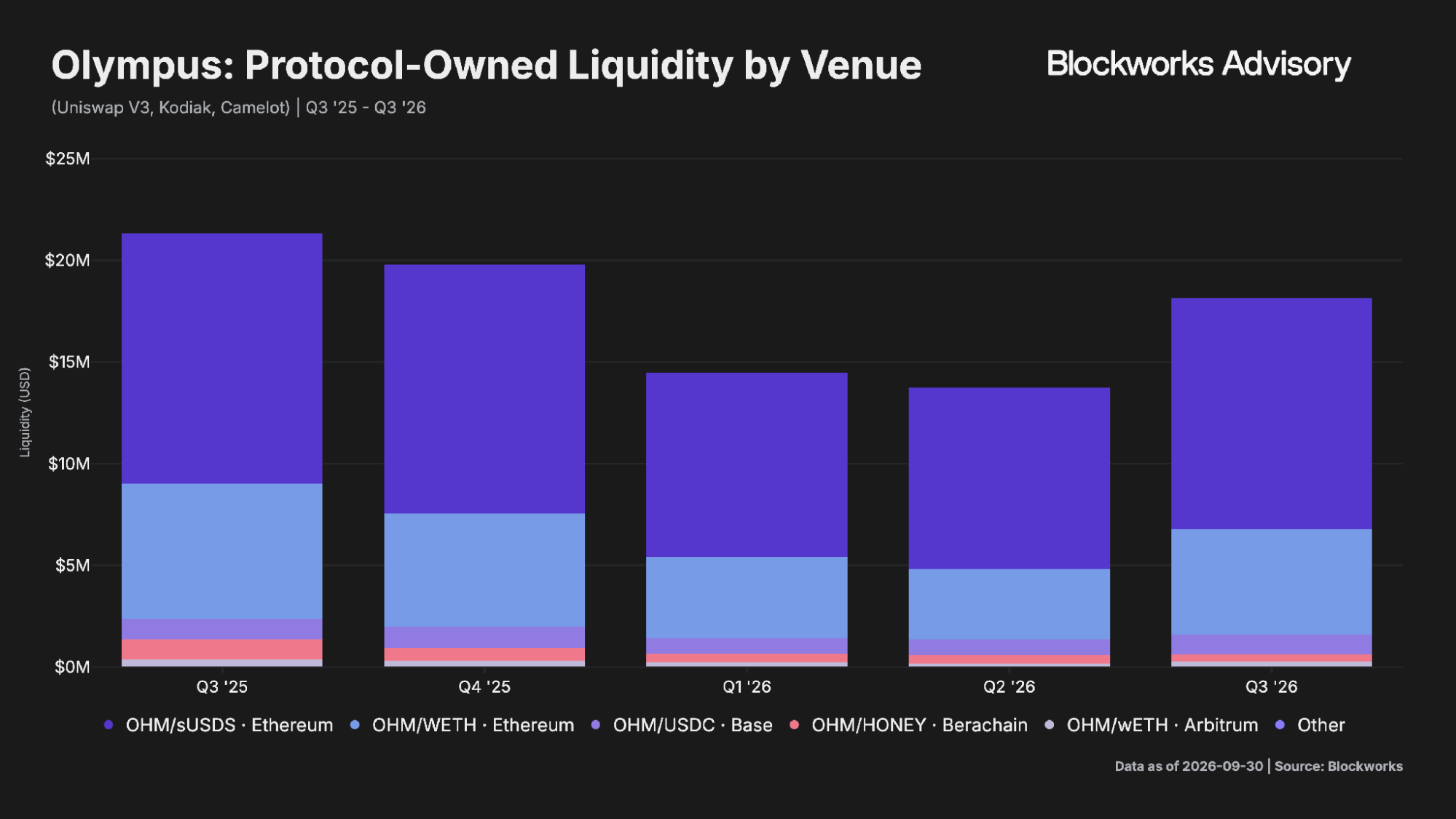
Protocol-owned liquidity grew from $13.7 million to $18.1 million in Q3, counting both sides of each position and including the higher market value of the OHM held in those positions, across Ethereum, Base, Berachain and Arbitrum. Chainlink CCIP carries OHM between Ethereum and Solana, and a pending proposal would extend it to Arbitrum, Optimism, Base and Berachain. The holder base was steady in Q3. On September 30, 8,349 addresses held OHM and 29,001 held gOHM, against 8,365 and 29,313 at the end of June.
Robinhood Chain is the newest venue. hOHM liquidity went live there in September, and the treasury built a USDG position in a Mellow vault that reached about $1 million by September 30. Origami Finance issues hOHM. The vault deposits gOHM into Cooler, keeps borrowing at the maximum loan-to-value and wraps the leveraged OHM exposure in one token. NetNet Capital, a reserve-backed protocol on Robinhood Chain, holds hOHM in its treasury and accepts it in its bond markets, by its own permissionless choice and without any agreement or budget from Olympus.
Product & Ecosystem Updates
Product Updates
Olympus opened its live state to software in July. The Olympus MCP, a Model Context Protocol server, is a read-only endpoint that needs no key and gives any AI agent access to backing, treasury, Cooler terms, supply and governance across 26 tools. Within days the community used it to decode a new Convertible Deposit position hours after it was opened.
Price Feed Resilience v1.2 (OIP-196) went live in July. OHM now prices off several independent feeds and drops any that go stale or deviate, and in the week of August 3 the price module kept resolving through three external feed failures. OCG #18 passed unanimously and executed on July 18, capping remaining OHM v1 migrations at 102,397 OHM v1, and the migration path opened on July 21. OIP-198, posted in September, proposes Chainlink CCIP bridging for OHM across Arbitrum, Optimism, Base and Berachain, alongside the existing Ethereum to Solana lane.
Incentives & Emissions
The Cooler borrowing limit kept rising on the governance-set schedule to pass the February backing gain through to borrowers, from 3,057 USDS per gOHM in late July to 3,071 on August 16. The ramp toward 3,123 USDS per gOHM was 85% complete at the end of September and finishes around October 27.
Key Risks
Statements in this report about future events, including Convertible Deposit conversions, YRF v2 and the end of the Cooler borrowing-limit ramp, are forward-looking and depend on market prices and governance decisions. Figures are as of September 30, 2026 unless stated otherwise.
No redemption right. OHM holders cannot redeem OHM for backing. The market price is set by trading and has fallen below backing in the past.
Backing composition. About 78% of liquid backing on September 30 was non-expiring Cooler loans to OHM holders, secured by gOHM, the protocol's own token. That part of backing cannot be converted to cash on demand.
Reserve drawdown. Repurchases have exceeded revenue in each of the last five quarters, drawing down treasury reserves, and open-market purchases above backing reduce backing per OHM.
Counterparty concentration. sUSDe (Ethena) made up 16.9% of liquid backing and sUSDS 2.6%. A depeg, sustained negative funding or an operational or custody failure at either issuer would reduce backing. The protocol also depends on ether.fi (weETH), Mellow and Paxos (the USDG vault), Origami (hOHM, which borrows through Cooler) and Chainlink CCIP (bridging).
Treasury changes. The treasury's holdings have changed since September 30 and can change further, by governance vote or under delegated authority, including into assets with volatile prices.
Dilution. Convertible Deposit conversions, reserve bonds and any sale of the 4.88 million OHM held by the treasury would increase circulating supply.
Smart contracts, price feeds and bridges. Despite external audits, contracts, price feeds and cross-chain bridges can fail or be exploited.
Governance. Governance can change policy parameters, including the Cooler rate and borrowing limits, the Emissions Manager premium and repurchase rules. The DAO Multisig adjusts some parameters within limits set by governance and holds the role that installs and upgrades protocol contracts.
Liquidity. OHM market depth depends largely on protocol-owned liquidity, and large trades can move the price.
Regulation. The treatment of OHM, gOHM, Convertible Deposits, and related products under US and non-US securities and commodities laws is unsettled, and regulatory action could restrict access to the protocol or its products.
Closing Summary
OHM's design differs from BTC and ETH. Each backed OHM is matched by $12.04 of liquid backing, verifiable onchain and held mostly as Cooler loans secured by gOHM. Holders have no right to redeem at that value, and the market price can fall below it. In Q3 that backing held while volatility ran at about two thirds of BTC's. Its price above backing reflects a premium the market sets, and Convertible Deposit auctions open while that premium is above a governance-set level.
Past results do not indicate future performance. Over the twelve months to September 30, BTC fell 26.7% and ETH 35.3%, against 7.7% for OHM. Holders could borrow against backing at 0.5%, and the protocol spent more than its revenue on repurchases in each of the last five quarters, drawing on reserves, with the YRF buying every day of Q3.
The next development to report is whether conversions occur. Depositors hold rights on 1.01 million OHM at a weighted $20.87, and Convertible Deposit auctions sell conversion rights at a premium to backing. If OHM trades above the strike and conversions occur, the treasury would gain the deposits and new OHM would be issued at 1.73 times quarter-end backing per OHM. Until then, Convertible Deposit loan interest, the end of the Cooler ramp in late October and the YRF v2 proposal set the pace of treasury income.
This report was commissioned by the Olympus Association. By providing this disclosure, we aim to ensure that the research reported in this document is conducted with objectivity and transparency. All content was produced independently by the author(s) and does not necessarily reflect the opinions of Blockworks. or the organization that requested the report. The commissioning organization may have input on the content of the report, but Blockworks maintains editorial control over the final report to retain data accuracy and objectivity. Author(s) submit financial conflict of interest (FCOI) disclosures on a monthly basis that are reviewed by appropriate internal parties and may hold cryptocurrencies named in this report. This report is meant for informational purposes only. It is not meant to serve as investment advice. You should conduct your own research and consult an independent financial, tax, or legal advisor before making any investment decisions. Past performance of any asset is not indicative of future results. Please see our Terms of Service for more information.