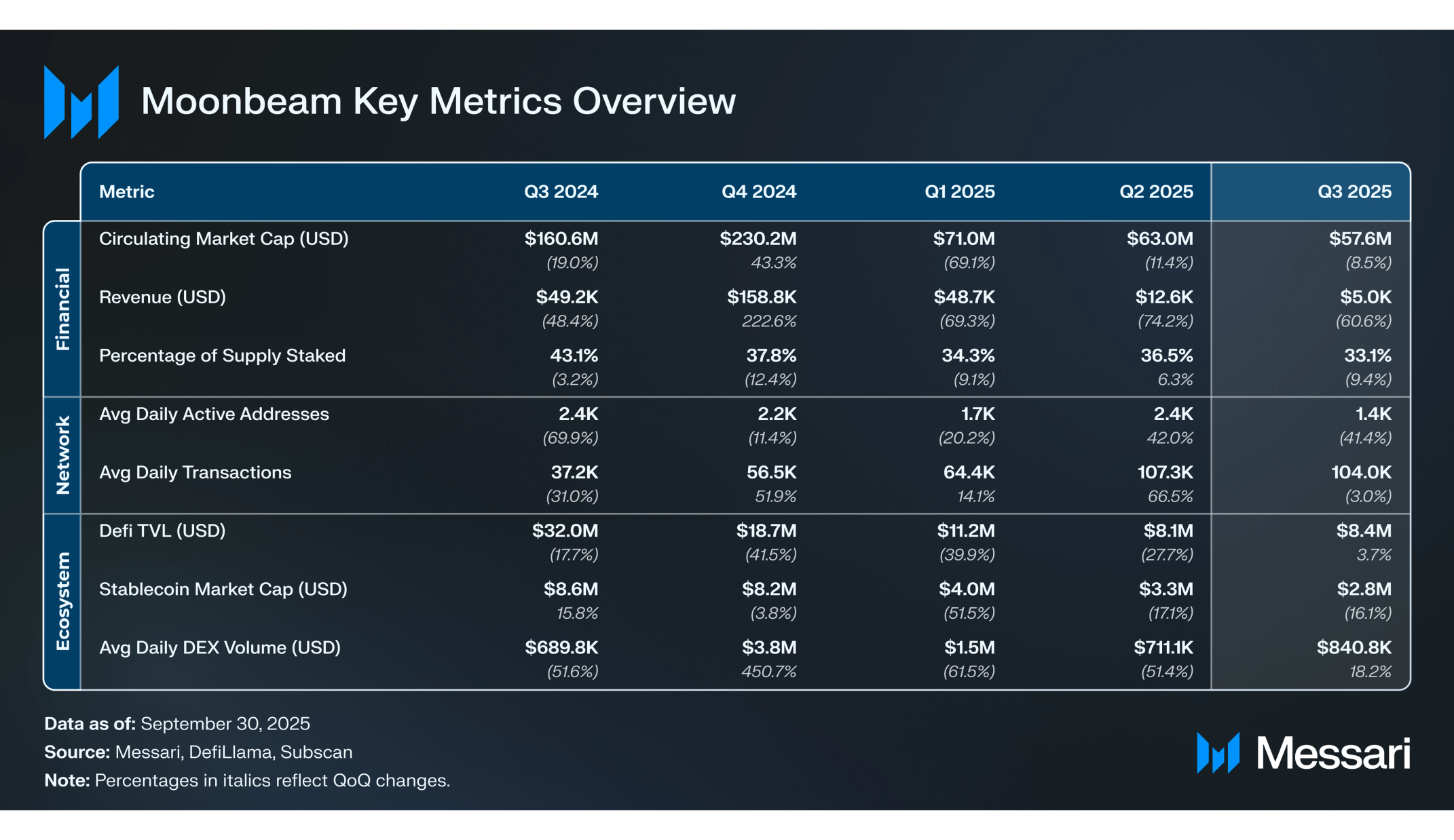
Moonbeam’s total gaming transactions rose 24.1% QoQ to 1.94 million. This increase follows a 154.8% increase in Q2, highlighting Moonbeam’s continued growth in this vertical.
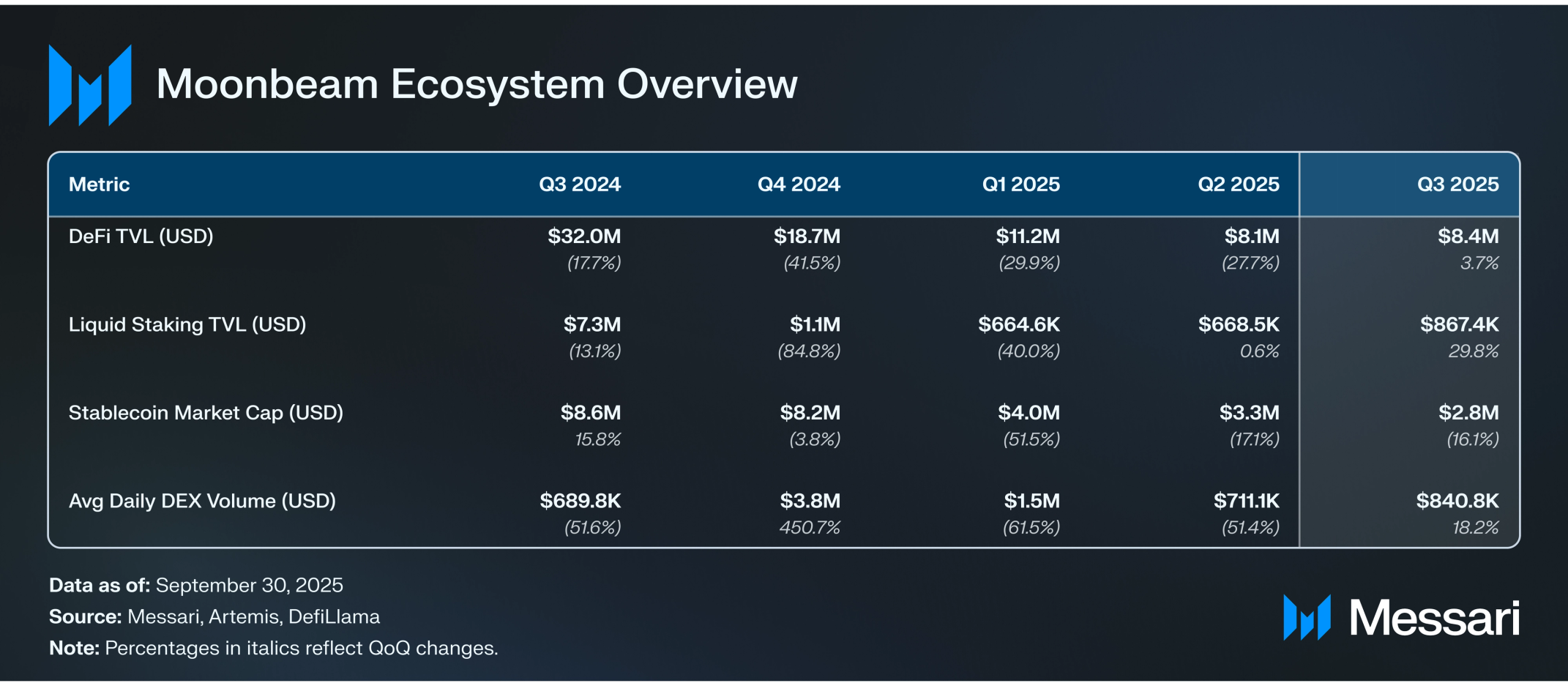
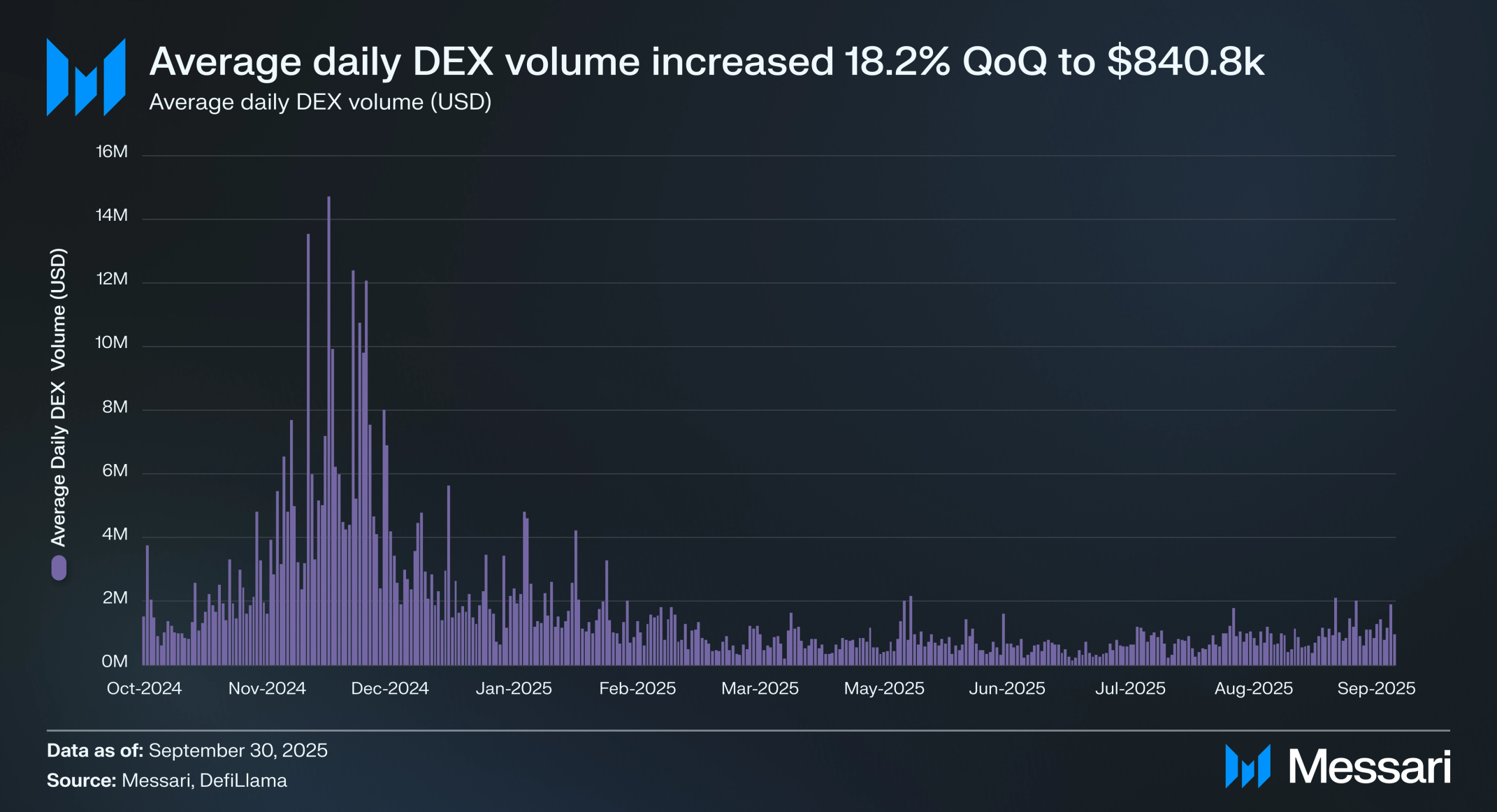
Moonbeam’s DeFi Total Value Locked (TVL) increased 3.7%QoQ to $8.4 million. Average daily DEX volume increased by 18.2% to $840,837, with most of this volume concentrated around StellaSwap.
Outmine, an onchain mining game, was launched on Moonbeam in Q3 and quickly became the network’s largest gaming application by total transactions and unique active users. During the quarter, the protocol processed 644,400 transactions, with a daily average of 201 unique active wallets.
Tokeniza launched tBRL, a tokenized version of the Brazilian Real, on Moonbeam. This integration allows users on the Tokeniza platform to invest in real-world assets (RWAs) using PIX, Brazil’s widely adopted payment system.
Infrastructure capabilities continued to improve in Q3, highlighted by the launch of a cross-chain bridge between Moonbeam and its sister network Moonriver. Runtime upgrades were also implemented during the quarter, aimed at adjusting GLMR’s token emission schedule and enhancing performance for developers.
Primer
Moonbeam (GLMR) is a Layer-1 parachain on Polkadot, serving as an EVM-compatible smart contract platform. It provides an Ethereum Virtual Machine (EVM) implementation and a Web3 API, enabling straightforward deployment of Solidity contracts and protocol interfaces with minimal modifications. Moonbeam enables cross-chain integrations, leveraging its Moonbeam Routed Liquidity functionality and bridge networks. Its primary features include staking, onchain governance, and a treasury controlled by Treasury Council members.
Moonbeam leverages Polkadot’s delegated Proof-of-Stake (DPoS) consensus model through the Relay Chain, while using collators to produce blocks on the parachain. GLMR is the network’s native token, used to pay gas fees, participate in governance, and support network security through staking and collator delegation.
The project was founded by Derek Yoo in 2020, who led the development of the network as the CEO of PureStake, a company specializing in development and tooling infrastructure. Moonbeam emerged from PureStake’s effort to provide a developer-friendly, Ethereum-compatible execution environment within the Polkadot ecosystem. Moonbeam secured its initial parachain slot in late 2021 after one of the largest community-backed crowdloans at the time, receiving more than 35 million DOT in support.
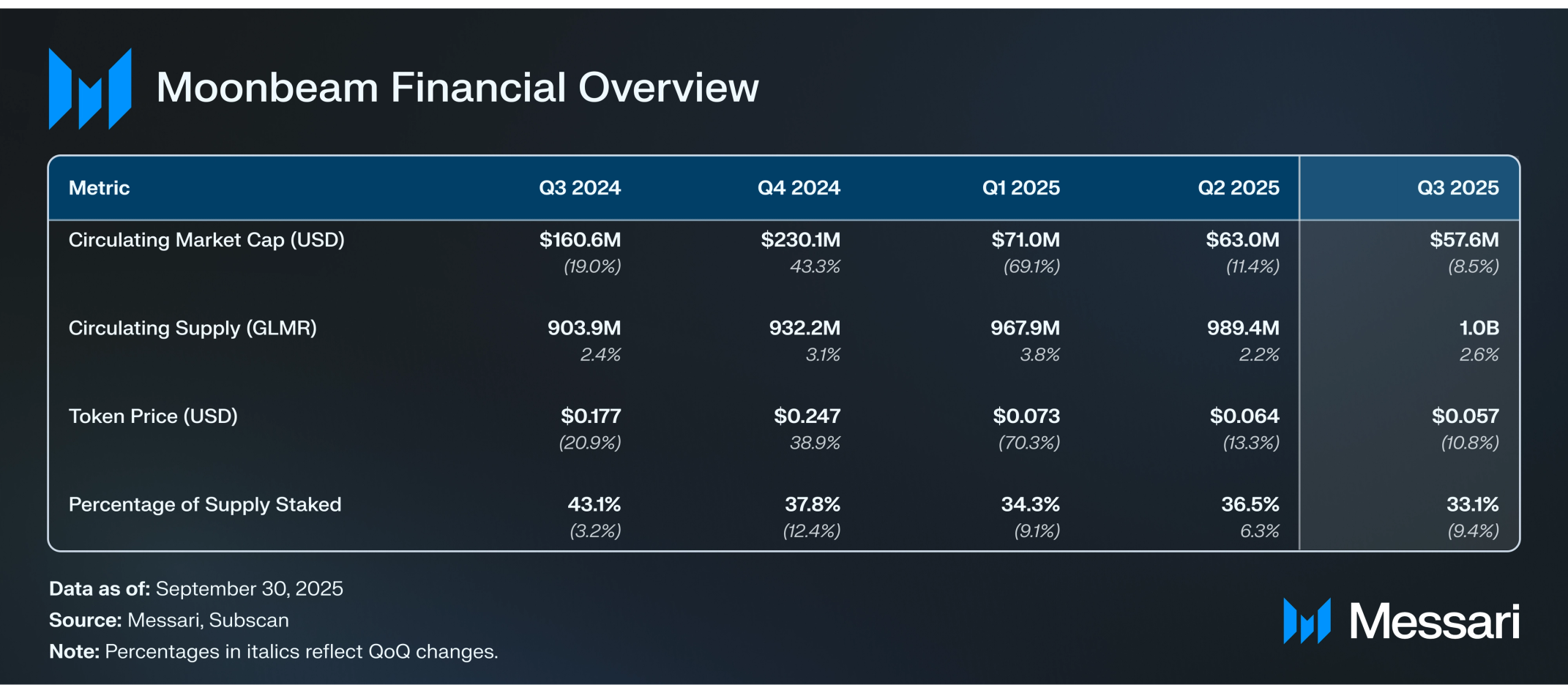
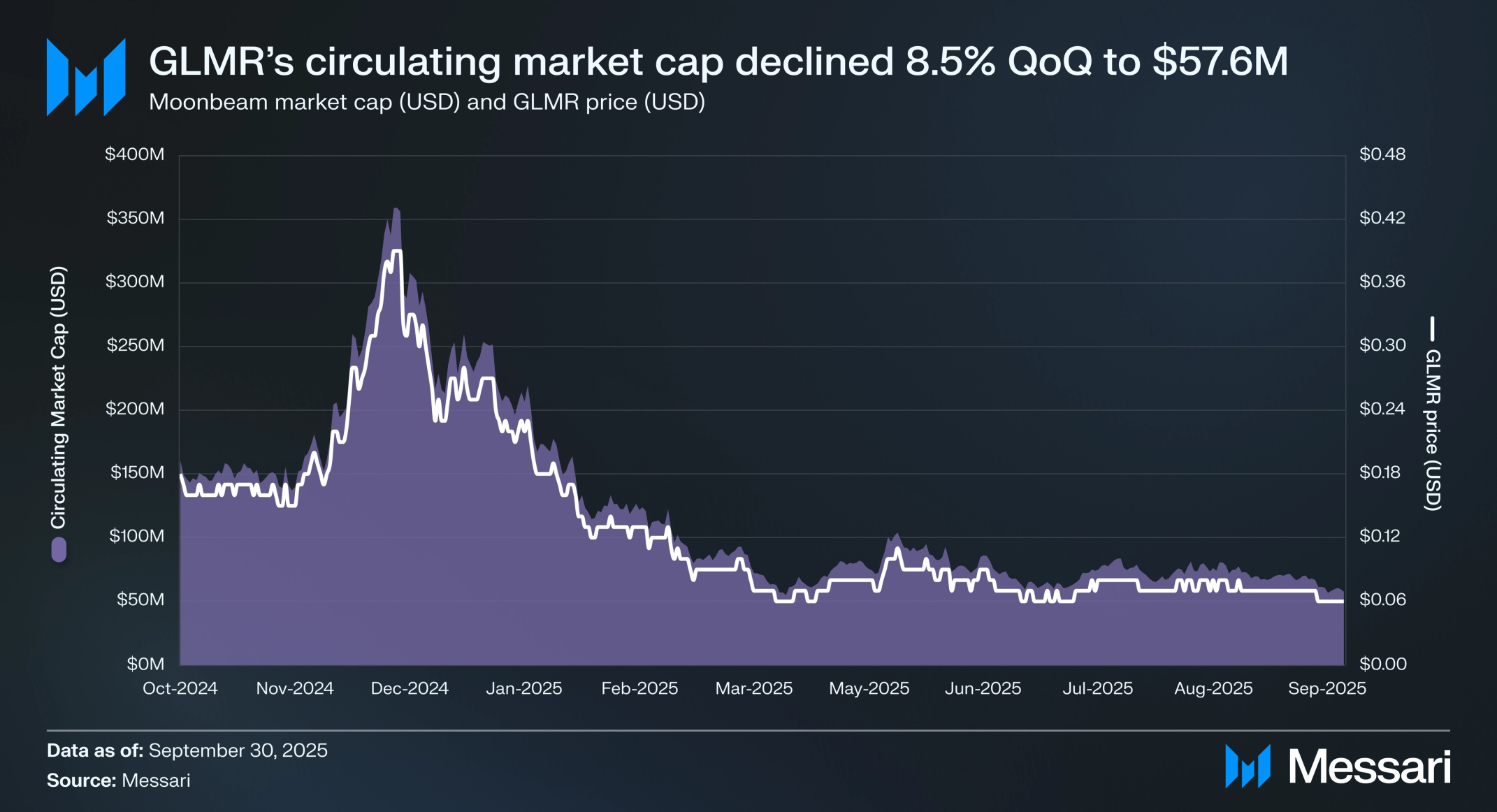
The circulating market cap and price of Moonbeam’s native asset, GLMR, corrected slightly in Q3 2025. The market cap declined 8.5% QoQ to $57.6 million, while the GLMR token price declined by 10.5% during the same period. The difference in the decline between market cap and price is driven by token emissions, as expanding supply raises valuation. During the quarter, 14.7 million GLMR were added to the circulating supply, distributed to stakers who secure the network.
Transactions
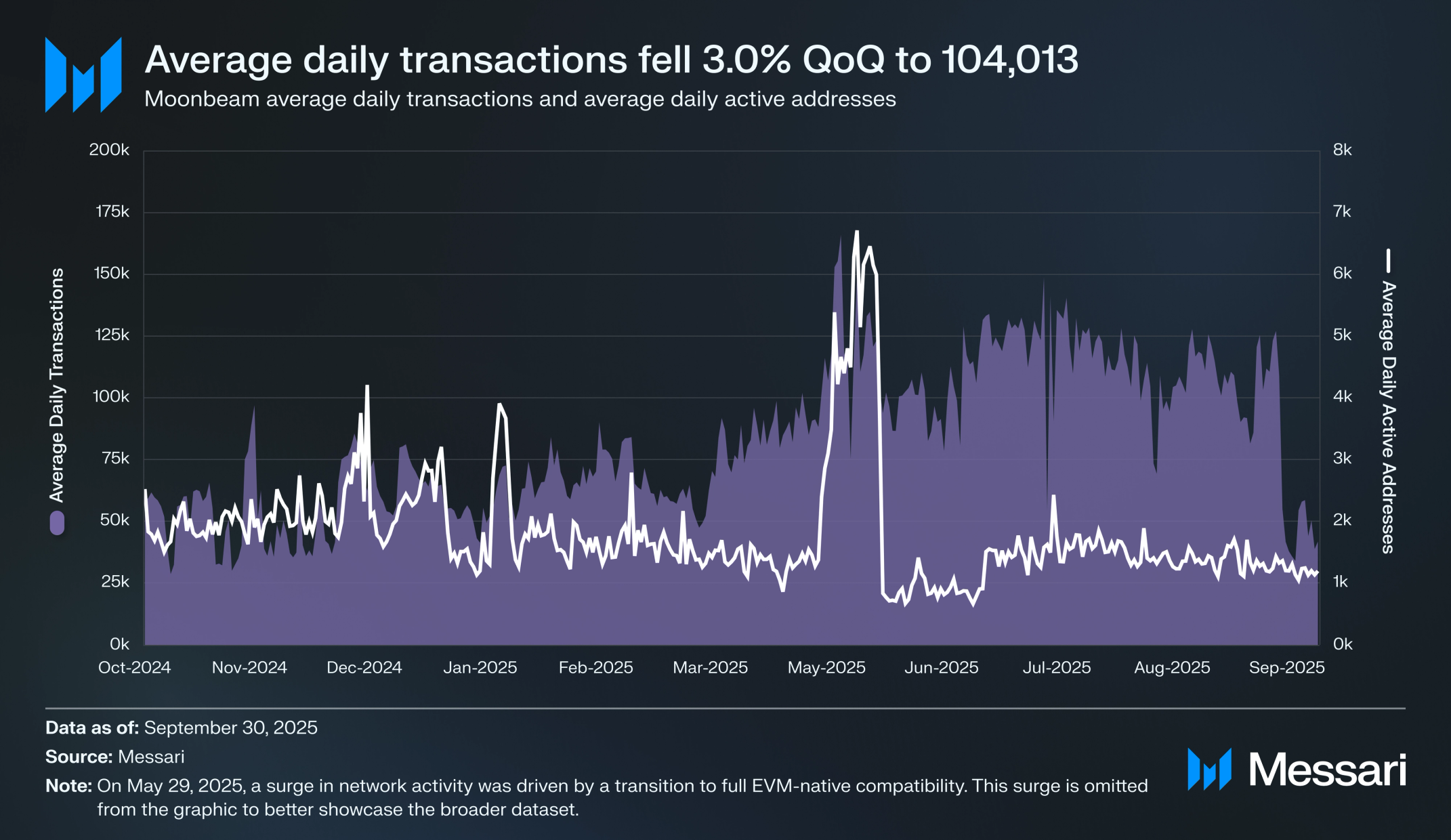
Following a quarter of transaction growth in Q2 2025, average daily transactions on Moonbeam declined slightly in Q3, down 3.0% to 104,013. Average daily active addresses, however, experienced a 41.4% decline to 1,427 in the quarter. The disparity between the decline in these metrics suggests an increase in the average amount of transactions conducted per active wallet.
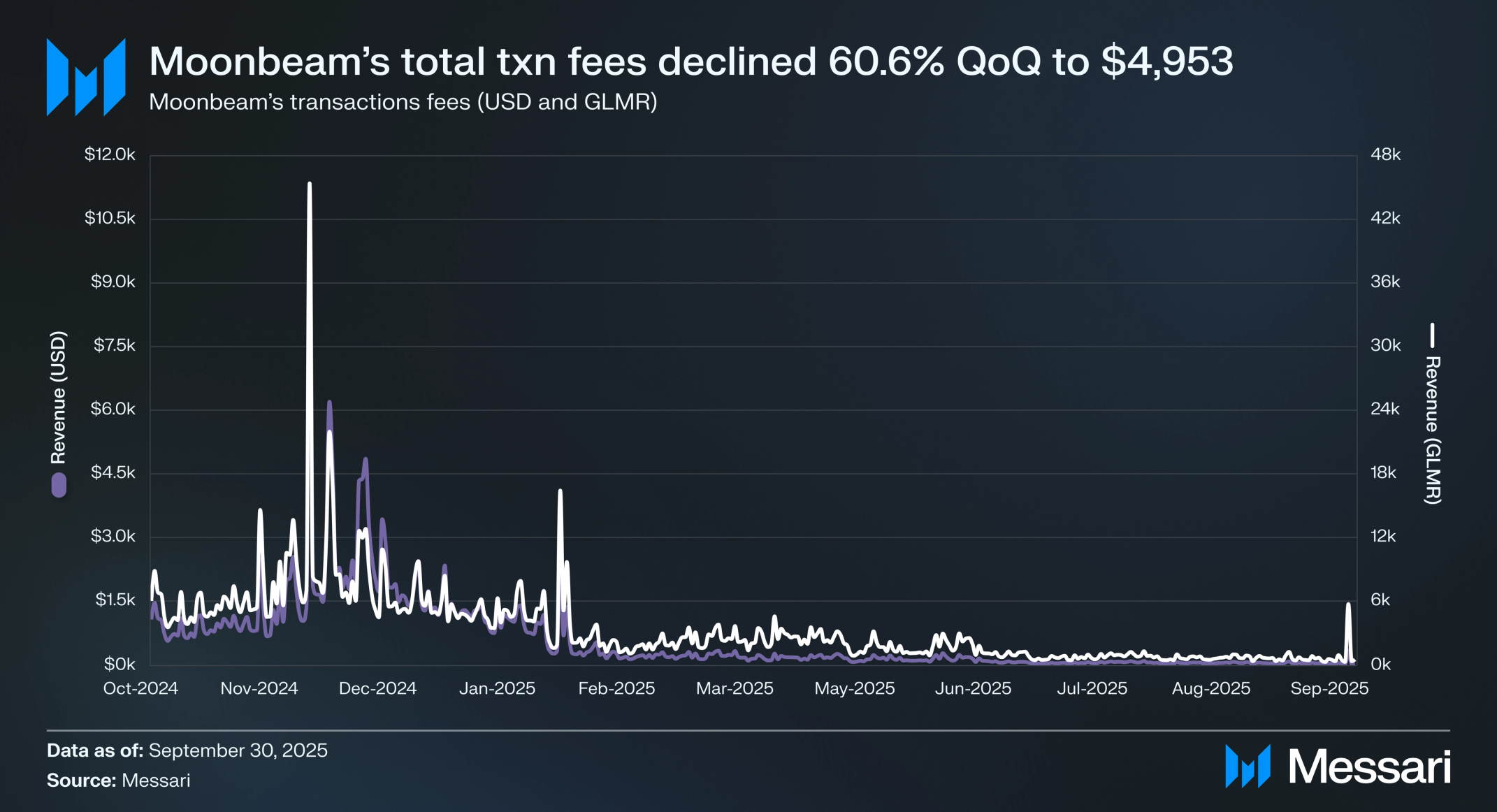
Moonbeam’s total transaction fees were $4,953 in Q3, a 60.6% decline QoQ from Q2’s total of $12,568. Denominated in GLMR, total transaction fees amounted to 70,052, experiencing a 57.5% QoQ decline from Q2’s total of 164,854 GLMR.
GLMR Staking
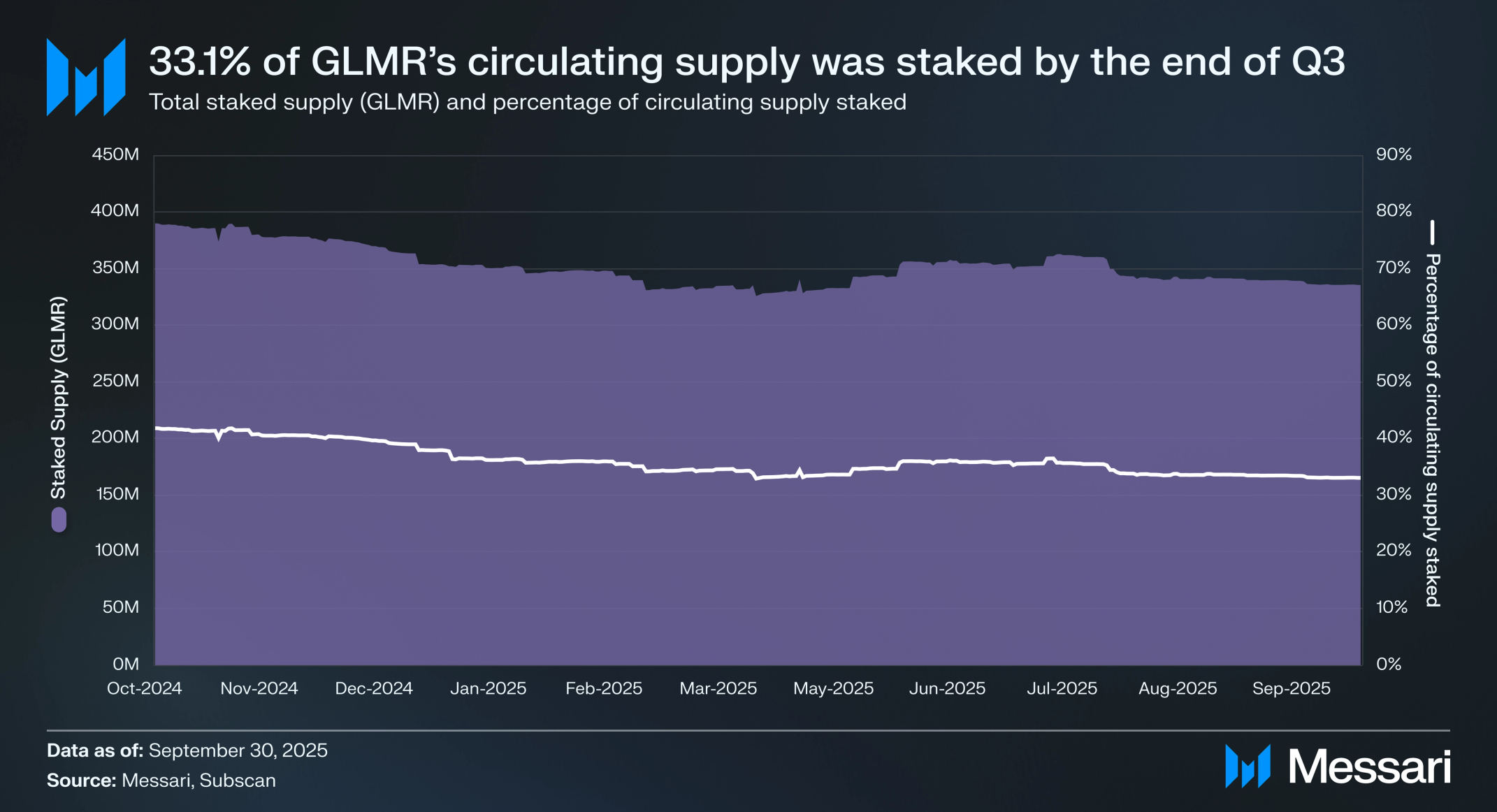
Moonbeam uses a Delegated Proof-of-Stake (DPoS) consensus mechanism, an evolution of Polkadot's Nominated Proof-of-Stake (NPoS), to collate (collect transactions from users and produce state transition proofs for the relay chain validators) transactions on the network. In this system, collators are selected based on the amount of staked GLMR that they control, which can be self-bonded and/or delegated. This design helps optimize decentralization while aligning incentives between collators and tokenholders. As of September 30, 2025, Moonbeam is secured by 73 active collator nodes and 335 million staked GLMR (33.1% of the GLMR’s total supply). This represents a 9.4% QoQ decline, falling from 36.5% of the supply being staked in Q2.
Ecosystem Analysis
DeFi
Q3 was a period of incremental growth for Moonbeam’s DeFi ecosystem. Total value locked (TVL) climbed from $8.1 million to $8.4 million QoQ, which is largely concentrated around the primary decentralized exchange (DEX) on the network, StellaSwap. The DEX experienced an increase in daily transaction volume, up 18.2% QoQ to $840,837.
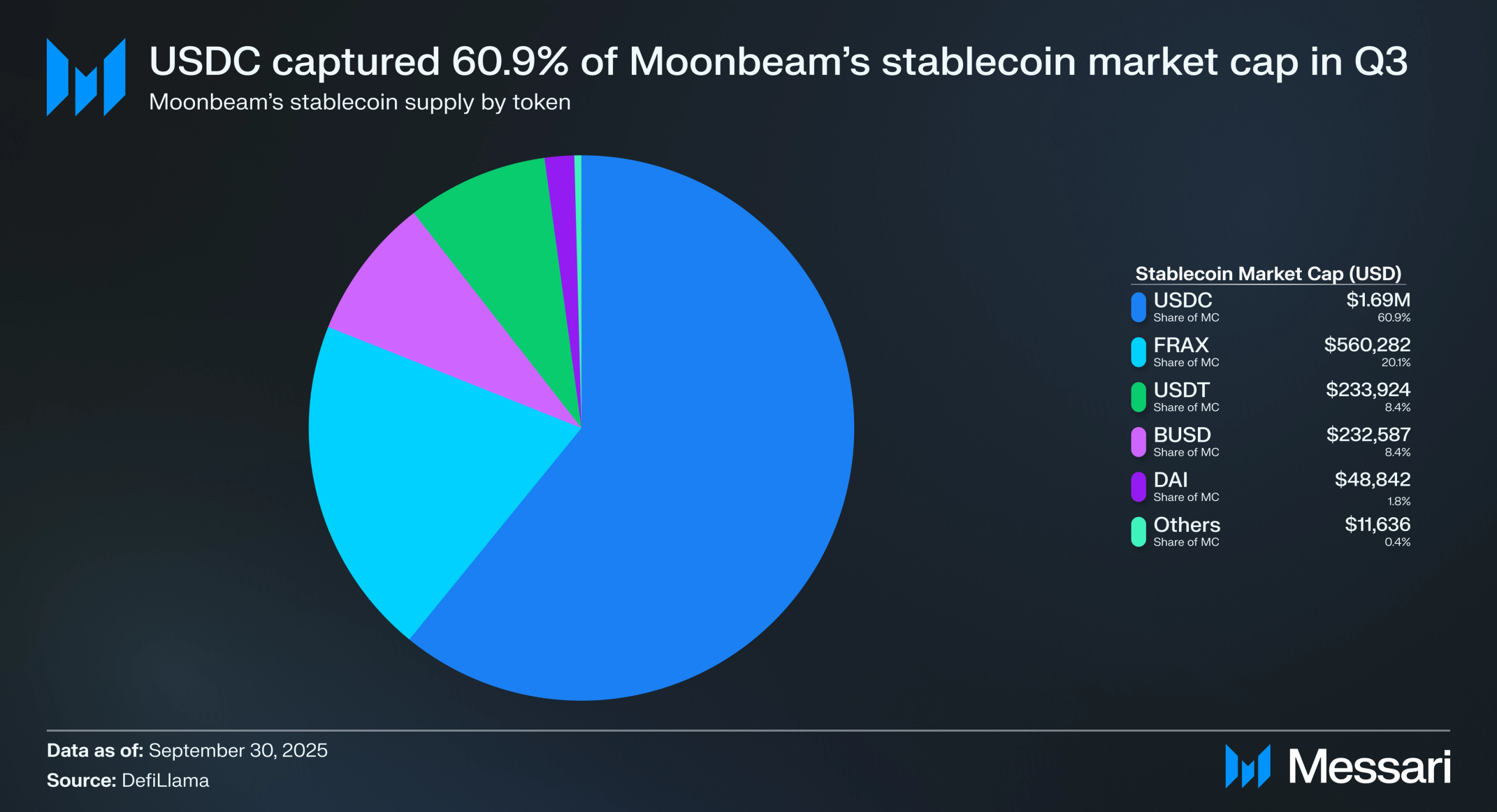
Moonbeam’s total stablecoin market cap dropped from approximately $3.3 million to $2.8 million, a 16.1% QoQ decrease. USDC built upon its dominance in stablecoin market share, climbing from 55.9% in Q2 to 60.9% in Q3. FRAX followed with $560,282, making up 20.1% of the market, while USDT and BUSD followed behind with $233,924 (8.4%) and $232,587 (8.4%), respectively. The visible skew towards USDC and FRAX suggests limited diversity in stablecoin liquidity, underscoring the challenges of expanding beyond the two major issuers.
Gaming
The gaming sector remained the primary driver of growth on Moonbeam in Q3. Total transactions in this vertical increased 24.1% QoQ, climbing from 1.6 million in Q2 to 1.9 million in Q3. This growth was further enhanced by Moondrop, Moonbeam’s campaign aimed at driving gaming participation on the network. The first tournament ran from August 21 to 28, 2025, where participants competed in an onchain reflex game for a prize pool of 1.0 million GLMR.
A number of different onchain gaming applications experienced expansion during this period:
Outmine: Originally released as a Telegram minigame, Outmine, a free-to-play mining game, launched on Moonbeam in Q3 and quickly rose to the top of the gaming sector. During the quarter, the project amassed 644,400 transactions with an average of 201 unique active wallets, claiming the top position in the Moonbeam gaming ecosystem by total transactions.
Tubbly: Launched on Moonbeam in Q2, Tubbly, an onchain mobile app that rewards users for visiting physical locations, recorded 513,500 transactions during Q3. The application averaged 594 unique active wallets, earning the top position on the network by that metric.
Olderfall: Olderfall is a player-versus-player (PvP) battle game that also experienced heightened activity during Q3. The application reached 414,800 transactions in Q3 while averaging 15 unique active wallets. On September 30, Olderfall announced the release of its Season 1 Battle Pass. Priced at 35 USDC, the pass gives players access to unique cosmetics, boosters, and exclusive NFT rewards within the Olderfall realm.
Data2073: Data2073, a trading card game, experienced a 104% increase in volume during Q3 and accumulated 178,200 transactions.
Real-World Assets
Despite technical issues that led to a protocol outage between September 17 and October 17, Tokeniza remained one of the largest applications on Moonbeam in Q3. The protocol facilitates the tokenization of Real-World Assets (RWAs) such as real estate and fiat currencies, allowing users to gain exposure to assets that may otherwise be difficult to invest in. On September 2, Tokeniza announced the launch of tBRL, a tokenized version of the Brazilian Real on Moonbeam. The initiative allows users to connect PIX, a popular payment system developed by the Central Bank of Brazil and launched in 2020, to onchain addresses on Moonbeam. In doing so, PIX users can gain access to Tokeniza’s offers, which include investment opportunities in real estate, bitcoin mining operations, and token sales. The CEO of Tokeniza, Mychel Mendes, highlighted Moonbeam’s speed and security as primary drivers behind the decision to use the network as the core infrastructure for the project.
Infrastructure Developments
Moonriver Bridge
Q3 was a pivotal quarter for the maturity of Moonbeam’s ecosystem. On September 24, the launch of the network’s cross-chain bridge between Moonbeam and Moonriver was announced. Moonriver is Moonbeam’s sister network built on Kusama. Known as Polkadot’s “canary network,” Kusama offers a more experimental and innovative environment than Polkadot. This upgrade represents a step in expanding access to applications on the network, as Moonbeam users can now seamlessly transfer assets and messages with security guarantees. As of September 30, the bridge supports MOVR, GLMR, USDT, and USDC.
Runtime Upgrades
The deployment of Runtime Upgrades 3800 and 3900 was an enhancement for tokenholders and developers on Moonbeam. On August 10, Runtime 3800 was released, headlined by a new capped linear inflation model for GLMR. Once the total token supply reaches 1.2 billion, inflation will become linear and capped at an emission rate of 60 million GLMR per year, or 5% of the total supply. This upgrade aims to reduce the effects of inflation on the price of GLMR and clarify the emission schedule for tokenholders. Additionally, Runtime 3800 introduced General Message Passing (GMP) and Cross-Consensus Messaging (XCM) v1 backward compatibility. This was an important upgrade to prevent the loss of funds for older transactions on the network following Polkadot’s stable2412 release, which removed support for XCM v1. Lazy migration cleanup and updated runtime weights were also released, which aim to improve both performance and efficiency on the network.
Runtime 3900 was another key network upgrade conducted in Q3. While the deployment of 3900 is scheduled for early Q4, proposal voting went live on September 23, allowing community members to voice support for the changes. This upgrade brings new Ethereum compatibility features, specifically support for EIP-2537 and EIP-7702. Supporting EIP-2537 enables Moonbeam to more effectively integrate with zero-knowledge (zk) tooling features, specifically BLS12-381 curve operations. The support of EIP-7702, which proposes enhancements to smart accounts, unlocks a wider range of potential account architectures on Moonbeam.
Closing Summary
Q3 2025 was characterized by Moonbeam’s continued expansion in the gaming sector and key infrastructure upgrades. Total transactions in the gaming vertical rose 24.1% QoQ, and several projects like Outmine, Tubbly, and Olderfall emerged as the top projects in a growing ecosystem. The launch of the cross-chain bridge between Moonbeam and Moonriver marked an important milestone for accessibility, enabling users to seamlessly transfer assets between the sister networks. Runtime upgrades also provided clarification for tokenholders and built upon existing developer tooling for builders on Moonbeam.
Despite slight declines in market cap and average daily transactions in Q3, Moonbeam’s focus on the broader ecosystem highlights the project’s commitment to the long-term future of the network. DeFi experienced steady growth with TVL growing 3.7% to $8.4 million QoQ and average daily DEX volume climbing 18.2% to $840,837. Looking ahead, Moonbeam enters Q4 focused on strengthening its position as the most active chain in the Polkadot ecosystem through new launches, partnerships, and network upgrades.
This report was commissioned by Moonbeam Foundation. All content was produced independently by the author(s) and does not necessarily reflect the opinions of Messari, Inc. or the organization that requested the report. The commissioning organization may have input on the content of the report, but Messari maintains editorial control over the final report to retain data accuracy and objectivity. Author(s) may hold cryptocurrencies named in this report. This report is meant for informational purposes only. It is not meant to serve as investment advice. You should conduct your own research and consult an independent financial, tax, or legal advisor before making any investment decisions. Past performance of any asset is not indicative of future results. Please see our Terms of Service for more information.
No part of this report may be (a) copied, photocopied, duplicated in any form by any means or (b) redistributed without the prior written consent of Messari®.
Entering crypto in 2020, Shale has experience as a trader, angel investor, and co-founder in the space. He graduated from the University of Washington, studying psychology and business. His interests include DeFi and Consumer Crypto.
Entering crypto in 2020, Shale has experience as a trader, angel investor, and co-founder in the space. He graduated from the University of Washington, studying psychology and business. His interests include DeFi and Consumer Crypto.