Monetary policy matters

Bitcoin's hardcoded supply schedule is one of its most defining characteristics. It feeds the narrative that Bitcoin is theoretically immune to debasement. And better yet, it is entirely predictable. Every four years (give or take a few days), the number of newly minted bitcoin will halve until it reaches its max supply of 21 million coins in 2140. Next week's halving is a perfect testament to Bitcoin's unwavering consistency.
This disinflationary monetary policy has served as a bootstrapping mechanism and continues to help drive adoption. A higher inflation rate in its youth incentivized early participation, and its decreasing issuance model and supply cap can prop up price in the long run given sufficient demand from investors.
But Bitcoin's issuance model is not a one size fits all policy within crypto.
While general stores-of-value like Bitcoin can benefit from a disinflationary emission schedule, not all tokens are well-suited for such a strict policy. Different systems and use cases require different token dynamics, which has led to the exploration of alternative issuance models since Bitcoin's inception. Kyle Samani defined and explored a few of these newer models, such as Burn and Mint Equilibrium tokens, in a 2018 article. For a more detailed explanation of the various emission types, refer to the Messari Classifications page on our qualitative metrics.
Show me the money
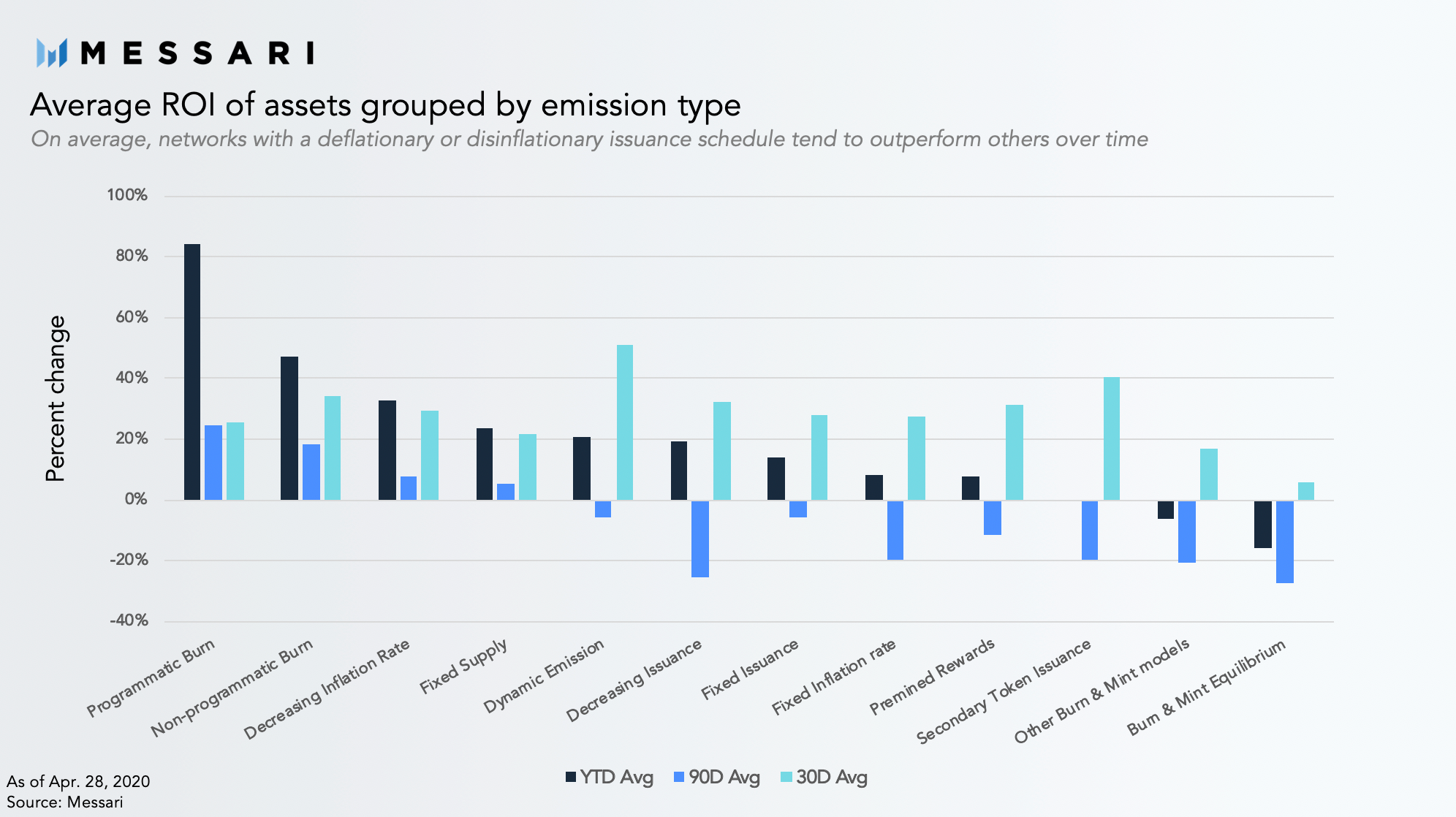
While Bitcoin's monetary policy has helped adoption, as reflected in its price appreciation over the last eleven years, how do these alternative models compare in terms of ROI? More succinctly, does an assets' emission type have an impact on price?

Wilson Withiam was a Senior Research Analyst at Messari. Previously, he worked at Circle Research where he conducted research on cryptoassets. He graduated with a B.Sc. in Kinesiology and Exercise Science before studying computer science and economics at UConn.