
Executive Summary
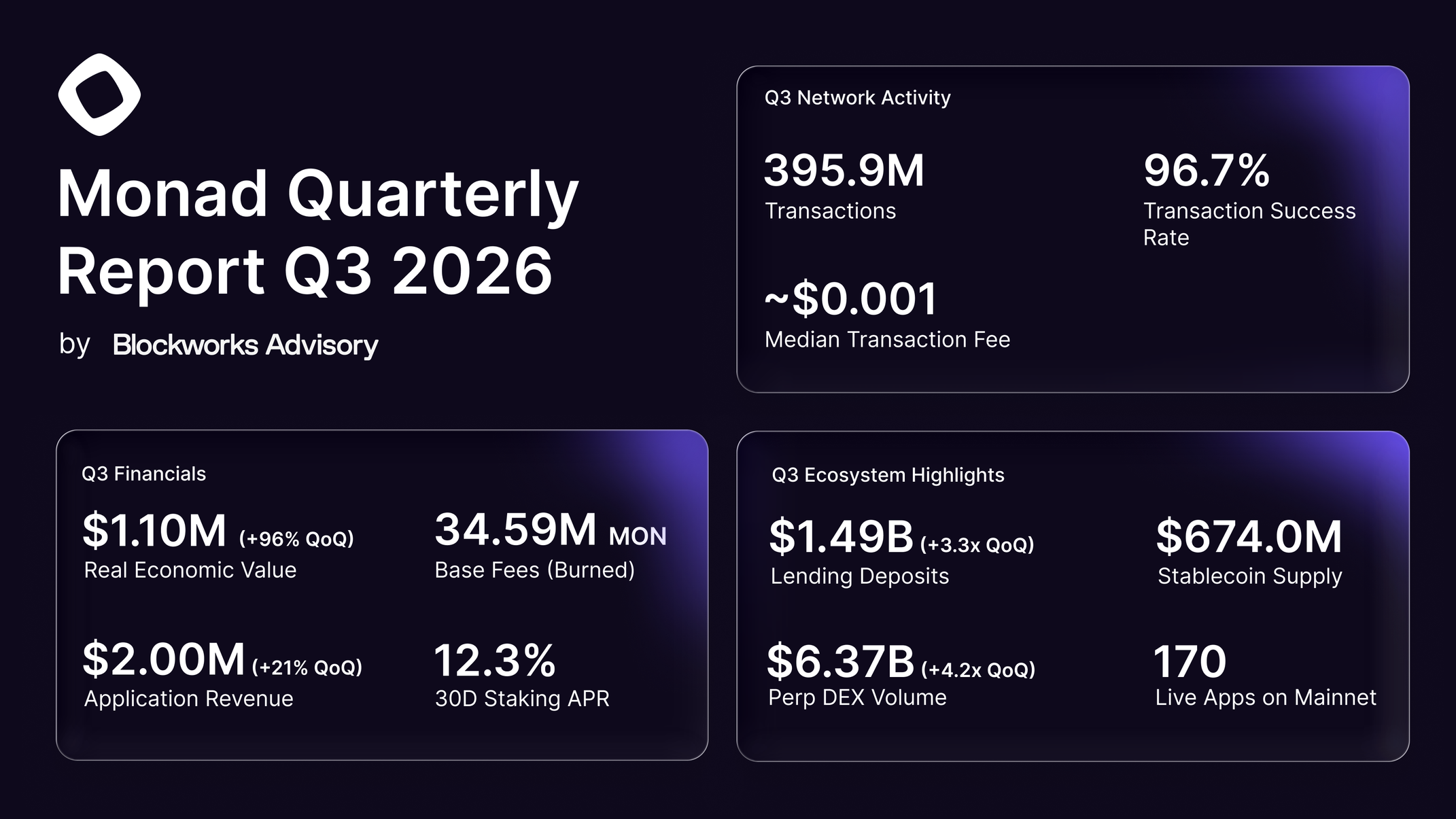
Fees and transactions on Monad nearly doubled in the third quarter. Real Economic Value (REV), the fees users paid for transaction execution, rose 96% from the second quarter to $1.10 million, and transactions rose 96% to 395.9 million. Lending deposits more than tripled over Q3 to $1.49 billion, led by Aave's July 2nd launch and inflows of dollar assets. Stablecoin supply grew from $452 million to $674 million, led by newer dollar tokens such as USDe and AUSD, and DeFi TVL, excluding outstanding borrows, rose from $358 million to $966 million.
Performance and storage improvements on the Monad blockchain during Q3 reduced block times from 400 to 300 milliseconds and deterministic finality from 800 to 600 milliseconds on July 23rd. Block rewards also decreased from 25 to 18 MON per block, reducing annualized issuance by 4%. With fees up and issuance per second down, Token Holder Income (REV minus operator payments) improved from negative $1.29 million to negative $393,000. Token Holder Income improved monthly from May through September, reaching negative $47,000.
Payment rails into the network widened. Interactive Brokers added USDC deposits and withdrawals on Monad in July. In September, Pods connected Pix, Brazil's most widely used instant payment rail, directly to Monad for neobanks and fintechs. MetaMask's Money Account launched exclusively on Monad on June 30th, giving users a self-custodial dollar balance with access to DeFi lending yields and spending through the MetaMask Card. Net capital inflows reached $473 million for the quarter, after a net outflow in the second.
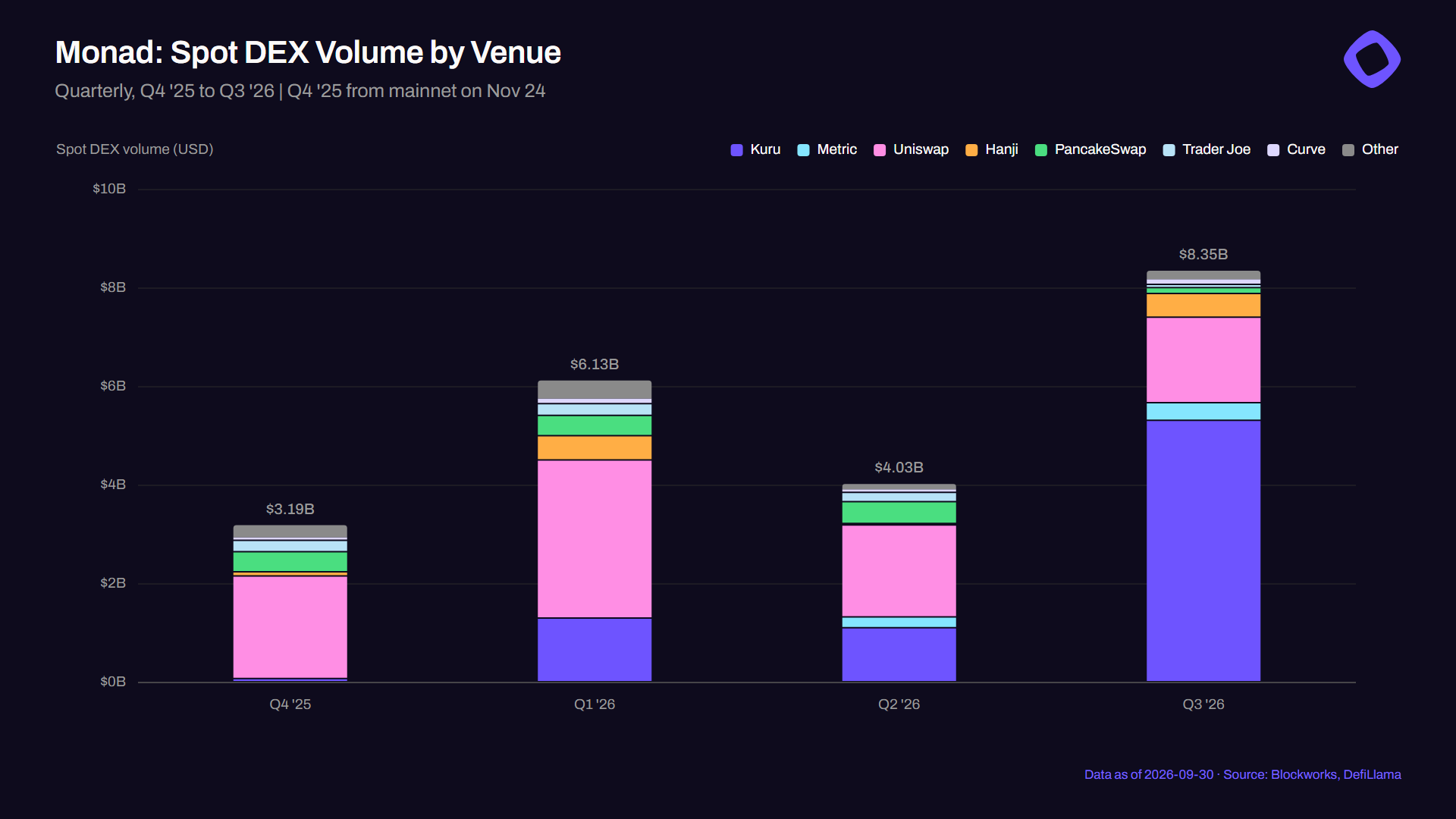
Daily active addresses fell 30% as new addresses per day dropped 69%, while returning addresses rose 21%. Spot trading concentrated on Kuru's order book, which carried 64% of the quarter's $8.35 billion in DEX volume, up from 27% in the second quarter.
Category Labs, the research and development organization that built the initial Monad client, also advanced Cadence and BTX research to address transaction ordering and front-running. These two research initiatives were not live on mainnet at quarter-end.
Financials
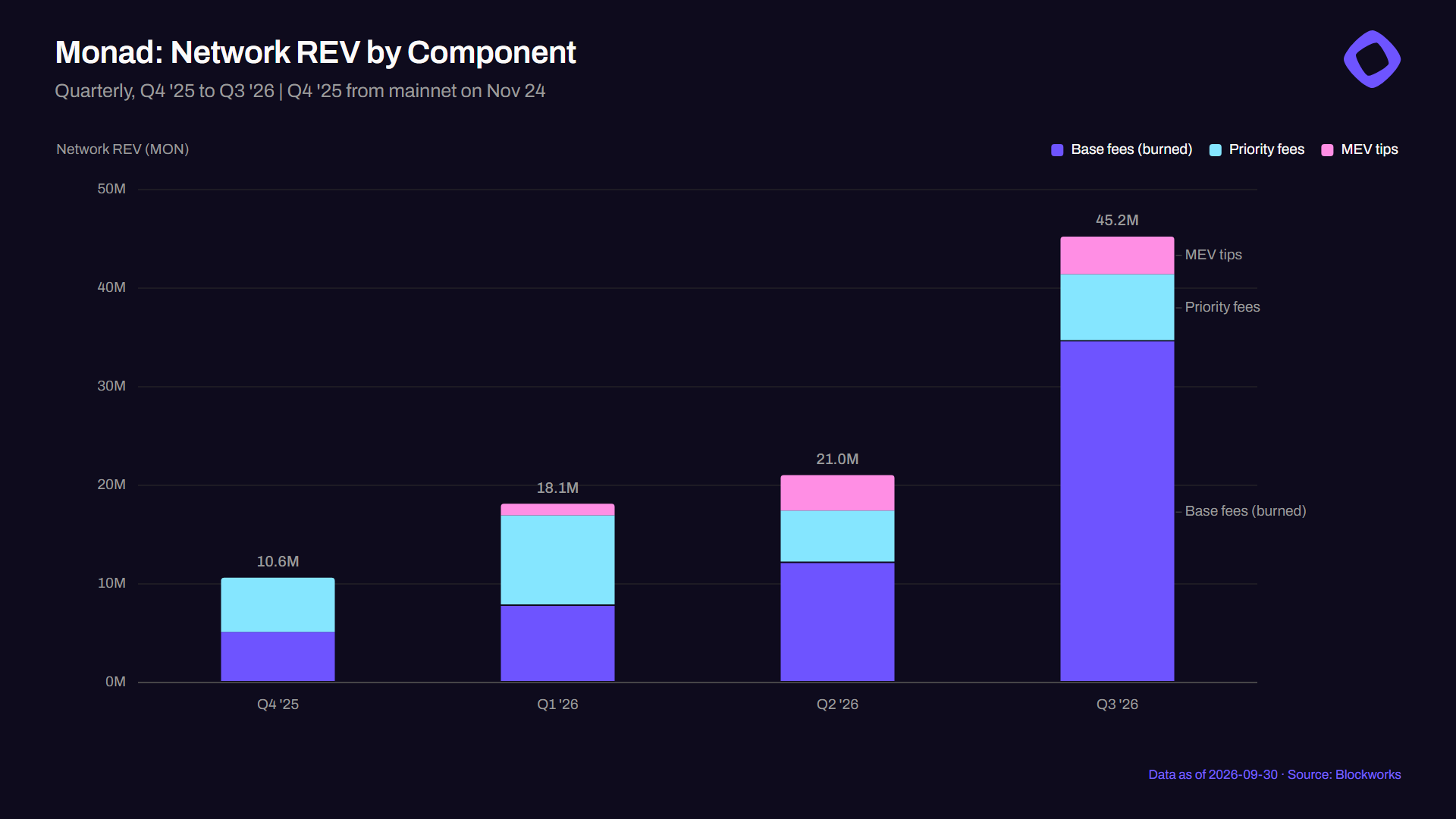
REV rose to 45.24 million MON ($1.10 million) from 21.03 million MON ($561,000) in the second quarter. Base fees drove the increase, nearly tripling to 34.59 million MON, or 76% of REV, while priority fees and MEV tips together came to 10.65 million MON. The base fee remained at its 100 MON-gwei floor all quarter, meaning revenue growth came entirely from increased network usage rather than higher base-fee prices.
Transactions nearly doubled, and the average gas charged per transaction rose from 602,000 to 873,000. The Monad protocol charges transactions for the full gas limit rather than gas consumed during execution, a design choice that supports asynchronous execution. Order-book trading applications tend to set higher gas limits, contributing to increased fee generation. Perpl, together with three high-volume contracts began trading through Kuru's order book in July and August, drew 39% of the quarter's base fees and 57% of their increase.
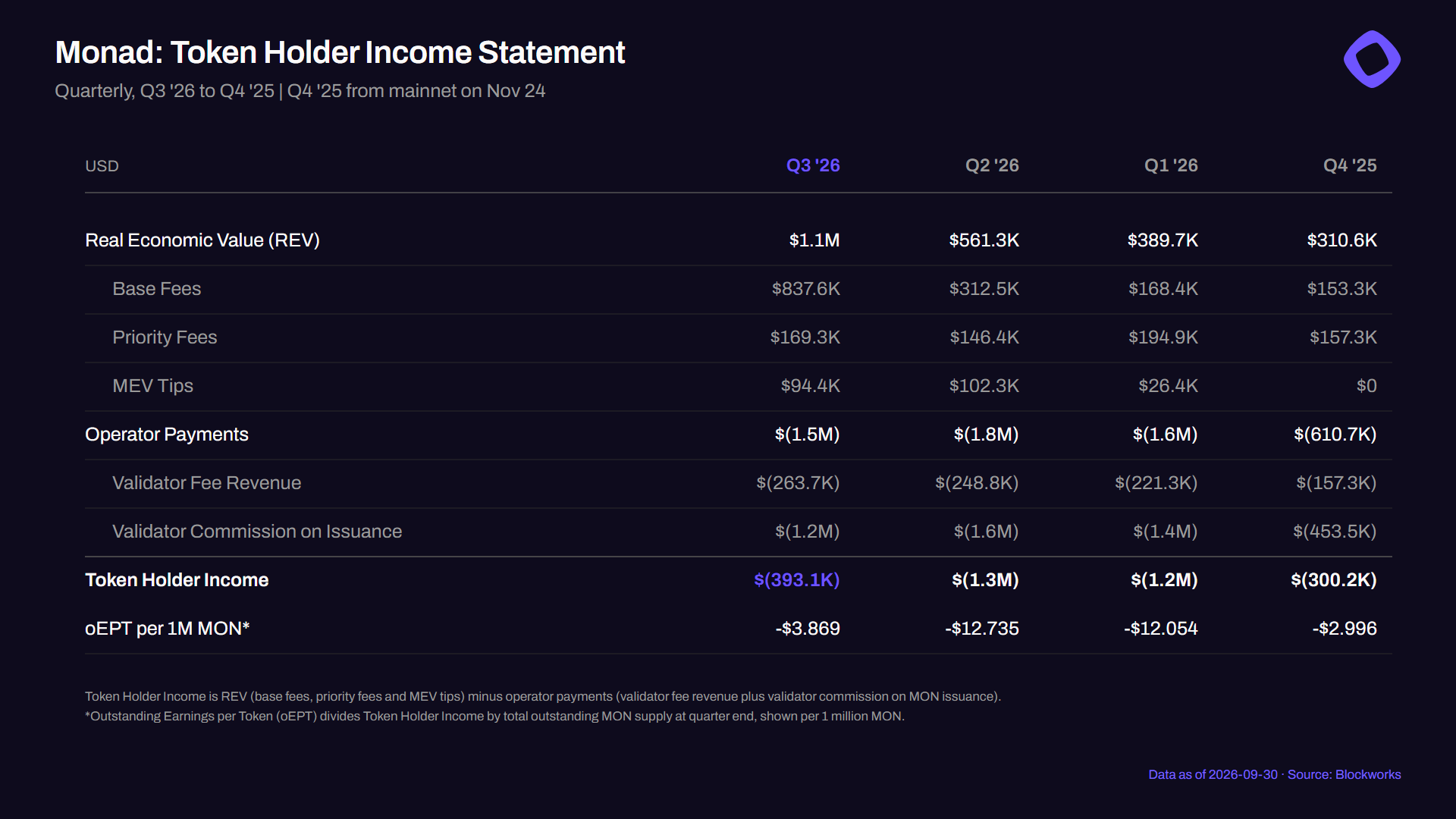
A note on the calculations: Monad's network revenue, Real Economic Value (REV) comprises the base fees, priority fees and MEV tips users pay for transaction execution. Base fees are burned, removing MON from supply, while priority fees and MEV tips go to the validators that produced the block, and validators also retain a commission on MON issuance before staking rewards pass to delegators. Token Holder Income is calculated as REV minus those operator payments. This is an analytical metric and does not represent income distributed or payable to MON holders. Delegator rewards are excluded because they represent a transfer from holders who do not stake to holders who do, so they are excluded from this calculation.
Operator payments fell to 63.15 million MON ($1.49 million) from 68.07 million MON ($1.85 million). Combined with higher network revenue, this narrowed negative Token Holder Income by approximately 70%, from negative 47.04 million MON (negative $1.29 million) to negative 17.91 million MON (negative $393,000).
The improvement was consistent throughout the quarter. Monthly Token Holder Income narrowed in every month from May onwards, reaching negative $47,000 in September, compared with negative $570,000 in April. Over the same period, base-fee burns increased relative to validator commission on issuance. In April, burns covered approximately one-sixth of validator commission; by September, they covered 88%, with 14.9 million MON burned against 16.8 million MON in commission.
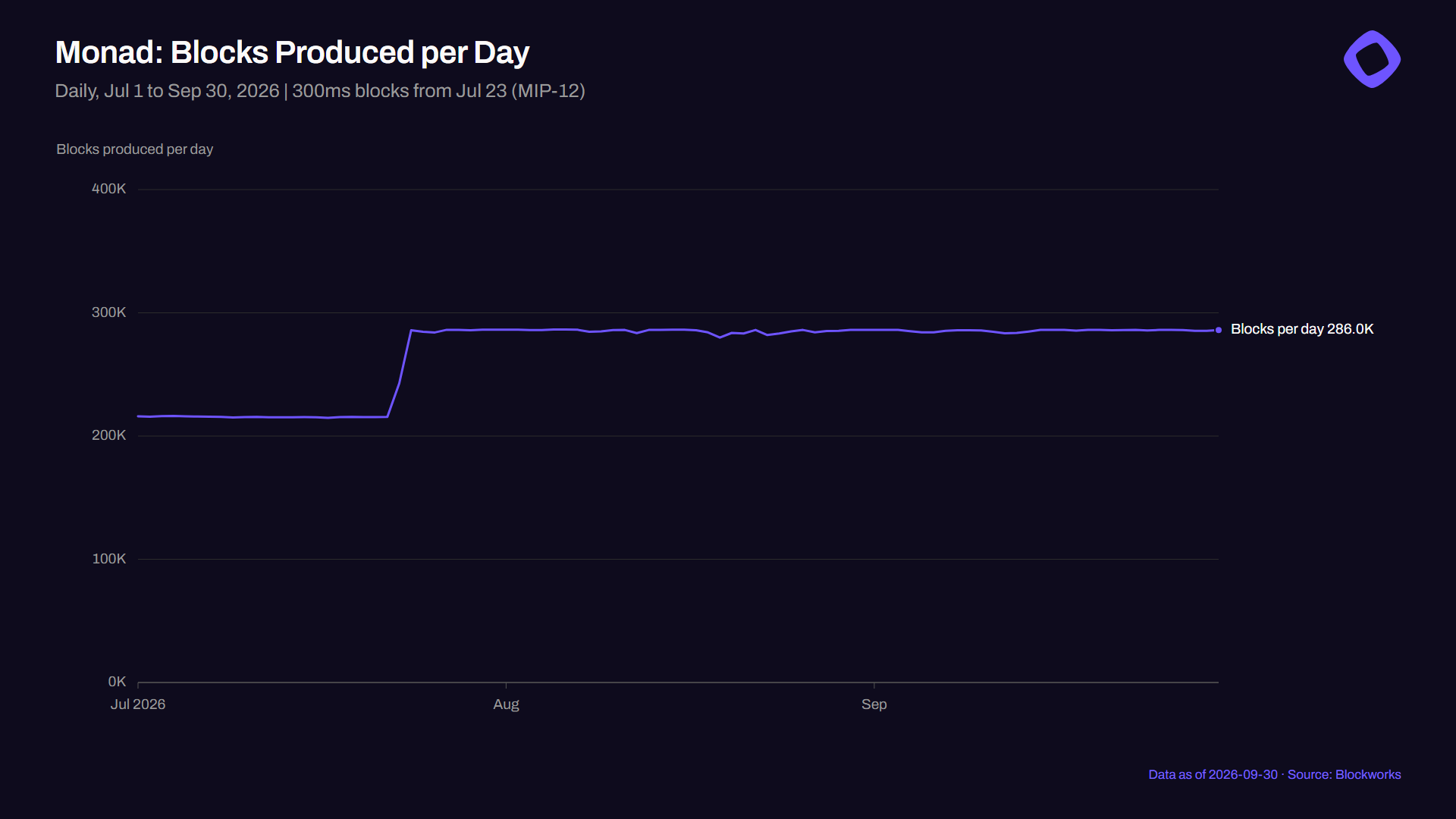
MIP-12, activated on July 23rd, reduced the block time from 400 to 300 milliseconds and lowered the block reward from 25 to 18 MON. Blocks per day increased from ~215,500 to ~285,400, and issuance per second fell 4%, from 62.5 to 60 MON. Despite producing 26% more blocks during the quarter, gross issuance fell 2.6% to 478.26 million MON.
The burn rate, burned MON as a share of gross issuance, rose to 7.2% from 2.5%, and net issuance of 443.67 million MON put annualized net inflation at about 1.7% as total supply rose from 101.155 billion to 101.599 billion MON.
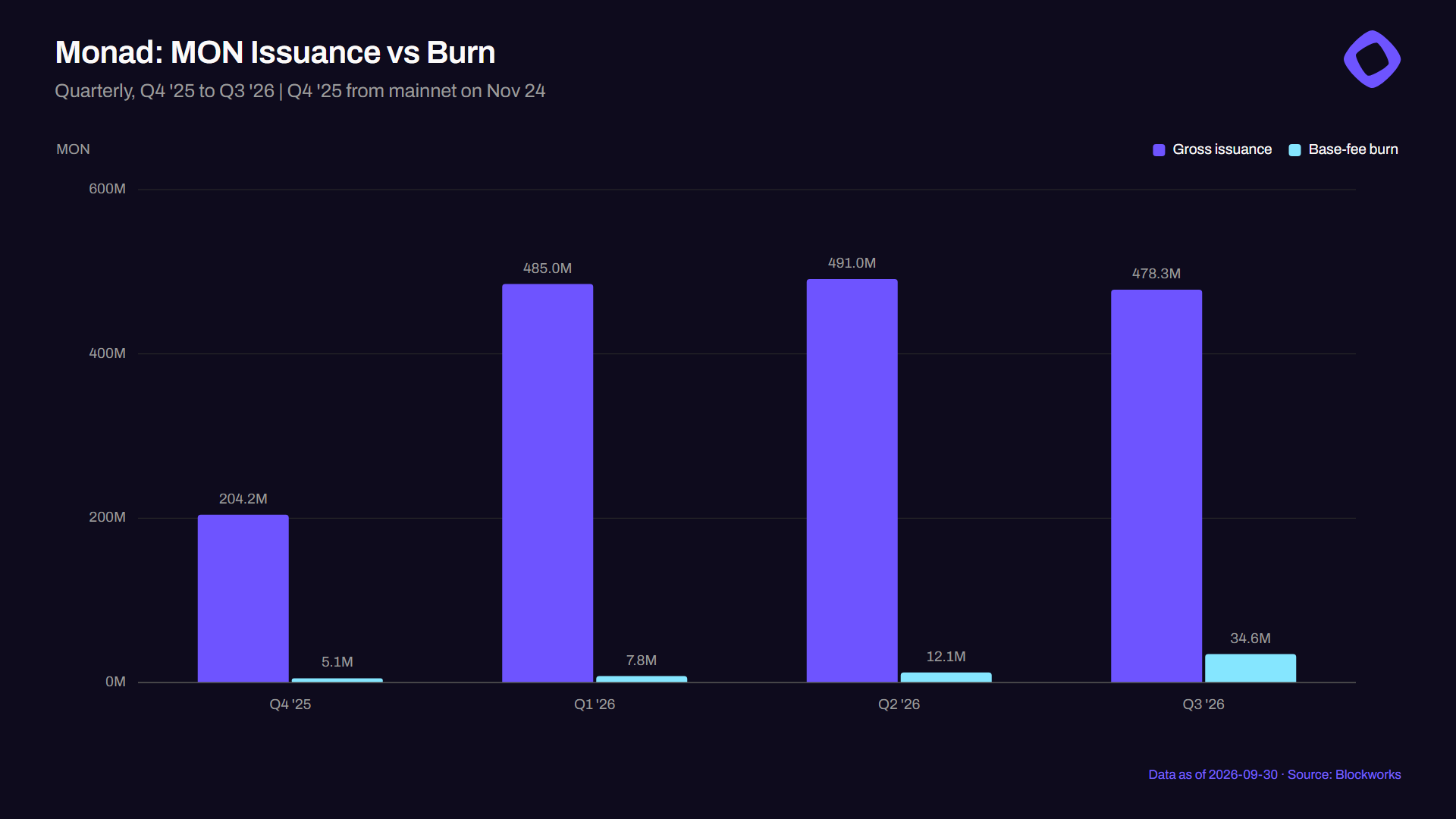
Validators kept 52.49 million MON of issuance as commission, an average rate of about 11% against 12% in the second quarter. Delegators received 425.77 million MON, while the 30-day staking APR eased from 13.1% to 12.3%. Transaction costs remained low throughout the quarter. At the minimum base fee of 100 MON-gwei, a typical swap of about 200,000 gas costs 0.02 MON.
MON Holder Activity and Supply
MON holder addresses rose 4.3% in Q3 to 6.54 million. Approximately 93% of the new addresses held less than 1 MON. Addresses with larger balances of 10 to 100 MON rose 17%, while addresses holding 1,000 MON or more fell 4%.
The largest blocks of MON sit outside that holder activity. Investor and team allocations totalling 46.7 billion MON, about 46% of total supply, remained locked at quarter end. Those allocations, along with the original Category Labs' treasury allocation, have been subject to a minimum one-year lock-up since the November 2025 mainnet launch.
Investor and the original Category Labs treasury tokens follow a four-year schedule with a one-year cliff and equal monthly unlocks after it. Team tokens are subject to minimum one-year lockups with varying vesting schedules. The first scheduled unlock for all three allocations falls on November 24th, 2026, subject to their respective vesting and lock-up terms. These allocations are expected to be completely unlocked by November 24th, 2029.
In August, the Monad Foundation completed an Early Investor Liquidity Program, offering certain early investors the ability to sell locked MON to the Foundation at a discount reflecting the four-year lock-up, capped at $60 million. Nearly all holders approached declined to participate. Any MON purchased by the Foundation under the program remains subject to the same original lock-up terms and the Foundation has not sold, offered to sell or sought to sell any MON over the counter (OTC) or otherwise and is not currently engaged in any process to do so.
Revenue Drivers
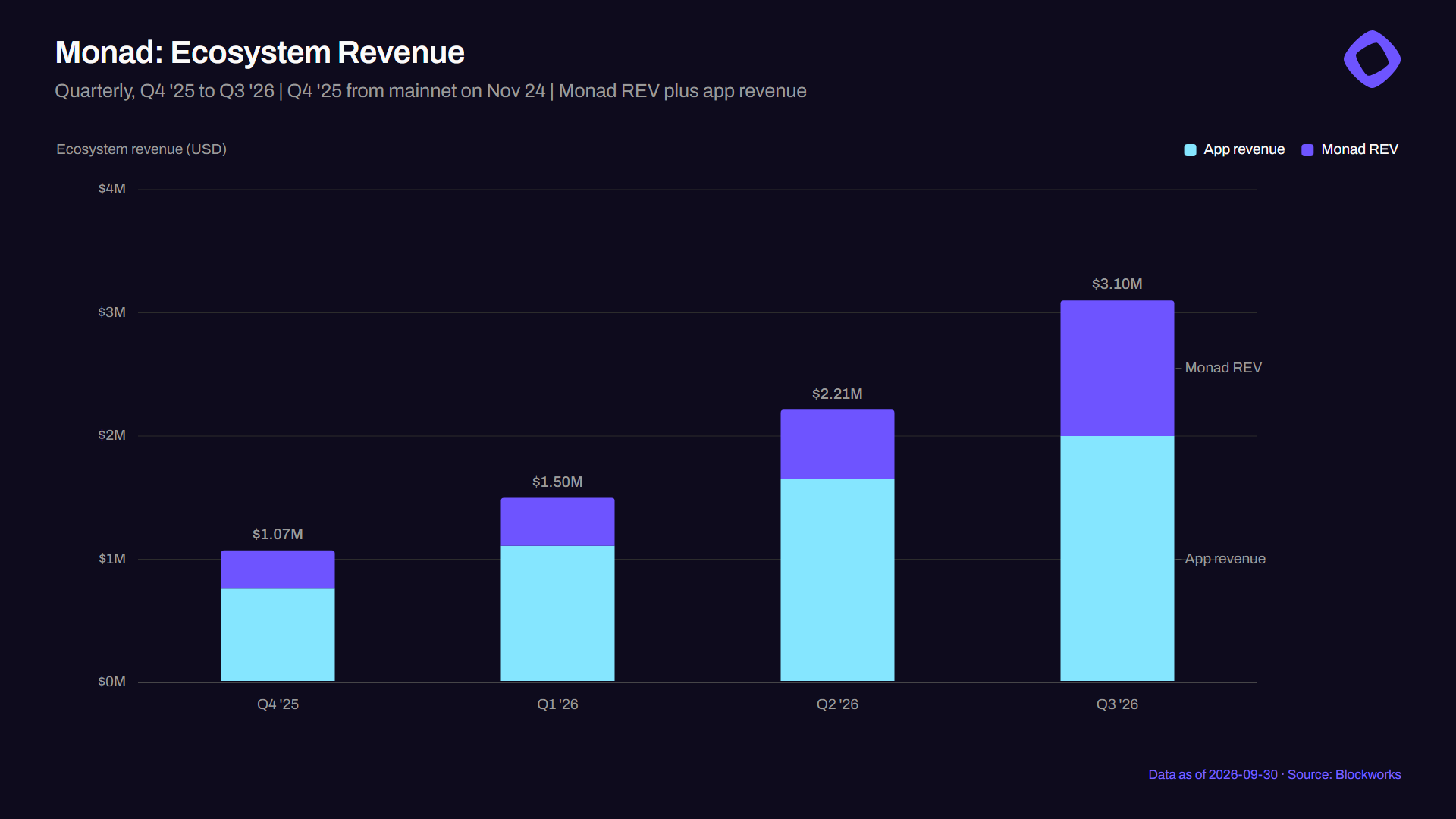
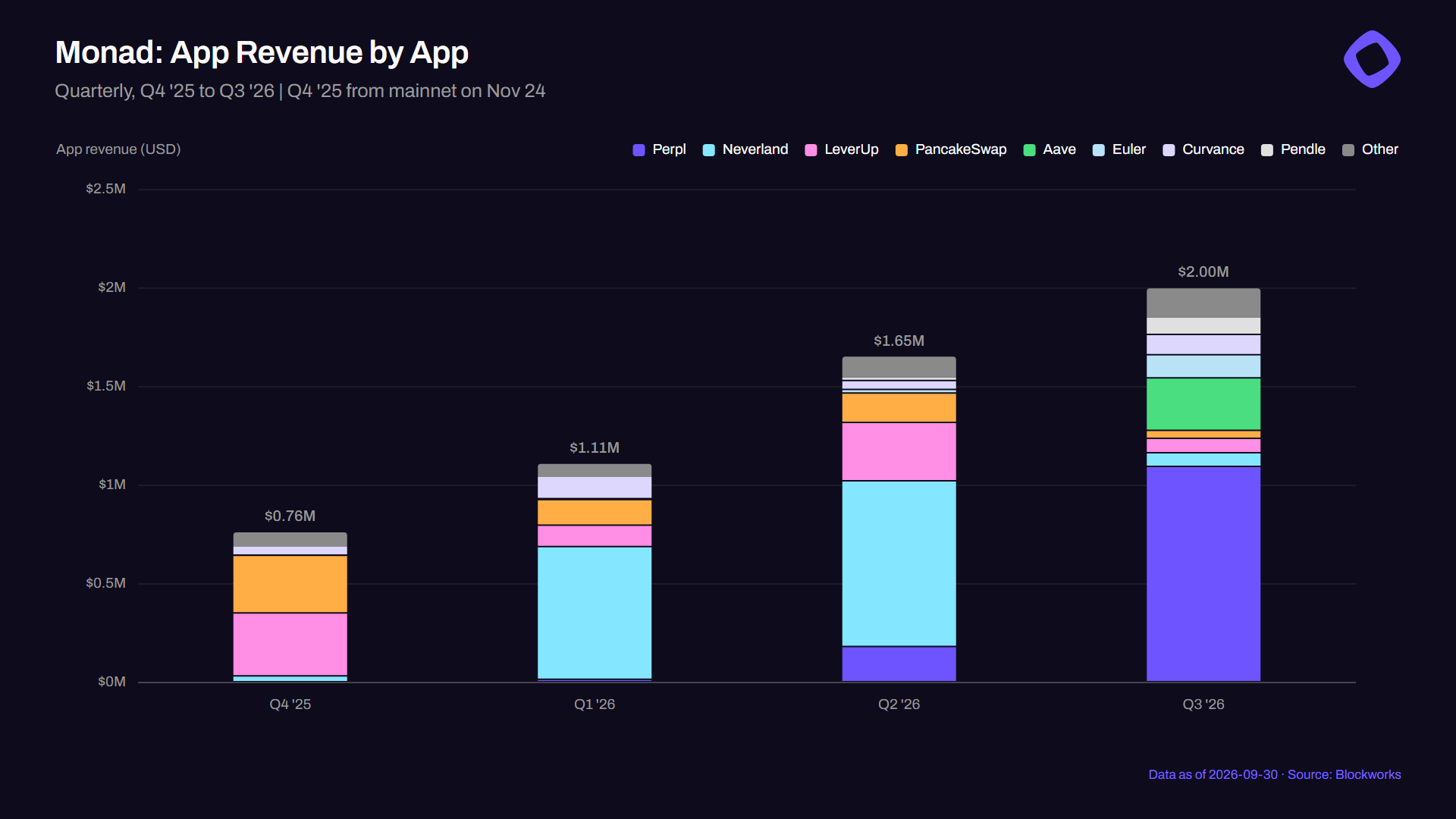
Monad’s ecosystem revenue, comprising network REV and the revenue earned by applications, reached $3.10 million in Q3. Applications generated $2.00 million, up 21% from $1.65 million, and accounted for 64% of the total ecosystem revenue. The number of applications also expanded from 140 on June 30th to 170 apps live on mainnet on September 30th.
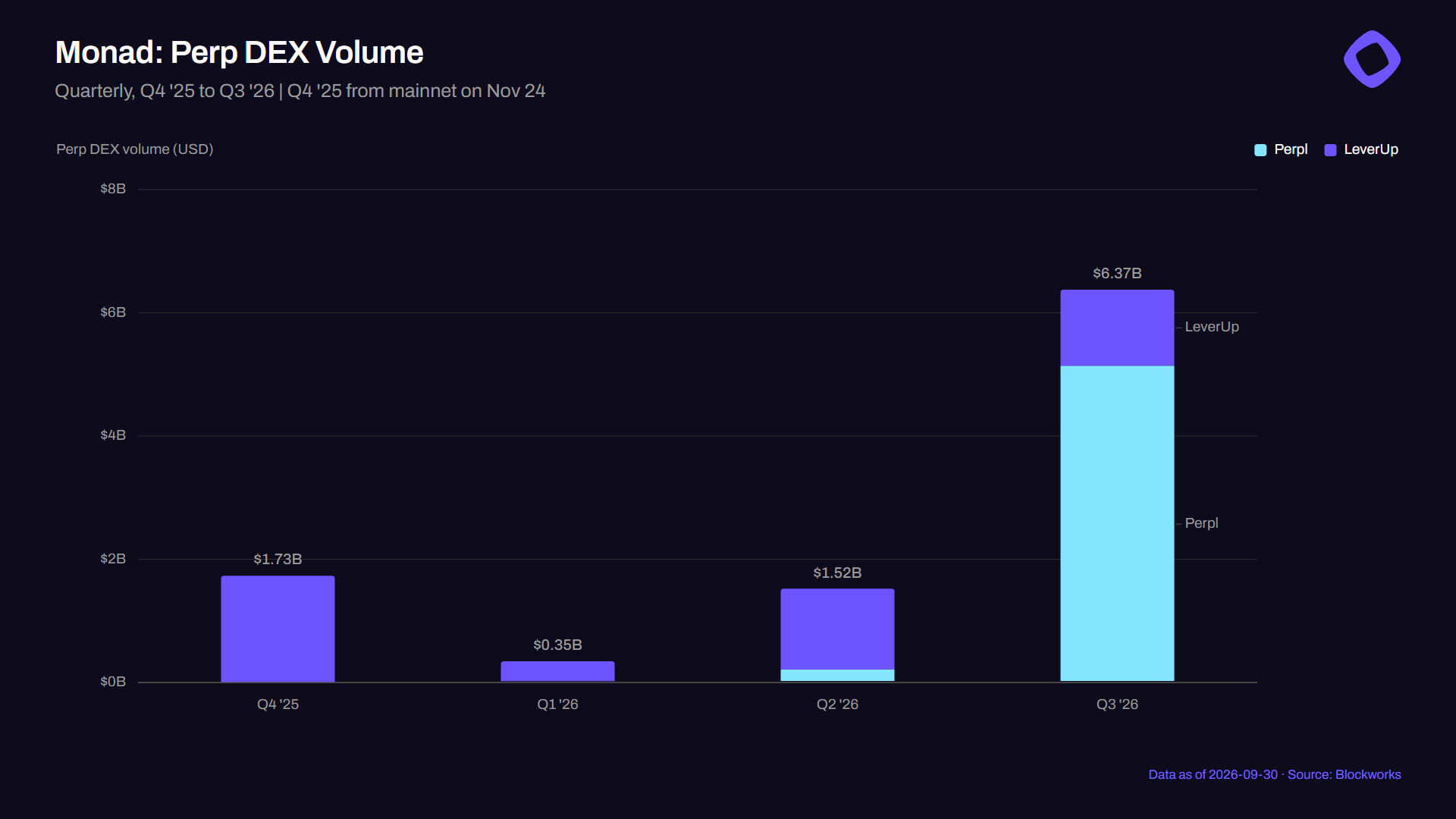
Trading was the largest source of application revenue, led by Perpl, a fully onchain perpetuals order book, which generated $1.09 million, or approximately 55% of the total. Perpl's trading volume increased from $210 million in the second quarter to $5.14 billion in the third. Lending and yield applications also contributed, with Aave generating $266,000, Euler $117,000, Curvance $103,000 and Pendle $91,000.
The sources of application revenue also shifted during the quarter. Neverland, which led in Q2 with $841,000, generated $69,000 in Q3 as its lending deposits declined.
Protocol Analysis
Network Performance and Activity
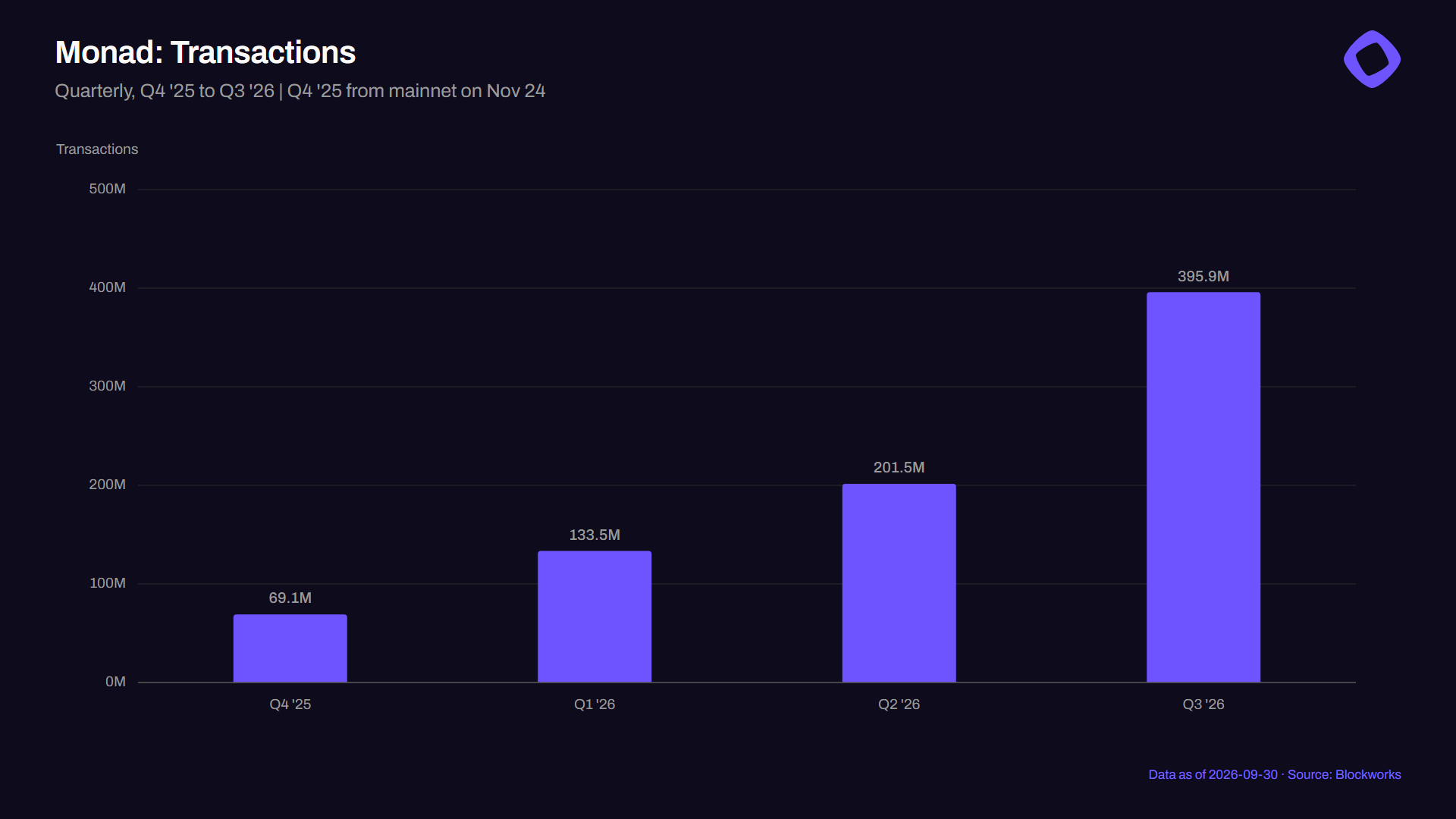
The Monad network processed 395.9 million transactions in the third quarter, up 96% from the second, averaging approximately 4.3 million transactions per day. Of those transactions, 96.7% succeeded, while the median transaction fee remained near $0.001.
Network performance improved following the July 23rd activation of MIP-12, which reduced block times from 400 to 300 milliseconds and deterministic finality from 800 to 600 milliseconds. Blocks produced per day increased by approximately one-third, while transaction, gas and byte limits per block were reduced proportionally, keeping per-second capacity unchanged. As a result, block reward was also reduced from 25 to 18 MON. MIP-8, activated on September 2nd, introduced more efficient state storage by grouping contiguous storage slots into shared disk pages, so each group of 128 slots costs a single lookup.
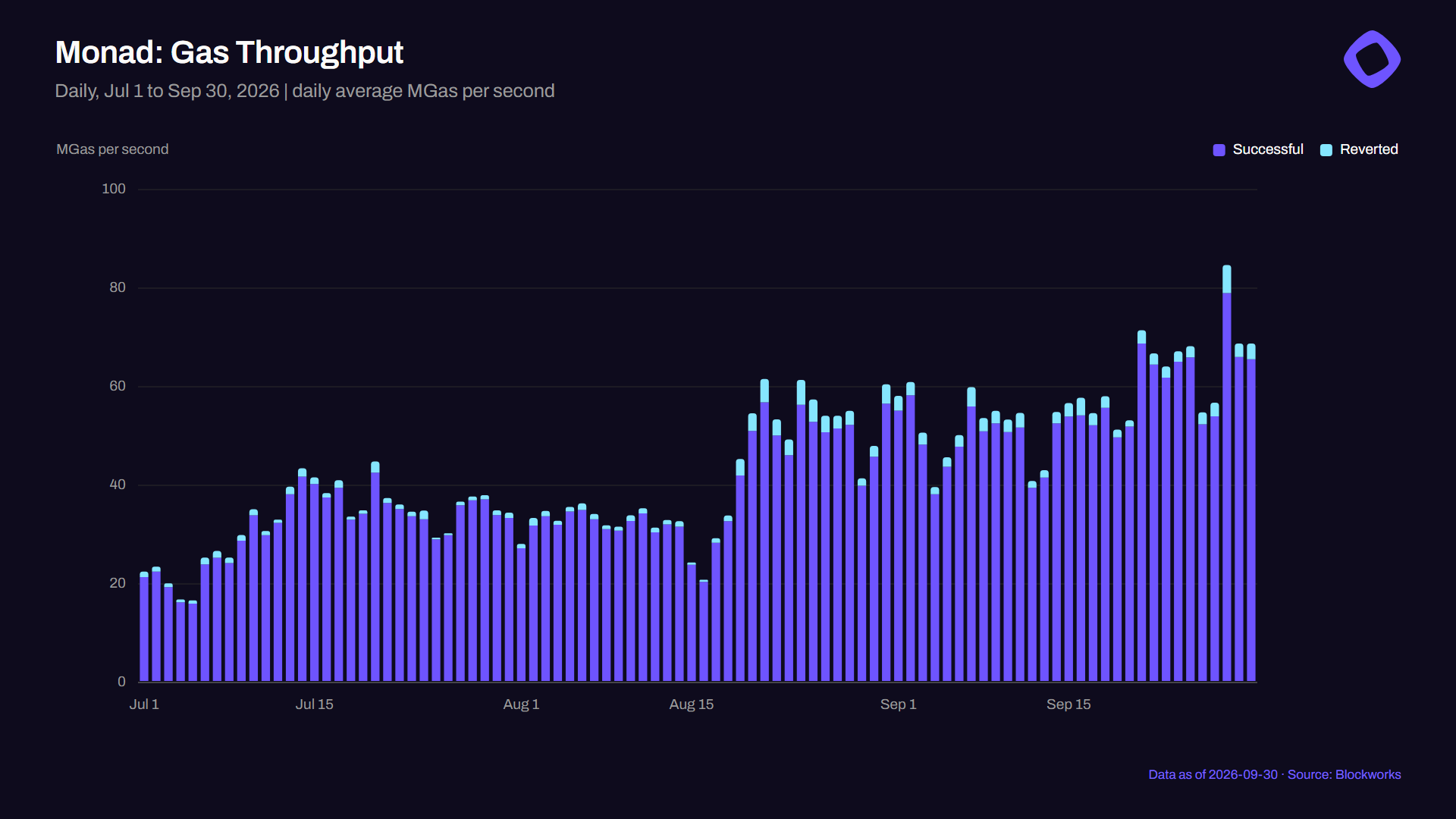
Gas throughput averaged 43.5 MGas per second over Q3, with a peak daily average of 84.7, against a design capacity of 500 MGas per second (150 million gas block every 300 milliseconds). Reverted transactions accounted for 4.2% of gas. Mainnet recorded no outages or halts during the quarter, continuing its uninterrupted operating history since the November 2025 launch.
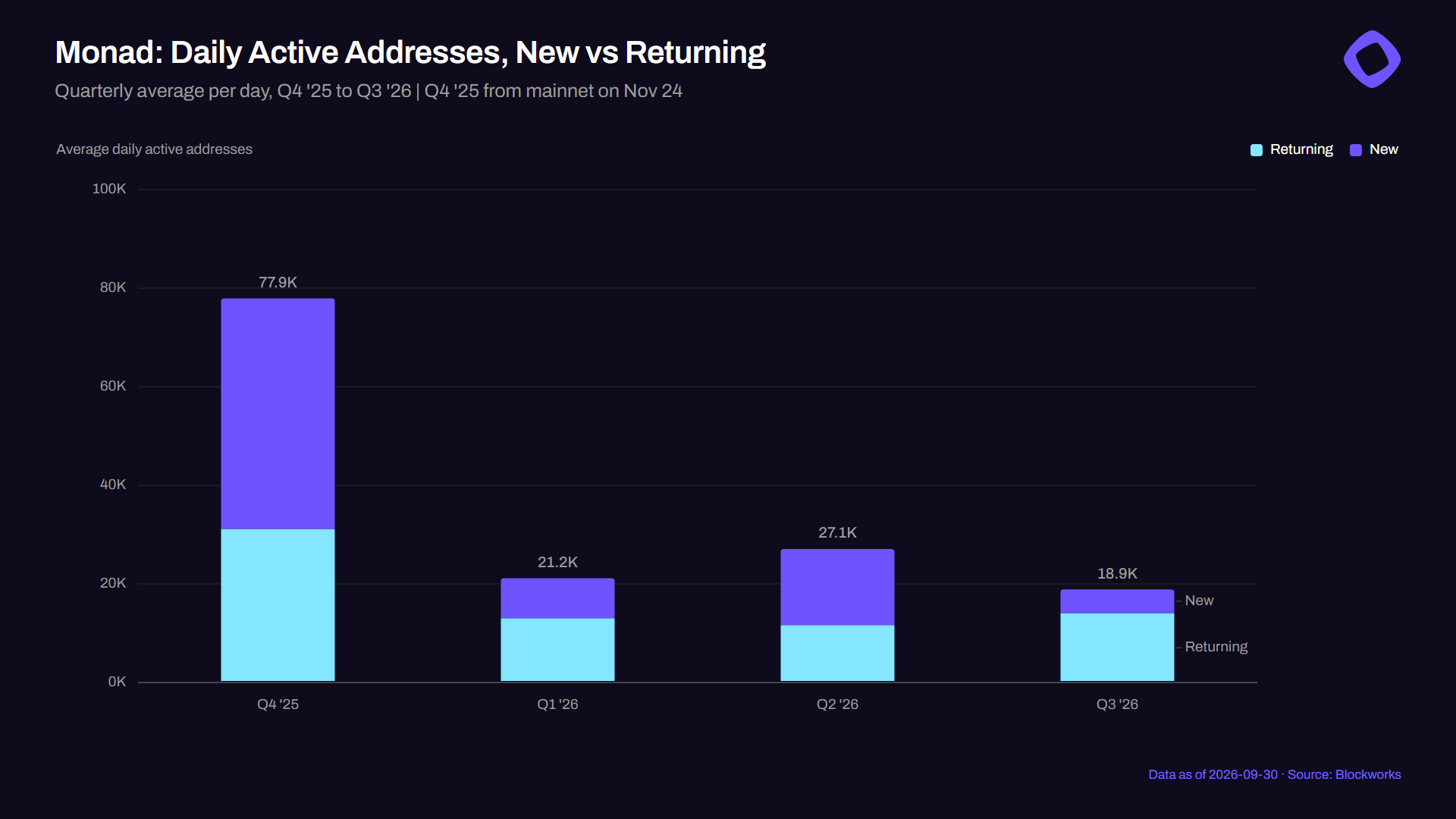
User activity showed a shift toward returning addresses. Average daily active addresses declined 30% to 18,883, driven by a 69% decline in new addresses to 4,790 per day. Returning addresses, however, increased 21% to 14,093 per day. The divergence indicates that activity became more concentrated among existing participants, even as the pace of new-address creation slowed.
Payments and Stablecoins
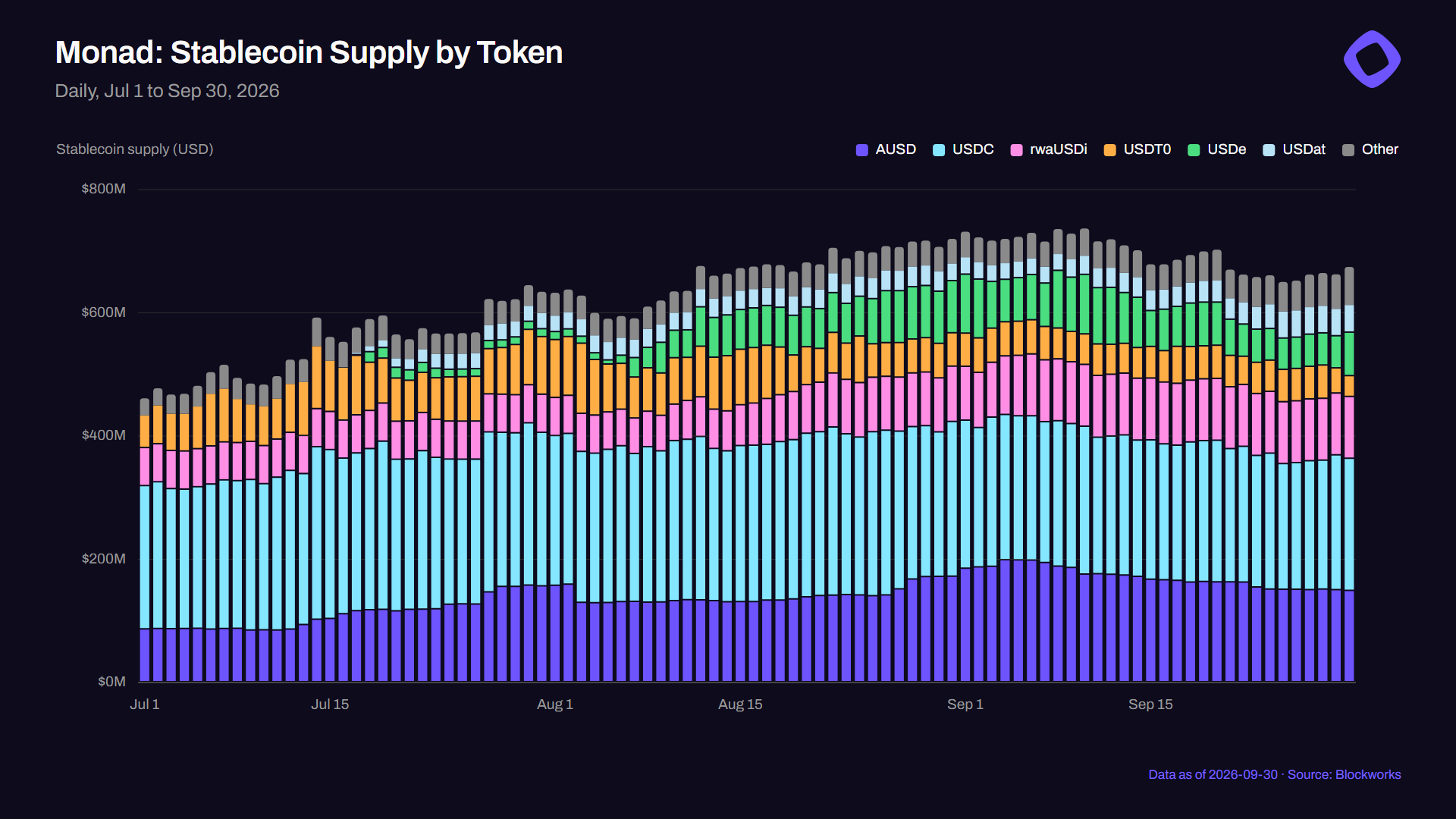
Stablecoin supply on Monad grew 49% during the quarter, from $452 million to $674 million, expanding the dollar liquidity available across payments, trading and lending applications. USDC remained the largest stablecoin at $215 million, followed by Agora's AUSD at $148 million, rwaUSDi at $100 million, Ethena's USDe at $71 million and Saturn's USDat at $45 million. Together, these five assets accounted for 86% of stablecoin supply.
Growth was led by newer dollar assets rather than the network's established USDC and USDT0 balances. Ethena’s USDe and Saturn’s USDat, both close to zero at the end of June, added $116 million in combined supply, while AUSD, rwaUSDi and MetaMask's mUSD contributed another $118 million.
USDC supply slipped 4% and USDT0 fell 37%, while USDC lending activity grew. Gross USDC deposits in lending markets rose from $62 million to $311 million, which exceeds USDC’s $215 million supply because borrowed USDC is redeposited and counted again. Net of $284 million in USDC loans, about $27 million of USDC sat in lending markets at quarter end.
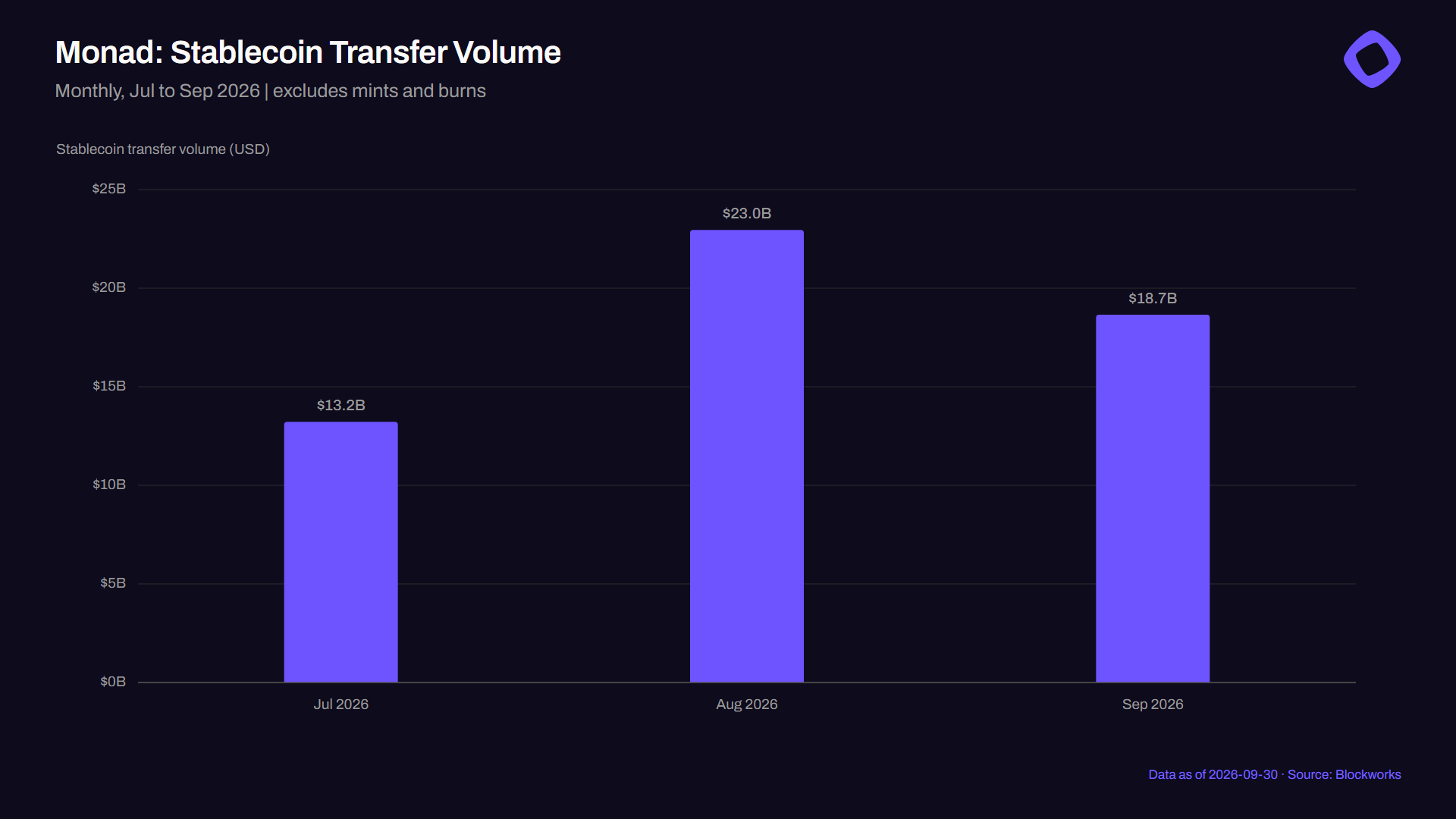
Stablecoin transfers, excluding mints and burns, totaled $54.8 billion during the quarter, peaking at $23.0 billion in August before easing to $18.7 billion in September. Euro-to-dollar stablecoin swaps on decentralized exchanges reached $260 million.
Bridges brought in a net $415 million of the quarter's $473 million in net capital inflows, led by Chainlink CCIP at $245 million. Stablecoin issuers minted a net $47 million on Monad.
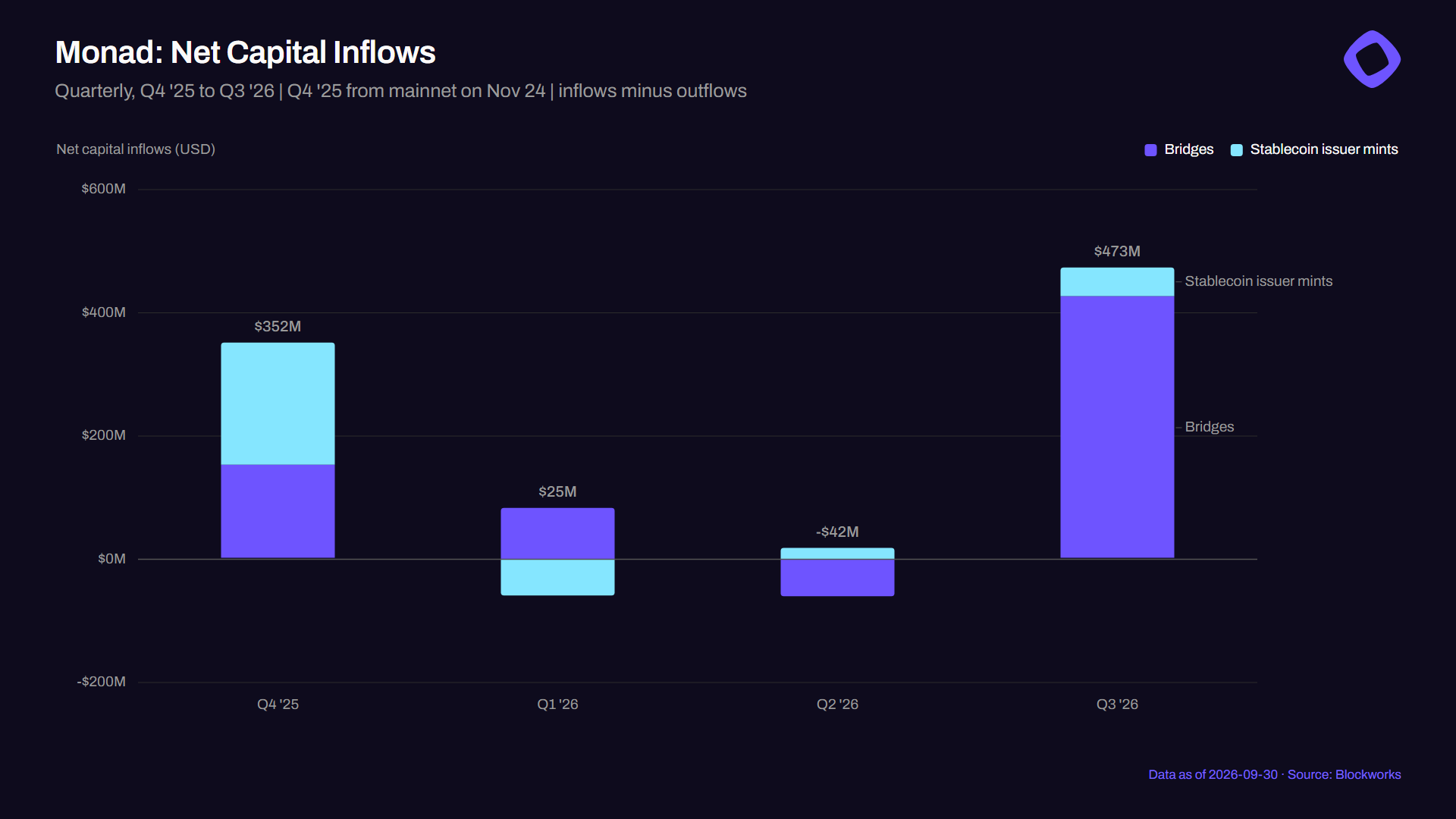
Access to that liquidity expanded through both institutional and consumer financial services. Interactive Brokers enabled USDC deposits and withdrawals on Monad in July, while Pods connected Brazil's Pix instant payment rail in September, allowing neobanks and fintechs to integrate onchain financial products. More than 30 fiat onramps supported access to the network, including payment methods such as Pix in Brazil and UPI in India.
Consumer-facing products also developed during the quarter. MetaMask's Money Account, launched exclusively on Monad in June, combines a self-custodial digital-dollar balance with access to DeFi lending yields and spending through the MetaMask Card. Rain provides infrastructure for stablecoin-funded cards usable across Visa's acceptance network. These integrations connect wallet access, earning opportunities and everyday spending, although their contribution to actual consumer transaction volume is not yet separately quantified in this report.
Infrastructure for agent-driven payments expanded on Monad. The Monad API Hub, launched in September, enables developers and software agents to pay for API requests in USDC without subscriptions or API keys. The Foundation joined the x402 Foundation's governing board and the Rain-led Agentic Payments Alliance, both focused on developing standards for machine-initiated commerce.
DeFi Lending and Trading
Lending was one of the largest contributors to Monad’s growth during the quarter. Deposits increased from $445 million to $1.49 billion, and outstanding loans went from $148 million to $610 million. The growth came from the new dollar assets.
Stablecoin deposits rose from $131 million to $600 million and tokenized-asset collateral, led by Maple's syrupUSDC and Accountable's vUSD, went from $138 million to $313 million, while deposits of MON and its liquid staking tokens fell from $9.0 million to $5.7 million.
Aave, which went live on Monad on July 2nd, held $581 million of deposits at quarter end. At the 46-day mark, its Monad market ranked third by weekly fees across its 21 deployments. Euler held $373 million, Morpho $320 million and Curvance $204 million.
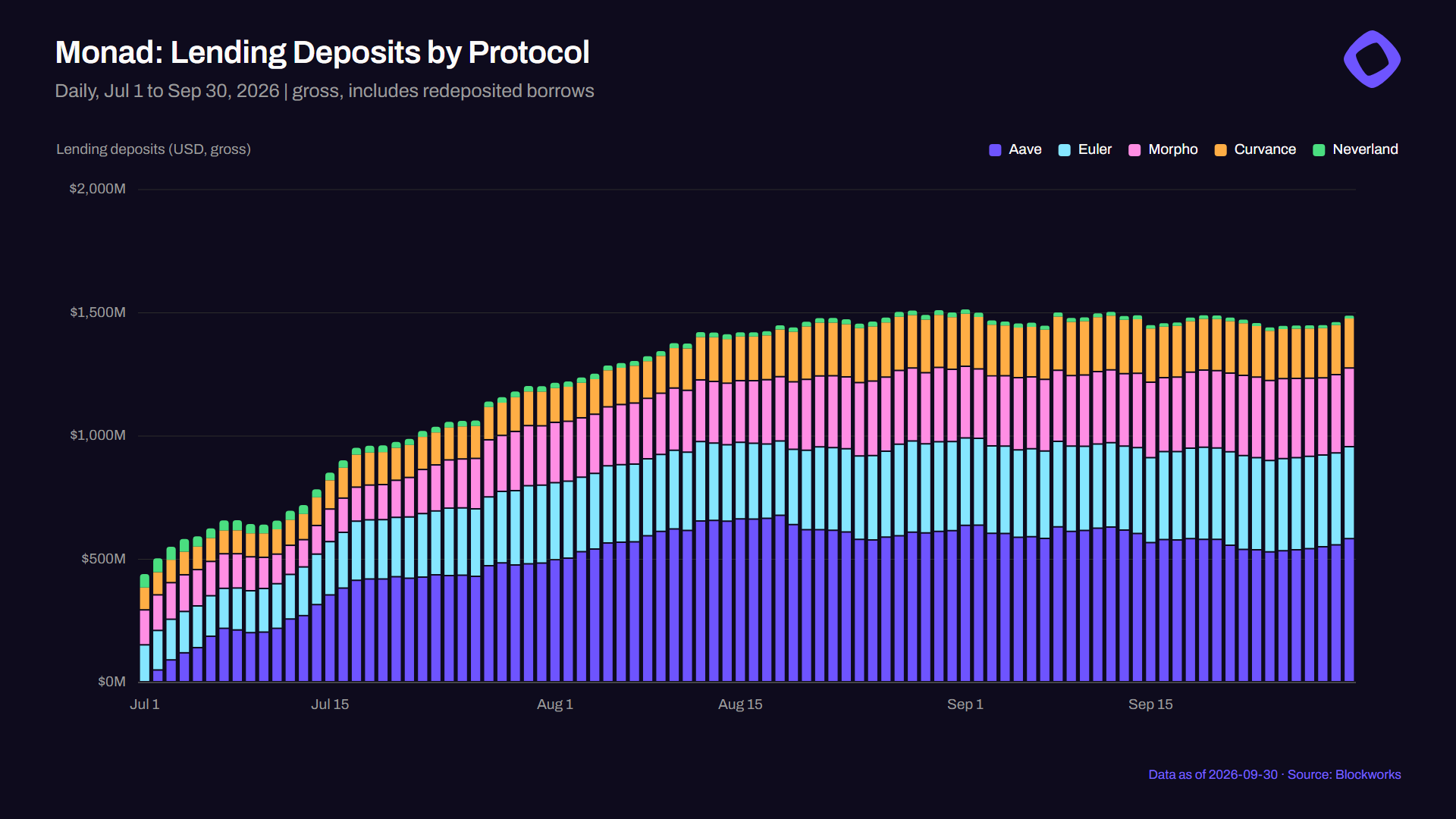
DeFi TVL, excluding outstanding borrows, nearly tripled to $966 million from $358 million. TVL including outstanding borrows increased to $1.86 billion from $698 million. Outstanding borrows counted in that measure rose to about $895 million from $340 million. Net capital inflows of $473 million represented more than three-quarters of the rise in TVL, and most of the growth occurring in July following Aave’s launch and the introduction of Maple’s syrupUSDC. TVL reached $834 million by July 31st after $463 million of net inflows that month. Over the quarter Chainlink CCIP, the bridge for syrupUSDC, brought in a net $245 million and Ethena's bridge $92 million.
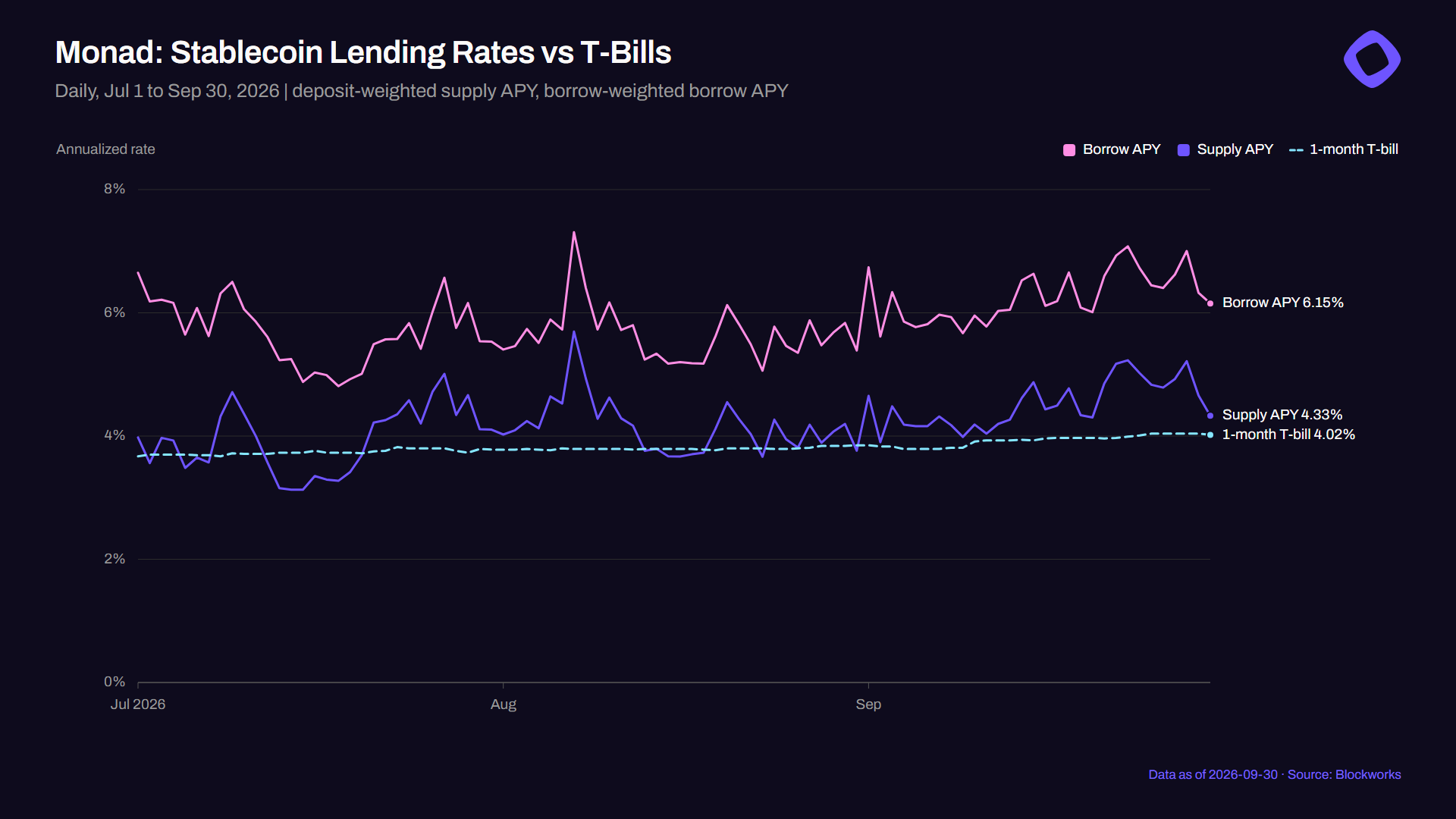
The composition of deposits also changed. Stablecoin lending also paid more than one-month T-bills for most of the quarter. Most of the new borrowing was in stablecoins, with stablecoin loans rising from $95 million to $472 million.
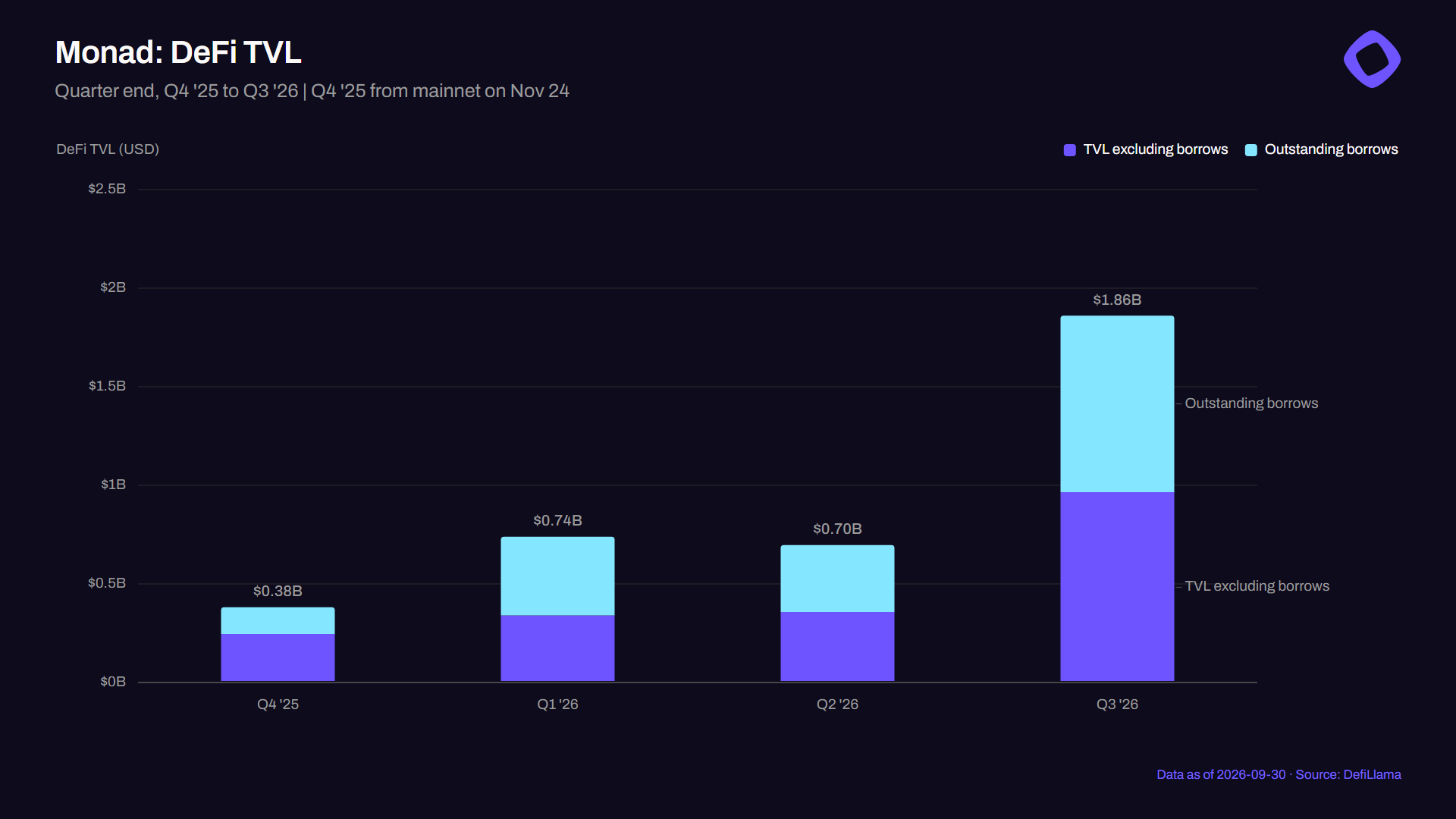
Borrowers paid $6.28 million in interest during the quarter, compared with $3.27 million in the second. Protocol net interest income declined 39% to $555,000, however, as lending activity on Neverland fell from $68 million to $12 million. Neverland retained ~42% of interest, while deposits on Aave, Euler and Curvance, retained about 10% of interest. Protocols kept 8.8% of interest paid in Q3, against 27.6% in Q2.
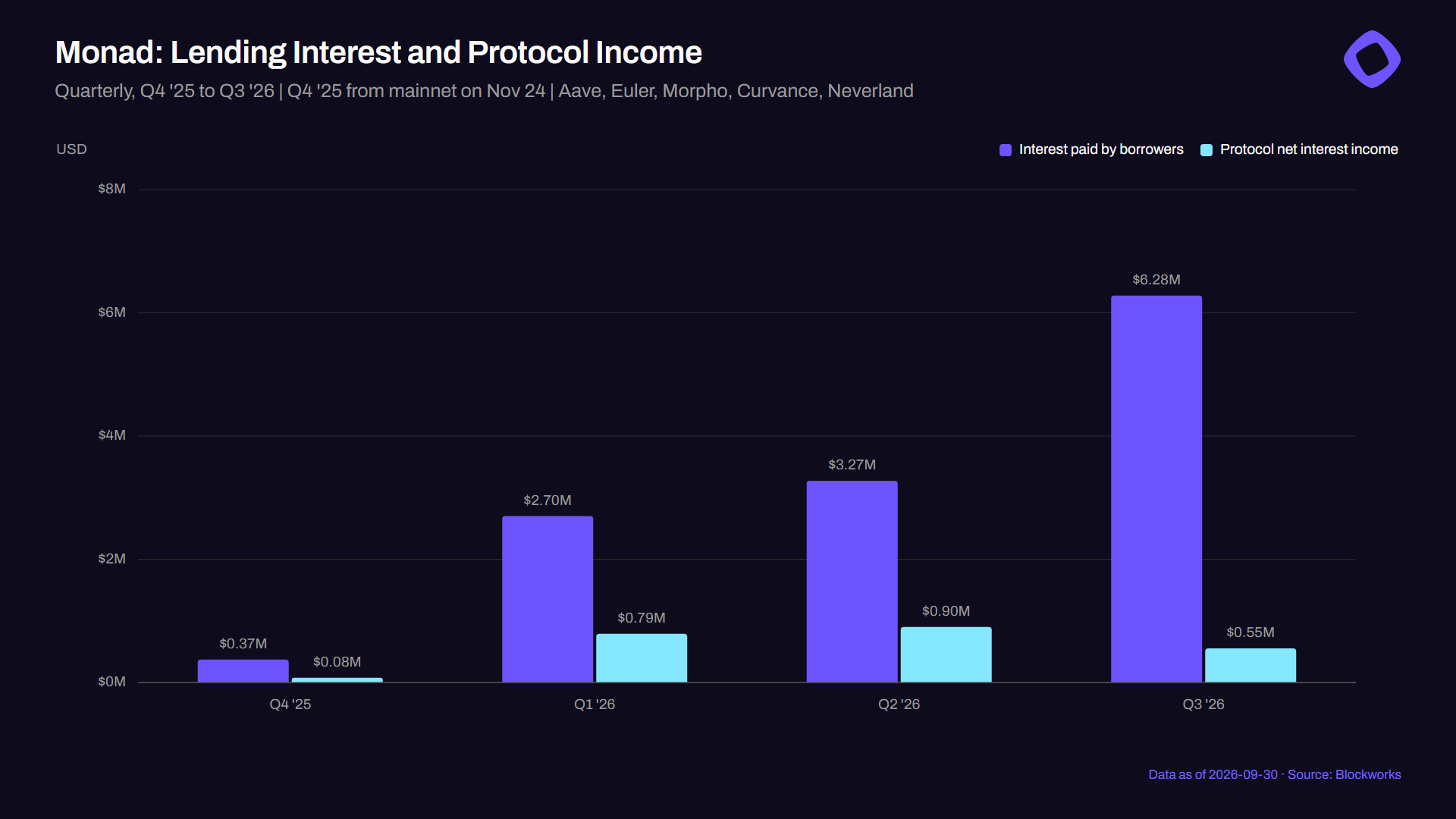
Stablecoin lenders recorded an average deposit-weighted supply APY of 4.20% over the quarter, above the 3.82% average yield on one-month Treasury bills, and stablecoin borrowers paid 5.87%. The daily supply rate ranged between 3.1% and 5.7% and sat above the T-bill yield on 72 of the quarter's 92 days.
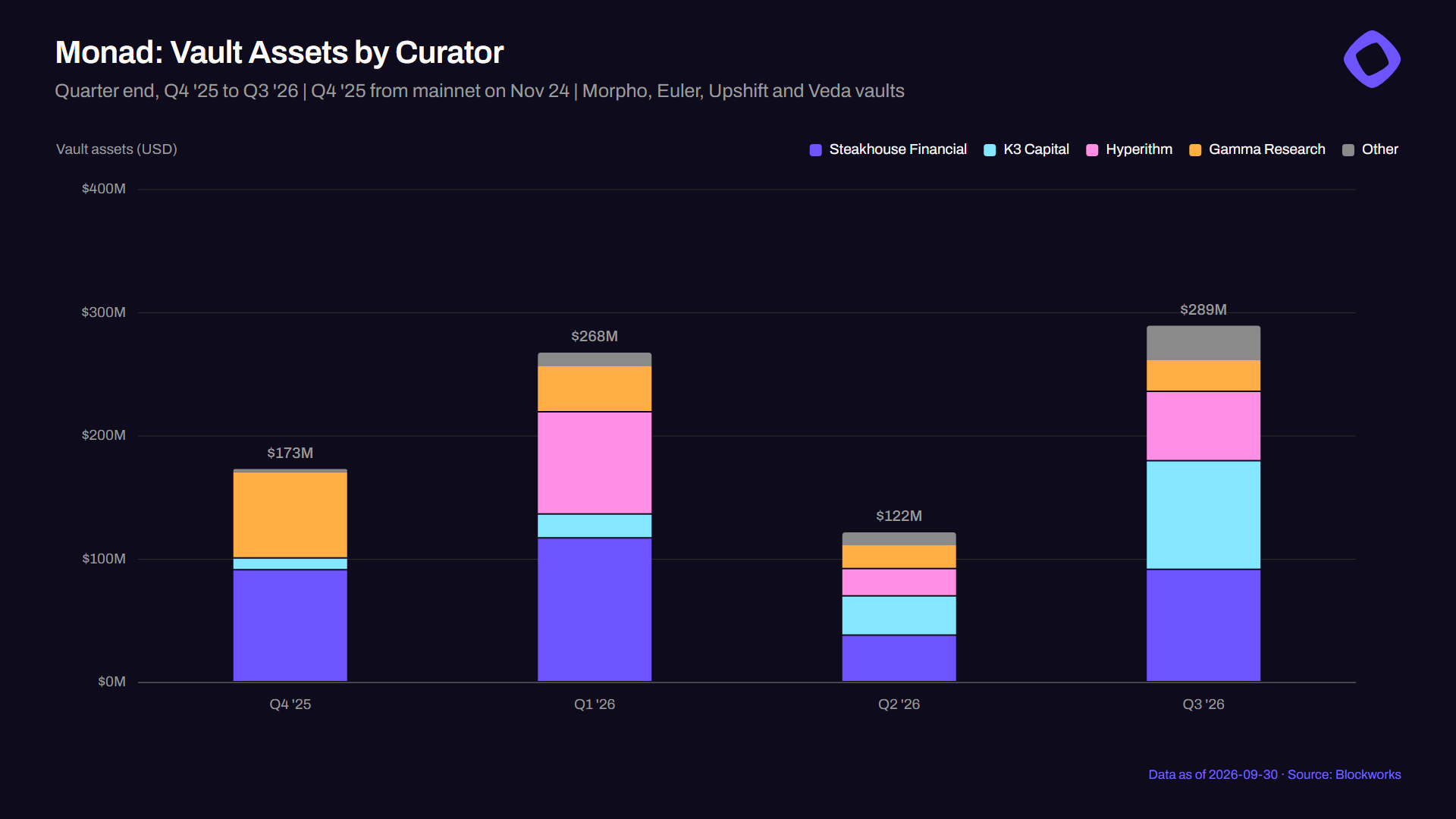
Curated vaults on Morpho, Euler, Upshift and Veda grew from $122 million to $290 million at the end of Q3. Steakhouse Financial managed $91 million, K3 Capital $88 million and Hyperithm $56 million. Stablecoin vaults made up $167 million of the total. The growth of curated vaults added another layer of managed lending strategies to the ecosystem.
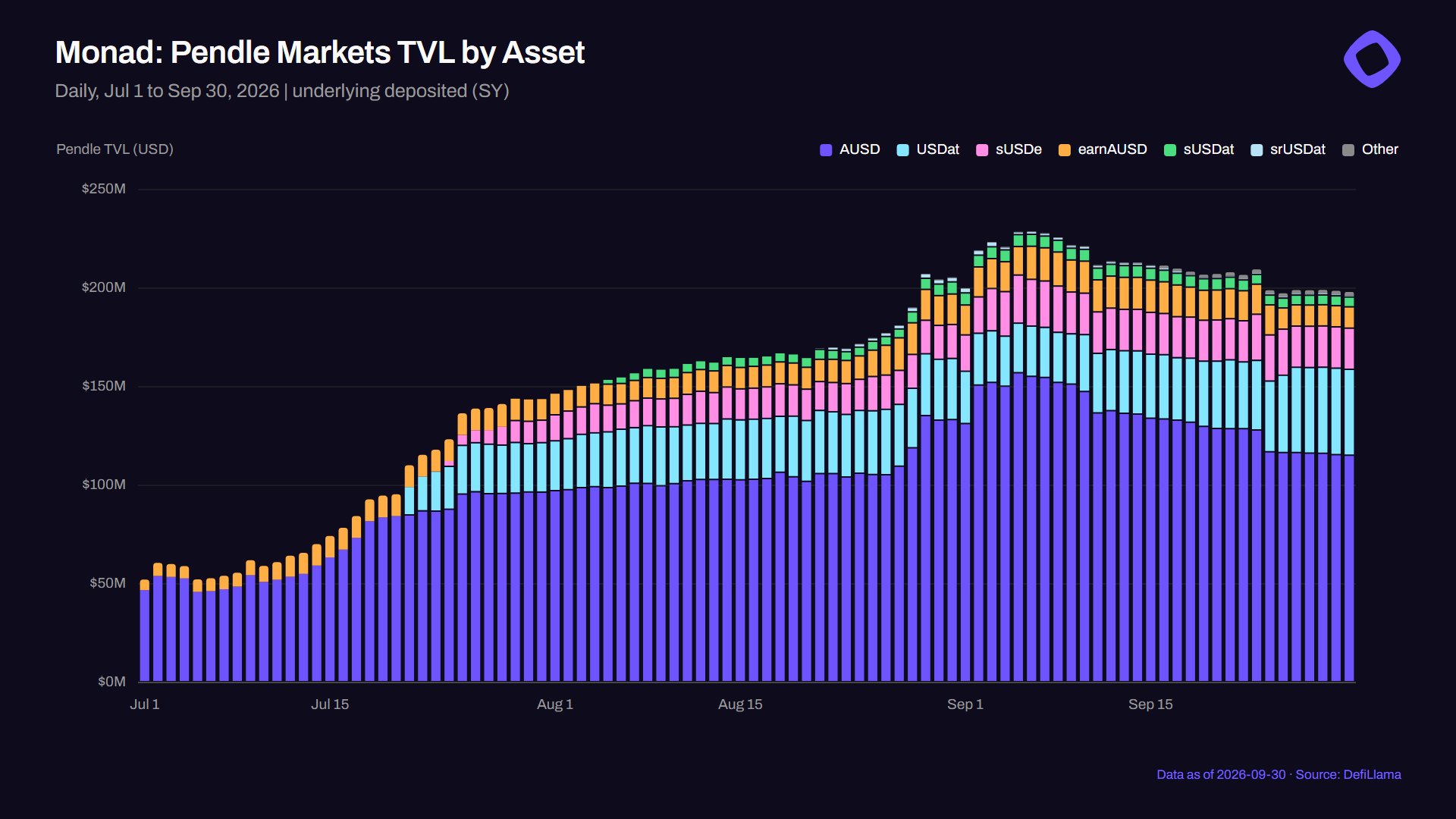
Yield markets also expanded. Pendle's underlying deposits grew from $52 million to $198 million, with AUSD markets accounting for 58% at the end of Q3 and USDat at 22%. Pendle principal tokens, which are claims on those same deposits, were also posted as $143 million of collateral in Monad lending markets, so the assets earn fixed yield while securing loans.
Spot trading more than doubled to $8.35 billion. ETH, BTC and other bridged-token pairs made up 40% of activity, followed by MON-stablecoins pairs at 32%. Stablecoin swaps accounted for 11% and tokenized assets for 10%, with the remaining 7% on venues without pair-level data. Tokenized-asset trading was almost entirely Tether Gold (XAUt0) on Kuru, and XAUt0 traded $857 million over the quarter against about $16 million of supply on Monad.
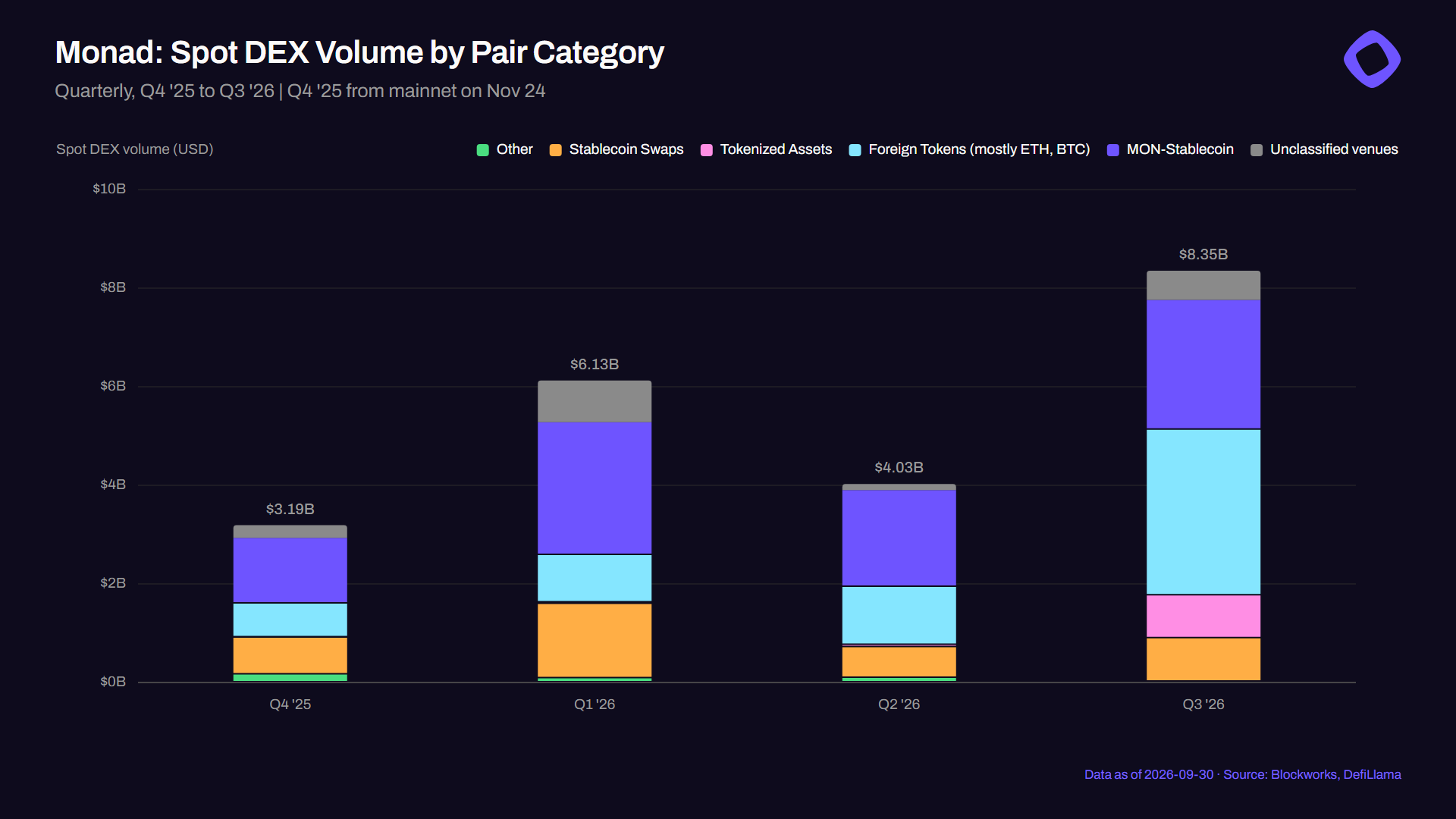
By venue, Kuru's order book carried 64% of the total quarterly spot volume. Its monthly volume rose from $363 million in July to more than $2.3 billion in both August and September. Kuru's revenue for the quarter was $4,400. Uniswap traded $1.73 billion and Metric, a proprietary AMM, $356 million. All venues other than Kuru together traded $3.05 billion, against $2.93 billion in Q2.
Perpl's perpetuals volume climbed from $210 million in the second quarter to $5.14 billion, while LeverUp's eased to $1.23 billion from $1.31 billion. Perpl's revenue peaked at $478,000 in August and fell to $194,000 in September with monthly volume still near $2 billion. It ended the quarter with $3.0 million of open interest.
Tokenized Assets
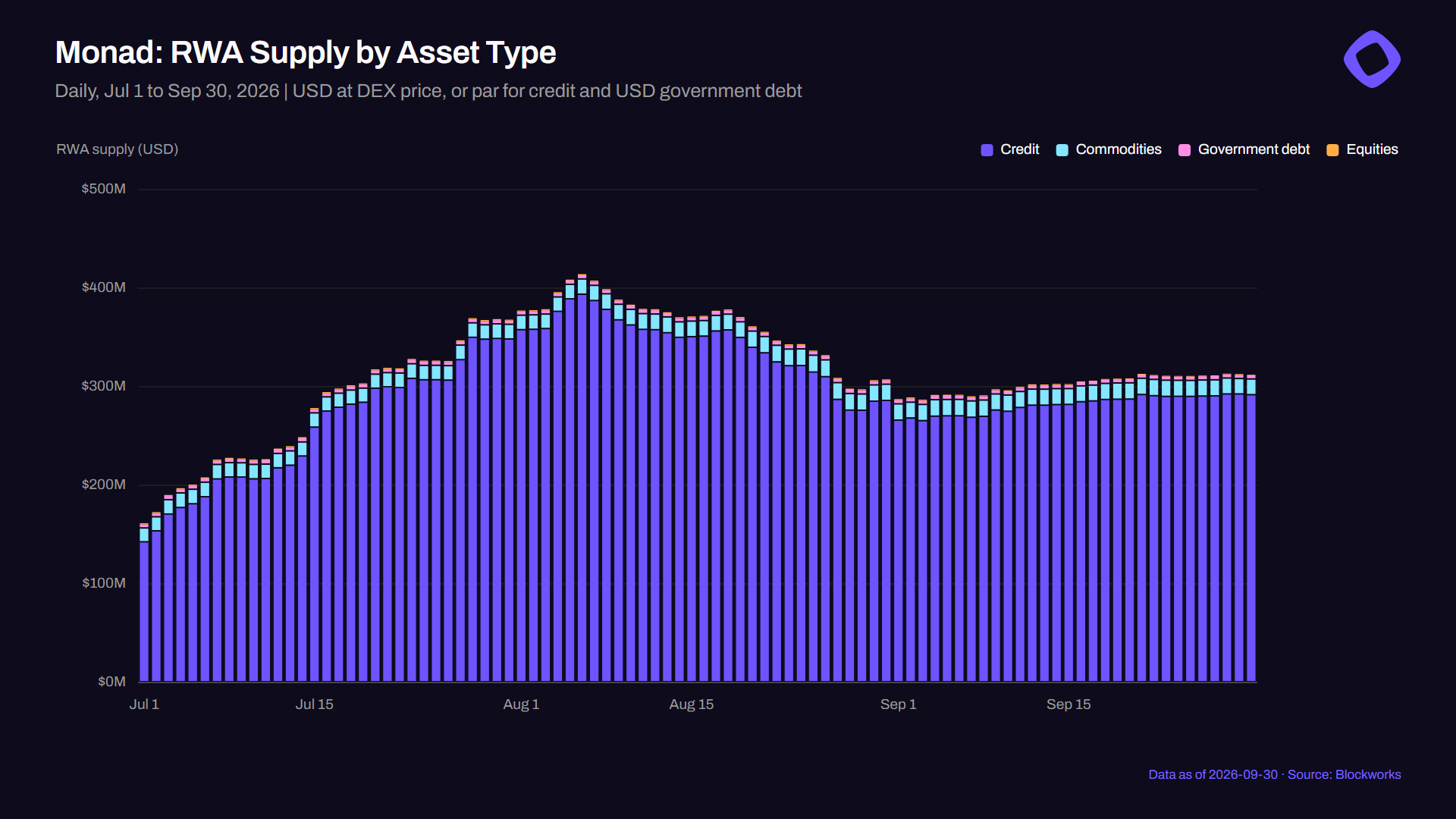
Tokenized real-world assets on Monad grew from $149 million to $312 million, with credit products accounting for $291 million of the total. Maple's syrupUSDC, backed by institutional borrowing, represented $143 million, followed by Accountable's vUSD at $106 million. Tether Gold accounted for approximately $16 million, while tokenized equities remained below $1 million.
New products and institutional use cases also emerged. Saturn introduced structured products backed by STRC and U.S. Treasuries, while K3 Capital opened an onchain credit facility lending AUSD to Galaxy through Accountable's YieldApp. These developments broadened the range of financial assets and credit arrangements available on the network, although tokenized credit remained the dominant category.
Staking and Validators
Staked MON increased slightly from 15.31 billion to 15.56 billion, lifting the stake rate to 15.3% of supply. At the end of the quarter, 97% of staked MON was natively staked.
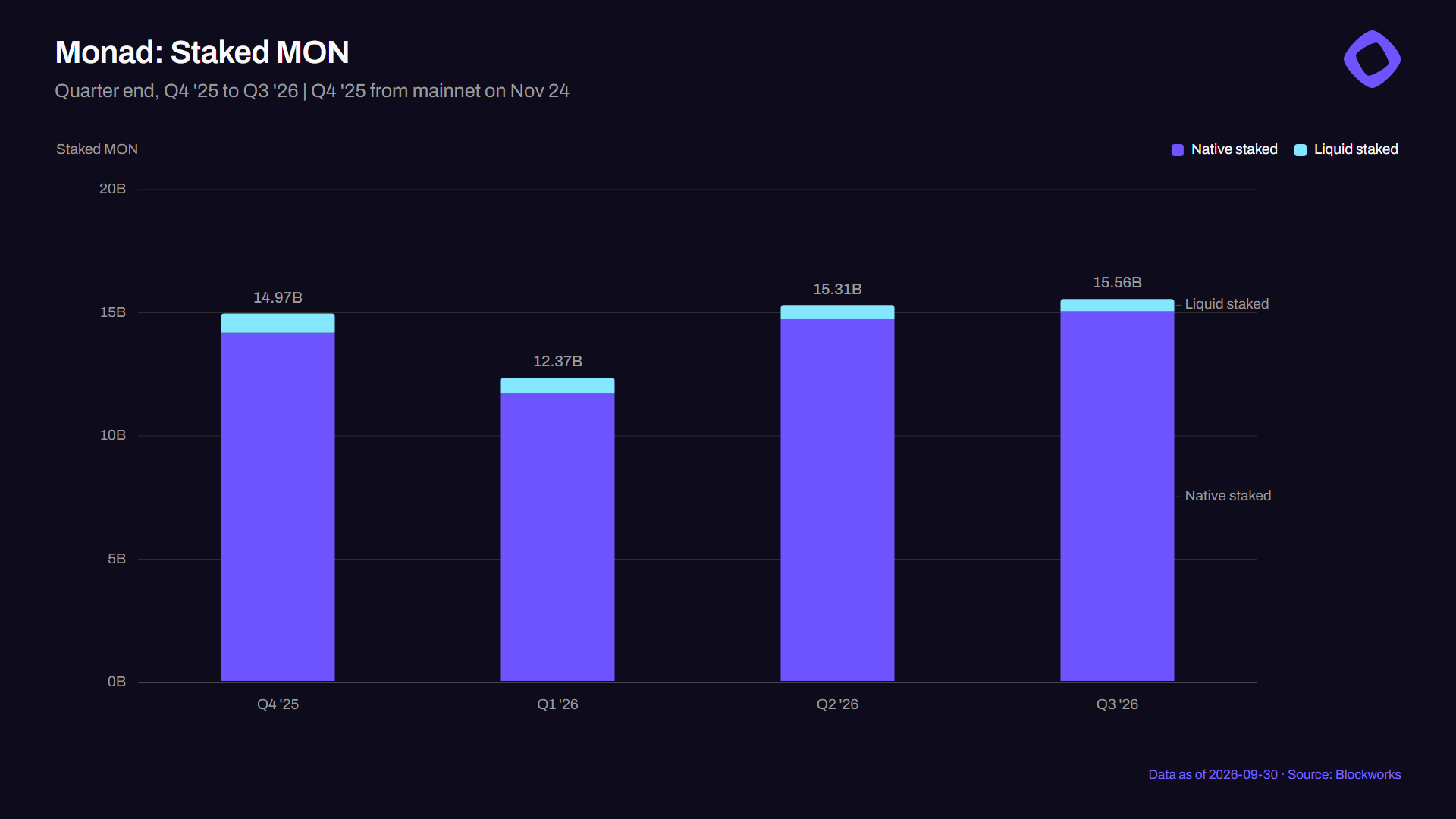
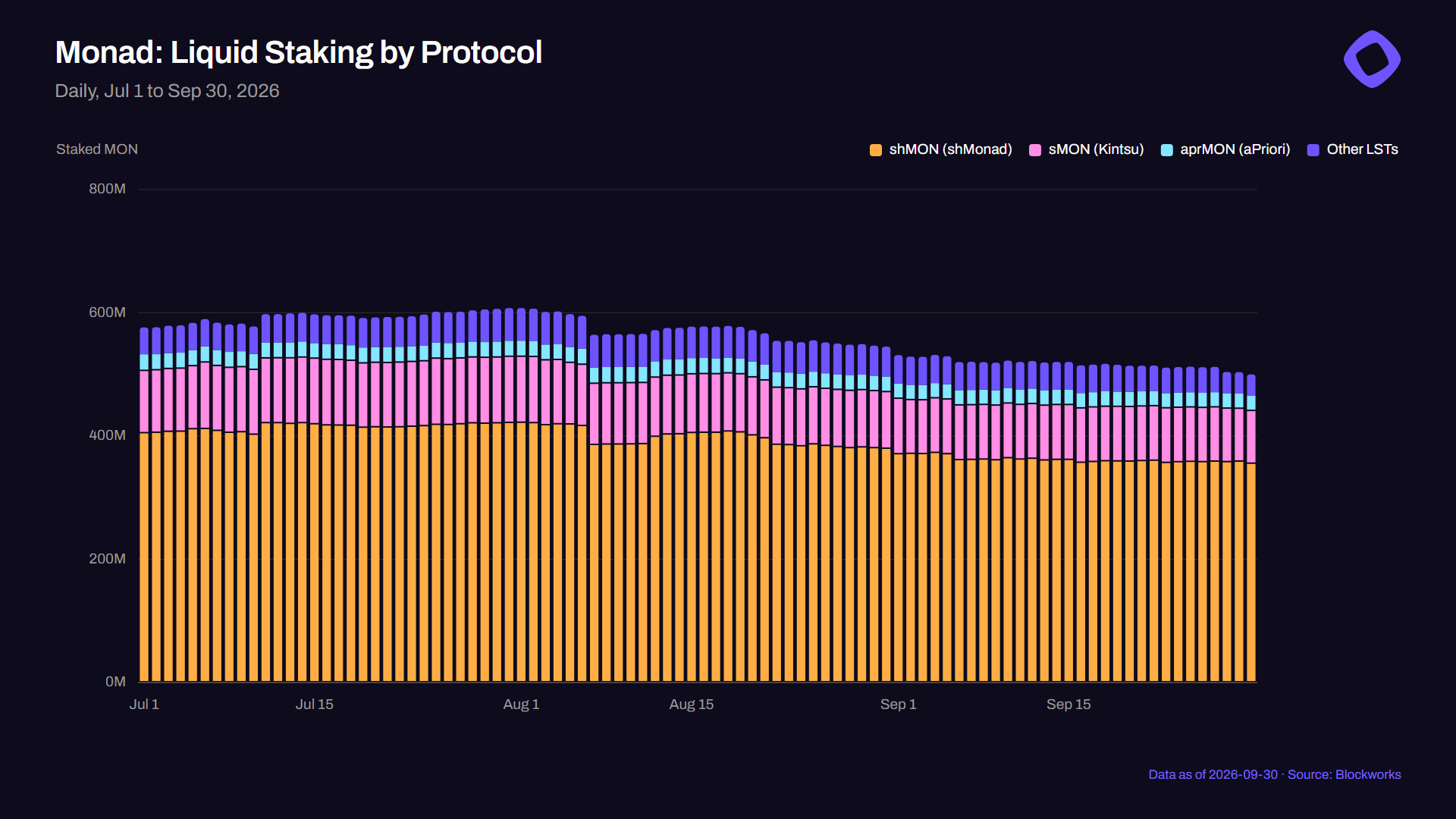
Liquid staking declined from 575 million to 500 million MON. ShMonad's shMON remained the largest liquid staking token, with 355 million MON, down from 402 million, while Kintsu's sMON declined from 102 million to 86 million MON.
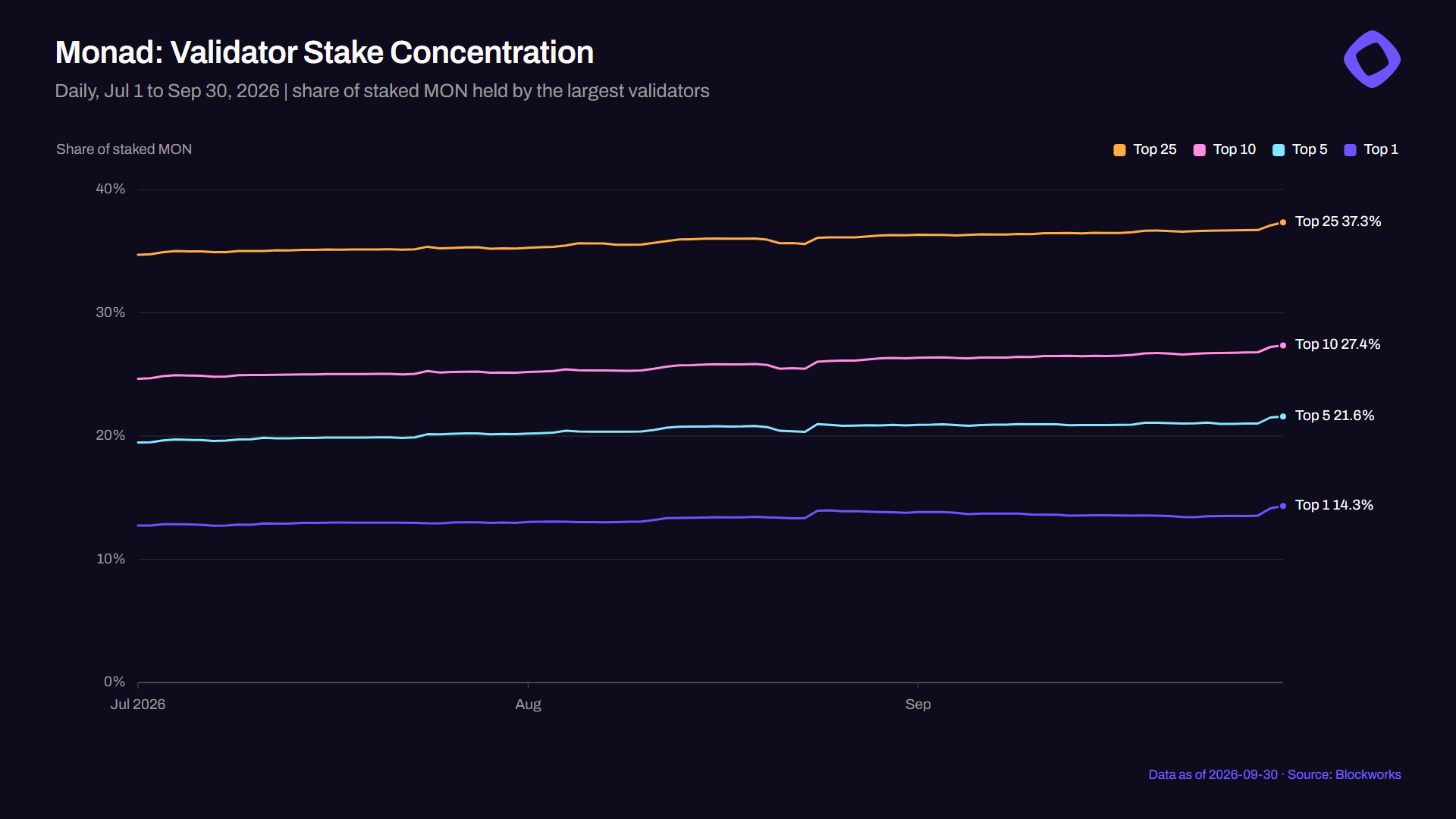
The validator network remained geographically distributed, with 196 active validators operating across 30+ countries. The largest validator’s share of staked MON rose from 12.8% to 14.3%, and the top 10 validators’ share of total stake went from 24.6% to 27.4%.
The Monad Foundation's Validator Delegation Program (VDP) continued supporting participating validators, with a minimum 98% uptime requirement for continued VDP delegation reviewed weekly.
Product & Ecosystem Updates
Research and Roadmap
Category Labs' research during the third quarter focused on improving transaction ordering, execution fairness and long-term security. These efforts support Monad's of providing open, neutral infrastructure for financial markets, where participants can transact without relying on privileged access or control over transaction ordering.
In an August essay, Open by Construction, Monad co-founder Keone Hon described MEV and front-running as "a tax on everyday users" and outlined a vision for financial markets that are "open to everyone, fair by construction." Two major research initiatives advanced during the quarter: Cadence and BTX.
Cadence, introduced on July 7th, is a consensus design that allows multiple validators to propose blocks concurrently, reducing the influence of any single proposer over transaction ordering. It is designed to support 100-millisecond blocks and approximately 200-millisecond finality. In simulations involving 200 validators and five concurrent proposers, average finality reached approximately 219 milliseconds.
BTX, Category Labs' encrypted mempool design, aims to prevent transaction information from being exposed before commitment, reducing opportunities for front-running and sandwich attacks. Its research paper received a Distinguished Paper Award at the IEEE Symposium on Security and Privacy in May. In August, Category Labs demonstrated end-to-end encryption across two nodes, with expansion to four to six nodes identified as the next development milestone.
Security research also progressed. In August, Category Labs published a draft MIP for flexible, upgradeable account authentication, allowing accounts to change cryptographic keys without changing addresses. A post-quantum roadmap followed on September 28th, prioritizing quantum-resistant wallet authentication and subsequently consensus security.
Following the quarter, Category Labs introduced two further initiatives. Monad Private Settlement, announced on October 6th, proposes private execution domains designed to protect sensitive transaction information while maintaining connectivity to shared liquidity on Monad. Quantum Cadence extends the consensus research toward post-quantum security. Together, these efforts address confidentiality, fair execution and cryptographic resilience.
Cadence, BTX and Quantum Cadence remain research initiatives, while flexible authentication is a proposal and Private Settlement remains in development. None of these capabilities was live on mainnet at quarter-end.
Awards & Recognition
Monad-related research received recognition across several leading computer science and cryptography conferences. MonadBFT, the consensus protocol underlying Monad, was accepted at DISC '26 in Rome. Category Labs' paper EVM Workloads in the Wild was accepted at AFT '26 in London, and its researchers co-authored six of the 34 papers at SBC 2026, with work also appearing at ACM PODC, ACM CCS and ACM SIGMETRICS.
Raj Parekh, head of stablecoins and payments at the Monad Foundation, was named to Stablecon's Stablecoins Most Influential 2026 list. Monad was also added to the Visa Onchain Analytics Dashboard.
Community Deployments
The expansion of financial applications continued during the quarter, with new stablecoins, tokenized assets and trading deployments broadening the range of financial activity available on Monad.
Maple's syrupUSDC markets went live on Aave on July 3rd, and Ethena launched USDe and sUSDe on July 16th. SoFiUSD, SoFi's stablecoin, became accessible through BitGo on August 25th. Midas and Wellington Management have announced plans to bring mWIN, a tokenized institutional credit strategy, to Monad.
Payments and access reached new users. Lemon, which operates mainly in Argentina and Peru, Wenia, the digital asset platform created by Grupo Cibest, and Vurelo, a Colombian fintech wallet, joined the network in September. Abound, a financial super-app for the Indian diaspora, is building its global finance platform on Monad. The Pods API has given neobanks a single integration for onchain financial products since July 24th. Monad support went live in the Base App, and MetaMask's Agent Wallet added Monad for AI agents. MON staking opened on Kraken and in the Ledger Wallet app. New trading venues followed in September, among them 1inch, o1's exchange stack and Crystal's fully onchain order book and launchpad.
The Monad Foundation's builder programs ran all quarter. Nitro, its accelerator, closed its first cohort with a Demo Day on July 28th, where seven teams pitched to more than 100 investors. Applications for a second cohort were announced the same day. Monad Blitz one-day hackathons ran 18 times in 11 countries, from Toronto and London to Abuja, Jakarta and five Indian cities. Metropolis, a six-week global hackathon with four tracks and more than $250,000 in prizes, opened on September 1st. On August 4th the Monad Foundation announced Open, Monad's first flagship conference, for October 6th in Singapore.
Product Updates
Two hard forks reached mainnet. MIP-12 took effect on July 23rd with client v0.15.1 and MIP-8 on September 2nd with v0.16.1, and client v0.16.2 moved block proposals to the RaptorCast v1 wire format on September 10th. MIP-9, which would have raised the active validator set from 200 to 300, was postponed on July 10th pending evaluation under Cadence. It was withdrawn on August 25th. Other proposals focused on protocol functionality and compatibility. New proposals included MIP-15, which would activate six EIPs from Ethereum's Glamsterdam upgrade, MIP-16 and MIP-18, which would add chain-history query methods and call-stack introspection opcodes, and MRC-17, a common router interface for proprietary AMMs.
For developers and AI agents, the Foundation launched Agent Hub, a resource for AI agents, on July 9th and open-sourced Ultrafuzz, an AI-powered smart contract fuzzing orchestrator, on September 10th. Category Labs open-sourced mera, which creates a crypto account from a single passkey prompt, on July 30th. It also released an upgraded monad-viz network debugger for MonadBFT. Its researchers published Giving Ordering Rights to Applications and Batched and Weighted Threshold Encryption with Silent Setup.
Incentives & Emissions
MIP-12 cut the block reward from 25 to 18 MON on July 23rd, lowering issuance per second by 4%. MOST, the Monad Open Source Track, launched on July 27th, backed by the Monad Foundation, to offer AI credits to builders who keep shipping open source projects on Monad.
Closing Summary
The Monad ecosystem economy ended the third quarter with $1.49 billion of lending deposits, $674 million of stablecoins and $312 million of tokenized assets. In dollar terms, fees nearly doubled while issuance per second fell, and negative Token Holder Income narrowed by about 70% from Q2 to Q3.
The first scheduled unlock of investor, team and Category Labs treasury tokens falls on November 24th, 2026, at the end of the one-year minimum lock-up. On the roadmap, Cadence and BTX are in development, as is Quantum Cadence, Category Labs’ post-quantum consensus design alongside the flexible-authentication proposal. After wallets and consensus, the post-quantum roadmap turns to staking, execution-layer cryptography, proof infrastructure and pre-confirmation privacy. An Aave governance proposal published in September would deploy Aave V4 on Monad with three risk-tiered markets and USDC and USDT0 as borrowable assets.
After the quarter closed, StraitsX announced on October 1st that it plans to bring its XSGD and XUSD stablecoins natively to Monad in early 2027. MON trading went live on Robinhood on October 5th. Category Labs introduced Monad Private Settlement on October 6th and published its technical white paper in early November, describing private execution domains connected to the public network's ordering and liquidity. Category Labs also published Quantum Cadence research in late October, outlining a post-quantum consensus design. On October 23rd the Foundation raised its Validator Delegation Program delegation tiers. On November 10th, Visa’s expansion of its stablecoin program with its integration with Monad was announced.
Disclaimer: This report was prepared by Blockworks and presents historical network and ecosystem data for the period indicated. References to third-party applications and financial products are for informational purposes and do not constitute an endorsement or investment recommendation by the Monad Foundation.
This report was commissioned by the Monad Foundation. By providing this disclosure, we aim to ensure that the research reported in this document is conducted with objectivity and transparency. All content was produced independently by the author(s) and does not necessarily reflect the opinions of Blockworks. or the organization that requested the report. The commissioning organization may have input on the content of the report, but Blockworks maintains editorial control over the final report to retain data accuracy and objectivity. Author(s) submit financial conflict of interest (FCOI) disclosures on a monthly basis that are reviewed by appropriate internal parties and may hold cryptocurrencies named in this report. This report is meant for informational purposes only. It is not meant to serve as investment advice. You should conduct your own research and consult an independent financial, tax, or legal advisor before making any investment decisions. Past performance of any asset is not indicative of future results. Please see our Terms of Service for more information.