Metaplex: A Comprehensive Token Creation Suite on Solana

Introduction
Metaplex, the leading NFT standard protocol on the Solana blockchain, empowers artists, brands, and creators to easily mint and launch tokens through user-friendly APIs and low-code tools. Initially developed within Solana Labs, Metaplex became an independent entity in late 2021, with notable contributors like Stephen Hess, former Head of Product at Solana Labs.
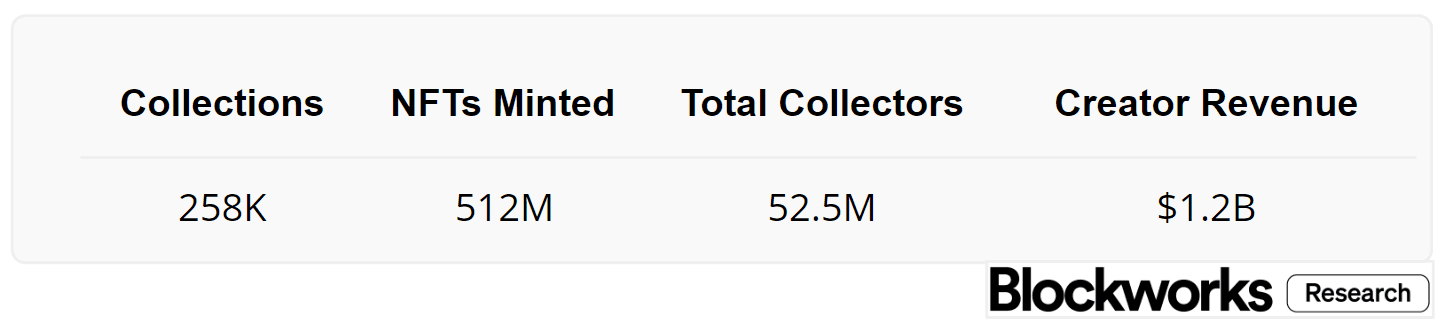
Metaplex is a core component of the Solana blockchain infrastructure. It offers a suite of tools for creating fungible, non-fungible, and hybrid tokens. Their offerings like Bubblegum and Token Metadata have witnessed significant adoption, primarily driven by the low-cost token creation environment on Solana. As the dominant NFT protocol on the Solana blockchain, Metaplex facilitates nearly all NFT mints. In fact, between August 2021 and May 2024, Metaplex accounted for over 99% of mints in the Solana NFT market. Given the 29 million compressed NFTs minted in June 2024, vs the ~305k NFTs minted in the same period, Metaplex’s market share is likely in the same region. By contrast, mints on Ethereum averaged between 1K and 4K per day over the last trailing year. As per CryptoSlam, over the last 30 days, NFT sales volume on Solana was 63% that of Ethereum ($87M vs $138M) while the number of NFT transactions was around three times that of Ethereum (1.39M vs 454K).
This is largely thanks to compressed NFTs that leverage cryptographic techniques to efficiently store and verify large amounts of data on the blockchain. To verify a single NFT, one only needs a small number of hashes leading back to the root rather than the entire collection. This is especially useful for collections with hundreds or thousands of NFTs, making operations like transfers and verifications less resource-intensive. Reducing the cost of minting has changed the dynamics of NFTs on Ethereum vs Solana. The technology is poised to evolve from a niche tool for creating scarce digital collectibles into a core infrastructure primitive that powers a wide array of digital experiences, shifting away from its historical association with artificial scarcity to enabling a proliferation of NFT-powered applications as the barriers to entry are dramatically lowered.
The low cost of minting on Solana has enabled numerous applications to explore creative use cases for compressed NFTs. For instance, DripHaus, a platform connecting creators to fans, has airdropped over 20 million compressed NFTs representing art, music, games, and comics to its users for just $2,000, a fraction of the $300 million it would have cost on Ethereum. Helium, a decentralized network of ~400K IoT and mobile hotspots, migrated from its own blockchain to Solana, issuing over 1 million compressed NFTs to represent the hotspots. Additionally, Tiplink, a crypto payments app allows sending "TipLinks" - links that can be used to claim an NFT - at scale via email, social media, and other channels. This leverages Metaplex's ability to mint NFTs programmatically. TipLink also provides an API and integration options to allow other web applications to distribute NFTs using its compressed NFT technology, which is built on top of Metaplex. TipLink is taking advantage of the powerful tooling and standards provided by the Metaplex ecosystem to enable frictionless, large-scale distribution of NFTs without requiring recipients to have a Solana wallet set up. These examples demonstrate how the low minting costs on Solana are opening up new possibilities for NFT use cases beyond digital art and collectibles.
Product Offering

Marc covers Ethereum, Bitcoin and their L2s. Previously led Ethereum and DeFi research at CoinShares.