This report was commissioned by Alluvial Finance. By providing this disclosure, we aim to ensure that the research reported in this document is conducted with objectivity and transparency. All content was produced independently by the author(s) and does not necessarily reflect the opinions of Blockworks. or the organization that requested the report. The commissioning organization may have input on the content of the report, but Blockworks maintains editorial control over the final report to retain data accuracy and objectivity. Author(s) submit financial conflict of interest (FCOI) disclosures on a monthly basis that are reviewed by appropriate internal parties and may hold cryptocurrencies named in this report. This report is meant for informational purposes only. It is not meant to serve as investment advice. You should conduct your own research and consult an independent financial, tax, or legal advisor before making any investment decisions. Past performance of any asset is not indicative of future results. Please see our Terms of Service for more information.
Liquid Collective's LsETH

Key Takeaways
- Liquid Collective’s Liquid Staked ETH (LsETH) offers enterprise-grade security and compliance for an Ethereum liquid staking token (LST).
- LsETH’s properties meet the unique compliance requirements expected by institutions, enterprises, funds, and individuals looking for exposure to ETH LSTs and LSTfi.
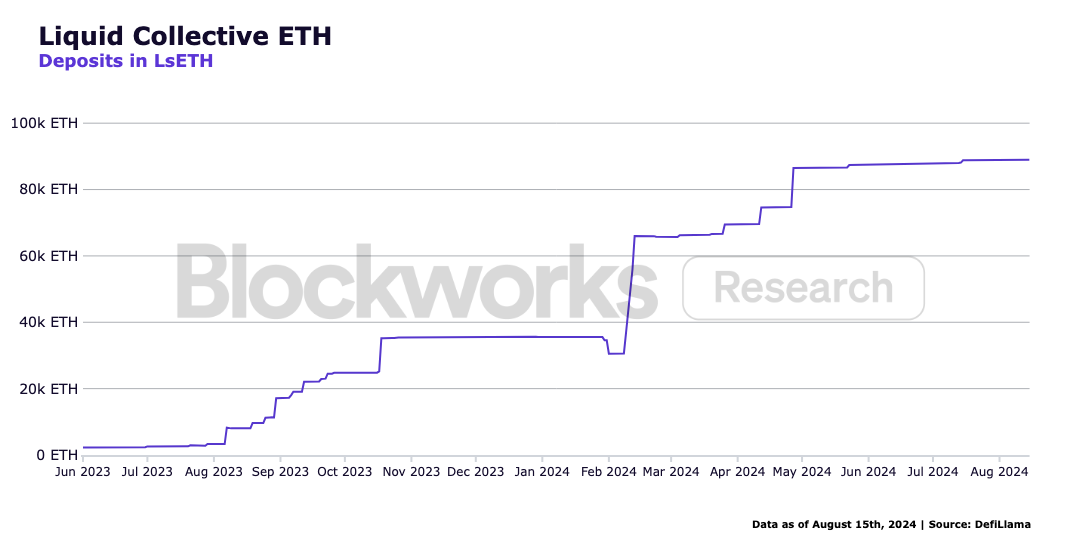
- The protocol’s 155% year-to-date growth in ETH deposits is evidence of its success in meeting clients’ unique needs.
Liquid Collective’s LsETH
Liquid Collective’s LsETH is an ETH LST designed specifically to optimize for compliance and security properties. Minting and redeeming of LsETH is offered by leading platforms that manage an allowlist for clients that meet and pass know-your-customer (KYC) and anti-money laundering (AML) checks. The platforms that perform these checks and manage the allowlist include Coinbase, Figment, Bitcoin Suisse, Twinstake, Hashnote, and Alloy. Once a client has passed these checks, they are added to the allowlist, which permits them to mint and redeem from the protocol. This model is similar to the one used by Circle, where mints and redemptions of USDC are restricted to counterparties that pass the KYC/AML checks. This process ensures that all of the core ETH deposits backing LsETH have passed compliance checks, and that only known counterparties are interacting with the underlying protocol’s contracts. Once LsETH has been minted by a known, allowlisted counterparty, that token is freely transferable onchain. This framework satisfies clients’ needs for compliance while still allowing for staking across a decentralized, distributed validator set, as opposed to a single operator. Liquid Collective’s model offers an LST to meet the unique requirements of institutions, funds, or individuals demanding known counterparties and security on a staked ETH position.
Node Operators
The Liquid Collective protocol’s node operators are geographically-distributed and run diversified Ethereum client implementations. There are currently 2,781 active validators on the protocol, run by Figment, Coinbase, Staked, and Blockdaemon. Node operators adhere to Liquid Collective’s service-level agreement (SLA), outlining baseline performance requirements. Under these SLAs, node operators on the Liquid Collective protocol are required to maintain performance consistent with the top 50th percentile of large-scale staking providers. Operator performance is measured and benchmarked against Rated’s Validator Effectiveness Rating (RAVER). Failure to maintain this level of performance will require the node operators to reimburse the protocol for missed ETH network rewards.
This week, Liquid Collective also supported the launch of the Node Operator Risk Standard (NORS) Certification, an industry-led certification that validator infrastructure operations meet enterprise-grade requirements. Confirming the implementation of best practices such as anti-slashing measures, disaster recovery, private key management, and more, the certification is the first specific to staking to include custom attestation reporting from big-4 auditors including KPMG, meeting the same AICPA auditing standards as SOC1, ISO27001, and other known institutional diligence standards. Liquid Collective expects to use NORS Certification alongside the protocol’s Performance SLAs as an objective input into qualifying active set participation.
Security
Liquid Collective also implements a comprehensive slashing coverage program for added security on funds. Nexus Mutual provides a bespoke coverage plan to protect against the loss of funds from slashing, offering up to $5M in coverage in excess of the policy’s deductible. This insurance policy dynamically adjusts its coverage amount in accordance with the quantity of protocol deposits. The protocol’s Slashing Coverage Treasury collects 0.30% of protocol rewards to pay deductibles on the Nexus Mutual coverage plan, and excesses are retained to protect against non-covered events. Additionally, node operators are also required to match 0.30% of the protocol’s deposits to fund coverage in the event of a fault or misconfiguration in their own infrastructure. Between the Nexus Mutual plan, the Slashing Coverage Treasury, and the Node Operator commitments, LsETH offers holders with added protection to minimize the loss of funds in the event of slashing.
LsETH deposits have grown tremendously over the past year, from around 3k ETH in August 2023, to over 90k ETH today. LsETH is a supported asset type on a number of restaking platforms and DeFi applications, including Uniswap, EigenLayer, Symbiotic, Inception, EigenPie, and Zircuit. About 14% of the total LsETH supply has been deposited on Zircuit’s restaking pool. LsETH is an ERC-20 token that operates under a cToken standard, where LsETH’s conversion rate to the underlying assets increases as rewards accrue. This token design allows for greater interoperability across DEX and DeFi protocols. Additionally, auto-staking rewards improves compounding and capital efficiency by eliminating the need to manually claim and stake accrued rewards. While LsETH is not currently accepted as collateral on onchain money markets, this development may come after critical volume and liquidity is achieved, and should bolster further growth and utility for the token.
Liquid Collective charges a protocol service fee of 10% of network rewards, with proceeds used to fund node operators, platforms, service providers, and the Slashing Coverage Treasury. This 10% takerate on rewards is consistent with the fee charged on Lido’s stETH, and a discount to Rocketpool’s 14% commission on rETH and Coinbase’s 25% commission on cbETH. Liquid Collective does not charge a fee on minting and redeeming LsETH. Currently, the Liquid Collective protocol’s core contracts are controlled by an administrative multi-sig, with signers including ecosystem participants. The protocol expects to progressively decentralize, distribute, and automate this authority over time through the introduction of a governance program.
Final Thoughts
Liquid Collective’s LsETH offers a unique value proposition for ETH stakers requiring the highest standards in security and compliance. With these requirements, LsETH is the preeminent solution. The 155% year-to-date growth in ETH deposits is testament to the protocol carving out its niche in the LST market, satisfying demand for a compliant, secure, and decentralized solution.

Luke leads coverage on money markets, stablecoins, real world assets, interoperability, and intents-based infrastructure. Previously worked in market research and product at a startup incubator.