LayerZero: The Cross-chain Security Marketplace

LayerZero is a cross-chain network that allows anyone to permissionlessly deliver data or messages across supported blockchains. Today, the network supports 31 blockchains, including the likes of Ethereum, Polygon, Arbitrum, zkSync, Base, and Mantle. On July 25, 2023, the network reached a milestone of 50MLayerZero messages transmitted.
Architecture
A cross-chain transaction between chain A and B consists of a transaction t_A on chain A, a communication protocol (LayerZero) between chain A and B, and a message m. Delivery of message m on the recipient chain B will generally, but not necessarily, result in an associated action/transaction on the recipient chain. For example, I sent my tokens to this contract on chain A, once my message m is delivered, I should be minted the same number of tokens on chain B. A valid delivery of a cross-chain transaction states that message *m *is delivered if and only if t_A is committed and valid on the source chain.
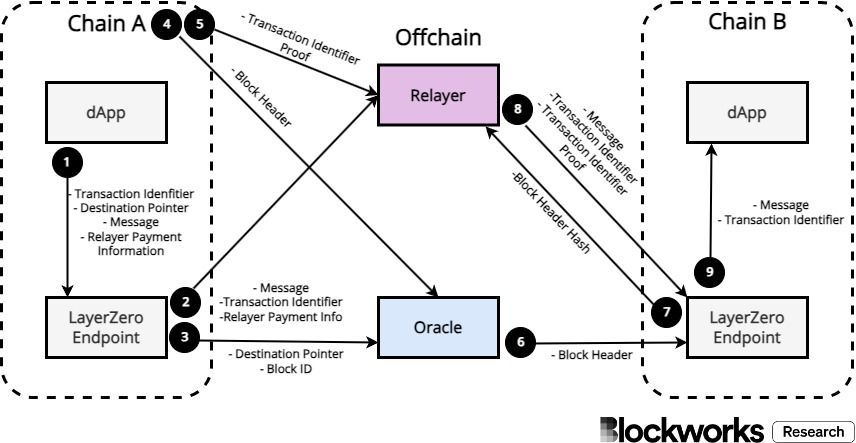
There are three key components to LayerZero’s architecture. A relayer, an oracle, and an endpoint. The oracle is a third-party service that provides a mechanism to read a block header from one chain and send it to another chain. In a similar manner, the relayer is an offchain service that fetches a transaction proof from the source chain and provides it to the recipient chain. A relayer and an oracle are separate entities independent of each other, and it is this independence that enables the trust minimized delivery of transactions cross-chain.
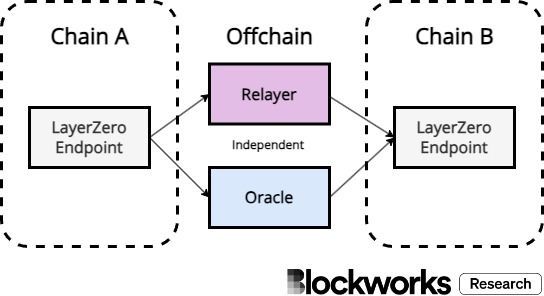
In order to facilitate a cross-chain transaction, the oracle produces a block-header containing t_A on chain A, while the relayer independently provides a proof associated with the transaction in that block on chain A. If the oracle and relayer agree between the block header and the transaction proof, then LayerZero delivers the message m to the client on chain B.

Ren leads coverage on Options, Structured Products, Money Markets, and AMMs. Previously worked at a crypto hedge fund managing DeFi strategies.