Infra Brief: The Need for Stronger Server Infrastructure

Key Narrative: The Need for Stronger Server Infrastructure
As the crypto space has evolved, the need for more advanced physical infrastructure has become imperative to accommodate the increasing performance requirements of blockchains and their applications. This has necessitated the adoption of more robust infrastructure providers, such as small to medium-sized data centers and hyperscalers, as opposed to relying on individual-run servers.
Validators
For instance, consider the infrastructure requirements for running a validator for a Layer-1. Compared to Ethereum, newer chains require significantly higher processing power, as indicated by the CPU Mark benchmark. Ethereum validators demand a CPU Mark of 6,667, whereas Aptos requires 14,405, Avalanche 26,659, and Solana 39,312.
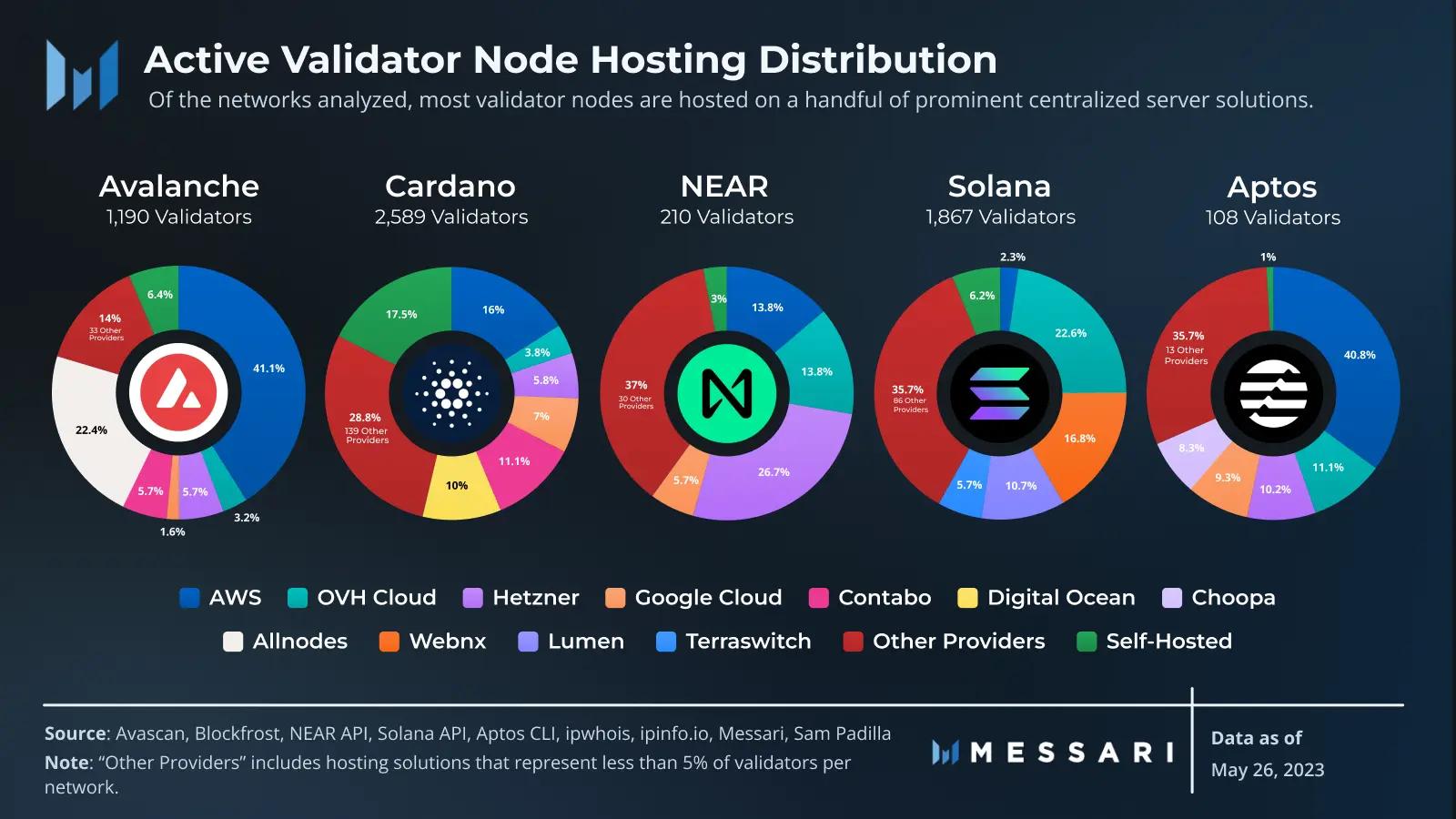
This increased demand for processing power, coupled with the need for low latency and high uptime, has driven the majority of validators towards being hosted in data centers.
Storage and Compute Networks

Sami Kassab is an Enterprise Research Analyst focusing primarily on Web3 Infrastructure and Bitcoin. Sami previously spent 5 years as an Aerospace Engineer designing aircraft engines and missile & defense systems.