
Executive Summary
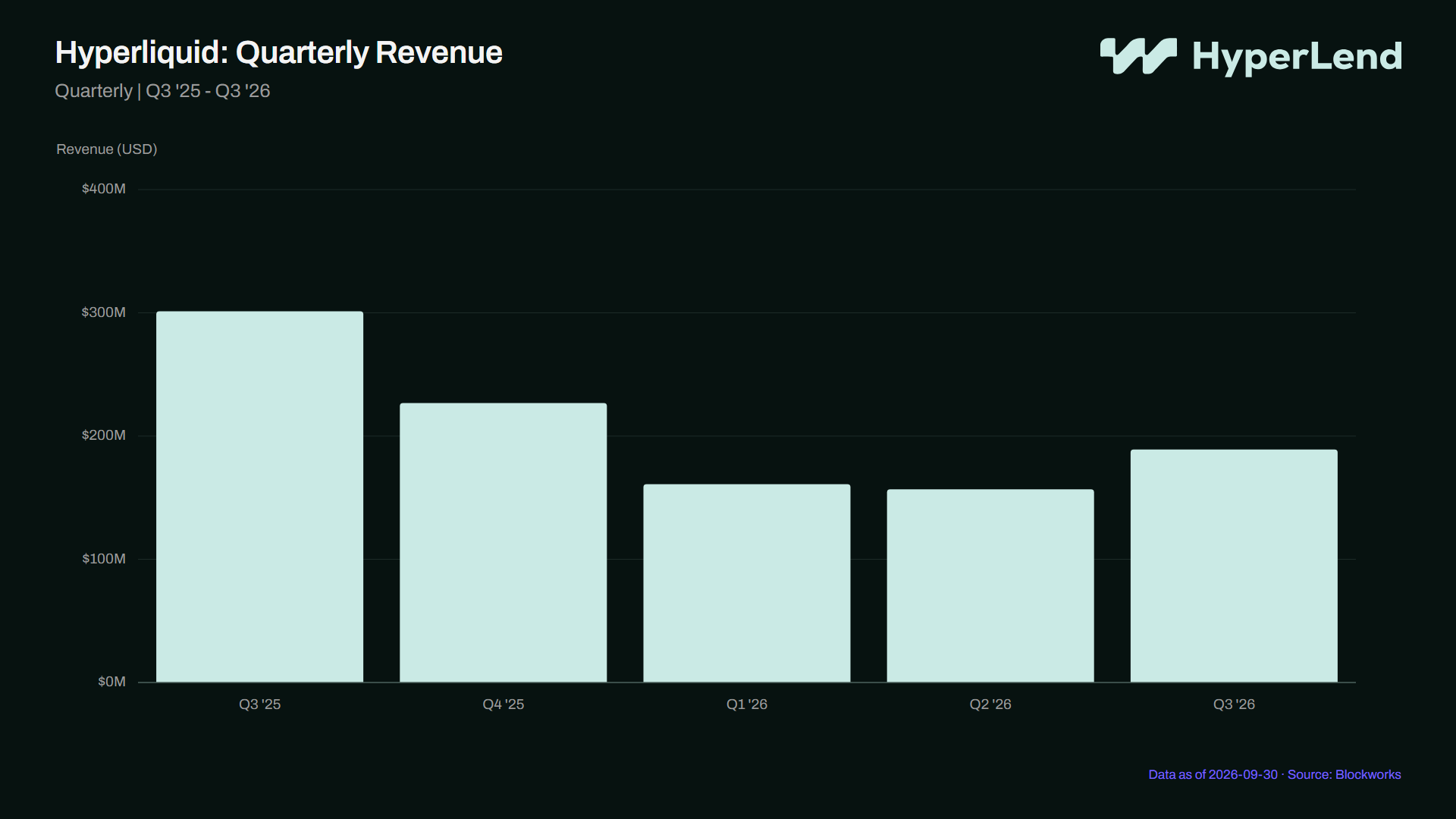
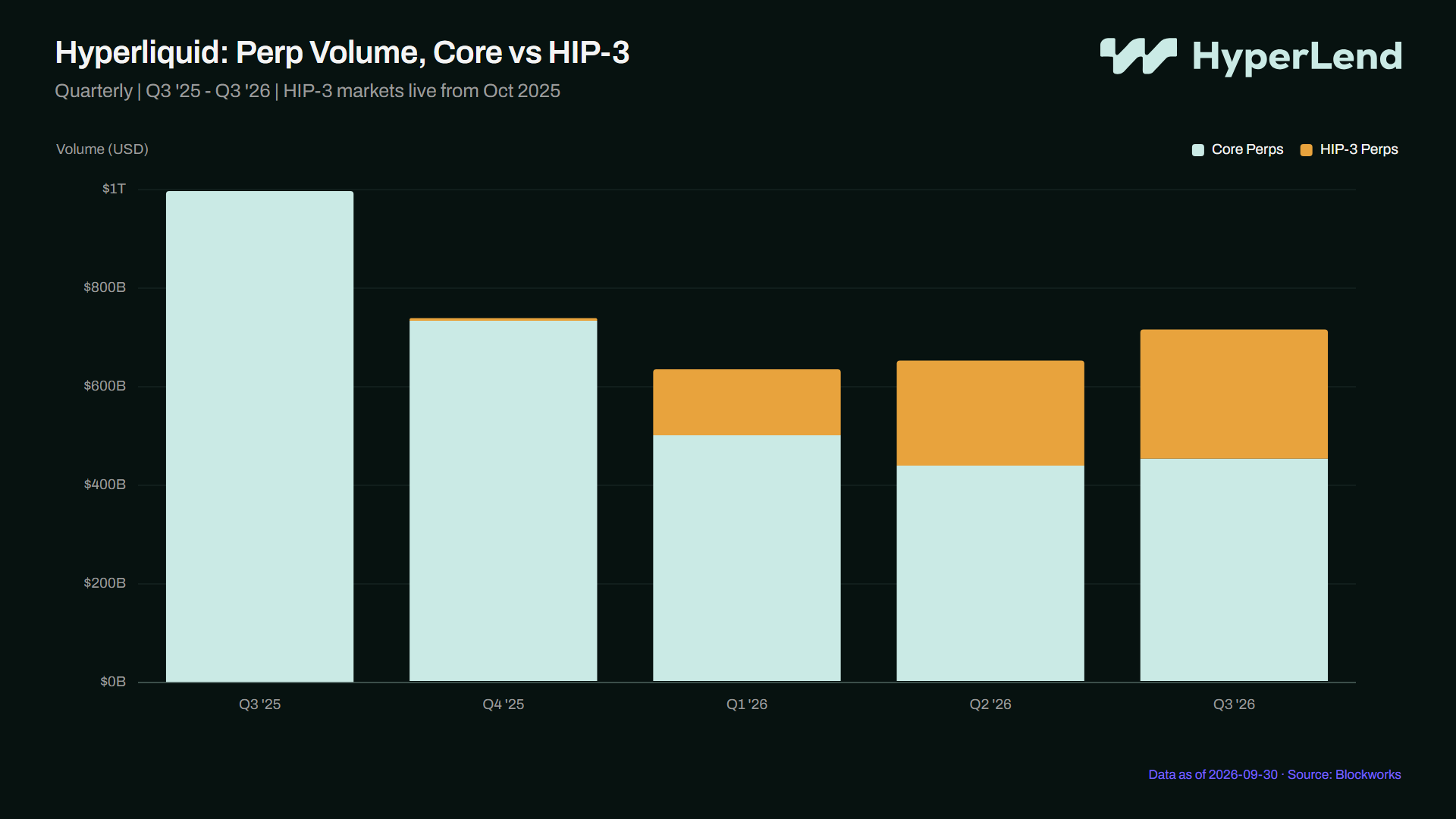
Hyperliquid's protocol revenue rose 21% in Q3 2026 to $189.1M, its first quarterly increase in four quarters. Open interest climbed 80% to $16.8B. HIP-3 builder markets carried 36.5% of perp volume in their highest quarter since launch, and HYPE gained 41%, reaching an all-time high on September 23. HyperLend, the credit layer of Hyperliquid, grew with that ecosystem for most of the quarter, with deposits reaching $909.4M and borrows $315.5M on August 27, the highest since October 2025. Borrows held there until September 19.
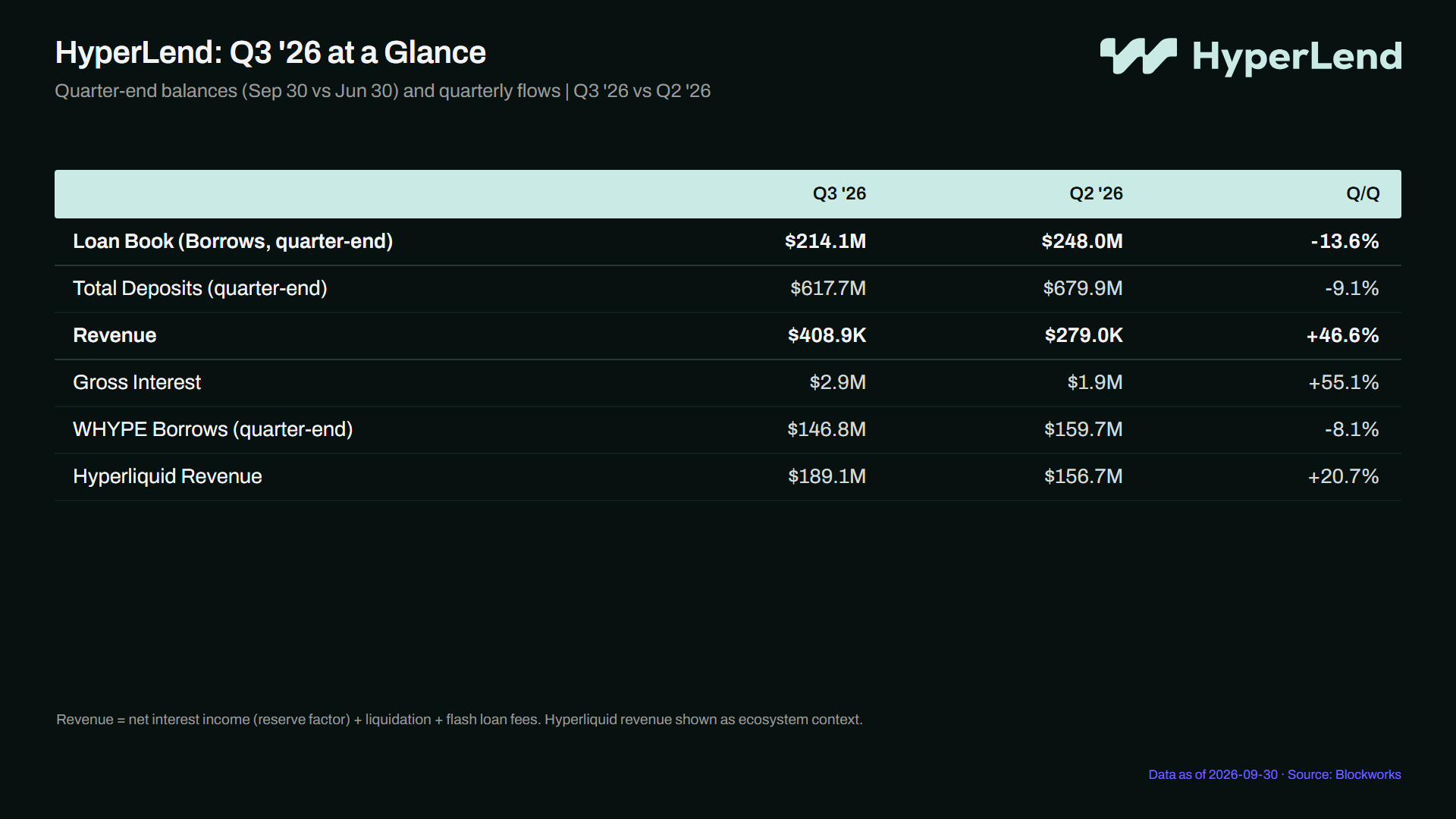
When HyperCore opened native borrowing to all accounts on September 18, its overlap with HyperLend sat in one product: stablecoin loans against HYPE or BTC, about 17% of HyperLend's debt just before the launch. That segment moved. USDC borrows fell from $91.4M on September 17 to $53.9M at quarter end. HyperLend closed Q3 with $617.7M in deposits and $214.1M in borrows, down 9.1% and 13.7% from June 30. The other 83% of the book is HYPE-denominated credit that HyperCore does not offer: HYPE borrowing, liquid-staked HYPE collateral, high-LTV loops and multi-asset collateral.
Revenue grew anyway. It rose 47% to $408.9K. Gross interest rose 55% to $2.95M, on average borrows 22% higher than in Q2. HyperLend's share of HyperEVM borrowing (HyperLend, Morpho and Euler) rose from 71% to 81% as Morpho's HyperEVM book roughly halved. The USDC borrow rate eased to 5.3% at quarter end, in line with HyperCore's 5%.
Q3 is also when HyperLend's institutional arm went live. Its first loan, $1.0M USDC against 40,000 natively staked HYPE, ran from July 17 to September 26 and was repaid in full with $16.8K of interest. Aviya signed Anchorage as its exclusive qualified custodian, the HyperLend Strategic Fund authorized up to 600,000 USDC for Aviya's build-out, and on September 30 Hyperion DeFi announced the first institutional credit facility on Aviya Finance, secured by natively staked HYPE in qualified custody at Anchorage Digital Bank. On the token side, Stake & Save rebates issued rose 59% to $71.9K and 116.1M HPL (11.6% of supply) was staked at quarter end.
Q3 was a transitional quarter. The ecosystem around HyperLend set highs, native lending arrived in one commoditized segment, and the protocol kept its revenue growth while opening an institutional credit line.
Management Commentary
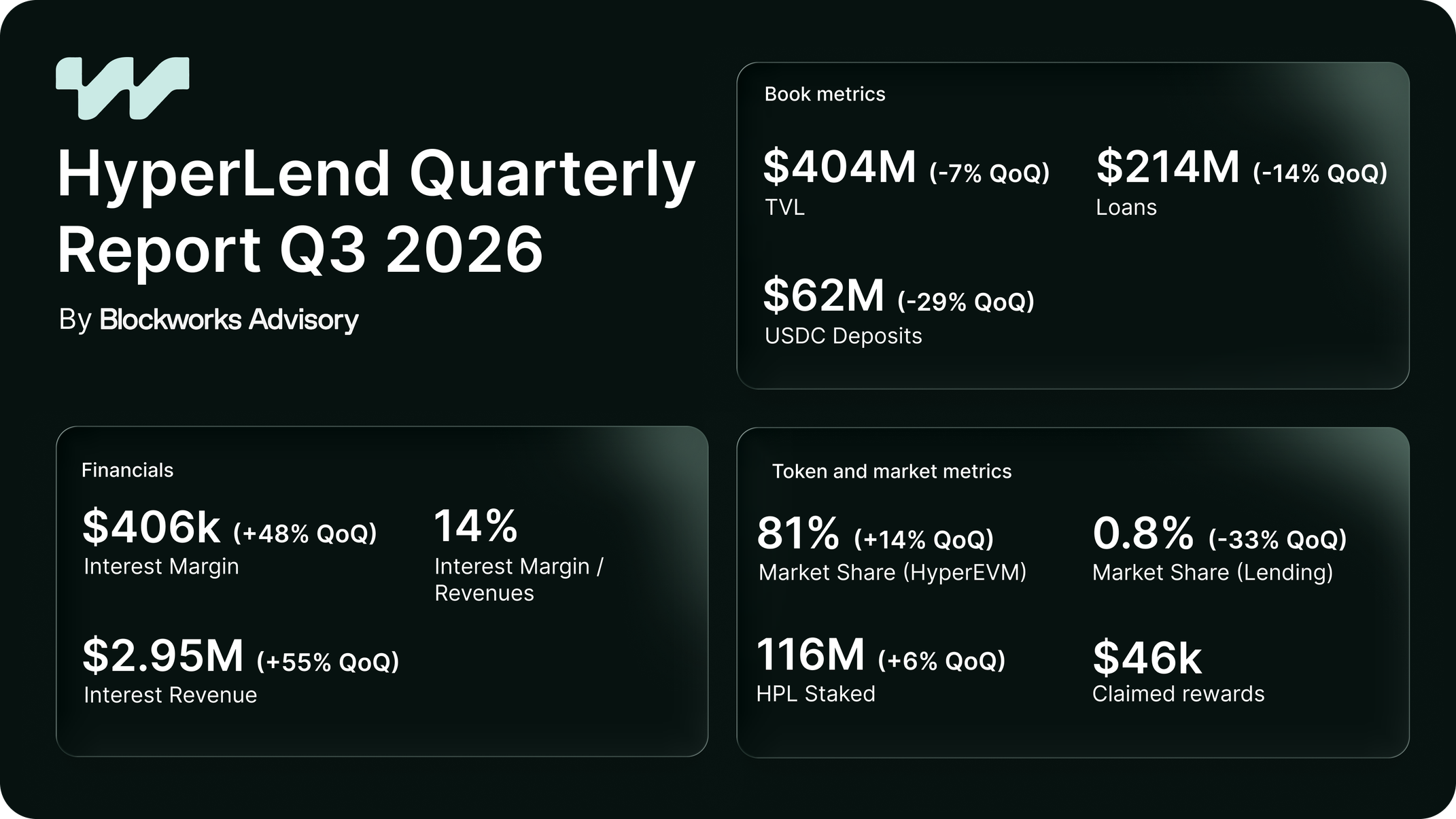
On September 18, HyperCore opened native borrowing to all accounts. For the first time, the exchange we are built on began lending directly to its own users. We think the quarter in which that happens tells investors more about a credit business than a quarter of easy growth, so we want to be specific about how HyperLend performed. Revenue grew 47% to $408.9K. Our share of HyperEVM borrowing rose from 71.2% to 80.6%. Aviya, our institutional credit arm, made its first loan and was repaid in full.
For most of the quarter the market worked in our favor. Hyperliquid's protocol revenue rose 21% to $189.1M, its first quarterly increase in four quarters. Open interest rose 80% to $16.8B, and HYPE gained 41% to an all-time high on September 23. On August 27 our deposits reached $909.4M and borrows $315.5M, the highest levels since October 2025. Borrows stayed near that level until September 19.
HyperCore competes with us in one product, stablecoin loans against HYPE or BTC, which made up roughly 17% of our debt just before its launch. That business moved quickly. USDC borrows fell from $91.4M on September 17 to $53.9M at quarter end, and our USDC borrow rate came down to 5.3%, close to HyperCore's 5%. A dollar loan against a liquid asset will go to the cheapest lender with the simplest process. We do not intend to fight the exchange on price for that loan, and we will not loosen our risk parameters to win it back.
The other 83% of our book is lending HyperCore does not do. That includes HYPE borrowing, loans against liquid-staked HYPE, high-LTV loops and multi-asset collateral. Each of these requires a lender that understands how the collateral is staked, held and liquidated, and that is where we have built the business. We ended the quarter with $617.7M in deposits and $214.1M in borrows, down 9.1% and 13.7% from June 30. A large WHYPE withdrawal in the same weeks also reduced HYPE liquidity. Revenue still grew, because average borrows for the quarter were 21.9% higher than in Q2. Over the same period Morpho's HyperEVM book fell by about half. Some of September's revenue came from two days of WHYPE borrow rates between 20% and 26%, and we do not expect that to repeat. Revenue is also still below the $766.8K we earned in Q3 2025, and we are not going to describe the rate cycle as recovered until it is.
September confirmed something we have believed since the start. Simple credit that any venue can offer ends up priced by whoever has the lowest cost. Lenders make durable money on credit that requires real judgment about the collateral. On Hyperliquid, the biggest example of that is natively staked HYPE.
The largest long-term holders of HYPE, including funds, treasury companies and validators, keep most of it in native staking, where it helps secure the network and earns yield. Until now, borrowing against it meant unstaking, waiting through the unwinding period, giving up the staking reward and moving the asset to a platform whose custody many institutions are not permitted to use. Most of these holders simply did not borrow. That leaves a large amount of high-quality collateral that today's public lending markets cannot serve.
We built Aviya to serve it. On July 17, Aviya lent $1.0M USDC against 40,000 natively staked HYPE, and the collateral stayed staked for the life of the loan. The borrower repaid in full on September 26, with $16.8K of interest. We kept the first loan small on purpose, because its job was to prove the process from origination through repayment. Aviya facilities are bilateral and fixed-rate, every counterparty goes through compliance before any capital moves, and the collateral sits with Anchorage Digital Bank, which Aviya signed this quarter as its exclusive qualified custodian. A regulated institution can now borrow against staked HYPE without changing who holds its assets.
Aviya also strengthens the protocol and the token. Interest from institutional borrowers flows into the reserve factor that funds Stake & Save rebates, and those borrowers can lower their net cost by staking HPL for the life of a facility. The same mechanism is already working in our public pools. Rebates issued rose 59% to $71.9K, equal to 17.6% of revenue, and 116.1M HPL, or 11.6% of supply, stayed staked through the September drawdown even though there is no lock-up. Last quarter we said the question was whether staking would turn into borrowing. Rebates issued and claimed both increased, so that shift has started. It is still small, and we will report on it every quarter.
We are funding Aviya carefully. The HyperLend Strategic Fund approved up to 600,000 USDC for Aviya's engineering, security, audits, legal work and operations. It is released in three tranches of 200,000 USDC, and each draw is reported onchain. Aviya's loans are not included in the core-market figures in this report. We will report its loan book as facilities fund, and we will not publish projections for it.
We also want to be direct about the risks. HYPE and its liquid-staking tokens are 85% of our deposits, so a severe drop in HYPE would hit both our public pools and Aviya. Staked collateral cannot be sold instantly, so every facility has to be sized and margined with the unwinding period in mind. Institutional deals move at the speed of legal review and custody onboarding. And September showed that the exchange will compete wherever a product is simple enough to commoditize. We set terms with each of these in mind before we set growth targets.
The longer-term picture is encouraging. HIP-3 builder markets carried 36.5% of Hyperliquid's perpetual volume in Q3, their highest share since launch. Every new market gives investors more reason to hold HYPE for the long term, and long-term holders are exactly the borrowers Aviya is designed for. Our job is to be the place they come to when they need liquidity and do not want to sell.
The way we run HyperLend has not changed. We integrate natively with Hyperliquid, keep our risk parameters conservative, share risk across lenders in our public pools and stay disciplined through the cycle. Q3 tested that approach against the strongest competitor we are likely to face. We held our ground where we offer something different, gave ground where we do not, and grew revenue through both. Credit for that goes to the team that ran the protocol through September and closed Aviya's first loan in the same quarter.
At the end of Q2, Aviya had not yet made its first loan. In Q3 it made that loan and was repaid. In Q4 our goal is to fund facilities against staked HYPE at scale, and we will report the results in dollars in our next letter.
Shimon
Chief Operating Officer, HyperLend
Financials
Revenue & Income Statement
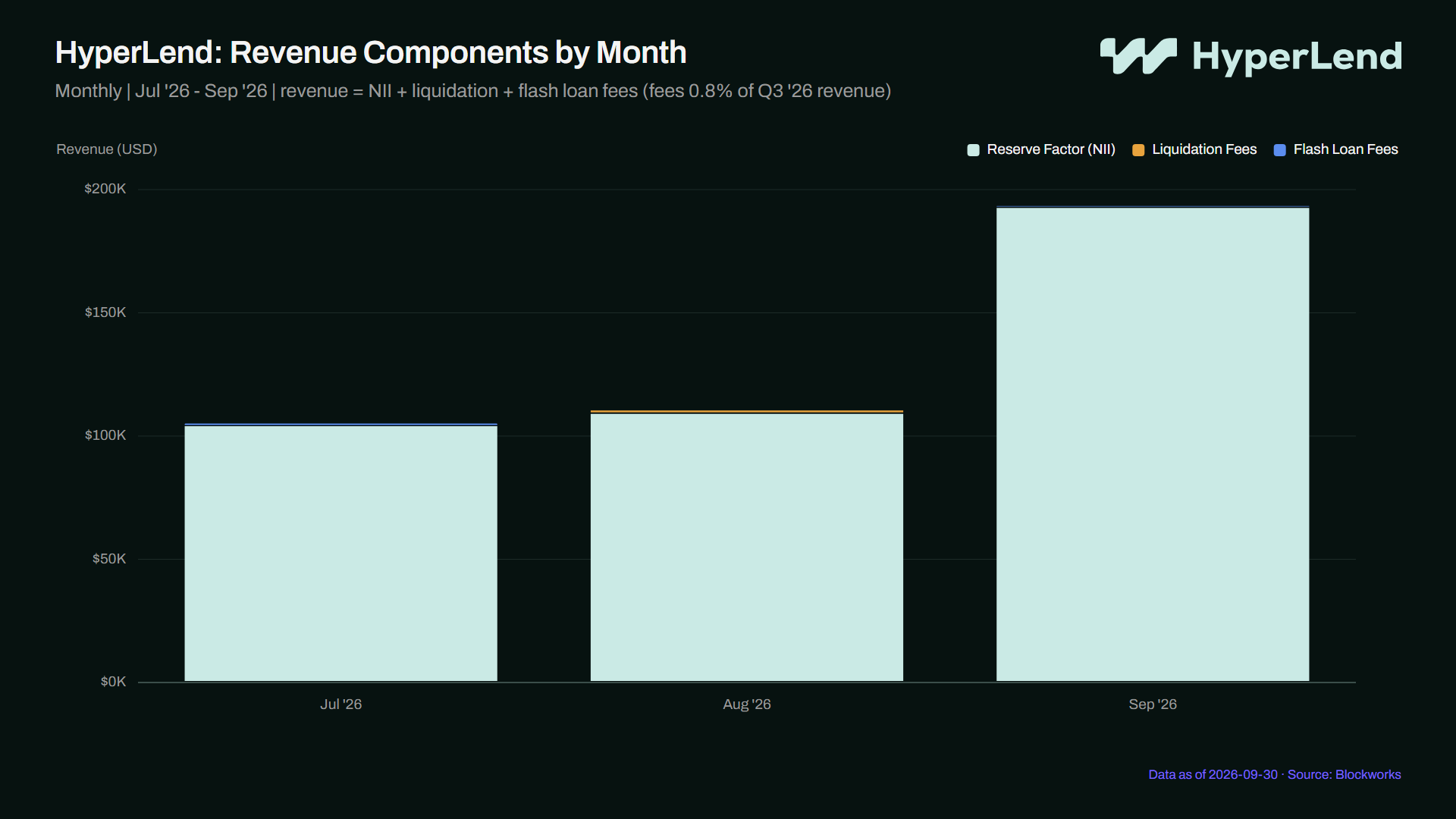
HyperLend generated $408.9K of revenue in Q3, up 47% from $279.0K in Q2 and the second consecutive quarterly increase. Net interest income, the reserve factor retained from borrow interest, was $405.5K of the total. Liquidation fees ($2.4K) and flash loan fees ($1.0K) were negligible. More than 99% of revenue was recurring interest. Gross interest paid by borrowers rose 55% to $2.95M, of which $2.54M passed through to depositors. The protocol retained 13.8% of gross interest, against 14.4% in Q2.
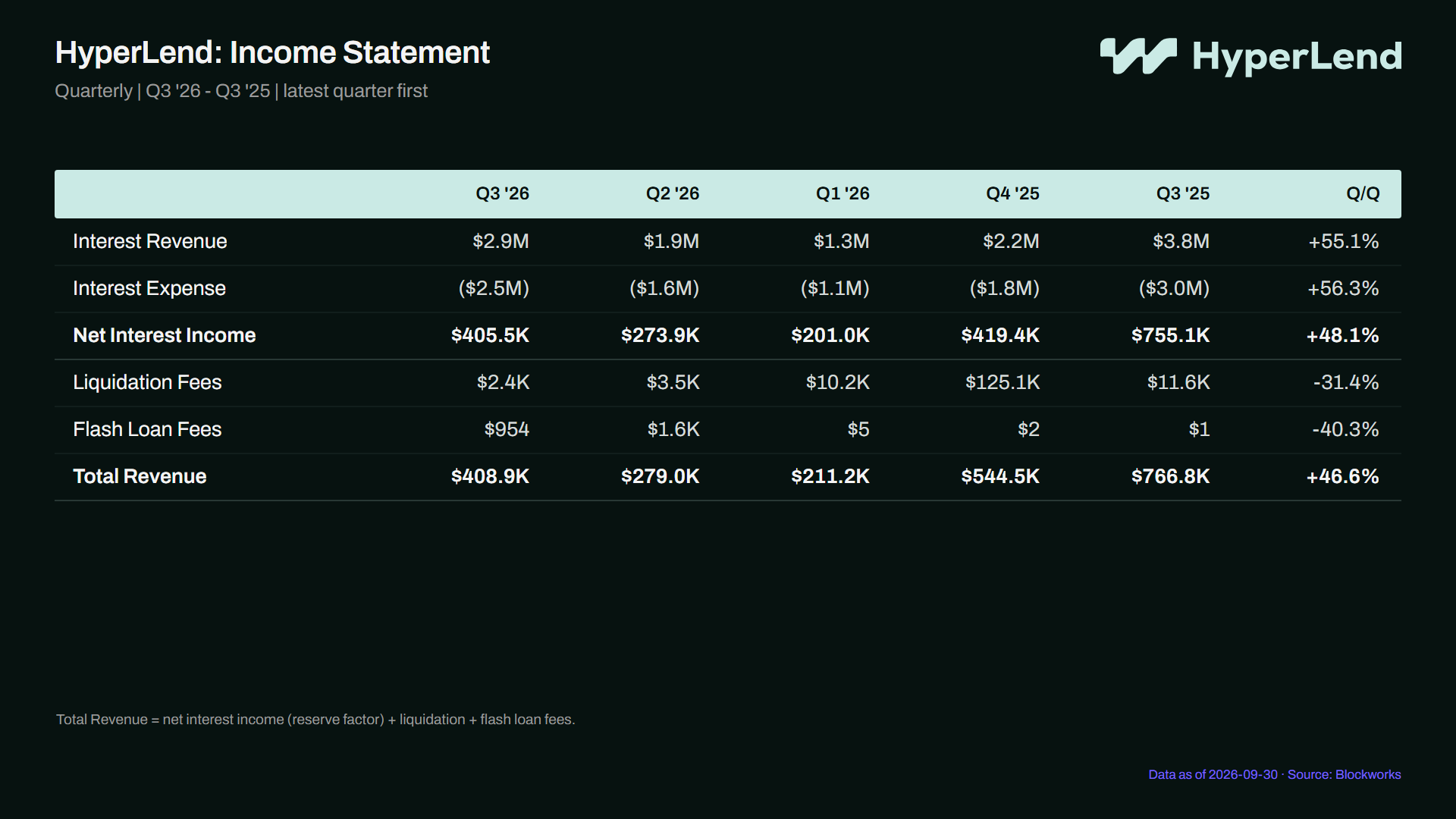
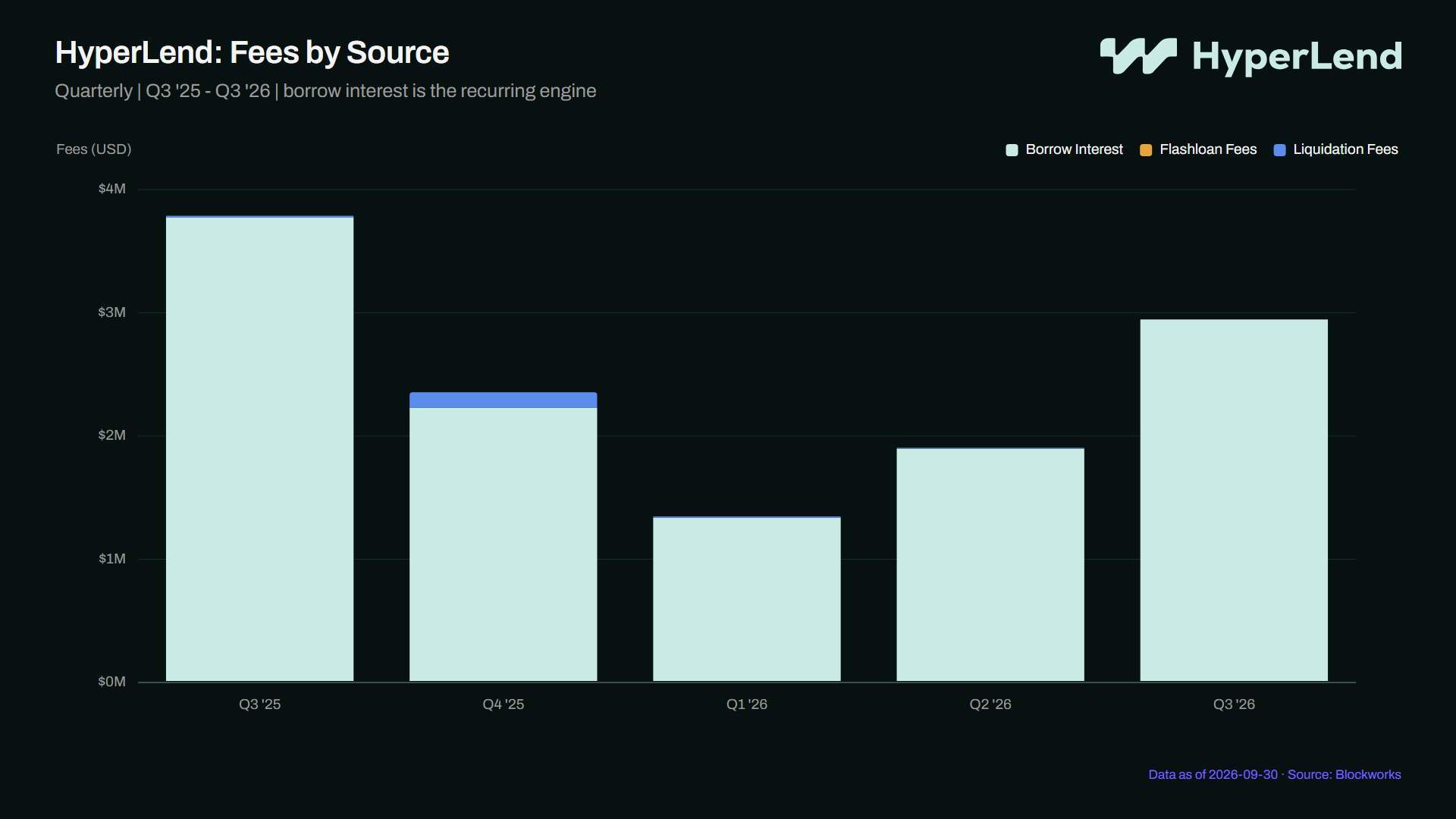
The increase came from a larger average book. Borrows averaged $268.0M in Q3 against $219.9M in Q2, up 21.9%, because the loan book spent most of the quarter above its June level. Monthly revenue ran at $105.0K in July and $110.5K in August. September brought $193.3K, and most of that step-up came in one week. After a large WHYPE supply withdrawal on September 20, the WHYPE borrow rate spiked to 20% to 26% for two days and stayed elevated through the following week, lifting daily interest from about $24K to as much as $135K. Revenue is still below the $766.8K of Q3 2025, when quarter-end borrows stood at $276.1M.
Balance Sheet & Liquidity
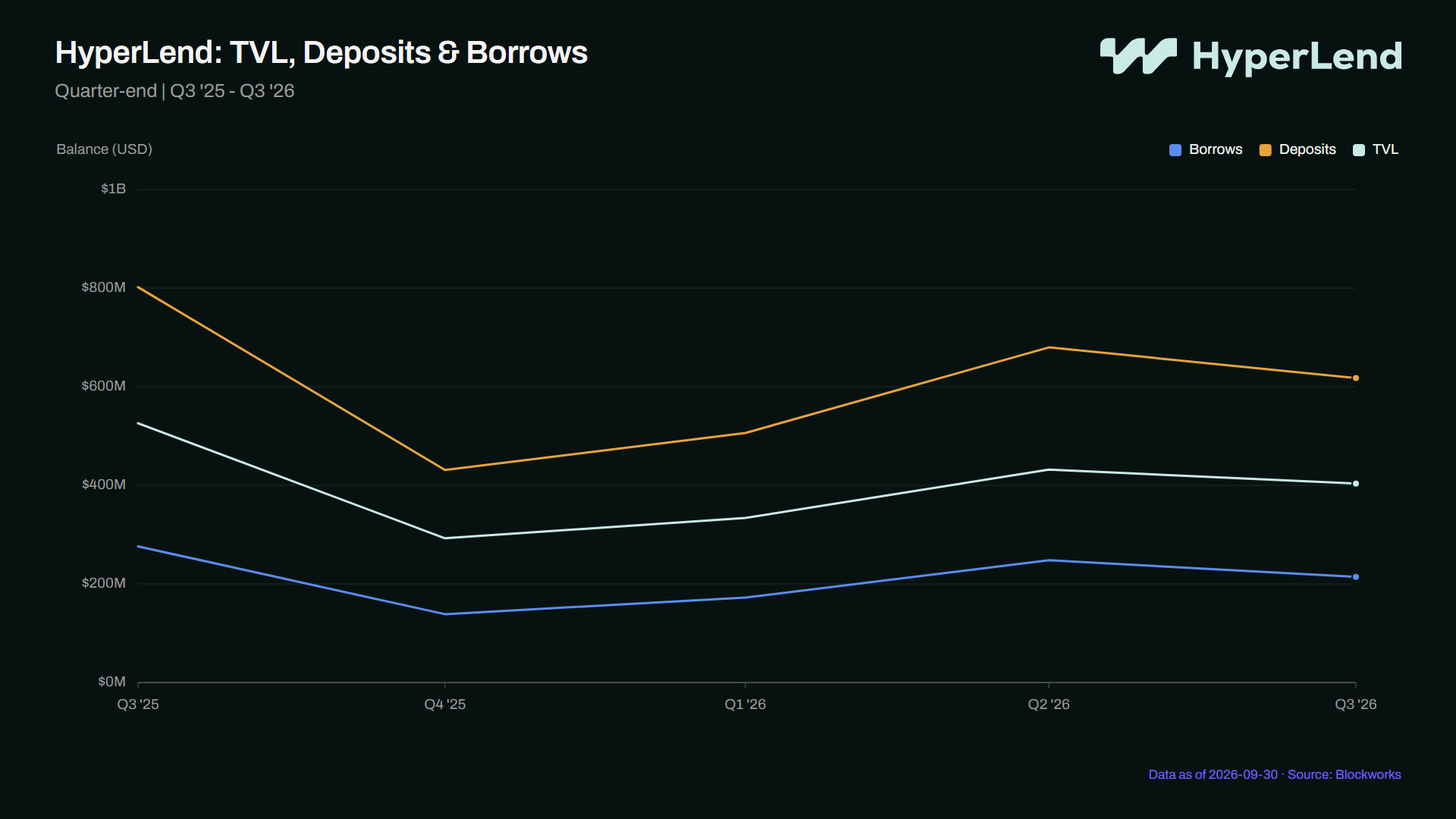
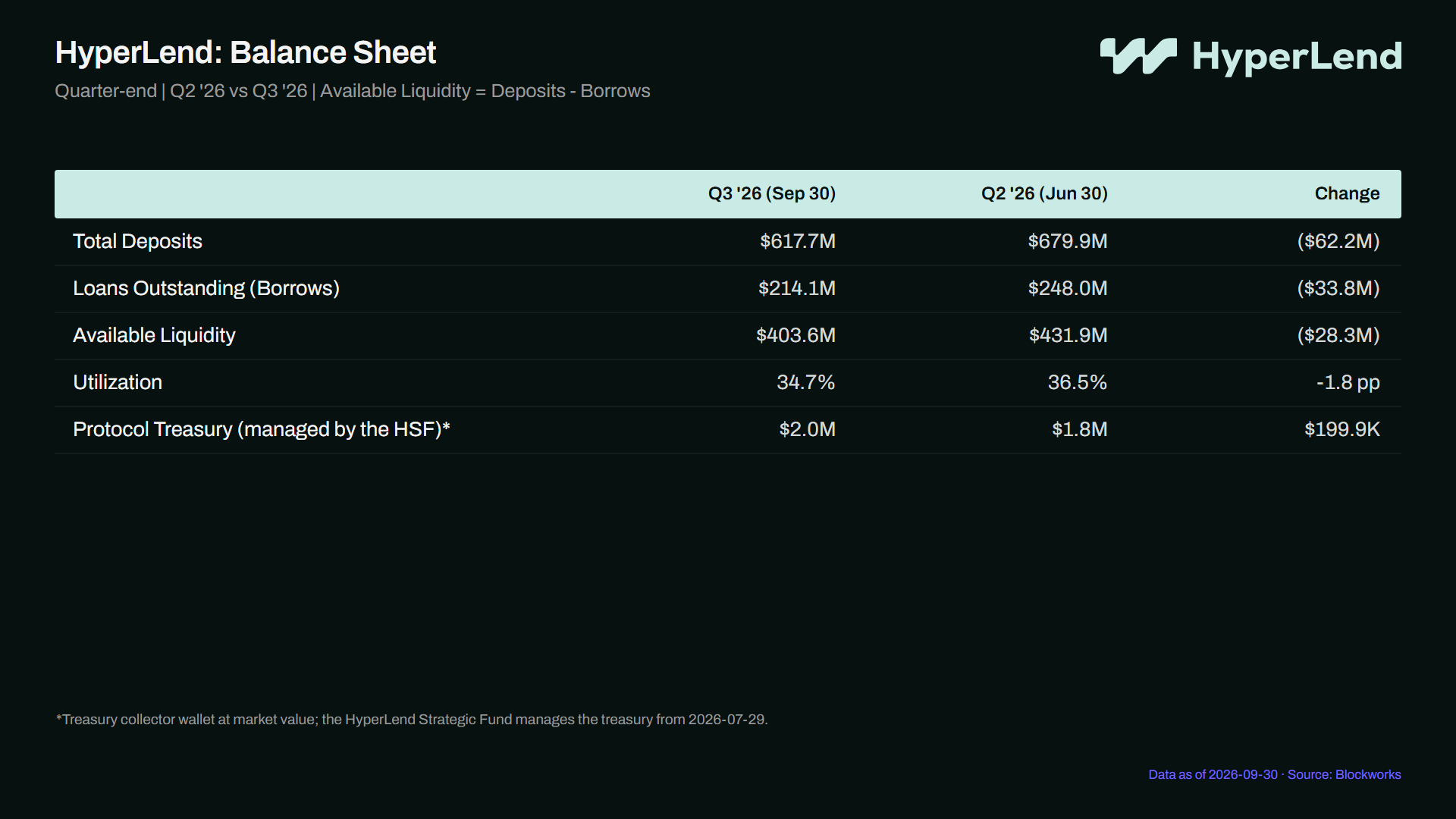
The quarter-end balance sheet compares two dates with a full cycle between them. Deposits grew from $679.9M on June 30 to a Q3 high of $909.4M on August 27, the highest level since October 2025, with borrows at $315.5M. Borrows held near that level until September 19 ($315.1M). Then two things happened. After HyperCore opened borrowing on September 18, stablecoin borrowers in the overlapping segment moved, and a WHYPE supply withdrawal reduced HYPE liquidity. HyperLend closed the quarter at $617.7M in deposits (down 9.1% Q/Q) and $214.1M in borrows (down 13.7%).
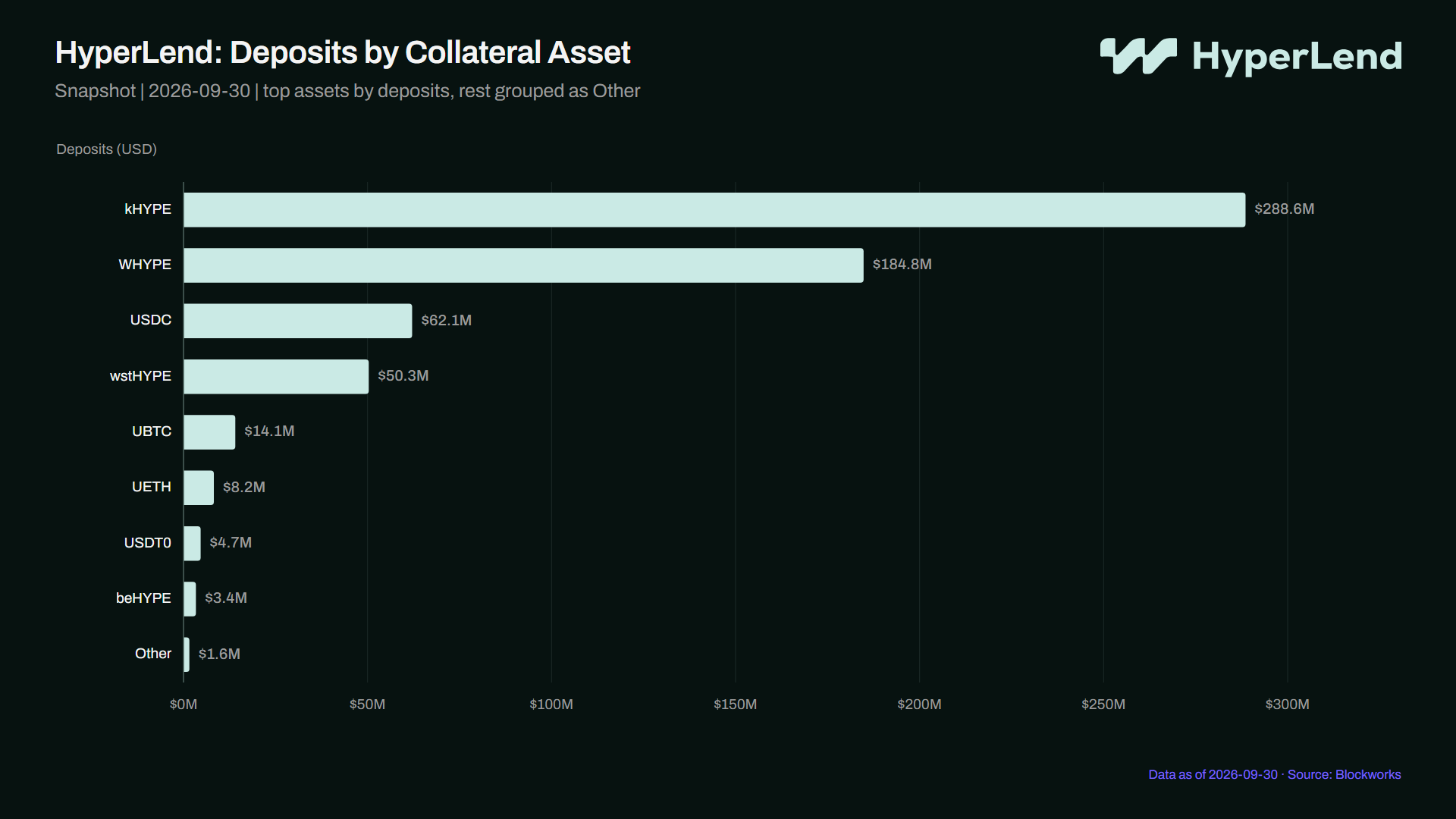
Available liquidity (deposits minus borrows, the protocol's TVL) was $403.6M at quarter end against $431.9M on June 30, and utilization was 34.7% against 36.5%. kHYPE, the collateral behind HyperLend's staking-yield loop, grew 5.5% to $288.6M and was 46.7% of deposits. The protocol treasury, managed by the HSF since July 29, held $2.03M at quarter end against $1.83M on June 30, up 10.9%. WHYPE was 56% of it ($1.14M), followed by USDC ($474.0K) and USDT0 ($199.7K).
Cash Flow & Capital Allocation
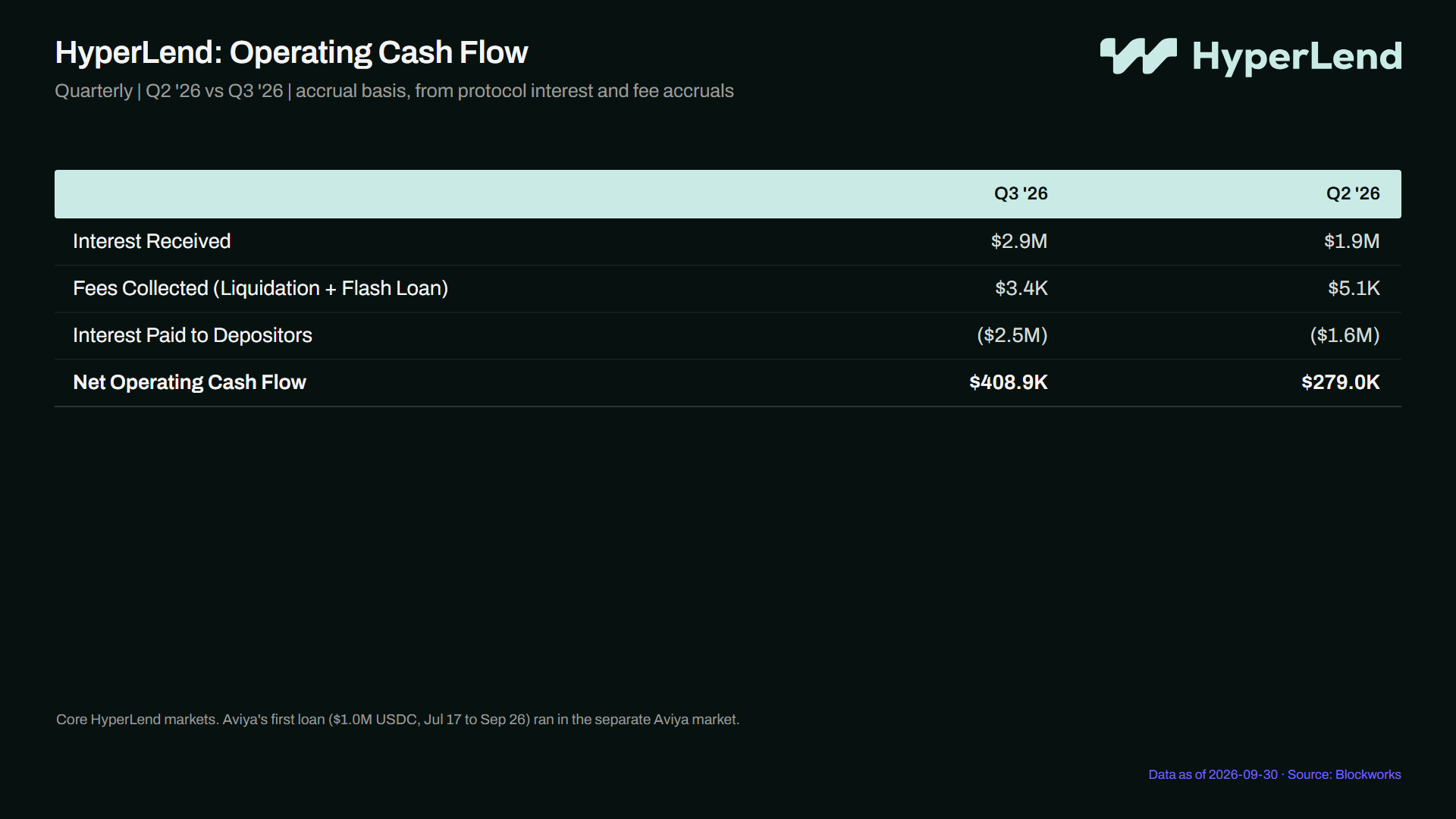
On an accrual basis, HyperLend received $2.95M of interest and $3.4K of fees in Q3 and paid $2.54M of interest to depositors, for net operating cash flow of $408.9K. Under the July 29 Foundation announcement, all future protocol revenue flows to the HyperLend Strategic Fund (HSF), which manages the treasury, including HPL. The Foundation authorized the HSF to draw up to 600,000 USDC to fund Aviya's engineering, security, audits, legal work, integrations and operations, released in three tranches of 200,000 USDC, each reported onchain as drawn. Aviya's first loan ran in its own market, outside these core-market flows, and is covered under Product Updates.
Token Financials & Staking
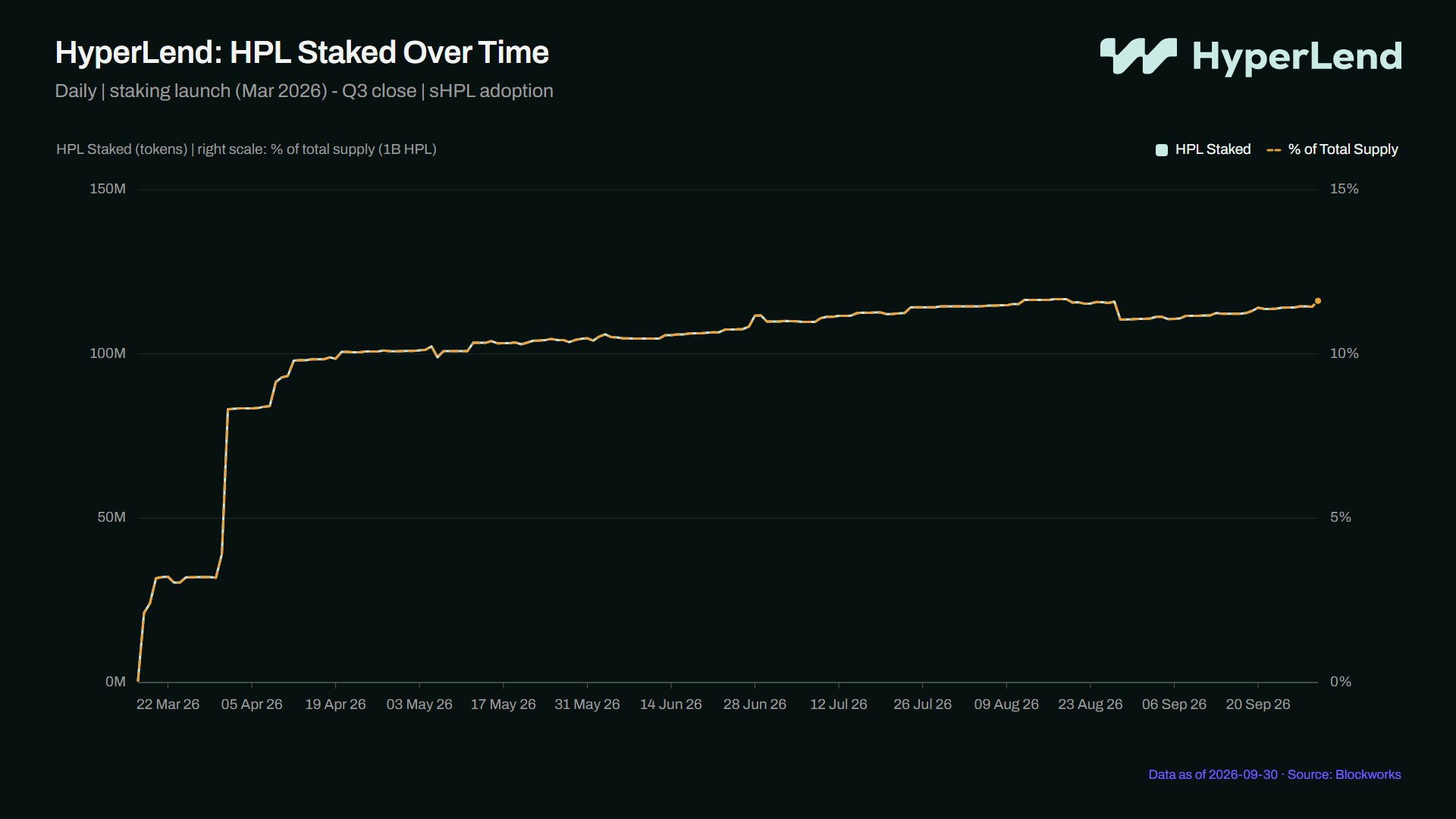
HPL staked through Stake & Save reached 116.1M at September 30, 11.6% of the 1B total supply, up from 109.9M (11.0%) at June 30. Staking peaked at 116.7M on August 18 and held near that level through the September drawdown in the loan book. Most of the adoption came between the March launch and June 30; Q3 added 5.6% on top of that base. Staking has no lock-up, and sHPL can be unstaked or swapped back to HPL at any time, so the staked balance held through September by holders' choice.
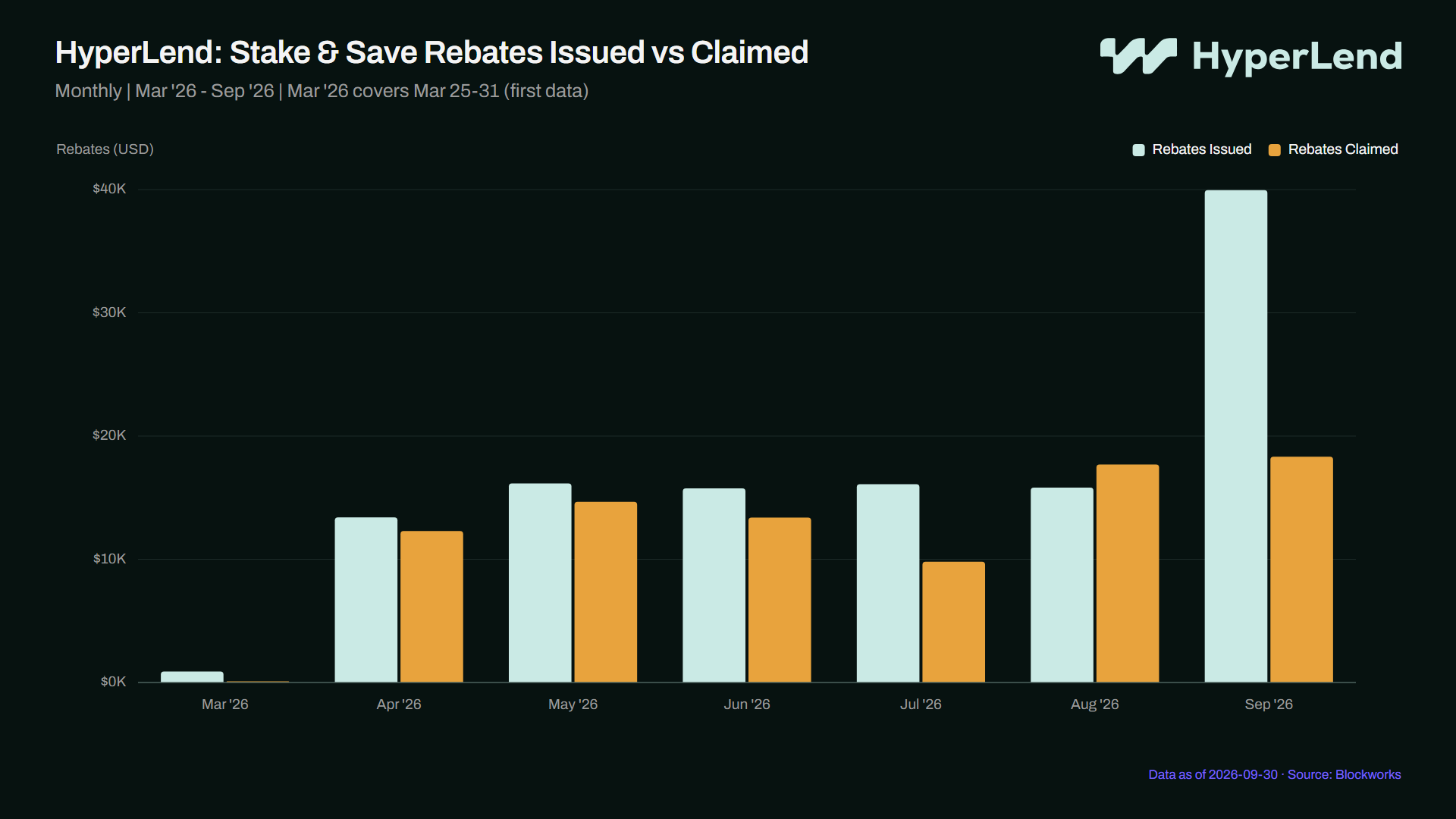
Staking ties HPL to borrowing. Holding sHPL qualifies a borrower for a rebate on HyperLend borrow interest of up to 80%, funded by the reserve factor and claimable weekly. Rebates issued rose to $71.9K in Q3 from $45.3K in Q2, up 59%, and claims rose to $45.8K from $40.3K. Issued rebates equaled 17.6% of Q3 revenue, against 16.2% in Q2. About two-thirds of issuance was paid in WHYPE. September was the largest month, with $40.0K issued. Since launch, $118.1K of rebates has been issued and $86.2K claimed, leaving $31.8K accrued to stakers and not yet claimed at quarter end. The borrow portion of the rebate applies from 10,000 HPL staked, with larger discounts at higher staking tiers.
The HyperLend Strategic Fund, created on July 29, receives all future protocol revenue and holds the treasury's HPL. Aviya links institutional credit to the token, because interest paid by institutional borrowers feeds the reserve factor that funds HPL rebates, and the Foundation stated that institutional borrowers will have a direct incentive to stake HPL to lower their net borrow cost over the life of a facility.
Loan & Rates Analysis
Outstanding Loans vs Morpho and HyperCore
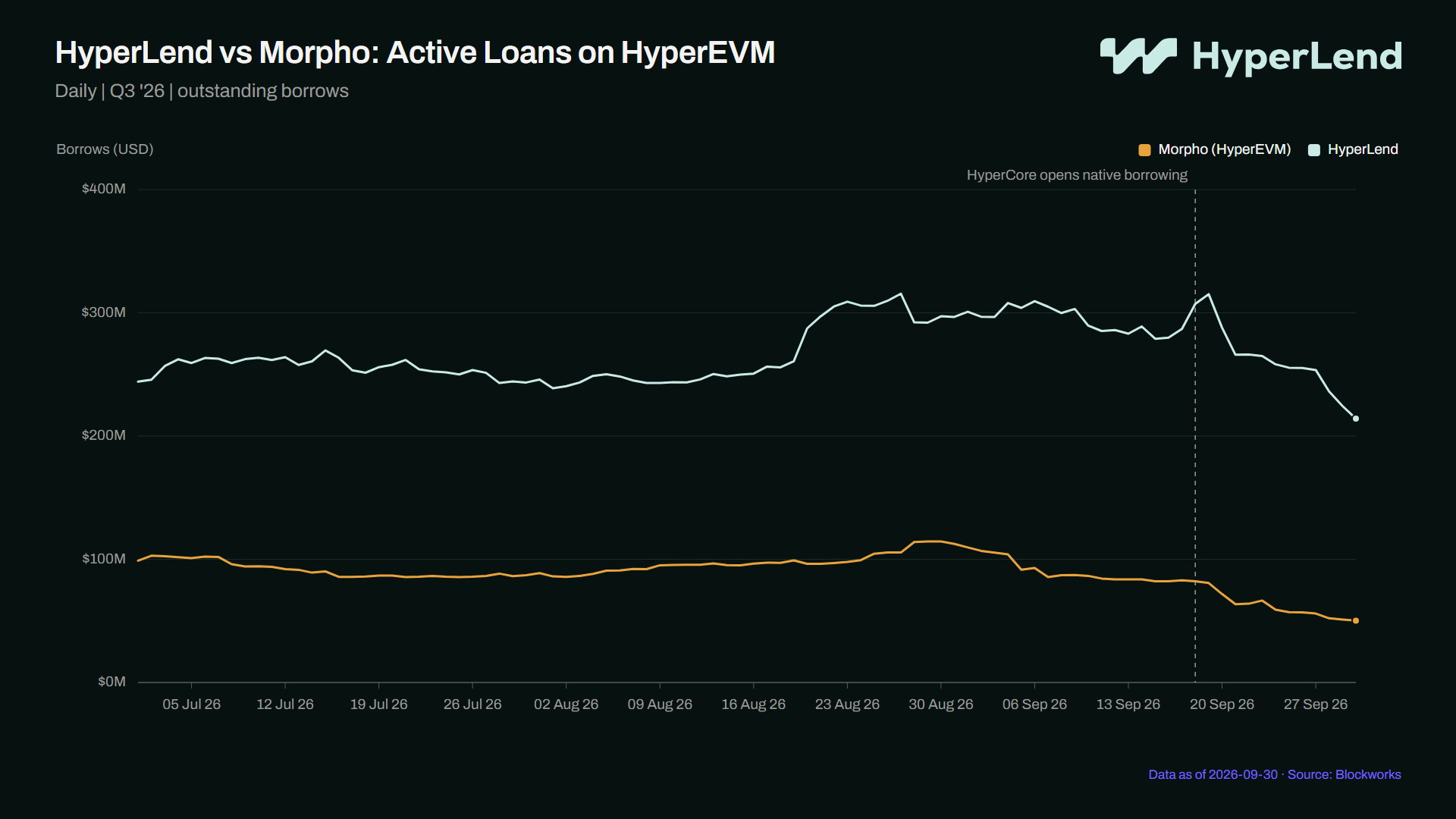
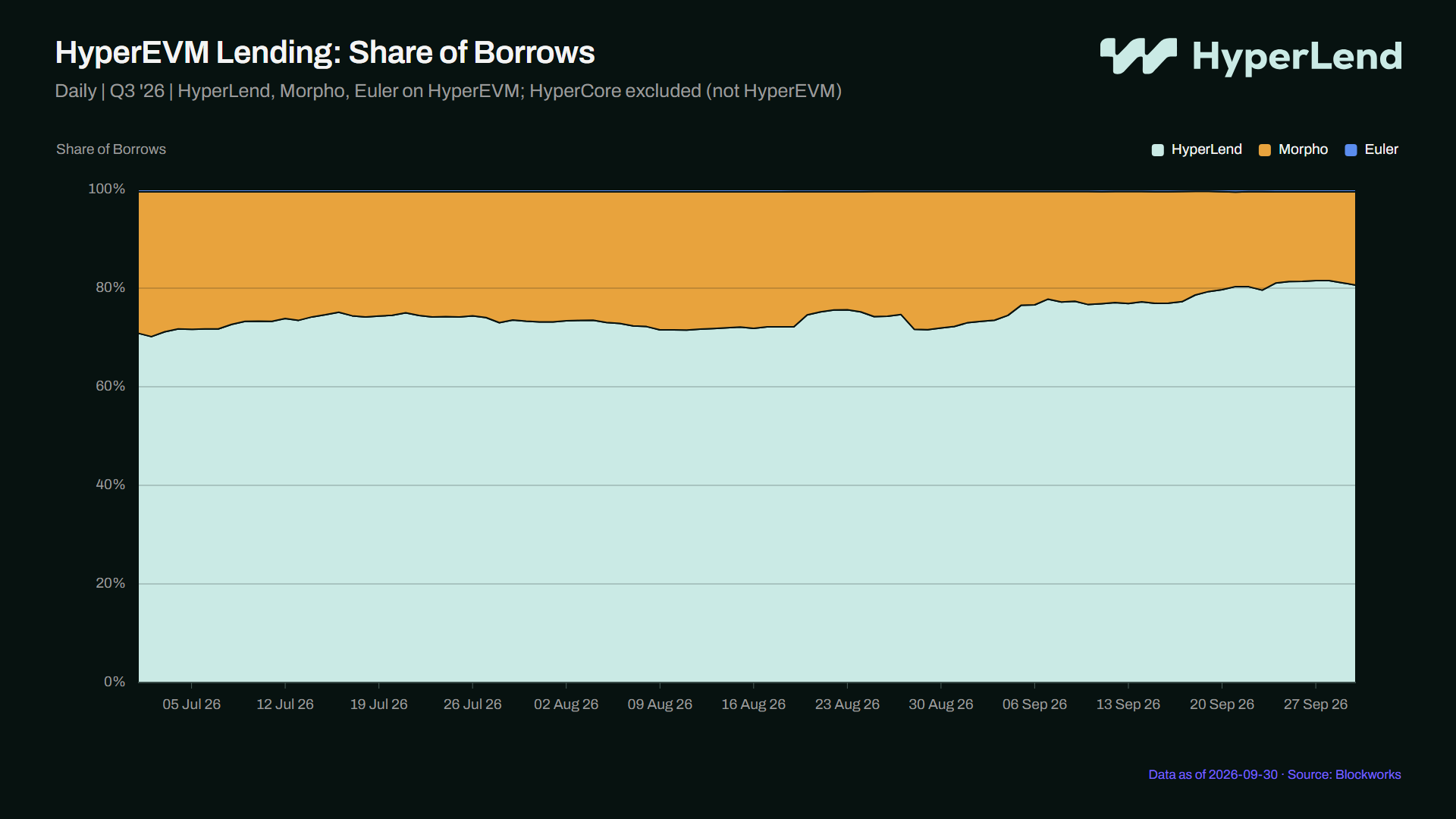
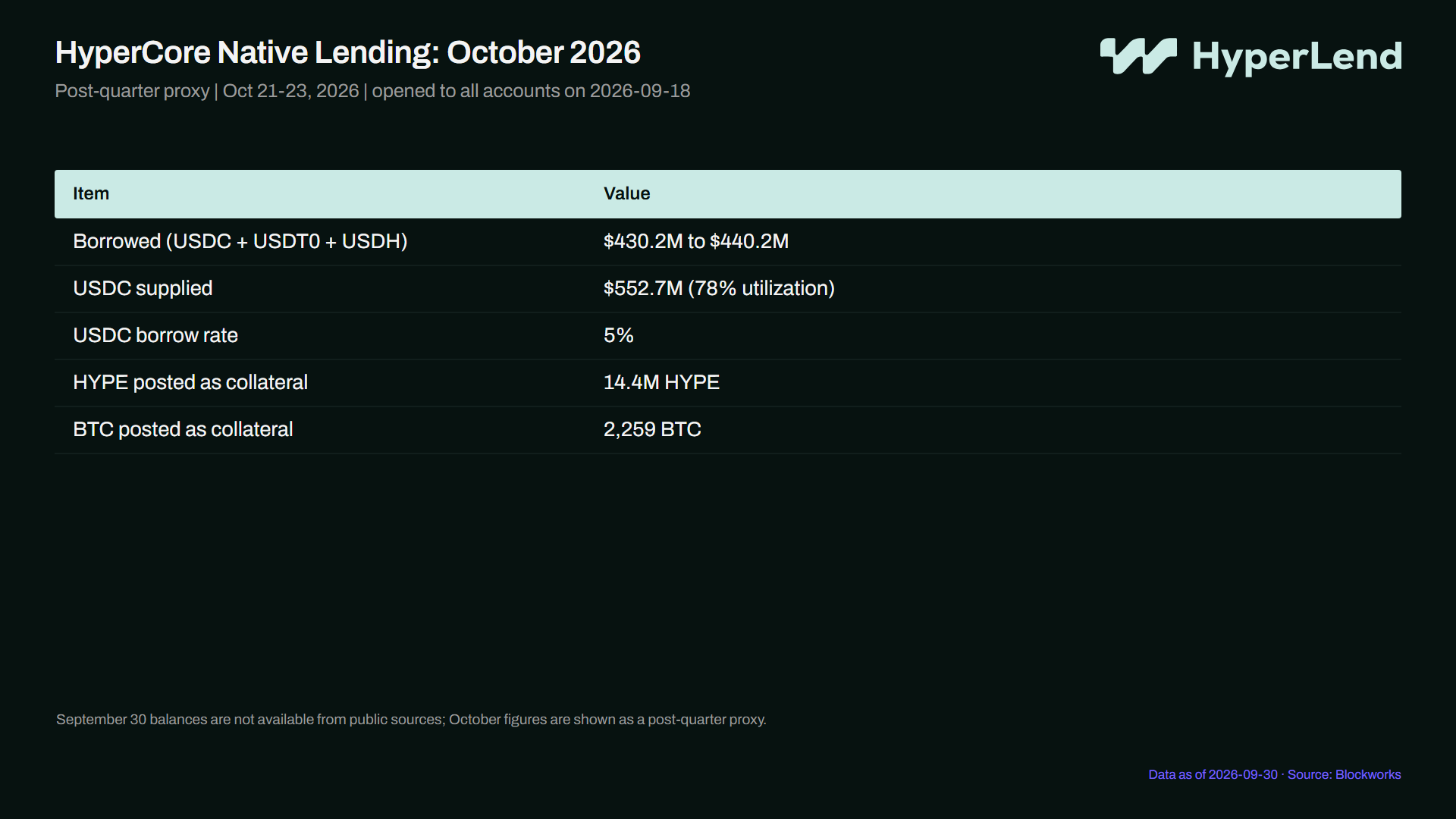
HyperLend ended Q3 with $214.1M in outstanding loans, against $50.2M for Morpho on HyperEVM, the venue behind Felix's vaults. Morpho's HyperEVM book fell 49% over the quarter from $98.6M, while HyperLend's fell 13.7%, so HyperLend's share of HyperEVM borrowing (HyperLend, Morpho and Euler) rose from 71.2% to 80.6%. Both books are concentrated in HYPE: 96% of Morpho's HyperEVM loans were backed by HYPE assets at quarter end, and HYPE and its liquid-staking tokens were 85% of HyperLend's deposits. HyperCore's native lending, open to all accounts since September 18, held about $430–440M of stablecoin borrows in October 2026 (post-quarter proxy).
Where HyperCore Overlaps
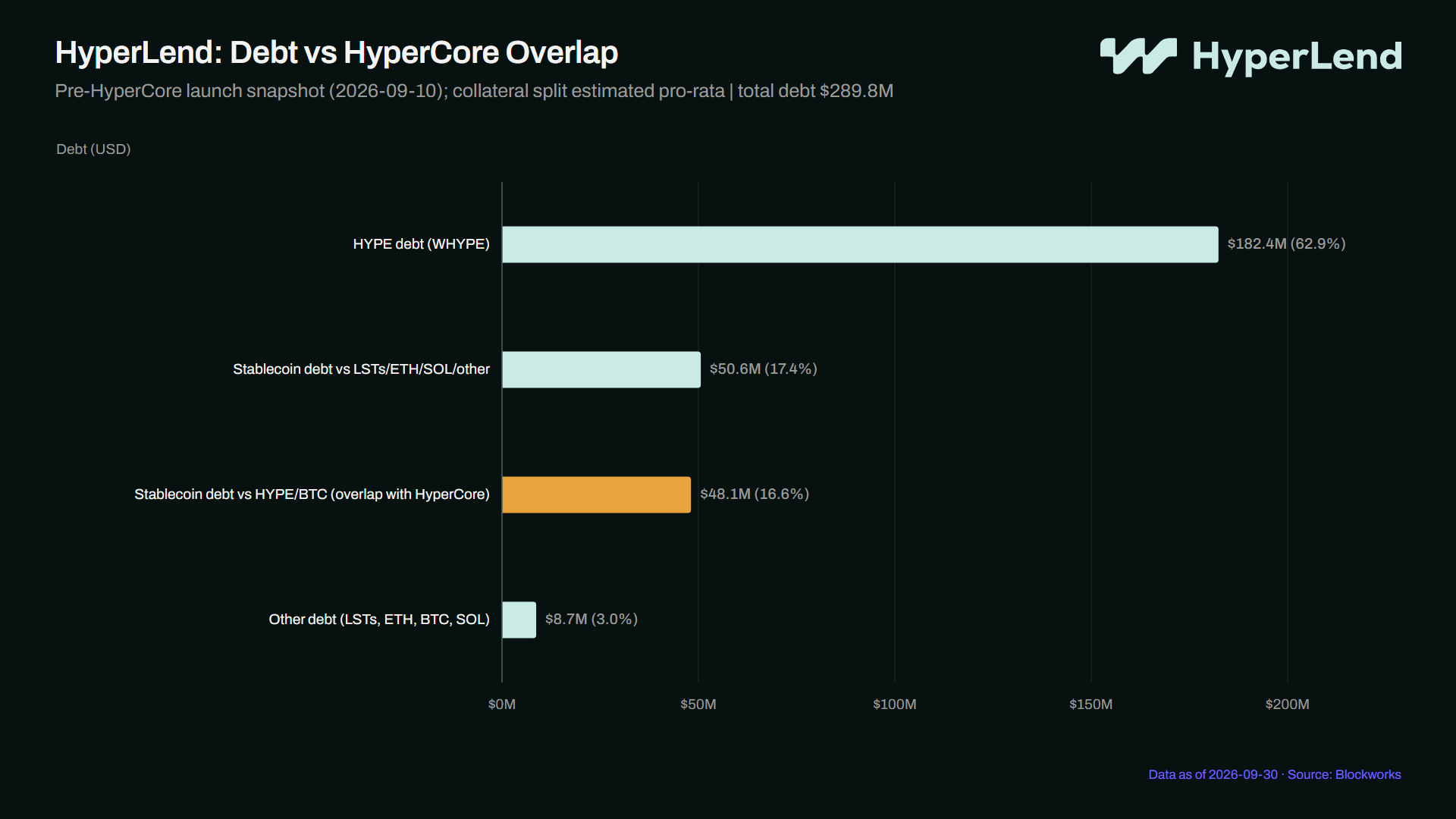
On September 10, before HyperCore opened borrowing to all accounts, HyperLend carried $289.8M of debt. By collateral, $182.4M (62.9%) was HYPE debt, which HyperCore does not lend. Another $50.6M (17.4%) was stablecoin debt against kHYPE, wstHYPE, ETH, SOL and other collateral HyperCore does not accept, and $8.7M (3.0%) was other non-stablecoin debt. The segment HyperCore can serve, stablecoin debt against HYPE or BTC, was $48.1M, or 16.6%. The September move matched that segment: USDC borrows fell by $37.5M between September 17 and September 30.
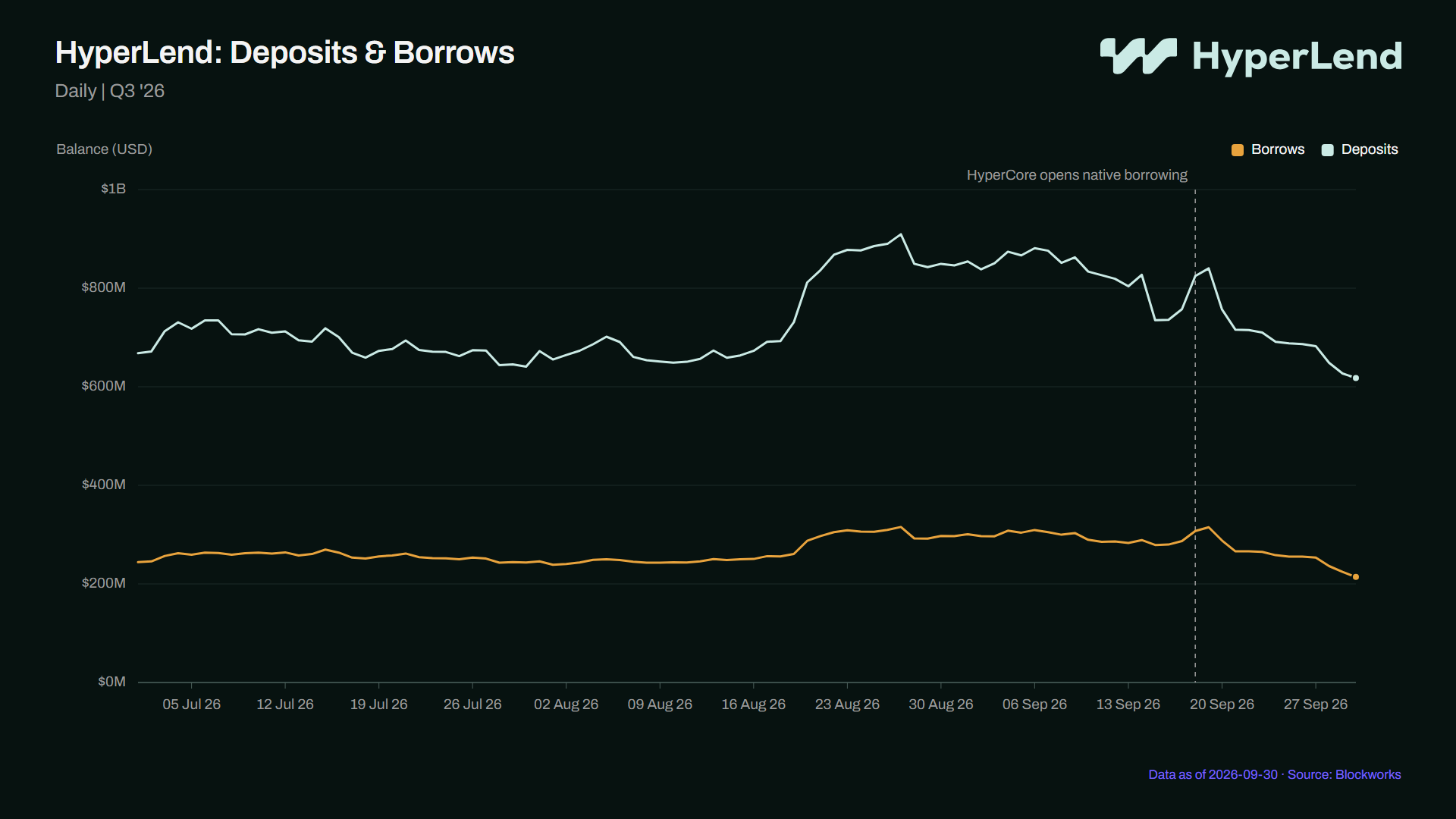
HYPE borrowing held over the quarter, down 8% to $146.8M. Its late-September dip followed a WHYPE supply withdrawal on September 20 (supply fell from $272.3M to $216.7M in a day), which pushed the WHYPE borrow rate to 20.1% and then 26.3% before it normalized to 1.4% by quarter end. Two-thirds of HYPE debt is backed by kHYPE, the staking-yield loop, and 8% by USDC, a short-HYPE position HyperCore cannot replicate. The August parameter changes support these loops. The HYPE LTV rose from 60% to 65.2% on August 11, and E-Mode LTVs rose to 82.7% for HYPE LSTs and 87% for kHYPE on August 24.
Stablecoin Rate Dynamics
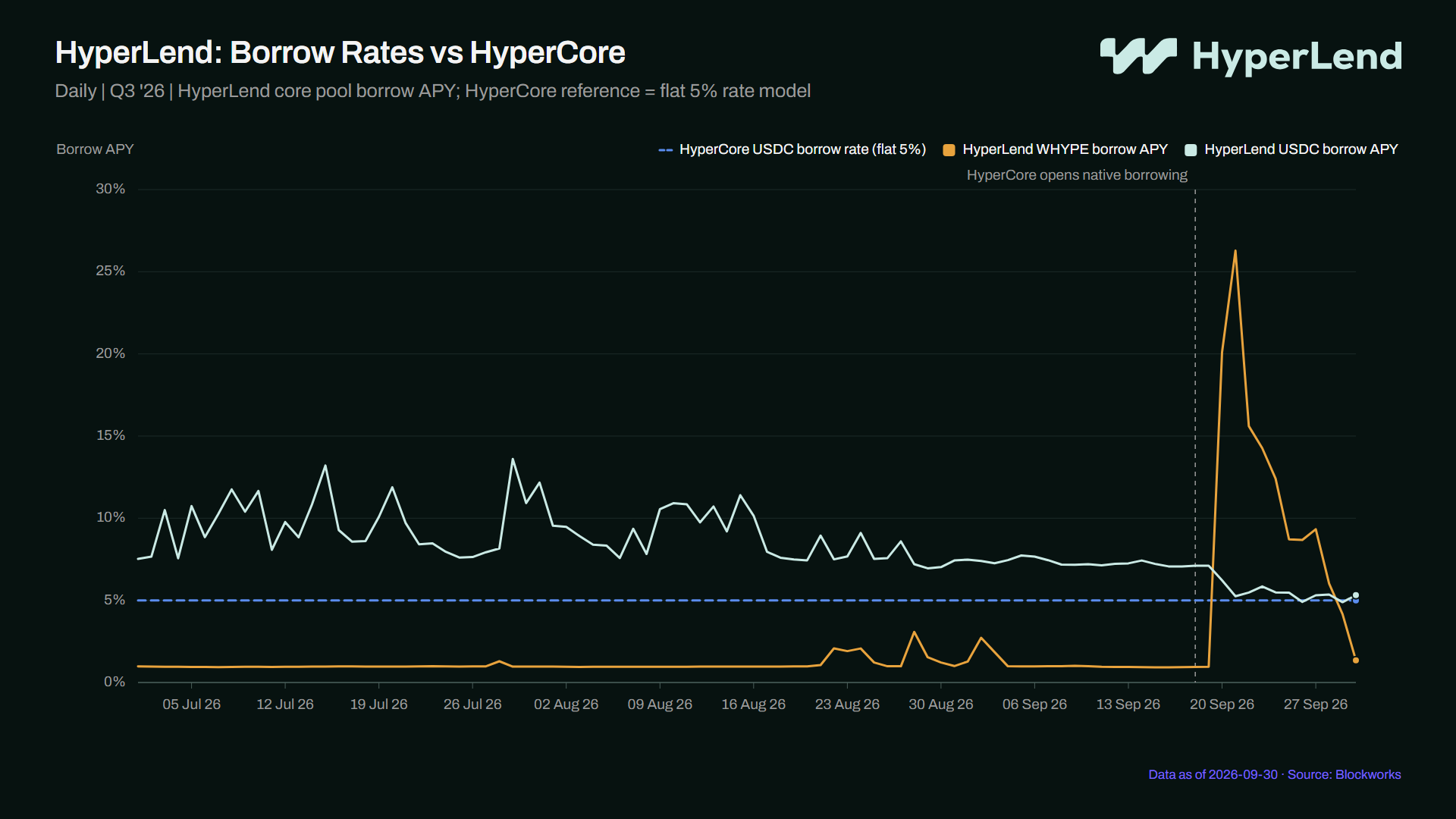
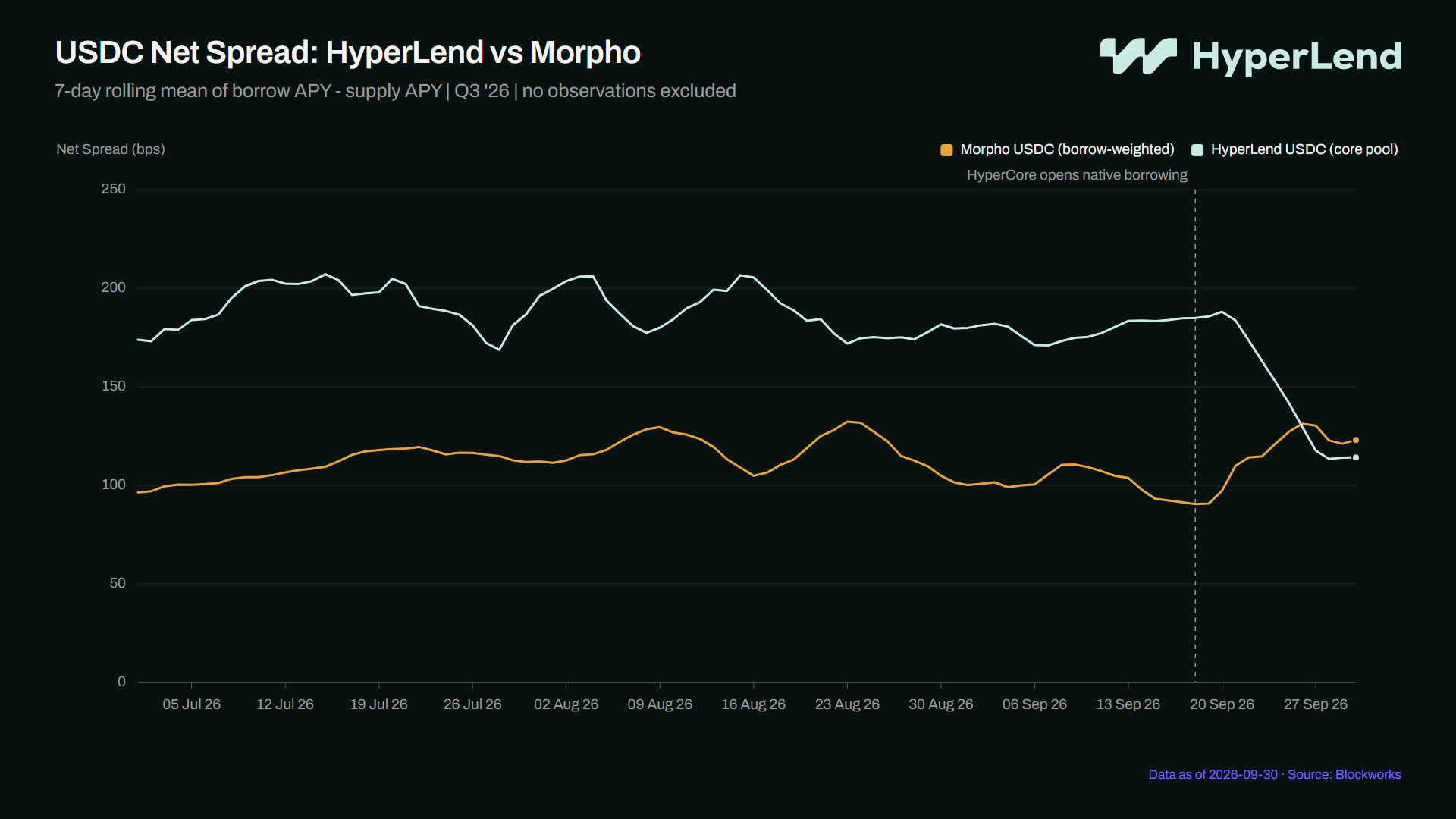
The USDC borrow rate averaged 9.6% in July, 8.7% in August and 6.6% in September, and closed the quarter at 5.3%, in line with HyperCore's flat 5% below 80% utilization. Average USDC utilization eased from 89% in July to 85% in September. HyperLend's USDC borrow rate tracked Morpho's throughout (6.6% against 6.7% in September). The difference is on the supply side, where HyperLend's reserve factor sets a wider borrow-supply spread: 160 bps in September against Morpho's 111 bps.
Product Updates & Strategic Positioning
Aviya: Institutional Credit
HyperLend's institutional arm moved from pilot to live venue in Q3. Aviya is a private, compliance-gated credit venue offering fixed-rate secured credit to institutions on Hyperliquid, built on HyperLend infrastructure. It launched a new brand identity on September 4, signed Anchorage as its exclusive qualified custodian on September 9, and is integrated with Atlas, Anchorage Digital's settlement and collateral network. On September 30, Hyperion DeFi announced the first institutional credit facility on Aviya Finance. The borrower's obligations are secured by natively staked HYPE held in qualified custody at Anchorage Digital Bank, N.A., so collateral keeps earning staking yield and never leaves custody. Because the HYPE stays natively staked, the HyperLend team notes it also keeps qualifying for Hyperliquid's staking fee discounts, which reach 40% off taker fees at 500,000 HYPE staked. That suits market makers and funds that trade in size on Hyperliquid and want to borrow against their stake without giving up either.
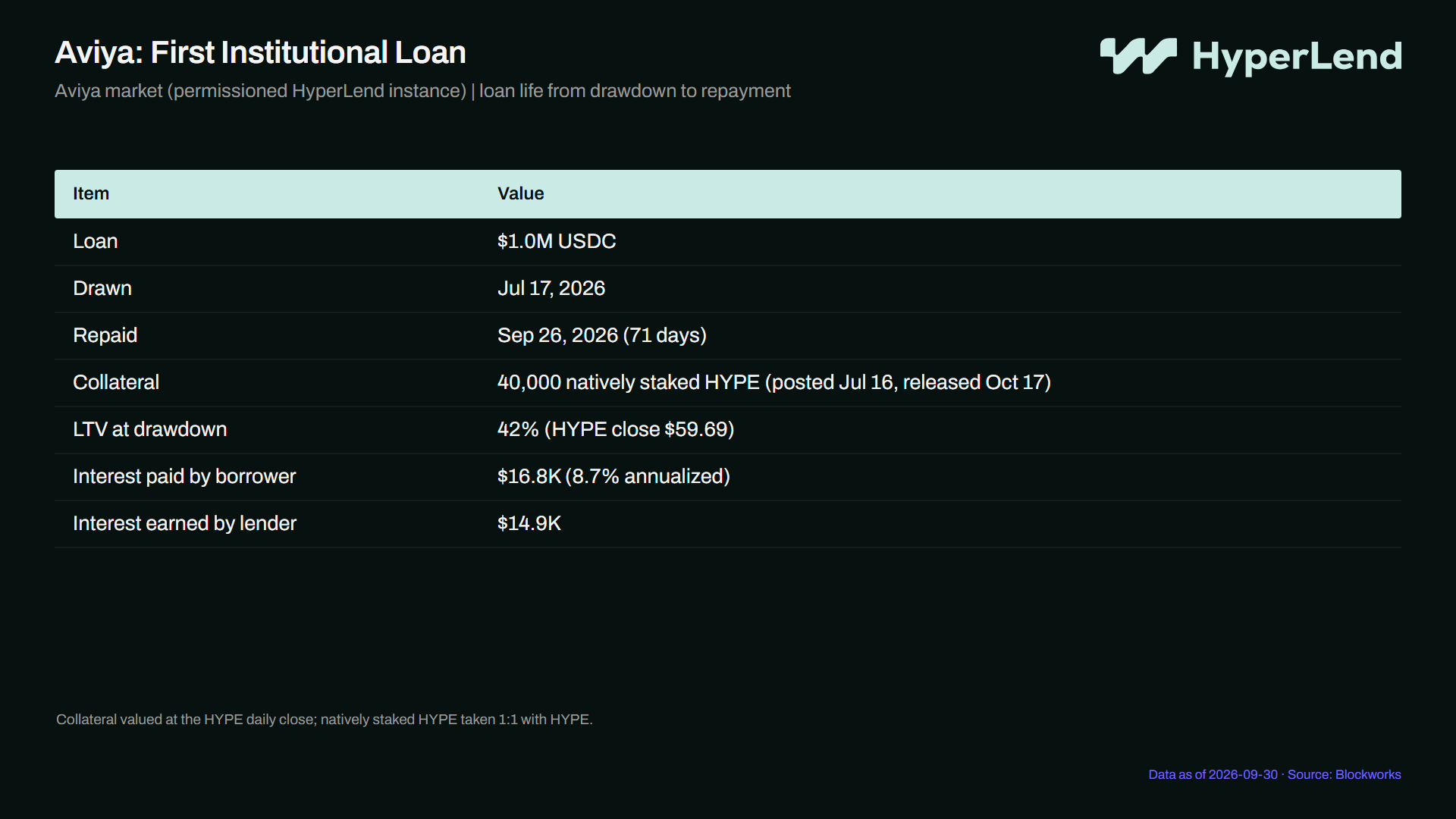
Aviya's first loan ran before the announcement. A lender supplied $1.0M USDC to the Aviya market, and the borrower drew it on July 17 against 40,000 natively staked HYPE, about a 42% loan-to-value at drawdown. It was repaid in full on September 26, after 71 days, with $16.8K of interest (8.7% annualized), of which $14.9K went to the lender, and the collateral was released on October 17. The amounts are small, but they combine regulated custody, staked collateral and a public-company lender, and arrived less than seven months after Hyperion DeFi engaged HyperLend in March to build a permissioned lending pool.
The team sizes the collateral base Aviya is built to serve at about 186M HYPE staked with community validators, roughly $14.5B at $78 per HYPE, excluding HYPE staked by Hyperliquid Strategies and Foundation validators. Aviya starts with HYPE and its staked derivatives and plans to add other asset types as collateral, with a stated scope that extends to tokenized stocks, commodities and fixed income. HyperLend's RWA lending instance is in development; it depends on deeper spot RWA liquidity on Hyperliquid, and there is no deployment yet.
Other Product Updates
HyperLend Strategic Fund. Created on July 29 to manage the treasury and receive all future protocol revenue, with a 600,000 USDC authorization for Aviya.
Risk parameters. Higher HYPE and E-Mode LTVs (August 11 and 24) raised capital efficiency for HYPE collateral and loops.
Across. Since September 2, users can bridge and supply any asset from chains Across supports in one transaction.
USR market wind-down. HyperLend set the shutdown of its USR market for August 10, after the USR recovery process, with less than $2,000 of debt outstanding and two borrowers liquidated at the $0.50 recovery value.
Positioning Against HyperCore
HyperCore lending is a trading-margin facility; HyperLend is the native credit layer for HYPE-aligned capital. Both venues lend stablecoins against HYPE or BTC. Only HyperLend lends HYPE itself (for carry trades, shorts and LST arbitrage), runs kHYPE and wstHYPE loops up to 87% LTV, accepts stablecoins, ETH or SOL as collateral, serves accounts above HyperCore's $25M portfolio-margin ceiling, and offers permissioned institutional credit with qualified custody through Aviya. HYPE posted as HyperCore collateral does not earn staking yield; kHYPE and wstHYPE posted on HyperLend keep earning it.
Sector Overview
Crypto Market Conditions
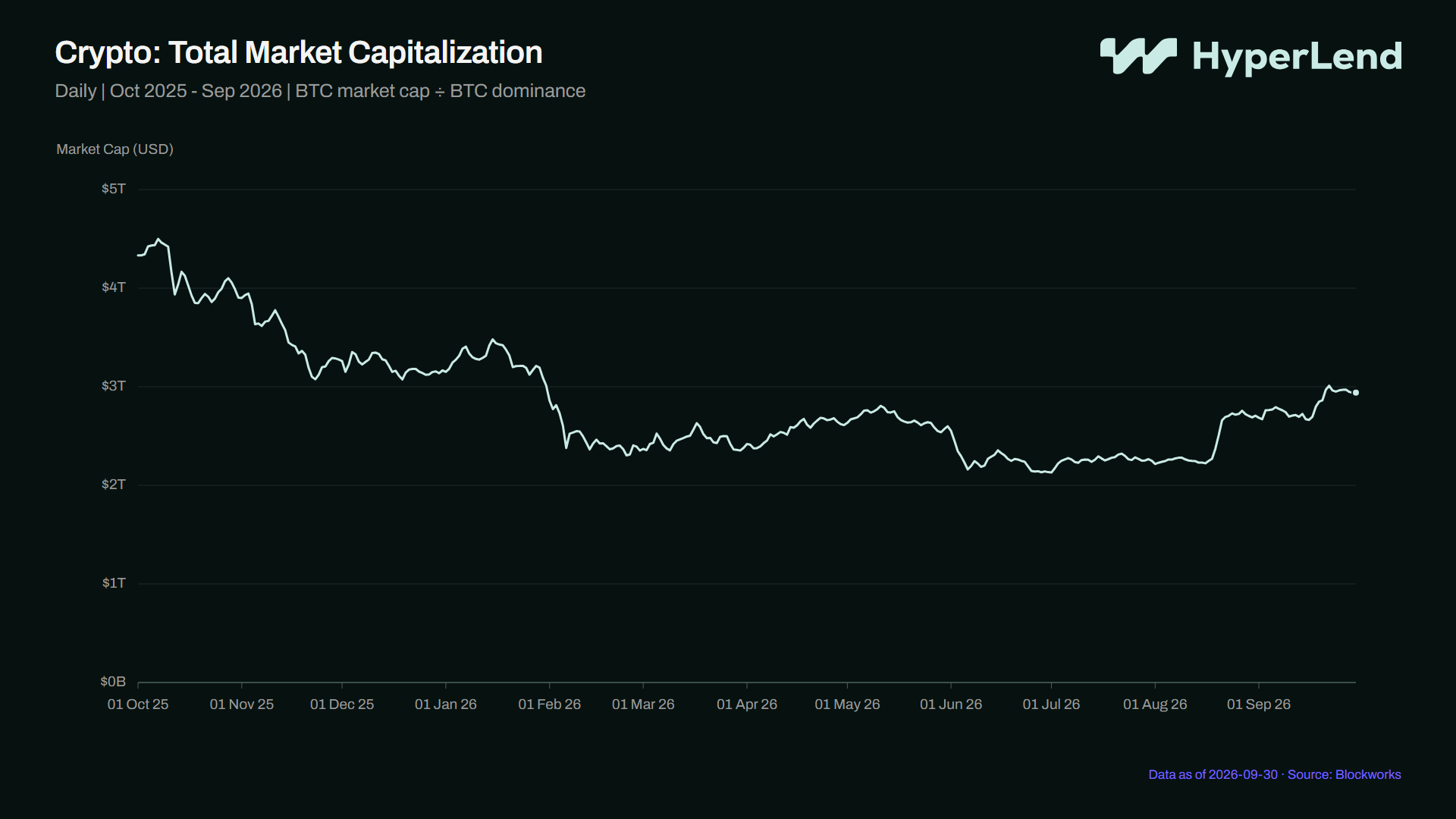
Total crypto market capitalization rose 39.4% in Q3, from $2.11T to $2.94T. BTC led, with its market capitalization up 43.0% and dominance up from 55.6% to 57.0%. The rally lifted DeFi balances broadly, including Hyperliquid's markets and the wider lending sector's books.
HYPE & Hyperliquid Context
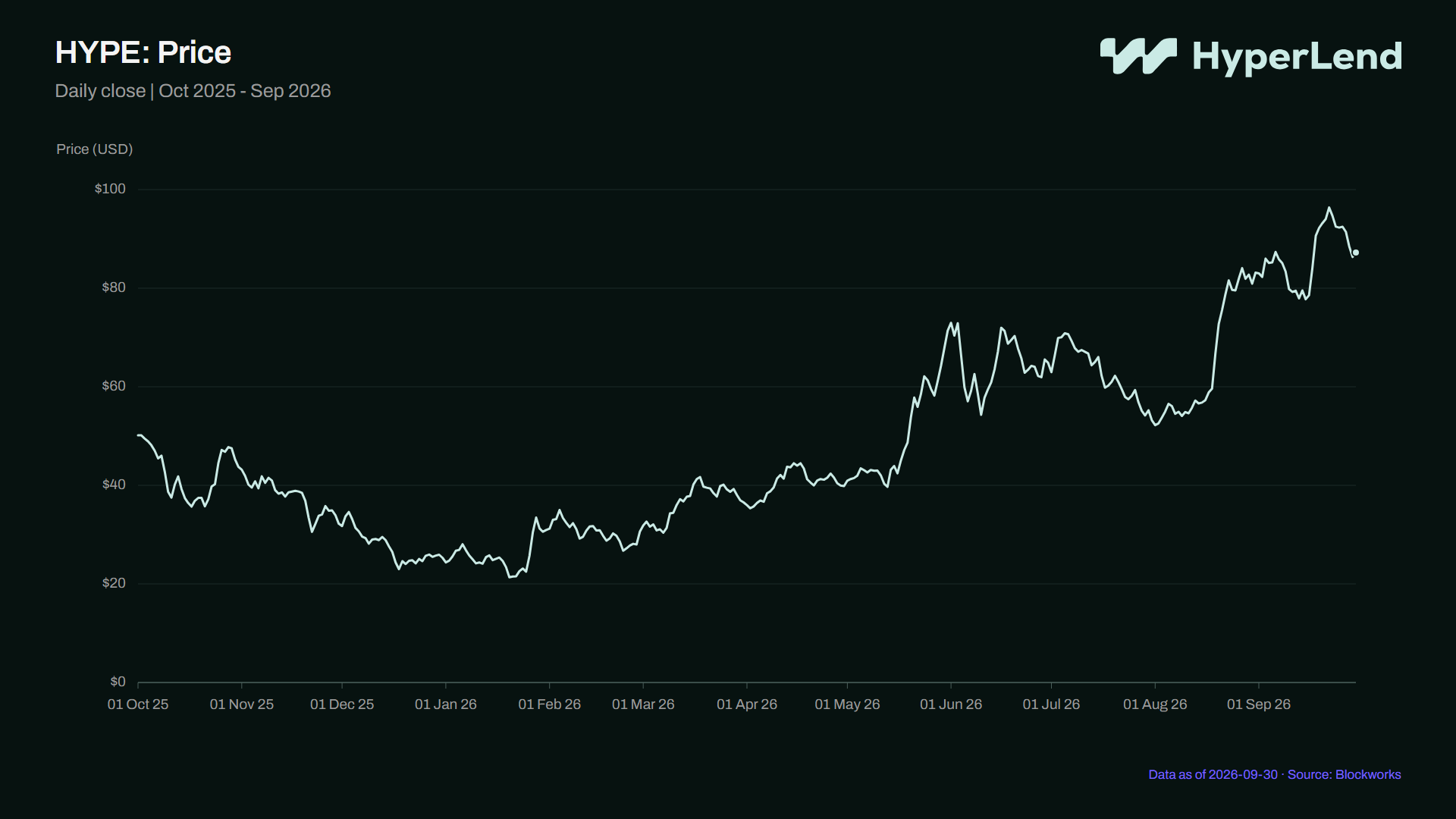
Hyperliquid's growth is HyperLend's tailwind: more HYPE value, more HYPE-aligned capital and more assets listed on Hyperliquid expand the collateral and borrow demand HyperLend serves. Protocol revenue rose 21% to $189.1M, the first quarterly increase in four quarters, though below the $301.2M of Q3 2025. Perp volume rose 9.7% to $716.0B. HIP-3 builder markets did $261.6B in their highest quarter since launch, up 22.8% and 36.5% of volume, and real-world asset perps topped half of weekly volume for two consecutive weeks in July. Open interest rose 80% to $16.8B and set a high of $18.1B on September 22. HYPE rose 41% over the quarter and reached an all-time high on September 23.
Access widened as well. On August 19, President Trump said the CFTC chair was working to bring Hyperliquid into the United States in a compliant way, and Payward, Kraken's parent, announced plans in September to offer onchain perpetuals to US clients through HIP-3. HYPE ETFs from 21Shares, Bitwise and Grayscale are custodied by Anchorage Digital, the same custodian behind Aviya.
DeFi Lending Sector
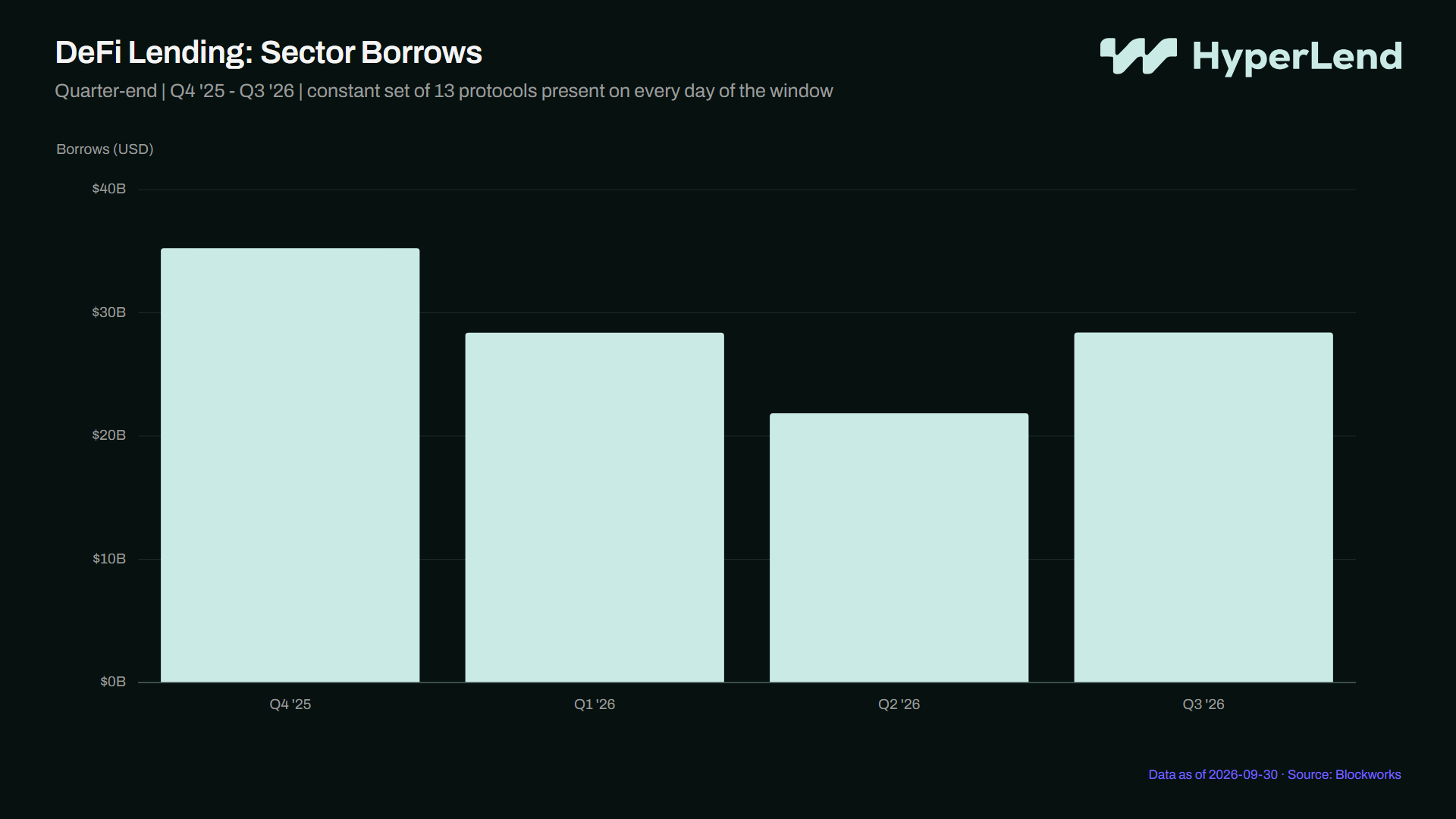
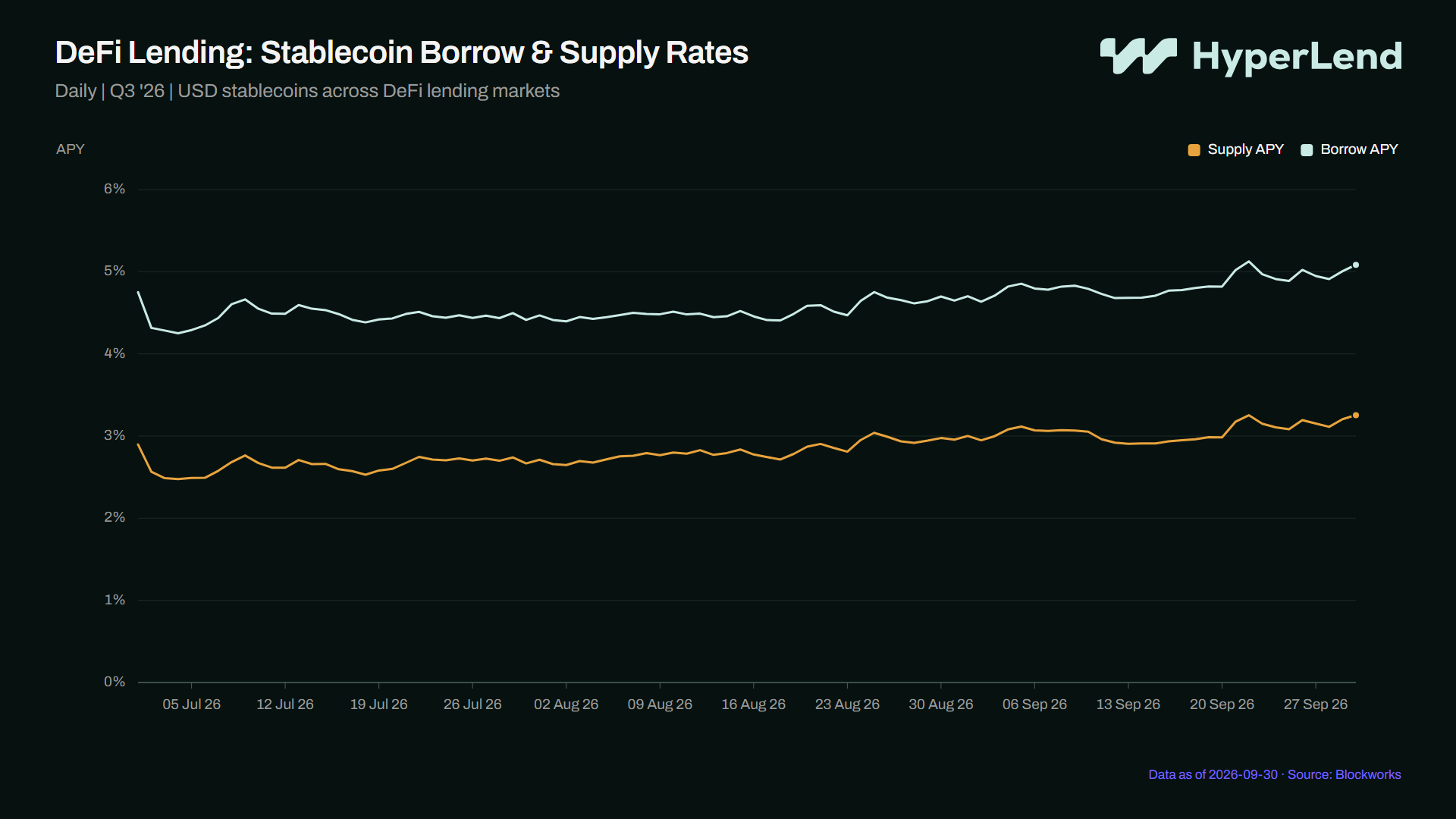
Sector borrows across a constant set of 13 lending protocols rose 29.6% in Q3, from $21.9B to $28.4B, with Aave up 32% and Morpho up 46% across all chains. HyperLend's fell 13.7%. It had tracked the sector until mid-September, with borrows up 27% on August 27 against June 30, before the HyperCore overlap reversed the gain. Sector stablecoin borrow rates edged up from a 4.5% July average to 4.8% in September. HyperLend's premium over the sector narrowed from about 5 points to 1.8, and to 0.2 points at quarter end (5.3% against 5.1%).
HyperCore Native Lending
Native lending is part of Hyperliquid maturing into a full financial stack. HyperCore opened borrowing to all accounts on September 18 with about $269M borrowed across its shared book, mostly pre-existing portfolio-margin debt. In October 2026 (post-quarter proxy), it held about $430–440M of borrows in USDC and USDT0, with $553M of USDC supplied at 78% utilization and a 5% borrow rate, backed by 14.4M HYPE and 2,259 BTC. September 30 balances are not available from public sources. Portfolio-margin eligibility is capped at accounts below $25M, and HyperEVM contracts cannot yet supply to it.
HYPE Sinkhole
Hyperliquid removes HYPE from circulation with its trading fees: more than 47M HYPE had been sequestered by the protocol by September 30. HyperLend adds a second sink by putting HYPE to work as collateral, with $527.1M of its quarter-end deposits in HYPE and its liquid-staking tokens.
Closing Summary & Outlook
The Q1 and Q2 reports set four watch items between them.
Staking flywheel: in Q2, rebate volume had not yet followed staking adoption. In Q3 it did, with rebates issued up 59% to $71.9K, and staked HPL edged up to 11.6% of supply.
Institutional activation: Aviya is live. Its first loan ran from July 17 to September 26 and was repaid in full, Anchorage signed as custodian, the Strategic Fund funded the build-out, and Hyperion DeFi announced the first institutional credit facility on September 30.
Revenue and rates: gross interest rose 55% and revenue 47%, while the USDC borrow rate fell to HyperCore's level.
Collateral diversification did not progress: HYPE and its liquid-staking tokens were 85% of deposits at quarter end, against 83% in Q2, with ETH and BTC borrowing up from a small base.
The outlook starts with Hyperliquid. Open interest, HIP-3 markets, real-world asset perps and a possible US path all widen the pool of HYPE-aligned capital that needs credit. HyperCore and HyperLend will coexist. They serve different users: HyperCore serves traders' margin; HyperLend serves HYPE borrowing, liquid-staked collateral, loops, larger accounts, cross-chain capital and HyperEVM composability. Rates are now level. With HyperLend's USDC borrow rate at HyperCore's 5%, stablecoin borrowers choosing between the two will weigh collateral terms, loops and composability more than price. For Aviya, the next step is scale (more facilities, more collateral types and a measurable institutional loan book), and the Foundation's stated intent is for institutional credit demand to translate into demand for HPL over time, through the reserve factor that funds rebates and the incentive for borrowers to stake. In October, HyperLend's balances moved lower, with deposits at $478.6M and borrows at $165.2M on October 22.
Appendix
What is HyperLend
HyperLend is the credit layer of Hyperliquid. It is a decentralized lending and borrowing market on HyperEVM, live on mainnet since March 2025 and derived from Aave v3, where suppliers earn interest and borrowers take overcollateralized loans at rates that float with utilization. Hyperliquid-native features include exchange-rate oracles that price liquid-staked HYPE against its staking contract, E-Mode loops for HYPE-correlated assets, and wHLP, which lets HLP depositors borrow against vault positions.
The HPL token launched in January 2026. Staking HPL as sHPL through Stake & Save earns a rebate on borrow interest of up to 80%; since July 29, the HyperLend Strategic Fund has managed the protocol treasury, and it receives all future protocol revenue.
Aviya is HyperLend's institutional arm. It is a permissioned, compliance-gated venue for fixed-rate secured credit, with Anchorage Digital as exclusive qualified custodian. It starts with HYPE and its staked derivatives as collateral and plans to add other asset types.
This report was commissioned by HyperLabs Inc.. By providing this disclosure, we aim to ensure that the research reported in this document is conducted with objectivity and transparency. All content was produced independently by the author(s) and does not necessarily reflect the opinions of Blockworks. or the organization that requested the report. The commissioning organization may have input on the content of the report, but Blockworks maintains editorial control over the final report to retain data accuracy and objectivity. Author(s) submit financial conflict of interest (FCOI) disclosures on a monthly basis that are reviewed by appropriate internal parties and may hold cryptocurrencies named in this report. This report is meant for informational purposes only. It is not meant to serve as investment advice. You should conduct your own research and consult an independent financial, tax, or legal advisor before making any investment decisions. Past performance of any asset is not indicative of future results. Please see our Terms of Service for more information.